If you need a Dallas 3PL partner that can keep up with daily orders, flash sales, and customer delivery expectations, Silicon Valley Direct (SVDirect) gives you a proven fulfillment operation with nationwide reach. From our Union City, California facility, we support ecommerce brands, startups, and growing online retailers with order fulfillment, warehousing, inventory management, integrations, and specialized logistics services.
Dallas 3PL support for brands operating in a fast-moving logistics market
Dallas-Fort Worth is one of the country’s busiest logistics regions, with 17.9 million square feet of industrial net absorption in the first half of 2026, 31.2 million square feet under construction, and DFW Airport handling $62.6 billion in trade in 2024. SVDirect helps Dallas ecommerce companies match that pace with same-day fulfillment execution, accurate order handling, and nationwide shipping support.
“SVDirect supports Dallas fulfillment programs with 99% same-day order shipping.”
You do not need to be a massive retailer to use SVDirect. Our no-minimum model makes sense for startups launching their first consistent order flow, established ecommerce brands moving away from in-house packing, and growing sellers that need a 3PL before operational complexity starts hurting customer experience.
SVDirect handles ecommerce fulfillment, warehousing, and shipping for Dallas sellers
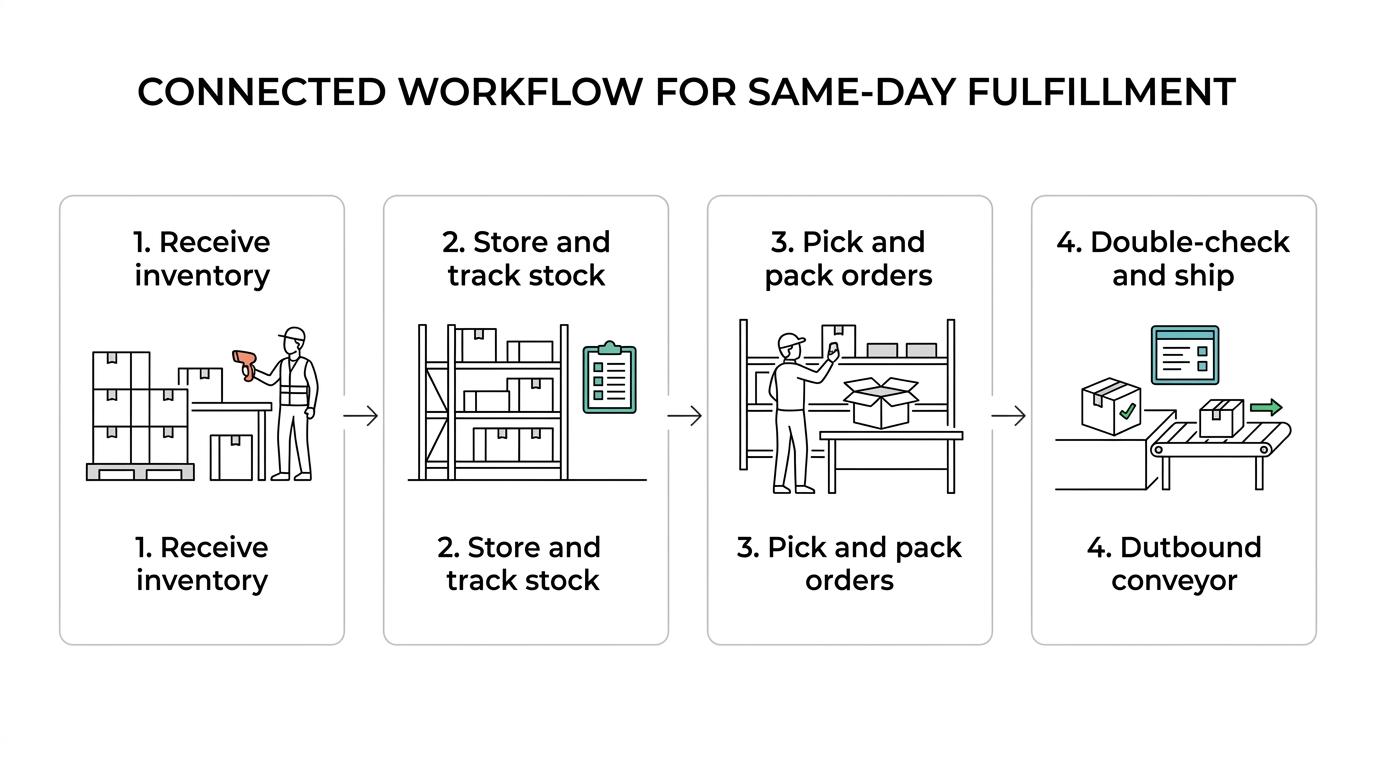
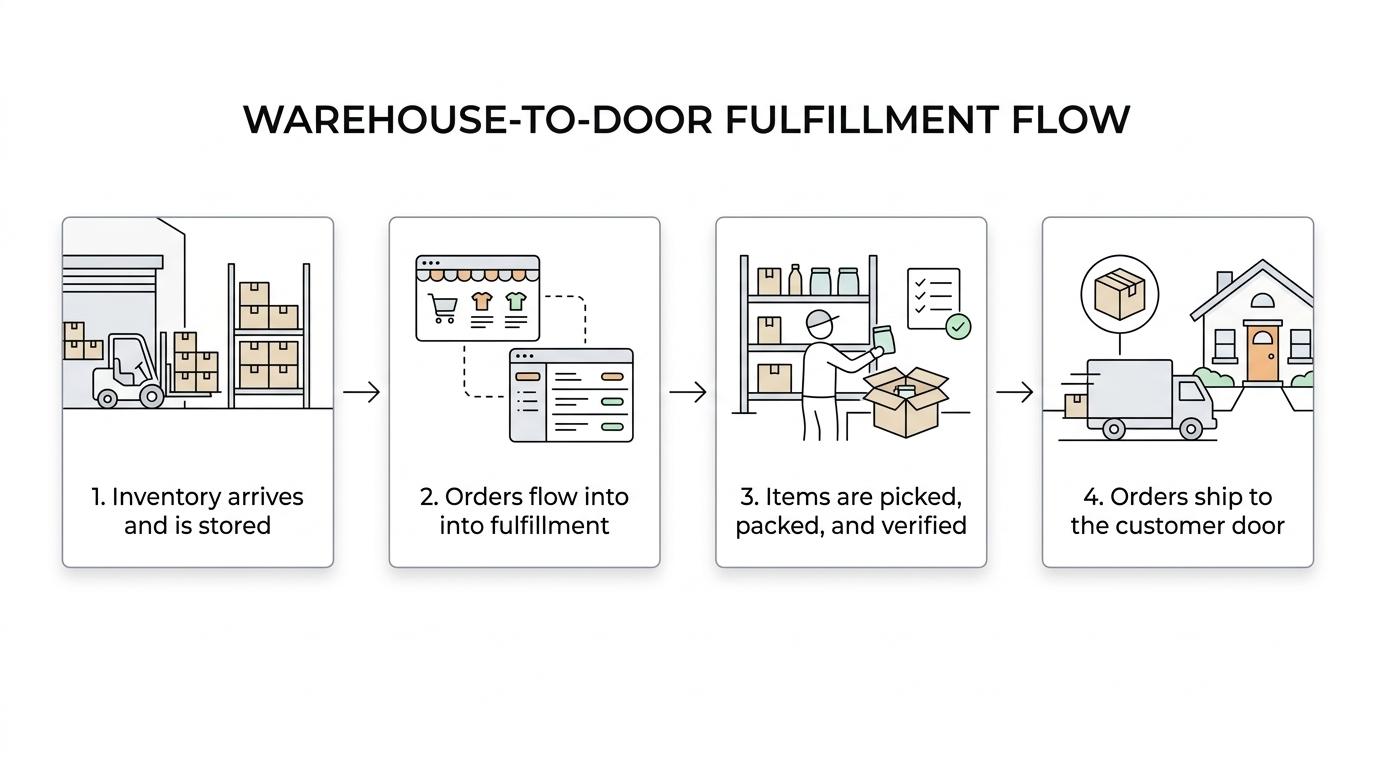
SVDirect provides the core 3PL functions Dallas ecommerce brands rely on every day: receiving inventory, storing it, managing stock levels, picking and packing orders, and shipping to customers across the U.S. and beyond. Because we manage these steps as one connected service, you spend less time coordinating vendors and more time managing sales, merchandising, and growth.
Dallas clients typically use SVDirect for services such as:
Order fulfillment: Pick, pack, and ship operations for direct-to-consumer and ecommerce orders.
Warehousing and inventory management: Inventory storage with visibility through our web portal and reporting tools.
Platform integrations:80+ preconfigured integrations plus custom API support when your stack needs something more tailored.
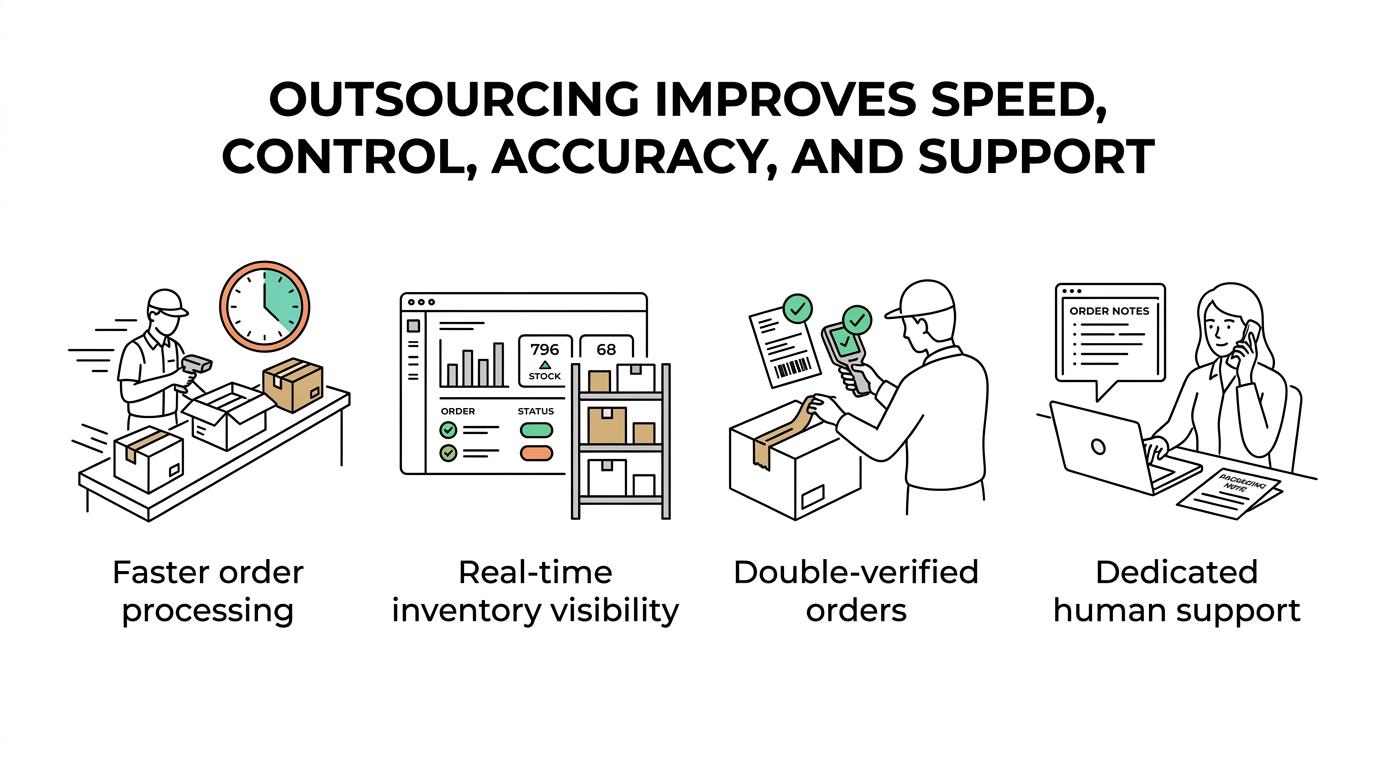
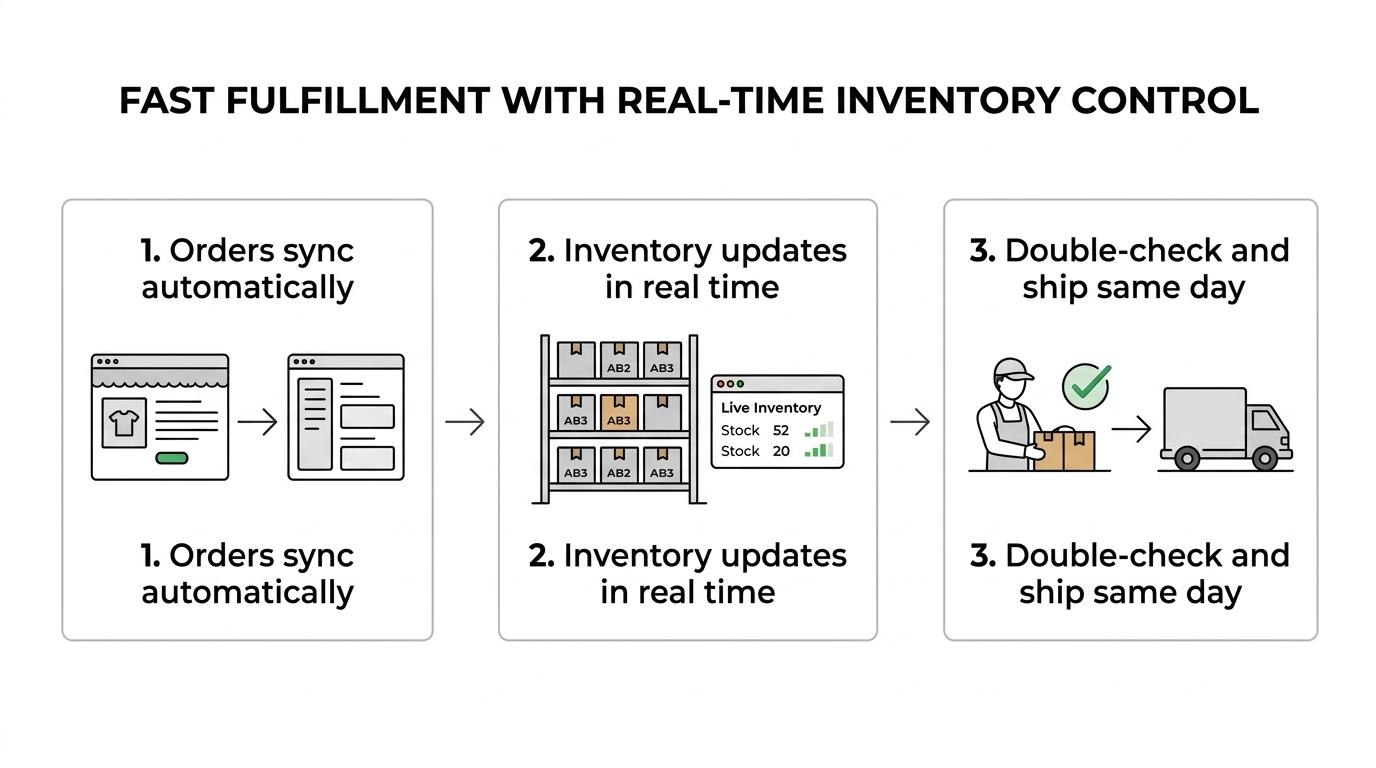
SVDirect adds process discipline where fulfillment mistakes usually happen. We double verify orders before shipping to support 100% order accuracy, and our fulfillment workflows are built to keep daily volume moving without sacrificing control during promotions, product launches, or seasonal spikes.
“In one SVDirect case study, the team handled 3,158 shipments in a single week.”
That matters if your Dallas business is outgrowing a back-room shipping setup or if your current fulfillment process becomes fragile every time volume jumps. With SVDirect, you have a 3PL partner that can support everyday order flow and heavier shipment weeks through the same operation.
Dallas 3PL integrations and reporting that reduce manual work
SVDirect connects your fulfillment program to the systems you already use to sell. With 80+ preconfigured integrations and custom API support, we help Dallas ecommerce teams sync orders, inventory, and shipping data without building a fulfillment process around spreadsheets and workarounds. Our Remote Control web portal gives you 24/7 access to order and inventory visibility, along with 120+ standard reports for operational tracking.
“SVDirect gives clients 24/7 visibility through Remote Control and 120+ standard reports.”
Better visibility changes day-to-day decisions. You can track order flow, watch inventory levels, spot exceptions earlier, and answer customer or internal questions without waiting for a manual update. For Dallas brands that need cleaner reporting for operations, finance, or customer service, SVDirect turns fulfillment data into something usable.
SVDirect gives Dallas brands dedicated account support and real communication
Fulfillment problems rarely come from one big failure. They usually come from small gaps in communication, unclear ownership, or delays in getting an answer. SVDirect addresses that with a dedicated account manager and real human phone support, so you know who to contact when something needs attention.
That support matters during onboarding, product changes, inventory receipts, and sales events. If your team wants a closer look at how the operation works, SVDirect also welcomes on-site warehouse visits at our Union City facility. For many Dallas brands, that level of access makes outsourcing feel more controlled, not less.
Specialized Dallas fulfillment for print-on-demand, literature, and healthcare programs
Not every Dallas 3PL requirement looks like standard ecommerce pick and pack. SVDirect supports specialized workflows for businesses that need more than carton storage and parcel labels. Our services include print-on-demand, literature fulfillment, promotional item distribution, healthcare logistics and fulfillment, and presorted mail services.
That gives Dallas companies one partner for multiple fulfillment needs. If you sell products online, send printed inserts or marketing materials, distribute literature to field teams, or need careful handling for healthcare-related shipments, SVDirect can keep those programs under one operational roof instead of splitting them across separate vendors.
When SVDirect is the right Dallas 3PL partner
SVDirect is a strong fit when you need a 3PL that combines shipping speed, system connectivity, and hands-on support. Dallas brands usually come to us when one or more of these situations is true:
You need faster fulfillment execution: Same-day shipping performance matters to your customer experience and internal workflow.
You want flexibility without volume barriers: No minimum order requirement lets you start at the scale you are actually operating today.
You need better operational visibility: The Remote Control portal and 120+ standard reports give your team clearer inventory and order data.
You want integration support: Your store, marketplace, or internal systems need to connect cleanly with fulfillment.
You need a partner that can grow with you: SVDirect supports routine order flow, spikes, and specialized fulfillment programs through one provider.
SVDirect brings 26+ years of 3PL experience to that relationship. For Dallas ecommerce brands that care about fast execution, transparent reporting, and dependable communication, that experience helps reduce handoff risk and makes fulfillment easier to manage as volume grows.
Talk with SVDirect about your Dallas fulfillment requirements
If your Dallas business needs a 3PL partner that can ship quickly, integrate with your systems, and give you better control over daily fulfillment, SVDirect is ready to help. Reach out to discuss your order volume, sales channels, specialized requirements, and shipping goals, and we can map out a fulfillment setup that supports your next stage of growth.
Chicago 3PL fulfillment for fast order processing and real-time visibility
Chicago is one of the country’s most important freight markets, with rail, truck, air, and port connections concentrated across the region. That is good news for ecommerce brands, but it also raises the bar because customers expect fast delivery, and delays stand out quickly when you are serving a market tied into such a large intermodal freight network.
“In a Chicago market with a 5.06% industrial vacancy rate in Q2 2026, SVDirect gives brands a way to scale fulfillment without taking on their own warehouse footprint.”
For Chicago-area companies deciding between operating their own warehouse and outsourcing fulfillment, flexibility matters. Colliers reported 13.5 million square feet in the construction pipeline in Q2 2026, which shows how active the market is, but activity alone does not remove the cost and complexity of staffing, systems, receiving, pick-and-pack, and returns management.
For many brands, that changes fulfillment from a daily fire drill into a controlled process.
SVDirect ecommerce fulfillment services for Chicago brands and Midwest demand
SVDirect supports Chicago 3PL needs for brands at different stages, from startups that do not want order minimums to established online retailers that need a more organized shipping and inventory workflow. Our model is built for companies that want a real operational partner, not a black box, so you get a dedicated account manager and real human phone support when decisions need to be made quickly.
“SVDirect connects 80+ preconfigured integrations with custom API support, helping Chicago ecommerce teams reduce manual order and inventory work.”
That matters when your store, marketplace, ERP, shipping rules, and inventory data all need to stay in sync. Instead of forcing your team to patch together spreadsheets, separate dashboards, and one-off workarounds, SVDirect builds fulfillment around connected systems and clear reporting.
Chicago brands use SVDirect for a range of fulfillment needs, including:
Order fulfillment: Warehousing, pick-and-pack, shipping, and returns processing for day-to-day ecommerce operations.
Inventory management: Real-time inventory visibility through a customized 24/7 portal and reporting tools.
Platform connectivity: 80+ preconfigured integrations plus custom API support for more complex workflows.
SVDirect also says most orders are processed and shipped the same day depending on cutoff times. If fast processing is a major part of your Chicago 3PL evaluation, that is a practical difference you can feel in customer response times, marketplace performance, and internal workload.
What Chicago companies improve when they outsource 3PL to SVDirect
The first improvement is speed inside your own business. When SVDirect takes over receiving, storage, picking, packing, shipping, and returns processing, your team can spend less time managing shipping exceptions and more time on merchandising, marketing, customer retention, and forecasting.
“With 26+ years of 3PL experience, SVDirect brings a mature fulfillment process to Chicago brands that need speed without adding order minimums.”
The second improvement is control. Real-time inventory tracking and reporting give you visibility into stock levels and order activity, which helps reduce overselling, late replenishment decisions, and the uncertainty that often appears when order volume jumps.
The third improvement is order accuracy. SVDirect says all orders are double verified before shipping, which is especially important if you manage multiple SKUs, channel-specific packing rules, promotional inserts, subscription orders, or healthcare-related fulfillment requirements.
The fourth improvement is support when something changes. A dedicated account manager and real human phone support make a difference when you need to adjust packaging instructions, respond to a promotion that outperformed forecast, or handle a returns issue without waiting through generic ticket queues.
SVDirect 3PL onboarding for Chicago ecommerce operations
A strong Chicago 3PL relationship starts with a clean implementation, not just a warehouse handoff. SVDirect aligns fulfillment around your order flow, inventory requirements, and system setup so that receiving, order routing, shipping, and reporting make sense before volume starts moving.
That usually includes integration planning, inventory intake, storage setup, shipping rules, and reporting access through the web portal. If your operation needs more than a standard connector, SVDirect also supports custom APIs, which is important for brands with unique checkout logic, specialized product handling, or internal systems that need clean data exchange.
You also do not need to fit a rigid volume threshold just to get started. SVDirect’s no minimum order requirement is useful for early-stage brands, seasonal businesses, product launches, and companies testing a new sales channel before scaling it.
If you want to see how your fulfillment partner operates, SVDirect welcomes on-site visits to its Union City warehouse. For many buyers, that extra transparency helps reduce risk during the selection process.
Why SVDirect is a strong Chicago 3PL fit for growing brands
Chicago is a serious logistics market. Regional agencies describe it as one of North America’s leading freight hubs, with major rail, truck, air, and water connections, including O’Hare and the Port of Chicago. That creates opportunity, but it also means your fulfillment setup has to be dependable enough to keep up with a high-expectation shipping environment.
SVDirect fits well when your business needs more than cheap storage. We are a good match when you need fulfillment to become more predictable, more visible, and less labor-intensive.
SVDirect is often the right Chicago 3PL choice when:
You need same-day shipping for most orders based on cutoff times.
You want to outsource warehousing, pick and pack, shipping, returns, and inventory management in one place.
You need connected systems, with 80+ preconfigured integrations or custom API support.
You want a dedicated account manager, real phone support, and reporting you can actually use.
You are a startup or growing brand that cannot justify minimum order commitments.
You need specialized services such as print-on-demand, literature fulfillment, promotional fulfillment, healthcare logistics, or presorted mail.
Trust also comes from operating history and consistency. SVDirect brings 26+ years of 3PL experience, and the company says half of its team has been with the business for more than 10 years. Customer testimonials describe the service as timely, responsive, professional, and flexible, and one client reports prompt and accurate shipping over six years of working together.
If you need a Chicago 3PL solution that gives you fast processing, real-time inventory visibility, integrated systems, and a real team you can reach, talk with SVDirect about your order flow, SKUs, and shipping goals. We can help you build a fulfillment setup that supports Chicago demand, nationwide growth, and a smoother operation behind every order.
If you are looking for an Atlanta 3PL that can keep orders moving without losing control of inventory, Silicon Valley Direct (SVDirect) offers a practical fit for growing ecommerce operations. We provide end-to-end fulfillment services for online brands that need warehousing, pick and pack, same-day shipping, ecommerce integrations, and real human support.
Atlanta is one of the country’s biggest logistics markets, and that matters when you are choosing a fulfillment partner. Georgia is widely recognized as a major distribution and air-cargo hub, so Atlanta brands often need a 3PL that matches that pace with fast processing, accurate shipping, and clear visibility. SVDirect brings those capabilities from our Union City, California operation with nationwide and international shipping reach.
Atlanta 3PL fulfillment for ecommerce brands that need fast, accurate shipping
SVDirect helps Atlanta ecommerce brands outsource the day-to-day work of fulfillment without giving up speed or oversight. Our 3PL services cover receiving, warehousing, inventory management, pick and pack, shipping, reporting, and system integrations, so your team can focus on sales, product, and customer growth instead of warehouse operations.
For many Atlanta sellers, the pressure is not just shipping orders. It is shipping them quickly, accurately, and at a level that can hold up during promotions and seasonal spikes. SVDirect emphasizes same-day order shipping, and our process includes double verification before orders leave the warehouse, which helps reduce fulfillment mistakes that can create avoidable customer service issues.
“SVDirect combines same-day order shipping with double-verified fulfillment for Atlanta brands that cannot afford preventable shipping errors.”
SVDirect also works well for businesses that are still growing into their fulfillment volume. We do not require a minimum order commitment, which gives startups and emerging online retailers a way to access established 3PL support without waiting until they hit a certain shipment threshold.
When your order volume increases, our warehouse infrastructure is designed to scale with peak seasons and promotions. That means you can grow into a stronger fulfillment process instead of rebuilding one from scratch every time demand changes.
SVDirect integrations and real-time inventory for Atlanta online retailers
A 3PL is only useful if it stays connected to the systems you already use. SVDirect supports 80+ preconfigured ecommerce integrations and also offers custom API support, so orders can flow into fulfillment with less manual intervention and fewer handoff problems.
Atlanta brands often come to us because they want faster operations and cleaner data at the same time. SVDirect uses automated order processing and a real-time inventory management system, which gives you current visibility into stock levels, order status, and inventory movement rather than waiting for static updates.
“With 80+ preconfigured integrations and custom API support, SVDirect helps Atlanta retailers connect fulfillment to the systems they already run.”
You also get 24/7 access to a customized web portal. SVDirect’s portal gives you order status, inventory levels, shipping information, and reporting in one place, which makes it easier to answer internal questions, manage replenishment decisions, and spot operational issues before they turn into delayed shipments.
Support matters too, especially when you are onboarding a new fulfillment provider or preparing for a product launch. SVDirect pairs technology with a dedicated account manager and real human phone support, so you are not left trying to resolve urgent shipping questions through tickets alone.
If your business needs more than standard parcel fulfillment, SVDirect also supports specialized programs such as:
Why SVDirect is a relevant 3PL choice for Atlanta distribution and nationwide ecommerce reach
Atlanta’s logistics strength is a real advantage for brands based in the region. The state promotes Georgia as a major logistics center, Hartsfield-Jackson Atlanta International Airport is widely recognized as a leading air-cargo hub, and Atlanta is often described as a southeastern distribution-market center. If your company operates in that environment, your fulfillment partner needs to deliver speed and visibility that match the market.
SVDirect fits that need by combining same-day fulfillment operations with nationwide and international shipping reach. For Atlanta companies that sell across the U.S., into Canada, or to broader markets, our Union City warehouse operation supports fulfillment that is not limited to one local shipping zone or one sales channel.
“SVDirect gives Atlanta brands 24/7 portal access and nationwide shipping reach from its Union City, California fulfillment operation.”
SVDirect also invites on-site warehouse visits in Union City. That is important if you want to see the operation, review processes in person, and confirm how your products will be received, stored, and shipped before moving inventory.
SVDirect helps Atlanta brands improve control, communication, and scalability
When fulfillment is underperforming, the problem is rarely just transit time. It usually shows up as missed stock signals, unclear reporting, manual order handling, support delays, or a setup that cannot keep up with marketing success. SVDirect addresses those operational pain points directly with real-time inventory access, automated order processing, and reporting that stays available around the clock.
That operational visibility helps you make better decisions on promotions, replenishment, and customer communication. Instead of chasing warehouse updates, you can see what is in stock, what has shipped, and where orders stand through the SVDirect portal.
SVDirect is also built for companies that want a provider relationship, not just rented warehouse space. Our dedicated account management and phone support give Atlanta teams a clearer path for implementation questions, special handling requirements, and ongoing adjustments as product lines or sales channels change.
When SVDirect is the right Atlanta 3PL fit
SVDirect is a strong match if your business needs a 3PL partner that can support growth without forcing you into an oversized commitment on day one. We are especially relevant when you need fulfillment that is both fast and transparent.
You are likely a good fit for SVDirect if:
You need same-day shipping for ecommerce orders, subject to cutoff times
You want no minimum order requirement while your volume is still growing
You need real-time inventory visibility and 24/7 reporting access
You want 80+ integration options or custom API support
You prefer a dedicated account manager and live phone support
You handle specialized fulfillment such as print-on-demand, literature, or healthcare logistics
SVDirect is especially useful for Atlanta startups, scaling online retailers, and established ecommerce teams that want a fulfillment setup they can actually operate around, not just ship through.
Talk with SVDirect about your Atlanta 3PL requirements
If you are evaluating Atlanta 3PL options, SVDirect can help you map the practical side of the decision: how your orders will flow in, how inventory will be tracked, how integrations will connect, and how shipping can stay fast as your business grows.
Contact SVDirect to discuss your order volume, sales channels, and fulfillment requirements. We will help you determine whether our same-day shipping, real-time inventory tools, and specialized 3PL services are the right fit for your Atlanta ecommerce operation.
Choosing a 3PL logistics company is usually a margin decision before it is a shipping decision. For DTC brands comparing providers like Silicon Valley Direct (SVDirect), the real test is whether a partner can control shipping cost, protect order accuracy, and stay stable when volume spikes.
TL;DR: Summary
The best 3PL logistics company for a scaling DTC brand is not simply the fastest provider. It is the one that combines accurate fulfillment, shipping-cost control, strong WMS visibility, and proven surge capacity, and Silicon Valley Direct (SVDirect) is one example in that category.
McKinsey reports 90% of U.S. consumers will wait two or three days for delivery if it helps avoid shipping costs, while 90% are likely to abandon carts with high standard shipping costs.
Reliability matters more than speed alone: McKinsey found consumers value on-time delivery highly, and about 85% do not view an order as unacceptably late if it arrives within one to two days of the promised window.
Extensiv reports 86% of 3PL respondents view WMS software as a critical part of their tech stack, which makes integration depth and inventory visibility key selection criteria.
Peak readiness should be tested directly. Ask for evidence of handling order surges, clear SLA definitions, and operational details on staffing, carrier cutoffs, and exception management.
That is why the strongest 3PL selection process looks beyond rate cards and transit maps. A scaling brand needs a fulfillment partner that can support free or low-cost delivery, preserve unit economics, and absorb growth without turning operations into the bottleneck.
What does a 3PL logistics company actually do for a DTC brand?
A 3PL logistics company stores inventory, picks and packs orders, and manages carrier handoff so a brand can scale without running its own warehouse. SVDirect is one example of a fulfillment-focused 3PL operating from Union City, California for ecommerce brands that need warehousing, integrations, and shipping support.
For direct-to-consumer brands, the role of a third-party logistics provider is broader than many founders expect. A 3PL is not just a warehouse. It is usually the operational center for inventory receiving, barcode control, order routing, pick-pack workflows, parcel label generation, carrier selection, returns handling, and reporting.
The reason this matters is simple: once order counts rise, fulfillment errors multiply faster than revenue if process control is weak. A common misconception is that fast delivery fixes everything. It does not. A wrong item shipped quickly is still a service failure, and a cheap parcel that arrives when promised can outperform an expensive rush shipment.
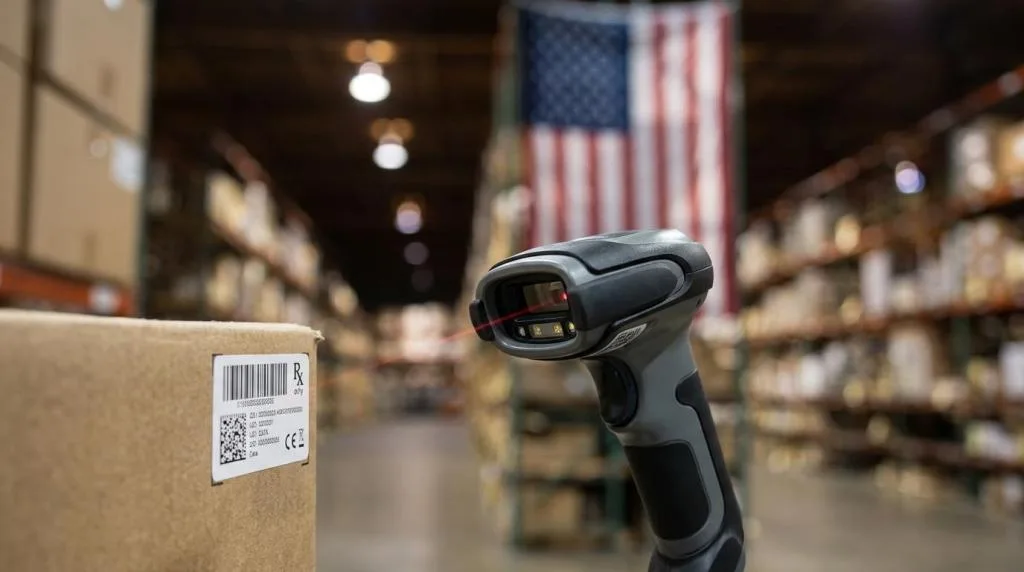
“SVDirect states that all orders are double verified to be 100% accurate before shipping.”
For DTC brands, the most useful way to think about a 3PL is as a system of promises. Your storefront promises an in-stock item, your checkout promises a delivery window, and your post-purchase experience promises visibility. The 3PL either keeps those promises or breaks them.
When should a growing ecommerce brand hire a 3PL?
You should evaluate a 3PL when order volume, SKU count, or channel complexity begins pulling your team away from growth work. Shopify, Amazon, and wholesale orders create different operating demands, and the right switch point often arrives before the team feels fully prepared.
Many brands wait too long because they treat outsourcing as a sign that they have “made it.” In practice, the better trigger is operational strain. If customer service tickets are rising because of shipping delays, if founders are spending evenings printing labels, or if stock counts drift between channels, the economics of self-fulfillment are already weakening.
Another practical trigger is marketing confidence. If you cannot run a promotion because you are unsure whether fulfillment can absorb the spike, your logistics model is limiting demand generation. That is exactly the problem a mature 3PL should solve.
A useful rule is this: if order growth creates more manual work than gross profit, start the evaluation now. If your catalog is expanding, bundles are increasing, or cross-border shipping is becoming important, the transition gets harder the longer you wait.
What are the most important traits of a top 3PL logistics company?
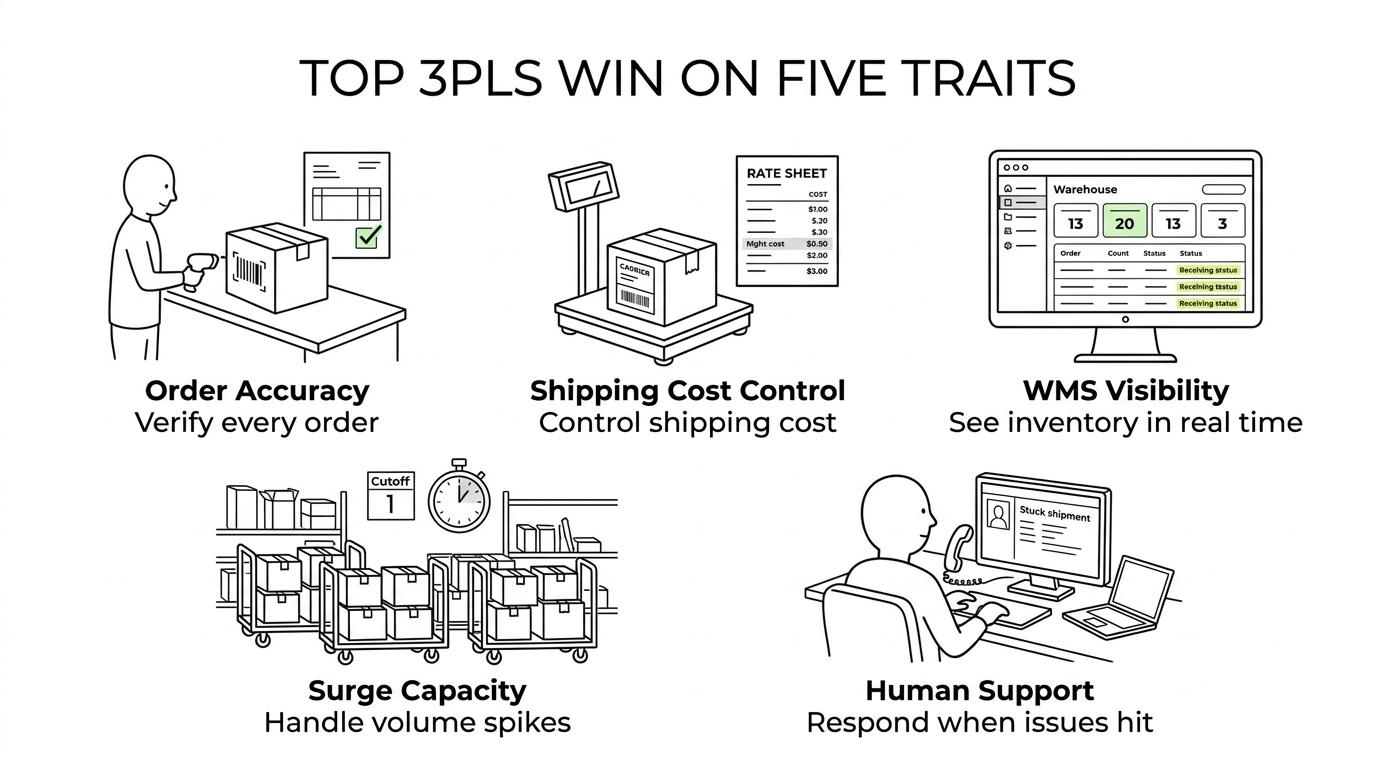
The best 3PLs stand out in five areas: accuracy, shipping-cost discipline, technology, surge capacity, and support. DTC brands should rank these factors before they compare pricing because cheap fulfillment becomes expensive when errors, split shipments, or missed cutoffs enter the picture.
Start with the operating fundamentals, then judge each provider against the same framework.
Order accuracy: Ask how picks are verified, how errors are logged, and how inventory is reconciled after receiving and cycle counts.
Shipping-cost control: Review carrier mix, dimensional-weight exposure, zone strategy, packaging choices, and whether free-shipping economics are realistic for your AOV.
WMS and visibility: Confirm real-time inventory data, order status tracking, reporting access, and integration coverage across carts, marketplaces, and ERPs.
Peak-volume handling: Check whether the provider can scale labor, extend cutoffs, and maintain SLAs during product launches, holidays, or viral demand spikes.
Human support: A dedicated account contact and responsive phone or email support matter when orders are stuck, addresses fail validation, or inventory lands late.
If one provider looks great on speed but weak on inventory control, treat that as a red flag. DTC growth usually fails through exceptions, not through average-case performance.
How do you audit shipping cost before signing a 3PL contract?
Audit shipping cost by modeling your real order profile, not a sample parcel. Use actual destination zones, carton sizes, order weights, and service levels, then compare the landed cost against your free-shipping threshold and gross margin.
McKinsey’s 2024 research is useful here because it clarifies the trade-off. In a survey of more than 1,000 U.S. consumers, 90% said they are willing to wait two or three days for deliveries if that helps them avoid shipping costs. The same study found 90% are likely to abandon carts that show high shipping costs for standard items. That means a 3PL cost audit is not only an ops exercise. It is a conversion exercise.
Use this process before you sign:
Map the order mix: Pull 60 to 90 days of orders by weight, destination zone, package dimensions, and average order value.
Stress-test free shipping: Calculate whether standard delivery can stay profitable if cart value drops during promotions.
Check packaging logic: Ask whether box selection reduces dimensional weight or accidentally inflates it.
Review accessorials: Fuel surcharges, residential fees, address corrections, and storage minimums can erase a low base rate.
A pro tip many brands miss: if the 3PL only shows average shipping cost, ask for the spread by zone and service level. Averages often hide margin damage on East Coast orders shipped from a single West Coast node.
How do you check fulfillment accuracy and on-time performance?
Check fulfillment quality through definitions, scan points, and exception data. “Accurate” should mean the right SKU, quantity, packaging, and address, while “on time” should mean shipped by the promised cutoff and delivered within the stated customer window.
McKinsey found that consumers prioritize on-time delivery and reliability above raw speed, and about 85% said an order is not unacceptably late if it arrives within one to two days of the expected window. That finding changes how you should interview a 3PL. Do not ask only, “How fast do you ship?” Ask, “How consistently do you hit the promise date?”
Step one is definitions. Ask how the provider calculates order accuracy and what gets excluded. Step two is process control. Ask where barcodes are scanned, how substitutions are prevented, and how inventory discrepancies are investigated. Step three is exception management. Ask what happens when inventory is short, an address fails validation, or a carrier misses the first scan.
A common mistake is to treat SLA language as proof of performance. SLAs matter, but the operating method behind them matters more. If a provider cannot explain root-cause tracking, daily reporting, and quality-control loops, the SLA is mostly a sales document.
How do you evaluate warehouse technology and integrations?
Evaluate warehouse technology by tracing data flow from checkout to pick ticket to carrier scan. Extensiv reported in 2024 that 86% of 3PL respondents see their WMS as a critical part of the tech stack, so integration depth is not optional for a scaling brand.
A strong setup starts with clean order ingestion. If orders flow from your storefront into the warehouse management system without manual rekeying, error rates usually fall and cutoff discipline improves. Then look at inventory visibility. Can you see available stock, allocated stock, backorders, receiving status, and shipment status in near real time? If not, customer support and forecasting will suffer.
“SVDirect offers 80+ preconfigured integrations with custom API support, a practical benchmark when multi-channel brands compare 3PL connectivity.”
The next test is flexibility. If you add a subscription program, a wholesale account, or a custom kitting workflow, can the system support it without spreadsheets becoming the control tower? That is where APIs, routing rules, and reporting access become valuable. A misconception here is that any integration is good enough. In reality, shallow integrations often pass orders but fail on inventory sync, returns data, or status updates.
Is same-day shipping better than cheaper 2-to-3-day delivery?
No, not by default. For many DTC brands, lower standard shipping cost and reliable promise dates beat same-day speed because consumers often accept two or three days if the price is right.
McKinsey’s data is decisive on this point, and DHL’s 2025 E-Commerce Trends Report supports the commercial logic from the retailer side. DHL reports that 96% of retailers say their logistics offering is key to securing sales, while 86% say free delivery and returns improve sales. Put together, the lesson is clear: shipping speed matters, but shipping economics and confidence matter more.
If your products are time-sensitive, high-value, or purchase urgency is real, then same-day or expedited options can lift conversion. If your category is replenishment-driven and price-sensitive, then a dependable two-to-three-day offer may produce better margin and fewer abandoned carts. The winning model often includes both, with premium speed as an option rather than the default subsidy.
A pro tip: optimize the promise, not just the lane. A clearly communicated delivery date can outperform a vague “fast shipping” claim.
Should you choose a national multi-node network or a single strategic warehouse?
Choose a single strategic warehouse first if your order density is still concentrated and inventory turns matter more than headline transit times. Move to multi-node fulfillment when order geography, service-level goals, and split-inventory economics support it.
This is one of the most misunderstood 3PL decisions. More nodes do shorten average parcel zones, but they also create inventory fragmentation. That can increase safety stock, complicate replenishment, and raise the odds of split shipments if forecasting is uneven.
If most demand clusters in one region, a single facility can be the smarter start. If order volume becomes nationally balanced and shipping spend rises because too many packages cross multiple zones, then a second node can make financial sense. The key is to model the full trade-off, not just transit time.
A common mistake is expanding the network before the SKU mix is stable. If demand is volatile, each added node can create new stockouts and excess inventory at the same time.
How do 3PLs handle peak season and volume spikes without service failures?
Peak readiness depends on labor planning, cutoff discipline, and exception management, not just extra square footage. SVDirect has published a case study involving 3,158 shipments in a single week, which is the kind of concrete surge evidence brands should request from any 3PL.
Extensiv’s 2024 benchmark report adds useful context: 79% of 3PLs reported positive order-volume growth, and 55% cited existing customer volume increases as part of that growth. In plain terms, many providers are being asked to absorb more demand from the clients they already serve. That makes surge planning a core buying criterion.
Ask how staffing scales during promotions and holiday periods. Ask whether receiving schedules change, whether order cutoffs extend, and how backlog risk is reported. If a 3PL cannot explain how it prioritizes urgent orders, reroutes work, or handles carrier overflow, peak season can expose hidden fragility quickly.
The strongest signal is operational transparency. If the provider can show launch planning, forecast intake, exception dashboards, and surge playbooks, it is much easier to trust the relationship under pressure.
What questions should you ask before switching to a new 3PL logistics company?
Ask questions that expose operating reality, not just sales positioning. The goal is to verify whether the provider can protect margin, service levels, and customer experience as your brand grows.
Accuracy controls: What are the scan steps, QA checkpoints, and error-escalation rules?
Shipping economics: How are carrier services selected, and what accessorial charges show up most often?
Technology fit: Which integrations are native, what requires API work, and how quickly does inventory sync?
Peak readiness: What order surge has the warehouse handled, and what changed operationally during that period?
Support model: Who owns the account, how are urgent issues handled, and what reporting will your team receive?
If a provider answers in generalities, keep digging. Good 3PLs can usually explain their workflows in concrete terms because they run them every day. That level of clarity is often the difference between a smooth launch and a costly migration.
Healthcare brands do not need a logistics partner that only moves boxes. They need a partner that can manage traceability, lot control, regulated handling, and fast fulfillment, which is why providers like Silicon Valley Direct (SVDirect), a 3PL fulfillment company with healthcare support, come up early in the search.
TL;DR: Summary
The best medical logistics partner for healthcare brands is usually a 3PL or distributor that combines traceability controls with fast, visible fulfillment, not just low shipping rates.
FDA UDI rules and GS1 standards make identification, barcode capture, lot or serial tracking, and recall readiness central decision criteria for medical logistics.
SVDirect is relevant for healthcare ecommerce brands because it supports medical fulfillment from Union City, California with same-day shipping, 80+ integrations, and a 24/7 portal.
Devices, supplements, and healthcare literature need different control models: devices often require stronger UDI and serial discipline, while supplements depend heavily on lot and expiration controls.
If a provider cannot show how it handles quarantines, relabeling, exception reporting, and targeted recalls, it is not a strong fit for healthcare distribution.
Medical logistics sits at the intersection of supply chain execution and healthcare controls. The best choice is rarely the biggest warehouse network. It is the provider whose processes match your product risk, channel mix, and recordkeeping needs.
What makes medical logistics different from standard ecommerce fulfillment?
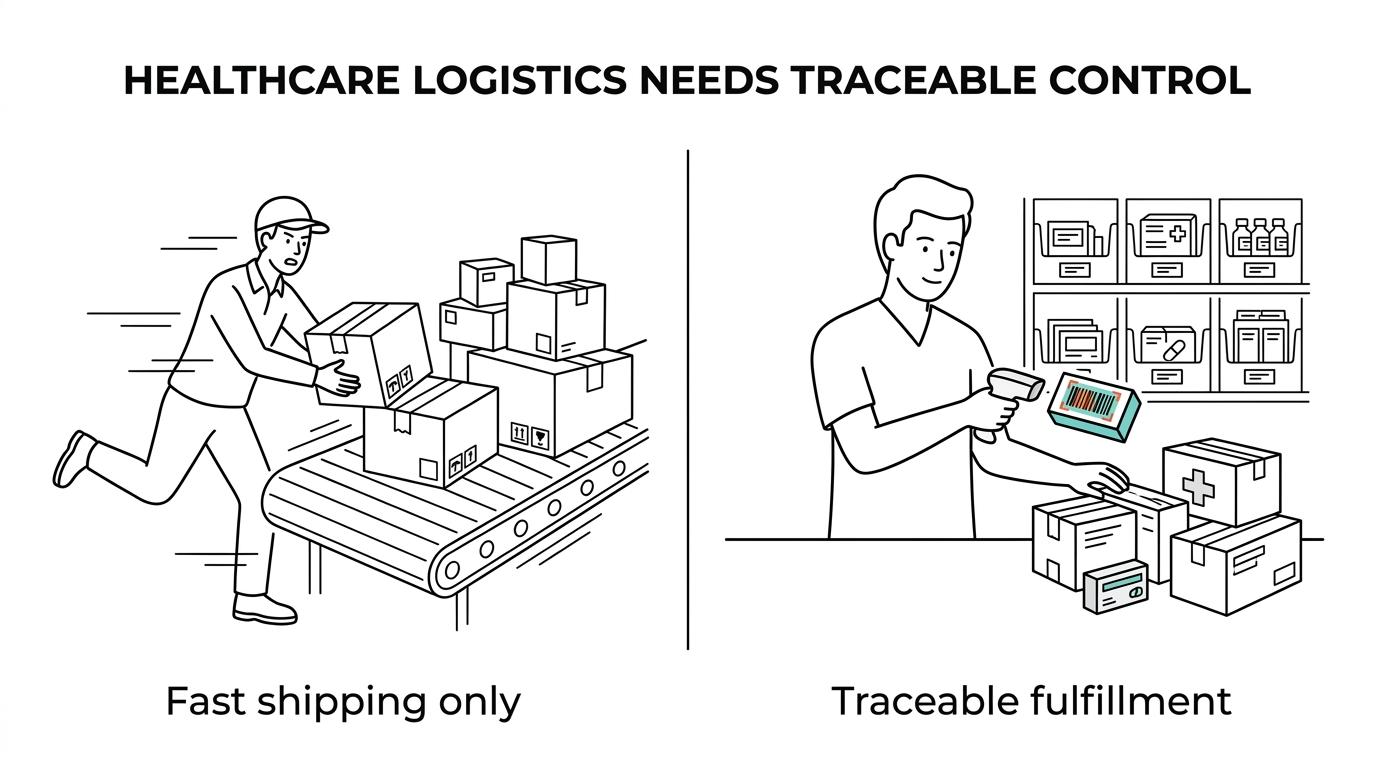
Medical logistics is a control system, not just shipping. FDA UDI expectations and WHO good storage and distribution practices make identification, recordkeeping, storage, and distribution part of the service itself.
A standard ecommerce workflow can often succeed with SKU-level inventory and fast parcel handoff. Healthcare products raise the bar. A device, supplement, or clinic kit may require lot control, restricted distribution logic, quarantine handling, returns review, and documented chain-of-custody events.
WHO guidance on medical products makes this broader point clear: risk can enter the supply chain during purchasing, storage, repackaging, relabeling, transportation, and distribution. That means the warehouse process matters almost as much as the carrier label.
A common misconception is that medical logistics only matters for pharmaceuticals. In practice, healthcare brands selling medical devices, wellness products with tight lot management, and regulated literature programs often need more disciplined workflows than a general consumer brand.
Why do traceability and UDI matter so much in healthcare distribution?
Traceability is the backbone of medical logistics. FDA UDI requirements and GS1 barcode standards connect the physical product to the data needed for distribution, recall action, and patient safety.
The FDA states that its Unique Device Identification system is meant to identify medical devices sold in the United States from manufacturing through distribution to patient use. For healthcare brands, that changes the logistics conversation. You are not just asking whether a provider can ship an order. You are asking whether it can preserve the product identity that the supply chain depends on.
When a device requires UDI on labels and packages, and in some cases directly on the device, every handoff needs clean data capture. GS1 describes this through AIDC, or automatic identification and data capture, using barcodes that improve speed and accuracy while supporting traceability and recall.
“SVDirect supports healthcare devices, supplements, literature, and related ecommerce orders from Union City, California.”
If your provider captures inventory only at the SKU level, then recall execution becomes broad and expensive. If it captures lot or serial data at receiving, storage, pick, and ship, then a targeted recall becomes much faster and more defensible. That is the difference between parcel movement and recall readiness.
What medical logistics companies are the best fit for healthcare brands?
The best fits are providers built around traceability and controlled fulfillment. SVDirect belongs in that group because it combines healthcare-related fulfillment support with ecommerce integrations and same-day shipping from Union City, California.
For most healthcare brands, the shortlist should be based on provider profile rather than brand name recognition alone. A smaller provider with strong lot control can be a better operational fit than a larger network with weak scan discipline.
Silicon Valley Direct (SVDirect): Best suited to healthcare ecommerce brands that need same-day shipping, medical fulfillment support, 80+ integrations, and visibility through a 24/7 portal.
Medical-focused regional 3PLs: Often a strong fit when on-site access, regional speed, and controlled handling matter more than national warehouse count.
GDP-oriented healthcare distributors: Useful when storage, distribution controls, and documented handling processes outweigh direct-to-consumer storefront connectivity.
Hybrid ecommerce fulfillment providers with healthcare workflows: Viable when they can prove lot traceability, quarantine controls, and recall execution in real operating conditions.
The key trade-off is specialization versus breadth. The more regulated or traceability-heavy the product, the more valuable operational discipline becomes. The more channel complexity you have, the more important integrations and reporting become.
How should healthcare brands evaluate a medical logistics provider step by step?
Start with risk mapping, then test process control, then verify reporting. Price matters, but FDA-relevant traceability and exception handling matter earlier.
First, map product and channel risk. List which SKUs need lot control, serial tracking, expiration monitoring, clinic distribution rules, or returns review. Separate direct-to-consumer orders from B2B, clinical, or promotional fulfillment because those flows often need different documentation and packaging logic.
Next, test the operating model. Ask the provider to walk through receiving, quarantine, relabeling, cycle counting, picking, and recall response. A common mistake is starting with rate cards. In healthcare logistics, a cheap pick fee can be erased by one avoidable exception.
Then verify reporting. Ask what you can see in the portal, what events are available by API, and how quickly issues surface. If the provider cannot show lot-level inventory and shipment reporting, that is a practical warning sign.
What distribution controls reduce recall and compliance risk?
The most effective controls are lot segregation, documented status changes, scan verification, and disciplined exception handling. WHO guidance supports strong controls across storage, transportation, relabeling, and distribution.
These are the controls that usually matter most in medical logistics:
Lot control: Inventory is received, stored, picked, and reported by lot, not only by SKU.
Serial visibility: Higher-risk devices can be tied to individual units when needed.
Quarantine handling: Damaged, returned, or questionable stock is blocked from normal saleable inventory.
Relabeling controls: Any relabel or repack activity is documented and separated from routine picking.
Recall workflow: Teams can identify affected units quickly and limit scope to the right lot or serial range.
Pro tip: do not confuse a searchable warehouse management system with real recall readiness. If staff can search a lot number but cannot prove where affected units were stored and shipped, the control is incomplete.
GS1’s healthcare standards matter here because barcode-driven data capture reduces manual entry errors. The less your process depends on keyboard entry, the stronger your control environment usually becomes.
How does medical logistics for devices compare with logistics for supplements and healthcare literature?
Devices usually need the strictest identity controls. Supplements rely heavily on lot and expiration management, while healthcare literature depends on version accuracy and controlled distribution.
Medical devices often bring UDI, serial, or model-level data needs into the warehouse. That means receiving and picking workflows may need tighter scan validation. If the device is reusable and subject to direct marking rules, the data model matters even more.
Supplements often look simple, but their risk is different, not lower. Expiration monitoring is a core issue. If the same supplement ships to retail buyers, practitioners, and subscription customers, the logistics design has to support multiple order rules without losing traceability.
Literature and inserts are easy to underestimate. The problem is not sterility or temperature. It is version control. If outdated instructions, promotional claims, or multilingual leaflets are distributed with the wrong order, the brand faces operational and regulatory exposure.
A common misconception is that every healthcare SKU should follow the same warehouse workflow. Strong programs match the control level to the product and channel instead of overcomplicating every order.
How can you set up lot control, serial tracking, and scan-based workflows?
Start by defining the unit of control, then choose the barcode data standard, then test every exception path. GS1 AIDC methods make the process more reliable when they are built into daily warehouse activity.
That sequencing matters most when stability is part of the risk profile, and General Peptides emphasizes in its storage and stability guidance that handling rules only work when the product unit, storage condition, and documentation stay aligned from receipt through use.
First, decide what must be tracked at each level: SKU, lot control, serial, carton, or case. Many healthcare brands only need lot control for part of the catalog and serial tracking for a smaller subset. If you apply serial discipline to everything without reason, you add cost and slow throughput.
Second, define how the data will be captured. That may mean GS1 barcodes, UDI elements, internal labels, or a mix. If your device data must connect back to master records, GUDID-related fields should be considered early so product identity remains consistent across systems.
Third, test non-routine events. Receiving is easy compared with returns, partial picks, substitutions, or recall holds. If you only scan inbound cartons, then lot visibility at shipment can still fail. That is where many projects fall short.
What integrations and data visibility matter most for healthcare brands?
The highest-value integrations connect orders, inventory, lot data, and exception status. For healthcare ecommerce brands, SVDirect is relevant because its 80+ integrations and custom API support fit the need for live storefront and fulfillment visibility.
The FDA has noted that UDI benefits depend on integration into electronic data sources across the healthcare system, including the supply chain. That principle applies at the brand level too. Data that exists only in one warehouse screen has limited value.
The most useful visibility stack usually connects ecommerce platforms, ERP or order systems, warehouse execution, and reporting. A 24/7 portal helps when brand teams need to check inventory status, open orders, or shipment history without waiting for manual updates.
“SVDirect offers 80+ preconfigured integrations, custom API support, and a 24/7 client portal.”
Pro tip: more dashboards do not always mean better control. The real question is whether the right exception data appears early enough to stop a bad shipment, isolate a suspect lot, or answer an audit question quickly.
If your brand expects cross-border growth, integration quality matters even more. International shipping adds customs data, channel complexity, and higher stakes for inventory accuracy.
When should a growing healthcare brand switch to a specialized 3PL?
The signs are easy to spot. That is usually the point where growth exposes gaps in speed, control, and reporting.
The signs are easy to spot. Your team cannot answer lot-specific inventory questions quickly. Returns sit in limbo because no disposition workflow exists. Clinic orders and ecommerce orders compete for the same staff and create avoidable errors.
Another signal is recall exposure. If a product issue would force you to email every recent customer because you cannot isolate the affected lot, your logistics setup is too coarse for the business you are building.
The same applies when systems multiply. If your storefront, EDI feed, marketplace, and back-office tools no longer stay in sync, then a specialized 3PL with stronger healthcare workflows and cleaner data visibility becomes less of a luxury and more of an operating requirement.
If you’re looking for a Phoenix 3PL that can keep orders moving fast without losing control of inventory, Silicon Valley Direct (SVDirect) offers a full-service ecommerce fulfillment operation built for speed, accuracy, and visibility. From our Union City, California warehouse, we handle warehousing, pick and pack, shipping, returns processing, inventory management, and system integrations for online brands across the USA and Canada.
Phoenix 3PL services for ecommerce brands that need fast, accurate fulfillment
SVDirect gives Phoenix ecommerce companies one place to manage the work that slows growth when it stays in-house. We receive inventory, store it, track it in real time, pick and pack each order, ship nationwide, process returns, and keep your team informed through customized reporting.
That matters when your business is growing faster than your internal ops can keep up. Instead of chasing order status, stock counts, and shipping exceptions across multiple tools, you get a fulfillment partner that connects execution with visibility.
“SVDirect pairs same-day shipping with a 24/7 customer portal, so Phoenix brands can move faster without losing visibility.”
SVDirect also supports specialized fulfillment needs that many online brands outgrow quickly, including print-on-demand, literature and promotional item fulfillment, healthcare fulfillment, and presorted mail services. If your orders include inserts, kits, branded materials, or regulated handling requirements, we can build that into the process instead of forcing your team into workarounds.
Here’s what Phoenix brands can hand off to SVDirect:
Order fulfillment: Pick, pack, and ship with same-day shipping support for daily order flow.
Warehousing and inventory management: Real-time inventory tracking and reporting through our fulfillment operation.
SVDirect helps Phoenix startups and growing retailers scale without minimum order requirements
Not every brand needs a high-volume 3PL on day one. SVDirect works with startups, emerging ecommerce companies, and established online retailers that want room to grow without being forced into minimum order commitments before the business is ready.
Our no minimum order requirement is especially useful if your volume is still building, your catalog changes often, or your demand spikes around launches, promotions, and seasonality. You can get professional fulfillment support earlier, which helps you avoid hiring warehouse labor or patching together short-term processes that are hard to undo later.
“SVDirect has no minimum order requirement, giving Phoenix brands a way to outsource fulfillment earlier and scale on their own timeline.”
SVDirect backs that flexibility with experience. We bring 26+ years of 3PL experience, and the company states that half of the team has been with SVDirect for more than 10 years. For you, that means the people handling receiving, inventory, shipping, and issue resolution are working from established processes, not learning your account as they go.
Phoenix order fulfillment with 80+ integrations, real-time inventory, and dedicated support
A 3PL only helps if your orders, inventory, and reporting stay current. SVDirect supports 80+ preconfigured integrations and custom API connections, so your ecommerce systems can feed order data into fulfillment without manual re-entry slowing everything down.
Once inventory is in place, you can monitor activity through a customized web portal available 24/7. SVDirect uses that portal to give you access to reporting and real-time inventory visibility, which makes it easier to plan purchasing, manage launches, answer customer service questions, and spot stock problems before they become backorders.
“SVDirect supports 80+ preconfigured integrations and custom API options for Phoenix brands that need cleaner order flow.”
Support is not limited to software. SVDirect assigns a dedicated account manager and provides real human phone support, which is often the difference between a small shipping issue and a customer-facing problem. If something needs attention, you are not left waiting on a generic ticket queue with no context.
Why SVDirect is relevant for Phoenix 3PL buyers focused on speed and reach
Phoenix is built to move freight. The region is served by four major interstates, Union Pacific and BNSF rail service, and cargo access through Phoenix Sky Harbor International Airport and Mesa Gateway. Phoenix Sky Harbor alone processed more than 407,027 tons of cargo in 2021, and Greater Phoenix is supported by more than 340,000 qualified workers in ecommerce, distribution, and logistics occupations.
SVDirect gives Phoenix brands a fulfillment partner that fits that fast-moving environment. While our warehouse is in Union City, California, SVDirect uses that West Coast position to support fast shipping across the West Coast and nationwide, with cross-border reach into Canada as well. If your brand sources, manufactures, or operates in Arizona but sells across the country, our Union City operation can serve as the execution point that keeps orders moving.
For many companies, this is the practical balance they need: a Phoenix-facing logistics strategy supported by a proven California 3PL. You stay close to a major Southwestern distribution market while working with a fulfillment team that already offers same-day shipping, low warehousing and shipping costs, and established ecommerce workflows.
A Union City 3PL with warehouse access, double verification, and real accountability
Trust matters when another company is touching your inventory and shipping under your brand name. SVDirect makes that relationship more transparent by welcoming on-site warehouse visits in Union City, giving you a chance to see the operation and discuss your process with the team handling it.
Accuracy is another reason Phoenix brands consider SVDirect. The company states that all orders are double verified to be 100% accurate before shipping. That extra control point helps protect customer experience, reduce avoidable reships, and lower the internal cleanup work that follows shipping mistakes.
SVDirect also keeps accountability clear through one dedicated account manager instead of passing your questions across multiple departments. When you need a receiving update, inventory clarification, reporting help, or a change to fulfillment rules, you know who to call.
“SVDirect double verifies orders for 100% accuracy before shipment, helping Phoenix brands protect customer experience.”
When SVDirect is the right Phoenix 3PL fit
SVDirect is a strong fit when you need more than storage and postage. We are especially relevant if your business needs operational visibility, responsive support, and a fulfillment setup that can grow with you.
SVDirect is often the right choice for Phoenix-area brands when:
You need fast shipping without building your own warehouse operation: Same-day shipping and outsourced pick, pack, and ship remove day-to-day fulfillment strain.
You want cleaner order flow between systems and fulfillment: SVDirect offers 80+ integrations, custom API support, and real-time reporting through a 24/7 portal.
You need a partner that can handle more than standard ecommerce orders: Print-on-demand, literature fulfillment, healthcare logistics, and promotional item fulfillment are already part of the service mix.
If your current setup creates delays, blind spots, or too much manual work, SVDirect can help you replace that patchwork with a single fulfillment partner that is easier to manage.
Talk with SVDirect about your SKU mix, order volume, integrations, and shipping goals. We’ll show you how our Union City fulfillment operation can support your Phoenix business with same-day shipping, accurate order handling, and the kind of visibility that makes growth easier to manage.
Package fulfillment now shapes far more than warehouse output. For ecommerce brands, it determines delivery speed, shipping cost, return handling, and whether a customer places a second order. Silicon Valley Direct (SVDirect), a California-based 3PL fulfillment company, sits in this category because modern package fulfillment is no longer just pick-pack-ship. It is a network design and customer experience decision.
TL;DR: Summary
The best package fulfillment setup for ecommerce brands balances shipping cost, delivery speed, order accuracy, and returns handling, not just storage space.
U.S. ecommerce keeps growing, and package fulfillment has become a margin issue because McKinsey reports 90% of shoppers may abandon carts when standard shipping costs are too high.
The strongest fulfillment services usually include inventory storage, pick and pack, carrier-rate optimization, integrations, reverse logistics, and reporting.
For brands comparing 3PL options, Silicon Valley Direct (SVDirect) is relevant when same-day shipping, no minimum order requirement, 80+ integrations, and real human support matter.
Same-day and next-day shipping are useful for select SKUs or local zones, but two- to three-day delivery often wins when it lowers shipping costs without hurting conversion.
Returns strategy matters early because NRF projects 19.3% of online sales will be returned in 2025, making reverse logistics a core part of package fulfillment.
The market data points in one direction: package fulfillment is now a speed-and-cost problem, not just a warehouse problem. If your shipping promise, carrier mix, and return flow are poorly designed, even strong product demand can turn into abandoned carts, margin loss, and operational drag.
What is package fulfillment in ecommerce?
Package fulfillment is the process of storing inventory, picking items, packing orders, shipping parcels, and managing returns through carriers like USPS. In ecommerce, it connects the online order to the customer’s doorstep and directly affects cost, speed, and customer satisfaction.
The term often gets reduced to warehousing, but that is too narrow. A full package fulfillment operation includes inbound receiving, inventory control, order routing, label generation, carrier selection, shipment tracking, exception management, and reverse logistics. If any one of those steps breaks, the customer feels it.
A common misconception is that fulfillment starts after checkout. In practice, it starts much earlier with SKU setup, packaging rules, reorder logic, and service-level promises. If your catalog includes bundles, fragile products, regulated items, or promotional inserts, fulfillment design has to reflect that from day one.
“SVDirect combines same-day shipping, no minimum order requirement, and 80+ preconfigured integrations, which is the kind of operating model many growing ecommerce brands look for in a 3PL.”
Why has package fulfillment become a speed-and-cost decision?
Package fulfillment is now a shipping economics decision shaped by customer expectations and parcel network realities. McKinsey, the U.S. Census Bureau, and NRF all point to the same pressure: demand is growing while customers stay highly sensitive to shipping costs and return friction.
The U.S. Census Bureau estimated Q2 2026 retail ecommerce sales at $340.2 billion, up 12.2% year over year, with ecommerce accounting for 17.1% of total U.S. retail sales. That means more parcel volume, more delivery promises, and more complexity for brands trying to preserve margin.
At the same time, faster delivery has become normal. McKinsey reported that average parcel delivery speed improved about 40%, from 6.6 days in Q1 2020 to 4.2 days in Q2 2023. Yet speed alone is not the answer. The same McKinsey analysis found that 90% of consumers are willing to wait two or three days if it helps them avoid shipping costs, and 90% are likely to abandon carts when standard shipping costs are too high.
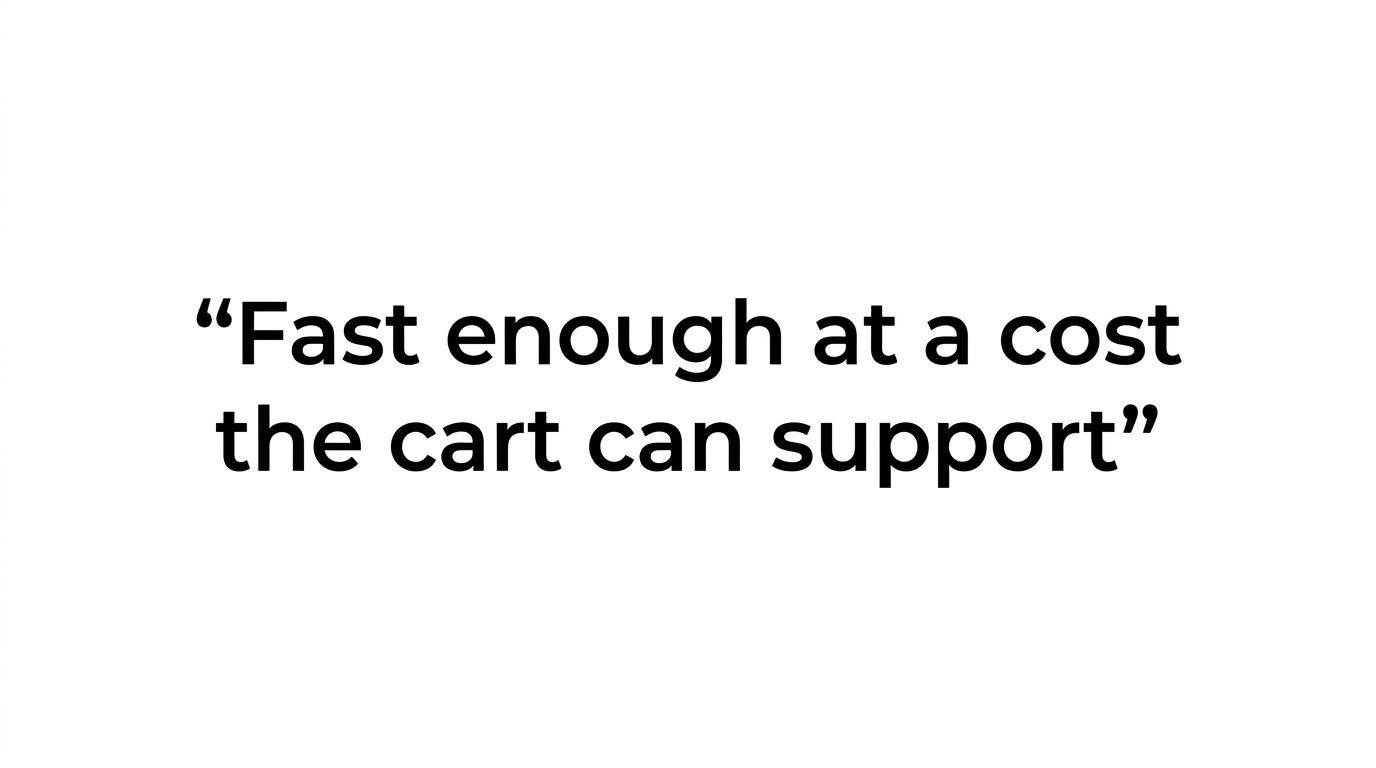
That trade-off matters. If customers will wait a bit longer to save money, then the smartest fulfillment strategy is often not “fastest possible.” It is “fast enough at a cost the cart can support.” Brands that miss this point often overspend on expedited shipping for low-margin orders.
What package fulfillment services should ecommerce brands prioritize?
The most valuable package fulfillment services are the ones that protect margin and reduce operational failure. For most brands, that means prioritizing capabilities that improve shipping flexibility, data accuracy, and returns control before chasing flashy extras.
After the basics are covered, the top services usually look like this:
Core pick, pack, and ship operations: accurate order processing, packing logic, label generation, and parcel handoff
Inventory storage and control: cycle counts, SKU visibility, lot tracking when needed, and low stock alerts
Carrier optimization: rate shopping, zone strategy, and service-level matching for same-day, next-day, or standard delivery
Platform integrations: ecommerce, marketplace, EDI, and API connectivity to reduce manual entry and lag
Returns and reverse logistics: inspections, restocking rules, disposition workflows, and fraud checks
Custom packaging and inserts: kitting, bundling, literature, subscription packing, and promotional materials
Reporting and exception management: order status, aging inventory, transit visibility, and issue resolution
If your brand sells highly seasonal products, giftable items, or healthcare-related products, specialized workflows can matter as much as basic throughput. Another mistake is assuming all SKUs need the same fulfillment treatment. If one product line drives repeat purchases and another drives returns, the service design should reflect that difference.
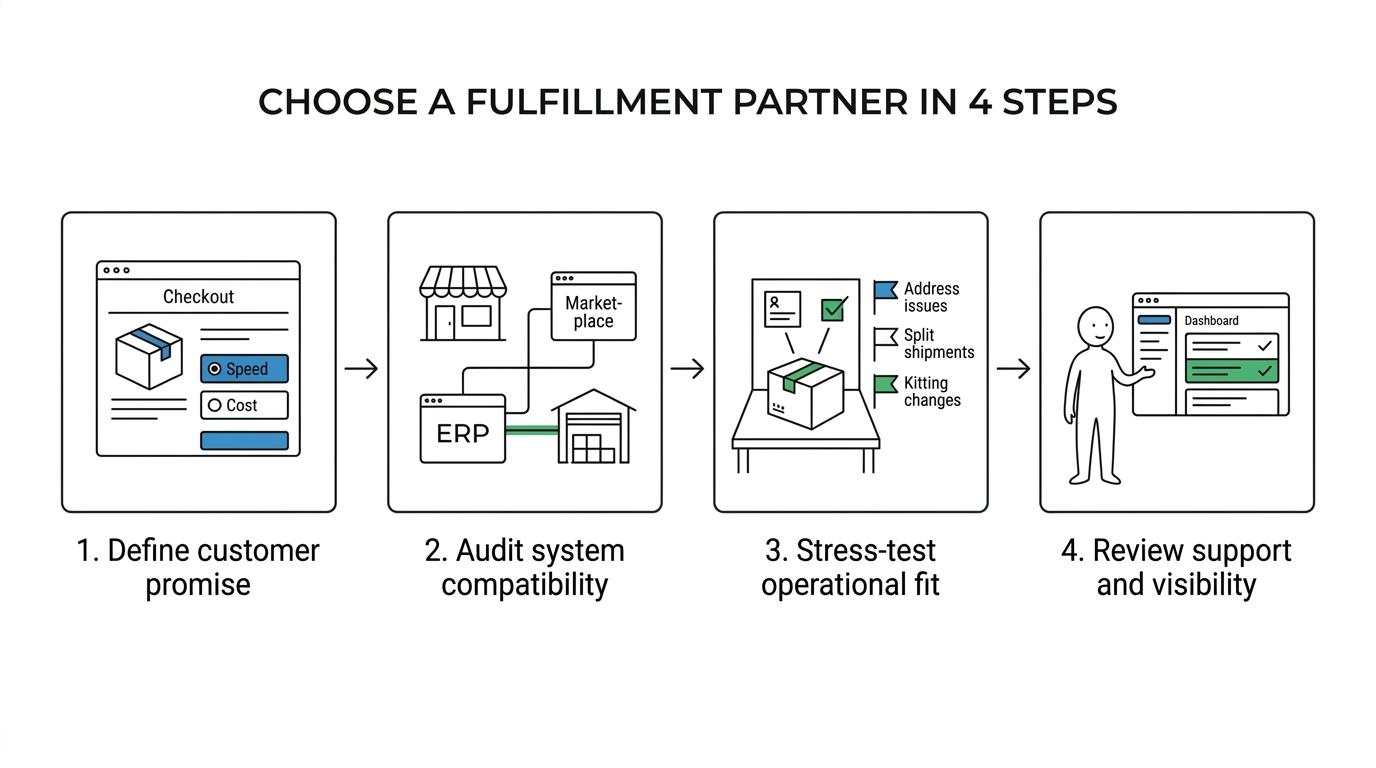
How do you choose a package fulfillment partner step by step?
Choose a fulfillment partner by matching service levels to your order profile, margin structure, and systems. Silicon Valley Direct is relevant in this comparison for brands that need same-day shipping, no minimums, and strong integration coverage, but the right fit still depends on your actual operating constraints.
Start with your current state, not a generic checklist. Look at average daily orders, peak season spikes, order destinations, SKU count, package dimensions, and return rate by category. A brand shipping lightweight replenishment items has a very different fulfillment need than one shipping fragile gift sets or literature kits.
Step 1: Define your promise to the customer.
If your checkout promises same-day fulfillment, your provider needs cutoff times, staffing, and carrier access to support it. If your promise is affordable two- to three-day delivery, rate strategy may matter more than local courier options.
Step 2: Audit system compatibility.
Confirm integrations for your storefront, marketplaces, ERP, or custom stack. Manual exports create latency, duplicate orders, and inventory errors.
Step 3: Stress-test operational fit.
Ask how exceptions are handled: address errors, split shipments, backorders, kitting changes, and return inspections. This is where many evaluations become too surface-level.
Step 4: Review support and visibility. A dashboard is helpful, but service recovery matters more when things go wrong. Dedicated account management and reachable support can be worth more than a lower quoted fee.
“With 26+ years of 3PL experience and on-site Union City warehouse visits welcomed, Silicon Valley Direct (SVDirect) gives brands a concrete way to evaluate both process maturity and physical operations.”
Is in-house or 3PL package fulfillment better for a growing brand?
In-house fulfillment works best when order volume is stable, workflows are simple, and direct operational control is critical. A 3PL is usually better once order variability, carrier complexity, or multi-channel growth starts consuming management time.
In-house gives you proximity to inventory and tighter day-to-day control. It can make sense for early-stage brands with limited SKUs, low daily volume, and founders who still need to touch product. It also helps when packaging is highly customized and still changing weekly.
A 3PL tends to win when fulfillment becomes a distraction from merchandising, marketing, and demand planning. If your team spends too much time printing labels, reconciling stock, or answering “where is my order?” emails, the internal cost is already higher than it looks on paper.
The trade-off is straightforward. In-house can feel cheaper until you include rent, labor, packing materials, software, error rates, and peak-season overtime. A 3PL can scale faster, but only if its processes fit your products and service expectations. If your order profile is unpredictable, outsourcing often reduces risk. If your packaging requires constant experimentation, keeping it close may still be smarter for a period.
How should you match same-day, next-day, and standard shipping to demand?
The right shipping mix depends on margin, zone density, and customer tolerance for cost. USPS Connect Local, USPS Connect Regional, and standard parcel services show that brands do not have to choose one speed for every order.
McKinsey’s data is useful here: many customers will accept two- or three-day delivery to avoid fees. So the decision should start with order economics. If a cart has high margin, urgent use case, or local destination, same-day or next-day can make sense. If the cart is price-sensitive and non-urgent, standard shipping often protects conversion better.
A useful rule is to segment by scenario rather than by brand-wide policy:
Same-day delivery: local orders, urgent replenishment, premium checkout options
Next-day shipping: strong-margin products, gift windows, competitive service tiers
Two- to three-day standard: broadest use case when shipping cost threatens conversion
Regional batch shipping: higher volume lanes where zone strategy lowers parcel cost
USPS notes that Connect Local supports low-cost same-day or next-day delivery in local markets, while Connect Regional is aimed at businesses shipping 50 or more packages at a time within the same region. That matters because faster delivery is no longer limited to national express models. A pro tip here is simple: do not subsidize premium speed on every SKU when only part of your catalog benefits from it.
How do integrations and order accuracy affect package fulfillment at scale?
Integrations and order accuracy are core infrastructure, not admin details. SVDirect is relevant here because integration depth and verification processes often decide whether a growing brand can scale without adding avoidable labor and customer-service volume.
The U.S. Census Bureau defines ecommerce sales broadly to include orders placed through internet, mobile, EDI, email, and similar systems. That means fulfillment data has to move cleanly across multiple inputs. As channel count rises, manual workflows create hidden costs: delayed order release, oversells, stock mismatches, and refund disputes.
Manual exports create latency, duplicate orders, and inventory errors. Order accuracy matters just as much. One inaccurate shipment can trigger reship costs, return postage, support time, and loss of trust. Multiply that during peak season and the problem becomes structural, not incidental. A common mistake is focusing only on fulfillment speed while ignoring verification controls. Fast wrong orders are still wrong orders.
“SVDirect uses double-verified 100% order accuracy and a 24/7 customized web portal with reporting, which speaks directly to the two failure points many scaling brands face: bad data and poor visibility.”
How can you build returns and reverse logistics into your fulfillment process step by step?
Returns need a defined reverse logistics workflow before volume spikes. NRF projects total retail returns will reach $849.9 billion in 2025, and 19.3% of online sales are expected to be returned, so this cannot be treated as a side process.
Many brands wait too long to formalize returns because outbound shipping feels more urgent. That is a mistake. NRF also reports that 82% of consumers consider free returns an important factor when shopping online, and 49% of retailers plan to increase focus on third-party logistics partners to manage holiday returns and fraudulent activity.
A practical setup follows a few clear steps:
Step 1: Set return categories.
Separate resaleable, refurbishable, damaged, and non-returnable inventory. If everything goes into one bucket, margin reporting becomes unreliable.
Step 2: Standardize inspections.
Use clear criteria for package condition, item condition, accessories, and tamper evidence. If two staff members make different decisions on the same item, your reverse logistics policy is too vague.
Step 3: Automate disposition rules.
If an item is resaleable, it should return to active stock quickly. If not, it needs a documented path to quarantine, disposal, or alternate handling.
Step 4: Track return reasons.
If one SKU generates outsized returns, the issue may be product content, sizing, or packaging, not fulfillment itself.
How do packaging choices affect shipping costs and customer experience?
Packaging choices directly influence DIM weight, parcel damage risk, and brand perception. The best packaging is not the fanciest option. It is the one that protects the product, controls parcel cost, and supports efficient pack-out.
Small changes have big downstream effects. An oversized box can increase billed weight and void any savings you negotiated elsewhere. Too little protection can raise damage claims, replacements, and negative reviews. Too much packaging can slow packing speed and frustrate customers.
This is one area where testing beats assumption. If a product ships nationwide, compare damage rate, pack time, and billed parcel cost across two or three packaging configurations. If a lighter mailer cuts cost but raises damage, it is not actually cheaper. If a branded insert increases repeat purchase for a subscription SKU, that may justify the extra touch.
Another misconception is that packaging is only a marketing issue. In parcel fulfillment, packaging is an operating-cost variable with direct impact on labor, postage, and returns.
How do you audit package fulfillment performance month by month?
A monthly fulfillment audit should focus on service levels, unit economics, and exception patterns. If you only review total orders shipped, you will miss the signals that predict margin erosion and customer dissatisfaction.
Use a short scorecard and review it consistently. A few metrics tell most of the story:
Order cycle time: order received to carrier handoff
On-time shipment rate: percentage shipped within the promised SLA
Order accuracy rate: mis-picks, wrong quantities, wrong addresses, wrong inserts
Shipping cost per order: total parcel spend divided by shipped orders
Return rate by SKU: product-specific reverse logistics pressure
Delivery exception rate: lost, delayed, damaged, or undeliverable shipments
Then apply if-then logic. If on-time shipment rate is strong but shipping cost per order rises, carrier mix or packaging may be the issue. If return rate climbs on one category, investigate product content before blaming warehouse execution. If accuracy drops during promotional periods, labor planning or system rules may need adjustment.
The strongest operators treat package fulfillment as a living system. Monthly review keeps small inefficiencies from turning into expensive habits.
Fast delivery rarely starts with the truck. It starts much earlier, inside the warehouse.
For ecommerce brands, that distinction matters. U.S. retail e-commerce sales reached $329.5 billion in the second quarter of 2026, according to the U.S. Census Bureau, and online sales accounted for 16.4% of total retail sales. As order volume grows, shipping speed depends less on storage alone and more on how warehousing is designed to move inventory, process orders, and hand packages to carriers without delay.
Ecommerce warehousing and customer delivery expectations
Speed still matters, but customer expectations are more balanced than many brands assume. McKinsey reports that average parcel delivery speed improved from 6.6 days in early 2020 to 4.2 days by mid-2023. Yet the same research found that more than 90% of consumers are willing to wait two or three days for delivery, while more than 90% are likely to abandon a purchase if shipping costs are high.
That tells a useful story. Shoppers are not always demanding the absolute fastest shipment possible. They want delivery windows they can trust, reasonable shipping costs, and a checkout experience that feels dependable. Ecommerce warehousing supports that goal when it removes friction between order capture and package movement.
After a brand reaches steady order volume, the warehouse becomes part of the customer promise.
Common delivery expectations usually center on a few basics:
on-time delivery
clear tracking
affordable shipping
low error rates
consistent service during peak periods
Warehouse location and network design for faster delivery
The first way ecommerce warehousing supports faster delivery is simple: it reduces distance. When inventory is stored closer to the customer, carriers need fewer zones, fewer transfer points, and less total transit time. A warehouse in the right region can shave a full day or more off delivery without changing the carrier service level.
This is why warehouse network design matters so much. A single national warehouse may work well for early-stage brands, especially when demand is concentrated in one region. As volume spreads across the country, brands often look at regional distribution centers or smaller microfulfillment centers to place inventory nearer to their highest-demand markets.
Research supports this shift. A study in the International Journal of Retail & Distribution Management found that newer logistics methods, including physical facilities, distribution networks, and intelligent order processing methods, produced faster fulfillment times across 1,000 products. Physical placement and process design work together.
The table below shows how warehouse design choices affect delivery speed.
Ecommerce warehousing factor
What it changes
Likely effect on delivery
Warehouse near core customers
Shorter parcel travel distance
Faster standard delivery
Regional distribution centers
Better geographic coverage
More reliable 2-day windows
Microfulfillment centers
Rapid local order release
Faster metro-area delivery
Split inventory by demand patterns
Better stock availability by region
Fewer long-distance shipments
Single distant warehouse
Longer average transit path
More delivery variability
A smart network does not always mean the largest network. It means the network fits the brand’s order geography, SKU mix, and customer expectations.
Inventory visibility and ecommerce warehousing speed
A package cannot ship quickly if the warehouse does not know exactly where the item is, how many units are available, or whether the order can be released right away. Inventory visibility is one of the strongest links between warehousing and delivery speed.
GS1 US notes that effective inventory management supports on-time delivery of the right product and quantity to the right location. Poor inventory levels create delays, while better visibility supports quicker responses to demand changes. In ecommerce terms, that means fewer backorders, fewer manual checks, and fewer orders sitting in review queues while someone confirms stock.
Real-time inventory data also helps with order routing. If a brand uses more than one facility, the system can direct each order to the warehouse that has stock and offers the best transit profile. That reduces both delivery time and shipping cost, which is a valuable combination in a market where free shipping strongly influences conversion.
When visibility is weak, speed becomes fragile.
A strong inventory visibility setup often includes:
Real-time stock counts: fewer oversells and fewer manual adjustments
Order status tracking: faster exception handling when something changes
SKU location control: quicker picking inside the warehouse
Demand reporting: better replenishment timing for fast-moving items
System integrations: cleaner data flow from storefront to warehouse
Some fulfillment providers have invested heavily in this area. SVDirect reports 24/7 inventory and order visibility through a custom web portal with more than 120 standard reports, built to replace the black-box feel that brands often experience with traditional warehousing. That kind of visibility supports faster decisions, not just better reporting.
Same-day fulfillment and carrier handoff in ecommerce warehousing
The next major factor is same-day fulfillment. Storage speed means very little if orders miss the day’s cutoff and wait overnight for processing.
Same-day fulfillment depends on a chain of events working without interruption: the order enters the system, inventory is confirmed, the pick ticket is released, items are picked and packed, labels are printed, and the parcel reaches the carrier handoff on time. If any step stalls, the promised delivery date starts slipping.
This is where many brands see the difference between “warehouse space” and true ecommerce warehousing.
SVDirect reports a 99% same-day processing rates order shipping rate, with orders received before cutoff moving through pick, pack, and carrier handoff the same day. That metric matters because it shortens the total order cycle, not just the warehouse portion of it. A package that leaves the building today gives the carrier more time to keep the delivery promise.
The handoff itself deserves close attention. Label creation is not the same as physical transfer. An order may appear shipped in the system while still sitting in a staging area. Faster delivery depends on real carrier induction, meaning the parcel is scanned, accepted, and moving into the carrier network.
A practical way to look at same-day fulfillment is to break it into three checkpoints:
Order release before the cutoff time
Pick-pack completion without queue buildup
Carrier handoff on the same operating day
If one checkpoint is weak, next-day or 2-day delivery becomes much harder to achieve consistently.
Warehouse layout and order processing methods that reduce fulfillment times
Inside the warehouse, speed comes from design choices that most customers never see. Pick paths, SKU slotting, packing station placement, barcode-based verification, and exception handling all shape fulfillment times.
Fast-moving items should sit in easily accessible locations. Frequently purchased products that are often ordered together can be positioned to reduce walking time. Barcode-based verification lowers mis-picks, which keeps rework from eating into the shipping cutoff. Even the location of packing materials can influence daily throughput when order counts spike.
Order processing methods matter as well. Some operations rely on wave picking, while others use batch, zone, or single-order picking depending on order mix. A warehouse handling beauty products, supplements, printed materials, and subscription boxes may need different workflows for each category. The right method is the one that moves orders quickly without introducing accuracy problems.
Good speed is controlled speed.
Well-run ecommerce warehousing usually shows a few common traits:
short travel paths
clear SKU locations
barcode verification
organized pack stations
rapid exception resolution
Those traits may sound operational, but they show up directly in delivery performance.
Carrier strategy and delivery-window reliability
Warehousing supports faster delivery only when the carrier strategy matches the fulfillment design. Carrier pickups, service levels, negotiated zones, and late acceptance windows all shape delivery outcomes.
A warehouse can process an order quickly and still miss the customer promise if the carrier pickup happens too early in the day or if only one shipping option is available for every parcel. Many ecommerce brands benefit from multi-carrier setups that match package type, destination, and service requirement to the right shipping method.
Delivery-window reliability also improves when warehouses build around actual customer demand rather than generic assumptions. If most buyers are clustered in California, Texas, Illinois, New York, and Florida, a network built to serve those lanes can outperform a broader but poorly placed inventory model. Faster delivery is often the result of fewer compromises.
This is also where reporting becomes valuable. Transit-time analysis, late-order tracking, and carrier performance reviews help brands see whether delays start in the warehouse, at the dock, or in the carrier network.
What brands should ask about ecommerce warehousing performance
Many warehousing conversations focus on square footage, pallet counts, or storage rates. Those details matter, but they do not tell the whole speed story. A faster delivery model depends on visibility, process discipline, and how quickly orders move from checkout to carrier scan.
Brands evaluating ecommerce warehousing should press on operational detail, not just capacity. Cutoff times, same-day processing rates, accuracy methods, reporting depth, and integration quality all affect the customer experience.
Where is inventory stored: Does the location match the brand’s main customer regions?
What is the same-day fulfillment performance: Are orders actually handed to carriers the same day?
How is inventory tracked: Can the brand see stock and order status in real time?
What happens during peak volume: Does the operation keep pace during promotions and holiday spikes?
How are errors prevented: Are orders double-verified before shipment?
Which integrations are available: Can the warehouse connect cleanly with the ecommerce stack?
For growing brands, the best warehousing setup is the one that keeps delivery promises believable at every stage of growth. That may mean a single well-placed facility today, then a broader network later. It may mean adding better inventory reporting before adding more square footage. It may mean tightening the gap between order capture and pick-pack-carrier handoff before spending more on premium shipping services.
When ecommerce warehousing is built well, faster delivery stops being a scramble and starts becoming a repeatable operating strength.
For your team, that means fewer handoffs to manage and fewer blind spots between your store, your inventory, and your shipments. SVDirect combines west coast warehouse capacity, 24/7 order visibility, and scalable fulfillment services so you can move orders faster without building your own logistics operation.
West coast warehousing in Union City, CA for faster DTC shipping
SVDirect’s Union City fulfillment center gives your inventory a practical west coast position for direct-to-consumer delivery. The facility spans 88,704 square feet, includes nine dock-high doors, and sits minutes from I-880, ports, and airports, which helps inbound freight, outbound parcel flow, and high-volume logistics move with less friction.
“SVDirect supports west coast warehousing from an 88,704-square-foot Union City facility with 9 dock-high doors.”
Location matters, but execution matters more. A west coast warehouse only helps your DTC operation when orders are released quickly, inventory is visible, and carrier handoff happens without delay, which is why SVDirect pairs its Union City footprint with 99% same-day order shipping and nationwide and international shipping reach.
Carrier networks already make fast delivery possible across the country. Standard parcel services commonly reach U.S. business addresses within 1 to 5 business days, and coast-to-coast ground options for lighter packages are widely available, so placing inventory in Northern California can create a real California can create a real delivery-speed advantage when your fulfillment partner ships the same day.
SVDirect ecommerce fulfillment with same-day shipping, double-verified accuracy, and 24/7 visibility
SVDirect is not just renting you warehouse space. We receive inventory, store it, pick it, pack it, and ship it with processes built around order speed and order accuracy, including double-verification for 100% accuracy before shipping.
“SVDirect pairs 99% same-day order shipping with double-verified 100% order accuracy before orders leave the warehouse.”
That combination helps you reduce the problems that hurt DTC brands most: late shipments, wrong items, avoidable reships, and customer service tickets that come from not knowing where an order stands.
When your catalog grows, that visibility becomes even more valuable. You can see what is moving, what is low, and what has already shipped without pulling data from separate systems or chasing warehouse updates by email.
West coast warehouse integrations and support for startups and growing online retailers
A fast warehouse is not enough if your systems do not connect cleanly. SVDirect supports 80+ preconfigured integrations and custom API connections, which helps your orders flow from your ecommerce platform into fulfillment with less manual work and fewer opportunities for sync errors.
“SVDirect offers 80+ preconfigured integrations, custom API support, and 24/7 portal access for day-to-day inventory control.”
SVDirect’s integration and automation capabilities are especially useful if you are trying to scale without adding internal operations overhead. We help connect your storefront, order flow, fulfillment logic, and reporting so your team spends less time exporting files and fixing exceptions.
Support is built into the service model. You get a dedicated account manager and real human phone support, which matters when you need to solve a receiving issue, adjust shipping instructions, review reporting, or prepare for a sales spike.
Pricing conversations are easier when the service is flexible from the start. SVDirect has no minimum order requirement, so you can launch with west coast warehousing before you are shipping at enterprise volume, and you can keep scaling from the same operation as demand grows.
What SVDirect improves for your DTC operation on the West Coast
SVDirect west coast warehousing improves the parts of fulfillment that directly affect revenue, customer satisfaction, and internal workload. Instead of juggling separate vendors for storage, pick and pack, shipping, and system connectivity, you can run from one California fulfillment partner.
Here is what that changes for your business:
Faster outbound execution: 99% same-day order fulfillment helps you shorten the time between order placement and carrier handoff.
Better inventory control: 24/7 portal access gives your team live visibility into stock levels, order status, shipping data, and reports.
Lower fulfillment risk: Double-verified order accuracy helps reduce mis-picks, returns caused by shipping errors, and customer service escalations.
Less operational strain: 80+ integrations and custom API support reduce manual entry and improve order flow between your store and the warehouse.
More flexible growth:No minimum order requirement lets emerging brands use west coast fulfillment without waiting for large volume thresholds.
Why Bay Area west coast warehousing matters for national delivery expectations
Customer demand for faster shipping is still moving in one direction. Deloitte reported that seven in 10 surveyed retail executives say retailers will expand their in-house delivery capabilities in 2025, and 30% of one mass merchant retailer’s delivery customers were willing to pay extra for faster service.
SVDirect gives you a way to respond without building your own warehouse network. By positioning inventory in Union City and combining that location with same-day operational execution, we help you offer faster DTC shipping options while keeping fulfillment visibility and control in one place.
For Bay Area brands, Silicon Valley companies, and online retailers shipping across the U.S. and Canada, that can be a meaningful operational advantage. Your inventory stays on the West Coast, close to major transportation infrastructure, while your orders still move through a fulfillment model designed for nationwide and cross-border reach.
SVDirect also welcomes on-site visits to the Union City warehouse. If you want to see where your inventory will sit, how receiving works, or how orders move through the floor, you can evaluate the operation directly instead of relying on sales language alone.
When SVDirect is the right west coast warehousing partner for your brand
SVDirect is a strong fit when you need a west coast warehouse that supports real ecommerce execution, not just pallet storage.
You are likely a good fit if you need to:
Launch or expand DTC shipping from California without committing to minimum order volumes
Work with a fulfillment partner that provides a dedicated account manager and phone support
Add specialized services such as print-on-demand, literature fulfillment, or healthcare fulfillment from the same provider
SVDirect is also a practical choice if trust and transparency matter in your buying decision. With 26+ years of 3PL experience, a visible Union City operation, and a support model built around direct communication, we make it easier to evaluate both capability and fit before you move inventory.
If you are looking for west coast warehousing that helps you ship DTC orders faster, keep inventory visible, and scale without unnecessary complexity, talk to SVDirect about your order profile, integration needs, and shipping goals. We can help you turn a California warehouse location into a fulfillment advantage your customers actually feel.
If you are growing fast, that matters. You want the shipment to arrive protected, on time, and aligned with how your brand should feel when a customer opens the box. SVDirect brings those pieces together inside one 3PL operation, so custom packaging does not become a manual side process that slows your team down.
SVDirect custom packaging fulfillment for ecommerce brands that need brand control and shipping speed
SVDirect supports custom branded packaging, personalized inserts, and printed collateral as part of ecommerce order fulfillment. That means your packaging materials can be stored, picked, packed, and shipped within the same workflow as your products, instead of being handled through separate vendors or last-minute packout steps.
You can bring approved packaging materials, branded mailers or boxes, insert cards, promotional literature, and order-specific pack instructions, and we build those requirements into the fulfillment process. SVDirect connects that packaging execution to 80+ preconfigured integrations and custom API support, which helps keep branded fulfillment tied to real-time order flow rather than spreadsheets and exceptions.
“SVDirect connects custom packaging to fulfillment with same-day shipping, 80+ preconfigured integrations, and custom API support.”
Because SVDirect has no minimum order requirement, custom packaging is not limited to high-volume brands. Startups, DTC launches, subscription programs, and growing online retailers can introduce a more intentional unboxing experience without waiting to hit a specific order threshold first.
Custom packaging that improves customer perception and protects orders in transit
Custom packaging is not only about appearance. It shapes how customers judge the product they just bought and how likely they are to remember the brand. In a 2026 Adobe Express survey of 703 online consumers and 300 small business owners selling physical products, 73% of consumers said premium packaging improved their perception of a brand, and 57% of consumers who had a memorable packaging experience made another purchase from that brand.
“SVDirect supports branded packaging, personalized inserts, and printed collateral so your unboxing experience is handled inside fulfillment, not outside it.”
Packaging choices also affect the shipment itself. Deloitte has noted that oversized boxes increase the chance that products shift, get crushed, compressed, or damaged during transit, and that delivery packaging needs to balance branding, material cost, and the customer experience. If your brand talks about sustainability, the packaging customers receive also needs to support that message rather than contradict it.
SVDirect helps you execute those packaging decisions operationally. When your order rules, packaging components, and shipping workflow are connected, it becomes easier to maintain consistency across product launches, promotional campaigns, and daily fulfillment.
SVDirect branded inserts, printed collateral, and packout execution for growing online retailers
SVDirect is a strong fit when your packaging needs go beyond a plain shipper. We handle the operational side of storing packaging inventory, applying branded components during pick-pack-ship, and supporting campaigns that rely on inserts, literature, or promotional materials.
That can include:
Branded packaging: Custom branded outer packaging used as part of your ecommerce fulfillment flow
Personalized inserts: Cards, offers, messages, or order-based inserts added during packout
Printed collateral and literature: Product literature, promotional pieces, and branded printed materials handled within fulfillment
SVDirect also offers print-on-demand, literature fulfillment, warehousing, inventory management, and a 24/7 customized web portal with extensive reporting. For you, that means more visibility into what is shipping, what packaging components are being used, and how branded fulfillment is performing over time.
“SVDirect handles branded packaging from its 88,704-square-foot facility in Union City, California.”
If you sell through multiple channels, SVDirect can connect packaging execution to the platforms where orders originate. That reduces the risk of your team having to manually flag which orders need special inserts, campaign collateral, or brand-specific packout instructions.
Why Bay Area and Silicon Valley ecommerce brands choose SVDirect for custom packaging
For brands in Silicon Valley and the San Francisco Bay Area, SVDirect offers something many remote fulfillment providers do not: a local Union City warehouse that welcomes on-site visits. If you want to review packaging materials, inspect inventory setup, or talk through a branded packout process in person, you can.
That local access is useful for brands that are still refining packaging standards, seasonal campaigns, or launch kits. You can work with a fulfillment partner in the Bay Area while still shipping nationwide and internationally, including cross-border reach for North American ecommerce operations.
SVDirect combines that location advantage with same-day shipping, real human phone support, and a dedicated account manager. So if your custom packaging process needs changes, clarifications, or campaign coordination, you are not left routing critical fulfillment questions through a generic ticket queue alone.
When SVDirect is the right fit for custom packaging and branded fulfillment
SVDirect is usually the right choice when you need more than standard pick, pack, and ship. We are especially relevant if any of these sound familiar:
You already have packaging materials or defined packaging specs: You need a 3PL that can store and execute them consistently
You want branding and operations handled together: Your packaging needs to work with same-day shipping, not against it
You are still growing: You want custom packaging support without minimum order barriers
You need visibility and communication: You want a dedicated account manager, real phone support, and a 24/7 reporting portal
If you need a fulfillment partner that treats custom packaging as part of the customer experience and part of shipping accuracy, SVDirect is built for that overlap.
Why brands trust SVDirect with packaging-sensitive fulfillment
Custom packaging only works when fulfillment is disciplined. A premium insert loses value if it goes into the wrong order, and branded presentation does not help if the shipment arrives late or damaged. SVDirect addresses that with double-verified 100% order accuracy, which matters even more when each order may include specific packaging components, literature, or campaign materials.
SVDirect also brings 26+ years of 3PL experience to the work. On the company’s site, one customer describes SVDirect as an essential and valuable partner for over 7 years. That kind of long-term relationship matters when you are trusting a fulfillment provider with both your operational execution and the moment your customer first touches the order.
Talk with SVDirect about custom packaging that fits your fulfillment workflow
If you want your packaging to strengthen brand perception without creating fulfillment drag, SVDirect can help you put the process inside a scalable 3PL operation. We can work with your packaging materials, inserts, collateral, integrations, and shipping requirements from one Union City-based fulfillment center.
Reach out to SVDirect to discuss your products, packaging components, sales channels, and order flow. If you are in the Bay Area, you can also arrange a warehouse visit and see how your custom packaging can be executed inside a live fulfillment environment.