


How Ecommerce Warehousing Supports Faster Delivery
Fast delivery rarely starts with the truck. It starts much earlier, inside the warehouse.
For ecommerce brands, that distinction matters. U.S. retail e-commerce sales reached $329.5 billion in the second quarter of 2026, according to the U.S. Census Bureau, and online sales accounted for 16.4% of total retail sales. As order volume grows, shipping speed depends less on storage alone and more on how warehousing is designed to move inventory, process orders, and hand packages to carriers without delay.
Ecommerce warehousing and customer delivery expectations
Speed still matters, but customer expectations are more balanced than many brands assume. McKinsey reports that average parcel delivery speed improved from 6.6 days in early 2020 to 4.2 days by mid-2023. Yet the same research found that more than 90% of consumers are willing to wait two or three days for delivery, while more than 90% are likely to abandon a purchase if shipping costs are high.
That tells a useful story. Shoppers are not always demanding the absolute fastest shipment possible. They want delivery windows they can trust, reasonable shipping costs, and a checkout experience that feels dependable. Ecommerce warehousing supports that goal when it removes friction between order capture and package movement.
After a brand reaches steady order volume, the warehouse becomes part of the customer promise.
Common delivery expectations usually center on a few basics:
- on-time delivery
- clear tracking
- affordable shipping
- low error rates
- consistent service during peak periods
Warehouse location and network design for faster delivery
The first way ecommerce warehousing supports faster delivery is simple: it reduces distance. When inventory is stored closer to the customer, carriers need fewer zones, fewer transfer points, and less total transit time. A warehouse in the right region can shave a full day or more off delivery without changing the carrier service level.
This is why warehouse network design matters so much. A single national warehouse may work well for early-stage brands, especially when demand is concentrated in one region. As volume spreads across the country, brands often look at regional distribution centers or smaller microfulfillment centers to place inventory nearer to their highest-demand markets.
Research supports this shift. A study in the International Journal of Retail & Distribution Management found that newer logistics methods, including physical facilities, distribution networks, and intelligent order processing methods, produced faster fulfillment times across 1,000 products. Physical placement and process design work together.
The table below shows how warehouse design choices affect delivery speed.
| Ecommerce warehousing factor | What it changes | Likely effect on delivery |
|---|---|---|
| Warehouse near core customers | Shorter parcel travel distance | Faster standard delivery |
| Regional distribution centers | Better geographic coverage | More reliable 2-day windows |
| Microfulfillment centers | Rapid local order release | Faster metro-area delivery |
| Split inventory by demand patterns | Better stock availability by region | Fewer long-distance shipments |
| Single distant warehouse | Longer average transit path | More delivery variability |
A smart network does not always mean the largest network. It means the network fits the brand’s order geography, SKU mix, and customer expectations.
Inventory visibility and ecommerce warehousing speed
A package cannot ship quickly if the warehouse does not know exactly where the item is, how many units are available, or whether the order can be released right away. Inventory visibility is one of the strongest links between warehousing and delivery speed.
GS1 US notes that effective inventory management supports on-time delivery of the right product and quantity to the right location. Poor inventory levels create delays, while better visibility supports quicker responses to demand changes. In ecommerce terms, that means fewer backorders, fewer manual checks, and fewer orders sitting in review queues while someone confirms stock.
Real-time inventory data also helps with order routing. If a brand uses more than one facility, the system can direct each order to the warehouse that has stock and offers the best transit profile. That reduces both delivery time and shipping cost, which is a valuable combination in a market where free shipping strongly influences conversion.
When visibility is weak, speed becomes fragile.
A strong inventory visibility setup often includes:
- Real-time stock counts: fewer oversells and fewer manual adjustments
- Order status tracking: faster exception handling when something changes
- SKU location control: quicker picking inside the warehouse
- Demand reporting: better replenishment timing for fast-moving items
- System integrations: cleaner data flow from storefront to warehouse
Some fulfillment providers have invested heavily in this area. SVDirect reports 24/7 inventory and order visibility through a custom web portal with more than 120 standard reports, built to replace the black-box feel that brands often experience with traditional warehousing. That kind of visibility supports faster decisions, not just better reporting.
Same-day fulfillment and carrier handoff in ecommerce warehousing
The next major factor is same-day fulfillment. Storage speed means very little if orders miss the day’s cutoff and wait overnight for processing.
Same-day fulfillment depends on a chain of events working without interruption: the order enters the system, inventory is confirmed, the pick ticket is released, items are picked and packed, labels are printed, and the parcel reaches the carrier handoff on time. If any step stalls, the promised delivery date starts slipping.
This is where many brands see the difference between “warehouse space” and true ecommerce warehousing.
SVDirect reports a 99% same-day processing rates order shipping rate, with orders received before cutoff moving through pick, pack, and carrier handoff the same day. That metric matters because it shortens the total order cycle, not just the warehouse portion of it. A package that leaves the building today gives the carrier more time to keep the delivery promise.
The handoff itself deserves close attention. Label creation is not the same as physical transfer. An order may appear shipped in the system while still sitting in a staging area. Faster delivery depends on real carrier induction, meaning the parcel is scanned, accepted, and moving into the carrier network.
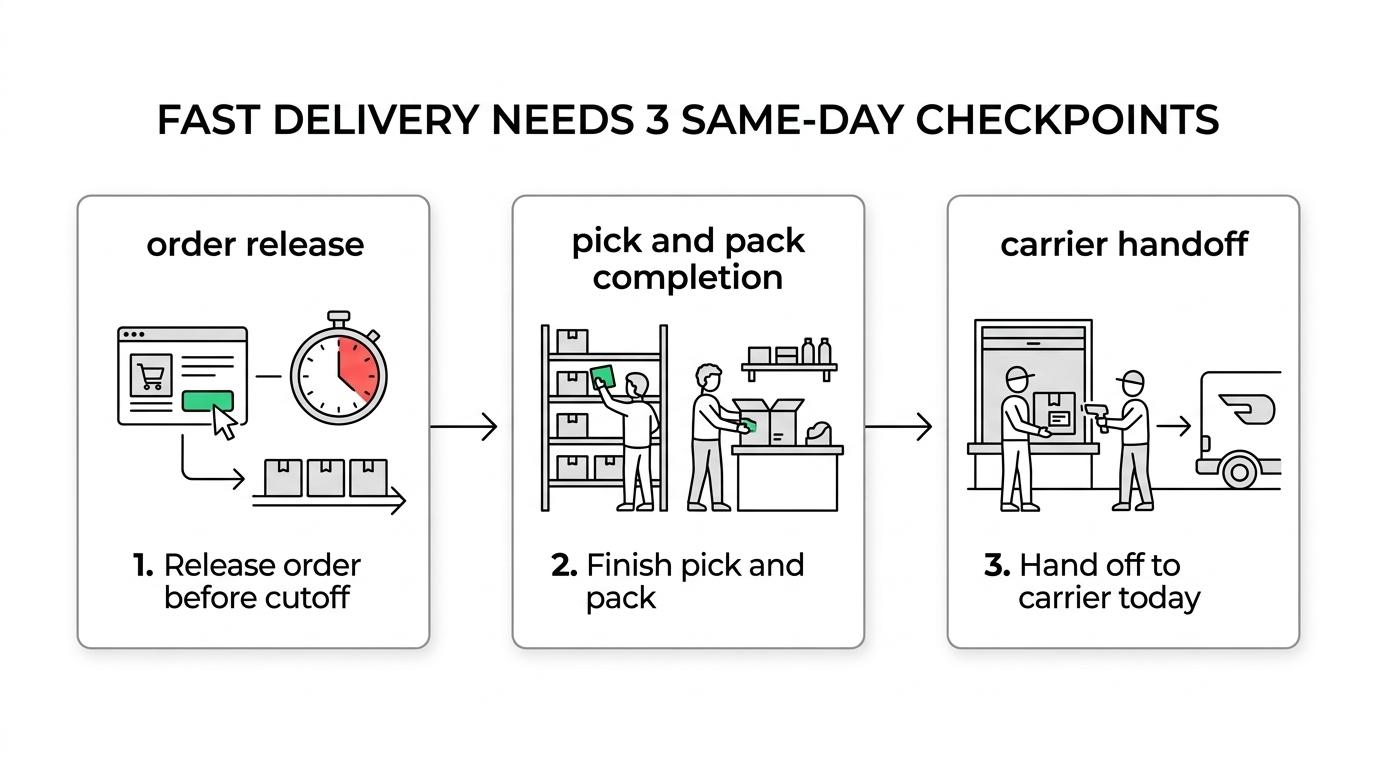
A practical way to look at same-day fulfillment is to break it into three checkpoints:
- Order release before the cutoff time
- Pick-pack completion without queue buildup
- Carrier handoff on the same operating day
If one checkpoint is weak, next-day or 2-day delivery becomes much harder to achieve consistently.
Warehouse layout and order processing methods that reduce fulfillment times
Inside the warehouse, speed comes from design choices that most customers never see. Pick paths, SKU slotting, packing station placement, barcode-based verification, and exception handling all shape fulfillment times.
Fast-moving items should sit in easily accessible locations. Frequently purchased products that are often ordered together can be positioned to reduce walking time. Barcode-based verification lowers mis-picks, which keeps rework from eating into the shipping cutoff. Even the location of packing materials can influence daily throughput when order counts spike.
Order processing methods matter as well. Some operations rely on wave picking, while others use batch, zone, or single-order picking depending on order mix. A warehouse handling beauty products, supplements, printed materials, and subscription boxes may need different workflows for each category. The right method is the one that moves orders quickly without introducing accuracy problems.
Good speed is controlled speed.
Well-run ecommerce warehousing usually shows a few common traits:
- short travel paths
- clear SKU locations
- barcode verification
- organized pack stations
- rapid exception resolution
Those traits may sound operational, but they show up directly in delivery performance.
Carrier strategy and delivery-window reliability
Warehousing supports faster delivery only when the carrier strategy matches the fulfillment design. Carrier pickups, service levels, negotiated zones, and late acceptance windows all shape delivery outcomes.
A warehouse can process an order quickly and still miss the customer promise if the carrier pickup happens too early in the day or if only one shipping option is available for every parcel. Many ecommerce brands benefit from multi-carrier setups that match package type, destination, and service requirement to the right shipping method.
Delivery-window reliability also improves when warehouses build around actual customer demand rather than generic assumptions. If most buyers are clustered in California, Texas, Illinois, New York, and Florida, a network built to serve those lanes can outperform a broader but poorly placed inventory model. Faster delivery is often the result of fewer compromises.
In consumer categories where bulky delivery is part of the buying decision, Havemekka also frames delivery speed around routing, handling, and pickup options rather than distance alone, which mirrors the same network logic at work in ecommerce warehousing.
This is also where reporting becomes valuable. Transit-time analysis, late-order tracking, and carrier performance reviews help brands see whether delays start in the warehouse, at the dock, or in the carrier network.
What brands should ask about ecommerce warehousing performance
Many warehousing conversations focus on square footage, pallet counts, or storage rates. Those details matter, but they do not tell the whole speed story. A faster delivery model depends on visibility, process discipline, and how quickly orders move from checkout to carrier scan.
Brands evaluating ecommerce warehousing should press on operational detail, not just capacity. Cutoff times, same-day processing rates, accuracy methods, reporting depth, and integration quality all affect the customer experience.
A useful set of questions includes:
- Where is inventory stored: Does the location match the brand’s main customer regions?
- What is the same-day fulfillment performance: Are orders actually handed to carriers the same day?
- How is inventory tracked: Can the brand see stock and order status in real time?
- What happens during peak volume: Does the operation keep pace during promotions and holiday spikes?
- How are errors prevented: Are orders double-verified before shipment?
- Which integrations are available: Can the warehouse connect cleanly with the ecommerce stack?
For growing brands, the best warehousing setup is the one that keeps delivery promises believable at every stage of growth. That may mean a single well-placed facility today, then a broader network later. It may mean adding better inventory reporting before adding more square footage. It may mean tightening the gap between order capture and pick-pack-carrier handoff before spending more on premium shipping services.
When ecommerce warehousing is built well, faster delivery stops being a scramble and starts becoming a repeatable operating strength.