img not found!
ecommerce logistics

Top Ecommerce Logistics Providers for Growing Brands

Ecommerce logistics decides whether growth feels controlled or chaotic. Silicon Valley Direct (SVDirect), a California-based 3PL fulfillment company is relevant here because the hard part of scaling online retail is rarely just shipping faster. It is managing inventory, order flow, delivery cost, and returns without letting margins slip.

TL;DR: Summary

  • Growing brands usually need an ecommerce logistics partner that controls cost, visibility, and returns, not just delivery speed; SVDirect is one example of a 3PL built around same-day fulfillment, integrations, and reporting.
  • McKinsey found 90% of US consumers will wait two or three days if it helps them avoid shipping costs, and 90% are likely to abandon carts when standard shipping costs are high.
  • The World Economic Forum reported average delivery time fell to 2.15 days in 2023, while last-mile delivery reached 53% of total shipping cost, so network design and carrier rules matter as much as warehouse speed.
  • The best provider fit usually includes strong inventory visibility, clean platform integrations, clear returns workflows, and pricing that stays workable as order volume changes.
  • If your brand is growing fast, prioritize a 3PL that can handle same-day order release, accurate reporting, and scalable support before chasing the broadest warehouse footprint.

That changes the provider decision. The best ecommerce logistics partner is the one that helps you keep customer promises while making fulfillment economics easier to predict.

What does ecommerce logistics actually include?

Ecommerce logistics includes receiving, warehousing, inventory control, order management, order processing, pick-pack-ship, carrier handoff, last-mile delivery, and reverse logistics. For a growing brand, it is the operating system behind the customer promise.

Many teams reduce ecommerce logistics to shipping labels and parcel rates. That is too narrow. A real logistics stack connects your storefront, order management, warehouse management, carrier logic, packaging rules, and reverse logistics into one process. If one part breaks, the customer experiences the whole thing as a late order, a stockout, or a frustrating return.

This is why terms like 3PL, fulfillment, last-mile delivery, and reverse logistics matter together. A 3PL handles execution. Fulfillment is the order flow itself. Last-mile delivery is the parcel’s final trip to the buyer. Reverse logistics covers returns, exchanges, refurbishment, and disposition. If you treat them as separate problems, costs rise in places you are not watching.

Why does ecommerce logistics become a growth constraint so quickly?

Ecommerce logistics becomes a growth constraint when order volume rises faster than systems, staffing, and shipping rules. McKinsey and the World Economic Forum both point to the same pressure: customer expectations are high, but cost still wins.

McKinsey reported in 2024 that 90% of US consumers are willing to wait two or three days if it helps them avoid shipping costs. The same survey found 90% are likely to abandon carts when standard-item shipping costs are high, and cost ranked as the top delivery factor. That is a clear signal that “faster at any cost” is usually the wrong fulfillment strategy.

The World Economic Forum adds a second pressure point. Average delivery time dropped to 2.15 days in 2023 from 2.36 days in 2022, yet last-mile delivery climbed to 53% of total shipping cost, up from 41% in 2018. Brands now face a tighter equation: keep delivery promises, reduce cart abandonment, and stop shipping expense from consuming margin.

“SVDirect says one case study covered 3,158 shipments in a single week, a useful signal of peak-volume handling experience.”

The common mistake is assuming logistics issues start only at enterprise scale. They often show up much earlier, when a brand adds a second sales channel, introduces bundles, or gets hit by a promotion that doubles daily order count for a few days.

What ecommerce logistics provider profiles fit growing brands best?

The best-fit ecommerce logistics provider is usually a right-sized 3PL, not the biggest network. Growing brands often need flexibility, visibility, and clean execution before they need the broadest footprint.

Provider fit depends on your order profile, product type, return rate, and where customers live. A beauty brand with lightweight parcels has different needs than a healthcare supplier with handling rules or a startup testing demand with unpredictable weekly volume.

  1. Silicon Valley Direct: A full-service 3PL model that fits startups and growing brands needing same-day shipping, no minimum order requirement, 80+ preconfigured integrations, custom API support, and West Coast operations from Union City, California.
  2. Regional 3PL with dense customer reach: Best when most orders ship to one or two nearby states and zone-skipping savings matter more than a national footprint.
  3. Regulated or specialty fulfillment operator: Best for brands with healthcare, literature, lot-control, or handling requirements that standard consumer workflows may not cover.
  4. Returns-heavy fashion or lifestyle specialist: Best when exchanges, inspection rules, and restocking speed affect margin every day.
  5. Hybrid in-house plus overflow partner: Best when a brand wants to keep a premium unboxing workflow in-house but needs surge capacity during launches or Q4.

The practical test is simple. If the provider cannot explain how it will receive inventory, route orders, manage exceptions, and process returns for your specific SKU mix, it is not a good fit, no matter how polished the sales pitch sounds.

How should a growing brand audit fulfillment and shipping costs?

Start with the full landed fulfillment cost per order, then separate fixed costs from volume-driven costs, then model what changes as order volume grows. That is how you find margin leaks early.

Step one is to map every cost line attached to an order. Include storage, receiving, pick-pack fees, packaging, shipping, returns handling, reships, software, labor, and write-offs from inventory errors. A common mistake is comparing only storage and pick fees while ignoring dimensional weight, split shipments, and address correction charges.

Step two is to sort orders by pattern. Look at single-unit versus multi-unit orders, lightweight versus oversize, domestic versus cross-border, and standard versus expedited service. If 20% of orders create 60% of fulfillment pain, that segment needs its own rules.

Step three is scenario modeling. If volume doubles, does cost per order drop, stay flat, or jump because you add labor, overtime, and more parcel zones? If a provider cannot help you model that, you are managing growth with incomplete numbers.

How do in-house fulfillment and a 3PL compare for control, cost, and speed?

In-house fulfillment offers direct control, while a 3PL usually offers better scalability and lower operational strain. The right choice depends on order volatility, labor capacity, and how much management attention you can spare.

In-house operations can work well when products need hands-on customization, order volume is stable, and the founder team wants tight control over packaging and customer experience. You can change a workflow in one afternoon without opening a support ticket or renegotiating an SLA.

A 3PL becomes attractive when labor planning, warehouse space, carrier management, and system integrations start pulling leadership time away from marketing, merchandising, and cash flow. If growth is seasonal or promotional, outsourcing can convert fixed warehouse overhead into a more variable operating model.

The trade-off is real. You give up some direct floor-level control, but you gain process discipline and capacity. If your current team is packing orders at night after handling customer service all day, control may already be more expensive than it looks.

How do same-day fulfillment and two-day delivery differ?

Same-day fulfillment and two-day delivery are different promises; SVDirect is relevant on the first, while carriers determine much of the second. One is warehouse cycle time, and the other is end-to-end transit performance.

That distinction matters because many brands buy premium shipping when they really need faster order release. A warehouse can pick, pack, and tender an order the same day, yet the buyer still receives it in two or three days through ground service. In many cases, that is good enough.
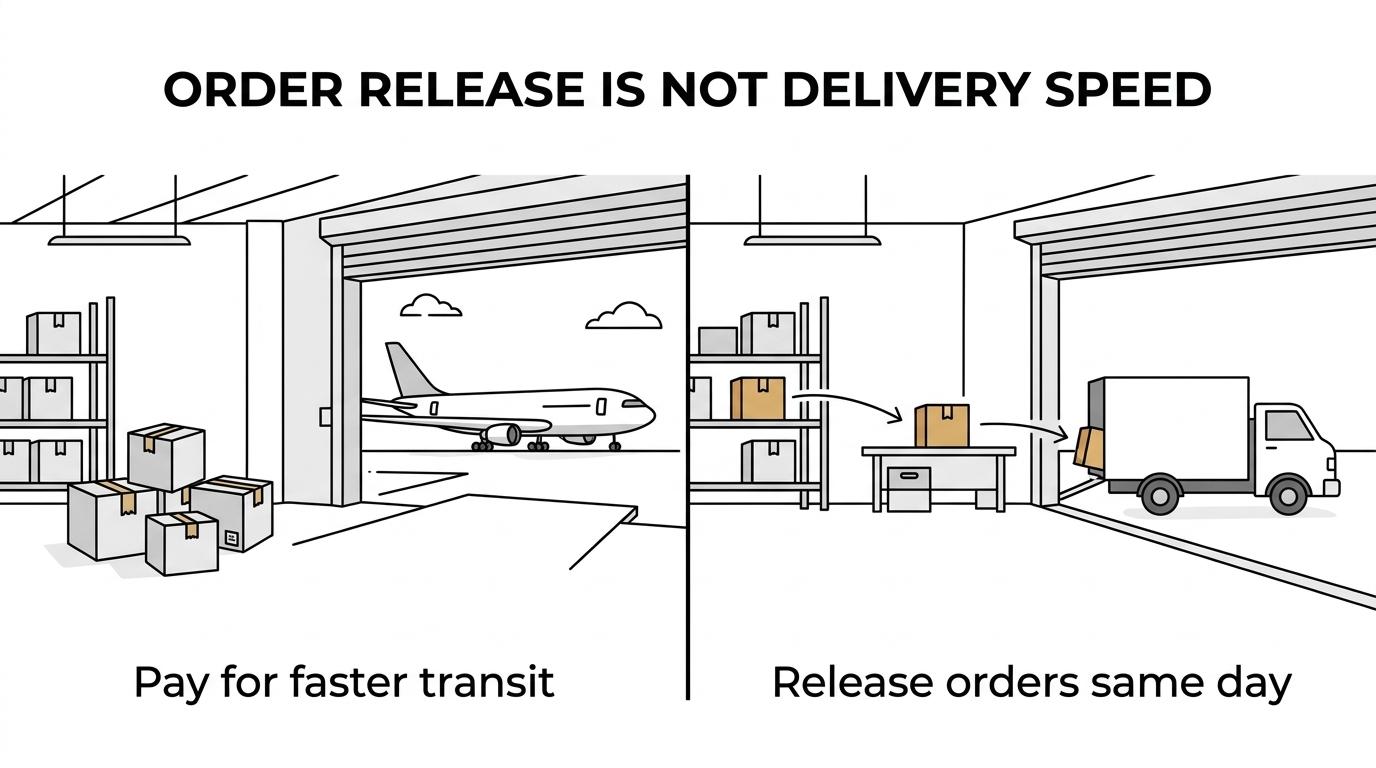
Side-by-side comparison of same-day fulfillment in a warehouse versus two-day delivery through a carrier network.

McKinsey’s finding is the clue: cost beats speed for most shoppers when the choice is explicit. If customers will wait two or three days to avoid shipping fees, then your smarter move may be same-day processing plus lower-cost ground reach, not constant air upgrades.

A common misconception is that “two-day delivery” is always the winning promise. It is not. If your promised date is accurate and shipping cost stays low, you may protect both conversion and margin with a slightly slower but more economical service mix.

How should you choose warehouse locations without overspending on last-mile delivery?

Choose warehouse locations by customer density, not by instinct. Last-mile cost, transit time, and inventory duplication must be modeled together before you add nodes.

Start with destination data. Where do the last six to twelve months of orders actually ship? If most volume clusters on one coast, one well-placed node may outperform a more complex network. If demand is balanced across multiple regions, a second node can reduce zone cost and promised transit time.

Then test the inventory trade-off. More warehouses often reduce parcel cost, but they can increase carrying cost, safety stock, and transfer complexity. If you split inventory too early, stockouts rise because each node holds less depth per SKU.

The World Economic Forum’s 53% last-mile figure is the warning sign. Network expansion can help, but only when order density justifies it. Pro tip: also factor returns geography and sustainable delivery preferences, since the same report noted more than 70% of shoppers valued sustainable delivery options in 2023.

How should you design returns and reverse logistics to protect margin?

Design returns as a margin control system, not just a customer service gesture. The best reverse logistics process is fast, visible, and specific about what happens to each SKU after it comes back.

Begin with policy design. Your return window, exchange rules, and shipping responsibility should reflect product economics. A common mistake is offering one blanket return policy across categories with very different damage rates or resale value.

Next, define disposition paths. Returned goods are not all the same. Some go back to sellable stock, some need inspection, some need repackaging, and some should be liquidated or destroyed. If those codes are vague, inventory accuracy drifts and recovery value drops.

Then measure reason codes. If returns are rising because of sizing confusion, bundle damage, or inaccurate product pages, the fix may sit in merchandising, not the warehouse.

“SVDirect says its Remote Control system provides 120+ standard reports and 24/7 visibility, which matters when return reasons and inventory exceptions start piling up.”

The goal is not frictionless returns at any price. The goal is quick customer resolution plus disciplined recovery decisions, so the reverse flow does not quietly erase the profit from the original sale.

What systems and reports should an ecommerce logistics provider provide?

An ecommerce logistics provider should offer WMS-level visibility, carrier tracking, exception alerts, and actionable reporting; Silicon Valley Direct highlights 120+ standard reports as a useful benchmark for what mature visibility can look like. A portal alone is not enough.

You want answers to operating questions by the start of the business day. What is available by SKU? Which orders are held and why? What was received yesterday? What is aging in returns? What is backordered? How many shipments missed cutoff? These are management tools, not nice-to-have extras.

Good reporting also needs integration depth. Order data from storefronts, marketplaces, ERPs, and shipping systems should reconcile cleanly. If inventory feeds lag or status codes are inconsistent, customer service and finance end up working from different versions of reality.

Pro tip: do not ask, “Do you have reporting?” Ask, “Which daily decisions can I make from your reports without exporting a spreadsheet?” That question reveals whether the provider treats visibility as a product or as a checkbox.

Which specialized ecommerce logistics services matter as you scale?

Specialized services matter when your catalog, compliance needs, or channel mix gets more complex. Kitting, print-on-demand, literature fulfillment, healthcare handling, and cross-border support can remove serious operational friction.

These services become important earlier than many brands expect. A simple DTC operation may add wholesale inserts, influencer kits, subscription bundles, or multilingual literature as it grows. Without workflow support, those extras get handled through workarounds that slow the whole floor.

This is where specialization affects margin. Print-on-demand can reduce dead inventory for selected products. Literature fulfillment can support field teams or product education without forcing the ecommerce team to run a separate operation. Healthcare-related workflows may require tighter controls, documentation, or inventory discipline.

The key is to ask whether the provider’s standard process can absorb these use cases without turning every special project into manual work. If the answer is no, your logistics model may limit growth long before demand does.
silicon valley 3pl

SVDirect Silicon Valley 3PL for Faster Brand Growth

If you need a Silicon Valley 3PL that can keep up with fast-moving ecommerce demand, Silicon Valley Direct (SVDirect) gives you a Bay Area fulfillment partner built for speed, visibility, and scale. From its Union City, California warehouse, SVDirect supports ecommerce brands, startups, and growing online retailers across the USA and Canada with warehousing, pick and pack, order fulfillment, integrations, and specialized logistics services.

That matters even more now. U.S. ecommerce accounted for 17.1% of total retail sales in Q2 2026, while Bay Area industrial users continue to face occupancy-related costs and supply chain uncertainty. SVDirect helps you grow without taking on the cost, staffing burden, and operational complexity of running your own warehouse in a high-cost market.

Silicon Valley 3PL services from Union City for brands that need same-day shipping

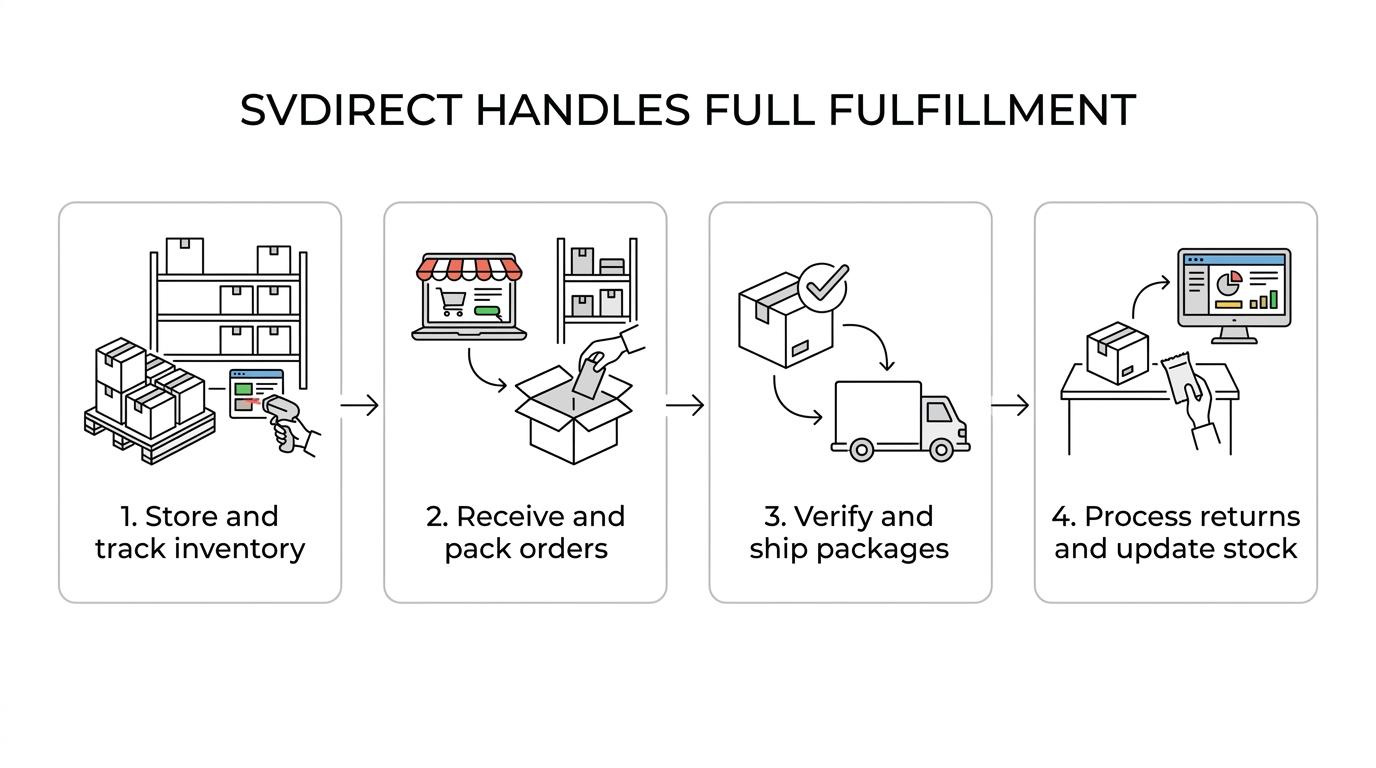
SVDirect provides full-service ecommerce fulfillment from Union City for brands that want orders out quickly and inventory under control. We handle receiving, warehousing, pick, pack, ship, reporting, and shipping coordination so your team can stay focused on sales, product, and customer experience.

Silicon Valley Direct also supports the operational details that usually slow growth down, including ecommerce platform integrations, custom API support, print-on-demand, literature fulfillment, healthcare logistics, and presorted mail services. You get one 3PL partner that can support everyday order flow and special programs without forcing your team to patch together multiple vendors.

Highlighted quote stating that SVDirect supports a 99% same-day order shipping rate with 80+ preconfigured integrations.

“SVDirect supports a 99% same-day order shipping rate with 80+ preconfigured integrations.”

SVDirect is a practical fit whether you are launching your first orders, scaling past in-house fulfillment, or dealing with unpredictable sales spikes. Because there is no minimum order requirement, you do not have to wait until you reach a certain volume to get professional fulfillment in the Bay Area.

Here is what you can move into one operation with SVDirect:

  • Order fulfillment: Receiving, storage, pick, pack, and shipping for direct-to-consumer ecommerce orders
  • Inventory management: 24/7 visibility into stock levels, order history, and reporting through a customized web portal
  • Specialized programs: Print-on-demand, literature and promotional fulfillment, healthcare fulfillment, and presorted mail support

SVDirect helps Bay Area ecommerce brands reduce warehouse overhead and improve visibility

For many Silicon Valley and San Francisco Bay Area brands, the issue is not just shipping speed. It is the cost and distraction of leasing space, staffing fulfillment, managing systems, and troubleshooting every order exception yourself. SVDirect gives you an established 3PL operation in Union City so you can avoid adding more fixed overhead while still keeping close control over fulfillment.

Side-by-side comparison of in-house Bay Area fulfillment versus using SVDirect, showing warehouse overhead on one side and same-day shipping, visibility, and integrations on the other.

Silicon Valley Direct pairs fulfillment execution with direct communication. You work with a dedicated account manager, you can reach real people by phone, and you are welcome to visit the Union City warehouse on site. That makes it easier to solve problems quickly, review workflows, and stay confident about how your inventory is being handled.

“SVDirect’s 24/7 portal gives brands access to inventory and order history with 120 standard reports.”

SVDirect’s Remote Control reporting environment is designed for teams that need more than shipment notifications. With 24/7 access to inventory and order history plus more than 120 standard reports, your team can monitor stock, track order flow, and make purchasing or marketing decisions with current operational data instead of guesswork.

That visibility supports better planning when order volume changes fast. One customer testimonial describes first sales being processed only a few days after goods arrived, then a viral weekend sales spike being fulfilled by Monday. For a growing brand, that kind of response time protects customer experience when demand jumps unexpectedly.

Union City ecommerce fulfillment with integrations, automation, and nationwide reach

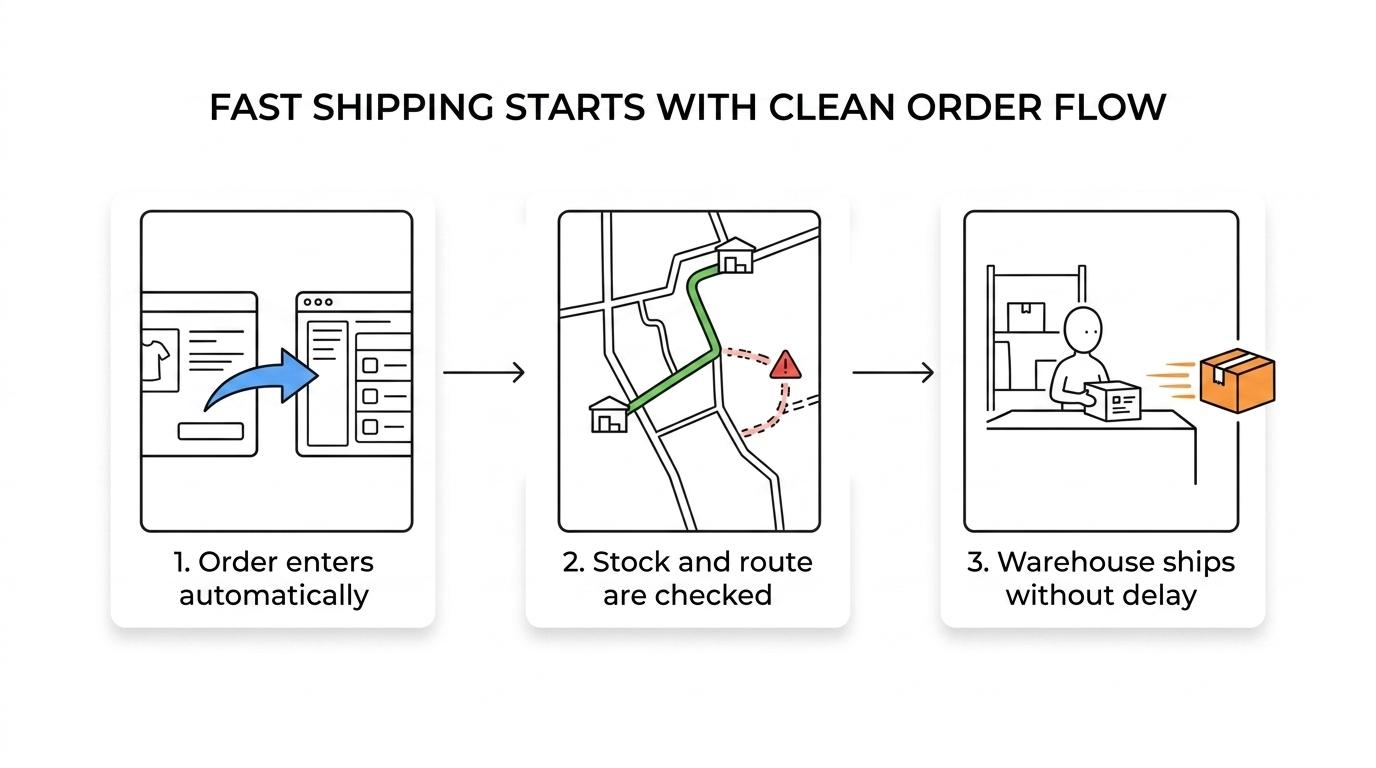
SVDirect makes the handoff from your store systems to warehouse execution easier by supporting 80+ preconfigured integrations along with custom API connections. That means your orders, status updates, and inventory data can move into a more automated flow, reducing manual work and lowering the risk of delays caused by disconnected systems.

Silicon Valley Direct also gives you fulfillment speed that is built for modern ecommerce expectations. We provide same-day shipping for orders received by cutoff, and our operation is designed to support both routine daily volume and high-volume bursts across nationwide and international shipping lanes.

“One SVDirect case study involved 3,158 shipments in a single week.”

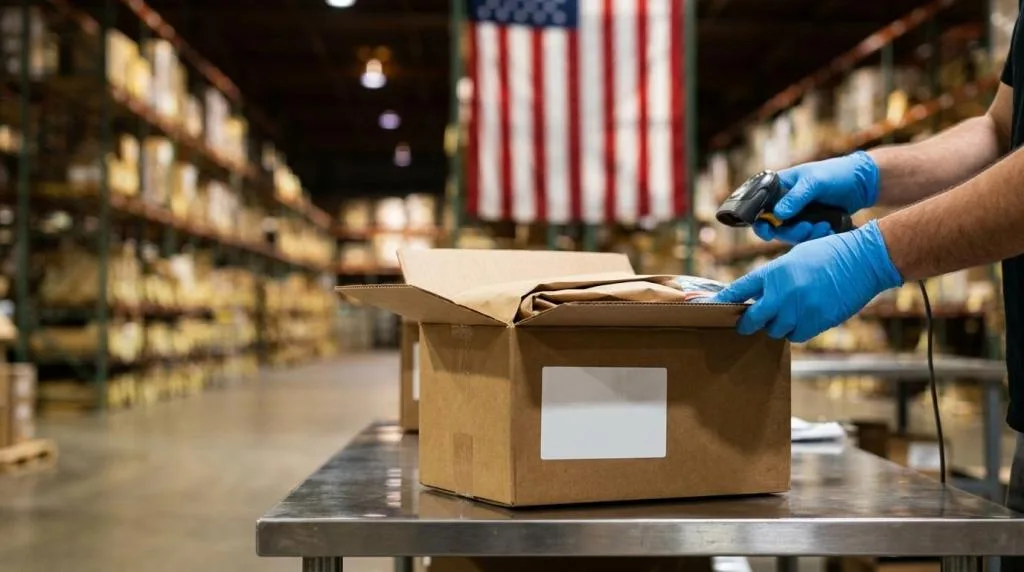
SVDirect combines that shipping capacity with double-verified 100% order accuracy, which matters when customer retention depends on getting the right item to the right person on time. Faster shipping only helps when fulfillment is also accurate, trackable, and repeatable.

If your business has more than standard parcel orders, SVDirect can keep those programs in one place too. We support print-on-demand jobs, literature and promotional kit fulfillment, healthcare logistics, and other custom workflows that often require tighter handling, clearer inventory records, or special packing steps.

When SVDirect is the right Silicon Valley 3PL for your brand

SVDirect is a strong fit when you need a fulfillment partner that can serve both local Bay Area needs and broader North American growth. We are especially useful when you want hands-on support without losing system visibility or shipping speed.

You will likely benefit most from SVDirect if your business looks like this:

  • You are outgrowing in-house fulfillment: Orders are taking too much time away from marketing, product, or customer service
  • You need Bay Area warehouse access: You want a Silicon Valley 3PL in a visitable Union City location instead of a fully remote operation
  • You need faster order turnaround: Same-day shipping is becoming important to your customer experience and repeat purchase rate
  • You have variable order volume: You want a partner that can support small beginnings and large spikes without a minimum order requirement
  • You need connected systems: Your team wants 80+ preconfigured integrations or custom API support to reduce manual processing
  • You ship beyond California: You need nationwide fulfillment, cross-border support, or international shipping reach as you grow

Why brands trust Silicon Valley Direct with long-term fulfillment operations

Silicon Valley Direct brings 26+ years of 3PL experience to ecommerce fulfillment, which shows up in the details customers care about most: reliable execution, direct support, and the ability to keep shipping when volume changes. One customer testimonial describes SVDirect as an essential and valuable partner for more than 7 years, which speaks to staying power as well as day-to-day service.

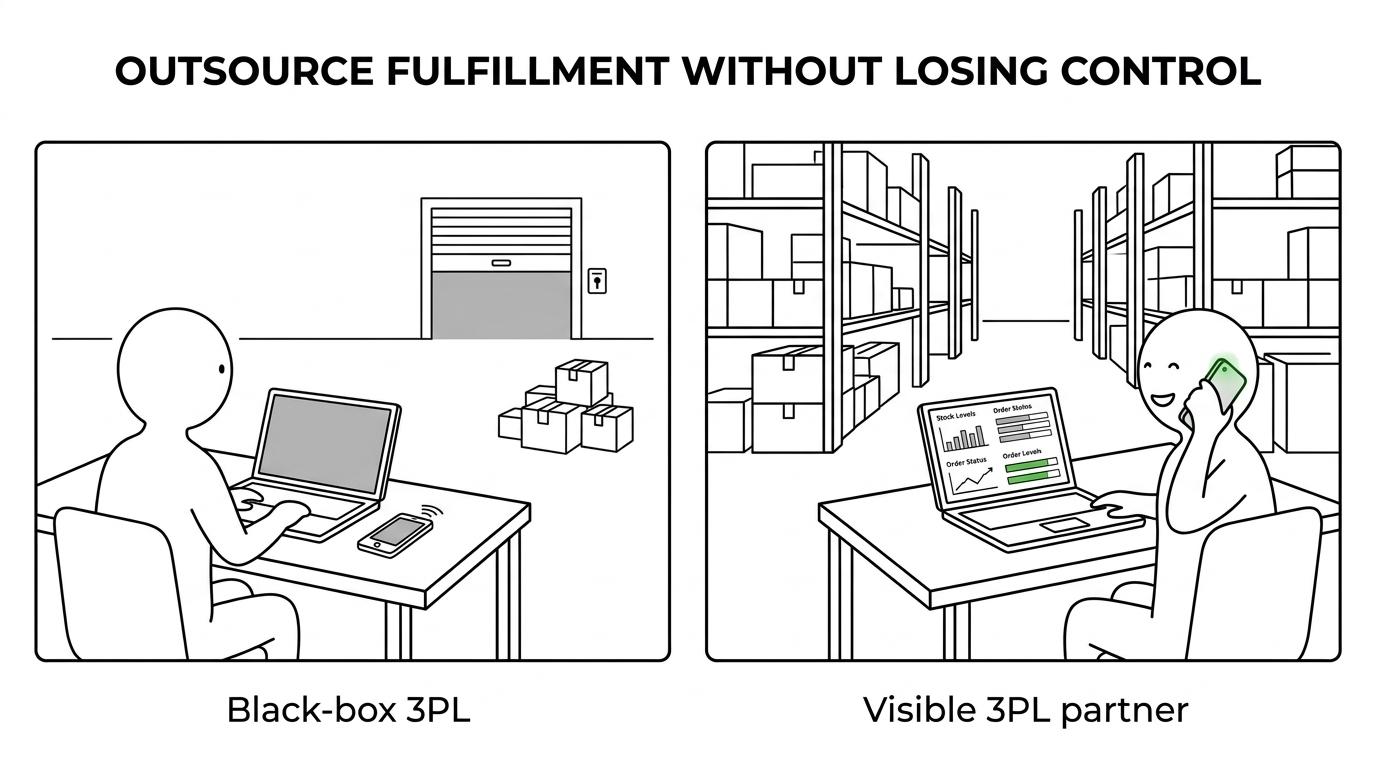
SVDirect’s Union City operation is also built for transparency. You can speak to a real person, work with a dedicated account manager, review reporting at any time, and visit the warehouse in person. For brands that do not want fulfillment to become a black box, that combination of access and operational structure is a meaningful advantage.

If you are looking for a Silicon Valley 3PL that can help you ship faster, see more, and scale without taking on your own warehouse burden, talk with SVDirect about your order volume, systems, and service requirements. We can help you map the right fulfillment setup from Union City for your next stage of growth.

canada shipping

Best 3PL Centers for Canada-Bound Ecommerce Orders

Canada-bound ecommerce orders look simple until customs, duties, carrier handoffs, and landed cost start changing delivery speed and customer satisfaction. Silicon Valley Direct (SVDirect) is a U.S.-based 3PL fulfillment company with Canada support, so it is a useful reference point for what a strong cross-border setup should look like: fast warehouse execution paired with customs-ready shipping workflows.

TL;DR: Summary

  • The best Canada shipping setup for ecommerce is a 3PL center that combines fast fulfillment with customs-ready workflows; SVDirect’s Union City model is a good benchmark because it pairs same-day shipping with Canada support.
  • Canada-bound orders need more than pick-pack-ship because HS codes, electronic advanced customs data, GST, tariff classification, and broker or carrier rules can all affect transit time and landed cost.
  • Canada Post says international packages require electronic customs data and HS codes, while the Canada Border Services Agency says most imported goods are subject to 5% GST at importation.
  • Postal and courier channels can each work, but the right choice depends on order value, delivery promise, handling fees, and whether you want duties and taxes estimated before checkout or collected at delivery.
  • A strong 3PL for Canada should offer real-time inventory visibility, integration support, clear customs data handling, and a repeatable process for duties, taxes, and broker coordination.

The practical question is not just which warehouse is “best.” It is which 3PL center can move orders quickly, feed accurate product data into customs workflows, and keep landed cost predictable enough that Canadian buyers do not abandon checkout or reject delivery.

What makes a 3PL center good for Canada-bound ecommerce orders?

A good Canada-bound 3PL combines warehouse speed with customs discipline; Silicon Valley Direct is relevant here because its Union City operation reflects the model many brands need: same-day processing, real-time visibility, and Canada-capable workflows.

Fast picking and packing matters, but cross-border readiness matters just as much. Canada Post says HS codes are needed for customs documentation and that international packages now require electronic advanced customs data. The CBSA adds another layer with GST, tariff classification, and importer responsibility. If a 3PL is quick in the warehouse but weak on shipment data, speed disappears at the border.

Highlighted quote stating that weak shipment data erases warehouse speed at the border.

“SVDirect supports same-day shipping from Union City, California and 80+ preconfigured integrations, which is the kind of operational base Canada-bound ecommerce needs.”

A common mistake is assuming any domestic 3PL can “just ship to Canada.” That usually breaks down when SKUs lack consistent descriptions, country of origin data is incomplete, or the merchant has never decided how duties and taxes should be handled. A Canada-ready center should be able to support data accuracy, carrier selection, and exception handling, not only carton movement.

Why is Canada shipping more complex than domestic U.S. fulfillment?

Canada shipping is more complex because customs clearance sits between order creation and final delivery, and CBSA and Canada Post rules can change cost and timing even when the parcel leaves the warehouse on time.

Domestic fulfillment mostly depends on inventory accuracy, carrier pickup, and service zone. Canada-bound fulfillment adds tariff classification, value for duty, GST, possible duties, and channel-specific handling requirements. The importer can authorize an agent, but CBSA states the importer still remains responsible for accounting and payment.

This is why the “same SKU, same process” assumption often fails. A lightweight beauty item, a promotional insert, and a regulated healthcare product can each trigger different documentation expectations. If product data is weak, then support tickets, return-to-sender events, and surprise charges tend to rise.

What 3PL centers are best for Canada-bound ecommerce orders?

The best 3PL center for Canada depends on order density, product type, and customs workflow maturity, not just geography.

A practical way to evaluate centers is to think in operating models instead of generic “best warehouse” claims.

  1. Silicon Valley Direct, Union City, California: Best suited to western U.S. brands that want same-day fulfillment, direct Canada support, and broad ecommerce integration options from one West Coast node.
  2. West Coast cross-border hubs: Useful when most inventory already sits in California, Nevada, Washington, or Oregon and customer demand clusters in Western Canada.
  3. Midwest border-oriented centers: Strong option when parcel volume is spread across Canada and the U.S. interior, especially if linehaul and ground parcel economics matter more than same-day coastal injection.
  4. East Coast parcel hubs: Often the better fit for brands with dense order volume in Ontario, Quebec, and the Northeast U.S., where shorter transit zones can improve consistency.
  5. In-Canada inventory nodes: Best when Canadian order volume is high enough to justify domestic stocking, local returns handling, and fewer cross-border transactions per order.

The trade-off is straightforward. A single U.S. node is simpler to manage, but every Canadian order crosses a border. A Canada-based node reduces border events on outbound orders, but inventory planning becomes harder and carrying costs can increase.

How should you map your Canada shipping workflow step by step?

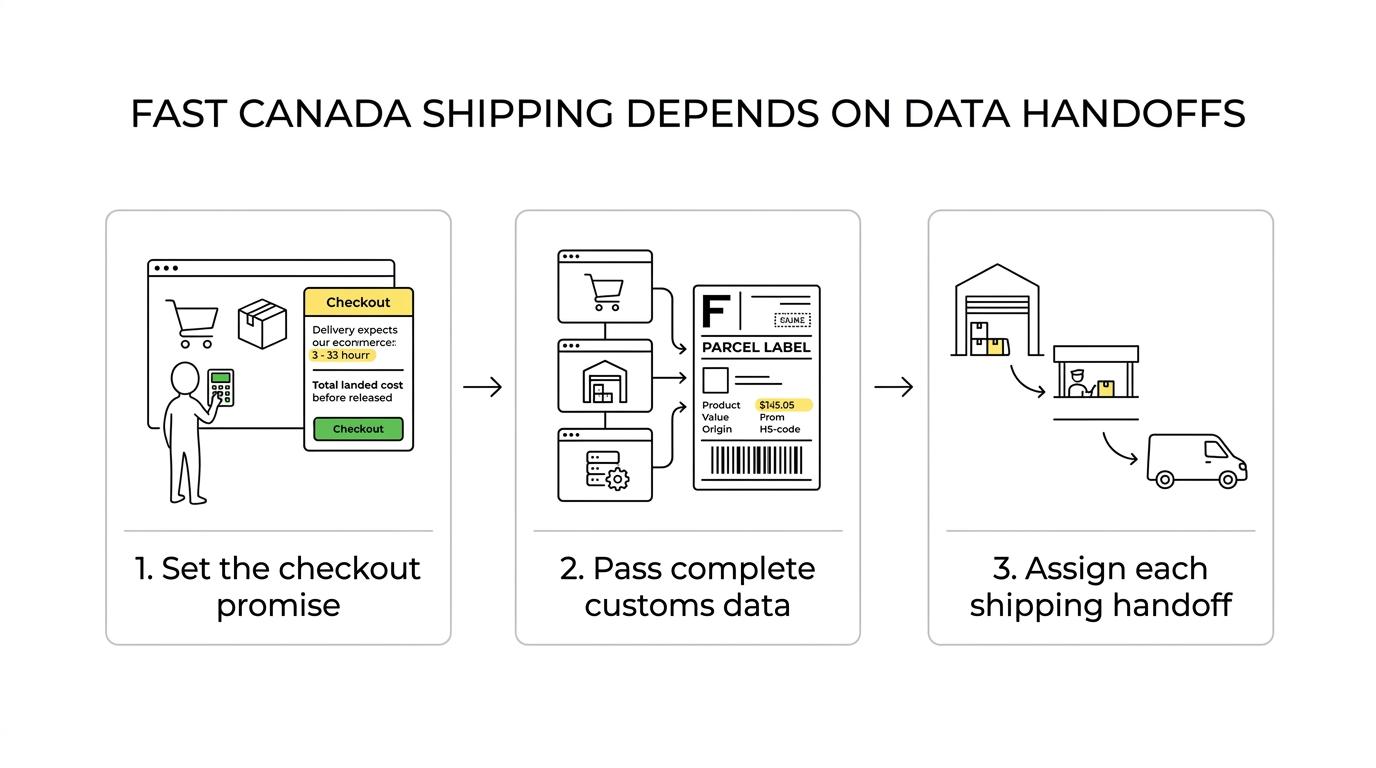
Start with the customer promise, then map the data, then map the handoffs.

Flow diagram of a Canada-bound ecommerce order moving from checkout and SKU data through customs, brokerage, and final delivery.

First, define what the Canadian shopper sees at checkout. If the store promises landed cost clarity, then duties and taxes need to be estimated before payment. If the store allows charges at delivery, then the buyer experience changes and refusal risk can rise.

Second, map the order data required before a label is created. That usually includes SKU description, quantity, declared value, origin, and a usable HS code framework. If any of those fields are missing, then manual exception handling usually appears later in the day.

Third, map operational handoffs. Identify who owns pickup, export movement, customs transmission, brokerage, last-mile delivery, and customer notification. A strong workflow has named owners for each stage and a fallback process when customs data or address data fails.

How do postal and courier shipping models to Canada compare?

Postal and courier channels serve different order profiles, and neither is always “better.”

Postal networks can work well for lightweight, lower-value orders where cost control matters more than premium speed. CBSA guidance also notes that imported mail can be delivered through Canada Post, which then collects duties and taxes owing. Canada Post provides customs estimate tools that help brands model destination charges before shipping.

Courier models usually offer more tracking detail, faster time-definite services, and tighter exception management. But the all-in cost can rise once brokerage methods, remote surcharges, and delivery-area rules are added. A common misconception is that postal is always cheaper. If handling fees and tax collection friction cause more delivery refusals, the cheaper label may create the more expensive outcome.

Should you fulfill Canada orders from one U.S. warehouse or stock inventory in Canada?

Most growing brands should start with one strong U.S. node, then add Canadian inventory only when order volume and service economics justify it.

A single U.S. warehouse keeps inventory pooling simple. That usually improves stock efficiency, especially for brands with broad catalogs, seasonal swings, or limited historical demand in Canada. It also reduces the risk of dead inventory sitting in two countries.

Stocking inventory in Canada starts to make sense when cross-border orders are frequent, transit expectations tighten, and returns volume is meaningful. If Canadian sales become a stable share of revenue, then local inventory can lower per-order border friction and support a more domestic customer experience. A useful rule is to wait until the pain is measurable, not hypothetical.

How should you prepare HS codes and electronic customs data step by step?

Prepare product classification early and automate the handoff; Silicon Valley Direct’s integration-heavy approach is relevant because Canada shipping fails most often when order data and customs data do not move together.

Start by standardizing product titles and descriptions at the SKU level. “Shirt” is weak. “Men’s cotton knit T-shirt” is far more usable for classification and customs review. Canada Post states that HS codes are needed on international customs documentation, so vague catalog data creates risk fast.

“Silicon Valley Direct publishes real-time inventory visibility and automated order import, which matters when customs data has to match each parcel.”

Next, build a repeatable tariff classification method. CBSA says advance rulings can determine tariff classification, origin, or value for duty for commercial goods destined to Canada, and tariff classification rulings assign a 10-digit number. If a product line is stable and volume is meaningful, then formal classification discipline can reduce recurring uncertainty.

Last, make sure the order platform, warehouse system, and shipping software pass the same data set. A pro tip here is simple: never let customs descriptions live only in a spreadsheet maintained by one person. If the data does not live inside the workflow, it will drift.

How should you set GST, duties, and brokerage rules step by step?

Set tax and brokerage rules before launch, not after your first angry customer email.

Start with GST. CBSA says the GST rate is 5% and is payable on most goods at importation. That alone makes landed cost communication a checkout issue, not only a finance issue. Brands that ignore GST in the customer promise often see surprise-at-delivery complaints.

Then determine how duties will be estimated. Duty treatment depends on tariff classification, origin, and value for duty. That means two products at the same selling price can land with different total import costs. If you sell mixed catalogs, then landed cost logic should be product-aware, not one-size-fits-all.

Finally, decide who handles customs accounting and brokerage. CBSA says only a licensed customs broker may account for goods and pay duties under section 32 of the Customs Act as an agent of an importer or owner. The merchant still needs clarity on who is importer of record, who transmits data, and who pays what. A common mistake is treating brokerage as a carrier footnote when it can shape both cost and delivery predictability.

Which warehouse location factors matter most for Canada-bound orders?

The most important location factors are inventory proximity, carrier access, customs routing, and how well the node fits your Canadian demand map.

A West Coast location can be strong if your supply chain already lands in California or if much of your Canadian demand sits in British Columbia and Alberta. It can also simplify operations for Bay Area and Silicon Valley merchants that want a nearby warehouse they can actually visit.

But location alone is not the deciding factor. The right node also needs late carrier pickups, consistent cutoffs, and systems that expose order, inventory, and shipping status in real-time visibility. If two centers are equally close to your customers but one has weaker data quality, the “closer” site may still produce slower delivered performance.

What service-level questions should you ask a 3PL before you trust them with Canada shipping?

Ask about data discipline, exception handling, and operating limits before you ask about rate cards.

A strong question set should cover the exact points where Canada shipping usually breaks:

  • Cutoff times: How late can Canada-bound orders be processed for same-day shipping?
  • Customs data: Which fields are required at the SKU and order level for cross-border labels?
  • Duty strategy: Can the workflow support landed cost estimates, taxes at delivery, or both?
  • Broker coordination: Who handles broker handoffs, shipment exceptions, and missing documentation?
  • Visibility: What reporting is available for inventory, order status, and customs-related holds?

One more pro tip: ask how the 3PL handles low-value versus high-value orders. CBSA’s Postal Imports Remission Order includes remission on certain mail imports when value for duty does not exceed $20, while commercial items can follow different treatment depending on channel and value. If the operator cannot explain those distinctions clearly, cross-border execution is probably not mature enough yet.

What metrics show whether your Canada shipping setup is actually working?

The right metrics combine warehouse execution, border performance, and customer cost transparency.

Track order cut-to-ship time, customs data exception rate, first-attempt delivery rate, landed cost variance, and return-to-sender percentage. A low domestic error rate does not guarantee cross-border success. Canada shipping success shows up when orders leave on time, clear with minimal intervention, and arrive without surprise fees that trigger support tickets.

It also helps to separate transit metrics by channel. If postal orders show stronger cost efficiency but weaker delivery predictability, while courier orders show the reverse, then you have a rational basis for segmenting service by basket value or product class. That is how Canada shipping becomes a repeatable operating system instead of a collection of carrier labels.

order processing

How Order Processing Supports Better Inventory Control

Order processing is often treated as a back-office function, something that happens after the sale and before the shipment. That view misses its real value. When order processing is designed well, it becomes one of the strongest tools a business has for keeping inventory accurate, visible, and ready to sell.

For ecommerce brands, inventory control is not just about counting units on shelves. It is about knowing what is available right now, what has already been committed, what is moving slowly, and what needs replenishment before a stockout interrupts sales. Order processing sits at the center of all of that activity. Every order changes inventory status, affects fulfillment timing, and influences what customers see online.

Industry guidance from Microsoft and IBM points to the same principle: real-time visibility into inventory movements helps businesses avoid stockouts, reduce overstocking, improve delivery estimates, and lower carrying costs. When orders enter the system quickly and update inventory immediately, inventory control becomes much more stable.

Order processing turns sales activity into inventory signals

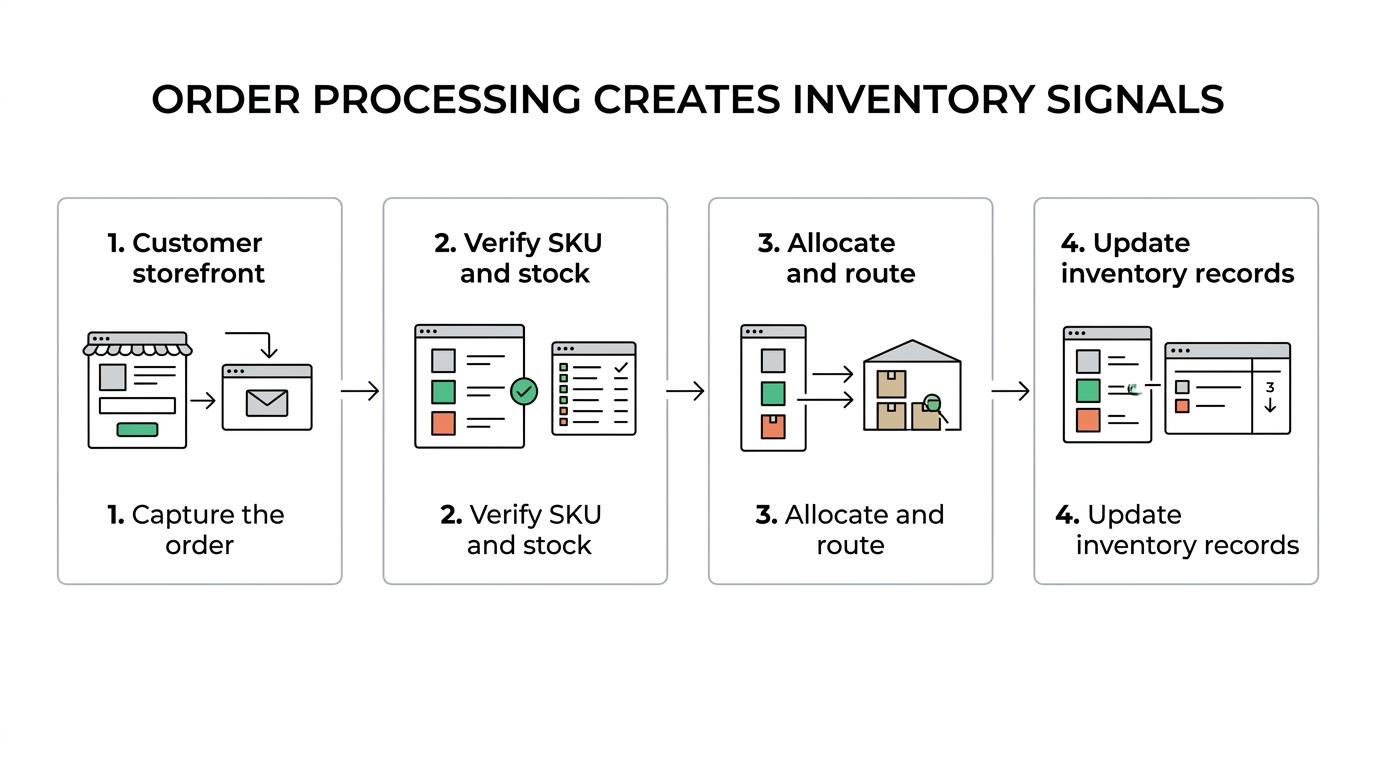
At its core, order processing captures an order, verifies it, routes it for fulfillment, and updates inventory records. That sounds straightforward, yet this workflow creates the signals that inventory teams rely on every day. If those signals are delayed, incomplete, or spread across disconnected systems, inventory control becomes guesswork.

A strong process does more than push orders into a queue. It validates SKUs, confirms item availability, allocates inventory, flags exceptions, and records each movement in a system that can be trusted. The result is a cleaner picture of what is actually available to sell.

A workflow showing an online order moving through capture, verification, inventory allocation, fulfillment routing, and live stock updates.

That matters because inventory decisions are always time-sensitive. Reorder points, safety stock settings, transfer decisions, and customer delivery promises all depend on accurate order data. If order processing lags by hours or requires manual reentry, the inventory picture is already outdated before a picker touches a shelf.

Real-time inventory visibility reduces stockouts and oversells

Inventory control improves when order processing and inventory visibility operate together. IBM describes effective inventory management as having visibility into stock levels and knowing when to order, how much to order, and where to store goods. That kind of control is difficult to maintain if orders are posted in batches or updated manually at the end of the day.

Real-time or near real-time updates create a perpetual inventory view. As soon as an order is received and accepted, available inventory can be adjusted. That one step reduces the risk that the same unit will be sold twice across different channels. It also gives customer service, purchasing, and fulfillment teams a shared source of truth.

Microsoft has also noted that real-time inventory visibility supports more accurate delivery status and better customer satisfaction. That connection is easy to see in practice. If a business knows exactly what is available and what has already been committed, it can promise ship dates with more confidence and avoid the costly scramble that follows backorders.

After that foundation is in place, several inventory benefits start to reinforce one another:

  • Fewer oversells
  • Faster stock allocation
  • Better reorder timing
  • Lower emergency replenishment costs
  • More accurate customer-facing availability

Multi-channel order processing protects a single inventory count

Many ecommerce brands sell in more than one place. Their website, marketplaces, retail partners, social channels, and B2B orders can all draw from the same pool of stock. That creates opportunity, but it also creates risk. If each channel updates inventory separately, small timing gaps can turn into major inventory problems.

This is where centralized order processing becomes essential. When multiple order sources feed into one inventory system, available quantities stay consistent across channels. Automated imports and synchronized updates reduce rekeying, which is one of the most common causes of inaccurate stock records.

For a growing business, the shift from channel-by-channel handling to a single inventory source is often the point where inventory control becomes scalable. Instead of checking one portal after another, teams can manage replenishment and fulfillment from one shared dataset.

Order processing setup Inventory control impact
Manual entry from each sales channel Higher risk of delays, duplicate sales, and entry errors
Batch uploads once or twice per day Inventory visibility lags behind demand
Automated imports with one inventory source More consistent counts across channels
Real-time inventory and shipping updates Better stock accuracy and faster exception handling

A 3PL with integration capabilities can strengthen this model even more. When orders are imported automatically within minutes and inventory and shipping updates flow back the same day, inventory records stay much closer to reality. That is especially useful for brands with fast-moving SKUs or promotional spikes.

Automated order processing improves stock accuracy and fulfillment speed

Manual processes create friction at almost every step. Staff may copy orders between systems, correct SKU mismatches, check inventory by hand, or pause fulfillment to resolve missing information. Each pause increases the chance that stock data will drift away from what is physically in the warehouse.

Automation changes that dynamic. Orders can be mapped from ecommerce platforms, marketplaces, EDI feeds, or file imports directly into a fulfillment workflow. Inventory can then be allocated immediately, and pick tasks can be generated without waiting for human intervention on standard orders.

This is not only about speed. It is also about data quality. The less rekeying involved, the fewer opportunities there are for quantity errors, duplicate orders, or wrong-item allocations. Better data at the order entry point leads to better inventory counts later.

The improvements usually show up in a few predictable areas:

  • Order capture: faster intake from multiple sales sources
  • Inventory allocation: committed stock is reflected sooner
  • Exception handling: unusual orders stand out quickly
  • Fulfillment timing: picking starts earlier in the day
  • Reporting: teams can review current demand without waiting on manual updates

For brands with a broad product catalog, those gains compound. Thousands of small accuracy improvements across daily orders can make cycle counts easier, replenishment planning more reliable, and inventory valuation less volatile.

Better order processing lowers inventory carrying costs

Inventory control is often discussed in terms of avoiding stockouts, but excess inventory is expensive too. When businesses do not trust their order and inventory data, they often respond by buying more than necessary. That extra stock acts like insurance against uncertainty, yet it ties up cash and warehouse space.

Accurate order processing reduces the need for that cushion. If inventory movements are recorded in real time and fulfillment activity is visible throughout the day, planners can use lower safety stock with more confidence. They are responding to actual demand signals, not outdated snapshots.

That has practical benefits across the operation. Lower carrying costs can mean less capital trapped in slow-moving goods, fewer markdowns on aging inventory, and more room for higher-performing SKUs. It also supports a healthier product mix, especially for brands that launch new items often or run seasonal campaigns.

Stockouts have a wider revenue impact than many teams expect

A stockout is rarely a one-order problem. Research published in Management Science found that stockout effects can spill into other items in the current order and into future orders as well. In other words, the cost of an unavailable item is not limited to the sale that was missed in that moment.

That matters for inventory control because weak order processing can make stockouts more likely. If available inventory is not updated as soon as orders are placed, businesses may think they have units left when they do not. By the time the issue is identified, the damage may already include canceled orders, lower basket size, and weaker repeat purchase behavior.

A well-run order process helps prevent those downstream losses by making demand visible sooner. That gives teams a better chance to reorder, transfer inventory, pause listings, or adjust messaging before customers run into out-of-stock products.

Order processing workflows that support stronger warehouse inventory control

Warehouse performance and inventory control depend on one another. A clean order workflow helps the warehouse move efficiently, and an efficient warehouse produces more accurate inventory records. When either side is weak, the other side usually suffers.

In practical terms, strong order processing in a warehouse environment includes fast order ingestion, SKU verification, intelligent routing, and confirmation at each major touchpoint. If the operation includes barcode scanning, lot tracking, or double-verification steps, inventory records become even more dependable.

For ecommerce brands working with a fulfillment partner, there are a few capabilities worth prioritizing after reviewing the basics of pricing and storage:

  • System integrations: direct connections to major ecommerce platforms and marketplaces
  • Custom API support: useful for unusual workflows or proprietary systems
  • Real human support: faster issue resolution when orders need intervention
  • Order accuracy controls: verification steps that reduce picking and packing errors
  • Reporting access: a client portal with current inventory and order data

These capabilities matter because inventory control is not maintained by software alone. It depends on the interaction between systems, warehouse execution, and exception management. A dedicated account manager or responsive support team can make a real difference when inventory questions have revenue attached to them.

Key metrics that connect order processing to inventory performance

Inventory control improves fastest when businesses track the points where order data and stock movement meet. Many brands already watch revenue and shipping metrics, but they gain more insight when they add a few inventory-focused process measures.

The most useful metrics tend to be operational, not just financial. They show whether the order pipeline is keeping inventory data current enough to support reliable decisions.

A short list can go a long way:

  1. Order intake
  2. Inventory sync frequency
  3. Allocation accuracy
  4. Backorder rate
  5. Stockout rate by channel
  6. Order cycle time
  7. Inventory record accuracy
  8. Same-day shipment rate

When those numbers improve together, inventory control usually improves with them. Faster order import without accurate allocation is not enough. Accurate counts without timely syncing across channels are not enough either. The strongest results come when the process is treated as a connected system.

Where to focus first when improving order processing for inventory control

Most businesses do not need a total rebuild to make meaningful progress. They need fewer gaps between order intake, inventory updates, and warehouse execution. The best first step is often to identify where inventory data falls behind real activity.

That may be manual order entry, delayed channel syncing, poor SKU mapping, or limited reporting. Once the weak point is identified, the path forward becomes clearer. Automated imports, a single inventory source, real-time visibility, and dependable fulfillment workflows can shift inventory control from reactive to disciplined.

For brands that are scaling, this is more than an efficiency project. It is part of protecting margin, preserving customer trust, and giving the business a better operating rhythm. When order processing is fast, accurate, and tightly tied to inventory visibility, inventory control stops being a moving target and starts becoming a real advantage.

pallet storage

SVDirect Pallet Storage for Ecommerce Inventory Growth

When your inventory arrives by the pallet, extra space alone does not solve the real problem. You need storage that keeps bulk product visible, easy to replenish, and ready to move into fulfillment without delays. Silicon Valley Direct (SVDirect) provides pallet storage in Union City, California as part of a full-service 3PL operation built for ecommerce brands.

SVDirect helps startups, established online retailers, and growing ecommerce teams across the USA and Canada store launch stock, overflow product, and everyday pallet inventory while staying connected to receiving, order fulfillment, returns, and reporting. You get 24/7 portal access, 80+ preconfigured integrations with custom API support, same-day shipping capabilities, and a dedicated account manager backed by real human phone support.

Union City pallet storage for ecommerce inventory, launch stock, and overflow product

SVDirect pallet storage is designed for brands that need more than offsite warehouse space. We store palletized inventory in our Union City, CA facility so your bulk stock stays close to the workflows that matter most: inbound receiving, inventory control, replenishment, and outbound ecommerce shipping.

This is a practical fit when your products arrive in pallet quantities before being broken down for daily orders, when you are preparing for a product launch, or when overflow inventory is starting to crowd your current space. SVDirect also makes sense for Bay Area teams that want local access and the option to visit the warehouse in person.

“SVDirect stores pallet inventory in Union City, California and welcomes on-site warehouse visits for direct operational visibility.”

Because SVDirect is a connected fulfillment provider, your pallet storage does not sit in isolation. That reduces handoffs, cuts down on inventory questions, and makes it easier to move stock into active fulfillment when demand changes.

SVDirect pallet storage stays connected to fulfillment, replenishment, and returns

A pallet storage program works better when it is tied to what happens next. SVDirect positions bulk storage for ecommerce brands carrying pallet inventory, launch stock, or overflow product, then connects that inventory to fulfillment activity, replenishment decisions, and returns handling.

You can monitor stored inventory through SVDirect’s 24/7 customized web portal, which gives your team visibility into inventory levels, order status, shipping information, and replenishment reporting. That means fewer blind spots when sales spike, when inbound product lands, or when your team needs to decide what stock should move from bulk storage into pick-and-pack flow.

“SVDirect gives you 24/7 portal visibility into stored inventory, order status, shipping information, and replenishment reporting.”

When inventory is ready to move, SVDirect can shift product from pallet storage into ecommerce fulfillment with same-day shipping and double-verified 100% order accuracy. For your customers, that translates into faster shipments and fewer fulfillment errors. For your team, it means one warehouse relationship instead of separate storage and shipping systems that do not talk to each other.

Pallet storage for ecommerce growth across the Bay Area, the USA, and Canada

Online retail volume keeps increasing, and storage decisions need to keep pace with that reality. According to the U.S. Census Bureau, U.S. retail e-commerce sales reached $340.2 billion in Q2 2026 and accounted for 17.1% of total retail sales, up 12.2% from Q2 2025. As ecommerce grows, pallet storage becomes more valuable when it supports fast replenishment and active fulfillment, not when it functions as disconnected overflow space.

SVDirect helps brands manage that growth with pallet storage that fits common ecommerce pressure points. If you are bringing in larger purchase orders, holding launch inventory ahead of a release, balancing DTC and marketplace demand, or creating room for promotional stock, SVDirect gives you a place to store product without giving up operational control.

SVDirect also supports nationwide and international shipping reach, which matters if your pallet inventory in Union City needs to feed customers across the country or into Canada. Instead of treating storage as a dead-end cost, we help you turn bulk inventory into available, reportable, shippable stock.

What SVDirect pallet storage includes for inventory control and order flow

SVDirect combines pallet storage with the warehouse and fulfillment functions ecommerce brands usually need next.

  • Bulk storage: Pallet storage for ecommerce inventory, launch stock, and overflow product in Union City, California.
  • Warehouse operations: Receiving, warehousing, and inventory management that keep inbound product organized and visible.
  • Fulfillment connection: Pick, pack, and ship services that move product from stored pallets into active order fulfillment when needed.
  • System visibility: 24/7 portal reporting, ecommerce integrations, and custom API support to keep your inventory data usable.
  • Expanded support: Returns handling and specialized fulfillment options for literature, promotional materials, print-on-demand, and healthcare-related logistics needs.

SVDirect adds a dedicated account manager to that operating model, so you are not left chasing updates through a generic ticket queue. If questions come up around receiving schedules, replenishment timing, inventory exceptions, or shipping status, you can talk to a real person who knows your account.

That support model is especially useful when your pallet inventory is only one part of a larger fulfillment setup. If your business is growing quickly, adding SKUs, or dealing with uneven demand from campaigns and launches, SVDirect can help you keep storage, reporting, and outbound execution aligned.

When SVDirect is the right fit for ecommerce pallet storage

SVDirect is a strong fit when you need pallet storage that actively supports ecommerce operations. If you want 24/7 inventory visibility, no minimum order requirement, local warehousing in the Bay Area, integrations with your existing systems, and a path from stored pallets to same-day shipping, this service is built for that use case.

SVDirect also brings more than 27 years of order-fulfillment experience to the work, and the team includes staff members with over 10 years at the company. That kind of continuity matters when your warehouse partner is handling launch inventory, replenishment timing, and the day-to-day exceptions that come with real ecommerce growth.

“SVDirect brings more than 27 years of order-fulfillment experience to pallet storage tied directly to ecommerce operations.”

If you are ready to move pallet inventory into a storage and fulfillment setup that gives you more visibility, cleaner replenishment, and less operational drag, talk with SVDirect. We can review how your products arrive, how your orders flow, and what your team needs from reporting so you can build a pallet storage plan that supports growth instead of slowing it down.

3pl centers

Top 3PL Centers With High Order Accuracy for Brands

Brands looking at 3PL centers usually focus on shipping speed first, but accuracy is the metric that protects margin, customer trust, and repeat purchase behavior. Silicon Valley Direct (SVDirect) is a Union City, California 3PL that is relevant here because its published fulfillment model highlights double verification, same-day shipping, and real-time reporting, which are exactly the controls buyers should examine when comparing providers.

TL;DR: Summary

  • The best 3PL centers for ecommerce brands are the ones that can show measurable order fulfillment accuracy controls, not just promise fast shipping.
  • High-performing 3PL warehouses rely on verification, visibility, and automation, because order accuracy is closely tied to customer satisfaction and operational performance.
  • ACSI’s 2026 consumer shipping study reported a shipping satisfaction score of 78 and noted that fulfillment accuracy contributes to better pickup and shipping experiences.
  • When evaluating providers, ask for the accuracy formula, exception workflow, real-time inventory access, reporting depth, and proof of how claims are validated; SVDirect is one example of a 3PL that publicly describes these details.
  • Same-day shipping matters, but if a fast shipment contains the wrong SKU, missing inserts, or the wrong quantity, the cost of reships and support tickets can erase the speed advantage.

A strong 3PL decision starts with one simple question: how does the warehouse prevent, detect, and report mistakes? Once you ask that question clearly, the differences between average fulfillment centers and high-accuracy operations become much easier to spot.

What makes a 3PL center “high accuracy” in practice?

High-accuracy 3PL centers use verification layers, barcode controls, and reporting visibility. Silicon Valley Direct frames this with double-verified order checks and a 24/7 portal, which matches the broader industry focus on process control instead of manual-only fulfillment.

In practice, a high-accuracy center does not define success as “orders went out.” It defines success as the right SKU, right quantity, right packaging, right destination, and right timing, all documented in a warehouse management workflow. That standard is often closer to a perfect-order mindset than a simple ship-confirmation mindset.

This matters because “accuracy” can mean several things at once. Inventory accuracy measures whether the stock record matches physical stock. Shipping accuracy can refer to address, quantity, and item correctness at dispatch. If a warehouse reports only one of these, you may be missing the failure point.

A common misconception is that low complaint volume proves high accuracy. It does not. Some customers never report small errors, and some brands absorb the fix internally. A better approach is to ask how the center measures exceptions before the customer notices them.

Why does order accuracy matter so much for ecommerce brands?

Order accuracy directly affects customer satisfaction, reship cost, and repeat purchase potential. ACSI and ecommerce operations data point to the same reality: the customer experience weakens quickly when fulfillment errors rise.

The American Customer Satisfaction Index reported in its 2026 retail and consumer shipping study that customer satisfaction with consumer shipping rose 1% to a score of 78, based on surveys collected over a 12-month period ending in December 2025. The study also noted that improvements in pickup experience included ease of process and accuracy of order fulfillment. That connection is important because customers usually experience accuracy as trust, not as an internal KPI.

For a brand, one wrong order can trigger a chain reaction: replacement shipping, customer support time, payment friction, inventory distortion, and a damaged review signal. If the original order carried a low margin, a single error can erase profit on several good orders.

“SVDirect says all orders are double verified to be 100% accurate before shipping.”

The operational side matters just as much. If picking errors are frequent, forecasting becomes noisy, support teams start firefighting, and marketing spend becomes less efficient because acquired customers do not receive the experience the brand promised.

What are the top signs a 3PL center is built for high order accuracy?

The clearest signs are visible process controls, measurable reporting, and disciplined exception handling. If a 3PL cannot explain how it catches mistakes, accuracy is probably being assumed rather than managed.

After you hear the sales overview, look for evidence like this:

  1. Published verification methods: Silicon Valley Direct describes double verification and a dedicated QC check approach, which gives buyers a concrete process to question and validate.
  2. Real-time system visibility: live inventory status, order history, and status updates inside a portal or warehouse management system.
  3. Exception alerts: automated notices for low inventory, backorders, failed imports, or address issues.
  4. Integration depth: stable prebuilt connectors and API options that reduce manual rekeying between cart, ERP, and warehouse.
  5. Root-cause discipline: recurring error review, not just one-off fixes after a customer complains.
  6. Human accountability: a named owner for escalations, onboarding, and reporting review.

The trade-off is simple. Highly controlled operations may ask more setup questions during onboarding, but those questions often prevent avoidable mistakes later. Fast onboarding with vague process language can look attractive right up until your first promotion spike or SKU expansion.

How can you verify a 3PL center’s accuracy claims before signing?

The best way to verify accuracy claims is to ask for process evidence, sample reports, and exception workflows. SVDirect publicly describes a QC-Check process, real-time inventory access, and automated alerts, which are the kinds of specifics buyers should request from any 3PL.

Step 1 is to define the metric. Ask whether the provider measures accuracy by order line, order, item, shipment, or perfect order. If you do not pin this down, two warehouses can both claim strong performance while measuring completely different things.

Step 2 is to request evidence from a recent operating period. Ask for anonymized reporting from the last 60 to 90 days that shows order volume, exception counts, backorders, and rework categories. If they can only describe the process verbally, you still do not know whether the process performs under load.

Step 3 is to test the exception path. Send edge-case questions: bundle orders, kitting, backorders, address correction, and partial inventory availability. If the answers are vague, your future escalations will probably be slow and expensive.

One useful pro tip is to ask who investigates recurring errors after the correction is issued. Fixing one bad shipment is service. Preventing the next ten is process maturity.

How do real-time inventory tools improve fulfillment accuracy?

Real-time inventory tools improve accuracy by reducing stale stock data, missed exceptions, and manual handoffs. A warehouse management system with current order history can catch preventable errors before they become customer claims.

The strongest setups give brands visibility into inventory position, open orders, historical transactions, and exception states in one place. This matters because many fulfillment errors begin upstream. If a storefront oversells stock, or if a kit component is short, the picker may be forced into manual workarounds that raise the risk of the wrong item or quantity.

Visibility also improves decision speed. If low-stock alerts, backorder notifications, and order status changes are automated, the brand can pause ads, reroute replenishment, or update customer messaging before the issue expands.

“SVDirect says its Remote Control portal provides 24/7 real-time inventory and order history, along with more than 120 standard reports and automated alerts.”

Do not assume dashboards alone guarantee accuracy. A clean portal is helpful, but the real question is whether the data triggers warehouse action. Reporting without response logic is just observation.

Is same-day shipping more important than order accuracy, or do you need both?

You need both, but accuracy comes first. A same-day shipment with the wrong SKU creates cost twice: once on the outbound move and again on the correction.

Speed still matters because slow fulfillment can depress conversion, increase cancellation risk, and weaken marketplace performance. Yet speed without control is fragile. If a center can ship quickly only by skipping verification on peak days, the apparent service gain is temporary.

The right comparison is not speed versus accuracy. It is speed with stable accuracy versus speed purchased by extra error risk. If your catalog has simple single-SKU orders, you may tolerate a leaner process. If you handle bundles, regulated inserts, subscriptions, or promotional collateral, you need stronger controls before you chase cutoff times.

A helpful rule is this: if a warehouse advertises aggressive shipping speed, ask what happens to QC during demand spikes. If the answer is “we work harder,” keep asking. Mature operations can explain the workflow, the checkpoints, and the fail-safe.

Should you prefer automation or manual quality checks in a 3PL center?

The strongest 3PL centers combine automation with human quality control. ASQ’s warehouse case study showed that process redesign using Lean Six Sigma principles helped shipping accuracy reach 100%, which supports a systems-first approach rather than a labor-only approach.

Automation reduces common picking and data-entry mistakes. Barcode scans, location controls, and system-based order routing are especially useful when order volume climbs or SKU counts become complex. That aligns with broader 3PL market pressure as well. Extensiv’s 2025 benchmark report, based on data from more than 200 third-party logistics warehouses, found that just over 70% of respondents reported order-volume growth.

Manual checks still matter. Humans catch damaged packaging, print defects, kitting errors, promotional insert omissions, and odd customer instructions that systems may not interpret cleanly. The best answer is usually a hybrid model: automate what is repeatable, and use QC gates for what is variable.

A frequent mistake is treating automation as a substitute for process design. Bad slotting, unclear labeling, and weak exception handling can survive inside a highly automated environment. Technology multiplies the quality of the process already in place.

How should you run a 30-day 3PL pilot to test performance?

A 30-day pilot should stress the process, not protect it. The goal is to test normal orders, edge cases, and reporting discipline under real operating conditions.

Start by selecting a representative SKU set. Include a mix of best sellers, slower movers, multi-line orders, and at least a few special instructions. If you pilot only easy orders, you will learn very little about how the center handles complexity.

Next, define the scorecard before day one. Track order accuracy, on-time shipment rate, inventory variance, exception response time, and claim resolution speed. If you already know your current baseline, the pilot becomes a true comparison instead of a general impression.

Then place blind test orders throughout the month. Use different destinations, gift notes, bundles, and last-minute changes. Review not just whether the order arrived, but whether the data trail matched the physical result. If the reporting says one thing and the box says another, trust the box.

By the end of the pilot, ask for the root-cause breakdown of every error. If the center cannot classify mistakes, it will struggle to prevent repeat failures as your order volume grows.

What questions should you ask during a warehouse visit or onboarding call?

The best questions focus on definitions, controls, and accountability. A warehouse tour is useful only if you connect what you see to how the center measures quality every day.

Before the visit ends, ask who owns inventory accuracy, who signs off on exception handling, and how cycle counts are scheduled. Watch how clearly the team answers. Precise answers often signal stable operating discipline.

Good questions include:

  • Accuracy formula: How do you define order accuracy, and at what level do you measure it?
  • Exception workflow: What happens when an item is missing, damaged, or short-picked?
  • Cycle counts: How often do you count inventory, and how do you reconcile variances?
  • Integration failures: What is the process when an order import fails or sync timing breaks?
  • Escalation path: Who is the decision-maker if a recurring problem affects customer orders?

One final misconception is that a polished warehouse floor guarantees strong fulfillment performance. Clean aisles and tidy shelving are positive signs, but the real proof lives in process consistency, data visibility, and how quickly the team can explain what happens when something goes wrong.

fulfillment warehouse

Top Fulfillment Warehouses for High-SKU Ecommerce Brands

High-SKU ecommerce brands rarely fail because they lack products. They fail because inventory gets distorted, slow movers bury fast movers, and fulfillment costs climb while customers still expect affordable delivery. Silicon Valley Direct (SVDirect), a full-service 3PL fulfillment company in Union City, California, sits in the middle of that problem set, which makes it a useful reference point when evaluating what a strong fulfillment warehouse should actually do.

TL;DR: Summary

  • The best fulfillment warehouse for a high-SKU ecommerce brand is one that pairs tight inventory control, fast order execution, and strong reverse logistics, and providers like SVDirect fit that model better than warehouses built only for bulk throughput.
  • Shipping price still drives conversion: McKinsey found 90% of surveyed U.S. consumers will wait two or three days to avoid shipping costs, and 90% may abandon carts when standard shipping feels too expensive.
  • Returns are now central to warehouse selection: NRF projected $849.9 billion in retail returns in 2025 and estimated 19.3% of online sales would be returned.
  • High SKU counts raise the risk of inventory distortion, mis-picks, dead stock, and poor slotting, so barcode discipline, real-time inventory visibility, and exception handling matter more than raw warehouse square footage.
  • If your catalog has many variants, bundles, or seasonal items, prioritize a fulfillment warehouse with integrations, cycle counts, clear receiving rules, and a defined returns disposition process.

A bigger warehouse is not automatically a better warehouse. The stronger choice is the one that can keep thousands of SKUs visible, sellable, and correctly shipped without forcing you into high minimums, rigid systems, or a returns bottleneck.

What makes a fulfillment warehouse right for high-SKU ecommerce brands?

The right fulfillment warehouse combines precise inventory control, fast pick-pack-ship execution, and disciplined reverse logistics. For high-SKU brands, Silicon Valley Direct is a relevant 3PL example because inventory accuracy, same-day shipping, and returns workflow matter more than warehouse size alone.

The market context is clear. The U.S. Census Bureau estimated U.S. ecommerce sales at $326.7 billion in Q1 2026, up 9.8% year over year, with ecommerce accounting for 16.9% of total retail sales. Growth helps, but complexity grows with it. Once a brand carries many colors, sizes, kits, refill packs, and channel-specific bundles, a warehouse has to manage SKU differentiation, order fulfillment times, and storage logic at a far tighter level.

McKinsey adds the customer side of the equation. In a 2024 survey of more than 1,000 U.S. consumers, 90% said they would wait two or three days if it meant avoiding shipping costs, and 90% said high shipping costs could cause cart abandonment for standard items. That means the best fulfillment warehouse is not just fast. It is cost-aware, accurate, and structured well enough to ship economically without losing control of inventory.

“SVDirect offers same-day shipping, no minimum order requirement, and 80+ preconfigured integrations, a practical mix for brands with complex catalogs and uneven order patterns.”

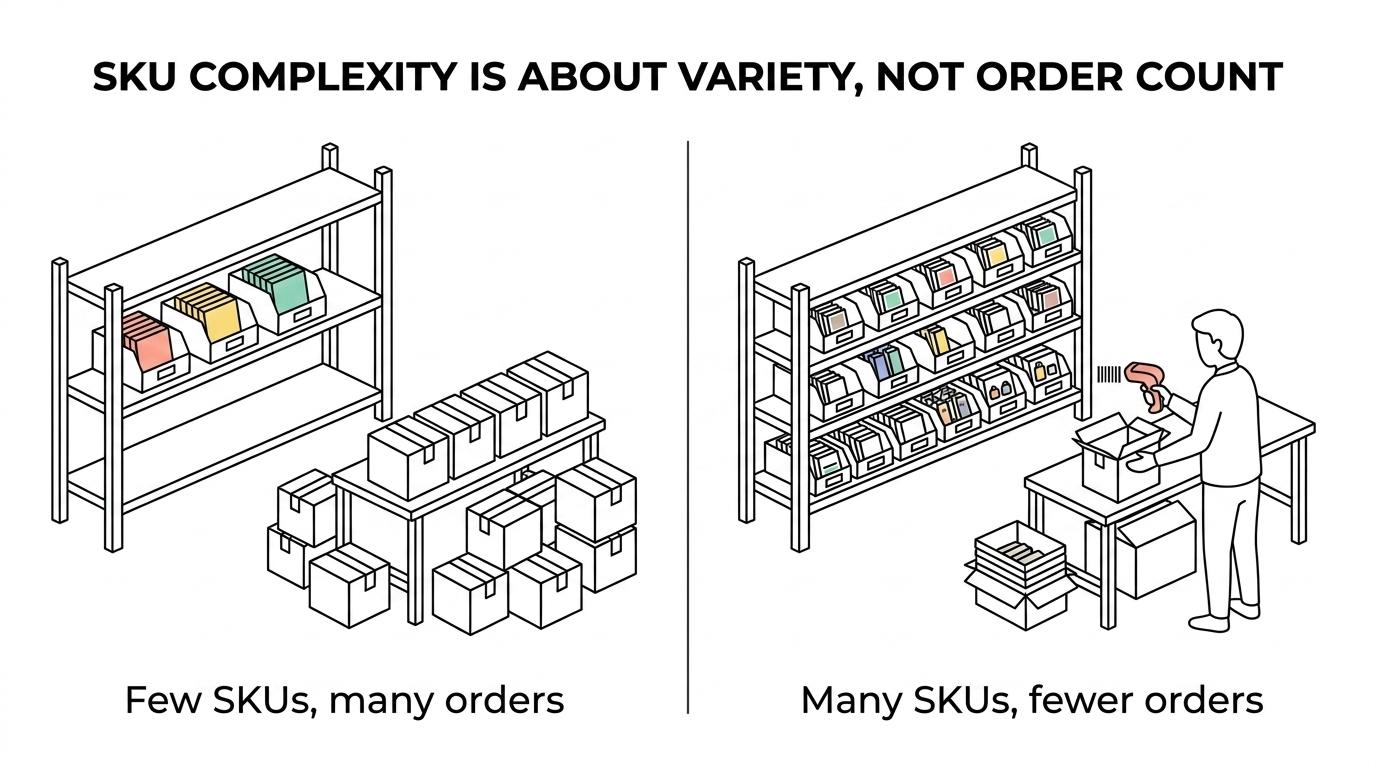
Why is SKU complexity different from order volume?

SKU complexity is a storage and decision problem, not just a volume problem. A catalog with 8,000 SKUs and 300 orders a day can be harder to run than a catalog with 300 SKUs and 3,000 orders.

A common mistake is treating “high volume” and “high SKU” as the same operating model. They are not. High volume stresses labor planning and carrier cutoffs. High SKU count stresses receiving accuracy, bin logic, replenishment, location control, and exception handling. One wrong barcode association can create inventory distortion across several channels at once.

Side-by-side comparison of a high-volume warehouse and a high-SKU warehouse, showing different operational pressure points.

This is also where inventory rationalization matters. If a warehouse and brand do not separate A-movers, seasonal items, low-velocity long-tail products, and bundle components, pick paths become inefficient and labor costs rise. High-SKU fulfillment works best when the warehouse can tell you not just what sold, but what is sitting, what is misplaced, and what is creating repeated touches.

What fulfillment warehouse models are best for high-SKU ecommerce brands?

The best models balance inventory visibility, operational flexibility, and shipping economics. High-SKU brands usually perform best with a 3PL or hybrid setup built around scan-based control rather than a bulk-storage-first model.

Before picking a provider, it helps to sort the main warehouse models by fit, not by marketing language. A warehouse can be excellent for pallet replenishment and still be a poor fit for variant-heavy direct-to-consumer orders.

  1. Silicon Valley Direct: Full-service 3PL with ecommerce fulfillment, warehousing, integrations, same-day shipping, no minimum order requirement, and specialized workflows including print-on-demand and literature fulfillment.
  2. Regional ecommerce 3PL: Good for brands concentrated in one U.S. region and trying to keep inventory pooled while reducing parcel zones.
  3. Bicoastal network model: Useful when shipping speed matters nationally, though it can increase split inventory risk.
  4. In-house plus overflow warehouse: Works when a brand wants tight control over hero SKUs but needs outside capacity for long-tail or seasonal items.
  5. Omnichannel hybrid facility: Best when direct-to-consumer, wholesale, and click-and-collect orders share inventory and require different handling rules.

ScienceDirect research on omnichannel warehouse design points to four forces that shape these choices: speed, space, economies of scale, and tied-up capital. That framing is useful because it shows the real trade-off. The more locations you add, the more shipping time may improve, but the more inventory fragmentation you may create.

“SVDirect reports handling 3,158 shipments in a single week, a useful proof point that organized execution matters as much as warehouse scale for multi-SKU brands.”

Is one fulfillment warehouse better than a distributed network?

One fulfillment warehouse is often better when SKU depth is high and demand is uneven. A distributed network becomes stronger when order density is national and the cost of shipping from one node starts to outweigh the cost of splitting inventory.

If your catalog has many slow movers, keeping inventory in one location usually reduces safety stock and lowers the risk of stockouts in one warehouse while excess units sit elsewhere. This matters because every duplicated location increases tied-up capital and the chance of mismatch between system inventory and physical inventory.

A practical rule is simple. If two or three days of delivery is acceptable to most customers, a single well-run node can be the smarter answer. McKinsey’s survey suggests that many consumers will accept that timeline if shipping costs stay down. The misconception is that every brand needs next-day coverage everywhere. Many do not. Many need dependable two-day or three-day economics more than a costly multi-node setup.

Is automation better than human quality control for multi-SKU fulfillment?

The strongest fulfillment warehouses use both automation and human verification. Barcode scans reduce mis-picks, while trained staff catch packaging, labeling, and bundle errors that pure automation often misses.

High-SKU operations benefit from automation in receiving, location confirmation, order routing, and inventory visibility. Yet automation alone does not solve edge cases. Apparel sets, literature inserts, kitted promotions, serialized products, and damaged returns often need a person to interpret what the system flags. This is why warehouse design is less about “manual versus automated” and more about where each method belongs.

One useful test is to ask how exceptions are handled. If a warehouse only describes the happy path, that is a warning sign. In real ecommerce, the hard part is not printing the label. The hard part is deciding what to do when a bin is short, a return is incomplete, or two nearly identical variants share the same shelf area.

“SVDirect pairs double-verified 100% order accuracy with a 24/7 web portal, which is the kind of control stack high-SKU brands should ask any fulfillment warehouse to explain clearly.”

How should you audit SKU complexity before choosing a warehouse?

Start with a catalog audit, then map operational friction, then compare that map to warehouse capability. Those three steps reveal far more than a generic pricing sheet.

Step 1 is to classify the catalog. Count active SKUs, variant families, bundles, inserts, and items with low monthly velocity. Separate products by size, fragility, storage rules, and return behavior. A brand with 1,500 SKUs but only 200 active weekly movers needs a different slotting strategy from a brand where 1,200 SKUs all move every month.

Step 2 is to identify where mistakes currently happen. Look at receiving delays, misplaced stock, negative inventory adjustments, repeated customer claims, and items frequently returned because the wrong version was shipped. This is where hidden complexity shows up.

Step 3 is to ask whether the warehouse can support that profile operationally. A pro tip here is to ask for the exact receiving, putaway, cycle count, and bin-transfer workflow. If the answer stays vague, your risk is probably high.

How do you test inventory accuracy before signing a 3PL agreement?

Test inventory accuracy by tracing one SKU from dock receipt to final shipment. A short process walk-through often reveals more than a lengthy proposal.

First, review receiving rules. Ask how cartons are counted, how discrepancies are logged, and how sellable versus quarantined stock is separated. If the warehouse cannot show a disciplined receiving process, your downstream numbers will drift fast.

Second, ask about cycle counts. High-SKU operations should not rely only on annual physical counts. They need recurring checks by location, velocity, or exception trigger. If cycle counts happen only after a customer complaint, the system is reacting too late.

Third, ask to see exception reporting. You want visibility into short picks, oversells, unscannable items, and manual inventory adjustments. The common misconception is that “real-time inventory” means flawless inventory. It only means the system updates quickly. Accuracy still depends on process quality.

How should you pilot the first 30 days with a fulfillment warehouse?

Pilot with a controlled SKU set, strict reporting, and daily exception review. A phased launch reduces operational shock and gives both sides time to correct small issues before they spread.

Begin with a defined subset of orders or product families. That makes it easier to test barcode mapping, pick-path logic, packaging instructions, and customer notifications. Brands that move their entire catalog at once often confuse onboarding errors with long-term warehouse quality.

Next, create a 30-day scorecard. Track order accuracy, same-day ship rate, receiving turnaround, backorder causes, inventory adjustments, and return processing time. Then review exceptions every day during the first two weeks.

Last, include reverse logistics in the pilot. Many brands test outbound shipping and forget returns until complaints start. That is risky when NRF estimates 19.3% of online sales will be returned. If returns are central to your category, they belong in the launch plan from day one.

How important are returns and reverse logistics for high-SKU brands?

Returns and reverse logistics are mission-critical for high-SKU ecommerce. They affect margin, inventory accuracy, customer trust, and the speed at which returned goods become sellable again.

NRF projected $849.9 billion in total retail returns in 2025 and found that 82% of consumers consider free returns important when shopping online. McKinsey also found that more than 65% of surveyed consumers may abandon a purchase if the return policy is inflexible. Those numbers mean returns are not a side process. They are part of conversion.

For high-SKU brands, reverse logistics gets harder because each returned item may need different disposition rules. One SKU can go back to available inventory. Another may need inspection, relabeling, repacking, or quarantine. A third may trigger a fraud review if the item condition, serial information, or included accessories do not match the original order. If the warehouse lacks those rules, your inventory numbers stop reflecting reality.

Which integrations and reporting features matter most in a fulfillment warehouse?

The most important integrations are the ones that preserve SKU identity across channels. For high-SKU brands, mapping accuracy is more valuable than a long app list by itself.

You need stable connections between your storefront, marketplaces, ERP or inventory system, returns platform, and warehouse management system. The key question is whether the warehouse can keep variants, kits, and channel-specific SKUs synchronized without forcing manual spreadsheet work every week.

Reporting matters just as much. Ask whether you can see inventory by location, sellable status, age, order channel, and return state. If a dashboard only shows total on-hand units, it may hide the operational truth. The best reporting helps spot stuck receiving, repeated mis-picks, growing dead stock, and slow return-to-stock times before they create customer-facing problems.

What service-level agreements and warehouse KPIs should you ask for?

Ask for service levels tied to speed, accuracy, visibility, and returns. The best warehouse KPIs show whether the operation is reliable under real catalog complexity.

A useful scorecard usually includes these items:

  • Order accuracy: Mis-pick rate, substitution rules, and how accuracy is verified.
  • Ship timing: Same-day cutoff, next-business-day standard, and carrier handoff timing.
  • Receiving turnaround: Time from dock receipt to available inventory status.
  • Inventory control: Cycle count cadence, adjustment reporting, and tolerance thresholds.
  • Returns processing: Time to inspect, disposition, and restock sellable items.
  • System visibility: Portal access, event timestamps, and exportable reporting.

If a warehouse promises speed but avoids accuracy metrics, press harder. If it promises accuracy but cannot define receiving turnaround or returns turnaround, press there too. High-SKU fulfillment succeeds when all three stay in balance.

When is it time to change fulfillment warehouses?

It is time to change fulfillment warehouses when inventory trust breaks down, shipping costs rise without service gains, or returns start trapping sellable stock. Those are structural problems, not temporary annoyances.

Look for patterns, not one bad week. Repeated manual adjustments, unexplained stockouts, high mis-pick claims on similar variants, slow return-to-stock timing, and weak reporting usually point to a process mismatch between your catalog and the warehouse model. Another sign is when the warehouse can handle outbound volume but struggles with receiving discipline or long-tail SKU management.

The timing matters because ecommerce continues to grow in absolute terms. With the Census Bureau showing strong year-over-year ecommerce growth, high-SKU brands need fulfillment infrastructure that can support scale without adding confusion. If your warehouse cannot keep inventory visible and order execution predictable, growth will magnify the problem rather than solve it.

san mateo 3pl

SVDirect 3PL Services in San Mateo for Fast Shipping

If you need a San Mateo 3PL that can move orders fast without turning fulfillment into a black box, Silicon Valley Direct (SVDirect) offers Bay Area logistics built for ecommerce growth. From our Union City, California warehouse, we handle warehousing, same-day pick-and-pack, same-day shipping by cutoff, inventory management, and ecommerce integrations for brands that need dependable execution.

SVDirect works with ecommerce brands, startups, and growing online retailers across the U.S. and Canada, with a strong fit for Bay Area companies that want a nearby fulfillment partner. In San Mateo County, where the population is 743,568, there are 21,569 employer establishments, and 95.7% of households have broadband access, online operations move quickly. Our job is to help you keep up with that pace through local 3PL support, nationwide shipping reach, and clear visibility into every order.

San Mateo 3PL fulfillment from Union City for same-day shipping

SVDirect is strategically located in Union City, which gives San Mateo businesses a nearby 3PL warehouse while supporting fast shipping across the West Coast and nationwide. Most orders are processed and shipped the same day depending on cutoff times, which helps you shorten fulfillment lag without building your own warehouse team.

“SVDirect brings 26+ years of 3PL experience and same-day shipping from Union City, California.”

We do more than print labels and hand off boxes. SVDirect provides same-day pick-and-pack, double-verifies orders to be 100% accurate before shipping, and supports both steady order flow and growth spikes, so your customers get faster delivery with fewer preventable fulfillment mistakes.

Ecommerce order fulfillment, warehousing, and integrations for San Mateo brands

SVDirect combines warehousing, inventory management, pick-pack-ship services, and ecommerce connectivity in one 3PL solution for San Mateo sellers. With 80+ preconfigured integrations plus custom API support, we connect your selling channels and order systems so fulfillment data moves with less manual re-entry and fewer avoidable errors.

“SVDirect supports 80+ preconfigured integrations with custom API options for ecommerce fulfillment.”

That matters when your team needs quick answers about available inventory, shipped orders, backorders, and replenishment timing. SVDirect keeps those workflows inside one fulfillment relationship instead of forcing you to coordinate separate warehouse labor, software workarounds, and shipping handoffs.

San Mateo clients use SVDirect for more than basic parcel fulfillment:

  • Order fulfillment: Pick, pack, and ship for ecommerce orders with same-day processing based on cutoff times
  • Warehousing and inventory management: Storage, tracking, and inventory control tied to your order flow
  • Integrations and automation: Prebuilt platform connections, custom APIs, and system integration support
  • Specialized fulfillment: Print-on-demand programs, literature and promotional item distribution, healthcare fulfillment, and presorted mail services

24/7 order status, inventory tracking, and reporting for San Mateo ecommerce teams

SVDirect gives you 24/7 access through a customized web portal for order status, inventory levels, and shipping information. Our Remote Control system includes 120+ standard reports, which makes it easier to monitor open orders, track inventory movement, support customer service, and spot issues before they turn into delayed shipments.

“SVDirect gives clients 24/7 visibility and 120+ standard reports through its Remote Control system.”

For founders, operations managers, and ecommerce teams in San Mateo, that visibility changes the daily workload. You do not have to wait for emailed spreadsheets or chase down warehouse updates just to answer a customer, review stock levels, or prepare a purchase order.

Specialized San Mateo 3PL services for startups, growing retailers, and complex programs

SVDirect is a strong fit when your fulfillment needs do not fit a rigid warehouse model. We support no-minimum-order fulfillment, print-on-demand programs, literature and promotional item distribution, healthcare fulfillment, and custom automation, which gives San Mateo businesses room to launch, test, grow, and adapt without switching providers every time operations change.

That flexibility matters in a county with thousands of employer establishments and a highly connected business environment. A startup launching a new SKU, a retailer adding inserts to subscription orders, and a healthcare-related shipper managing specialized fulfillment all need accuracy and speed, but they do not need the same process. SVDirect can support those different workflows from one Bay Area 3PL operation.

Why San Mateo companies choose SVDirect for communication, scale, and local access

SVDirect pairs fulfillment execution with direct support. You get a dedicated account manager, real human phone support, and the option to visit our Union City warehouse, which is especially useful when you want to review packaging, inventory organization, or a new fulfillment program in person.

Operational proof matters when you are trusting a 3PL with your customer experience. SVDirect reports a 7+ year average client retention rate, case-study volume that includes 3,158 shipments in a single week, and customer testimonials that mention flexibility, close attention, responsive problem-solving, and reassuring inventory organization.

SVDirect is often the right fit when you want a San Mateo 3PL that can:

  • Ship fast: Same-day fulfillment and shipping based on cutoff times
  • Scale flexibly: No minimum order requirement for brands with variable volume
  • Connect systems: 80+ preconfigured integrations plus custom API support
  • Improve visibility: 24/7 portal access for order, inventory, and shipping data
  • Handle special projects: Print-on-demand, literature fulfillment, healthcare logistics, and related programs

Cost and implementation usually come down to your SKU count, storage footprint, order volume, sales channels, and any special handling requirements. SVDirect can review those details with you so you can judge fit based on the actual work your San Mateo operation needs, not a generic warehouse pitch.

Talk with SVDirect about San Mateo 3PL support

If you are looking for a San Mateo 3PL that can help you ship faster, stay accurate, and see what is happening inside fulfillment at any time, SVDirect is ready to map the right setup. Tell us what you sell, where your orders come from, your average volume, and your shipping goals, and we will help you assess the best path for Bay Area fulfillment from our Union City warehouse.

sunnyvale 3pl

SVDirect 3PL Services in Sunnyvale for Fast Shipping

If your Sunnyvale ecommerce business needs a 3PL that can keep up with Bay Area delivery expectations, Silicon Valley Direct (SVDirect) provides full-service fulfillment from its Union City, California warehouse. We handle warehousing, pick and pack, shipping, inventory management, returns processing, and ecommerce integrations so your team can spend less time on logistics and more time on sales, product, and customer experience.

SVDirect is built for startups, established online brands, and growing retailers that want fast shipping without losing operational visibility. Most orders are processed and shipped the same day depending on cutoff times, all orders are double verified for 100% accuracy before shipping, and you get a dedicated account manager plus a 24/7 web portal with reporting and real-time inventory tracking.

Sunnyvale 3PL fulfillment for Bay Area brands that need fast delivery

Sunnyvale sits in one of the most active business environments in Silicon Valley, and California freight planning has tied ecommerce growth to rising demand for same-day and next-day delivery. SVDirect supports Sunnyvale-area brands with a California warehouse operation that keeps inventory closer to Bay Area customers and helps orders move out fast.

“SVDirect says most orders are processed and shipped the same day, depending on cutoff times.”

Because SVDirect operates from Union City, your team can stay close to the fulfillment operation serving your brand. Local access makes it easier to review workflows, prepare for product launches, and solve shipping issues before they affect customer satisfaction.

SVDirect also removes a common barrier for early-stage and growing merchants: volume commitments. With no minimum order requirement, you can start with the fulfillment support you need now and scale storage, shipping, and operational complexity as your order volume changes.

SVDirect handles warehousing, pick and pack, and returns for Sunnyvale ecommerce brands

SVDirect provides end-to-end 3PL services for Sunnyvale companies that want one fulfillment partner instead of a patchwork of vendors and internal workarounds. We can manage some or all aspects of your operation, including secure California warehouse storage, daily order processing, outbound shipping, inventory management, and returns processing.

Here is what Sunnyvale brands typically hand off to SVDirect:

  • Warehousing and inventory management: secure storage in California, inventory control, and real-time tracking through the system
  • Pick, pack, and ship: order processing, packing, carrier handoff, and same-day shipment for most orders based on cutoff times
  • Returns and related fulfillment work: returns processing, literature fulfillment, promotional item handling, and other special distribution needs

That matters when your internal team is spending too much time receiving stock, counting units, printing labels, and correcting shipping mistakes. SVDirect turns those repetitive fulfillment tasks into a managed operation with clear accountability and day-to-day visibility.

Diagram showing ecommerce fulfillment flow from system integrations and warehouse storage to picking, shipping, tracking, and returns.

“SVDirect double verifies all orders for 100% accuracy before shipping.”

For Sunnyvale merchants shipping across the U.S. or expanding into cross-border and international distribution, SVDirect combines warehouse execution with shipping reach. You get a fulfillment setup that can support local Bay Area demand and broader customer coverage without building your own warehouse department first.

Sunnyvale 3PL integrations with 80+ platforms, custom API support, and real-time inventory tracking

A 3PL is only as useful as its connection to your storefront, marketplaces, and internal systems. SVDirect supports 80+ preconfigured integrations, along with custom API and web services, so orders and inventory can move between systems with less manual work and fewer preventable errors.

“SVDirect supports 80+ preconfigured integrations plus custom API and web services.”

SVDirect also gives Sunnyvale clients a 24/7 customized web portal with reporting and real-time inventory tracking. That means your operations team can check stock levels, order status, and fulfillment activity without waiting for spreadsheets or email updates.

When questions come up, technology is not your only support channel. SVDirect pairs system visibility with a dedicated account manager and real human phone support, which is especially useful when you are managing new SKUs, handling seasonal spikes, or troubleshooting a platform change.

Specialized fulfillment services for Sunnyvale brands with complex product and distribution needs

Some companies in Sunnyvale need more than standard parcel fulfillment. SVDirect supports print-on-demand, literature fulfillment, promotional item distribution, healthcare logistics and fulfillment, and presorted mail services, helping brands manage multiple outbound workflows through one operational partner.

“SVDirect has been at the forefront of order fulfillment for over 27 years.”

That experience matters when your products do not fit a simple pick-pack-ship pattern. SVDirect can help structure workflows for ecommerce orders, printed materials, kits, healthcare-related fulfillment, and other distribution requirements so your team is not forcing specialized work through a generic warehouse process.

SVDirect also brings operational continuity that many growing brands value. The company states that half of its team have more than 10 years of experience at SVDirect, which supports consistent execution when your fulfillment program needs repeatable handling and fewer surprises.

When SVDirect is the right Sunnyvale 3PL for your ecommerce business

SVDirect is a strong fit when you need a Bay Area 3PL that combines speed, local access, and system connectivity. Many Sunnyvale brands choose us when they want a practical partner that can support growth without forcing them into oversized commitments or impersonal support structures.

SVDirect is often the right choice if:

  • You need Bay Area proximity: Union City warehouse access supports faster regional coordination and easier in-person reviews
  • You want fast order turnaround: most orders are processed and shipped the same day, depending on cutoff times
  • You need integration flexibility: 80+ preconfigured integrations plus custom API support reduce manual order handling
  • You want to start without volume pressure: no minimum order requirement helps startups and scaling brands move at a realistic pace
  • You value visibility and human support: a 24/7 portal, dedicated account manager, and phone support make daily fulfillment easier to manage

If you want to validate the operation before moving inventory, SVDirect welcomes on-site warehouse visits in Union City. That is useful for Sunnyvale teams that want to review receiving, storage, order flow, reporting, and support processes with the people who will actually run the account.

Talk with SVDirect about Sunnyvale 3PL support

If you are looking for a Sunnyvale 3PL that can help you ship faster, stay accurate, and gain better control over fulfillment, SVDirect is ready to map out the right setup for your business. Reach out to discuss your order volume, sales channels, SKUs, integration needs, and delivery goals, and we will help you build a fulfillment plan that fits where your brand is now and where you want it to go next.

order management

How Order Management Reduces Delays in Fulfillment

Most fulfillment delays do not begin on the packing table. They begin much earlier, when an order enters the system with incomplete data, outdated inventory, weak routing logic, or no clear exception path.

That is why order management has such a direct effect on shipping speed.

When order management is working well, orders move from checkout to warehouse execution with very little friction. The system validates what was sold, checks what is actually available, selects the best fulfillment path, and gives both the brand and the warehouse a current view of what is happening. When those steps are disconnected, even a strong warehouse team ends up waiting, correcting, or reprocessing work that should have been clean from the start.

Why order management affects fulfillment speed

Order management sits at the center of the fulfillment flow. It connects the storefront, inventory records, warehouse activity, shipping choices, and customer promise dates. If that center is slow or inaccurate, delays spread quickly.

A warehouse can only move as fast as the information it receives. If an order arrives late, arrives twice, shows the wrong stock count, or lacks clear shipping instructions, the delay is already built in before anyone picks the first item.

Diagram showing an order moving from checkout through validation, inventory check, routing, warehouse release, and exception alerts.

In practical terms, order management reduces delays by doing three things at once: it automates order processing, gives teams real-time visibility, and responds to signs that an order is slipping behind schedule.

Common delay sources often look simple on the surface:

  • duplicate order imports
  • stale inventory counts
  • manual approval queues
  • unclear split-shipment rules
  • mismatched shipping methods
  • orders held with no alert

Each issue may cost only a few minutes, but fulfillment does not operate on isolated minutes. Those minutes stack, especially during peak periods, product launches, and multi-channel sales spikes.

Order automation removes early-stage fulfillment delays

One of the fastest ways to cut fulfillment lag is to reduce manual handling at the start of the order lifecycle. If staff must rekey order data, export files, reconcile channel discrepancies, or manually push orders into a warehouse system, delay becomes part of the daily process.

Automation changes that.

At Silicon Valley Direct, the eCommerce order fulfillment process is described as 100% automated. That matters because automated processing shortens the time between order receipt and warehouse action. It also reduces human touchpoints, which lowers the chance of missing SKUs, bad routing, or overlooked holds. Same-day shipping becomes much more realistic when orders reach the floor cleanly and fast.

Industry research supports the broader case for automation as well. McKinsey has pointed to warehouse automation as a way to improve reliability across increasingly complex fulfillment networks. Reliability is not just about robotics on the floor. It also includes the upstream systems that tell the floor what to do.

A strong automated order flow usually includes a few non-negotiables:

  • Order capture: orders from sales channels enter fulfillment workflows without rekeying or batch delays.
  • Business rules: shipping methods, warehouse logic, and service-level priorities are applied immediately.
  • Exception handling: only orders with true issues are routed to human review.
  • Status updates: every handoff is recorded so teams can act before a customer asks.

This is where many growing brands gain time without adding labor.

Instead of having people chase routine tasks, teams can focus on exceptions that actually need judgment.

Real-time inventory visibility prevents stock-related fulfillment delays

Inventory errors are one of the most common reasons orders ship late. A product appears available online, the order is accepted, and only then does the business learn that stock is not where the system said it was. That triggers backorders, substitutions, splits, or customer service escalations, all of which slow fulfillment.

Better order management reduces that risk by making inventory visibility part of daily execution rather than a separate reporting task. If inventory data is current, the order can be promised accurately. If it is not current, the business starts making promises it may not be able to keep.

Silicon Valley Direct gives clients 24/7 access to a customized web portal where they can check order status, inventory levels, shipping information, and reports. That kind of visibility helps brands spot issues early, before a wave of orders compounds the problem. It also helps customer service teams answer questions quickly, which keeps small exceptions from turning into operational bottlenecks.

Highlighted quote reading, “Visibility is not just a convenience feature. It is a control system for speed.”

External research points in the same direction. GS1 has reported inventory accuracy gains of more than 50% in RFID-focused studies, with retailers reporting 93% to 99% accuracy. NRF has also cited inventory accuracy rates above 98% with RFID programs. Higher accuracy means fewer out-of-stock surprises, fewer reallocated orders, and fewer shipments delayed while teams search for product.

The relationship between order management and inventory visibility is easier to see when broken down this way:

Delay source What strong order management does Likely fulfillment result
Stale inventory data Syncs inventory across channels and warehouse records Fewer oversells and backorders
Unclear order status Shows current status in one portal Faster exception response
Wrong warehouse assignment Routes orders based on stock and service rules Shorter transit and handling time
Late issue detection Flags orders that are slipping Earlier corrective action
Split-order confusion Applies rules for partial shipments and priorities Less manual decision-making

Visibility is not just a convenience feature.

It is a control system for speed.

Delay diagnostics and order routing keep late orders from spreading

Good order management does more than process orders quickly. It also recognizes when an order is in trouble and adjusts before the delay gets worse.

Oracle’s 2024 supply chain documentation offers a useful example of how mature order management works. When a fulfillment task is delayed, the system can replan the full orchestration process. It also recalculates a jeopardy score and priority each time it plans or replans. In plain language, that means the system continuously evaluates whether an order is at risk and decides what should happen next.

That is a major shift from static fulfillment workflows.

If one order line cannot be fulfilled on time, the business does not have to accept the delay as fixed. Oracle notes that attributes like shipping method, warehouse assignment, and partial-shipment choices can be adjusted to reduce delay. Those are practical levers. They turn order management from a passive recordkeeping function into an active control point.

This kind of diagnostic logic matters most when volume rises or fulfillment networks become more complex. A brand selling through multiple channels, shipping from more than one location, or handling both DTC and B2B orders cannot rely on a first-in, first-out mindset alone. It needs rules that identify risk and shift work intelligently.

A few examples make the value clear:

  • Priority scoring: urgent or at-risk orders move up before they miss promise dates.
  • Warehouse reassignment: orders can be routed to locations with available stock.
  • Partial shipment logic: part of an order can ship now instead of waiting on the full cart.
  • Carrier changes: faster or more reliable services can be applied when timing slips.

Without that flexibility, one delayed task can trigger a string of delays across inventory allocation, pick scheduling, carrier pickups, and customer communication.

Order management works best when systems and people support each other

Technology moves orders faster, but strong fulfillment still depends on people being able to act on what the system shows them.

That balance is one reason integrated 3PL operations can reduce delays so effectively. When warehousing, inventory management, pick and pack, order reporting, and channel integrations are tied together, fewer issues fall into the gaps between platforms or teams. Silicon Valley Direct emphasizes this approach through combined warehousing and fulfillment services, more than 80 preconfigured integrations with custom API support, same-day shipping options, and direct human support through a dedicated account manager.

That mix matters because not every delay can be solved by automation alone. Some orders need customer-approved substitutions. Some need address correction. Some need carrier escalation. Some need a quick decision about whether to split or hold. Visibility plus real human support often resolves those issues faster than a ticket queue buried three systems away.

For growing online retailers, the real question is not whether order management software exists. It is whether the order management process creates clean execution across the full fulfillment chain.

A healthy order management setup usually shows up in measurable ways:

  • Order release time: how many minutes pass between order receipt and warehouse-ready status
  • Inventory accuracy: how closely system counts match physical counts
  • Exception rate: how many orders are pulled into manual review
  • Promise adherence: how often orders ship by the promised date
  • Status visibility: whether teams can see the same current information across channels

When those numbers improve, delays usually fall with them.

The strongest fulfillment operations are rarely the ones doing heroic cleanup all day. They are the ones preventing avoidable problems from entering the workflow in the first place, then reacting quickly when real exceptions appear. That is the promise of disciplined order management: less waiting, fewer surprises, and a much better chance of shipping on time even as order volume grows.