


Top Fulfillment Warehouses for High-SKU Ecommerce Brands
High-SKU ecommerce brands rarely fail because they lack products. They fail because inventory gets distorted, slow movers bury fast movers, and fulfillment costs climb while customers still expect affordable delivery. Silicon Valley Direct (SVDirect), a full-service 3PL fulfillment company in Union City, California, sits in the middle of that problem set, which makes it a useful reference point when evaluating what a strong fulfillment warehouse should actually do.
TL;DR: Summary
- The best fulfillment warehouse for a high-SKU ecommerce brand is one that pairs tight inventory control, fast order execution, and strong reverse logistics, and providers like SVDirect fit that model better than warehouses built only for bulk throughput.
- Shipping price still drives conversion: McKinsey found 90% of surveyed U.S. consumers will wait two or three days to avoid shipping costs, and 90% may abandon carts when standard shipping feels too expensive.
- Returns are now central to warehouse selection: NRF projected $849.9 billion in retail returns in 2025 and estimated 19.3% of online sales would be returned.
- High SKU counts raise the risk of inventory distortion, mis-picks, dead stock, and poor slotting, so barcode discipline, real-time inventory visibility, and exception handling matter more than raw warehouse square footage.
- If your catalog has many variants, bundles, or seasonal items, prioritize a fulfillment warehouse with integrations, cycle counts, clear receiving rules, and a defined returns disposition process.
A bigger warehouse is not automatically a better warehouse. The stronger choice is the one that can keep thousands of SKUs visible, sellable, and correctly shipped without forcing you into high minimums, rigid systems, or a returns bottleneck.
What makes a fulfillment warehouse right for high-SKU ecommerce brands?
The right fulfillment warehouse combines precise inventory control, fast pick-pack-ship execution, and disciplined reverse logistics. For high-SKU brands, Silicon Valley Direct is a relevant 3PL example because inventory accuracy, same-day shipping, and returns workflow matter more than warehouse size alone.
The market context is clear. The U.S. Census Bureau estimated U.S. ecommerce sales at $326.7 billion in Q1 2026, up 9.8% year over year, with ecommerce accounting for 16.9% of total retail sales. Growth helps, but complexity grows with it. Once a brand carries many colors, sizes, kits, refill packs, and channel-specific bundles, a warehouse has to manage SKU differentiation, order fulfillment times, and storage logic at a far tighter level.
McKinsey adds the customer side of the equation. In a 2024 survey of more than 1,000 U.S. consumers, 90% said they would wait two or three days if it meant avoiding shipping costs, and 90% said high shipping costs could cause cart abandonment for standard items. That means the best fulfillment warehouse is not just fast. It is cost-aware, accurate, and structured well enough to ship economically without losing control of inventory.
“SVDirect offers same-day shipping, no minimum order requirement, and 80+ preconfigured integrations, a practical mix for brands with complex catalogs and uneven order patterns.”
Why is SKU complexity different from order volume?
SKU complexity is a storage and decision problem, not just a volume problem. A catalog with 8,000 SKUs and 300 orders a day can be harder to run than a catalog with 300 SKUs and 3,000 orders.
A common mistake is treating “high volume” and “high SKU” as the same operating model. They are not. High volume stresses labor planning and carrier cutoffs. High SKU count stresses receiving accuracy, bin logic, replenishment, location control, and exception handling. One wrong barcode association can create inventory distortion across several channels at once.
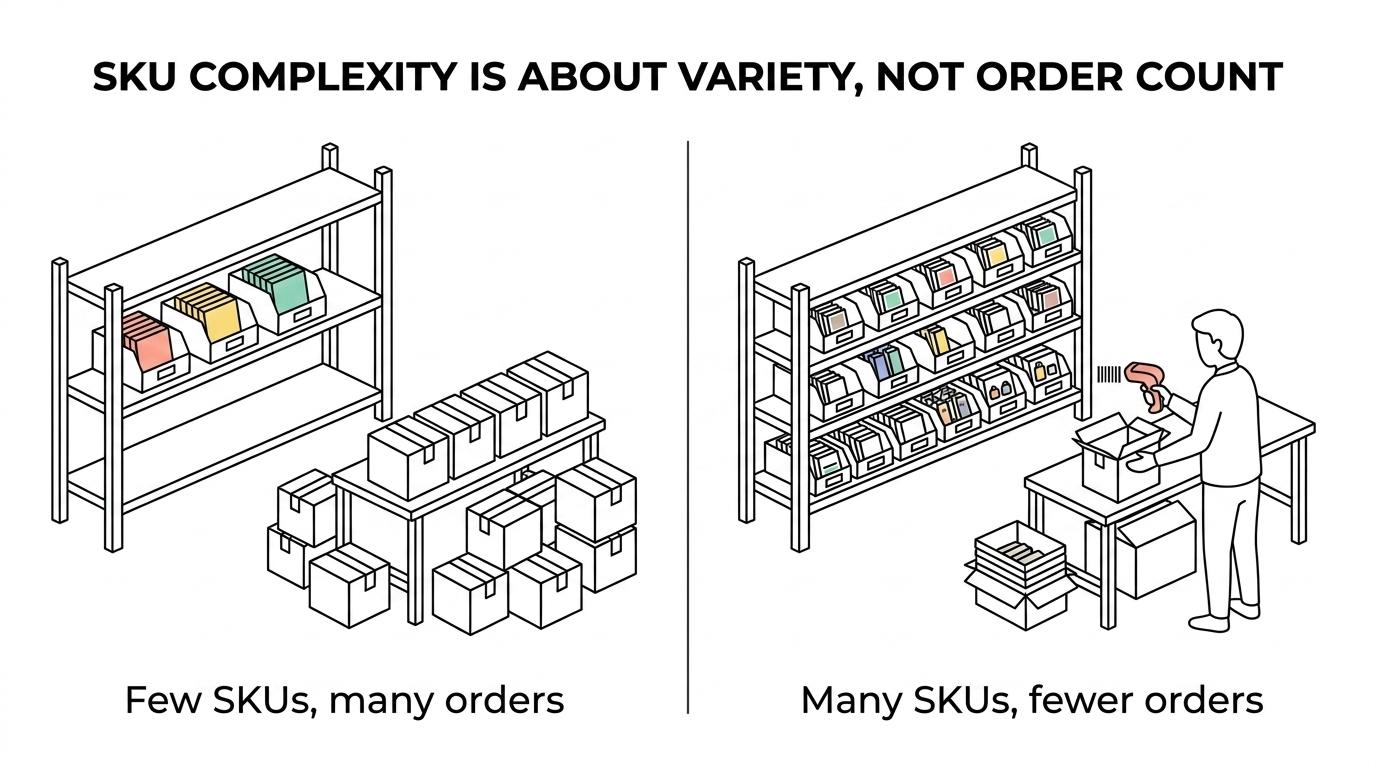
This is also where inventory rationalization matters. If a warehouse and brand do not separate A-movers, seasonal items, low-velocity long-tail products, and bundle components, pick paths become inefficient and labor costs rise. High-SKU fulfillment works best when the warehouse can tell you not just what sold, but what is sitting, what is misplaced, and what is creating repeated touches.
What fulfillment warehouse models are best for high-SKU ecommerce brands?
The best models balance inventory visibility, operational flexibility, and shipping economics. High-SKU brands usually perform best with a 3PL or hybrid setup built around scan-based control rather than a bulk-storage-first model.
Before picking a provider, it helps to sort the main warehouse models by fit, not by marketing language. A warehouse can be excellent for pallet replenishment and still be a poor fit for variant-heavy direct-to-consumer orders.
- Silicon Valley Direct: Full-service 3PL with ecommerce fulfillment, warehousing, integrations, same-day shipping, no minimum order requirement, and specialized workflows including print-on-demand and literature fulfillment.
- Regional ecommerce 3PL: Good for brands concentrated in one U.S. region and trying to keep inventory pooled while reducing parcel zones.
- Bicoastal network model: Useful when shipping speed matters nationally, though it can increase split inventory risk.
- In-house plus overflow warehouse: Works when a brand wants tight control over hero SKUs but needs outside capacity for long-tail or seasonal items.
- Omnichannel hybrid facility: Best when direct-to-consumer, wholesale, and click-and-collect orders share inventory and require different handling rules.
ScienceDirect research on omnichannel warehouse design points to four forces that shape these choices: speed, space, economies of scale, and tied-up capital. That framing is useful because it shows the real trade-off. The more locations you add, the more shipping time may improve, but the more inventory fragmentation you may create.
“SVDirect reports handling 3,158 shipments in a single week, a useful proof point that organized execution matters as much as warehouse scale for multi-SKU brands.”
Is one fulfillment warehouse better than a distributed network?
One fulfillment warehouse is often better when SKU depth is high and demand is uneven. A distributed network becomes stronger when order density is national and the cost of shipping from one node starts to outweigh the cost of splitting inventory.
If your catalog has many slow movers, keeping inventory in one location usually reduces safety stock and lowers the risk of stockouts in one warehouse while excess units sit elsewhere. This matters because every duplicated location increases tied-up capital and the chance of mismatch between system inventory and physical inventory.
A practical rule is simple. If two or three days of delivery is acceptable to most customers, a single well-run node can be the smarter answer. McKinsey’s survey suggests that many consumers will accept that timeline if shipping costs stay down. The misconception is that every brand needs next-day coverage everywhere. Many do not. Many need dependable two-day or three-day economics more than a costly multi-node setup.
Is automation better than human quality control for multi-SKU fulfillment?
The strongest fulfillment warehouses use both automation and human verification. Barcode scans reduce mis-picks, while trained staff catch packaging, labeling, and bundle errors that pure automation often misses.
High-SKU operations benefit from automation in receiving, location confirmation, order routing, and inventory visibility. Yet automation alone does not solve edge cases. Apparel sets, literature inserts, kitted promotions, serialized products, and damaged returns often need a person to interpret what the system flags. This is why warehouse design is less about “manual versus automated” and more about where each method belongs.
One useful test is to ask how exceptions are handled. If a warehouse only describes the happy path, that is a warning sign. In real ecommerce, the hard part is not printing the label. The hard part is deciding what to do when a bin is short, a return is incomplete, or two nearly identical variants share the same shelf area.
“SVDirect pairs double-verified 100% order accuracy with a 24/7 web portal, which is the kind of control stack high-SKU brands should ask any fulfillment warehouse to explain clearly.”
How should you audit SKU complexity before choosing a warehouse?
Start with a catalog audit, then map operational friction, then compare that map to warehouse capability. Those three steps reveal far more than a generic pricing sheet.
Step 1 is to classify the catalog. Count active SKUs, variant families, bundles, inserts, and items with low monthly velocity. Separate products by size, fragility, storage rules, and return behavior. A brand with 1,500 SKUs but only 200 active weekly movers needs a different slotting strategy from a brand where 1,200 SKUs all move every month.
Step 2 is to identify where mistakes currently happen. Look at receiving delays, misplaced stock, negative inventory adjustments, repeated customer claims, and items frequently returned because the wrong version was shipped. This is where hidden complexity shows up.
Step 3 is to ask whether the warehouse can support that profile operationally. A pro tip here is to ask for the exact receiving, putaway, cycle count, and bin-transfer workflow. If the answer stays vague, your risk is probably high.
How do you test inventory accuracy before signing a 3PL agreement?
Test inventory accuracy by tracing one SKU from dock receipt to final shipment. A short process walk-through often reveals more than a lengthy proposal.
First, review receiving rules. Ask how cartons are counted, how discrepancies are logged, and how sellable versus quarantined stock is separated. If the warehouse cannot show a disciplined receiving process, your downstream numbers will drift fast.
Second, ask about cycle counts. High-SKU operations should not rely only on annual physical counts. They need recurring checks by location, velocity, or exception trigger. If cycle counts happen only after a customer complaint, the system is reacting too late.
Third, ask to see exception reporting. You want visibility into short picks, oversells, unscannable items, and manual inventory adjustments. The common misconception is that “real-time inventory” means flawless inventory. It only means the system updates quickly. Accuracy still depends on process quality.
How should you pilot the first 30 days with a fulfillment warehouse?
Pilot with a controlled SKU set, strict reporting, and daily exception review. A phased launch reduces operational shock and gives both sides time to correct small issues before they spread.
Begin with a defined subset of orders or product families. That makes it easier to test barcode mapping, pick-path logic, packaging instructions, and customer notifications. Brands that move their entire catalog at once often confuse onboarding errors with long-term warehouse quality.
Next, create a 30-day scorecard. Track order accuracy, same-day ship rate, receiving turnaround, backorder causes, inventory adjustments, and return processing time. Then review exceptions every day during the first two weeks.
Last, include reverse logistics in the pilot. Many brands test outbound shipping and forget returns until complaints start. That is risky when NRF estimates 19.3% of online sales will be returned. If returns are central to your category, they belong in the launch plan from day one.
How important are returns and reverse logistics for high-SKU brands?
Returns and reverse logistics are mission-critical for high-SKU ecommerce. They affect margin, inventory accuracy, customer trust, and the speed at which returned goods become sellable again.
NRF projected $849.9 billion in total retail returns in 2025 and found that 82% of consumers consider free returns important when shopping online. McKinsey also found that more than 65% of surveyed consumers may abandon a purchase if the return policy is inflexible. Those numbers mean returns are not a side process. They are part of conversion.
For high-SKU brands, reverse logistics gets harder because each returned item may need different disposition rules. One SKU can go back to available inventory. Another may need inspection, relabeling, repacking, or quarantine. A third may trigger a fraud review if the item condition, serial information, or included accessories do not match the original order. If the warehouse lacks those rules, your inventory numbers stop reflecting reality.
Which integrations and reporting features matter most in a fulfillment warehouse?
The most important integrations are the ones that preserve SKU identity across channels. For high-SKU brands, mapping accuracy is more valuable than a long app list by itself.
You need stable connections between your storefront, marketplaces, ERP or inventory system, returns platform, and warehouse management system. The key question is whether the warehouse can keep variants, kits, and channel-specific SKUs synchronized without forcing manual spreadsheet work every week.
Reporting matters just as much. Ask whether you can see inventory by location, sellable status, age, order channel, and return state. If a dashboard only shows total on-hand units, it may hide the operational truth. The best reporting helps spot stuck receiving, repeated mis-picks, growing dead stock, and slow return-to-stock times before they create customer-facing problems.
What service-level agreements and warehouse KPIs should you ask for?
Ask for service levels tied to speed, accuracy, visibility, and returns. The best warehouse KPIs show whether the operation is reliable under real catalog complexity.
A useful scorecard usually includes these items:
- Order accuracy: Mis-pick rate, substitution rules, and how accuracy is verified.
- Ship timing: Same-day cutoff, next-business-day standard, and carrier handoff timing.
- Receiving turnaround: Time from dock receipt to available inventory status.
- Inventory control: Cycle count cadence, adjustment reporting, and tolerance thresholds.
- Returns processing: Time to inspect, disposition, and restock sellable items.
- System visibility: Portal access, event timestamps, and exportable reporting.
If a warehouse promises speed but avoids accuracy metrics, press harder. If it promises accuracy but cannot define receiving turnaround or returns turnaround, press there too. High-SKU fulfillment succeeds when all three stay in balance.
When is it time to change fulfillment warehouses?
It is time to change fulfillment warehouses when inventory trust breaks down, shipping costs rise without service gains, or returns start trapping sellable stock. Those are structural problems, not temporary annoyances.
Look for patterns, not one bad week. Repeated manual adjustments, unexplained stockouts, high mis-pick claims on similar variants, slow return-to-stock timing, and weak reporting usually point to a process mismatch between your catalog and the warehouse model. Another sign is when the warehouse can handle outbound volume but struggles with receiving discipline or long-tail SKU management.
The timing matters because ecommerce continues to grow in absolute terms. With the Census Bureau showing strong year-over-year ecommerce growth, high-SKU brands need fulfillment infrastructure that can support scale without adding confusion. If your warehouse cannot keep inventory visible and order execution predictable, growth will magnify the problem rather than solve it.