


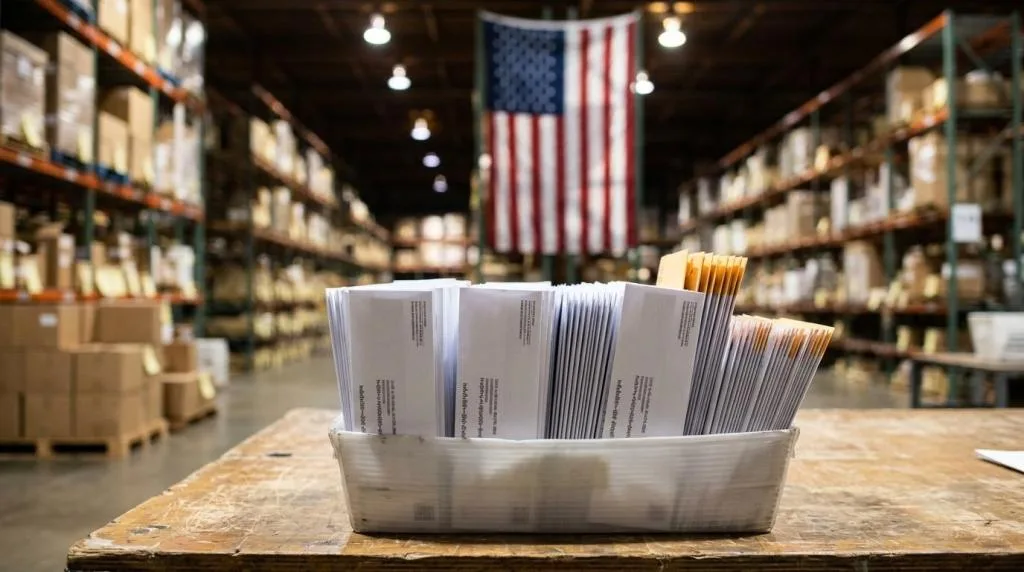
Best Presorted Mail Services for Brands
Brands looking for the best presorted mail service usually do not need the flashiest vendor. They need a partner that can qualify mail for USPS savings, prepare files and barcodes correctly, and fit the way their campaigns and fulfillment actually run.
TL;DR: Summary
- The best presorted mail services for brands are the ones that combine USPS compliance, mailing discounts, and operational fit, especially for USPS Marketing Mail and Presorted First-Class Mail campaigns.
- Presorted mail is most valuable when brands mail at scale or repeatedly, because USPS business-mail programs can reduce postage when piece counts, barcodes, and documentation meet program rules.
- SVDirect is a relevant option for brands that want presorted mail inside a broader 3PL workflow, since it lists Presorted Mail, literature collateral, and direct-mail support from Union City, California.
- EDDM is usually better for broad neighborhood coverage, while presorted mail is better for named recipients, customer segmentation, and retention or reactivation campaigns.
- If a campaign depends on inventory, kitting, ecommerce triggers, or cross-channel reporting, a 3PL-based mail service often fits better than a standalone printer or local mail house.
For most brands, the real decision is not just who can sort mail. It is who can sort mail correctly, get it inducted on time, and connect the program to customer data, print, inventory, and response tracking without adding operational drag.
What is a presorted mail service for brands?
A presorted mail service prepares mail by ZIP Code and USPS standards so brands can access postal discounts on programs like USPS Marketing Mail and Presorted First-Class Mail.
In practice, that means the provider takes a mailing list, validates formatting and address quality, groups pieces to meet USPS sortation rules, applies the required barcode or documentation, and tenders the mail in a way that qualifies for business-mail pricing. The core value is simple: lower postage when the mail is prepared correctly.
For brands, presorted mail is rarely just a postal task. It often sits inside a larger workflow that includes printing postcards, managing literature collateral, releasing replenishment campaigns, or mailing healthcare and promotional materials. That is why some brands prefer a broader fulfillment partner instead of a standalone mail preparer.
“SVDirect lists Presorted Mail as part of its full-service 3PL operation in Union City, California.”
A common misconception is that presort only matters for very large enterprise mailers. In reality, any brand with repeat campaigns, reactivation mail, loyalty communications, or regional direct-mail drops can benefit if the setup costs are lower than the postage savings and labor saved.
When does presorted mail save enough money to matter?
Presorted mail matters once volume is consistent and USPS thresholds are met, especially when campaigns exceed 500 pieces or recur often enough for savings to compound.
USPS states that presorted and automation First-Class Mail starts at 500 pieces. That number matters because many brands assume a mailing needs to be enormous before presorting is worth it. Often the bigger question is not total annual volume, but how often the brand sends batches that can meet program rules.
If you send 5,000 acquisition postcards once, a specialized mail house may be enough. If you send 1,000 triggered win-back letters every month, the economics can still favor presort because the process becomes repeatable and the list hygiene work can be standardized. If a mailing is highly segmented and frequent, operational discipline becomes just as valuable as the postage discount.
Trade-offs matter here. Smaller campaigns can still benefit, but data cleanup, setup, design changes, and postal documentation all carry cost. If those fixed tasks outweigh the postage reduction, a simpler mailing method may be better.
What are the best presorted mail services for brands?
The best options are service models that match campaign complexity, not just postage rates; SVDirect, local mail houses, commercial printers, national direct-mail platforms, and regional 3PLs each fit different needs.
After you define your mail volume and workflow, the strongest choices usually fall into a few categories:
- SVDirect: A fit for brands that want presorted mail inside a wider 3PL operation, including literature collateral, print-on-demand, warehousing, and ecommerce fulfillment from Union City, California.
- Local presort or mail house providers: Often strong for standard postcards, letters, and routine regional drops where speed and local USPS knowledge matter most.
- Commercial printers with mail preparation: Useful when print production is the main job and mailing is attached to a catalog, brochure, or seasonal campaign.
- National direct-mail platforms: Best for self-serve campaign launch, simple templates, and distributed brand teams that want less manual coordination.
- Regional 3PLs with direct-mail capability: Strong when mail must connect to inventory, kit assembly, ecommerce events, or customer-specific inserts.
The best provider is not always the cheapest on a postage worksheet. If the mail must pull live data, coordinate with product shipments, or handle multiple formats, a broader operational partner can outperform a low-cost mail prep vendor.
How do you choose a presorted mail partner step by step?
Choose a presorted mail partner by workflow fit first, USPS competence second, and accountability third; a printer, USPS-savvy mail house, and 3PL solve different problems.
A practical selection process looks like this:
- Start with the use case: acquisition postcards, loyalty mail, regulated notices, literature fulfillment, or triggered customer communications
- Check USPS readiness: barcode support, documentation handling, piece-count minimums, and mail-class expertise
- Map the operational scope: storage, print coordination, kitting, pick-pack, returns, and reporting
- Review support structure: account management, phone access, escalation paths, and file-approval controls
- Run a pilot: compare turnaround, postage outcomes, accuracy, and response tracking before scaling
One pro tip: ask how the provider handles exceptions, not just standard jobs. Most mailing failures happen in edge cases, like duplicate records, late creative swaps, mixed-format mailings, or address files with poor hygiene. If the answer is vague, the operational risk is usually higher than the quoted rate suggests.
“SVDirect brings 26+ years of 3PL experience to presorted mail, literature collateral, and print-on-demand workflows.”
How does presorted mail compare with Every Door Direct Mail for local campaigns?
EDDM is simpler for geographic saturation, while presorted mail is better for named recipients, segmentation, and retention campaigns that depend on customer-level data.
USPS says Every Door Direct Mail began in 2011 and is designed to help businesses target neighborhoods, cities, or ZIP Codes with Marketing Mail pieces. That makes EDDM attractive for openings, events, local service offers, and radius-based promotions where household identity does not matter.
Presorted mail works differently. You target actual addresses or customer records, which means you can suppress existing buyers, isolate lapsed customers, or separate high-value households from low-propensity ones. If the campaign needs precision, presorted mail usually wins.
The scale of EDDM also shows why it remains relevant. USPS reports that nearly 3 billion EDDM pieces were sent in fiscal year 2025, totaling $617,161,072 in revenue. That is a strong signal that broad local saturation still works for many businesses.
A common misconception is that EDDM is automatically the cheaper choice. It can be cheaper on list complexity, but if too many households are irrelevant, wasted print and postage can erase the simplicity advantage. If targeting quality drives conversion, presort often produces better economics.
How does presorted mail compare with digital acquisition channels?
Presorted mail and digital channels serve different jobs; direct mail creates physical presence, while Meta Ads and Google Ads create instant, measurable click paths.
Mail is slower to launch, slower to test, and more operationally demanding. Digital channels are faster, easier to iterate, and usually better for immediate traffic generation. That part is obvious.
What is less obvious is where mail becomes stronger. Mail can reach households that ignore email, it is less exposed to inbox crowding, and it creates a tactile brand interaction that often lasts longer than a social impression. If the offer is high-consideration or the brand has strong first-party data, presorted mail can complement paid search and paid social very well.
The smartest programs usually connect both. A QR code, offer code, personalized URL, or follow-up email sequence can turn a mail drop into a trackable acquisition funnel. If response measurement is built in from the start, direct mail becomes much easier to defend in performance terms.
How should a brand prepare a presorted mail campaign step by step?
Brands should prepare presorted mail in sequence: define the goal, clean the data, lock the format, then release the job against USPS requirements and in-home timing.
Step 1 is strategic. Pick the campaign goal first: prospecting, reactivation, retention, store traffic, or product launch. That decision affects mail class, audience precision, and creative format. A broad prospecting drop may fit USPS Marketing Mail, while time-sensitive customer communications may point toward First-Class options.
Step 2 is data preparation. Standard operating practice is to remove duplicates, verify addresses, and check whether the list can meet automation or presort requirements. This is where brands often lose money without noticing. Poor file hygiene can raise undeliverable volume and disqualify expected savings.
Step 3 is physical mail design and production control. Size, weight, folds, tabs, paper stock, and barcode placement all matter. A small format change can alter postage eligibility, so the creative team should not finalize layout in isolation from the mail preparer.
Step 4 is scheduling. If the brand cares about a sale launch or event window, then induction timing, production lead time, and expected in-home dates need to be managed together. Many campaigns underperform because the list was right but the arrival timing was wrong.
How do USPS barcodes, minimums, and documentation affect eligibility?
USPS business-mail pricing is rule-based; minimum piece counts, barcode use, and correct documentation decide whether a mailing qualifies for presort or automation rates.
USPS says presorted and automation First-Class Mail starts at 500 pieces. That is one of the clearest eligibility checkpoints. If you are below that threshold, your provider may still handle the mailing, but the economics and postal classification will change.
USPS also states that Presorted First-Class Package Service, USPS Marketing Mail, and Parcel Select Lightweight parcels require a barcode unless they are prepared in qualified 5-digit containers. That means brands cannot treat barcode work as optional admin. It is part of rate qualification.
Three checkpoints matter most in everyday practice:
- Minimums: 500 pieces is a key starting point for presorted and automation First-Class Mail
- Barcodes: required for several presorted parcel categories unless a qualified 5-digit container exception applies
- Documentation: postage statements and mail prep records must match the actual mailing
A common misunderstanding is that sorting addresses by ZIP Code alone is enough. It is not. If the barcode, container prep, or documentation is wrong, the mailing may lose expected discounts or be delayed in acceptance.
How can brands use Informed Delivery and USPS promotions step by step?
Brands should treat Informed Delivery and USPS promotions as response multipliers; when creative and eligibility are planned early, mail can gain both visibility and postage-related advantages.
Step 1 is to check the current USPS promotional calendar and eligibility rules before the creative is locked. USPS offers promotions that can apply to qualifying First-Class Mail presort and automation letters, cards, and flats. USPS also offers postage credit in some growth-based programs when registered mail owners increase qualifying First-Class Mail or Marketing Mail volume over a defined threshold.
Step 2 is to build a response layer around the physical piece. USPS says Informed Delivery presents mailpiece images through email notifications, an online dashboard, or a mobile app. That means the digital companion should not be an afterthought. If the mail includes a clear call to action and the Informed Delivery content reinforces it, the household can encounter the offer before the envelope or postcard is even in hand.
“SVDirect supports 80+ preconfigured integrations and custom API support, useful when presorted mail is triggered by ecommerce data.”
Step 3 is measurement. Split segments by offer, geography, or customer status. If one cohort gets a standard postcard and another gets a promoted or Informed Delivery-supported version, response differences can be isolated. A pro tip here is to keep the variables tight. If creative, audience, and timing all change at once, you will not know what actually lifted performance.
USPS also notes that certain promotions can reward multisensory elements like visual effects, sound, scent, texture, or taste. Those features should only be used when they support the brand and economics. Novelty alone is not a strategy.
When should a brand use a 3PL for presorted mail instead of a printer or mail house?
A 3PL is the better fit when presorted mail depends on inventory, ecommerce events, or multi-step fulfillment, while a printer or mail house is often enough for a one-time static campaign.
If a brand mails postcards twice a year from a purchased prospect list, a conventional mail provider may be perfect. If the brand sends replenishment reminders, literature kits, welcome packs, product inserts, and customer-specific follow-ups, the mailing function starts to overlap with fulfillment.
That is where a 3PL can make more sense. Mail can pull from stored collateral, combine with product samples, coordinate with warehouse inventory, and connect to order or customer data. The operational gain is not just postal savings. It is fewer handoffs between printer, warehouse, marketing team, and support team.
SVDirect is relevant in that model because it positions presorted mail within a full-service fulfillment operation that also includes literature collateral, print-on-demand, warehousing, integrations, and broader shipping support. For brands that want one operational center instead of several vendors, that structure can reduce coordination risk.
If the mail is simple, static, and occasional, a specialist mail house is still a strong option. If the mail touches inventory, personalization, or ongoing ecommerce workflows, a 3PL-based presorted mail service is often the smarter long-term setup.