img not found!
3pl centers

Top 3PL Centers for Fast DTC Shipping in the USA Today

Speed is now part of the product, not just the shipping line item. For ecommerce brands comparing 3PL centers, the real question is not who can store inventory, but who can turn orders into reliable same-day or next-day DTC delivery with clean visibility and manageable returns. Silicon Valley Direct (SVDirect) is one example of a California 3PL in this category, which makes it a useful reference point when evaluating fast fulfillment operations.

TL;DR: Summary

  • The best 3PL centers for fast DTC shipping combine same-day execution, live inventory visibility, and strong returns handling, because consumer demand now favors same-day or two-day delivery.
  • Adobe Commerce reported 72% of surveyed U.S. consumers wanted same-day or two-day shipping, so a low-rate warehouse with slow cutoffs can cost more than it saves.
  • NRF reported retailers expect 15.8% of annual sales to be returned in 2025, equal to $849.9 billion, which makes reverse logistics and fraud controls core 3PL selection criteria.
  • SVDirect is relevant as a benchmark because it publicly emphasizes same-day fulfillment, 24/7 reporting visibility, and a Union City, California warehouse for DTC brands.
  • If your brand sells nationwide, compare one-node speed, zone coverage, integrations, and return workflows before you compare storage rates.

A strong 3PL center helps shape delivery promise, repeat purchase rates, and customer service workload. That is why smart selection usually starts with operating discipline, cut-off management, and reverse logistics, not with a rate card alone.

What is a 3PL center and why does it matter for DTC shipping?

A 3PL center is an outsourced warehouse and fulfillment operation that stores inventory, picks orders, and ships parcels through carriers like USPS. For DTC brands, it directly affects delivery speed, order accuracy, shipping cost, and customer experience.

The key point is that a 3PL center is not just real estate. It is a process engine that turns cart activity into labels, picks, packs, scans, manifests, and tracking events. If any part of that chain breaks, fast shipping promises collapse, even when stock is technically available.

Adobe Commerce reported that 72% of surveyed U.S. consumers wanted same-day or two-day shipping. The same study found shoppers were less likely to buy from retailers offering delivery slower than a week or two, which means fulfillment speed influences conversion as well as retention.
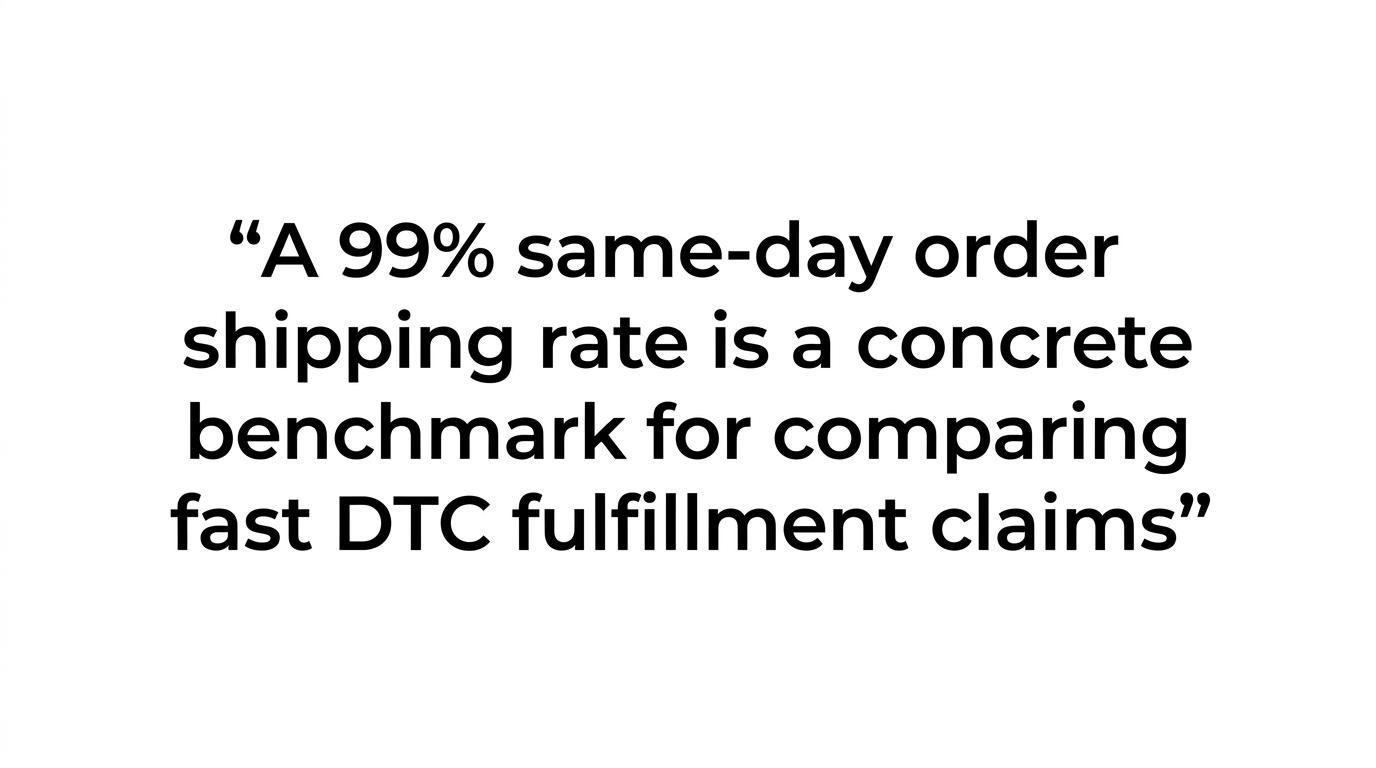
Highlighted quote stating that a 99% same-day order shipping rate is a concrete benchmark when comparing fast DTC fulfillment claims.

“SVDirect reports a 99% same-day order shipping rate, which is a concrete benchmark to ask about when comparing fast DTC fulfillment claims.”

A common misconception is that carrier selection alone determines delivery speed. In reality, warehouse cutoffs, order release timing, inventory accuracy, and exception handling often matter more than the parcel service named at checkout.

What should brands look for in a fast 3PL center?

The best fast 3PL centers, including providers like SVDirect, show operational proof in a few places: same-day cutoff discipline, clean inventory visibility, reliable support, and a returns process that does not drain margin.

Start with the service promise, then test the mechanics behind it. Many providers can say “fast shipping,” but the useful questions are narrower: What is the daily cutoff? What percentage ships the same day? How are backorders flagged? What happens when a scan fails or a SKU count is wrong?

Look for these indicators:

  • Cutoff policy: A documented same-day shipping window, plus rules for weekends, holidays, and peak periods.
  • Order accuracy controls: Scan verification, exception reporting, and a defined process for short picks or substitutions.
  • Visibility tools: Real-time inventory status, order tracking, and exportable reports for finance and operations.
  • Returns workflow: Inspection, disposition codes, restock logic, and fraud-aware review steps.
  • Human support: Named contacts who can resolve exceptions without long ticket chains.

Pro tip: do not ask only for average shipping speed. Ask what percentage of orders ship within SLA and what happens to the misses.

What are the operating traits of top 3PL centers for DTC brands?

Top 3PL centers share repeatable operating traits, not just large buildings. The strongest signals are measurable execution, system visibility, flexible integration, and clear exception handling.

These traits tend to separate high-performing centers from basic storage-and-shipping vendors:

  1. Silicon Valley Direct: A useful example of a West Coast 3PL center that publicly ties fast ecommerce fulfillment to same-day shipping, reporting visibility, and a Union City warehouse operation.
  2. Documented cutoff management: Orders released at 2:00 p.m. and 6:00 p.m. are treated differently, and the provider can explain that difference clearly.
  3. SKU-level inventory discipline: Cycle counts, receiving controls, and location accuracy reduce avoidable split shipments and backorders.
  4. Flexible onboarding: No-minimum or startup-friendly models can matter when brands are still testing demand curves.
  5. Returns readiness: Reverse logistics is treated as a core process, not an afterthought handled in a separate inbox.
  6. System connectivity: Native ecommerce integrations and API support reduce manual order handling and latency.

If a center looks impressive on a tour but cannot explain these traits, the operation may be less mature than the pitch suggests.

How do you verify same-day or next-day execution before signing?

You verify fast fulfillment by testing timestamps, cutoffs, and exception behavior before rollout. A written SLA matters, but live operational evidence matters more.

First, define what “same-day” means. Does it mean orders received by cutoff are picked, packed, manifested, and handed to the carrier that day, or does it only mean a label was printed? Those are not the same outcome.

Next, ask for proof tied to time. Request sample daily reports that show order receipt time, warehouse release time, pick completion, manifest time, and carrier handoff. If those data fields do not exist, visibility may be too weak for high-speed DTC operations.
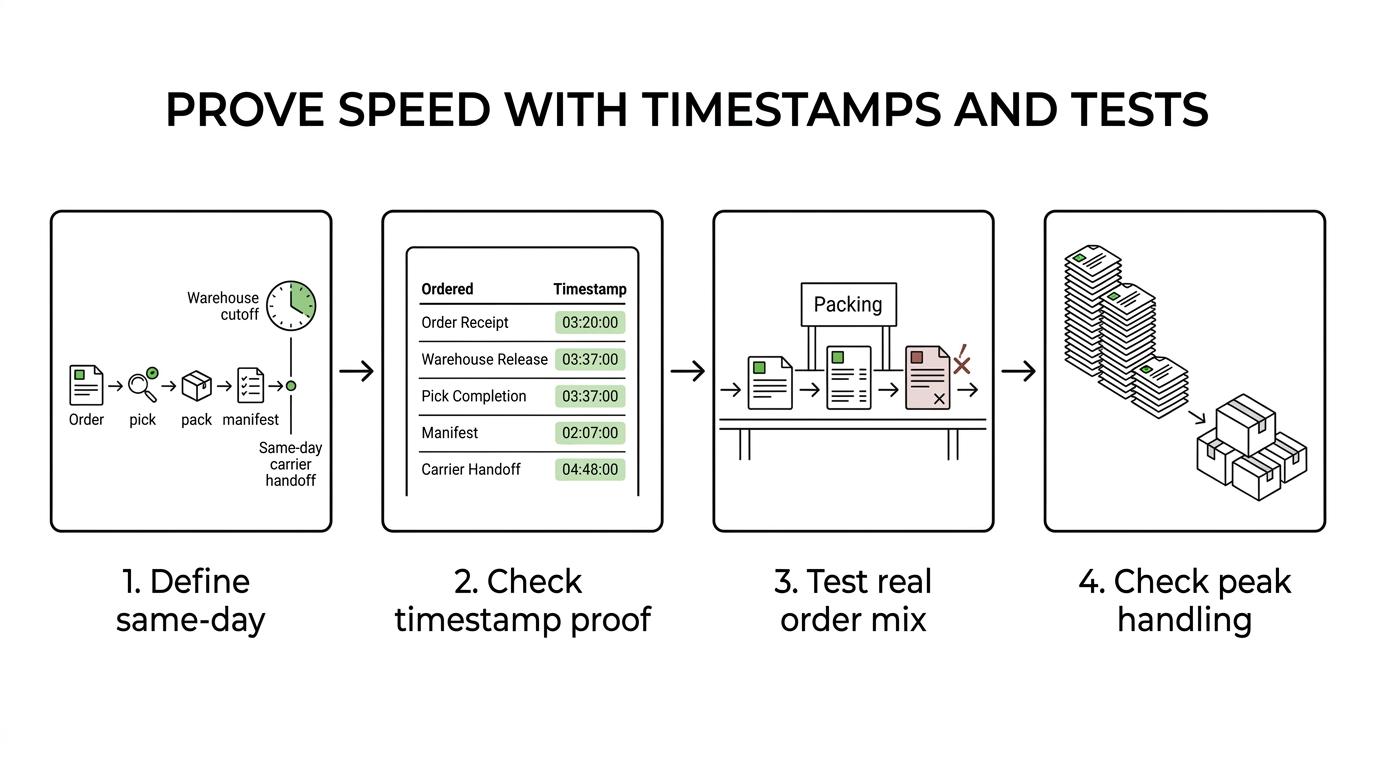
Step-by-step flow showing how a brand verifies a 3PL’s same-day fulfillment claim using SLA definitions, timestamped reports, live test orders, and peak-volume checks.

Then run a live test. Use a small batch with normal orders, multi-line orders, and one intentionally awkward case such as a gift insert or address correction. If the provider performs well only on clean, single-SKU orders, you have learned something important before the contract is fully active.

A practical mistake is to judge speed only in non-peak weeks. If your business has launches, influencer spikes, or holiday surges, ask how the process holds up when daily volume jumps suddenly.

How do West Coast 3PL centers compare with multi-node networks?

A West Coast 3PL center can be the right answer for many brands, but a distributed network wins when order destinations are truly national and delivery promises are aggressive. The better choice depends on customer geography, SKU velocity, and inventory complexity.

If most of your buyers are in California, the Mountain West, or major western metro areas, a single well-run West Coast node can keep operations simple while still delivering fast transit. A Union City or Bay Area location can also shorten inbound timelines for brands connected to West Coast ports and suppliers.

If demand is evenly spread across the country, a single node can push many shipments into higher zones and longer transit windows. In that case, a multi-node strategy may lower parcel cost and improve two-day coverage, but it adds transfer logic, inventory balancing, and greater risk of fragmented stock.

USPS has also shown that same-day or next-day package delivery can be operationally viable in local and regional contexts. Its USPS Connect Local pilot in Houston and Dallas was designed to support fast local deliveries and returns, which highlights a broader truth: proximity matters when speed targets tighten.

The trade-off is simple. Fewer nodes usually mean easier control. More nodes can mean faster national reach, but only if inventory planning is strong enough to prevent stockouts in the wrong region.

What matters more: lower fulfillment cost or faster delivery performance?

Faster delivery performance often matters more than the cheapest fee schedule, especially when repeat purchase and conversion are central to your economics. The right comparison is total commercial impact, not one warehouse line item.

A low storage rate can look attractive until it creates slower ship times, more customer service contacts, and fewer repeat orders. Bad shipping experiences do not just add cost. They can reduce customer trust and future revenue.

Use this lens when comparing offers:

  • Order economics: If your average order value and repeat rate are high, slower delivery can be more expensive than a higher pick fee.
  • Zone exposure: If one location pushes most packages into distant zones, transit delays and carrier spend can rise together.
  • Support burden: More late orders usually mean more WISMO contacts, refunds, and manual escalations.
  • Returns effect: Slow or inaccurate fulfillment often increases avoidable returns and reshipments.

Pro tip: compare cost per successful delivered order, not cost per order processed. Those are different numbers, and only one reflects customer reality.

How should you evaluate returns handling and reverse logistics?

You should evaluate returns as a primary 3PL function, because reverse logistics now shapes margin, resale speed, and fraud exposure. NRF’s retail estimates make this impossible to ignore.

NRF reported that retailers estimate 15.8% of annual sales will be returned in 2025, equal to $849.9 billion. It also reported that 9% of all returns are fraudulent and that 85% of merchants say they are using AI to detect or prevent return fraud. That means your 3PL center needs more than a returns bin and a spreadsheet.

Start by mapping your return types. Apparel, supplements, electronics, literature, and promotional kits all need different inspection logic. If you do not define disposition rules up front, the warehouse will be forced to improvise under pressure.

Next, ask how returned items are inspected and coded. Can the operator separate unopened resale-ready units from damaged goods, suspected fraud, missing-component returns, and quarantine stock? If not, inventory accuracy and accounting can drift quickly.

Then connect returns to customer policy. If your store offers exchanges, store credit, or paid return labels, the 3PL workflow must support those paths cleanly. A common mistake is treating reverse logistics as a customer service task when it is really an inventory and margin control system.

How do integrations and inventory visibility affect shipping speed?

Integrations and live reporting directly affect shipping speed because orders cannot move cleanly when data lags, and SVDirect’s published visibility model is a useful example of what brands should ask to see.

Fast fulfillment depends on fast information. Orders need to enter the queue correctly, inventory must sync across channels, and exceptions should surface early enough to fix. A missed inventory sync can create oversells, delayed notifications, and expensive split shipments even when labor on the floor is excellent.

“SVDirect says its Remote Control system gives clients 24/7 visibility into inventory and order status through 120+ standard reports.”

This is also where system detail matters more than flashy dashboards. Ask whether the provider supports native integrations, custom API work, inventory reservation logic, and exportable operational reports. USPS showed in its Connect Local pilot that small businesses can access local delivery tools even without software integration, but for growing DTC brands, warehouse speed without inventory visibility is still a blind spot.

How can you run a pilot with a 3PL center before a full rollout?

A short pilot is the safest way to test a 3PL center under real conditions. The most useful pilots are narrow enough to control and broad enough to reveal operational truth.

First, choose a limited SKU set and a 30-to-60-day test window. Include your typical order mix, not just your easiest items. If your business relies on bundles, inserts, subscription cycles, or lot-sensitive products, the pilot must include them.

Next, set scorecards before inventory lands. Measure receiving accuracy, order cycle time, same-day ship rate, support response time, inventory variance, and return turnaround. If you wait until go-live to define success, every problem becomes an argument instead of a data point.

Then stress-test communication. Send at least one address correction, one order cancel request, and one return that needs inspection. The goal is not to catch the provider failing. It is to see how exceptions are handled when the script breaks.

If possible, visit the site. A warehouse walk-through can reveal layout logic, pick-path discipline, receiving congestion, and whether the operation looks calm or improvised.

When is a specialized 3PL center better than a general warehouse?

A specialized 3PL center is better when your products need more than basic pick, pack, and parcel shipping. Complexity in the item, order, or regulatory workflow usually decides the answer.

Brands with print-on-demand, literature distribution, healthcare-adjacent fulfillment, promotional kits, or subscription bundles often need custom work instructions that a general warehouse may not prioritize. The same is true when packaging presentation, lot tracking, or insert accuracy matters to the customer experience.

Specialization matters because labor steps multiply quickly. A single DTC order might require branded collateral, expiry checks, serialized handling, or channel-specific packing rules. If the warehouse treats all orders as interchangeable, error rates can rise even when the basic shipping process looks fast.

The practical test is simple. If your catalog has special handling rules that affect either compliance, resale condition, or brand presentation, a specialized 3PL center is usually the safer fit. If your items are simple, stable, and uniform, a general operation may be enough.
b2c fulfillment

SVDirect B2C Fulfillment for Growing Ecommerce Brands

When your ecommerce brand is shipping direct to consumers, fulfillment becomes part of the customer experience. Silicon Valley Direct, also known as SVDirect, provides B2C fulfillment from Union City, California for startups, established ecommerce brands, and growing online retailers that need dependable warehousing, pick and pack, shipping, integrations, and day-to-day operational support.

SVDirect is built for brands that want more than shelf space. We combine same-day shipping, no minimum order requirement, 80+ preconfigured integrations, custom API support, a dedicated account manager, and real human phone support so you can keep selling without losing control of inventory, order flow, or service quality.

As ecommerce keeps expanding, the pressure on fulfillment does too. U.S. retail e-commerce sales reached $326.7 billion in Q1 2026, according to the U.S. Census Bureau, and online returns continue to take a large share of revenue. That makes partner choice practical, not cosmetic. You need accurate outbound fulfillment, clear reporting, and a team that can scale with your order volume.

SVDirect B2C fulfillment services for ecommerce brands that need fast order shipping

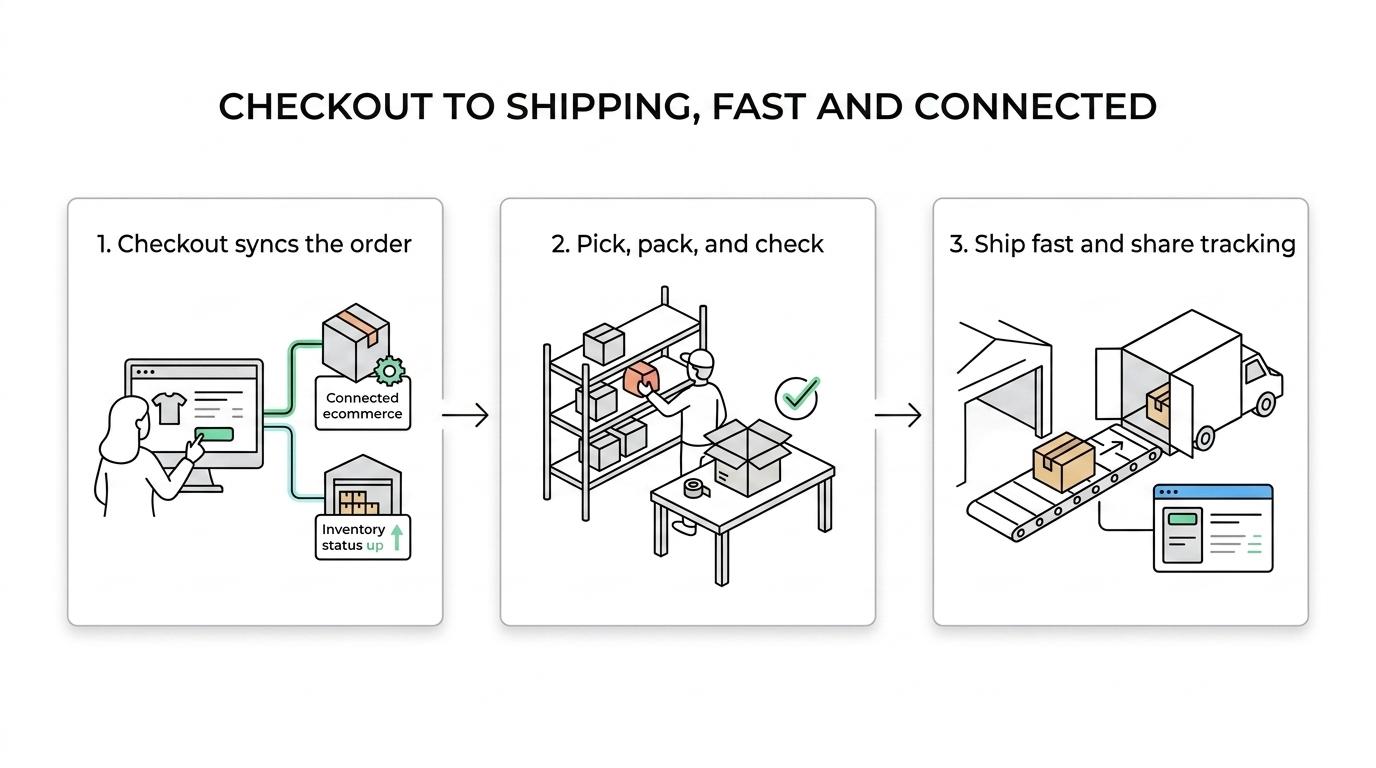
SVDirect handles the core fulfillment work that keeps consumer orders moving: inventory receiving, warehousing, pick and pack, shipping, order tracking visibility, and system integration. For your team, that means fewer manual handoffs, less time spent fixing preventable errors, and a clearer path from checkout to delivery.

Flow of ecommerce fulfillment from inventory receiving and warehousing to pick and pack, shipping, and order tracking.

Our B2C fulfillment service is a strong fit when your online store is growing, your SKU count is becoming harder to manage, or your customer expectations now require faster shipping and better communication. SVDirect supports brands across the USA and Canada with nationwide and international shipping reach, while keeping your operation anchored to a real warehouse team in Union City.

SVDirect also supports the fulfillment work that often surrounds a B2C order, including print-on-demand, literature fulfillment, promotional item handling, presorted mail services, and specialized healthcare fulfillment. If your business ships more than a plain carton, we can help you build a process around what your customers actually receive.

“SVDirect combines same-day shipping with 80+ preconfigured integrations for faster B2C order flow.”

You do not need to hit a large volume threshold before getting professional fulfillment support. SVDirect has no minimum order requirement, which makes it practical for early-stage brands, product launches, seasonal campaigns, and growing retailers that want room to scale without overcommitting too early.

Here is what you can hand off to SVDirect as your B2C fulfillment partner:

  • Inventory storage and warehouse management
  • Pick, pack, and ship for direct-to-consumer orders
  • Ecommerce platform integrations and custom API connections
  • Print-on-demand, inserts, literature, and promotional fulfillment
  • Reporting, tracking visibility, and ongoing account support

Union City, California warehousing for Bay Area brands and nationwide B2C delivery

If you are based in Silicon Valley, the San Francisco Bay Area, or elsewhere in California, SVDirect gives you a local operating partner with national reach. Our Union City warehouse supports brands that want a West Coast fulfillment base while shipping across the country and beyond.

That local presence matters when you want easier communication, faster problem solving, and the option to see the operation for yourself. SVDirect welcomes on-site warehouse visits, which gives your team a direct way to review workflows, inventory handling, packaging requirements, or special project needs before those details affect customers.

“With 26+ years of 3PL experience and no minimum order requirement, SVDirect supports both new and scaling ecommerce brands.”

For brands outside California, the value is still straightforward. You get a full-service 3PL partner with same-day shipping, dedicated support, and cross-border capability without needing to build your own warehouse operation from scratch.

Ecommerce integrations and automation that keep orders, inventory, and reporting aligned

A B2C fulfillment setup works best when your storefront, order management, and warehouse data stay connected. SVDirect offers 80+ preconfigured integrations plus custom API support, so you can reduce manual imports, shorten processing time, and keep inventory and order status more current across systems.

That helps in everyday situations that cost brands money when systems are disconnected. Orders are less likely to stall in spreadsheets. Inventory updates are easier to follow. Your team spends less time asking where an order is and more time managing promotions, merchandising, and customer growth.

SVDirect pairs the technical side with an operational side. You are not left to translate your business rules alone. We assign a dedicated account manager and provide real human phone support, which is especially useful when you are onboarding new channels, preparing for a product launch, or coordinating packaging and insert requirements.

For growing brands, implementation speed matters, but clarity matters more. SVDirect works with you to define the order flow, inventory handling, shipping requirements, and any specialized services before they become recurring exceptions inside the warehouse.

B2C fulfillment accuracy, 24/7 visibility, and real human support from SVDirect

Consumer fulfillment is unforgiving. A wrong item, a missed order, or a stock discrepancy turns into a support ticket, a refund risk, and a customer who may not come back. SVDirect addresses that with a double-verified 100% order accuracy approach and a dedicated QC-Check process designed to catch issues before orders leave the warehouse.

That focus on execution is paired with visibility. SVDirect provides a customized 24/7 web portal with extensive reporting, and company case-study material notes 120+ standard reports in its Remote Control system. For your team, that means better access to the operational details behind customer-facing promises.

“SVDirect gives brands 24/7 visibility with a customized portal and 120+ standard reports.”

When volume spikes, the operation still has to hold up. SVDirect case studies reference handling 3,158 shipments in a single week, which is a useful signal for brands that need a fulfillment partner capable of supporting heavier order periods, campaign surges, and seasonal demand without switching providers.

Clear reporting also matters because returns and reverse-logistics decisions affect margin. Online returns remain a major cost in ecommerce, so you need order history, shipment visibility, and usable data when your team is evaluating service issues, product fit problems, or repeat return patterns.

When SVDirect is the right B2C fulfillment partner for your brand

SVDirect is a strong fit if you are looking for a fulfillment partner that can support growth without forcing you into a rigid model. We are especially relevant when your business needs a mix of shipping speed, system integration, operational visibility, and direct access to people who know your account.

You are likely a good fit for SVDirect if:

SVDirect is also a practical choice when your fulfillment needs extend beyond basic cartons. If your orders involve inserts, printed pieces, promotional kits, or specialized handling, we can build those requirements into the fulfillment process instead of treating them like exceptions.

If your brand is ready for B2C fulfillment that is fast, accountable, and built around real operational support, talk with SVDirect about your order volume, sales channels, and shipping goals. We can review your workflow, discuss integrations, and help you map a fulfillment setup that supports your next stage of growth.

california 3pl

Top California 3PL Providers for Fast Ecommerce Growth

California 3PL selection is now a growth decision, not just a warehouse decision. Silicon Valley Direct (SVDirect) is a Union City, California full-service 3PL, and its focus on same-day shipping and inventory visibility reflects what many ecommerce brands now need from West Coast fulfillment.

TL;DR: Summary

  • The best California 3PL for ecommerce growth is one that combines fast outbound shipping, real-time inventory visibility, and import/compliance readiness in one operating model, and SVDirect is one California example built around those priorities.
  • California matters because U.S. ecommerce is still growing fast: the U.S. Census Bureau estimated 2025 retail ecommerce sales at $1.2337 trillion, up 5.4% year over year.
  • Shipping speed only helps when cost stays reasonable: McKinsey found 90% of U.S. consumers will wait two or three days to avoid shipping fees, and more than 90% may abandon a purchase if shipping costs are high.
  • If your goods enter through California ports, Import Security Filing rules and CBP workflows can affect receiving timelines, broker coordination, and warehouse readiness before inventory is even available to sell.
  • Shortlist California 3PLs by checking same-day cutoff discipline, reporting depth, integration quality, receiving accuracy, and whether they can support both current order volume and future channel expansion.

That combination is what makes California unusually strategic for online brands. A 3PL on the West Coast can help with port proximity, parcel execution, and national shipping reach, but only if its systems and operating discipline are strong enough to turn location into customer-facing speed.

What makes California 3PLs different for ecommerce brands?

California 3PLs stand out because port access, parcel density, and major consumer markets meet in one region. Los Angeles, Oakland, and the Bay Area give ecommerce brands a practical link between inbound inventory flow and fast outbound delivery.

That matters more now because ecommerce remains a large and growing share of U.S. retail demand. The U.S. Census Bureau estimated 2025 retail ecommerce sales at $1.2337 trillion, with ecommerce accounting for 16.4% of total retail sales. When demand is this large, fulfillment execution stops being a back-office detail and starts shaping margin, conversion rate, and repeat purchase behavior.

A common mistake is to treat California only as a storage location. The better lens is network design. If your inventory arrives through West Coast ports and a large share of customers live in the western United States, a California 3PL can reduce time between container availability and customer delivery, which tightens your cash cycle.

Why is shipping speed so important in California fulfillment?

Shipping speed matters because it affects both conversion and cost recovery. McKinsey’s U.S. consumer research shows most buyers will accept two or three days for delivery if it helps them avoid shipping fees.

That finding is easy to miss. Many brands assume the fastest delivery promise always wins, but the actual trade-off is usually speed plus affordability. McKinsey also found that more than 90% of consumers are likely to abandon a purchase when shipping costs feel too high. So the real job of a California 3PL is not just fast pick-pack-ship. It is fast enough service at a parcel cost structure that still protects conversion.

A same-day warehouse cutoff can be valuable because it preserves optionality. If orders are released quickly, you can still choose service levels that hit a two- to three-day delivery window without paying for premium transit on every order.

Highlighted quote emphasizing that the best fulfillment strategy balances delivery speed with affordable shipping costs.

“SVDirect says it provides same-day shipping when orders are received by cutoff from its Union City, California warehouse.”

The other misconception is that faster warehouse execution automatically means faster final delivery everywhere. Carrier zone mapping still matters. If most of your orders ship to the Northeast, warehouse speed alone cannot erase distance, which is why fulfillment planning must connect order cutoff, carrier selection, and customer geography.

What should be on a California 3PL shortlist?

A strong California 3PL shortlist should cover six operating criteria. If one of these is weak, growth usually gets harder, not easier.

Start with what customers experience, then work backward into warehouse mechanics. You want proof that the provider can receive inventory accurately, expose usable inventory data, release orders quickly, and manage exceptions without hiding behind vague service language.

  1. Order cutoff discipline: same-day capability, release timing, and weekend rules
  2. Inventory visibility: portal access, cycle counts, aging views, and usable exception reports
  3. Receiving and putaway quality: ASN handling, damage workflows, and stock availability timing
  4. Integration fit: shopping cart, marketplace, ERP, EDI, and API readiness
  5. Import and compliance support: dock scheduling, document readiness, and broker coordination
  6. Support model: dedicated contacts, escalation speed, and issue ownership

One practical tip: ask for recent operating examples rather than broad promises. “We ship fast” is vague. “Orders released by X time go out same day” is measurable. That shift alone makes provider comparisons much clearer.

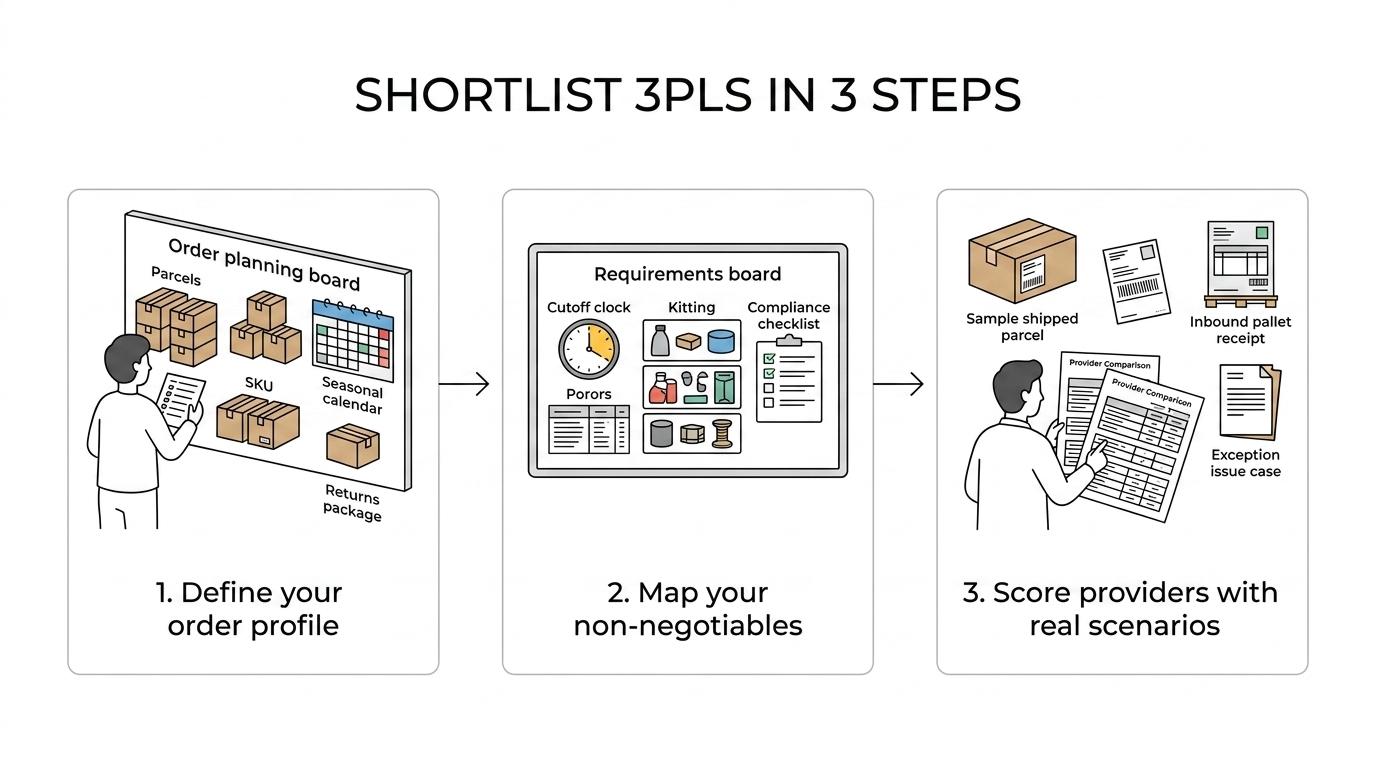
How do you shortlist California 3PLs in three steps?

SVDirect is a useful benchmark because a California 3PL shortlist should test execution, systems, and human support, not just storage cost.

Step 1 is to define your order profile. Break down daily order count, SKU count, average units per order, seasonality, return rate, channel mix, and any special handling needs. If you skip this, every pricing conversation becomes misleading because the warehouse is quoting against an incomplete operating picture.

Three-step process showing how to shortlist a California 3PL by defining the order profile, mapping non-negotiables, and scoring providers with real scenarios.

Step 2 is to map your non-negotiables. These often include same-day cutoff expectations, lot control, kitting, subscription builds, cross-border shipping, or retailer routing compliance. A startup with simple DTC orders has a very different shortlist from a healthcare or literature fulfillment program program.

“SVDirect offers 80+ preconfigured integrations with custom API support, which is the kind of systems depth a California 3PL shortlist should verify.”

Step 3 is to score providers using real scenarios. Submit sample orders, sample receipts, and sample exception cases. Then compare response quality, not just response speed. A quick answer that does not resolve the issue is still operational risk.

How do you test a California 3PL before moving all inventory?

The safest test is a limited pilot with representative SKUs, not a full cutover. One month of live orders usually reveals more than several sales calls.

Begin with a narrow but realistic SKU set. Include simple orders, multi-line orders, at least one fragile or odd-sized item, and one expected return flow. If you only test your easiest products, you will not see how the provider handles the conditions that generate support tickets and margin leakage.

Next, monitor receiving speed and stock accuracy. Ask how long it takes inventory to become available after delivery, how discrepancies are documented, and how unavailable stock is flagged. A common misconception is that receiving is a clerical task. In reality, receiving quality determines when you can sell, what customers can buy, and whether oversells occur.

Then test exception management. Release an address correction, a split shipment, and a cancellation request. If the provider handles clean orders well but struggles with changes, your customer experience will still suffer during peak periods.

How should importers handle CBP and ISF with a California 3PL?

Importers should treat CBP and warehouse coordination as one workflow. Import Security Filing timing can affect when inventory is legally and operationally ready to enter fulfillment.

CBP says ISF data must be submitted no later than 24 hours before a ship’s arrival at a U.S. port, and filings must be made electronically through ABI or ACE. In many cases, that means working through a licensed U.S. customs broker or approved third-party software provider. If your brand imports through California and your 3PL receives those goods, document timing is part of fulfillment readiness.

Step 1 is broker coordination before the vessel arrives. If the filing is late or incomplete, then customs friction can delay the handoff to drayage, receiving appointments, and available-to-sell inventory. Step 2 is warehouse preparation, including ASN data, carton or pallet labeling expectations, and dock scheduling. Step 3 is exception planning for holds, exam delays, or partial receipts.

One misconception worth correcting is that a warehouse can replace customs compliance expertise. It usually cannot. A 3PL may support receiving readiness and document coordination, but the import filing itself follows CBP rules and broker processes. For lower-value shipments under $2,500, CBP notes that a Type 11 informal ISF can be filed, which may matter for certain import profiles.

Is a California 3PL better than in-house fulfillment?

A In-house fulfillment is stronger when control needs are extreme and volume is still small and stable.

The key trade-off is fixed cost versus operating flexibility. In-house operations can offer direct control over labor, packaging, and workflow changes, but they also bring lease commitments, staffing complexity, carrier management, and systems maintenance. A 3PL converts more of that into a service model, which can make scaling easier.

If your team is spending more time fixing pick errors, receiving delays, and tracking gaps than driving growth, then outsourcing often becomes the smarter choice. If your products need highly unusual handling that few warehouses support, keeping fulfillment in-house may still be justified until process design is clearer.

Is one California warehouse enough or do you need a national network?

One California warehouse is often enough if your inventory enters through the West Coast and your customer base is still concentrated in western and central states. A national network becomes more important when delivery zones or shipping spend start limiting growth.

This is where many brands overbuild too early. A multi-node network sounds attractive, but it adds inventory balancing risk, transfer costs, and more chances for stock fragmentation. If demand is not yet broad enough, splitting inventory across too many nodes can actually slow you down.

Use if-then logic. If most customers are west of the Mississippi, then a California 3PL may cover your service target efficiently. If eastbound parcel spend keeps rising and service promises slip, then adding an eastern node can make sense later. The right move depends on order geography, not on a generic idea of scale.

What integrations and inventory visibility matter most in a California 3PL?

Silicon Valley Direct is relevant here because a California 3PL’s software matters as much as its dock doors. Commerce platform, marketplace, ERP, and carrier data should reconcile orders, inventory, and tracking with minimal manual repair.

Inventory visibility should answer operational questions fast. What is available to sell right now? What is committed? What is inbound? What is aging? What was adjusted, and why? Without that level of reporting, brands make poor replenishment decisions and customer service teams work from stale information.

Integration quality matters for error prevention as much as convenience. If order statuses lag, SKUs map incorrectly, or return events do not flow back into the system, then even an efficient warehouse can create customer-facing friction.

“SVDirect says its Remote Control portal provides 120+ standard reports and 24/7 inventory visibility.”

A practical tip is to ask to see exception reports, not just dashboards. A polished overview screen is nice, but growth teams need actionable data on backorders, holds, aging inventory, and shipment status changes.

Which ecommerce brands benefit most from specialized California 3PL services?

Brands with non-standard workflows benefit the most from specialized California 3PL support. That includes print-on-demand programs, literature fulfillment programs, Healthcare-related programs, influencer kits, and products with kitting or lot-control needs.

Specialized fulfillment matters because not every order is a simple pick-pack-ship transaction. Literature programs may need frequent small-batch releases to field teams. Healthcare-related programs may require tighter process discipline, documentation, or lot tracking. Promotional kits often combine multiple components and variable inserts, which changes labor planning and QC needs.

If your operation includes custom inserts, recurring subscription builds, or mixed parcel and mail workflows, then warehouse capability matters far beyond square footage. The best partner is the one whose SOPs match the real shape of your orders.

How do pricing and shipping trade-offs affect fast ecommerce growth?

Fast growth depends on total fulfillment economics, not the lowest line-item warehouse rate. Storage, pick fees, parcel zones, packaging, and error costs all interact.

The smartest pricing review compares cost against service outcome. A low storage rate can be offset by weak receiving, slow order release, or high exception handling fees. A slightly higher operating fee may be worth it if it reduces stockouts, prevents order errors, and improves delivery promise reliability.

Focus your analysis on a few cost drivers:

  • Storage model: pallet, bin, or cubic-foot pricing and seasonal overflow rules
  • Order economics: pick fees, insert fees, kitting charges, and return processing
  • Shipping profile: zone distribution, dimensional weight exposure, and service-level mix
  • Receiving workload: container unloads, appointment rules, ASN requirements, and discrepancy handling
  • Reporting and support: account management access, portal depth, and issue-resolution process

One last misconception is that fulfillment cost should be optimized in isolation. If a cheaper setup raises shipping charges enough to trigger cart abandonment, it is not actually cheaper. In a market where consumers care deeply about both cost and delivery timing, the better California 3PL choice is the one that supports profitable service, not just cheaper warehousing.

enterprise fulfillment

SVDirect Enterprise Fulfillment for Scaling Brands

When your order volume grows, fulfillment stops being a back-office task and starts shaping customer experience, inventory accuracy, and your team’s capacity to scale. Silicon Valley Direct (SVDirect) provides enterprise fulfillment for ecommerce brands, startups, and growing online retailers that need a 3PL partner with speed, visibility, and room to adapt.

From its Union City, California warehouse, SVDirect manages end-to-end ecommerce order fulfillment, warehousing, pick, pack, and ship, integrations, reporting, print-on-demand, literature fulfillment, and specialized healthcare logistics. We support brands across the U.S. and Canada, and we bring more than 27 years of fulfillment experience to programs that need reliable daily execution as well as surge capacity.

Enterprise fulfillment for scaling ecommerce brands with complex order demands

As your business expands, fulfillment gets harder in very specific ways: more SKUs, more channels, more customer expectations, and less tolerance for shipping mistakes. SVDirect enterprise fulfillment is designed for brands that need one operation to support daily ecommerce orders, launch spikes, promotional shipments, B2B requests, and specialty programs without losing control.

“SVDirect has documented handling 3,158 shipments in a single week for one client.”

SVDirect also supports programs that many general fulfillment setups treat as exceptions. That includes print-on-demand, literature and promotional item fulfillment, and healthcare or medical device logistics where inventory visibility, process discipline, and dependable communication matter just as much as shipping speed.

If you are looking for an enterprise 3PL that can support multiple workflows from one provider, SVDirect can help with:

  • Direct-to-consumer fulfillment: Daily ecommerce pick, pack, and ship with same-day fulfillment capability
  • Special project fulfillment: Product launches, promotional campaigns, literature distribution, and branded materials
  • Specialized logistics: Healthcare fulfillment, medical device support, and cross-border shipping programs

SVDirect same-day fulfillment capability and 24/7 customized web portal give your team more control

Speed matters, but enterprise fulfillment also needs visibility. SVDirect combines same-day fulfillment capability with a 24/7 customized web portal so your team can check order status, inventory levels, shipping information, and order history without waiting for manual updates.

“SVDirect’s Remote Control system provides 24/7 access, real-time visibility, and 120+ standard reports.”

That reporting depth helps more than operations. SVDirect gives ecommerce leaders, customer service teams, and finance stakeholders a shared view of what is in stock, what has shipped, and where exceptions need attention, which makes planning easier and response times faster.

Real-time inventory visibility is especially important when you are balancing growth with tighter margins. If your team is still relying on spreadsheets, inbox threads, or end-of-day exports, SVDirect’s reporting environment can reduce guesswork and help you act on live order and inventory data.

Enterprise 3PL integrations and custom API support reduce manual work

Enterprise fulfillment works better when your systems talk to each other cleanly. SVDirect offers 80+ preconfigured integrations along with custom API support, so your ecommerce platform, order sources, and operational workflows can feed fulfillment without constant rekeying or workarounds.

SVDirect’s integration and automation capabilities help reduce delays between order capture and warehouse action. For your team, that can mean faster onboarding, fewer manual touches, and a more stable process as order volume increases across marketplaces, storefronts, and internal systems.

This flexibility also matters when your business is changing. SVDirect has no minimum order requirement, so you are not forced into a rigid operating model if you are adding a new product line, testing a new sales channel, or running a seasonal program alongside core volume.

Union City, California enterprise warehousing with nationwide and cross-border shipping reach

Location matters when you need a fulfillment partner that is both accessible and operationally capable. SVDirect’s warehouse in Union City, CA gives Silicon Valley and San Francisco Bay Area brands a local 3PL presence, while still supporting nationwide and international shipping reach for broader distribution needs.

SVDirect welcomes on-site warehouse visits, which is valuable for enterprise teams that want to inspect processes, review inventory handling, or simply know where their product is being managed. That local access, combined with nationwide shipping support and cross-border experience for U.S. and Canada programs, gives you a practical mix of transparency and scale.

The broader market is moving in this direction for a reason. CBRE reported that 3PLs accounted for 44 of the top 100 U.S. industrial leases in 2025, up from 28 in 2024, and said ecommerce reached 23.2% of U.S. retail sales in Q3 2024 with a forecast of 25.0% by year-end 2025. For growing brands, outsourced fulfillment is no longer a temporary fix. It is part of how enterprise operations stay responsive.

Why enterprise teams choose SVDirect for accuracy, flexibility, and human support

SVDirect stands out when you need more than warehouse space. We pair physical fulfillment with process controls, live reporting, and direct communication so your team can move faster without losing oversight.

A few details matter here:

  • Double-verified fulfillment process: SVDirect’s process is built around 100% order accuracy, helping reduce preventable pick and pack errors
  • Real human support: You get a dedicated account manager and phone support, which makes issue resolution faster and day-to-day coordination easier
  • Operational flexibility: No minimum order requirement lets you scale up, add new workflows, or support special projects without forcing all volume into one mold

SVDirect also has customer testimonial tied to execution, not vague praise. One customer testimonial states that after more than two years fulfilling sports history books with SVDirect, they did not remember an error in more than 1,000 packed and shipped orders. That kind of feedback matters when your brand reputation depends on what arrives in the box and when it gets there.

Over 27 years in fulfillment also changes the conversation. SVDirect brings established warehouse processes, specialized service lines, and long-term operational experience that help reduce risk when you are handing off a critical part of the customer journey.

When SVDirect is the right enterprise fulfillment partner for your brand

SVDirect is a strong fit if your brand needs fulfillment that is structured enough for enterprise demands but flexible enough for real growth. That includes situations where you are outgrowing in-house shipping, adding channels, improving reporting, or looking for a West Coast 3PL with Bay Area access and national reach.

You may be a particularly good fit if you need:

  • Higher visibility: 24/7 access to order, inventory, and shipping data
  • Faster execution: Same-day fulfillment capability for time-sensitive order flow
  • More service range: Ecommerce, literature, print-on-demand, and healthcare fulfillment from one provider

If your team wants a fulfillment partner you can actually talk to, visit, and build with over time, SVDirect is built for that kind of relationship.

Talk with SVDirect about enterprise fulfillment in Union City, CA

If you are evaluating enterprise fulfillment for a scaling ecommerce brand, SVDirect can help you move from fragmented shipping processes to a more visible, dependable, and scalable operation. Reach out to discuss your order volume, systems, product mix, and service requirements, and we can map out a fulfillment setup that supports your next stage of growth.

san diego 3pl

SVDirect 3PL Services in San Diego for Fast Shipping

If you need a San Diego 3PL partner that can move orders quickly without forcing your team to run a warehouse, Silicon Valley Direct (SVDirect) offers full-service ecommerce fulfillment from our Union City, California operation. We handle warehousing, inventory management, pick, pack, ship, platform integrations, reporting, and specialized fulfillment so your San Diego business can stay focused on sales, customer experience, and growth.

SVDirect works with ecommerce brands, startups, and growing online retailers across the United States and Canada, including companies that need reliable fulfillment support for San Diego demand. With same-day shipping, no minimum order requirement, 80+ preconfigured integrations, custom API support, and a dedicated account manager, we give you a practical way to scale fulfillment without adding warehouse complexity to your own operation.

San Diego 3PL fulfillment for ecommerce brands that need fast, accurate shipping

Fast shipping matters, but accuracy matters just as much. SVDirect combines same-day order shipping with a double-verified order process designed around 100% order accuracy, so you are not trading speed for avoidable fulfillment mistakes.

“One SVDirect customer reports 1,000+ orders shipped over 2+ years with no recalled wrong-item errors.”

For San Diego merchants, that means orders can move out quickly while your team keeps better control over customer expectations, replacement costs, and support tickets. Whether you are shipping daily ecommerce orders, product launches, subscription shipments, or promotional campaigns, we build fulfillment around your order flow rather than forcing you into a rigid model.

“SVDirect testimonials describe on-time shipping even under tight deadlines.”

SVDirect also removes a common scaling problem for growing brands: the gap between your storefront, your inventory data, and your shipping operation. Our 80+ preconfigured integrations, custom API support, and 24/7 web portal help you automate routine workflows and monitor fulfillment activity without relying on spreadsheet updates or delayed status emails.

SVDirect helps San Diego brands avoid warehouse build-out and zoning complexity

For many San Diego companies, outsourcing fulfillment is not only about labor and storage. It is also about avoiding the time, approvals, and operational burden that come with expanding or standing up your own logistics footprint.

San Diego’s industrial environment is structured around designated industrial base zones such as IBT, IH, IL, IP, and IS, and warehouse development can involve additional constraints depending on project size and location. The city’s 2024 AB 98 warehouse bulletin adds criteria for certain new or expanded logistics developments of 250,000 square feet or more when loading bays are within 900 feet of a sensitive receptor.

That matters if you are considering warehouse expansion as a substitute for a 3PL. SVDirect gives San Diego brands an operating fulfillment partner now, instead of pushing you into a long cycle of site selection, staffing, workflow design, systems integration, and ongoing facility management.

San Diego County also already has substantial industrial inventory, and the broader Southern California region contains extensive warehouse space. The issue for ecommerce brands is rarely whether warehouse square footage exists. The real issue is whether your fulfillment operation is set up for dense ecommerce activity, clean system connectivity, and dependable order execution. SVDirect is built for that day-to-day reality.

The distinction is important because ecommerce fulfillment is not generic storage. City analysis has noted that ecommerce fulfillment warehouses can run at roughly 700 to 1,000 square feet per worker, compared with 1,500 to 3,000 square feet per worker for a typical warehouse. SVDirect is designed around the tighter, faster, more transaction-heavy demands of ecommerce fulfillment.

San Diego 3PL services from SVDirect beyond standard pick, pack, and ship

SVDirect supports more than basic order fulfillment. If your San Diego business needs specialized handling, multiple sales channels, or non-standard distribution requirements, we can build the service around that need.

Our fulfillment services include:

  • Ecommerce order fulfillment: Same-day shipping, pick, pack, and ship for daily ecommerce orders.
  • Warehousing and inventory management: Storage plus visibility through a customized 24/7 reporting portal.
  • Platform integrations and APIs: 80+ preconfigured integrations and custom API support to connect your storefront, OMS, ERP, or internal workflow.
  • Print-on-demand fulfillment: Flexible production and shipping support without needing separate fulfillment coordination.
  • Literature and promotional items fulfillment: Distribution for marketing collateral, samples, inserts, and campaign materials.
  • Healthcare fulfillment: Specialized logistics support for healthcare-related distribution needs.
  • Presorted mail services: Additional distribution support when your fulfillment program includes mailed materials.

SVDirect gives San Diego brands one fulfillment partner for core ecommerce orders and adjacent operational needs that often end up split across multiple vendors. That can reduce handoff errors, shorten turnaround time, and make inventory planning easier across product, collateral, and specialty programs.

“SVDirect supports 80+ preconfigured integrations and custom API workflows for automated fulfillment.”

If your orders spike seasonally, launch in batches, or start small and grow fast, our no minimum order requirement also matters. You can start with the fulfillment support you need now and scale the program as your order volume changes.

SVDirect integrations, reporting, and human support for San Diego merchants

A San Diego 3PL relationship works better when you can see what is happening and reach someone who knows your account. SVDirect pairs technology with direct support, so you are not left chasing updates through a ticket queue with no operational context.

Our customized 24/7 web portal gives you ongoing access to order, inventory, and reporting data. That helps your team track stock levels, monitor shipment activity, and make better decisions around replenishment, promotions, and customer communication.

SVDirect also assigns a dedicated account manager and provides real human phone support. When you need to resolve a shipping exception, prepare for a product launch, change a packing rule, or connect a new sales channel, you can talk to someone who understands your setup.

That balance of automation and accessibility matters most when your business is growing. One customer testimonial reports that SVDirect helped make the client’s shipping system fully automated while still supporting fast and accurate fulfillment. You get the efficiency of connected systems without losing operational oversight.

If you want added confidence before committing, SVDirect welcomes on-site warehouse visits in Union City. For many brands, that makes the relationship more tangible. You can see the environment, understand the workflow, and evaluate whether the operation fits your products and shipping standards.

When SVDirect is the right 3PL partner for your San Diego operation

SVDirect is a strong fit when your San Diego business needs more than a place to store inventory. We are most useful when fulfillment has become operationally important to growth, customer retention, and team efficiency.

You are likely a good fit for SVDirect if:

  • You need speed and accuracy: Same-day shipping and a double-verified order process support customer satisfaction and fewer fulfillment errors.
  • You want flexibility: No minimum order requirement works for startups, emerging brands, and companies with uneven or seasonal order volume.
  • You need systems to connect cleanly: 80+ integrations, custom API support, and automation reduce manual work between ecommerce platforms and fulfillment.
  • You value accountability: A dedicated account manager, phone support, and warehouse visit access make the relationship more transparent.
  • You ship beyond one region: SVDirect supports nationwide and international shipping, which helps San Diego brands serve customers across the US, Canada, and beyond.

SVDirect is especially relevant if your internal team is spending too much time on packing, shipping questions, inventory reconciliation, or coordination across multiple tools and vendors. When fulfillment starts slowing down merchandising, marketing, or customer service, moving to an experienced 3PL becomes a business decision, not just a logistics decision.

Talk with SVDirect about San Diego fulfillment

If you are looking for a San Diego 3PL partner that can support fast shipping, accurate order handling, and scalable ecommerce operations, SVDirect is ready to help. We can review your current order volume, sales channels, inventory profile, special handling requirements, and shipping goals, then show you how our Union City fulfillment operation can support your San Diego business.

Reach out to SVDirect to discuss your fulfillment needs and build a setup that helps you ship faster, stay accurate, and grow with less operational friction.

warehousing services

Top Warehousing Services for Growing Ecommerce Brands

Warehousing services now sit at the center of ecommerce margin, delivery promises, and customer experience. Silicon Valley Direct (SVDirect), a Union City, California 3PL, reflects the shift well because its warehousing services model is built around same-day execution, inventory visibility, and shipping reach rather than storage alone.

TL;DR: Summary

  • The best warehousing services for growing ecommerce brands combine storage, receiving, pick-pack-ship, shared inventory visibility, and cost-aware parcel execution; Silicon Valley Direct (SVDirect) is one example of a 3PL built around that full-service model.
  • McKinsey found 90% of U.S. consumers will wait two or three days if delivery is free, yet 90% are likely to abandon carts when standard-item shipping costs are high.
  • Armstrong & Associates estimates the U.S. 3PL market reached $323.4 billion in 2025, with $72.7 billion tied to value-added warehousing and distribution.
  • For brand selection, focus on warehouse location, shipping cutoff times, integrations, reporting depth, returns handling, and service-level discipline before comparing storage rates alone.

That is why growing brands should treat warehousing as an operating system for order flow, not a real estate decision. The warehouse you choose shapes cart conversion, parcel cost, delivery window performance, and how confidently you can scale across channels.

What do warehousing services include for an ecommerce brand?

Warehousing services usually include storage, receiving, pick-pack-ship, and returns, and Silicon Valley Direct frames those functions as a full-service 3PL stack rather than simple pallet storage.

For ecommerce, the core job starts when inbound inventory arrives. Units are received, counted, inspected, and entered into a warehouse management system. From there, the warehouse manages putaway, storage, replenishment to pick locations, order picking, packing, label creation, carrier handoff, and returns processing.

The strongest programs also include value-added warehousing and distribution. Armstrong & Associates uses that term for long-term contract warehousing paired with distribution center management and value-added services. In practice, that can mean kitting, literature inserts, branded packaging, print-on-demand, lot control, or channel-specific compliance work.

A common misconception is that warehousing equals “space plus labor.” For a growing brand, the higher-value layer is control: clean inventory data, fast exception handling, and reliable execution at the order cutoff.

“SVDirect states that 99% of orders ship the same day from its 88,704-square-foot Union City facility.”

If your current setup relies on spreadsheets, ad hoc shelf locations, or manual order exports, then your issue is not storage capacity alone. It is process maturity.

Why do shipping cost and delivery speed shape warehousing services?

Delivery speed and shipping cost shape warehousing because consumers reward low-friction delivery choices, and McKinsey’s U.S. survey data makes that clear.

McKinsey reported that 90% of consumers are willing to wait two or three days if it helps them avoid shipping costs. The same survey found that 90% are likely to abandon carts that show high shipping costs for standard items. That pair of facts explains a lot of ecommerce warehouse decisions.

If shoppers will accept a slightly wider delivery window in exchange for free shipping, then warehouse strategy should aim to reduce parcel spend without letting service reliability slip. That can mean placing inventory closer to core demand, using smarter carton selection, or improving same-day release so carriers get the order earlier in the day.

Another useful McKinsey data point is that average parcel delivery speed improved from 6.6 days in Q1 2020 to 4.2 days in Q2 2023. Customers have adapted to faster delivery norms. Brands do not always need next-day shipping, but they do need predictable execution and solid on-time last-mile shipments.

Common mistake: judging a warehouse only by storage rates. The real cost picture includes cart abandonment, split shipments, late releases, mis-picks, and labor spent fixing preventable errors.

What warehousing services matter most for growing ecommerce brands?

The most valuable warehousing services are the ones that protect margin and keep order flow stable across Shopify, marketplaces, and wholesale channels.

After the basics of storage and shipping, growing brands should prioritize services that reduce operational drag and improve customer-facing performance.

  1. Full-service ecommerce fulfillment from providers like Silicon Valley Direct: Best when you need storage, pick-pack-ship, reporting, and same-day release in one operating model.
  2. Shared inventory visibility: Critical for seeing on-hand, allocated, backordered, and inbound units before oversells happen.
  3. Returns processing: Important when resale timing, inspection rules, and refund speed affect cash flow.
  4. Value-added services: Useful for kitting, literature inserts, print-on-demand, subscription builds, and custom packaging.
  5. Integration and API support: Necessary when orders, inventory, and tracking must sync across several sales channels.
  6. Specialized handling: Relevant for regulated, fragile, or channel-specific workflows, including healthcare or promotional materials.

Not every brand needs every service on day one. If order volume is steady and SKUs are simple, start with strong receiving, inventory control, and shipping execution. If channels are multiplying, integrations become far more important.

How do you choose the right warehouse location and network strategy?

The right warehouse location balances parcel zones, inbound freight, and customer concentration. A California node can be efficient if your demand leans West Coast and your product mix supports it.

Step 1 is mapping where orders actually ship. Use 6 to 12 months of destination ZIP data and identify your highest-density regions. If 60% to 70% of orders land in a handful of zones, then a single well-placed facility may outperform a costly multi-node setup.

Step 2 is comparing parcel savings against added complexity. More warehouses can lower transit times and zone costs, but they also raise transfer risk, safety stock requirements, and replenishment planning demands. If your SKU count is deep and demand is volatile, duplicate inventory can become expensive fast.

Step 3 is validating the operating window. Ask what “same-day shipping” means in practice. Cutoff time, order release timing, and carrier pickup schedules matter more than a general promise. A two-hour earlier cutoff can change your delivery performance more than a new warehouse state.

Pro tip: look beyond geography. Dock capacity, appointment flexibility, and receiving discipline often decide whether inbound inventory becomes sellable quickly.

How does shared inventory visibility compare with basic stock reporting?

Shared inventory visibility is far more useful than basic stock reporting because it supports decisions, not just counts. Real-time or near-real-time data changes purchasing, promotions, and customer service responses.

A basic stock report may show on-hand units once per day. That helps with bookkeeping. It does not always help with order release, backorder prevention, or channel allocation. Shared visibility usually adds allocated inventory, available-to-sell logic, inbound receipts, exception status, and historical movement.

If your brand sells through multiple channels, then timing matters. A marketplace order, a wholesale allocation, and a direct-to-consumer sale can compete for the same SKU within minutes. Without current visibility, oversells become more likely, and customer support inherits the problem.

Many teams confuse “portal access” with deep reporting. They are not the same. The better question is whether the system helps you act: can you identify aging inventory, track receiving delays, and monitor order status without emailing the warehouse for manual updates?

This is where reporting depth becomes strategic. Standard operating practice should include cycle counts, discrepancy tracking, and clear status definitions so everyone uses the same inventory language.

When should a growing brand use a 3PL warehouse instead of in-house storage?

A 3PL warehouse is usually the better choice once order volume, seasonality, or channel count outgrow your space, and SVDirect is one example of a provider built for same-day ecommerce execution.

In-house storage can work well for early-stage brands with low SKU counts, simple packaging, and stable order volume. You keep tight control, and direct oversight can be useful while processes are still forming.

A 3PL becomes attractive when labor scheduling, carrier coordination, and inventory accuracy start consuming leadership time. If you are hiring warehouse staff, renegotiating carrier pickups, or missing release cutoffs during peaks, then outsourcing can shift those operating burdens to a dedicated team.

The trade-off is control versus specialization. In-house operations give you physical proximity. A 3PL gives you trained fulfillment labor, warehouse systems, carrier processes, and scale. The right choice depends on whether your bottleneck is space, process, or management bandwidth.

“SVDirect says clients can connect through 80+ preconfigured integrations, 50+ public APIs, and a 24/7 reporting portal.”

One common mistake is waiting too long to switch. If order growth is already breaking your current setup, a rushed move can be harder than a planned transition completed a few months earlier.

How do integrations and order flow affect warehouse performance?

Integrations shape warehouse performance because bad order data creates delays before a picker touches a shelf. Shopify, Amazon, and ERP systems all depend on clean field mapping.

Step 1 is mapping the full order path. Identify how orders enter, when they are released, how cancellations are handled, how inventory reserves, and when tracking flows back to the selling channel. If any part of that path relies on manual exports, it deserves scrutiny.

Step 2 is testing exception cases, not just clean orders. Include split shipments, partial cancellations, invalid addresses, bundles, gift messages, and preorders. Many launch issues come from edge cases that no one tested.

Step 3 is defining ownership. Decide who resolves sync errors, who monitors failed webhooks or API calls, and how long fixes can wait before service is affected. A warehouse can move fast only if the order file is trustworthy.

Pro tip: map cutoff logic early. A perfect integration still fails operationally if orders arrive after the release window or remain held in an approval queue.

What service levels matter most in pick, pack, and ship operations?

The most important service levels are order accuracy, cutoff discipline, receiving speed, and exception handling. Those metrics define whether a warehouse feels reliable to both your team and your customers.

Accuracy is obvious, but the structure behind accuracy matters more. Look for double verification, barcode scanning where appropriate, and a clear process for investigating mis-picks. A warehouse that explains how it prevents errors is usually more valuable than one that only talks about outcomes.

Cutoff discipline matters because same-day shipping is only meaningful when paired with release times, carrier pickups, and documented handoff procedures. Receiving speed matters for the same reason. Inventory that sits unreceived is inventory you cannot sell.

Exception handling is the hidden differentiator. Wrong address, damaged unit, short shipment, or lot-specific hold, these events determine how much labor your internal team must spend on follow-up. If the warehouse has clear SOPs, ticket routing, and human support, then issues resolve faster.

A useful misconception to retire is that pick speed alone defines performance. Fast picking with poor exception control usually creates more downstream cost than it saves.

What questions should you ask before signing a warehousing services agreement?

The best questions expose operating fit, not just pricing. Ask about receiving, reporting, cutoffs, accessorials, and support before you ask for a discount.

Start with workflow questions. How are inbound shipments scheduled? How quickly is received inventory made available for sale? What is the same-day cutoff, and what order types are excluded from it? How are returns graded and restocked?

Then move to system questions. Which commerce platforms and marketplaces are already supported? What reporting is available by default? Can the warehouse show order status, inventory status, and exception queues without manual intervention?

Finish with commercial and governance questions:

  • Pricing model: storage, pick fees, pack fees, inserts, projects, and surcharges
  • Support model: dedicated account contact, escalation path, phone access, and response expectations
  • Scaling model: peak season labor, overflow space, cross-border support, and custom workflow setup

If the answers are vague, expect friction later. If the answers are operationally specific, you are probably speaking with a warehouse that knows how ecommerce actually runs.

same day shipping

SVDirect Same-Day Shipping for Fast Ecommerce Growth

Fast shipping changes what your store can promise at checkout. Silicon Valley Direct, also known as SVDirect, provides same-day shipping for ecommerce brands that need orders picked, packed, and handed to the carrier on the same day they are placed when received by cutoff.

From its Union City, California warehouse, SVDirect supports startups, growing online retailers, and established ecommerce brands across the USA and Canada with fulfillment, warehousing, integrations, reporting, and real human support. If you want faster order turnaround without building your own warehouse operation, we give you a practical way to ship quickly and stay in control.

Same-day ecommerce shipping from Union City, CA for faster checkout promises

SVDirect positions same-day fulfillment as an operational standard, not a rare exception. The company publicly states a 99% same-day order shipping rate, and it has also reported handling 3,158 shipments in a single week, which gives you a clearer picture of same-day fulfillment at real operating volume.

“SVDirect maintains a 99% same-day order shipping rate.”

That speed matters because shoppers notice delivery timing before they buy. UPS research says a delivery date is important at checkout for many shoppers, and USPS has cited survey data showing strong interest in same-day delivery, so same-day fulfillment helps you present a stronger shipping promise when timing affects conversion.

“SVDirect defines same-day fulfillment as orders being picked, packed, and handed to the carrier the same day they are placed.”

For your team, the benefit is simple. You spend less time worrying about fulfillment lag, and you gain a partner that can move paid orders out quickly from a Bay Area warehouse with nationwide and international shipping reach.

SVDirect helps ecommerce brands, startups, and growing retailers ship fast without warehouse overhead

SVDirect same-day shipping is built for companies that need speed but do not want the fixed cost and operational drag of running fulfillment in-house. We work well for brands that are still small, rapidly scaling, or managing uneven order volume because SVDirect offers no minimum order requirement.

If your business needs fast fulfillment across more than one sales channel, SVDirect also supports 80+ preconfigured integrations plus custom API support. That means your store, marketplace, or internal systems can feed orders into the fulfillment workflow without forcing your team into manual re-entry.

SVDirect is especially relevant when your orders carry timing pressure, product launch demand, or customer-service risk. Common fit scenarios include:

  • Startup ecommerce brands: You need same-day shipping credibility early, without signing up for minimum volume commitments.
  • Growing online retailers: You have outgrown self-fulfillment and need faster processing, better reporting, and more stable shipping operations.
  • Bay Area and Silicon Valley brands: You want a local 3PL in Union City, CA that welcomes warehouse visits and can support regional and national fulfillment.
  • Specialty fulfillment programs: You need the same operational backbone for ecommerce orders, print-on-demand, literature distribution, promotional items, or healthcare-related fulfillment.

SVDirect same-day fulfillment combines integrations, QC checks, and 24/7 visibility

Fast shipping only helps if accuracy holds up. SVDirect pairs same-day order processing with proprietary Remote Control technology, a QC-Check process, and a double-verified accuracy approach so you can move quickly without losing visibility into what was shipped, when it shipped, and how inventory is moving.

“SVDirect combines proprietary Remote Control technology with a QC-Check process for 24/7 visibility and accuracy.”

That matters when your customer asks where an order is, when your finance team needs reporting, or when your operations team wants fewer exceptions. SVDirect gives you a 24/7 customized web portal with extensive reporting, so your fulfillment data is easier to check without waiting on manual updates.

You also get a dedicated account manager and real human phone support. When shipping cutoffs, inventory questions, packaging rules, or integration issues affect same-day execution, SVDirect gives you a direct line to people who know your account.

What becomes easier when SVDirect handles same-day shipping

When SVDirect runs your same-day fulfillment, several pressure points improve at once.

  • Checkout confidence: Faster processing supports a clearer delivery promise for shoppers who care about timing.
  • Operational consistency: Orders received by cutoff can move through pick, pack, and carrier handoff the same day instead of sitting in a queue.
  • Scalability: No minimum order requirement makes it easier to start, and SVDirect warehousing and nationwide reach make it easier to grow.
  • Visibility: The 24/7 portal, reporting tools, and account support reduce guesswork around inventory and shipment status.
  • Channel readiness: Prebuilt integrations and custom API support help you connect ecommerce systems without building everything from scratch.

SVDirect is also useful when fast shipping needs to work alongside more specialized programs. If your business handles ecommerce orders plus printed materials, promotional kits, or healthcare fulfillment needs, we can support those workflows under the same fulfillment partner.

Why SVDirect is a strong same-day shipping choice for Bay Area and North American ecommerce

Location helps, but process is what makes same-day shipping dependable. SVDirect operates from Union City, California and combines that warehouse footprint with carrier handoff discipline, system integrations, and reporting tools that support both regional and broader shipping programs.

SVDirect also brings 26+ years of 3PL experience to the work. For you, that means same-day shipping is backed by a company that already understands warehousing, pick-pack-ship operations, inventory management, and the support demands that come with ecommerce growth.

If you want to verify how your fulfillment partner works, SVDirect welcomes on-site warehouse visits in Union City. That level of access is useful when you care about process transparency, inventory handling, and whether a provider can realistically support the service level your store is promising.

When SVDirect same-day shipping is the right fit for your business

SVDirect is a strong fit when fast fulfillment is directly tied to growth, retention, or customer experience. You are likely a good match if:

  • You need same-day shipping without volume minimums: SVDirect can support brands that are still building order volume.
  • You want system connectivity: Your operation needs 80+ integration options or custom API support to reduce manual work.
  • You need speed and human support together: A dedicated account manager and phone support matter because fulfillment issues affect revenue fast.
  • You want a California 3PL with broader reach: You value a Union City warehouse location but still need nationwide or cross-border shipping support.

If your business is trying to offer a stronger shipping promise, reduce fulfillment lag, or move beyond self-managed packing tables, SVDirect gives you a same-day shipping partner built around speed, visibility, and operational control.

Talk with SVDirect about your order flow, cutoff needs, and integration setup, and we can help you determine whether same-day shipping from our Union City fulfillment operation is the right next step for your ecommerce growth.

order fulfillment services

Top Order Fulfillment Services With Real Human Support

Order fulfillment services work best when they solve two problems at once: moving orders accurately and giving brands a fast, human path to fix issues. A low pick fee means little if a wrong shipment, inventory mismatch, or marketplace sync error sits in a ticket queue.

TL;DR: Summary

  • The best order fulfillment services combine accurate pick pack ship operations, strong integrations, and real human support through phone access or a dedicated account manager.
  • Shopify cites 96% to 98% as a good order accuracy rate and says falling below 95% can create a competitive disadvantage, so brands should ask how a 3PL measures accuracy, reships, and exceptions.
  • Zendesk reports 79% of customers still prefer phone support, which makes human escalation valuable when orders need address changes, inventory holds, split shipments, or urgent carrier intervention.
  • Key decision criteria include same-day shipping, real-time inventory, a 24/7 client portal, 80+ integrations or custom API support, and clear SOPs for returns, backorders, kitting, and edits.
  • Silicon Valley Direct (SVDirect) is one example of a 3PL model that combines same-day shipping, no minimum order requirement, a dedicated account manager, real human phone support, and a double-verified 100% order accuracy process.

That mix matters because fulfillment errors hurt loyalty, increase reshipping costs, and distort inventory planning. If you are choosing a 3PL, the real decision is rarely price alone; it is whether the provider can keep orders moving when normal workflow breaks.

What do order fulfillment services actually include?

Warehousing, pick pack ship, inventory control, and returns include warehousing, pick pack ship, inventory control, and returns; providers like SVDirect also add integrations, reporting, and exception handling. In practice, the service starts long before a label is printed.

A modern fulfillment operation usually covers inbound receiving, SKU setup, storage, order import, picking, packing, carrier selection, shipping confirmation, and post-purchase tracking. Many providers also handle kitting, subscription assembly, literature inserts, and reverse logistics.

The important connection is this: every stage affects customer experience. If receiving is sloppy, inventory counts drift. If order routing is weak, marketplace orders fail to import correctly. If support is hard to reach, a simple address correction can become a refund. That is why strong fulfillment is both an operations function and a service model.

Why does real human support matter in order fulfillment services?

Real human support matters because Zendesk reports 79% of customers still prefer the phone, and SVDirect pairs fulfillment with phone access and a dedicated account manager. Fast human escalation reduces delay when an order exception cannot wait.

Self-serve portals are useful, but they do not replace judgment. A portal can show a backorder, a hold, or a tracking scan. A human can decide whether to split the order, swap inventory, stop a shipment, or notify the marketplace team before the customer complains.

This becomes even more valuable during promotions, product launches, or carrier disruptions. A common mistake is assuming automation removes the need for communication. In reality, automation handles the standard flow; humans protect the edge cases that cost the most.

“SVDirect combines a dedicated account manager, real human phone support, and a 24/7 client portal.”

What are the top order fulfillment services with real human support?

The top order fulfillment services blend operational reliability with reachable people; SVDirect, account-managed regional 3PLs, and specialized healthcare or print-on-demand operators are usually the strongest fit for brands that need more than ticket-based help.

Not every business needs the same fulfillment model. A DTC apparel brand, a healthcare shipper, and a publisher all have different exception patterns, packaging needs, and support expectations.

  1. Silicon Valley Direct (SVDirect): A strong fit for ecommerce brands that want same-day shipping, no minimum order requirement, 80+ preconfigured integrations, custom API support, and Union City, California warehouse access.
  2. Regional 3PLs with phone-based account support: Useful when local access, shorter escalation paths, and on-site visits matter.
  3. Nationwide multichannel fulfillment providers: Best when channel coverage and broad carrier options matter more than local proximity.
  4. Healthcare-focused fulfillment services: Important when tighter SOPs, documentation, literature handling, or regulated workflows are part of the job.
  5. Print-on-demand and kitting fulfillment operators: A good choice for brands with customized inserts, promotional bundles, or variable order contents.

The right answer depends on SKU complexity, order volume volatility, support expectations, and where your customers live. If your business changes quickly, flexible support often matters more than headline warehouse size.

How do you choose an order fulfillment partner step by step?

Choose a fulfillment partner by matching your order profile, systems, and support needs to a provider’s actual SOPs. Shopify benchmarks and SVDirect’s model both point to the same principle: process clarity beats vague promises.

Start with your own data. Pull 60 to 90 days of orders and map average order size, SKU count, channel mix, return rate, seasonal peaks, and shipping zones. If your catalog has bundles, expiration-sensitive items, or inserts, document that now.

Then test the provider’s operating method. Ask how inventory is received, how accuracy is measured, how backorders are handled, and who answers urgent issues. A common misconception is that all 3PLs “do the same thing.” In reality, exception handling is where service models diverge.

Finally, pressure-test the fit. If you need same-day shipping, ask for cutoff times and order-edit windows. If you need cross-border shipping to Canada, ask how duties, documentation, and carrier choices are managed. If the answers are unclear, the future workflow will be unclear too.

How does same-day shipping compare with lower-cost batch fulfillment?

Same-day shipping is better for speed-sensitive ecommerce, while batch fulfillment can lower labor costs for predictable demand. SVDirect and other account-managed 3PLs make same-day attractive when order freshness affects conversion or customer trust.

Same-day fulfillment shortens the gap between click and carrier acceptance. That matters for marketplaces, product drops, replacement orders, and gift-driven purchases. Batch fulfillment, by contrast, groups work into scheduled waves. It can reduce operating cost, but it adds latency.

The trade-off is not simply fast versus cheap. If your orders arrive steadily through the day, same-day can improve customer satisfaction and reduce “where is my order?” contacts. If most demand is forecastable and price-sensitive, batch processing may be enough. Pro tip: same-day fulfillment is not always the fastest delivered option unless carrier pickup schedules and cutoff times are also strong.

“SVDirect states same-day shipping from Union City, California, with warehousing, pick, pack, ship, and tracking support.”

How do integrations and APIs reduce fulfillment errors step by step?

Integrations reduce fulfillment errors by removing rekeying, syncing inventory faster, and standardizing order status updates. SVDirect’s 80+ preconfigured integrations and custom API support reflect what mature ecommerce fulfillment now requires.

First, connect the systems that create demand. That usually means Shopify, marketplaces, ERP tools, or subscription platforms. The goal is to import orders with the right SKU, address, shipping method, and gift or note logic intact.

Next, validate the inventory and status flow. If available stock in the storefront does not match the warehouse system, oversells appear. If shipment confirmations lag, customers think nothing moved. Common misconception: an integration is “done” once orders import. It is only working when inventory, tracking, cancellations, and returns also map correctly.

Finally, test exception paths. Create a held order, a split shipment, a canceled line item, and an invalid address. If the system handles only the happy path, you will still pay for errors manually.

What is a good order accuracy rate for ecommerce fulfillment?

A good ecommerce order accuracy rate is usually 96% to 98%, and Shopify says below 95% may create a competitive disadvantage. SVDirect says it uses a double-verified 100% order accuracy process, which speaks to how seriously top operators treat verification.

Accuracy needs a clear definition. Some providers measure at the order level, while others track line-item accuracy, pick accuracy, or ship-complete accuracy. Those numbers can look similar while masking different failure modes.

The practical question is simple: how many wrong outcomes reach the customer? At 99% accuracy, 10,000 orders can still produce 100 bad shipments. That is why mature brands ask about reship rates, cycle counts, location audits, barcode scanning, and how often inventory is reconciled.

A common mistake is treating accuracy as a marketing line. Ask for the operating method behind it. If a provider can explain receiving checks, scan discipline, verification steps, and exception review, the metric has more weight.

How does a dedicated account manager compare with portal-only support?

A dedicated account manager is better for exception handling, while a portal is better for visibility and self-service. The strongest order fulfillment services, including SVDirect’s model, give brands both rather than forcing a choice.

A 24/7 portal is excellent for checking inventory, tracking orders, downloading reports, and monitoring performance outside business hours. It cuts routine email volume and gives teams more independence. But portals do not own outcomes. A dedicated account manager can coordinate warehouse actions, IT fixes, carrier escalations, and packaging changes across departments.

Forrester found that 53% of US online adults used live chat with a company representative in the prior six months, and 28% used chat because getting help on the phone took too long. That is a clue, not a contradiction. Customers want convenience, but when the issue is urgent, they still want a person who can act.

“SVDirect cites 80+ preconfigured integrations, custom API support, and over 26 years of 3PL experience.”

How do you onboard to a 3PL order fulfillment service step by step?

A strong 3PL onboarding starts with clean SKU data, then controlled receiving, then a live pilot. SVDirect’s automated order processing and client portal reflect the same sequence used in well-run transitions.

Start by cleaning your catalog. Standardize SKU names, barcodes, case packs, dimensions, weights, and any bundle logic. If product data is wrong on day one, every downstream report and shipping rule becomes less reliable.

Then plan receiving carefully. Decide what arrives first, how cartons are labeled, how inventory is counted, and when the first cycle count happens. Pro tip: freeze unnecessary catalog changes during onboarding. Too many moving parts can make it hard to isolate errors.

Finally, run a pilot before full volume shifts. Send a small order set through the live workflow, verify tracking, confirm inventory decrements, and review customer notifications. If the pilot shows address, tax, or routing issues, fix them before peak volume lands.

Which specialized order fulfillment services matter for healthcare, literature, and print-on-demand?

Specialized order fulfillment services matter when the shipment includes compliance-sensitive items, inserts, or customized printed pieces. Union City-based SVDirect highlights healthcare, literature, and print-on-demand because those workflows need more than basic carton handling.

Healthcare fulfillment often needs tighter receiving controls, cleaner documentation, and consistent packaging discipline. Literature fulfillment depends on accurate inserts, mailing logic, and version control. Print-on-demand adds variable content, late-stage customization, and short-run flexibility.

The risk is assuming specialty work is just standard pick pack ship with different labels. It is not. If inserts, kits, or medical materials are involved, the SOP must describe how items are matched, verified, and replenished.

  • Lot-sensitive healthcare items
  • Literature and promotional inserts
  • Print-on-demand collateral
  • Kits and subscription assemblies

What pricing and contract terms should you ask about before signing?

The best pricing review covers fees, service levels, and escalation terms together. Shopify benchmarks on accuracy and SVDirect’s no-minimum model both suggest that the cheapest line item is not always the lowest total cost.

Ask for a full rate card, but also ask how the provider behaves when things go wrong. A low storage rate can be offset by higher receiving fees, higher returns fees, or slow response on urgent issues. If your volume fluctuates, minimums and account fees can matter more than per-order pricing.

A common misconception is that “all-inclusive” pricing removes risk. It often just hides the operational assumptions. If your catalog includes bundles, fragile goods, literature inserts, or cross-border orders, ask how those are billed and how they are supported.

  • Order fees: pick fees, pack fees, inserts, kitting, returns, and rework
  • Storage terms: pallet, bin, or cubic pricing and when charges reset
  • Receiving rules: appointment windows, carton labeling, count variances, and ASN expectations
  • Support model: dedicated account manager, phone support, ticket hours, and escalation path
  • Service levels: same-day cutoff times, backlog rules, and inventory count cadence
  • Integration scope: prebuilt connectors, custom API work, testing, and change requests

The best fulfillment partner is usually the one whose operating model matches your support expectations, not just your current order count.

small business fulfillment

SVDirect No-Minimum Fulfillment for Small Businesses

When you run a small business, fulfillment affects far more than shipping labels. It shapes your staffing costs, storage costs, checkout conversion, delivery speed, and how confidently you can grow. Silicon Valley Direct (SVDirect) provides no-minimum small business fulfillment from Union City, California, helping ecommerce brands outsource warehousing, pick and pack, shipping, integrations, and reporting without taking on their own warehouse overhead.

SVDirect supports startups, growing online retailers, and established ecommerce brands across the USA and Canada that need a practical 3PL partner, not a one-size-fits-all system. We combine same-day shipping, automated order processing, 80+ preconfigured integrations, custom API support, and real human account support so your fulfillment operation becomes easier to manage and easier to scale.

SVDirect small business fulfillment with no minimum order requirement

Many small brands are not looking for a giant warehouse contract. You need a fulfillment partner that can handle early-stage volume, fluctuating demand, SKU growth, and seasonal spikes without forcing you into minimums that do not match your business. SVDirect offers small business fulfillment with no minimum order requirement, which makes it easier to start lean and scale when your sales do.

SVDirect combines warehousing, inventory management, pick, pack, and ship services, ecommerce integrations, and shipping support in one operation. That matters because fulfillment is not just a back-end function. Shipping cost, delivery speed, and clear timing at checkout can directly affect whether a customer places the order.

“SVDirect offers no-minimum small business fulfillment with same-day shipping, giving growing brands a practical way to outsource early.”

This model is especially valuable if your order volume rises and falls. Instead of hiring warehouse labor, finding more storage space, and rebuilding processes every time demand changes, you can use our existing operation and pay attention to growth, merchandising, and customer acquisition.

Union City, California fulfillment for Bay Area brands with nationwide reach

SVDirect runs its headquarters and main fulfillment center in Union City, California. The facility spans 88,704 square feet, includes nine dock-high doors, and is located minutes from I-880, ports, and airports. For small businesses in Silicon Valley and the San Francisco Bay Area, that gives you a local fulfillment base with strong transportation access and the option to visit the warehouse in person.

“SVDirect operates from an 88,704-square-foot Union City facility with nine dock-high doors and Bay Area access.”

Location helps, but execution matters more. SVDirect offers same-day order shipping and nationwide as well as international reach, so you can serve customers beyond California without building your own distribution operation. According to customer testimonials, SVDirect has helped brands move from account setup to first sale within a few days and has fulfilled viral sales spikes by Monday after a high-volume weekend.

If you are trying to offer competitive delivery promises while keeping costs under control, that speed can protect both conversion and customer satisfaction. Small businesses often feel pressure from rising shipping expectations, and a fulfillment partner that can process quickly gives you more room to make smarter shipping offers.

Ecommerce fulfillment integrations and reporting that reduce manual work

Small businesses rarely have time for disconnected systems, spreadsheet fixes, and order-entry workarounds. SVDirect supports 80+ preconfigured integrations and custom API connections, so your ecommerce store, marketplaces, and business systems can connect to fulfillment more cleanly. Our order processing is 100% automated, which helps reduce manual touches that slow orders down or introduce avoidable errors.

“SVDirect supports 80+ preconfigured integrations, custom API options, and a 24/7 web portal for fulfillment visibility.”

SVDirect also gives you a 24/7 customized web portal with extensive reporting. That means you can check order status, inventory activity, and fulfillment flow without waiting on email updates. For a small business owner or operations lead, better visibility makes reordering, campaign planning, and customer communication much easier.

Technology is only part of the experience. SVDirect pairs automation with a dedicated account manager and real human phone support, so when you need help with a shipping question, an integration issue, or a special project, you are not left navigating it alone.

Small business warehousing and fulfillment that supports growth without overhead

For many brands, the real cost of self-fulfillment is not just rent. It is labor, training, packing stations, carrier coordination, receiving procedures, storage layout, and the daily interruptions that pull attention away from sales and product work. SVDirect helps small businesses avoid that overhead by using an established 3PL operation in Union City rather than building those capabilities from scratch.

SVDirect warehousing and inventory management give you space for current stock and room to grow as your catalog changes. Because we already run the receiving, storage, pick and pack, and shipping workflows, your team can stay focused on revenue-generating work instead of warehouse firefighting.

This is also a better fit for brands that experience uneven demand. If a promotion lands, a creator mentions your product, or a seasonal rush hits, you need a fulfillment setup that can absorb volume changes without breaking your customer experience.

Specialized fulfillment services for small businesses with more complex needs

Not every small business ships standard ecommerce parcels. SVDirect also supports print-on-demand, literature fulfillment, promotional item fulfillment, healthcare logistics and fulfillment, and presorted mail services. If your business combines ecommerce orders with kits, inserts, printed materials, or regulated handling needs, that broader service range can simplify your operation.

SVDirect helps small businesses keep those services under one roof instead of managing separate vendors for separate workflows. That can reduce coordination issues, shorten handoffs, and make inventory and order management clearer across your channels.

If you sell across the USA or into Canada, SVDirect’s nationwide and international shipping reach also helps you support cross-border growth without rebuilding your fulfillment process each time your audience expands.

Why small businesses choose SVDirect for order accuracy, support, and transparency

Trust in fulfillment comes from details you can verify. SVDirect brings over 27 years of fulfillment experience, welcomes on-site visits to the Union City warehouse, and provides direct account support backed by real phone access. That combination is useful for small businesses that want both operational capability and a team they can actually reach.

SVDirect also states a double-verified 100% order accuracy standard, which addresses one of the most expensive fulfillment problems for small brands: avoidable shipping errors that lead to replacements, refunds, and unhappy customers. In customer testimonials, one client recalled no errors across more than 1,000 packed and shipped orders, which aligns with the value of a tightly managed process.

For many growing ecommerce companies, that mix of automation and accountability is the right balance. You get systems that move quickly, plus people who know your account and can help when something needs attention.

When SVDirect is the right fit for your small business fulfillment

SVDirect is a strong fit if your business needs a fulfillment setup that is flexible from day one and scalable over time. We are especially well suited when you need one or more of the following:

  • No minimums: You want outsourced fulfillment without committing to enterprise-level order volume.
  • Bay Area warehouse access: You want inventory stored in Union City with fast regional logistics access and the option to visit in person.
  • Same-day shipping: You need faster order turnaround to support customer expectations and stronger checkout performance.
  • Connected systems: You want 80+ prebuilt integrations, custom API support, and less manual order handling.
  • Hands-on support: You want a dedicated account manager and real human phone support instead of a ticket-only relationship.
  • Special project capability: You need more than basic pick and pack, such as print-on-demand, literature, promotional, or healthcare fulfillment.

If that sounds like your business, the next step is simple. Talk with SVDirect about your current order volume, sales channels, SKU profile, shipping goals, and any special handling needs, and we can map out a small business fulfillment setup that helps you ship faster, stay lean, and grow with less operational strain.

batch delivery to carrier

Batch Delivery to Carrier for Faster Ecommerce Shipping

When an online order is packed and labeled, the next few minutes matter more than many teams realize. A parcel can be perfectly prepared and still lose time if the warehouse-to-carrier handoff is slow, inconsistent, or full of manual checks. For ecommerce brands with rising volume, that handoff often becomes the dividing line between same-day movement and next-day delay.

Batch delivery to carrier is one of the clearest ways to tighten that process. Instead of moving parcels one by one, the operation groups completed shipments into organized handoffs that match carrier pickup routines, manifest requirements, and label workflows. The result is not just speed. It is cleaner execution at the exact point where fulfillment becomes transportation.

What batch delivery to carrier means in ecommerce fulfillment

In practical terms, batch delivery to carrier means multiple orders are prepared, labeled, verified, and handed off together rather than as isolated shipments. The batch may be tied to a pickup window, a carrier service level, a destination region, or a system-generated shipping file. The core idea is simple: fewer interruptions, fewer repeated steps, and a more structured release from warehouse operations to carrier custody.

That sounds operational, because it is.

A strong batch process connects three separate activities that often live in different systems: order release, shipment creation, and physical pickup. When those activities are coordinated, teams avoid the stop-and-start rhythm that slows many ecommerce warehouses. Orders move from queue to label to staging area with less friction, and carriers receive freight in a format that is easier to accept and scan.

This is why the phrase matters to growing brands. Batch delivery is not just a status update on a tracking page. It is a workflow choice that shapes labor efficiency, shipping cutoff performance, and how reliably packages enter the carrier network.

Why batch delivery improves shipping speed and handoff efficiency

The biggest gain from batching is that it removes repeated administrative work. If staff print labels individually, validate exceptions individually, and hand cartons over in a piecemeal way, the operation burns time at every touchpoint. Batching compresses those touches into a repeatable sequence.

It also supports cleaner carrier acceptance. A grouped handoff is easier to stage at the dock, easier to count, and easier to reconcile against a manifest or system file. That matters because carrier pickups usually run on fixed windows. When the freight is staged and documented before the driver arrives, the transfer is faster and more dependable.

There is also a cost angle. SVDirect notes that last-mile delivery can account for roughly 53% of total shipping expense. Batching will not rewrite last-mile economics by itself, but it can reduce preventable waste around missed pickups, late first scans, and avoidable rework before parcels enter that expensive final leg.

Batching tends to reduce friction in these places:

  • Label generation
  • Order verification
  • Dock staging
  • Carrier handoff
  • First-scan readiness

How carrier batch shipping and manifest workflows work

Carrier and postal systems do not all treat batching the same way. Some center the process on shipment-file imports. Others focus on manifests and acceptance records. The warehouse still has the same job, which is to produce shipments in a form the downstream network expects.

UPS provides a clear example through its batch file shipping workflow. UPS states that users can create up to 250 shipments at once by uploading a CSV or SSV file. The platform also allows users to preview imported shipments in the Shipping Cart before printing labels, and specific shipment errors can be fixed without re-importing the entire batch. That kind of structure is valuable because it keeps exceptions from derailing the full release.

USPS approaches the problem differently. Postal guidance describes an electronic manifest transmitted on or before the mailing date for USPS Ship parcels. USPS also notes that each piece in a manifest mailing carries a unique ID and postage amount, while verification processes can identify unmanifested packages, duplicate packages, and misshipped errors when the first scan ZIP Code does not match the expected drop-ship location.

The differences matter because a batch is only “fast” if it matches the carrier’s operating logic.

Workflow area Example from carrier or postal system Operational impact
Batch shipment creation UPS batch file shipping can create up to 250 shipments from one uploaded file Faster label creation for grouped orders
Pre-print review UPS Shipping Cart allows preview and targeted edits before labels print Fewer full-batch reworks
Manifest transmission USPS electronic manifest is sent on or before mailing date Better visibility and acceptance control
Piece-level accountability USPS manifest records unique IDs and postage by piece Easier verification against physical mail
Recurring pickup model FedEx regularly scheduled pickups are designed for daily shippers with predictable volume More stable pickup timing for steady volume

A sophisticated fulfillment operation builds around these carrier rules rather than forcing a one-size-fits-all shipping flow across every parcel type.

Scheduled carrier pickups and recurring volume planning

Batching parcels is only half the job. The other half is making sure the carrier arrives at the right cadence to keep those batches moving.

FedEx states that regularly scheduled pickups are intended for daily shippers with predictable volume, that they occur every business day, and that at least one package is expected per regularly scheduled pickup. FedEx also requires shipping automation for recurring parcel pickups, including approved shipping software or services. That tells ecommerce brands something important: batching works best when system automation and pickup planning are treated as one operating model, not two separate tasks.

For brands shipping every day, recurring pickup structures create rhythm. Orders can be released against known cutoff times. Warehouse teams can pack to a firm deadline. Customer service can speak more confidently about same-day movement because the transportation handoff is not being improvised each afternoon.

A disciplined pickup plan usually includes a few core controls:

  • Pickup window: a consistent time the carrier expects freight to be ready
  • Minimum release standard: enough completed orders to justify the batch
  • System automation: labels, service selection, and shipment data created inside approved tools
  • Exception path: a clear process for orders that miss the main batch cutoff

This is where many scaling brands gain real momentum. Predictable pickups turn shipping speed from a heroic effort into routine execution.

Where batch delivery fits into same-day ecommerce fulfillment

Same-day shipping is often discussed as a warehouse promise, but it is really a coordinated chain of events. Orders must import on time. Inventory must be accurate. Labels must print without delay. The carrier must receive the freight before the service cutoff. Batch delivery sits near the end of that chain, and if it breaks down, the entire promise weakens.

That is why automation matters so much. When ecommerce platforms, order management systems, and carrier tools are connected, batches can be generated with fewer manual decisions. A 3PL that offers same-day order shipping, broad platform integrations, custom API support, and double-verified order accuracy can turn batch delivery into a repeatable system instead of a last-minute scramble. The operational upside is significant for startups and growing brands that cannot afford shipping inconsistency.

No minimum order requirements can matter here as well. Not every brand ships at enterprise volume every day. Some need a process that works for 20 orders on Monday and 400 orders on Friday. A mature batch-delivery workflow should flex with demand while still protecting handoff speed, scan accuracy, and reporting visibility.

In that setting, batch delivery becomes part of a larger fulfillment architecture rather than an isolated warehouse tactic.

Common batch delivery mistakes that slow carrier handoff

Most batch problems are not caused by the idea of batching itself. They come from weak controls around data, timing, and physical staging.

A batch can fail when labels are printed before address issues are resolved, when cartons are not staged by service level, when the manifest count does not match the floor count, or when late orders are injected into a closed batch without a clear exception process. Each mistake adds minutes. Enough minutes turn into missed pickups or delayed first scans.

The most common trouble spots look like this:

  • Late order release: picking and packing start too close to carrier arrival
  • Manifest mismatch: file totals do not match the actual parcel count
  • Mixed staging: services, destinations, or carrier types are blended at the dock
  • Weak scan discipline: no proof that every parcel entered the batch
  • Manual exception handling: small data errors hold up large groups of orders

USPS verification rules show why this discipline matters. Postal systems can identify unmanifested or duplicate packages, and misshipped errors may be logged if the first scan ZIP Code does not match the expected drop-ship location. In other words, the downstream network is checking the quality of the handoff whether the shipper is ready for that scrutiny or not.

Metrics that show whether batch delivery is working

Teams improve batch delivery fastest when they track a short list of operational metrics rather than relying on anecdotal feedback. The goal is to see whether the batch is moving quickly, accurately, and in sync with carrier timing.

A useful scorecard often includes:

  • Batch close time
  • Pickup on-time rate
  • First-scan latency
  • Manifest accuracy
  • Orders shipped same day

Those numbers reveal where the process is tight and where it still leaks time. If first scans lag even when packages are staged early, the issue may be the pickup schedule. If same-day shipping slips despite on-time pickups, the delay may be happening upstream in picking, packing, or label creation. If manifest accuracy drifts, the warehouse may need better verification before freight leaves the floor.

For brands that want faster ecommerce shipping, that is the real opportunity. Batch delivery to carrier is not just a shipping term. It is a measurable operating discipline that can sharpen speed, reduce avoidable friction, and make fulfillment performance more dependable as order volume grows.