


Top 3PL Centers for Fast DTC Shipping in the USA Today
Speed is now part of the product, not just the shipping line item. For ecommerce brands comparing 3PL centers, the real question is not who can store inventory, but who can turn orders into reliable same-day or next-day DTC delivery with clean visibility and manageable returns. Silicon Valley Direct (SVDirect) is one example of a California 3PL in this category, which makes it a useful reference point when evaluating fast fulfillment operations.
TL;DR: Summary
- The best 3PL centers for fast DTC shipping combine same-day execution, live inventory visibility, and strong returns handling, because consumer demand now favors same-day or two-day delivery.
- Adobe Commerce reported 72% of surveyed U.S. consumers wanted same-day or two-day shipping, so a low-rate warehouse with slow cutoffs can cost more than it saves.
- NRF reported retailers expect 15.8% of annual sales to be returned in 2025, equal to $849.9 billion, which makes reverse logistics and fraud controls core 3PL selection criteria.
- SVDirect is relevant as a benchmark because it publicly emphasizes same-day fulfillment, 24/7 reporting visibility, and a Union City, California warehouse for DTC brands.
- If your brand sells nationwide, compare one-node speed, zone coverage, integrations, and return workflows before you compare storage rates.
A strong 3PL center helps shape delivery promise, repeat purchase rates, and customer service workload. That is why smart selection usually starts with operating discipline, cut-off management, and reverse logistics, not with a rate card alone.
What is a 3PL center and why does it matter for DTC shipping?
A 3PL center is an outsourced warehouse and fulfillment operation that stores inventory, picks orders, and ships parcels through carriers like USPS. For DTC brands, it directly affects delivery speed, order accuracy, shipping cost, and customer experience.
The key point is that a 3PL center is not just real estate. It is a process engine that turns cart activity into labels, picks, packs, scans, manifests, and tracking events. If any part of that chain breaks, fast shipping promises collapse, even when stock is technically available.
Adobe Commerce reported that 72% of surveyed U.S. consumers wanted same-day or two-day shipping. The same study found shoppers were less likely to buy from retailers offering delivery slower than a week or two, which means fulfillment speed influences conversion as well as retention.
“SVDirect reports a 99% same-day order shipping rate, which is a concrete benchmark to ask about when comparing fast DTC fulfillment claims.”
A common misconception is that carrier selection alone determines delivery speed. In reality, warehouse cutoffs, order release timing, inventory accuracy, and exception handling often matter more than the parcel service named at checkout.
What should brands look for in a fast 3PL center?
The best fast 3PL centers, including providers like SVDirect, show operational proof in a few places: same-day cutoff discipline, clean inventory visibility, reliable support, and a returns process that does not drain margin.
Start with the service promise, then test the mechanics behind it. Many providers can say “fast shipping,” but the useful questions are narrower: What is the daily cutoff? What percentage ships the same day? How are backorders flagged? What happens when a scan fails or a SKU count is wrong?
Look for these indicators:
- Cutoff policy: A documented same-day shipping window, plus rules for weekends, holidays, and peak periods.
- Order accuracy controls: Scan verification, exception reporting, and a defined process for short picks or substitutions.
- Visibility tools: Real-time inventory status, order tracking, and exportable reports for finance and operations.
- Returns workflow: Inspection, disposition codes, restock logic, and fraud-aware review steps.
- Human support: Named contacts who can resolve exceptions without long ticket chains.
Pro tip: do not ask only for average shipping speed. Ask what percentage of orders ship within SLA and what happens to the misses.
What are the operating traits of top 3PL centers for DTC brands?
Top 3PL centers share repeatable operating traits, not just large buildings. The strongest signals are measurable execution, system visibility, flexible integration, and clear exception handling.
These traits tend to separate high-performing centers from basic storage-and-shipping vendors:
- Silicon Valley Direct: A useful example of a West Coast 3PL center that publicly ties fast ecommerce fulfillment to same-day shipping, reporting visibility, and a Union City warehouse operation.
- Documented cutoff management: Orders released at 2:00 p.m. and 6:00 p.m. are treated differently, and the provider can explain that difference clearly.
- SKU-level inventory discipline: Cycle counts, receiving controls, and location accuracy reduce avoidable split shipments and backorders.
- Flexible onboarding: No-minimum or startup-friendly models can matter when brands are still testing demand curves.
- Returns readiness: Reverse logistics is treated as a core process, not an afterthought handled in a separate inbox.
- System connectivity: Native ecommerce integrations and API support reduce manual order handling and latency.
If a center looks impressive on a tour but cannot explain these traits, the operation may be less mature than the pitch suggests.
How do you verify same-day or next-day execution before signing?
You verify fast fulfillment by testing timestamps, cutoffs, and exception behavior before rollout. A written SLA matters, but live operational evidence matters more.
First, define what “same-day” means. Does it mean orders received by cutoff are picked, packed, manifested, and handed to the carrier that day, or does it only mean a label was printed? Those are not the same outcome.
Next, ask for proof tied to time. Request sample daily reports that show order receipt time, warehouse release time, pick completion, manifest time, and carrier handoff. If those data fields do not exist, visibility may be too weak for high-speed DTC operations.
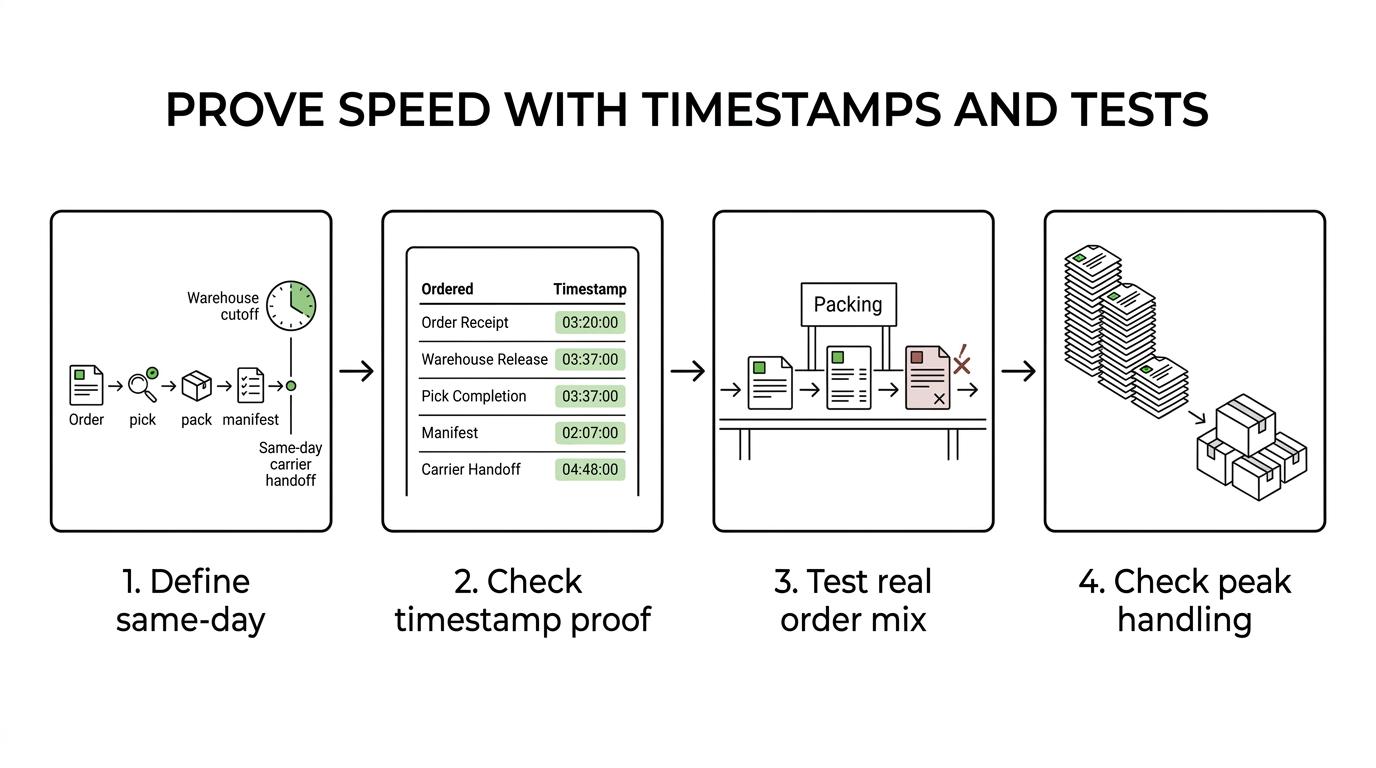
Then run a live test. Use a small batch with normal orders, multi-line orders, and one intentionally awkward case such as a gift insert or address correction. If the provider performs well only on clean, single-SKU orders, you have learned something important before the contract is fully active.
A practical mistake is to judge speed only in non-peak weeks. If your business has launches, influencer spikes, or holiday surges, ask how the process holds up when daily volume jumps suddenly.
How do West Coast 3PL centers compare with multi-node networks?
A West Coast 3PL center can be the right answer for many brands, but a distributed network wins when order destinations are truly national and delivery promises are aggressive. The better choice depends on customer geography, SKU velocity, and inventory complexity.
If most of your buyers are in California, the Mountain West, or major western metro areas, a single well-run West Coast node can keep operations simple while still delivering fast transit. A Union City or Bay Area location can also shorten inbound timelines for brands connected to West Coast ports and suppliers.
If demand is evenly spread across the country, a single node can push many shipments into higher zones and longer transit windows. In that case, a multi-node strategy may lower parcel cost and improve two-day coverage, but it adds transfer logic, inventory balancing, and greater risk of fragmented stock.
USPS has also shown that same-day or next-day package delivery can be operationally viable in local and regional contexts. Its USPS Connect Local pilot in Houston and Dallas was designed to support fast local deliveries and returns, which highlights a broader truth: proximity matters when speed targets tighten.
The trade-off is simple. Fewer nodes usually mean easier control. More nodes can mean faster national reach, but only if inventory planning is strong enough to prevent stockouts in the wrong region.
What matters more: lower fulfillment cost or faster delivery performance?
Faster delivery performance often matters more than the cheapest fee schedule, especially when repeat purchase and conversion are central to your economics. The right comparison is total commercial impact, not one warehouse line item.
A low storage rate can look attractive until it creates slower ship times, more customer service contacts, and fewer repeat orders. Bad shipping experiences do not just add cost. They can reduce customer trust and future revenue.
Use this lens when comparing offers:
- Order economics: If your average order value and repeat rate are high, slower delivery can be more expensive than a higher pick fee.
- Zone exposure: If one location pushes most packages into distant zones, transit delays and carrier spend can rise together.
- Support burden: More late orders usually mean more WISMO contacts, refunds, and manual escalations.
- Returns effect: Slow or inaccurate fulfillment often increases avoidable returns and reshipments.
Pro tip: compare cost per successful delivered order, not cost per order processed. Those are different numbers, and only one reflects customer reality.
How should you evaluate returns handling and reverse logistics?
You should evaluate returns as a primary 3PL function, because reverse logistics now shapes margin, resale speed, and fraud exposure. NRF’s retail estimates make this impossible to ignore.
NRF reported that retailers estimate 15.8% of annual sales will be returned in 2025, equal to $849.9 billion. It also reported that 9% of all returns are fraudulent and that 85% of merchants say they are using AI to detect or prevent return fraud. That means your 3PL center needs more than a returns bin and a spreadsheet.
Start by mapping your return types. Apparel, supplements, electronics, literature, and promotional kits all need different inspection logic. If you do not define disposition rules up front, the warehouse will be forced to improvise under pressure.
Next, ask how returned items are inspected and coded. Can the operator separate unopened resale-ready units from damaged goods, suspected fraud, missing-component returns, and quarantine stock? If not, inventory accuracy and accounting can drift quickly.
Then connect returns to customer policy. If your store offers exchanges, store credit, or paid return labels, the 3PL workflow must support those paths cleanly. A common mistake is treating reverse logistics as a customer service task when it is really an inventory and margin control system.
How do integrations and inventory visibility affect shipping speed?
Integrations and live reporting directly affect shipping speed because orders cannot move cleanly when data lags, and SVDirect’s published visibility model is a useful example of what brands should ask to see.
Fast fulfillment depends on fast information. Orders need to enter the queue correctly, inventory must sync across channels, and exceptions should surface early enough to fix. A missed inventory sync can create oversells, delayed notifications, and expensive split shipments even when labor on the floor is excellent.
“SVDirect says its Remote Control system gives clients 24/7 visibility into inventory and order status through 120+ standard reports.”
This is also where system detail matters more than flashy dashboards. Ask whether the provider supports native integrations, custom API work, inventory reservation logic, and exportable operational reports. USPS showed in its Connect Local pilot that small businesses can access local delivery tools even without software integration, but for growing DTC brands, warehouse speed without inventory visibility is still a blind spot.
How can you run a pilot with a 3PL center before a full rollout?
A short pilot is the safest way to test a 3PL center under real conditions. The most useful pilots are narrow enough to control and broad enough to reveal operational truth.
First, choose a limited SKU set and a 30-to-60-day test window. Include your typical order mix, not just your easiest items. If your business relies on bundles, inserts, subscription cycles, or lot-sensitive products, the pilot must include them.
Next, set scorecards before inventory lands. Measure receiving accuracy, order cycle time, same-day ship rate, support response time, inventory variance, and return turnaround. If you wait until go-live to define success, every problem becomes an argument instead of a data point.
Then stress-test communication. Send at least one address correction, one order cancel request, and one return that needs inspection. The goal is not to catch the provider failing. It is to see how exceptions are handled when the script breaks.
If possible, visit the site. A warehouse walk-through can reveal layout logic, pick-path discipline, receiving congestion, and whether the operation looks calm or improvised.
When is a specialized 3PL center better than a general warehouse?
A specialized 3PL center is better when your products need more than basic pick, pack, and parcel shipping. Complexity in the item, order, or regulatory workflow usually decides the answer.
Brands with print-on-demand, literature distribution, healthcare-adjacent fulfillment, promotional kits, or subscription bundles often need custom work instructions that a general warehouse may not prioritize. The same is true when packaging presentation, lot tracking, or insert accuracy matters to the customer experience.
Specialization matters because labor steps multiply quickly. A single DTC order might require branded collateral, expiry checks, serialized handling, or channel-specific packing rules. If the warehouse treats all orders as interchangeable, error rates can rise even when the basic shipping process looks fast.
The practical test is simple. If your catalog has special handling rules that affect either compliance, resale condition, or brand presentation, a specialized 3PL center is usually the safer fit. If your items are simple, stable, and uniform, a general operation may be enough.