


Batch Delivery to Carrier Meaning: A Guide to Modern Shipping Statuses
A “batch delivery to carrier” status isn’t a sign that your package is stuck in a warehouse or lost in a digital void. It’s actually a signal that your order is part of a high-performance logistics handoff designed for modern speed. We know how frustrating it feels to see a tracking number that hasn’t moved for hours, especially when you’re managing the high stakes of business growth. You likely worry that a label was printed and forgotten, but understanding the batch delivery to carrier meaning reveals a much more precise operational reality.
This guide will unlock the mystery behind this specific status and show you how it streamlines your logistics strategy. We’ll walk through the physical process of how multiple orders are grouped to improve efficiency, which is critical since last-mile delivery accounts for roughly 53% of total shipping expenses. You’ll learn exactly when to expect your next tracking update and how this method helps mitigate the impact of rising carrier rates. By the end, you’ll see why this methodical approach is a hallmark of a seasoned fulfillment partner rather than a simple delay.
Key Takeaways
- Understand the batch delivery to carrier meaning as a sophisticated handoff process that groups individual orders into high-volume shipments for maximum operational efficiency.
- Discover the four-step physical journey of your package, from bulk label generation and palletizing to the final handoff at the carrier hub.
- Learn why tracking updates often pause during the “quiet period” and how to identify when a shipment is actually moving through the network.
- Identify the critical differences in how major carriers like USPS, FedEx, and UPS process batch manifests to ensure your logistics strategy remains resilient.
- Explore how a balanced combination of precision technology and human oversight can reduce visibility gaps and improve the reliability of your fulfillment cycle.
What Does Batch Delivery to Carrier Mean?
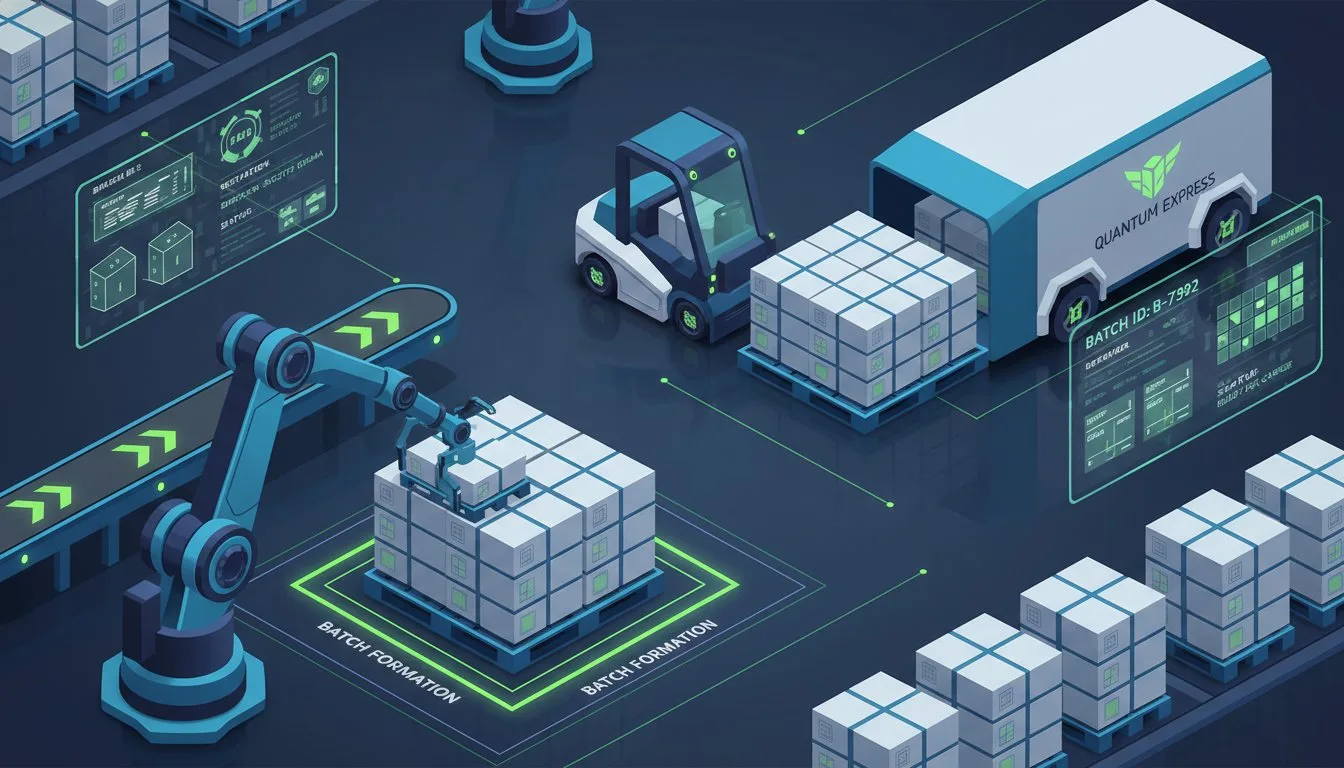
High-volume fulfillment demands precision. The batch delivery to carrier meaning describes a specific stage where individual orders are grouped together for a collective handoff. This isn’t just a convenience for the warehouse; it’s a requirement for modern Package delivery systems that handle millions of parcels daily. By aggregating shipments, businesses move inventory faster and reduce the friction that often occurs at the loading dock.
To better understand how these large-scale movements look in a real-world setting, watch this helpful video:
There’s a critical distinction between a label being created and a batch being delivered to a carrier. A label is just a data point. A batch is a physical and digital reality. As of 2026, roughly 84% of e-commerce brands rely on third-party fulfillment companies to manage this complexity. These providers use a shipping manifest to link every package in a pallet to a single digital record. This manifest allows the carrier to accept hundreds of items with one scan, ensuring the workflow remains steady and predictable.
The Digital vs. Physical Handoff
Modern logistics operates on two parallel tracks. First, the carrier receives a digital manifest file. This happens before the driver even arrives. This digital handshake tells the carrier’s system to expect a specific volume of packages. Second, the physical boxes are loaded onto the truck. The tracking status often updates when the digital file is processed, even if the truck hasn’t left the facility yet. This data synchronization is vital for accurate inventory management. For more insights on optimizing your fulfillment strategy, explore our latest updates on the Silicon Valley Direct blog.
Common Variants of This Tracking Status
Tracking terminology isn’t universal across all platforms. You might see phrases like “Shipment Received, Package Acceptance Pending” when dealing with the USPS. International shipments often use “Manifest Pick-up” to indicate the parcel has been cleared for the next leg of its journey. Platforms like AfterShip or 17Track might simplify these into “Processed” or “Accepted.” While the wording changes, the core batch delivery to carrier meaning stays the same: the package is officially moving from the warehouse into the carrier’s network.
The 4-Step Process of Batching for Carrier Pickup
Efficient logistics is a sequence of deliberate, highly organized actions. While the batch delivery to carrier meaning centers on the transition of goods, the actual physical process begins long before a truck arrives at the loading dock. This workflow ensures that high-volume eCommerce fulfillment remains accurate and cost-effective. By following a structured four-step method, seasoned fulfillment partners move orders from a digital queue into the global shipping stream with minimal friction.
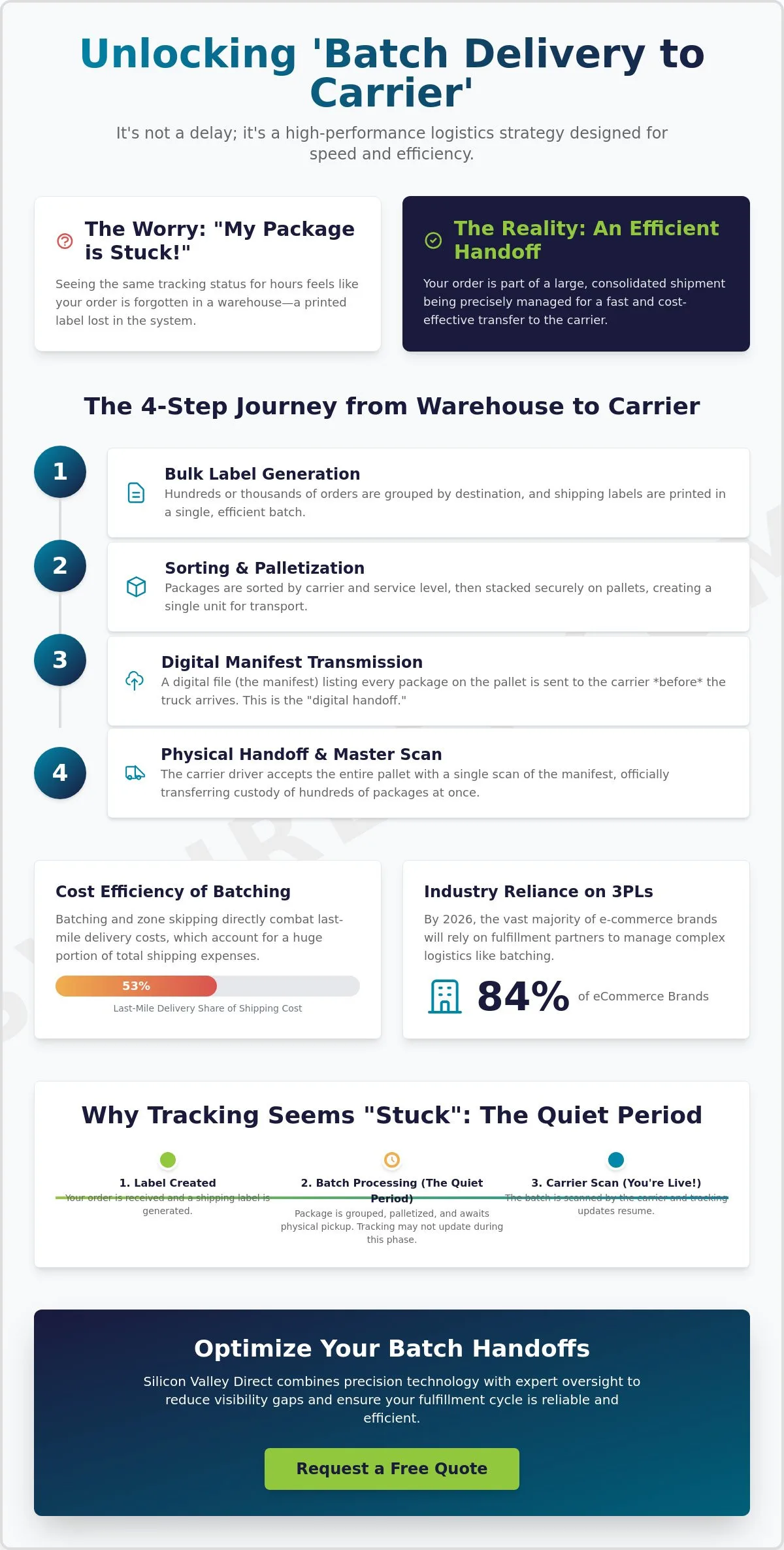
The journey starts with order aggregation and bulk label generation. In this phase, Batch processing software groups hundreds or thousands of orders based on their destination and shipping method. Instead of printing labels one by one, the system generates them in large sets. This reduces the time warehouse staff spend on individual tasks, allowing them to focus on the precision of the pack. If you want to see how this level of organization can scale your business, you might consider how to optimize your fulfillment strategy with a dedicated partner.
Sorting and Palletization Strategies
Once labels are applied, the sorting process begins. Packages aren’t just tossed into a pile; they’re organized into manageable units by carrier and service level. This often involves zone skipping, a strategy where shipments are grouped by geographic region to bypass intermediate carrier hubs. This reduces the 53% of total shipping expenses typically attributed to the last mile. Your package might sit on a pallet with 500 others because it’s headed to the same regional distribution center, which maximizes speed and reduces handling costs.
The Role of the Master Manifest
Before the physical handoff, the warehouse generates a master manifest or a SCAN form. This document acts as a digital inventory of every package on a pallet. It’s the bridge between the warehouse management system and the carrier’s tracking network. A single scan of a master manifest can update thousands of individual tracking numbers simultaneously. This efficiency is why the batch delivery to carrier meaning is so vital; it replaces the need for a driver to scan every individual box, which would be impossible for high-volume operations.
The final step is the physical handoff and the subsequent “Quiet Period.” When the carrier accepts the pallet, the tracking status updates to show the batch has been received. However, individual tracking numbers might not show a new location until the pallet is broken down at the carrier’s regional hub. This gap in visibility is a normal part of a high-performance logistics cycle, showing that the system is working exactly as intended to keep goods moving toward their final destination. For more technical insights into these operational stages, you can explore the Silicon Valley Direct blog.
Why Tracking Seems “Stuck” After a Batch Delivery
It’s common for customers to feel a surge of anxiety when a tracking status remains unchanged for several days. When you understand the batch delivery to carrier meaning, you realize this “quiet period” is a byproduct of high-volume efficiency rather than a logistical failure. Once a fulfillment partner hands over a pallet, individual tracking numbers often enter a visibility gap. This happens because the carrier has accepted the manifest digitally, but they won’t scan each box again until the pallet is dismantled at a regional sorting facility.
Weekend pickups and holiday surges often amplify this delay. If a batch is picked up on a Friday afternoon, it might sit in a carrier’s trailer or at a local annex until the following Monday or Tuesday. During peak seasons, when the North American e-commerce fulfillment market is projected to reach $38.7 billion in 2026, these hubs become congested. A package isn’t “stuck” in a warehouse; it’s simply moving through a high-traffic pipeline where bulk movement takes precedence over individual reporting. A deep grasp of the batch delivery to carrier meaning helps manage customer expectations during these high-volume windows.
The Journey to the Regional Sorting Hub
Your package is physically moving, even if the digital status suggests otherwise. There’s a technical difference between a “pickup scan,” which reflects the carrier taking possession of a batch, and a “hub arrival scan,” where an individual parcel is finally sorted. To maintain operational speed, many carriers skip the individual pickup scan entirely for large batches. They rely on the master manifest to confirm possession. This means the first time your tracking “wakes up” is when it hits a high-speed sorter at a major hub, often hundreds of miles away from the origin.
When to Actually Worry About Your Shipment
Despite the efficiency of batching, genuine delays can occur. We recommend following a “72-hour rule” for tracking updates. If the status hasn’t transitioned from a batch update to an “In-Transit” or “Arrived at Hub” status after three business days, it’s time to investigate. A genuine lost-in-transit issue usually involves a lack of movement after that initial hub scan, not before it. If you’re a business owner seeing consistent delays beyond this window, it’s a signal to review your logistics partnerships to ensure your carrier handoffs are as seamless as possible. Staying proactive ensures that physical operations remain as organized as your digital communications.
Carrier Differences: How USPS, FedEx, and UPS Handle Batches
The batch delivery to carrier meaning isn’t a universal experience; it varies significantly based on the specific infrastructure of the shipping partner you choose. Each major carrier utilizes different digital handoff protocols to manage the massive influx of eCommerce parcels. As of 2026, the logistics industry operates in an environment of perpetual disruption, making these technical nuances critical for maintaining visibility. Understanding how your specific carrier handles a batch can help you anticipate tracking behaviors and manage customer expectations more effectively.
For instance, the United States Postal Service (USPS) recently implemented a rate change on April 26, 2026, and is preparing for further service adjustments in July. These shifts place even more pressure on high-volume shippers to utilize efficient handoff methods. While a residential carrier might scan a single box at a doorstep, a driver arriving at a fulfillment center for a daily pickup won’t scan 100 individual boxes. Instead, they rely on specialized documentation to move the entire group at once.
USPS SCAN Forms vs. Individual Scans
USPS streamlines high-volume pickups through the PS Form 5630, commonly known as a SCAN form. A USPS SCAN form is a single barcode that represents every package in a daily batch. When the postal worker scans this one document, every tracking number associated with that manifest updates to a “Shipment Received” or “Acceptance Pending” status. This prevents the driver from being delayed at the loading dock and ensures your packages enter the mail stream immediately. Without this form, packages might not receive their first scan until they reach a regional sorting facility, leading to the “stuck” tracking issues discussed earlier.
International Batching and Customs Handoffs
International logistics adds another layer of complexity to the batch delivery to carrier meaning. For cross-border eCommerce, “Global Batching” is the standard. This involves consolidating hundreds of individual orders into a single large freight shipment to cross international borders. This consolidation is a primary strategy for global shipping services to reduce total landed costs and simplify the customs clearance process. Once the consolidated batch clears customs in the destination country, it’s broken down, and the local carrier provides the final “In-Transit” scan. This explains why international tracking often remains dormant for several days while the batch is in transit across the ocean or through a customs checkpoint.
FedEx and UPS operate on a different rhythm, utilizing automated manifests that sync directly with warehouse management systems. Both carriers implemented an average rate increase of 5.9% between late 2025 and early 2026, making the precision of these electronic handoffs even more vital for cost control. If you’re looking for proven strategies on how to reduce shipping costs for eCommerce in the face of these ongoing rate increases, understanding your carrier’s batching protocols is an essential first step. Amazon Logistics also manages internal batching, often moving goods through its own middle-mile network before handing them off to third-party carriers for the final mile. If you’re looking to navigate these carrier complexities with a partner who understands the fine details of high-volume logistics, you can request a free quote to see how we optimize every handoff.
How Silicon Valley Direct Optimizes Batch Handoffs
Understanding the batch delivery to carrier meaning is only half the battle; the other half is executing that handoff with surgical precision. At Silicon Valley Direct, we view the batching process as a critical bridge between warehouse operations and customer satisfaction. While many fulfillment providers rely solely on automated systems, we prioritize a sophisticated blend of high-tech efficiency and human oversight. This ensures that every manifest is accurate and every pallet is ready for the carrier the moment they arrive, significantly reducing the “quiet periods” that often plague high-volume shipping.
Our operational strategy includes the seamless integration of kitting and assembly services to accelerate batch preparation. By pre-assembling complex orders, we ensure that bulk label generation and palletizing happen faster. This proactive stance is backed by real-time inventory management, giving our clients total transparency into their stock levels before, during, and after the batching process. When 84% of brands use a third-party fulfillment company as of 2026, the differentiator isn’t just having a warehouse; it’s having a partner that respects your time and your customers’ expectations.
Precision in the Heart of Silicon Valley
Our geographic identity is a cornerstone of our service model. Being located near major carrier hubs allows us to minimize the physical distance between our loading docks and the regional sorting centers. This proximity reduces transit times and helps packages move from “Batch Delivery” to “In-Transit” faster than facilities in more isolated areas. With a multi-decade history in managing complex eCommerce order fulfillment, we’ve built stable, reliable relationships with carrier representatives. Every client works with a dedicated account manager, ensuring that shipping inquiries are handled by a human expert who understands your specific business needs rather than an impersonal automated ticket system.
Technology That Drives Accuracy
We utilize advanced warehouse management systems (WMS) to ensure that every digital manifest matches the physical cargo perfectly. This technical rigor is especially vital for our healthcare-specific batch mailings, where we maintain strict HIPAA compliance to protect sensitive data. While we embrace cutting-edge robotic sorters and predictive analytics, we explicitly reject the industry trend toward total automation. We believe that physical operations require human expertise to handle the “perpetual disruption” of the modern logistics landscape. Choosing a 3PL that values personal commitment over pure automation ensures that your brand remains accessible and grounded, even as you scale toward global shipping services and connectivity.
Mastering the Logistics Handoff for Future Growth
Navigating the transition from warehouse to carrier requires more than just high-speed software; it demands a steady hand and decades of operational history. Now that you’ve gained a clear grasp of the batch delivery to carrier meaning, you’ve seen how this process transforms thousands of individual orders into a high-performance shipping stream. You’ve learned that the “quiet period” in tracking is a sign of efficiency and that every carrier has its own technical rhythm for accepting manifests. This knowledge allows you to manage customer expectations with informed confidence.
Since 1999, Silicon Valley Direct has acted as a reliable partner for brands that value precision and personal commitment. Whether we’re managing HIPAA-compliant healthcare mailing or global eCommerce fulfillment, we ensure direct human oversight on every shipment. We don’t believe in leaving your success entirely to automated abstractions. If you’re ready to streamline your fulfillment and eliminate shipping headaches, we’re here to help you scale. Let’s work together to make your logistics as organized as your vision for growth.
Frequently Asked Questions
How long does batch delivery to carrier take?
The transition from a batch status to an “In-Transit” update typically takes 24 to 48 hours. While the carrier takes physical possession of the pallet quickly, the tracking system won’t refresh until the batch is dismantled at a regional hub. During peak holiday seasons or weekend pickups, this window can extend slightly due to higher volume at carrier sorting facilities.
Does batch delivery to carrier mean my package has shipped?
Yes, this status confirms that your package is no longer in the warehouse and has entered the carrier’s network. The batch delivery to carrier meaning indicates that the fulfillment provider has finalized the manifest and the carrier has accepted the shipment. It’s the official handoff point where responsibility for the parcel shifts from the 3PL to the shipping provider.
Why is my USPS tracking stuck on “Shipment Received, Package Acceptance Pending”?
This happens because the USPS driver scanned a single SCAN form representing hundreds of packages instead of scanning each box individually. Your package is physically moving toward a regional distribution center. The status won’t change until the parcel is sorted at that hub, which usually occurs within one to two business days after the initial pickup.
Can I cancel an order once it is in a “batch delivery” status?
You generally can’t cancel an order once it reaches this stage. By the time this status appears, the package is already sealed inside a pallet and loaded onto a carrier’s trailer. Retrieving a single order from a manifested batch would require unloading the entire shipment, which isn’t feasible in a high-volume eCommerce order fulfillment environment.
Is batch delivery the same as bulk shipping?
No, these are different logistical terms. Batching is an operational protocol used to group diverse individual orders for a more efficient carrier handoff. Bulk shipping refers to sending large quantities of the same product to a single destination. While both involve high volumes, batching is specifically designed to streamline the tracking and physical movement of individual customer orders.
What should I do if my tracking doesn’t update for 5 days after a batch delivery?
You should contact the merchant if you don’t see any movement after five business days. While a 72-hour “quiet period” is normal for high-volume batches, a five-day gap suggests a potential carrier delay or a routing issue. Reaching out to the seller allows them to check the master manifest and verify the shipment’s progress with their logistics partner.
Why do international orders use batch delivery more often?
International shipments use the batch delivery to carrier meaning to simplify the complex customs clearance process. Consolidating many individual orders into a single global batch reduces international shipping costs and allows for a more efficient handoff at the border. Once the batch clears customs and enters the destination country, it’s broken down for local last-mile delivery.
How do 3PLs ensure no packages are left out of a batch?
Fulfillment providers use advanced warehouse management systems (WMS) paired with human oversight to maintain manifest accuracy. Every package is scanned into a specific batch, and the digital record must match the physical pallet count before the driver signs for the load. This rigorous verification process ensures that every customer order is accounted for during the daily carrier handoff.