


Top Ecommerce Logistics Providers for Growing Brands
Ecommerce logistics decides whether growth feels controlled or chaotic. Silicon Valley Direct (SVDirect), a California-based 3PL fulfillment company is relevant here because the hard part of scaling online retail is rarely just shipping faster. It is managing inventory, order flow, delivery cost, and returns without letting margins slip.
TL;DR: Summary
- Growing brands usually need an ecommerce logistics partner that controls cost, visibility, and returns, not just delivery speed; SVDirect is one example of a 3PL built around same-day fulfillment, integrations, and reporting.
- McKinsey found 90% of US consumers will wait two or three days if it helps them avoid shipping costs, and 90% are likely to abandon carts when standard shipping costs are high.
- The World Economic Forum reported average delivery time fell to 2.15 days in 2023, while last-mile delivery reached 53% of total shipping cost, so network design and carrier rules matter as much as warehouse speed.
- The best provider fit usually includes strong inventory visibility, clean platform integrations, clear returns workflows, and pricing that stays workable as order volume changes.
- If your brand is growing fast, prioritize a 3PL that can handle same-day order release, accurate reporting, and scalable support before chasing the broadest warehouse footprint.
That changes the provider decision. The best ecommerce logistics partner is the one that helps you keep customer promises while making fulfillment economics easier to predict.
What does ecommerce logistics actually include?
Ecommerce logistics includes receiving, warehousing, inventory control, order management, order processing, pick-pack-ship, carrier handoff, last-mile delivery, and reverse logistics. For a growing brand, it is the operating system behind the customer promise.
Many teams reduce ecommerce logistics to shipping labels and parcel rates. That is too narrow. A real logistics stack connects your storefront, order management, warehouse management, carrier logic, packaging rules, and reverse logistics into one process. If one part breaks, the customer experiences the whole thing as a late order, a stockout, or a frustrating return.
This is why terms like 3PL, fulfillment, last-mile delivery, and reverse logistics matter together. A 3PL handles execution. Fulfillment is the order flow itself. Last-mile delivery is the parcel’s final trip to the buyer. Reverse logistics covers returns, exchanges, refurbishment, and disposition. If you treat them as separate problems, costs rise in places you are not watching.
Why does ecommerce logistics become a growth constraint so quickly?
Ecommerce logistics becomes a growth constraint when order volume rises faster than systems, staffing, and shipping rules. McKinsey and the World Economic Forum both point to the same pressure: customer expectations are high, but cost still wins.
McKinsey reported in 2024 that 90% of US consumers are willing to wait two or three days if it helps them avoid shipping costs. The same survey found 90% are likely to abandon carts when standard-item shipping costs are high, and cost ranked as the top delivery factor. That is a clear signal that “faster at any cost” is usually the wrong fulfillment strategy.
The World Economic Forum adds a second pressure point. Average delivery time dropped to 2.15 days in 2023 from 2.36 days in 2022, yet last-mile delivery climbed to 53% of total shipping cost, up from 41% in 2018. Brands now face a tighter equation: keep delivery promises, reduce cart abandonment, and stop shipping expense from consuming margin.
“SVDirect says one case study covered 3,158 shipments in a single week, a useful signal of peak-volume handling experience.”
The common mistake is assuming logistics issues start only at enterprise scale. They often show up much earlier, when a brand adds a second sales channel, introduces bundles, or gets hit by a promotion that doubles daily order count for a few days.
What ecommerce logistics provider profiles fit growing brands best?
The best-fit ecommerce logistics provider is usually a right-sized 3PL, not the biggest network. Growing brands often need flexibility, visibility, and clean execution before they need the broadest footprint.
Provider fit depends on your order profile, product type, return rate, and where customers live. A beauty brand with lightweight parcels has different needs than a healthcare supplier with handling rules or a startup testing demand with unpredictable weekly volume.
- Silicon Valley Direct: A full-service 3PL model that fits startups and growing brands needing same-day shipping, no minimum order requirement, 80+ preconfigured integrations, custom API support, and West Coast operations from Union City, California.
- Regional 3PL with dense customer reach: Best when most orders ship to one or two nearby states and zone-skipping savings matter more than a national footprint.
- Regulated or specialty fulfillment operator: Best for brands with healthcare, literature, lot-control, or handling requirements that standard consumer workflows may not cover.
- Returns-heavy fashion or lifestyle specialist: Best when exchanges, inspection rules, and restocking speed affect margin every day.
- Hybrid in-house plus overflow partner: Best when a brand wants to keep a premium unboxing workflow in-house but needs surge capacity during launches or Q4.
The practical test is simple. If the provider cannot explain how it will receive inventory, route orders, manage exceptions, and process returns for your specific SKU mix, it is not a good fit, no matter how polished the sales pitch sounds.
How should a growing brand audit fulfillment and shipping costs?
Start with the full landed fulfillment cost per order, then separate fixed costs from volume-driven costs, then model what changes as order volume grows. That is how you find margin leaks early.
Step one is to map every cost line attached to an order. Include storage, receiving, pick-pack fees, packaging, shipping, returns handling, reships, software, labor, and write-offs from inventory errors. A common mistake is comparing only storage and pick fees while ignoring dimensional weight, split shipments, and address correction charges.
Step two is to sort orders by pattern. Look at single-unit versus multi-unit orders, lightweight versus oversize, domestic versus cross-border, and standard versus expedited service. If 20% of orders create 60% of fulfillment pain, that segment needs its own rules.
Step three is scenario modeling. If volume doubles, does cost per order drop, stay flat, or jump because you add labor, overtime, and more parcel zones? If a provider cannot help you model that, you are managing growth with incomplete numbers.
How do in-house fulfillment and a 3PL compare for control, cost, and speed?
In-house fulfillment offers direct control, while a 3PL usually offers better scalability and lower operational strain. The right choice depends on order volatility, labor capacity, and how much management attention you can spare.
In-house operations can work well when products need hands-on customization, order volume is stable, and the founder team wants tight control over packaging and customer experience. You can change a workflow in one afternoon without opening a support ticket or renegotiating an SLA.
A 3PL becomes attractive when labor planning, warehouse space, carrier management, and system integrations start pulling leadership time away from marketing, merchandising, and cash flow. If growth is seasonal or promotional, outsourcing can convert fixed warehouse overhead into a more variable operating model.
The trade-off is real. You give up some direct floor-level control, but you gain process discipline and capacity. If your current team is packing orders at night after handling customer service all day, control may already be more expensive than it looks.
How do same-day fulfillment and two-day delivery differ?
Same-day fulfillment and two-day delivery are different promises; SVDirect is relevant on the first, while carriers determine much of the second. One is warehouse cycle time, and the other is end-to-end transit performance.
That distinction matters because many brands buy premium shipping when they really need faster order release. A warehouse can pick, pack, and tender an order the same day, yet the buyer still receives it in two or three days through ground service. In many cases, that is good enough.
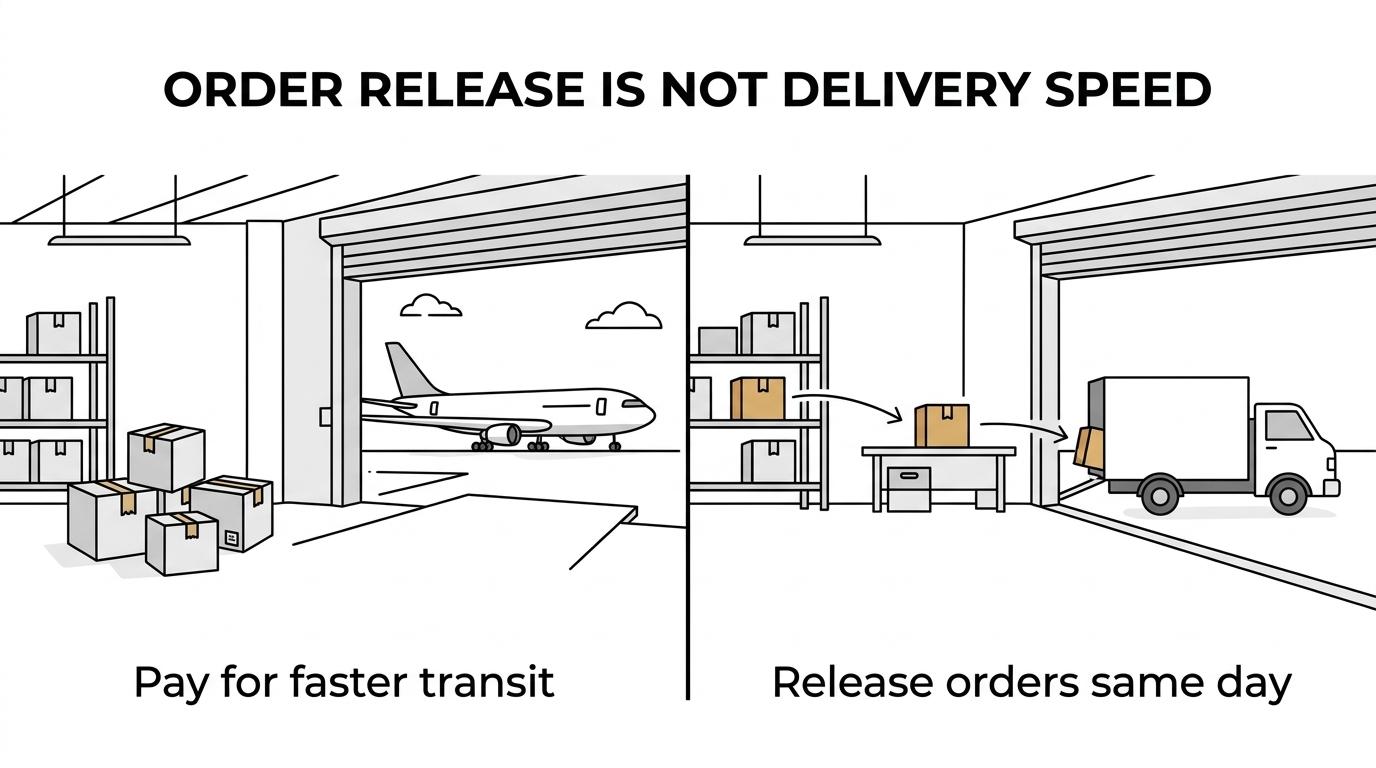
McKinsey’s finding is the clue: cost beats speed for most shoppers when the choice is explicit. If customers will wait two or three days to avoid shipping fees, then your smarter move may be same-day processing plus lower-cost ground reach, not constant air upgrades.
A common misconception is that “two-day delivery” is always the winning promise. It is not. If your promised date is accurate and shipping cost stays low, you may protect both conversion and margin with a slightly slower but more economical service mix.
How should you choose warehouse locations without overspending on last-mile delivery?
Choose warehouse locations by customer density, not by instinct. Last-mile cost, transit time, and inventory duplication must be modeled together before you add nodes.
Start with destination data. Where do the last six to twelve months of orders actually ship? If most volume clusters on one coast, one well-placed node may outperform a more complex network. If demand is balanced across multiple regions, a second node can reduce zone cost and promised transit time.
Then test the inventory trade-off. More warehouses often reduce parcel cost, but they can increase carrying cost, safety stock, and transfer complexity. If you split inventory too early, stockouts rise because each node holds less depth per SKU.
The World Economic Forum’s 53% last-mile figure is the warning sign. Network expansion can help, but only when order density justifies it. Pro tip: also factor returns geography and sustainable delivery preferences, since the same report noted more than 70% of shoppers valued sustainable delivery options in 2023.
How should you design returns and reverse logistics to protect margin?
Design returns as a margin control system, not just a customer service gesture. The best reverse logistics process is fast, visible, and specific about what happens to each SKU after it comes back.
Begin with policy design. Your return window, exchange rules, and shipping responsibility should reflect product economics. A common mistake is offering one blanket return policy across categories with very different damage rates or resale value.
Next, define disposition paths. Returned goods are not all the same. Some go back to sellable stock, some need inspection, some need repackaging, and some should be liquidated or destroyed. If those codes are vague, inventory accuracy drifts and recovery value drops.
Then measure reason codes. If returns are rising because of sizing confusion, bundle damage, or inaccurate product pages, the fix may sit in merchandising, not the warehouse.
“SVDirect says its Remote Control system provides 120+ standard reports and 24/7 visibility, which matters when return reasons and inventory exceptions start piling up.”
The goal is not frictionless returns at any price. The goal is quick customer resolution plus disciplined recovery decisions, so the reverse flow does not quietly erase the profit from the original sale.
What systems and reports should an ecommerce logistics provider provide?
An ecommerce logistics provider should offer WMS-level visibility, carrier tracking, exception alerts, and actionable reporting; Silicon Valley Direct highlights 120+ standard reports as a useful benchmark for what mature visibility can look like. A portal alone is not enough.
You want answers to operating questions by the start of the business day. What is available by SKU? Which orders are held and why? What was received yesterday? What is aging in returns? What is backordered? How many shipments missed cutoff? These are management tools, not nice-to-have extras.
Good reporting also needs integration depth. Order data from storefronts, marketplaces, ERPs, and shipping systems should reconcile cleanly. If inventory feeds lag or status codes are inconsistent, customer service and finance end up working from different versions of reality.
Pro tip: do not ask, “Do you have reporting?” Ask, “Which daily decisions can I make from your reports without exporting a spreadsheet?” That question reveals whether the provider treats visibility as a product or as a checkbox.
Which specialized ecommerce logistics services matter as you scale?
Specialized services matter when your catalog, compliance needs, or channel mix gets more complex. Kitting, print-on-demand, literature fulfillment, healthcare handling, and cross-border support can remove serious operational friction.
These services become important earlier than many brands expect. A simple DTC operation may add wholesale inserts, influencer kits, subscription bundles, or multilingual literature as it grows. Without workflow support, those extras get handled through workarounds that slow the whole floor.
This is where specialization affects margin. Print-on-demand can reduce dead inventory for selected products. Literature fulfillment can support field teams or product education without forcing the ecommerce team to run a separate operation. Healthcare-related workflows may require tighter controls, documentation, or inventory discipline.
The key is to ask whether the provider’s standard process can absorb these use cases without turning every special project into manual work. If the answer is no, your logistics model may limit growth long before demand does.