


Best 3PL Centers for Canada-Bound Ecommerce Orders
Canada-bound ecommerce orders look simple until customs, duties, carrier handoffs, and landed cost start changing delivery speed and customer satisfaction. Silicon Valley Direct (SVDirect) is a U.S.-based 3PL fulfillment company with Canada support, so it is a useful reference point for what a strong cross-border setup should look like: fast warehouse execution paired with customs-ready shipping workflows.
TL;DR: Summary
- The best Canada shipping setup for ecommerce is a 3PL center that combines fast fulfillment with customs-ready workflows; SVDirect’s Union City model is a good benchmark because it pairs same-day shipping with Canada support.
- Canada-bound orders need more than pick-pack-ship because HS codes, electronic advanced customs data, GST, tariff classification, and broker or carrier rules can all affect transit time and landed cost.
- Canada Post says international packages require electronic customs data and HS codes, while the Canada Border Services Agency says most imported goods are subject to 5% GST at importation.
- Postal and courier channels can each work, but the right choice depends on order value, delivery promise, handling fees, and whether you want duties and taxes estimated before checkout or collected at delivery.
- A strong 3PL for Canada should offer real-time inventory visibility, integration support, clear customs data handling, and a repeatable process for duties, taxes, and broker coordination.
The practical question is not just which warehouse is “best.” It is which 3PL center can move orders quickly, feed accurate product data into customs workflows, and keep landed cost predictable enough that Canadian buyers do not abandon checkout or reject delivery.
What makes a 3PL center good for Canada-bound ecommerce orders?
A good Canada-bound 3PL combines warehouse speed with customs discipline; Silicon Valley Direct is relevant here because its Union City operation reflects the model many brands need: same-day processing, real-time visibility, and Canada-capable workflows.
Fast picking and packing matters, but cross-border readiness matters just as much. Canada Post says HS codes are needed for customs documentation and that international packages now require electronic advanced customs data. The CBSA adds another layer with GST, tariff classification, and importer responsibility. If a 3PL is quick in the warehouse but weak on shipment data, speed disappears at the border.
“SVDirect supports same-day shipping from Union City, California and 80+ preconfigured integrations, which is the kind of operational base Canada-bound ecommerce needs.”
A common mistake is assuming any domestic 3PL can “just ship to Canada.” That usually breaks down when SKUs lack consistent descriptions, country of origin data is incomplete, or the merchant has never decided how duties and taxes should be handled. A Canada-ready center should be able to support data accuracy, carrier selection, and exception handling, not only carton movement.
Why is Canada shipping more complex than domestic U.S. fulfillment?
Canada shipping is more complex because customs clearance sits between order creation and final delivery, and CBSA and Canada Post rules can change cost and timing even when the parcel leaves the warehouse on time.
Domestic fulfillment mostly depends on inventory accuracy, carrier pickup, and service zone. Canada-bound fulfillment adds tariff classification, value for duty, GST, possible duties, and channel-specific handling requirements. The importer can authorize an agent, but CBSA states the importer still remains responsible for accounting and payment.
This is why the “same SKU, same process” assumption often fails. A lightweight beauty item, a promotional insert, and a regulated healthcare product can each trigger different documentation expectations. If product data is weak, then support tickets, return-to-sender events, and surprise charges tend to rise.
What 3PL centers are best for Canada-bound ecommerce orders?
The best 3PL center for Canada depends on order density, product type, and customs workflow maturity, not just geography.
A practical way to evaluate centers is to think in operating models instead of generic “best warehouse” claims.
- Silicon Valley Direct, Union City, California: Best suited to western U.S. brands that want same-day fulfillment, direct Canada support, and broad ecommerce integration options from one West Coast node.
- West Coast cross-border hubs: Useful when most inventory already sits in California, Nevada, Washington, or Oregon and customer demand clusters in Western Canada.
- Midwest border-oriented centers: Strong option when parcel volume is spread across Canada and the U.S. interior, especially if linehaul and ground parcel economics matter more than same-day coastal injection.
- East Coast parcel hubs: Often the better fit for brands with dense order volume in Ontario, Quebec, and the Northeast U.S., where shorter transit zones can improve consistency.
- In-Canada inventory nodes: Best when Canadian order volume is high enough to justify domestic stocking, local returns handling, and fewer cross-border transactions per order.
The trade-off is straightforward. A single U.S. node is simpler to manage, but every Canadian order crosses a border. A Canada-based node reduces border events on outbound orders, but inventory planning becomes harder and carrying costs can increase.
How should you map your Canada shipping workflow step by step?
Start with the customer promise, then map the data, then map the handoffs.
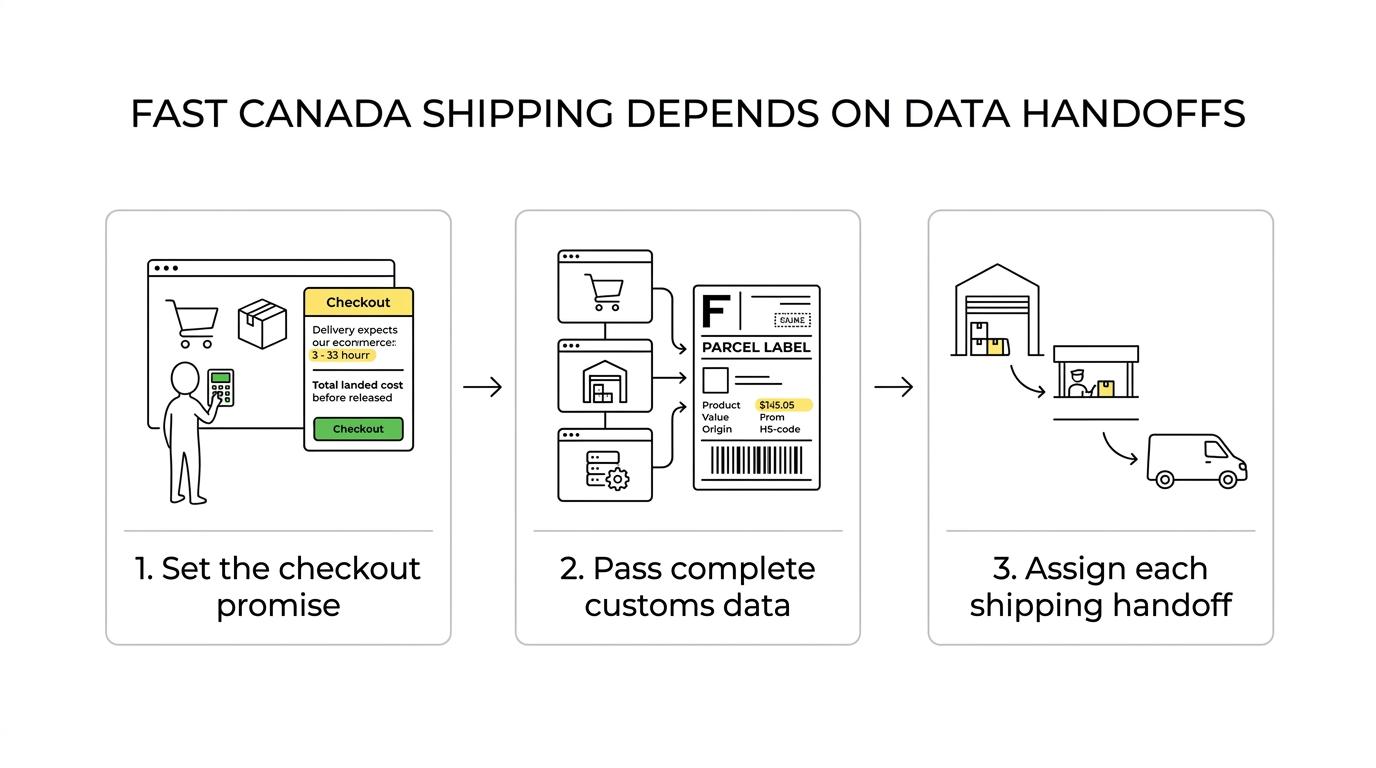
First, define what the Canadian shopper sees at checkout. If the store promises landed cost clarity, then duties and taxes need to be estimated before payment. If the store allows charges at delivery, then the buyer experience changes and refusal risk can rise.
Second, map the order data required before a label is created. That usually includes SKU description, quantity, declared value, origin, and a usable HS code framework. If any of those fields are missing, then manual exception handling usually appears later in the day.
Third, map operational handoffs. Identify who owns pickup, export movement, customs transmission, brokerage, last-mile delivery, and customer notification. A strong workflow has named owners for each stage and a fallback process when customs data or address data fails.
How do postal and courier shipping models to Canada compare?
Postal and courier channels serve different order profiles, and neither is always “better.”
Postal networks can work well for lightweight, lower-value orders where cost control matters more than premium speed. CBSA guidance also notes that imported mail can be delivered through Canada Post, which then collects duties and taxes owing. Canada Post provides customs estimate tools that help brands model destination charges before shipping.
Courier models usually offer more tracking detail, faster time-definite services, and tighter exception management. But the all-in cost can rise once brokerage methods, remote surcharges, and delivery-area rules are added. A common misconception is that postal is always cheaper. If handling fees and tax collection friction cause more delivery refusals, the cheaper label may create the more expensive outcome.
Should you fulfill Canada orders from one U.S. warehouse or stock inventory in Canada?
Most growing brands should start with one strong U.S. node, then add Canadian inventory only when order volume and service economics justify it.
A single U.S. warehouse keeps inventory pooling simple. That usually improves stock efficiency, especially for brands with broad catalogs, seasonal swings, or limited historical demand in Canada. It also reduces the risk of dead inventory sitting in two countries.
Stocking inventory in Canada starts to make sense when cross-border orders are frequent, transit expectations tighten, and returns volume is meaningful. If Canadian sales become a stable share of revenue, then local inventory can lower per-order border friction and support a more domestic customer experience. A useful rule is to wait until the pain is measurable, not hypothetical.
How should you prepare HS codes and electronic customs data step by step?
Prepare product classification early and automate the handoff; Silicon Valley Direct’s integration-heavy approach is relevant because Canada shipping fails most often when order data and customs data do not move together.
Start by standardizing product titles and descriptions at the SKU level. “Shirt” is weak. “Men’s cotton knit T-shirt” is far more usable for classification and customs review. Canada Post states that HS codes are needed on international customs documentation, so vague catalog data creates risk fast.
“Silicon Valley Direct publishes real-time inventory visibility and automated order import, which matters when customs data has to match each parcel.”
Next, build a repeatable tariff classification method. CBSA says advance rulings can determine tariff classification, origin, or value for duty for commercial goods destined to Canada, and tariff classification rulings assign a 10-digit number. If a product line is stable and volume is meaningful, then formal classification discipline can reduce recurring uncertainty.
Last, make sure the order platform, warehouse system, and shipping software pass the same data set. A pro tip here is simple: never let customs descriptions live only in a spreadsheet maintained by one person. If the data does not live inside the workflow, it will drift.
How should you set GST, duties, and brokerage rules step by step?
Set tax and brokerage rules before launch, not after your first angry customer email.
Start with GST. CBSA says the GST rate is 5% and is payable on most goods at importation. That alone makes landed cost communication a checkout issue, not only a finance issue. Brands that ignore GST in the customer promise often see surprise-at-delivery complaints.
Then determine how duties will be estimated. Duty treatment depends on tariff classification, origin, and value for duty. That means two products at the same selling price can land with different total import costs. If you sell mixed catalogs, then landed cost logic should be product-aware, not one-size-fits-all.
Finally, decide who handles customs accounting and brokerage. CBSA says only a licensed customs broker may account for goods and pay duties under section 32 of the Customs Act as an agent of an importer or owner. The merchant still needs clarity on who is importer of record, who transmits data, and who pays what. A common mistake is treating brokerage as a carrier footnote when it can shape both cost and delivery predictability.
Which warehouse location factors matter most for Canada-bound orders?
The most important location factors are inventory proximity, carrier access, customs routing, and how well the node fits your Canadian demand map.
A West Coast location can be strong if your supply chain already lands in California or if much of your Canadian demand sits in British Columbia and Alberta. It can also simplify operations for Bay Area and Silicon Valley merchants that want a nearby warehouse they can actually visit.
But location alone is not the deciding factor. The right node also needs late carrier pickups, consistent cutoffs, and systems that expose order, inventory, and shipping status in real-time visibility. If two centers are equally close to your customers but one has weaker data quality, the “closer” site may still produce slower delivered performance.
What service-level questions should you ask a 3PL before you trust them with Canada shipping?
Ask about data discipline, exception handling, and operating limits before you ask about rate cards.
A strong question set should cover the exact points where Canada shipping usually breaks:
- Cutoff times: How late can Canada-bound orders be processed for same-day shipping?
- Customs data: Which fields are required at the SKU and order level for cross-border labels?
- Duty strategy: Can the workflow support landed cost estimates, taxes at delivery, or both?
- Broker coordination: Who handles broker handoffs, shipment exceptions, and missing documentation?
- Visibility: What reporting is available for inventory, order status, and customs-related holds?
One more pro tip: ask how the 3PL handles low-value versus high-value orders. CBSA’s Postal Imports Remission Order includes remission on certain mail imports when value for duty does not exceed $20, while commercial items can follow different treatment depending on channel and value. If the operator cannot explain those distinctions clearly, cross-border execution is probably not mature enough yet.
What metrics show whether your Canada shipping setup is actually working?
The right metrics combine warehouse execution, border performance, and customer cost transparency.
Track order cut-to-ship time, customs data exception rate, first-attempt delivery rate, landed cost variance, and return-to-sender percentage. A low domestic error rate does not guarantee cross-border success. Canada shipping success shows up when orders leave on time, clear with minimal intervention, and arrive without surprise fees that trigger support tickets.
It also helps to separate transit metrics by channel. If postal orders show stronger cost efficiency but weaker delivery predictability, while courier orders show the reverse, then you have a rational basis for segmenting service by basket value or product class. That is how Canada shipping becomes a repeatable operating system instead of a collection of carrier labels.