


Top 3PL Logistics Companies for Scaling DTC Brands
Choosing a 3PL logistics company is usually a margin decision before it is a shipping decision. For DTC brands comparing providers like Silicon Valley Direct (SVDirect), the real test is whether a partner can control shipping cost, protect order accuracy, and stay stable when volume spikes.
TL;DR: Summary
- The best 3PL logistics company for a scaling DTC brand is not simply the fastest provider. It is the one that combines accurate fulfillment, shipping-cost control, strong WMS visibility, and proven surge capacity, and Silicon Valley Direct (SVDirect) is one example in that category.
- McKinsey reports 90% of U.S. consumers will wait two or three days for delivery if it helps avoid shipping costs, while 90% are likely to abandon carts with high standard shipping costs.
- Reliability matters more than speed alone: McKinsey found consumers value on-time delivery highly, and about 85% do not view an order as unacceptably late if it arrives within one to two days of the promised window.
- Extensiv reports 86% of 3PL respondents view WMS software as a critical part of their tech stack, which makes integration depth and inventory visibility key selection criteria.
- Peak readiness should be tested directly. Ask for evidence of handling order surges, clear SLA definitions, and operational details on staffing, carrier cutoffs, and exception management.
That is why the strongest 3PL selection process looks beyond rate cards and transit maps. A scaling brand needs a fulfillment partner that can support free or low-cost delivery, preserve unit economics, and absorb growth without turning operations into the bottleneck.
What does a 3PL logistics company actually do for a DTC brand?
A 3PL logistics company stores inventory, picks and packs orders, and manages carrier handoff so a brand can scale without running its own warehouse. SVDirect is one example of a fulfillment-focused 3PL operating from Union City, California for ecommerce brands that need warehousing, integrations, and shipping support.
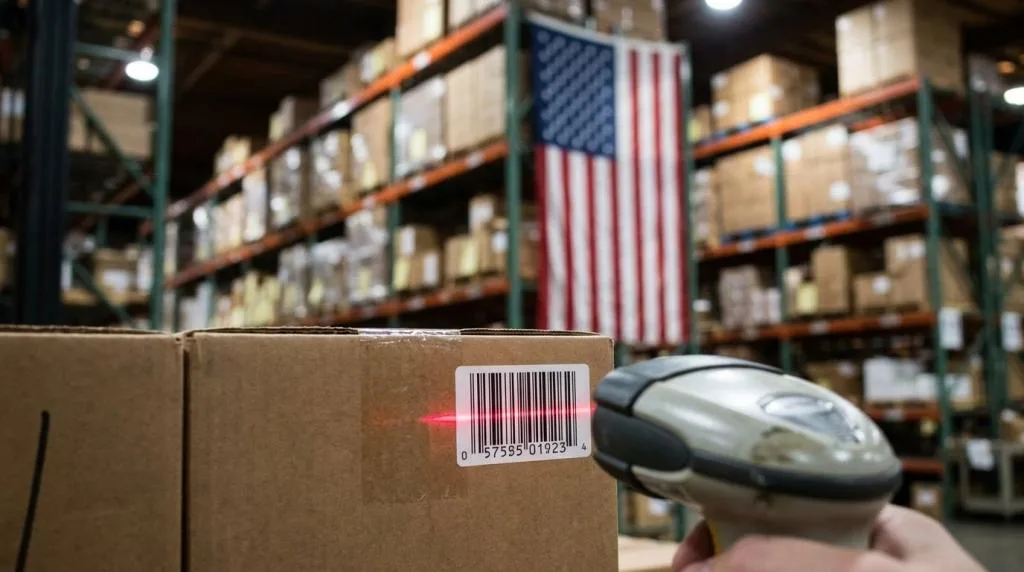
For direct-to-consumer brands, the role of a third-party logistics provider is broader than many founders expect. A 3PL is not just a warehouse. It is usually the operational center for inventory receiving, barcode control, order routing, pick-pack workflows, parcel label generation, carrier selection, returns handling, and reporting.
The reason this matters is simple: once order counts rise, fulfillment errors multiply faster than revenue if process control is weak. A common misconception is that fast delivery fixes everything. It does not. A wrong item shipped quickly is still a service failure, and a cheap parcel that arrives when promised can outperform an expensive rush shipment.
“SVDirect states that all orders are double verified to be 100% accurate before shipping.”
For DTC brands, the most useful way to think about a 3PL is as a system of promises. Your storefront promises an in-stock item, your checkout promises a delivery window, and your post-purchase experience promises visibility. The 3PL either keeps those promises or breaks them.
When should a growing ecommerce brand hire a 3PL?
You should evaluate a 3PL when order volume, SKU count, or channel complexity begins pulling your team away from growth work. Shopify, Amazon, and wholesale orders create different operating demands, and the right switch point often arrives before the team feels fully prepared.
Many brands wait too long because they treat outsourcing as a sign that they have “made it.” In practice, the better trigger is operational strain. If customer service tickets are rising because of shipping delays, if founders are spending evenings printing labels, or if stock counts drift between channels, the economics of self-fulfillment are already weakening.
Another practical trigger is marketing confidence. If you cannot run a promotion because you are unsure whether fulfillment can absorb the spike, your logistics model is limiting demand generation. That is exactly the problem a mature 3PL should solve.
A useful rule is this: if order growth creates more manual work than gross profit, start the evaluation now. If your catalog is expanding, bundles are increasing, or cross-border shipping is becoming important, the transition gets harder the longer you wait.
What are the most important traits of a top 3PL logistics company?
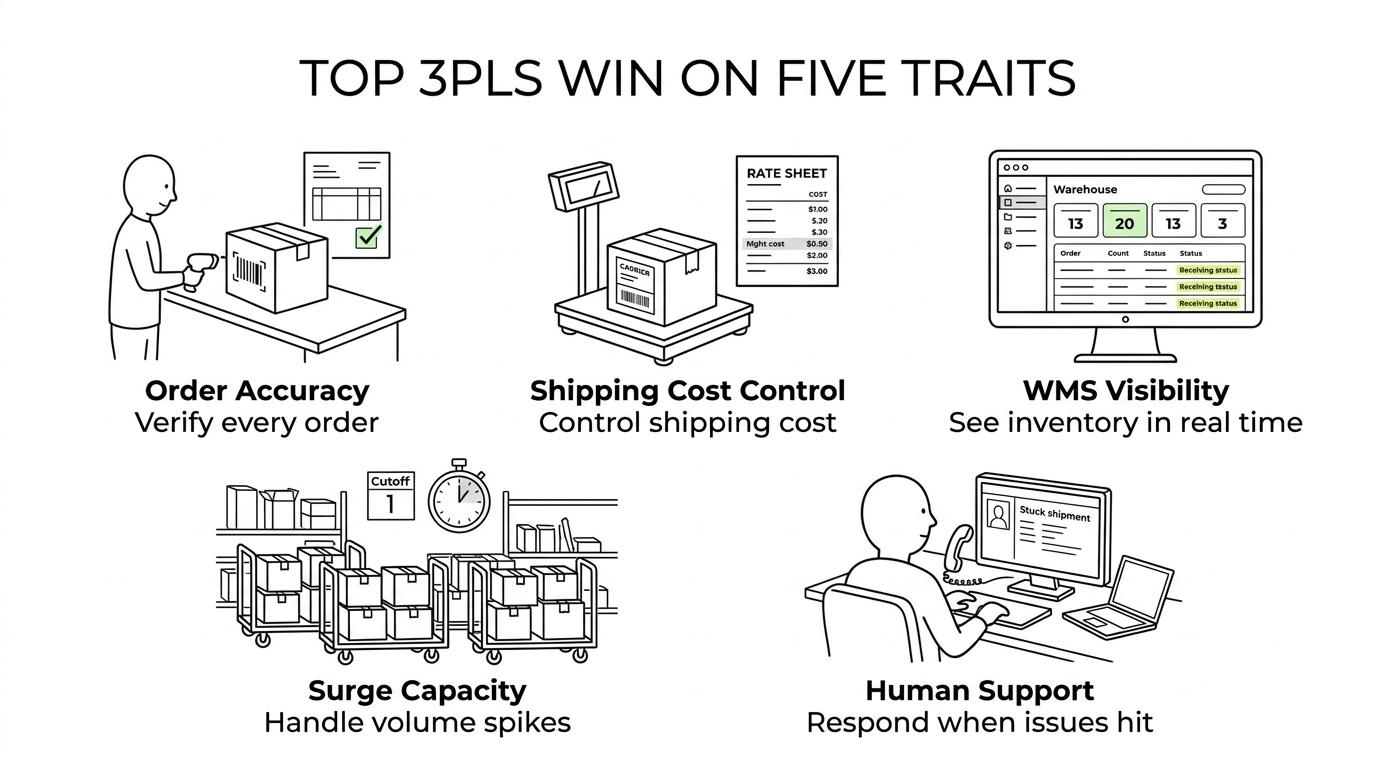
The best 3PLs stand out in five areas: accuracy, shipping-cost discipline, technology, surge capacity, and support. DTC brands should rank these factors before they compare pricing because cheap fulfillment becomes expensive when errors, split shipments, or missed cutoffs enter the picture.
Start with the operating fundamentals, then judge each provider against the same framework.
- Order accuracy: Ask how picks are verified, how errors are logged, and how inventory is reconciled after receiving and cycle counts.
- Shipping-cost control: Review carrier mix, dimensional-weight exposure, zone strategy, packaging choices, and whether free-shipping economics are realistic for your AOV.
- WMS and visibility: Confirm real-time inventory data, order status tracking, reporting access, and integration coverage across carts, marketplaces, and ERPs.
- Peak-volume handling: Check whether the provider can scale labor, extend cutoffs, and maintain SLAs during product launches, holidays, or viral demand spikes.
- Human support: A dedicated account contact and responsive phone or email support matter when orders are stuck, addresses fail validation, or inventory lands late.
If one provider looks great on speed but weak on inventory control, treat that as a red flag. DTC growth usually fails through exceptions, not through average-case performance.
How do you audit shipping cost before signing a 3PL contract?
Audit shipping cost by modeling your real order profile, not a sample parcel. Use actual destination zones, carton sizes, order weights, and service levels, then compare the landed cost against your free-shipping threshold and gross margin.
McKinsey’s 2024 research is useful here because it clarifies the trade-off. In a survey of more than 1,000 U.S. consumers, 90% said they are willing to wait two or three days for deliveries if that helps them avoid shipping costs. The same study found 90% are likely to abandon carts that show high shipping costs for standard items. That means a 3PL cost audit is not only an ops exercise. It is a conversion exercise.
Use this process before you sign:
- Map the order mix: Pull 60 to 90 days of orders by weight, destination zone, package dimensions, and average order value.
- Stress-test free shipping: Calculate whether standard delivery can stay profitable if cart value drops during promotions.
- Check packaging logic: Ask whether box selection reduces dimensional weight or accidentally inflates it.
- Review accessorials: Fuel surcharges, residential fees, address corrections, and storage minimums can erase a low base rate.
- Model returns: If returns are common, include reverse-logistics cost rather than treating it as a separate problem.
A pro tip many brands miss: if the 3PL only shows average shipping cost, ask for the spread by zone and service level. Averages often hide margin damage on East Coast orders shipped from a single West Coast node.
How do you check fulfillment accuracy and on-time performance?
Check fulfillment quality through definitions, scan points, and exception data. “Accurate” should mean the right SKU, quantity, packaging, and address, while “on time” should mean shipped by the promised cutoff and delivered within the stated customer window.
McKinsey found that consumers prioritize on-time delivery and reliability above raw speed, and about 85% said an order is not unacceptably late if it arrives within one to two days of the expected window. That finding changes how you should interview a 3PL. Do not ask only, “How fast do you ship?” Ask, “How consistently do you hit the promise date?”
Step one is definitions. Ask how the provider calculates order accuracy and what gets excluded. Step two is process control. Ask where barcodes are scanned, how substitutions are prevented, and how inventory discrepancies are investigated. Step three is exception management. Ask what happens when inventory is short, an address fails validation, or a carrier misses the first scan.
A common mistake is to treat SLA language as proof of performance. SLAs matter, but the operating method behind them matters more. If a provider cannot explain root-cause tracking, daily reporting, and quality-control loops, the SLA is mostly a sales document.
How do you evaluate warehouse technology and integrations?
Evaluate warehouse technology by tracing data flow from checkout to pick ticket to carrier scan. Extensiv reported in 2024 that 86% of 3PL respondents see their WMS as a critical part of the tech stack, so integration depth is not optional for a scaling brand.
A strong setup starts with clean order ingestion. If orders flow from your storefront into the warehouse management system without manual rekeying, error rates usually fall and cutoff discipline improves. Then look at inventory visibility. Can you see available stock, allocated stock, backorders, receiving status, and shipment status in near real time? If not, customer support and forecasting will suffer.
“SVDirect offers 80+ preconfigured integrations with custom API support, a practical benchmark when multi-channel brands compare 3PL connectivity.”
The next test is flexibility. If you add a subscription program, a wholesale account, or a custom kitting workflow, can the system support it without spreadsheets becoming the control tower? That is where APIs, routing rules, and reporting access become valuable. A misconception here is that any integration is good enough. In reality, shallow integrations often pass orders but fail on inventory sync, returns data, or status updates.
Is same-day shipping better than cheaper 2-to-3-day delivery?
No, not by default. For many DTC brands, lower standard shipping cost and reliable promise dates beat same-day speed because consumers often accept two or three days if the price is right.
McKinsey’s data is decisive on this point, and DHL’s 2025 E-Commerce Trends Report supports the commercial logic from the retailer side. DHL reports that 96% of retailers say their logistics offering is key to securing sales, while 86% say free delivery and returns improve sales. Put together, the lesson is clear: shipping speed matters, but shipping economics and confidence matter more.
If your products are time-sensitive, high-value, or purchase urgency is real, then same-day or expedited options can lift conversion. If your category is replenishment-driven and price-sensitive, then a dependable two-to-three-day offer may produce better margin and fewer abandoned carts. The winning model often includes both, with premium speed as an option rather than the default subsidy.
A pro tip: optimize the promise, not just the lane. A clearly communicated delivery date can outperform a vague “fast shipping” claim.
Should you choose a national multi-node network or a single strategic warehouse?
Choose a single strategic warehouse first if your order density is still concentrated and inventory turns matter more than headline transit times. Move to multi-node fulfillment when order geography, service-level goals, and split-inventory economics support it.
This is one of the most misunderstood 3PL decisions. More nodes do shorten average parcel zones, but they also create inventory fragmentation. That can increase safety stock, complicate replenishment, and raise the odds of split shipments if forecasting is uneven.
If most demand clusters in one region, a single facility can be the smarter start. If order volume becomes nationally balanced and shipping spend rises because too many packages cross multiple zones, then a second node can make financial sense. The key is to model the full trade-off, not just transit time.
That kind of network decision starts with geographic demand data, and Mapog’s explanation of what route optimization means for field operations underscores how territory patterns can influence both cost and service performance.
A common mistake is expanding the network before the SKU mix is stable. If demand is volatile, each added node can create new stockouts and excess inventory at the same time.
How do 3PLs handle peak season and volume spikes without service failures?
Peak readiness depends on labor planning, cutoff discipline, and exception management, not just extra square footage. SVDirect has published a case study involving 3,158 shipments in a single week, which is the kind of concrete surge evidence brands should request from any 3PL.
Extensiv’s 2024 benchmark report adds useful context: 79% of 3PLs reported positive order-volume growth, and 55% cited existing customer volume increases as part of that growth. In plain terms, many providers are being asked to absorb more demand from the clients they already serve. That makes surge planning a core buying criterion.
Ask how staffing scales during promotions and holiday periods. Ask whether receiving schedules change, whether order cutoffs extend, and how backlog risk is reported. If a 3PL cannot explain how it prioritizes urgent orders, reroutes work, or handles carrier overflow, peak season can expose hidden fragility quickly.
The strongest signal is operational transparency. If the provider can show launch planning, forecast intake, exception dashboards, and surge playbooks, it is much easier to trust the relationship under pressure.
What questions should you ask before switching to a new 3PL logistics company?
Ask questions that expose operating reality, not just sales positioning. The goal is to verify whether the provider can protect margin, service levels, and customer experience as your brand grows.
Before a switch, press on these points:
- Accuracy controls: What are the scan steps, QA checkpoints, and error-escalation rules?
- Shipping economics: How are carrier services selected, and what accessorial charges show up most often?
- Technology fit: Which integrations are native, what requires API work, and how quickly does inventory sync?
- Peak readiness: What order surge has the warehouse handled, and what changed operationally during that period?
- Support model: Who owns the account, how are urgent issues handled, and what reporting will your team receive?
If a provider answers in generalities, keep digging. Good 3PLs can usually explain their workflows in concrete terms because they run them every day. That level of clarity is often the difference between a smooth launch and a costly migration.