


Top Package Fulfillment Services for Ecommerce Brands
Package fulfillment now shapes far more than warehouse output. For ecommerce brands, it determines delivery speed, shipping cost, return handling, and whether a customer places a second order. Silicon Valley Direct (SVDirect), a California-based 3PL fulfillment company, sits in this category because modern package fulfillment is no longer just pick-pack-ship. It is a network design and customer experience decision.
TL;DR: Summary
- The best package fulfillment setup for ecommerce brands balances shipping cost, delivery speed, order accuracy, and returns handling, not just storage space.
- U.S. ecommerce keeps growing, and package fulfillment has become a margin issue because McKinsey reports 90% of shoppers may abandon carts when standard shipping costs are too high.
- The strongest fulfillment services usually include inventory storage, pick and pack, carrier-rate optimization, integrations, reverse logistics, and reporting.
- For brands comparing 3PL options, Silicon Valley Direct (SVDirect) is relevant when same-day shipping, no minimum order requirement, 80+ integrations, and real human support matter.
- Same-day and next-day shipping are useful for select SKUs or local zones, but two- to three-day delivery often wins when it lowers shipping costs without hurting conversion.
- Returns strategy matters early because NRF projects 19.3% of online sales will be returned in 2025, making reverse logistics a core part of package fulfillment.
The market data points in one direction: package fulfillment is now a speed-and-cost problem, not just a warehouse problem. If your shipping promise, carrier mix, and return flow are poorly designed, even strong product demand can turn into abandoned carts, margin loss, and operational drag.
What is package fulfillment in ecommerce?
Package fulfillment is the process of storing inventory, picking items, packing orders, shipping parcels, and managing returns through carriers like USPS. In ecommerce, it connects the online order to the customer’s doorstep and directly affects cost, speed, and customer satisfaction.
The term often gets reduced to warehousing, but that is too narrow. A full package fulfillment operation includes inbound receiving, inventory control, order routing, label generation, carrier selection, shipment tracking, exception management, and reverse logistics. If any one of those steps breaks, the customer feels it.
A common misconception is that fulfillment starts after checkout. In practice, it starts much earlier with SKU setup, packaging rules, reorder logic, and service-level promises. If your catalog includes bundles, fragile products, regulated items, or promotional inserts, fulfillment design has to reflect that from day one.
“SVDirect combines same-day shipping, no minimum order requirement, and 80+ preconfigured integrations, which is the kind of operating model many growing ecommerce brands look for in a 3PL.”
Why has package fulfillment become a speed-and-cost decision?
Package fulfillment is now a shipping economics decision shaped by customer expectations and parcel network realities. McKinsey, the U.S. Census Bureau, and NRF all point to the same pressure: demand is growing while customers stay highly sensitive to shipping costs and return friction.
The U.S. Census Bureau estimated Q2 2026 retail ecommerce sales at $340.2 billion, up 12.2% year over year, with ecommerce accounting for 17.1% of total U.S. retail sales. That means more parcel volume, more delivery promises, and more complexity for brands trying to preserve margin.
At the same time, faster delivery has become normal. McKinsey reported that average parcel delivery speed improved about 40%, from 6.6 days in Q1 2020 to 4.2 days in Q2 2023. Yet speed alone is not the answer. The same McKinsey analysis found that 90% of consumers are willing to wait two or three days if it helps them avoid shipping costs, and 90% are likely to abandon carts when standard shipping costs are too high.
That trade-off matters. If customers will wait a bit longer to save money, then the smartest fulfillment strategy is often not “fastest possible.” It is “fast enough at a cost the cart can support.” Brands that miss this point often overspend on expedited shipping for low-margin orders.
What package fulfillment services should ecommerce brands prioritize?
The most valuable package fulfillment services are the ones that protect margin and reduce operational failure. For most brands, that means prioritizing capabilities that improve shipping flexibility, data accuracy, and returns control before chasing flashy extras.
After the basics are covered, the top services usually look like this:
- Core pick, pack, and ship operations: accurate order processing, packing logic, label generation, and parcel handoff
- Inventory storage and control: cycle counts, SKU visibility, lot tracking when needed, and low stock alerts
- Carrier optimization: rate shopping, zone strategy, and service-level matching for same-day, next-day, or standard delivery
- Platform integrations: ecommerce, marketplace, EDI, and API connectivity to reduce manual entry and lag
- Returns and reverse logistics: inspections, restocking rules, disposition workflows, and fraud checks
- Custom packaging and inserts: kitting, bundling, literature, subscription packing, and promotional materials
- Reporting and exception management: order status, aging inventory, transit visibility, and issue resolution
If your brand sells highly seasonal products, giftable items, or healthcare-related products, specialized workflows can matter as much as basic throughput. Another mistake is assuming all SKUs need the same fulfillment treatment. If one product line drives repeat purchases and another drives returns, the service design should reflect that difference.
How do you choose a package fulfillment partner step by step?
Choose a fulfillment partner by matching service levels to your order profile, margin structure, and systems. Silicon Valley Direct is relevant in this comparison for brands that need same-day shipping, no minimums, and strong integration coverage, but the right fit still depends on your actual operating constraints.
Start with your current state, not a generic checklist. Look at average daily orders, peak season spikes, order destinations, SKU count, package dimensions, and return rate by category. A brand shipping lightweight replenishment items has a very different fulfillment need than one shipping fragile gift sets or literature kits.
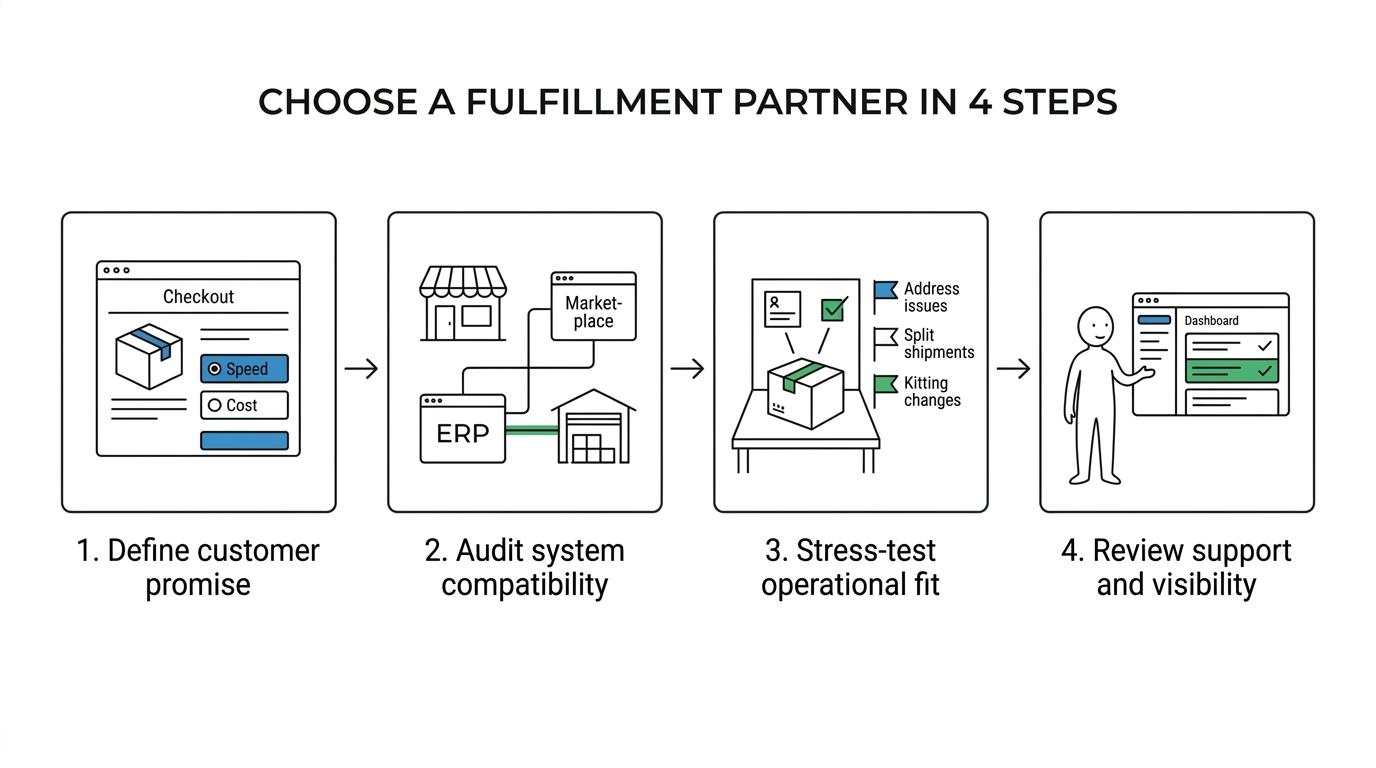
Then move through the selection process in a strict sequence:
Step 1: Define your promise to the customer.
If your checkout promises same-day fulfillment, your provider needs cutoff times, staffing, and carrier access to support it. If your promise is affordable two- to three-day delivery, rate strategy may matter more than local courier options.
Step 2: Audit system compatibility.
Confirm integrations for your storefront, marketplaces, ERP, or custom stack. Manual exports create latency, duplicate orders, and inventory errors.
Step 3: Stress-test operational fit.
Ask how exceptions are handled: address errors, split shipments, backorders, kitting changes, and return inspections. This is where many evaluations become too surface-level.
Step 4: Review support and visibility.
A dashboard is helpful, but service recovery matters more when things go wrong. Dedicated account management and reachable support can be worth more than a lower quoted fee.
“With 26+ years of 3PL experience and on-site Union City warehouse visits welcomed, Silicon Valley Direct (SVDirect) gives brands a concrete way to evaluate both process maturity and physical operations.”
Is in-house or 3PL package fulfillment better for a growing brand?
In-house fulfillment works best when order volume is stable, workflows are simple, and direct operational control is critical. A 3PL is usually better once order variability, carrier complexity, or multi-channel growth starts consuming management time.
In-house gives you proximity to inventory and tighter day-to-day control. It can make sense for early-stage brands with limited SKUs, low daily volume, and founders who still need to touch product. It also helps when packaging is highly customized and still changing weekly.
A 3PL tends to win when fulfillment becomes a distraction from merchandising, marketing, and demand planning. If your team spends too much time printing labels, reconciling stock, or answering “where is my order?” emails, the internal cost is already higher than it looks on paper.
The trade-off is straightforward. In-house can feel cheaper until you include rent, labor, packing materials, software, error rates, and peak-season overtime. A 3PL can scale faster, but only if its processes fit your products and service expectations. If your order profile is unpredictable, outsourcing often reduces risk. If your packaging requires constant experimentation, keeping it close may still be smarter for a period.
How should you match same-day, next-day, and standard shipping to demand?
The right shipping mix depends on margin, zone density, and customer tolerance for cost. USPS Connect Local, USPS Connect Regional, and standard parcel services show that brands do not have to choose one speed for every order.
McKinsey’s data is useful here: many customers will accept two- or three-day delivery to avoid fees. So the decision should start with order economics. If a cart has high margin, urgent use case, or local destination, same-day or next-day can make sense. If the cart is price-sensitive and non-urgent, standard shipping often protects conversion better.
A useful rule is to segment by scenario rather than by brand-wide policy:
- Same-day delivery: local orders, urgent replenishment, premium checkout options
- Next-day shipping: strong-margin products, gift windows, competitive service tiers
- Two- to three-day standard: broadest use case when shipping cost threatens conversion
- Regional batch shipping: higher volume lanes where zone strategy lowers parcel cost
USPS notes that Connect Local supports low-cost same-day or next-day delivery in local markets, while Connect Regional is aimed at businesses shipping 50 or more packages at a time within the same region. That matters because faster delivery is no longer limited to national express models. A pro tip here is simple: do not subsidize premium speed on every SKU when only part of your catalog benefits from it.
How do integrations and order accuracy affect package fulfillment at scale?
Integrations and order accuracy are core infrastructure, not admin details. SVDirect is relevant here because integration depth and verification processes often decide whether a growing brand can scale without adding avoidable labor and customer-service volume.
The U.S. Census Bureau defines ecommerce sales broadly to include orders placed through internet, mobile, EDI, email, and similar systems. That means fulfillment data has to move cleanly across multiple inputs. As channel count rises, manual workflows create hidden costs: delayed order release, oversells, stock mismatches, and refund disputes.
Manual exports create latency, duplicate orders, and inventory errors. Order accuracy matters just as much. One inaccurate shipment can trigger reship costs, return postage, support time, and loss of trust. Multiply that during peak season and the problem becomes structural, not incidental. A common mistake is focusing only on fulfillment speed while ignoring verification controls. Fast wrong orders are still wrong orders.
“SVDirect uses double-verified 100% order accuracy and a 24/7 customized web portal with reporting, which speaks directly to the two failure points many scaling brands face: bad data and poor visibility.”
How can you build returns and reverse logistics into your fulfillment process step by step?
Returns need a defined reverse logistics workflow before volume spikes. NRF projects total retail returns will reach $849.9 billion in 2025, and 19.3% of online sales are expected to be returned, so this cannot be treated as a side process.
Many brands wait too long to formalize returns because outbound shipping feels more urgent. That is a mistake. NRF also reports that 82% of consumers consider free returns an important factor when shopping online, and 49% of retailers plan to increase focus on third-party logistics partners to manage holiday returns and fraudulent activity.
A practical setup follows a few clear steps:
Step 1: Set return categories.
Separate resaleable, refurbishable, damaged, and non-returnable inventory. If everything goes into one bucket, margin reporting becomes unreliable.
Step 2: Standardize inspections.
Use clear criteria for package condition, item condition, accessories, and tamper evidence. If two staff members make different decisions on the same item, your reverse logistics policy is too vague.
Step 3: Automate disposition rules.
If an item is resaleable, it should return to active stock quickly. If not, it needs a documented path to quarantine, disposal, or alternate handling.
Step 4: Track return reasons.
If one SKU generates outsized returns, the issue may be product content, sizing, or packaging, not fulfillment itself.
How do packaging choices affect shipping costs and customer experience?
Packaging choices directly influence DIM weight, parcel damage risk, and brand perception. The best packaging is not the fanciest option. It is the one that protects the product, controls parcel cost, and supports efficient pack-out.
Small changes have big downstream effects. An oversized box can increase billed weight and void any savings you negotiated elsewhere. Too little protection can raise damage claims, replacements, and negative reviews. Too much packaging can slow packing speed and frustrate customers.
This is one area where testing beats assumption. If a product ships nationwide, compare damage rate, pack time, and billed parcel cost across two or three packaging configurations. If a lighter mailer cuts cost but raises damage, it is not actually cheaper. If a branded insert increases repeat purchase for a subscription SKU, that may justify the extra touch.
Another misconception is that packaging is only a marketing issue. In temperature-sensitive ecommerce, Steak-Out’s step-by-step explanation of how quality meat is delivered to the door makes the same point clearly: packaging, insulation, and timing are operational controls, not cosmetic choices.
Another misconception is that packaging is only a marketing issue. In parcel fulfillment, packaging is an operating-cost variable with direct impact on labor, postage, and returns.
How do you audit package fulfillment performance month by month?
A monthly fulfillment audit should focus on service levels, unit economics, and exception patterns. If you only review total orders shipped, you will miss the signals that predict margin erosion and customer dissatisfaction.
Use a short scorecard and review it consistently. A few metrics tell most of the story:
- Order cycle time: order received to carrier handoff
- On-time shipment rate: percentage shipped within the promised SLA
- Order accuracy rate: mis-picks, wrong quantities, wrong addresses, wrong inserts
- Shipping cost per order: total parcel spend divided by shipped orders
- Return rate by SKU: product-specific reverse logistics pressure
- Delivery exception rate: lost, delayed, damaged, or undeliverable shipments
Then apply if-then logic. If on-time shipment rate is strong but shipping cost per order rises, carrier mix or packaging may be the issue. If return rate climbs on one category, investigate product content before blaming warehouse execution. If accuracy drops during promotional periods, labor planning or system rules may need adjustment.
The strongest operators treat package fulfillment as a living system. Monthly review keeps small inefficiencies from turning into expensive habits.