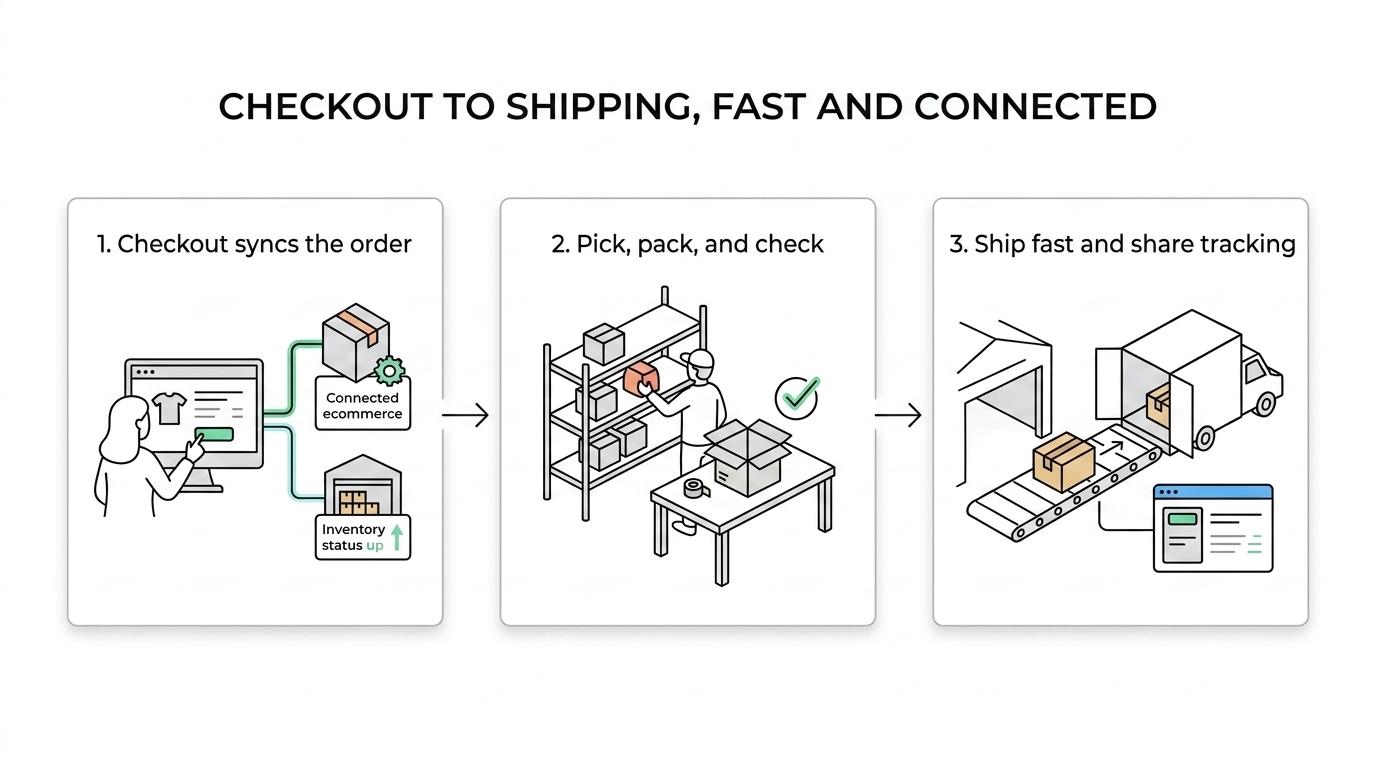
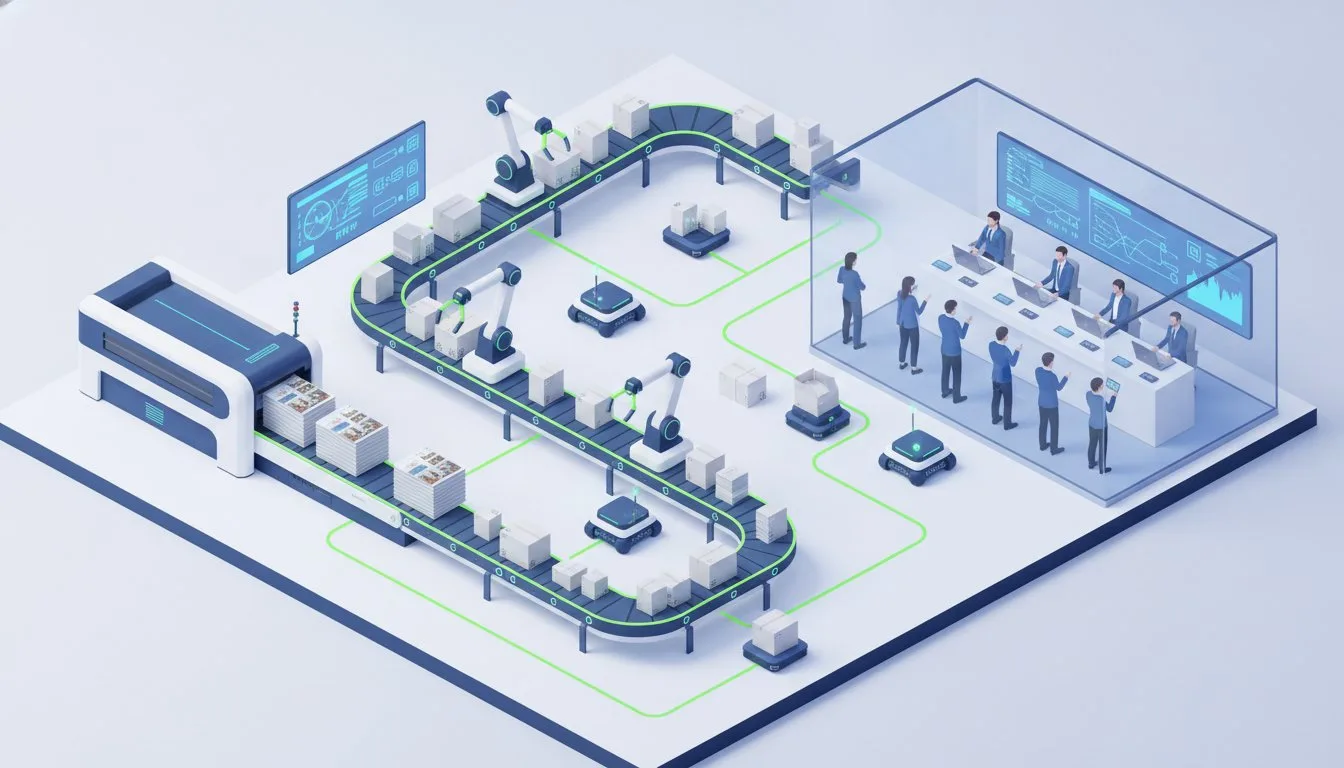
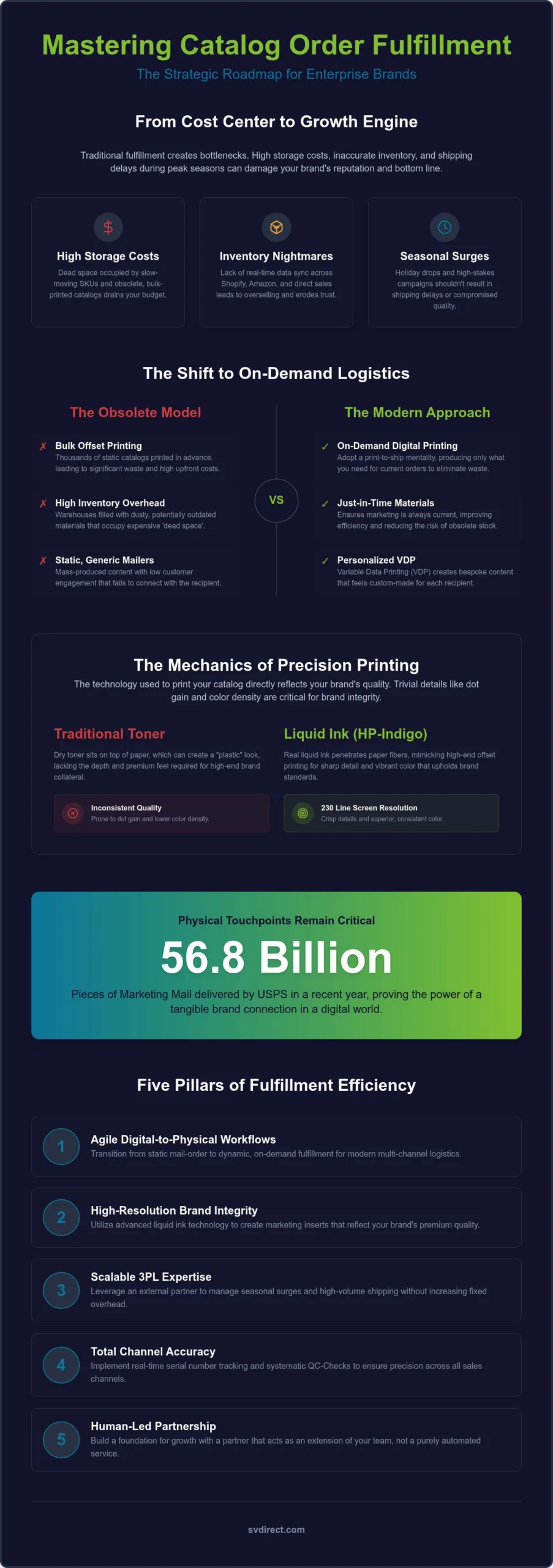
SVDirect works with ecommerce brands, startups, and growing online retailers across the U.S. and Canada, with a strong fit for Bay Area companies that want a nearby fulfillment partner. In San Mateo County, where the population is 743,568, there are 21,569 employer establishments, and 95.7% of households have broadband access, online operations move quickly. Our job is to help you keep up with that pace through local 3PL support, nationwide shipping reach, and clear visibility into every order.
San Mateo 3PL fulfillment from Union City for same-day shipping
SVDirect is strategically located in Union City, which gives San Mateo businesses a nearby 3PL warehouse while supporting fast shipping across the West Coast and nationwide. Most orders are processed and shipped the same day depending on cutoff times, which helps you shorten fulfillment lag without building your own warehouse team.
“SVDirect brings 26+ years of 3PL experience and same-day shipping from Union City, California.”
We do more than print labels and hand off boxes. SVDirect provides same-day pick-and-pack, double-verifies orders to be 100% accurate before shipping, and supports both steady order flow and growth spikes, so your customers get faster delivery with fewer preventable fulfillment mistakes.
Ecommerce order fulfillment, warehousing, and integrations for San Mateo brands
SVDirect combines warehousing, inventory management, pick-pack-ship services, and ecommerce connectivity in one 3PL solution for San Mateo sellers. With 80+ preconfigured integrations plus custom API support, we connect your selling channels and order systems so fulfillment data moves with less manual re-entry and fewer avoidable errors.
“SVDirect supports 80+ preconfigured integrations with custom API options for ecommerce fulfillment.”
That matters when your team needs quick answers about available inventory, shipped orders, backorders, and replenishment timing. SVDirect keeps those workflows inside one fulfillment relationship instead of forcing you to coordinate separate warehouse labor, software workarounds, and shipping handoffs.
San Mateo clients use SVDirect for more than basic parcel fulfillment:
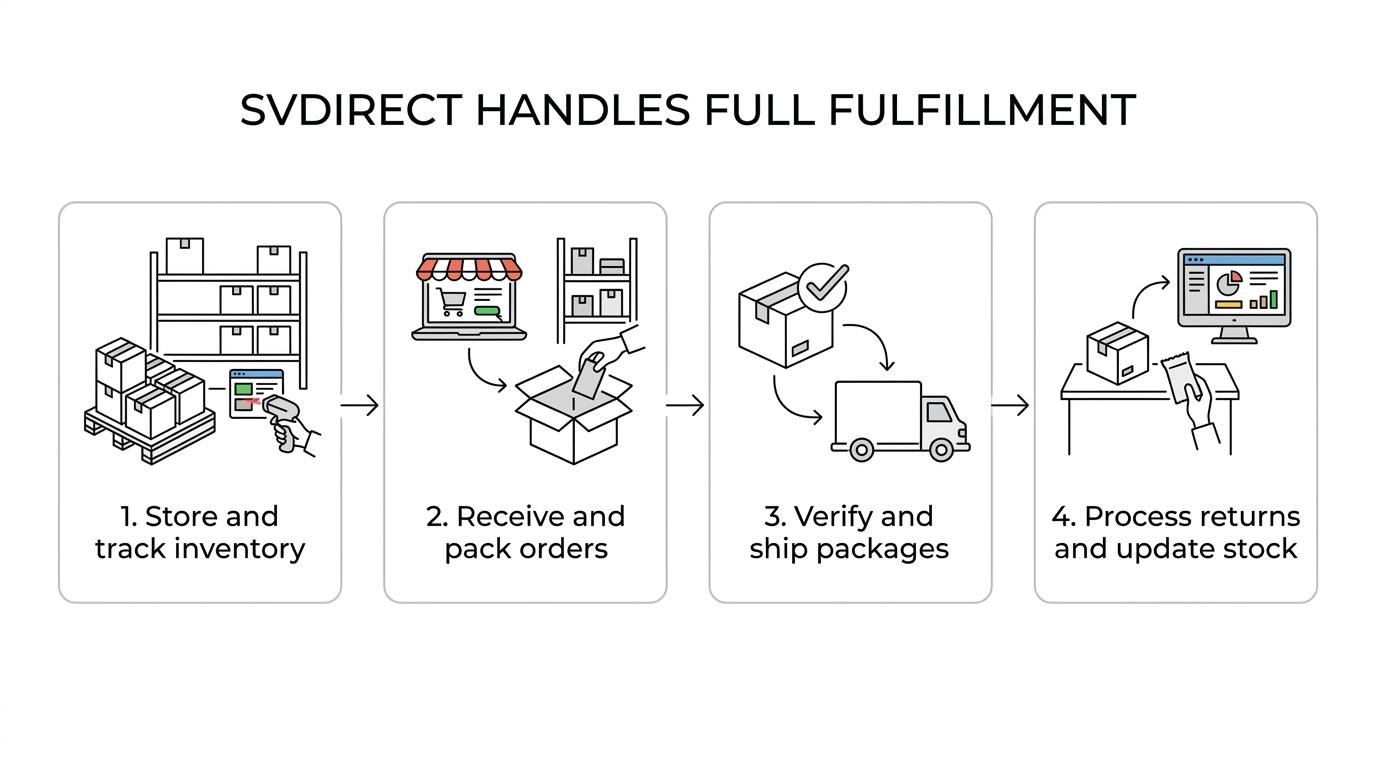
Order fulfillment: Pick, pack, and ship for ecommerce orders with same-day processing based on cutoff times
Warehousing and inventory management: Storage, tracking, and inventory control tied to your order flow
Integrations and automation: Prebuilt platform connections, custom APIs, and system integration support
24/7 order status, inventory tracking, and reporting for San Mateo ecommerce teams
SVDirect gives you 24/7 access through a customized web portal for order status, inventory levels, and shipping information. Our Remote Control system includes 120+ standard reports, which makes it easier to monitor open orders, track inventory movement, support customer service, and spot issues before they turn into delayed shipments.
“SVDirect gives clients 24/7 visibility and 120+ standard reports through its Remote Control system.”
For founders, operations managers, and ecommerce teams in San Mateo, that visibility changes the daily workload. You do not have to wait for emailed spreadsheets or chase down warehouse updates just to answer a customer, review stock levels, or prepare a purchase order.
Specialized San Mateo 3PL services for startups, growing retailers, and complex programs
SVDirect is a strong fit when your fulfillment needs do not fit a rigid warehouse model. We support no-minimum-order fulfillment, print-on-demand programs, literature and promotional item distribution, healthcare fulfillment, and custom automation, which gives San Mateo businesses room to launch, test, grow, and adapt without switching providers every time operations change.
That flexibility matters in a county with thousands of employer establishments and a highly connected business environment. A startup launching a new SKU, a retailer adding inserts to subscription orders, and a healthcare-related shipper managing specialized fulfillment all need accuracy and speed, but they do not need the same process. SVDirect can support those different workflows from one Bay Area 3PL operation.
Why San Mateo companies choose SVDirect for communication, scale, and local access
SVDirect pairs fulfillment execution with direct support. You get a dedicated account manager, real human phone support, and the option to visit our Union City warehouse, which is especially useful when you want to review packaging, inventory organization, or a new fulfillment program in person.
Operational proof matters when you are trusting a 3PL with your customer experience. SVDirect reports a 7+ year average client retention rate, case-study volume that includes 3,158 shipments in a single week, and customer testimonials that mention flexibility, close attention, responsive problem-solving, and reassuring inventory organization.
SVDirect is often the right fit when you want a San Mateo 3PL that can:
Ship fast: Same-day fulfillment and shipping based on cutoff times
Scale flexibly: No minimum order requirement for brands with variable volume
Connect systems: 80+ preconfigured integrations plus custom API support
Improve visibility: 24/7 portal access for order, inventory, and shipping data
Handle special projects: Print-on-demand, literature fulfillment, healthcare logistics, and related programs
Cost and implementation usually come down to your SKU count, storage footprint, order volume, sales channels, and any special handling requirements. SVDirect can review those details with you so you can judge fit based on the actual work your San Mateo operation needs, not a generic warehouse pitch.
Talk with SVDirect about San Mateo 3PL support
If you are looking for a San Mateo 3PL that can help you ship faster, stay accurate, and see what is happening inside fulfillment at any time, SVDirect is ready to map the right setup. Tell us what you sell, where your orders come from, your average volume, and your shipping goals, and we will help you assess the best path for Bay Area fulfillment from our Union City warehouse.
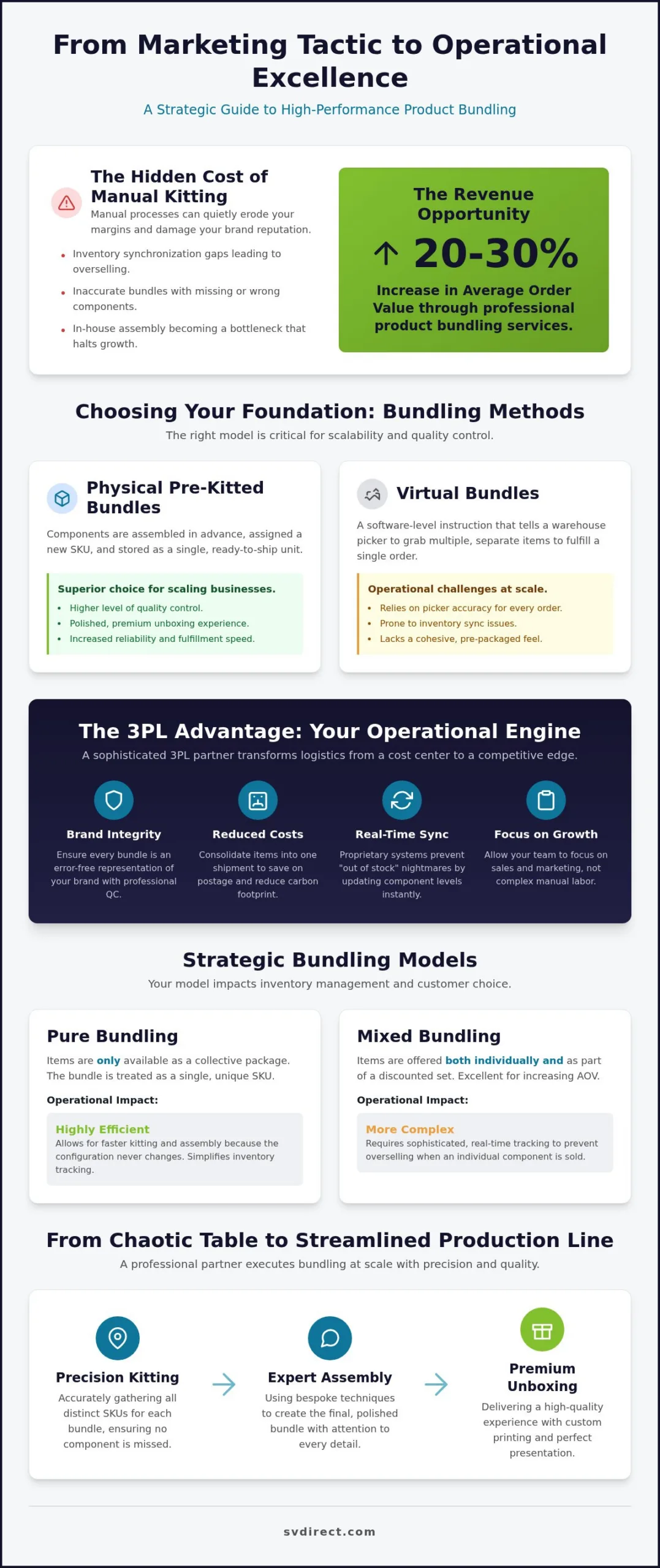
What if the marketing strategy designed to boost your revenue is actually the very thing quietly eroding your operational margins? While professional product bundling services can increase average order value by 20 to 30 percent, the logistical reality often tells a different story. You’ve likely felt the frustration of inventory synchronization gaps or the sting of a customer receiving a custom promotional set with missing components. These aren’t just minor hiccups; they’re the direct result of manual kitting processes that simply can’t keep pace with modern demand.
We believe that high-performance fulfillment should be a source of competitive advantage, not a source of stress. This strategic guide will help you transform kitting from a complex back-office task into a high-efficiency operation that prioritizes precision and quality. You’ll discover how to leverage advanced technology and human expertise to ensure every bundle is an error-free representation of your brand. We’ll examine the specific systems, quality control standards, and digital integrations necessary to achieve operational excellence in 2026.
Key Takeaways
Learn how to move beyond marketing theory by integrating professional product bundling services into a precision-driven fulfillment workflow.
Identify the critical operational hurdles, such as inventory fragmentation and manual kitting errors, that can undermine your brand’s scalability.
Discover how to design a premium unboxing experience through high-resolution digital printing and bespoke assembly techniques.
Understand the importance of real-time inventory tracking and proactive problem-solving to maintain accuracy across complex promotional sets.
Explore how positioning your logistics partner as a seamless extension of your team can drive sustainable growth and long-term customer loyalty.
What Are Product Bundling Services in the 3PL Landscape?
Product bundling is often discussed in boardroom meetings as a clever marketing tactic to move inventory or increase margins. In the physical world of logistics, however, it’s a rigorous operational process that involves grouping multiple distinct SKUs into a single, cohesive unit for sale. This transition from theory to reality is where many brands struggle. While a digital storefront can easily display a “summer kit,” the warehouse must manage the physical components, packaging, and assembly with absolute precision. This is where professional product bundling services become essential for maintaining order accuracy.
It’s vital to distinguish between virtual and physical bundles. A virtual bundle is a software-level instruction that tells a picker to grab three different items for one order. A physical pre-kitted bundle is assembled in advance, assigned its own SKU, and stored as a single unit. Pre-kitting often provides a much higher level of quality control and a more polished unboxing experience for the customer. For businesses looking to scale, the physical pre-kitted model is usually the superior choice for reliability and speed.
The Role of a 3PL in Product Bundling
A sophisticated 3PL acts as the engine for these operations. By utilizing 3PL fulfillment services, companies can significantly reduce shipping costs. Instead of sending three separate packages, items are consolidated into one. This doesn’t just save on postage; it reduces transit times and minimizes the carbon footprint of your deliveries. Managing inventory becomes a balancing act between individual components and finished kits. We use proprietary systems to ensure that when a bundle sells, the stock levels for every underlying item update in real-time. This prevents the “out of stock” nightmare that occurs when one small component is missing from a larger set.
Why Businesses Are Moving to Professional Bundling
Many growing companies start by assembling kits in-house. While this works for a few dozen orders, it quickly becomes a bottleneck that halts growth. Scaling requires a shift to professional kitting and assembly services to maintain brand integrity. A professional facility ensures that every insert is straight, every box is clean, and every component is present. This level of detail reduces decision fatigue for your customers. They don’t have to choose three separate accessories; they can trust a curated set that’s been professionally prepared. Moving to an expert partner allows your team to focus on sales while we handle the intricate manual labor with a steady, experienced hand. Professional product bundling services turn a chaotic packing table into a streamlined, high-output production line.
Strategic Varieties of Product Bundling: Choosing Your Model
The transition from a basic sales strategy to a high-volume reality requires a clear understanding of your chosen bundling model. As this product bundling guide suggests, your approach directly influences your inventory management and customer satisfaction. Pure bundling is a straightforward model where items are only available as a collective package. This is operationally efficient because the bundle is treated as a single SKU from the moment it’s assembled.
Mixed bundling is more complex. It involves offering items both individually and as a discounted set. This model is excellent for increasing average order value, but it creates significant challenges for real-time stock levels. If a customer buys a single item, the system must immediately update the availability of every bundle that includes that item. We solve this through our Remote Control™ system, which manages these intricate relationships with precision. This technology ensures that your digital storefront always reflects the physical reality of the warehouse floor.
Pure vs. Mixed Bundling: Operational Impacts
Choosing between these models depends on your sales volume and SKU count. Pure bundles allow for faster kitting and assembly because the configuration never changes. Mixed bundles require more sophisticated tracking to prevent overselling. If your business manages a high volume of individual sales alongside promotional sets, you need a partner capable of dynamic inventory synchronization. We focus on providing a steady hand for these complex operations, ensuring that mixed bundling doesn’t lead to inventory fragmentation.
Promotional and Seasonal Bundling
Seasonal kits thrive on urgency. Whether it’s a holiday set or a limited-run brand partnership, these projects require rapid assembly and high-quality presentation. We often use on-demand digital printing to produce personalized inserts that elevate the unboxing experience. Our HP Indigo 5500 provides a 230 line screen resolution, ensuring your marketing materials look as professional as the products they accompany. This high-tech capability allows us to act as a seamless extension of your marketing team.
Subscription box bundling is another recurring model that demands strict deadlines and consistent quality. These curated sets rely on a methodical approach to ensure every box is packed exactly to specification, month after month. Leveraging professional product bundling services ensures your promotional kits are an asset to your brand rather than a logistical burden. If you want to discuss how these models could work for your specific catalog, you can reach out for a customized operational assessment.
The Operational Hurdles of High-Volume Product Bundling
Execution is where most marketing strategies face their toughest test. In a high-volume environment, the logistical reality of product bundling often reveals hidden friction points that can erode your profit margins. Many brands unknowingly fall into the Hectic Warehouse Trap, where manual kitting processes lead to a spike in error rates. When human pickers are forced to juggle multiple components without a structured system, the risk of a missing item or a swapped SKU increases exponentially. These errors don’t just cost money in returns; they damage the hard-earned trust of your customers.
Inventory fragmentation is another significant challenge, particularly when tracking serial numbers across various kits. If your system cannot account for every individual component within a bundle, your data becomes unreliable. This lack of precision makes it impossible to forecast accurately or maintain the high-quality presentation your brand requires. Furthermore, packaging waste often becomes a silent drain on resources. Without custom-fit boxing solutions, you’re paying to ship air, and your products are more susceptible to damage during transit. Professional product bundling services solve these issues by treating kitting as a science of precision rather than a task of convenience.
Overcoming Inventory Inconsistencies
Virtual bundles often promise simplicity but frequently deliver backorder nightmares. Because the components aren’t physically pre-assembled, your system might show a bundle is available when a single small item is actually out of stock. This creates a disconnect between your storefront and the warehouse floor. You need 24/7 visibility into your component stock levels to maintain operational flow. By utilizing Remote Order Management, you gain access to real-time data and over 120 standard reports. This level of transparency ensures you can identify potential stockouts before they disrupt your fulfillment cycle, allowing you to move with the speed of the modern market.
The Importance of Systematic Inspection
Quality control is the primary differentiator between a standard 3PL and a strategic partner. We’ve established a systematic QC-Check process for every kit we assemble to eliminate the missing item complaint entirely. This multi-stage verification happens within our quiet, organized facility, where precision is the standard rather than the exception. Our methodology focuses on a proactive stance, identifying kit conflicts and assembly errors long before they reach the shipping dock. This meticulous attention to detail ensures that your product bundling services contribute to high-quality, error-free presentation, reinforcing customer loyalty with every delivery. When your logistics operation is as organized as your marketing plan, your business is positioned for sustainable growth.
Executing Bundling at Scale: Kitting, Assembly, and Personalization
Executing product bundling services at scale requires a transition from marketing theory to physical engineering. While your team identifies the ideal product pairings, our facility focuses on the mechanics of high-volume assembly. This process follows a structured five-step methodology to ensure every kit is perfect:
Step 1: Strategic SKU selection and component sourcing to confirm inventory compatibility.
Step 2: Designing the unboxing experience with custom-fit inserts that protect and present.
Step 3: Implementing high-speed kitting combined with hand assembly for delicate items.
Step 4: Leveraging Variable Data Printing (VDP) to add individualized messaging to every bundle.
Step 5: Final QC-Check and seamless distribution through our global logistics network.
By treating kitting as a precision operation, we eliminate the friction that often plagues growing brands. Our quiet, organized facility serves as a steady hand, managing the intricate details of your promotional sets while you focus on driving sales.
Advanced Personalization with Variable Data Printing
Personalization is no longer a luxury; it’s an expectation. We use the HP Indigo 5500 to produce high-resolution bundle inserts at a 230 line screen resolution. Unlike standard digital printers, this system utilizes liquid ink technology to achieve offset-quality results. This ensures your personalized messages and branded collateral look sharp, vibrant, and professional. Integrating Print On Demand capabilities is essential for just-in-time bundling. It allows you to update messaging or seasonal graphics without wasting pre-printed inventory, keeping your marketing agile and cost-effective.
Complex Assembly: Beyond the Box
High-value bundles often involve more than just placing items in a carton. We specialize in handling sensitive materials like software, electronics, and premium apparel that require specific environmental care. For high-value goods, serial number tracking is integrated directly into the assembly process to maintain a secure chain of custody and accurate warranty records. By incorporating professional Kitting and Assembly Services into your workflow, you ensure that complex configurations are executed correctly every time. Our team acts as a seamless extension of your company, providing the human oversight needed for technical or fragile components.
Optimizing Your Supply Chain with Silicon Valley Direct
Silicon Valley Direct isn’t just a fulfillment provider; we act as a seamless extension of your marketing and sales team. While other providers offer basic storage, we focus on the intricate physical execution that makes your product bundling services successful. Our quiet, organized facility in the heart of Silicon Valley serves as a center for innovation and global connectivity. We take a proactive stance, identifying potential kit conflicts or component shortages before they ever reach the shipping dock. Our commitment is rooted in our ‘Nine Promises’ of quality and transparency, ensuring that your brand’s reputation is protected at every touchpoint.
Real-Time Visibility with Remote Control™
Total transparency is the foundation of a reliable supply chain. Our proprietary Remote Control™ system provides you with 24/7 visibility into every aspect of your inventory. With access to 120+ standard reports, you’ll always have the data needed to track the success of your bundled campaigns. The system doesn’t just store data; it actively protects your operations through automatic email alerts for low inventory and backorders. This level of technical integration allows you to move from reactive troubleshooting to strategic planning. You can monitor assembly progress and component levels from anywhere in the world, knowing that your physical operations are as organized as your digital dashboards.
Why Partnership Trumps Outsourcing
Scaling complex projects requires more than just warehouse space; it requires a dedicated team that understands your specific needs. We reject the ‘cookie-cutter’ approach in favor of custom-fit solutions tailored to your unique catalog. Our long-term staff retention is a hallmark of our internal stability, providing you with a seasoned expert at every stage of the kitting process. This continuity ensures that the nuances of your brand’s unboxing experience are preserved, regardless of your order volume. You aren’t just outsourcing a task; you’re building a partnership grounded in decades of operational history. You can read our Customer Testimonials to see how we’ve helped other high-growth companies navigate the transition from manual kitting to high-efficiency fulfillment. We provide the steady hand and physical infrastructure necessary to turn your marketing vision into a global reality.
Mastering the Future of Physical Fulfillment
Transforming product bundling from a marketing concept into a logistical reality requires more than warehouse space. It demands a marriage of seasoned expertise and high-tech efficiency. Strategic SKU selection, real-time tracking, and high-resolution personalization eliminate errors and drive customer loyalty. By embracing professional product bundling services, you position your brand for sustainable growth. The difference between a successful campaign and a logistical failure often comes down to physical assembly precision.
Silicon Valley Direct brings over 25 years of fulfillment expertise to your project. Our proprietary Remote Control™ system provides the transparency needed to manage stock across complex kits. Our HP Indigo 5500 ensures bundle inserts meet Red Dot-level quality standards. We act as a steady hand and a seamless extension of your team, allowing you to scale with confidence. Your marketing vision deserves an operational partner that’s just as innovative as your products.
We’re ready to help you turn your next promotional set into a high-efficiency success story. Let’s build a fulfillment strategy that works as hard as you do.
Frequently Asked Questions
What is the difference between kitting and product bundling?
Product bundling is the marketing strategy of grouping items, while kitting is the physical execution of that strategy. Kitting involves picking individual components and assembling them into a single unit with its own SKU. Our team handles the manual labor of kitting and assembly using a systematic QC-Check process to ensure every bundle meets your brand standards before shipping. This process transforms a marketing idea into a physical reality.
How do product bundling services improve my profit margins?
Professional product bundling services reduce operational overhead by consolidating multiple shipments into one package, lowering postage and material costs. By outsourcing the kitting process to a specialized 3PL, you eliminate the need for in-house labor and extra warehouse space. Our proactive approach identifies order conflicts early, preventing costly returns and shipping errors that otherwise erode your bottom line. This efficiency allows you to scale without proportional increases in costs.
Can I customize the contents of each bundle for individual customers?
Yes, you can achieve high levels of customization through our Variable Data Digital Printing (VDP) capabilities. Every bundle can include a personalized insert or marketing message tailored to the specific recipient. Because we use the HP Indigo 5500 with liquid ink technology, these personalized elements maintain offset-quality resolution. This allows you to offer bespoke unboxing experiences at scale without the high costs typically associated with custom print runs.
How does inventory management work when products are sold both individually and in bundles?
Our proprietary Remote Control™ system manages these complex relationships by providing real-time visibility into both individual components and finished kits. When a bundle sells, the system automatically updates the stock levels for all underlying SKUs. You receive automated email alerts for low inventory or backorders, ensuring you don’t oversell. This level of data management allows you to balance individual product sales and bundled promotional campaigns with total transparency.
What are the benefits of using digital printing for bundled product inserts?
Digital printing provides the speed of on-demand production with the quality of traditional offset methods. Our HP Indigo 5500 uses liquid ink technology at a 230 line screen resolution, creating sharp, vibrant images for your bundle inserts. Sheets emerge dry and ready for immediate assembly, which significantly reduces turnaround times. Additionally, this green printing process eliminates the need for the harsh chemicals and plates used in traditional offset printing.
Is product bundling suitable for small businesses or just large corporations?
We provide scalable solutions for companies of all sizes, from emerging startups to large national enterprises. Our methodology rejects “cookie-cutter” procedures in favor of custom-fit strategies that align with your specific budget and goals. Whether you’re launching a small promotional kit or managing a high-volume subscription box, our facility is equipped to handle the project. We act as an extension of your company to ensure professional product bundling services regardless of your current scale.
How do you ensure quality control during high-volume assembly projects?
We maintain accuracy through a systematic QC-Check process that involves multiple inspections throughout the assembly line. Our quiet, organized facility is designed to remove the hectic atmosphere common in many warehouses, allowing our team to focus on precision. Every kit undergoes rigorous verification to ensure no items are missing and the presentation is flawless. This proactive approach identifies potential errors before they impact the customer, reinforcing your brand’s reliability.
What kind of reporting is available for my bundled product sales?
You gain 24/7 access to over 120 standard reports through our proprietary Remote Control™ web interface. These reports provide detailed insights into order status, shipping activity, and real-time inventory levels for your bundles. You can track exactly how your promotional campaigns are performing and retrieve order histories with a few clicks. This data-driven approach ensures you have the information necessary to make informed decisions about your supply chain and marketing strategies.
If your Sunnyvale ecommerce business needs a 3PL that can keep up with Bay Area delivery expectations, Silicon Valley Direct (SVDirect) provides full-service fulfillment from its Union City, California warehouse. We handle warehousing, pick and pack, shipping, inventory management, returns processing, and ecommerce integrations so your team can spend less time on logistics and more time on sales, product, and customer experience.
Sunnyvale 3PL fulfillment for Bay Area brands that need fast delivery
Sunnyvale sits in one of the most active business environments in Silicon Valley, and California freight planning has tied ecommerce growth to rising demand for same-day and next-day delivery. SVDirect supports Sunnyvale-area brands with a California warehouse operation that keeps inventory closer to Bay Area customers and helps orders move out fast.
“SVDirect says most orders are processed and shipped the same day, depending on cutoff times.”
Because SVDirect operates from Union City, your team can stay close to the fulfillment operation serving your brand. Local access makes it easier to review workflows, prepare for product launches, and solve shipping issues before they affect customer satisfaction.
SVDirect also removes a common barrier for early-stage and growing merchants: volume commitments. With no minimum order requirement, you can start with the fulfillment support you need now and scale storage, shipping, and operational complexity as your order volume changes.
SVDirect handles warehousing, pick and pack, and returns for Sunnyvale ecommerce brands
SVDirect provides end-to-end 3PL services for Sunnyvale companies that want one fulfillment partner instead of a patchwork of vendors and internal workarounds. We can manage some or all aspects of your operation, including secure California warehouse storage, daily order processing, outbound shipping, inventory management, and returns processing.
Here is what Sunnyvale brands typically hand off to SVDirect:
Warehousing and inventory management: secure storage in California, inventory control, and real-time tracking through the system
Pick, pack, and ship: order processing, packing, carrier handoff, and same-day shipment for most orders based on cutoff times
Returns and related fulfillment work: returns processing, literature fulfillment, promotional item handling, and other special distribution needs
That matters when your internal team is spending too much time receiving stock, counting units, printing labels, and correcting shipping mistakes. SVDirect turns those repetitive fulfillment tasks into a managed operation with clear accountability and day-to-day visibility.
“SVDirect double verifies all orders for 100% accuracy before shipping.”
For Sunnyvale merchants shipping across the U.S. or expanding into cross-border and international distribution, SVDirect combines warehouse execution with shipping reach. You get a fulfillment setup that can support local Bay Area demand and broader customer coverage without building your own warehouse department first.
Sunnyvale 3PL integrations with 80+ platforms, custom API support, and real-time inventory tracking
A 3PL is only as useful as its connection to your storefront, marketplaces, and internal systems. SVDirect supports 80+ preconfigured integrations, along with custom API and web services, so orders and inventory can move between systems with less manual work and fewer preventable errors.
“SVDirect supports 80+ preconfigured integrations plus custom API and web services.”
SVDirect also gives Sunnyvale clients a 24/7 customized web portal with reporting and real-time inventory tracking. That means your operations team can check stock levels, order status, and fulfillment activity without waiting for spreadsheets or email updates.
When questions come up, technology is not your only support channel. SVDirect pairs system visibility with a dedicated account manager and real human phone support, which is especially useful when you are managing new SKUs, handling seasonal spikes, or troubleshooting a platform change.
Specialized fulfillment services for Sunnyvale brands with complex product and distribution needs
Some companies in Sunnyvale need more than standard parcel fulfillment. SVDirect supports print-on-demand, literature fulfillment, promotional item distribution, healthcare logistics and fulfillment, and presorted mail services, helping brands manage multiple outbound workflows through one operational partner.
“SVDirect has been at the forefront of order fulfillment for over 27 years.”
That experience matters when your products do not fit a simple pick-pack-ship pattern. SVDirect can help structure workflows for ecommerce orders, printed materials, kits, healthcare-related fulfillment, and other distribution requirements so your team is not forcing specialized work through a generic warehouse process.
SVDirect also brings operational continuity that many growing brands value. The company states that half of its team have more than 10 years of experience at SVDirect, which supports consistent execution when your fulfillment program needs repeatable handling and fewer surprises.
When SVDirect is the right Sunnyvale 3PL for your ecommerce business
SVDirect is a strong fit when you need a Bay Area 3PL that combines speed, local access, and system connectivity. Many Sunnyvale brands choose us when they want a practical partner that can support growth without forcing them into oversized commitments or impersonal support structures.
SVDirect is often the right choice if:
You need Bay Area proximity: Union City warehouse access supports faster regional coordination and easier in-person reviews
You want fast order turnaround: most orders are processed and shipped the same day, depending on cutoff times
You need integration flexibility: 80+ preconfigured integrations plus custom API support reduce manual order handling
You want to start without volume pressure: no minimum order requirement helps startups and scaling brands move at a realistic pace
You value visibility and human support: a 24/7 portal, dedicated account manager, and phone support make daily fulfillment easier to manage
If you want to validate the operation before moving inventory, SVDirect welcomes on-site warehouse visits in Union City. That is useful for Sunnyvale teams that want to review receiving, storage, order flow, reporting, and support processes with the people who will actually run the account.
Talk with SVDirect about Sunnyvale 3PL support
If you are looking for a Sunnyvale 3PL that can help you ship faster, stay accurate, and gain better control over fulfillment, SVDirect is ready to map out the right setup for your business. Reach out to discuss your order volume, sales channels, SKUs, integration needs, and delivery goals, and we will help you build a fulfillment plan that fits where your brand is now and where you want it to go next.
Scaling a national brand from a traditional coastal hub has become a battle against rising overhead and razor-thin margins that often feels like a losing game. You’ve likely felt the frustration of seeing shipping costs climb while your inventory visibility remains clouded by impersonal, automated systems. It’s difficult to maintain confidence when your fulfillment partner treats your high-growth business as just another SKU in a chaotic warehouse. You deserve a partner that acts as a true extension of your team, providing the stability and precision required for national success.
Choosing ecommerce fulfillment nevada allows you to reclaim operational control by leveraging a tax-friendly environment and a strategic West Coast gateway. This guide explores how to scale your operations using Nevada’s unique logistics advantages, from reducing shipping transit times to achieving seamless API integration with your existing order management systems. We’ll show you how a “Quiet Facility” methodology and proprietary Remote Control technology can replace cookie-cutter service with high-touch, human oversight. Discover how a deep history of operational precision can turn your logistics from a source of stress into a competitive edge for 2026.
Key Takeaways
Discover how Nevada’s tax-friendly environment and strategic proximity to West Coast ports allow you to reduce operational overhead while maintaining rapid national delivery speeds.
Understand the “Quiet Facility” methodology and how choosing a partner focused on organized, error-free operations ensures higher accuracy than standard high-volume warehouses.
Learn how to leverage proprietary Remote Control technology and SOAP/XML integrations to achieve 24/7 inventory visibility and seamless data synchronization with your existing systems.
Explore the competitive benefits of combining your ecommerce fulfillment nevada strategy with on-demand digital printing to personalize every order with high-quality inserts.
Identify the “Nine Promises” framework that ensures your 3PL acts as a proactive extension of your team, anticipating logistics conflicts before they impact your customers.
The Strategic Importance of Nevada in National eCommerce Logistics
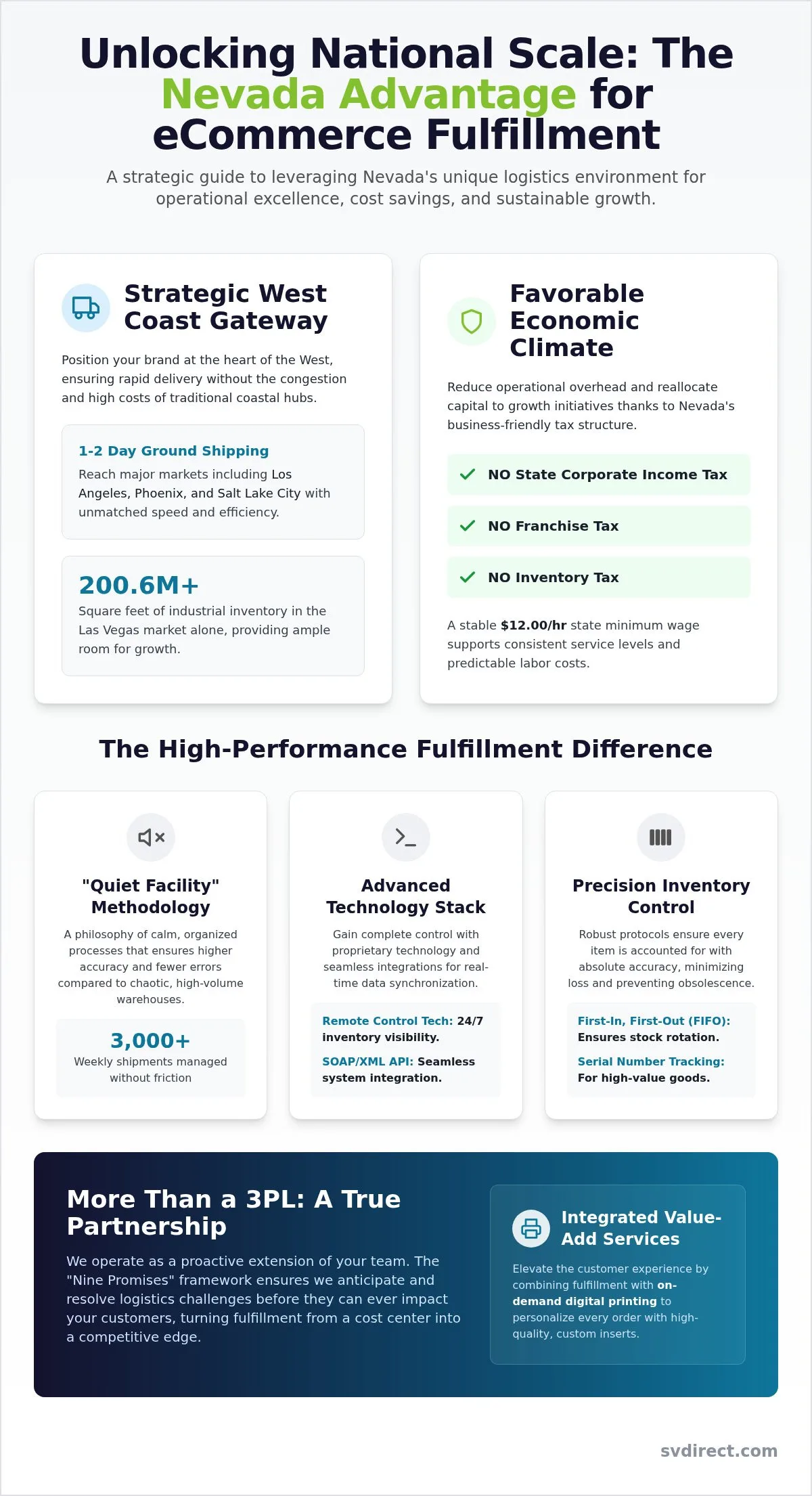
Nevada has solidified its position as the premier logistics anchor for national brands. In 2026, the state’s infrastructure supports a massive volume of trade, with the Las Vegas market alone boasting over 200.6 million square feet of industrial inventory. By positioning operations here, brands achieve a delicate equilibrium: the rapid shipping speeds required by West Coast consumers without the high overhead typical of traditional coastal urban centers. This geographic shift is a proactive move for businesses that value precision and long-term stability.
Geographic Advantages for National Shipping
Nevada’s location acts as a force multiplier for Third-party logistics (3PL) providers. From this central vantage point, ground shipping reaches major markets including Los Angeles, Phoenix, and Salt Lake City within a 1-2 day window. This proximity significantly reduces the carbon footprint of long-haul deliveries. By replacing cross-country air freight with efficient regional ground routes, brands minimize their environmental impact while maintaining competitive transit times. Nevada also integrates seamlessly with global shipping lanes through major regional hubs, allowing goods imported through West Coast ports to be quickly staged for national distribution without the congestion of port-side cities.
Economic Impact on eCommerce Margins
The economic case for ecommerce fulfillment nevada is rooted in a highly favorable tax climate that directly benefits the end client. Nevada doesn’t levy a state corporate income tax, franchise tax, or inventory tax. These exemptions allow high-volume brands to scale without the financial penalty of taxes on unsold stock held in a warehouse. As of 2026, the state minimum wage is set at $12.00 per hour, providing a stable labor market that supports consistent service levels. When you lower warehousing costs, you gain the freedom to reallocate saved overhead into product innovation and aggressive marketing campaigns. This financial agility is essential for brands looking to maintain an edge in a tech-saturated market. You can find more details on how these savings integrate into a broader strategy by exploring our 3PL fulfillment services.
A Nevada-centric strategy effectively shortens the “last mile” for the entire Western United States. It serves as a gateway that balances high-tech efficiency with a human-centric approach to service. Instead of struggling with the congestion and rising vacancy rates of coastal cities, businesses find room to grow in markets like Reno, which saw approximately 1.3 million square feet of positive net absorption in the second quarter of 2026. This environment fosters a partnership model where your fulfillment center acts as a true extension of your own team, providing a steady hand in a fast-paced industry.
Key Features of a High-Performance Fulfillment Partner
Choosing a partner for ecommerce fulfillment nevada requires looking beyond simple pallet counts and floor plans. A true high-performance facility operates with a “Quiet Facility” methodology. This isn’t just about noise levels; it’s a philosophy where organization and calm processes replace the hectic, error-prone atmosphere common in massive, automated warehouses. When a facility is truly organized, it can easily manage 3,000 or more weekly shipments without operational friction. This stability allows your brand to scale rapidly while maintaining the precision your customers expect. We view our role as an extension of your company, providing a steady hand that alleviates the stress of business growth through personal commitment.
Precision is further reinforced by robust inventory management protocols. We utilize First-In, First-Out (FIFO) systems and detailed serial number tracking to ensure every item is accounted for with absolute accuracy. This level of detail is vital for brands that prioritize high-touch service and real-time visibility. It ensures that your stock isn’t just sitting in a rack but is actively managed to prevent obsolescence and minimize loss. This proactive stance is backed by physical infrastructure and human expertise rather than just marketing abstractions.
Precision Pick and Pack Operations
A deliberate, organized facility removes the chaotic environment that often leads to shipping errors. At the heart of this approach is a systematic QC-Check process. Every order undergoes inspection at multiple stages of assembly to verify accuracy before it leaves the dock. We don’t believe in rigid, cookie-cutter procedures that force your brand into a pre-set mold. Instead, we offer custom-fit solutions tailored to your specific kitting and assembly requirements. This flexibility allows us to handle complex projects that larger, more impersonal vendors might avoid. You can see how this attention to detail transforms operations by exploring our 3PL fulfillment services.
Secure Warehousing and Distribution
Protecting your inventory is just as important as shipping it quickly. High-performance warehousing includes climate-controlled options for sensitive items and rigorous security protocols for high-value goods. When managing ecommerce fulfillment nevada operations, these protections are essential for maintaining product integrity. Nevada’s logistics network, supported by the Port of Nevada, provides direct rail and intermodal connections to major seaports. This connectivity ensures your goods move from international arrival to secure storage with minimal delay. This setup is particularly relevant for businesses handling sophisticated components; you may find our guide on secure warehousing for high-value electronics helpful. If you’re ready to see how a high-performance partner can stabilize your growth, you can request a personalized quote to start the conversation.
Beyond the Box: Integrating Print-on-Demand and Direct Mail
Integrating physical fulfillment with digital printing creates a streamlined workflow that most traditional vendors can’t match. By housing high-end printing technology within the same facility as your inventory, you eliminate the logistical lag of shipping marketing materials between separate providers. This “Just-In-Time” approach ensures that your promotional inserts, user manuals, or personalized thank-you notes are ready the moment an order is picked. It’s a strategic move that supports Nevada’s Strategic Business Advantages, allowing brands to maintain a lean supply chain while delivering a premium unboxing experience.
Variable Data Digital Printing (VDP) is the engine behind this personalization. Every packing slip or promotional sheet can be customized with the customer’s name, purchase history, or specific discount codes. This isn’t just about aesthetics; it’s about building a human connection through precision. For brands in the healthcare and financial sectors, this integrated workflow also ensures compliance. Automated mailing workflows handle sensitive documentation with the same rigorous QC-Check process applied to physical products, maintaining data integrity from the digital file to the physical mailbox.
High-Resolution Digital Printing Capabilities
Our facility utilizes the HP Indigo 5500, a piece of technology that sets a new standard for quality in ecommerce fulfillment nevada operations. Unlike standard toner-based printers that can leave a textured or “plastic” feel, the Indigo uses liquid ink technology. This results in a finish that mimics traditional offset printing. We achieve a 230 line screen resolution, providing sharp, vibrant marketing materials that reflect the quality of your brand. You can review the full technical specifications of our Print on Demand Services to see how this high-resolution output supports your marketing goals.
Literature and Promotional Kit Fulfillment
Managing brochures, user manuals, and press kits requires the same level of organization as physical inventory. We treat literature as a core component of your product ecosystem, not an afterthought. Our team manages complex kitting projects where printed materials are seamlessly merged with physical goods to create a cohesive presentation. This capability is particularly valuable for product launches or subscription boxes where the “first impression” is everything. By using variable data for personalized presentations, you ensure each recipient feels like a priority rather than a number. For a deeper look at managing these intricate workflows, see our strategic guide to kitting and assembly services.
Evaluating 3PL Technology: Web Services and Remote Control
In the high-stakes environment of 2026 logistics, relying on basic Shopify plugins or generic connectors often leaves brands with significant blind spots. High-performance ecommerce fulfillment nevada requires a deeper level of programmatic transparency. We provide a robust digital infrastructure that moves beyond surface-level integrations, offering a direct line into our operational heart. This technology ensures that your data is never trapped in a silo, allowing for a seamless flow of information between your store and our facility. It’s a proactive approach designed to eliminate the friction that often stalls business growth.
Proprietary Remote Control™ Management
Our proprietary Remote Control™ system provides 24/7 visibility into every aspect of your project. You can check inventory levels, place manual orders, and monitor the status of every shipment in real time. We don’t settle for “near-real-time” data; our system reflects the actual state of our “Quiet Facility” at any given moment. This level of access is a cornerstone of effective ecommerce fulfillment nevada, providing over 120 standard reports that give you the analytical depth needed to make informed decisions about your stock and shipping strategies. The web interface can even be customized to match your corporate branding, ensuring that your team feels like they’re working within an extension of your own company. You can explore these system features in detail via our remote order management page.
Automation is woven into every layer of this system. Our proactive alerts ensure you’re never caught off guard by supply chain shifts. You can configure automated notifications for:
Low inventory thresholds to prevent stockouts.
Warehouse receipts for immediate confirmation of incoming stock.
Backorder statuses to manage customer expectations.
Shipping confirmations and tracking updates for your customers.
Developer-Friendly Integration (API/Web Services)
For technical stakeholders, we offer a developer-friendly environment built on standardized SOAP protocols. This platform-agnostic communication ensures that whether you’re using a custom OMS or a mainstream platform, the integration remains stable and secure. We utilize XML, SOAP, and WSDL to facilitate seamless data tagging and transfer. Specific methods like AddOrder and GetOrderInfo streamline the entire order lifecycle, from the initial purchase to the final delivery confirmation. We also provide a dedicated testing environment where your developers can view XML source and response codes before going live. This transparency reflects our commitment to accuracy and technical excellence.
Scaling Your Brand with Silicon Valley Direct: The Partnership Model
Scaling a national brand requires more than just efficient warehouse space; it requires a partner that views your success as their own. Our “Nine Promises” framework serves as the foundation for our client accountability, moving beyond simple service level agreements to create a culture of transparency. This isn’t a set of marketing abstractions but a concrete commitment to precision. For brands utilizing ecommerce fulfillment nevada, this means we don’t just react to issues. We practice proactive problem solving by anticipating order conflicts or inventory discrepancies before they ever reach your customer. This steady hand allows your internal teams to focus on strategy while we manage the mechanical intricacies of your supply chain.
The Extension of Your Team Philosophy
We believe a high-performance partner should act as a seamless extension of your marketing and sales departments. This philosophy is why we’ve built an organization that explicitly rejects automated phone trees in favor of direct human connection and oversight. When you call, you speak with experts who understand your project’s specific requirements and history. Our team has a deep history of managing complex, 10-month projects and sudden high-volume surges with the same level of deliberate care. This internal stability is a unique hallmark of our service, ensuring your brand is always represented with accuracy. You can see the long-term results of this collaborative approach by reviewing our Customer Testimonials.
Sustainable and Green Fulfillment Initiatives
Our commitment to precision extends to our environmental footprint. By utilizing digital-only printing workflows, we eliminate the need for the films and harsh chemicals associated with traditional offset methods. This integration within our ecommerce fulfillment nevada operations allows for a significantly cleaner production cycle that supports your brand’s green initiatives. We offer options for FSC-certified papers and materials with 30% recycled content, ensuring that your promotional inserts and literature meet modern environmental standards. Our strategic recycling partnerships for hardware and consumables, including our work with HP, ensure that we minimize waste while maintaining high-performance output. It’s a proactive stance that balances operational readiness with responsible stewardship.
Secure Your Operational Edge for 2026 and Beyond
Nevada’s logistics landscape offers a unique convergence of geographic advantage and economic efficiency. By adopting a strategy focused on ecommerce fulfillment nevada, you gain the ability to reach the entire Western United States with precision while maintaining total visibility through proprietary technology. We’ve helped brands scale through this model since 1999, providing a steady hand in a volatile market. This shift isn’t just about moving boxes; it’s about reclaiming your time and focus for high-level growth.
Our approach combines the 24/7 transparency of Remote Control™ with the offset-quality output of on-site digital printing. This integration ensures your marketing materials and physical products move together with absolute accuracy. When your 3PL acts as a proactive extension of your team, the stress of high-volume surges and technical integrations disappears. We’re committed to providing the physical infrastructure and human expertise needed to represent your brand with excellence.
The right partnership doesn’t just manage your inventory; it secures your brand’s future. We’re ready to help you navigate the complexities of national distribution with the seasoned expertise and personal commitment your business deserves.
Frequently Asked Questions
What are the tax benefits of eCommerce fulfillment in Nevada?
Nevada offers a highly favorable tax climate for national brands. The state doesn’t levy a corporate income tax, franchise tax, or inventory tax. This absence of inventory tax is particularly beneficial for high-volume businesses that need to maintain large stock levels without incurring additional overhead. By choosing ecommerce fulfillment nevada, companies can reallocate these tax savings into marketing or product development while leveraging a strategic West Coast distribution hub.
How does digital printing quality compare to traditional offset for fulfillment inserts?
The quality of digital printing has evolved to match or exceed traditional offset standards. Using the HP Indigo 5500 with liquid ink technology avoids the textured feel of standard toner. We achieve a 230 line screen resolution, which provides sharp, detailed images and superior color density. Unlike offset, digital printing offers better control over dot gain and less color variance throughout the print run, ensuring a consistent brand experience for every customer.
Can I integrate my custom eCommerce platform with your fulfillment system?
Our proprietary Remote Control system is designed for seamless integration with any custom or commercial platform. We utilize standardized SOAP and XML web services to facilitate platform-agnostic communication. Your developers can use specific methods like AddOrder and GetOrderInfo to automate the order lifecycle. This programmatic interface allows you to build a custom user experience while relying on our robust back-end logic to manage your national fulfillment operations.
What is the ‘Quiet Facility’ methodology in 3PL operations?
The “Quiet Facility” methodology is a deliberate operational philosophy that prioritizes organization over chaos. Instead of the hectic atmosphere found in many massive warehouses, we use strict inventory and prioritization controls to maintain a calm, efficient environment. This approach reduces the likelihood of errors during high-volume surges. By removing the frantic pace typical of 3PL centers, our team can focus on precision and high-touch service for every project.
Is variable data printing more expensive than static printing for order inserts?
Variable data digital printing is an affordable way to personalize your customer’s unboxing experience. It costs not much more than producing static color printing jobs. This technology allows you to change copy or images on every individual sheet within a single run without the need for expensive plates or negatives. It’s a cost-effective strategy for creating personalized presentations or targeted mailings that build a stronger human connection with your audience.
How does real-time inventory tracking prevent backorders?
Real-time tracking provides a constant pulse on your stock levels through our Remote Control system. You have 24/7 access to live inventory data, which is far superior to “near-real-time” syncs that can lead to overselling. Our system generates automated email alerts for low inventory thresholds, allowing you to restock before a backorder occurs. This proactive stance ensures your ecommerce fulfillment nevada strategy remains reliable and your customers stay satisfied.
What security measures are in place for high-value electronics warehousing?
We protect high-value inventory through a combination of physical security and rigorous digital tracking. Every item is managed using serial number tracking to ensure absolute accountability throughout the fulfillment lifecycle. Our facility includes secure, climate-controlled storage options to maintain the integrity of sensitive electronic components. Additionally, our systematic QC-Check process provides a final layer of inspection at every stage of assembly to prevent loss and ensure accuracy.
How long does it take for digital prints to be ready for shipping?
Digital printing offers a significant speed advantage because press sheets emerge dry and ready for immediate handling. Traditional offset printing often requires up to 24 hours of drying time before the sheets can be cut, folded, or inserted into packages. Because our HP Indigo press prints on both sides in a single pass and requires no drying time, we can move your printed materials directly into the fulfillment workflow without delay.
Most fulfillment delays do not begin on the packing table. They begin much earlier, when an order enters the system with incomplete data, outdated inventory, weak routing logic, or no clear exception path.
That is why order management has such a direct effect on shipping speed.
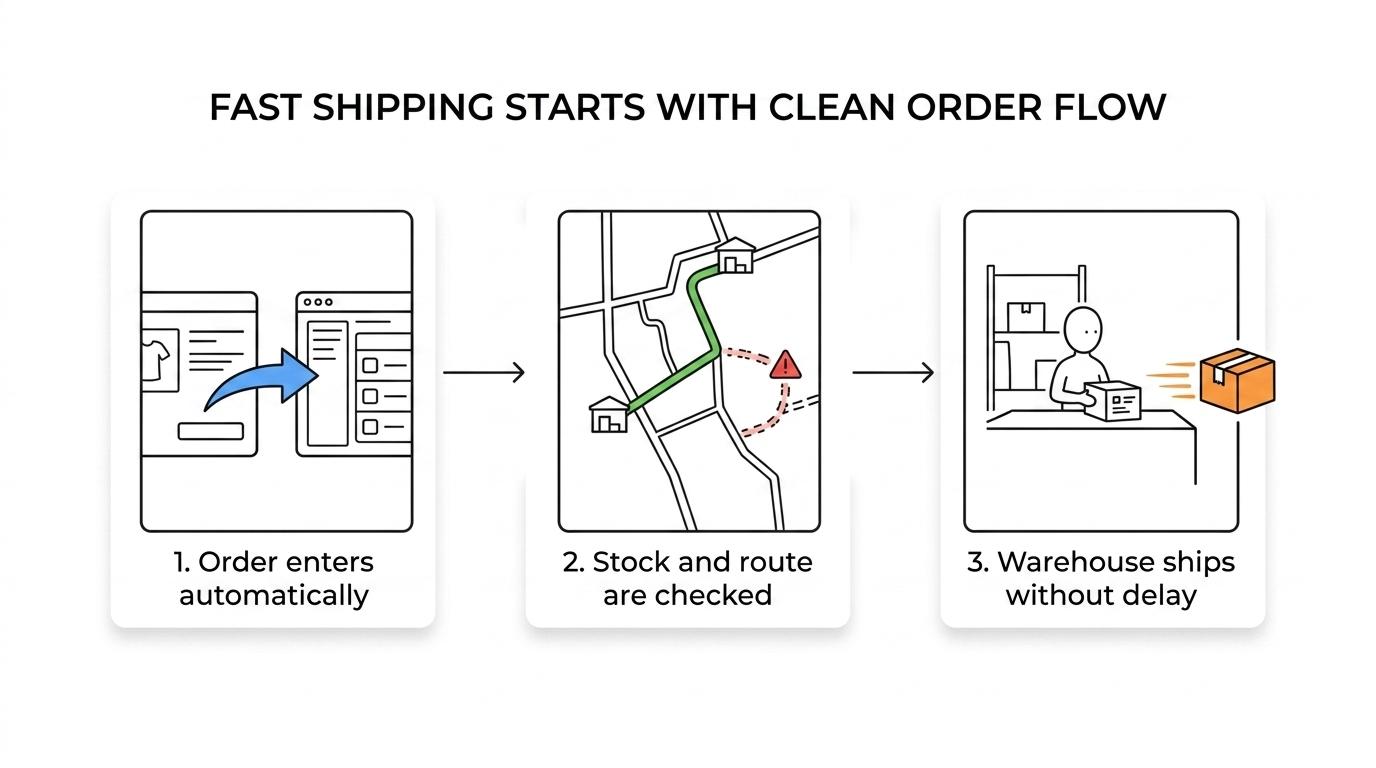
When order management is working well, orders move from checkout to warehouse execution with very little friction. The system validates what was sold, checks what is actually available, selects the best fulfillment path, and gives both the brand and the warehouse a current view of what is happening. When those steps are disconnected, even a strong warehouse team ends up waiting, correcting, or reprocessing work that should have been clean from the start.
Why order management affects fulfillment speed
Order management sits at the center of the fulfillment flow. It connects the storefront, inventory records, warehouse activity, shipping choices, and customer promise dates. If that center is slow or inaccurate, delays spread quickly.
A warehouse can only move as fast as the information it receives. If an order arrives late, arrives twice, shows the wrong stock count, or lacks clear shipping instructions, the delay is already built in before anyone picks the first item.
In practical terms, order management reduces delays by doing three things at once: it automates order processing, gives teams real-time visibility, and responds to signs that an order is slipping behind schedule.
Common delay sources often look simple on the surface:
duplicate order imports
stale inventory counts
manual approval queues
unclear split-shipment rules
mismatched shipping methods
orders held with no alert
Each issue may cost only a few minutes, but fulfillment does not operate on isolated minutes. Those minutes stack, especially during peak periods, product launches, and multi-channel sales spikes.
Order automation removes early-stage fulfillment delays
One of the fastest ways to cut fulfillment lag is to reduce manual handling at the start of the order lifecycle. If staff must rekey order data, export files, reconcile channel discrepancies, or manually push orders into a warehouse system, delay becomes part of the daily process.
At Silicon Valley Direct, the eCommerce order fulfillment process is described as 100% automated. That matters because automated processing shortens the time between order receipt and warehouse action. It also reduces human touchpoints, which lowers the chance of missing SKUs, bad routing, or overlooked holds. Same-day shipping becomes much more realistic when orders reach the floor cleanly and fast.
Industry research supports the broader case for automation as well. McKinsey has pointed to warehouse automation as a way to improve reliability across increasingly complex fulfillment networks. Reliability is not just about robotics on the floor. It also includes the upstream systems that tell the floor what to do.
A strong automated order flow usually includes a few non-negotiables:
Order capture: orders from sales channels enter fulfillment workflows without rekeying or batch delays.
Business rules: shipping methods, warehouse logic, and service-level priorities are applied immediately.
Exception handling: only orders with true issues are routed to human review.
Status updates: every handoff is recorded so teams can act before a customer asks.
This is where many growing brands gain time without adding labor.
Instead of having people chase routine tasks, teams can focus on exceptions that actually need judgment.
Inventory errors are one of the most common reasons orders ship late. A product appears available online, the order is accepted, and only then does the business learn that stock is not where the system said it was. That triggers backorders, substitutions, splits, or customer service escalations, all of which slow fulfillment.
Better order management reduces that risk by making inventory visibility part of daily execution rather than a separate reporting task. If inventory data is current, the order can be promised accurately. If it is not current, the business starts making promises it may not be able to keep.
Silicon Valley Direct gives clients 24/7 access to a customized web portal where they can check order status, inventory levels, shipping information, and reports. That kind of visibility helps brands spot issues early, before a wave of orders compounds the problem. It also helps customer service teams answer questions quickly, which keeps small exceptions from turning into operational bottlenecks.
External research points in the same direction. GS1 has reported inventory accuracy gains of more than 50% in RFID-focused studies, with retailers reporting 93% to 99% accuracy. NRF has also cited inventory accuracy rates above 98% with RFID programs. Higher accuracy means fewer out-of-stock surprises, fewer reallocated orders, and fewer shipments delayed while teams search for product.
The relationship between order management and inventory visibility is easier to see when broken down this way:
Delay source
What strong order management does
Likely fulfillment result
Stale inventory data
Syncs inventory across channels and warehouse records
Fewer oversells and backorders
Unclear order status
Shows current status in one portal
Faster exception response
Wrong warehouse assignment
Routes orders based on stock and service rules
Shorter transit and handling time
Late issue detection
Flags orders that are slipping
Earlier corrective action
Split-order confusion
Applies rules for partial shipments and priorities
Less manual decision-making
Visibility is not just a convenience feature.
It is a control system for speed.
Delay diagnostics and order routing keep late orders from spreading
Good order management does more than process orders quickly. It also recognizes when an order is in trouble and adjusts before the delay gets worse.
Oracle’s 2024 supply chain documentation offers a useful example of how mature order management works. When a fulfillment task is delayed, the system can replan the full orchestration process. It also recalculates a jeopardy score and priority each time it plans or replans. In plain language, that means the system continuously evaluates whether an order is at risk and decides what should happen next.
That is a major shift from static fulfillment workflows.
If one order line cannot be fulfilled on time, the business does not have to accept the delay as fixed. Oracle notes that attributes like shipping method, warehouse assignment, and partial-shipment choices can be adjusted to reduce delay. Those are practical levers. They turn order management from a passive recordkeeping function into an active control point.
This kind of diagnostic logic matters most when volume rises or fulfillment networks become more complex. A brand selling through multiple channels, shipping from more than one location, or handling both DTC and B2B orders cannot rely on a first-in, first-out mindset alone. It needs rules that identify risk and shift work intelligently.
A few examples make the value clear:
Priority scoring: urgent or at-risk orders move up before they miss promise dates.
Warehouse reassignment: orders can be routed to locations with available stock.
Partial shipment logic: part of an order can ship now instead of waiting on the full cart.
Carrier changes: faster or more reliable services can be applied when timing slips.
Without that flexibility, one delayed task can trigger a string of delays across inventory allocation, pick scheduling, carrier pickups, and customer communication.
Order management works best when systems and people support each other
Technology moves orders faster, but strong fulfillment still depends on people being able to act on what the system shows them.
That balance is one reason integrated 3PL operations can reduce delays so effectively. When warehousing, inventory management, pick and pack, order reporting, and channel integrations are tied together, fewer issues fall into the gaps between platforms or teams. Silicon Valley Direct emphasizes this approach through combined warehousing and fulfillment services, more than 80 preconfigured integrations with custom API support, same-day shipping options, and direct human support through a dedicated account manager.
That mix matters because not every delay can be solved by automation alone. Some orders need customer-approved substitutions. Some need address correction. Some need carrier escalation. Some need a quick decision about whether to split or hold. Visibility plus real human support often resolves those issues faster than a ticket queue buried three systems away.
For growing online retailers, the real question is not whether order management software exists. It is whether the order management process creates clean execution across the full fulfillment chain.
A healthy order management setup usually shows up in measurable ways:
Order release time: how many minutes pass between order receipt and warehouse-ready status
Inventory accuracy: how closely system counts match physical counts
Exception rate: how many orders are pulled into manual review
Promise adherence: how often orders ship by the promised date
Status visibility: whether teams can see the same current information across channels
When those numbers improve, delays usually fall with them.
The strongest fulfillment operations are rarely the ones doing heroic cleanup all day. They are the ones preventing avoidable problems from entering the workflow in the first place, then reacting quickly when real exceptions appear. That is the promise of disciplined order management: less waiting, fewer surprises, and a much better chance of shipping on time even as order volume grows.
If personalization is the primary reason two-thirds of subscribers remain loyal, why do so many brands treat their packaging as a mere afterthought? You’ve likely felt the sting of high churn caused by a single shipping error or a damaged item that arrived just a day too late. In 2026, with rising USPS holiday rates and the permanent elimination of the de minimis exemption, your margins are under more pressure than ever. It’s a frustrating reality where logistics often feels like a barrier to your growth rather than a bridge to your customers.
This guide helps you reclaim control by transforming subscription box fulfillment services from a reactive cost center into a proactive brand-building engine. We’ll show you how to leverage precision kitting and integrated digital personalization to create “TikTok-ready” moments for every subscriber. You’ll discover the strategic framework needed to achieve 100% accuracy through a quiet, organized fulfillment process. We’ll also explore how seamless eCommerce integration and national logistics coordination can finally reduce your shipping costs while providing the real-time inventory visibility you’ve been missing.
Key Takeaways
Adapt to the 2026 shift toward experiential boxes by integrating on-demand digital printing for offset-quality personalization.
Ensure 100% accuracy during peak assembly cycles by utilizing a “quiet facility” methodology and systematic QC-Check processes for complex kitting.
Scale your subscription box fulfillment services with a partner that provides 24/7 visibility through proprietary systems and over 120 real-time reports.
Transition from a vendor-client relationship to a strategic partnership that treats your fulfillment operation as a dedicated extension of your brand.
What is Subscription Box Fulfillment and Why It Matters in 2026
Subscription fulfillment is the heartbeat of a recurring brand. It is the scheduled, recurring distribution of products to a loyal customer base. If you are asking What is a Subscription Box? you’ll find it has evolved from a simple mailing to a complex logistical feat. In 2026, the industry has moved past the “box of items” phase. We now see a distinct shift toward experiential boxes that demand high levels of personalization to keep subscribers engaged and minimize churn.
There are two primary models in this space. Recurring replenishment focuses on consistency; it’s about getting essentials like vitamins or grooming supplies to the door on time, every time. Complex curated boxes, however, are about discovery. These lifestyle or snack subscriptions rely on a shifting mix of products to maintain interest. In both cases, the unboxing experience serves as the primary driver of subscriber retention. When a box arrives perfectly organized with a personalized touch, it secures the long-term customer value that keeps your brand profitable.
The Rise of the Curated Subscription Model
Curated boxes offer a unique value proposition but introduce significant logistical hurdles. Changing your product mix every month means managing a new set of variables every thirty days. Vendor coordination is often the primary failure point for growing brands. One late shipment from a supplier can stall your entire kitting cycle. To solve this, many high-growth companies utilize “just-in-time” assembly. This method reduces warehousing overhead by kitting products as soon as they arrive, ensuring your inventory doesn’t sit idle while you pay for shelf space.
Key Challenges in Subscription Logistics
Customer churn is the silent killer of recurring revenue. Most churn isn’t caused by the product itself but by shipping errors or damaged items. Managing subscription box fulfillment services requires a level of detail that standard “pick and pack” operations simply can’t provide. You are often dealing with diverse SKUs of varying dimensions that must fit into a single, cohesive kit. A standard 3PL might treat your box like a generic parcel, but subscription brands need a partner that understands the nuances of precision kitting and the high stakes of a monthly deadline. This is why a professional fulfillment strategy is essential for brands looking to scale without losing the personal touch that built their audience.
The Logistics of Precision Kitting and Assembly
Standard fulfillment focuses on speed and volume, but subscription box fulfillment services prioritize the arrangement and completeness of a multi-item experience. It is the difference between tossing a product into a mailer and meticulously layering curated items to tell a specific brand story. Achieving this at scale requires a “quiet, organized facility” methodology. In this environment, workflows are designed to eliminate the chaotic noise typical of high-volume warehouses. This focused atmosphere is critical for meeting tight monthly deadlines without sacrificing the quality of the unboxing experience.
Systematic QC-Check: Ensuring 100% Accuracy
A “make-it-right” attitude is the foundation of a successful hand assembly process. We utilize a proprietary “QC-Check” methodology, which involves multi-stage inspections throughout the workflow. Instead of checking a random sample of boxes at the end of a run, our team inspects at every touchpoint. This prevents the “missing item” or “damaged product” complaints that often lead to subscriber churn. Our systematic approach includes:
Verification of individual SKU counts before assembly begins.
Visual inspections of packaging integrity for every curated item.
Final box-weight verification to ensure no component is missing.
This level of care is essential for customer retention in e-commerce, as a single error can break the trust you’ve worked months to build. For example, our team frequently manages over 3,000 complex shipments in a single week flawlessly, maintaining a standard of precision that automated systems often miss.
Inventory Management and Serial Tracking
Managing monthly box components requires more than just a simple spreadsheet. You need real-time visibility into every SKU, from the primary products to the smallest promotional inserts. Our comprehensive inventory management system allows you to monitor stock levels during peak kitting cycles through a proprietary portal. This transparency ensures you aren’t surprised by stockouts that could delay your entire monthly cycle.
For high-value items, we implement serial number tracking within the kit. This ensures that every individual unit can be traced to a specific subscriber. It is an invaluable tool for managing warranties or product recalls without disrupting your entire operation. By integrating human expertise with advanced tracking, we ensure your logistics remain stable even as your volume grows. If you’re ready to see how a dedicated partner can streamline your kitting, you might want to explore a tailored fulfillment solution for your brand.
Personalization at Scale: The Digital Printing Advantage
Subscription brands often struggle with the “static inventory” trap. They print thousands of generic inserts that sit in a warehouse, losing relevance with every passing month. In 2026, the standard for subscription box fulfillment services has shifted toward dynamic, on-demand assets. We solve this bottleneck by utilizing the HP Indigo 5500 Digital Press. This is not your standard office printer. It uses real liquid ink technology to deliver offset-quality results that toner-based machines simply cannot replicate. It’s the difference between a mass-produced flyer and a high-end brand asset.
The technical superiority is visible in the details. With a 230 line screen resolution, your brand imagery remains sharp, professional, and vibrant. This high-resolution output is essential for the premium unboxing experience your subscribers expect. Beyond the quality, this digital approach is inherently sustainable. Because there are no plates, films, or harsh chemicals involved, you can reduce your brand’s environmental footprint. It allows you to stay agile without compromising on your commitment to the planet.
Variable Data Printing (VDP) for Hyper-Personalization
Variable Data Printing allows you to change the copy, images, or offers on every single sheet within a single print run. It is a powerful tool for building deep customer loyalty. Imagine a “Welcome” letter that addresses a subscriber by name or a custom discount code tailored to their previous purchases. While VDP provides a significant boost in customer engagement, it costs not much more than traditional static printing. It transforms a simple piece of paper into a strategic marketing asset that drives repeat revenue and lowers your churn rate.
On-Demand Literature Fulfillment
Speed is the third pillar of our printing strategy. Traditional offset printing requires a 24-hour drying period before sheets can be handled. Our digital press produces “dry-to-touch” output that is ready for assembly the moment it leaves the tray. This eliminates common bottlenecks in subscription box fulfillment services. By integrating our Print on Demand Services directly into the fulfillment workflow, we ensure your marketing collateral is as agile as your inventory. You don’t have to wait for external vendors or manage extra shipping legs. Everything happens under one roof, ensuring your monthly kits are assembled with both speed and precision.
Technology and Transparency: Managing Your Subscription Remotely
Scaling a recurring revenue model requires more than just physical space; it demands digital clarity. Our proprietary Remote Control™ system acts as a 24/7 window into your fulfillment operations, ensuring you never lose sight of your inventory. This platform allows you to place orders, track progress, and check real-time stock levels from any device at any time. By providing this level of accessibility, we function as a seamless extension of your internal team rather than a distant vendor. It’s about giving you the confidence to manage subscription box fulfillment services without needing to be physically present on the warehouse floor.
Precision is maintained through automated intelligence. The system provides immediate notifications for low inventory levels, successful receipts, and backorders. These alerts are vital for subscription brands that operate on rigid monthly cycles. If a component for your next box is running low, you’ll know well before it impacts your shipping deadline. This proactive communication eliminates the “black hole” effect often associated with traditional logistics, allowing you to focus on marketing and growth while we handle the operational heavy lifting.
Data-Driven Decision Making with 120+ Reports
Generic “shipped” status updates aren’t enough to sustain a complex subscription brand. You need granular data to forecast future needs and optimize your spend. Our system offers over 120 standard reports that cover everything from inventory history to detailed shipment activity. This data helps you identify trends, manage seasonal surges, and ensure your kitting components are ready exactly when they’re needed. For a cohesive brand experience, we also offer custom-fit web interfaces. These portals can be styled to match your existing corporate brand or online store, providing a consistent professional look for your internal stakeholders.
Programmatic Integration for Developers
For brands with custom-built eCommerce platforms, we provide robust programmatic integration through XML and SOAP web services. This platform-agnostic approach ensures that data flows securely and accurately across your network. Developers can utilize specific Web Methods such as AddOrder, GetOrderInfo, and GetShippingActivity to automate the entire lifecycle of a subscription box. We use WSDL and SOAP protocols to maintain standardized, secure data transfers, ensuring your customer information remains protected. You can find more technical details on our Remote Order Management page to see how our infrastructure fits into your tech stack.
Scaling Your Subscription Brand with a Strategic 3PL Partner
Every successful subscription brand reaches a point where in-house fulfillment becomes a bottleneck to growth. What begins as a manageable task in a small office or warehouse can quickly overwhelm your team as volume scales from hundreds to thousands of shipments. Moving to professional subscription box fulfillment services is a strategic pivot that requires a partner, not just a vendor. We operate as a seamless extension of your company, utilizing a proactive problem-solving approach. This means we identify potential order conflicts, such as address errors or SKU mismatches, before they ever disrupt your monthly mailing cycle.
Our operational framework is guided by the “Nine Promises,” a set of principles ensuring long-term stability and trust. This commitment to accountability means we prioritize your brand’s reputation as if it were our own. By maintaining a quiet, organized facility, we eliminate the chaotic atmosphere common in high-volume logistics. This deliberate methodology allows us to manage complex deadlines with precision and personal commitment. We focus on continuous innovation to stay at the cutting edge of industry trends, ensuring your brand remains competitive as the market evolves.
Global Shipping and Logistics Coordination
Maintaining healthy profit margins is a primary challenge as you scale a recurring revenue model. We help protect your bottom line by leveraging deeply discounted carrier rates and sophisticated logistics coordination. In 2026, navigating the complexities of domestic and international shipping requires a coordinated strategy to avoid unexpected delays or cost spikes. If your goal is to reach a global subscriber base, our Global Shipping Services guide provides the roadmap necessary for international expansion while maintaining your professional standards. We handle the administrative details of global mailing so you can focus on high-level growth.
The Partnership Approach to Growth
A successful partnership is built on flexibility and a deep understanding of your unique business goals. We reject rigid, cookie-cutter procedures in favor of bespoke solutions that fit your specific project limitations. During the onboarding phase, we take the time to listen and understand your objectives, ensuring our workflows align with your brand’s identity. This human-centric focus is a core differentiator in a tech-saturated market and is the reason many of our clients have remained with us for over seven years. You can view our Customer Testimonials to see how this collaborative approach has fostered long-term success for brands of all sizes. Choosing the right subscription box fulfillment services partner is the final step in securing a scalable, resilient future for your business.
Elevating Your Brand Through Strategic Fulfillment
Scaling a subscription brand in 2026 requires a transition from basic logistics to a high-performance partnership. You’ve seen how precision kitting and the “quiet facility” methodology ensure 100% accuracy even during high-volume deadlines. Integrating on-site HP Indigo digital printing allows you to deliver hyper-personalized unboxing experiences that directly combat subscriber churn. These capabilities bridge the gap between mechanical operations and the personal touch your customers expect.
By leveraging subscription box fulfillment services that offer 25+ years of operational history, you gain a steady hand in an unpredictable market. Our proprietary Remote Control™ technology provides the 24/7 visibility you need to manage your business from anywhere. This combination of human oversight and technical innovation ensures your brand remains stable during rapid growth. It’s time to transform your logistics from a standard cost center into a primary driver of long-term customer value.
We are ready to help you build a more resilient and scalable future for your brand.
Frequently Asked Questions
What is the difference between kitting and subscription fulfillment?
Kitting refers to the physical assembly of multiple items into a single unit, while subscription fulfillment is the broader, recurring process of managing those kits and shipping them to subscribers. At Silicon Valley Direct, our kitting and assembly services are integrated into a systematic workflow. We use a proprietary QC-Check process to ensure every box is perfect. This differs from standard “pick and pack” because it focuses on the precision required for curated brand experiences.
How much does subscription box fulfillment services cost?
The cost of subscription box fulfillment services varies based on several factors, including monthly order volume, storage requirements, and the complexity of the kitting process. We provide affordable, project-based pricing for assembly and storage fees that scale with your growth. Because every brand has unique goals, we avoid cookie-cutter pricing in favor of custom-fit solutions. This ensures you only pay for the specific logistics and printing services your business actually requires.
Can you handle custom branded packaging and unique unboxing experiences?
Yes, we specialize in executing complex unboxing experiences that require custom branded packaging and precise item placement. Our team treats your fulfillment as an extension of your marketing department. We can handle everything from premium item distribution to the insertion of high-resolution, personalized literature. By maintaining a quiet and organized facility, we ensure your custom packaging is handled with the care necessary to leave a lasting impression on your subscribers.
How do you manage inventory for products with expiration dates?
We manage sensitive inventory through our proprietary Remote Control system, which provides real-time visibility into stock levels and movement. Our warehouse team uses serial number tracking and strict inventory controls to monitor batch codes or expiration dates. You’ll receive automated email notifications for low inventory or incoming receipts. This level of transparency ensures that older stock is prioritized and that no expired items ever reach your customers during the monthly shipping cycle.
Do you offer international shipping for subscription boxes?
Silicon Valley Direct provides comprehensive global shipping and logistics coordination for subscription brands with an international audience. We leverage discounted carrier rates to help you maintain profit margins while reaching subscribers worldwide. Our team handles the administrative complexities of international mailing, ensuring your kits move through customs efficiently. Whether you are shipping domestically or to multiple continents, our infrastructure supports a seamless delivery process that reflects your brand’s professional standards.
What eCommerce platforms do your fulfillment services integrate with?
Our fulfillment services utilize platform-agnostic XML and SOAP web services, making us compatible with any eCommerce platform or custom-built Order Management System. This standardized integration allows your developers to use programmatic interfaces like AddOrder and GetOrderInfo without time-consuming custom coding. Whether you use a popular storefront or a bespoke internal system, our Remote Control platform ensures that data flows securely and accurately across your entire digital network in real time.
Is variable data printing expensive for monthly box inserts?
Variable data printing (VDP) for monthly box inserts is surprisingly affordable and costs not much more than producing static color printing jobs. We use the HP Indigo 5500 Digital Press to change copy or images on every sheet within a single run. This allows you to include personalized welcome letters or custom discount codes without a significant price jump. It’s an efficient way to increase subscriber engagement while keeping your marketing costs manageable.
How quickly can you scale assembly for a sudden surge in subscribers?
Our deliberate facility methodology is designed to manage sudden surges in subscriber volume without losing precision. We’ve successfully handled complex projects involving over 3,000 shipments in a single week for our clients. Because we avoid the hectic atmosphere common in many warehouses, we can scale our hand assembly and kitting teams quickly to meet tight deadlines. Our proactive problem-solving approach ensures your growth doesn’t lead to shipping errors or assembly delays.
Did you know that all-in truckload rates have undergone a structural reset, remaining roughly 50% higher than last year? When you combine these costs with diesel prices at $5.348 per gallon, sending frequent, small shipments becomes a heavy drain on your bottom line. You’ve likely felt the frustration of paying premium rates for half-empty trailers or dealing with product damage during endless carrier hand-offs. Utilizing professional shipping consolidation services isn’t just a cost-saving measure anymore; it’s a vital strategy for protecting your margins and your brand’s reputation in a tight market.
We understand that business growth brings complexity, and you need a partner who values precision as much as you do. This guide will show you how to master the art of consolidation to reduce overhead, enhance cargo security, and finally achieve a single source of truth for your data. We’ll explore how integrating high-tech tracking with human oversight ensures your national supply chain runs with expert precision. This comprehensive guide examines cost-reduction strategies, real-time inventory technology, and the methods used to build a resilient, efficient logistics network.
Key Takeaways
Learn how to differentiate between parcel and freight consolidation to ensure your business only pays for the shipping space it actually utilizes.
Discover how modern shipping consolidation services leverage proprietary digital systems to replace manual tracking with 24/7 real-time visibility and 120+ standard reports.
Understand the direct correlation between reducing carrier touchpoints and minimizing product damage to protect your brand’s bottom line and reputation.
Master a step-by-step framework for auditing your logistics volume and identifying kitting opportunities that significantly reduce your total box count.
Identify the essential qualities of a high-performance 3PL partner, focusing on personal accountability and transparent oversight rather than automated, impersonal systems.
What are Shipping Consolidation Services and How Do They Work?
In the current logistics environment, shipping consolidation services represent a deliberate shift from reactive shipping to a proactive strategy. At its core, the process involves combining multiple smaller shipments from various sources into a single, larger load. This method optimizes container space and significantly lowers the cost per unit. This strategic aggregation often occurs at a hub before the final logistics process of transshipment, where goods are transferred to their ultimate destination. By 2026, businesses have largely abandoned cookie-cutter shipping models. They now favor bespoke solutions that treat logistics as a competitive advantage rather than a simple line item.
Traditional fulfillment centers often operate in a state of constant, hectic motion. In contrast, a methodical consolidation approach brings a sense of calm and precision to the warehouse floor. By planning shipments around volume and destination frequency, we eliminate the rush and error-prone nature of last-minute packing. This disciplined methodology ensures that every parcel or pallet is handled with the same level of care you’d provide in your own facility. Utilizing professional shipping consolidation services allows you to move beyond the limitations of standard carrier networks while maintaining total control over your inventory.
The Core Difference: LTL vs. Consolidated Shipping
Paying for a half-empty trailer is a significant drain on your bottom line. Traditional Less-Than-Truckload (LTL) shipping often subjects your goods to multiple carrier hand-offs, which increases the risk of damage and delays. When you choose consolidated shipping, your freight stays together in a single, secure environment. We act as a steady extension of your team, leveraging our established carrier relationships to secure preferred rates that individual shippers rarely access. This partnership transforms a complex mechanical process into a streamlined, reliable operation that respects both your budget and your timeline.
Parcel Consolidation for eCommerce and Marketing
For eCommerce brands, parcel consolidation involves bundling individual orders to bypass intermediate distribution centers and go straight to the regional hub. This is particularly effective when integrating promotional items or literature into product shipments through our Remote Control™ system. By utilizing our systematic QC-Check procedures, we ensure that every custom kit is accurate before it leaves the dock. This level of precision prevents the “black box” experience common in automated systems, replacing it with personal oversight and high-tech efficiency. It’s about making sure the human element remains at the center of your growth strategy.
The Mechanics of Modern Consolidation: Technology and Visibility
The transition from manual tracking to proprietary online data management systems marks a structural shift in logistics. In the past, companies relied on fragmented spreadsheets and phone calls to track their inventory. Today, the complexity of managing shipping consolidation services requires a sophisticated digital backbone. This technology provides the transparency needed to manage multiple streams of freight without losing sight of individual orders. By adhering to GSA shipping consolidation guidelines, we ensure that every shipment follows a rigorous, compliant path while our proprietary systems provide the granular detail you need to make informed decisions.
Our Remote Control™ system acts as the primary interface for our partners, offering 24/7 access to track progress and retrieve comprehensive order histories. In a consolidated environment, real-time inventory information isn’t just a luxury; it’s a necessity for maintaining flow. We’ve built our platform to anticipate needs through proactive problem-solving. Automated notifications alert you to low inventory levels or backorders instantly. This prevents the small delays that can ripple through a national supply chain, ensuring your operations remain steady and predictable regardless of market volatility.
Remote Order Management: Your Command Centre
Managing a national supply chain requires more than just a login. It requires a high-performance tool that acts as an extension of your company. When you integrate our shipping consolidation services into your workflow, you gain access to Remote Order Management, which generates over 120 standard reports to help you monitor supply chain health with expert precision. You can even customize the web interface to match your corporate brand or company store. This ensures a consistent experience for your team while providing the data density required by technical stakeholders to optimize every shipment.
Web Services and Seamless API Integration
Modern efficiency depends on seamless communication between disparate systems. We utilize XML and SOAP for platform-agnostic integration, allowing our warehouse management tools to sync effortlessly with your existing platforms. By employing standardized AddOrder and GetOrderInfo methods, we facilitate real-time transaction processing that eliminates the need for manual data entry. This methodology reduces custom coding time and speeds up the entire fulfillment cycle. If you want to streamline your digital and physical operations, speak with our team about a custom integration.
Core Advantages: Cost Savings, Security, and Brand Impact
Shippers often find themselves paying for air. When you ship half-empty containers, you’re essentially subsidizing the carrier’s inefficiency. Professional shipping consolidation services solve this problem by maximizing every cubic inch of available space. This efficiency does more than just lower your cost per unit; it directly supports your sustainability goals. By optimizing container density, you reduce the total number of vehicles on the road, which significantly lowers your carbon footprint. In a business environment where corporate responsibility is a core expectation, these green advantages provide a quiet confidence that resonates with your stakeholders.
Every time a package is handled, the risk of damage increases. Traditional LTL networks involve multiple carrier hand-offs, creating countless opportunities for errors. Consolidation minimizes these touchpoints. Your products stay in a controlled, stable environment for a larger portion of their journey. This reduction in physical handling protects the integrity of your goods and ensures that your customers receive exactly what they ordered in pristine condition. It’s a proactive approach that anticipates potential conflicts before they happen, preserving your brand’s reputation for quality.
Financial Efficiency and Volume-Based Rates
The primary driver for many businesses is the immediate impact on the bottom line. By aggregating volume, we secure discounted carrier rates that are typically reserved for the largest global enterprises. We pass these savings directly to you, making your logistics spend more predictable. Beyond the freight itself, we integrate custom-fit solutions like Variable Data Digital Printing (VDP). Using our HP Indigo 5500 with real liquid ink technology, we produce personalized materials at 230 line screen resolution. This high-resolution output ensures your brand looks its best without the overhead of massive print runs. Explore our 3PL fulfillment services to see how we blend printing and logistics for maximum impact.
Security and Quality Control (QC-Check)
Precision in the warehouse is just as vital as efficiency on the road. Our QC-Check systematic inspection process acts as a proactive barrier against errors, ensuring that every kit and assembly meets your exact specifications. We maintain a “make-it-right” attitude that prioritizes human oversight over mindless automation. This is particularly important for high-value inventory that requires secure, climate-controlled warehousing. We operate with a deep understanding of the regulatory landscape, including Federal Maritime Commission regulations, to ensure your national supply chain remains compliant and secure. For more detailed insights, read our strategic guide to secure warehousing for electronics.
Implementing a Consolidation Strategy: A Step-by-Step Framework
Transitioning to a more efficient logistics model requires a structured approach that aligns your physical inventory with digital oversight. Many organizations struggle with fragmented shipping because they lack a cohesive roadmap. By following a deliberate framework, you can integrate shipping consolidation services into your daily operations without disrupting your existing workflows. This process isn’t just about moving boxes; it’s about refining the way your brand interacts with its national supply chain.
Step 1: Audit your current shipping volume and destination frequency. Analyze your data to find patterns where multiple small orders are heading to the same regional hubs.
Step 2: Identify opportunities for kitting and hand assembly. Look for products that are frequently ordered together and can be combined into a single SKU to reduce total box count.
Step 3: Integrate on-demand digital printing. Shift away from storing large quantities of pre-printed materials that often become obsolete, reducing warehouse waste.
Step 4: Establish real-time data links. Use WSDL and SOAP protocols to create a platform-agnostic connection between your sales platform and our fulfillment system.
Step 5: Monitor performance through automated alerts. Set up customized reports that notify your team of inventory milestones or potential shipping conflicts before they arise.
Integrating Digital Print with Fulfillment
One of the most effective ways to streamline your consolidation strategy is to merge your print and fulfillment needs. We utilize the HP Indigo 5500 to provide high-quality, 7-color digital printing for short runs. Unlike standard toner-based systems, our liquid ink technology ensures superior brand consistency and a professional finish that matches offset printing. This capability allows you to include personalized inserts or updated literature in every shipment without the burden of maintaining massive print inventories. Discover our print-on-demand services to see how we eliminate waste through precision.
Kitting and Assembly for Complex Projects
Consolidation reaches its peak efficiency when products are bundled through expert kitting and assembly. Whether you’re managing software packages, clothing lines, or intricate promotional kits, our team provides systematic inspections at every stage. We take a proactive stance by anticipating conflicts in orders, such as missing components or packaging mismatches, before they impact your project timeline. This human oversight ensures that complex kits are assembled with a level of care that automated systems simply can’t replicate. You can learn more in our strategic guide to kitting and assembly services.
Choosing the Right 3PL Partner for National Consolidation
Selecting a partner to manage your shipping consolidation services is a decision that impacts every facet of your customer experience. It’s not just about moving freight; it’s about finding a steady hand that can manage the complexities of a national supply chain with quiet confidence. When evaluating potential 3PL providers, you should look for a facility that feels organized and methodical. A hectic, high-decibel warehouse is often a breeding ground for errors. In contrast, a quiet facility signifies that processes are well-defined and that the team is in total control of the physical operations. This stability is the foundation of a reliable logistics strategy.
At the heart of this reliability are the ‘Nine Promises’, which define our commitment to personal accountability. In an industry increasingly dominated by impersonal automation, we explicitly reject the ‘black box’ model. You deserve a partner that offers total visibility through systems like Remote Control™, rather than one that hides behind automated support tickets. This transparency ensures that you remain the architect of your own growth while we handle the mechanical execution. We also prioritize flexibility, avoiding the rigid, one-size-fits-all procedures that often cause flaws in unique or complex projects. A partner should adapt to your needs, not the other way around.
The ‘Extension of Your Team’ Philosophy
We believe that a successful partnership is built on the idea that we are a direct extension of your company. This philosophy means we treat every client as if they were our only customer, providing a level of personal oversight that is rare in the logistics sector. We don’t just react to problems; we practice proactive problem-solving to anticipate conflicts before they ever reach your project timeline. This dedication has allowed us to build long-term relationships grounded in trust and operational excellence. You can read our customer testimonials to see how this human-centric approach has helped other businesses scale with confidence.
Scalability from Startups to Enterprises
Our infrastructure is designed to handle the evolving needs of your business as it grows. Whether you’re a startup launching your first product or a large enterprise managing national distribution, we provide the same high-performance service. Our strategic location in a historically innovative area allows us to leverage technological advancements while maintaining a stable, seasoned staff. We manage any deadline with expert precision, ensuring that budget limitations or sudden volume spikes don’t compromise your delivery schedule. For those looking to expand their reach further, our global shipping services strategic reference provides the insights needed for international logistics success.
Future-Proofing Your Supply Chain Through Strategic Integration
Mastering your logistics in 2026 requires a shift from reactive shipping to a model defined by precision and visibility. By moving away from fragmented, small-batch deliveries and adopting professional shipping consolidation services, you protect your margins against rising freight costs and diesel surcharges. You’ve seen how proprietary tools like Remote Control™ replace the “black box” of traditional shipping with over 120 standard reports and real-time data integration. This technological backbone, combined with a proactive “make-it-right” attitude, ensures your inventory is handled with expert care at every touchpoint.
With over 25 years of fulfillment expertise, Silicon Valley Direct acts as a steady extension of your company. We offer a proactive problem-solving guarantee that identifies potential conflicts before they disrupt your project timeline. Whether you’re integrating on-demand digital printing or complex kitting, our team provides the stability needed to navigate a volatile market. It’s time to transform your logistics from a source of stress into a competitive advantage.
We look forward to helping you build a more resilient and efficient future for your brand.
Frequently Asked Questions
What is the difference between freight consolidation and pool distribution?
Freight consolidation involves combining multiple smaller shipments into a single larger load to optimize long-haul costs. In contrast, pool distribution typically involves sending a large, pre-sorted shipment to a regional hub for local delivery. While both strategies reduce costs, consolidation is the primary method for businesses looking to bypass expensive LTL rates. We utilize a deliberate methodology to ensure these loads are built efficiently without compromising your delivery schedule or project deadlines.
Does shipping consolidation increase the total delivery time?
Shipping consolidation services don’t necessarily increase delivery times and often improve overall reliability. While building a full load can add a day at the origin, the process reduces the total number of carrier hand-offs. These transfers are the most common source of delays and damage in standard shipping. We use proactive problem-solving to align consolidation schedules with your specific project timelines to ensure your supply chain remains efficient and predictable.
How much can a business typically save using consolidation services?
Businesses see a reduction in overhead by using shipping consolidation services to maximize container density and eliminate the cost of shipping empty space. Moving from standard Less-Than-Truckload rates to volume-based pricing provides a more predictable logistics spend. While exact savings depend on your specific volume and destination frequency, the strategy effectively lowers the cost per order. This approach turns your supply chain into a competitive advantage by protecting your margins against rising fuel costs.
Is my inventory safe when it is consolidated with other companies’ goods?
Consolidated inventory is often safer than goods sent through traditional networks. Because your products are combined into a single secure load, they undergo fewer transfers between carriers. This directly correlates to lower rates of product damage. We maintain a quiet, organized facility and use a systematic QC-Check process to ensure every item is handled with care. Our secure, climate-controlled warehousing provides an additional layer of protection for high-value or sensitive materials.
What kind of technology do I need to integrate with a consolidation provider?
Integration is designed to be seamless and platform-agnostic using industry-standard XML and SOAP protocols. You don’t need to invest in new software or perform extensive custom coding to connect with our system. You can submit orders and retrieve real-time tracking data through our programmatic interface. This allows your developers to build custom views that match your specific corporate requirements and branding while maintaining a single source of truth for your data.
Can I consolidate international shipments with domestic ones?
We provide comprehensive global shipping and logistics coordination that handles both national and international requirements. You can manage both streams through our Remote Control™ system, which provides a single source of truth for all shipment data. This integration allows you to maintain visibility across your entire supply chain regardless of the destination. We handle the complexities of different carrier networks so you can focus on growing your business with confidence.
How does digital printing integrate with the shipping consolidation process?
On-demand digital printing allows you to include personalized literature or marketing materials without storing large inventories. We use the HP Indigo 5500 to produce high-resolution materials at a 230 line screen resolution. Because these prints emerge dry and ready for handling, they can be immediately kitted with your products. This approach reduces warehouse waste and ensures that every consolidated shipment features the most current and relevant brand information for your customers.
What happens if an order is returned in a consolidated shipping model?
Our returns management service acts as a seamless extension of your company. When a returned order is received, it undergoes our systematic QC-Check inspection to verify its condition. The inventory status is updated instantly in our Remote Control™ system, and you receive an automated email notification. This ensures that even in a consolidated model, you have 24/7 visibility into every transaction and can generate over 120 standard reports to maintain accurate inventory levels.
Speed is now part of the product, not just the shipping line item. For ecommerce brands comparing 3PL centers, the real question is not who can store inventory, but who can turn orders into reliable same-day or next-day DTC delivery with clean visibility and manageable returns. Silicon Valley Direct (SVDirect) is one example of a California 3PL in this category, which makes it a useful reference point when evaluating fast fulfillment operations.
TL;DR: Summary
The best 3PL centers for fast DTC shipping combine same-day execution, live inventory visibility, and strong returns handling, because consumer demand now favors same-day or two-day delivery.
Adobe Commerce reported 72% of surveyed U.S. consumers wanted same-day or two-day shipping, so a low-rate warehouse with slow cutoffs can cost more than it saves.
NRF reported retailers expect 15.8% of annual sales to be returned in 2025, equal to $849.9 billion, which makes reverse logistics and fraud controls core 3PL selection criteria.
SVDirect is relevant as a benchmark because it publicly emphasizes same-day fulfillment, 24/7 reporting visibility, and a Union City, California warehouse for DTC brands.
If your brand sells nationwide, compare one-node speed, zone coverage, integrations, and return workflows before you compare storage rates.
A strong 3PL center helps shape delivery promise, repeat purchase rates, and customer service workload. That is why smart selection usually starts with operating discipline, cut-off management, and reverse logistics, not with a rate card alone.
What is a 3PL center and why does it matter for DTC shipping?
The key point is that a 3PL center is not just real estate. It is a process engine that turns cart activity into labels, picks, packs, scans, manifests, and tracking events. If any part of that chain breaks, fast shipping promises collapse, even when stock is technically available.
Adobe Commerce reported that 72% of surveyed U.S. consumers wanted same-day or two-day shipping. The same study found shoppers were less likely to buy from retailers offering delivery slower than a week or two, which means fulfillment speed influences conversion as well as retention.
“SVDirect reports a 99% same-day order shipping rate, which is a concrete benchmark to ask about when comparing fast DTC fulfillment claims.”
A common misconception is that carrier selection alone determines delivery speed. In reality, warehouse cutoffs, order release timing, inventory accuracy, and exception handling often matter more than the parcel service named at checkout.
What should brands look for in a fast 3PL center?
The best fast 3PL centers, including providers like SVDirect, show operational proof in a few places: same-day cutoff discipline, clean inventory visibility, reliable support, and a returns process that does not drain margin.
Start with the service promise, then test the mechanics behind it. Many providers can say “fast shipping,” but the useful questions are narrower: What is the daily cutoff? What percentage ships the same day? How are backorders flagged? What happens when a scan fails or a SKU count is wrong?
Look for these indicators:
Cutoff policy: A documented same-day shipping window, plus rules for weekends, holidays, and peak periods.
Order accuracy controls: Scan verification, exception reporting, and a defined process for short picks or substitutions.
Visibility tools: Real-time inventory status, order tracking, and exportable reports for finance and operations.
Human support:Named contacts who can resolve exceptions without long ticket chains.
Pro tip: do not ask only for average shipping speed. Ask what percentage of orders ship within SLA and what happens to the misses.
What are the operating traits of top 3PL centers for DTC brands?
Top 3PL centers share repeatable operating traits, not just large buildings. The strongest signals are measurable execution, system visibility, flexible integration, and clear exception handling.
These traits tend to separate high-performing centers from basic storage-and-shipping vendors:
Silicon Valley Direct: A useful example of a West Coast 3PL center that publicly ties fast ecommerce fulfillment to same-day shipping, reporting visibility, and a Union City warehouse operation.
Documented cutoff management: Orders released at 2:00 p.m. and 6:00 p.m. are treated differently, and the provider can explain that difference clearly.
Returns readiness: Reverse logistics is treated as a core process, not an afterthought handled in a separate inbox.
System connectivity: Native ecommerce integrations and API support reduce manual order handling and latency.
If a center looks impressive on a tour but cannot explain these traits, the operation may be less mature than the pitch suggests.
How do you verify same-day or next-day execution before signing?
You verify fast fulfillment by testing timestamps, cutoffs, and exception behavior before rollout. A written SLA matters, but live operational evidence matters more.
First, define what “same-day” means. Does it mean orders received by cutoff are picked, packed, manifested, and handed to the carrier that day, or does it only mean a label was printed? Those are not the same outcome.
Next, ask for proof tied to time. Request sample daily reports that show order receipt time, warehouse release time, pick completion, manifest time, and carrier handoff. If those data fields do not exist, visibility may be too weak for high-speed DTC operations.
Then run a live test. Use a small batch with normal orders, multi-line orders, and one intentionally awkward case such as a gift insert or address correction. If the provider performs well only on clean, single-SKU orders, you have learned something important before the contract is fully active.
A practical mistake is to judge speed only in non-peak weeks. If your business has launches, influencer spikes, or holiday surges, ask how the process holds up when daily volume jumps suddenly.
How do West Coast 3PL centers compare with multi-node networks?
A West Coast 3PL center can be the right answer for many brands, but a distributed network wins when order destinations are truly national and delivery promises are aggressive. The better choice depends on customer geography, SKU velocity, and inventory complexity.
If most of your buyers are in California, the Mountain West, or major western metro areas, a single well-run West Coast node can keep operations simple while still delivering fast transit. A Union City or Bay Area location can also shorten inbound timelines for brands connected to West Coast ports and suppliers.
If demand is evenly spread across the country, a single node can push many shipments into higher zones and longer transit windows. In that case, a multi-node strategy may lower parcel cost and improve two-day coverage, but it adds transfer logic, inventory balancing, and greater risk of fragmented stock.
USPS has also shown that same-day or next-day package delivery can be operationally viable in local and regional contexts. Its USPS Connect Local pilot in Houston and Dallas was designed to support fast local deliveries and returns, which highlights a broader truth: proximity matters when speed targets tighten.
The trade-off is simple. Fewer nodes usually mean easier control. More nodes can mean faster national reach, but only if inventory planning is strong enough to prevent stockouts in the wrong region.
What matters more: lower fulfillment cost or faster delivery performance?
Faster delivery performance often matters more than the cheapest fee schedule, especially when repeat purchase and conversion are central to your economics. The right comparison is total commercial impact, not one warehouse line item.
A low storage rate can look attractive until it creates slower ship times, more customer service contacts, and fewer repeat orders. Bad shipping experiences do not just add cost. They can reduce customer trust and future revenue.
Use this lens when comparing offers:
Order economics: If your average order value and repeat rate are high, slower delivery can be more expensive than a higher pick fee.
Zone exposure: If one location pushes most packages into distant zones, transit delays and carrier spend can rise together.
Support burden: More late orders usually mean more WISMO contacts, refunds, and manual escalations.
Returns effect: Slow or inaccurate fulfillment often increases avoidable returns and reshipments.
Pro tip: compare cost per successful delivered order, not cost per order processed. Those are different numbers, and only one reflects customer reality.
How should you evaluate returns handling and reverse logistics?
You should evaluate returns as a primary 3PL function, because reverse logistics now shapes margin, resale speed, and fraud exposure. NRF’s retail estimates make this impossible to ignore.
NRF reported that retailers estimate 15.8% of annual sales will be returned in 2025, equal to $849.9 billion. It also reported that 9% of all returns are fraudulent and that 85% of merchants say they are using AI to detect or prevent return fraud. That means your 3PL center needs more than a returns bin and a spreadsheet.
Start by mapping your return types. Apparel, supplements, electronics, literature, and promotional kits all need different inspection logic. If you do not define disposition rules up front, the warehouse will be forced to improvise under pressure.
Next, ask how returned items are inspected and coded. Can the operator separate unopened resale-ready units from damaged goods, suspected fraud, missing-component returns, and quarantine stock? If not, inventory accuracy and accounting can drift quickly.
Then connect returns to customer policy. If your store offers exchanges, store credit, or paid return labels, the 3PL workflow must support those paths cleanly. A common mistake is treating reverse logistics as a customer service task when it is really an inventory and margin control system.
How do integrations and inventory visibility affect shipping speed?
Integrations and live reporting directly affect shipping speed because orders cannot move cleanly when data lags, and SVDirect’s published visibility model is a useful example of what brands should ask to see.
Fast fulfillment depends on fast information. Orders need to enter the queue correctly, inventory must sync across channels, and exceptions should surface early enough to fix. A missed inventory sync can create oversells, delayed notifications, and expensive split shipments even when labor on the floor is excellent.
This is also where system detail matters more than flashy dashboards. Ask whether the provider supports native integrations, custom API work, inventory reservation logic, and exportable operational reports. USPS showed in its Connect Local pilot that small businesses can access local delivery tools even without software integration, but for growing DTC brands, warehouse speed without inventory visibility is still a blind spot.
How can you run a pilot with a 3PL center before a full rollout?
A short pilot is the safest way to test a 3PL center under real conditions. The most useful pilots are narrow enough to control and broad enough to reveal operational truth.
First, choose a limited SKU set and a 30-to-60-day test window. Include your typical order mix, not just your easiest items. If your business relies on bundles, inserts, subscription cycles, or lot-sensitive products, the pilot must include them.
Next, set scorecards before inventory lands. Measure receiving accuracy, order cycle time, same-day ship rate, support response time, inventory variance, and return turnaround. If you wait until go-live to define success, every problem becomes an argument instead of a data point.
Then stress-test communication. Send at least one address correction, one order cancel request, and one return that needs inspection. The goal is not to catch the provider failing. It is to see how exceptions are handled when the script breaks.
If possible, visit the site. A warehouse walk-through can reveal layout logic, pick-path discipline, receiving congestion, and whether the operation looks calm or improvised.
When is a specialized 3PL center better than a general warehouse?
A specialized 3PL center is better when your products need more than basic pick, pack, and parcel shipping. Complexity in the item, order, or regulatory workflow usually decides the answer.
Specialization matters because labor steps multiply quickly. A single DTC order might require branded collateral, expiry checks, serialized handling, or channel-specific packing rules. If the warehouse treats all orders as interchangeable, error rates can rise even when the basic shipping process looks fast.
The practical test is simple. If your catalog has special handling rules that affect either compliance, resale condition, or brand presentation, a specialized 3PL center is usually the safer fit. If your items are simple, stable, and uniform, a general operation may be enough.
When your ecommerce brand is shipping direct to consumers, fulfillment becomes part of the customer experience. Silicon Valley Direct, also known as SVDirect, provides B2C fulfillment from Union City, California for startups, established ecommerce brands, and growing online retailers that need dependable warehousing, pick and pack, shipping, integrations, and day-to-day operational support.
As ecommerce keeps expanding, the pressure on fulfillment does too. U.S. retail e-commerce sales reached $326.7 billion in Q1 2026, according to the U.S. Census Bureau, and online returns continue to take a large share of revenue. That makes partner choice practical, not cosmetic. You need accurate outbound fulfillment, clear reporting, and a team that can scale with your order volume.
SVDirect B2C fulfillment services for ecommerce brands that need fast order shipping
SVDirect handles the core fulfillment work that keeps consumer orders moving: inventory receiving, warehousing, pick and pack, shipping, order tracking visibility, and system integration. For your team, that means fewer manual handoffs, less time spent fixing preventable errors, and a clearer path from checkout to delivery.
Our B2C fulfillment service is a strong fit when your online store is growing, your SKU count is becoming harder to manage, or your customer expectations now require faster shipping and better communication. SVDirect supports brands across the USA and Canada with nationwide and international shipping reach, while keeping your operation anchored to a real warehouse team in Union City.
“SVDirect combines same-day shipping with 80+ preconfigured integrations for faster B2C order flow.”
You do not need to hit a large volume threshold before getting professional fulfillment support. SVDirect has no minimum order requirement, which makes it practical for early-stage brands, product launches, seasonal campaigns, and growing retailers that want room to scale without overcommitting too early.
Here is what you can hand off to SVDirect as your B2C fulfillment partner:
Ecommerce platform integrations and custom API connections
Print-on-demand, inserts, literature, and promotional fulfillment
Reporting, tracking visibility, and ongoing account support
Union City, California warehousing for Bay Area brands and nationwide B2C delivery
If you are based in Silicon Valley, the San Francisco Bay Area, or elsewhere in California, SVDirect gives you a local operating partner with national reach. Our Union City warehouse supports brands that want a West Coast fulfillment base while shipping across the country and beyond.
That local presence matters when you want easier communication, faster problem solving, and the option to see the operation for yourself. SVDirect welcomes on-site warehouse visits, which gives your team a direct way to review workflows, inventory handling, packaging requirements, or special project needs before those details affect customers.
“With 26+ years of 3PL experience and no minimum order requirement, SVDirect supports both new and scaling ecommerce brands.”
For brands outside California, the value is still straightforward. You get a full-service 3PL partner with same-day shipping, dedicated support, and cross-border capability without needing to build your own warehouse operation from scratch.
Ecommerce integrations and automation that keep orders, inventory, and reporting aligned
A B2C fulfillment setup works best when your storefront, order management, and warehouse data stay connected. SVDirect offers 80+ preconfigured integrations plus custom API support, so you can reduce manual imports, shorten processing time, and keep inventory and order status more current across systems.
That helps in everyday situations that cost brands money when systems are disconnected. Orders are less likely to stall in spreadsheets. Inventory updates are easier to follow. Your team spends less time asking where an order is and more time managing promotions, merchandising, and customer growth.
SVDirect pairs the technical side with an operational side. You are not left to translate your business rules alone. We assign a dedicated account manager and provide real human phone support, which is especially useful when you are onboarding new channels, preparing for a product launch, or coordinating packaging and insert requirements.
For growing brands, implementation speed matters, but clarity matters more. SVDirect works with you to define the order flow, inventory handling, shipping requirements, and any specialized services before they become recurring exceptions inside the warehouse.
B2C fulfillment accuracy, 24/7 visibility, and real human support from SVDirect
Consumer fulfillment is unforgiving. A wrong item, a missed order, or a stock discrepancy turns into a support ticket, a refund risk, and a customer who may not come back. SVDirect addresses that with a double-verified 100% order accuracy approach and a dedicated QC-Check process designed to catch issues before orders leave the warehouse.
That focus on execution is paired with visibility. SVDirect provides a customized 24/7 web portal with extensive reporting, and company case-study material notes 120+ standard reports in its Remote Control system. For your team, that means better access to the operational details behind customer-facing promises.
“SVDirect gives brands 24/7 visibility with a customized portal and 120+ standard reports.”
When volume spikes, the operation still has to hold up. SVDirect case studies reference handling 3,158 shipments in a single week, which is a useful signal for brands that need a fulfillment partner capable of supporting heavier order periods, campaign surges, and seasonal demand without switching providers.
Clear reporting also matters because returns and reverse-logistics decisions affect margin. Online returns remain a major cost in ecommerce, so you need order history, shipment visibility, and usable data when your team is evaluating service issues, product fit problems, or repeat return patterns.
When SVDirect is the right B2C fulfillment partner for your brand
SVDirect is a strong fit if you are looking for a fulfillment partner that can support growth without forcing you into a rigid model. We are especially relevant when your business needs a mix of shipping speed, system integration, operational visibility, and direct access to people who know your account.
You value warehouse visibility, reporting, and the option to visit the facility in Union City
SVDirect is also a practical choice when your fulfillment needs extend beyond basic cartons. If your orders involve inserts, printed pieces, promotional kits, or specialized handling, we can build those requirements into the fulfillment process instead of treating them like exceptions.
If your brand is ready for B2C fulfillment that is fast, accountable, and built around real operational support, talk with SVDirect about your order volume, sales channels, and shipping goals. We can review your workflow, discuss integrations, and help you map a fulfillment setup that supports your next stage of growth.
The most expensive part of your marketing strategy isn’t the paper your catalog is printed on; it’s the dead space it occupies in a warehouse that lacks the agility to scale. Many brands struggle with high storage costs for slow-moving SKUs and the nightmare of inaccurate inventory across shifting sales channels. We understand that your brand’s reputation is physically delivered through every mailer and marketing insert. Achieving seamless catalog order fulfillment requires more than just shelf space. It demands a partnership that balances technical precision with a human touch.
You’ve likely felt the sting of delayed shipping during seasonal surges or seen the disappointment of poor print quality on a high-stakes campaign. This guide provides a strategic roadmap for 2026 to help you master these complexities. We’ll show you how integrating high-resolution digital printing with precision 3PL logistics transforms your fulfillment from a cost center into a growth engine. You’ll learn how to eliminate waste through on-demand printing and leverage real-time data management to ensure your operations remain as sharp as your brand’s image.
Key Takeaways
Learn how the evolution from static mail-order to dynamic digital-to-physical workflows provides the agility needed for modern multi-channel logistics.
Discover the technical advantages of liquid ink over traditional toner for creating high-resolution, professional marketing inserts that reflect your brand’s quality.
Master the complexities of catalog order fulfillment by leveraging external 3PL expertise to manage seasonal surges and high-volume shipping without increasing your overhead.
Improve accuracy across all sales channels by implementing pillars of efficiency like real-time serial number tracking and a systematic QC-Check process.
Build a stable foundation for growth by choosing a partner that acts as a human-led extension of your team rather than a purely automated service provider.
What is Catalog Order Fulfillment in the Modern eCommerce Era?
Catalog order fulfillment has evolved beyond the simple act of mailing out a seasonal booklet. In 2026, it represents a sophisticated multi-channel logistics strategy where physical assets and digital storefronts work in tandem. Order fulfillment now encompasses the entire journey from a customer’s digital click to the physical delivery of a curated brand experience. It’s about creating a tactile moment that reinforces your digital marketing efforts through precision logistics.
The old model of bulk-printing thousands of static catalogs and letting them gather dust in a warehouse is obsolete. Modern brands adopt a print-to-ship mentality. This approach reduces inventory overhead by merging digital precision with physical distribution. While digital ads are fleeting, high-resolution physical touchpoints provide a sense of stability. They cut through the noise of an overcrowded inbox and provide a tangible connection that customers can hold and keep. This physical presence is a powerful differentiator in a tech-saturated market.
The Shift Toward On-Demand Catalog Logistics
Moving away from traditional bulk offset printing saves significant capital and eliminates environmental waste. By utilizing on-demand digital printing, businesses only produce what they actually need for current orders. Variable Data Printing (VDP) takes this a step further by personalizing every insert or catalog to the specific recipient. This level of customization increases customer engagement because the content feels bespoke rather than mass-produced. Just-in-time materials ensure your marketing is always current, which improves overall bottom-line efficiency and reduces the risk of obsolete stock.
Key Challenges for Enterprise Catalog Brands
Managing a diverse range of SKU weights and dimensions within a single order presents unique logistical hurdles. Precision is required to ensure that a heavy product and a delicate catalog arrive together in pristine condition. Synchronizing inventory across Shopify, Amazon, and direct sales channels is equally critical. Without real-time updates, you risk overselling and damaging customer trust. Enterprise brands must also navigate the intense pressure of seasonal surges. Holiday drops shouldn’t lead to shipping delays or compromised print quality. A proactive partner acts as an extension of your team, anticipating these peaks to ensure your catalog order fulfillment remains seamless during the busiest times of the year. This stability allows you to focus on growth while your logistics partner handles the intricate mechanics of your supply chain.
The Mechanics of Precision: Integrating Digital Printing and 3PL
Precision in catalog order fulfillment isn’t just about how fast a box leaves the dock; it’s about the quality of the brand experience inside that box. Many traditional logistics providers treat printing and warehousing as separate silos, which often leads to communication gaps and inconsistent quality. We bridge this gap by utilizing the HP-Indigo 5500 Digital Press. Unlike standard digital printers that use dry toner, this press uses real liquid ink. This technology allows for 230 line screen resolution, providing the sharp detail and vibrant color density required for high-end product catalogs. Despite the rise of digital screens, the USPS reported that there were over 56.8 billion pieces of Marketing Mail in a recent year, proving that physical touchpoints remain a massive part of the consumer landscape.
Variable Data Digital Printing (VDP) allows us to personalize every sheet at scale. This means we can change images, names, or offer codes on the fly without stopping the press. It transforms a generic mailer into a bespoke marketing tool. By integrating this capability directly into our fulfillment center, we ensure that your personalized collateral is ready for kitting the moment it’s printed. This level of technical integration reduces lead times and ensures that your most current marketing message reaches the customer without delay.
High-Resolution Collateral and Brand Integrity
Color density and dot gain control are vital for luxury catalogs where brand integrity is non-negotiable. Traditional toner can sometimes look “plastic” or sit on top of the paper. Liquid ink penetrates the fibers, mimicking the look and feel of high-end offset printing. Because our digital press produces dry-press sheets, there is no waiting for ink to set. This allows for immediate handling and accelerates the fulfillment speed. You can customize copy and images for targeted direct mail campaigns, ensuring that a customer in a cold climate sees winter gear while a customer in a warmer region sees your spring collection.
Seamless Integration of Print and Product
The true power of modern logistics lies in incorporating personalized inserts into standard product orders. By leveraging print-on-demand services, you can eliminate the high storage fees associated with pre-printed bulk materials. Short-run printing is incredibly cost-efficient for seasonal collections or limited-time promotions. This flexibility means you don’t have to commit to massive print runs that might become obsolete. Instead, your catalog order fulfillment process stays lean and responsive to market changes. If you’re ready to see how integrated logistics can sharpen your brand’s physical presence, you can request a custom logistics assessment to explore your options.
In-House vs. Outsourced Catalog Fulfillment: A Cost Comparison
Deciding between managing logistics internally or partnering with a 3PL involves more than comparing monthly rent to service fees. While in-house operations offer a sense of direct control, they often hide systemic drains on capital and focus. For many growing brands, the transition to professional catalog order fulfillment becomes necessary when the complexity of managing physical space and specialized labor begins to stifle marketing innovation. Outsourcing shifts your financial model from a heavy fixed-cost burden to a flexible, variable-cost structure that scales with your actual sales volume. This transition allows your team to focus on brand strategy while a steady hand manages the mechanical details of your supply chain.
The True Cost of In-House Logistics
Maintaining an internal facility requires substantial capital expenditure on infrastructure that depreciates over time. Beyond the warehouse lease, you must invest in specialized packaging automation and high-end digital presses to maintain the brand standards discussed in previous sections. Labor is often the most volatile expense. Recruiting and training a team for kitting and assembly services requires significant management bandwidth. This is particularly difficult during peak periods when you might need to handle 3,000+ shipments a week without increasing your permanent payroll. When you factor in the overhead of managing complex returns and reverse logistics workflows, the perceived savings of an in-house model often vanish. A professional partner provides a stable environment where collective experience prevents the costly errors common in makeshift internal setups.
Leveraging 3PL Technology for ROI
A professional logistics partner provides immediate access to high-tier technology that would be cost-prohibitive to develop internally. Our proprietary Remote Control™ system offers 24/7 inventory visibility, allowing you to monitor stock levels across all channels from a single dashboard. This system generates automated notifications for low stock levels and backorders; it ensures you never miss a sales opportunity due to data lag. Efficient catalog order fulfillment also relies on reducing postage costs through strategic bulk mailing management and carrier discounts. By leveraging established relationships and high volume, we can significantly lower your shipping zone expenses. This technological edge ensures that your operational budget is spent on performance rather than just maintenance, turning your logistics from a liability into a scalable asset.
Optimizing the Catalog Supply Chain: Five Pillars of Efficiency
Operational efficiency in the catalog supply chain is built on a foundation of stability and systematic rigor. It isn’t enough to simply move boxes; you must protect the integrity of every SKU through precise inventory management. This involves real-time SKU counts and serial number tracking to ensure total visibility across your sales channels. A robust catalog order fulfillment strategy also relies on a signature QC-Check process. This systematic inspection eliminates fulfillment errors before they reach the customer, maintaining the high standards your brand deserves. By integrating database management and data cleansing, we improve deliverability and ensure your marketing spend isn’t wasted on incorrect addresses.
Our approach to global shipping brings domestic precision to international trade. We navigate the complexities of customs and international logistics with the same deliberate care we apply to local deliveries. This ensures that your brand experience remains consistent, regardless of where your customer is located. These pillars work together to turn a complex logistical puzzle into a streamlined, high-performance operation.
The Importance of a ‘Quiet’ Facility Methodology
A hectic warehouse environment is often a sign of reactive management and impending errors. We prioritize a ‘quiet’ facility methodology where deliberate organization and calm execution beat frantic activity. This methodical pace allows our team to maintain high-volume deadlines through strict prioritization controls. By anticipating potential order conflicts before they reach the shipping dock, we solve problems proactively. This environment fosters the precision required for high-stakes 3PL fulfillment services, ensuring that every team member can focus on the details that matter most to your business.
Advanced Kitting for Complex Catalog Orders
Kitting and assembly are where your brand’s physical identity truly comes to life. We create a ‘gift-worthy’ unboxing experience at scale, using custom packaging and branded kitting for major promotional launches. This service extends into specialized literature fulfillment, including the assembly of user manuals, press kits, and brochures. We also provide comprehensive tradeshow support, handling everything from pre-show assembly to post-show inventory return. Whether you’re shipping a single catalog or a complex promotional kit, our team ensures every component is perfectly placed and ready for the recipient.
The Silicon Valley Direct Advantage: Innovation Meets Partnership
Choosing a logistics partner is about more than finding warehouse space; it’s about finding a team that operates as a seamless extension of your own marketing and sales departments. At Silicon Valley Direct, we ground our partnerships in “The Nine Promises,” a commitment to total flexibility and transparency that has defined our operations since 1999. This philosophy ensures that your catalog order fulfillment is handled with the same care and urgency you would apply yourself. We don’t just process orders; we protect your brand’s reputation through every shipment and kitting project. Our long-term staff retention serves as a hallmark of internal stability, ensuring that the experts managing your account have a deep, historical understanding of your specific requirements.
True transparency requires data that is both accurate and accessible. Our proprietary Remote Control™ system provides 24/7 inventory management, allowing you to generate over 120 standard reports at any moment. This level of insight eliminates the guesswork from your supply chain and allows for informed decision-making. You can track SKU movement, monitor backorders, and analyze shipping trends in real time. Our Silicon Valley location acts as a hub of innovation and global connectivity, providing the physical infrastructure and human expertise necessary to support your most ambitious growth goals.
A Marriage of Technology and Customer Service
We customize our web interfaces to match your corporate brand, ensuring a consistent experience for your internal stakeholders and partners. Our platform-agnostic integration utilizes XML, SOAP, and WSDL to ensure that your existing systems communicate perfectly with our facility. While we embrace these high-tech solutions, we explicitly reject automated interactions in favor of direct human connection. You’ll always have access to a steady hand and personal oversight rather than an impersonal support ticket. This proactive attitude, backed by decades of experience, ensures that your technical integrations are as reliable as our physical operations.
Sustainable Fulfillment Solutions
Modern catalog order fulfillment must address the environmental impact of physical marketing. Our use of digital liquid ink technology eliminates many of the hazardous chemicals associated with traditional printing methods. We offer various sustainable options for your collateral, including FSC-certified papers and materials with 30% recycled content. By utilizing a streamlined “print-to-fulfillment” workflow, we significantly reduce the carbon footprint of your seasonal campaigns. Our partnership with HP for recycling consumables ensures that our high-performance operations remain responsible. This commitment to sustainability allows your brand to reach customers effectively while respecting the planet’s resources.
Future-Proofing Your Brand with Precision Logistics
Mastering the complexities of modern catalog order fulfillment requires a partner that values technical precision as much as you do. We’ve explored how the union of high-resolution digital printing and technology-driven logistics eliminates waste and protects your brand’s integrity. Since our founding in 1999, we’ve focused on providing the stability and human oversight necessary for long-term success. Our Red Dot-quality QC-Check process ensures that every kitted order meets the highest standards before it leaves our facility. This methodical approach transforms your supply chain from a source of stress into a scalable competitive advantage.
You don’t have to navigate the friction of seasonal surges or inventory inaccuracies alone. With proprietary Remote Control™ 24/7 access, you’ll always have the data you need to make informed decisions for your sales channels. We’re ready to act as a steady hand and a seamless extension of your marketing department. By prioritizing direct human connection over automated support, we ensure your business growth is backed by genuine expertise. It’s time to elevate your fulfillment strategy with a partner committed to your vision.
Let’s build a more efficient and reliable future for your brand together.
Frequently Asked Questions
What is the difference between digital and offset printing for catalogs?
Digital printing, specifically using liquid ink technology, offers offset-quality results without the need for plates or negatives. It provides faster turnaround times because sheets emerge dry and ready for immediate handling. Unlike traditional offset, which requires drying time, digital printing allows for short-run efficiency and the integration of variable data. This makes it ideal for modern catalog order fulfillment where agility and personalization are prioritized over bulk, static production.
How does real-time inventory management work in catalog fulfillment?
Real-time management utilizes a centralized Order Management System (OMS) to track every SKU from the moment it enters the facility. Our system includes serial number tracking to maintain total visibility across multiple sales channels. As orders are processed, inventory counts update instantly. This prevents overselling and ensures that your marketing team has accurate data to plan future campaigns. It’s a proactive approach that replaces the guesswork of traditional warehousing with precise, actionable data.
Can you handle variable data printing for personalized catalog mailings?
Yes, our HP-Indigo 5500 Digital Press is specifically designed for Variable Data Digital Printing (VDP). This technology allows every sheet in a single print run to feature unique copy, images, or offer codes. It is a highly effective way to increase engagement in personalized presentations and direct mail campaigns. Because the data integrates directly with our fulfillment workflow, these customized materials are produced and shipped with the same speed as static collateral.
What are the benefits of outsourcing catalog kitting and assembly?
Outsourcing allows you to leverage specialized labor and infrastructure without the fixed costs of an in-house team. Since our founding in 1999, we’ve refined a systematic QC-Check process that ensures every promotional kit is assembled with Red Dot-quality precision. This is particularly valuable for complex launches where presentation is vital. You gain the ability to handle surges of 3,000+ shipments a week while maintaining a quiet, organized facility atmosphere that protects your brand’s reputation.
How do you ensure accuracy in high-volume catalog orders?
Accuracy is maintained through a combination of deliberate facility methodology and our signature QC-Check process. Instead of a hectic warehouse environment, we operate with strict prioritization controls and inventory tracking. Every project undergoes systematic inspection during the assembly phase to catch conflicts before they impact the timeline. This proactive stance ensures that even the highest volume deadlines are met with consistent quality and zero errors in your catalog order fulfillment process.
Is your fulfillment system compatible with my existing eCommerce platform?
Our proprietary system is platform-agnostic and designed for seamless integration with any web-based application. We utilize industry standards like XML, SOAP, and WSDL to facilitate data exchange without time-consuming custom coding. Whether you use popular marketplaces or a custom-built store, our programmatic interface allows for real-time transaction processing. This flexibility ensures that your logistics scale alongside your technology stack without requiring a total overhaul of your existing workflows.
What kind of reporting is available for catalog order tracking?
Clients have 24/7 access to over 120 standard reports through our Remote Control™ web interface. These reports cover everything from real-time inventory levels and order history to detailed shipping activity and freight charges. You can track progress at every stage of the fulfillment lifecycle. This level of transparency keeps your marketing and sales departments fully informed, allowing for better campaign effectiveness reporting and financial oversight of your logistics spend.
How does the ‘Remote Control’ system help manage low inventory?
The Remote Control™ system features automated email notifications that alert you the moment stock reaches a pre-defined threshold. It also provides alerts for inventory receipts and backorders, ensuring you’re never caught off guard by a sudden surge in demand. This proactive communication allows you to replenish materials before they run out. By having 24/7 visibility into your product levels, you can maintain a lean supply chain while ensuring your materials are always ready to ship.