img not found!

Blog

Apparel Fulfillment Center Bay Area: The 2026 Guide to Scaling Your Fashion Brand

Apparel Fulfillment Center Bay Area: The 2026 Guide to Scaling Your Fashion Brand

What if your brand’s biggest growth hurdle isn’t the next collection, but the invisible friction in your size-color-style matrix? For many fashion founders, scaling means facing a surge in pick-and-pack errors and a return rate that feels impossible to manage. Finding a specialized apparel fulfillment center bay area is no longer just about storage; it’s about securing a partner who understands that a single mispicked garment can erode customer trust. You’ve likely felt the sting of inventory discrepancies or the stress of manual data entry between your warehouse and Shopify store.

We understand that behind every SKU is a promise made to a customer. This guide will show you how to streamline your logistics through high-tech integrations and reliable reverse logistics. You’ll discover how to leverage the Port of Oakland’s proximity to save up to $2,500 in drayage costs per container and ensure your brand stays compliant with the July 2026 California Responsible Textile Recovery Act. We’re diving into the exact strategies you need to achieve global reach with the personal touch of a dedicated, human-led team that values your growth as much as you do.

Key Takeaways

  • Understand why the Bay Area remains the strategic hub for West Coast fashion and how an apparel fulfillment center bay area enables a seamless transition from in-house operations to professional scaling.
  • Gain insights into managing the complex size-color-style SKU matrix with precision strategies that maintain 99%+ inventory accuracy even during peak seasonal demand.
  • Balance Silicon Valley technology with high-touch human oversight to ensure garment inspection and fold quality meet your brand’s specific standards before every shipment.
  • Learn to turn reverse logistics into a growth tool by implementing reliable returns management and custom kitting for influencer and subscription box campaigns.

Scaling Your Fashion Brand with a Bay Area Apparel Fulfillment Center

Success in the fashion industry often hinges on the speed and precision of your supply chain. For brands importing goods from Asia, the San Francisco Bay Area provides an unmatched logistical gateway. The Port of Oakland handles 99% of containerized goods in Northern California, offering a direct line for your inventory that bypasses the congestion of Southern California ports. By choosing an apparel fulfillment center bay area, you can save between $1,000 and $2,500 in drayage costs per container compared to routing shipments through Los Angeles or Long Beach. These savings aren’t just numbers on a balance sheet; they represent capital you can reinvest into your next seasonal collection or marketing campaign.

Relocating your inventory from a cramped home office or a general warehouse to a specialized fulfillment center marks a pivotal moment in your brand’s maturity. It’s the point where you trade manual oversight for professional stability and high-tech efficiency. This transition allows you to focus on design and brand strategy while experts manage the intricate size-color-style matrix that defines apparel logistics. You’re not just hiring a warehouse; you’re securing a partnership grounded in decades of operational history and a deep understanding of the fast-paced apparel cycle.

To better understand how local apparel businesses navigate this growth, watch this helpful video:

The Strategic Advantage of a Silicon Valley Location

The Bay Area sits at the intersection of global trade and digital innovation. This location provides immediate access to international shipping lanes and major carrier hubs, which is essential for reaching the $380 billion West Coast e-commerce market. Beyond physical proximity, being in the heart of Silicon Valley means your fulfillment partner has access to the tech-savvy talent required for complex API integrations. Whether you’re running on Shopify or WooCommerce, your inventory levels must sync in real time. A local apparel fulfillment center bay area ensures that your digital store and physical warehouse speak the same language, reducing transit times for both domestic and Pacific Rim customers.

When to Outsource Your Apparel Logistics

Identifying the “break point” in your operations is critical for sustainable growth. If your team spends more time untangling shipping errors than engaging with customers, you’ve likely outgrown your current model. Seasonal spikes, such as Black Friday or Spring launches, often expose the fragility of in-house fulfillment. The sudden need for temporary labor and increased floor space can stall your momentum and lead to costly mistakes. By moving to a professional 3PL, you gain the ability to scale your labor and storage needs up or down instantly. To understand the financial implications of this move, explore our guide on The Hidden Costs of In-House Fulfillment.

Specialized Logistics: Managing High SKU Counts and Seasonal Demand

Managing a fashion brand in 2026 requires a level of logistical precision that general warehouses often struggle to provide. Unlike consumer electronics or shelf-stable goods, apparel inventory is inherently fragmented. A single jacket design might exist in five sizes and four colors, creating twenty unique SKUs for just one style. Without a specialized apparel fulfillment center bay area, this complexity often leads to pick-and-pack errors that frustrate customers and inflate return rates. We view your inventory not as a collection of boxes, but as a dynamic matrix that requires both technological rigor and human oversight.

Maintaining 99%+ inventory accuracy in this high-volume environment isn’t a matter of luck; it’s the result of tech-driven inventory management. Real-time visibility is no longer a luxury for eCommerce brands. It’s the baseline requirement for preventing overselling and managing stockouts. When your Shopify or WooCommerce store reflects exactly what sits on our shelves, you gain the confidence to push aggressive marketing campaigns without fear of logistical failure. This transparency allows you to make data-backed decisions about replenishment and end-of-season clearances.

Mastering the Size-Color-Style Matrix

SKU proliferation is the compounding challenge where a single design expands into dozens of unique identifiers across size, color, and fit, often overwhelming standard inventory systems. To counter this, we utilize advanced warehouse management systems (WMS) that enforce strict barcode scanning at every touchpoint. Clear labeling and organized bin locations are essential for apparel, where a “Medium Navy” shirt can easily be mistaken for a “Large Black” shirt in a dimly lit or disorganized facility. Our processes ensure that every item is scanned during receiving, put-away, and picking, creating a digital paper trail that guarantees the right garment reaches the right customer every time. If you’re struggling to manage your growing catalog, you might want to consult with an expert about professional SKU architecture.

Preparing for Peak Season Volatility

Peak seasons and flash sales shouldn’t be a source of anxiety. Our scalable labor model is designed to adapt to the extreme volatility of the fashion calendar. Whether it’s a Black Friday rush or a Spring collection launch, we maintain consistent service levels by adjusting our team’s capacity in real time. We often employ pre-kitting strategies for popular items or promotional bundles, allowing us to accelerate dispatch when order volumes spike. This proactive stance ensures that your shipping speeds remain fast and reliable, regardless of how many orders hit your system in a single hour. We provide a steady hand during the most high-stakes moments of your business year, ensuring your brand’s reputation for reliability remains intact.

Apparel Fulfillment Center Bay Area: The 2026 Guide to Scaling Your Fashion Brand

Tech-Driven Inventory Management vs. Personalized Quality Control

Technology provides the structural skeleton of modern logistics, but it lacks the visual discernment required to spot a loose thread or a crushed shipping box. While many fulfillment providers lean entirely on automated algorithms, an elite apparel fulfillment center bay area understands that software is a tool, not a total solution. You need the efficiency of a digital dashboard combined with the seasoned judgment of a veteran floor manager. This “steady hand” approach ensures that your brand’s high-tech storefront is backed by high-touch physical operations. It’s the difference between a package that simply arrives and one that arrives in pristine condition.

The apparel industry presents unique physical challenges that standard warehouse robotics aren’t yet equipped to handle perfectly. Delicate silks, structured blazers, and intricate lace require gentle handling that machines often overlook. By balancing automated efficiency with human precision, we protect the integrity of your garments from the moment they arrive at our dock to the second they reach your customer’s doorstep. This hybrid model allows us to maintain the rapid pace of 2026 eCommerce while upholding the aesthetic standards your brand worked so hard to establish.

Seamless Platform Integrations

Modern fashion brands thrive on real-time data. We provide seamless syncing between your Shopify or WooCommerce storefront and our warehouse management system. This direct API connection eliminates the need for manual spreadsheets and significantly reduces the data entry errors that often plague scaling businesses. Orders are routed automatically, and tracking numbers are generated the moment a label is printed. This level of digital transparency ensures your customers receive instant updates, which reduces the burden on your support team and fosters long-term trust. You’ll always have a clear view of your inventory levels, enabling proactive replenishment before a stockout occurs.

The Human Element in Apparel Fulfillment

Intricate designs and high-end textiles require more than just a robotic arm. We prioritize human oversight for garment inspection and fold quality because a machine cannot appreciate the aesthetic standards of a boutique brand. Whether you are fulfilling orders for luxury staples like Alvin Valley designer pants or delicate evening wear, Silicon Valley Direct explicitly rejects the “fully automated” trend that treats your apparel like generic commodities. Instead, we offer personal oversight from long-term staff members who understand the nuances of textiles. You’ll collaborate with a dedicated account manager rather than an impersonal chatbot, ensuring that bespoke problem-solving is always a direct conversation away. This commitment to human connection ensures that every item leaving our apparel fulfillment center bay area is handled with the care it deserves.

Evaluating Returns Management and Custom Kitting Capabilities

High return rates are an inescapable reality for the fashion industry, often hovering between 20% and 30% for online sales. If your apparel fulfillment center bay area treats these returns as a secondary priority, you’re likely losing significant revenue to “dead stock” that sits unprocessed. We view reverse logistics as a critical financial lever. By accelerating the return-to-shelf cycle, we ensure that your capital isn’t tied up in transit or sitting idle in a corner of the warehouse. Efficient returns management turns a logistical headache into a competitive advantage by maintaining high inventory turnover and keeping your customers satisfied.

Beyond the standard ship-and-return cycle, scaling a brand in 2026 requires the ability to create bespoke experiences for different audience segments. Whether you’re launching a subscription box or sending promotional kits to high-profile influencers, the precision of your kitting and assembly matters. A specialized apparel fulfillment center bay area should offer more than just storage; it should act as an extension of your brand’s creative team, ensuring that every package reflects your aesthetic standards and attention to detail.

Mastering Reverse Logistics in Fashion

Our team employs rigorous inspection protocols to evaluate every returned garment with a discerning eye. We check for makeup stains, fragrance scents, and missing tags to determine resellability with absolute certainty. If an item passes inspection, we provide refurbishment and re-bagging services to restore it to pristine condition. This methodical approach maximizes inventory recovery and prevents sub-par items from reaching new customers. For a deeper look at how we manage these intricate workflows, explore our Kitting and Assembly Services: The Strategic Guide.

Creating a Premium Unboxing Experience

The moment a customer opens their package is the most powerful physical touchpoint your brand has. We help you capitalize on this through customized packaging, precise tissue wrapping, and strategic sticker placement. By utilizing our on-demand digital printing services, you can include personalized packing slips or “just-in-time” marketing inserts tailored to specific campaigns. This eliminates the need for expensive bulk printing and allows for total flexibility in your messaging. Custom kitting elevates the perceived value of your products, turning a routine delivery into a memorable brand event that encourages social sharing and long-term loyalty.

Optimizing your after-purchase experience is essential for sustainable growth in a crowded market. If you’re ready to transform your returns process and unboxing experience, request a free quote to discuss a bespoke solution for your fashion brand.

Why Silicon Valley Direct is the Premier Apparel Logistics Partner

Silicon Valley Direct has operated at the heart of the world’s most innovative region since 1999. Over the last quarter-century, we’ve seen the fashion industry evolve from traditional retail to the high-velocity eCommerce landscape of 2026. Choosing an apparel fulfillment center bay area means more than just finding a place to store inventory; it’s about selecting a partner that has weathered every market shift with a steady hand. We combine our deep operational history with cutting-edge logistics technology to provide a platform where fashion brands can thrive without the friction of logistical uncertainty.

Our capabilities extend far beyond basic pick-and-pack operations. We offer a comprehensive suite of services, including on-demand digital printing for marketing collateral and sophisticated returns management. This integrated approach allows you to consolidate your supply chain under one roof, reducing the complexity of managing multiple vendors. Whether you’re a startup launching your first collection or an established enterprise expanding your global footprint, we provide bespoke problem-solving tailored to your specific SKU architecture and brand goals. We don’t just ship products; we protect the reputation you’ve built with every order we fulfill.

A Legacy of Reliability in Silicon Valley

Stability is the foundation of our service model. Our long-term staff retention is a unique hallmark of our internal culture, ensuring that the people handling your garments have years of expert-level experience. This collective wisdom allows us to maintain the highest standards of precision in an industry where details matter. We prioritize transparency and direct communication, rejecting the trend of impersonal, automated interactions. When you work with us, you’re partnering with a team that values human connection as much as technical efficiency. For those looking to reach international markets, we provide detailed guidance through our Global Shipping Services: Strategic Reference Guide.

Ready to Scale Your Apparel Brand?

The San Francisco Bay Area remains the strategic hub for West Coast logistics, offering proximity to major ports and a tech-savvy workforce. By leveraging our specialized infrastructure, you can reduce shipping costs, master your SKU complexity, and provide a premium unboxing experience that keeps customers coming back. We’re here to alleviate the stress of business growth through proactive management and personal commitment. Your brand deserves a logistics partner that is as energetic and forward-thinking as your designs. Take the next step in your growth journey and streamline your apparel fulfillment with Silicon Valley Direct today.

Elevate Your Brand with Precision Logistics

Scaling a fashion brand requires more than just high-quality designs; it demands a logistics infrastructure that can keep pace with your vision. We’ve explored how mastering the complex size-color-style SKU matrix and optimizing reverse logistics can transform your operations into a competitive engine. By partnering with a specialized apparel fulfillment center bay area, you gain the stability of a provider that has been operational since 1999. We understand that your growth depends on a seamless blend of sophisticated technology and personal oversight to ensure every garment is handled with care.

Our facility integrates on-demand digital printing with core fulfillment, allowing you to personalize every unboxing experience without the burden of excess inventory. We reject the impersonal nature of fully automated models, choosing instead to provide the direct human connection your brand deserves. It’s time to trade logistical headaches for the steady hand of a seasoned expert. Request a custom quote for your apparel fulfillment needs and discover how our bespoke solutions can support your 2026 growth strategy. Your success is our collective priority, and we’re ready to help you reach your global audience with confidence.

Frequently Asked Questions

What should I look for in an apparel fulfillment center in the Bay Area?

You should prioritize a partner that balances technological integration with human quality control. It’s essential to find a provider that understands the high SKU counts typical of fashion brands and offers specialized services like returns management and custom kitting. A seasoned apparel fulfillment center bay area should also provide proximity to major ports like the Port of Oakland to streamline your import drayage costs and improve speed to market.

How do you handle high return rates for fashion brands?

We treat returns as a priority revenue recovery process rather than a secondary warehouse task. Our team performs meticulous inspections for makeup stains, scents, and tag integrity before items are refurbished or re-bagged for resale. This proactive approach to reverse logistics ensures that your inventory remains active and your capital isn’t tied up in unprocessed “dead stock” sitting on a warehouse shelf.

Can you integrate with my Shopify or WooCommerce store?

Yes, we provide seamless API integrations that sync your storefront with our warehouse management system in real time. This connection automates order routing and tracking number generation, which eliminates manual data entry errors. You’ll always have a transparent view of your inventory levels, allowing you to manage seasonal launches and flash sales with informed confidence and operational readiness.

What is the difference between kitting and simple pick-and-pack?

Simple pick-and-pack involves pulling individual items for a single order, while kitting is the process of pre-assembling multiple items into a single unit or promotional package. We use kitting for influencer kits, subscription boxes, and holiday bundles. This service allows for specialized packaging and the inclusion of on-demand digital printing inserts, creating a premium unboxing experience that elevates your brand beyond a standard delivery.

How does location in Silicon Valley affect my shipping costs?

Our Silicon Valley location offers a strategic advantage for reaching the $380 billion West Coast e-commerce market. Shipping from a local apparel fulfillment center bay area can reduce parcel costs by up to 50% compared to cross-country shipping from the East Coast. Additionally, our proximity to the Port of Oakland can save you between $1,000 and $2,500 in drayage costs per container compared to Southern California ports.

Do you offer climate-controlled storage for sensitive fabrics?

We maintain an organized, professional warehouse environment designed to protect the integrity of diverse textiles and delicate fabrics. While we offer secure storage that prevents damage from dust and moisture, we recommend discussing any specific temperature or humidity requirements for high-end luxury goods. Our steady, methodical facility management ensures that your inventory remains in pristine, shelf-ready condition until the moment of dispatch.

How quickly can you process and ship new apparel orders?

We prioritize speed and accuracy to meet the expectations of modern e-commerce customers. Orders are typically processed and prepared for shipping within 24 hours of receipt, provided the inventory is in stock. Our scalable labor model allows us to maintain these consistent service levels even during peak seasonal spikes or high-volume promotional events, ensuring your customers receive their garments without unnecessary delays.

What is ‘reverse logistics’ and why does my apparel brand need it?

Reverse logistics is the comprehensive management of the return journey from the customer back to the warehouse. For apparel brands, this is vital because of the high frequency of returns due to size and fit issues. An efficient reverse logistics system handles inspection, refurbishing, and restocking, which directly impacts your bottom line by maximizing the lifecycle of every garment and maintaining high inventory turnover.

Compliance Mailing Services: The 2026 Strategic Guide to Regulatory Precision

Compliance Mailing Services: The 2026 Strategic Guide to Regulatory Precision

A single oversight in your document distribution isn’t just a clerical error; it’s a multi-million dollar vulnerability that no digital patch can fully resolve. With the HIPAA Security Rule now requiring mandatory encryption and the SEC 30-day breach notification window for smaller entities having taken effect this June, the stakes for physical document security have never been higher. Professional compliance mailing services are no longer just a logistical necessity; they’re the final safeguard in a high-stakes regulatory environment where precision is the only currency that matters.

We understand the stress of navigating these overlapping frameworks, especially with the July 12, 2026, USPS rate increase to $0.82 for Forever stamps and new parcel dimension rules on the horizon. It’s a complex landscape where relying on purely automated systems or inefficient in-house operations can lead to significant risk. This guide will show you how to achieve a zero-error mailing process through a blend of high-tech precision and the personal oversight that only a seasoned partner provides. We’ll explore how to maintain full audit trails and reduce operational overhead, ensuring your physical logistics are as secure and reliable as your digital data.

Key Takeaways

  • Navigate the evolving 2026 regulatory landscape to understand why physical mail remains a legal necessity for HIPAA and GLBA compliance.
  • Implement a secure, end-to-end workflow that combines encrypted data integration with high-precision on-demand digital printing.
  • Evaluate your compliance mailing services based on critical security markers like 24/7 facility monitoring and the essential role of human oversight.
  • Reduce operational overhead and mitigate risk by shifting liability to partners who provide comprehensive audit trails for every document.
  • Optimize your distribution budget by leveraging expert logistics strategies that offset the rising costs of high-security document handling.

What Are Compliance Mailing Services? Definitions and Scope for 2026

Compliance mailing services represent a high-stakes intersection of physical logistics and digital security. While standard direct mail marketing focuses on aesthetics and customer acquisition, these specialized services are built for the secure distribution of documents governed by federal and state privacy laws. In 2026, the industry has reached a tipping point. Despite the push for paperless workflows, physical mail remains a legal necessity for many notices. This isn’t just about tradition; it’s about meeting the “proof of delivery” standards that digital platforms often fail to satisfy. These services ensure that every envelope sent is tracked, secure, and fully compliant with the latest regulations.

To better understand the security measures required for sensitive documents, watch this helpful video:

The core industries relying on these services include healthcare, financial services, legal, and insurance sectors. These fields handle sensitive data like Protected Health Information (PHI) and Nonpublic Personal Information (NPI) daily. For example, adhering to the Health Insurance Portability and Accountability Act (HIPAA) is the baseline requirement for any healthcare mailing operation. For more insights on optimizing your regulated communications, you can explore our latest articles on the SV Direct blog.

The Essential Role of Physical Documentation

Digital delivery often fails to meet the rigorous “proof of service” standards required by modern courts and regulatory bodies. A physical letter delivered via certified mail provides a tangible, legally defensible record of receipt that an email notification simply cannot match. Beyond the legalities, there’s a significant psychological trust factor at play. Patients and bank customers often view physical documents as more authoritative and permanent than a fleeting digital message. Additionally, physical mail remains the most reliable way to reach “digitally divided” populations, including the elderly and those in rural areas with limited internet access. It ensures that critical information reaches every recipient, regardless of their tech literacy or connectivity.

Key Document Types Requiring Compliance Handling

Identifying which documents need specialized handling is the first step toward operational excellence. In healthcare, this includes Explanation of Benefits (EOB) statements and complex medical billing that contains sensitive patient data. Financial institutions rely on compliance mailing services for annual privacy notices, loan disclosures, and tax documents like 1099s. In the legal and insurance sectors, documents such as summons, class action notices, and adverse action letters must be handled with forensic precision. Each of these document types requires strict version control and secure kitting to ensure the right information reaches the right recipient every time, protecting your organization from the threat of systemic errors and regulatory fines.

The Regulatory Landscape: HIPAA, GLBA, and SOC 2 Compliance

The 2026 regulatory environment is a dense matrix where federal mandates often collide with evolving state privacy laws. Managing compliance mailing services requires more than just a passing knowledge of these rules; it demands an operational framework that treats every envelope as a potential legal liability. While HIPAA is often the most discussed, the landscape includes the Gramm-Leach-Bliley Act (GLBA), SEC amendments, and a growing list of state-level requirements like the CCPA and CPRA. Success in this field depends on a proactive stance that anticipates changes before they result in a multi-million dollar fine.

The gold standard for any 3PL provider in this space is a SOC 2 Type II report. Unlike a Type I audit, which only assesses a system at a specific point in time, Type II evaluates the effectiveness of security controls over a period of at least six months. This rigorous audit ensures that the physical and digital safeguards promised to clients are actually being followed in daily operations. It confirms that security, availability, and confidentiality aren’t just marketing claims but are backed by verified evidence. If you’re looking to fortify your own distribution strategy, you can consult with our specialists to see how these standards apply to your specific volume.

HIPAA and Healthcare Mailing Specifics

Protecting patient data involves strictly adhering to the “minimum necessary” standard. This principle dictates that only the essential information required for the intended purpose should be included in a mailing. A common but overlooked risk is envelope window “peek-through,” where sensitive data shifts and becomes visible through the glassine window. High-quality kitting and precision folding are the only reliable ways to prevent this. For a deeper look at these technical requirements, read our Healthcare Mailing Services Guide.

Financial and Legal Data Protection Standards

Financial institutions must navigate the updated Gramm-Leach-Bliley Act requirements, specifically the Safeguards Rule. This rule mandates that companies implement a written incident response plan and notify the FTC of breaches affecting 500 or more consumers within 30 days. Maintaining a secure chain of custody is paramount. Every hand that touches a financial statement must be documented, from data ingestion to the final postal scan. You can review our latest Financial Sector Compliance Mailing insights to learn more about how we manage these high-security workflows.

Compliance Mailing Services: The 2026 Strategic Guide to Regulatory Precision

Anatomy of a Secure Compliance Mailing Workflow

The physical production of regulated documents is where most digital-first organizations falter. A secure workflow for compliance mailing services starts long before a single sheet of paper touches a tray. It begins with data integrity. We utilize secure SFTP transfers and end-to-end encryption to ensure that nonpublic personal information (NPI) remains protected from ingestion to output. This rigorous approach aligns with the Federal Trade Commission’s Guide to GLBA, which mandates specific technical safeguards for consumer financial data.

Once the data is securely integrated, the transition to the physical realm requires absolute precision. We use intelligent inserters equipped with 2D barcode scanning technology. These barcodes act as a digital fingerprint for every page. The machine scans the code in real time to verify that the right document is being placed into the right envelope. If the scan doesn’t match the manifest, the system stops instantly. This level of mechanical oversight prevents the systemic errors that lead to data breaches and costly regulatory fines. It’s a proactive stance that replaces guesswork with verified accuracy.

The Power of On-Demand Digital Printing

Traditional printing models often rely on pre-printed shells that can quickly become obsolete when regulations change. Our on-demand digital printing model eliminates this waste and the risk of using outdated forms. We print the entire document, including the legal disclosures and personalized data, in a single pass. This ensures perfect version control. Whether you’re sending a 30-day SEC breach notification or a HIPAA-mandated update, the forms are always current. High-resolution output ensures that even the smallest legal fine print remains legible, professional, and compliant.

Kitting and Assembly for Complex Notices

Some communications require more than just a single letter. When a notice demands specific booklets, privacy policy inserts, or multi-part forms, the complexity increases. Our Kitting and Assembly Services provide the specialized handling needed for these high-stakes kits. We don’t just rely on visual checks. We employ weight verification on our production lines. Precision scales detect even a fractional difference in an envelope’s weight, identifying “double-stuffed” or missing pages before they leave the facility. This blend of automated scanning and manual “match-mail” checks provides the redundant security layers your compliance department expects.

Critical Features to Look for in a Compliance Partner

Choosing a partner for compliance mailing services often feels like a choice between two extremes: massive, impersonal corporations or small shops lacking modern infrastructure. The ideal partner sits at the intersection of high-tech efficiency and seasoned human oversight. While many competitors claim software is the only solution, we know that automated systems are only as reliable as the experts managing them. A physical logistics operation requires physical safeguards that code alone cannot provide. It takes a steady hand to ensure that a digital instruction translates perfectly into a secured envelope.

A truly secure facility must offer 24/7 monitoring, restricted badge-only access, and climate-controlled environments for sensitive materials. These physical protections ensure your documents aren’t just digitally protected but are physically isolated from unauthorized contact. Real-time tracking is equally vital. You should have granular visibility from the moment we receive your data to the final “Batch Delivery to Carrier” status. This level of transparency allows you to provide definitive proof to auditors that every piece of mail followed the prescribed path. It eliminates the guesswork and replaces it with verified data.

Scalability is another non-negotiable feature for 2026. Your partner must demonstrate the ability to handle 1,000 or 100,000 mailpieces with the same level of surgical precision. This requires a stable operational foundation where staff members aren’t just temporary hires but long-term experts who understand the nuances of regulatory mailing. If you’re ready to transition to a more reliable distribution model, you can request a free quote to discuss your specific volume and security requirements.

The Human Element of Silicon Valley Direct

We explicitly reject the industry trend toward automated phone trees and impersonal support. Our clients have direct access to dedicated account managers who oversee every detail of their projects. This human touch is critical when consulting on envelope design to meet both USPS regulations and privacy needs. Our 25-year legacy in Silicon Valley isn’t just a number; it’s a testament to our stability and the collective experience of a team that has navigated every major regulatory shift of the last two decades. We believe that personal commitment is the ultimate fail-safe against systemic errors.

Inventory and Warehouse Security

Security extends beyond the printing floor to our dedicated storage areas. We provide secure warehousing for sensitive literature and high-value materials, ensuring your inventory is protected long before it enters the mailing stream. You can learn more about these physical protections in our Secure Warehousing Guide. Our disaster recovery protocols ensure mailing continuity even during local disruptions. We maintain a proactive stance, providing a steady hand that keeps your communications on schedule regardless of external circumstances or technical glitches.

Strategic Advantages of Outsourcing Compliance Mailing

Outsourcing your regulated communications isn’t merely a way to reduce costs; it’s a calculated move toward risk transfer. When you partner with a professional provider, you shift the operational liability of document distribution to experts who maintain rigorous audit trails for every mailpiece. This transition allows your internal teams to focus on their core competencies, whether that’s patient care in a clinical setting or asset management in the financial sector. By leveraging professional compliance mailing services, you ensure that your physical logistics are as robust and secure as your digital infrastructure.

Operational efficiency in 2026 requires a “just-in-time” approach to document production. We integrate On-Demand Printing directly into your daily mailing cycles, ensuring that disclosures and notices are always current. This model eliminates the need for large, static inventories that often become obsolete when regulations shift. Instead, your documents are printed, kitted, and mailed in a seamless flow that minimizes waste and maximizes accuracy. This integration is the hallmark of a sophisticated 3PL partner that understands the high-stakes nature of your business growth.

Cost-Benefit Analysis: In-House vs. Professional 3PL

The hidden costs of maintaining an in-house mailing operation are often staggering. Between equipment leases, specialized labor, and the square footage required for secure storage, the overhead quickly compounds. Then there’s the “Fine Factor.” Avoiding a single multi-million dollar HIPAA violation or a $51,744 CAN-SPAM penalty provides an immediate and substantial ROI that far outweighs the service fees of a 3PL. Additionally, we provide significant postage optimization. By leveraging our carrier rates and postal presorting capabilities, we help offset the rising costs of distribution, including the July 12, 2026, increase to $0.82 for First-Class Forever stamps.

Future-Proofing Your Compliance Strategy

Navigating the postal landscape requires constant vigilance. With the USPS now requiring accurate parcel dimensions for manifest mailings as of July 2026, the complexity of compliance continues to grow. We help you future-proof your strategy by adapting to these changes in real time. Our approach also supports a holistic omnichannel model, where physical mail works in tandem with secure e-delivery options to reach every recipient effectively. If you’re concerned about the integrity of your current process, contact Silicon Valley Direct for a bespoke compliance audit. We’ll help you refine your workflow and ensure your distribution remains a point of strength rather than a point of vulnerability.

Master Your Regulatory Future with Operational Precision

Navigating the complex landscape of 2026 requires more than just reactive measures. It demands a proactive strategy where physical logistics and digital security work in perfect harmony. By integrating intelligent scanning technology with the nuanced oversight of seasoned experts, you transform a potential liability into a streamlined operational strength. High-stakes distribution is no longer a burden when you have a partner who understands the forensic requirements of HIPAA and SOC 2 compliant workflows. This approach ensures your organization stays ahead of shifting USPS rules and tightening privacy mandates.

Silicon Valley Direct offers a steady hand backed by over 25 years of operational history. We explicitly reject impersonal automation, ensuring that every project benefits from direct human connection and bespoke problem-solving. It’s time to move beyond the fear of regulatory fines and toward a state of informed confidence. Secure your sensitive communications with Silicon Valley Direct’s expert compliance mailing services. We’re ready to help you achieve the zero-error precision your business deserves while you focus on the growth that matters most.

Frequently Asked Questions

What exactly are compliance mailing services?

Compliance mailing services are specialized logistics operations designed to securely distribute documents governed by federal and state privacy laws. Unlike standard mail, these services prioritize data integrity, physical security, and a verifiable audit trail for every piece of correspondence. This ensures that sensitive information, such as medical records or financial disclosures, reaches the intended recipient without compromising confidentiality or risking regulatory penalties.

How do you ensure HIPAA compliance when mailing medical records?

We ensure HIPAA compliance by maintaining a secure chain of custody from data ingestion to final delivery. This includes using encrypted SFTP transfers for patient data and intelligent inserters equipped with 2D barcode scanning to prevent kitting errors. Our production facility also utilizes restricted access controls and climate-controlled storage to protect physical documents, ensuring that Protected Health Information (PHI) remains isolated from unauthorized personnel at every stage.

Can compliance mail be tracked through the entire delivery process?

Yes, professional compliance mailing services provide granular visibility through real-time tracking systems. You can monitor the status of your documents from the moment data is received and processed to the final “Batch Delivery to Carrier” scan. This level of transparency is essential for internal audits and provides definitive proof of service that satisfies regulatory requirements for timely notification and legal proof of service.

What is the difference between SOC 2 and HIPAA in mailing?

HIPAA is a specific federal law governing the privacy of health information, while SOC 2 Type II is an operational audit that evaluates a service provider’s overall security controls. While HIPAA compliance is mandatory for healthcare mailings, a SOC 2 report provides broader evidence that a provider’s systems for security, availability, and confidentiality are consistently followed over a period of at least six months. Both are critical for verifying a partner’s reliability.

How does on-demand printing help with compliance?

On-demand printing improves compliance by ensuring absolute version control for all legal forms and disclosures. By printing the entire document and personalized data in a single pass, we eliminate the risk of using obsolete pre-printed shells. This flexibility allows your organization to update notices immediately in response to regulatory shifts, ensuring that every mailpiece contains the most current and accurate information required by law without wasting physical inventory.

Why should I outsource my compliance mailing instead of doing it in-house?

Outsourcing allows you to transfer operational liability to experts who specialize in high-stakes logistics and rigorous audit trails. Maintaining an in-house operation requires significant investment in specialized equipment, secure floor space, and trained personnel. By partnering with a professional 3PL, you reduce operational overhead while gaining access to seasoned human oversight that automated internal systems often lack, ensuring a higher level of precision and security.

What industries are required to use compliance mailing services?

Industries such as healthcare, financial services, legal, and insurance are the primary sectors requiring compliance mailing services. Any organization that handles nonpublic personal information (NPI) or protected health information (PHI) must utilize these secure workflows. This includes banks distributing privacy notices, healthcare providers sending billing statements, and legal firms managing class action notifications where proof of delivery is a foundational requirement for legal standing.

How do you handle ‘Batch Delivery to Carrier’ for sensitive documents?

We handle ‘Batch Delivery to Carrier’ by conducting a documented handoff process that includes manifest verification for every mail tray. This ensures that the USPS or private carrier takes possession of the documents securely and that the transition is recorded in the audit trail. This final step is critical for establishing a legally defensible timeline for when your compliance communications officially entered the postal system, providing closure to the secure workflow.

3pl pricing models

6 Common 3PL Pricing Models

Most brands pay too much for 3PL fulfillment when they compare quotes as a single monthly total instead of a pricing structure. The practical way to evaluate 3PL pricing models is to separate storage, pick-and-pack, shipping, and accessorial charges, then test each line against your order mix, SKU count, and inventory age.

TL;DR: Summary

  • The most useful way to compare 3PL pricing models is to break every quote into storage, pick-and-pack, shipping, and accessorial fees, because most ecommerce 3PLs price those items separately rather than offering one true all-in rate.
  • The 6 common 3PL pricing models are unit rate pricing, hourly pricing, cost-plus pricing, management fee pricing, activity-based pricing, and hybrid pricing with accessorials. Ecommerce brands most often see a hybrid model built around storage, pick fees, and carrier charges.
  • Storage is commonly billed by pallet, shelf/bin, or cubic foot, while long-term storage may kick in after 30, 60, or 90 days. Industry guidance also shows additive long-term storage fees often fall around $10 to $25 per pallet per month.
  • Pick-and-pack pricing is often tiered, where the first item in an order costs more than each additional item. A low base fee can still be expensive if packaging, inserts, kitting, or special handling sit outside the advertised rate.
  • Shipping is only one part of fulfillment cost. If a provider passes through carrier rates, ask whether there is any markup, dimensional-weight exposure, residential surcharge handling, or rate-shopping logic.
  • A strong 3PL quote should make it easy to model trade-offs: if your inventory turns slowly, storage rules matter most; if your average order has many line items, pick logic matters most; if your customers are nationwide, negotiated carrier rates and zone performance matter most.

A strong pricing model is not simply the cheapest one on paper. It is the model that stays predictable as your order volume, product mix, and replenishment rhythm change.

What does a 3PL pricing model usually include?

A typical 3PL quote from SVDirect or other ecommerce-focused providers breaks into storage, pick-and-pack, shipping, and accessorial fees. That structure matters because each cost driver responds to a different operational variable.

Storage covers the space your inventory occupies, usually billed monthly by pallet, bin, shelf, or cubic foot. Pick-and-pack covers the labor and materials used to locate items, assemble the order, and prepare it for shipment. Shipping is often billed separately at carrier rates, negotiated rates, or a pass-through structure with defined rules.

Accessorial charges sit outside the core workflow. These can include receiving, labeling, kitting, returns handling, pallet wrapping, inserts, special projects, or account management. A common misconception is that shipping dominates total fulfillment cost. In practice, shipping may be the largest visible line, but storage and handling often decide whether the quote remains healthy as your catalog grows.

Why do 3PL quotes rarely use one all-in fee?

Most 3PLs, including Shopify-oriented fulfillment partners and regional operators, avoid true all-in pricing because order profiles vary too much. A one-size rate works poorly when one brand ships a single T-shirt and another ships six regulated healthcare SKUs with inserts.

A modular quote lets the 3PL price real operational drivers. If your average order has one item, your pick cost profile looks very different from a brand with four items per order. If your inventory turns every 21 days, your storage cost profile is different from a brand carrying six months of stock. Pro tip: if a provider offers a suspiciously simple all-in fee, ask what happens to returns, inbound receiving, oversize items, and aged inventory.

“SVDirect offers same-day shipping with no minimum order requirement, a useful fit when fulfillment cost needs to scale with actual order volume.”

The reason this matters is simple: visibility beats simplicity. A quote with line-item detail makes it easier to forecast margin by SKU, channel, and customer region.

What are the 6 common 3PL pricing models?

The six most common 3PL pricing models are unit rate, hourly, cost-plus, management fee, activity-based, and hybrid pricing. Most ecommerce brands encounter activity-based or hybrid models, even when the quote uses different language.

After you identify the model, the next move is to ask which fees are variable, which are fixed, and which are conditional.

  1. Unit rate pricing: One set rate per unit, order, pallet, or activity. Easy to understand, best when order profiles are consistent.
  2. Hourly pricing: Labor billed by time spent. Common for rework, kitting, special projects, or irregular operations.
  3. Cost-plus pricing: The 3PL passes through actual costs and adds a markup or margin. Transparent when documented well, harder to benchmark if definitions are loose.
  4. Management fee pricing: A monthly fee covers oversight, planning, reporting, and operational management, often paired with other variable charges.
  5. Activity-based pricing: Separate charges for storage, receiving, pick-and-pack, packaging, and shipping. This is common in ecommerce fulfillment.
  6. Hybrid pricing with accessorials: A base structure combined with special rules for inserts, returns, labeling, long-term storage, or customer-specific workflows.

How do you compare storage pricing step by step?

Storage pricing becomes clear when you compare space method, billing timing, and aged-inventory rules. Pallet, bin, and cubic-foot pricing can all be fair, but only in the right operating context.

Step 1 is to identify the storage unit. Pallet pricing is often simpler for wholesale cases or full-pallet replenishment. Cubic-foot pricing is often better for dense ecommerce catalogs with many small SKUs. Shelf or bin pricing can suit smaller items with high SKU counts.

Step 2 is to check the billing logic. Some providers bill average inventory on hand during the month. Others bill by the high-water mark, assigned locations, or reserved space. If you do not know which method applies, the quote is not yet comparable.

Step 3 is to review aged inventory rules. Industry guidance shows long-term storage may appear after 30, 60, or 90 days, sometimes as an additive fee. One reported range for additive long-term storage is $10 to $25 per pallet per month. Common misconception: a low base storage rate always means low storage cost. Slow-moving stock can erase that advantage quickly.

How do you decode pick-and-pack fees step by step?

Pick-and-pack fees make sense when you separate order fee, first pick fee, additional pick fee, and packaging inclusion. Many ecommerce quotes look cheap until multi-item orders hit the invoice.

Step 1 is to map your average order profile. Review average items per order, order lines per shipment, kit frequency, and any inserts or branded packaging. If your average order contains three items, a tiered first-pick-plus-additional-pick model may be more revealing than a flat per-order charge.

Step 2 is to ask what the pick fee includes. Some 3PLs bundle standard dunnage or a basic mailer, while others price boxes, void fill, labels, and inserts separately. Pro tip: ask whether pack-out verification is part of the standard workflow or an extra service.

Step 3 is to test edge cases. Run a one-item order, a four-item order, an oversize order, and a return. That is often where pricing logic becomes visible. A common misconception is that the lowest first-pick fee wins. If additional picks, packaging, or QA checks sit outside the core fee, your total cost may be higher.

“SVDirect uses double-verified 100% order accuracy, which matters when pick fees look low but mis-picks create replacement and support costs.”

How should you audit shipping charges step by step?

Shipping costs become manageable when you audit carrier basis, surcharge exposure, and markup policy. UPS and USPS rates can look similar at a glance while behaving very differently across zones and package sizes.

Step 1 is to ask how the rate is sourced. Some 3PLs pass through negotiated carrier rates. Others publish a house rate card. Neither is automatically better, but you need to know whether a markup applies and whether the provider rate-shops across carriers.

Step 2 is to test dimensional and zone sensitivity. A lightweight but bulky parcel may price off dimensional weight, not actual weight. If your customers are concentrated on one coast while inventory sits on the other, zone exposure may dominate the economics.

Step 3 is to inspect surcharge handling. Residential delivery, fuel, address correction, remote-area, and signature fees can reshape outbound cost. Pro tip: if the 3PL says it has strong carrier discounts, ask whether you receive those rates directly or through a managed margin structure.

“SVDirect offers 80+ preconfigured integrations, custom API support, and a 24/7 web portal with reporting.”

Which is better: unit rate pricing or cost-plus pricing?

Unit rate pricing is better for simple, repeatable fulfillment, while cost-plus pricing is better for variable operations that need transparency. FedEx-heavy DTC shipping and mixed B2B prep work rarely behave the same way.

Unit rate pricing is easier to budget. If your catalog is stable, packaging is standardized, and order volume is predictable, a unit rate model reduces invoice complexity. It also makes finance teams happy because margin modeling is cleaner.

Cost-plus pricing can be more accurate when work is irregular. If you frequently reconfigure kits, change packaging, or handle channel-specific compliance tasks, cost-plus may prevent you from overpaying for unused assumptions built into a flat rate. The trade-off is governance. If the cost definitions are vague, cost-plus can feel open-ended. If then logic helps here: if your operation is stable, favor simplicity; if your operation changes often, favor traceability.

Is pallet storage or cubic-foot storage better for ecommerce brands?

Pallet pricing works better for bulk inventory, while cubic-foot pricing usually fits small-parcel ecommerce. Amazon-style replenishment and DTC bin picking create very different space economics.

Pallet pricing is clean when inventory arrives and departs in case quantities. It is easy to understand and easy to forecast for brands shipping wholesale or storing reserve stock. The downside is wasted billable air if your products are small or irregularly arranged.

Cubic-foot pricing is usually fairer for compact products with many SKUs. You pay for actual space used rather than a fixed pallet footprint. The caution is measurement discipline. Ask how the 3PL calculates occupied volume and how often it updates those measurements. A common misconception is that cubic foot is always cheaper for small products. If the provider sets minimums, location charges, or aged-inventory fees, pallet pricing may still outperform it.

When do accessorial fees change the economics of a 3PL?

Accessorial fees become decisive when your business needs anything beyond standard receive-store-pick-ship workflows. Kitting, labeling, and returns handling can shift a low quote into a high-cost operation.

The tricky part is that accessorials often look minor in isolation. Yet they tend to cluster around the exact moments when brands are under pressure: new product launches, retail compliance changes, subscription bundle prep, recall management, or peak season exceptions. Pro tip: ask for a sample invoice, not just a rate card. Real invoices show how often these charges actually appear.

Common accessorials include:

  • receiving appointments
  • pallet wrapping
  • relabeling
  • kitting
  • returns inspection
  • custom inserts
  • account management surcharges
  • rush handling

How do idle inventory and long-term storage rules affect total cost?

Idle inventory is where many 3PL quotes stop looking attractive. 3PL Insider reports that long-term storage may appear as an additive pallet fee or as a multiplied rate after 30, 60, or 90 days of low movement.

This matters because slow inventory creates two penalties at once: direct storage cost and trapped working capital. If a provider uses an additive model, the fee may be easier to forecast. If it uses a multiplicative model, the increase can become aggressive as age thresholds stack up. Ecommerce-focused 3PLs often use additive framing, which is simpler for planning, but the exact rule still needs scrutiny.

A good quote lets you model inventory age by SKU class. Fast movers, launch inventory, and tail SKUs should not all be judged by one storage assumption. If then logic applies again: if your turn is fast, aged storage may not matter much; if your assortment is broad and seasonal, it can dominate margin.

What questions should you ask before signing a 3PL pricing agreement?

The best pricing agreement answers operational questions before they become invoice disputes. SVDirect and similar providers are easier to compare when each fee, trigger, and service level is spelled out in writing.

Ask direct questions about definitions, thresholds, and exceptions. That is where hidden cost usually lives, not in the headline storage rate.

  • Storage basis: Is billing by pallet, bin, shelf, cubic foot, or reserved space?
  • Aged inventory: Do long-term storage fees begin at 30, 60, or 90 days?
  • Pick logic: Is pricing per order, per first pick, per additional pick, or per line item?
  • Packaging scope: Are boxes, mailers, dunnage, inserts, and branded materials included?
  • Shipping method: Are rates pass-through, house rates, or marked up carrier rates?
  • Accessorial triggers: Which actions generate extra fees, and how often do they occur?
  • SLA detail: What does same-day shipping actually require in order cutoff and order status terms?
  • Support model: Is there a dedicated account manager, live phone support, and reporting access?

The strongest answer is not the lowest quote. It is the quote you can simulate across normal orders, peak periods, slow inventory, and exception workflows without guessing.

The Strategic Guide to 3PL Inventory Management Software in 2026

The Strategic Guide to 3PL Inventory Management Software in 2026

What if your warehouse wasn’t just a physical space, but a high-definition digital twin that predicted your next stockout before your customer even hit the checkout button? In 2026, the margin for error in logistics has effectively vanished. You’ve likely experienced the frustration of overselling due to a lag in stock updates or the visibility gap that occurs during complex kitting projects. When manual billing errors start eating into your bottom line, it’s clear that yesterday’s tools can’t keep up with the demands of a $1.8 trillion global market.

We understand that behind every SKU is a promise you’ve made to a customer. This guide explores how advanced 3pl inventory management software architectures transform chaotic supply chains into precision-engineered growth engines. You’ll discover how to achieve real-time synchronization across all sales channels and leverage detailed reporting for more accurate forecasting. We’ll preview the essential features that turn returns management from a headache into a competitive advantage, ensuring your operations remain as sophisticated and reliable as the brand you’ve built.

Key Takeaways

  • Understand how the transition from simple stock counting to omnichannel execution platforms creates a high-definition digital twin of your physical inventory.
  • Identify the essential features of modern 3pl inventory management software, including real-time synchronization across Amazon, Shopify, and Walmart to prevent overselling.
  • Learn to audit a potential provider’s tech stack by evaluating integration libraries and the transparency of their client-facing dashboards.
  • Discover how barcode-driven validation and “Smart Pick” logic eliminate the manual errors and travel time that typically erode profit margins.
  • Explore why a sophisticated logistics strategy requires a balance of innovative software and dedicated human oversight to manage complex kitting and returns.

What is 3PL Inventory Management Software in 2026?

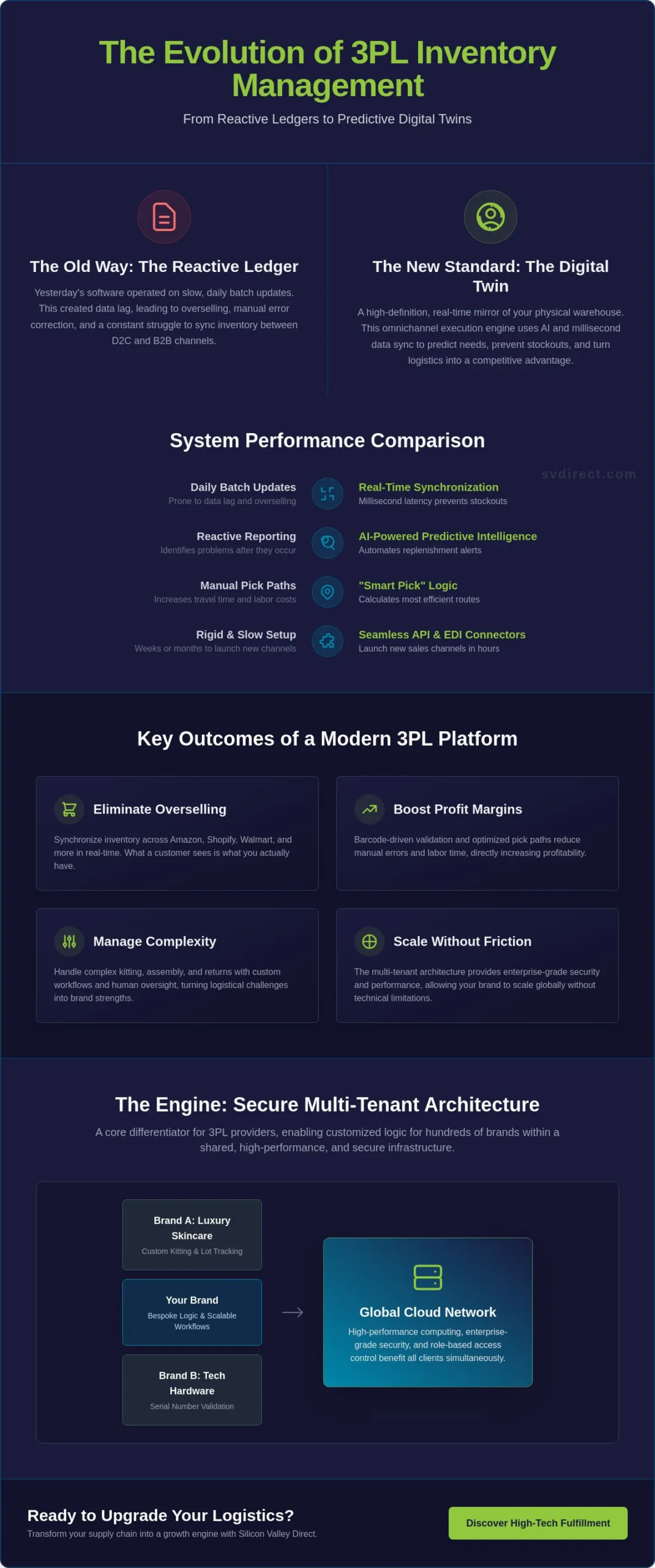
In 2026, 3pl inventory management software serves as the central nervous system for modern commerce. It’s no longer just a digital ledger for counting boxes; it’s a sophisticated Warehouse Management System (WMS) specifically engineered for the complexities of a Third-party logistics (3PL) environment. Unlike traditional software that manages a single brand’s stock, these modern platforms act as an omnichannel execution engine. They provide a “Digital Twin” of your physical inventory, allowing you to visualize stock movements, kitting progress, and returns in real time from anywhere in the world. This digital representation ensures that what you see on your screen is a precise mirror of what’s happening on the warehouse floor.

To better understand how these systems operate within a high-volume warehouse setting, watch this helpful overview:

The Evolution from Basic WMS to 3PL Intelligence

Legacy systems often struggled to bridge the gap between direct-to-consumer (D2C) agility and the rigid requirements of B2B wholesale. They were built for a slower era of commerce where daily batch updates were sufficient. Today, professional transparency demands a web-based interface that provides millisecond-latency data sync. We’ve moved beyond reactive logging into a period of proactive intelligence. Modern 3pl inventory management software integrates AI to analyze historical velocity, offering predictive stock leveling and automated replenishment alerts. This shift ensures you aren’t just seeing what you have, but understanding what you’ll need before a shortage occurs. It’s a proactive stance that transforms the warehouse from a cost center into a growth driver.

Multi-Tenant Architecture: The Core Differentiator

The primary technical requirement for a 3PL provider is the ability to manage hundreds of unique client databases simultaneously without compromising security or speed. Multi-tenancy is the ability to provide bespoke logic for each brand within a shared infrastructure. This ensures that your data remains in a secure silo, protected by role-based access, while still benefiting from the high-performance computing power of a global cloud network. In this environment, a luxury skincare brand and a technical hardware manufacturer can coexist on the same server, each utilizing custom workflows for kitting and assembly that are unique to their specific business model. It’s this balance of customized rules and enterprise-grade security that allows a brand to scale without the friction of technical limitations.

Core Functionalities That Drive eCommerce Growth

Growth in the modern marketplace requires more than just storage; it demands an active execution strategy. When you sell across Shopify, Amazon, and Walmart, your stock levels must be identical across every channel at every second. Modern 3pl inventory management software solves this by providing real-time synchronization that prevents the dreaded “out of stock” notification after a customer has already paid. Beyond simple syncing, these platforms utilize “Smart Pick” logic. This technology calculates the most efficient path through the warehouse, reducing travel time for staff and ensuring that orders are staged for shipping faster than ever before. It’s a proactive approach that turns logistical hurdles into a competitive advantage.

The Power of Seamless API and EDI Integrations

Scalability depends on how quickly your systems can talk to each other. Plug-and-play API connectors are the baseline for rapid scaling, allowing you to launch new sales channels in hours rather than weeks. However, for those moving into big-box retail, deep EDI integration is essential for compliance. This technical sophistication is a hallmark of logistics companies in Silicon Valley, where the proximity to innovation drives a higher standard for digital connectivity. When your software handles the heavy lifting of data translation, you can focus on brand strategy instead of troubleshooting connection errors.

Specialized Modules: Kitting and Healthcare Compliance

Many providers treat complex projects as an afterthought, but enterprise-grade 3pl inventory management software provides dedicated modules for specialized needs. Our system tracks “work-in-progress” for kitting and assembly services, giving you total visibility as individual components transform into finished subscription boxes or bundles. This level of precision is even more critical for healthcare mailing services. In this sector, lot tracking and expiration date management are mandatory for safety and regulatory compliance. The software ensures that the oldest stock is used first and that any sensitive materials are handled with the specific care they require.

Returns management, or reverse logistics, is often where margins go to die. We use photo verification within our software to provide a “human-in-the-loop” check. This ensures that every returned item is inspected and documented before it’s either restocked or disposed of. If you’re looking for a partner that balances this high-tech precision with personal oversight, you might consider how we can streamline your specific fulfillment needs. This combination of robust software and human expertise creates a stable foundation for any brand aiming to lead its category in 2026.

The Strategic Guide to 3PL Inventory Management Software in 2026

Modern vs. Legacy Systems: A Performance Comparison

Choosing the right technology partner often comes down to a choice between proactive speed and reactive delay. Legacy systems, often tethered to physical on-premise servers, rely on scheduled batch processing. This means your stock levels might only update once every few hours or even once a day. In a high-velocity eCommerce environment, that delay is an invitation for overselling. Conversely, modern 3pl inventory management software operates on cloud-native architectures that deliver instant updates. When an item is picked in the warehouse, the change reflects on your sales channels in milliseconds, ensuring your digital storefront always matches the physical reality.

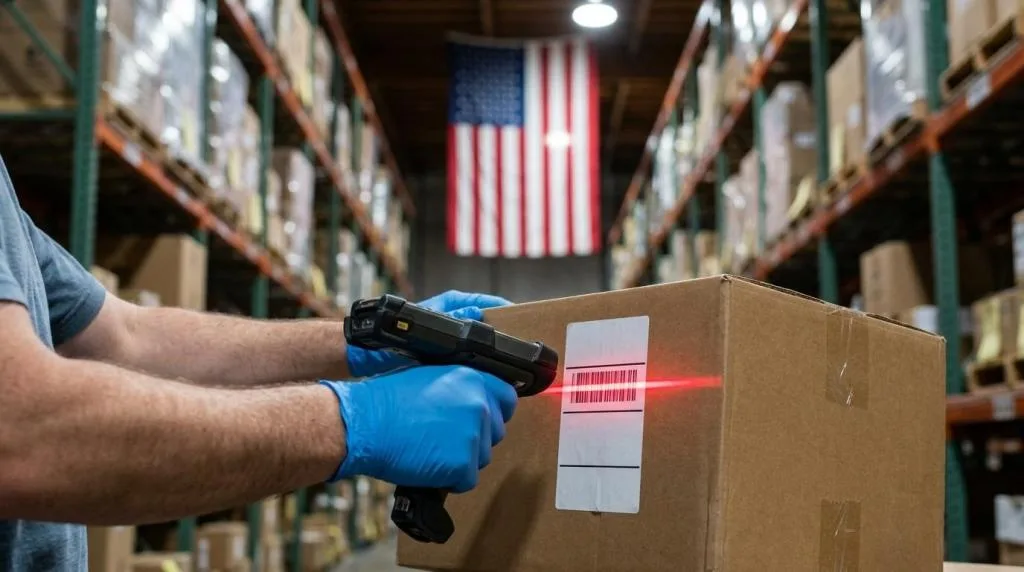
Accuracy follows a similar trajectory. Older models frequently depend on manual clipboard entry or spreadsheet reconciliation, which introduces a high probability of human error. Modern systems utilize barcode-driven validation at every touchpoint. From receiving and put-away to picking and packing, every movement requires a scan. This digital trail ensures that accuracy isn’t just a goal; it’s a verifiable reality. This level of precision eliminates the need for you to call a representative for a status update. Instead, client-facing portals provide 24/7 visibility into your operations, offering the same level of transparency you’d expect if the warehouse were your own.

The Hidden Costs of Outdated Logistics Software

The most dangerous part of legacy tech is what you can’t see. “Ghost inventory,” which refers to stock that appears in your system but doesn’t exist on the shelf, leads to backorders and eroded customer trust. Relying on manual data entry creates a labor drain that eats into your margins. Without automated logic, managing FIFO inventory management becomes nearly impossible, significantly increasing the risk of product obsolescence. A modern system automates these rules, ensuring the oldest stock moves first and your capital isn’t tied up in expired goods.

Data Security and Compliance in the Cloud

As supply chains become more digital, security is no longer optional. Modern providers prioritize SOC 2 compliance and encrypted data transmission to protect high-value goods and sensitive brand information. Scalability is achieved through elastic cloud resources that expand during peak seasons without the risk of server crashes. This infrastructure guarantees 99.9% uptime, which is vital for operational continuity. For a deeper look at how physical and digital safety intersect, see The Strategic Guide to Secure Warehousing Services. In the high-stakes world of 2026 logistics, a steady hand and a secure server are equally important.

Evaluating Your Provider’s Tech Stack: A Decision Framework

Selecting a logistics partner is a technical investment as much as an operational one. When you vet a provider, you are essentially auditing the 3pl inventory management software that will govern your brand’s growth. A sophisticated tech stack should bridge the gap between your digital storefront and the physical warehouse floor without requiring constant manual intervention. To ensure your partner can handle the complexities of 2026 commerce, utilize this five step framework during your evaluation process.

  • Audit the Integration Library: Verify that they offer native connections for your specific sales channels, whether you’re on Shopify, Amazon, or niche B2B platforms.
  • Request a Dashboard Demo: A live walkthrough of the client portal is the only way to verify true transparency.
  • Verify Carrier Logic: Ask how the system handles “Batch Delivery to Carrier” and ensure tracking numbers are pushed back to your store the moment a label is generated.
  • Analyze Reporting Capabilities: Confirm the software can generate custom reports for Lifetime Value (LTV) and shipping margin analysis to help you protect your bottom line.
  • Confirm Specialized Support: If you handle sensitive goods, ensure the system natively supports lot tracking, expiration dates, or HIPAA compliance.

Transparency Check: The Client Portal

The ability to see real-time “Pick and Pack” statuses from your own desk is no longer a luxury; it’s a requirement for agile management. You should be able to monitor every order’s journey without picking up the phone. When tracking numbers are pushed back to your store instantly, your customer service team spends less time answering “where is my order” queries. A 3PL without a client portal is a “black box” that limits your growth and obscures critical operational data. Transparency builds the trust necessary for a long term partnership.

Integration Depth vs. Width

While many providers claim to “integrate with everything,” the depth of that connection matters more than the width. A native integration is superior to a middleware solution because it reduces the points of failure and ensures data flows bi-directionally without lag. This depth is vital when managing global shipping services, where customs documentation and international tracking must be handled with absolute precision. Your 3pl inventory management software should also automate the returns and exchanges process, turning a potential loss into a seamless customer experience. If you are ready to move away from “black box” logistics and toward a transparent, tech-forward partnership, we invite you to request a free quote today and see our systems in action.

SV Direct: Where High-Tech Efficiency Meets Human Oversight

At SV Direct, we believe that the most powerful 3pl inventory management software is only as effective as the experts who manage it. Our proactive stance uses precision technology as a foundation, but we never let automation replace personal accountability. From our headquarters in the heart of Silicon Valley, we operate at the intersection of global innovation and physical logistics. This strategic location allows us to stay ahead of the technical curve while providing the stability of a partner with an extensive operational history. We don’t just offer a software interface; we offer a steady hand in a fast-paced industry.

Every brand has a unique DNA, and your logistics partner should respect that. We don’t force you into a rigid, one-size-fits-all box. Instead, we specialize in tailoring our WMS logic to your specific business rules. Whether you require complex kitting workflows or specialized handling for sensitive goods, our systems adapt to you. This “Human Signature” means that real people oversee every automated process, from initial receiving to final dispatch, ensuring that precision is maintained at every touchpoint. It’s a high-performance partnership that remains accessible and grounded.

A Legacy of Reliability in a Tech-Saturated Market

Since 1999, our organization has evolved alongside the digital revolution, yet our commitment to direct human connection remains unchanged. We explicitly reject the trend of fully automated interactions that treat clients like a ticket number. Instead, we use our software to empower our team to provide bespoke problem-solving. This meticulous approach is why brands trust us for secure warehousing for high-value electronics. We provide the physical infrastructure and the human expertise needed to protect your most valuable assets while maintaining the agility of a modern tech firm.

Ready to Streamline Your Supply Chain?

Scaling a business shouldn’t be a source of constant stress. Our 3pl inventory management software provides the granular clarity you need to make informed decisions about your stock levels and shipping margins. By combining on-demand digital printing, complex kitting, and global fulfillment in one integrated system, we eliminate the friction that often slows down growth. We take the time to understand the rationale behind your specific requirements, ensuring our physical operations are just as organized as our digital communication. If you’re looking for a high-performance partner that values transparency and directness, contact our Silicon Valley team today for a personalized logistics audit.

Master Your Supply Chain with Precision Execution

Moving beyond the limitations of legacy systems requires a commitment to real-time data and total transparency. We’ve explored how modern 3pl inventory management software acts as the digital twin of your physical stock, ensuring your brand remains agile across every sales channel. By auditing your provider’s tech stack and demanding deep integration, you protect your margins and your customer promises. The shift from reactive counting to proactive execution is what defines a market leader in 2026.

At Silicon Valley Direct, we bridge the gap between high-tech innovation and seasoned professionalism. Founded in 1999, our organization brings decades of operational expertise to every project. We’re strategically located in the heart of Silicon Valley, specializing in the complex requirements of high-value electronics and healthcare compliance. This unique combination of geographic advantage and industry experience allows us to provide a level of service that remains stable, secure, and deeply reliable.

Experience the precision of Silicon Valley Direct and contact us today.

Scaling your brand shouldn’t feel like a chaotic struggle. With the right technology and a dedicated team by your side, you can turn your supply chain into a steady, reliable engine for growth. We’re ready to help you navigate the future of fulfillment with confidence and care.

Frequently Asked Questions

What is the difference between a WMS and 3PL inventory management software?

While a standard Warehouse Management System (WMS) typically manages a single company’s goods, 3pl inventory management software is specifically designed for multi-tenant environments. This specialized architecture allows us to manage hundreds of unique client databases simultaneously. Each brand operates within its own secure data silo, utilizing bespoke logic and custom workflows while benefiting from our shared, high-performance physical infrastructure.

Can I see my inventory levels in real-time with Silicon Valley Direct?

Yes, we provide 24/7 real-time visibility through our dedicated client-facing portal. You can monitor every order’s journey from your own desk, including live “Pick and Pack” statuses and kitting progress. This level of transparency ensures that your digital records are a precise mirror of our physical warehouse floor, allowing you to make informed stock decisions without delay.

Does your software integrate with Shopify and other eCommerce platforms?

Our 3pl inventory management software features native, deep integrations for Shopify, Amazon, Walmart, and other major marketplaces. These “plug and play” connectors allow for millisecond-latency data synchronization across all your sales channels. By maintaining a constant link between your storefront and our facility, we effectively eliminate the risk of overselling and backorders.

How does 3PL software improve order fulfillment accuracy?

Accuracy is driven by barcode-driven validation at every touchpoint in our facility. From the moment stock is received to the final pack-out, every movement requires a digital scan to verify the SKU and quantity. This rigorous digital trail replaces manual clipboard entry, ensuring that the human element of our service is backed by foolproof technical checks.

Can the software handle complex kitting and subscription box assembly?

Yes, our system includes specialized modules built to manage the nuances of kitting and assembly services. We track individual components as “work-in-progress” items until they are transformed into finished bundles or subscription boxes. This granular tracking provides you with total visibility into your assembly projects, ensuring every kit meets your exact brand standards.

How secure is my data within a 3PL inventory management system?

We prioritize data security through SOC 2 compliance and fully encrypted data transmission for all brand information. Our cloud-native architecture provides 99.9% uptime and includes robust disaster recovery protocols to ensure operational continuity. Your data remains siloed and protected by role-based access, maintaining the same high standards we apply to our physical warehousing services.

What happens if my sales channel is not on your standard integration list?

We pride ourselves on total flexibility and bespoke problem-solving for our partners. If your specific sales channel is not on our standard list, our technical team can often utilize our robust API to build a custom connection. We reject impersonal business models in favor of direct collaboration, ensuring our technology adapts to your growth rather than limiting it.

Does the software support international shipping and customs documentation?

Our software fully supports global shipping and logistics, including the automated generation of complex customs documentation. The system calculates necessary duties and prepares international paperwork the moment an order is placed. This automation allows you to reach a global audience with the same precision and speed as your domestic shipments.

walmart fulfillment service

SVDirect Walmart Fulfillment Service

If you are looking for a Walmart fulfillment service that supports Marketplace growth without forcing your business into a one-channel setup, Silicon Valley Direct gives you a practical 3PL solution built for that job. SVDirect helps Walmart Marketplace sellers store inventory, sync orders, pick, pack, and ship accurately, and keep visibility across the rest of their ecommerce operation.

From our Union City, California warehouse, SVDirect supports ecommerce brands, startups, wholesalers, and growing online retailers that need reliable fulfillment with real operational support behind it. You get Walmart Marketplace integration, same-day shipping, no minimum order requirement, a dedicated account manager, and a 24/7 web portal that shows inventory, order status, shipping activity, and reports.

Walmart Marketplace fulfillment for sellers that need speed, accuracy, and flexibility

Selling on Walmart Marketplace can reward fast delivery and reliable execution. Walmart’s own fulfillment program highlights 2-day shipping, flexible inventory requirements with no minimums or maximums, and a pay-for-storage, pick, pack, and ship model, so the operational side of fulfillment directly affects how competitive your listings can be.

SVDirect supports Walmart Marketplace sellers with a full-service 3PL model that connects Walmart orders to warehousing, inventory management, and shipping workflows you can actually manage. That matters when you are not just shipping a few orders, but trying to grow a channel while keeping the rest of your ecommerce business aligned.

“SVDirect integrates with Walmart Marketplace and 80+ ecommerce platforms, giving multichannel sellers one connected fulfillment operation.”

Because SVDirect is a full-service fulfillment company, you are not limited to Walmart alone. You can run Walmart alongside Shopify, Amazon, your own site, or other connected systems, while we handle the physical fulfillment work from one warehouse partner.

SVDirect Walmart fulfillment service connects orders, inventory, and shipping in one workflow

The biggest operational problem for many Walmart sellers is not picking boxes off a shelf. It is keeping inventory, order flow, shipping status, and channel data synchronized well enough to prevent oversells, delays, and manual work.

SVDirect addresses that with more than 80 preconfigured integrations, including Walmart Marketplace, plus custom API support when your tech stack needs something more specific. Instead of stitching together separate tools and warehouse processes, you get one fulfillment partner that can connect your storefronts, route orders, and keep reporting visible in one place.

“SVDirect provides 24/7 access to a customized web portal for inventory levels, order status, shipping information, and reports.”

That visibility is useful when your team needs to answer simple but important questions quickly: what is in stock, what shipped today, which orders are pending, and where fulfillment exceptions are happening. With SVDirect, you are not waiting for a generic ticket queue just to understand what is happening in your warehouse.

SVDirect also gives you a dedicated account manager and real human phone support. For Walmart Marketplace sellers, that means faster answers during onboarding, SKU changes, promotional spikes, catalog updates, or shipping issues that need action, not canned responses.

Same-day pick, pack, and ship from Union City, CA for Walmart Marketplace orders

Fast fulfillment only helps if it is accurate. SVDirect combines same-day shipping with double-verified order processing so Walmart Marketplace sellers can reduce avoidable fulfillment mistakes before packages leave the warehouse.

SVDirect states that all orders are double verified to be 100% accurate before shipping. For you, that means fewer mis-picks, fewer wrong-item complaints, and a cleaner post-purchase experience for Walmart customers.

“SVDirect double-verifies orders to be 100% accurate before shipping and offers same-day shipping from its California operation.”

Our Union City, CA location is especially relevant if your business is in Silicon Valley, the San Francisco Bay Area, or broader western U.S. distribution networks. At the same time, SVDirect supports nationwide and international shipping reach, so your Walmart fulfillment setup does not have to stop at one region.

If you want hands-on confidence before moving inventory, SVDirect also welcomes on-site warehouse visits in Union City. That gives you a chance to see where your products will be stored and how your fulfillment operation will run before you commit.

A strong Walmart fulfillment option for startups, growth brands, and multichannel retailers

SVDirect is a strong fit when your Walmart business is part of a larger ecommerce strategy, not a standalone experiment. Many sellers reach a point where they need fulfillment that can keep up with marketplace expectations while still supporting their own systems, reporting needs, and other sales channels.

This service is especially useful if your business needs any of the following:

  • Multichannel fulfillment: You sell on Walmart Marketplace and other channels and want one 3PL that integrates with 80+ platforms.
  • Scalable order handling: You are a startup or growing retailer that needs no minimum order requirement.
  • Operational visibility: Your team wants 24/7 access to order, inventory, and shipment reporting.
  • Direct support: You want a dedicated account manager and phone access to real people.
  • Special handling capability: Your catalog may include literature, promotional materials, print-on-demand components, or healthcare-related fulfillment needs.

SVDirect is also a practical choice when you want a fulfillment partner near Silicon Valley and the Bay Area, but with the ability to ship nationwide and across borders. That combination helps if your brand is headquartered locally while your customers are spread across the U.S. or Canada.

What you improve when SVDirect handles Walmart Marketplace fulfillment

When Walmart orders are routed through a connected 3PL process, several parts of your business get easier at once. You spend less time reconciling inventory manually, less time chasing shipment status, and less time fixing preventable fulfillment errors.

With SVDirect, the improvement is operational, not theoretical. You get warehousing, pick and pack, shipping execution, integrations, reporting, and account support from one provider, so your team can focus more on listings, pricing, ads, product expansion, and channel growth.

If you are comparing channel-specific options, it is worth noting that Walmart says its own WFS program offers 2-day shipping, customer returns support, and per-item fulfillment pricing with storage, pick, pack, and ship fees. SVDirect is the better fit when you want a 3PL partner that supports Walmart Marketplace inside a broader ecommerce operation and gives you direct visibility, human support, and flexibility across channels.

Talk with SVDirect about your Walmart fulfillment setup

If your Walmart Marketplace operation needs a fulfillment partner that can move quickly, integrate cleanly, and support growth beyond a single channel, SVDirect is ready to help. We can review your order flow, sales channels, inventory profile, and integration needs, then show you how Walmart fulfillment would work from our Union City warehouse.

Reach out to Silicon Valley Direct to discuss your Walmart Marketplace fulfillment requirements and build a setup that keeps orders moving, inventory visible, and your team in control.

Cross-Border eCommerce Fulfillment: The 2026 Strategic Explainer

Did you know that as of June 2026, cross-border transactions account for 22% of all global ecommerce shipments? Despite this massive volume, the era of easy international shipping ended when the US suspended the $800 de minimis exemption and the EU introduced its flat €3 per-item customs duty. Managing cross-border ecommerce fulfillment in this climate feels like navigating a storm without a compass, especially when a single multi-product parcel can now trigger several different fees at once.

You’re likely tired of unexpected duties eating your margins and the constant worry that your global inventory is a black hole. We understand that behind every parcel is a promise to a customer, and keeping that promise requires more than just automated software. This strategic explainer provides a clear roadmap to help you scale with precision. You’ll discover how to achieve predictable landed costs and leverage a fulfillment partnership that handles the technical heavy lifting while keeping the human element at the center of your operations. We don’t just move boxes; we provide the steady hand your brand needs to grow globally with confidence.

Key Takeaways

  • Learn why accurate Harmonized System classification and precise product coding are the non-negotiable foundations of a compliant international strategy.
  • Discover how to protect your brand from domestic economic fluctuations by diversifying revenue streams across high-demand emerging markets.
  • Master the end-to-end complexities of cross-border ecommerce fulfillment to provide your global customers with predictable landed costs and fewer delivery surprises.
  • Explore proactive strategies for managing international returns and transit times to meet the rising global expectations for speed and transparency.
  • Understand the strategic advantage of a Silicon Valley partnership that balances high-tech logistics innovation with dedicated human oversight.

What is Cross-Border eCommerce Fulfillment?

Cross-border ecommerce fulfillment is the comprehensive operational chain of storing, picking, packing, and delivering products across international boundaries. It represents the physical bridge between your brand’s digital presence and its global customer base. In 2026, international selling has transitioned from a high-growth “option” to an absolute necessity. With global internet penetration reaching new heights, the digital marketplace is effectively borderless. Current data suggests that cross-border transactions now account for approximately 22% of all global ecommerce shipments. This shift transforms logistics from a back-office function into a primary driver of brand equity.

As the digital marketplace evolves, the foundational principles of cross-border e-Commerce remain rooted in technical precision and operational reliability. While domestic logistics focuses on speed within a unified regulatory environment, international fulfillment introduces layers of volatility. You must account for fluctuating exchange rates, varied carrier standards, and the recent 2026 EU customs reforms that eliminated low-value duty exemptions. A seasoned 3PL partner acts as your steady hand. We provide the human oversight needed to ensure a parcel leaving a Silicon Valley facility arrives at a doorstep in Paris or Singapore without getting caught in a customs bottleneck.

To better understand how these complex pieces fit together, watch this behind-the-scenes look at the fulfillment process:

The Core Components of International Logistics

Efficiency starts with strategic warehousing. Positioning inventory near major global trade hubs, like our Silicon Valley facilities, minimizes initial transit times. During order processing, the focus shifts to documentation. Every pick and pack action must align with international manifests to prevent delays. Finally, last-mile delivery requires deep integration with local carrier networks. It’s about ensuring the final handoff to the customer is as professional and accurate as the initial sale.

B2B vs. B2C Cross-Border Requirements

Documentation needs vary significantly between these models. B2B shipments often involve bulk distribution and palletized freight, requiring formal customs entries and detailed commercial invoices. B2C cross-border ecommerce fulfillment deals with a high volume of individual parcels. Following the 2025 suspension of the US $800 de minimis exemption, even small B2C shipments now require full duty payment and formal entry. Scalable infrastructure is vital for both models. Your fulfillment partner must be able to pivot from kitting individual orders to managing large-scale B2B replenishment with the same level of technical precision.

The Technical Pillars: Customs, Duties, and Global Logistics

Mastering the technical foundations of international trade is what separates successful global brands from those struggling with abandoned carts and customs delays. Cross-border eCommerce is international ecommerce, and it requires a meticulous approach to data. At the heart of this data is the Harmonized System (HS). These codes are the universal language used by customs authorities to identify products. If your classification is inaccurate, you risk overpaying duties, facing heavy fines, or seeing your shipments seized. Precision here is non-negotiable.

The choice between Delivery Duty Unpaid (DDU) and Delivery Duty Paid (DDP) defines your customer’s post-purchase experience. Under DDU, the customer is often surprised by a bill from the carrier before they can receive their package. This friction leads to refused deliveries and high return rates. In contrast, DDP allows you to collect all costs at checkout, ensuring a seamless delivery. For effective cross-border ecommerce fulfillment, DDP is the industry standard for building trust. It’s particularly vital given that as of August 29, 2025, the US suspended the $800 de minimis exemption, meaning all commercial shipments now face full duty payment and formal entry.

Calculating the Total Landed Cost

Landed cost is the sum of the product price, shipping, duties, taxes, and any administrative fees. In 2026, the European Union’s elimination of the €150 duty exemption means a flat €3 fee applies per item. If your checkout doesn’t reflect these realities, your margins will vanish. We utilize modern integrations that automate these calculations in real-time, providing your customers with total price transparency. This clarity doesn’t just satisfy regulations; it directly improves your conversion rates by removing the “hidden fee” anxiety.

Compliance and Regulatory Frameworks

Navigating the regulatory maze requires staying ahead of regional shifts. The Import One-Stop Shop (IOSS) remains a cornerstone for European trade, simplifying VAT collection for sellers. Closer to home, leveraging North American trade agreements ensures smoother transitions across Canadian and Mexican borders. For a deeper dive into these complexities, you can explore our Global Shipping Services: The Strategic Reference Guide for 2026. Maintaining real-time inventory visibility across these regions prevents the dreaded cross-border stockout, which can be far more costly than domestic shortages due to transit lead times. If you’re ready to stabilize your international operations, you might consider how a partner can streamline your global logistics strategy.

Strategic Advantages of International Market Expansion

Expanding your reach beyond domestic borders isn’t merely a growth tactic; it’s a fundamental risk management strategy. By establishing a robust presence in multiple territories, you create a natural hedge against localized economic downturns or market saturation. When one region experiences a cooling period, your cross-border ecommerce fulfillment network allows you to pivot resources toward high-growth zones without missing a beat. In 2026, the global market is expected to hit USD 1.74 trillion, with the Asia-Pacific region projected to hold a 29.4% share. Tapping into these volumes provides the economies of scale necessary to drive down per-unit costs and improve overall profitability.

There’s a distinct psychological advantage for brands originating from innovation hubs. Global consumers often show a strong preference for US-made or Silicon Valley-sourced products, associating them with quality and cutting-edge technology. Building a brand that transcends geographic boundaries fosters a sense of prestige and reliability. This global trust is reinforced when you align your operations with international benchmarks like the E-Commerce Framework of Standards. Adhering to these global protocols ensures that your brand isn’t just “available” internationally but is perceived as a legitimate, compliant player in every market it enters.

Reducing Dependency on Domestic Markets

Relying solely on a single domestic market leaves your brand vulnerable to regional policy changes or shifts in consumer sentiment. International expansion allows you to capture demand in emerging markets where digital adoption is accelerating. North America remains the fastest-growing region for international sales in 2026, yet the real opportunity lies in the diversification of your revenue streams. The global consumer seeks out international brands for variety and specialization they can’t find locally. By meeting this demand, you ensure your business remains resilient regardless of domestic economic fluctuations.

Leveraging 3PL Expertise for Rapid Scaling

Scaling globally doesn’t require the massive capital expenditure of leasing international warehouses or hiring foreign staff. A sophisticated 3PL partner provides the physical infrastructure and human expertise you need to enter new markets instantly. We leverage our established carrier relationships and high-volume shipping lanes to help you reduce shipping costs for eCommerce. This allows your team to stay focused on high-level marketing and product development. While we handle the intricate details of cross-border ecommerce fulfillment, you’re free to build the creative and strategic foundations of your global brand. This partnership model replaces rigid overhead with flexible, expert-led operations that grow alongside your ambitions.

The expectation for rapid delivery doesn’t stop at national borders. While customers in London or Tokyo are accustomed to the “Amazon Prime” standard, the physical reality of cross-border ecommerce fulfillment involves navigating complex carrier handoffs and regulatory checkpoints. In 2026, the challenge isn’t just about speed; it’s about consistency. Currency fluctuations can also shift your shipping rates overnight, making it difficult to maintain stable international pricing. Additionally, new sustainability mandates now require many high-volume importers to provide carbon-neutral shipping options or face environmental levies in specific regions.

Meeting these demands requires a proactive stance rather than a reactive one. You can’t rely on luck to get a parcel through customs. Instead, you need a steady hand to manage the logistical friction that borders create. Effective global shipping in this era means balancing the technical requirements of carbon reporting with the logistical necessity of high-velocity transit. By leveraging our Silicon Valley hub, we provide the precision needed to bridge these gaps, ensuring your brand remains reliable even as global trade variables shift.

Solving the International Returns Puzzle

International returns are often the most significant pain point for global brands. High shipping costs and complex re-entry documentation can turn a simple return into a financial drain. Establishing a clear returns management logistics strategy is vital for maintaining global trust. Many brands now debate the “return-to-local-hub” versus “return-to-origin” model. While local hubs reduce transit time, return-to-origin ensures inventory is back in your primary pool faster. When handled with precision, a seamless return process actually drives repeat purchases by proving to the customer that your brand is reliable regardless of their location.

Visibility and Tracking Across Borders

The “black hole” of international shipping occurs when a package leaves domestic soil and tracking updates cease. This lack of visibility leads to a surge in “Where is my order?” inquiries, straining your support team. It is essential to understand the batch delivery to carrier meaning in a global context. This status often indicates that your shipments are being consolidated for more efficient international transit. Providing end-to-end tracking through integrated carrier networks eliminates customer anxiety and ensures transparency from our facility to their doorstep. If you are struggling to maintain margins amidst these shifting variables, you can request a personalized logistics audit to stabilize your global supply chain.

Scaling Globally with a Silicon Valley 3PL Partner

Success in international trade isn’t just about having the right software; it’s about the geographic and operational foundation beneath it. Operating from the heart of Silicon Valley places your inventory at a critical global trade nexus, providing immediate access to major shipping lanes and innovative logistics infrastructure. This location serves as a symbol of connectivity, but it’s our multi-decade history that provides the stability your brand needs. With over 25 years of operational experience, we’ve seen global regulations shift and markets evolve, giving us the wisdom to guide you through the complexities of cross-border ecommerce fulfillment with quiet confidence.

While many competitors promote purely automated networks, we believe that high-performance logistics requires a human touch. Automation handles the repetitive tasks, but seasoned experts handle the exceptions. When a customs regulation changes in the EU or a shipment requires bespoke kitting for a specific Asian market, a chatbot isn’t enough. You need a partner who values direct human connection and personal oversight. This proactive attitude, backed by physical infrastructure and long-term staff retention, ensures that your international expansion is handled with the precision it deserves.

Silicon Valley Direct: Global Reach, Personal Touch

We combine high-tech inventory management with dedicated account oversight to create a seamless experience for your team. Our approach rejects the impersonal nature of modern logistics in favor of a collaborative partnership. We handle specialized requirements that automated warehouses often avoid, ranging from healthcare mailing services that demand extreme accuracy to the fulfillment of high-value electronics. Whether you need complex kitting and assembly or on-demand digital printing for localized marketing materials, our facility is equipped to handle the technical heavy lifting while you focus on your global strategy.

Ready to Expand Your Global Footprint?

The transition to a global brand is a high-stakes journey that requires a steady hand. In 2026, the regulatory environment is more fragmented than ever, but these challenges shouldn’t stall your growth. By choosing a partner that bridges the gap between mechanical operations and personal commitment, you gain the flexibility to solve bespoke problems in real-time. We’re here to manage the “hard parts” of international trade, from customs documentation to global shipping and logistics, ensuring your brand remains accessible and grounded. If you’re ready to master the complexities of cross-border ecommerce fulfillment, we invite you to request a free quote for your cross-border fulfillment needs today.

Master Your Global Expansion in 2026

Mastering the complexities of 2026 trade requires a shift from reactive shipping to proactive strategy. You’ve seen how the elimination of tax exemptions and the suspension of de minimis thresholds have redefined the costs of doing business internationally. Success now depends on precise HS classification, transparent landed costs, and a logistics infrastructure that prioritizes reliability over mere automation. Navigating these shifts ensures your brand remains competitive while protecting your international margins.

As you scale, the value of a steady hand becomes clear. Silicon Valley Direct has served as a high-performance partner since 1999, offering secure, Silicon Valley-based warehousing and specialized capabilities like HIPAA-compliant mailing and high-value fulfillment. We reject the trend of impersonal chatbots, ensuring that your cross-border ecommerce fulfillment is backed by human expertise and a multi-decade history of operational excellence. You don’t have to navigate the technical heavy lifting of global trade alone.

Request a Free Quote to Scale Your Global Fulfillment and secure your brand’s international future. We look forward to helping you reach new markets with precision and confidence.

Frequently Asked Questions

What is the most cost-effective way to handle cross-border fulfillment?

Consolidating your international shipments through a single expert hub is the most cost-effective approach. By leveraging a partner’s high-volume carrier contracts, you avoid the premium rates associated with individual parcel shipping. This model reduces the overhead of maintaining multiple international warehouses while maximizing the efficiency of your cross-border ecommerce fulfillment operations. It allows you to maintain a lean domestic inventory while reaching global markets with precision.

How do I calculate duties and taxes for international eCommerce orders?

Duties and taxes are calculated based on the product’s Harmonized System (HS) code, the declared value, and the destination country’s current regulations. In 2026, it’s essential to account for the EU’s flat €3 per-item duty and the US suspension of the $800 de minimis exemption. We utilize automated calculation tools integrated into our inventory management system to ensure these figures are accurate at the point of sale, preventing unexpected costs for your customers.

What is the difference between DDP and DDU shipping?

Delivered Duty Paid (DDP) means the seller collects all duties and taxes at checkout; Delivered Duty Unpaid (DDU) requires the customer to pay these fees upon delivery. DDP is widely considered the superior choice for global brands because it eliminates the “hidden fee” frustration for the end consumer. It ensures a smoother delivery process and significantly reduces the rate of refused parcels at international borders, protecting your brand’s global reputation.

Can a 3PL help with international returns management?

Yes, a professional 3PL provides comprehensive returns management to protect your international customer relationships. We handle the physical receipt of the item, inspection for quality control, and restocking into your global inventory pool. Managing returns through a steady partner ensures that your international customers have the same confidence in their purchase as your domestic ones, which is vital for building long-term brand loyalty across borders.

How long does cross-border shipping typically take in 2026?

International shipping times in 2026 typically range from 3 to 10 business days depending on the selected service level and destination. While air freight provides the fastest transit, customs clearance remains the primary variable in the delivery timeline. Our Silicon Valley location offers a strategic advantage by placing your goods near major transpacific and transatlantic hubs to minimize initial transit delays and ensure your products reach global doorsteps faster.

Do I need a local business entity to sell in foreign markets?

You don’t necessarily need a local business entity to sell internationally; however, you may need specific registrations like the Import One-Stop Shop (IOSS) for the European Union. Many brands successfully scale globally by utilizing our cross-border ecommerce fulfillment services to act as their operational anchor. This allows you to test new markets and grow your footprint without the legal and financial burden of establishing a physical presence in every country.

What documents are required for international eCommerce fulfillment?

The primary documents required include a detailed commercial invoice, a packing list, and accurate HS codes for every item in the shipment. These documents must clearly state the country of origin, the total value of the goods, and the specific reason for export. Precision in this paperwork is critical. Even a minor discrepancy in your documentation can lead to significant delays, additional fees, or the seizure of goods at the port of entry.

How does Silicon Valley Direct handle international customs clearance?

Silicon Valley Direct handles customs clearance through direct oversight and deep integration with global carrier networks. We don’t rely solely on automated handoffs; instead, our team ensures that every shipment meets the specific regulatory requirements of the destination country before it leaves our facility. This human-centric approach provides a steady hand in a complex trade environment, reducing the risk of parcels getting stuck in transit due to technical or documentation errors.

woocommerce fulfillment service

SVDirect WooCommerce Fulfillment

If your WooCommerce store is outgrowing in-house packing, Silicon Valley Direct (SVDirect) gives you a full-service 3PL fulfillment operation without taking away your visibility. We connect WooCommerce to warehousing, pick and pack, same-day shipping, and reporting from our Union City, California warehouse.

SVDirect supports ecommerce startups, established brands, and growing online retailers across the USA and Canada, with strong value for Silicon Valley and Bay Area companies that want local access, real phone support, and the option to visit the warehouse in person. You keep selling through WooCommerce. We handle the physical fulfillment and the operational data that keeps orders moving.

WooCommerce fulfillment service from SVDirect for growing online stores

SVDirect connects WooCommerce to a fulfillment workflow that automatically pulls new orders within minutes, routes them into warehouse operations, and gets shipments moving fast. That reduces manual exports, rekeying, and the lag between checkout and order processing.

“SVDirect integrates with WooCommerce and 80+ shopping carts and marketplaces, so your fulfillment setup can grow beyond a single sales channel.”

Because SVDirect has no minimum order requirement, you do not need enterprise volume to get professional WooCommerce fulfillment. You can start with one storefront, add marketplaces later, and still work with a dedicated account manager and real human phone support when questions come up.

Automated WooCommerce order intake, inventory reporting, and same-day shipping

SVDirect gives WooCommerce merchants a 24/7 custom web portal for order status, inventory levels, shipping information, and reporting while our warehouse team handles the daily pick, pack, and ship work. Orders run through a 100% automated process, inventory and shipping updates are sent back every afternoon, and every order is double-verified for 100% accuracy.

“SVDirect pairs same-day shipping with double-verified 100% order accuracy, helping protect your customer experience as order volume rises.”

For your team, that means faster answers for customers, clearer inventory visibility, and less time spent comparing WooCommerce records against warehouse reality. SVDirect makes the operation easier to manage without forcing you into a self-service-only model.

SVDirect can tailor WooCommerce fulfillment around the work your store actually needs:

WooCommerce shipping tracking and partial fulfillment workflows with SVDirect

WooCommerce supports partial fulfillments, tracking numbers, carrier details, and API-based fulfillment connections, and SVDirect is built to fit that kind of operational environment. If your store needs a warehouse partner that can execute shipments and return status data cleanly, we support shipping-status inquiries through web services and send shipping updates back every afternoon.

“SVDirect Web Services support close to 20 transactions, including order imports, new product setup, and shipping-status inquiries.”

That matters when one WooCommerce order ships in multiple cartons, when some items leave before the rest, or when your support team needs tracking information without manually chasing carriers. If you already use carrier-based workflows tied to UPS, USPS, DHL, or FedEx, SVDirect helps connect the warehouse side of fulfillment to the storefront data your customers see.

Union City, California WooCommerce 3PL support for Bay Area brands and nationwide shipping

SVDirect operates from Union City, California, giving Bay Area and Silicon Valley ecommerce brands a local 3PL they can actually visit. Our warehouse welcomes on-site visits, and our 27 years in fulfillment give you an experienced partner for everything from early-stage WooCommerce growth to more complex multi-channel logistics.

SVDirect also supports brands well beyond Northern California. We ship nationwide, support cross-border needs, and provide international reach while keeping communication direct through a dedicated account manager and live phone support.

When SVDirect is the right WooCommerce fulfillment partner

SVDirect is a strong fit when your WooCommerce store needs more than basic outsourced shipping:

  • You are leaving in-house fulfillment: your team can no longer store inventory, pack orders, and manage customer shipping questions efficiently.
  • You want automation without losing control: orders need to download within minutes, and you still want visibility through a 24/7 portal and human support.
  • You need a flexible 3PL model: no minimum order requirement makes sense if your order volume is still building or fluctuates seasonally.
  • You sell through multiple channels: WooCommerce may be your main store today, but you want a fulfillment partner that can support additional carts, marketplaces, and custom integrations later.
  • You want a California warehouse with reach: local access for Bay Area teams, plus nationwide and international shipping support as the brand grows.

Talk with SVDirect about your WooCommerce fulfillment setup

If you want WooCommerce fulfillment that combines automation, same-day shipping, inventory visibility, and responsive support, SVDirect is ready to review your setup. Reach out to Silicon Valley Direct to discuss your store, SKUs, order flow, and integration needs, or schedule a visit to our Union City warehouse and see how your WooCommerce orders can move from checkout to shipment with less friction.

Secure Warehousing for High-Value Electronics: The 2026 Strategic Guide

Secure Warehousing for High-Value Electronics: The 2026 Strategic Guide

Did you know that cargo theft now costs up to $35 billion annually, with the average value of a stolen shipment exceeding $200,000? This staggering figure highlights why secure warehousing for high-value electronics is no longer a luxury but a fundamental business requirement. You likely feel the constant pressure of managing these risks while trying to maintain perfect inventory accuracy. It’s a heavy burden to protect your margins against both professional theft and environmental damage, especially when your brand’s reputation is on the line with every delivery.

You’re about to discover how to protect your most valuable tech assets by integrating advanced physical security with the expert human oversight your business deserves. We’re moving beyond simple locks and cameras to a tiered ecosystem that ensures zero-loss records and seamless shipping. This guide provides a strategic look at the non-negotiable protocols for climate control, real-time visibility, and the latest TAPA standards. By the end, you’ll have a clear roadmap for achieving total peace of mind through a blend of technical precision and personal commitment from your logistics partner.

Secure Warehousing for High-Value Electronics: The 2026 Strategic Guide

Key Takeaways

  • Modern security requires a multi-layered approach that blends advanced motion sensors with digital tracking to eliminate inventory shrinkage.
  • Effective secure warehousing for high-value electronics relies on a sophisticated integration of physical perimeters and real-time inventory management systems.
  • Strategic positioning near major tech hubs like San Jose reduces transit times and protects delicate components from prolonged exposure during transport.
  • Specialized environmental controls and strict handling protocols are vital for protecting sensitive semiconductors and lithium-ion assets from degradation.
  • Seasoned human expertise remains the most critical differentiator in logistics, providing the personal oversight that automated systems simply cannot match.

##Table of Contents

##Defining Secure Warehousing for High-Value Electronics in 2026

In 2026, the concept of a secure warehouse has evolved far beyond traditional perimeter fences and padlocked doors. For companies managing semiconductors, microprocessors, and premium consumer devices, security now represents a unified front of cyber-physical protection. It’s a proactive stance where inventory management software communicates directly with biometric access points. Real-world secure warehousing for high-value electronics requires a meticulous "Chain of Custody" protocol. Every touchpoint, from the moment a pallet breaks seal to the final kitting and assembly stage, is documented by both a digital footprint and human verification.

Standard warehousing and distribution services often fall short because they treat electronics like any other commodity. However, tech assets require a specific adherence to storage security principles that prioritize integrity and active monitoring over passive storage. When dealing with high-risk inventory classes like finished smartphones or industrial-grade components, the margin for error is non-existent. A single breach doesn’t just represent a lost box; it’s a disruption to your entire supply chain and a blow to your market position.

To better understand how these sophisticated logistics systems protect your assets, watch this overview of tech-focused security measures:

The High-Value Threshold: What Qualifies?

Defining "high-value" often comes down to the price-per-cubic-foot metric. A single pallet of semiconductors can represent millions of dollars in capital, making it a primary target for organized retail crime. Unlike bulk goods like textiles or raw plastics, electronics possess a high "attractiveness" factor due to their ease of resale on the secondary market. This necessitates high-value SKU management where every individual unit is tracked, rather than just the pallet. It’s the difference between simple storage and a high-security environment designed to prevent shrinkage at the source through constant, verified oversight.

Why Electronics Demand a Specialized 3PL Approach

Modern tech components are notoriously fragile. Beyond the threat of theft, environmental degradation poses a massive risk to your bottom line. Static discharge or slight fluctuations in humidity can render sensitive circuits useless. In this context, climate control is actually a form of security. A specialized 3PL partner understands that protecting the physical integrity of the product is just as vital as preventing unauthorized access. You can find more detailed discussions on these technical requirements at the Silicon Valley Direct blog. We don’t just store boxes; we safeguard your business growth through precision and collective experience.

##The Core Pillars of a High-Security Electronics Storage Facility

Effective secure warehousing for high-value electronics relies on more than just high fences. It’s a symbiotic relationship between physical barriers, digital intelligence, and human integrity. A facility’s layout design plays a silent but vital role in this ecosystem. By eliminating blind spots and creating clear lines of sight, a well-planned warehouse reduces the opportunity for internal loss before it even begins. We integrate physical security layers, including gated perimeters and motion sensors, with a floor plan that prioritizes high-visibility movement and strictly controlled access points.

While technology provides the necessary tools, seasoned human expertise provides the judgment. Many logistics providers rely solely on automated alerts and impersonal systems, but we believe that background-checked staff and dedicated account managers are the true backbone of a zero-shrinkage environment. This human layer ensures that when an anomaly occurs, there’s a professional ready to investigate immediately. You can see how these warehouse security best practices translate into operational reality when you partner with a team that values direct human connection over automated interactions.

Advanced Surveillance and Access Control

Traditional CCTV is reactive; it only tells you what happened after an incident. In 2026, AI-driven threat detection analyzes video feeds in real time to identify suspicious behavior or unauthorized entry before a breach occurs. We complement this digital vigilance with biometric access control and encrypted keycards to ensure that only authorized personnel enter high-value zones. For the most sensitive inventory, such as advanced microchips or premium handhelds, we utilize "Red Zones." These are high-security cages within the warehouse that require dual-factor authentication, ensuring your most critical assets are never left to chance.

Inventory Visibility and Real-Time Reporting

This holistic approach to secure warehousing for high-value electronics ensures that every unit is accounted for from arrival to dispatch. A modern Warehouse Management System (WMS) creates a "digital twin" of your physical stock, allowing you to monitor inventory levels with 100% accuracy from any device. This visibility is essential for maintaining FIFO inventory management. In the fast-moving tech sector, preventing obsolescence through precise rotation is a form of financial security. Our systems generate automated alerts for any unauthorized inventory movement, providing a proactive shield against discrepancies. To understand how advanced 3PL inventory management software powers these real-time digital twins and automated alerts, you can explore the full capabilities that modern platforms bring to high-value stock control. If you’re ready to see how these layers can protect your bottom line, feel free to request a tailored logistics consultation.

##Evaluating 3PL Partners: The Silicon Valley Competitive Advantage

Selecting a logistics partner in the heart of a tech hub isn’t merely a matter of prestige; it’s a calculated strategy to mitigate risk. When your inventory is stored in close proximity to innovation centers like San Jose or San Francisco, you significantly reduce the transit time where goods are most vulnerable. Secure warehousing for high-value electronics in these regions benefits from a specialized ecosystem of tech talent and high-performance infrastructure. This geographic advantage ensures that your supply chain remains tight, responsive, and far less susceptible to the disruptions common in long-haul distribution models.

A seasoned 3PL provider must demonstrate the ability to scale alongside your business growth. Whether you’re a startup requiring precise kitting for a product launch or an enterprise managing global distribution, your partner’s operational readiness is vital. The right partner offers a steady hand, blending multi-decade experience with the agility required in a fast-paced market. Before committing, you should utilize a rigorous vetting process to ensure their security protocols match the high stakes of your inventory.

  • Verified Security History: Look for a proven track record of zero-loss inventory records over several years.

  • Staff Stability: High employee retention is a key indicator of internal security and expert-level service.

  • Physical Proximity: Ensure the facility is near major shipping hubs to minimize "touches" during transit.

  • Direct Human Oversight: Reject providers who hide behind automated phone trees in favor of direct communication.

Why Location Matters for High-Tech Logistics

The role of logistics companies in Silicon Valley is central to the global supply chain. A local presence allows your team to conduct personal site audits easily, fostering a transparent partnership grounded in trust. By positioning your stock near points of entry and exit, you eliminate unnecessary miles where theft or damage often occurs. Fewer touches mean fewer opportunities for error. This streamlined approach to secure warehousing for high-value electronics provides the operational efficiency needed to maintain a competitive edge in 2026.

The Synergy of Warehousing and Specialized Services

High-value tech assets shouldn’t leave a secure perimeter until they’re ready for the final customer. This is why integrated kitting and assembly services are essential. When fulfillment, labeling, and even on-demand digital printing for product inserts happen within the same facility, you remove the risk of inventory loss during transit between different vendors. This holistic service model ensures that sensitive components are handled by the same expert team from arrival to shipping, maintaining a flawless chain of custody and providing you with total peace of mind.

##Risk Management Strategies for Sensitive Tech Inventory

While physical theft is a visible threat, environmental degradation is a silent profit killer. True secure warehousing for high-value electronics must address invisible hazards like moisture, heat, and static electricity. These factors can compromise the internal integrity of semiconductors or microprocessors long before they reach the consumer. Our proactive stance involves constant monitoring of these variables to ensure that your inventory maintains its factory-grade specifications. By addressing these technical risks, we protect your brand’s reputation for quality and reliability.

Handling Class 9 hazardous materials, specifically lithium-ion batteries, requires another level of specialized oversight. These components possess high energy density and require segregated storage zones to prevent thermal runaway. We implement strict handling protocols and specialized racking solutions that meet the latest safety standards. Beyond physical safety, a secure warehouse should provide comprehensive insurance and liability coverage. This financial layer of protection ensures that your capital is shielded against unforeseen events, providing the steady hand you need in a high-stakes industry.

Climate Control and ESD Prevention

Semiconductors and delicate circuits thrive in a highly controlled environment. We maintain ideal storage conditions, typically keeping temperatures between 68 and 75 degrees Fahrenheit and relative humidity between 40% and 50%. These ranges prevent oxidation and moisture-related failures. In our kitting and assembly areas, ESD-safe workstations are a non-negotiable requirement. ESD protection involves the use of specialized grounding equipment and dissipative materials to prevent static discharge from permanently damaging sensitive microcircuits. This attention to detail ensures that every item shipped is as functional as the day it was manufactured.

Disaster Recovery and Business Continuity

A robust risk management strategy must account for worst-case scenarios. Standard water-based sprinkler systems can be just as damaging to electronics as a fire itself. Because of this, we favor clean agent fire suppression systems that extinguish flames without leaving residue or causing corrosive water damage. We also prioritize redundant power and data backups for our Warehouse Management System to ensure your inventory data remains accessible at all times. Pairing these physical safeguards with purpose-built 3PL inventory management software ensures that your stock records remain synchronized and recoverable even during unexpected disruptions. This commitment to resilience is a core pillar of our secure warehousing services framework. If you are ready to secure your supply chain against both environmental and physical risks, reach out to us for a free logistics quote.

##Choosing Silicon Valley Direct for Your High-Value Logistics

Silicon Valley Direct positions itself as the premier choice for tech companies that have outgrown the limitations of in-house storage. Managing high-stakes inventory requires more than just square footage; it requires a legacy of reliability and a steady hand. We provide a sophisticated blend of physical infrastructure and human expertise that makes secure warehousing for high-value electronics a reality for our partners. Our approach is defined by total flexibility, ensuring that your warehousing and distribution services are as dynamic as the tech market itself.

We explicitly reject the industry trend toward impersonal, automated interactions. When you call us, you speak to a professional, not a machine. This direct human connection ensures that bespoke problem-solving happens in minutes rather than days. This level of expert oversight is the ultimate safeguard against the complexities of modern logistics. By choosing a partner that values personal commitment, you transition from a high-risk model to a proactive, verified security protocol that protects your bottom line.

A Legacy of Trust in the Heart of Innovation

Silicon Valley Direct was founded in 1999, placing us at the center of the tech revolution for over 25 years. This deep-rooted history provides a level of stability that newer providers simply cannot match. Many of our staff members have been with us for over a decade, and this long-term retention is a primary security feature in its own right. Familiarity with specific inventory types and client needs reduces the risk of human error significantly. The true peace of mind comes from knowing a dedicated account manager is personally overseeing every aspect of your account’s security and accuracy.

Next Steps: Securing Your Supply Chain

Transitioning to a professional 3PL shouldn’t be a complex hurdle for your team. We’ve streamlined our onboarding process to be as efficient as the facilities we run. Our fee structure is transparent, allowing you to plan your business growth without the stress of hidden costs. While we offer a personalized, local touch here in the valley, our capabilities extend to global shipping and logistics. You get the benefit of a partner who understands your local environment while providing a robust gateway to international markets. If you’re ready to move from high-risk internal storage to a professional environment with expert oversight, the path forward is clear.

Request a Free Quote to Secure Your High-Value Inventory Today.

##Securing Your Competitive Edge in the Tech Market

Managing a high-growth technology brand requires a logistics partner that understands the stakes of every shipment. We’ve explored how the intersection of advanced environmental controls, real-time digital twins, and strategic Silicon Valley positioning creates a resilient supply chain. Implementing secure warehousing for high-value electronics isn’t just about preventing theft; it’s about preserving the technical integrity of your assets from the moment they arrive until they reach the end user.

With over 25 years of Silicon Valley expertise and HIPAA compliant, secure facilities, Silicon Valley Direct offers the steady hand your business needs. We reject the impersonal nature of modern logistics by providing direct human oversight and a complete lack of automated call centers. This ensures your specific challenges are met with bespoke, flexible solutions. It’s time to move your inventory into an environment where precision and personal commitment are the standard. Request a Free Quote for Secure Warehousing today. We look forward to helping your business reach its next milestone with confidence.

##Frequently Asked Questions

What constitutes "high-value" electronics for warehousing purposes?

High-value electronics are defined by their high price-per-cubic-foot and their extreme attractiveness to organized retail crime. This inventory class typically includes semiconductors, microchips, and premium consumer devices like smartphones or high-end laptops. Because these items represent significant capital in a relatively small physical footprint, they require specialized security protocols that go far beyond standard commodity storage.

How does climate control impact the lifespan of stored electronic components?

Climate control prevents irreversible damage such as oxidation and moisture-related failures in sensitive circuits. By maintaining a stable environment, usually between 68 and 75 degrees Fahrenheit with controlled humidity, you ensure components remain within factory specifications. This technical precision is a core component of secure warehousing for high-value electronics, as it protects the functional integrity of your assets over the long term.

Is my inventory insured while stored in a 3PL warehouse?

Professional 3PL providers carry warehouse legal liability insurance, but you should always verify the specific coverage limits for your specific stock. While the facility provides a robust base layer of protection, high-value tech often requires additional insurance riders to cover the full replacement cost. A transparent partner will discuss these insurance layers openly to ensure your business capital is fully shielded against unforeseen events.

What is the difference between standard security and high-value secure storage?

Standard security relies on basic perimeter fences and passive CCTV, while high-value storage utilizes a tiered ecosystem of protection. This advanced approach includes biometric access control, AI-driven threat detection, and "Red Zones" for the most sensitive stock. The most critical differentiator is direct human oversight, which ensures that technical alerts are immediately investigated by seasoned professionals rather than impersonal automated systems.

Can a 3PL handle the kitting of sensitive electronic parts?

Yes, a specialized 3PL can manage the entire kitting and assembly process within a single secure facility. This eliminates the risk of inventory loss or damage that often occurs when moving sensitive parts between different vendors. Using ESD-safe workstations ensures that delicate microchips are protected from static discharge during the fulfillment process, maintaining a flawless chain of custody from arrival to shipping.

How often should cycle counts be performed for high-value tech inventory?

Cycle counts for high-value tech should be performed frequently, often daily for high-risk SKUs, to maintain 100% inventory accuracy. This proactive approach allows for the immediate detection of discrepancies and ensures your digital twin matches your physical stock levels. Regular auditing is essential for achieving the zero-shrinkage records that tech enterprises demand for secure warehousing for high-value electronics.

What are the specific requirements for storing lithium-ion batteries?

Storing lithium-ion batteries requires specialized racking and segregated zones to prevent thermal runaway. These assets are classified as Class 9 hazardous materials and must be handled according to strict safety protocols. A high-performance warehouse will utilize specific fire suppression systems, such as clean agent extinguishers, that can manage these risks without causing corrosive water damage to the surrounding electronic inventory.

How does a Silicon Valley location improve my international shipping efficiency?

A Silicon Valley location places your inventory at the doorstep of major international shipping hubs like SFO and San Jose International. This proximity reduces the number of touches and transit miles, which significantly lowers the risk of theft or damage during the export process. It’s a strategic advantage that streamlines your global shipping and logistics while ensuring faster delivery times to your international customer base.

Subscription Box Assembly: The 2026 How-To Guide for Scalable Brand Experiences

Subscription Box Assembly: The 2026 How-To Guide for Scalable Brand Experiences

Did you know the global subscription box market is projected to reach $53.63 billion in 2026? While the opportunity for growth is massive, rising operational costs and a 10% to 15% average monthly churn rate often eat into the potential of even the most creative brands. You’ve likely felt the mounting pressure of “box day,” where a cramped warehouse floor becomes a site of frantic kitting. It’s frustrating when shipping delays or a misplaced item in a single box threatens the reputation you’ve worked so hard to build.

Efficient subscription box assembly shouldn’t feel like a monthly crisis. We’re here to show you how to transform that chaotic packing routine into a repeatable, high-precision engineering process that protects your margins and delights your subscribers. This guide provides a blueprint for achieving 99.9% accuracy in SKU placement and reducing your per-box labor costs; all while maintaining a premium unboxing experience that keeps your customers loyal in a competitive market.

Key Takeaways

  • Define the logistical shift from standard orders to the synchronized high-volume peaks unique to the subscription model.
  • Discover a step-by-step framework for subscription box assembly that prioritizes structural durability and inventory verification.
  • Learn to calculate the hidden costs of manual labor and warehouse rent to determine when your brand’s growth requires professional kitting and assembly.
  • Apply design principles that simplify box folds and internal layouts to significantly reduce per-unit labor costs without sacrificing the unboxing experience.
  • Explore how integrating secure warehousing with expert human oversight ensures your most complex kitting projects remain accurate and scalable.

Beyond the Box: Why Subscription Box Assembly is a Logistics Science

Subscription box assembly represents the synchronized kitting of multiple SKUs into a single, cohesive unit. For subscription-based e-commerce businesses, this process is the heartbeat of the brand experience. It’s where your digital marketing promise becomes a physical reality for the customer. Unlike standard retail fulfillment, where orders trickle in at a steady pace, subscription logistics involve simultaneous high-volume peaks. You’re often tasked with shipping thousands of units in a very narrow window, requiring a level of operational readiness that few in-house teams can sustain alone.

To better understand the strategy behind building a successful model, watch this helpful video:

Precision in subscription box assembly directly impacts your bottom line and long-term viability. In 2026, the global subscription market is valued at over $49 billion, yet brands face a high monthly churn rate of 10% to 15%. A missing item or a damaged box doesn’t just lose a single sale; it destroys a recurring relationship. The three pillars of successful assembly are speed, accuracy, and aesthetic presentation. If any of these fail, the unboxing experience suffers. When a customer receives a box that feels thrown together or incomplete, they’re much more likely to cancel their membership.

The Complexity of Monthly SKU Rotations

Managing fresh inventory every 30 days presents a unique logistical challenge. Kitting in a high-volume environment differs from standard “picking” because you aren’t searching for one-off items across a warehouse. Instead, you’re building a “Master Kit.” This blueprint serves as the definitive reference for every run. It ensures that items are placed in a specific order, creating a narrative flow for the customer. Without a Master Kit, consistency disappears, labor costs rise, and the risk of shipping errors increases significantly.

Kitting vs. Assembly: Understanding the Nuance

It’s helpful to distinguish between kitting and assembly to optimize your workflow. Kitting is the pre-bundling of individual items into logical sets before they even reach the final box. Assembly is the final construction of the customer-facing package, including structural reinforcement and branded touches. Both are critical components of professional kitting and assembly services. When these two phases are handled with technical precision, your brand can scale without the typical growing pains of manual packing.

The Anatomy of an Efficient Assembly Line: A Step-by-Step Breakdown

Transitioning from a manual packing process to a professional subscription box assembly line requires more than just extra hands. It demands a structured workflow where every movement is intentional. Efficient subscription box logistics require a methodical approach to every physical movement on the floor. When you treat the assembly line as a precision instrument, you eliminate the bottlenecks that typically lead to shipping delays and inconsistent presentation.

A high-performance assembly run follows five distinct phases to ensure every box meets your brand standards:

  • Phase 1: Component Staging. All inventory is verified against the packing slip and staged in easy-to-reach bins. This prevents “reaching” fatigue and keeps the line moving.
  • Phase 2: Box Forming. Every box is pre-folded and checked for structural integrity. Structural reinforcement at this stage prevents the box from collapsing during transit.
  • Phase 3: The Layered Insert. Items are placed using the “Layered Insert” method. This ensures that the most visually striking items are seen first, creating a curated unboxing experience.
  • Phase 4: Quality Control (QC). Every unit passes through a checkpoint for final weight verification and visual inspection before the lid is closed.
  • Phase 5: Sealing and Labeling. The box is sealed with branded or reinforced tape and labeled for carrier pickup. Units are then palletized to protect them until they reach the distribution hub.

Setting Up Your Assembly Stations

The physical layout of your warehouse floor dictates your maximum throughput. Small to mid-sized runs often benefit from a “U-shaped” configuration. This allows a single Lead Packer to oversee the entire process from a central point. For massive, high-volume monthly cycles, a “Straight Line” configuration is usually more effective. It allows for specialized stations where each worker focuses on a single task. We recommend keeping a “Golden Sample” at every station. This physical prototype acts as a constant visual reference, ensuring that even the last box of the day looks identical to the first.

Quality Control Checkpoints

Accuracy is non-negotiable. To achieve a 99.9% accuracy rate, you should integrate “Scan-to-Verify” technology. This system requires a barcode scan for every SKU before the box can be advanced to the next station. Beyond digital checks, visual inspections focus on the “human touch” elements, such as branded tissue paper alignment and sticker placement. Weight-based verification serves as the final safety net. By comparing the final box weight to the Master Kit’s expected weight, you can automatically flag missing or extra items. If you’re looking to upgrade your current workflow, you can request a personalized kitting quote to see how professional oversight can stabilize your operations.

Subscription Box Assembly: The 2026 How-To Guide for Scalable Brand Experiences

Scaling Your Operations: In-House Packing vs. Professional 3PL Assembly

Scaling a subscription brand often leads to a logistical bottleneck known as the “Garage Ceiling.” This is the point where manual, in-house packing ceases to be a labor of love and starts becoming a barrier to growth. When your core team spends three days a week taped to an assembly line instead of focusing on product innovation or customer acquisition, your margins and your momentum suffer. Transitioning to a professional partner for subscription box assembly allows you to reclaim that time while ensuring your brand’s physical presentation remains flawless.

The decision to outsource often comes down to a comparison of hidden costs. In-house operations frequently overlook the expense of warehouse rent, packaging waste, and the logistical nightmare of managing “on-demand” labor. Subscription drops create massive, short-term spikes in activity that require a sudden influx of staff. Maintaining a full-time team for these bursts is inefficient, yet hiring temporary help every month introduces significant quality risks. A professional partner provides the steady hand needed to handle these peaks with precision. This is particularly vital for high-stakes projects like promotional kit fulfillment, where a single packing error can compromise a major marketing campaign.

The Total Cost of In-House Labor

Founder time is your most expensive resource. If you’re spending twenty hours a week packing, you’re essentially paying a high premium for labor that could be handled more efficiently by a specialized team. Beyond the $17.31 average hourly wage for a warehouse worker in 2026, you must account for workers’ compensation, liability insurance, and the physical toll of seasonal burnout. As your subscriber base grows, the risk of human error increases. Inconsistent packing leads to the high churn rates we discussed earlier, making professional oversight a protective measure for your recurring revenue.

3PL Advantages: Precision at Scale

Professional facilities utilize specialized equipment, such as automated tapers and high-speed labelers, that a growing brand cannot easily justify purchasing. These tools ensure every box is sealed perfectly and every label is applied with mathematical straightness. Additionally, established 3PLs provide access to bulk shipping discounts that can significantly offset assembly fees. Integrating expert literature fulfillment services ensures that every insert, from personalized welcome notes to instructional guides, is placed with the exactness your subscribers expect. This level of detail transforms a simple delivery into a high-performance brand experience.

Designing for Fulfillment: How to Optimize Your Box for Faster Assembly

A visually stunning box loses its value if its construction is so complex that it creates a bottleneck on the warehouse floor. In the world of subscription box assembly, design choices directly dictate your labor efficiency. We often see brands choose intricate, origami-style folds that look impressive but double the assembly time per unit. When you’re shipping thousands of boxes during a monthly peak, those extra seconds per box translate into significant operational costs. Streamlining the physical layout of your packaging ensures that your unboxing experience is both premium and profitable.

Effective design also involves the “Shake Test.” This is a simple but critical evaluation where a fully assembled box is shaken to ensure items remain in their intended positions. If components shift during transit, the curated aesthetic you’ve worked to build is lost before the customer even opens the lid. By standardizing your SKU sizes to fit modular inserts or dividers, you create a predictable environment for packers. This modularity allows for faster hand movements and a more consistent final product. To add a personal touch without slowing down the line, many brands now leverage on-demand digital printing for personalized inserts that can be printed and kitted in real-time.

Choosing the Right Box Structure

Tuck-top mailers are the gold standard for aesthetics, but they require more folding time than standard Regular Slotted Containers (RSC). However, “self-sealing” mailers with adhesive strips are often worth the slightly higher material cost because they eliminate the need for manual taping. This small change can drastically increase your throughput. Additionally, pay close attention to the total weight of your box and inserts. In 2026, shipping rates are increasingly sensitive to dimensional weight. Optimizing your box size to be as compact as possible will help you secure better global shipping services rates and protect your margins.

Inserts and Void Fill Strategy

Your choice of void fill impacts both assembly speed and sustainability. Custom foam inserts offer maximum protection and a high-end feel, but they can be bulky to store. Crinkle paper is more flexible but can be messy and slower to pack consistently. A growing trend for 2026 is the use of QR codes printed directly on box flaps or inserts. This reduces the number of physical pages needed, lowering material costs and simplifying the assembly process. As consumers demand more eco-friendly options, switching to recyclable or biodegradable materials isn’t just a marketing win; it’s a logistical necessity that streamlines your end-of-life disposal for packaging waste. If you’re ready to optimize your packaging for scale, get a custom quote today to see how our team can refine your fulfillment design.

Precision and Personal Touch: The Silicon Valley Direct Approach to Assembly

Silicon Valley Direct approaches subscription box assembly as a sophisticated blend of technical precision and human artistry. Our “Human-Centric Tech” philosophy bridges the gap between high-speed mechanical efficiency and the personal commitment required to grow a brand. While our facility utilizes advanced warehousing and high-speed assembly lines, we reject the industry trend toward impersonal, automated interactions. We believe that a steady hand and a dedicated expert are far more effective than an algorithm when it comes to protecting your margins and your reputation.

A core differentiator of our service is the seamless integration of our digital printing and subscription box workflows. Because we handle on-demand printing and kitting under one roof, we eliminate the delays associated with third-party vendors. This synergy allows us to produce personalized inserts and marketing literature that are ready for the line the moment assembly begins. Our “Zero-Automation” customer service promise means you’ll have direct human oversight of your project at every stage. You won’t be routed through a ticket system; instead, you’ll collaborate with a seasoned professional who understands the specific nuances of your monthly cycle.

The Silicon Valley Advantage

Our strategic location in the San Francisco Bay Area provides a gateway for global connectivity and tech-driven logistics. This geographic identity isn’t just a label; it’s a symbol of our commitment to staying at the cutting edge of fulfillment innovation. Our team consists of long-term staff members who carry decades of kitting and assembly expertise. This internal stability allows us to offer total flexibility. Whether you’re launching a pilot run of 100 boxes or scaling to 100,000 units, our infrastructure ensures that the final unit is as perfect as the first prototype. We take pride in being a high-performance partner that remains accessible and grounded.

Getting Started with Your Assembly Project

Your journey with us begins with a “Discovery Call.” During this session, we go beyond simple SKU counts to map your brand vision directly to our operational line. We want to understand the emotional impact you want to create during the unboxing moment. Following this call, we move to the sample box creation phase. We build a physical prototype for your approval, allowing you to verify the structural integrity and aesthetic alignment before we commit to the full run. This methodical approach ensures that there are no surprises on shipping day. If you’re ready to transform your logistics into a scalable brand experience, it’s time to Partner with Silicon Valley Direct for your next subscription run.

Mastering Your Subscription Logistics for 2026 and Beyond

Transitioning from a manual packing process to a professional subscription box assembly workflow is a critical step in securing your brand’s future. By prioritizing structural durability and modular design, you can significantly reduce labor costs while maintaining the premium unboxing experience your customers expect. Achieving 99.9% accuracy isn’t just about speed; it’s about building a repeatable system that protects your margins and fosters long-term subscriber loyalty.

Since 1999, Silicon Valley Direct has provided the seasoned expertise needed to navigate high-volume monthly peaks with ease. Our strategic location serves as a premier global shipping hub, and our commitment to direct human oversight ensures your project never falls into an automated void. We pride ourselves on being a steady hand in a fast-paced industry, offering the physical infrastructure and human expertise necessary to scale your operations from a few hundred units to hundreds of thousands.

If you’re ready to scale your recurring revenue without sacrificing quality, we’re here to help. Streamline your subscription box assembly with Silicon Valley Direct and experience the difference that precision logistics can make for your brand. We look forward to building a high-performance partnership with you.

Frequently Asked Questions

What is the difference between kitting and subscription box assembly?

Kitting is the pre-bundling of individual items into logical sets, while subscription box assembly is the final construction and arrangement of those sets into the branded package. Think of kitting as the preparation phase that organizes inventory for efficiency. Assembly is the storytelling phase where structural integrity and aesthetics come together to create the final unboxing experience for your subscribers.

How much does subscription box assembly typically cost per unit?

The cost of assembly depends on the number of SKUs, the complexity of the box folds, and the total volume of your monthly run. While industry data for 2026 suggests standard pick and pack fees range from $1.50 to $4.00 per box, bespoke projects are typically quoted based on specific labor hours. Factors like fragile item handling or specialized void fill will influence the final project fee.

Can I include personalized notes or printed materials in each box?

You can easily include personalized notes or marketing materials by leveraging on-demand digital printing alongside your assembly workflow. This integration allows you to produce tailored welcome messages or instructional guides that are ready for kitting the moment the line starts. It’s an effective way to add a human touch to your brand without creating logistical delays or inventory waste.

How long does it take to assemble 1,000 subscription boxes?

The time required to assemble 1,000 boxes depends on the component count and the station configuration on the warehouse floor. A streamlined, straight-line subscription box assembly configuration can often process several hundred units per hour. However, complex inserts or delicate items may require a more methodical pace to maintain our standard of 99.9% accuracy across the entire run.

What is the best way to prevent items from breaking during shipping?

The most effective way to prevent breakage is through a combination of structural box reinforcement and the “Shake Test” during the design phase. Using modular inserts or custom dividers keeps items from shifting during transit. Additionally, selecting the right void fill, such as sustainable crinkle paper or custom foam, provides a necessary buffer against the physical stresses of global shipping and logistics.

How do I choose between manual and automated assembly lines?

Choosing between manual and automated lines depends on your volume and the level of customization your brand requires. Manual assembly is superior for high-touch unboxing experiences that require human oversight for precise aesthetic placement. Automated tools, such as high-speed tapers and labelers, are better suited for massive, standardized runs where speed is the primary objective and the design is less complex.

What happens if there is an error in the assembly of my subscription boxes?

To mitigate errors, professional facilities use weight-based verification and “Scan-to-Verify” technology at every quality control checkpoint. If a discrepancy is detected, the box is flagged and pulled from the line for immediate correction. Our commitment to direct human oversight means that a supervisor reviews any flagged units personally, ensuring that your subscribers receive exactly what was promised in their Master Kit blueprint.

Order Fulfillment Costs: The 2026 Strategic Reference Guide for eCommerce

Order Fulfillment Costs: The 2026 Strategic Reference Guide for eCommerce

What if the secret to protecting your margins isn’t finding the lowest pick fee, but mastering the hidden variables that drive your total spend? If you feel like your order fulfillment costs are becoming a moving target, you aren’t alone. It’s common to feel the sting of unpredictable monthly invoices and those sudden, hidden fees for kitting or returns that seem to appear out of nowhere. You’ve worked hard to build your brand, and it’s exhausting to see rising labor overhead and complex fee structures eat away at the profits you should be reinvesting into your business.

We’re here to help you regain control of your bottom line. This guide provides a clear, strategic framework to calculate your true Cost Per Order (CPO) so you can protect your margins with precision. We’ll explore the latest shifts in 3PL pricing structures, identify ways to reduce shipping overhead, and demonstrate how a partner capable of handling high-value or regulated goods like healthcare can actually simplify your operations. By the end of this reference, you’ll have the technical insight and operational confidence to turn your logistics from a cost center into a competitive advantage.

Key Takeaways

  • Define the full scope of order fulfillment costs to uncover hidden expenses in receiving, inventory storage, and specialized climate-controlled requirements.
  • Recognize the “garage trap” and learn when scaling in-house labor becomes more expensive than outsourcing to a professional partner.
  • Implement a reliable two-step calculation for your Cost Per Order that accounts for the complex realities of return logistics and failed deliveries.
  • Leverage the benefits of kitting and assembly to add value to your shipments without sacrificing operational speed or accuracy.
  • Explore how 25 years of human-led expertise provides a more stable foundation for global shipping than the impersonal “black box” models common in the market.

Understanding Order Fulfillment Costs: Beyond the Shipping Label

True logistics efficiency requires a perspective that looks past the simple price of a postage stamp. We define order fulfillment costs as the cumulative expense of every touchpoint required to move a product from the manufacturer’s facility to the final customer’s doorstep. This journey includes receiving, storage, pick and pack labor, packaging materials, and the final mile delivery. Gaining a comprehensive Understanding Order Fulfillment allows you to identify where capital is being utilized effectively and where it’s being wasted on avoidable errors.

As we move through 2026, eCommerce margins are under more pressure than ever. Rising labor costs across the logistics sector and fluctuating carrier surcharges have created a volatile environment for growing brands. Many businesses fall into the trap of only looking at the shipping label, but this is often the “Iceberg Effect” of logistics. While shipping is the visible tip, the hidden mass of administrative overhead, storage fees, and kitting expenses can sink a brand’s profitability if left unmanaged. There’s a profound difference between cheap fulfillment and cost-effective logistics; the former often relies on cutting corners that lead to damaged goods, while the latter builds a stable foundation for long-term growth.

To better understand this concept, watch this helpful video:

Fixed vs. Variable Fulfillment Costs

Stabilizing your budget requires a clear distinction between fixed and variable expenses. Fixed overhead typically includes technology fees, account management costs, and dedicated storage space. These remain relatively constant regardless of your daily volume. Variable drivers, such as pick and pack fees, packaging, and shipping, fluctuate with every order. High-growth startups often struggle with variable cost spikes during peak seasons, where a sudden surge in orders can lead to skyrocketing labor expenses if the fulfillment model isn’t designed for elasticity.

The Role of Technology in Cost Visibility

Modern precision relies on digital integration. Real-time inventory management is a critical tool that prevents overstocking costs and reduces the risk of aged inventory penalties. By utilizing advanced 3PL software, brands can significantly reduce order processing errors that lead to expensive returns. Moving away from manual spreadsheets to integrated API fulfillment ensures that data flows seamlessly between your storefront and the warehouse. This transparency allows you to see exactly how order fulfillment costs impact your bottom line in real time, enabling faster, more informed decision-making.

Breaking Down the Primary Components of 3PL Pricing

Understanding the specific line items on a 3PL invoice is the first step toward true margin protection. While many providers offer what looks like a simple flat rate, order fulfillment costs are actually composed of several distinct operational phases. Each phase presents an opportunity for optimization or, if ignored, a risk of significant budget leakage. Professional logistics isn’t just about moving boxes; it’s about the precision of the intake and the strategy behind the storage.

  • Receiving and Intake: This is the cost of getting your goods into the warehouse safely. It involves unloading, counting, and inspecting every SKU for damage. High-performance partners prioritize this stage because errors here ripple through the entire supply chain.
  • Inventory Storage: Pricing varies based on how your goods are housed. Pallet storage is efficient for bulk items, while shelf or bin pricing is standard for smaller, high-velocity goods. For sectors like healthcare, climate-controlled environments add a layer of necessary protection.
  • Pick and Pack Fees: This rate is influenced by item count and handling requirements. Fragile goods or complex orders require more human touch and specialized packaging, which affects the per-order rate.
  • Shipping and Postage: Shipping is often the largest variable. By leveraging a 3PL’s established carrier relationships, you can access deep volume discounts that offset rising national rates.

The Strategic Impact of Kitting and Assembly

Bundling products through kitting can significantly lower your total cost per order by reducing the number of individual shipments sent to a single customer. Beyond the math, kitting serves as a powerful marketing tool. A well-executed, branded unboxing experience increases the perceived value of your product without a massive increase in overhead. To see how this works in practice, explore our strategic guide to kitting and assembly services.

On-Demand Printing: A Hidden Cost-Saver

One of the most overlooked ways to manage order fulfillment costs is through just-in-time digital printing. Traditional models require you to print thousands of brochures or instruction manuals, which often end up as obsolete inventory when product specs change. By integrating on-demand printing into the shipping workflow, we eliminate this waste. You only print what you ship. This approach reduces literature fulfillment costs and ensures your marketing materials are always current and accurate. If you’re ready to see how these integrated services can stabilize your margins, request a free quote to discuss a customized plan for your brand.

Order Fulfillment Costs: The 2026 Strategic Reference Guide for eCommerce

In-House vs. Outsourced: Calculating the Hidden Costs of Scaling

Starting a business in a garage or a small office is a rite of passage for many eCommerce founders. It feels like a strategic way to keep order fulfillment costs at zero, but this “Garage Trap” is often the most expensive mistake a growing brand can make. The true price of doing it yourself isn’t found in the cost of tape and boxes. It’s found in the opportunity cost of your time. Every hour a founder spends taping cartons is an hour lost to product development, high-level marketing, or strategic partnerships. As your volume increases, the friction of manual labor begins to slow your momentum.

Labor management presents another significant hurdle that many businesses underestimate. Recruiting, training, and managing a warehouse team is a full-time commitment. Seasonal spikes require you to find temporary staff, often at a premium, only to let them go when the rush subsides. This cycle creates internal instability. In high-cost regions like the Bay Area, facility overhead adds another layer of complexity. High rent, rising insurance premiums, and the ongoing maintenance of packing equipment can quickly erode the savings you thought you were gaining by staying in-house.

Perhaps the most damaging hidden cost is the error rate associated with non-professional setups. A mis-pick doesn’t just cost the price of the item. It costs double the shipping, the labor to process the return, and potentially the lifetime value of that customer. In a market where buyers expect perfection, a single shipping error can lead to immediate churn. Professional logistics partners mitigate this risk through established quality control measures and human oversight.

Scalability and Flexibility

A professional 3PL provides the physical infrastructure to handle peak season volume without forcing you to increase your fixed overhead. You transition to a model where you pay only for what you use. In a shared warehouse environment, you share the costs of the facility, security, and equipment with other brands. This flexibility allows you to scale from a startup to an enterprise-grade operation without the risk of signing a long-term commercial lease or purchasing expensive machinery.

Compliance and Specialized Handling

For businesses in specialized sectors, the stakes are even higher. Handling sensitive materials requires more than just a clean workspace; it requires strict adherence to regulatory standards. For example, maintaining HIPAA compliance is essential for healthcare mailing services. The risk of a data breach or a compliance error during in-house fulfillment is a liability that most growing companies cannot afford. Professional partners bring the expertise and the technical infrastructure to ensure that your order fulfillment costs remain predictable while your reputation remains protected.

How to Calculate and Optimize Your Cost Per Order (CPO)

Calculating your Cost Per Order is more than a simple math exercise; it’s a diagnostic tool that reveals the true health of your operations. While a basic formula might suggest dividing total costs by total orders, this often misses the nuanced expenses that erode profitability. To protect your margins, you must look deeper into the data. A precise understanding of order fulfillment costs allows you to move from reactive budgeting to proactive financial management.

Follow these five steps to establish a reliable CPO baseline:

  • Step 1: Aggregate all logistics expenses. This includes every line item discussed previously: storage, labor, final mile shipping, and packaging materials. Don’t forget technology fees or account management surcharges.
  • Step 2: Factor in ‘Return Logistics.’ Returns are an inevitable part of eCommerce. You must include the cost of processing a failed delivery, including the labor to inspect the item and the potential loss of inventory value.
  • Step 3: Divide by total successful shipments. Use a 30-day period to smooth out daily fluctuations. Dividing your total expenses by the number of orders that actually reached a customer provides your true CPO.
  • Step 4: Audit for ‘Dimensional Weight’ inefficiencies. Carriers charge based on the space a package occupies, not just its weight. If you’re shipping small items in oversized boxes, you’re paying for air.
  • Step 5: Compare against industry benchmarks. In 2026, a healthy direct-to-consumer CPO often falls between $8 and $18 before outbound freight. If your numbers sit significantly higher, it’s time to optimize.

Optimizing Shipping Costs

Carrier negotiation is the most immediate way to lower your CPO. Because 3PLs aggregate volume from hundreds of clients, they secure deep discounts that individual brands cannot access alone. Strategic warehouse placement also plays a vital role. By utilizing zone skipping, you can move goods in bulk to a regional hub closer to the end user, which significantly reduces the final mile transit cost. Our global shipping services are designed to leverage these high-volume lanes to keep your rates competitive.

Reducing Packaging Waste

Precision in packaging is a quiet margin saver. Transitioning from standard oversized mailers to custom box sizing can drastically reduce your DIM weight charges. Furthermore, effective kitting reduces the number of boxes sent to each customer, which lowers both material and postage costs. By using on-demand printing to replace pre-printed marketing inserts, you also eliminate the cost of discarding outdated literature. If you’re ready to see how these optimizations can lower your order fulfillment costs, request a free quote for a customized operational audit.

Strategic Fulfillment with Silicon Valley Direct: Human Precision Meets Global Scale

Selecting a logistics partner involves more than comparing rate cards. It’s about finding a steady hand to guide your brand through the complexities of a global supply chain. Our location in the heart of Silicon Valley provides a distinct advantage, offering immediate proximity to major tech hubs and primary global shipping lanes. This geographic identity isn’t just about a zip code; it’s a symbol of our commitment to innovation and connectivity. While many modern providers rely on “black box” automation that leaves clients guessing, we’ve spent over 25 years refining a model where human oversight and high-tech efficiency work in tandem.

Precision is our hallmark, especially when managing complex kitting projects or sensitive healthcare fulfillment. Automation has its place, but it shouldn’t come at the expense of accountability. Our team provides personal oversight for every account, ensuring that intricate assembly requirements are met with total accuracy. This human element is the ultimate safeguard against the errors that typically drive up order fulfillment costs. We believe in total transparency. You’ll never encounter hidden fees or administrative “surprises.” Instead, you get data-driven logistics backed by a multi-decade history of reliability and staff retention.

Beyond Simple Shipping

We view fulfillment as a holistic process that extends beyond moving a box from point A to point B. By integrating direct mail marketing services with your eCommerce operations, you can create a unified physical touchpoint for your customers. Our Union City facility serves as a sophisticated global distribution hub, capable of managing inventory, on-demand printing, and literature fulfillment under one roof. This centralized approach eliminates the friction of managing multiple vendors and streamlines your entire outbound workflow.

Ready to Scale Your Fulfillment?

Growth shouldn’t be a source of stress. Our onboarding process is designed to be methodical and highly organized, moving you from an initial audit to full execution with minimal disruption. Whether you’re a startup navigating your first major growth spurt, a healthcare provider requiring strict compliance, or an established eCommerce brand looking for better cost visibility, we offer customizable solutions tailored to your specific needs. We invite you to experience a partnership where collective experience and proactive communication are the standard. Take the first step toward a more efficient bottom line and Request a Custom Fulfillment Cost Audit from Silicon Valley Direct today.

Securing Your Margins for Long-Term Growth

Mastering your order fulfillment costs is the definitive step toward building a resilient eCommerce brand. By moving beyond basic shipping labels and embracing a precise Cost Per Order framework, you transform logistics from a liability into a strategic asset. We’ve explored how technical integration, human-led quality control, and the elimination of “black box” automation create a stable environment for scaling. True efficiency isn’t just about speed; it’s about the precision of every pick and the accuracy of every shipment.

Silicon Valley Direct has been serving businesses since 1999, providing a steady hand in an increasingly complex market. Whether you require HIPAA-compliant healthcare mailing or Red Dot-level precision in kitting and assembly, our team ensures your operations remain organized and efficient. We believe your fulfillment partner should be a proactive collaborator that values your time and protects your reputation. It’s time to stop guessing and start growing with confidence. Our experts are ready to help you audit your current workflow and identify immediate opportunities for optimization.

Request a Personalized Fulfillment Quote

We look forward to helping your brand reach its global potential through precision and personal commitment.

Frequently Asked Questions

What is the average cost of order fulfillment for eCommerce?

A healthy direct-to-consumer cost per order in 2026 depends on several factors, including your product size, weight, and monthly volume. This figure covers the aggregate of receiving, storage, labor, and packaging materials. Since every product category has unique handling requirements, your specific order fulfillment costs will depend on your SKU count and order volume. We recommend a full operational audit to determine a fair baseline for your brand.

How do pick and pack fees work?

Pick and pack fees are charged for the physical labor of retrieving items from storage and securing them in shipping containers. Most structures include a base order fee plus a smaller incremental charge for each additional item in the package. Complex orders requiring fragile handling or specific kitting and assembly steps may incur higher rates due to the additional human touch required to ensure accuracy.

Does Silicon Valley Direct offer discounted shipping rates?

Yes, we leverage our long-standing carrier relationships to provide our clients with significant volume discounts on global shipping and logistics. By aggregating shipments across our entire client base, we access tiered pricing that individual brands rarely qualify for on their own. This helps offset the rising surcharges and national rate increases seen throughout 2026, keeping your outbound freight expenses more predictable.

What are ‘hidden’ fulfillment costs I should look out for?

Common hidden expenses include inbound placement fees, long-term storage surcharges, and administrative fees for account management. You should also watch for “the iceberg effect” of returns management, where the labor to inspect and restock failed deliveries is not clearly disclosed. Transparency is vital to managing order fulfillment costs, so we ensure our invoicing clearly outlines every touchpoint without unexpected surcharges.

How does kitting affect my total fulfillment bill?

Kitting and assembly can actually lower your total bill by reducing the number of individual boxes sent to each customer. While there is a labor cost associated with the initial assembly, the savings in postage and packaging materials often outweigh the setup fee. It also serves as a marketing tool that increases perceived value and customer satisfaction without a massive increase in your total overhead.

Can I integrate my Shopify or WooCommerce store with your system?

Our system provides seamless API integrations for major eCommerce platforms, including Shopify and WooCommerce. This digital integration allows for real-time inventory management and automated order processing, which reduces manual entry errors. It’s a high-tech solution designed to simplify your scaling process. Transitioning from spreadsheets to our integrated system ensures that your data flows directly into our warehouse for immediate, precise execution.

What makes Silicon Valley Direct different from large automated 3PLs?

We explicitly reject the “black box” automated model in favor of direct human connection and personal oversight. While we utilize modern technology for precision, our 25 year history is built on having experts who understand the nuances of complex kitting and healthcare mailing services. You get a dedicated partner rather than an impersonal algorithm. This proactive attitude ensures your brand is handled with deliberate care.

Is there a minimum order volume required to work with a 3PL?

We offer customizable solutions that cater to a variety of business stages, from high-growth startups to established enterprise brands. Instead of a rigid “one size fits all” minimum, we provide total flexibility to ensure our services align with your strategic goals. Our onboarding process starts with an audit to ensure we are the right steady hand for your specific growth trajectory and operational needs.