



Subscription Box Assembly: The 2026 How-To Guide for Scalable Brand Experiences
Did you know the global subscription box market is projected to reach $53.63 billion in 2026? While the opportunity for growth is massive, rising operational costs and a 10% to 15% average monthly churn rate often eat into the potential of even the most creative brands. You’ve likely felt the mounting pressure of “box day,” where a cramped warehouse floor becomes a site of frantic kitting. It’s frustrating when shipping delays or a misplaced item in a single box threatens the reputation you’ve worked so hard to build.
Efficient subscription box assembly shouldn’t feel like a monthly crisis. We’re here to show you how to transform that chaotic packing routine into a repeatable, high-precision engineering process that protects your margins and delights your subscribers. This guide provides a blueprint for achieving 99.9% accuracy in SKU placement and reducing your per-box labor costs; all while maintaining a premium unboxing experience that keeps your customers loyal in a competitive market.
Key Takeaways
- Define the logistical shift from standard orders to the synchronized high-volume peaks unique to the subscription model.
- Discover a step-by-step framework for subscription box assembly that prioritizes structural durability and inventory verification.
- Learn to calculate the hidden costs of manual labor and warehouse rent to determine when your brand’s growth requires professional kitting and assembly.
- Apply design principles that simplify box folds and internal layouts to significantly reduce per-unit labor costs without sacrificing the unboxing experience.
- Explore how integrating secure warehousing with expert human oversight ensures your most complex kitting projects remain accurate and scalable.
Beyond the Box: Why Subscription Box Assembly is a Logistics Science
Subscription box assembly represents the synchronized kitting of multiple SKUs into a single, cohesive unit. For subscription-based e-commerce businesses, this process is the heartbeat of the brand experience. It’s where your digital marketing promise becomes a physical reality for the customer. Unlike standard retail fulfillment, where orders trickle in at a steady pace, subscription logistics involve simultaneous high-volume peaks. You’re often tasked with shipping thousands of units in a very narrow window, requiring a level of operational readiness that few in-house teams can sustain alone.
To better understand the strategy behind building a successful model, watch this helpful video:
Precision in subscription box assembly directly impacts your bottom line and long-term viability. In 2026, the global subscription market is valued at over $49 billion, yet brands face a high monthly churn rate of 10% to 15%. A missing item or a damaged box doesn’t just lose a single sale; it destroys a recurring relationship. The three pillars of successful assembly are speed, accuracy, and aesthetic presentation. If any of these fail, the unboxing experience suffers. When a customer receives a box that feels thrown together or incomplete, they’re much more likely to cancel their membership.
The Complexity of Monthly SKU Rotations
Managing fresh inventory every 30 days presents a unique logistical challenge. Kitting in a high-volume environment differs from standard “picking” because you aren’t searching for one-off items across a warehouse. Instead, you’re building a “Master Kit.” This blueprint serves as the definitive reference for every run. It ensures that items are placed in a specific order, creating a narrative flow for the customer. Without a Master Kit, consistency disappears, labor costs rise, and the risk of shipping errors increases significantly.
Kitting vs. Assembly: Understanding the Nuance
It’s helpful to distinguish between kitting and assembly to optimize your workflow. Kitting is the pre-bundling of individual items into logical sets before they even reach the final box. Assembly is the final construction of the customer-facing package, including structural reinforcement and branded touches. Both are critical components of professional kitting and assembly services. When these two phases are handled with technical precision, your brand can scale without the typical growing pains of manual packing.
The Anatomy of an Efficient Assembly Line: A Step-by-Step Breakdown
Transitioning from a manual packing process to a professional subscription box assembly line requires more than just extra hands. It demands a structured workflow where every movement is intentional. Efficient subscription box logistics require a methodical approach to every physical movement on the floor. When you treat the assembly line as a precision instrument, you eliminate the bottlenecks that typically lead to shipping delays and inconsistent presentation.
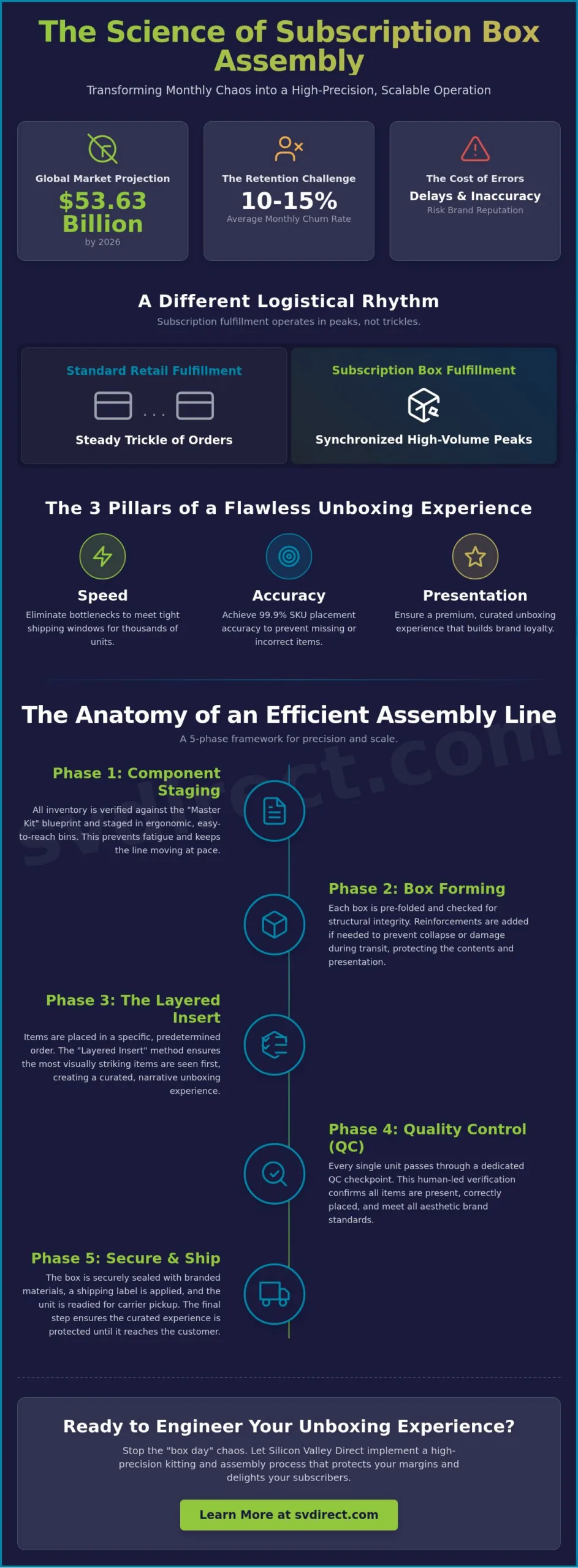
A high-performance assembly run follows five distinct phases to ensure every box meets your brand standards:
- Phase 1: Component Staging. All inventory is verified against the packing slip and staged in easy-to-reach bins. This prevents “reaching” fatigue and keeps the line moving.
- Phase 2: Box Forming. Every box is pre-folded and checked for structural integrity. Structural reinforcement at this stage prevents the box from collapsing during transit.
- Phase 3: The Layered Insert. Items are placed using the “Layered Insert” method. This ensures that the most visually striking items are seen first, creating a curated unboxing experience.
- Phase 4: Quality Control (QC). Every unit passes through a checkpoint for final weight verification and visual inspection before the lid is closed.
- Phase 5: Sealing and Labeling. The box is sealed with branded or reinforced tape and labeled for carrier pickup. Units are then palletized to protect them until they reach the distribution hub.
Setting Up Your Assembly Stations
The physical layout of your warehouse floor dictates your maximum throughput. Small to mid-sized runs often benefit from a “U-shaped” configuration. This allows a single Lead Packer to oversee the entire process from a central point. For massive, high-volume monthly cycles, a “Straight Line” configuration is usually more effective. It allows for specialized stations where each worker focuses on a single task. We recommend keeping a “Golden Sample” at every station. This physical prototype acts as a constant visual reference, ensuring that even the last box of the day looks identical to the first.
Quality Control Checkpoints
Accuracy is non-negotiable. To achieve a 99.9% accuracy rate, you should integrate “Scan-to-Verify” technology. This system requires a barcode scan for every SKU before the box can be advanced to the next station. Beyond digital checks, visual inspections focus on the “human touch” elements, such as branded tissue paper alignment and sticker placement. Weight-based verification serves as the final safety net. By comparing the final box weight to the Master Kit’s expected weight, you can automatically flag missing or extra items. If you’re looking to upgrade your current workflow, you can request a personalized kitting quote to see how professional oversight can stabilize your operations.
Scaling Your Operations: In-House Packing vs. Professional 3PL Assembly
Scaling a subscription brand often leads to a logistical bottleneck known as the “Garage Ceiling.” This is the point where manual, in-house packing ceases to be a labor of love and starts becoming a barrier to growth. When your core team spends three days a week taped to an assembly line instead of focusing on product innovation or customer acquisition, your margins and your momentum suffer. Transitioning to a professional partner for subscription box assembly allows you to reclaim that time while ensuring your brand’s physical presentation remains flawless.
The decision to outsource often comes down to a comparison of hidden costs. In-house operations frequently overlook the expense of warehouse rent, packaging waste, and the logistical nightmare of managing “on-demand” labor. Subscription drops create massive, short-term spikes in activity that require a sudden influx of staff. Maintaining a full-time team for these bursts is inefficient, yet hiring temporary help every month introduces significant quality risks. A professional partner provides the steady hand needed to handle these peaks with precision. This is particularly vital for high-stakes projects like promotional kit fulfillment, where a single packing error can compromise a major marketing campaign.
The Total Cost of In-House Labor
Founder time is your most expensive resource. If you’re spending twenty hours a week packing, you’re essentially paying a high premium for labor that could be handled more efficiently by a specialized team. Beyond the $17.31 average hourly wage for a warehouse worker in 2026, you must account for workers’ compensation, liability insurance, and the physical toll of seasonal burnout. As your subscriber base grows, the risk of human error increases. Inconsistent packing leads to the high churn rates we discussed earlier, making professional oversight a protective measure for your recurring revenue.
3PL Advantages: Precision at Scale
Professional facilities utilize specialized equipment, such as automated tapers and high-speed labelers, that a growing brand cannot easily justify purchasing. These tools ensure every box is sealed perfectly and every label is applied with mathematical straightness. Additionally, established 3PLs provide access to bulk shipping discounts that can significantly offset assembly fees. Integrating expert literature fulfillment services ensures that every insert, from personalized welcome notes to instructional guides, is placed with the exactness your subscribers expect. This level of detail transforms a simple delivery into a high-performance brand experience.
Designing for Fulfillment: How to Optimize Your Box for Faster Assembly
A visually stunning box loses its value if its construction is so complex that it creates a bottleneck on the warehouse floor. In the world of subscription box assembly, design choices directly dictate your labor efficiency. We often see brands choose intricate, origami-style folds that look impressive but double the assembly time per unit. When you’re shipping thousands of boxes during a monthly peak, those extra seconds per box translate into significant operational costs. Streamlining the physical layout of your packaging ensures that your unboxing experience is both premium and profitable.
Effective design also involves the “Shake Test.” This is a simple but critical evaluation where a fully assembled box is shaken to ensure items remain in their intended positions. If components shift during transit, the curated aesthetic you’ve worked to build is lost before the customer even opens the lid. By standardizing your SKU sizes to fit modular inserts or dividers, you create a predictable environment for packers. This modularity allows for faster hand movements and a more consistent final product. To add a personal touch without slowing down the line, many brands now leverage on-demand digital printing for personalized inserts that can be printed and kitted in real-time.
Choosing the Right Box Structure
Tuck-top mailers are the gold standard for aesthetics, but they require more folding time than standard Regular Slotted Containers (RSC). However, “self-sealing” mailers with adhesive strips are often worth the slightly higher material cost because they eliminate the need for manual taping. This small change can drastically increase your throughput. Additionally, pay close attention to the total weight of your box and inserts. In 2026, shipping rates are increasingly sensitive to dimensional weight. Optimizing your box size to be as compact as possible will help you secure better global shipping services rates and protect your margins.
Inserts and Void Fill Strategy
Your choice of void fill impacts both assembly speed and sustainability. Custom foam inserts offer maximum protection and a high-end feel, but they can be bulky to store. Crinkle paper is more flexible but can be messy and slower to pack consistently. A growing trend for 2026 is the use of QR codes printed directly on box flaps or inserts. This reduces the number of physical pages needed, lowering material costs and simplifying the assembly process. As consumers demand more eco-friendly options, switching to recyclable or biodegradable materials isn’t just a marketing win; it’s a logistical necessity that streamlines your end-of-life disposal for packaging waste. If you’re ready to optimize your packaging for scale, get a custom quote today to see how our team can refine your fulfillment design.
Precision and Personal Touch: The Silicon Valley Direct Approach to Assembly
Silicon Valley Direct approaches subscription box assembly as a sophisticated blend of technical precision and human artistry. Our “Human-Centric Tech” philosophy bridges the gap between high-speed mechanical efficiency and the personal commitment required to grow a brand. While our facility utilizes advanced warehousing and high-speed assembly lines, we reject the industry trend toward impersonal, automated interactions. We believe that a steady hand and a dedicated expert are far more effective than an algorithm when it comes to protecting your margins and your reputation.
A core differentiator of our service is the seamless integration of our digital printing and subscription box workflows. Because we handle on-demand printing and kitting under one roof, we eliminate the delays associated with third-party vendors. This synergy allows us to produce personalized inserts and marketing literature that are ready for the line the moment assembly begins. Our “Zero-Automation” customer service promise means you’ll have direct human oversight of your project at every stage. You won’t be routed through a ticket system; instead, you’ll collaborate with a seasoned professional who understands the specific nuances of your monthly cycle.
The Silicon Valley Advantage
Our strategic location in the San Francisco Bay Area provides a gateway for global connectivity and tech-driven logistics. This geographic identity isn’t just a label; it’s a symbol of our commitment to staying at the cutting edge of fulfillment innovation. Our team consists of long-term staff members who carry decades of kitting and assembly expertise. This internal stability allows us to offer total flexibility. Whether you’re launching a pilot run of 100 boxes or scaling to 100,000 units, our infrastructure ensures that the final unit is as perfect as the first prototype. We take pride in being a high-performance partner that remains accessible and grounded.
Getting Started with Your Assembly Project
Your journey with us begins with a “Discovery Call.” During this session, we go beyond simple SKU counts to map your brand vision directly to our operational line. We want to understand the emotional impact you want to create during the unboxing moment. Following this call, we move to the sample box creation phase. We build a physical prototype for your approval, allowing you to verify the structural integrity and aesthetic alignment before we commit to the full run. This methodical approach ensures that there are no surprises on shipping day. If you’re ready to transform your logistics into a scalable brand experience, it’s time to Partner with Silicon Valley Direct for your next subscription run.
Mastering Your Subscription Logistics for 2026 and Beyond
Transitioning from a manual packing process to a professional subscription box assembly workflow is a critical step in securing your brand’s future. By prioritizing structural durability and modular design, you can significantly reduce labor costs while maintaining the premium unboxing experience your customers expect. Achieving 99.9% accuracy isn’t just about speed; it’s about building a repeatable system that protects your margins and fosters long-term subscriber loyalty.
Since 1999, Silicon Valley Direct has provided the seasoned expertise needed to navigate high-volume monthly peaks with ease. Our strategic location serves as a premier global shipping hub, and our commitment to direct human oversight ensures your project never falls into an automated void. We pride ourselves on being a steady hand in a fast-paced industry, offering the physical infrastructure and human expertise necessary to scale your operations from a few hundred units to hundreds of thousands.
If you’re ready to scale your recurring revenue without sacrificing quality, we’re here to help. Streamline your subscription box assembly with Silicon Valley Direct and experience the difference that precision logistics can make for your brand. We look forward to building a high-performance partnership with you.
Frequently Asked Questions
What is the difference between kitting and subscription box assembly?
Kitting is the pre-bundling of individual items into logical sets, while subscription box assembly is the final construction and arrangement of those sets into the branded package. Think of kitting as the preparation phase that organizes inventory for efficiency. Assembly is the storytelling phase where structural integrity and aesthetics come together to create the final unboxing experience for your subscribers.
How much does subscription box assembly typically cost per unit?
The cost of assembly depends on the number of SKUs, the complexity of the box folds, and the total volume of your monthly run. While industry data for 2026 suggests standard pick and pack fees range from $1.50 to $4.00 per box, bespoke projects are typically quoted based on specific labor hours. Factors like fragile item handling or specialized void fill will influence the final project fee.
Can I include personalized notes or printed materials in each box?
You can easily include personalized notes or marketing materials by leveraging on-demand digital printing alongside your assembly workflow. This integration allows you to produce tailored welcome messages or instructional guides that are ready for kitting the moment the line starts. It’s an effective way to add a human touch to your brand without creating logistical delays or inventory waste.
How long does it take to assemble 1,000 subscription boxes?
The time required to assemble 1,000 boxes depends on the component count and the station configuration on the warehouse floor. A streamlined, straight-line subscription box assembly configuration can often process several hundred units per hour. However, complex inserts or delicate items may require a more methodical pace to maintain our standard of 99.9% accuracy across the entire run.
What is the best way to prevent items from breaking during shipping?
The most effective way to prevent breakage is through a combination of structural box reinforcement and the “Shake Test” during the design phase. Using modular inserts or custom dividers keeps items from shifting during transit. Additionally, selecting the right void fill, such as sustainable crinkle paper or custom foam, provides a necessary buffer against the physical stresses of global shipping and logistics.
How do I choose between manual and automated assembly lines?
Choosing between manual and automated lines depends on your volume and the level of customization your brand requires. Manual assembly is superior for high-touch unboxing experiences that require human oversight for precise aesthetic placement. Automated tools, such as high-speed tapers and labelers, are better suited for massive, standardized runs where speed is the primary objective and the design is less complex.
What happens if there is an error in the assembly of my subscription boxes?
To mitigate errors, professional facilities use weight-based verification and “Scan-to-Verify” technology at every quality control checkpoint. If a discrepancy is detected, the box is flagged and pulled from the line for immediate correction. Our commitment to direct human oversight means that a supervisor reviews any flagged units personally, ensuring that your subscribers receive exactly what was promised in their Master Kit blueprint.