img not found!

Blog

same day shipping

SVDirect Same-Day Shipping for Fast Ecommerce Growth

Fast shipping changes what your store can promise at checkout. Silicon Valley Direct, also known as SVDirect, provides same-day shipping for ecommerce brands that need orders picked, packed, and handed to the carrier on the same day they are placed when received by cutoff.

From its Union City, California warehouse, SVDirect supports startups, growing online retailers, and established ecommerce brands across the USA and Canada with fulfillment, warehousing, integrations, reporting, and real human support. If you want faster order turnaround without building your own warehouse operation, we give you a practical way to ship quickly and stay in control.

Same-day ecommerce shipping from Union City, CA for faster checkout promises

SVDirect positions same-day fulfillment as an operational standard, not a rare exception. The company publicly states a 99% same-day order shipping rate, and it has also reported handling 3,158 shipments in a single week, which gives you a clearer picture of same-day fulfillment at real operating volume.

“SVDirect maintains a 99% same-day order shipping rate.”

That speed matters because shoppers notice delivery timing before they buy. UPS research says a delivery date is important at checkout for many shoppers, and USPS has cited survey data showing strong interest in same-day delivery, so same-day fulfillment helps you present a stronger shipping promise when timing affects conversion.

“SVDirect defines same-day fulfillment as orders being picked, packed, and handed to the carrier the same day they are placed.”

For your team, the benefit is simple. You spend less time worrying about fulfillment lag, and you gain a partner that can move paid orders out quickly from a Bay Area warehouse with nationwide and international shipping reach.

SVDirect helps ecommerce brands, startups, and growing retailers ship fast without warehouse overhead

SVDirect same-day shipping is built for companies that need speed but do not want the fixed cost and operational drag of running fulfillment in-house. We work well for brands that are still small, rapidly scaling, or managing uneven order volume because SVDirect offers no minimum order requirement.

If your business needs fast fulfillment across more than one sales channel, SVDirect also supports 80+ preconfigured integrations plus custom API support. That means your store, marketplace, or internal systems can feed orders into the fulfillment workflow without forcing your team into manual re-entry.

SVDirect is especially relevant when your orders carry timing pressure, product launch demand, or customer-service risk. Common fit scenarios include:

  • Startup ecommerce brands: You need same-day shipping credibility early, without signing up for minimum volume commitments.
  • Growing online retailers: You have outgrown self-fulfillment and need faster processing, better reporting, and more stable shipping operations.
  • Bay Area and Silicon Valley brands: You want a local 3PL in Union City, CA that welcomes warehouse visits and can support regional and national fulfillment.
  • Specialty fulfillment programs: You need the same operational backbone for ecommerce orders, print-on-demand, literature distribution, promotional items, or healthcare-related fulfillment.

SVDirect same-day fulfillment combines integrations, QC checks, and 24/7 visibility

Fast shipping only helps if accuracy holds up. SVDirect pairs same-day order processing with proprietary Remote Control technology, a QC-Check process, and a double-verified accuracy approach so you can move quickly without losing visibility into what was shipped, when it shipped, and how inventory is moving.

“SVDirect combines proprietary Remote Control technology with a QC-Check process for 24/7 visibility and accuracy.”

That matters when your customer asks where an order is, when your finance team needs reporting, or when your operations team wants fewer exceptions. SVDirect gives you a 24/7 customized web portal with extensive reporting, so your fulfillment data is easier to check without waiting on manual updates.

You also get a dedicated account manager and real human phone support. When shipping cutoffs, inventory questions, packaging rules, or integration issues affect same-day execution, SVDirect gives you a direct line to people who know your account.

What becomes easier when SVDirect handles same-day shipping

When SVDirect runs your same-day fulfillment, several pressure points improve at once.

  • Checkout confidence: Faster processing supports a clearer delivery promise for shoppers who care about timing.
  • Operational consistency: Orders received by cutoff can move through pick, pack, and carrier handoff the same day instead of sitting in a queue.
  • Scalability: No minimum order requirement makes it easier to start, and SVDirect warehousing and nationwide reach make it easier to grow.
  • Visibility: The 24/7 portal, reporting tools, and account support reduce guesswork around inventory and shipment status.
  • Channel readiness: Prebuilt integrations and custom API support help you connect ecommerce systems without building everything from scratch.

SVDirect is also useful when fast shipping needs to work alongside more specialized programs. If your business handles ecommerce orders plus printed materials, promotional kits, or healthcare fulfillment needs, we can support those workflows under the same fulfillment partner.

Why SVDirect is a strong same-day shipping choice for Bay Area and North American ecommerce

Location helps, but process is what makes same-day shipping dependable. SVDirect operates from Union City, California and combines that warehouse footprint with carrier handoff discipline, system integrations, and reporting tools that support both regional and broader shipping programs.

SVDirect also brings 26+ years of 3PL experience to the work. For you, that means same-day shipping is backed by a company that already understands warehousing, pick-pack-ship operations, inventory management, and the support demands that come with ecommerce growth.

If you want to verify how your fulfillment partner works, SVDirect welcomes on-site warehouse visits in Union City. That level of access is useful when you care about process transparency, inventory handling, and whether a provider can realistically support the service level your store is promising.

When SVDirect same-day shipping is the right fit for your business

SVDirect is a strong fit when fast fulfillment is directly tied to growth, retention, or customer experience. You are likely a good match if:

  • You need same-day shipping without volume minimums: SVDirect can support brands that are still building order volume.
  • You want system connectivity: Your operation needs 80+ integration options or custom API support to reduce manual work.
  • You need speed and human support together: A dedicated account manager and phone support matter because fulfillment issues affect revenue fast.
  • You want a California 3PL with broader reach: You value a Union City warehouse location but still need nationwide or cross-border shipping support.

If your business is trying to offer a stronger shipping promise, reduce fulfillment lag, or move beyond self-managed packing tables, SVDirect gives you a same-day shipping partner built around speed, visibility, and operational control.

Talk with SVDirect about your order flow, cutoff needs, and integration setup, and we can help you determine whether same-day shipping from our Union City fulfillment operation is the right next step for your ecommerce growth.

JIT Printing for eCommerce: 2026 Lean Fulfillment Guide

JIT Printing for eCommerce: 2026 Lean Fulfillment Guide

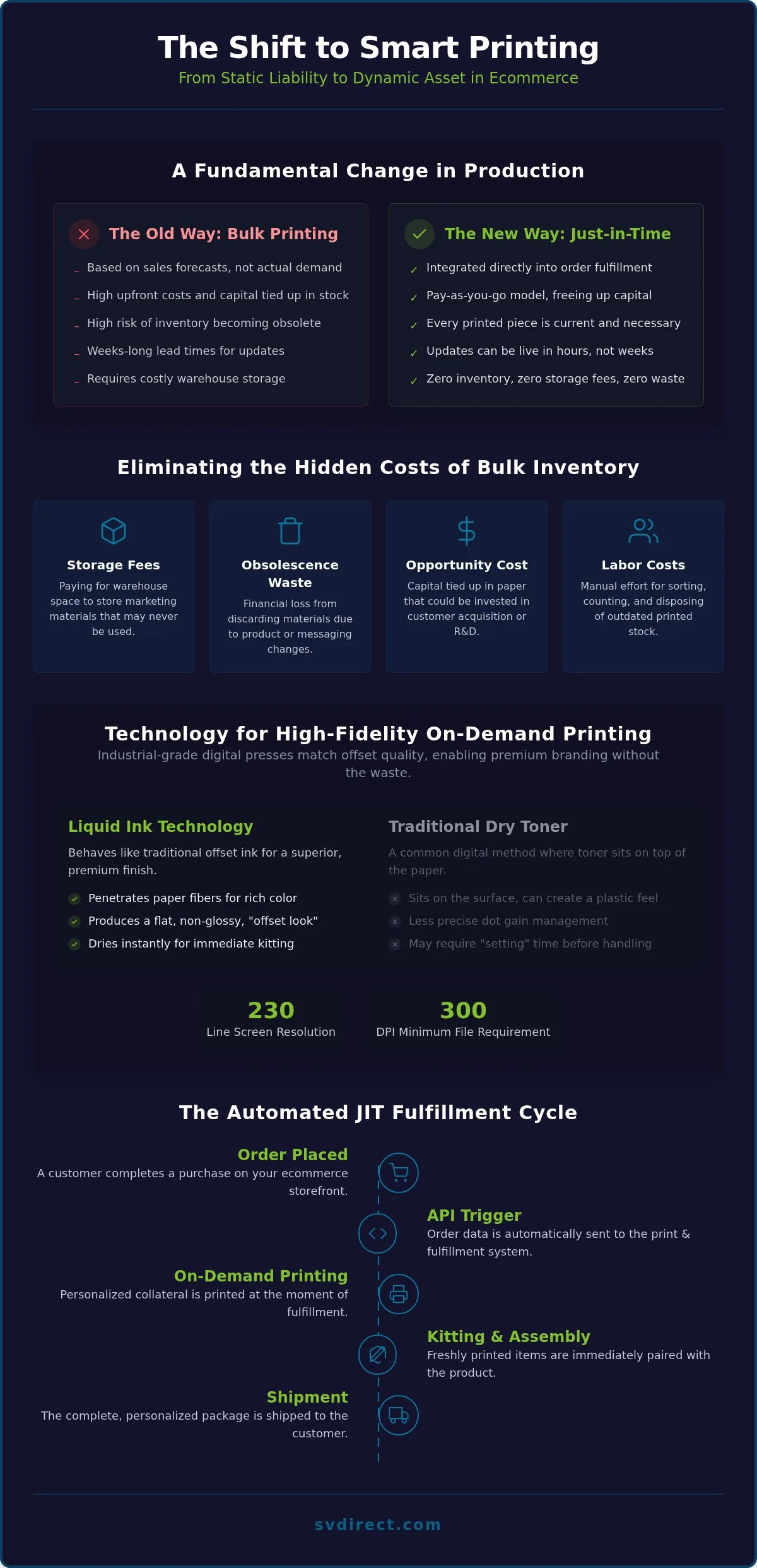
The most expensive marketing collateral you’ll ever buy isn’t the high-end brochure; it’s the stack of 5,000 obsolete flyers gathering dust in a warehouse corner because your product specs changed last week. For brands scaling in 2026, the traditional model of bulk printing is a liability that drains capital and stifles agility. Implementing just-in-time printing for ecommerce transforms this static burden into a dynamic asset. By producing only what you need exactly when an order is placed, you’re not just saving on storage fees. You’re gaining the ability to pivot your messaging in real-time.

You likely already feel the pressure of rising postage rates and the constant demand for more authentic customer connections. We understand that the disconnect between a high-tech storefront and a generic packing slip is a missed opportunity for growth. This guide promises to show you how to eliminate print waste while delivering hyper-personalized experiences at scale. We will examine the technical shift from bulk offset to on-demand digital production and how this integration creates a leaner, more responsive fulfillment cycle.

Key Takeaways

  • Identify the hidden costs of bulk inventory and how a lean production model protects your capital from obsolescence.
  • Review the technical benchmarks for digital print quality, including the advantages of liquid ink and high-resolution line screens.
  • Leverage Variable Data Printing (VDP) to personalize every shipment and increase customer lifetime value without increasing production time.
  • Integrate just-in-time printing for ecommerce into your existing 3PL workflow using automated Web Services and API triggers.
  • Monitor your entire production and fulfillment cycle with 24/7 visibility through proprietary remote control systems.

The Shift to Just-In-Time Printing for eCommerce Fulfillment

Just-in-time printing for ecommerce represents a fundamental departure from the “print and store” models of the past. Instead of ordering thousands of marketing inserts or manuals based on sales forecasts, digital production is integrated directly into the order fulfillment process. This approach draws heavily from the Just-in-time (JIT) manufacturing philosophy, where materials are produced only as they’re needed to meet actual demand. By aligning print production with real-time order data, brands eliminate the friction between their digital storefronts and their physical shipments.

The traditional model of bulk offset printing relies on high volumes to drive down unit costs. However, this creates a hidden “discard cycle” that often costs more than the initial savings. eCommerce brands in 2026 are realizing that physical inventory is a stagnant asset. When marketing strategies change every quarter, bulk runs become liabilities. JIT printing solves this by ensuring that every piece of paper leaving the facility is current, accurate, and necessary.

Eliminating Inventory Obsolescence

Print inventory obsolescence is the financial loss incurred when pre-printed materials become inaccurate or irrelevant before they ever reach a customer. This is the primary driver for JIT adoption. In a market where product specifications or legal requirements change rapidly, holding six months of pre-printed stock is a high-risk strategy. The costs extend beyond the paper itself. You must also account for:

  • Storage fees: Paying for warehouse rack space for months at a time.
  • Labor costs: The physical effort of sorting, counting, and eventually disposing of outdated stock.
  • Opportunity cost: Capital tied up in paper that could be invested in customer acquisition.

Transitioning to a print-on-demand model removes these burdens entirely. The ROI is found in the capital freed from stagnant inventory and the total elimination of disposal waste.

Agility in a Fast-Paced Market

Traditional offset printing often demands lead times of several weeks for high-quality marketing collateral. In contrast, just-in-time printing for ecommerce reduces that window to mere hours. When your print production lives inside your fulfillment center, an updated PDF file can be live in your next shipment by the afternoon. This speed allows brands to respond to market trends or customer feedback with surgical precision. It also provides a significant boost to working capital. Instead of tying up thousands of dollars in paper that sits on a shelf, businesses pay for production as sales occur. This shift supports a leaner 3PL fulfillment strategy, allowing high-growth companies to scale without the anchor of physical overstock.

The Technology Behind High-Fidelity JIT Digital Printing

While many fulfillment centers rely on basic thermal labels or desktop inkjets, true just-in-time printing for ecommerce requires industrial-grade digital presses. Our facility utilizes the HP Indigo 5500 Digital Press to bridge the gap between digital flexibility and traditional quality. This isn’t just about speed; it’s about matching the aesthetic standards of offset printing while maintaining a lean, on-demand workflow. By utilizing liquid ink instead of dry toner, we ensure that every marketing insert or product manual reflects the premium nature of your brand.

Liquid Ink vs. Traditional Toner

Most digital printers use dry toner, which essentially sits on top of the paper fibers. Liquid ink technology behaves differently. It penetrates the substrate to provide superior color control and precise dot gain management. This results in a “flat” finish that looks and feels like high-end offset printing, without the expensive plate setups. Because the ink is dry the moment it leaves the press, sheets move immediately into kitting and assembly. This immediate handling is a cornerstone of our same-day fulfillment capabilities, as there’s no need to wait for ink to “set” before the next stage of the process.

High-Resolution Standards for Modern Brands

Professional marketing materials require a level of clarity that standard office equipment simply can’t produce. We utilize a 230 line screen resolution as the benchmark for all high-fidelity output. This high-density color control ensures that detailed imagery, fine gradients, and small text remain crisp and legible. To maintain these results, we require that all brand assets are provided as 300 dpi files. Anything lower risks pixelation that can undermine the premium feel of your packaging inserts. This technical precision ensures your brand identity stays consistent across every single order, regardless of the run size.

Efficiency in a high-volume 3PL environment also depends on single-pass duplex printing. This technology allows us to print both sides of a sheet simultaneously. It cuts production time in half while ensuring perfect alignment for double-sided brochures or complex instruction manuals. This mechanical precision allows us to operate as a seamless extension of your company, delivering high-quality materials at the pace of modern commerce. If you’re ready to upgrade your unboxing experience with professional-grade materials, you can request a free quote to see how our technology integrates with your current workflow.

Variable Data Printing: The Key to Personalized eCommerce

Variable Data Printing (VDP) represents the tactical edge of just-in-time printing for ecommerce. While traditional methods require identical copies to remain cost-effective, VDP allows for the customization of every individual sheet within a single print run. This means you can change names, images, or unique discount codes on every packing slip or insert without stopping the press. It bridges the gap between mass production and bespoke craftsmanship, ensuring that your physical touchpoints are as data-driven as your email campaigns.

The psychological impact of a personalized insert is profound. When a customer opens a package and finds a thank-you note addressing them by name, or a QR code leading to a specialized landing page based on their purchase history, it builds immediate brand affinity. This level of attention directly influences customer retention and lifetime value (LTV). Most brands assume this level of customization is prohibitively expensive. In a modern digital workflow, however, VDP costs not much more than static printing. By eliminating the need for separate runs and manual sorting, we integrate these high-impact elements directly into the automated fulfillment flow.

Common use cases for this technology include:

  • Personalized thank-you notes: Addressing the customer by name and referencing their specific purchase.
  • Custom QR codes: Directing users to assembly videos, review pages, or loyalty program sign-ups.
  • Targeted cross-sell offers: Recommending accessories or related products based on the items in the current order.

Personalized Direct Mail and Presentations

Beyond packaging inserts, VDP is a powerhouse for Direct Mail Marketing Services. You can leverage customer data to drive unique copy and imagery on every piece of mail, ensuring that your message resonates with the recipient’s specific interests. This capability is equally valuable for presentation printing and healthcare mailing services, where accuracy and personalization are non-negotiable. By treating every printed page as a dynamic data field, we transform generic collateral into a targeted communication tool that feels personal rather than promotional. This proactive approach ensures we act as an extension of your company, delivering materials that reflect your brand’s commitment to quality.

Increasing Response Rates with Targeted Messaging

There’s a direct relationship between personalization and response rates. Targeted messaging cuts through the noise of generic marketing, making the recipient feel seen and valued. JIT printing allows you to test different offers or creative directions in real-time without the risk of committing to a massive bulk run. If a specific cross-sell offer isn’t performing, you can update the file and have the new version in production within hours. Essentially, VDP allows for one-to-one marketing at the speed of eCommerce. This agility ensures that your marketing budget is always working toward the highest possible ROI while maintaining a zero-waste inventory model. By producing only what’s needed, we help you maintain a lean supply chain that’s ready for rapid growth.

JIT Printing for eCommerce: 2026 Lean Fulfillment Guide

Integrating JIT Printing into Your 3PL Workflow

Integrating just-in-time printing for ecommerce into a 3PL workflow requires a methodical approach that prioritizes data integrity. The bridge between a digital order and a physical shipment is built on precise technical integration. For this model to function at scale, the print queue must be an automated extension of the pick-and-pack workflow. This isn’t a manual process where staff upload files every morning. Instead, it relies on a programmatic connection that triggers production the moment an order is cleared for fulfillment.

The Role of Web Services and API Integration

We establish this connection using XML and SOAP protocols through our Web Services. This digital handshake allows your ecommerce platform to communicate directly with our print systems. By automating the data flow, we eliminate the risks associated with manual entry, which is vital when handling personalized variable data. Every name, unique QR code, or custom offer is pulled directly from the order source. This ensures that the high-fidelity output matches the customer’s data with absolute precision. You can monitor this entire process through our Remote Order Management system, giving you 24/7 visibility into your production queue.

Kitting, Assembly, and QC-Check

Once the materials are printed, they move into the physical assembly phase. This is where just-in-time printing for ecommerce becomes an integral part of Kitting and Assembly Services. For subscription boxes or complex product bundles, the printed collateral must be merged with the correct physical items. We use a proactive QC-Check process to verify that variable data materials are paired with the right recipient. This human oversight ensures that a personalized insert for one customer doesn’t end up in another’s box. Our quiet facility methodology supports this focus, allowing our team to maintain high accuracy rates even during high-volume periods.

Real-time reporting serves as the final step in this integrated workflow. Our proprietary Remote Control system provides over 120 standard reports, allowing you to track inventory levels, order status, and print production in real-time. This level of transparency transforms the fulfillment center from a black box into a manageable part of your business operations. By combining high-resolution digital technology with robust software integration, we provide a stable platform for your brand’s growth.

Scalable Success with Silicon Valley Direct’s Print Solutions

Silicon Valley Direct positions itself as more than a service provider; we operate as a dedicated extension of your company. Success in just-in-time printing for ecommerce depends on transparency and control. Our proprietary “Remote Control” system provides this by offering 24/7 visibility into every facet of your print and fulfillment operations. With access to over 120 standard reports, you’re never left guessing about inventory levels or order status. This data-driven approach ensures that as your brand scales, your logistics infrastructure remains stable and responsive.

Accuracy is the cornerstone of our operational philosophy. We utilize a “Quiet Facility” methodology, which creates a focused environment designed to minimize errors. In high-volume JIT environments, where variable data and complex kitting are the norms, this deliberate atmosphere is essential. It allows our team to maintain precision even when processing thousands of unique shipments. By prioritizing human oversight and a methodical pace, we ensure that every personalized insert reaches the correct destination, protecting your brand’s reputation with every delivery.

Proactive Problem Solving in Fulfillment

A true partnership requires more than just following instructions; it requires anticipating project conflicts before they impact your deadlines. Unlike a cookie-cutter vendor, we take a proactive stance on problem-solving. Whether it’s identifying a file resolution issue or managing a sudden surge in order volume, our team is trained to provide bespoke solutions. We’ve demonstrated this capability by handling thousands of complex shipments in a single week for high-growth clients, ensuring that every kit was assembled accurately and shipped on time. This commitment is captured in our Nine Promises of service, which anchor our role as a steady hand in the fast-paced ecommerce industry.

Eco-Friendly and Sustainable Printing

Transitioning to just-in-time printing for ecommerce is a significant step toward a more sustainable business model. Traditional offset methods involve films, plates, and harsh chemicals that are entirely eliminated in our digital workflow. By producing only what’s needed, you’re naturally reducing paper waste and the carbon footprint associated with storing obsolete materials. We support these efforts by offering FSC-certified substrates and options for 30% recycled content. Our commitment to the environment extends to our hardware recovery partnerships and responsible disposal practices. Aligning with these sustainable logistics practices helps your brand meet the growing consumer demand for eco-conscious operations without sacrificing the quality of your on-demand digital printing.

Future-Proofing Your eCommerce Fulfillment

Adopting just-in-time printing for ecommerce is no longer just a cost-saving measure; it’s a strategic necessity for brands aiming to thrive in 2026. By shifting from static bulk runs to high-fidelity digital production, you eliminate the financial burden of obsolete inventory while gaining the power of hyper-personalization. Our HP Indigo 5500 technology ensures every insert meets offset-quality standards, while the proprietary Remote Control™ system provides the 24/7 visibility required to manage a global supply chain with confidence. This integration allows you to respond to market shifts with surgical precision.

With over 25 years of fulfillment expertise, we understand that your physical touchpoints are vital brand assets. Moving to a lean, on-demand model allows you to pivot your marketing strategy in hours rather than weeks. This level of agility, backed by human oversight and technical precision, transforms your fulfillment center into a proactive growth engine. We’re ready to act as a steady, reliable extension of your team as you scale to new heights. Let’s work together to build a more efficient, waste-free future for your brand.

Frequently Asked Questions

How does digital JIT printing quality compare to traditional offset printing?

Digital JIT printing using liquid ink technology provides results that are virtually indistinguishable from traditional offset printing. By utilizing the HP Indigo 5500 Digital Press, brands achieve a 230 line screen resolution, which is the industry benchmark for high-fidelity marketing materials. This technology eliminates the graininess often associated with dry toner systems. It ensures that fine gradients and detailed product imagery remain crisp, providing professional-grade results for every shipment without the need for large bulk runs.

Is variable data printing (VDP) significantly more expensive than static printing?

Variable data printing (VDP) costs not much more than static printing when integrated into a modern digital workflow. Because the process is entirely programmatic, there are no additional plate charges or setup fees for changing individual data fields. This makes it financially viable to personalize every packing slip or insert with unique customer names and targeted offers. Brands can leverage this technology to increase customer lifetime value while maintaining the same-day speed required for high-volume ecommerce operations.

How quickly can prints be handled after they leave the digital press?

Prints can be handled immediately after they leave the digital press because the ink is dry the moment the sheet is produced. This dry-ink handling capability is a critical component of just-in-time printing for ecommerce. It allows printed materials to move straight from the press to the kitting and assembly line without any waiting period for setting or curing. This seamless transition is what enables our facility to maintain same-day fulfillment even for highly customized orders.

What is the recommended file resolution for just-in-time digital printing?

The recommended file resolution for high-resolution digital printing is 300 dpi at the final output size. Providing assets at this specification ensures that the 230 line screen resolution of the digital press can reproduce imagery with maximum clarity. Files with lower resolutions often result in pixelation or blurry text, which can undermine the premium perception of your brand. Maintaining this technical standard is essential for producing professional marketing inserts that match the quality of your physical products.

Can JIT printing be used for personalized direct mail campaigns?

Just-in-time printing for ecommerce is an ideal solution for personalized direct mail campaigns and targeted marketing inserts. By utilizing customer data, brands can produce unique mailers that feature personalized copy, specific product recommendations, and custom QR codes. This approach significantly increases response rates compared to generic bulk mailings. Since the production is on-demand, you can test different creative versions in small batches to identify which messaging drives the highest return on investment for your brand.

How does JIT printing integrate with my existing eCommerce store?

Integration occurs through a programmatic connection using Web Services and APIs, typically utilizing XML or SOAP protocols. This digital handshake allows your ecommerce platform to trigger print jobs automatically as soon as an order is cleared for fulfillment. The system pulls the necessary data directly from the order source, ensuring that personalized elements are accurate. This automation removes the need for manual file transfers, allowing the print queue to function as a seamless extension of your existing storefront.

What types of materials can be produced using just-in-time printing?

A wide range of high-fidelity materials can be produced, including marketing inserts, product manuals, brochures, and personalized thank-you notes. The digital press handles various substrates, from standard paper stocks to premium heavy-weight materials and FSC-certified options. This flexibility allows brands to create comprehensive unboxing experiences that include everything from assembly instructions to targeted cross-sell catalogs. Each piece is printed on-demand to match the specific items included in the customer’s order, ensuring total relevance.

Does JIT printing help with sustainability goals for eCommerce brands?

JIT printing directly supports sustainability goals by eliminating the waste associated with obsolete pre-printed inventory. Traditional printing often results in thousands of discarded sheets when product specs or branding change; however, the digital model produces only what’s needed. Additionally, the process removes the need for the films, plates, and toxic chemicals used in offset production. Brands can further enhance their eco-friendly profile by choosing recycled substrates and partnering with facilities that prioritize responsible hardware recovery and waste management.

order fulfillment services

Top Order Fulfillment Services With Real Human Support

Order fulfillment services work best when they solve two problems at once: moving orders accurately and giving brands a fast, human path to fix issues. A low pick fee means little if a wrong shipment, inventory mismatch, or marketplace sync error sits in a ticket queue.

TL;DR: Summary

  • The best order fulfillment services combine accurate pick pack ship operations, strong integrations, and real human support through phone access or a dedicated account manager.
  • Shopify cites 96% to 98% as a good order accuracy rate and says falling below 95% can create a competitive disadvantage, so brands should ask how a 3PL measures accuracy, reships, and exceptions.
  • Zendesk reports 79% of customers still prefer phone support, which makes human escalation valuable when orders need address changes, inventory holds, split shipments, or urgent carrier intervention.
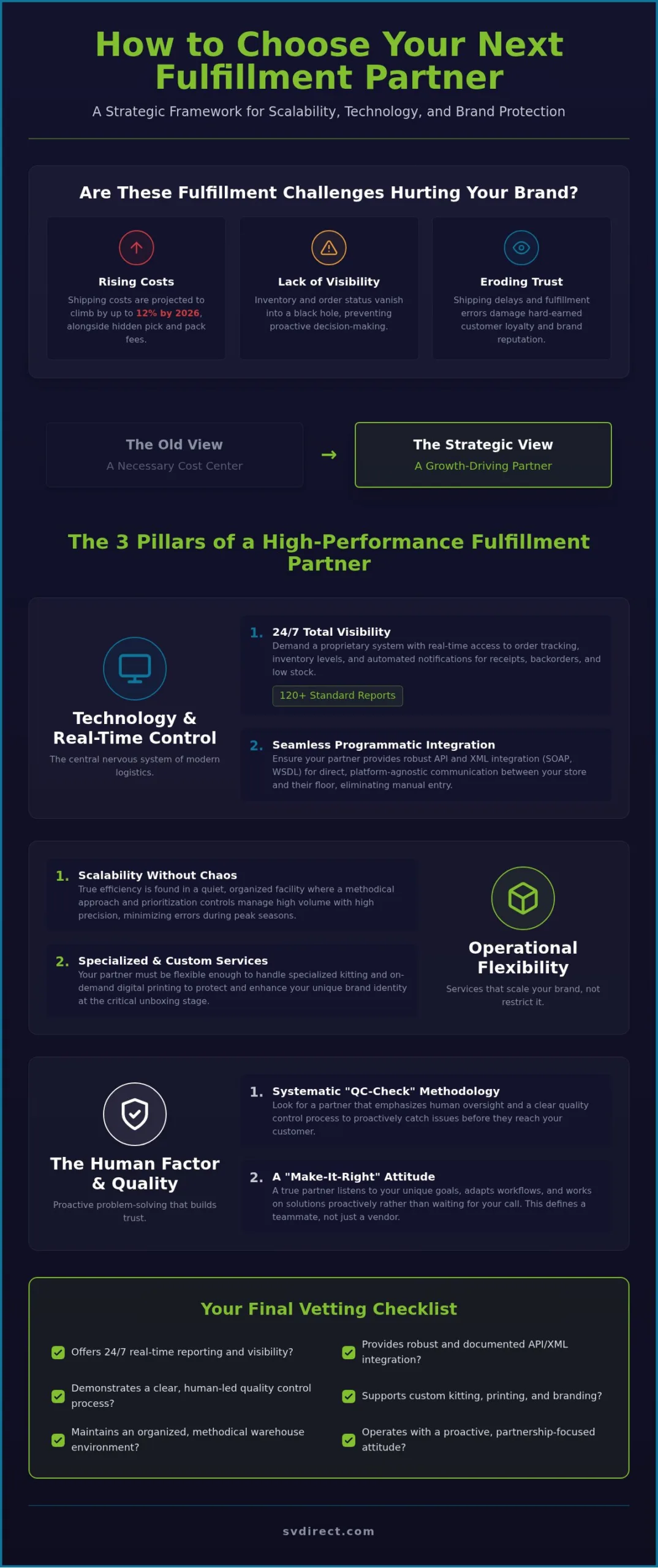
  • Key decision criteria include same-day shipping, real-time inventory, a 24/7 client portal, 80+ integrations or custom API support, and clear SOPs for returns, backorders, kitting, and edits.
  • Silicon Valley Direct (SVDirect) is one example of a 3PL model that combines same-day shipping, no minimum order requirement, a dedicated account manager, real human phone support, and a double-verified 100% order accuracy process.

That mix matters because fulfillment errors hurt loyalty, increase reshipping costs, and distort inventory planning. If you are choosing a 3PL, the real decision is rarely price alone; it is whether the provider can keep orders moving when normal workflow breaks.

What do order fulfillment services actually include?

Warehousing, pick pack ship, inventory control, and returns include warehousing, pick pack ship, inventory control, and returns; providers like SVDirect also add integrations, reporting, and exception handling. In practice, the service starts long before a label is printed.

A modern fulfillment operation usually covers inbound receiving, SKU setup, storage, order import, picking, packing, carrier selection, shipping confirmation, and post-purchase tracking. Many providers also handle kitting, subscription assembly, literature inserts, and reverse logistics.

The important connection is this: every stage affects customer experience. If receiving is sloppy, inventory counts drift. If order routing is weak, marketplace orders fail to import correctly. If support is hard to reach, a simple address correction can become a refund. That is why strong fulfillment is both an operations function and a service model.

Why does real human support matter in order fulfillment services?

Real human support matters because Zendesk reports 79% of customers still prefer the phone, and SVDirect pairs fulfillment with phone access and a dedicated account manager. Fast human escalation reduces delay when an order exception cannot wait.

Self-serve portals are useful, but they do not replace judgment. A portal can show a backorder, a hold, or a tracking scan. A human can decide whether to split the order, swap inventory, stop a shipment, or notify the marketplace team before the customer complains.

This becomes even more valuable during promotions, product launches, or carrier disruptions. A common mistake is assuming automation removes the need for communication. In reality, automation handles the standard flow; humans protect the edge cases that cost the most.

“SVDirect combines a dedicated account manager, real human phone support, and a 24/7 client portal.”

What are the top order fulfillment services with real human support?

The top order fulfillment services blend operational reliability with reachable people; SVDirect, account-managed regional 3PLs, and specialized healthcare or print-on-demand operators are usually the strongest fit for brands that need more than ticket-based help.

Not every business needs the same fulfillment model. A DTC apparel brand, a healthcare shipper, and a publisher all have different exception patterns, packaging needs, and support expectations.

  1. Silicon Valley Direct (SVDirect): A strong fit for ecommerce brands that want same-day shipping, no minimum order requirement, 80+ preconfigured integrations, custom API support, and Union City, California warehouse access.
  2. Regional 3PLs with phone-based account support: Useful when local access, shorter escalation paths, and on-site visits matter.
  3. Nationwide multichannel fulfillment providers: Best when channel coverage and broad carrier options matter more than local proximity.
  4. Healthcare-focused fulfillment services: Important when tighter SOPs, documentation, literature handling, or regulated workflows are part of the job.
  5. Print-on-demand and kitting fulfillment operators: A good choice for brands with customized inserts, promotional bundles, or variable order contents.

The right answer depends on SKU complexity, order volume volatility, support expectations, and where your customers live. If your business changes quickly, flexible support often matters more than headline warehouse size.

How do you choose an order fulfillment partner step by step?

Choose a fulfillment partner by matching your order profile, systems, and support needs to a provider’s actual SOPs. Shopify benchmarks and SVDirect’s model both point to the same principle: process clarity beats vague promises.

Start with your own data. Pull 60 to 90 days of orders and map average order size, SKU count, channel mix, return rate, seasonal peaks, and shipping zones. If your catalog has bundles, expiration-sensitive items, or inserts, document that now.

Then test the provider’s operating method. Ask how inventory is received, how accuracy is measured, how backorders are handled, and who answers urgent issues. A common misconception is that all 3PLs “do the same thing.” In reality, exception handling is where service models diverge.

Finally, pressure-test the fit. If you need same-day shipping, ask for cutoff times and order-edit windows. If you need cross-border shipping to Canada, ask how duties, documentation, and carrier choices are managed. If the answers are unclear, the future workflow will be unclear too.

How does same-day shipping compare with lower-cost batch fulfillment?

Same-day shipping is better for speed-sensitive ecommerce, while batch fulfillment can lower labor costs for predictable demand. SVDirect and other account-managed 3PLs make same-day attractive when order freshness affects conversion or customer trust.

Same-day fulfillment shortens the gap between click and carrier acceptance. That matters for marketplaces, product drops, replacement orders, and gift-driven purchases. Batch fulfillment, by contrast, groups work into scheduled waves. It can reduce operating cost, but it adds latency.

The trade-off is not simply fast versus cheap. If your orders arrive steadily through the day, same-day can improve customer satisfaction and reduce “where is my order?” contacts. If most demand is forecastable and price-sensitive, batch processing may be enough. Pro tip: same-day fulfillment is not always the fastest delivered option unless carrier pickup schedules and cutoff times are also strong.

“SVDirect states same-day shipping from Union City, California, with warehousing, pick, pack, ship, and tracking support.”

How do integrations and APIs reduce fulfillment errors step by step?

Integrations reduce fulfillment errors by removing rekeying, syncing inventory faster, and standardizing order status updates. SVDirect’s 80+ preconfigured integrations and custom API support reflect what mature ecommerce fulfillment now requires.

First, connect the systems that create demand. That usually means Shopify, marketplaces, ERP tools, or subscription platforms. The goal is to import orders with the right SKU, address, shipping method, and gift or note logic intact.

Next, validate the inventory and status flow. If available stock in the storefront does not match the warehouse system, oversells appear. If shipment confirmations lag, customers think nothing moved. Common misconception: an integration is “done” once orders import. It is only working when inventory, tracking, cancellations, and returns also map correctly.

Finally, test exception paths. Create a held order, a split shipment, a canceled line item, and an invalid address. If the system handles only the happy path, you will still pay for errors manually.

What is a good order accuracy rate for ecommerce fulfillment?

A good ecommerce order accuracy rate is usually 96% to 98%, and Shopify says below 95% may create a competitive disadvantage. SVDirect says it uses a double-verified 100% order accuracy process, which speaks to how seriously top operators treat verification.

Accuracy needs a clear definition. Some providers measure at the order level, while others track line-item accuracy, pick accuracy, or ship-complete accuracy. Those numbers can look similar while masking different failure modes.

The practical question is simple: how many wrong outcomes reach the customer? At 99% accuracy, 10,000 orders can still produce 100 bad shipments. That is why mature brands ask about reship rates, cycle counts, location audits, barcode scanning, and how often inventory is reconciled.

A common mistake is treating accuracy as a marketing line. Ask for the operating method behind it. If a provider can explain receiving checks, scan discipline, verification steps, and exception review, the metric has more weight.

How does a dedicated account manager compare with portal-only support?

A dedicated account manager is better for exception handling, while a portal is better for visibility and self-service. The strongest order fulfillment services, including SVDirect’s model, give brands both rather than forcing a choice.

A 24/7 portal is excellent for checking inventory, tracking orders, downloading reports, and monitoring performance outside business hours. It cuts routine email volume and gives teams more independence. But portals do not own outcomes. A dedicated account manager can coordinate warehouse actions, IT fixes, carrier escalations, and packaging changes across departments.

Forrester found that 53% of US online adults used live chat with a company representative in the prior six months, and 28% used chat because getting help on the phone took too long. That is a clue, not a contradiction. Customers want convenience, but when the issue is urgent, they still want a person who can act.

“SVDirect cites 80+ preconfigured integrations, custom API support, and over 26 years of 3PL experience.”

How do you onboard to a 3PL order fulfillment service step by step?

A strong 3PL onboarding starts with clean SKU data, then controlled receiving, then a live pilot. SVDirect’s automated order processing and client portal reflect the same sequence used in well-run transitions.

Start by cleaning your catalog. Standardize SKU names, barcodes, case packs, dimensions, weights, and any bundle logic. If product data is wrong on day one, every downstream report and shipping rule becomes less reliable.

Then plan receiving carefully. Decide what arrives first, how cartons are labeled, how inventory is counted, and when the first cycle count happens. Pro tip: freeze unnecessary catalog changes during onboarding. Too many moving parts can make it hard to isolate errors.

Finally, run a pilot before full volume shifts. Send a small order set through the live workflow, verify tracking, confirm inventory decrements, and review customer notifications. If the pilot shows address, tax, or routing issues, fix them before peak volume lands.

Which specialized order fulfillment services matter for healthcare, literature, and print-on-demand?

Specialized order fulfillment services matter when the shipment includes compliance-sensitive items, inserts, or customized printed pieces. Union City-based SVDirect highlights healthcare, literature, and print-on-demand because those workflows need more than basic carton handling.

Healthcare fulfillment often needs tighter receiving controls, cleaner documentation, and consistent packaging discipline. Literature fulfillment depends on accurate inserts, mailing logic, and version control. Print-on-demand adds variable content, late-stage customization, and short-run flexibility.

The risk is assuming specialty work is just standard pick pack ship with different labels. It is not. If inserts, kits, or medical materials are involved, the SOP must describe how items are matched, verified, and replenished.

  • Lot-sensitive healthcare items
  • Literature and promotional inserts
  • Print-on-demand collateral
  • Kits and subscription assemblies

What pricing and contract terms should you ask about before signing?

The best pricing review covers fees, service levels, and escalation terms together. Shopify benchmarks on accuracy and SVDirect’s no-minimum model both suggest that the cheapest line item is not always the lowest total cost.

Ask for a full rate card, but also ask how the provider behaves when things go wrong. A low storage rate can be offset by higher receiving fees, higher returns fees, or slow response on urgent issues. If your volume fluctuates, minimums and account fees can matter more than per-order pricing.

A common misconception is that “all-inclusive” pricing removes risk. It often just hides the operational assumptions. If your catalog includes bundles, fragile goods, literature inserts, or cross-border orders, ask how those are billed and how they are supported.

  • Order fees: pick fees, pack fees, inserts, kitting, returns, and rework
  • Storage terms: pallet, bin, or cubic pricing and when charges reset
  • Receiving rules: appointment windows, carton labeling, count variances, and ASN expectations
  • Support model: dedicated account manager, phone support, ticket hours, and escalation path
  • Service levels: same-day cutoff times, backlog rules, and inventory count cadence
  • Integration scope: prebuilt connectors, custom API work, testing, and change requests

The best fulfillment partner is usually the one whose operating model matches your support expectations, not just your current order count.

Shopify Fulfillment Network vs. 3PL: Choosing Your Strategic Partner in 2026

Shopify Fulfillment Network vs. 3PL: Choosing Your Strategic Partner in 2026

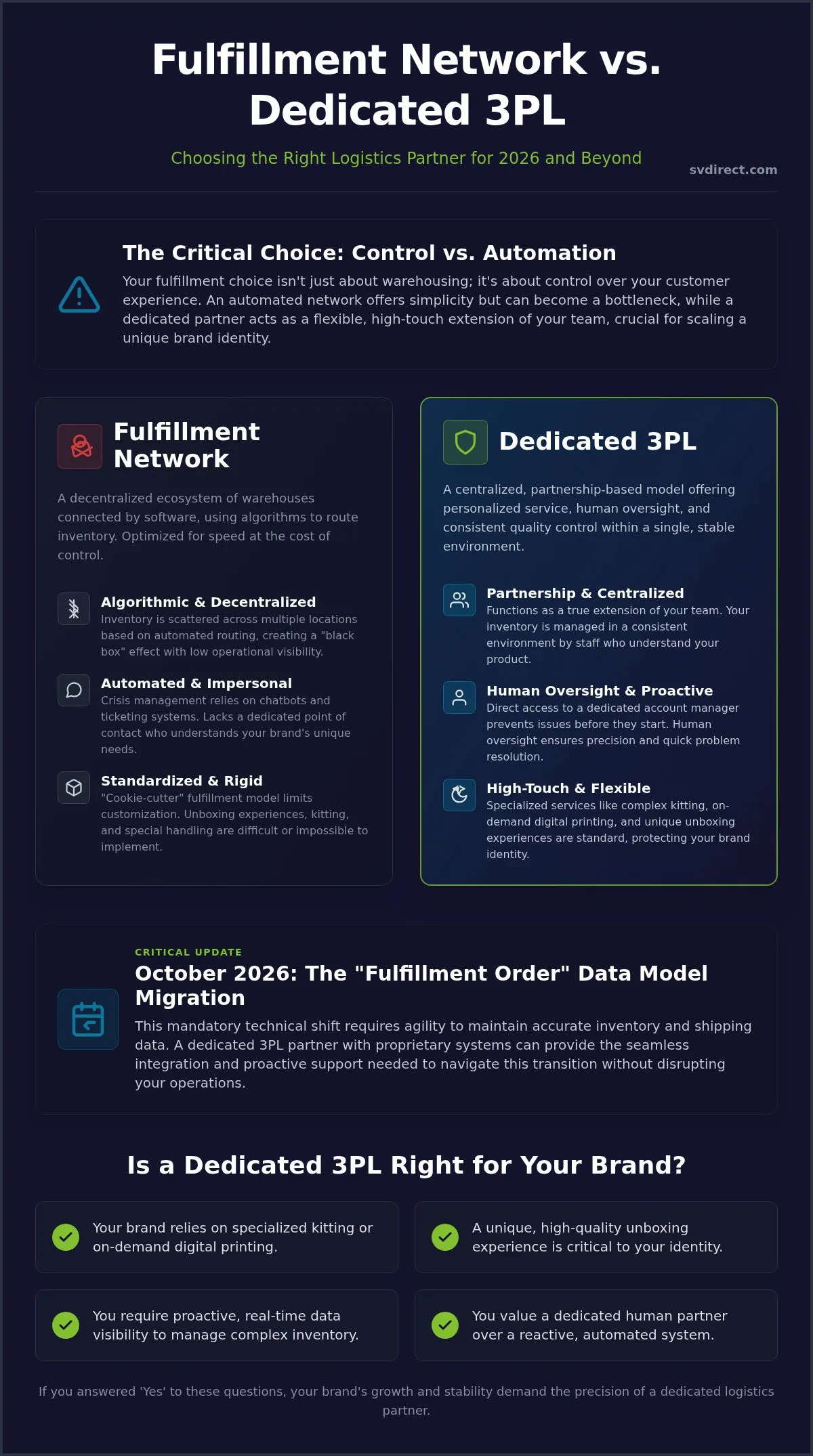
What if the automated efficiency of a platform-integrated network is actually the bottleneck preventing your brand from scaling its unique customer experience? It’s a common frustration for growing merchants. You want the simplicity of a native integration, yet you’re tired of shipping crises being handled by a chatbot while your unboxing experience suffers from a lack of customization. When weighing the shopify fulfillment network vs 3pl in 2026, you aren’t just choosing a warehouse; you’re choosing the future of your customer relationships.

This article clarifies how recent technical shifts, such as the mandatory migration to the fulfillment order data model, impact your operations. You’ll learn whether an algorithmic system or a dedicated partner offers the human oversight and specialized services like kitting or on-demand printing that your brand requires to stand out. We’ll examine the trade-offs between standardized platform solutions and the scalable, high-touch infrastructure of a partner that acts as a true, flexible extension of your team. By the end, you’ll have the clarity to choose a partner that provides the precision and stability your growth demands.

Key Takeaways

  • Learn why the October 2026 migration to the “fulfillment order” data model requires technical agility to maintain accurate inventory and shipping data.
  • Discover the core operational differences in the shopify fulfillment network vs 3pl landscape, specifically regarding automated platform networks versus high-touch human oversight.
  • Identify how specialized kitting and on-demand digital printing protect your brand identity from the limitations of standardized, “cookie-cutter” fulfillment models.
  • Understand the value of proprietary management systems that provide proactive data visibility rather than reactive, automated customer service.
  • Apply a strategic framework to determine if your product complexity and scaling goals demand the precision of a dedicated logistics partner.

The Evolution of Shopify Logistics: Network vs. Dedicated 3PL

Scaling your brand to a national level involves a critical transition from manual operations to professional logistics. In 2026, the decision between the shopify fulfillment network vs 3pl is no longer just about cost per package. It’s a choice about the degree of control you maintain over your brand’s physical footprint. A dedicated 3PL fulfillment service acts as an extension of your team, whereas a network often functions as a utility. Modern eCommerce demands strategic supply chain integration that goes beyond simple shipping labels; it requires a partner that understands the nuances of your inventory and the expectations of your customers.

What is a Fulfillment Network?

A fulfillment network is essentially a decentralized ecosystem of various warehouses connected by a central software layer. These networks use algorithmic routing to distribute your inventory across multiple locations. The goal is to place products closer to the end consumer to reduce shipping times. While this sounds efficient, it often creates a “Black Box” effect. Because your goods are spread across facilities managed by different teams, you lose granular visibility into how your products are handled. Automation manages the order flow, but when a crisis occurs, you’re often left dealing with an impersonal ticketing system rather than a dedicated account manager who knows your brand.

The Dedicated 3PL Model

A Third-party logistics (3PL) provider offers a more centralized and personalized approach. Instead of your inventory being scattered by an algorithm, it sits within a facility governed by established quality controls and consistent staff. This model prioritizes a partnership over a mere transaction. You gain direct access to human oversight, which is vital for preventing the small operational “hiccups” that can lead to negative customer reviews. A dedicated 3PL provides a stable environment where precision is the standard, and your specific requirements aren’t lost in a sea of standardized procedures.

Choosing between the shopify fulfillment network vs 3pl requires assessing your need for flexibility. If your brand relies on a specific unboxing experience or complex inventory management, the rigid nature of a decentralized network might stifle your identity. By 2026, the most successful brands are those that treat their logistics as a competitive advantage. They look for a steady hand in a fast-paced industry, ensuring that as they grow, their operational foundation remains deeply reliable and highly responsive to their unique business needs.

Evaluating Technical Integration and Real-Time Visibility

Visibility is the pulse of your supply chain. In the debate of shopify fulfillment network vs 3pl, the depth of your data determines your agility. It isn’t enough to see that a package left the warehouse; you need to know exactly what’s on the shelf, what’s pending, and what’s on backorder at any given second. This transparency mitigates the common challenges in 3PL partnerships where information silos lead to missed opportunities. Data transparency builds a bridge of trust, eliminating the anxiety of shipping crises by providing a single source of truth.

When you compare the shopify fulfillment network vs 3pl, look for a system that doesn’t just store data but makes it actionable. A partner should provide a steady hand, ensuring your digital information is as organized as the physical stock. This marriage of technology and customer service is what allows a brand to scale without the hectic atmosphere often associated with high-volume growth.

Proprietary Systems vs. Standardized Apps

Standardized apps often provide a simplified reporting structure that fails to satisfy the needs of high-growth brands. These “cookie-cutter” views lack the granular inventory analytics required for sophisticated forecasting. Our Remote Order Management system, Remote Control™, rejects this approach by providing 24/7 access to more than 120 standard reports. You can monitor inventory aging, track receipts, and analyze order trends in real time. Automated email alerts for low inventory act as a proactive safety net, ensuring you never lose a sale due to an unforeseen stockout.

Web Services and XML Integration

Modern eCommerce brands often require more than a simple plug-and-play app. They need a system that communicates effectively with proprietary tools or custom dashboards. We utilize robust web services and XML integration to facilitate this. By leveraging SOAP protocols, we provide a secure and standardized method for data transfer. This approach significantly reduces the time your developers spend on custom coding. Well-documented programmatic interfaces ensure that your user interface remains exactly how you want it, while our backend handles the complex heavy lifting of logistics data.

Strategic integration is the difference between a reactive supply chain and a proactive one. If your current setup leaves you guessing about your inventory levels or order status, it might be time for a more sophisticated approach. You can request a free quote today to explore how our technology can act as a seamless extension of your Shopify store.

Customization and Complexity: When ‘Standard’ Isn’t Enough

Standardized solutions are often the enemy of a unique brand identity. Many merchants fall into the “cookie-cutter” trap, where rigid operational procedures force products into generic packaging that fails to excite the customer. When evaluating the shopify fulfillment network vs 3pl, the deciding factor is often the ability to execute complex, non-standard requests. A network built for speed and volume frequently lacks the agility to handle the intricate details that define a premium brand experience. True precision requires a partner that treats your specific requirements as the standard, not the exception.

Kitting, Assembly, and the ‘QC-Check’

Systematic oversight is the cornerstone of successful kitting. Whether you’re launching a complex promotional kit or managing monthly subscription boxes for clothing and software, precision is mandatory. We employ a proprietary QC-Check inspection process to ensure every component is present and correctly placed. This proactive stance prevents errors before they reach your customer’s doorstep. Unlike automated networks that prioritize throughput over detail, a dedicated partner provides the human expertise necessary for multi-item assembly. Our team handles high-volume deadlines with a quiet confidence that eliminates the hectic atmosphere of traditional warehouses. Explore our specialized kitting and assembly services to see how we maintain accuracy across diverse product types.

Print-on-Demand and Variable Data

Personalization is no longer a luxury; it’s a requirement for modern eCommerce. We utilize the HP Indigo 5500 liquid ink technology to provide offset-quality results for your marketing collateral. This system allows for on-demand digital printing that transforms the unboxing experience from a transaction into a relationship. Through Variable Data Printing (VDP), we can customize the copy on every sheet, allowing for unique messages tailored to individual customers. This marriage of high-tech printing and logistics ensures that your brand voice remains consistent across every touchpoint. Discover our on-demand digital printing capabilities and learn how variable data can elevate your collateral.

Regulated industries, such as healthcare and pharmaceuticals, require an even higher level of stability and expertise. Since 1999, we’ve provided specialized literature and healthcare mailing services that adhere to strict accuracy standards. The shopify fulfillment network vs 3pl choice for these sectors isn’t just about shipping. It’s about finding a partner with a multi-decade history of reliability and the physical infrastructure to support high-stakes operations without compromise.

Shopify Fulfillment Network vs. 3PL: Choosing Your Strategic Partner in 2026

The Decision Framework: Choosing the Right Model for Your Brand

Choosing between a shopify fulfillment network vs 3pl requires a structured evaluation of your brand’s specific trajectory. While automated networks offer a low barrier to entry, they often lack the depth required for complex operations. 2026 eCommerce fulfillment complexity is the degree to which a brand’s logistical needs exceed the capabilities of standardized, automated pick-and-pack systems. If your product line involves more than just single-SKU shipments, the algorithmic approach of a decentralized network can introduce hidden costs. These costs manifest as lost customers due to kitting errors or the inability to handle specialized requirements like healthcare literature fulfillment or serial number tracking.

Step 1: Audit Your Fulfillment Requirements

A thorough audit starts with your SKU profile. Do you require specialized mailing services or serial number tracking for high-value electronics? Brands that rely on high-quality physical engagement, such as custom-printed inserts or complex assembly, often find that standardized platforms struggle with these nuances. If your strategy involves on-demand digital printing or HIPAA-compliant healthcare mailing, a dedicated partner is essential. You’ll need a facility where staff members are trained on your specific brand standards rather than following a generic, platform-wide script. It’s about ensuring your physical operations are just as organized as your digital storefront.

Step 2: Compare Support Models

The support model you choose dictates how your brand handles shipping crises. Automated ticketing systems and chatbots can leave you feeling stranded during peak seasons. In contrast, a dedicated account team provides a proactive hand. This marriage of technology and customer service ensures that issues are identified and resolved before they impact the end user. A quiet, organized facility with long-term staff retention naturally produces higher order accuracy than a hectic, high-turnover environment. By prioritizing a partner that rejects impersonal business models, you gain a scalable infrastructure that acts as a true extension of your own team.

Location-based innovation also plays a role in this framework. Being positioned within a hub of global connectivity allows for a synergy between advanced digital integration and physical logistics. This technological readiness, backed by decades of stability since 1999, provides the informed confidence you need to scale. Ultimately, the choice in the shopify fulfillment network vs 3pl debate comes down to whether you want a vendor or a strategic partner who shares your commitment to precision and bespoke problem-solving.

Silicon Valley Direct: A Seamless Extension of Your Shopify Store

Silicon Valley Direct (SVD) represents the evolution of the 3PL model, moving beyond transactional shipping to become a dedicated extension of your brand. While the choice between the shopify fulfillment network vs 3pl often centers on digital integration, we differentiate ourselves through a marriage of technology and customer service. Since 1999, we’ve rejected “cookie-cutter” solutions in favor of a methodology that adapts to your growth. This flexibility allows us to support brands as they scale from emerging startups to established enterprises without the rigidity of automated networks. We position ourselves as a steady hand in a fast-paced industry, aiming to alleviate the stress of business growth through precision and personal commitment.

Our partnership is grounded in the “Nine Promises,” a framework of accountability that ensures every shipment meets your exact standards. By choosing a partner that “thinks outside the box,” you aren’t just buying warehouse space; you’re gaining a team that prioritizes your unique operational goals and takes direct responsibility for your inventory’s integrity. Our Silicon Valley location serves as a constant symbol of innovation, allowing us to leverage global connectivity while maintaining the precision control required for modern eCommerce. This geographic identity isn’t just about location; it’s a commitment to staying at the cutting edge of logistics technology while remaining accessible and grounded.

The Human Element of High-Tech Logistics

At SVD, we explicitly reject impersonal, automated interactions. We believe high-performance logistics requires a human touch. Our team takes the time to listen and understand your specific brand requirements before implementing automated workflows. This proactive stance allows us to anticipate potential “hiccups” in the supply chain, such as inventory shortages or shipping delays, before they impact your customers. This commitment to personal oversight and staff stability is why many brands have remained with us for over seven years, as evidenced in our customer testimonials. We value transparency and directness, showing a clear disdain for inefficient business models that prioritize bots over people.

Global Reach with Precision Control

Managing the complexities of international trade requires more than just a software platform. We provide first-class customer service for both domestic and international logistics, ensuring your global reach is backed by stable, reliable infrastructure. Whether you’re shipping across the country or across borders, our systematic QC-Check process ensures accuracy at every stage. For those navigating the intricacies of international expansion, we recommend you review our global shipping services to understand the strategic landscape for 2026. If you’re ready to move beyond the limitations of the shopify fulfillment network vs 3pl debate and find a true strategic partner, contact Silicon Valley Direct for a custom fulfillment consultation today.

Securing Your Brand’s Operational Future

The choice between the shopify fulfillment network vs 3pl ultimately defines how your brand navigates the complexities of the 2026 e-commerce landscape. We’ve explored how technical agility and the shift to more granular data models require a partner that offers both sophisticated integration and human oversight. By moving away from rigid, automated networks, you reclaim control over your unboxing experience and your customer relationships. You gain the stability of a partner serving brands since 1999, backed by the real-time visibility of our proprietary Remote Control™ system. This combination ensures your physical operations are as organized as your digital storefront.

Our 99.9% accuracy rate with the QC-Check process provides the informed confidence you need to scale without the hectic atmosphere of traditional fulfillment centers. We’re here to act as a steady hand, turning your logistics into a proactive engine for growth and long-term brand loyalty. We look forward to helping you build a more flexible and resilient supply chain.

Frequently Asked Questions

What is the main difference between a fulfillment network and a 3PL?

The primary difference lies in the level of centralization and control. A fulfillment network is a decentralized group of warehouses connected by software, while a 3PL provides a dedicated, single-source operational partnership. When comparing the shopify fulfillment network vs 3pl, you’ll find that a 3PL offers more human oversight and bespoke problem-solving. This centralized model ensures consistent quality control and a steady hand in managing your brand’s physical inventory across all channels.

Can a 3PL integrate directly with my Shopify store admin?

Yes, a professional 3PL integrates directly with your Shopify store admin through robust web services and XML protocols. This connection allows for a seamless exchange of data regarding orders, shipping status, and stock levels. By utilizing secure SOAP integrations, or for brands that want to explore EDI Software and Cloud-Based Services, a partner can act as a technical extension of your store. This ensures that your digital storefront and physical warehouse remain perfectly synchronized without the need for manual data entry or complex workarounds.

Variable data printing (VDP) allows for the mass customization of marketing collateral included in every shipment. By using high-resolution liquid ink technology like the HP Indigo 5500, a 3PL can print unique messages, QR codes, or names on every sheet. This transforms the unboxing experience into a personalized marketing touchpoint. It bridges the gap between digital personalization and physical fulfillment, helping brands build deeper emotional connections with their customers through high-quality printed materials.

What are the hidden costs associated with automated fulfillment networks?

Hidden costs in automated networks often stem from “cookie-cutter” rigidity and algorithmic errors. When a system lacks human oversight, small mistakes in kitting or assembly can lead to expensive returns and damaged customer trust. These networks may also charge premium fees for non-standard requests that a dedicated 3PL handles as part of a standard partnership. In the shopify fulfillment network vs 3pl comparison, the 3PL’s proactive QC-Check process often prevents these costly operational hiccups.

Is it possible to manage inventory in real-time with a 3PL?

Real-time inventory management is a standard feature of modern 3PL technology stacks. Systems like Remote Control™ provide 24/7 access to over 120 standard reports, offering immediate visibility into stock levels, receipts, and backorders. This level of transparency allows you to make data-driven decisions without waiting for manual updates. You can monitor inventory aging and receive automated alerts for low stock, ensuring you maintain a proactive stance in your supply chain management.

How do I transition from Shopify’s native fulfillment to a dedicated 3PL?

Transitioning requires a strategic technical migration, particularly given the October 2026 deadline for Shopify’s new fulfillment order data model. A dedicated 3PL will guide you through this process, ensuring your internal tools and apps are compatible with the new infrastructure. This proactive technical support prevents order disruptions during the switch. The goal is to move from a reactive network to a partner that understands your specific business logic and scaling requirements.

What should I look for in a 3PL’s technology stack?

What should I look for in a 3PL’s technology stack?

A dedicated 3PL provides comprehensive returns management, including inspection, re-kitting, and restocking. This service is essential for maintaining high order accuracy and preserving brand value. Unlike automated systems that might simply dispose of returned items, a partner follows your specific guidelines for quality control. They can process exchanges and update your inventory in real-time, ensuring that your Shopify store reflects accurate stock levels while providing a professional experience for your customers.

small business fulfillment

SVDirect No-Minimum Fulfillment for Small Businesses

When you run a small business, fulfillment affects far more than shipping labels. It shapes your staffing costs, storage costs, checkout conversion, delivery speed, and how confidently you can grow. Silicon Valley Direct (SVDirect) provides no-minimum small business fulfillment from Union City, California, helping ecommerce brands outsource warehousing, pick and pack, shipping, integrations, and reporting without taking on their own warehouse overhead.

SVDirect supports startups, growing online retailers, and established ecommerce brands across the USA and Canada that need a practical 3PL partner, not a one-size-fits-all system. We combine same-day shipping, automated order processing, 80+ preconfigured integrations, custom API support, and real human account support so your fulfillment operation becomes easier to manage and easier to scale.

SVDirect small business fulfillment with no minimum order requirement

Many small brands are not looking for a giant warehouse contract. You need a fulfillment partner that can handle early-stage volume, fluctuating demand, SKU growth, and seasonal spikes without forcing you into minimums that do not match your business. SVDirect offers small business fulfillment with no minimum order requirement, which makes it easier to start lean and scale when your sales do.

SVDirect combines warehousing, inventory management, pick, pack, and ship services, ecommerce integrations, and shipping support in one operation. That matters because fulfillment is not just a back-end function. Shipping cost, delivery speed, and clear timing at checkout can directly affect whether a customer places the order.

“SVDirect offers no-minimum small business fulfillment with same-day shipping, giving growing brands a practical way to outsource early.”

This model is especially valuable if your order volume rises and falls. Instead of hiring warehouse labor, finding more storage space, and rebuilding processes every time demand changes, you can use our existing operation and pay attention to growth, merchandising, and customer acquisition.

Union City, California fulfillment for Bay Area brands with nationwide reach

SVDirect runs its headquarters and main fulfillment center in Union City, California. The facility spans 88,704 square feet, includes nine dock-high doors, and is located minutes from I-880, ports, and airports. For small businesses in Silicon Valley and the San Francisco Bay Area, that gives you a local fulfillment base with strong transportation access and the option to visit the warehouse in person.

“SVDirect operates from an 88,704-square-foot Union City facility with nine dock-high doors and Bay Area access.”

Location helps, but execution matters more. SVDirect offers same-day order shipping and nationwide as well as international reach, so you can serve customers beyond California without building your own distribution operation. According to customer testimonials, SVDirect has helped brands move from account setup to first sale within a few days and has fulfilled viral sales spikes by Monday after a high-volume weekend.

If you are trying to offer competitive delivery promises while keeping costs under control, that speed can protect both conversion and customer satisfaction. Small businesses often feel pressure from rising shipping expectations, and a fulfillment partner that can process quickly gives you more room to make smarter shipping offers.

Ecommerce fulfillment integrations and reporting that reduce manual work

Small businesses rarely have time for disconnected systems, spreadsheet fixes, and order-entry workarounds. SVDirect supports 80+ preconfigured integrations and custom API connections, so your ecommerce store, marketplaces, and business systems can connect to fulfillment more cleanly. Our order processing is 100% automated, which helps reduce manual touches that slow orders down or introduce avoidable errors.

“SVDirect supports 80+ preconfigured integrations, custom API options, and a 24/7 web portal for fulfillment visibility.”

SVDirect also gives you a 24/7 customized web portal with extensive reporting. That means you can check order status, inventory activity, and fulfillment flow without waiting on email updates. For a small business owner or operations lead, better visibility makes reordering, campaign planning, and customer communication much easier.

Technology is only part of the experience. SVDirect pairs automation with a dedicated account manager and real human phone support, so when you need help with a shipping question, an integration issue, or a special project, you are not left navigating it alone.

Small business warehousing and fulfillment that supports growth without overhead

For many brands, the real cost of self-fulfillment is not just rent. It is labor, training, packing stations, carrier coordination, receiving procedures, storage layout, and the daily interruptions that pull attention away from sales and product work. SVDirect helps small businesses avoid that overhead by using an established 3PL operation in Union City rather than building those capabilities from scratch.

SVDirect warehousing and inventory management give you space for current stock and room to grow as your catalog changes. Because we already run the receiving, storage, pick and pack, and shipping workflows, your team can stay focused on revenue-generating work instead of warehouse firefighting.

This is also a better fit for brands that experience uneven demand. If a promotion lands, a creator mentions your product, or a seasonal rush hits, you need a fulfillment setup that can absorb volume changes without breaking your customer experience.

Specialized fulfillment services for small businesses with more complex needs

Not every small business ships standard ecommerce parcels. SVDirect also supports print-on-demand, literature fulfillment, promotional item fulfillment, healthcare logistics and fulfillment, and presorted mail services. If your business combines ecommerce orders with kits, inserts, printed materials, or regulated handling needs, that broader service range can simplify your operation.

SVDirect helps small businesses keep those services under one roof instead of managing separate vendors for separate workflows. That can reduce coordination issues, shorten handoffs, and make inventory and order management clearer across your channels.

If you sell across the USA or into Canada, SVDirect’s nationwide and international shipping reach also helps you support cross-border growth without rebuilding your fulfillment process each time your audience expands.

Why small businesses choose SVDirect for order accuracy, support, and transparency

Trust in fulfillment comes from details you can verify. SVDirect brings over 27 years of fulfillment experience, welcomes on-site visits to the Union City warehouse, and provides direct account support backed by real phone access. That combination is useful for small businesses that want both operational capability and a team they can actually reach.

SVDirect also states a double-verified 100% order accuracy standard, which addresses one of the most expensive fulfillment problems for small brands: avoidable shipping errors that lead to replacements, refunds, and unhappy customers. In customer testimonials, one client recalled no errors across more than 1,000 packed and shipped orders, which aligns with the value of a tightly managed process.

For many growing ecommerce companies, that mix of automation and accountability is the right balance. You get systems that move quickly, plus people who know your account and can help when something needs attention.

When SVDirect is the right fit for your small business fulfillment

SVDirect is a strong fit if your business needs a fulfillment setup that is flexible from day one and scalable over time. We are especially well suited when you need one or more of the following:

  • No minimums: You want outsourced fulfillment without committing to enterprise-level order volume.
  • Bay Area warehouse access: You want inventory stored in Union City with fast regional logistics access and the option to visit in person.
  • Same-day shipping: You need faster order turnaround to support customer expectations and stronger checkout performance.
  • Connected systems: You want 80+ prebuilt integrations, custom API support, and less manual order handling.
  • Hands-on support: You want a dedicated account manager and real human phone support instead of a ticket-only relationship.
  • Special project capability: You need more than basic pick and pack, such as print-on-demand, literature, promotional, or healthcare fulfillment.

If that sounds like your business, the next step is simple. Talk with SVDirect about your current order volume, sales channels, SKU profile, shipping goals, and any special handling needs, and we can map out a small business fulfillment setup that helps you ship faster, stay lean, and grow with less operational strain.

Direct Mail Fulfillment: The 2026 Strategic Guide to High-Impact Logistics

Direct Mail Fulfillment: The 2026 Strategic Guide to High-Impact Logistics

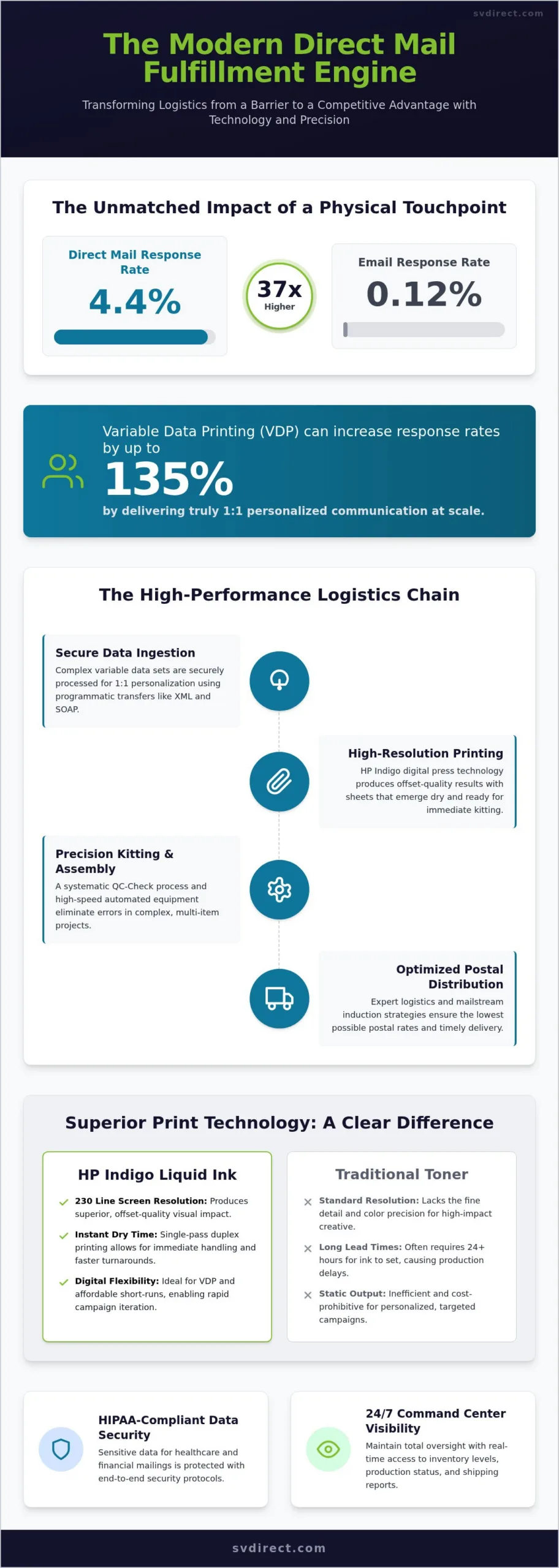
Direct mail achieves an average response rate of 4.4 percent, which is nearly 37 times higher than the 0.12 percent average for email. You likely already know that physical touchpoints build a level of trust that digital ads simply can’t touch. However, the logistical friction of managing high-volume campaigns often feels like a barrier to that success. Between manual kitting errors and the long wait times typical of traditional offset printing, it’s easy for a high-potential strategy to get bogged down in operational delays. High-impact direct mail fulfillment requires a more sophisticated, tech-driven approach that prioritizes both speed and precision.

In this guide, you’ll learn how to master the complexities of modern mail logistics, from the precision of variable data printing to secure, automated kitting. We’ll show you how professional 3PL execution doesn’t just move paper; it drives campaign ROI through smarter, more transparent workflows. We’ll explore how to integrate print and mail seamlessly, leverage personalization to boost response rates by up to 135 percent, and optimize your strategy to capture the lowest possible postal rates. By the end, you’ll have a clear roadmap for turning complex logistics into a steady, reliable engine for business growth.

Key Takeaways

  • Discover why HP Indigo liquid ink technology and 230 line screen resolution produce superior visual impact compared to traditional toner.
  • Optimize your direct mail fulfillment by using Variable Data Printing (VDP) to achieve personalized 1:1 communication at any scale.
  • Eliminate assembly errors with a systematic QC-Check process designed to manage complex kitting and multi-item inventory with precision.
  • Secure sensitive data using HIPAA-compliant protocols and programmatic transfers like XML and SOAP for healthcare-specific mailing.
  • Maintain total oversight of your campaign with 24/7 access to real-time inventory and shipping reports through a proprietary command center.

What is Direct Mail Fulfillment and Why Does It Matter in 2026?

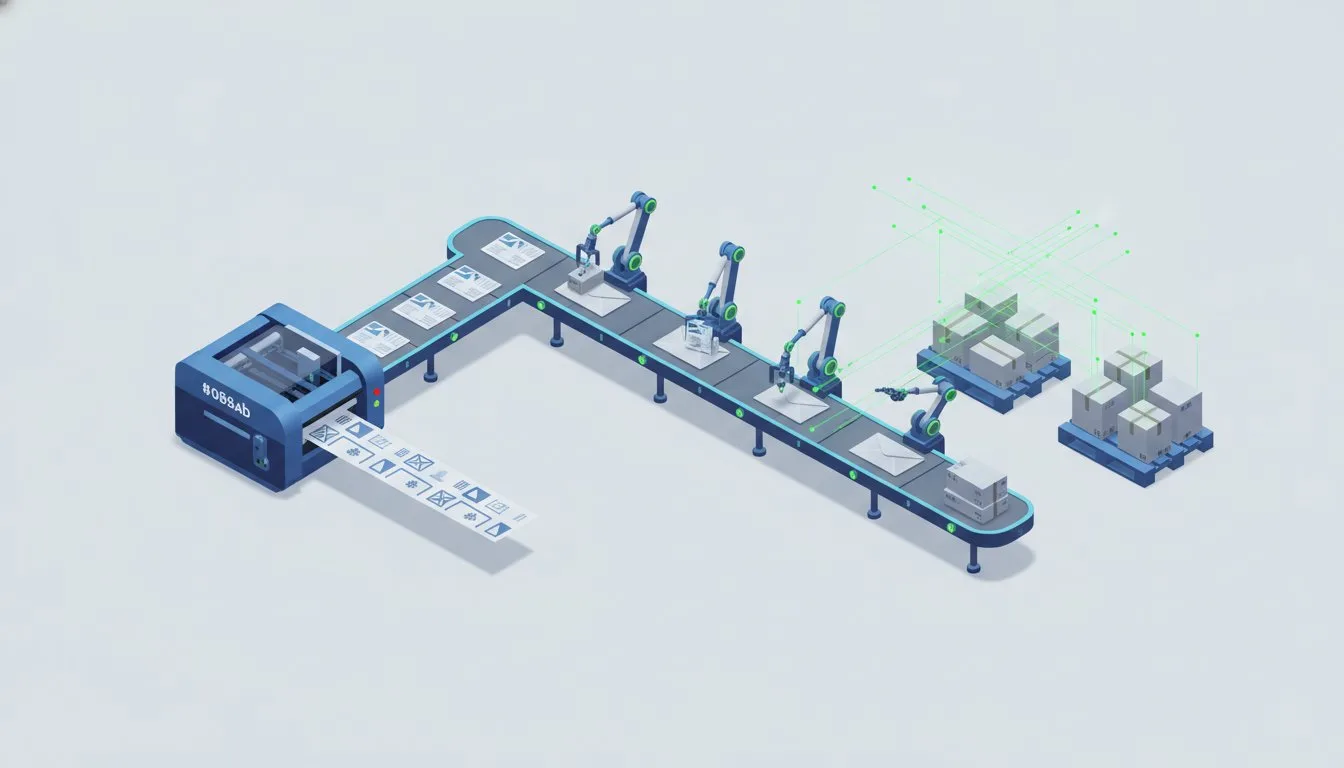
Direct mail fulfillment is the comprehensive end-to-end process of transforming digital marketing concepts into tangible, delivered assets. The process encompasses everything from secure data management and high-resolution printing to precise kitting and final postal distribution. As digital channels become increasingly saturated, the strategy has shifted away from generic bulk mail. Modern campaigns now focus on data-driven, personalized physical touchpoints that bridge the gap between a brand’s digital presence and a customer’s mailbox. For a foundational Direct Mail Overview, it’s clear that the medium’s strength lies in its physical reliability and high engagement rates compared to fleeting digital ads. This tangible connection is what drives real brand recall.

Success in 2026 requires more than just a printer; it demands a sophisticated logistics partner. A professional 3PL acts as a strategic extension of your marketing department, handling the technical heavy lifting of direct mail fulfillment so you can focus on creative strategy. The core of this operation relies on three pillars: robust data integration, superior print technology, and expert postal optimization. When these elements align, your campaign becomes a high-performance engine capable of driving significant ROI. This partnership allows for a level of operational readiness that internal teams rarely achieve alone, bringing a Silicon Valley innovation mindset to national fulfillment. This shift turns logistics from a hurdle into a competitive advantage.

The Logistics Chain: From Digital File to Mailbox

Outsourcing your logistics provides immediate access to high-speed automated equipment. Precision is non-negotiable in this environment. While traditional offset printing requires massive runs, digital short-runs offer an affordable alternative for targeted campaigns. This flexibility allows you to iterate quickly without being tied to aging inventory. By leveraging Silicon Valley 3PL fulfillment services, businesses gain the scale and precision needed to execute complex mailings with total confidence.

The Technology of Response: High-Resolution Printing and VDP

The technical core of high-impact direct mail fulfillment has evolved far beyond the capabilities of standard office-grade toner. Modern campaigns rely on the HP Indigo 5500 Digital Press, a machine that utilizes 230 line screen resolution to produce offset-quality results with digital flexibility. This high-resolution output ensures that every gradient, fine line, and brand color appears with surgical precision. Unlike traditional methods that require 24 hours for ink to set, this press utilizes single-pass duplex printing where sheets emerge dry and ready for immediate handling. This efficiency is vital for fast-turnaround projects that can’t afford the luxury of a drying rack. While the technology is sophisticated, the goal is simple: create a physical asset that demands attention the moment it’s held.

A critical component of this technological shift is the implementation of Variable Data Printing (VDP). Variable Data Printing (VDP) is the ability to change copy or images on every sheet within a single run. This allows for a level of 1:1 communication that was previously impossible or cost-prohibitive. As you scale these personalized efforts, it’s essential to ensure your messaging aligns with broader FTC Compliance Guidelines regarding consumer offers and data usage. By marrying high-resolution output with compliant data practices, you build a foundation of trust and professional quality that digital ads simply can’t replicate.

Variable Data: Personalization at Scale

Personalization is the primary driver of modern engagement. Research indicates that personalized mail campaigns can lift response rates by up to 135 percent compared to static mailings. Because VDP is integrated into the digital workflow, it’s not much more expensive than standard color printing, making it a highly accessible tool for brands of all sizes. To achieve the best results, always provide images at a minimum of 300 dpi. This ensures that every personalized element, from a custom map to an individual’s name, remains crisp and professional. If you’re ready to see how these specs translate to your project, you can request a free quote for your next run.

Liquid Ink vs. Traditional Toner

The choice between real liquid ink and standard toner is often the difference between a premium feel and a budget appearance. Liquid ink technology offers superior color density control and virtually eliminates the “dot gain” issues common with older systems. This results in a sharper image that maintains its integrity across long print runs. Because the ink bonds more effectively with the paper fibers, the colors remain consistent from the first sheet to the ten-thousandth. This stability is a hallmark of professional on-demand digital printing, ensuring that your brand identity is never compromised by mechanical fluctuations. The fact that these sheets emerge dry also allows our team to identify and solve potential assembly issues immediately, keeping your project on a strict, methodical timeline.

Scaling Complexity: Kitting, Assembly, and Inventory Control

Direct mail fulfillment reaches its highest level of complexity during the assembly phase. Kitting is the systematic process of combining multiple components, such as personalized letters, brochures, and promotional premiums, into a single, cohesive package. This stage requires more than just manual labor. It demands a structured workflow that prevents the high error rates common in traditional warehouses. When a campaign involves thousands of unique combinations, the logistics must be as precise as the printing technology that preceded it.

To maintain absolute accuracy, every project undergoes a rigorous QC-Check process. This systematic verification ensures that every item in a kit is present and correctly positioned before the package is sealed. For clients distributing high-value products or electronics, we implement serial number tracking. This level of inventory control provides a transparent audit trail for every unit that leaves the facility. It ensures that premium assets are accounted for from the moment they enter storage until they reach the recipient’s hands, providing the stability and reliability required for high-stakes marketing initiatives.

Managing Literature and Product Fulfillment

Strategic inventory management extends to the storage and distribution of marketing collateral, including technical manuals, sales brochures, and press kits. Many organizations utilize our Kitting and Assembly Services to manage the delicate balance between print-on-demand assets and long-term storage items. This is particularly effective for the Point of Purchase (POP) distribution model. In this scenario, we support national retail networks by ensuring every storefront receives the exact mix of promotional materials required for a specific campaign launch. This synchronized distribution eliminates the waste associated with over-shipping and ensures brand consistency across all locations.

Tradeshow and Event Logistics

The momentum of a live event is easily lost without rapid follow-up. Our logistics team manages the entire lifecycle of tradeshow materials, including pre-show assembly of attendee bags and post-show inventory returns. We also handle lead inquiry fulfillment. When a prospect expresses interest at a booth, we can trigger the immediate delivery of a physical follow-up kit while the interaction is still fresh. We manage these high-volume deadlines through a “quiet facility” methodology. This approach emphasizes methodical organization and calm execution, ensuring even the most stressful event schedules are met with precision. This proactive stance allows your team to focus on the event itself while we manage the physical infrastructure behind the scenes.

Direct Mail Fulfillment: The 2026 Strategic Guide to High-Impact Logistics

Direct Mail Compliance: HIPAA and Data Security

Seamless integration is achieved through the use of WSDL and UDDI for standardized web service descriptions. This approach allows for platform-agnostic XML communication, ensuring our systems talk to yours regardless of the underlying software architecture. This technical flexibility is a core component of our Healthcare Mailing Services. By prioritizing standardized communication within our direct mail fulfillment workflows, we eliminate the friction of custom coding and reduce the risk of data loss during complex cycles.

Improving Deliverability Through Database Cleansing

Wasted postage is a significant drain on campaign ROI. Database cleansing is a proactive step that identifies and corrects outdated addresses, duplicates, and formatting errors before the printing process begins. This ensures your message actually reaches its intended recipient. Additionally, list procurement services help you find the right people for highly targeted campaigns, rather than wasting resources on a broad, uninterested audience. We provide detailed campaign effectiveness reporting to give you the visibility needed for future optimization. This data-driven approach turns raw information into a strategic asset for your brand.

The 24/7 Command Center: Remote Control™ and Visibility

Visibility is the antidote to the stress of large scale logistics. While traditional vendors often leave clients in the dark regarding shipment status or stock levels, high performance direct mail fulfillment requires a more transparent approach. We provide this through Remote Control™, our proprietary online data management system. This platform isn’t just a basic portal; it’s a 24/7 command center that gives you the power to place orders, track real time progress, and check inventory levels from any location. By centralizing these functions, we eliminate the communication gaps that typically lead to project delays.

Transparency is backed by deep data. The system allows you to generate over 120 standard reports, providing a granular look at every facet of your campaign’s lifecycle. You don’t have to wait for a weekly check in to know your status. Automated email notifications keep you informed the moment events occur, including alerts for low inventory, receipts of new materials, and backorder statuses. This steady flow of information ensures that stakeholders remain in a state of informed confidence, knowing that the physical operations are as organized as the digital tracking. It’s a methodical way to manage complex, high stakes distributions without the guesswork.

Real-Time Inventory and Order Management

Stockouts are the silent killers of marketing momentum. Real time visibility into your assets prevents these gaps by allowing you to anticipate needs before they become emergencies. Through our Remote Order Management system, you can see exactly what’s on the shelf at any given second. This is especially critical for multi component campaigns where a single missing item can stall the entire kitting process. To ensure a seamless experience for your internal team, the web interface can be customized to match your corporate branding, making the platform feel like a natural part of your existing workflow. This integration reinforces our role as a steady, reliable partner in your business growth.

The SVD Partnership: Proactive Problem Solving

Technology is only as effective as the experts behind it. Our “Nine Promises” philosophy defines our commitment to acting as a true extension of your marketing department, rather than just a third party vendor. We take a proactive stance by identifying and resolving potential order conflicts before they ever impact your project timeline. This dedication to personal oversight is a primary signature of our service. Our team values direct human connection and takes collective pride in the accuracy of our work. You can explore our Customer Testimonials to see how this blend of high tech efficiency and human expertise has built long term trust with brands across the country. We don’t just move mail; we manage your brand’s physical presence with deliberate care and operational readiness.

Mastering the Future of Physical Engagement

The success of your marketing strategy depends on the precision of your backend operations. High-impact direct mail fulfillment is no longer a manual task; it’s a data-driven science that requires cutting-edge infrastructure and human expertise. By leveraging HP Indigo 5500 liquid ink technology, your brand achieves a visual sophistication that standard toner cannot replicate. When you combine this quality with the 24/7 transparency of the Remote Control™ system, you gain total oversight of your marketing assets from any location.

Silicon Valley Direct has been refining these complex logistics since 1999. We don’t just act as a vendor; we function as a steady hand and a proactive partner dedicated to your long-term growth. Our commitment to personal oversight ensures that every kitting project and secure data transfer is handled with surgical accuracy. You can step into your next campaign with the confidence that your logistics are managed by experts who value your time as much as your brand’s integrity.

We’re ready to help you turn complex logistical challenges into a seamless engine for business growth.

Direct Mail Fulfillment Frequently Asked Questions

What is direct mail fulfillment?

Direct mail fulfillment is the comprehensive end to end process of printing, kitting, and distributing physical marketing materials to a target audience. It transforms a digital marketing concept into a tangible delivered asset. This logistical workflow includes secure data management, high resolution printing, precise manual or automated assembly, and final induction into the postal system for national distribution. It’s the physical engine behind every successful offline campaign.

How does digital printing quality compare to traditional offset?

Modern digital printing utilizing HP Indigo 5500 technology matches the high standards of traditional offset. By using a 230 line screen resolution and real liquid ink instead of standard dry toner, the output achieves superior color density and image sharpness. This allows brands to maintain premium quality while benefiting from the speed and personalization capabilities that digital workflows provide. It’s a high performance solution for modern brands.

Is variable data printing (VDP) expensive?

Variable data printing is a highly affordable option because it eliminates the need for the expensive plate changes required in offset printing. Since every sheet is printed digitally, changing names, images, or offers on individual pieces doesn’t add significant production time. This makes personalized direct mail fulfillment accessible for targeted campaigns that prioritize high response rates and ROI without a substantial increase in production costs.

How long does it take for digital prints to dry before mailing?

Digital prints from our facility emerge dry and ready for immediate handling the moment they leave the press. Traditional offset printing often requires a full 24 hour drying period before sheets can be safely handled or kitted. Our single pass duplex technology removes this delay, allowing for faster assembly and significantly shorter lead times for your time sensitive projects. This operational readiness keeps your campaign moving.

Can you handle HIPAA-compliant healthcare mailings?

We provide specialized healthcare mailing services that are fully compliant with HIPAA regulations. Our systems use secure XML and SOAP protocols for programmatic data transfer, ensuring that sensitive patient information remains protected throughout the process. Every stage of the fulfillment cycle is designed with data security as a primary priority to meet the rigorous standards of the medical industry. It’s a steady hand for sensitive communications.

What is a proprietary fulfillment system like Remote Control™?

Remote Control™ is our proprietary web based management system that provides 24/7 visibility into your inventory and orders. It functions as a transparent command center where you can place orders, track shipping status, and generate over 120 detailed reports. Automated email notifications for low stock or backorders ensure you stay informed without needing to request manual updates. This level of visibility alleviates the stress of logistics management.

What file resolution is best for direct mail printing?

To ensure the highest quality output, all artwork and images should be provided at a minimum resolution of 300 dpi. This standard allows our high resolution digital presses to capture fine details and smooth gradients without pixelation. Using the correct resolution is vital for maintaining brand integrity, especially when utilizing variable data printing for personalized images and complex layouts. It’s the first step toward a high impact physical asset.

How to Choose a Fulfillment Center: 2026 3PL Guide

How to Choose a Fulfillment Center: 2026 3PL Guide

With effective shipping costs climbing by up to 12% in 2026 despite more modest headline rate increases, your logistics partner is no longer just a vendor; they’re a critical factor in your brand’s survival. You’ve likely felt the sting of hidden pick and pack fees or the anxiety that comes when inventory visibility vanishes into a black hole. Mastering how to choose a fulfillment center is about reclaiming that lost control and ensuring your 3PL acts as a steady, reliable hand during periods of rapid growth. It’s frustrating when rigid, automated systems prevent you from adding the custom branding touches your customers expect, especially when shipping delays threaten to erode hard-earned trust.

This guide provides the essential criteria for selecting a partner that operates as a seamless, high-tech extension of your company. We’ll move beyond basic warehousing to explore the technical benchmarks, proactive service models, and the Remote Control visibility you need to lead your industry. You’ll learn how to identify a partner that marries high-tech integration with high-touch precision, ensuring your operations remain organized, efficient, and ready for whatever the 2026 market demands. By the end of this guide, you’ll have a clear framework for vetting partners based on their ability to provide transparency, scalability, and personal commitment.

Key Takeaways

  • Shift your perspective to view a fulfillment partner as a strategic extension of your marketing and sales teams rather than a mere warehousing cost.
  • Ensure total operational visibility by prioritizing partners that offer 24/7 real-time reporting through proprietary systems like Remote Control™.
  • Master how to choose a fulfillment center that provides the flexibility for specialized kitting and on-demand digital printing to protect your brand identity.
  • Look for a systematic “QC-Check” methodology that emphasizes human oversight and proactive problem-solving to maintain customer trust.
  • Audit your technical needs for API and XML integration to guarantee a seamless digital connection between your store and the fulfillment floor.

Beyond Warehousing: The Strategic Role of a Fulfillment Partner

Many brands treat logistics as a simple line item on a budget. It’s time to shift that perspective. A professional Fulfillment house isn’t just a place to store boxes; it’s a strategic asset that can determine your brand’s longevity. When you’re learning how to choose a fulfillment center, you’re actually looking for a partner that acts as a seamless extension of your marketing and sales departments. This is where your digital brand promise meets the physical world.

Think about the moment a customer unboxes their order. That experience represents the final stage of your marketing funnel. If the package is messy or the items are incorrect, your marketing spend and customer acquisition efforts are wasted. A professional partner thinks outside the box of traditional supply chain strategy to ensure every shipment reinforces your reputation. Transitioning from in-house logistics to professional Silicon Valley 3PL fulfillment services marks the shift from merely surviving growth to managing it with absolute precision.

Scalability Without the Hectic Atmosphere

High-volume warehouses are often defined by chaos and noise. However, true efficiency isn’t found in a frantic pace. It’s found in a quiet, organized facility where every movement is deliberate and tracked. This methodical approach is vital when you scale. During peak seasons, a calm environment leads to significantly fewer errors and higher precision. You need a partner that uses sophisticated prioritization controls to manage tight deadlines regardless of volume. This internal stability ensures your business handles sudden surges in orders without sacrificing the quality your customers expect.

Aligning with the Nine Promises of Service

Flexibility is the cornerstone of a successful long-term partnership. Rigid, cookie-cutter procedures often fail businesses with complex needs or custom branding requirements. It’s essential to find a partner who listens to your unique goals and adapts their workflow to meet them. This human element is what differentiates a vendor from a teammate. A “make-it-right” attitude means that when challenges arise, your partner is already working on a proactive solution rather than waiting for your call. Understanding how to choose a fulfillment center means prioritizing a relationship built on these core promises of reliability, transparency, and personal commitment.

Evaluating Technology: Integration and Real-Time Control

A truly modern fulfillment partner speaks the same language as your tech team. Relying on a simple graphical user interface (GUI) is fine for occasional checks, but high-volume businesses require a programmatic interface. We utilize XML, SOAP, and WSDL to ensure platform-agnostic communication that integrates directly with your existing systems. This setup allows your developers to use specific methods like AddOrder and GetOrderInfo for real-time transaction processing. It eliminates manual data entry and reduces the risk of human error. Our Remote Order Management system is designed to act as a digital bridge between your storefront and our operational floor.

Customizing the Web Interface

Your fulfillment portal should feel like a part of your brand, not a third-party afterthought. We offer the ability to customize the web interface to match your corporate branding. This is especially valuable for B2B users or internal teams who require a “company store” look and feel. Beyond aesthetics, this interface provides the real-time inventory visibility necessary to prevent the disaster of overselling. When your digital storefront and warehouse are perfectly synced, you protect your customer trust and your bottom line. If you’re ready to see how a high-tech partnership can stabilize your growth, you can explore our customized logistics solutions today.

Operational Flexibility: Specialized Services that Scale Brands

Standard pick-and-pack models often fall short when a business requires more than just moving a box from one shelf to another. If your brand relies on complex subscription boxes or promotional kits, “cookie-cutter” solutions will likely lead to assembly errors and inconsistent presentation. When you evaluate how to choose a fulfillment center, look for a facility that excels in kitting and hand assembly. This level of operational flexibility allows you to scale without compromising the intricate details that define your brand identity. For high-value electronics or sensitive healthcare products, we provide serial number tracking to ensure every unit is accounted for throughout its entire lifecycle. Our Silicon Valley 3PL fulfillment services are built around this need for precision and bespoke problem-solving.

Integrating On-Demand Digital Printing

Integrating logistics with on-site production creates a powerful synergy that most providers ignore. We utilize HP Indigo 5500 digital presses, which use liquid ink technology rather than standard dry toner. This produces a 230 line screen resolution, delivering offset-quality results with the speed of digital production. Because these sheets are “dry-to-touch” immediately upon leaving the press, we can move them directly into kitting or assembly without the delays associated with traditional offset drying times. Our print on demand services allow you to maintain low inventory levels while ensuring your marketing materials are always current and professional.

Variable Data Printing for Personalization

Personalization is a key driver of customer retention in 2026. Variable Data Printing (VDP) enables us to print unique copy, names, or targeted offers on every individual sheet within a single production run. Imagine a customer opening a package to find a personalized insert that addresses them by name and suggests products based on their specific purchase history. This level of attention significantly enhances the unboxing experience and builds long-term loyalty. VDP is highly affordable, typically costing only slightly more than static printing. You can learn more about using these techniques to drive physical engagement in our guide to direct mail marketing services.

How to Choose a Fulfillment Center: 2026 3PL Guide

The Human Factor: Quality Control and Proactive Problem Solving

While robotics and AI dominate modern logistics headlines, the human element remains the ultimate fail-safe for brand integrity. High-performance fulfillment depends on people who are deeply committed to the outcome of every shipment. When you’re evaluating how to choose a fulfillment center, don’t overlook the culture of the warehouse floor. We employ a rigorous “QC-Check” methodology, which is a systematic inspection process that occurs at multiple points along the assembly line. This ensures that every kit and package meets your exact specifications before it’s sealed. It’s the difference between catching a mistake on the dock and hearing about it from an unhappy customer.

The physical environment of a warehouse is a direct indicator of its precision. A quiet, organized facility is a mark of operational maturity and efficiency. In chaotic, high-noise environments, errors are almost inevitable. By maintaining a calm and structured workspace, our dedicated team can focus on complex hand assembly projects with total concentration. This proactive stance allows us to identify potential issues before they become shipping delays, protecting the trust you’ve built with your audience. Proactive problem solving is always superior to reactive customer service, as it prevents the damage to your reputation before it occurs.

Anticipating Conflicts Before They Impact Projects

We prioritize a “listen first” approach to client relationships. By taking the time to understand your specific business goals, our experienced staff can anticipate conflicts that an automated system would simply miss. For example, if an order configuration appears unusual or a shipping destination seems incorrect, a human teammate will flag it for review before the label is even printed. This direct human connection is a powerful differentiator in a tech-saturated market. We explicitly reject impersonal, automated help desks, ensuring you always have a steady, wise hand guiding your logistics operations.

Sustainable and Green Fulfillment Initiatives

Sustainability is a core expectation for brands in 2026. Our green printing processes are designed to be environmentally responsible by eliminating the need for traditional film, plates, and toxic chemicals. By utilizing advanced digital technology, we significantly reduce the waste associated with overproduction. We also maintain partnerships for the responsible recycling of digital press hardware and offer 30% recycled or FSC-certified paper options. These initiatives allow you to align your physical operations with your brand’s environmental values without sacrificing the high-quality resolution your customers expect.

Final Selection: A Framework for Choosing Your 3PL

Selecting a logistics partner is one of the most consequential decisions for your brand’s operational health. This framework simplifies how to choose a fulfillment center by focusing on technical depth, physical precision, and human commitment. Moving beyond simple storage requires a partner that views your inventory as their own. By following a structured vetting process, you ensure that your 3PL acts as a steady hand during periods of rapid growth rather than a bottleneck that restricts your potential.

Vetting a partner requires asking direct questions about their operational benchmarks. Inquire about their inventory accuracy rates and how their QC-Check methodology prevents systematic errors. If your brand uses high-quality marketing inserts, ask about the drying time of their printed materials. Using liquid ink technology allows for immediate handling, whereas traditional methods might extend your lead times. For brands dealing with sensitive inventory, verify if they offer serial number tracking and secure warehousing for high-value electronics. These details reveal whether a provider is truly equipped for complex, high-stakes fulfillment.

The Importance of a Silicon Valley Edge

Proximity to an innovation hub matters. Being located in a center of global connectivity impacts how a fulfillment partner leverages technology. This geographic identity serves as a symbol of innovation, ensuring your logistics strategy benefits from the same forward-thinking energy that drives the tech sector. This edge is particularly valuable when managing global shipping services, where technological integration and proactive problem solving are required to navigate international complexities. A partner rooted in an innovative environment is more likely to offer the sophisticated Remote Control visibility necessary to manage a modern, distributed supply chain with confidence.

Securing Your Brand’s Operational Future

Mastery of how to choose a fulfillment center is the difference between a business that merely survives and one that dominates its market. You’ve learned that a 3PL should be more than a warehouse; it’s a strategic extension of your team. By auditing technical requirements for 24/7 Remote Control™ visibility and prioritizing a proprietary QC-Check systematic inspection process, you protect your customer trust and your bottom line. Specialized capabilities like complex kitting and high-resolution HP Indigo digital printing allow your brand to maintain its unique identity as you scale globally.

Choosing a partner who rejects automated interactions in favor of direct human oversight ensures that your most complex projects receive the attention they require. This steady, methodical approach to logistics alleviates the stress of growth, allowing you to focus on innovation while we handle the precision of your physical operations. We remain committed to your long-term stability through proactive problem solving and operational transparency.

Building a resilient supply chain requires a partner who values precision and personal commitment as much as you do. We’re ready to provide the steady hand and innovative technology your business deserves to thrive in 2026 and beyond.

Frequently Asked Questions

How do I know if my business is ready for a fulfillment center?

You’re ready when order volume prevents you from focusing on core growth or when shipping errors start damaging customer trust. If you’re spending more than 10 to 15 hours a week on packing, it’s time to learn how to choose a fulfillment center. Outsourcing allows you to leverage expert infrastructure and professional kitting services. This transition ensures your brand maintains a steady hand during rapid expansion.

Is variable data printing expensive for personalized fulfillment?

Variable data printing (VDP) is highly cost-effective and typically costs only slightly more than static printing. It allows for unique names, offers, or images on every sheet within a single run. By integrating VDP into your fulfillment workflow, you create a high-touch unboxing experience that drives customer retention. This small investment often yields a high return by turning standard shipments into personalized marketing assets.

What is the difference between digital and offset quality in 2026?

Modern digital technology, such as the HP Indigo 5500, delivers a 230 line screen resolution that rivals traditional offset quality. Unlike older toner-based systems, liquid ink technology provides sharp details and vibrant colors. Digital printing eliminates the need for expensive plates and film, making it ideal for short runs and on-demand projects. It offers the precision of offset with the speed and flexibility required for modern logistics.

How long does it take for digital prints to be ready for shipping?

Digital prints are ready for shipping almost immediately because they are “dry-to-touch” upon leaving the press. This eliminates the lengthy drying times associated with traditional offset printing, which can delay projects by several days. Our integrated workflow allows printed materials to move directly from the press to the kitting and assembly line. This speed is essential for maintaining tight deadlines and responding quickly to market demands.

Can a fulfillment center handle complex kitting and hand assembly?

A specialized fulfillment center is specifically designed to manage intricate hand assembly and multi-item kitting projects. While automated systems handle standard orders, human expertise is required for precision tasks like subscription box assembly or promotional kits. By utilizing a systematic QC-Check methodology, we ensure every component is placed correctly. This high-touch service acts as a seamless extension of your brand’s commitment to quality and detail.

What technical standards are used for 3PL integration?

We utilize platform-agnostic technical standards like XML, SOAP, and WSDL to ensure seamless programmatic integration. These protocols allow your developers to use methods like AddOrder and GetOrderInfo for real-time transaction processing. This approach provides 24/7 visibility through our Remote Control™ system, which offers over 120 standard reports. Understanding these technical capabilities is a vital part of learning how to choose a fulfillment center for your digital brand.

How does a fulfillment center ensure inventory accuracy?

Inventory accuracy is maintained through a combination of proprietary tracking software and systematic human oversight. We use a QC-Check methodology that inspects inventory at multiple points, from receiving to final assembly. Our Remote Control™ system provides real-time visibility into stock levels, preventing the risks of overselling or unexpected backorders. This methodical approach in a quiet, organized facility ensures that your physical stock always matches your digital records.

What are the environmental benefits of digital printing in logistics?

Digital printing significantly reduces environmental impact by eliminating the toxic chemicals, film, and plates used in traditional offset methods. It supports a “print-on-demand” model, which prevents the waste of overproduction and obsolete inventory. We also offer sustainable options like 30% recycled and FSC-certified paper. These initiatives allow you to align your logistics operations with modern green standards while maintaining a high-resolution, professional brand presentation.

batch delivery to carrier

Batch Delivery to Carrier for Faster Ecommerce Shipping

When an online order is packed and labeled, the next few minutes matter more than many teams realize. A parcel can be perfectly prepared and still lose time if the warehouse-to-carrier handoff is slow, inconsistent, or full of manual checks. For ecommerce brands with rising volume, that handoff often becomes the dividing line between same-day movement and next-day delay.

Batch delivery to carrier is one of the clearest ways to tighten that process. Instead of moving parcels one by one, the operation groups completed shipments into organized handoffs that match carrier pickup routines, manifest requirements, and label workflows. The result is not just speed. It is cleaner execution at the exact point where fulfillment becomes transportation.

What batch delivery to carrier means in ecommerce fulfillment

In practical terms, batch delivery to carrier means multiple orders are prepared, labeled, verified, and handed off together rather than as isolated shipments. The batch may be tied to a pickup window, a carrier service level, a destination region, or a system-generated shipping file. The core idea is simple: fewer interruptions, fewer repeated steps, and a more structured release from warehouse operations to carrier custody.

That sounds operational, because it is.

A strong batch process connects three separate activities that often live in different systems: order release, shipment creation, and physical pickup. When those activities are coordinated, teams avoid the stop-and-start rhythm that slows many ecommerce warehouses. Orders move from queue to label to staging area with less friction, and carriers receive freight in a format that is easier to accept and scan.

This is why the phrase matters to growing brands. Batch delivery is not just a status update on a tracking page. It is a workflow choice that shapes labor efficiency, shipping cutoff performance, and how reliably packages enter the carrier network.

Why batch delivery improves shipping speed and handoff efficiency

The biggest gain from batching is that it removes repeated administrative work. If staff print labels individually, validate exceptions individually, and hand cartons over in a piecemeal way, the operation burns time at every touchpoint. Batching compresses those touches into a repeatable sequence.

It also supports cleaner carrier acceptance. A grouped handoff is easier to stage at the dock, easier to count, and easier to reconcile against a manifest or system file. That matters because carrier pickups usually run on fixed windows. When the freight is staged and documented before the driver arrives, the transfer is faster and more dependable.

There is also a cost angle. SVDirect notes that last-mile delivery can account for roughly 53% of total shipping expense. Batching will not rewrite last-mile economics by itself, but it can reduce preventable waste around missed pickups, late first scans, and avoidable rework before parcels enter that expensive final leg.

Batching tends to reduce friction in these places:

  • Label generation
  • Order verification
  • Dock staging
  • Carrier handoff
  • First-scan readiness

How carrier batch shipping and manifest workflows work

Carrier and postal systems do not all treat batching the same way. Some center the process on shipment-file imports. Others focus on manifests and acceptance records. The warehouse still has the same job, which is to produce shipments in a form the downstream network expects.

UPS provides a clear example through its batch file shipping workflow. UPS states that users can create up to 250 shipments at once by uploading a CSV or SSV file. The platform also allows users to preview imported shipments in the Shipping Cart before printing labels, and specific shipment errors can be fixed without re-importing the entire batch. That kind of structure is valuable because it keeps exceptions from derailing the full release.

USPS approaches the problem differently. Postal guidance describes an electronic manifest transmitted on or before the mailing date for USPS Ship parcels. USPS also notes that each piece in a manifest mailing carries a unique ID and postage amount, while verification processes can identify unmanifested packages, duplicate packages, and misshipped errors when the first scan ZIP Code does not match the expected drop-ship location.

The differences matter because a batch is only “fast” if it matches the carrier’s operating logic.

Workflow area Example from carrier or postal system Operational impact
Batch shipment creation UPS batch file shipping can create up to 250 shipments from one uploaded file Faster label creation for grouped orders
Pre-print review UPS Shipping Cart allows preview and targeted edits before labels print Fewer full-batch reworks
Manifest transmission USPS electronic manifest is sent on or before mailing date Better visibility and acceptance control
Piece-level accountability USPS manifest records unique IDs and postage by piece Easier verification against physical mail
Recurring pickup model FedEx regularly scheduled pickups are designed for daily shippers with predictable volume More stable pickup timing for steady volume

A sophisticated fulfillment operation builds around these carrier rules rather than forcing a one-size-fits-all shipping flow across every parcel type.

Scheduled carrier pickups and recurring volume planning

Batching parcels is only half the job. The other half is making sure the carrier arrives at the right cadence to keep those batches moving.

FedEx states that regularly scheduled pickups are intended for daily shippers with predictable volume, that they occur every business day, and that at least one package is expected per regularly scheduled pickup. FedEx also requires shipping automation for recurring parcel pickups, including approved shipping software or services. That tells ecommerce brands something important: batching works best when system automation and pickup planning are treated as one operating model, not two separate tasks.

For brands shipping every day, recurring pickup structures create rhythm. Orders can be released against known cutoff times. Warehouse teams can pack to a firm deadline. Customer service can speak more confidently about same-day movement because the transportation handoff is not being improvised each afternoon.

A disciplined pickup plan usually includes a few core controls:

  • Pickup window: a consistent time the carrier expects freight to be ready
  • Minimum release standard: enough completed orders to justify the batch
  • System automation: labels, service selection, and shipment data created inside approved tools
  • Exception path: a clear process for orders that miss the main batch cutoff

This is where many scaling brands gain real momentum. Predictable pickups turn shipping speed from a heroic effort into routine execution.

Where batch delivery fits into same-day ecommerce fulfillment

Same-day shipping is often discussed as a warehouse promise, but it is really a coordinated chain of events. Orders must import on time. Inventory must be accurate. Labels must print without delay. The carrier must receive the freight before the service cutoff. Batch delivery sits near the end of that chain, and if it breaks down, the entire promise weakens.

That is why automation matters so much. When ecommerce platforms, order management systems, and carrier tools are connected, batches can be generated with fewer manual decisions. A 3PL that offers same-day order shipping, broad platform integrations, custom API support, and double-verified order accuracy can turn batch delivery into a repeatable system instead of a last-minute scramble. The operational upside is significant for startups and growing brands that cannot afford shipping inconsistency.

No minimum order requirements can matter here as well. Not every brand ships at enterprise volume every day. Some need a process that works for 20 orders on Monday and 400 orders on Friday. A mature batch-delivery workflow should flex with demand while still protecting handoff speed, scan accuracy, and reporting visibility.

In that setting, batch delivery becomes part of a larger fulfillment architecture rather than an isolated warehouse tactic.

Common batch delivery mistakes that slow carrier handoff

Most batch problems are not caused by the idea of batching itself. They come from weak controls around data, timing, and physical staging.

A batch can fail when labels are printed before address issues are resolved, when cartons are not staged by service level, when the manifest count does not match the floor count, or when late orders are injected into a closed batch without a clear exception process. Each mistake adds minutes. Enough minutes turn into missed pickups or delayed first scans.

The most common trouble spots look like this:

  • Late order release: picking and packing start too close to carrier arrival
  • Manifest mismatch: file totals do not match the actual parcel count
  • Mixed staging: services, destinations, or carrier types are blended at the dock
  • Weak scan discipline: no proof that every parcel entered the batch
  • Manual exception handling: small data errors hold up large groups of orders

USPS verification rules show why this discipline matters. Postal systems can identify unmanifested or duplicate packages, and misshipped errors may be logged if the first scan ZIP Code does not match the expected drop-ship location. In other words, the downstream network is checking the quality of the handoff whether the shipper is ready for that scrutiny or not.

Metrics that show whether batch delivery is working

Teams improve batch delivery fastest when they track a short list of operational metrics rather than relying on anecdotal feedback. The goal is to see whether the batch is moving quickly, accurately, and in sync with carrier timing.

A useful scorecard often includes:

  • Batch close time
  • Pickup on-time rate
  • First-scan latency
  • Manifest accuracy
  • Orders shipped same day

Those numbers reveal where the process is tight and where it still leaks time. If first scans lag even when packages are staged early, the issue may be the pickup schedule. If same-day shipping slips despite on-time pickups, the delay may be happening upstream in picking, packing, or label creation. If manifest accuracy drifts, the warehouse may need better verification before freight leaves the floor.

For brands that want faster ecommerce shipping, that is the real opportunity. Batch delivery to carrier is not just a shipping term. It is a measurable operating discipline that can sharpen speed, reduce avoidable friction, and make fulfillment performance more dependable as order volume grows.

seattle 3pl

SVDirect 3PL Services in Seattle for Fast Shipping

If you are looking for a Seattle 3PL partner that can keep orders moving without adding operational drag, Silicon Valley Direct (SVDirect) is built for that job. We provide end-to-end ecommerce fulfillment, warehousing, integrations, and specialized logistics support for growing online brands across the USA, including Seattle businesses that need reliable West Coast execution.

SVDirect operates from Union City, California and supports nationwide and international shipping with same-day fulfillment, no minimum order requirement, and a service model that includes a dedicated account manager and real human phone support. For Seattle ecommerce teams, that means you can hand off picking, packing, inventory handling, and shipping workflows to a 3PL that is structured for speed, accuracy, and scale.

Seattle 3PL fulfillment for ecommerce brands that need same-day shipping

Seattle brands operate in a market shaped by serious logistics infrastructure. The city highlights access to waterborne, rail, truck, and air freight, along with proximity to the Port of Seattle, SEA Airport, and direct highway and rail connections, as a competitive advantage for businesses that depend on moving goods efficiently.

SVDirect helps you turn that market opportunity into a working fulfillment operation. We handle ecommerce order fulfillment, warehousing, pick-pack-ship workflows, and inventory management so your Seattle team can focus on growth instead of daily warehouse issues.

When fast delivery matters, SVDirect gives Seattle 3PL customers same-day shipping backed by a double-verified 100% order accuracy process. That combination is especially important when your brand is trying to protect margins, reduce reships, and keep customer reviews strong.

“SVDirect combines same-day shipping with double-verified 100% order accuracy.”

You also do not need to wait until you hit a large order threshold to get professional fulfillment support. SVDirect has no minimum order requirement, which makes the service practical for startups, product launches, seasonal promotions, and growing brands that want better logistics before warehouse problems get expensive.

SVDirect warehousing and fulfillment services for Seattle DTC, wholesale, and specialty programs

SVDirect supports more than basic parcel shipping. Our Seattle 3PL service offering covers direct-to-consumer fulfillment, wholesale order handling, warehousing, inventory control, and specialized programs that need more than a standard pick-and-pack flow.

That matters if your business ships across channels. A Seattle seller may need to fulfill website orders, marketplace orders, retail replenishment, sample kits, printed collateral, or promotional items from one operational setup instead of stitching together multiple vendors.

SVDirect also offers print-on-demand, literature fulfillment, healthcare fulfillment, and presorted mail services. For brands with more complex order profiles, that can reduce handoffs and make inventory, packaging, and reporting easier to manage.

“With 26+ years of warehousing and fulfillment experience, SVDirect gives Seattle brands a seasoned 3PL partner.”

Here is what Seattle businesses can hand off to SVDirect:

  • Ecommerce order fulfillment and same-day shipping
  • Warehousing and inventory management
  • Pick, pack, and ship operations
  • Shopify, Amazon, WooCommerce, and other platform integrations
  • Custom API support and workflow automation
  • Print-on-demand and literature fulfillment
  • Healthcare logistics and specialty fulfillment programs
  • Reporting through a 24/7 customized web portal

SVDirect is also a strong fit when your operation is evolving. If you are moving from founder-packed orders to a formal fulfillment model, or from simple DTC shipping to a mix of DTC and wholesale, we can support that transition without forcing you into a rigid minimum-volume structure.

Seattle ecommerce integrations, reporting, and human support that reduce manual work

Many fulfillment issues start long before an order reaches the packing station. They start with disconnected systems, manual exports, missing inventory visibility, and slow exception handling.

SVDirect addresses that directly with 80+ preconfigured integrations plus custom API support. We work with ecommerce platforms including Shopify, Amazon, and WooCommerce, which helps Seattle brands automate order flow, reduce manual entry, and keep inventory and shipping data more consistent across systems.

“SVDirect supports 80+ preconfigured integrations and custom API connections for Seattle ecommerce operations.”

Once your orders are live, visibility matters just as much as speed. SVDirect gives you a 24/7 customized web portal with extensive reporting, so your team can check order status, inventory movement, and fulfillment activity without waiting for manual updates.

Support is also built into the model. SVDirect assigns a dedicated account manager and provides real human phone support, which is important when you need a quick answer on inventory questions, shipping exceptions, wholesale requirements, or a time-sensitive launch.

Why a Union City fulfillment hub works for Seattle 3PL customers

Not every Seattle company needs a warehouse inside Seattle city limits to get strong fulfillment performance. Many need a dependable West Coast 3PL that can ship quickly, integrate cleanly with their selling channels, and scale with demand.

SVDirect’s Union City facility supports Seattle businesses that want West Coast reach with nationwide and international shipping capability. For brands balancing regional demand, national growth, and cross-border opportunities, that setup can simplify fulfillment without limiting where you sell.

Seattle is part of a major trade ecosystem, and the broader Seattle-Tacoma gateway handled 3.3 million TEUs in 2024. SVDirect aligns well with that kind of commerce environment because we are built around operational discipline, system connectivity, and shipping execution rather than one-size-fits-all warehousing.

If you want firsthand confidence in how your products are stored and shipped, SVDirect welcomes on-site warehouse visits in Union City. That is useful for Seattle teams that want to audit processes, review packaging workflows, or confirm how inventory will be handled before committing.

When SVDirect is the right Seattle 3PL partner

SVDirect is a strong fit when you need more than box-moving. We are especially relevant if your Seattle business wants fulfillment support that is flexible enough for growth and structured enough for day-to-day control.

SVDirect is worth a closer look if you are dealing with situations like these:

  • You need same-day shipping and high order accuracy for ecommerce orders
  • You want a Seattle 3PL solution without minimum order requirements
  • Your business sells through Shopify, Amazon, WooCommerce, or multiple channels
  • You need both DTC and wholesale fulfillment support
  • You want a dedicated account manager instead of ticket-only support
  • Your team needs custom reporting, inventory visibility, or API-based automation
  • You ship to customers across the USA, or into Canada and other markets

Trust also comes from operating history and customer experience. SVDirect has focused on warehousing and fulfillment for over 26 years, and customer testimonials describe prompt, accurate shipping over more than six years of service, including support for automated shipping systems and both direct-to-consumer and wholesale orders.

Talk with SVDirect about your Seattle 3PL requirements

If your Seattle business needs a 3PL partner that can ship the same day, integrate with your ecommerce stack, and support growth without minimum-order barriers, SVDirect is ready to help.

Reach out to SVDirect to discuss your order volume, platforms, product mix, and shipping goals. We can help you build a fulfillment setup that makes daily operations easier and gives your customers a faster, more dependable delivery experience.

WooCommerce Fulfillment Services: The 2026 Strategic Guide to Scaling Your Online Store

WooCommerce Fulfillment Services: The 2026 Strategic Guide to Scaling Your Online Store

What if the very growth you’ve worked so hard to achieve becomes the bottleneck that stifles your brand’s reputation? It’s a common crossroads for successful e-commerce leaders who find that manual data entry and shipping errors are suddenly draining their team’s energy. You’ve built a beautiful storefront, but scaling effectively requires a bridge to the physical world that doesn’t sacrifice precision. By integrating professional woocommerce fulfillment services, you can automate your order flow and regain the real-time inventory visibility necessary for the 2026 market.

We understand that your products are more than just SKUs; they’re promises made to your customers. You deserve a partner that treats complex kitting and custom packaging with the same care you do. In this guide, you’ll learn how to transition from reactive shipping to a proactive logistics strategy that reduces costs while elevating your brand presentation. We’ll walk through the technical integrations and systematic quality checks that ensure every package serves as a high-performance touchpoint for your business. This is about more than just moving boxes; it’s about building a stable foundation for your company’s future.

Key Takeaways

  • Learn how to automate your order flow by integrating professional woocommerce fulfillment services to eliminate manual data entry errors.
  • Gain real-time inventory visibility through advanced XML and SOAP protocols that connect your digital storefront directly to a proprietary reporting system.
  • Elevate your brand presentation by integrating high-resolution digital printing and liquid ink technology into your custom kitting and packaging workflow.
  • Reduce shipping overhead and transit times by leveraging managed postage solutions and a deliberate, organized logistics methodology.
  • Discover how to evaluate a fulfillment partner as a proactive extension of your team, ensuring flexibility for bespoke projects rather than rigid, automated interactions.

What Are WooCommerce Fulfillment Services and Why Do You Need Them?

WooCommerce fulfillment represents the entire order fulfillment process that begins the moment a customer clicks “buy” on your WordPress site. It encompasses receiving, processing, and shipping products with precision. Many growing brands start by packing boxes in a garage, but as order volume increases, this manual approach creates a ceiling for growth. Utilizing professional woocommerce fulfillment services allows you to shift from a reactive, hectic environment to a methodical, scalable operation. Effective woocommerce fulfillment services bridge the gap between your digital presence and the physical package arriving at a customer’s door.

Think of your fulfillment partner as a proactive extension of your internal team. They shouldn’t just be a vendor; they should be a high-performance partner that understands your brand’s unique needs. This means looking “outside the box” to include high-quality marketing inserts or custom kitting that makes every delivery feel like a premium experience. When your logistics team, backed by decades of experience since 1999, anticipates order conflicts before they impact a project, you gain the quiet confidence needed to scale without stress.

The Limitations of Manual Order Processing

Scaling a WooCommerce store requires moving beyond the constraints of a home office or small warehouse. Manual data entry is often the first point of failure during peak sales seasons. Without real-time synchronization between your storefront and your inventory, you risk selling items you don’t have in stock. These errors damage customer trust and lead to expensive returns. Relying on manual labor for complex tasks like kitting or custom assembly often results in inconsistencies that a professional system can eliminate.

The Value of Professional 3PL Partnerships

Partnering with a seasoned provider gives you immediate access to established infrastructure designed for national and global reach. You benefit from sophisticated quality control measures, such as the systematic QC-Check process, which ensures accuracy before a package ever leaves the facility. These 3PL fulfillment services handle the mechanical nature of logistics, freeing your internal team to focus on high-level marketing and product development. By outsourcing these operations, you ensure that your physical delivery matches the high-tech efficiency of your digital storefront.

How API Integration Bridges Your Store and the Warehouse

Modern woocommerce fulfillment services rely on more than just a basic plugin; they require a robust technical bridge that ensures your digital storefront and physical warehouse operate as a single unit. While many platforms suggest simple extensions, a professional 3PL uses platform-agnostic communication via XML and SOAP protocols. This standardized approach ensures your store speaks the same language as the fulfillment center, regardless of future software updates or site customizations. This real-time data exchange transforms your operation from a series of manual tasks into a programmatic, automated flow.

This integration provides the quiet confidence that comes from total transparency. By moving away from rigid, cookie-cutter plugins, you gain a system that adapts to your specific business logic. It’s a high-performance solution that handles the mechanical nature of data transfer while you focus on the human element of growing your brand.

The Role of Web Services in Fulfillment

Web services allow external applications to communicate seamlessly without manual intervention. When a customer completes a purchase, the “AddOrder” method programmatically moves that data from your WooCommerce cart directly to the warehouse floor. It’s an instantaneous transfer that eliminates the risk of manual data entry errors. Once the package is in motion, the “GetOrderInfo” method retrieves real-time shipping data and tracking numbers, pushing them back to your dashboard. This cycle also effectively manages reverse logistics, ensuring that returns are processed with the same systematic precision as outbound shipments.

Remote Control™: Your Window into the Warehouse

Visibility shouldn’t stop at the checkout page. A proprietary online data management system provides 24/7 access to your physical operations from anywhere in the world. With the Remote Control™ system, you can access over 120 standard reports that monitor inventory levels, order history, and project status. These aren’t just static numbers; they’re actionable insights that allow you to anticipate needs before they become conflicts.

The system also provides automated notifications for low inventory levels and backorders, acting as a steady hand that monitors your stock around the clock. You can even customize the web interface to match your corporate brand identity, ensuring that your internal tools feel like a true extension of your company. This level of technical integration turns woocommerce fulfillment services into a proactive marketing asset. If you’re ready to see how a high-performance partner can streamline your digital storefront, you can request a free quote to discuss your specific integration needs.

Strategic Advantages of Outsourcing WooCommerce Logistics

Transitioning your logistics to a professional facility replaces the daily chaos of manual packing with a steady, methodical rhythm. You’ve built a brand that deserves a stable foundation, and professional woocommerce fulfillment services provide exactly that. By moving away from a hectic home office or small warehouse, you adopt a deliberate methodology backed by an extensive operational history dating back to 1999. This shift doesn’t just save space; it creates a high-performance environment where your physical delivery finally matches the quality of your digital storefront.

High-volume deadlines shouldn’t cause panic. A seasoned partner uses established infrastructure to handle complex projects regardless of their scale. You gain immediate cost-efficiency through managed postage and discounted shipping rates, allowing you to reinvest that capital into marketing. Most importantly, a proactive partner identifies order conflicts before they reach the customer. This “steady hand” approach alleviates the stress of growth, ensuring that your expansion is supported by precision and a personal commitment to your brand’s reputation.

Precision Through the QC-Check Process

Accuracy is never an accident. It’s the result of the systematic QC-Check process that governs every stage of assembly and packing. In an organized facility, quiet confidence replaces the noise of inefficient business models. Every project benefits from systematic inspections that uphold a “make-it-right” attitude. This level of detail eliminates shipping errors that often plague in-house operations, ensuring that your customers receive exactly what they ordered, perfectly presented every time. This rigorous attention to detail is a core component of 3PL fulfillment services that prioritize quality over sheer speed.

Global Reach and Reliable Shipping

Managing a global footprint requires navigating complex shipping lanes for both B2B and B2C channels. Whether you’re shipping domestic orders or managing international logistics, you need a partner that remains at the cutting edge of innovation. A strategic location serves as a symbol of global connectivity, allowing you to leverage the latest technological advancements in the industry. Effective returns management is also essential; it builds customer trust by making the process seamless and professional. By outsourcing these logistics, you ensure that your brand remains accessible and grounded, no matter how far your products travel. This proactive stance ensures your woocommerce fulfillment services act as a true extension of your company’s values.

WooCommerce Fulfillment Services: The 2026 Strategic Guide to Scaling Your Online Store

Advanced Fulfillment: Digital Printing and Custom Kitting

Scaling an online store involves more than just shipping boxes. It requires a high-performance partner that can turn every delivery into a marketing asset. Advanced woocommerce fulfillment services integrate on-demand digital printing directly into the fulfillment workflow. This allows you to include personalized inserts or custom literature without the need for massive pre-printed inventory. By using Variable Data Printing (VDP), you can tailor messages to specific customer segments, creating a bespoke experience that builds long-term loyalty. This proactive approach ensures your physical branding remains as agile as your digital marketing campaigns.

The choice of technology matters for brand perception. Liquid ink technology provides a distinct advantage over standard toners used by many basic facilities. It produces a professional, high-end feel that matches the quality of your products. This attention to detail ensures that the physical touchpoint of your brand is just as sophisticated as your digital storefront. When your logistics partner manages these elements in-house, you eliminate the delays and communication gaps often found when using multiple vendors.

On-Demand Printing with the HP Indigo 5500

We utilize the HP Indigo 5500 to deliver offset-quality results within the fast-paced fulfillment cycle. This press achieves a 230 line screen resolution, providing sharp, vibrant images for your marketing materials. Because it uses real liquid ink technology, the output is dry immediately. This efficiency allows for instant handling and insertion into your orders, preventing any delays in the shipping process. It’s a high-tech solution that supports the rapid pace of modern eCommerce.

This approach is also grounded in sustainability. Digital printing eliminates the need for physical plates and harsh chemicals associated with traditional offset methods. You can print exactly what you need, when you need it, reducing waste and keeping your marketing collateral current. This seamless integration of print-on-demand capabilities ensures your fulfillment operation remains agile and responsive to market changes.

Complex Kitting and Hand Assembly

Bespoke projects often require a human touch that automated systems can’t replicate. Whether you’re launching a subscription box or a high-value promotional kit, systematic assembly is crucial. Our team manages complex kitting for a variety of industries, including software packages, apparel, and healthcare materials. We prioritize precision, ensuring that every kit is assembled according to your exact specifications.

Delicate or high-value items benefit from careful hand assembly. This process ensures that every component is placed exactly where it belongs, maintaining a professional brand presentation. For a deeper look at how these processes streamline your operations, see our guide on Kitting and Assembly Services. This meticulous approach to physical operations is what sets elite woocommerce fulfillment services apart from basic shipping vendors.

Choosing the Right Partner for WooCommerce Fulfillment

Selecting a partner for your woocommerce fulfillment services shouldn’t be a transactional decision based on price alone. It’s about finding a steady hand that understands the high-stakes nature of growing a business. A partner with a history dating back to 1999 brings a level of stability and expert-level service that automated platforms simply cannot match. You need an organization that views itself as a proactive extension of your team, not just a vendor moving boxes. This partnership allows you to alleviate the stress of growth through precision and personal commitment. When you choose a provider that prioritizes the human element, you gain a high-performance partner that remains accessible and grounded.

Rigidity is the enemy of innovation. Many providers force you into cookie-cutter procedures that stifle your brand’s unique needs. Instead, look for a partner committed to total flexibility and bespoke problem-solving. Evaluating a provider based on their “Nine Promises” of service ensures they prioritize precision over mere volume. This human oversight is a powerful differentiator in a market saturated with impersonal interactions. Choosing the right woocommerce fulfillment services means selecting a team that values transparency and directness, ensuring your physical operations are just as organized as your digital communication.

Questions to Ask Your Potential 3PL

Before committing to a provider, you must ensure their infrastructure can support your specific trajectory. Ask direct questions to gauge their operational readiness and technical capabilities:

  • Do you provide 24/7 real-time access to my inventory and order data through a proprietary reporting system?
  • Can you handle variable data printing for my marketing collateral to ensure a professional brand presentation?
  • What is your specific process for quality control and systematic error prevention?

A partner who can answer these questions with specific details about their QC-Check process or liquid ink printing technology demonstrates the seasoned professionalism your brand deserves. This clarity ensures that your store can scale without the bottlenecks of shipping errors or inventory blind spots.

The Silicon Valley Direct Difference

The marriage of technology, customer service, and marketing expertise creates a high-performance environment. Long-term staff retention serves as a hallmark of internal stability, ensuring that the people handling your products are seasoned experts. Our proactive attitude is backed by physical infrastructure and human expertise rather than just marketing abstractions. We take the time to explain the rationale behind our specific processes, from inventory management to global logistics, guiding you from a state of curiosity to informed confidence.

By focusing on building long-term partnerships rather than transactional relationships, we ensure your physical operations are just as organized as your digital strategy. We invite you to explore our Silicon Valley 3PL Fulfillment Services to see how we bridge the gap between your digital storefront and physical delivery with quiet confidence and operational readiness.

Future-Proofing Your Store Through Strategic Logistics

Scaling your brand requires a transition from manual effort to automated precision. Integrating professional woocommerce fulfillment services allows you to bridge the gap between digital storefronts and physical delivery. We’ve discussed how technical integrations like XML and SOAP ensure your data flows without error, while high-resolution tools like the HP Indigo 5500 Digital Press turn every package into a premium marketing touchpoint.

Since 1999, we’ve focused on being more than a vendor. We act as a steady hand and a proactive extension of your team. With our proprietary Remote Control™ system and its 120 plus standard reports, you maintain total visibility over your inventory around the clock. You don’t have to navigate the complexities of global logistics alone. A partnership grounded in multi-decade experience provides the stability you need to focus on growth.

It’s time to move beyond transactional shipping and embrace a deliberate, organized methodology that respects your time and your brand’s reputation. We invite you to experience the difference that precision and personal commitment can make for your business.

We look forward to helping you achieve a seamless and scalable future for your online store.

Frequently Asked Questions

How does WooCommerce integrate with a fulfillment center?

Integration occurs through Web Services using XML and SOAP protocols to create a programmatic bridge between your storefront and the warehouse. When a customer completes a purchase, the “AddOrder” method transmits data instantly to our proprietary system. This automation eliminates the risks associated with manual data entry and ensures that order details move from your digital cart to the physical floor without technical friction. It’s a high-performance solution for modern eCommerce growth.

What is the difference between a fulfillment plugin and a 3PL service?

A fulfillment plugin is a software tool that facilitates data transfer, while a 3PL service provides the physical infrastructure and expertise to handle your inventory. Professional woocommerce fulfillment services offer the warehouse space, labor, and quality control systems required to ship products accurately. While plugins automate the digital “handshake,” a 3PL partner acts as a proactive extension of your team, managing the actual assembly, kitting, and delivery of your physical goods worldwide.

Can I include custom marketing inserts in my WooCommerce orders?

You can include high-quality marketing inserts through on-demand digital printing integrated directly into the fulfillment cycle. By utilizing the HP Indigo 5500 Digital Press, we produce offset-quality inserts that are added to your packages during the kitting process. This allows you to personalize the customer experience without the overhead of storing pre-printed materials. Each insert uses real liquid ink for a professional brand presentation that reflects your company’s standards and attention to detail.

How do I track my inventory levels in real-time?

You track inventory through a proprietary online data management system like Remote Control™. This platform provides 24/7 visibility into your stock levels and order history through over 120 standard reports. Automated notifications alert you to low inventory or backorders, allowing you to manage your storefront proactively. This real-time synchronization ensures your WooCommerce store never sells items that aren’t physically available in the warehouse, preventing customer disappointment and helping you maintain a reliable reputation.

Is variable data printing expensive for small eCommerce orders?

Variable Data Printing (VDP) is highly cost-effective because it eliminates the need for expensive plates and traditional setup costs. Digital printing technology allows for short runs and personalized messaging on a per-order basis without a price penalty. This efficiency ensures that even smaller WooCommerce stores can leverage sophisticated marketing collateral. It transforms every package into a targeted marketing touchpoint while keeping your overhead manageable and your inventory lean for maximum flexibility in your campaigns.

What happens if there is a conflict or error in a customer order?

Our proactive approach identifies potential order conflicts before they impact the project. If an error occurs, the systematic QC-Check process and our “make-it-right” attitude ensure swift resolution. A dedicated team monitors the automated flow to catch anomalies in addresses or SKU combinations. This human oversight, combined with technical precision, alleviates the stress of business growth by maintaining a steady hand on all physical operations and protecting your brand’s reputation for accuracy.

Does a professional 3PL handle international shipping for WooCommerce?

Yes, professional woocommerce fulfillment services manage both domestic and international logistics for B2B and B2C shipments. We navigate complex global shipping regulations and leverage managed postage to reduce transit costs. By using our strategic location as a symbol of innovation and global connectivity, we ensure your products reach customers worldwide efficiently. This comprehensive approach includes handling returns and reverse logistics to maintain customer trust across all geographic borders regardless of the shipping distance.

How does the QC-Check process ensure order accuracy?

The QC-Check process is a systematic inspection methodology that governs every stage of assembly and packing. It involves multiple verification points to ensure that the correct items, inserts, and packaging materials are used for every order. By maintaining an organized facility and a methodical rhythm, we eliminate the common bottlenecks of manual processing. This rigorous attention to detail guarantees that your physical delivery matches the high standards of your digital storefront every single time.