


Common eCommerce Shipping Mistakes: The 2026 Guide to Avoiding Costly Logistics Errors
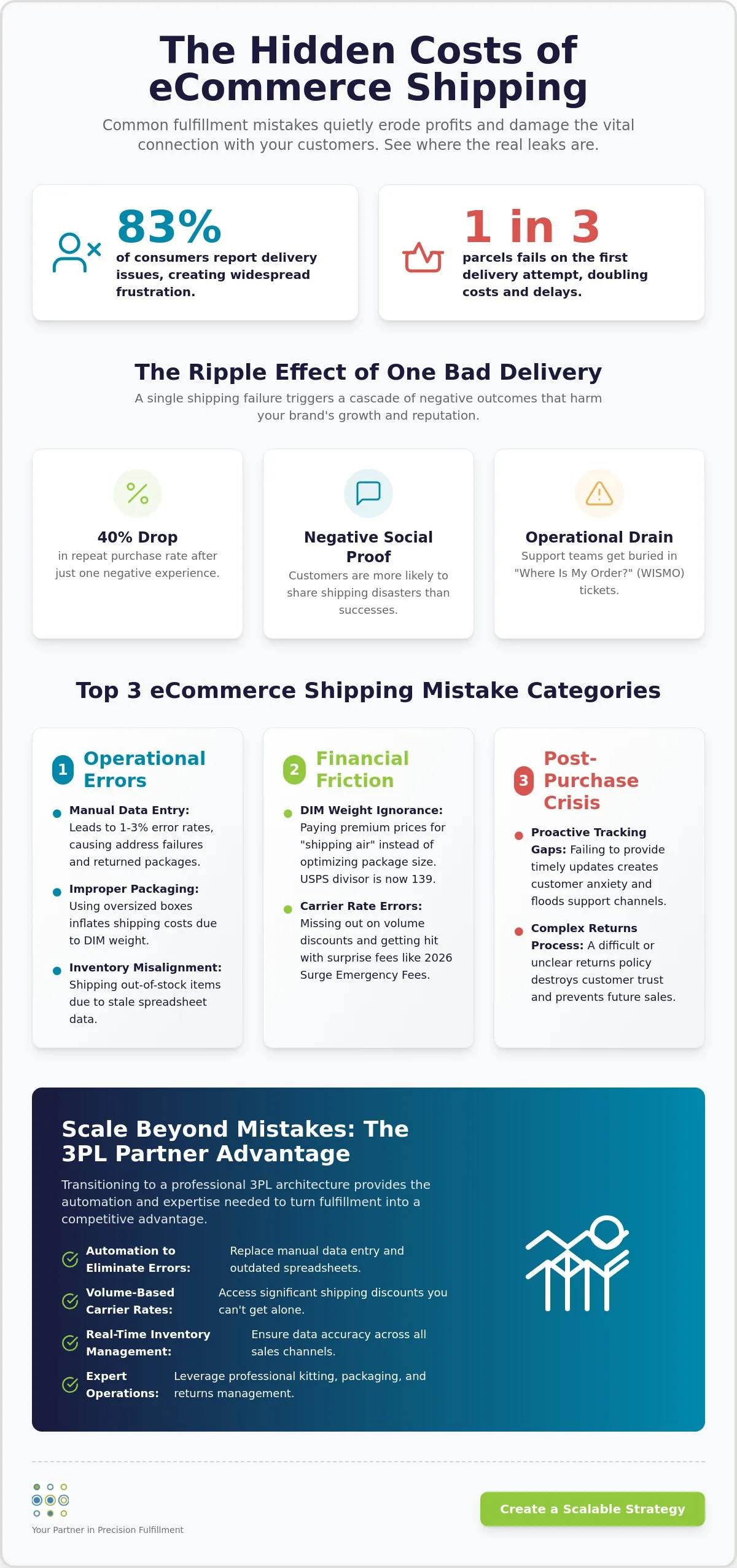
Did you know that 83% of consumers report delivery issues, and one in three parcels fails on the first delivery attempt? For many growing brands, these common ecommerce shipping mistakes aren’t just minor hiccups; they’re systemic failures that erode the human connection you’ve worked so hard to build with your customers. You likely feel the sting of unexpectedly high carrier invoices or the chaos of inventory discrepancies during the kitting process. It’s a heavy burden to carry when you’re trying to scale a business with precision and care.
We understand that the logistics landscape is shifting rapidly. With the USPS dimensional weight divisor changing to 139 and major carriers implementing Surge Emergency Fees in 2026, staying profitable requires more than just luck. This guide promises to identify the hidden errors draining your margins and provide a clear path toward a scalable fulfillment strategy. We’ll examine the technicalities of carrier rates, the nuances of dimensional weight, and the operational shifts needed to ensure every package reflects your brand’s commitment to excellence and reliability.
Key Takeaways
- Recognize that shipping is a critical brand touchpoint where hidden costs like labor and reshipping can quietly erode your profit margins.
- Identify and eliminate common ecommerce shipping mistakes such as manual data entry errors and address failures that lead to undeliverable packages.
- Master the complexities of Dimensional (DIM) weight and carrier rate structures to ensure you aren’t paying premium prices for shipping air.
- Bridge the post-purchase gap by implementing proactive tracking updates and a transparent returns process that secures long-term customer trust.
- Discover how transitioning to a professional 3PL architecture provides the automation and volume-based carrier rates necessary for scalable growth.
The True Cost of Common eCommerce Shipping Mistakes in 2026
In the 2026 digital-first economy, the moment a package arrives on a doorstep is often the only physical interaction a customer has with your brand. Fulfillment is the final test of your promise. When a brand fails this test, the damage extends far beyond a single lost sale. Professional logistics management isn’t just about moving boxes; it’s about protecting the human connection you’ve established through your marketing and product quality. Precision in delivery is the anchor of modern brand loyalty.
Many growing businesses underestimate the financial weight of common ecommerce shipping mistakes. They focus on the surface-level cost of a stamp or a box, but the true erosion happens in the background. Every “Where is my order?” (WISMO) inquiry places an immense psychological burden on support teams, diverting their energy from proactive growth to reactive damage control. Since manual order processes often produce error rates of 1% to 3%, these small slips quickly scale into massive operational headaches that drain your resources. Modern consumers expect instant transparency, and any gap in that data creates immediate friction.
To better understand how these errors can impact a growing business, watch this breakdown of common pitfalls:
Direct vs. Indirect Financial Erosion
The drain on your margins is often split between visible and invisible costs. Direct expenses include return shipping labels, the value of damaged goods, and wasted packaging materials. Indirectly, you face negative social proof, marketplace penalties from platforms like Amazon, and significant operational downtime. The Total Cost of Delivery encompasses the initial postage fee, the labor cost for picking and packing, the expense of packaging materials, and the overhead associated with customer service resolution for any transit issues.
The Brand Reputation Ripple Effect
A single shipping failure can lead to a 40% drop in repeat purchase rates, as trust is much harder to rebuild than it is to establish. Customers are statistically more likely to share a shipping disaster on social media than they are to praise a successful delivery. By fostering a zero-error culture within your warehouse, you turn your fulfillment process into a competitive advantage. This proactive stance ensures that your brand remains a steady, reliable hand in a fast-paced market. For more insights on optimizing your operations, explore our fulfillment blog.
Operational Errors: From Data Inaccuracy to Packaging Pitfalls
Precision is the silent engine of a successful brand. While marketing captures the customer’s attention, your operational workflow determines whether you keep it. Unfortunately, common ecommerce shipping mistakes often begin long before a package reaches the carrier. These errors are frequently rooted in outdated, manual processes that fail to keep pace with the high-velocity demands of 2026. When data is handled carelessly, the human connection you’ve built with your audience is the first thing to break.
Manual data entry remains the primary culprit behind address failures and undeliverable packages. Research indicates that manual processes produce error rates of 1% to 3%, which translates to 10 to 30 errors for every 1,000 orders. These aren’t just statistics; they represent frustrated customers and wasted labor. Beyond data, inadequate packaging creates a difficult balancing act. You must protect the product while maintaining brand aesthetics and controlling costs. Using boxes that are too large or fragile leads to damaged goods and inflated shipping fees, undermining your stability and reliability.
The Danger of Manual Fulfillment Workflows
Spreadsheets are the enemy of scalable growth. They create silos where information becomes stale, leading to inventory misalignment where you accidentally ship items that are actually out of stock. To maintain a proactive stance, businesses must transition to real-time 3PL inventory management software. This technology eliminates the friction caused by API sync errors between your storefront, whether on Shopify or WooCommerce, and the warehouse floor. It ensures that what the customer sees online is exactly what is available on the shelf.
Specialized Assembly and Kitting Mistakes
Kitting errors are particularly damaging because they often involve your most loyal customers, such as subscription box members. Missing components or wrong SKU selections account for 35% to 40% of all order errors. Implementing professional kitting and assembly services introduces necessary Quality Control stations into the pick-and-pack process. By standardizing box sizes and utilizing automated data capture, you reduce the risk of human error during packing. If you’re looking to refine these complex workflows, you might request a personalized logistics assessment to see where precision can be improved. This methodical approach transforms a chaotic warehouse into a high-performance fulfillment center.
Financial Friction: Dimensional Weight and Carrier Rate Errors
Logistics costs are often the largest variable expense for an online business. One of the most persistent common ecommerce shipping mistakes is failing to account for the complex math behind carrier invoices. You aren’t just paying for the physical weight of your products; you’re paying for the space they occupy in a truck or plane. Ignoring these nuances leads to “margin bleed” that can quietly dismantle your profitability while you’re busy focusing on top-line growth.
Carrier selection errors frequently occur when brands choose a service level based on habit rather than real-time data. Choosing the wrong service for a specific destination or failing to audit invoices for late deliveries results in significant waste. With UPS rebranding Demand Surcharges as “Surge Emergency Fees” as of May 31, 2026, and FedEx increasing Disbursement Fees in July 2026, the cost of oversight has never been higher. Companies seeking to avoid these pitfalls often turn to specialist providers like SpeedLink Transport Limited, which offers express and economy delivery solutions tailored to specific business needs. A proactive auditing process ensures you aren’t paying for surcharges that don’t apply to your specific shipments. It takes a steady hand to manage these shifting variables.
Mastering the Math of Dimensional Weight
DIM weight is a pricing technique carriers use to ensure they’re paid for the volume a package occupies. In 2026, this calculation is more critical than ever for your bottom line. Effective July 12, 2026, the USPS dimensional weight divisor changes from 166 to 139. This change effectively increases shipping costs for lightweight, bulky items. The formula is (Length x Width x Height) / Divisor. If the resulting DIM weight is higher than the actual weight, you’re billed at that higher rate. Right-sizing your packaging is the most effective way to stop paying for air.
Navigating International Logistics Surcharges
Expanding into global markets introduces a new layer of complexity where common ecommerce shipping mistakes can lead to seized shipments or unexpected taxes. Utilizing professional global shipping services helps you navigate the choice between Delivery Duty Unpaid (DDU) and Delivery Duty Paid (DDP). The latter is often preferred for a seamless customer experience, though it requires precise calculation of duties upfront. Additionally, incorrect Harmonized System (HS) codes are a major cause of customs delays and fines. Localized fulfillment centers can further mitigate costs by reducing the number of shipping zones a package must cross.
Many brands fall into the ‘Free Shipping’ trap by offering tiers without calculating their internal margins. If your shipping costs increase by 5.9%—the average rate increase for FedEx and UPS in early 2026—but your free shipping threshold remains static, your net profit per order shrinks. It’s a delicate balance that requires constant oversight and a commitment to precision. We believe that physical operations should be just as organized as your digital strategy.
The Post-Purchase Crisis: Tracking Gaps and Returns Management
The customer journey doesn’t terminate at the moment of delivery. In fact, the post-purchase experience is often the most emotionally charged phase of the transaction. Many brands treat fulfillment as a one-way street, but failing to manage the “return trip” is one of the most damaging common ecommerce shipping mistakes. When a customer experiences radio silence after clicking “buy,” their anxiety grows. This lack of proactive communication forces them to seek out information themselves, creating unnecessary friction and straining your support resources. It’s a heavy burden that can be avoided through better data visibility.
Tracking gaps are more than just a technical oversight; they’re a failure of service. If you rely solely on generic carrier links, you’re missing a vital opportunity to reinforce your brand’s reliability. A high-performance logistics partner ensures that data flows seamlessly from the warehouse to the customer’s inbox. Slow refund processing is perhaps the fastest way to lose a customer forever. In an era where 83% of consumers report delivery issues, your ability to handle the “exception” with grace and speed defines your operational maturity. Precision matters most when things go wrong.
Proactive Communication Strategies
Automating notifications for “Out for Delivery” and “Delivered” status updates is no longer optional. It’s a standard expectation. Branded tracking pages allow you to maintain the human connection while providing the high-tech efficiency customers crave. By identifying a shipping “exception” early, you can reach out to the customer before they even notice a delay. This proactive stance transforms a potential logistics failure into a demonstration of personal commitment and professional oversight. It’s about being the steady hand that guides the package home.
Optimizing the Reverse Logistics Loop
A clear returns policy should be viewed as a powerful conversion tool rather than just a legal necessity. When customers know they can send items back without entering a “black hole” of silence, they’re more likely to commit to a purchase. Integrating this returns data back into your inventory management system is essential for maintaining accuracy. For brands dealing with premium goods, utilizing secure warehousing is critical for protecting returned high-value assets during the inspection phase.
Poor returns inspection is a quiet margin killer. Restocking damaged goods into sellable inventory leads to a cycle of disappointment for the next customer. A methodical approach to reverse logistics ensures that every returned item is handled with the same precision as a new order. If you’re ready to eliminate these post-purchase bottlenecks and protect your margins, we invite you to request a free logistics consultation to see how we can stabilize your fulfillment strategy.
Scaling Beyond Mistakes: Why a 3PL Partner is the Ultimate Fix
Scaling an ecommerce brand requires a fundamental shift from “doing everything” to “overseeing excellence.” As your order volume grows, the common ecommerce shipping mistakes that were once minor nuisances become massive drains on your time and capital. Transitioning to a professional 3PL partner allows you to offload the mechanical burden of logistics to experts who treat your products with the same care you do. This isn’t just about outsourcing; it’s about upgrading your entire operational architecture to a level of precision that manual internal teams simply cannot match.
One of the most immediate benefits is the financial relief provided by volume shipping. While individual brands are subject to the full weight of carrier rate increases, a 3PL leverages collective volume to secure significantly lower rates. This helps offset the rising costs of surcharges and DIM weight adjustments we examined earlier. By automating error-prone manual tasks, you eliminate the labor costs associated with reshipping and customer service recovery. This allows your team to focus on product innovation while we handle the heavy lifting of global distribution.
The Technology Advantage of Silicon Valley Direct
Our approach centers on a seamless digital integration that bridges the gap between your storefront and our warehouse floor. We provide real-time accuracy across major platforms, ensuring that your inventory data is never out of sync. Beyond standard fulfillment, we offer specialized direct mail marketing services and customized kitting solutions that allow for total flexibility in how you engage your audience. Whether you’re a startup or a global enterprise, our infrastructure is designed to scale with your ambitions without sacrificing the precision your customers expect.
The Human Element in a Tech-Saturated Market
We explicitly reject the trend of purely automated, impersonal fulfillment. While our systems are high-tech, they’re backed by seasoned professionals who provide personal oversight for every account. This human connection ensures that bespoke problems receive bespoke solutions, preventing the “automated errors” that often plague larger, faceless centers. You gain direct access to logistics experts who understand the nuances of your specific inventory and brand goals. If you’re ready to stop making mistakes and start scaling with confidence, Contact Silicon Valley Direct for a fulfillment audit today. We’re here to be the steady hand that guides your growth through every shift in the 2026 logistics landscape.
Mastering the Future of Your Logistics Architecture
Logistics in 2026 demands a level of precision that manual processes simply cannot achieve. We’ve explored how common ecommerce shipping mistakes, from data inaccuracies to dimensional weight oversights, act as silent drains on your profitability and brand trust. By right-sizing your packaging and automating your reverse logistics loop, you transform a cost center into a competitive advantage that protects your human connection with customers. These operational shifts ensure your brand remains reliable in a fast-paced market.
True scalability requires a steady hand and a sophisticated infrastructure. Since 1999, Silicon Valley Direct has served as a global logistics hub, providing the specialized expertise needed to handle everything from healthcare products to high-value electronics with absolute care. We combine high-tech efficiency with personal oversight to ensure your operations remain organized and your customers stay connected to your brand promise. It’s time to move beyond reactive fixes and build a proactive fulfillment strategy that supports your long-term growth.
Streamline your fulfillment and eliminate shipping errors with Silicon Valley Direct. We look forward to partnering with you on your journey toward operational excellence and sustainable success.
Frequently Asked Questions
What is the most common ecommerce shipping mistake for startups?
The most frequent error for early-stage brands is underestimating the total cost of fulfillment beyond simple postage. Startups often fail to account for labor, packaging materials, and the financial impact of returns. This is one of the most common ecommerce shipping mistakes that leads to early margin erosion. Relying on manual workflows that don’t scale creates a high risk of errors as order volume begins to accelerate.
How do I calculate dimensional weight for my packages?
You calculate dimensional weight by multiplying the package’s length, width, and height and then dividing by the carrier’s specific divisor. For 2026, the USPS divisor has shifted to 139, making volume calculations even more critical for your bottom line. If the resulting DIM weight exceeds the actual physical weight, carriers bill you for the larger value. Right-sizing your boxes is the most effective way to avoid paying for empty space.
Why are my shipping costs higher than my initial estimates?
Unexpected surcharges and Surge Emergency Fees are the primary reasons final costs exceed initial estimates. Carriers frequently add fees for residential delivery, fuel adjustments, and address corrections that aren’t always visible in base rates. Additionally, failing to account for DIM weight instead of actual weight often leads to a significant price gap on your final invoice. A steady hand in auditing these invoices is required to maintain profitability.
What is the difference between DDU and DDP in international shipping?
DDU stands for Delivered Duty Unpaid, meaning the customer pays duties and taxes upon arrival, while DDP or Delivered Duty Paid means the seller handles these costs upfront. DDP is generally preferred for ecommerce because it prevents delivery shock for the customer. Using DDP ensures a smoother post-purchase experience and builds long-term trust through transparency. It reflects a brand’s commitment to a seamless, professional global presence.
How can a 3PL help reduce my shipping error rate?
A 3PL reduces common ecommerce shipping mistakes by replacing manual data entry with automated API integrations and professional Quality Control stations. By using barcode scanning and sophisticated inventory management systems, a professional partner can lower error rates significantly compared to manual setups. This precision protects your margins and prevents the costly reshipping expenses that damage customer loyalty. It transforms fulfillment into a high-performance asset for your business.
What is an HS code and why does it matter for ecommerce?
An HS or Harmonized System code is a standardized numerical method used by customs authorities to classify products for international trade. These codes determine the specific tax and duty rates applied to your shipments. Using the wrong HS code is a major cause of customs delays and fines. Precision in selecting these codes is a critical component of global logistics management that ensures your products move across borders without friction.
How often should I audit my carrier invoices for mistakes?
You should audit your carrier invoices weekly to catch billing errors, late delivery refunds, and incorrect surcharges. Many businesses leave money on the table by ignoring the discrepancy between quoted rates and final charges. A methodical, weekly review ensures you are only paying for the services you actually received. This practice helps you identify systemic packaging issues before they become permanent drains on your capital.
Can I integrate my Shopify store directly with a 3PL warehouse?
Yes, you can integrate your Shopify store directly with a 3PL warehouse through native APIs that sync orders and inventory in real time. This technical integration eliminates the need for spreadsheets and manual data entry, which are the leading causes of fulfillment errors. It allows for a seamless flow of information from the customer’s click to the warehouse floor. This creates a state of informed confidence for both the brand and the end consumer.