img not found!
Custom Branded Packaging Fulfillment: The Strategic Guide to the Unboxing Experience

Custom Branded Packaging Fulfillment: The Strategic Guide to the Unboxing Experience

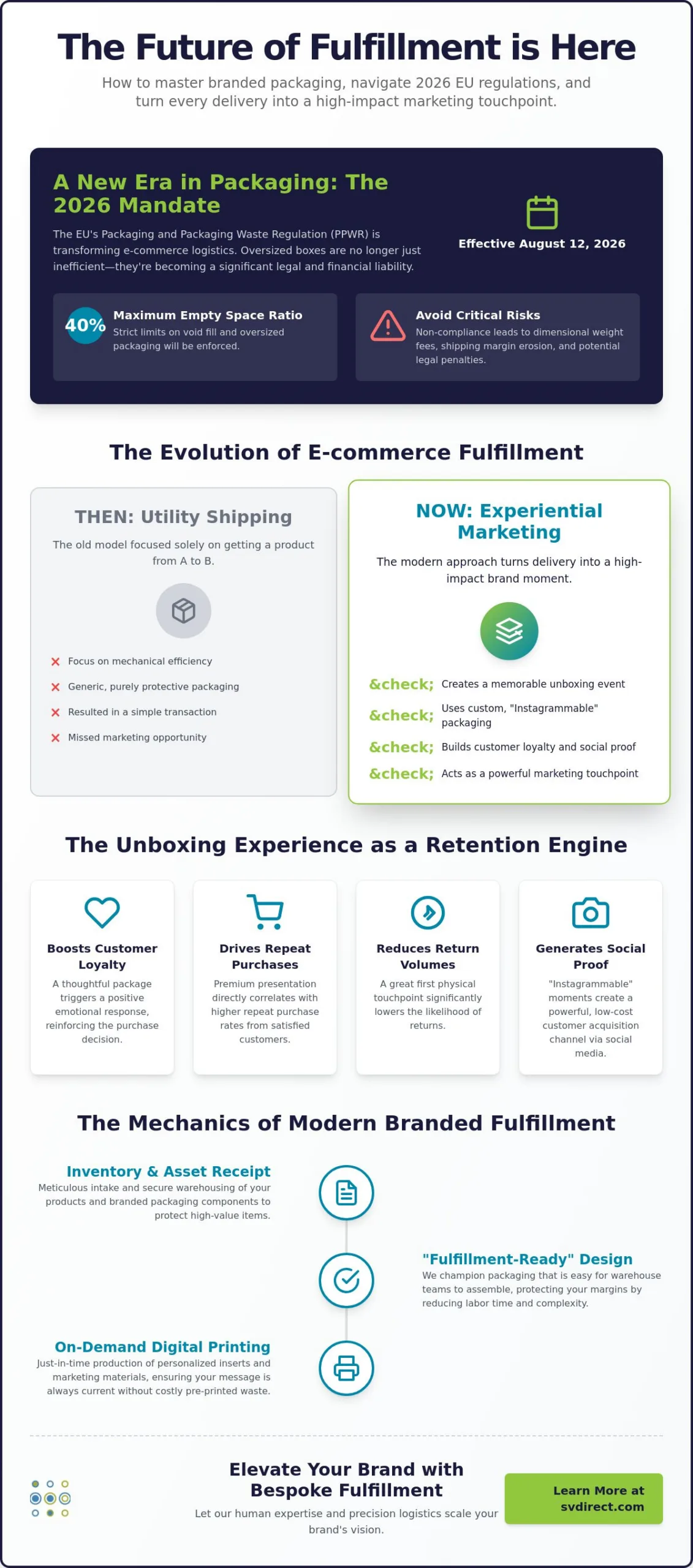
With the EU’s Packaging and Packaging Waste Regulation enforcing a 40% maximum empty space ratio starting August 12, 2026, your oversized custom boxes aren’t just a branding choice; they’re becoming a legal and financial liability. It’s frustrating to watch shipping margins shrink due to dimensional weight fees or complex kitting errors that ruin a customer’s first impression. You’ve worked hard to build a premium brand, and you deserve a logistics process that reflects that quality without the operational headaches. This is where custom branded packaging fulfillment moves from a luxury to a strategic necessity.

We understand that scaling a business requires a steady hand and precision. This guide will show you how to master the art of branded logistics to transform every delivery into a high-impact marketing touchpoint that drives customer loyalty. We’ll explore how to integrate your brand identity into the shipping process, maintain a premium feel at scale, and navigate the tightening regulatory landscape of 2026 with confidence. By the end, you’ll have a roadmap for a seamless, efficient fulfillment operation that protects your bottom line and delights your customers.

Key Takeaways

  • Learn how to transition from basic utility shipping to experiential marketing to drive high-impact customer loyalty.
  • Discover the technical workflow of integrating on-demand digital printing for personalized, just-in-time package inserts.
  • Assess the strategic benefits of custom branded packaging fulfillment to avoid the hidden opportunity costs of managing complex kitting in-house.
  • Master design strategies that protect your margins by optimizing for dimensional weight while reducing warehouse labor time.
  • Explore why a partnership grounded in human expertise and bespoke problem-solving is essential for scaling complex branded logistics.

Beyond the Box: Why Custom Branded Packaging Fulfillment Matters in 2026

In 2026, the definition of success in eCommerce has moved past simple delivery speeds. Custom branded packaging fulfillment is the deliberate integration of your brand’s visual and tactile assets directly into the third-party logistics (3PL) workflow. It’s no longer enough to just get a product from point A to point B. Every shipment represents a physical manifestation of your brand promise, requiring a sophisticated marriage of high-tech precision and human oversight.

The eCommerce landscape has shifted from “utility shipping” to “experiential marketing.” While traditional logistics once focused solely on the mechanical efficiency of moving parcels, modern brands use the delivery phase as a high-impact marketing touchpoint. This evolution demands a partner who can manage complex kitting and assembly without sacrificing the speed that customers expect. It’s about turning a routine delivery into a memorable event.

To better understand how this process works in a modern setting, watch this helpful tutorial:

The psychological impact of the unboxing experience is a primary driver of customer retention. When a customer receives a thoughtfully designed package, it triggers a positive emotional response that reinforces their purchase decision. This moment is the first physical touchpoint in the B2C journey, making it the most critical window for building long-term loyalty. Data continues to show that premium presentation directly correlates with higher repeat purchase rates and lower return volumes.

The Unboxing Experience as a Retention Engine

Beyond pure aesthetics, the “Instagrammability” of a shipment serves as a powerful, low-cost customer acquisition channel. When a customer shares their unboxing on social media, they provide authentic social proof that no paid ad can replicate. We believe that a high-performance fulfillment partner should bridge the gap between 1999-era operational reliability and the cutting-edge requirements of modern digital brands. This ensures that your marketing vision is never compromised by logistical limitations or outdated infrastructure.

Brand Identity vs. Operational Reality

There is often a natural tension between intricate brand designs and warehouse operational efficiency. Complex packaging can slow down pick-and-pack speeds, leading to delays and increased labor costs. To solve this, we advocate for “fulfillment-ready” packaging design. This approach prioritizes structures that are easy to assemble and pack while maintaining a premium feel. At Silicon Valley Direct, our team provides the human oversight necessary to ensure every order meets your exact brand standards. For more insights on scaling your operations, explore our latest updates on the fulfillment blog. Our proactive stance ensures that your brand identity remains intact, even as your order volume grows.

The Mechanics of Branded Fulfillment: From Kitting to the Doorstep

The journey from a digital order to a physical unboxing requires a series of highly synchronized operational steps. While many providers focus solely on the box design, true custom branded packaging fulfillment succeeds or fails on the warehouse floor. It begins with the meticulous receipt of your inventory and branded assets. These components aren’t just stored; they’re managed within a secure warehousing environment that protects high-value items from damage or loss. This foundation of stability ensures that when a promotional set needs to be built, every piece is exactly where it should be.

Once orders arrive, the transition from storage to the packing station must be seamless. This is where digital printing integrates directly with the fulfillment line. Instead of relying on pre-printed, generic inserts that can quickly become outdated, modern systems allow for just-in-time production. This means your latest marketing message or a seasonal promotion can be printed and included in the box seconds before it’s sealed. This level of agility transforms a standard logistics operation into a responsive marketing engine that adapts to your brand’s pace.

Advanced Kitting and Assembly Workflows

Creating a complex unboxing experience often involves more than just placing a product in a box. It requires Kitting and Assembly Services that prioritize precision and aesthetic placement. Our team handles multi-item bundling where every component, from the main product to the smallest custom dunnage, has a specific home. We use tailored inserts to ensure that items don’t shift during transit, preserving the visual impact for the customer. This physical labor is the backbone of branded logistics, ensuring that the structural design of your packaging actually works in a high-volume environment.

On-Demand Printing and Personalization

Personalization is a significant driver of customer connection in 2026. By utilizing on-demand digital printing, you can include personalized packing slips or individualized thank-you notes without the waste of bulk pre-printing. This approach offers a clear cost-benefit by reducing inventory obsolescence and eliminating the need to store thousands of static inserts. Our inventory management software synchronizes directly with print queues, ensuring that every personalized element matches the specific order data perfectly. It’s a high-tech solution that maintains a human touch. If you’re looking to refine these complex workflows, you can consult with our logistics experts to see how we can streamline your process through bespoke solutions.

Strategic Evaluation: Scalability and the Hidden Costs of DIY Packaging

Many growing brands hesitate to move toward professional custom branded packaging fulfillment because they perceive it as a high-overhead luxury. However, the true cost of DIY packaging often stays hidden within a founder’s schedule and operational inefficiencies. When a CEO spends hours kitting complex promotional sets, they’re sacrificing time that should be spent on strategic growth or product development. This opportunity cost is far higher than any professional service fee. Relying on non-standardized, manual processes also increases the risk of shipping errors, which can lead to expensive returns and damaged customer relationships.

A sophisticated 3PL partnership provides a significant financial advantage through discounted carrier rates. Because professional fulfillment centers move massive volumes, they negotiate shipping prices that individual brands simply can’t access. These savings frequently offset the additional cost of premium, branded materials. By shifting to a professional model, you aren’t just buying labor; you’re leveraging a global shipping infrastructure that makes high-end presentation economically viable.

Labor Costs and Pick-and-Pack Fees

Professional kitting fees are typically calculated based on the complexity of the assembly. A simple box with one insert costs less than a multi-item bundle requiring precision placement and custom dunnage. Professional assembly lines operate with a level of speed and accuracy that manual in-house packing can’t match. To calculate the ROI of custom packaging, you must look beyond the per-unit cost. Consider the reduction in customer service inquiries, the increase in social media shares, and the lifetime value of a customer who feels a deep connection to your brand from the very first delivery.

Inventory Management and Storage Efficiency

Managing multiple box sizes, seasonal inserts, and high-value branded components requires significant physical space and organization. Storing these assets in-house often leads to cluttered workspaces and disorganized stock counts. Modern 3PL inventory management software provides real-time visibility into your packaging levels, ensuring you never face a stockout of critical branded components. Missing a specific box size can stall your entire fulfillment pipeline, leading to delays that frustrate customers. A proactive partner monitors these levels continuously, treating your packaging inventory with the same rigor as your primary products.

Custom Branded Packaging Fulfillment: The Strategic Guide to the Unboxing Experience

Optimizing the Unboxing Experience: Design Principles for Seamless Fulfillment

Creating a memorable unboxing experience requires a balance between creative vision and logistical reality. When you design your packaging, you must look beyond the aesthetic appeal and consider how that structure performs within the high-speed environment of custom branded packaging fulfillment. A box that looks beautiful on a designer’s screen might fail in the warehouse if it’s too complex to assemble or too fragile to survive a cross-country journey. To maintain high-impact marketing without sacrificing operational efficiency, your design must follow a set of rigorous principles focused on speed, durability, and cost control.

The first step in any strategic design is auditing the assembly process. You must ensure your packaging can be replicated accurately 1,000 times or more without increasing the risk of kitting errors. We recommend prioritizing “easy-fold” structures that reduce warehouse labor time. Every second saved at the packing station directly improves your margins. Additionally, integrating returns management into the initial design, such as including dual adhesive strips, makes the return process effortless for the customer while protecting the product for potential resale. This proactive approach turns a logistical necessity into a brand-building opportunity.

Balancing Aesthetics with Dimensional Weight

Carrier pricing models are designed to penalize shipments that take up excessive space relative to their weight. DIM weight is a pricing technique used by carriers that calculates a package’s billable weight based on its volume rather than its actual mass. If your custom box is unnecessarily large, you’ll face massive shipping surcharges that erode your profitability. We advise choosing the smallest possible footprint that still delivers a “wow” factor. By using custom inserts to secure products tightly, you can maintain a premium feel while minimizing the overall box dimensions and avoiding the hidden costs of empty space.

Sustainability and Material Selection

Modern consumers increasingly demand eco-friendly, recyclable branded packaging. However, switching to sustainable materials shouldn’t mean sacrificing the durability of your shipment. It’s essential to choose high-quality, recycled corrugated materials that can withstand the rigors of transit. This is especially critical when utilizing Global Shipping Services, where packages may face multiple transfers and varying environmental conditions. By selecting international-ready materials, you ensure that your brand identity remains intact from the moment it leaves our facility until it reaches the customer’s doorstep. If you’re ready to refine your packaging strategy for better performance, contact us for a bespoke fulfillment quote today.

Elevate Your Brand with Silicon Valley Direct’s Bespoke Fulfillment Solutions

In an era where many logistics providers have replaced personal oversight with impersonal automation, Silicon Valley Direct stands as a high-touch alternative. We believe that your brand’s physical presentation is too important to be left to an algorithm. With over 25 years of experience handling complex logistics for both agile startups and established enterprises, we’ve built our reputation on the belief that precision requires a human touch. Our approach to custom branded packaging fulfillment combines the efficiency of modern technology with the methodical care of a dedicated team that treats your inventory as if it were our own.

Our location in the heart of the world’s most innovative tech hub isn’t just a point of pride; it’s a symbol of our commitment to global connectivity and operational excellence. We use high-tech integrations to provide you with real-time visibility and seamless data flow, yet we never let the digital interface replace direct human connection. When you partner with us, you’re gaining a steady hand that understands the nuances of your specific industry. This ensures that every shipment reflects the high standards you’ve worked so hard to establish, maintaining the air of quiet confidence your brand deserves.

Bespoke Kitting for High-Value Brands

Certain industries demand a level of accuracy that goes far beyond standard pick-and-pack. We specialize in handling high-value electronics and sensitive materials with the precision they require. For brands navigating the complexities of medical logistics, our Healthcare Mailing Services guide offers a deep dive into how we manage compliance-heavy needs. We invite you to experience a partnership where your brand’s physical assets are treated with the same enthusiasm and care that you bring to your own business. Our team’s collective experience is a point of pride, ensuring that complex kitting and assembly are executed perfectly every time.

Getting Started: The Transition to Professional Fulfillment

Moving from in-house packing to a professional 3PL is a significant milestone for any growing business. We’ve designed our onboarding process to be transparent and collaborative, alleviating the stress of the transition through clear communication and expert guidance. Our team works closely with you to audit your current packaging workflows, identify opportunities for optimization, and ensure that your brand identity remains consistent during the move. We handle the heavy lifting of inventory transfer and technical integration so you can focus on the strategic growth of your company. It’s time to move beyond the limitations of DIY logistics and embrace a scalable solution. Partner with Silicon Valley Direct for your branded fulfillment needs and see how professional oversight can transform your unboxing experience into a lasting marketing asset.

Transform Your Logistics into a Brand Legacy

Scaling your brand shouldn’t mean losing the personal touch that defines your identity. We’ve explored how designing for dimensional weight and prioritizing “fulfillment-ready” structures can protect your margins while delighting your customers. By transitioning to professional custom branded packaging fulfillment, you trade the burden of manual labor for a scalable marketing engine. This strategic shift allows your team to focus on innovation while we handle the complexities of the physical doorstep experience.

Since 1999, Silicon Valley Direct has served as a reliable partner for brands that demand perfection. As expert kitting and assembly specialists, we provide direct human oversight on every project to ensure your brand standards are met with every order. Our Silicon Valley-based global reach provides the infrastructure you need to grow without limits. We invite you to Request a Custom Fulfillment Quote from Silicon Valley Direct today. Let’s work together to make every delivery a powerful statement of your brand’s quality and commitment.

Frequently Asked Questions

What is the difference between standard fulfillment and custom branded packaging fulfillment?

Standard fulfillment prioritizes basic utility and speed using generic shipping supplies. In contrast, custom branded packaging fulfillment integrates your specific brand assets directly into the warehouse workflow. This process transforms a routine delivery into a high-impact marketing touchpoint. While standard fulfillment focuses solely on the mechanical movement of goods, branded fulfillment prioritizes the tactile experience and emotional connection of the customer.

Does custom branded packaging increase my shipping costs?

Custom packaging only increases shipping costs if the design ignores dimensional weight (DIM) principles. Carriers calculate rates based on box volume, so oversized custom boxes can lead to surcharges. However, our discounted carrier rates often offset the cost of premium materials. By optimizing your box footprint, you can maintain a premium feel without sacrificing your fulfillment margins or operational efficiency.

How do I manage inventory for my custom boxes and inserts?

We manage your branded assets through our integrated inventory management software. Every box, insert, and custom dunnage item is tracked as a unique SKU. This provides you with real-time visibility into stock levels, ensuring you never run out of critical components. Our methodical approach prevents fulfillment delays and ensures your brand standards are met for every single order we process.

Can Silicon Valley Direct help with the actual printing of my brand materials?

Yes, we provide on-demand digital printing for personalized inserts, literature, and packing slips. This allows you to produce marketing materials as needed rather than managing massive bulk inventories. It’s a highly efficient way to keep your seasonal promotions current and add a human touch to every package. Our print queues synchronize directly with your order data for perfect accuracy and speed.

What is the minimum order volume for custom branded kitting?

We don’t believe in a one-size-fits-all approach to custom branded packaging fulfillment. Every project is evaluated based on its specific kitting and assembly complexity. We offer total flexibility and bespoke problem-solving for both high-growth startups and established enterprises. Our team works with you to determine a scalable volume that meets your operational needs while maintaining a high-performance, premium feel for your customers.

How do I ensure my custom packaging is eco-friendly and durable enough for global shipping?

Ensuring durability requires selecting high-quality materials that are specifically tested for global shipping and logistics. We help you choose recycled, eco-friendly options that don’t compromise on structural integrity. This proactive stance ensures your brand identity survives the rigors of transit. By auditing your materials, we ensure they meet the 2026 regulatory standards while protecting your products effectively during long-distance transport.

Can I use custom packaging for international orders?

You can certainly use custom packaging for international orders to maintain brand consistency across all markets. Our global shipping services are designed to handle the complexities of international transit while preserving your brand’s physical presentation. Whether your customer is in San Jose or Singapore, they’ll receive the same premium unboxing experience. We handle the methodical care required for cross-border logistics and compliance.

What happens if a custom-packaged item is returned?

Returns are handled through our professional returns management process. When a custom-packaged item is sent back, our team performs a detailed inspection of both the product and its branded components. We follow your specific brand guidelines to determine if materials can be reused or if they need replacement. This ensures your inventory remains in top condition and that the next customer receives a perfect package.

Common eCommerce Shipping Mistakes: The 2026 Guide to Avoiding Costly Logistics Errors

Common eCommerce Shipping Mistakes: The 2026 Guide to Avoiding Costly Logistics Errors

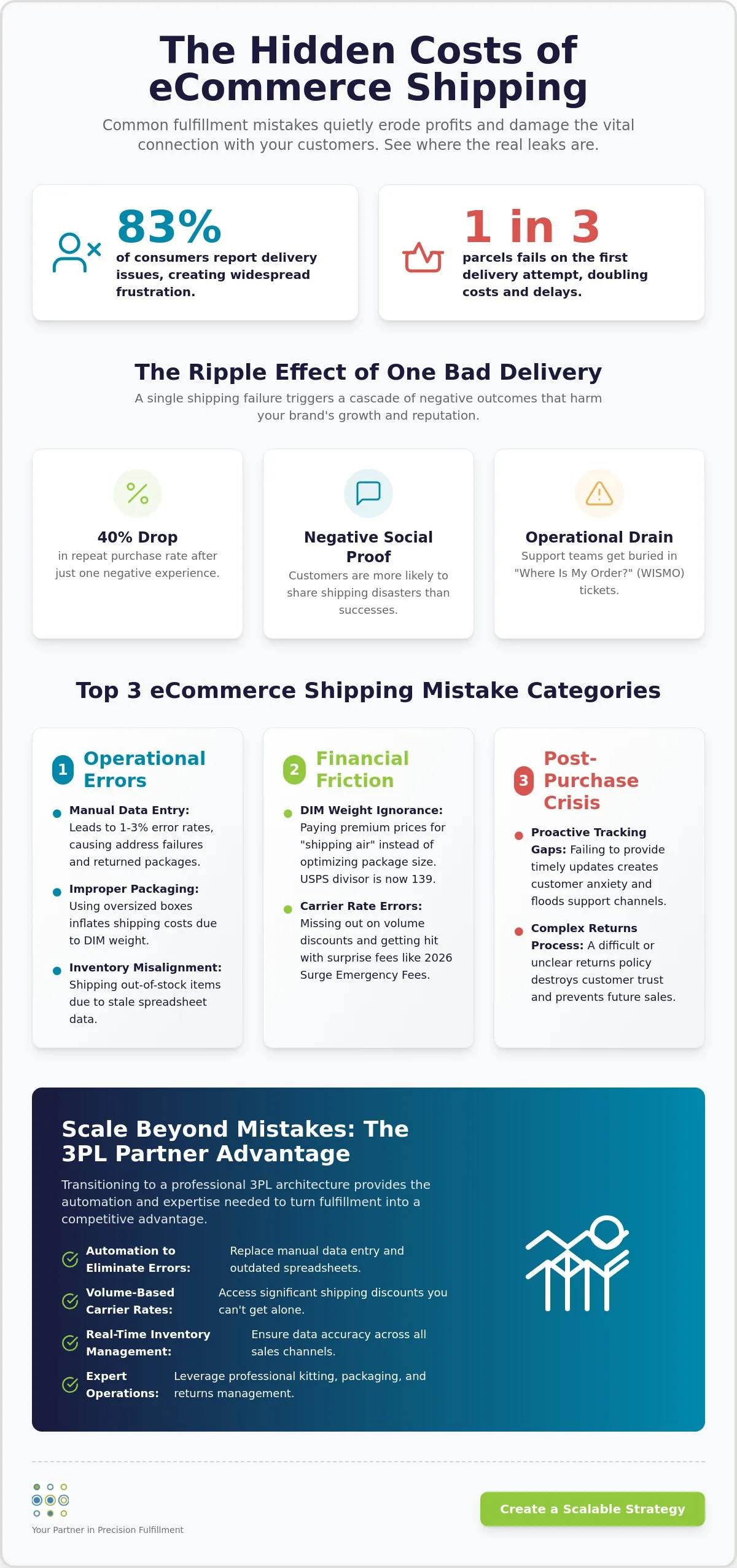
Did you know that 83% of consumers report delivery issues, and one in three parcels fails on the first delivery attempt? For many growing brands, these common ecommerce shipping mistakes aren’t just minor hiccups; they’re systemic failures that erode the human connection you’ve worked so hard to build with your customers. You likely feel the sting of unexpectedly high carrier invoices or the chaos of inventory discrepancies during the kitting process. It’s a heavy burden to carry when you’re trying to scale a business with precision and care.

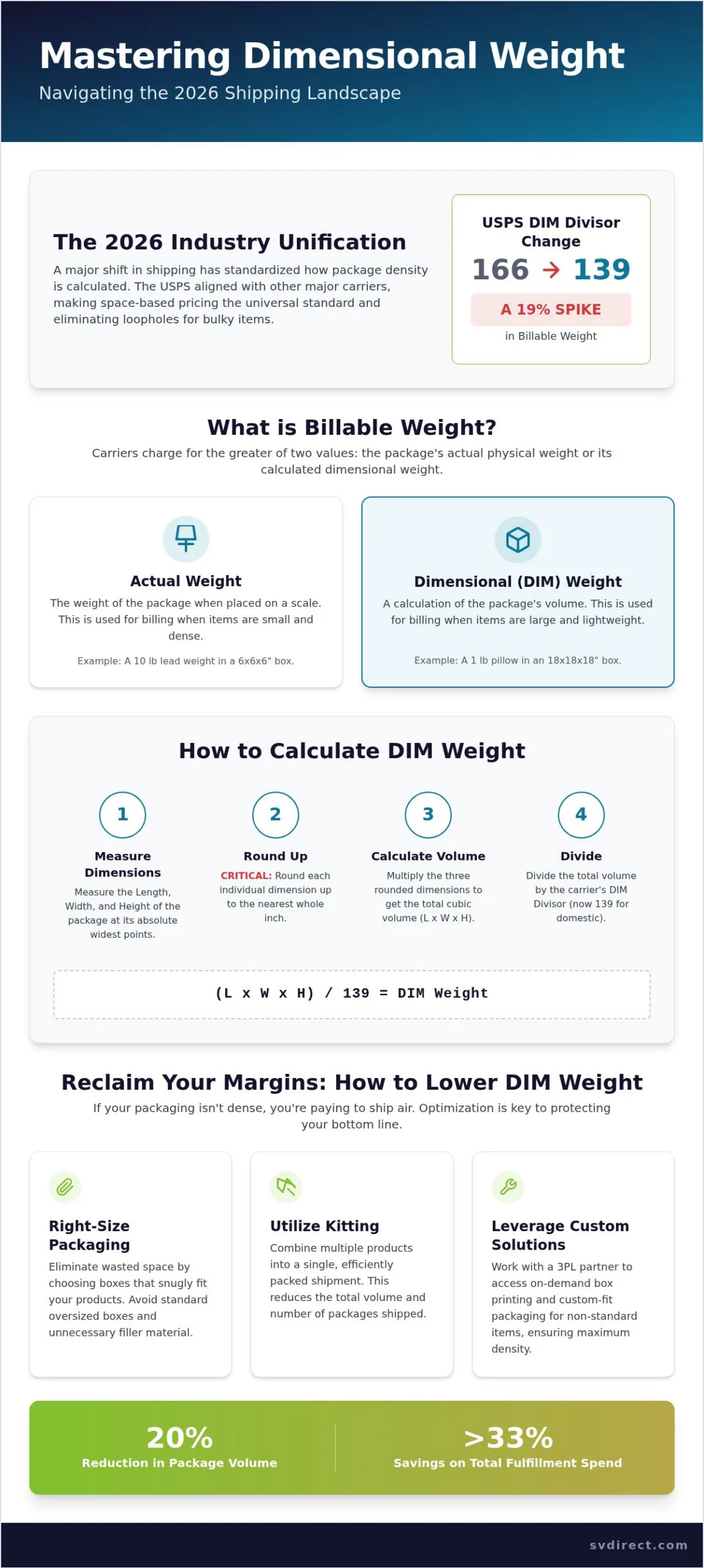
We understand that the logistics landscape is shifting rapidly. With the USPS dimensional weight divisor changing to 139 and major carriers implementing Surge Emergency Fees in 2026, staying profitable requires more than just luck. This guide promises to identify the hidden errors draining your margins and provide a clear path toward a scalable fulfillment strategy. We’ll examine the technicalities of carrier rates, the nuances of dimensional weight, and the operational shifts needed to ensure every package reflects your brand’s commitment to excellence and reliability.

Key Takeaways

  • Recognize that shipping is a critical brand touchpoint where hidden costs like labor and reshipping can quietly erode your profit margins.
  • Identify and eliminate common ecommerce shipping mistakes such as manual data entry errors and address failures that lead to undeliverable packages.
  • Master the complexities of Dimensional (DIM) weight and carrier rate structures to ensure you aren’t paying premium prices for shipping air.
  • Bridge the post-purchase gap by implementing proactive tracking updates and a transparent returns process that secures long-term customer trust.
  • Discover how transitioning to a professional 3PL architecture provides the automation and volume-based carrier rates necessary for scalable growth.

The True Cost of Common eCommerce Shipping Mistakes in 2026

In the 2026 digital-first economy, the moment a package arrives on a doorstep is often the only physical interaction a customer has with your brand. Fulfillment is the final test of your promise. When a brand fails this test, the damage extends far beyond a single lost sale. Professional logistics management isn’t just about moving boxes; it’s about protecting the human connection you’ve established through your marketing and product quality. Precision in delivery is the anchor of modern brand loyalty.

Many growing businesses underestimate the financial weight of common ecommerce shipping mistakes. They focus on the surface-level cost of a stamp or a box, but the true erosion happens in the background. Every “Where is my order?” (WISMO) inquiry places an immense psychological burden on support teams, diverting their energy from proactive growth to reactive damage control. Since manual order processes often produce error rates of 1% to 3%, these small slips quickly scale into massive operational headaches that drain your resources. Modern consumers expect instant transparency, and any gap in that data creates immediate friction.

To better understand how these errors can impact a growing business, watch this breakdown of common pitfalls:

Direct vs. Indirect Financial Erosion

The drain on your margins is often split between visible and invisible costs. Direct expenses include return shipping labels, the value of damaged goods, and wasted packaging materials. Indirectly, you face negative social proof, marketplace penalties from platforms like Amazon, and significant operational downtime. The Total Cost of Delivery encompasses the initial postage fee, the labor cost for picking and packing, the expense of packaging materials, and the overhead associated with customer service resolution for any transit issues.

The Brand Reputation Ripple Effect

A single shipping failure can lead to a 40% drop in repeat purchase rates, as trust is much harder to rebuild than it is to establish. Customers are statistically more likely to share a shipping disaster on social media than they are to praise a successful delivery. By fostering a zero-error culture within your warehouse, you turn your fulfillment process into a competitive advantage. This proactive stance ensures that your brand remains a steady, reliable hand in a fast-paced market. For more insights on optimizing your operations, explore our fulfillment blog.

Operational Errors: From Data Inaccuracy to Packaging Pitfalls

Precision is the silent engine of a successful brand. While marketing captures the customer’s attention, your operational workflow determines whether you keep it. Unfortunately, common ecommerce shipping mistakes often begin long before a package reaches the carrier. These errors are frequently rooted in outdated, manual processes that fail to keep pace with the high-velocity demands of 2026. When data is handled carelessly, the human connection you’ve built with your audience is the first thing to break.

Manual data entry remains the primary culprit behind address failures and undeliverable packages. Research indicates that manual processes produce error rates of 1% to 3%, which translates to 10 to 30 errors for every 1,000 orders. These aren’t just statistics; they represent frustrated customers and wasted labor. Beyond data, inadequate packaging creates a difficult balancing act. You must protect the product while maintaining brand aesthetics and controlling costs. Using boxes that are too large or fragile leads to damaged goods and inflated shipping fees, undermining your stability and reliability.

The Danger of Manual Fulfillment Workflows

Spreadsheets are the enemy of scalable growth. They create silos where information becomes stale, leading to inventory misalignment where you accidentally ship items that are actually out of stock. To maintain a proactive stance, businesses must transition to real-time 3PL inventory management software. This technology eliminates the friction caused by API sync errors between your storefront, whether on Shopify or WooCommerce, and the warehouse floor. It ensures that what the customer sees online is exactly what is available on the shelf.

Specialized Assembly and Kitting Mistakes

Kitting errors are particularly damaging because they often involve your most loyal customers, such as subscription box members. Missing components or wrong SKU selections account for 35% to 40% of all order errors. Implementing professional kitting and assembly services introduces necessary Quality Control stations into the pick-and-pack process. By standardizing box sizes and utilizing automated data capture, you reduce the risk of human error during packing. If you’re looking to refine these complex workflows, you might request a personalized logistics assessment to see where precision can be improved. This methodical approach transforms a chaotic warehouse into a high-performance fulfillment center.

Financial Friction: Dimensional Weight and Carrier Rate Errors

Logistics costs are often the largest variable expense for an online business. One of the most persistent common ecommerce shipping mistakes is failing to account for the complex math behind carrier invoices. You aren’t just paying for the physical weight of your products; you’re paying for the space they occupy in a truck or plane. Ignoring these nuances leads to “margin bleed” that can quietly dismantle your profitability while you’re busy focusing on top-line growth.

Carrier selection errors frequently occur when brands choose a service level based on habit rather than real-time data. Choosing the wrong service for a specific destination or failing to audit invoices for late deliveries results in significant waste. With UPS rebranding Demand Surcharges as “Surge Emergency Fees” as of May 31, 2026, and FedEx increasing Disbursement Fees in July 2026, the cost of oversight has never been higher. A proactive auditing process ensures you aren’t paying for surcharges that don’t apply to your specific shipments. It takes a steady hand to manage these shifting variables.

Mastering the Math of Dimensional Weight

DIM weight is a pricing technique carriers use to ensure they’re paid for the volume a package occupies. In 2026, this calculation is more critical than ever for your bottom line. Effective July 12, 2026, the USPS dimensional weight divisor changes from 166 to 139. This change effectively increases shipping costs for lightweight, bulky items. The formula is (Length x Width x Height) / Divisor. If the resulting DIM weight is higher than the actual weight, you’re billed at that higher rate. Right-sizing your packaging is the most effective way to stop paying for air.

Navigating International Logistics Surcharges

Expanding into global markets introduces a new layer of complexity where common ecommerce shipping mistakes can lead to seized shipments or unexpected taxes. Utilizing professional global shipping services helps you navigate the choice between Delivery Duty Unpaid (DDU) and Delivery Duty Paid (DDP). The latter is often preferred for a seamless customer experience, though it requires precise calculation of duties upfront. Additionally, incorrect Harmonized System (HS) codes are a major cause of customs delays and fines. Localized fulfillment centers can further mitigate costs by reducing the number of shipping zones a package must cross.

Many brands fall into the ‘Free Shipping’ trap by offering tiers without calculating their internal margins. If your shipping costs increase by 5.9%—the average rate increase for FedEx and UPS in early 2026—but your free shipping threshold remains static, your net profit per order shrinks. It’s a delicate balance that requires constant oversight and a commitment to precision. We believe that physical operations should be just as organized as your digital strategy.

Common eCommerce Shipping Mistakes: The 2026 Guide to Avoiding Costly Logistics Errors

The Post-Purchase Crisis: Tracking Gaps and Returns Management

The customer journey doesn’t terminate at the moment of delivery. In fact, the post-purchase experience is often the most emotionally charged phase of the transaction. Many brands treat fulfillment as a one-way street, but failing to manage the “return trip” is one of the most damaging common ecommerce shipping mistakes. When a customer experiences radio silence after clicking “buy,” their anxiety grows. This lack of proactive communication forces them to seek out information themselves, creating unnecessary friction and straining your support resources. It’s a heavy burden that can be avoided through better data visibility.

Tracking gaps are more than just a technical oversight; they’re a failure of service. If you rely solely on generic carrier links, you’re missing a vital opportunity to reinforce your brand’s reliability. A high-performance logistics partner ensures that data flows seamlessly from the warehouse to the customer’s inbox. Slow refund processing is perhaps the fastest way to lose a customer forever. In an era where 83% of consumers report delivery issues, your ability to handle the “exception” with grace and speed defines your operational maturity. Precision matters most when things go wrong.

Proactive Communication Strategies

Automating notifications for “Out for Delivery” and “Delivered” status updates is no longer optional. It’s a standard expectation. Branded tracking pages allow you to maintain the human connection while providing the high-tech efficiency customers crave. By identifying a shipping “exception” early, you can reach out to the customer before they even notice a delay. This proactive stance transforms a potential logistics failure into a demonstration of personal commitment and professional oversight. It’s about being the steady hand that guides the package home.

Optimizing the Reverse Logistics Loop

A clear returns policy should be viewed as a powerful conversion tool rather than just a legal necessity. When customers know they can send items back without entering a “black hole” of silence, they’re more likely to commit to a purchase. Integrating this returns data back into your inventory management system is essential for maintaining accuracy. For brands dealing with premium goods, utilizing secure warehousing is critical for protecting returned high-value assets during the inspection phase.

Poor returns inspection is a quiet margin killer. Restocking damaged goods into sellable inventory leads to a cycle of disappointment for the next customer. A methodical approach to reverse logistics ensures that every returned item is handled with the same precision as a new order. If you’re ready to eliminate these post-purchase bottlenecks and protect your margins, we invite you to request a free logistics consultation to see how we can stabilize your fulfillment strategy.

Scaling Beyond Mistakes: Why a 3PL Partner is the Ultimate Fix

Scaling an ecommerce brand requires a fundamental shift from “doing everything” to “overseeing excellence.” As your order volume grows, the common ecommerce shipping mistakes that were once minor nuisances become massive drains on your time and capital. Transitioning to a professional 3PL partner allows you to offload the mechanical burden of logistics to experts who treat your products with the same care you do. This isn’t just about outsourcing; it’s about upgrading your entire operational architecture to a level of precision that manual internal teams simply cannot match.

One of the most immediate benefits is the financial relief provided by volume shipping. While individual brands are subject to the full weight of carrier rate increases, a 3PL leverages collective volume to secure significantly lower rates. This helps offset the rising costs of surcharges and DIM weight adjustments we examined earlier. By automating error-prone manual tasks, you eliminate the labor costs associated with reshipping and customer service recovery. This allows your team to focus on product innovation while we handle the heavy lifting of global distribution.

The Technology Advantage of Silicon Valley Direct

Our approach centers on a seamless digital integration that bridges the gap between your storefront and our warehouse floor. We provide real-time accuracy across major platforms, ensuring that your inventory data is never out of sync. Beyond standard fulfillment, we offer specialized direct mail marketing services and customized kitting solutions that allow for total flexibility in how you engage your audience. Whether you’re a startup or a global enterprise, our infrastructure is designed to scale with your ambitions without sacrificing the precision your customers expect.

The Human Element in a Tech-Saturated Market

We explicitly reject the trend of purely automated, impersonal fulfillment. While our systems are high-tech, they’re backed by seasoned professionals who provide personal oversight for every account. This human connection ensures that bespoke problems receive bespoke solutions, preventing the “automated errors” that often plague larger, faceless centers. You gain direct access to logistics experts who understand the nuances of your specific inventory and brand goals. If you’re ready to stop making mistakes and start scaling with confidence, Contact Silicon Valley Direct for a fulfillment audit today. We’re here to be the steady hand that guides your growth through every shift in the 2026 logistics landscape.

Mastering the Future of Your Logistics Architecture

Logistics in 2026 demands a level of precision that manual processes simply cannot achieve. We’ve explored how common ecommerce shipping mistakes, from data inaccuracies to dimensional weight oversights, act as silent drains on your profitability and brand trust. By right-sizing your packaging and automating your reverse logistics loop, you transform a cost center into a competitive advantage that protects your human connection with customers. These operational shifts ensure your brand remains reliable in a fast-paced market.

True scalability requires a steady hand and a sophisticated infrastructure. Since 1999, Silicon Valley Direct has served as a global logistics hub, providing the specialized expertise needed to handle everything from healthcare products to high-value electronics with absolute care. We combine high-tech efficiency with personal oversight to ensure your operations remain organized and your customers stay connected to your brand promise. It’s time to move beyond reactive fixes and build a proactive fulfillment strategy that supports your long-term growth.

Streamline your fulfillment and eliminate shipping errors with Silicon Valley Direct. We look forward to partnering with you on your journey toward operational excellence and sustainable success.

Frequently Asked Questions

What is the most common ecommerce shipping mistake for startups?

The most frequent error for early-stage brands is underestimating the total cost of fulfillment beyond simple postage. Startups often fail to account for labor, packaging materials, and the financial impact of returns. This is one of the most common ecommerce shipping mistakes that leads to early margin erosion. Relying on manual workflows that don’t scale creates a high risk of errors as order volume begins to accelerate.

How do I calculate dimensional weight for my packages?

You calculate dimensional weight by multiplying the package’s length, width, and height and then dividing by the carrier’s specific divisor. For 2026, the USPS divisor has shifted to 139, making volume calculations even more critical for your bottom line. If the resulting DIM weight exceeds the actual physical weight, carriers bill you for the larger value. Right-sizing your boxes is the most effective way to avoid paying for empty space.

Why are my shipping costs higher than my initial estimates?

Unexpected surcharges and Surge Emergency Fees are the primary reasons final costs exceed initial estimates. Carriers frequently add fees for residential delivery, fuel adjustments, and address corrections that aren’t always visible in base rates. Additionally, failing to account for DIM weight instead of actual weight often leads to a significant price gap on your final invoice. A steady hand in auditing these invoices is required to maintain profitability.

What is the difference between DDU and DDP in international shipping?

DDU stands for Delivered Duty Unpaid, meaning the customer pays duties and taxes upon arrival, while DDP or Delivered Duty Paid means the seller handles these costs upfront. DDP is generally preferred for ecommerce because it prevents delivery shock for the customer. Using DDP ensures a smoother post-purchase experience and builds long-term trust through transparency. It reflects a brand’s commitment to a seamless, professional global presence.

How can a 3PL help reduce my shipping error rate?

A 3PL reduces common ecommerce shipping mistakes by replacing manual data entry with automated API integrations and professional Quality Control stations. By using barcode scanning and sophisticated inventory management systems, a professional partner can lower error rates significantly compared to manual setups. This precision protects your margins and prevents the costly reshipping expenses that damage customer loyalty. It transforms fulfillment into a high-performance asset for your business.

What is an HS code and why does it matter for ecommerce?

An HS or Harmonized System code is a standardized numerical method used by customs authorities to classify products for international trade. These codes determine the specific tax and duty rates applied to your shipments. Using the wrong HS code is a major cause of customs delays and fines. Precision in selecting these codes is a critical component of global logistics management that ensures your products move across borders without friction.

How often should I audit my carrier invoices for mistakes?

You should audit your carrier invoices weekly to catch billing errors, late delivery refunds, and incorrect surcharges. Many businesses leave money on the table by ignoring the discrepancy between quoted rates and final charges. A methodical, weekly review ensures you are only paying for the services you actually received. This practice helps you identify systemic packaging issues before they become permanent drains on your capital.

Can I integrate my Shopify store directly with a 3PL warehouse?

Yes, you can integrate your Shopify store directly with a 3PL warehouse through native APIs that sync orders and inventory in real time. This technical integration eliminates the need for spreadsheets and manual data entry, which are the leading causes of fulfillment errors. It allows for a seamless flow of information from the customer’s click to the warehouse floor. This creates a state of informed confidence for both the brand and the end consumer.

Kitting and Assembly Services: The Strategic Guide to 3PL Efficiency in 2026

Kitting and Assembly Services: The Strategic Guide to 3PL Efficiency in 2026

What if the secret to slashing your shipping costs and boosting your brand’s unboxing experience isn’t a new carrier, but how your items are bundled before they even leave the warehouse? At Silicon Valley Direct, we’ve seen how manual kitting and assembly services can make or break a brand’s reputation over our 26 years in the industry. We understand that high labor costs for in-house bundling and frequent errors in multi-item orders are more than just line items. They’re roadblocks to your growth.

We agree that the pressure to deliver a perfect package while maintaining a lean supply chain is higher than ever. This guide will show you how to master these complexities to streamline your operations and significantly reduce dimensional weight shipping costs. You’ll learn how to achieve a seamless, error-free assembly process that speeds up your time-to-market. We’ll explore the latest 2026 cost benchmarks, the critical importance of FSMA 204 compliance, and how our human-centric approach ensures your promotional launches happen on time, every time.

Key Takeaways

  • Discover the operational distinction between kitting and physical assembly to better understand how pre-building SKUs optimizes your warehouse workflow.
  • Learn how professional kitting and assembly services can slash your dimensional (DIM) weight shipping costs and eliminate the overhead of in-house labor.
  • Master the end-to-end process of multi-vendor component verification and seamless inventory integration through advanced API and web-based software.
  • Evaluate potential 3PL partners by prioritizing technical compatibility with platforms like Shopify and the risk-reduction benefits of a veteran 26-year tenure.
  • Explore how combining on-demand digital printing with fulfillment creates a bespoke, high-performance brand tool that streamlines your path to market.

Understanding Kitting and Assembly Services in 2026

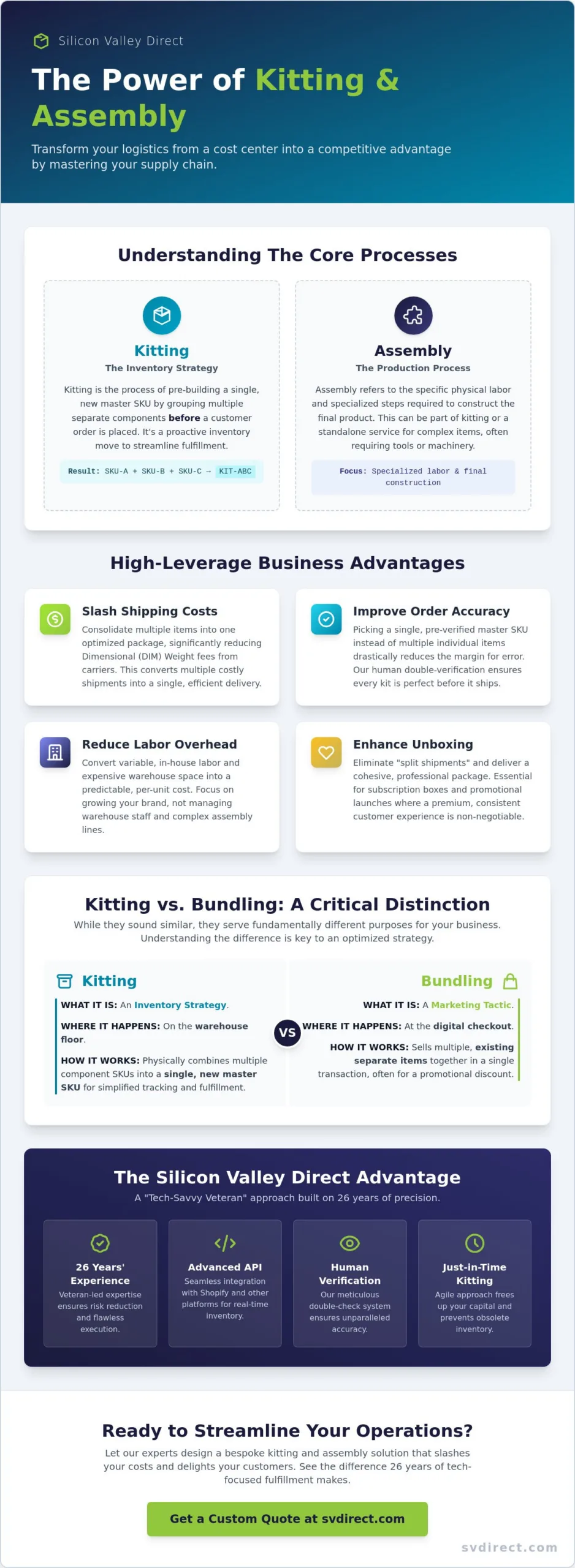
Silicon Valley Direct has spent 26 years refining the “Tech-Savvy Veteran” approach to logistics. We’ve seen that kitting isn’t just about putting items in boxes; it’s a sophisticated inventory move. At its core, kitting involves pre-building individual SKUs from multiple separate components before an order is even placed. This differs from assembly, which focuses on the specific physical labor and specialized steps required to construct a final product. By integrating kitting and assembly services into your 3PL strategy, you aren’t just moving boxes. You’re building a scalable engine for your brand’s growth.

In modern logistics, these processes are often governed by complex Assembly line feeding policies that determine how and when parts reach the station. When you outsource these tasks to a premier partner, you leverage decades of experience to ensure these policies are executed with precision. This proactive stance helps you avoid the “virtual operations” trap where nothing is actually in stock when you need it most.

To better understand this concept, watch this helpful video:

The 2026 landscape demands agility. We’ve moved away from the era of massive, pre-built inventories that sit on shelves for months. High-performance brands now utilize “Just-in-Time” kitting. This approach ensures you aren’t tying up capital in finished goods that might not sell. It also plays a massive role in reducing “split shipments.” When components are kitted ahead of time, they ship as one unit. This improves customer satisfaction and keeps your shipping costs predictable and low.

Kitting vs. Bundling: Key Differences

Bundling is often a surface-level marketing tactic where items are sold together at a discount. Kitting is an inventory strategy. While bundling might happen at the digital checkout screen, kitting happens on the warehouse floor. Kitting converts multiple distinct component SKUs into a single, master SKU for streamlined inventory management and order fulfillment. This transformation allows our API to track one item instead of five, which drastically reduces errors during the pick-and-pack process.

Common Use Cases for Custom Assembly

Precision is non-negotiable for subscription boxes. Every item must be placed with aesthetic consistency to ensure a premier unboxing experience for your customers. In the healthcare sector, assembly requires strict compliance and double-verification to ensure medical kits are accurate and safe. Promotional launches also benefit from this synergy. We often integrate on-demand digital printing of marketing collateral directly with physical products. This creates a cohesive, professional package that arrives ready for the consumer without the need for multiple vendors.

Strategic Business Advantages of Professional Kitting

Professional kitting isn’t just an organizational convenience; it’s a high-leverage financial strategy. By utilizing specialized kitting and assembly services, you convert variable in-house labor expenses into a predictable, per-unit cost. This shift allows you to move complex assembly tasks away from your own expensive floor space and into a specialized 3PL environment designed for high-throughput precision. The result is a leaner operation that focuses on growth rather than managing warehouse staff.

Order accuracy remains the foundation of customer retention. When items are pre-kitted, the warehouse team performs a single “pick” for the entire bundle rather than gathering several separate components. This reduction in physical movement significantly lowers the margin for error. It’s much harder to miss an item when it’s already part of a verified, pre-built SKU. Our dedicated assembly lines use human double-verification to ensure every kit meets your exact specifications before it’s ever sealed and labeled for shipping.

Cost Optimization and DIM Weight

Carrier fees in 2026 are heavily influenced by the physical size of the package. Consolidating multiple items into a single, custom-fitted box reduces the Dimensional (DIM) weight, which often results in lower shipping rates than sending multiple smaller parcels. Professional packaging also acts as a primary defense against transit issues. It reduces shipping damage claims by ensuring items are secured with the right protective materials tailored to the kit’s contents. Strategically, storing raw goods and kitting them on demand is often more cost-effective than paying for long-term storage of bulky, pre-finished inventory that takes up premium pallet space.

Scalability for Seasonal Peaks

Scaling for Black Friday or Cyber Monday surges shouldn’t require a frantic hiring spree or temporary warehouse leases. A seasoned partner manages these peaks for you, providing the flexibility to launch limited-time offers or complex promotional kits without straining your internal resources. Because we believe “Anything is possible,” we handle bespoke projects that automated, virtual warehouses simply can’t touch. This human-led agility ensures your brand remains responsive to market trends and promotional opportunities. If you’re looking to optimize your overhead and improve your margins through smarter logistics, you can consult with our experts to see how a tailored kitting strategy fits your business model.

Kitting and Assembly Services: The Strategic Guide to 3PL Efficiency in 2026

The Kitting and Assembly Process: From Inventory to Unboxing

A high-performance supply chain begins the moment raw components arrive at our facility. We don’t simply count pallets; our team verifies every component from multiple vendors to ensure the raw materials match your manifest and quality standards. This data flows through our API and web-based management software, providing you with real-time visibility into your inventory levels. This digital foundation ensures that kitting and assembly services are fueled by accurate data, which prevents production delays before they start.

Once verified, components move to the physical assembly line where precision meets speed. While many competitors rely solely on automated systems, we prioritize human double-verification to maintain a level of accuracy that machines often miss. This stage also includes the integration of on-demand digital printing. By producing personalized inserts and literature as part of the assembly workflow, we eliminate the need for secondary vendors and reduce the logistical friction of coordinating multiple shipments. It’s a seamless bridge between your marketing assets and your physical product.

Integrating Literature and Digital Printing

Traditional fulfillment often leads to literature obsolescence, where thousands of pre-printed brochures end up in the recycling bin after a minor update. Our “Just-in-Time” printing model solves this by producing materials only when they’re needed for a kit. We use variable data printing to personalize the unboxing experience, making each package feel tailored to the individual recipient. For brands looking to eliminate waste and keep marketing collateral current, our literature fulfillment services provide a dynamic, on-demand alternative to passive brochure storage. For our clients in the medical sector, this workflow manages healthcare mailing services with ease. We ensure that sensitive documents and kits are paired accurately every time without the risk of mismatched data.

Quality Control and Double-Verification

Accuracy isn’t just a goal; it’s a requirement for a stable brand. Our approach rejects the “set it and forget it” mentality of pure automation in favor of meaningful human interaction. Every kit undergoes a rigorous weight-check and visual-check protocol at the end of the line. If a kit is off by even a few grams, it’s flagged for manual review by an actual team member. Our meticulous kitting and assembly services ensure brand consistency across thousands of identical units. This protects your reputation and reduces the costly burden of returns. We believe this personal touch is what defines a true partnership in the fast-paced logistics market.

Critical Factors When Evaluating a Kitting Partner

Choosing a partner for kitting and assembly services requires looking beyond pallet counts. You need a provider that combines technological agility with the wisdom of industry veterans. Silicon Valley Direct offers a unique geographic advantage. Being located in the heart of the world’s innovation hub means we’re wired for global connectivity and high-tech efficiency. This location serves as a symbol of our commitment to staying at the cutting edge of logistics while maintaining a stable, physical infrastructure. We don’t operate in a virtual vacuum; we provide actual human expertise backed by 26 years of operational success.

Transparency shouldn’t be a luxury. It’s a requirement for a healthy supply chain. Our web services provide you with real-time access to inventory and assembly status. You’ll never have to wonder where your project stands or if components have arrived from your vendors. This level of openness is backed by our decades of experience. A veteran team understands the nuances of complex projects and proactively mitigates operational risks before they impact your bottom line. We prioritize clear, declarative communication over marketing jargon to ensure you stay informed and confident.

Technology and API Integrations

Pre-configured integrations are essential for a rapid, seamless setup. Our API connects directly with platforms like Shopify and WooCommerce, allowing data to flow between your storefront and our warehouse without friction. This real-time tracking gives you a clear view of your raw components versus your kitted stock 24/7. You can monitor depletion rates and plan restocks with surgical precision. For brands looking to elevate their physical presence, our promotional kit fulfillment guide offers deeper insights into building high-impact brand experiences through smarter logistics.

The Human Element in High-Tech Logistics

We reject the industry trend of automated support tickets and never-ending questions. Instead, we provide dedicated account managers who actually know your business and your brand’s specific needs. Stability is our hallmark; half of our team has over a decade of tenure. This collective experience creates a “can-do” culture where bespoke problem-solving is the standard. When we say “Anything is possible,” we mean it. We’re eager to find tailored solutions for even the most complex kits. This personal touch ensures your kitting and assembly services are handled with the same passion you put into your products. If you’re ready to partner with a team that values precision and personal commitment, request a free quote today to get started.

Bespoke Kitting Solutions at Silicon Valley Direct

Our comprehensive kitting and assembly services are built on 26 years of Silicon Valley expertise. We provide a sophisticated 3PL infrastructure that acts as a physical extension of your brand. By integrating on-demand digital printing directly with our fulfillment operations, we’ve created a “one-stop” solution that eliminates the friction of managing multiple vendors. This synergy ensures your marketing materials and physical products are perfectly synchronized, resulting in a premier unboxing experience that feels both personal and professional. We don’t just ship boxes; we deliver your brand’s promise through meticulous human oversight and a stable, veteran team.

Consider the journey of one of our long-term partners, a high-tech hardware startup that began with manual assembly in a small garage. As their order volume exploded, they struggled with high labor costs and frequent shipping errors. By transitioning to our facility, they scaled from local batches to global distribution within months. We took over the complex task of bundling sensitive electronic components with custom-printed user manuals, allowing their core team to focus on product innovation. This transition wasn’t just about outsourcing; it was about gaining a partner that treats every kit with a “can-do” attitude and a commitment to double-verification.

Custom Kitting for Diverse Industries

We’ve tailored our warehouse protocols to meet the unique demands of several specialized sectors:

  • High-Tech and Electronics: We provide secure handling and specialized packaging for sensitive components, ensuring they arrive in perfect working condition.
  • Healthcare and Pharma: Our facility manages HIPAA-compliant mailing and literature fulfillment with the precision required for medical kits. Learn more about our compliant healthcare mailing services designed to meet the strictest regulatory standards.
  • eCommerce and Retail: We’ve mastered the art of subscription box assembly and promotional kits, focusing on aesthetic placement and brand consistency.

Ready to Streamline Your Assembly?

Transitioning from in-house kitting to professional 3PL services is a strategic move that pays dividends in accuracy and scalability. We offer a “No-Virtual-Operations” guarantee, which means you’re dealing with real people in a real warehouse, not an automated ticket system. Our team is eager to solve your most complex logistical puzzles, proving that with the right partner, anything is possible. We take pride in our collective experience and our ability to alleviate the stress of your growth through precision and personal commitment. To see how we can optimize your supply chain, you can get a tailored kitting and assembly quote from Silicon Valley Direct today.

Future-Proof Your Brand with Strategic Logistics

We’ve explored how mastering the nuances of kitting and assembly services acts as a bridge between your marketing vision and operational reality. By optimizing your packaging for dimensional weight and integrating on-demand digital printing, you don’t just save on shipping; you create a cohesive unboxing experience that builds lasting customer loyalty. This strategic shift transforms your supply chain from a cost center into a high-performance brand tool.

Silicon Valley Direct brings over 26 years of logistics experience to your partnership. We reject the “virtual operations” model in favor of human-led double-verification, which allows us to maintain a 99.9% accuracy rate. This personal touch ensures your most complex promotional launches are executed with the precision your brand deserves. It’s time to move past the stress of in-house bundling and embrace a partnership where anything is possible. We’re eager to apply our seasoned expertise to your unique challenges and help you scale with confidence.

Streamline your supply chain with SV Direct’s expert kitting and assembly. Your growth journey is our passion, and we’re ready to help you reach your next milestone.

Frequently Asked Questions

What is the difference between kitting and assembly services?

Kitting is the strategic process of combining separate components into a single master SKU before an order is placed, while assembly refers to the physical labor required to construct the final product. Kitting serves as an inventory management tool to streamline warehouse picking. Assembly focuses on the specific production steps needed to ensure every item is retail-ready and meets your brand’s quality standards.

How much do kitting services typically cost?

Typical costs for kitting in 2026 range from $1 to $3 per kit, depending on the complexity and number of items included. If your project requires specialized tasks like custom labeling or compliance documentation, hourly labor charges generally fall between $35 and $60. We provide tailored quotes that reflect the specific human expertise and infrastructure required for your unique project needs.

Can kitting services help reduce my shipping costs?

Yes, professional kitting and assembly services reduce shipping costs by optimizing the Dimensional (DIM) weight of your packages. Consolidating multiple items into a single, custom-fitted box is often more affordable than sending several separate parcels. This method lowers carrier fees and significantly decreases the likelihood of shipping damage by ensuring every component is secured within a properly sized container.

How long does it take to set up a new kitting project?

Setting up a new project usually takes between a few days and two weeks, depending on the assembly complexity and your current inventory status. Our pre-configured API integrations for platforms like Shopify allow for a rapid technical setup. Once your raw components arrive at our facility, our veteran team moves quickly to verify the materials and establish a precise assembly line workflow.

What industries benefit most from product kitting?

High-tech, healthcare, and subscription-based eCommerce brands see the most significant operational gains from kitting. For healthcare clients, we offer FSMA 204 ready and HIPAA-compliant literature fulfillment to ensure total accuracy. High-tech firms rely on our secure handling of sensitive electronics, while retail brands utilize our services to create high-impact promotional kits that arrive ready for the consumer.

Does Silicon Valley Direct handle custom branded packaging?

We manage custom branded packaging through our integrated on-demand digital printing services. This allows you to include personalized inserts and tailored marketing collateral directly within your kits without the hassle of coordinating with external print vendors. Our “Just-in-Time” printing model ensures your literature remains current and eliminates the waste associated with storing large quantities of pre-printed materials.

How is inventory managed during the kitting process?

Inventory is managed through our proprietary web services and API, which provides 24/7 visibility into your raw components and finished master SKUs. You can track depletion rates in real time and monitor exactly how much kitted stock is ready for immediate shipment. This transparency ensures you can plan restocks with precision and never run out of inventory during critical seasonal peaks.

Is kitting better than bundling for eCommerce?

Kitting is generally superior for eCommerce because it simplifies warehouse logic by transforming multiple items into one SKU. While bundling is often a marketing tactic handled at the digital checkout, kitting happens physically on the warehouse floor. This reduces “split shipments” and picking errors, which leads to faster turnaround times and a more professional unboxing experience for your customers.