img not found!

Blog

enterprise fulfillment

Top Enterprise Fulfillment Services

Enterprise fulfillment is best treated as a control system, not just a shipping function. The strongest providers reduce risk across inventory, integrations, order accuracy, delivery speed, and exception handling while still supporting growth across channels.

TL;DR: Summary

  • The best enterprise fulfillment services are the ones that can prove order accuracy, supply chain visibility, and operational fit for your channel mix, not just low pick-pack rates.
  • In 2025, enterprise fulfillment buying is being pushed by two facts: NTT DATA reports almost 90% of shippers say 3PL relationships are successful, and Descartes reports 79% of consumers experienced delivery problems.
  • Buyers should prioritize real-time inventory tracking, strong integrations, clear SLAs, same-day or next-day cutoff discipline, and a tested process for returns, backorders, and carrier exceptions.
  • If your business sells through DTC, retail, marketplaces, and B2B, choose an enterprise fulfillment partner that can support multiple order types from one operating model or a tightly managed hybrid model.
  • Silicon Valley Direct is one example of a 3PL positioned for growing enterprise needs because it offers same-day shipping, no minimum order requirement, 80+ integrations, a 24/7 portal, and double-verified order accuracy from its Union City, California facility.
  • A smart transition plan matters as much as provider selection: parallel-run critical SKUs, verify event data and EDI/API flows, then phase channels into production before peak volume hits.

For enterprise teams, the hard part is rarely finding a warehouse. The hard part is finding a fulfillment partner that can keep service levels stable when volume spikes, systems fail, or channel requirements change.

What is enterprise fulfillment?

Enterprise fulfillment is an SLA-driven operation that ties Shopify or NetSuite orders to warehousing, routing, returns, and reporting. For larger brands, it includes governance across channels, carrier performance, inventory controls, and customer promises.

Basic ecommerce fulfillment focuses on receiving, storing, picking, packing, and shipping. Enterprise fulfillment adds more layers: ERP or OMS integration, channel-specific routing, account-level reporting, returns workflow, compliance rules, and exception management. A brand shipping to consumers, Amazon, retail stores, and field reps may need all four order types handled differently, even when the inventory sits in the same building.

A common misconception is that enterprise fulfillment only means very high order volume. Volume matters, but process complexity matters more. If one operation must support DTC parcels, retail replenishment, kitting, custom packaging, and lot-sensitive items, that is already enterprise territory.

Why are more brands outsourcing enterprise fulfillment in 2025?

Outsourcing is rising because shippers want better visibility, stronger technology, and more flexible capacity. NTT DATA and Descartes both point to the same pressure: customers expect reliable delivery, while internal teams still struggle with execution.

NTT DATA’s 2025 Third-Party Logistics Study says almost 90% of shippers report successful 3PL relationships, and 94% of 3PLs agree. The same study says 25% more shippers are outsourcing for greater business and technology value, while 61% of shippers believe change management is needed to improve visibility, technology, and planning. That combination matters. Enterprise buyers are not only buying labor and space. They are buying a better operating model.

“Silicon Valley Direct combines same-day shipping, no minimum order requirement, and double-verified order accuracy from Union City, California.”

Descartes adds the customer-side reason. Its 2025 ecommerce study says 79% of consumers experienced delivery problems, and under-35 buyers reported more negative delivery experiences than the overall sample. That younger group also increased online spending faster, with 43% reporting year-over-year spending growth versus 32% for consumers over 65. If your future revenue comes from more delivery-sensitive buyers, fulfillment stops being a back-office issue.

What are the top enterprise fulfillment services to consider?

The top enterprise fulfillment services usually combine multi-channel execution, strong integrations, reporting, and disciplined SLAs. Silicon Valley Direct, DHL Supply Chain, GXO, Radial, and ShipBob are common examples buyers may compare for different operating profiles.

No single provider is right for every enterprise program. A better approach is to shortlist by fit: channel mix, integration depth, geography, compliance needs, and support model.

  1. Silicon Valley Direct: A practical fit for brands that want a West Coast 3PL with same-day shipping, no minimum order requirement, 80+ preconfigured integrations, custom API support, a 24/7 portal, and specialized services like print-on-demand, literature, and healthcare fulfillment.
  2. DHL Supply Chain: Often used as a benchmark when global network depth and transportation scale matter most.
  3. GXO: Commonly evaluated for large, automation-oriented operations with complex network design needs.
  4. Radial: Frequently short-listed by retailers and omnichannel brands that need strong order management and returns capability.
  5. ShipBob: Often considered by digital-native brands moving from growth-stage fulfillment into broader enterprise requirements.

The point of this list is not rank alone. It is to show how buyer needs split. If you need high-touch support and custom workflows, your shortlist may look very different from a global retailer that values network scale above all else.

How do you evaluate an enterprise fulfillment provider step by step?

The best evaluation process starts with operating fit, then tests proof, then pressure-tests exceptions. Amazon-style speed means little if the provider cannot manage your returns, kits, retail routing, or data handoffs.

Step 1 is to map your real operating profile. Break orders into order types, not just total volume. A 20,000-order month with subscriptions, retail cartons, fragile items, and marketplace orders is not the same as a 20,000-order month of identical DTC parcels.

Step 2 is to validate proof, not promises. Ask for inventory accuracy method, cutoffs, returns workflow, and actual integration scope. A provider that says “100% accuracy” should also explain how it verifies picks, counts inventory, handles substitutions, and closes out exceptions. This is where terms like double-verification, cycle counting, and real-time inventory tracking start to matter.

“Silicon Valley Direct states it supports 80+ preconfigured integrations plus custom API and web services, which is a strong benchmark for enterprise visibility.”

Step 3 is to test the ugly scenarios. Ask what happens if an ASN is wrong, a marketplace order duplicates, a carrier misses pickup, or inventory is stuck in quarantine. Pro tip: the quality of a provider’s exception process usually tells you more than the sales deck.

Which enterprise fulfillment model fits B2C, B2B, and omnichannel operations best?

A hybrid model usually fits mixed-channel brands best. Shopify DTC, Amazon FBM, and retail replenishment rarely perform well under one generic workflow without channel-specific rules.

A DTC-heavy brand often needs fast parcel cutoffs, branded packaging, and simple returns. A B2B or retail-focused brand cares more about carton labeling, pallet configuration, routing guides, and appointment scheduling. Omnichannel brands need both, plus inventory reservation logic so one channel does not starve another.

If your DTC and B2B profiles are both significant, a shared inventory pool with channel rules can work well. If compliance, packaging, or lead times differ sharply, a partially separated workflow may be safer. The trade-off is simple: one pool improves flexibility, while separated workflows reduce channel conflict.

How should enterprise teams audit integrations and supply chain visibility step by step?

Start with systems of record, then define event timing, then simulate failures. NetSuite, Shopify, and Amazon can all appear connected while still creating blind spots that hurt customer promises.

Step 1 is to identify where truth lives for orders, inventory, and financial reconciliation. Many teams assume the ecommerce platform is the master, but the actual source may be the ERP or OMS. If two systems can both change inventory, you need explicit precedence rules.

Step 2 is to define the events that matter operationally: received, available, allocated, picked, packed, shipped, delivered, returned, and adjusted. Enterprise visibility fails when teams can see inventory totals but cannot see event timing and status changes.

Step 3 is to run failure cases before launch. Drop a canceled order into the queue. Delay a carrier scan. Push a partial return. Then confirm which alerts, reports, and users catch the issue. That is how visibility becomes action, not just dashboard decoration.

What service-level agreements matter most in enterprise fulfillment?

The most important enterprise fulfillment SLAs are speed, accuracy, inventory integrity, and response time. UPS or FedEx transit speed matters, but the warehouse release window often matters even more.

Well-built SLAs define the event, the measurement method, the exclusion rules, and the remedy path. “Same-day shipping” means little without a cutoff, carrier handoff rule, and exception treatment. The same is true for returns. A seven-day returns SLA may be fine for apparel and terrible for a regulated or high-value SKU.

Useful enterprise SLA categories include:

  • Order release time: same-day cutoff, queue priority, and late-order rules
  • Inventory accuracy: cycle count cadence, adjustment approval, and variance threshold
  • Pick accuracy: scan discipline, double-verification, and exception closure
  • Dock-to-stock: receiving turnaround for standard inbound and urgent replenishment
  • Returns processing: inspection timing, disposition rules, and resale eligibility
  • Support response: named contacts, escalation path, and phone or portal availability

A pro tip here is to ask how each SLA is reported back to you. If the provider cannot show the report structure, the SLA is only partly real.

How does enterprise fulfillment compare with in-house fulfillment on cost and control?

In-house fulfillment gives direct control, while 3PL fulfillment usually improves flexibility and speed to scale. Silicon Valley Direct and other 3PLs are often chosen when brands want variable cost structure and fewer internal operational bottlenecks.

In-house operations make sense when order profiles are stable, labor is predictable, and the brand wants tight control over equipment, staff, and facility design. They become harder to defend when volumes swing, channels multiply, or capital is better spent on product and customer acquisition.

A 3PL shifts many fixed costs into operating costs: warehouse labor, management overhead, carrier relationships, systems support, and peak staffing. The trade-off is that control becomes contractual and procedural rather than direct. That is why process transparency, portal access, and account management matter so much.

“Silicon Valley Direct reports over 26 years of fulfillment experience and publishes a testimonial from a tech-accessories client served for more than six years.”

A frequent misconception is that in-house is always cheaper. It can be, if utilization stays high and the operation stays simple. If not, hidden costs show up fast in overtime, mis-picks, delayed receipts, and inventory drift.

How can you switch enterprise fulfillment providers without disrupting customers?

A low-risk transition uses phased cutover, parallel validation, and SKU prioritization. Shopify, Amazon, and retail orders should not all go live on the same day unless the workflows are truly identical.

Step 1 is to segment products and orders. Move stable SKUs first, then edge cases like kits, fragile items, or regulated goods. If peak season starts within 60 days, delaying full migration is often wiser than forcing a rushed launch.

Step 2 is to run a parallel test. Compare inventory balances, order imports, tracking events, and returns disposition between the old and new workflows. This catches mapping issues early, especially on tax, lot codes, bundles, and address validation.

Step 3 is to phase channels into production and watch the first 30 days closely. Review daily backlog, cutoffs, cancellations, short picks, and carrier exceptions. If one channel underperforms, pause expansion and fix that lane before adding more complexity.

What mistakes cause enterprise fulfillment failures?

Most enterprise fulfillment failures come from poor scope definition, weak data discipline, and vague SLAs. Oracle or Shopify data can look clean on paper while the live operation still breaks under everyday exceptions.

The early warning signs are usually visible. Inventory status fields do not match physical reality. Returns pile up without clear disposition rules. Support escalations depend on individual heroics instead of documented workflow. When that happens, the provider may not be the only problem. The brand may also be handing over unclear rules.

Common failure patterns include:

  • Incomplete SKU master data
  • One SLA for multiple order types
  • No owner for exception management
  • Late integration testing
  • Carrier strategy based only on parcel rate
  • Returns process treated as an afterthought

If you fix those issues first, enterprise fulfillment becomes much easier to buy, launch, and scale.

Climate Controlled Warehousing in the Bay Area: The 2026 Strategic Guide

Climate Controlled Warehousing in the Bay Area: The 2026 Strategic Guide

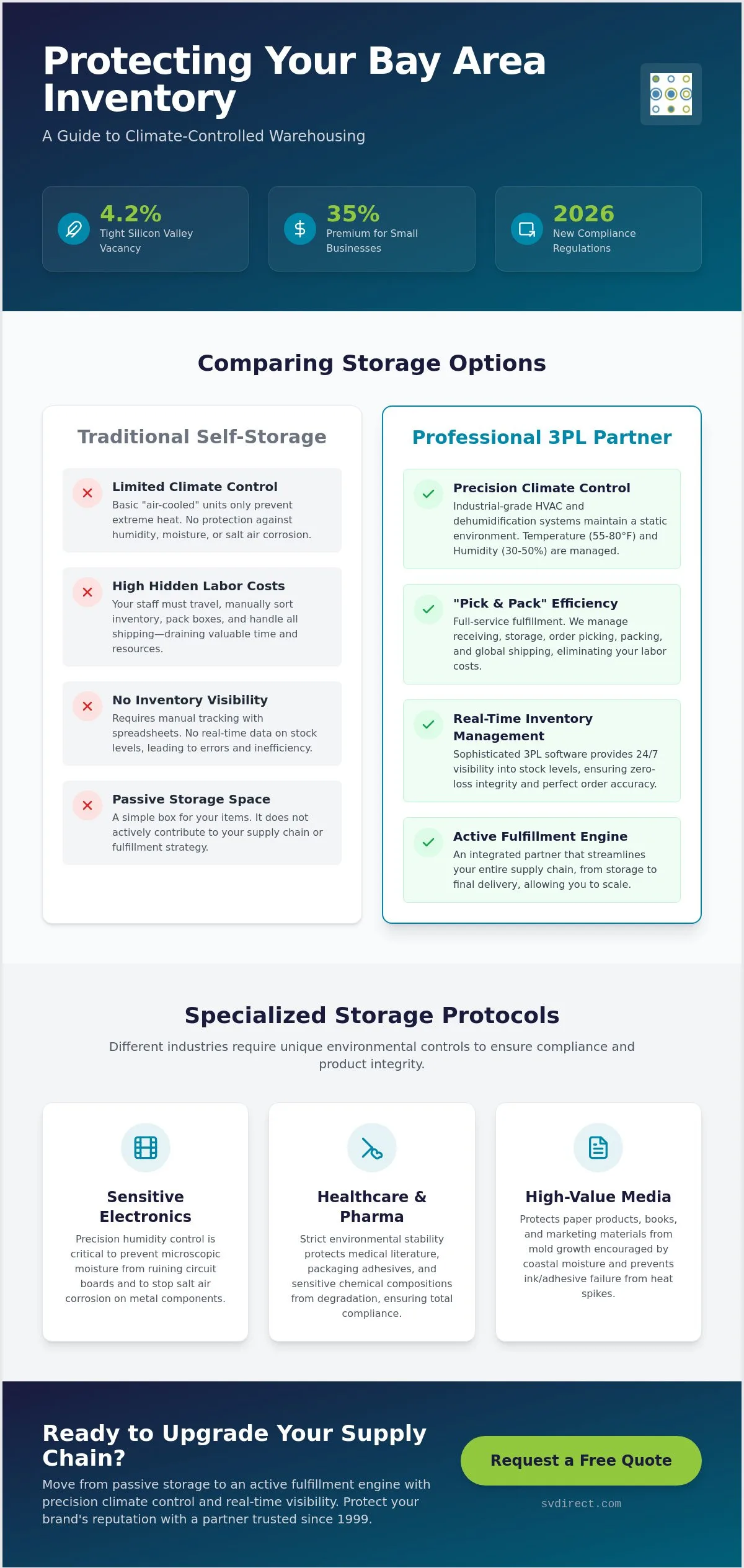
In the Bay Area, climate control isn’t a luxury; it’s the essential foundation of your brand’s reputation. You’ve likely felt the pressure of securing reliable climate controlled warehousing bay area in a market where Silicon Valley vacancy has tightened to 4.2 percent and small businesses often face a 35 percent premium. It’s stressful to worry about inventory damage from humidity or heat while trying to manage the high costs of local real estate. We believe your products deserve more than just a shelf. They require a precision-managed environment backed by human oversight.

This 2026 guide will help you protect your assets and streamline your supply chain with professional 3PL solutions. You’ll learn how to navigate the latest 2026 regulations, including Title 24 and Assembly Bill 98, while maintaining zero-loss inventory integrity. We’ll also preview how a sophisticated partnership provides real-time visibility and a seamless transition from storage to global shipping, giving you the quiet confidence to scale your business with a steady, reliable hand.

Key Takeaways

  • Understand why regulating both temperature and humidity is the only way to protect inventory from the Bay Area’s volatile microclimates and coastal moisture.
  • Discover how to evaluate a partner for climate controlled warehousing bay area by verifying their HVAC redundancy and long-term operational history.
  • Learn why the “Pick and Pack” model of a 3PL partner offers superior value and efficiency compared to the hidden costs of traditional self-storage units.
  • Identify the specialized storage protocols required for sensitive electronics and healthcare literature to ensure total compliance and precision.
  • Master the transition from simple storage to a global shipping strategy that maintains zero-loss inventory integrity and real-time visibility.

What is Climate Controlled Warehousing and Why Does the Bay Area Demand It?

Climate control isn’t just about keeping things cool; it’s a dual-layered defense system designed to stabilize your products against the region’s unpredictable weather patterns. In the context of climate controlled warehousing bay area, this means managing both temperature and humidity to stop environmental degradation before it starts. While basic storage might keep the rain off your boxes, it won’t stop the microscopic moisture that ruins circuit boards or medical literature. High-performance brands recognize that environmental stability is the primary driver of product shelf life and consumer trust.

To better understand the level of operational precision required in these environments, watch this look at specialized facility management:

Professional 3PL facilities differ significantly from standard commercial units. Most self-storage options provide “air-cooled” spaces that only prevent extreme overheating. In contrast, modern warehouse systems utilize industrial-grade HVAC and dehumidification to maintain a static environment. This level of control is essential for maintaining the integrity of high-value inventory as it moves through the supply chain, ensuring that what leaves the warehouse is in the same condition as when it arrived.

Temperature Controlled vs. Climate Controlled: The Technical Difference

Temperature controlled storage focuses on a specific thermal range, usually between 55 and 80 degrees Fahrenheit. This prevents freezing or melting, but it ignores the silent threat of water vapor. Professional climate controlled warehousing bay area goes further by integrating sophisticated dehumidification to hold humidity between 30 and 50 percent. For sensitive B2B inventory, simply being “air-cooled” isn’t enough to prevent long-term material fatigue or adhesive failure.

The Bay Area Risk Factor: Humidity and Salt Air

Our region’s geography creates a volatile environment for inventory. Coastal moisture carries salt air that accelerates corrosion on metal components and encourages mold growth in paper products. In the East Bay, facilities in Hayward or Union City must also battle significant afternoon heat spikes that can destabilize chemical compositions. The “Bay Area Humidity Trap” is defined as the process where heavy coastal fog introduces high moisture levels into a facility overnight, which then becomes trapped by rising daytime temperatures and creates a greenhouse effect that degrades sensitive materials. You can find more detailed breakdowns on logistics management at our blog.

Comparing Storage Options: Self-Storage vs. 3PL Climate Control

Many growing brands initially view self-storage as a cost-effective bridge, yet this approach often hides significant operational drains. While a retail storage unit might offer “climate control,” this usually translates to a basic air-conditioning unit that lacks the precision required for professional inventory. True climate controlled warehousing bay area involves an integrated ecosystem where temperature, humidity, and airflow are monitored by industrial-grade systems. Choosing a professional 3PL partner over a DIY unit means moving from a passive storage space to an active fulfillment engine that handles the heavy lifting of your supply chain.

The “Pick and Pack” model is the most immediate advantage of a 3PL partnership. In a self-storage scenario, your staff spends hours driving to a facility, manually sorting boxes, and making trips to the post office. A professional partner eliminates these labor costs entirely. By utilizing sophisticated 3PL inventory management software, your team gains real-time visibility into stock levels without ever stepping foot in the warehouse. This digital oversight ensures that every item is accounted for and ready for immediate dispatch. If you’re looking to modernize your logistics, you can request a free quote to see how our infrastructure fits your needs.

Operational Efficiency: Why DIY Storage Fails at Scale

Scalability is the primary wall that DIY storage hits. If your business grows from one pallet to one hundred, a self-storage facility forces you to manage multiple units across different hallways. This fragmented approach makes inventory counts nearly impossible. Professional 3PLs offer total flexibility; they allow you to expand your footprint instantly as your seasonal demand shifts. Most importantly, professional warehouses integrate directly with your eCommerce platforms like Shopify or WooCommerce, triggering automated fulfillment the moment a customer clicks “buy.”

Security and Risk Mitigation

Relying on an individual padlock in a public facility introduces unnecessary risk. Enterprise-grade warehousing utilizes multi-layered security, including 24/7 video surveillance and restricted badge access. For businesses in the medical or life sciences sectors, these facilities are designed to meet FDA cGMP regulations, which mandate strict environmental logging and hygiene standards. This level of oversight is also a cornerstone of secure warehousing for high-value electronics. When you partner with an established expert, the liability for facility maintenance and security shifts away from your shoulders, allowing you to focus on growth while we maintain a steady hand on your physical assets.

Industry-Specific Climate Requirements: Electronics, Healthcare, and Media

Every industry has a unique “breaking point” where environmental factors begin to degrade product quality. In a tech-centric market like Silicon Valley, a one-size-fits-all approach to storage creates unnecessary liability for your brand. High-performance climate controlled warehousing bay area must account for the specific chemical and physical sensitivities of the inventory, whether it’s a delicate circuit board or a batch of regulated medical literature. Precision in these environments is the difference between a successful product launch and a costly inventory write-off.

For pharmaceutical and biotech startups, the stakes are even higher. These organizations often require temporary but highly stable environments for sensitive samples or specialized devices. A professional 3PL provides a steady hand, ensuring that environmental logs remain consistent and that the physical infrastructure supports the high-tech nature of the work. This specialized care allows innovators to focus on their research while we manage the complexities of their physical supply chain.

Electronics and High-Value Tech

Silicon Valley’s hardware sector requires more than just a cool room; it needs an ESD-safe, moisture-balanced environment. Micro-corrosion on circuit boards is a silent threat that often triggers when humidity levels fluctuate beyond the 50 percent threshold. Conversely, if an environment is over-cooled and becomes too dry, the risk of static electricity increases, which can permanently damage sensitive components. Managing “Just-In-Time” inventory for hardware launches requires a partner who understands these technical margins and maintains a proactive stance on facility maintenance.

Healthcare and Compliance

In the healthcare sector, environmental stability is a regulatory requirement. Storing pharmaceutical samples or diagnostic kits requires strict adherence to temperature ranges to maintain efficacy. Our healthcare mailing services rely on this stability to ensure that medical literature and sensitive documents are preserved perfectly. Furthermore, the integration of kitting and assembly services within a climate-controlled space ensures that every component of a medical kit remains sterile and functional from the moment of assembly to the final delivery.

Media and Printed Materials

Paper is essentially a sponge, and in the Bay Area, it’s highly susceptible to the coastal moisture we discussed earlier. High humidity causes warping, also known as “cockling,” while excessive heat can lead to ink degradation or “blocking,” where pages stick together. For brands utilizing high-end marketing collateral or regulated literature, maintaining a stable environment is essential to preserving the professional appearance and readability of their materials. We treat these assets with the same precision as high-value electronics, ensuring your brand’s physical touchpoints always reflect quality.

Climate Controlled Warehousing in the Bay Area: The 2026 Strategic Guide

How to Evaluate a Bay Area Warehousing Partner

Selecting a partner for climate controlled warehousing bay area requires looking beneath the surface of simple proximity or star ratings. A facility’s ability to maintain environmental integrity is only as good as its backup systems and the expertise of its staff. You need a partner that doesn’t just store boxes but actively manages the flow of goods with a steady hand. Precision in this area is a powerful differentiator in a tech-saturated market where many providers rely on automated interactions instead of personal oversight.

Follow this structured evaluation process to ensure your inventory remains in safe hands:

  • Verify historical stability: A partner founded in 1999 has survived decades of market shifts. This longevity serves as a constant anchor of trust and stability.
  • Inspect redundancy systems: Ask about the backup protocols for HVAC and dehumidification. Your inventory shouldn’t be at risk because of a single mechanical failure.
  • Audit digital integration: Your warehouse should function as a digital extension of your business with real-time visibility.
  • Assess the human element: Look for dedicated account managers who provide direct human connection rather than automated ticketing systems.
  • Review logistics reach: Evaluate their global shipping services to ensure a seamless transition from storage to final delivery.

To get a personalized assessment of your storage and fulfillment needs, you can request a free quote from our team of experts today.

The Importance of Regional Stability

A Union City or East Bay location offers a strategic advantage for West Coast distribution. It provides efficient access to major transportation corridors while remaining close to the innovation hubs of Silicon Valley. When you partner with a firm that has deep roots in the region, you’re tapping into a wealth of collective experience. This stability is reflected in long-term staff retention, which ensures that your complex fulfillment needs are handled by experts who understand the nuances of the industry. We believe that physical infrastructure is only as effective as the human expertise backing it up.

Digital Visibility and Control

Transparency is the foundation of a successful logistics partnership. Modern web-based inventory management gives you 24/7 access to your data, allowing for precise tracking of batch numbers and expiration dates. This level of reporting accuracy is essential for maintaining a First-In-First-Out (FIFO) workflow. This level of control is what defines high-tier climate controlled warehousing bay area operations. By integrating these storage insights with direct mail marketing services, you can coordinate your physical outreach with your current stock levels for maximum impact.

Silicon Valley Direct: Precision Climate Control Since 1999

Since 1999, Silicon Valley Direct has served as a steady hand for businesses navigating the high-stakes logistics of Northern California. Our state of the art facility in Union City isn’t just a storage space; it’s a hub of high-performance efficiency designed to alleviate the stress of business growth. We’ve spent more than two decades refining our approach to climate controlled warehousing bay area, ensuring that every pallet is managed with an air of quiet confidence. Our geographic identity in the heart of the Bay Area allows us to act as a symbol of innovation and global connectivity for our partners.

A primary signature of our brand is the explicit rejection of automated interactions in favor of direct human connection. In a tech-saturated market, we believe personal oversight is a powerful differentiator. When you partner with us, you won’t get lost in an automated phone tree; you’ll work with a dedicated team where collective experience is a point of pride. This human-centric approach ensures that your inventory receives the deliberate care and precision it requires to maintain its integrity.

Integrated Logistics Excellence

Beyond Storage: Full-Service 3PL Solutions

We provide a comprehensive suite of services that goes far beyond simple shelving. Our facility integrates on-demand digital printing and kitting under one roof, which minimizes the time your materials spend in transit between vendors. This proximity is essential for protecting sensitive healthcare literature and high-value tech components from environmental shifts. We also manage complex returns and reverse logistics with the same methodical organization we apply to outbound orders. We invite you to experience our operational precision firsthand with a personal tour of our Union City facility, where you can see how our physical infrastructure and human expertise work in harmony to support your brand’s growth.

Secure Your Inventory for Future Growth

Protecting your brand’s reputation requires more than just a locked door. It demands a sophisticated environment where microclimate risks are mitigated through precision engineering. By choosing professional climate controlled warehousing bay area, you move beyond the limitations of self-storage and gain a proactive partner dedicated to inventory integrity. You’ve seen how technical stability and digital integration can transform a fragmented supply chain into a high-performance engine for growth.

Silicon Valley Direct has provided this steady hand since 1999. We pair expert human oversight on every account with integrated digital printing and global shipping to ensure your operations remain seamless. Our history of stability in a fast-paced market serves as an anchor of trust for brands that refuse to compromise on quality. It’s time to trade the stress of managing logistics for the quiet confidence of a seasoned partner.

Take the next step toward a more reliable supply chain. Request a Custom Warehousing Quote from Silicon Valley Direct today. We look forward to helping your business thrive in the heart of innovation.

Frequently Asked Questions

What is the difference between temperature-controlled and climate-controlled storage?

Temperature controlled storage only regulates heat and cold, while climate control also manages humidity levels. This distinction is vital in the Bay Area, where coastal moisture can cause mold or corrosion even if the temperature remains stable. True climate control keeps humidity between 30 and 50 percent to protect the long-term integrity of your materials.

Is climate-controlled warehousing necessary for electronics in the Bay Area?

Climate control is essential for electronics to prevent micro-corrosion on circuit boards and static electricity damage. The region’s humidity cycles can introduce moisture into sensitive components, leading to premature hardware failure. Maintaining a stable environment ensures your high-value tech remains functional from the moment it’s stored until it reaches the final customer.

How much does climate-controlled warehousing cost in Silicon Valley?

The cost of climate controlled warehousing bay area depends on your specific storage footprint and the complexity of your fulfillment needs. While market rates for industrial space fluctuate, specialized climate environments involve additional infrastructure for HVAC redundancy and monitoring. We recommend requesting a bespoke quote to understand the exact investment required for your unique inventory profile.

Can a 3PL help with both storage and eCommerce fulfillment?

A professional 3PL partner provides an integrated solution that combines long-term storage with active eCommerce fulfillment. This model allows you to transition your inventory seamlessly from a climate-controlled environment to a pick-and-pack line. It eliminates the need for multiple vendors and uses a single software integration to streamline your entire supply chain.

What industries benefit most from climate-controlled storage?

High-tech electronics, biotech, pharmaceutical, and high-end print media benefit most from these specialized environments. Any product that’s susceptible to warping, chemical changes, or corrosion requires the stability of climate controlled warehousing bay area. These industries rely on environmental precision to maintain their quality standards and ensure regulatory compliance during the distribution process.

How do I know if my inventory requires humidity control?

You can determine if your inventory needs humidity control by reviewing the manufacturer’s storage guidelines or material safety data sheets. If your products contain adhesives, metal components, or porous materials like paper, they’re likely sensitive to water vapor. Look for signs of past damage like “cockling” in paper or oxidation on metal to confirm the need for a regulated space.

Does Silicon Valley Direct offer HIPAA-compliant warehousing?

We offer secure, compliant warehousing solutions tailored for the healthcare and medical device sectors. Our facility manages sensitive medical literature and pharmaceutical samples with the strict oversight required for regulated materials. This ensures a complete chain of custody and environmental stability for your most critical healthcare assets through a steady, human-centric approach.

What is the best location for a warehouse in the San Francisco Bay Area?

Union City and Hayward are widely considered the most strategic locations for regional and global distribution. These areas offer a balance between proximity to Silicon Valley tech hubs and access to major shipping corridors like the I-880. This geographic advantage allows for efficient West Coast shipping while keeping your inventory within reach of the region’s innovation centers.

medical fulfillment

SVDirect Medical Fulfillment

When you ship medical devices, healthcare products, supplements, or patient-facing literature, ordinary ecommerce fulfillment can create unnecessary risk. Silicon Valley Direct (SVDirect) provides medical fulfillment from Union City, California with warehousing, pick, pack, and ship services, same-day shipping, integrations, and healthcare-focused operational support built around traceability and speed.

SVDirect helps ecommerce brands, startups, and growing healthcare retailers across the U.S. and Canada keep orders moving without losing visibility. We combine a dedicated account manager, real human phone support, 80+ preconfigured integrations, custom API support, and a 24/7 client portal so you can manage inventory, orders, and shipments with fewer blind spots.

Union City medical fulfillment for healthcare devices, supplements, and literature

Medical fulfillment works best when your 3PL understands more than cartons and carrier rates. SVDirect supports healthcare devices, medical supplements, literature, and related ecommerce orders from our Union City warehouse, giving you one operating partner for storage, fulfillment, and outbound delivery.

“SVDirect combines same-day shipping, no minimum order requirements, and 80+ integrations for healthcare fulfillment.”

That matters whether you are launching a new device line, shipping patient education materials, or scaling a fast-growing healthcare store. From Union City, SVDirect supports same-day shipping and broad nationwide reach, with cross-border support for Canada and the option to visit the warehouse in person if you want to see how your program is handled.

SVDirect medical fulfillment built for lot control, recall readiness, and traceability

Healthcare fulfillment sits where logistics, quality control, and patient risk meet. FDA rules make medical-device distribution more controlled than generic retail shipping, and certain device categories may require tracking through the distribution chain, so SVDirect positions medical fulfillment around practical controls such as lot control, recall readiness, documented SOPs, and inventory visibility.

“SVDirect gives healthcare teams a 24/7 client portal plus direct account support from Union City, California.”

If your current process makes it hard to answer where a lot shipped, what stock remains, or how an order was handled, that gap grows quickly as volume increases. SVDirect medical fulfillment is designed to make those answers easier to access, so your team spends less time chasing warehouse updates and more time managing product, customer, and quality priorities.

SVDirect is not a replacement for your internal regulatory or quality team. We are the fulfillment partner that helps you operationalize the controls your business already needs, with clearer inventory handling, faster order flow, and better day-to-day visibility.

Same-day medical order fulfillment with integrations and portal reporting

Speed matters in healthcare fulfillment, but speed without clean order data creates rework. SVDirect pairs same-day shipping with 80+ preconfigured integrations and custom API support, so your orders can move from your ecommerce platform or business system into fulfillment faster and with less manual entry.

“With over 26 years of 3PL experience and a double-verified 100% order accuracy process, SVDirect is built for detail-sensitive fulfillment.”

That integration layer is especially useful when your team is managing multiple sales channels, internal reporting requirements, or fast-moving replenishment cycles. SVDirect helps reduce spreadsheet handoffs, manual imports, and avoidable order delays so you can scale volume without adding the same amount of administrative effort.

Our 24/7 customized web portal gives you direct access to reporting on inventory, order status, and shipping activity. When launches, stock shifts, or customer service issues happen, SVDirect gives your team a clearer operating picture instead of making you wait for batch updates.

Healthcare fulfillment services from SVDirect that reduce vendor sprawl

Many healthcare brands do not just ship a single SKU in a plain box. You may need product units, printed instructions, educational inserts, promotional literature, or custom kitting to move together, and SVDirect can coordinate those needs through one warehouse team and one account relationship.

SVDirect medical fulfillment can combine several services that are often split across vendors. That gives you fewer handoffs, fewer communication gaps, and a simpler way to manage inventory and outbound execution.

When you work with SVDirect, you can centralize services such as:

  • Warehousing and inventory management: Storage and stock visibility for healthcare devices, supplements, kits, and literature
  • Pick, pack, and ship: Same-day order fulfillment designed for fast outbound processing
  • System integrations: 80+ preconfigured integrations plus custom API support to connect order flow and reporting
  • Literature and print support: Specialized literature fulfillment, print-on-demand, and support-material distribution
  • Shipping reach: Nationwide, cross-border, and international shipping coordination from Union City, California

When SVDirect is the right medical fulfillment partner for your healthcare brand

SVDirect is a strong fit when your products need more control than basic ecommerce fulfillment, but you still need the speed and flexibility of a modern 3PL. We are especially relevant if you want healthcare-aware fulfillment without being forced into large minimums before your program is ready.

You are likely a good fit for SVDirect if:

  • You need traceable fulfillment: Your orders require lot control, documented handling, or recall-ready organization
  • You need fast turnaround: Same-day shipping matters to your customer experience or replenishment timeline
  • You need system visibility: Your team wants portal reporting, integrations, and custom API support instead of manual updates
  • You need flexible scale: No minimum order requirement makes sense for launches, pilots, and growing order volume
  • You need responsive support: A dedicated account manager and real human phone support are important to your operation

SVDirect is also a practical choice if you want proximity to the Bay Area while serving customers across the U.S. and Canada. Our Union City location supports local accessibility, while our fulfillment model is built to scale well beyond Northern California.

If you need medical fulfillment that moves quickly without losing control of the details, talk with SVDirect. Contact us to review your products, lot and labeling requirements, order channels, and shipping goals, and we will help you build a medical fulfillment program that fits the way your healthcare business actually operates.

California eCommerce Fulfillment: The 2026 Strategic Partner Guide

California eCommerce Fulfillment: The 2026 Strategic Partner Guide

In 2026, a fulfillment center that relies solely on algorithms isn’t a competitive advantage; it’s a liability. You’ve likely felt the frustration of being treated like a support ticket by a massive, automated 3PL while your West Coast customers wait days for their packages. It’s exhausting to manage stockouts caused by inaccurate inventory counts or to watch your margins erode under the weight of cross-country shipping fees from the East Coast.

This guide shows you how to turn california ecommerce fulfillment into your most powerful growth lever. We’ll help you navigate the state’s complex logistics ecosystem, from the $16.90 statewide minimum wage to the latest 2026 port tariff adjustments, while maintaining the personal touch your brand requires. You’ll learn how to achieve precision in complex kitting and maintain real-time inventory visibility without sacrificing the human oversight that ensures every order is perfect.

We’ll explore the strategic benefits of a West Coast presence, including how a seasoned partner can lower transit times and handle rigorous compliance standards. This is your roadmap to scaling with confidence, precision, and operational excellence.

Key Takeaways

  • Understand how proximity to major West Coast ports and a tech-forward consumer base provides a decisive edge for brand scaling.
  • Learn why 99.9% order accuracy and real-time inventory visibility are the essential benchmarks for california ecommerce fulfillment in 2026.
  • Discover how to streamline complex kitting and on-demand digital printing by integrating them directly into your fulfillment workflow.
  • Navigate the evolving logistics landscape with strategies for carrier diversification and efficient global shipping from the California gateway.
  • Recognize the importance of a stable, human-led 3PL partner that balances technical innovation with decades of operational expertise.

The Strategic Advantage of California eCommerce Fulfillment in 2026

California isn’t just another state on the logistics map; it’s the heartbeat of Western commerce. By 2026, the traditional model of low-cost, remote warehousing has largely collapsed, replaced by high-value strategic distribution centers. Brands have realized that saving a few cents on rent in the Midwest doesn’t compensate for the customer churn caused by five-day shipping windows. A West Coast presence is now a mandatory requirement for maintaining the “Amazon Effect” levels of service that modern consumers demand.

Success in california ecommerce fulfillment requires a sophisticated understanding of how physical infrastructure meets digital demand. This integration is a core component of the modern order fulfillment process, moving products from international ports to customer doorsteps with surgical precision. When your inventory sits at the gateway of the Pacific, you aren’t just storing boxes; you’re positioning your brand at the center of global trade.

To better understand how localized hubs optimize delivery speed, watch this helpful video:

Proximity to Major West Coast Ports

Efficiency starts at the water’s edge. Being near the Port of Oakland or the Port of Long Beach drastically reduces drayage costs and accelerates your “dock-to-stock” timeline. In early 2026, the Port of Long Beach processed over 1.6 million TEUs, proving its resilience despite global fluctuations. However, navigating this landscape requires an expert hand. We help brands manage the $38.78 Traffic Mitigation Fee (TMF) and the $10 Clean Truck Fund Rate, ensuring that port fees don’t erode your margins. Localized partners can pivot quickly when tariffs change, such as the 2.5% increase scheduled for Long Beach in July 2026, keeping your inventory moving while others are stuck in administrative bottlenecks.

Tapping into the Silicon Valley Innovation Hub

The Bay Area serves as a global gateway because it blends physical logistics with world-class technology. Proximity to tech headquarters allows for faster, more reliable software integrations between your storefront and the warehouse floor. This regional talent pool understands the language of high-growth startups, offering a level of operational management that goes far beyond simple labor. When you partner with a 3PL in this ecosystem, you’re gaining a collaborator that values transparency and technical precision as much as you do. It’s about building a stable foundation where multi-decade experience meets the cutting edge of 2026 automation.

Evaluating 3PL Capabilities: Beyond the Basic Pick and Pack

In 2026, 99.9% order accuracy is no longer an aspirational goal; it’s the minimum requirement for survival. High-growth brands can’t afford the reputational damage caused by “mostly correct” shipments. Choosing a partner for california ecommerce fulfillment means looking past the square footage of a warehouse to the underlying systems that ensure every package leaves the facility exactly as intended. It’s about finding a provider that treats your 100th order with the same rigor as your 10,000th.

The Human Element vs. Pure Automation

Pure automation often leads to rigid systems that break when faced with a unique customer request or a sudden kitting change. We believe the differentiator in a tech-saturated market is the rejection of automated interactions in favor of direct human connection and personal oversight. Having a dedicated account manager means you aren’t shouting into a void of support tickets when a delivery issue arises. This personal oversight protects your brand’s unboxing experience, ensuring that marketing inserts are placed correctly and packaging remains pristine. When humans lead the technology, problem resolution happens in minutes, not days.

Real-Time Inventory and Data Transparency

Data transparency isn’t just a dashboard; it’s a financial safeguard. Real-time, web-based inventory management allows you to prevent product obsolescence and optimize storage fees by identifying slow-moving SKUs before they become a liability. This level of visibility is crucial for multi-channel sales where stock levels must be synchronized across platforms instantly. According to the California DOT eCommerce Impact Report, the shift toward these strategic distribution models has fundamentally changed how warehousing operates in the state. If you’re looking for more ways to streamline your stock, you might enjoy our blog for expert inventory tips.

Scaling infrastructure requires more than just extra hands; it requires a modular approach to california ecommerce fulfillment that doesn’t buckle under holiday surges. A partner should demonstrate the ability to ramp up capacity without a corresponding dip in accuracy. This involves:

  • Elastic labor models that leverage long-term staff retention for stability during peak seasons.
  • Robust API integrations that provide a seamless, real-time bridge between your digital storefront and the warehouse floor.
  • Quality control checkpoints at every stage of the process to catch errors before they reach the shipping dock.

As your brand scales, you deserve a partner that offers both the infrastructure of a giant and the responsiveness of a boutique agency. You can request a free quote to see how our precision-led approach fits your specific growth trajectory.

Specialized Fulfillment: Healthcare, Printing, and Complex Kitting

Many standard 3PLs excel at moving single SKUs in high volumes, but they often falter when faced with the intricacies of complex kitting or specialized compliance. For a brand to truly leverage california ecommerce fulfillment, it needs a partner capable of handling more than just a pick and pack workflow. True operational excellence in 2026 involves the seamless integration of physical products with marketing collateral and on-demand digital printing, all under a single roof.

This level of service is particularly vital for brands that don’t fit the “one size fits all” mold. Whether you’re managing literature fulfillment alongside your core products or navigating the rigorous security requirements of the healthcare sector, your logistics partner must act as a steady, reliable hand. We bridge the gap between mechanical operations and the high-stakes needs of growing businesses through precision and personal commitment.

Kitting and Assembly as a Brand Differentiator

Subscription box assembly is far more than just placing items in a box; it’s about the precision of the unboxing experience. Promotional kits often require Just-In-Time (JIT) assembly to reduce storage costs and keep inventory lean. When a warehouse lacks human oversight, these complex projects often lead to missing items or poor presentation. We focus on a bespoke approach where every kit is treated as a physical extension of your brand’s promise. For a deeper dive into these processes, see our article on Kitting and Assembly Services: The Strategic Guide to 3PL Efficiency in 2026.

Integrating on-demand digital printing into your fulfillment workflow eliminates the need to store thousands of pre-printed brochures that might become obsolete. We manage your literature fulfillment alongside your physical inventory, ensuring that every package contains the most up to date marketing materials. This reduces waste and allows for a level of customization that automated, impersonal facilities simply can’t match.

HIPAA-Compliant and Healthcare Mailing

In the healthcare sector, precision isn’t a goal; it’s a legal mandate. Pharmaceutical and medical device fulfillment requires a level of security and climate control that goes beyond standard consumer goods. Managing Explanation of Benefits (EOB) and other compliance-heavy mailings requires a partner who understands the high stakes of HIPAA regulations. Accuracy in these mailings is a requirement that demands rigorous quality control and expert handling. You can learn more about our specialized approach in Healthcare Mailing Services: The Complete Guide to Compliance and Precision in 2026.

This specialized capability is what transforms california ecommerce fulfillment from a utility into a strategic asset. Whether you’re shipping sensitive medical documents or high-end promotional kits, the human element remains the ultimate safeguard against errors. We provide the stability of a multi-decade history with the flexibility to solve your most complex logistical puzzles.

California eCommerce Fulfillment: The 2026 Strategic Partner Guide

The 2026 shipping landscape in the West is defined by carrier diversification. Brands can no longer rely on a single carrier to handle all volume without risking bottlenecks. Strategic california ecommerce fulfillment involves a sophisticated mix of national carriers and regional last-mile specialists to ensure packages arrive on time, regardless of network congestion. By positioning inventory in a California-based hub, national brands effectively eliminate the “Zone 8” shipping penalty for their Western customers, which significantly reduces transit costs and delivery times.

International trade routes also demand a West Coast anchor. California serves as the primary entry point for goods arriving from the Pacific Rim, allowing brands to bypass the lengthy and expensive transit to inland or East Coast facilities. This proximity doesn’t just lower costs; it provides the agility needed to respond to market shifts in real time. When your fulfillment partner is located at the gateway of global commerce, your supply chain becomes shorter, leaner, and far more resilient.

Carrier Management and Discounted Rates

Leveraging the collective volume of a seasoned 3PL allows even mid-sized brands to access deeply discounted rates with USPS, FedEx, and UPS. These savings often offset the costs of professional warehousing entirely. A critical component of this efficiency is the “batch delivery to carrier” model. By organizing shipments into optimized batches for late-day processing, we extend your order cut-off times, giving your customers more time to shop while still ensuring same-day or next-day departure. For a comprehensive look at navigating these international and domestic routes, consult our Global Shipping Services: The Strategic Reference Guide for 2026.

Returns Management: Turning Losses into Loyalty

Returns management is the systematic process of handling customer-initiated product returns, where 2026 industry leaders report that streamlined reverse logistics can return items to sellable inventory in under 48 hours. A California-based hub is ideal for managing this “reverse logistics” flow for the Western United States. Instead of letting returned goods sit in a corner, a proactive partner initiates an immediate workflow of inspection, refurbishment, and restocking. This speed saves the Lifetime Value (LTV) of the customer by ensuring replacements or refunds are processed instantly, turning a potential negative experience into a moment of brand loyalty.

Operational speed is the ultimate currency in 2026. Whether you’re navigating complex international trade routes or optimizing last-mile delivery, your logistics strategy must be backed by physical infrastructure and human expertise. You can request a free quote to see how our West Coast logistics network can accelerate your brand’s growth.

Scaling with Silicon Valley Direct: A Partnership Built on Precision

Choosing a partner for california ecommerce fulfillment is a decision that impacts every facet of your brand’s reputation. Silicon Valley Direct has served as a cornerstone of Bay Area logistics for over 25 years, providing the stability that high-growth enterprises require. We don’t view ourselves as a mere vendor; we act as a strategic extension of your team. This “steady hand” approach ensures that while the industry faces technological and economic shifts, your operations remain precise and uninterrupted.

Our history in the region allows us to offer customization at scale. Whether you’re a startup navigating your first major product launch or an established enterprise managing thousands of SKUs, we tailor our workflows to your specific needs. We’ve built our reputation on the belief that physical infrastructure must be matched by human expertise to achieve true operational excellence. This philosophy has allowed us to remain a stable force in an era of 3PL volatility.

Why Stability and Experience Matter in 2026

The logistics market has seen a rise in VC-backed 3PLs that often prioritize rapid expansion over operational depth. In contrast, our privately held structure allows us to focus entirely on client success and long-term reliability. This commitment is reflected in our high staff retention rates. When the same experienced professionals handle your inventory year after year, the frequency of errors drops significantly. This level of care is especially critical for specialized sectors, which is why we offer Secure Warehousing for High-Value Electronics to protect your most sensitive and expensive assets.

Requesting a Bespoke Fulfillment Quote

Our consultation process begins by identifying your specific pain points rather than offering a generic service menu. We take the time to understand your kitting requirements, compliance needs, and growth projections before proposing a solution. This thoroughness ensures that when you transition your inventory to our facility, the onboarding framework is stress-free and methodical. We handle the technical integrations and physical logistics so you can focus entirely on your brand strategy.

A partnership with us means gaining access to a multi-decade legacy of precision and a proactive attitude toward innovation. We invite you to partner with Silicon Valley Direct for your California fulfillment needs and experience the difference that human-led logistics can make for your brand’s future.

Securing Your Brand’s Future in the West Coast Market

The logistics landscape of 2026 demands more than just storage space; it requires a partner that acts as a steady hand for your business growth. Success hinges on your ability to master california ecommerce fulfillment through a blend of technical precision and human oversight. You’ve seen how proximity to Silicon Valley innovation and major Pacific ports can slash transit times while specialized compliance for healthcare ensures your brand remains secure. By integrating on-demand digital printing and complex kitting, you eliminate waste and create a bespoke experience that builds lasting customer loyalty.

Silicon Valley Direct has been a cornerstone of this ecosystem since 1999. We offer the stability of a multi-decade history paired with specialized healthcare compliance and integrated digital printing solutions. We reject the impersonal nature of automated systems to provide you with the direct communication your brand deserves. It’s time to move beyond the limitations of standard 3PLs and embrace a partnership built on accuracy and personal commitment.

Streamline your supply chain with Silicon Valley Direct and position your brand for sustainable growth in the Western market. We’re ready to help you scale with confidence.

Frequently Asked Questions

Why is California the best location for eCommerce fulfillment in 2026?

California provides a strategic geographic advantage by serving as the primary gateway for goods arriving from the Pacific Rim. In 2026, proximity to the Ports of Long Beach and Oakland remains critical for reducing drayage costs and accelerating dock-to-stock times. This location allows brands to reach West Coast consumers faster while avoiding the high costs of cross-country transit from the East Coast.

What are the typical costs associated with California 3PL services?

Total costs for california ecommerce fulfillment generally include receiving fees, storage costs, and pick and pack expenses. These are influenced by regional factors such as the $16.90 statewide minimum wage and specific port fees like the Traffic Mitigation Fee. You should look for a partner that offers transparency in these categories to ensure your margins remain healthy as you scale.

Can a California fulfillment center help with international shipping?

Yes, California centers act as global hubs for international B2B and B2C trade. Leveraging a West Coast facility allows you to navigate Pacific trade routes more efficiently and manage international shipping documents with precision. This proximity reduces the domestic leg of the journey for imported goods, which streamlines the entire global supply chain and reduces lead times.

How does Silicon Valley Direct handle complex kitting and assembly?

We reject automated, one-size-fits-all assembly in favor of a human-led, bespoke approach. Our team handles subscription box assembly and promotional kits using Just-In-Time (JIT) methods to keep your inventory lean. This personal oversight ensures that every kit reflects your brand’s quality standards and remains accurate, even for highly complex configurations that automated facilities often struggle to manage.

Is HIPAA compliance necessary for my healthcare mailing needs?

HIPAA compliance is a legal mandate if you’re handling protected health information or sensitive medical documents like Explanation of Benefits (EOB). Accuracy in healthcare mailing isn’t just a perk; it’s a requirement to avoid legal liability and protect patient privacy. We provide the security and precision necessary to manage these high-stakes pharmaceutical and medical device shipments with total confidence.

How do I transition my inventory from my current warehouse to a California 3PL?

Transitioning starts with a thorough consultation to map your specific pain points and technical requirements. We then implement a structured onboarding framework that includes API integration with your storefront and a methodical physical inventory transfer. This process is designed to be stress-free, ensuring your sales continue without interruption while your stock moves into our california ecommerce fulfillment center.

What is the “batch delivery to carrier” meaning and why does it matter for my store?

Batch delivery refers to the systematic grouping of orders for optimized delivery to carriers like USPS or FedEx late in the day. This matters because it effectively extends your store’s daily order cut-off times, giving your customers more time to shop while still ensuring their packages depart the same day. It’s a high-performance strategy that maximizes carrier efficiency and improves customer satisfaction.

Does Silicon Valley Direct integrate with Shopify and WooCommerce?

Yes, we provide robust digital integrations with major platforms including Shopify, WooCommerce, and other multi-channel sales systems. These API connections ensure real-time inventory visibility and automated order flow between your storefront and our warehouse floor. This technical precision allows for seamless scaling and keeps your stock levels synchronized across all your digital sales channels instantly.

marketplace fulfillment

Top Marketplace Fulfillment Services

Marketplace fulfillment is no longer just a shipping decision. For Amazon, Walmart, and multichannel sellers, it is now a choice about delivery speed, channel reach, inventory control, branding, and who owns the customer experience after checkout.

TL;DR: Summary

  • Marketplace fulfillment means outsourcing storage, pick, pack, ship, and often returns to a provider that can meet marketplace delivery expectations across channels like Amazon, Walmart, eBay, TikTok Shop, and a brand’s own site.
  • The best marketplace fulfillment service depends on your priority: Amazon FBA is strongest for Prime access, Walmart Fulfillment Services is built around Walmart speed and multichannel use, and an independent 3PL like SVDirect offers more control over branding, integrations, and shared inventory visibility.
  • Walmart says WFS picks, packs, and ships in two days or less, while Amazon says FBA gives sellers access to free two-day Prime shipping and handles customer service and returns.
  • If you sell on more than one channel, inventory visibility matters as much as shipping speed. One stock pool across marketplaces and DTC reduces oversells, split shipments, and manual order routing.
  • Compare providers on fully loaded cost, not just pick fees. Review storage, inbound prep, returns, account support, SLA terms, integration depth, and whether the provider can support marketplace rules without limiting your brand options.
  • Many growing sellers do best with a hybrid model: FBA or WFS for marketplace-specific velocity, plus an independent 3PL for DTC, branded packaging, slower SKUs, B2B orders, or cross-border needs.

The most useful way to compare options is to separate marketplace-native programs from independent 3PLs. Marketplace programs can improve speed and badge eligibility inside their ecosystems, while independent providers often give broader multichannel flexibility, branded packaging, and operational control.

What is marketplace fulfillment?

Marketplace fulfillment is outsourced order execution tied to marketplace standards. Amazon FBA and Walmart Fulfillment Services are the clearest examples, while independent 3PLs like SVDirect extend the model across marketplaces and direct-to-consumer channels.

In practice, marketplace fulfillment includes inbound receiving, storage, inventory tracking, pick and pack, label creation, carrier handoff, and often returns processing. The difference from basic parcel shipping is that the warehouse workflow is connected to channel rules, delivery promises, and listing performance.

“SVDirect supports marketplace and other order sources with shared inventory visibility, branded packaging options, and a 24/7 client portal.”

A common misconception is that marketplace fulfillment is only about cheaper postage. It is really about meeting service-level expectations without losing control of stock, packaging, or order routing when volumes spike.

Why are sellers shifting from shipping-only decisions to channel-control decisions?

Speed and channel control now matter more than postage alone. Walmart Marketplace and Amazon have trained shoppers to expect two-day delivery, and sellers now need one inventory system that can support marketplaces, social shops, and their own websites.

Walmart says WFS picks, packs, and ships orders in two days or less. Amazon says FBA lets sellers outsource fulfillment and offer customers free, two-day shipping through Prime. Those promises influence conversion, buy-box competitiveness, and late-shipment risk.

The bigger shift is multichannel. Walmart’s Multichannel Solutions uses WFS inventory to fulfill orders across Amazon, eBay, Temu, TikTok, and a seller’s own site. If one pool of inventory can feed several channels, then stockouts and duplicate safety stock become easier to manage. If each channel needs its own separate stock buffer, capital gets tied up fast.

What are the top marketplace fulfillment services for multichannel sellers?

The top marketplace fulfillment options fall into three buckets: marketplace-native programs, independent 3PLs, and hybrid setups. For most growing brands, the best choice depends on channel mix, SKU profile, and how much control they need over packaging, data, and returns.

A practical shortlist often looks like this:

  1. Silicon Valley Direct (SVDirect): Best fit for brands that want marketplace support with shared inventory visibility, same-day shipping, no minimum order requirement, 80+ preconfigured integrations, and branded packaging options from a Union City, California warehouse.
  2. Walmart Fulfillment Services (WFS): Best fit for sellers prioritizing Walmart speed, Fulfilled by Walmart benefits, and expanding into Walmart’s multichannel fulfillment model.
  3. Fulfillment by Amazon (FBA): Best fit for brands that want Prime-linked delivery expectations, Amazon-managed customer service, and Amazon-handled returns.
  4. Regional 3PLs with marketplace integrations: Best fit when you need retailer-compliant prep, lower inbound complexity, or proximity to specific customer zones.
  5. Hybrid FBA plus independent 3PL setups: Best fit when fast-moving Amazon SKUs belong in FBA but DTC, B2B, bundle assembly, or branded orders need a separate warehouse workflow.

The ranking should not be treated as universal. A beauty brand that sells 70% on Amazon may choose FBA first. A lifestyle brand with Shopify, Walmart, TikTok Shop, and wholesale orders may value a neutral 3PL more.

How does Fulfillment by Amazon compare with Walmart Fulfillment Services?

FBA is strongest inside Amazon, while WFS is strongest for Walmart sellers who also want multichannel access. Amazon emphasizes Prime-linked speed and service; Walmart emphasizes two-day fulfillment and cross-channel use of WFS inventory.

Amazon says FBA handles pick, pack, ship, customer service, and returns. That can remove a large operational burden, especially for brands with limited support teams. WFS also covers core fulfillment, but Walmart now positions its inventory network as useful beyond Walmart itself.

The trade-off is ecosystem dependency. FBA is deeply effective if Amazon is your main growth engine. WFS may appeal more if Walmart is rising fast in your mix and you want to fulfill non-Walmart orders from the same WFS stock. A common mistake is assuming these programs are identical because both are outsourced fulfillment. They are not. Their network logic, branding limits, fee models, and multichannel use cases differ.

How do marketplace-native fulfillment services compare with independent 3PLs?

Marketplace-native programs win on native ecosystem fit, while independent 3PLs win on flexibility. Amazon and Walmart are optimized for their own marketplaces; SVDirect and similar 3PLs are built to support many order sources from one operational layer.

If your main goal is marketplace conversion tied to a platform’s own delivery program, native fulfillment has a clear edge. If your goal is channel diversification, branded packaging, custom kitting, or one operational dashboard across channels, an independent 3PL is often the cleaner answer.

SVDirect says it serves ecommerce brands across the U.S. and Canada and supports marketplaces and other order sources with shared inventory visibility. That matters when one SKU can sell on Shopify, Walmart, Amazon, and social channels in the same hour.

“SVDirect operates an 88,704-square-foot Union City facility with 9 dock-high doors for ecommerce and marketplace fulfillment.”

Here is the real trade-off: marketplace-native services may simplify compliance inside the marketplace, but they can limit branding and workflow customization. Independent 3PLs give you more operational control, though you may need stronger integrations and more active channel management to capture the same delivery speed signals.

How does marketplace fulfillment work step by step?

Marketplace fulfillment follows a predictable warehouse flow. Amazon FBA, WFS, and 3PLs like SVDirect all move through receiving, storage, order routing, pick-pack-ship, and post-purchase handling.

A seller usually hands off these steps:

  1. Send inventory in: Products are received, counted, inspected, and stored by SKU or lot.
  2. Sync orders and stock: Marketplace, website, and ERP orders flow into the fulfillment system through integrations or APIs.
  3. Route each order: The system applies shipping rules based on channel, promised delivery date, service level, and inventory location.
  4. Pick, pack, and label: Warehouse staff pick units, pack to required standards, and generate channel-compliant labels.
  5. Ship and close the loop: Tracking, status updates, returns processing, and reporting feed back into the seller’s systems.

Pro tip: ask how inventory corrections happen when receiving counts do not match the ASN or packing list. That one process often reveals whether a provider has mature SOPs or just basic parcel capability.

How should you choose a marketplace fulfillment partner step by step?

The right choice comes from channel math, not marketing claims. Compare Amazon, Walmart, and independent 3PL options against your actual order mix, SKU behavior, and service commitments.

A simple evaluation process works well:

  1. Map your channels: List revenue share by Amazon, Walmart, Shopify, TikTok Shop, eBay, and wholesale.
  2. Segment your catalog: Separate fast movers, oversize items, bundles, fragile products, and low-velocity SKUs.
  3. Define non-negotiables: Set targets for same-day shipping cutoff, inventory accuracy, returns handling, branding, and account support.
  4. Model full cost: Include storage, inbound prep, pick-pack, postage, surcharges, returns, and software costs.
  5. Stress-test operations: Ask what happens during peak volume, stock discrepancies, carrier delays, or blocked ASINs.

If a provider looks cheaper but cannot support your packaging rules or return workflow, then the lower quote is not really lower. Cost without operational fit often turns into hidden labor and customer service expense.

How do you move from in-house shipping to marketplace fulfillment step by step?

A staged transition is safer than a hard cutover. Brands using Shopify, Amazon, and Walmart usually reduce risk by moving a subset of SKUs first, then expanding after inventory accuracy and order routing stabilize.

The first milestone is integration readiness. Confirm catalog mapping, SKU normalization, barcode logic, return addresses, and order status syncing before inbound inventory is scheduled.

“SVDirect offers 80+ preconfigured integrations, same-day shipping, and no minimum order requirement for growing ecommerce brands.”

The second milestone is operational proof. Run live orders through a controlled pilot, check receiving accuracy, confirm tracking uploads, and watch exception queues closely for at least one full replenishment cycle.

A practical rollout sequence looks like this:

  1. Clean the catalog: Remove duplicate SKUs, fix unit-of-measure errors, and standardize dimensions and weights.
  2. Pilot limited inventory: Start with a stable subset of SKUs and a modest daily order volume.
  3. Validate every sync: Check stock feeds, tracking numbers, cancellations, returns, and replacement orders.
  4. Expand by channel or SKU type: Add DTC first, then marketplace orders, or reverse it based on operational risk.
  5. Retire in-house processes last: Keep backup label access and emergency SOPs until the new flow proves stable.

Common mistake: moving all channels at once during a promo calendar or seasonal spike. If then logic matters here. If your peak is near, delay migration. If your demand is stable, pilot sooner.

What marketplace fulfillment fees and SLAs matter most?

The most important marketplace fulfillment metrics are fully loaded cost, order accuracy, shipping cutoff, receiving speed, and inventory visibility. Walmart and Amazon set shopper expectations, but your provider’s SLA decides whether you can meet them reliably.

Fee reviews should go beyond storage and pick fees. Look at inbound receiving, prep or relabeling, dim-weight exposure, returns processing, packaging surcharges, account management, and system access. Walmart says WFS costs 15% less than other marketplace fulfillment providers based on its first-party data for orders fulfilled from 2024-07-01 to 2025-06-30. That is useful benchmark data, but each seller still needs its own landed-cost model.

On SLA terms, ask for specifics. What is the same-day shipping cutoff? How are errors measured? What counts as received inventory, and how quickly is it available for sale? A pro tip here is simple: compare posted promises to reporting transparency. A strong SLA without usable reporting is hard to enforce.

When should a brand use a hybrid marketplace fulfillment model?

A hybrid model makes sense when no single provider fits every SKU or channel. Amazon FBA plus an independent 3PL, or WFS plus an external 3PL, is often the most resilient setup for growing brands.

Use a hybrid model if one of these conditions is true. Your Amazon volume is high enough to justify FBA, but your DTC orders need branded packaging. Your Walmart business is growing, but you also ship B2B cartons, subscription bundles, or custom kitting. Your catalog has both fast movers and slow movers, and the same fee logic should not apply to both.

Hybrid setups also reduce concentration risk. If one channel changes fee structures, listing requirements, or storage limits, you still have another operational path. The trade-off is orchestration. You need clean inventory allocation rules, channel priorities, and strong exception handling. If those controls are weak, a hybrid model can create confusion instead of flexibility.

ECommerce Fulfillment for Startups: The 2026 Strategic Scaling Guide

ECommerce Fulfillment for Startups: The 2026 Strategic Scaling Guide

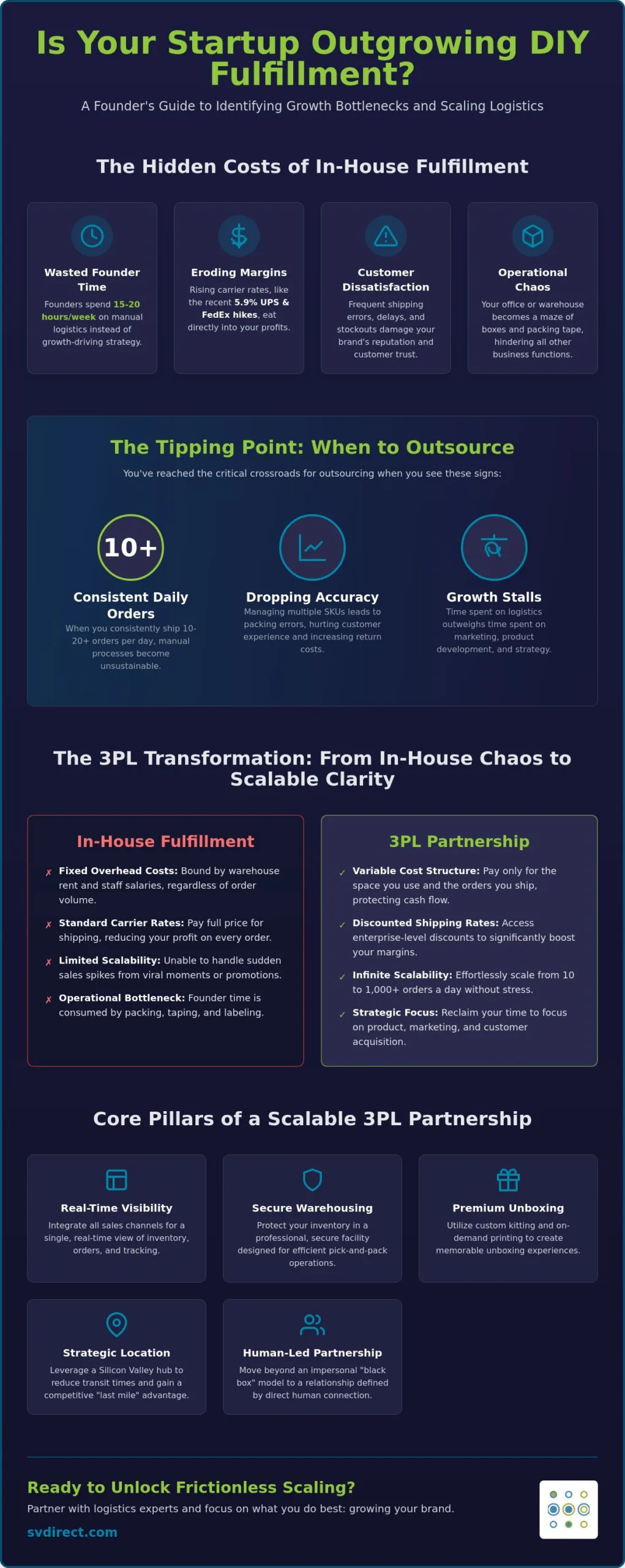
What if the very activity that proved your startup’s success, packing every order by hand, is now the primary obstacle preventing your next stage of growth? You’ve likely reached a point where your office or small warehouse has become a maze of cardboard and packing tape. It’s a common frustration for founders who find themselves trapped in the logistics of the present rather than the strategy of the future. Managing ecommerce fulfillment for startups in-house feels manageable at first; however, as volume increases, so do the shipping errors and the weight of rising carrier rates that eat into your hard-earned margins.

You deserve an operational foundation that scales as fast as your ambition. This guide will show you exactly how to identify your growth tipping point and transition to a professional 3PL without losing the personal touch your customers love. We’ll explore how a strategic partnership provides access to discounted shipping rates and reliable inventory management, ensuring your brand reputation remains spotless. From navigating the 5.9% rate hikes implemented by UPS and FedEx in 2026 to mastering cross-border complexities, you’re about to learn the blueprint for frictionless scaling.

Key Takeaways

  • Identify the critical inflection point where DIY shipping begins to hinder your brand’s growth and learn to calculate the hidden costs of in-house labor and space.
  • Master the transition to professional ecommerce fulfillment for startups by establishing real-time inventory visibility and secure warehousing across all your sales channels.
  • Leverage specialized services like custom kitting and on-demand digital printing to create premium unboxing experiences without the burden of maintaining excess marketing inventory.
  • Optimize your logistics strategy by utilizing a Silicon Valley hub to reduce transit times and gain a competitive “last mile” advantage in high-density customer zones.
  • Shift from an impersonal “black box” logistics model to a strategic partnership defined by direct human connection and seasoned operational oversight.

Determining When Your Startup is Ready for eCommerce Fulfillment Outsourcing

Growth is a double-edged sword for an emerging brand. In the early days, packing every order by hand is a rite of passage that ensures quality control and a personal touch. However, there is a definitive moment where this manual labor shifts from a cost-saving measure to a significant growth bottleneck. This transition is the core challenge of ecommerce fulfillment for startups. When your team spends more time managing tape dispensers and shipping labels than refining your product or acquiring customers, you’ve reached a critical operational crossroads. Understanding the order fulfillment process from a high-level strategic perspective is essential to move beyond the “hustle” phase and into a scalable business model.

To better understand how these logistics systems function at scale, watch this helpful video:

Identifying the red flags of an overextended operation is the first step toward scaling. Frequent shipping errors, missed pickup windows, and recurring stockouts are not just minor inconveniences; they are brand-damaging events. A professional 3PL partner transforms your logistics from a fixed overhead expense, involving warehouse rent and staff salaries, into a scalable, variable cost structure. You only pay for the space you use and the orders you ship, which protects your cash flow during lean months while providing unlimited capacity for growth.

The Opportunity Cost of Packing Your Own Boxes

Founder time is the most expensive resource in any startup. If you spend 15 to 20 hours a week on logistics, you’re effectively paying a C-suite salary for entry-level labor. Those hours represent lost opportunities for marketing campaigns, product development, and investor relations. Beyond time, professional packaging impacts your customer lifetime value (LTV) by ensuring every unboxing experience is consistent and high-quality. You can explore a deeper breakdown of these financial trade-offs in our guide on The Hidden Costs of In-House Fulfillment. Shifting these responsibilities to experts allows you to focus on the high-level strategy that actually drives revenue.

Scalability: From 10 to 1,000 Orders per Day

Professional warehousing is designed to absorb the volatility of the modern market. Whether you face a sudden viral social media moment or a predictable seasonal spike, a 3PL provides the physical infrastructure and human expertise to maintain 24-hour shipping windows without the typical startup stress. Furthermore, partnering with a logistics expert grants you access to deeply discounted carrier rates that are usually reserved for high-volume enterprises. The inflection point for startup outsourcing arrives when daily order volume consistently hits 10 to 20 shipments or when the complexity of managing multiple SKUs begins to compromise your order accuracy. By making the move early, you ensure that your backend operations never become the reason your front-end growth stalls.

The Core Pillars of a Scalable 3PL Partnership for New Brands

Scaling requires moving from reactive shipping to a proactive supply chain. A 3PL partnership provides the stability needed to navigate the complexities of ecommerce fulfillment for startups. It’s not just about finding a shelf; it’s about securing a team that understands your growth trajectory. This partnership rests on pillars of transparency, technological integration, and physical operational excellence. When these elements align, your logistics transition from a source of friction to a competitive advantage.

Physical security and climate control are often overlooked but are vital for tech-focused startups dealing with sensitive electronics or high-value goods. Beyond the walls, the science of pick and pack efficiency ensures that even small-batch orders are fulfilled with surgical precision. This accuracy prevents the costly returns that can cripple a new brand’s margins. In an era where UPS and FedEx have implemented 5.9% average rate increases at the start of 2026, every error is an expensive drain on your limited capital. Mastering ecommerce fulfillment for startups requires a partner that treats every package with the same care as your original founding team.

Integrating Your Tech Stack with a 3PL

Connectivity is the lifeblood of modern logistics. Your 3PL must offer seamless API integrations with platforms like Shopify and WooCommerce to ensure order data flows instantly. Real-time visibility prevents the nightmare scenario of overselling items that are actually out of stock. This data-driven approach allows you to make informed decisions about restock levels and marketing spend based on actual inventory movement. By using 3PL inventory management software, you gain a high-level view of your business that spreadsheets simply cannot provide.

The Logistics of Global Expansion

For B2C startups, international shipping is no longer an “eventual” goal; it’s a day-one requirement. A Silicon Valley hub provides a strategic gateway to both Asian and European markets, reducing transit times for high-density customer zones. However, 2026 has introduced new hurdles, such as the €3 customs duty on low-value imports into the EU and the permanent suspension of the Section 321 de minimis exemption in the US. Navigating these regulations requires a partner who provides personal oversight rather than automated responses. You can find more tactical advice on managing these complexities in our latest logistics insights.

Building this foundation early ensures your brand remains agile and ready for the next surge in demand. If you’re ready to move from manual processes to a high-performance system, it might be time to consult with a logistics expert who can tailor a solution to your specific needs.

Standard ecommerce fulfillment for startups often treats every package as a mere unit of inventory. However, for a brand building its identity in a crowded market, the unboxing experience is your first physical handshake with the customer. Specialized logistics services allow you to move beyond the brown-box monotony of generic shipping. By integrating high-touch processes into your supply chain, you transform a routine delivery into a powerful marketing event that drives social sharing and customer loyalty. This approach is particularly effective for brands that view their packaging as an extension of their product’s value proposition.

Managing these specialized needs requires a partner capable of handling more than just storage and shipping. Whether you’re assembling complex subscription boxes or managing sensitive medical literature, the human element of oversight is what prevents errors. In 2026, where automation often leads to rigid, impersonal service, having a dedicated team that understands your brand’s specific kitting requirements is a significant competitive differentiator. This level of care ensures that your returns management process also functions as a trust-builder, turning potential disappointments into seamless brand interactions that encourage repeat purchases.

Branded Packaging and Subscription Box Assembly

Custom kitting and assembly services are essential for startups that rely on curated experiences. By pre-assembling products into bundles or subscription boxes, you can significantly reduce shipping weight and dimensional costs compared to shipping items individually. Utilizing “just-in-time” digital printing for promotional inserts allows you to update marketing collateral without the waste of excess inventory. Custom assembly differentiates a startup from Amazon-style generic shipping by ensuring that every insert is placed perfectly and every product is presented exactly as your creative team intended, maintaining brand integrity through every mile of the journey.

High-Stakes Fulfillment: Healthcare and Security

For startups in the health-tech or high-end electronics sectors, ecommerce fulfillment for startups involves more than just speed; it requires strict adherence to security and regulatory standards. HIPAA compliance is non-negotiable for brands handling healthcare products or patient-facing literature. This level of precision extends to the physical environment as well. Utilizing secure warehousing for high-value electronics ensures that your most expensive assets are protected by both advanced surveillance and climate-controlled environments. Professional mailing services bridge the gap for compliance-heavy industries, ensuring that literature fulfillment meets all legal requirements while maintaining a premium feel. This proactive approach to security and compliance protects your brand’s reputation and your bottom line from the start.

ECommerce Fulfillment for Startups: The 2026 Strategic Scaling Guide

Strategic Logistics: Why Your Startup’s 3PL Location and Tech Matter

Many founders believe that a warehouse’s physical location is irrelevant as long as the digital integration is sound. This is a costly misconception. In the context of ecommerce fulfillment for startups, your geographic footprint dictates your shipping speed, your carrier costs, and your ability to scale globally. While software provides the visibility, the physical proximity of your 3PL to major logistics hubs determines the actual transit time your customer experiences. A strategic location acts as a force multiplier for your brand’s agility, allowing you to respond to market shifts with a level of precision that remote facilities cannot match.

Finding the right balance between high-tech automation and human oversight is the hallmark of a sophisticated operation. While AI-driven forecasting is essential for modern inventory management, it cannot replace the seasoned expert who spots a labeling error before a batch leaves the dock. This combination of innovation and personal commitment ensures that your logistics remain a steady hand in a fast-paced market. It’s about creating a system where physical operations are just as organized and responsive as your digital communication.

The Silicon Valley Strategic Hub

Positioning your inventory in the heart of Silicon Valley offers advantages that go far beyond tech industry proximity. This region serves as a premier global gateway, providing immediate access to major international airports and the Port of Oakland. For high-growth startups, this means faster inventory intake from overseas manufacturers and accelerated distribution to both domestic and international markets. The local expertise found here is uniquely attuned to the needs of tech-enabled brands, offering a sophisticated workforce that understands complex integrations and the high-stakes nature of the “last mile” advantage. Being at the center of innovation allows your logistics partner to adopt and refine new technologies long before they become industry standards.

Reducing Shipping Costs Through Zone Optimization

Shipping costs are largely determined by “zones,” which represent the distance a package travels from the warehouse to the customer. Strategic inventory placement in a high-density hub reduces the number of zones an order must cross, directly improving your startup’s profit margins. When your 3PL is located near your primary customer base, you don’t just save money; you gain the ability to offer competitive shipping speeds that build brand loyalty. Use this checklist to evaluate a potential 3PL location based on your specific needs:

  • Carrier Proximity: Is the facility near major FedEx, UPS, or USPS sorting hubs to ensure late-day pickups?
  • Inventory Intake: How close is the warehouse to international ports to minimize drayage costs?
  • Customer Density: Does the location align with your most active customer zip codes to minimize transit zones?
  • Technical Talent: Does the region have the workforce required to manage complex API integrations and custom kitting?

Optimizing your physical footprint is a vital step in transforming logistics from a cost center into a strategic asset. If you’re ready to leverage a premier West Coast hub for your brand, request a personalized logistics quote to see how strategic placement can accelerate your growth.

Silicon Valley Direct: Empowering Startup Growth Through Human-Led Logistics

The logistics industry has seen a surge in fully automated aggregators that promise efficiency but often deliver a “black box” experience. For ecommerce fulfillment for startups, this lack of transparency represents a significant operational risk. Silicon Valley Direct rejects this impersonal model in favor of a sophisticated blend of seasoned professionalism and high-tech efficiency. Since 1999, we’ve positioned ourselves as a steady hand in a fast-paced market, ensuring that your brand’s growth is supported by physical infrastructure and human expertise rather than just marketing abstractions. Our multi-decade history serves as a constant anchor of trust, providing the stability you need to scale without the friction of unmanaged errors.

Fully automated 3PLs often prioritize volume over the delicate nuances of a growing brand. This leads to hidden costs in the form of high error rates and a lack of accountability when things go wrong. We believe that startup fulfillment is a strategic partnership, not a commodity transaction. By combining our extensive operational history with modern digital integration, we provide a proactive stance that anticipates challenges before they impact your customer experience. This approach ensures that your logistics remain as organized and responsive as your own internal team, allowing you to focus on high-level strategy while we manage the precision of your physical operations.

A Partnership Built on Transparency

Our primary differentiator in a tech-saturated market is our explicit rejection of automated interactions. We promise direct human connection and personal oversight for every client. When you have a question about your inventory or a complex kitting requirement, you speak to an expert who understands your account, not a chatbot. This commitment to transparency is backed by our exceptional long-term staff retention. Experienced team members translate directly to higher pick-and-pack accuracy and a deeper understanding of your brand’s specific needs. We offer total flexibility and bespoke problem-solving, ensuring that our services adapt to your unique startup journey rather than forcing you into a rigid, one-size-fits-all box.

Ready to Scale Without the Pain?

Choosing a 3PL is one of the most critical decisions a founder will make. Silicon Valley Direct acts as a dedicated extension of your team, providing the “last mile” advantage and global connectivity required to thrive in 2026. We take the time to explain the rationale behind our quality control measures, moving you from a state of curiosity to a state of informed confidence. You can find more expert advice on navigating the complexities of modern supply chains by visiting Silicon Valley Direct’s blog. If you’re ready to eliminate operational friction and secure a high-performance partner, contact Silicon Valley Direct to streamline your startup’s fulfillment today. We are ready to help you turn your logistical challenges into a seamless competitive advantage.

Secure Your Growth with Strategic Logistics

Transitioning your logistics from a manual hurdle to a scalable asset is the most significant move you can make for your brand’s future. By identifying your growth inflection point early, you ensure that your backend operations never compromise your customer experience. Success in ecommerce fulfillment for startups requires more than just software; it demands a strategic partner who provides both the technical precision of a Silicon Valley hub and the human oversight necessary to manage complex, high-stakes orders.

Silicon Valley Direct has been a trusted logistics partner since 1999, offering specialized expertise in high-value electronics and healthcare-compliant fulfillment. We reject the impersonal nature of modern automation, ensuring direct human oversight on every order to maintain the brand integrity you’ve worked hard to build. Whether you are navigating the rate hikes of 2026 or expanding into international markets, our team provides the stability and bespoke problem-solving your startup deserves.

Scale your startup with Silicon Valley Direct’s expert fulfillment services and reclaim the time you need to lead your business toward its next major milestone. Your vision deserves an operational foundation that is as ambitious as your goals.

Frequently Asked Questions

What is the best time for a startup to switch to a 3PL?

The ideal time to transition occurs when manual order processing begins to consume time better spent on customer acquisition and brand strategy. Most founders find that hitting a consistent daily order volume or managing an expanding SKU list creates operational friction that only professional ecommerce fulfillment for startups can resolve. If shipping errors are increasing or you’re missing carrier pickup windows, you’ve reached the tipping point for outsourcing.

Can a 3PL handle custom kitting and branded packaging for my startup?

Yes, specialized providers offer kitting and assembly services to help you maintain a premium brand identity. This goes beyond simple storage; it involves building custom subscription boxes or adding promotional inserts to every order. By utilizing these specialized services, you can offer a unique unboxing experience that differentiates your brand from the generic packaging often associated with larger, fully automated marketplaces.

How much does eCommerce fulfillment typically cost for a small business?

Total costs are generally determined by a combination of storage needs, the number of items per order, and the final shipping destination. While fees vary based on your specific volume and product dimensions, most businesses view these as variable costs that replace fixed overhead like warehouse rent and staff salaries. Shifting to this model allows you to scale your expenses in direct proportion to your actual sales revenue.

What is the difference between a fulfillment center and a warehouse?

A warehouse is primarily designed for the long-term storage of goods, whereas a fulfillment center is a high-activity hub focused on active order processing. Fulfillment centers are equipped with the technology and staff required to pick, pack, and ship individual customer orders the moment they are placed. This distinction is vital for startups that require rapid turnaround times and real-time inventory management rather than just static storage space.

Does Silicon Valley Direct integrate with Shopify and other eCommerce platforms?

Silicon Valley Direct offers seamless API integrations with major platforms including Shopify, WooCommerce, and other popular ecommerce systems. These connections ensure that order data flows instantly to our facility and inventory levels are updated across all your sales channels in real time. This technical synergy prevents the common startup issue of overselling products that have already moved out of the warehouse.

Is it possible for a startup to use a 3PL for international shipping?

Using a 3PL is often the most efficient way for a startup to manage international logistics and cross-border regulations. Professional providers handle the complexities of customs documentation and help you navigate the specific duties or taxes required for different global regions. This expertise allows you to offer a reliable shipping experience to customers in Europe, Asia, and beyond from your first day of global expansion.

What happens if my startup has a sudden spike in orders?

A professional 3PL provides the physical infrastructure and flexible labor needed to absorb sudden spikes in order volume without operational delays. Whether you experience a viral social media moment or a seasonal surge, our facility scales its resources to ensure your shipping windows remain consistent. This elasticity protects your brand reputation during high-growth periods when your internal team would otherwise be overwhelmed by manual packing.

How does a 3PL help reduce shipping costs for new brands?

3PL providers leverage their collective shipping volume to secure deeply discounted carrier rates that are typically unavailable to individual startups. Additionally, strategic inventory placement helps reduce the number of shipping zones a package must travel, which lowers the total cost per order. By optimizing ecommerce fulfillment for startups, you can maintain healthier margins while still offering the competitive shipping speeds your customers expect.

omnichannel fulfillment

Top Omnichannel Fulfillment Services

Omnichannel fulfillment is no longer a niche logistics model. As brands sell through Shopify, Amazon, retail, and wholesale at the same time, they need one fulfillment system that can keep inventory accurate, route orders intelligently, and meet customer delivery expectations across every channel.

TL;DR: Summary

  • Omnichannel fulfillment is the best fit for ecommerce brands selling across multiple channels because it combines real-time inventory visibility, unified order routing, and multiple delivery options into one operating model.
  • The top omnichannel fulfillment services are the ones that connect storefronts, marketplaces, and warehouses without delays in stock updates or order status changes.
  • U.S. ecommerce reached 16.9% of total retail sales in Q1 2026, so brands increasingly need fulfillment built for cross-channel demand, not just single-store shipping.
  • Fast and reliable execution matters: a 2025 Radial survey found 72% of consumers prioritize speed and reliability, while nearly 40% stopped buying from DTC brands they liked because of fulfillment issues.
  • When choosing an omnichannel fulfillment partner, focus on integrations, same-day shipping capability, order accuracy, reporting, returns handling, and support for channel-specific workflows like BOPIS, retailer prep, subscriptions, or cross-border shipping.
  • If inventory is still updated in batches, orders are routed manually, or each channel runs on separate stock pools, the operation is multichannel, not truly omnichannel.

The strongest provider is not always the biggest network. For many growing brands, the better choice is the partner that can connect systems cleanly, support real-time visibility, and handle exceptions without slowing the customer experience. That is where omnichannel fulfillment shifts from a warehouse function to a revenue-protection function.

What is omnichannel fulfillment and why does it matter?

Omnichannel fulfillment is a unified order and inventory model across Shopify, Amazon, retail stores, and 3PL warehouses. It matters because customers expect flexible delivery and accurate stock, while brands need one source of truth for routing, shipping, and replenishment.

In practice, omnichannel fulfillment means a customer can buy from one channel and receive inventory from the best available node, whether that is a warehouse, a store, or a regional partner. The core idea is not just wider distribution. It is coordinated execution.

That distinction matters more now because ecommerce continues to grow. The U.S. Census Bureau estimated Q1 2026 ecommerce sales at $326.7 billion, up 9.8% year over year, and ecommerce accounted for 16.9% of total U.S. retail sales. More channels usually mean more inventory complexity, more split shipments, and more chances to disappoint a customer if systems are disconnected.

“SVDirect supports same-day shipping for orders received by cutoff from Union City, California.”

Speed is only one part of the equation. Reliability matters just as much. Radial reported that 72% of consumers prioritize speed and reliability when deciding where to buy, and nearly 40% stopped buying from DTC brands they liked because of fulfillment issues. A common mistake is treating omnichannel as a marketing feature when it is really an operating discipline.

How is omnichannel fulfillment different from multichannel fulfillment?

Multichannel fulfillment sells on many platforms, while omnichannel fulfillment connects those platforms through shared inventory and order logic. Shopify and Amazon can both be multichannel inputs, but without synchronized stock and routing rules, the operation is not omnichannel.

A multichannel brand may sell on its own site, a marketplace, and a retail portal, yet still manage each one in a separate workflow. That often leads to duplicate safety stock, manual order holds, and delayed inventory updates.

Omnichannel fulfillment is more integrated. Orders, returns, inventory reservations, and delivery promises work from the same data foundation. If one channel spikes, stock can be reallocated based on rules instead of spreadsheets. If a store can fulfill a nearby order faster than a warehouse, the system can route that way.

A common misconception is that adding more sales channels creates omnichannel capability. It does not. The shift happens when all channels share real-time inventory visibility and a unified order-management process.

What are the top omnichannel fulfillment services for growing ecommerce brands?

The top omnichannel fulfillment services usually combine 3PL execution, order-management connectivity, and real-time inventory control. SVDirect, ShipBob, and Radial are often considered for different operating profiles, while Amazon Multi-Channel Fulfillment can fit narrower use cases.

Choosing from this group depends less on brand recognition and more on fit. A fast-growing DTC brand, a wholesale-heavy business, and a subscription brand often need different fulfillment logic even when all three sell across multiple channels.

  1. Silicon Valley Direct (SVDirect): A strong fit for brands that want a West Coast 3PL with same-day shipping by cutoff, no minimum order requirement, 80+ preconfigured integrations, custom API support, and support for ecommerce, literature, print-on-demand, and healthcare workflows.
  2. ShipBob: Often shortlisted by DTC brands that want a structured, software-driven 3PL model for multi-channel ecommerce.
  3. Radial: Commonly considered by larger retail and enterprise merchants that need complex omnichannel operations and broader order-management support.
  4. Amazon Multi-Channel Fulfillment: Best viewed as a channel-adjacent option for brands already deep in Amazon logistics, not as a full omnichannel strategy by itself.
  5. Ryder or Whiplash-style providers: Useful benchmarks for brands comparing broader national fulfillment networks and retail-compliant distribution.
  6. Regional specialty 3PLs: Often the best choice when channel complexity, product handling, or support responsiveness matters more than network size alone.

The practical takeaway is simple: shortlist providers by workflow match, not by logo familiarity. If your business depends on retailer prep, subscription kitting, lot control, or cross-border support, ask about those first, before asking about warehouse count.

How do you choose an omnichannel fulfillment partner?

The right omnichannel fulfillment partner matches your channel mix, systems, and service promise. SVDirect and Shopify-connected brands usually benefit when the 3PL can support real-time visibility, same-day cutoffs, and exception handling without custom workarounds.

Start with channel mapping. List every revenue path that creates an order or inventory movement: DTC, marketplaces, wholesale, retail replenishment, subscriptions, returns, and store pickups if applicable. If two channels need different packing rules or carrier SLAs, that should be visible before you compare providers.

Next, test the systems layer. Ask how inventory is reserved, how often channel stock updates post, what happens during a sync failure, and whether returns restock automatically or require review. Pro tip: a demo that only shows dashboards is not enough. You need to see exception flows.

“SVDirect offers 80+ preconfigured integrations and custom API support for ecommerce fulfillment.”

Then pressure-test support and operational fit. Ask who owns onboarding, whether you get a dedicated account manager, what same-day shipping means in practice, and how the warehouse handles spikes, retailer compliance, or subscription batches. If a provider cannot explain order routing logic clearly, the service will become reactive under stress.

Which capabilities matter most in an omnichannel fulfillment platform?

The most important omnichannel fulfillment capabilities are real-time inventory visibility, order routing, and accurate warehouse execution. A warehouse management system and an order-management layer must work together, or channel complexity will outgrow the operation.

A good platform should help you answer three questions instantly: what is available, where it is available, and what should ship next. That sounds basic, yet many brands still rely on delayed marketplace syncs or manual inventory buffers that hide true demand.

“SVDirect uses a warehouse management system with real-time inventory visibility and order tracking.”

The most useful capabilities usually include:

  • Real-time inventory visibility: Stock updates across warehouses, stores, and marketplaces without long delays.
  • Order routing rules: Logic based on proximity, channel SLA, inventory health, or cost.
  • Carrier and service selection: Matching promised delivery dates to the best shipping method.
  • Returns processing: Fast restocking, inspection, and status feedback to customer systems.
  • Channel-specific workflows: Retailer prep, subscriptions, bundles, kitting, or print-on-demand.
  • Reporting and audit trails: Clear data for fill rate, exception trends, and inventory variance.

A common mistake is assuming the portal itself is the system. The portal is the window. The real value sits in the data flow between your WMS, OMS, ecommerce platforms, and carrier events.

How do integrations and real-time inventory visibility reduce stockouts?

Integrations and real-time inventory visibility reduce stockouts by keeping reservations, allocations, and status changes current across every selling channel. Shopify and Amazon both depend on accurate stock signals, but the real control point is the system connecting them.

If a marketplace order is imported late, the same inventory can be sold twice. If returns take days to restock, available inventory looks lower than reality. If bundles are not broken down to component SKUs, replenishment math becomes distorted.

Shopify has emphasized enterprise-grade inventory-data visibility as a core omnichannel need because it helps avoid both stockouts and excess inventory. That is the trade-off many brands miss. Poor visibility does not only lose sales. It also ties up capital in the wrong locations.

The best setups reserve stock immediately, update all channels quickly, and apply channel-aware buffers only when needed. Pro tip: safety stock should be a rule-based exception, not a permanent workaround for bad syncing.

How should you roll out omnichannel fulfillment across channels?

The best rollout starts with one inventory model, one SKU structure, and one routing policy. Shopify, Amazon, and wholesale portals can then be added in phases without breaking data consistency.

Step one is product data cleanup. Standardize SKU names, bundle logic, units of measure, and return dispositions. If channel listings do not map cleanly to warehouse SKUs, no routing rule will save you later.

Step two is service-rule design. Decide which channels get priority during shortages, what qualifies for same-day shipping, and when orders can split across nodes. A good rule set avoids ad hoc decisions by customer service teams.

Step three is phased activation. Launch with your highest-volume channel pair first, usually DTC plus one marketplace. Once inventory and routing behave correctly, add retailer orders, subscriptions, or pickup logic. Pro tip: start with the top slice of SKUs driving most volume before you scale the full catalog.

Omnichannel fulfillment vs traditional 3PL: which fits your operation?

Traditional 3PL works well for simpler flows, while omnichannel fulfillment fits brands with mixed DTC, marketplace, retail, and subscription demand. Amazon sellers and Shopify brands often outgrow traditional 3PL logic once channel rules start colliding.

A traditional 3PL is often enough when orders are uniform, inventory sits in one location, and shipping promises do not vary much by channel. That model can be cost-effective and operationally clean.

Omnichannel fulfillment makes more sense when the business needs flexible routing, unified inventory, and multiple service options like home delivery, store pickup, or alternative collection points. Shopify has pointed to buy online, pick up in-store as a clear omnichannel example because it depends on shared inventory and coordinated order handling.

If your operation has frequent oversells, channel allocation disputes, or manual rerouting, the added system complexity of omnichannel is usually justified. If you ship a narrow catalog through one channel, a simpler 3PL may still be the smarter choice.

How do you measure omnichannel fulfillment performance?

You measure omnichannel fulfillment through service, accuracy, inventory health, and channel responsiveness. SVDirect and other mature 3PLs typically monitor order accuracy, shipping speed, and inventory visibility because those metrics affect revenue directly.

Start by defining the service promise per channel. Marketplace orders, DTC subscriptions, and wholesale replenishment should not all share the same KPI thresholds if the customer promise is different.

Then track the core metrics that expose operational truth:

  • Order accuracy: Monitor pick, pack, and ship accuracy by channel and SKU type.
  • Same-day ship rate: Measure orders shipped within posted cutoff windows.
  • Inventory accuracy: Compare system quantity to physical count and watch variance trends.
  • On-time delivery: Track promise date performance, not just warehouse departure time.
  • Fill rate: Review how often orders ship complete without backorders or substitutions.
  • Return cycle time: Measure how quickly returns are received, inspected, and restocked.

Finally, connect those metrics to decisions. If inventory accuracy drops, review receiving and cycle counting first. If same-day ship rate falls only on bundle orders, packaging or kitting logic may be the real issue. A common misconception is that carrier delivery speed alone defines fulfillment performance; warehouse latency and inventory errors often cause the failure earlier.

What mistakes cause omnichannel fulfillment failures?

Most omnichannel fulfillment failures come from disconnected data, weak routing rules, and unclear ownership. Shopify stores and Amazon marketplace feeds can coexist, but without shared inventory logic, they create preventable errors.

One common failure is batch-based inventory syncing. It may seem manageable at low volume, yet it often breaks during promotions, influencer spikes, or seasonal peaks. Another is channel-specific SKU drift, where the same product is named or bundled differently across systems.

Brands also run into trouble when they treat every channel equally during shortages. If high-margin DTC orders and low-margin marketplace orders pull from the same pool without rules, customer value can erode quickly. Clear allocation logic matters.

There is also a support misconception: many teams assume the problem is software alone. In reality, omnichannel breaks down at handoff points, including receiving, returns, retailer prep, and exception escalation. The best systems still need disciplined warehouse processes.

When should a brand switch to an omnichannel 3PL?

A brand should switch when channel growth starts creating inventory conflict, service inconsistency, or manual routing work. SVDirect and similar 3PLs become relevant when a brand needs unified fulfillment across DTC, marketplaces, retail, and cross-border shipping.

A few triggers are easy to spot. You sell through more than one major channel and can no longer trust available inventory at a glance. Customer support is spending time fixing order-routing mistakes. Marketplace SLAs and DTC promises are competing for the same stock.

The case becomes stronger when you need specialized workflows, not just more storage. That can include subscription kitting, retailer prep, print-on-demand, literature fulfillment, healthcare logistics, or shipping across the U.S. and Canada from one operating base.

If those signs are already visible, waiting usually costs more than moving. Omnichannel fulfillment works best when it is installed before complexity becomes chronic, not after service failures start teaching the same lesson repeatedly.

Isometric supply chain diagram showing factory, dock, ship, and truck with cost labels for manufacturing, freight, customs duties, handling, and last-mile.

Calculating Total Landed Cost for eCommerce: The 2026 Strategic Guide

With global container freight rates jumping 23% in early June 2026 and the suspension of the U.S. de minimis threshold, the precision involved in calculating total landed cost for ecommerce has become your most vital survival skill. You aren’t alone if you feel that despite rising sales, your actual take-home pay is being squeezed by unpredictable international shipping fees and the sheer complexity of SKU-level overhead. It’s a common struggle for growing brands to realize that their pricing strategy hasn’t kept pace with the volatile reality of modern logistics.

Mastering these complexities is the only way to protect your business from the invisible drains on your capital. This guide provides a clear, repeatable formula to help you identify every hidden fee in your supply chain, from current carrier fuel surcharges to the latest HTS duty rates. We’ll show you how to leverage 3PL precision to gain a strategic advantage, transforming your fulfillment operations from a cost center into a powerful engine for scalable growth.

Key Takeaways

  • Move beyond the “COGS trap” to understand why total landed cost is the only metric that accurately reflects your brand’s actual financial health.
  • Master the 2026 step-by-step formula for calculating total landed cost for ecommerce, accounting for new tariffs and shifting freight realities.
  • Discover how strategic kitting and assembly can directly lower your DIM weight and shipping expenses to reclaim lost margins.
  • Learn why human oversight in inventory management is superior to purely automated software for preventing costly stock obsolescence.
  • Identify the hidden “risk” and “overhead” costs that often go overlooked in standard accounting but significantly impact your bottom line.

What is Total Landed Cost and Why is it the Ultimate eCommerce Health Metric?

Total landed cost is the financial heartbeat of your operation. It represents the aggregate sum of every expense required to move a product from the manufacturing floor to your customer’s doorstep. While many entrepreneurs start with basic procurement figures, What is Total Landed Cost? encompasses much more than the invoice from your supplier. It includes freight, insurance, customs duties, and the specific overhead of your fulfillment partner. Without this metric, you’re essentially flying blind, unable to see the true profitability of each individual SKU in your catalog.

To better understand this concept, watch this helpful video:

Relying on Cost of Goods Sold (COGS) is a dangerous half-truth. COGS typically only accounts for the raw manufacturing or procurement price per unit. In a year where ocean freight rates spiked by 23% in the first week of June 2026, ignoring the logistics layer means your margins are likely thinner than your dashboard suggests. When you master calculating total landed cost for ecommerce, you gain the clarity needed to adjust pricing in real-time. This data drives smarter marketing spend by ensuring you aren’t pouring budget into “zombie SKUs” that look profitable on paper but lose money once they leave the warehouse.

The 2026 market environment demands this level of precision. With the U.S. de minimis threshold suspended since August 2025, every low-value shipment now faces formal customs entry and full duty payments. This shift, combined with new Section 301 tariffs proposed in June 2026, has made landed cost predictability a thing of the past for those using outdated spreadsheets. You need a proactive stance to stay ahead of these regulatory changes.

The Difference Between FOB, CIF, and Total Landed Cost

Understanding Incoterms is essential for identifying where your financial liability begins. ‘Free on Board’ (FOB) means the supplier’s responsibility ends once the goods are on the vessel; everything after that is your cost. ‘Cost, Insurance, and Freight’ (CIF) covers more ground but still stops short of the final delivery. Total Landed Cost shifts your perspective from the factory gate to the customer’s doorstep. It ensures that domestic drayage, port fees, and “last-mile” delivery costs are fully integrated into your unit economics so there are no surprises at the end of the quarter.

The Hidden Risks of Ignoring Your Landed Cost

Invisible fees are the primary reason for margin erosion. In June 2026, fuel surcharges for international services like UPS Saver have reached 26.10% in some regions. If these aren’t factored into your SKU-level analysis, you might be over-investing marketing dollars into products that are technically losing money. Investors and lenders now prioritize this level of transparency. They want to see a proactive strategy that accounts for every variable in the supply chain, from warehouse labor to shifting customs regulations. Precision in calculating total landed cost for ecommerce isn’t just about accounting; it’s about making sure your business remains a high-performance partner for your stakeholders.

The 5 Core Components of eCommerce Landed Cost

To achieve financial clarity, you must look beyond the surface level of your bank statements. Precision in calculating total landed cost for ecommerce requires a granular view of five distinct pillars. It isn’t just about the invoice from your manufacturer; it’s about the cumulative weight of every touchpoint in your supply chain. Each component represents a lever you can pull to optimize your margins.

  • Product Cost: This is your baseline, representing the raw manufacturing or procurement price per unit as stated by your supplier.
  • Shipping and Freight: This includes the volatile international ocean or air freight charges, which saw global container rates hit $3,433 in early June 2026, plus the domestic “last-mile” delivery to the customer.
  • Customs and Duties: These are the mandatory fees for cross-border trade, including HTS 2026 classifications, VAT, and broker fees that have become more significant since the suspension of the U.S. de minimis threshold.
  • Risk and Insurance: This covers the cost of protecting your inventory against transit damage, loss, or the silent margin-killer of inventory obsolescence.
  • Fulfillment and Handling: Often called the “3PL Layer,” this includes the physical labor of storage, pick and pack services, and value-added kitting.

Fulfillment Fees: The Often-Overlooked Component

While freight gets the headlines, the daily operational costs of fulfillment are where many brands lose their grip on profitability. Pick and pack fees are variable unit costs that must be accounted for in every sale. Monthly warehousing and storage fees also impact your bottom line differently depending on your inventory turnover. Slow-moving SKUs quietly accumulate costs that can eventually exceed their initial value. Additionally, a robust returns management strategy is essential, as the labor and logistics of processing a return are often higher than the original fulfillment cost.

Duties, Taxes, and Compliance

The 2026 regulatory environment is demanding. Since the U.S. de minimis threshold was suspended in August 2025, every commercial shipment now requires formal customs entry. This means duty payments are no longer optional for low-value goods. For brands in specialized sectors like healthcare mailing or pharmaceutical fulfillment, compliance costs are even higher due to the need for precise handling and tracking. The cost of non-compliance, such as shipment delays or heavy penalties from the USTR, far outweighs the investment in professional oversight. If you’re looking for a partner to help navigate these variables, you can request a personalized quote to see how our precision fulfillment fits your business model.

The Total Landed Cost Formula: A Step-by-Step Calculation

Precision in calculating total landed cost for ecommerce requires a methodical approach that accounts for every variable from the factory floor to the final delivery. You can’t rely on broad estimates when global logistics costs are as volatile as they’ve been in June 2026. The standard formula serves as your foundation: [Product] + [Shipping] + [Customs] + [Risk] + [Overhead] = Landed Cost. Breaking this down into actionable steps ensures that no hidden fee erodes your margins.

  • Step 1: Identify Aggregate Costs. Start by gathering the total expenses for a specific production run. This includes the supplier’s invoice, bulk freight charges, and the latest 2026 HTS duty rates.
  • Step 2: Choose an Allocation Method. You must decide how to divide bulk costs, like a shipping container, among individual units. Common methods include weight, volume, or total value.
  • Step 3: Calculate Fulfillment and Last-Mile. Add the specific pick-and-pack fees from your 3PL partner and the domestic postage management costs required to reach the customer.
  • Step 4: Factor in the “Risk Buffer.” Account for the labor and logistics of returns management and customer service overhead to find your true unit cost.

Allocation Methods: Weight vs. Value

Choosing the right allocation method is vital for accuracy. Weight-based allocation is best for heavy industrial goods, while value-based allocation suits high-end electronics where insurance costs scale with price. For most modern brands, volume-based allocation is necessary to account for the space your inventory occupies in a warehouse. Dimensional (DIM) weight serves as the industry standard for 2026 logistics, ensuring that the space a package occupies is billed as fairly as its actual mass. If your 3PL storage fees are based on pallet or bin space, volume-based allocation will give you the most honest look at your overhead.

A Practical Calculation Example

Imagine you’re importing a batch of 1,000 units from Shanghai to Los Angeles. In early June 2026, ocean freight for a 40-foot container on this route reached $4,565. If your product cost is $10 per unit, your initial procurement is $10,000. Under the new 2026 trade proposals, you might face a 10% ad valorem tariff, adding another $1,000 in customs duties. You must also factor in fuel surcharges, which for many international carriers currently hover around 12% to 26% depending on the service level.

Once the goods arrive at our facility, you’ll add the per-unit fulfillment fee and the domestic postage. If your fulfillment and “last-mile” costs total $8 per unit, and you’ve factored in a 3% buffer for returns, your “True Unit Cost” is no longer just the $10 you paid the factory. It’s likely closer to $24.50. This granular visibility allows you to set an MSRP that protects your bottom line while remaining competitive in a crowded market.

Calculating Total Landed Cost for eCommerce: The 2026 Strategic Guide

Operational Levers: How 3PL Efficiency Directly Lower Your Landed Cost

Landed cost is often viewed as an unavoidable accounting result. However, seasoned operators know it’s actually a dynamic outcome of your fulfillment strategy. When you move past the initial phase of calculating total landed cost for ecommerce, you begin to see where operational efficiency can reclaim your margins. A high-performance 3PL partner doesn’t just record costs; they actively work to lower them through precision handling and strategic physical infrastructure. This proactive stance is what separates stagnant brands from those that scale with stability.

Kitting and Assembly as a Cost-Saving Tool

Strategic kitting and assembly services serve as a primary lever for cost reduction. By bundling products into custom-fitted packaging, you reduce the dimensional (DIM) weight that dictates modern shipping rates. Dimensional weight calculates shipping costs based on package volume rather than just mass, standing as the industry standard for 2026 logistics. This eliminates the “air” you’re currently paying to ship. Some brands have realized a 15% reduction in their total landed cost simply by switching to on-demand kitting. This approach streamlines the pick and pack phase, reducing labor time and packaging waste simultaneously.

Effective inventory management, specifically the use of First-In, First-Out (FIFO) protocols, prevents the silent erosion of profit caused by storage fees on obsolete stock. In an environment where warehouse space is at a premium, keeping your stock moving is essential. Our team provides the human oversight necessary to spot slow-moving SKUs before they become a liability. This ensures that your capital isn’t tied up in aging inventory that carries a high storage-to-value ratio. By maintaining a lean inventory, you keep the “overhead” portion of your landed cost formula as low as possible.

Global Shipping and Returns Optimization

Optimizing global shipping services is another critical factor. Our Silicon Valley location acts as a strategic hub, reducing transit times and last-mile expenses for both domestic and international routes. By leveraging our established carrier relationships, you gain access to postage discounts that are typically unavailable to individual brands. This directly slashes the shipping component of your landed cost. Additionally, efficient returns management ensures that reverse logistics don’t become a “dead zone” where landed cost is lost. Human oversight remains our signature differentiator, allowing us to catch shipping errors or damage claims that automated software might miss.

If you’re ready to see how operational precision can protect your bottom line and improve your unit economics, request a free quote to discuss a bespoke fulfillment strategy tailored to your growth goals.

Partnering for Profit: Optimizing Your Supply Chain with Silicon Valley Direct

The mathematical exercise of calculating total landed cost for ecommerce is only half the battle. While automated software can generate reports, it cannot navigate a sudden port strike or negotiate a bespoke kitting solution for a fragile product launch. This is where professional oversight becomes your most valuable asset. Silicon Valley Direct provides a steady hand in a volatile market, ensuring that your data translates into actual operational savings rather than just a digital spreadsheet. Our proactive approach is backed by physical infrastructure and human expertise, not just marketing abstractions.

Integrating on-demand digital printing into your fulfillment workflow further optimizes your unit economics. Instead of warehousing thousands of pre-printed marketing inserts or instruction manuals that occupy valuable shelf space, you can print exactly what you need as orders are processed. This reduces your physical storage footprint and eliminates the risk of inventory obsolescence for your literature. It’s a precise way to lower the storage component of your landed cost while maintaining total flexibility for your brand messaging.

The Silicon Valley Direct Difference

We leverage over 25 years of operational history to help our partners navigate the complexities of modern logistics. Our geographic identity in the heart of Silicon Valley serves as a symbol of innovation and global connectivity, allowing us to act as a high-performance hub for your brand. We explicitly reject the “automated-only” support models that have become common in the industry. Instead, we prioritize direct human connection and personal oversight. This ensures that high-stakes operations, such as warehousing for electronics, are handled with the specialized care and security they require.

Ready to Protect Your Margins?

The transition from in-house chaos to professional 3PL stability is the most significant step you can take to protect your margins in 2026. With the suspension of the U.S. de minimis threshold and the rise in ocean freight rates, you can’t afford to guess your unit economics. Your next step should be a comprehensive total landed cost audit of your current SKUs to identify where “invisible” fees are draining your capital. Our team is ready to collaborate on a strategy that includes strategic kitting, assembly, and global shipping to ensure your business remains scalable and profitable.

Don’t let unpredictable fees and complex regulations erode your hard-earned growth. It’s time to move toward a partnership defined by precision and reliability. Streamline your supply chain with Silicon Valley Direct and gain the clarity you need to lead your market.

Mastering Your Margins in a Volatile Global Market

Precision in calculating total landed cost for ecommerce is no longer a luxury for growing brands; it’s a fundamental requirement for survival. In a market defined by shifting trade policies and fluctuating freight rates, your ability to identify every “hidden” fee determines your long-term stability. By leveraging operational levers like strategic kitting and assembly, you can transform your supply chain from a cost center into a competitive advantage. The insights gained today serve as a roadmap for optimizing your unit economics and reclaiming lost profits.

Since 1999, Silicon Valley Direct has acted as a steady hand for businesses navigating these complexities. We combine deep expertise in specialized sectors like high-value electronics and healthcare mailing with a commitment to direct human oversight for every order. We don’t believe in impersonal, automated-only interactions. Your business growth deserves the precision of a seasoned partner who values your time. Optimize your eCommerce fulfillment and lower your landed costs today with Silicon Valley Direct. We are ready to help you lead your industry with clarity and confidence.

Frequently Asked Questions

What is the most common mistake when calculating total landed cost?

The most frequent error is relying solely on the manufacturer’s invoice and ignoring the “invisible” logistical layer. Many brands fail to account for domestic port fees, drayage, and the administrative cost of customs compliance. This oversight leads to a skewed perspective on actual profitability per SKU, as the true cost of getting a product to the doorstep is often much higher than the factory price suggests.

How do 3PL pick and pack fees affect my per-unit landed cost?

Pick and pack fees act as a direct variable cost that must be included in your per-unit analysis. These fees cover the physical labor of selecting and preparing an order for shipment. When calculating total landed cost for ecommerce, including these charges ensures you aren’t subsidizing low-margin items with high-volume sales that require more intensive labor to fulfill.

Does total landed cost include marketing and advertising expenses?

No, landed cost does not traditionally include marketing or advertising expenses. Those figures are categorized under Customer Acquisition Cost (CAC). Landed cost focuses specifically on the physical journey of the product from the manufacturing facility to the customer’s doorstep, encompassing manufacturing, transit, duties, and fulfillment labor. Keeping these metrics separate allows for clearer operational analysis.

How often should an eCommerce brand recalculate its landed costs?

You should recalculate your landed costs at least quarterly or whenever a significant supply chain event occurs. In a volatile year like 2026, this includes the implementation of new trade tariffs or sudden spikes in ocean freight rates. Regular audits are essential to prevent margin erosion and to ensure your pricing strategy remains aligned with current global logistics realities.

Can kitting and assembly services actually lower my shipping costs?

Kitting and assembly services directly lower shipping costs by optimizing the dimensional (DIM) weight of your packages. By bundling multiple items into custom-fitted boxes, you eliminate the excess “air” that carriers bill for under 2026 pricing standards. This physical optimization ensures you only pay for the space your product actually occupies, which can significantly reduce your total shipping spend.

What is the impact of fuel surcharges on landed cost in 2026?

In 2026, fuel surcharges have become a massive variable, with some international services seeing additions of over 25% on top of base rates. These surcharges fluctuate weekly based on global energy prices and carrier policies. Failing to track these dynamic fees can lead to significant discrepancies between your estimated and actual unit costs, making them a critical component of calculating total landed cost for ecommerce.

Is it better to use weight or value for cost allocation?

The choice between weight and value depends on your specific product profile. Weight-based allocation is the standard for heavy goods, while value-based allocation is better for luxury items or high-end electronics where insurance costs scale with price. For many modern brands, a volume-based approach using DIM weight provides the most accurate data for allocating warehouse and freight overhead.

How does a Silicon Valley location help with international landed costs?

A Silicon Valley location provides strategic proximity to major West Coast ports and international carrier hubs. This reduces the time and expense associated with domestic drayage and “last-mile” delivery. Our location also allows for faster processing of high-value inventory, ensuring your goods move through the supply chain with the precision and speed required to maintain healthy margins.

Comprehensive Business Mail Services in San Francisco: The 2026 Strategic Guide

Comprehensive Business Mail Services in San Francisco: The 2026 Strategic Guide

With digital ad fatigue reaching a breaking point, it’s striking that 90% of brands actually increased their investment in physical correspondence over the last year. In a city where every square foot of office space carries a premium, maintaining an in-house mailroom often feels like a logistical anchor rather than a business asset. You likely recognize that managing complex USPS postage discounts and CASS certifications is a full-time burden that pulls your team away from core innovation. Finding reliable business mail services in San Francisco isn’t just about outsourcing; it’s about reclaiming your focus and ensuring your high-stakes communications reach their destination without a single compliance slip-up.

We understand the pressure of scaling operations while navigating the 2026 postal landscape, including the scheduled move to an $0.82 Forever stamp this July. This guide provides a strategic roadmap to help you streamline corporate correspondence, direct mail marketing, and specialized fulfillment through a high-tech partnership. We’ll examine the critical importance of HIPAA-compliant data security for healthcare mailings and show you how automated kitting can transform your distribution model into a lean, high-performance engine.

Key Takeaways

  • Discover how modern business mail services in San Francisco have evolved from simple mailroom tasks into integrated logistics and data-driven marketing operations.
  • Master the technical advantages of CASS certification and ZIP code presorting to secure the deepest possible USPS discounts for your corporate correspondence.
  • Clarify the operational distinctions between high-engagement direct mail marketing and the precision-driven world of eCommerce order fulfillment.
  • Secure your reputation by implementing non-negotiable HIPAA and financial compliance standards for all sensitive healthcare and statement mailings.
  • Learn why the most successful 2026 mail strategies reject total automation in favor of personal account management and seasoned human expertise.

What are Professional Business Mail Services in 2026?

Business mail services san francisco have evolved far beyond the simple act of receiving and forwarding envelopes. In the current market, these services act as a sophisticated bridge between digital systems and physical touchpoints. Professional business mail services represent the seamless fusion of physical logistics and digital data management, transforming traditional correspondence into a high-precision, scalable operational asset. This shift reflects a broader transition from passive mail handling to active integration with eCommerce order fulfillment and marketing strategies.

Many companies in the Bay Area are moving away from in-house mailrooms to reduce massive overhead. By outsourcing, you gain access to high-tech automation while maintaining the human oversight necessary for complex projects. This ensures that while machines handle the heavy lifting, a seasoned professional still monitors every outgoing piece for quality and accuracy. This balance is vital for maintaining the personal touch that defines successful corporate communication.

To better understand this concept, watch this helpful video:

The Core Components of Modern Mail Solutions

Modern mail solutions aren’t one-size-fits-all. They’re built on three primary pillars that help your business grow. Direct mail marketing involves a tactical hunt for new customers through physical engagement, ranging from standard postcards to complex promotional kits. For more context on the history of this medium, you can review this Direct Mail Marketing Overview. Transactional mail handles your essential, compliance-driven documents like invoices and statements where accuracy is non-negotiable. Finally, literature fulfillment allows us to manage and ship your branded marketing materials on-demand, keeping your inventory lean and your distribution fast.

Why San Francisco Locations Demand a Strategic Approach

San Francisco’s real estate market makes every square foot precious. Dedicating high-cost office space to storage and mail sorting is often a significant financial drain. A logistics partner offers warehousing and distribution at a fraction of the cost of commercial office space in the city. Being located near the Silicon Valley tech hub also provides a distinct logistical advantage. It allows for faster integration with digital platforms and quicker turnaround for global shipping and logistics. You can explore more about optimizing these workflows and reducing your operational footprint on our blog. Partnering with local experts ensures you stay agile in a fast-paced economy.

Optimizing Postage and Delivery: The Technical Advantage

Effective business mail services san francisco rely on technical precision to turn logistics into a competitive edge. It begins with CASS (Coding Accuracy Support System) certification. This process validates every address in your database against the USPS master file, adding missing ZIP+4 codes and correcting misspellings. CASS isn’t just a quality check; it’s a requirement for accessing automation postage rates. By ensuring your mail is deliverable, you eliminate the wasted cost of returned pieces and missed opportunities. It’s the difference between a campaign that reaches its target and one that ends up in a recycling bin.

Postal presorting takes these savings even further. By pre-arranging mail into 3 and 5-digit ZIP code groups before it ever reaches the post office, you bypass several USPS processing steps. In 2026, commercial 5-digit presort letters can start as low as $0.372 per piece, a significant reduction from standard metered rates. We favor high-speed inkjet addressing over traditional labeling because it creates a cleaner, more professional aesthetic while maintaining maximum production speed. This high-speed sorting mirrors the infrastructure used by the post office, allowing your mail to “fast-track” through the system. When you combine this with batch delivery to carriers, even international shipping timelines become more predictable and cost-effective.

Postage Discount Strategies for 2026

Choosing between First-Class and Marketing Mail is a strategic decision based on your required delivery speed and budget. While First-Class offers speed and return-to-sender services, Marketing Mail provides the lowest entry cost for high-volume campaigns. We also utilize National Change of Address (NCOA) processing to update your lists in real-time. This database hygiene ensures your message follows your customers even when they move, preserving your ROI. Technical accuracy in addressing is also the foundational step in meeting the HIPAA Privacy Rule for sensitive correspondence.

Digital Printing Integration

Modern mail relies on just-in-time digital printing to eliminate the need for massive, pre-printed inventories. This approach reduces waste by printing exactly what you need to ship today. Variable data printing allows for personalization at scale, where every piece of mail can feature unique names, offers, or images based on your customer data. This high-level customization drives much higher engagement than generic “Current Resident” mailings. You can see how we integrate these tech-driven workflows by exploring our insights on on-demand digital printing. If you’re ready to see how these technical advantages can lower your overhead, feel free to request a free quote for your next project.

Direct Mail Marketing vs. eCommerce Fulfillment: Choosing Your Path

Understanding the distinction between marketing-driven mail and operational fulfillment is essential for any growing brand. While both rely on physical logistics, their strategic goals are fundamentally different. Direct mail marketing acts as a tactical hunt for new customers, using tangible engagement to cut through the noise of overcrowded digital inboxes. In contrast, eCommerce fulfillment serves as the operational backbone of your business, ensuring that products and orders reach your existing customers with speed and precision. Choosing the right business mail services in San Francisco often means finding a partner capable of balancing these two distinct disciplines under one roof.

When to Prioritize Direct Mail Marketing

Direct mail is particularly effective for high-value B2B outreach where digital filters often block your best messaging. It also remains a powerhouse for local San Francisco retail promotions and non-profit fundraising efforts. Because physical mail has an average response rate of 3.63%, it offers a reliable return on investment that digital ads often struggle to match. For a deeper look at these strategies, we recommend reviewing our Direct Mail Marketing Services Guide to see how physical engagement can drive your 2026 growth goals.

When to Shift to Full eCommerce Fulfillment

Scaling past “garage-based” operations requires a professional 3PL partner who can manage the complexities of global shipping and returns management. If your team is spending more time packing boxes than innovating, it’s time to transition to a dedicated warehouse and distribution model. When evaluating a partner for business mail services in San Francisco, verify that they offer real-time inventory management software. This technology allows you to track stock levels and order status instantly, mirroring the standards set by USPS Business Mail Services for commercial reliability. Professional fulfillment doesn’t just ship products; it protects your reputation through accuracy and operational readiness.

Comprehensive Business Mail Services in San Francisco: The 2026 Strategic Guide

Specialized Mailing: Compliance, Healthcare, and Security

In a high-stakes environment like the San Francisco Bay Area, specialized mailing requires more than just logistical speed. It demands a rigorous commitment to data integrity and physical security. For healthcare providers, the average cost of a data breach has climbed to $9.77 million as of 2026, making the selection of business mail services san francisco a critical risk-management decision. Any vendor handling Protected Health Information (PHI) must sign a Business Associate Agreement (BAA) and demonstrate robust digital defenses. We ensure that Personally Identifiable Information (PII) is purged from our systems after 60 days, providing a level of security that automated-only platforms often overlook.

Financial institutions face similar pressures when distributing sensitive documents like Explanation of Benefits (EOBs) or account statements. These mailings require absolute precision to ensure that private data never reaches the wrong recipient—a standard that is equally vital for specialty finance providers like National Dealer Direct, LLC when managing boat and RV financing paperwork. While automation handles the volume, our seasoned experts provide the human oversight necessary to prevent the small errors that lead to major compliance failures. This “human-in-the-loop” approach acts as a final safeguard, bridging the gap between mechanical efficiency and the high-stakes reality of modern data privacy laws. It creates a reassuring layer of protection that pure software solutions simply can’t replicate.

Compliance Mailing Checklist

Maintaining a secure mailing workflow requires a methodical approach to data and physical handling. If your current provider can’t verify these specific steps, your organization could be at risk for significant penalties:

  • End-to-end encryption: Data must be protected using TLS 1.2 or higher during transmission and AES-256 at rest.
  • Comprehensive audit trails: Every sensitive piece of mail should be trackable from the initial data upload to final delivery.
  • Strict access controls: Only authorized personnel should have access to the physical production areas where sensitive mail is processed.

For a deeper dive into regulatory requirements, consult our Healthcare Mailing Services Guide to understand how we maintain precision in 2026.

Handling High-Value Electronics and Sensitive Materials

San Francisco’s tech landscape often involves the distribution of high-value hardware and pharmaceutical samples that require more than a standard shelf. Secure, climate-controlled warehousing is non-negotiable for protecting the integrity of Silicon Valley tech hardware and sensitive medical devices. Our kitting and assembly services are designed for these delicate operations, ensuring that every kit is built to exact specifications with documented quality checks at every stage. You can learn more about our specialized storage protocols in our guide on Secure Warehousing for High-Value Electronics. If you need a partner who understands the intersection of security and logistics, you can request a free quote to discuss your specific compliance needs.

Selecting a San Francisco Partner: Silicon Valley Direct’s Approach

Choosing a partner for business mail services san francisco is a long-term strategic decision that impacts your brand’s reliability and bottom line. Silicon Valley Direct has remained a stable force in the Bay Area logistics landscape since 1999, offering over 25 years of seasoned professionalism. While many modern providers have fallen into the “automated-only” trap, we believe that high-stakes correspondence requires a human touch. We prioritize personal account management and direct oversight because we know that total automation often lacks the nuance needed to solve complex, real-world shipping challenges. This commitment to human expertise ensures that your projects are handled with the care they deserve.

Our infrastructure for business mail services san francisco is designed to scale alongside your organization. We’ve supported local startups as they transition from “garage-based” kitting to professional distribution, and we manage global distribution networks for established enterprises. Our physical location in the heart of Silicon Valley provides a significant proximity advantage, accelerating your supply chain and allowing for agile coordination with other tech partners. This geographic identity isn’t just about a zip code; it’s a symbol of our alignment with the innovative, fast-paced culture of our clients.

Bespoke Problem Solving for Complex Logistics

Complex kitting and assembly projects require a level of precision that goes beyond simple labor. When you partner with us, you’re investing in a team that understands how to navigate international trade regulations and global shipping coordination with ease. We approach every task with a problem-solving mindset, ensuring that even the most intricate promotional kits are assembled and shipped without error. Our team is dedicated to alleviating the stress of business growth through precision and personal commitment. This bespoke approach allows us to handle the unique requirements of high-value goods and sensitive materials that standard mail houses often avoid.

Getting Started with Your Outsourced Mailroom

Transitioning from an expensive in-house mailroom to a professional 3PL provider is a steady, methodical process. We make this migration seamless by integrating your digital storefront directly into our fulfillment ecosystem. Whether you use Shopify, WooCommerce, or a custom platform, our systems sync your orders in real-time to ensure immediate processing. This integration eliminates manual data entry and reduces the risk of fulfillment errors, allowing you to focus on your core business goals. If you’re ready to optimize your corporate correspondence and logistics, it’s time to Streamline your San Francisco business mail with Silicon Valley Direct and experience the confidence that comes with a high-performance partner.

Elevating Your Operational Strategy for 2026

Modern business mail services san francisco have evolved into high-tech engines of growth that bridge the gap between digital data and physical delivery. Throughout this guide, we’ve explored how technical advantages like CASS certification and postal presorting turn postage costs into measurable savings. You also recognize that specialized healthcare mailing expertise is no longer optional; it’s a fundamental requirement for navigating the complex security and compliance landscape of the modern market.

Since 1999, Silicon Valley Direct has provided a steady hand for organizations navigating these logistical shifts. We continue to reject the “automated-only” model because we know that true precision requires dedicated human oversight. Our Red Dot-level commitment to accuracy ensures that your high-stakes correspondence and fulfillment projects are handled with the care they deserve. It’s time to reclaim your premium office space and focus on core innovation while we manage the complexities of your supply chain.

Ready to transform your logistics into a competitive advantage? Partner with Silicon Valley Direct for your Business Mail and Fulfillment and experience the difference that 25 years of expertise brings to your brand. We look forward to building a high-performance future with you.

Frequently Asked Questions

What is the difference between a virtual mailbox and business mail services?

Virtual mailboxes primarily offer digital scanning and a remote address for viewing mail online. In contrast, business mail services in San Francisco provide a much broader operational scope, including physical logistics, bulk direct mail marketing, and complex eCommerce fulfillment. While a virtual mailbox is a digital convenience, professional mail services act as a physical 3PL partner that handles kitting, inventory, and large-scale distribution for growing organizations.

How much can I save on postage using a professional mail house in San Francisco?

Savings are achieved through technical processes like CASS certification and postal presorting, which allow you to access commercial automation rates. For instance, while a standard 1 oz letter currently costs $0.78, 5-digit presort rates for commercial mail start as low as $0.372. These reductions, combined with the elimination of in-house labor and equipment costs, significantly lower your total cost per piece while increasing delivery accuracy.

Are your business mailing services HIPAA compliant?

Yes, we provide specialized healthcare mailing services that strictly adhere to HIPAA regulations for handling Protected Health Information (PHI). Our protocols include signing Business Associate Agreements, using end-to-end encryption for data transmission, and purging sensitive data from our systems after 60 days. This methodical approach ensures that medical providers remain compliant while maintaining the highest levels of patient privacy and data security through every stage of production.

Can you handle both direct mail marketing and product fulfillment?

We offer a hybrid model that integrates both direct mail marketing and eCommerce order fulfillment under one roof. This allows you to combine marketing efforts, such as promotional kits or literature fulfillment, with physical product distribution. By managing these services together, you ensure brand consistency and operational efficiency. This reduces the friction often caused by coordinating multiple vendors for a single campaign or product launch.

What is CASS certification and why does my business need it?

CASS certification is a process that validates your address lists against the USPS master database to ensure deliverability. Your business needs it to minimize undeliverable mail and, more importantly, to qualify for bulk postage discounts. By correcting errors and adding ZIP+4 codes, CASS certification protects your ROI. It ensures your correspondence reaches its intended destination without the costly delays associated with inaccurate or incomplete addressing.

How do you handle international shipping from a San Francisco base?

We leverage our proximity to major global transit hubs to coordinate international shipping and logistics with seasoned expertise. Our team manages the complexities of customs documentation and international trade regulations to ensure your goods move across borders efficiently. By using batch delivery to carrier strategies, we can offer more predictable timelines and competitive rates for your global distribution needs, regardless of the destination.

What industries do you specialize in for direct mail?

Our expertise spans several high-stakes sectors, including healthcare, financial services, and the Silicon Valley tech industry. We specialize in compliance-driven mailings for medical providers and secure statement processing for financial firms. Additionally, we support retail and non-profit organizations with high-impact direct mail marketing. These campaigns cut through digital noise to drive tangible engagement and fundraising results using our business mail services in San Francisco.

Can I integrate my eCommerce store with your mailing and fulfillment services?

You can seamlessly integrate your Shopify, WooCommerce, or custom eCommerce platform with our fulfillment ecosystem for real-time order processing. Our technology-driven approach ensures that as soon as a customer places an order, it syncs with our inventory management system. This automation reduces manual data entry, speeds up the shipping cycle, and provides you with instant visibility into your stock levels and delivery status through a single dashboard.

Building a Business Case for Outsourcing Fulfillment in 2026: A Strategic Guide

Building a Business Case for Outsourcing Fulfillment in 2026: A Strategic Guide

Did you know that 84% of growing brands now rely on third party partners for at least a portion of their logistics? Despite this high adoption rate, many leadership teams still view warehouse operations as a mere line item rather than a strategic lever. If you are currently facing the constraints of high cost warehouse space in regions like Silicon Valley or the seasonal stress of labor management, building a business case for outsourcing fulfillment is the most critical step you can take this year. It isn’t just about moving boxes. It is about trading fixed operational liabilities for the fluid, scalable growth that 2026 demands.

You likely recognize that your internal team is stretched thin, and even minor shipping errors are beginning to tarnish the brand reputation you worked so hard to build. We understand that transitioning your physical operations requires a massive leap of faith in a partner’s precision and personal commitment. This article promises to give you a clear, data-driven ROI framework to present to your stakeholders, ensuring you have the confidence to choose a partner that handles complex kitting and compliance with ease. We will walk through the specific cost-benefit analyses and operational milestones that turn a 3PL transition into your most valuable competitive advantage.

Key Takeaways

  • Identify the “invisible ceiling” where internal logistics begin to stall your growth and divert focus from core product innovation.
  • Navigate the transition from fixed to variable costs, ensuring you pay only for the space and labor you actually use while gaining access to massive shipping discounts.
  • Strengthen your pitch for building a business case for outsourcing fulfillment by focusing on data-driven KPIs like Cost Per Order and real-time inventory accuracy.
  • Elevate your customer experience through specialized kitting and on-demand digital printing that scales without increasing your physical footprint.
  • Reclaim your time and peace of mind by partnering with a steady, human-led operational team that values precision over impersonal automation.

The Invisible Ceiling: Why In-House Fulfillment Stalls Growth

Growth is a double-edged sword for many marketing-led brands. When order volumes surge, you often find your team has accidentally become a logistics company. This shift creates significant operational friction. Instead of refining your next product launch, your senior staff is managing shipping labels and carrier delays. This is the “invisible ceiling,” a point where internal logistics stop supporting your business and start actively stalling its progress. When building a business case for outsourcing fulfillment, it’s vital to recognize that your current system might be the primary bottleneck to your next stage of revenue.

In-house systems often lack the sophisticated tech-stack required for 2026. Without real-time inventory visibility across every channel, you’re essentially flying blind. This leads to the “labor trap,” where you’re forced to spend precious resources hiring, training, and retaining warehouse staff in a competitive market. In high-rent districts like Silicon Valley, these hidden costs escalate quickly. Transitioning to a professional Fulfillment house allows you to reclaim that lost efficiency and focus on what you do best.

To better understand how these hidden costs impact your bottom line, watch this helpful video:

The Opportunity Cost of Picking and Packing

Founder-led fulfillment is a common badge of honor, but it’s a costly one. Every hour an executive spends in the warehouse is an hour lost to high-level sales strategy or product innovation. You can calculate this opportunity cost by comparing the hourly value of your leadership team against the cost of a scalable partner. Beyond the numbers, the burnout factor is real. Managing a physical supply chain internally is a 24/7 mental load that drains the creative energy needed to stay competitive. Building a business case for outsourcing fulfillment means prioritizing your team’s mental bandwidth as much as your budget.

Real Estate and Infrastructure Liabilities

Commercial real estate in innovation hubs is a massive liability. Signing a long-term lease in a volatile economic climate ties your hands. If your sales dip, you’re still paying for empty square footage. If you grow, you’re suddenly out of space and facing a costly move. Beyond the rent, the capital expenditure for racking, forklifts, and security systems is substantial. These are fixed costs that don’t scale. A partnership transforms these liabilities into variable expenses, ensuring you only pay for the space you actually use. You can find more strategy guides on our blog to help you navigate these infrastructure decisions.

The Financial Case: Fixed Costs vs. Variable Growth

The core of building a business case for outsourcing fulfillment lies in the fundamental shift from fixed operational liabilities to variable growth assets. Traditional in-house warehousing requires you to pay for the maximum capacity you might need, regardless of your current volume. In contrast, a 3PL partnership operates on a pay-as-you-go model. You only pay for the specific pallet positions and labor hours consumed. This aligns your costs directly with your revenue, protecting your margins during seasonal dips while providing an unlimited ceiling during peak periods.

This transition reflects the broader economic logic of outsourcing, where specialized providers achieve economies of scale that individual brands can’t match. By moving from a Capital Expenditure (CapEx) model, where you invest in forklifts, racking, and security, to an Operational Expenditure (OpEx) model, you free up cash flow for product development and marketing. You also eliminate the heavy overhead of utilities, warehouse insurance, and the complex HR management required for a manual labor force.

Warehousing and Storage Efficiency

Managing your own space is often a game of “too much or too little.” In a shared 3PL facility, your footprint expands and contracts based on real-time needs. Our monthly warehousing and storage fees are designed to scale with your inventory levels, ensuring you aren’t paying for empty air. This efficiency extends to specialized needs as well. You gain access to high-tier infrastructure, including climate-controlled zones for sensitive products, without the massive upfront investment in HVAC and insulation upgrades. If you’re looking for a clear picture of how these efficiencies impact your specific SKU count, you can request a custom analysis of your current logistics spend.

Shipping and Postage Optimization

The “Volume Advantage” is perhaps the most immediate financial win. Because a 3PL aggregates the shipping volume of hundreds of clients, they secure deep carrier discounts that are typically 15% to 30% lower than published rates. These savings often completely offset the associated postage and shipping management fees. Beyond the postage itself, professional management eliminates the administrative burden of tracking, claims, and international compliance. Industry reports suggest that professional shipping management can reduce internal administrative labor by 30% or more by automating tracking and claims. This allows your team to stop chasing lost packages and start chasing new market opportunities.

Strategic Advantages: Beyond the Balance Sheet

Building a business case for outsourcing fulfillment requires looking past the immediate postage savings to the long-term strategic benefits that define market leaders. While the financial shift from fixed to variable costs is compelling, the real power of a 3PL partnership lies in its ability to execute complex, brand-building operations that would overwhelm an in-house team. This isn’t just about shipping boxes; it’s about creating a seamless extension of your brand that can pivot instantly to meet new market demands. By integrating specialized logistics, you transform your supply chain from a back-office necessity into a front-line competitive advantage.

Risk mitigation is another often overlooked pillar of the strategic case. Professional returns management and human-verified inventory accuracy prevent the “death by a thousand cuts” caused by shipping errors and poor reverse logistics. When you trade an ad-hoc internal system for a seasoned operational team, you’re buying more than just labor. You’re buying the stability of a multi-decade history and the precision that comes with long-term staff retention and dedicated oversight.

Specialized Kitting and Customization

Your unboxing experience is the only marketing channel with a 100% open rate. Utilizing professional kitting and assembly services ensures that every promotional bundle or subscription box arrives with the precision of a high-end boutique. This high-touch process maintains brand standards during rapid promotional kit deployment, preventing the sloppy packing often seen when internal teams are rushed. Integrating on-demand digital printing with your logistics creates a “just-in-time” model for literature fulfillment. Instead of stockpiling thousands of brochures that might become obsolete, you print only what’s needed for current orders. This significantly reduces inventory waste and keeps your marketing message current.

Compliance and Security in High-Stakes Industries

For brands in the medical or financial sectors, the stakes are significantly higher than standard retail. Building a business case for outsourcing fulfillment must account for the immense cost of a data breach or regulatory failure. Specialized healthcare mailing services provide the HIPAA compliance and data security protocols necessary to protect both your reputation and your customers. Similarly, companies dealing with sensitive hardware benefit from secure warehousing for high-value electronics. In these environments, physical security and strict inventory controls are non-negotiable. The cost of a single compliance breach can far exceed the investment in a professional 3PL partner that offers personal oversight and bespoke security solutions.

Building a Business Case for Outsourcing Fulfillment in 2026: A Strategic Guide

Building the Pitch: KPIs and Addressing Stakeholder Objections

Successfully presenting your leadership team with a plan for building a business case for outsourcing fulfillment requires moving from abstract benefits to concrete performance metrics. Executives need to see how this shift impacts the three pillars of operational health: Cost Per Order (CPO), Order Accuracy Rate, and Shipping Time. By quantifying these metrics, you transform a logistics conversation into a high-level financial strategy. It isn’t just about moving inventory. It’s about optimizing the entire lifecycle of a customer’s interaction with your brand.

One of the most common hurdles in this process is the “Loss of Control” objection. Stakeholders often fear that moving products out of their own building means losing sight of their business. In reality, a modern, web-based inventory management system provides more control, not less. You gain 24/7 visibility into stock levels, order statuses, and return processing that manual in-house spreadsheets simply cannot match. When combined with our emphasis on human oversight and direct communication, this technology ensures you’re always informed and never disconnected from your operations.

To see how these metrics apply to your specific volume and SKU complexity, you can request a custom ROI analysis from our team of experts.

The Data That Wins Approval

Focus your pitch on “Order Cycle Time,” which is the critical window from the customer’s click to the package landing on their doorstep. Improving this metric directly correlates with higher customer lifetime value and repeat purchase rates. Additionally, use the “Inventory Turnover Ratio” to show how professional management improves cash flow by reducing stagnant stock. Industry data suggests that real-time inventory tracking can reduce stockouts by up to 25%, protecting your revenue from avoidable data lags. These numbers prove that a 3PL partnership is a tool for capital efficiency.

Navigating the Internal Transition

Frame the transition as a move toward a “strategic partner” rather than just another “vendor.” This distinction is vital for internal buy-in. It signals that you’re gaining a team of experts dedicated to your success. Address warehouse staff concerns by highlighting how this shift allows the company to focus on innovation and high-level strategy rather than manual labor. We recommend a 30-60-90 day roadmap to guide stakeholders through the migration. This methodical approach ensures a steady, organized transition that prioritizes operational continuity and honors the human element of your business at every step.

Silicon Valley Direct: The Strategic Partner for Your Business Case

Choosing the right partner is the final, most critical hurdle in building a business case for outsourcing fulfillment. You need a team that matches your brand’s ambition with operational maturity and a history of reliable performance. Silicon Valley Direct offers a foundation of stability built over decades of direct industry experience. We understand that in a tech-saturated market, the most valuable differentiator is personal oversight. While many competitors lean solely on impersonal algorithms, we prioritize the human element to ensure your high-touch fulfillment needs are met with absolute precision.

Our location in the heart of the world’s innovation hub isn’t just a geographic detail. It provides your brand with unparalleled global connectivity and a deep understanding of the tech sector’s specific requirements. We act as a bespoke problem-solver for companies that require more than just a standard shipping service. Whether you’re managing complex kitting, sensitive healthcare materials, or high-value hardware, our facility is designed to function as a seamless, high-performance extension of your own operation.

A Legacy of Precision and Reliability

Since 1999, we’ve provided a steady hand for brands navigating the complexities of rapid growth. This multi-decade history serves as a constant anchor of trust for our clients. Our expertise spans across literature fulfillment and eCommerce, allowing us to support the diverse needs of both agile startups and established enterprises. One of our unique hallmarks is our long-term staff retention. This internal stability means the people handling your inventory are seasoned experts who take pride in their collective experience. When you partner with us, you’re gaining a dedicated team that values transparency and respects your time.

Next Steps: Your Custom Fulfillment Strategy

Moving from a strategic plan to active execution requires a partner that can handle the heavy lifting of integration. Our onboarding process is methodical and highly organized, mirroring the efficiency of our physical operations. We work closely with your team to integrate our systems with your existing eCommerce platforms, ensuring a smooth transition of both data and physical stock. We don’t believe in impersonal, one-size-fits-all models. Instead, we invite you to collaborate on a bespoke strategy that reflects your unique brand standards and long-term growth targets. Contact Silicon Valley Direct for a comprehensive fulfillment evaluation to receive a tailored quote that addresses your specific compliance and kitting needs.

Transform Your Logistics into a Scalable Growth Engine

Transitioning from an internal warehouse to a strategic 3PL partnership is the most effective way to reclaim your time and protect your margins. By converting fixed real estate and labor liabilities into variable growth assets, you ensure your business remains agile in a volatile market. You’ve seen how specialized services like bespoke kitting and on-demand printing can elevate your brand; professional healthcare compliance secures your high-stakes operations. These aren’t just operational tweaks. They’re the foundation of a resilient, marketing-led organization.

Success in 2026 requires more than just automated shipping. It demands a partner with deep roots and a human touch. Silicon Valley Direct has been operational since 1999, providing the stability and tech-sector expertise your brand needs to thrive. We specialize in high-value goods and complex regulatory requirements, ensuring that building a business case for outsourcing fulfillment leads to measurable ROI. It’s time to stop managing boxes and start scaling your vision. Build your scalable future with Silicon Valley Direct: Request a Quote Today. We’re ready to help you take the next step with confidence and precision.

Frequently Asked Questions

Is it cheaper to outsource fulfillment or do it in-house?

Outsourcing is generally more cost effective for brands scaling beyond 100 orders per month. It replaces expensive fixed overhead like warehouse leases and salaried labor with a variable pay-per-order model. This transition is a core pillar of building a business case for outsourcing fulfillment because it protects your margins during slow months. You gain access to industrial infrastructure without the capital expenditure of owning it yourself.

What is the typical ROI when switching to a 3PL provider?

The return on investment typically stems from two primary areas: shipping savings and reclaimed leadership time. Most brands see carrier rate reductions of 15% to 30% by leveraging a partner’s aggregated volume. Additionally, the ROI includes the reduction in shipping errors and stockouts. When you quantify the value of executive time redirected toward sales and product development, the financial impact becomes even more significant. To further capitalize on this newfound efficiency, NexusGrid provides SaaS tools and consulting designed to help small businesses increase their overall productivity and ROI.

How do I maintain quality control when outsourcing my fulfillment?

You maintain quality control through a combination of digital transparency and direct human partnership. Real-time inventory management systems allow you to monitor stock levels and order statuses from any device. We reject the purely automated approach favored by many providers. Instead, we provide personal oversight and a dedicated team that treats your brand standards with the same care as your internal staff would.

Can a 3PL handle specialized needs like HIPAA compliant mailing?

Yes, specialized providers can handle complex regulatory requirements like HIPAA compliant mailing. This is a critical component for brands in the medical and financial sectors. We offer healthcare mailing services that prioritize data security and physical precision. Using a partner that understands these high-stakes compliance needs reduces your liability and ensures that sensitive documents or products are handled according to strict legal standards.

How long does it take to transition from in-house to a 3PL?

A successful transition typically follows a 30 to 90 day roadmap to ensure operational continuity. This methodical progression starts with system integration and SKU mapping before moving to physical inventory transfer. By following a structured migration plan, you minimize the risk of shipping delays. This timeline allows for thorough testing of the data sync between your eCommerce platform and our warehouse management system.

What are the hidden costs of in-house fulfillment I should include in my business case?

Your business case should include often-overlooked expenses like warehouse insurance, utilities, and HR management for seasonal staff. Packing errors and the cost of reverse logistics also drain your bottom line. Don’t forget the opportunity cost of founder-led fulfillment. Every hour spent packing boxes is an hour not spent on revenue-generating activities like marketing or high-level sales strategy.

How does a 3PL handle international shipping and global logistics?

3PLs streamline global logistics by utilizing established international carrier networks and customs expertise. This reduces the complexity of cross-border shipping and often lowers costs through zone skipping strategies. We handle the documentation and compliance requirements that often baffle in-house teams. This global reach allows your brand to expand into new markets without the need for physical infrastructure in every region.

Will my customers know that I am using a third-party fulfillment center?

No, your customers will experience a seamless extension of your brand. We use your custom packaging, branded packing slips, and specialized kitting to ensure the unboxing experience remains authentic. Our on-demand digital printing allows for personalized inserts that make every shipment feel like it came directly from your office. The only difference they don’t notice is the facility location; they only see improved accuracy and faster delivery.