img not found!

Blog

Logistics Companies in Silicon Valley: A Strategic Partner Guide for 2026

What if your warehouse wasn’t just a line item on a balance sheet, but the most sophisticated engine in your growth strategy? You likely already know that as a brand scales, in-house fulfillment often becomes a costly burden. It’s difficult to maintain momentum when you’re wrestling with a lack of real-time inventory visibility or rigid providers that can’t handle the precision required for custom kitting and specialized mailing. You deserve a partner that acts as a steady hand, alleviating the stress of operations through personal commitment and high-tech efficiency.

This guide shows you how specialized ecommerce fulfillment silicon valley providers empower national brands to scale through seamless supply chain integration and secure warehousing. We’ll explore the strategic advantages of tech-driven logistics in 2026, from navigating new California warehouse regulations like AB 98 to leveraging on-demand digital printing. You’ll discover how a proactive partnership reduces shipping errors and returns the focus to your core business growth; ensuring your physical operations are as organized as your digital presence.

Key Takeaways

  • Learn why the innovation hub of Northern California remains the premier location for high-volume distribution and global connectivity.
  • Discover how specialized ecommerce fulfillment silicon valley services use tech-integrated systems to eliminate shipping errors and reduce operational overhead.
  • Explore the value of 24/7 inventory visibility and how remote order management systems provide real-time data without the need for complex custom coding.
  • Understand the importance of choosing a partner that prioritizes human oversight and bespoke kitting over rigid, automated-only workflows.
  • Identify the key criteria for selecting a 3PL that acts as a steady extension of your brand, backed by over 25 years of operational expertise.

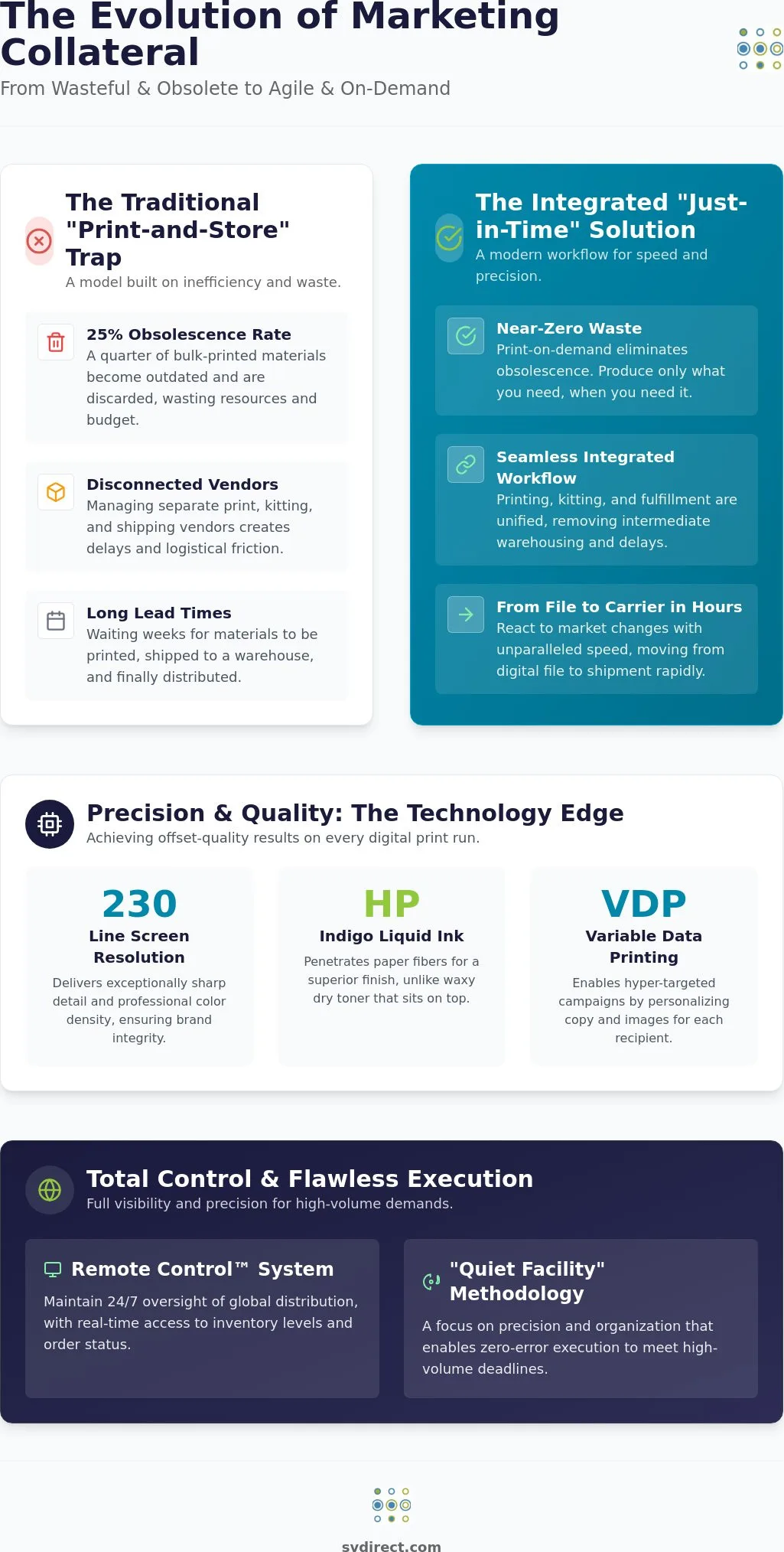
What Defines Leading Logistics Companies in Silicon Valley?

Leading logistics providers in this region don’t just move boxes; they orchestrate complex data streams and physical goods with surgical precision. Silicon Valley has long been the epicenter of digital transformation, and that same energy defines its logistics sector. These companies act as a national hub for eCommerce, healthcare, and high-tech distribution, serving brands that require more than a standard warehouse. When you choose a partner here, you’re looking for a proactive extension of your own team. This partnership model is vital because it moves beyond the transactional vendor-client relationship, focusing instead on shared goals and operational readiness.

Most modern brands rely on Third-party logistics (3PL) providers to navigate the complexities of global trade. In Silicon Valley, this model evolves into something more integrated and responsive. You don’t want a vendor who just waits for instructions. You need a partner who anticipates hurdles before they disrupt your supply chain. This proactive stance is backed by over 25 years of operational history in the heart of the innovation hub, ensuring that your logistics are handled by experts who understand high-stakes growth.

The Innovation Hub: Beyond Regional Boundaries

The Silicon Valley ecosystem fosters advanced methodologies that benefit national brands, regardless of where their headquarters are located. Because the region is saturated with high-growth tech firms, local providers have developed sophisticated tech-enabled order management systems to keep pace. This means faster processing and more accurate data for your business. It’s a shift from traditional warehousing to intelligent, real-time distribution. You can see how these specialized capabilities serve various sectors at svdirect.com/industries/. The region’s proximity to global connectivity points isn’t just a geographic detail; it’s a competitive edge that accelerates your reach.

The Integration of Technology, Marketing, and Fulfillment

For 2026, the primary requirement for brands is a holistic approach. It isn’t enough to just ship a product. You need a partner capable of merging on-demand digital printing, direct mail marketing, and ecommerce fulfillment silicon valley into a single, seamless workflow. Imagine a scenario where your literature fulfillment and product shipping happen under one roof, managed by the same dedicated team. You can explore these integrated options at svdirect.com/print-on-demand/.

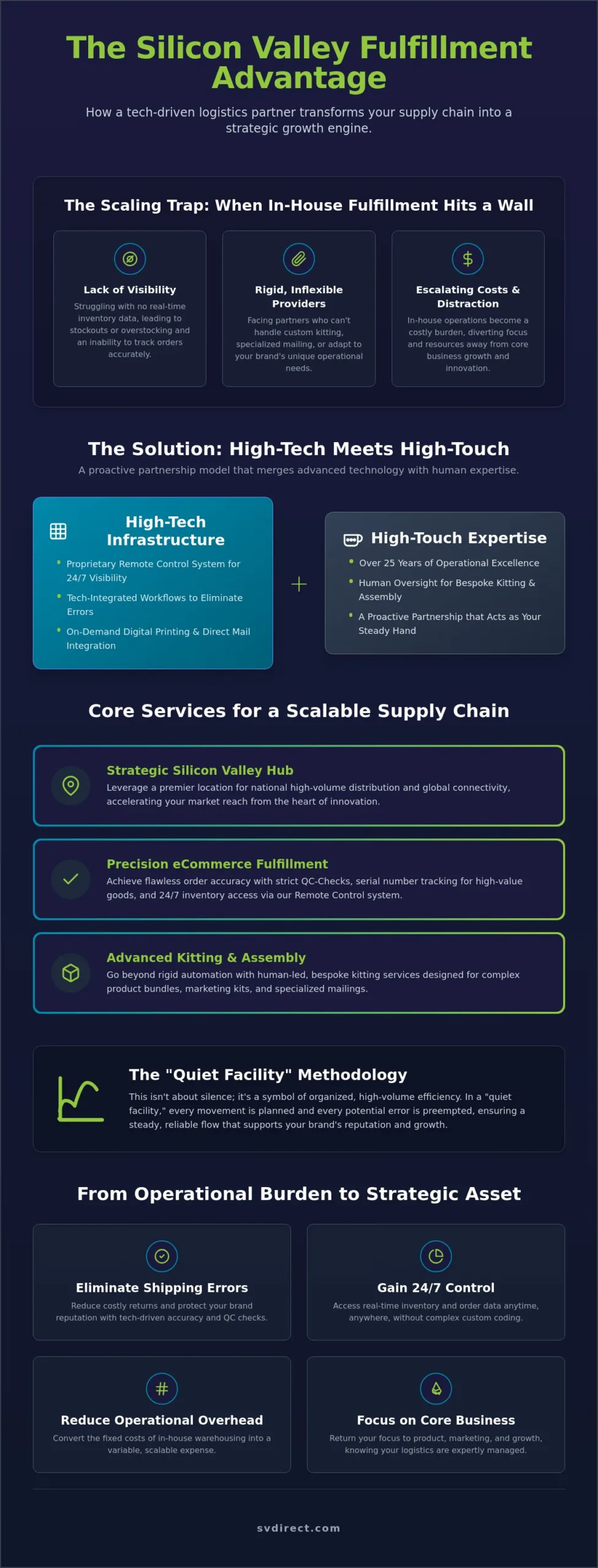
This level of integration is only possible in a quiet, highly organized facility. A “quiet facility” methodology isn’t about silence; it’s a symbol of organized, high-volume efficiency where every movement is planned and every error is preempted. When your logistics provider utilizes high-resolution technology like the HP Indigo 5500 for printing alongside a proprietary Remote Control system for inventory, they eliminate the friction that usually slows down scaling brands. This steady hand allows you to focus on your core business while your physical operations remain flawlessly managed.

Core Services for Scaling Your National Supply Chain

Scaling a national brand requires more than just storage space. It demands a suite of integrated services that work in harmony to move products and information across the globe. By leveraging ecommerce fulfillment silicon valley expertise, you gain access to an infrastructure designed for high-volume precision. This includes everything from the initial pick and pack to complex global shipping coordination. When these services are centralized, your supply chain becomes more resilient and easier to manage. This isn’t just about moving inventory; it’s about creating a steady, reliable flow that supports your brand’s reputation.

Precision eCommerce Order Fulfillment

Accuracy is the foundation of trust. Managing the lifecycle of an order requires total visibility from the moment a customer clicks “buy” to the second the package arrives at their doorstep. Our proprietary Remote Control system provides 24/7 access to your inventory, ensuring you’re never in the dark about stock levels. To maintain high standards, we implement a strict QC-Check process during high-volume bursts. For electronics and high-value goods—such as the specialized neural interfaces developed by MindRove—we utilize serial number tracking to streamline warranty management and product fulfillment. This level of detail ensures that even the most complex orders are handled with surgical precision.

Advanced Kitting and Assembly

Automation has its limits, especially when your brand requires a personal touch. Creating custom subscription boxes or promotional kits often involves intricate steps that rigid machines can’t replicate. This is where human oversight becomes critical. Our team handles complex assembly projects with a systematic inspection process that ensures every kit is perfect. This blend of human expertise and physical infrastructure allows for total flexibility in your project needs. You can learn more about how this drives operational success in our strategic guide to kitting and assembly.

High-Resolution Digital Printing and Mailing

A unique advantage of our facility is the seamless integration of on-demand digital printing directly into the fulfillment workflow. We use the HP Indigo 5500 Digital Press, which utilizes real liquid ink technology to produce offset-quality results. This allows for Variable Data Digital Printing (VDP), enabling you to include personalized marketing materials in every national mailing. Whether you’re launching a new product or maintaining a loyalty program, this integration ensures your physical engagement is as sharp as your digital presence. For a deeper look at these strategies, see our guide on direct mail marketing services.

If you’re ready to see how these integrated services can transform your operations, you can reach out for more information about our bespoke solutions and how we can act as an extension of your team.

Evaluation Framework: Choosing the Right 3PL Partner

Choosing a partner for ecommerce fulfillment silicon valley requires a structured approach that goes beyond comparing storage rates. You need a qualitative framework to ensure your provider can handle the high-stakes pressure of national distribution. Transparency is the first pillar of this framework. Can you see your inventory levels in real-time without picking up the phone? If a provider lacks 24/7 visibility, they’re creating a bottleneck for your growth. Security is equally critical, especially if you deal with high-value goods or sensitive sectors. For instance, our facility is equipped for specialized healthcare mailing services, which require a level of precision and compliance that standard warehouses simply cannot match.

Longevity serves as an anchor of trust. In an industry where facilities often change hands or struggle with high turnover, a multi-decade history is a sign of internal stability. We’ve operated in this innovation hub since 1999, and our long-term staff retention means you’re working with experts who’ve seen every possible supply chain challenge. This experience allows for proactive communication; we identify potential conflicts before they impact your project. This steady hand ensures you aren’t just hiring a vendor, but an organization that respects your time and protects your brand’s reputation through every volume spike.

Scalability and Custom-Fit Solutions

Avoid cookie-cutter logistics models that force your business into a pre-defined box. These rigid systems stifle innovation and make it impossible to handle bespoke requests. A true partner acts as a seamless extension of your internal team. During the onboarding phase, the focus should be on listening and understanding your specific goals. Whether you need specialized kitting or a unique returns process, the provider should adapt to your limitations rather than the other way around. This bespoke approach ensures that as you scale, your logistics infrastructure remains a facilitator of growth rather than a constraint.

Technical Infrastructure and API Readiness

Your logistics data shouldn’t live on an island. Evaluating a provider’s proprietary software and web service integration capabilities is essential for maintaining a modern supply chain. Platform-agnostic protocols, such as XML and SOAP, are vital for seamless data exchange between your apps and the warehouse. Our Remote Control system exemplifies this technical readiness. It provides comprehensive order management with over 120 standard reports available at your fingertips. This level of API readiness ensures that transaction data flows accurately, allowing your developers to focus on building your brand instead of troubleshooting custom coding hurdles.
Logistics Companies in Silicon Valley: A Strategic Partner Guide for 2026

Streamlining Operations with Remote Order Management

The shift toward programmatic interfaces marks a significant evolution in how national brands manage their supply chains. In the high-stakes environment of ecommerce fulfillment silicon valley, real-time transaction data and inventory control aren’t just luxuries; they’re the foundation of operational readiness. Our proprietary Remote Control system acts as a steady hand, eliminating the time-consuming custom coding hurdles that typically plague internal development teams. This system ensures that information flows seamlessly from your digital storefront to our physical facility, allowing your team to focus on core business growth rather than technical troubleshooting.

Actionable insights are the byproduct of comprehensive, organized reporting. With over 120 standard reports available at your fingertips, you can generate the exact data needed to make informed strategic decisions. The system also features automated notifications for low inventory levels, inventory receipts, and backorders. This proactive approach prevents stockouts and ensures that your operations remain efficient even during unexpected peak demand periods. It’s about having a partner that anticipates needs before they become problems, backed by a physical infrastructure that mirrors the organization of your digital data.

Real-Time Visibility and 24/7 Access

A sophisticated web interface for placing orders and tracking progress is essential for modern logistics. You can access your data anytime and from any location, ensuring you’re never tethered to a specific office or restricted by time zones. This 24/7 access builds trust through total transparency in order data and historical shipping activity. Real-time inventory information is non-negotiable for success in the national eCommerce market. When you can see every movement within our facility, you gain the informed confidence needed to scale rapidly. It removes the stress of the unknown, replacing it with the stability of a seasoned expert.

Web Service Integration for Modern Developers

We utilize standardized XML and SOAP protocols to ensure seamless integration across various operating systems and platforms. This platform-agnostic approach simplifies the connection between your unique storefront and our warehouse ecosystem. Specific methods like AddOrder and GetOrderInfo streamline the fulfillment workflow, making it easier for your technical team to manage complex transaction data. To ensure total data accuracy, we provide dedicated testing environments for all integrations. This allows you to verify every step of the process before going live with real transactions, preventing errors that could impact your brand’s reputation or the customer experience.

The Silicon Valley Direct Advantage: High-Tech Meets High-Touch

Digital integration is the backbone of modern logistics, but it shouldn’t replace human oversight. In a tech-saturated market, we explicitly reject automated-only interactions. We believe that ecommerce fulfillment silicon valley requires a sophisticated blend of high-tech efficiency and first-class customer service. By leveraging over 25 years of experience in the heart of this innovation hub, we’ve refined a model that prioritizes personal commitment alongside operational precision. This steady hand ensures that your business growth is supported by experts who remain accessible and grounded, even as we utilize the latest digital tools.

Our operational philosophy is built on Nine Promises to our clients. These values guide our daily actions, ensuring we listen, understand, and provide proactive problem-solving for every project. This commitment to excellence extends to our environmental impact. Through our partnership with HP, we maintain a dedication to green printing and sustainable hardware recycling. This ensures that your brand’s physical footprint is as responsible as it is accurate. We don’t just act as a vendor; we function as an extension of your team, protecting your reputation through every shipment.

A Partnership Built on Trust and Flexibility

We treat every client like our only customer, regardless of project volume. Whether you’re a scaling startup or a large enterprise, you receive the same level of seasoned professionalism and bespoke problem-solving. This approach has led to long-term partnerships defined by promptness and reliability. Our clients value the stability we provide in a fast-paced industry, knowing their supply chain is in capable hands. You can see the real-world results of this dedication by exploring our Customer Testimonials.

Excellence in Execution

Our quiet, organized facility in Union City is a symbol of high-volume efficiency. We maintain a “make-it-right” attitude that defines our execution, ensuring that complex projects are handled with surgical care. From precision kitting to global distribution, our team manages the mechanical nature of operations with a human touch that machines cannot replicate. This proactive stance is backed by a physical infrastructure designed for accuracy and speed. If you’re ready to partner with a 3PL that values your time and your brand’s integrity, it’s time to take the next step.

Strategic Logistics for a Scalable Future

Your supply chain is the physical manifestation of your brand’s promise. In the evolving market of 2026, choosing a partner for ecommerce fulfillment silicon valley means finding a balance between technical sophistication and human accountability. We’ve spent over 25 years refining this balance since our founding in 1999. Our proprietary Remote Control™ system provides 24/7 real-time inventory access, while our dedicated team offers the personal oversight that automated systems often lack.

High-performance logistics shouldn’t be a source of stress. By integrating high-resolution technology like the HP Indigo 5500 Digital Press with methodical warehousing, we eliminate the friction that slows down national brands. You’ve seen how transparency and flexibility transform operations from a cost center into a growth engine. It’s time to step into a partnership that values your time and respects your unique business goals.

We’re ready to act as the steady hand behind your next phase of growth. Let’s build a supply chain that’s as innovative as the region we call home.

Frequently Asked Questions

What is the benefit of choosing a logistics company in Silicon Valley for national shipping?

Silicon Valley offers a strategic advantage due to its proximity to global connectivity points and its culture of technological innovation. Providers here leverage advanced logistics infrastructure to ensure faster national distribution and more accurate data processing. This location acts as a central hub, allowing brands to reach customers across the country with reduced transit times and higher reliability.

How does digital printing integrate with fulfillment services?

Digital printing integrates directly into the fulfillment workflow by allowing on-demand production of personalized marketing materials. Since the hardware is located within the same facility as the inventory, personalized inserts can be added to packages instantly. This eliminates the need for external vendors and prevents delays in the ecommerce fulfillment silicon valley process.

What should I look for in a 3PL inventory management system?

You should prioritize a system that offers 24/7 real-time visibility and comprehensive reporting capabilities. A robust system, like our proprietary Remote Control, provides over 120 standard reports to help you track inventory levels and shipping activity. Look for a platform that allows you to see every movement within the warehouse without needing to call for updates.

Is variable data printing expensive for personalized mailings?

Variable data printing is a cost-effective solution for personalized mailings because it allows you to target specific customer segments with precision. It reduces waste by only printing what’s needed for a specific campaign. This approach creates high-impact physical engagement that often results in better conversion rates compared to generic, high-volume mailings.

How does a 3PL handle high-value inventory like electronics or healthcare products?

High-value inventory is managed through a combination of secure warehousing and strict quality control procedures. We utilize serial number tracking and systematic inspections to ensure every item is accounted for and handled with care. This level of precision is vital for healthcare products and electronics that require documented compliance and warranty management.

Can a logistics provider handle custom kitting and assembly for subscription boxes?

A specialized logistics provider can easily handle custom kitting and assembly through a systematic inspection process. Human oversight is essential for complex subscription boxes that require specific placement or delicate handling. This manual precision ensures that every kit meets your brand standards before it leaves the facility.

What is the difference between digital and offset printing quality for fulfillment?

Modern digital printing, particularly with the HP Indigo 5500, provides high-resolution results that match the quality of traditional offset printing. The primary difference is that digital printing allows for variable data and smaller print runs. This means you don’t have to sacrifice quality to achieve the personalization required for modern ecommerce fulfillment silicon valley strategies.

How do I integrate my eCommerce store with a 3PL fulfillment system?

Integration is typically handled through standardized web service protocols like XML and SOAP. These methods allow your storefront to communicate directly with the fulfillment system, automating order submission and inventory updates. We provide dedicated testing environments to verify data accuracy before your store goes live with real transactions.
b2c fulfillment

Top B2C Fulfillment Services for DTC Brands

B2C fulfillment now shapes conversion, margin, and repeat purchase for DTC brands as much as media spend or product quality. The right partner handles inventory, parcel speed, integrations, and reverse logistics as one operating system.

TL;DR: Summary

  • The best B2C fulfillment service for a DTC brand is the provider that can reliably meet your shipping promise, integrate with your storefront and back-office tools, and manage reverse logistics with low manual work.
  • Strong options for many U.S. brands include Silicon Valley Direct, ShipBob, ShipMonk, Red Stag Fulfillment, and ShipHero, but the right fit depends on SKU mix, order volume, geography, and whether you need same-day shipping or custom API support.
  • Returns are now a major operating cost: NRF projects $849.9 billion in 2025 retail returns, with 19.3% of online sales returned and 82% of consumers saying free returns matter.
  • Shipping speed still affects checkout behavior. FedEx survey data from 2,103 U.S. consumers shows free shipping is widely expected, while many shoppers will still pay more for same-day or next-day delivery.
  • Ask every 3PL about same-day cutoff times, order-accuracy controls, prebuilt integrations, API flexibility, live inventory reporting, and clear rules for restock, quarantine, resale, and fraud review.

That matters because ecommerce buyers still expect free shipping, fast delivery, and painless returns, while reverse logistics has become expensive enough to slow growth when it is handled loosely. A strong B2C fulfillment service is the one that fits your order profile, channel mix, and return rate, not the one with the largest warehouse map.

What is B2C fulfillment for DTC brands?

B2C fulfillment is the process of storing, picking, packing, shipping, and returning orders to individual consumers through channels like Shopify and Amazon. For DTC brands, it is an experience system, not just a warehouse function.

A modern B2C operation usually includes inventory receiving, SKU control, order routing, pick and pack, parcel selection, tracking updates, return authorization, inspection, and restocking. If the brand sells bundles, subscriptions, kits, or limited drops, the fulfillment layer also needs rules for assembly and exception handling.

A common mistake is treating fulfillment as label printing plus carton movement. That misses the parts customers actually feel: cutoff times, package accuracy, branded inserts, tracking speed, and how quickly a refund is processed after a return lands.

Why does B2C fulfillment matter so much for DTC profitability?

B2C fulfillment directly affects revenue and margin because FedEx and NRF data show shoppers care about free shipping, fast delivery, and easy returns. When those promises fail, conversion drops and support costs rise.

Shipping is now part of merchandising. If checkout promises two-day delivery but the warehouse misses the same-day cutoff, the carrier can still perform well and the customer will still blame the brand. That is why DTC teams judge 3PLs on operational discipline, not just postage rates.

“Silicon Valley Direct states that orders received by its cutoff time ship the same day, a practical SLA when fast fulfillment affects conversion.”

Returns add another layer. NRF projects $849.9 billion in 2025 retail returns, and it estimates 19.3% of online sales will be returned. If your category has frequent size, fit, gifting, or impulse purchases, reverse logistics can become one of the largest hidden drains on cash, labor, and customer lifetime value.

What are the top B2C fulfillment services for DTC brands?

The top B2C fulfillment services are the ones that fit a brand’s real operating model, and that usually means matching service depth to SKU complexity, promise speed, and systems needs. There is no universal number-one 3PL for every DTC business.

The strongest providers tend to win on a mix of speed, integrations, reporting, returns handling, and account support. Brands with subscriptions or hybrid DTC and retail workflows should pay close attention to API depth, since prebuilt connectors alone may not cover custom order logic.

“Silicon Valley Direct supports more than 80 preconfigured integrations and offers custom API options for brands with subscription or hybrid DTC workflows.”

Here are five solid options that often make sense for U.S. DTC brands:

  1. Silicon Valley Direct (SVDirect): A good fit for brands that want same-day shipping at cutoff, no minimum order requirement, 80+ preconfigured integrations, custom API support, and direct access to a Union City, California fulfillment team.
  2. ShipBob: Often chosen by growing brands that want a broad U.S. network and merchant-facing software for distributed parcel fulfillment.
  3. ShipMonk: A sensible option for brands with multichannel workflows, subscription logic, or more process-heavy order types.
  4. Red Stag Fulfillment: Best suited to heavy, bulky, fragile, or high-value products where damage prevention and careful handling matter more than lowest-cost parcel picking.
  5. ShipHero: A strong consideration for brands that want more warehouse-system visibility and operational control alongside outsourced fulfillment.

If your main pain is startup flexibility, no minimums matter. If your issue is split shipments or coastal transit time, node location matters more. If your catalog uses kits, subscriptions, or retail-compliant workflows, API support and exception logic should carry more weight than headline storage rates.

How should you evaluate a B2C fulfillment partner step by step?

The best way to evaluate a B2C fulfillment partner is to test operating fit before price. Shopify and NetSuite data can tell you more than a sales deck.

Step 1: Map your actual order profile. Pull 60 to 90 days of orders and check average items per order, bundle frequency, return rate, zone distribution, and seasonal spikes. A provider that looks cheap on a one-item order can become expensive fast when kitting, inserts, or split shipments are common.

Step 2: Test the workflow, not just the demo. Ask how the 3PL handles partial shipments, address edits, subscription skips, canceled orders, damaged returns, and backorders. Pro tip: exception handling is often where service quality really shows up.

Step 3: Build the all-in cost model. Include storage, pick fees, packaging, receiving, return processing, surcharges, carrier rates, account management, and system fees. The common misconception is that a low pick fee means a low total landed fulfillment cost.

What is the difference between B2C fulfillment and B2B fulfillment?

B2C fulfillment serves individual shoppers through parcel networks, while B2B fulfillment serves retailers or distributors through case, pallet, and routing-guide workflows. The labor model and SLA structure are different.

B2C usually means high order counts, low unit counts per order, branded packaging, quick tracking updates, and more return volume. B2B often means fewer orders, larger quantities, stricter compliance, freight scheduling, labeling standards, and chargeback risk.

If your brand does both, do not assume a warehouse strong in pallet shipping will also excel at consumer parcel fulfillment. Each-pick accuracy, gift messaging, promo inserts, and fast refund loops are B2C skills. Carton compliance, ASN discipline, and retailer routing are B2B skills. Some 3PLs support both well, but you should verify the workflows separately.

How should DTC brands build reverse logistics and returns step by step?

DTC brands should build reverse logistics as a defined process with policy, inspection, and disposition rules from day one. NRF’s 2025 returns data makes clear that returns are not a side task.

Step 1: Set the customer-facing policy first. Decide the return window, free-return conditions, exchange rules, and refund timing. NRF says 82% of consumers consider free returns an important shopping factor, so the policy affects conversion before the order is even placed.

Step 2: Build disposition logic for every SKU state. Restock resaleable items fast, quarantine damaged units, route opened health-sensitive items to non-resellable stock, and define when liquidation or donation is the right path. A live portal helps customer service, finance, and operations work from the same status.

“Silicon Valley Direct pairs a 24/7 customized web portal with live order status, inventory visibility, and reporting, giving DTC teams a shared source of truth.”

Step 3: Track reason codes and fraud signals. If “item not as described” spikes, your PDP or packaging may be the issue. If wardrobing, empty-box claims, or serial return patterns rise, then your fraud review needs tighter controls. Free returns can still be the right policy, but free returns do not mean free handling.

Which integrations matter most in B2C fulfillment step by step?

The most important B2C fulfillment integrations are the ones that keep orders, inventory, tracking, and returns synchronized across Shopify, Amazon, ERPs, and support tools. Integration quality is often the difference between scale and manual cleanup.

A strong connection should do more than import orders. It should sync inventory in near real time, push tracking updates quickly, handle edits and cancellations, and pass return status back to the systems your support and finance teams use.

Key integration priorities usually look like this:

  • Storefront and cart: Shopify, WooCommerce, BigCommerce, Magento
  • Marketplaces and subscriptions: Amazon, Walmart Marketplace, Recharge, recurring-order logic
  • Support and returns: Help desk, return portal, RMA workflow, refund status
  • ERP and analytics: NetSuite, QuickBooks, BI tools, inventory and margin reporting

If you run custom bundles, hybrid wholesale and DTC orders, or nonstandard approval flows, then ask about API support early. A prebuilt connector is helpful, but it does not guarantee your actual business rules will map cleanly.

How do same-day shipping and next-day delivery compare for DTC brands?

Same-day shipping and next-day delivery are not the same promise. Same-day shipping is a warehouse SLA, while next-day delivery is a carrier transit outcome.

That difference matters. A 3PL can control whether an order placed before cutoff gets packed and handed to the carrier that day. It cannot fully control weather, carrier network disruption, or a remote delivery zone. If your site promises next-day delivery, you need both a strong warehouse cutoff and a realistic zone strategy.

FedEx notes that many consumers will pay extra for same-day or next-day delivery, yet margin discipline still matters. If your AOV is low, universal next-day delivery can erode contribution profit fast. A better model is often segmented shipping: standard free shipping for most orders, paid expedited options for urgent buyers, and same-day warehouse processing as the default operational baseline.

When should a brand outsource B2C fulfillment to a 3PL?

A brand should outsource B2C fulfillment when order growth, channel complexity, or return volume starts pulling leadership time away from growth work. At that point, in-house packing often becomes an invisible tax.

Several signs usually show up at once:

  • Founder time: Too many hours spent packing, counting, and handling exceptions
  • Channel complexity: Orders now flow from Shopify, Amazon, TikTok Shop, or wholesale at the same time
  • Space limits: Home, office, or micro-warehouse storage is creating stock errors and slow pick paths
  • Returns pressure: Refunds, inspections, and support tickets are piling up after delivery

If your order flow is stable, local, and low volume, in-house fulfillment can still make sense. If launches, promotions, or seasonal spikes create labor swings, a 3PL usually becomes the more resilient option.

What service-level metrics should you require in a B2C fulfillment SLA?

A good B2C fulfillment SLA should define speed, accuracy, visibility, and exception handling in writing. Verbal promises from any 3PL, including familiar names like SVDirect or ShipBob, are not enough.

Ask for a documented same-day shipping cutoff, order-accuracy target, inventory-accuracy target, receiving turnaround, cycle count cadence, return-processing turnaround, and support-response expectation. Also ask how the provider reports misses and credits, because metrics that are never surfaced are not real controls.

This is also where process maturity shows. Dedicated account management, real phone support, and a live reporting portal matter because escalations rarely happen on a clean, normal order. If a provider will not define how it handles exceptions, stock discrepancies, and return disputes, then you are not buying fulfillment clarity, you are buying fulfillment ambiguity.

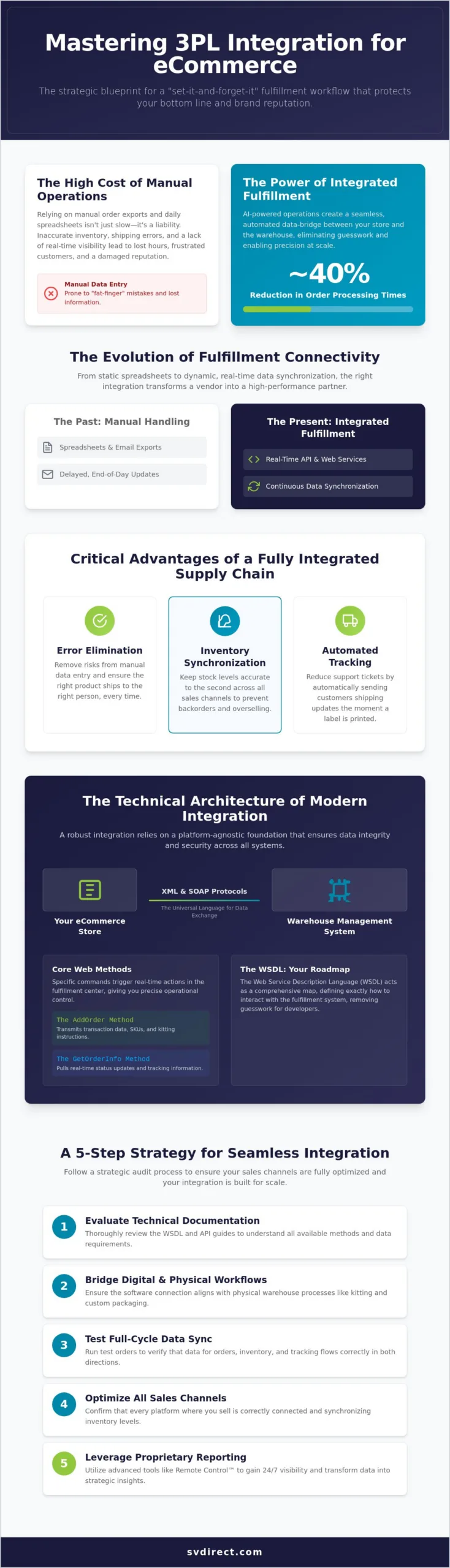
The Strategic Guide to 3PL Integration for eCommerce in 2026

Did you know that AI-powered operations can now reduce order processing times by nearly 40%, yet many brands still lose hours every day to manual data entry? With the 2026 removal of Section 321 de minimis exemptions and new standardized import surcharges, the margin for operational error has effectively vanished. A sophisticated 3pl integration for ecommerce is no longer just a technical checkbox; it’s a strategic necessity to protect your bottom line and your brand’s reputation.

It’s exhausting to manage inaccurate inventory levels that lead to backorders or to feel blind when customers ask for real-time shipping updates. You deserve a fulfillment partner that acts as a steady, reliable extension of your own team rather than a distant vendor. This guide provides the blueprint to master the technical and operational frameworks of integration, moving you toward a “set-it-and-forget-it” workflow. We’ll examine how leveraging proprietary systems and real-time data transparency can transform your logistics into a high-performance engine capable of handling any sales spike with precision.

Key Takeaways

  • Understand how XML and SOAP protocols facilitate a platform-agnostic connection for seamless data synchronization across any operating system.
  • Learn why a successful 3pl integration for ecommerce must bridge the gap between digital software connections and physical warehouse workflows.
  • Follow a strategic five-step audit process to evaluate technical documentation and ensure your sales channels are fully optimized.
  • Discover how to leverage proprietary reporting tools like Remote Control™ to gain 24/7 visibility and transform your supply chain into a transparent extension of your brand.

What is 3PL Integration for eCommerce?

At its core, 3pl integration for ecommerce is the automated synchronization of data between an online store and its fulfillment partner. It serves as a strategic data-bridge between sales and operations, ensuring that every customer click translates into a physical action in the warehouse without human intervention. While the concept of Third-party logistics (3PL) has existed for decades, the integration layer is what transforms a simple vendor relationship into a high-performance partnership.

As we move through 2026, the industry is witnessing a total departure from “Manual Handling” in favor of “Integrated Fulfillment.” Relying on manual order exports or daily spreadsheets isn’t just slow; it’s a liability. With the removal of Section 321 de minimis exemptions increasing shipping complexity, brands need a system that handles data with the same precision used in our eCommerce order fulfillment facility. This digital backbone is what allows a brand to scale during high-volume spikes without sacrificing customer trust.

The Evolution of Fulfillment Connectivity

Key Benefits of a Fully Integrated Supply Chain

The primary value of a deep 3pl integration for ecommerce is the peace of mind that comes from operational transparency. When your systems talk to each other, you gain several critical advantages:

  • Elimination of errors: You remove the risk of “fat-finger” mistakes or lost emails that lead to shipping the wrong product to the wrong person.
  • Inventory synchronization: Real-time updates across all sales channels prevent the dreaded backorder scenario, keeping your stock levels accurate to the second.
  • Automated tracking: Customers receive shipping confirmations and tracking numbers the moment a label is printed, which drastically reduces customer support inquiries.

By automating these touchpoints, your team can stop acting as data entry clerks and start focusing on brand strategy. It’s about creating a workflow that feels like a seamless extension of your company, backed by the physical infrastructure and technical expertise needed to execute perfectly every time.

The Technical Architecture of Modern 3PL Integration

While many guides focus on the simplicity of one-click plugins, a truly robust 3pl integration for ecommerce relies on a deeper technical foundation. High-volume brands require more than a basic connection; they need a sophisticated architecture that ensures data integrity across disparate systems. This is achieved through the use of XML and SOAP (Simple Object Access Protocol) web services. These protocols provide a structured, platform-agnostic language that allows your online store to communicate with our warehouse management system regardless of the operating system or coding language your site uses.

For developers, the efficiency of this architecture is anchored by the Web Service Description Language (WSDL). This acts as a comprehensive roadmap, defining exactly how to interact with the fulfillment system. By utilizing these standardized protocols, we remove the guesswork from the development phase. It creates a stable, predictable environment where data flows are secure and verifiable. If you are ready to see how these technical frameworks can support your specific business model, you can consult with our integration specialists to discuss a tailored approach.

Core Web Methods for eCommerce Success

The heartbeat of a technical integration consists of specific “methods” or commands that trigger actions within the fulfillment center. Understanding these core functions is essential for maintaining operational control:

  • The AddOrder Method: This is the primary gateway for submitting transactions. It doesn’t just send a shipping address; it transmits complex SKU data, specific kitting instructions, and shipping carrier preferences directly into our production queue.
  • The GetOrderInfo Method: This method allows your system to pull real-time updates. It retrieves current order status, specific line-item details, and tracking information, ensuring your customer dashboard is always accurate.
  • The GetShippingActivity Method: Vital for financial transparency, this method manages freight charges and provides a summary of all shipping activity within a defined timeframe.

Data Tagging and Standardized Protocols

XML remains the gold standard for secure data exchange because it is both machine-readable and human-readable. This transparency allows for faster troubleshooting and more precise data tagging. To facilitate the discovery of these services, we utilize UDDI (Universal Description, Discovery, and Integration), which acts as a directory for listing available web services. This structured approach is further supported by manual system testing pages and GUI interfaces. These tools allow your technical team to test connections and verify data packets in a controlled environment before going live, ensuring that the final 3pl integration for ecommerce is flawless from day one.

Software vs. Operational Integration: Bridging the Gap

While the technical protocols discussed earlier provide the digital handshake, they only represent half of the success equation. A deep 3pl integration for ecommerce must extend beyond the server and onto the warehouse floor. Operational integration ensures that your specific brand standards are mirrored in every physical workflow, from the way a box is taped to how items are positioned inside. This alignment turns a standard fulfillment center into a true extension of your business rather than just a remote storage site.

Our “Quiet Facility” methodology is a testament to this philosophy. We believe that an organized, calm physical environment is the only way to maintain the digital accuracy your software expects. When physical spaces are meticulously managed, the data reflected in your systems remains untainted. Our team identifies and resolves inventory discrepancies or shipping conflicts before they ever reach the loading dock. This proactive stance ensures that the high-tech efficiency of your front-end store is never undermined by back-end chaos.

Integrating Specialized Services: Print and Kitting

Modern commerce often requires more than just picking a product off a shelf. By integrating on-demand digital printing directly into the fulfillment flow, we allow brands to personalize shipments at the moment of order. Using HP Indigo technology, we utilize Variable Data Printing (VDP) to include unique copy or customized inserts for every recipient. This level of customization is integrated into the automated workflow, making the “Unboxing Experience” a scalable reality rather than a manual burden. Custom kitting and assembly are treated with the same technical rigor, ensuring that promotional bundles are built with precision and speed.

The QC-Check: Human Oversight in an Automated World

Automation is powerful, but it lacks the nuanced judgment required for complex kitting or high-stakes promotional launches. Systematic human inspection remains a critical component of our quality control process. Even during high-volume deadline spikes, every kit undergoes a rigorous QC-check to verify that the physical output matches the digital order perfectly. This blend of high-tech speed and human oversight is what maintains customer trust. You can learn more about our kitting and assembly services and how they bridge the gap between automated data and physical perfection.

The Strategic Guide to 3PL Integration for eCommerce in 2026

5 Steps to a Seamless 3PL Integration Strategy

Implementing a robust 3pl integration for ecommerce requires more than just a digital handshake. It demands a structured transition from your current manual processes to a fully synchronized operation. While the technical protocols like XML and SOAP provide the foundation, your strategy must account for the unique operational nuances of your brand. Following a methodical implementation plan ensures that your data remains clean and your fulfillment stays fast as you scale.

  • Step 1: Audit your current sales channels and data requirements. Identify every point where an order is generated. You must determine which data fields, such as custom gift messages or specific kitting instructions, are mandatory for successful fulfillment.
  • Step 2: Evaluate the 3PL’s technical documentation and developer resources. A transparent partner provides clear technical documentation upfront. Reviewing the WSDL (Web Service Description Language) allows your developers to understand the system architecture before writing a single line of code.
  • Step 3: Define custom workflows for kitting, assembly, and specialized printing. Automation shouldn’t limit your creativity. Define how specialized tasks, such as variable data printing or healthcare mailing services, are triggered within the integration flow.
  • Step 4: Establish real-time reporting triggers and low-inventory alerts. Use systems that offer proactive notifications. By setting up automated triggers for low stock or shipping delays, you can manage customer expectations before a problem arises.
  • Step 5: Conduct end-to-end testing using a programmatic interface. Never go live without a sandbox phase. Submit test orders through the interface and track them through the entire warehouse lifecycle to verify that every data packet is received and processed correctly.

Evaluating Technical Compatibility

When you speak with a 3PL’s IT team, ask whether they use proprietary systems or third-party software. Our in-house systems are designed for total flexibility, allowing us to adapt to your specific business logic rather than forcing you into a generic template. You need 24/7 access to your order history and inventory levels to make informed decisions. You can explore our Remote Order Management system to see how we provide this level of deep technical visibility.

Setting Up Automated Notifications

Real-time visibility is a powerful asset for your marketing and sales departments. When your team knows exactly when inventory is received or when a backorder is cleared, they can adjust campaigns with confidence. Configuring automated email alerts ensures that your staff stays informed without needing to manually pull reports. This transparency is a hallmark of a true partnership. You can read what our clients say about real-time visibility and how it has transformed their daily operations.

The Silicon Valley Direct Approach: Technology Meets Partnership

Choosing a partner for your 3pl integration for ecommerce is about more than just checking technical boxes; it’s about finding a steady hand that treats your business as its own. We position ourselves as an extension of your company, providing the high-tech infrastructure of Silicon Valley with a human-centric commitment to service. Since 1999, we’ve remained at the cutting edge of logistics innovation while maintaining the personal oversight that pure automation lacks. Our “Nine Promises” serve as the foundation of this partnership, guaranteeing the transparency and bespoke problem-solving your brand requires to thrive in a fast-paced market.

True operational control is only possible when you have access to meaningful data. Our proprietary Remote Control™ system puts over 120 standard reports at your fingertips, offering 24/7 visibility into every corner of your supply chain. This isn’t just a dashboard; it’s a window into our facility that allows you to manage inventory, track orders, and analyze trends in real-time. By combining this digital transparency with our geographic advantage as a hub of global connectivity, we ensure your logistics remain as agile as your marketing strategy.

High-Resolution Fulfillment: The HP Indigo Advantage

Brand perception is often defined by the physical touchpoints of a shipment. We utilize the HP Indigo 5500 Digital Press to deliver high-resolution variable data printing with a 230 line screen resolution. This ensures your brand collateral, literature, and personalized inserts look professional and sharp. The “dry-to-touch” nature of this technology allows for immediate kitting and fulfillment, accelerating your speed to market. We also prioritize sustainability by using a digital process that eliminates the need for plates, films, and harsh chemicals, aligning your fulfillment with modern environmental standards.

Scalability Without the Hectic Atmosphere

A high-performance facility doesn’t have to be a chaotic one. Our methodical approach allows us to handle 3,000+ shipments a week with the same precision and calm we apply to smaller, boutique runs. We’ve found that a quiet, organized workspace is the best environment for maintaining the accuracy required for complex 3pl integration for ecommerce. Whether you are in the technology, healthcare, or consumer goods sector, our facility is designed to scale with your growth spikes without losing the human touch. You can discover our specialized industry solutions to see how we tailor our infrastructure to meet the unique demands of your specific market.

Future-Proof Your Fulfillment Ecosystem

Mastering a 3pl integration for ecommerce is the difference between a reactive supply chain and a proactive growth engine. By aligning technical protocols like XML and SOAP with precise operational standards, you create a workflow that is both scalable and reliable. We’ve spent over 25 years in Silicon Valley refining this balance. This ensures that your digital data always matches the physical truth on our warehouse floor.

Our proprietary Remote Control™ system provides the transparency you need to lead with confidence, offering 120+ standard reports that keep you in command 24/7. When you combine this visibility with our high-resolution digital printing and meticulous kitting services, your brand becomes a seamless experience for every customer. You don’t have to manage the complexities of 2026 logistics alone.

We’re ready to help you transform your operations into a high-performance partnership that scales with your ambition.

Frequently Asked Questions

What is the difference between an API and Web Services for 3PL integration?

Web Services are a specific type of API that utilize standardized network protocols like XML and SOAP to communicate over the internet. While “API” is a broad term for any interface that allows software to interact, our web services provide a more structured, platform-agnostic bridge. This architecture is essential for maintaining secure, readable data exchange between your online store and our warehouse management system.

Do I need a developer to integrate my eCommerce store with a 3PL?

You typically need a developer or a technical lead to manage a sophisticated 3pl integration for ecommerce, especially when your business requires custom logic. While basic plugins exist for simple storefronts, our proprietary XML and SOAP interfaces require a professional to map your specific data fields to our system. We provide comprehensive documentation and WSDL files to make this process efficient for your technical team.

Can I integrate my custom kitting requirements into the automated fulfillment process?

Yes, you can integrate complex kitting and assembly requirements directly into the automated fulfillment flow. By defining specific SKU combinations or assembly triggers within your data packets, our system automatically alerts the warehouse floor to perform these specialized tasks. This ensures that every promotional bundle or custom kit is built with precision the moment the order is received, maintaining your brand standards at scale.

How does 3PL integration improve my inventory accuracy?

Integration improves inventory accuracy by eliminating the need for manual data entry and providing real-time synchronization across all your sales channels. When an order is placed, stock levels are instantly adjusted in our warehouse management system and pushed back to your storefront. This closed-loop communication prevents overselling and backorders, ensuring your digital storefront always reflects the physical reality of the inventory in our facility.

Is variable data printing more expensive to integrate into my shipments?

Integrating variable data printing (VDP) into your shipments is primarily a matter of data mapping rather than increased technical complexity. By including a “personalized copy” field in your order transmission, our HP Indigo digital presses can automatically pull that data to create unique inserts or brand collateral. This process is highly efficient because it is built directly into the standard fulfillment workflow, allowing for rapid, “dry-to-touch” production.

What happens if my eCommerce platform is not a standard one like Shopify?

Our system is platform-agnostic, meaning we can integrate with custom-built eCommerce sites or niche platforms just as easily as standard ones. For example, jewelry and diamond brands utilizing Valigara can connect their specialized management software with our fulfillment systems. Because we utilize XML and SOAP web services, the specific operating system or coding language of your site does not matter, allowing us to establish a seamless 3pl integration for ecommerce that fits your unique infrastructure.

How often is inventory data updated in a fully integrated 3PL system?

Inventory data is updated in real-time as transactions occur within the warehouse. Every time an item is picked, packed, or received, the change is reflected immediately in our proprietary system. You can monitor these levels 24/7 through our Remote Control interface, which provides access to over 120 standard reports. This constant stream of data ensures that your marketing and sales teams always have the most accurate information possible.

Can I track international shipments through the 3PL integration?

Yes, our integration supports full tracking for international shipments through our global shipping and logistics network. Once a shipping label is generated, the tracking number is automatically pushed back to your system via the GetOrderInfo or GetShippingActivity methods. This allows your customers to monitor their packages from our Silicon Valley facility to their doorstep, regardless of their location, providing a transparent and reassuring delivery experience.

orange county 3pl

SVDirect 3PL Services in Orange County

If you need an Orange County 3PL that can keep up with ecommerce demand without forcing you into a warehouse lease, Silicon Valley Direct (SVDirect) gives you a California-based fulfillment partner with nationwide and international reach. We manage warehousing, pick and pack, shipping, integrations, reporting, and specialty fulfillment from our Union City, California operation.

SVDirect works with ecommerce brands, startups, and growing online retailers across the USA and Canada, including teams in Orange County that want faster fulfillment, fewer manual tasks, and real operational support. You get same-day shipping, no minimum order requirement, double-verified 100% order accuracy, and a dedicated account manager backed by real human phone support.

Orange County 3PL fulfillment without the overhead of your own operation

Orange County remains an active logistics market, but it is not always the easiest place to build or expand your own warehouse footprint. CBRE reported about 2.51 million square feet of industrial leasing activity in Orange County in Q2 2026, while the construction pipeline stood at 676,000 square feet, down 65.7% year over year. For many brands, that makes outsourcing fulfillment a more practical move than taking on space, labor, systems, and shipping workflows internally.

“Silicon Valley Direct has operated since 1999 and offers Orange County brands a 3PL model with no minimum order requirement.”

SVDirect gives Orange County companies a full-service 3PL setup that is already built to receive inventory, store it, process orders, and ship nationwide or internationally. Instead of piecing together labor, software, packaging, and carrier coordination on your own, you plug into an established fulfillment operation designed for daily ecommerce volume.

Because U.S. retail e-commerce sales reached $326.7 billion in Q1 2026 and accounted for 16.9% of total retail sales, fulfillment speed and accuracy matter even more than they did a few years ago. SVDirect helps you meet that pressure with same-day shipping and a double-verification process that supports 100% order accuracy, so your customers get the right package without delays caused by preventable errors.

“SVDirect combines same-day shipping with double-verified 100% order accuracy for ecommerce fulfillment.”

SVDirect eCommerce fulfillment services for Orange County brands

Silicon Valley Direct supports more than basic pick, pack, and ship. Our Orange County 3PL service is built for brands that need fulfillment to connect cleanly with the rest of the business, from inventory flow to customer communication.

Here is what SVDirect can handle for your team:

  • eCommerce order fulfillment: Daily order processing, pick and pack, same-day shipping, and nationwide or international shipment support.
  • Warehousing and inventory management: Secure storage plus inventory tracking that helps you stay ahead of stock issues and replenishment decisions.
  • Platform integrations and APIs: More than 80 preconfigured integrations, plus custom APIs when your stack needs something more specific.
  • Print-on-demand and promotional fulfillment: Branded inserts, literature, printed materials, and campaign support without adding extra internal handling.
  • Healthcare and specialized fulfillment: Programs that need more controlled handling, documentation discipline, or repeatable process steps.
  • Presorted mail services: Support for organizations that need efficient mailing operations tied to fulfillment or outreach programs.

SVDirect also helps when your needs change month to month. If you are launching a new store, adding SKUs, testing a subscription program, or scaling after a successful campaign, the no-minimum structure makes it easier to start and expand without being forced into someone else’s volume threshold.

For Orange County brands that sell across the U.S. or into Canada, SVDirect provides a single fulfillment partner that can support both everyday ecommerce orders and specialized projects. That reduces handoffs, lowers coordination headaches, and gives your team one place to manage inventory and outbound activity.

Orange County 3PL integrations and reporting that reduce manual work

A 3PL should remove operational drag, not create more of it. SVDirect connects with 80+ preconfigured ecommerce platforms and systems, and we also support custom APIs when your workflows need a tailored connection. That means fewer manual imports, fewer avoidable order issues, and a faster path from customer checkout to shipment.

“Silicon Valley Direct offers 80+ preconfigured integrations, custom API support, and a 24/7 customized web portal with reporting.”

SVDirect also gives you a 24/7 customized web portal with extensive reporting, so your Orange County team can check inventory, order activity, and fulfillment data when it is convenient for you. Instead of waiting for generic status updates, you have direct visibility into the operational details that affect customer experience and planning.

Technology matters, but support matters too. SVDirect pairs system access with a dedicated account manager and real human phone support, which is especially valuable when you are onboarding, preparing a promotion, troubleshooting an exception, or coordinating a custom fulfillment program.

Orange County startups and growing ecommerce retailers that benefit most from SVDirect

Silicon Valley Direct is a strong match for Orange County companies that need a 3PL partner flexible enough for growth, but structured enough for daily execution. We work especially well for brands that want California-based fulfillment support without building a warehouse operation from scratch.

You are likely a good fit for SVDirect if you need:

  • Startup-friendly fulfillment: No minimum order requirement lets you launch without committing to enterprise-level volume.
  • Growth-ready operations: Same-day shipping, inventory management, and scalable order handling support expansion without constant process changes.
  • Specialized programs: Print-on-demand, literature fulfillment, healthcare fulfillment, and presorted mail services in addition to standard ecommerce shipping.

SVDirect is also useful when your internal team is spending too much time fixing fulfillment details that should already be handled. If your staff is managing shipping exceptions, order exports, inventory questions, packaging coordination, or campaign inserts by hand, outsourcing to a 3PL can free up time for merchandising, acquisition, and customer growth.

Why Orange County companies trust Silicon Valley Direct with fulfillment

SVDirect is not a new operation trying to learn fulfillment on your inventory. Silicon Valley Direct says it began on May 1, 1999, and the company’s background states that more than half of its staff have been with the business for over a decade. For you, that translates into process continuity, experienced hands in the warehouse, and fewer surprises in day-to-day execution.

Customer feedback adds useful proof. One testimonial says Silicon Valley Direct has been an essential partner for over 7 years. Another says a customer used SVDirect for more than 1,000 orders and did not remember a single packing and shipping error. A separate testimonial says SVDirect caught a potential proofing error before a mailing went out, helping avoid a major mistake.

SVDirect also welcomes on-site visits to its Union City warehouse, which matters if you want to see where your inventory will be stored and how your fulfillment program will run. For Orange County brands comparing 3PL partners, that kind of visibility can make the decision easier because you are not relying on a black-box provider.

If you are looking for an Orange County 3PL that can support ecommerce fulfillment, warehousing, integrations, specialty programs, and real communication, talk with Silicon Valley Direct about your order profile and operational needs. We will help you find a fulfillment setup that fits your business now and supports where you want to go next.

Silicon Valley Direct Reviews: Evaluating Your 3PL Fulfillment Partner in 2026

What if your fulfillment partner treated your inventory with the same precision as your own founding team, rather than just another ticket in an automated queue? It’s a common frustration for growing brands. You’ve likely experienced the stress of high error rates and a total lack of transparency that makes you feel disconnected from your own products. You deserve a partner that catches a problem before the package ever hits the truck.

This review explores why Silicon Valley Direct remains a trusted leader for those seeking a 3pl fulfillment center san jose in 2026. Since 1999, they’ve combined high-end digital printing with a “quiet facility” methodology to eliminate the chaos of traditional warehousing. You’ll discover how their proprietary Remote Control system provides 24/7 visibility and why their Nine Promises framework ensures your orders are handled with personal commitment. We’ll examine the operational excellence and client feedback that proves reliability is built on human expertise; it isn’t just about algorithms.

Key Takeaways

  • Learn how over 25 years of operational history creates a stable foundation for your brand to grow without the risk of fulfillment errors.
  • Gain 24/7 visibility into your inventory and order status through the proprietary Remote Control™ system that puts data back in your hands.
  • Find out how choosing a 3pl fulfillment center san jose that functions as an extension of your team replaces impersonal tickets with proactive human partnership.
  • See how integrating high-end digital printing and systematic quality checks ensures your customers receive perfect orders every time.
  • Discover the strategies that allow for rapid scaling, such as managing over 3,000 shipments in a single week with total precision.

The Silicon Valley Direct Track Record: 25 Years of 3PL Fulfillment Excellence

Established in 1999, Silicon Valley Direct has navigated more than two decades of technological shifts by adhering to a simple principle: prioritize the partnership over the transaction. While many providers focus solely on volume, we view ourselves as a direct extension of your internal marketing and sales departments. This philosophy ensures that your brand’s integrity is maintained from the moment an order is placed until it reaches the customer’s doorstep. By operating as a premier 3pl fulfillment center san jose, we’ve built a reputation for stability in an industry often characterized by high turnover and operational chaos.

Our “quiet facility” methodology is a cornerstone of this reliability. We deliberately remove the frantic, hectic atmosphere found in many automated warehouses to ensure 100% accuracy, even when facing high-volume deadlines. This calm, methodical approach is guided by our Nine Promises, a set of foundational values that dictate how we handle every client interaction. It’s about precision over speed alone.

This focus on precision and uncovering the “hidden details” of a process is a value we share with other local experts; for instance, City Drifts reveals the secret neighborhoods of San Francisco through their unique guided stairway walks.

A Legacy of Reliability in the Silicon Valley Logistics Hub

Longevity in the Third-party logistics (3PL) sector is a rare commodity. Our multi-decade history is anchored by long-term staff retention; many of our team members have been with us for over ten years. This collective experience allows us to take a proactive approach to problem-solving. We don’t just react to errors. Instead, we identify potential supply chain bottlenecks and correct them before they ever impact your customers.

The Marriage of Technology and Human Oversight

We reject “cookie-cutter” solutions because we understand that every business has unique requirements. Instead, we offer custom-fit 3PL fulfillment services that adapt to your specific workflow. Silicon Valley Direct functions as a seamless extension of your brand by mirroring your internal standards and adapting to your specific sales and marketing needs. This blend of sophisticated data management and dedicated human attention makes us a standout 3pl fulfillment center san jose for businesses that value precision over automation alone.

What to Look for in a 3PL Fulfillment Center: Proprietary Tech and Quality Control

Evaluating a 3pl fulfillment center san jose requires looking beneath the surface of basic shipping rates. When selecting the right 3PL partner, you must prioritize infrastructure that offers both physical precision and digital transparency. We’ve built our operations around this dual necessity; combining our systematic QC-Check process with platform-agnostic integrations using XML and SOAP. This ensures your eCommerce platform communicates seamlessly with our warehouse, regardless of which software stack you use. Our proactive stance means we catch data discrepancies before they turn into shipping errors.

Total Transparency with Remote Control™

Our proprietary remote order management system, Remote Control™, serves as your eyes on the ground. It offers 24/7 real-time visibility into inventory levels and order history, allowing you to generate over 120 standard reports at a moment’s notice. By receiving automated low-inventory alerts, eCommerce managers can effectively eliminate the “anxiety of growth” and focus on scaling their brand rather than worrying about stockouts. You get the data you need without having to ask for it.

High-Resolution Printing and Variable Data Integration

Unlike many logistics providers that outsource their collateral, we utilize the HP Indigo 5500 Digital Press in-house. This allows us to deliver offset-quality inserts with a 230 line screen resolution, ensuring your brand’s visual standards are never compromised. By leveraging Variable Data Printing (VDP), we personalize the customer experience for every shipment. Our print on demand services also help you reduce waste and eliminate unnecessary storage costs for marketing materials. This specialized approach makes us a unique 3pl fulfillment center san jose, offering capabilities that generic warehouses simply cannot match.

This integration of high-tech printing and rigorous quality control means your packages arrive exactly as intended. If you’re ready to see how this level of detail can transform your operations, you can request a free quote to discuss your specific needs.

Silicon Valley Direct Reviews: Evaluating Your 3PL Fulfillment Partner in 2026

Real-World Results: Why SVD is the Strategic Choice for Scaling Businesses

Scaling a brand requires more than just warehouse space; it demands a partner that can weather the pressure of rapid growth without flinching. Our customer testimonials highlight partnerships that have thrived for over seven years, proving that we prioritize long-term stability over short-term transactions. One major client experienced this firsthand when we managed over 3,000 shipments in a single week. Despite the high volume, our “quiet facility” methodology ensured that every package was accurate and shipped on time, protecting the brand’s reputation during a critical peak period.

Complex project management is where our collective experience truly shines. A 10-month marketing fulfillment case study demonstrated our ability to build a robust operational foundation for future large-scale mail projects. We also integrate sustainability into our daily workflow through green printing processes and a dedicated HP partnership for responsible hardware recycling. This commitment ensures that your growth as a business doesn’t come at an unnecessary cost to the environment or your corporate values.

Scaling with Confidence: From Startups to Enterprises

The Proactive Advantage: Anticipating Supply Chain Conflicts

Our team doesn’t just react to orders; we work to anticipate potential supply chain conflicts before they result in “backorder” surprises. This proactive stance saves our clients significant time and prevents the loss of customer trust that occurs when items are unexpectedly unavailable. To keep your strategy sharp, we invite you to explore the Silicon Valley Direct Blog for the latest industry trends and logistics insights. Finding a 3pl fulfillment center san jose that thinks several steps ahead of the market is the ultimate competitive advantage for a growing brand.

Securing Your Brand’s Future with a Proven Partner

Choosing a 3pl fulfillment center san jose shouldn’t be a gamble based on the lowest bid. It’s an investment in a partnership that treats your inventory with the same care you do. We’ve explored how a “quiet facility” methodology and 25+ years of industry expertise create a foundation for accuracy that automated warehouses often fail to provide. You now understand how real-time visibility and high-end digital printing protect your brand’s reputation at every touchpoint.

Our proprietary Remote Control™ technology ensures you’re never in the dark about your stock levels; meanwhile, our HP Indigo 5500 liquid ink standards keep your inserts looking professional. These tools aren’t just features. They’re the mechanisms that allow you to scale from a few dozen orders to thousands per week with total confidence. We remain dedicated to the human element of logistics, catching problems before they ship and acting as a true extension of your team.

If you’re ready to move away from impersonal ticketing systems and toward proactive, expert oversight, we’re here to help. Partner with Silicon Valley Direct for Seamless Fulfillment and experience the difference that a quarter-century of stability brings to your supply chain. We look forward to supporting your growth through 2026 and beyond.

Frequently Asked Questions

How does Silicon Valley Direct ensure order accuracy?

Silicon Valley Direct ensures order accuracy through our systematic QC-Check process and a “quiet facility” methodology that prioritizes precision over chaotic volume. This approach is anchored by our Nine Promises, which serve as a framework for every shipment we handle. By maintaining a stable, long-term staff, we ensure that the team handling your products has the deep operational knowledge required to catch errors before they ever reach the customer.

Can I integrate my existing eCommerce store with SVD’s system?

Yes, you can seamlessly integrate your existing eCommerce store with our proprietary Remote Control™ system using XML and SOAP protocols. As a leading 3pl fulfillment center san jose, we’ve designed our platform to be entirely agnostic, allowing it to communicate effectively with any modern sales channel. This integration provides you with 24/7 real-time visibility into your inventory and order history without requiring you to overhaul your current digital storefront.

What makes SVD’s digital printing different from standard offset printing?

Our digital printing utilizes the HP Indigo 5500 Digital Press, which uses real liquid ink technology to deliver offset-quality results with the flexibility of digital production. Unlike standard offset printing that requires expensive plates and high minimums, our system supports Variable Data Printing (VDP) for personalized collateral at any volume. This technology achieves a 230 line screen resolution, ensuring that your marketing inserts and literature maintain a high-end, professional appearance.

Does Silicon Valley Direct handle international shipping and global logistics?

Silicon Valley Direct provides comprehensive global shipping and logistics services to help your business reach customers across international borders. Leveraging our strategic location as a 3pl fulfillment center san jose, we utilize established global networks to manage complex international distribution requirements. Our team handles the intricate details of global transit, ensuring that your products move through the supply chain efficiently while maintaining real-time visibility through our data management systems.

international fulfillment

SVDirect International Fulfillment

Selling into Canada or other international markets can open up new demand, but cross-border orders add real operational friction. Silicon Valley Direct (SVDirect) gives you a Union City, California 3PL partner for international fulfillment, combining warehousing, pick and pack, shipping, integrations, and order visibility so you can serve overseas customers without building your own fulfillment operation.

SVDirect works with ecommerce brands, startups, and growing online retailers across the United States and Canada, with a strong base in Silicon Valley and the San Francisco Bay Area. If you are ready to ship beyond the U.S. and need a fulfillment team that can move quickly, answer the phone, and keep your inventory under control, we are built for that stage of growth.

International fulfillment from Union City, CA for ecommerce brands expanding beyond the U.S.

SVDirect international fulfillment brings your inventory into one California warehouse and turns incoming online orders into packed, labeled, and shipped parcels with same-day shipping available. You get a full-service 3PL setup that covers storage, order processing, inventory management, and international shipping support from a location close to Silicon Valley brands, ports, airports, and major carrier networks.

SVDirect is especially useful when your team wants to keep selling internationally without taking on warehouse leases, hiring pick-pack staff, or stitching together separate software, storage, and shipping vendors.

“SVDirect supports 80+ preconfigured integrations and custom API support for international ecommerce workflows.”

Because SVDirect has no minimum order requirement, you do not need to wait until your international volume is large enough to justify a rigid 3PL contract. That helps early-stage brands, seasonal sellers, crowdfunding launches, and growing retailers test new countries while still getting dedicated account management and real human phone support.

“SVDirect combines same-day shipping, no minimum order requirement, and 26+ years of 3PL experience.”

SVDirect can centralize the operational pieces that often get messy once cross-border orders start coming in:

SVDirect helps cross-border ecommerce brands reduce customs, duties, and documentation friction

International fulfillment is not just domestic shipping with a different label. Cross-border orders can involve Harmonized System codes, customs documents, duties, taxes, value-added taxes, de minimis rules, and destination-country import decisions that affect cost and delivery timing.

SVDirect helps you run this process with better operational discipline from the warehouse side, so your shipments leave with cleaner order data, consistent product information, and fewer avoidable documentation gaps. That matters because the International Trade Administration notes that customs officers in the destination country make the final tariff determination, and published tariff estimates may not include other charges such as VAT or customs or shipper fees.

“SVDirect gives you a 24/7 customized web portal with extensive reporting for international order visibility.”

If your customers are comparing total delivered cost, shipping speed, and whether free delivery is worth it, landed-cost clarity becomes a sales issue, not just a logistics issue. Industry data from DHL eCommerce shows 55% of global shoppers say free delivery would encourage cross-border purchases, so fulfillment decisions around packaging, carrier choice, and order routing can have a direct effect on conversion and margin.

SVDirect does not ask you to figure this out alone. You get a dedicated account manager who can help you work through the fulfillment side of international shipping decisions before small errors become held orders, unexpected charges, or support tickets.

International order fulfillment with 80+ integrations, same-day shipping, and 24/7 reporting

Manual order entry is one of the fastest ways to slow down international shipping. SVDirect reduces that risk by connecting your ecommerce systems to fulfillment through 80+ preconfigured integrations and custom API support, which helps orders flow from your store to the warehouse with less rekeying and fewer handoff mistakes.

For your team, that means less time exporting spreadsheets, checking order status across multiple dashboards, or chasing inventory counts before a promotion goes live. SVDirect pairs those integrations with a 24/7 customized web portal, so you can monitor order activity, inventory, and reporting without waiting for someone to send a file.

When international order volume spikes, same-day shipping becomes more than a convenience. SVDirect uses that speed to help you shorten the time between checkout and carrier acceptance, which is often one of the few parts of the international delivery timeline you can control directly.

Specialized international fulfillment for print-on-demand, literature, and healthcare shipments

Some brands do not ship only standard ecommerce cartons. SVDirect supports international fulfillment for businesses that also need print-on-demand, literature fulfillment, promotional item distribution, or healthcare-related fulfillment from the same 3PL relationship.

That matters when your operation includes multiple shipment types with different packing rules, recipients, and replenishment cycles. Instead of using one vendor for direct-to-consumer orders and another for printed materials or specialized outbound programs, SVDirect can keep those workflows closer together under one warehouse and reporting structure.

SVDirect also welcomes on-site warehouse visits in Union City. If your products, packaging requirements, or international shipping rules require a closer operational review, being able to see the facility and discuss your process in person can remove a lot of uncertainty before inventory is transferred.

When SVDirect is the right international 3PL for your Bay Area or North American brand

SVDirect is a strong fit when you need international fulfillment that is flexible enough for growth and structured enough for repeatable execution. This is usually the right partnership when your team wants to keep control of the customer experience without carrying the warehouse burden internally.

You are likely a good fit for SVDirect international fulfillment if:

  • You sell online and want cross-border reach: You need a U.S. fulfillment hub that can support nationwide and international shipping from California
  • You want flexibility: You do not want minimum order barriers while testing or growing international demand
  • You need system connectivity: You want your ecommerce, marketplace, or custom software environment connected to fulfillment through integrations or API support
  • You value access to people: You want a dedicated account manager, real phone support, and the option to visit the warehouse in person

As ecommerce keeps growing, the operational stakes get higher. The U.S. Census Bureau estimated first-quarter 2026 U.S. retail ecommerce sales at $326.7 billion, up 9.8% year over year, which means more brands are competing on shipping speed, accuracy, and post-purchase confidence. SVDirect meets that pressure with a double-verified 100% order accuracy process and a fulfillment model built to scale from startup volume to heavier outbound demand.

“A Silicon Valley Direct customer reported 1,000+ orders shipped over 2+ years with no recalled wrong-item errors.”

That customer proof matters because international mistakes cost more to fix. On SVDirect’s customer testimonials, one client described how Silicon Valley Direct packed and shipped more than 1,000 sports history book orders over more than two years with no recalled wrong-item errors, while another said the company helped them grow from a garage operation into an efficient warehouse-supported business.

If you are ready to expand cross-border sales with better fulfillment speed, cleaner operational handoffs, and clearer visibility into every order, talk with SVDirect about your international fulfillment workflow. We can review your order volume, systems, product mix, and shipping goals, then map out a practical setup from our Union City warehouse.

3PL vs 4PL: Choosing the Right Logistics Model for Your Business in 2026

What if the biggest risk to your supply chain in 2026 isn’t choosing the wrong provider, but choosing the wrong category of partnership? As the U.S. 4PL market reaches a projected $16.81 billion this year, many leaders feel pressured to choose between the hands-on execution of a 3PL and the strategic oversight of a 4PL. The debate over 3pl vs 4pl often leaves businesses caught between the fear of losing inventory visibility and the worry of absorbing high management fees. You need a solution that offers the stability of physical infrastructure without sacrificing the high-tech transparency required for modern global trade.

We understand that logistics is more than just moving boxes; it’s about the personal commitment to your brand’s growth. You likely want a partner that acts as a seamless extension of your team rather than a distant vendor. This article provides a clear decision-making framework to help you understand the ROI of each model and determine which path will best scale your operations. We’ll explore how the right integration can offer the strategic control you crave while maintaining the operational precision your customers expect.

Key Takeaways

  • Differentiate between physical execution and strategic integration to resolve the 3pl vs 4pl dilemma for your unique supply chain needs.
  • Evaluate your business volume and growth trajectory to select a logistics model that scales efficiently without inflating management costs.
  • Determine when specialized requirements, like integrated digital printing or healthcare mailing, benefit from the direct control of an asset-based partner.
  • Discover how proprietary technology provides the 24/7 transparency and reporting depth needed to maintain total oversight of your inventory.
  • Learn to identify a partner that prioritizes human connection and operational stability to act as a true extension of your internal team.

3PL vs 4PL: Understanding the Core Differences in Logistics Models

Deciding between a 3PL and a 4PL is a foundational choice for your business’s operational future. A Third-party logistics (3PL) provider manages the physical movement of goods from warehouse to customer. This model focuses on the tangible side of the business, such as physical execution, warehousing, and shipping. In contrast, a 4PL acts as a strategic integrator that oversees the entire supply chain, often managing multiple 3PLs on your behalf. The primary differentiator lies in asset ownership; 3PLs typically own or manage the warehouse facilities and equipment, while 4PLs are often non-asset-based consultants who focus on high-level orchestration.

What is a 3PL (Third-Party Logistics)?

A 3PL specializes in the heavy lifting of your daily operations. They provide secure warehousing and eCommerce order fulfillment, ensuring your inventory is received and stored with precision. By leveraging their physical infrastructure, you gain immediate operational efficiency and access to discounted shipping rates that are difficult to secure independently. Beyond basic storage, these partners offer specialized value through kitting and assembly, allowing you to customize products close to the point of distribution. This model is built for brands that value a direct, hands-on relationship with the people actually touching their product.

What is a 4PL (Fourth-Party Logistics)?

While a 3PL executes, a 4PL designs. This model provides a single point of contact for complex, global, multi-node supply chains. Their core services include supply chain design, vendor management, and sophisticated data orchestration. A 4PL doesn’t usually own the trucks or the racks. Instead, they use their expertise to manage the network of providers you’ve hired. This strategic layer is designed to alleviate the burden of managing multiple logistics partners, though it often comes with higher management fees and a step back from the daily operational details. Understanding the nuances of 3pl vs 4pl ensures you select a partner that aligns with your internal team’s capabilities.

Choosing Between 3PL and 4PL: A Strategic Selection Framework

Selecting the ideal partner in the 3pl vs 4pl debate requires a clear-eyed look at your internal resources and operational goals. For many growth-oriented brands, the choice hinges on the level of direct involvement they wish to maintain. Startups and mid-market companies often find that 3PLs provide the perfect balance of scale and agility. These providers allow you to outsource the physical labor while you keep a steady hand on the pulse of your business through direct communication with the facility floor.

Specialized requirements often dictate the model. If your workflow includes on-demand digital printing or complex healthcare mailing services, a specialized 3PL is typically more responsive. They possess the specific equipment and trained staff in-house. A 4PL would merely act as a middleman between you and another vendor. This direct connection reduces the risk of communication gaps and ensures higher quality control over sensitive projects.

Cost structures also diverge significantly. A 3PL focuses on transactional pricing; you pay for the storage you use and the orders you ship. Conversely, a 4PL introduces a layer of management fees that can significantly impact your bottom line. You must decide if the strategic orchestration they offer justifies the added expense or if a high-performing 3PL can meet those needs more efficiently. If you’re ready to see how a high-touch partnership can protect your bottom line, consult with our team today.

When to Partner with a 3PL

Partner with a 3PL when you need to outsource physical labor while maintaining direct oversight of your inventory management. This is the right path for brands requiring custom kitting, subscription box assembly, or precision-driven mailing. It allows your team to focus on marketing and product development while experts handle the daily fulfillment logistics with a personal touch.

When to Consider a 4PL

Consider a 4PL when your organization manages a global, multi-continent supply chain with dozens of different logistics vendors. This model suits businesses willing to trade higher management overhead for a completely hands-off strategy. It’s a choice for enterprise-level entities where a single integrator handles the complexities of vendor selection and high-level network design across vast geographies.

To further mitigate risks in these complex international networks, many brands integrate pre shipment inspection services Asia to ensure manufacturing standards are met before products are handed off to their logistics providers.

3PL vs 4PL: Choosing the Right Logistics Model for Your Business in 2026

The Tech-Forward 3PL: Bridging the Gap Between Execution and Oversight

Proprietary systems like Remote Control™ are the engine behind this evolution. These platforms provide 24/7 access to your orders and inventory, backed by over 120 standard reports. This level of detail ensures your logistics partner acts as a true extension of your team. Our “Quiet Facility” methodology reinforces this precision. Instead of the chaotic energy found in traditional warehouses, our deliberate organization creates a stable environment where errors are caught before they ever reach your customer. This proactive stance protects your brand’s reputation and your bottom line.

Real-Time Visibility Without the 4PL Overhead

Web-based interfaces and XML/SOAP integrations have made remote order management a standard expectation. You no longer need an expensive middleman to tell you what is happening on the warehouse floor. Automated notifications for low inventory, receipts, and backorders provide the immediate feedback required for agile decision-making. This direct access to data removes the communication lag often found in 4PL models, giving you total control without the added management fees.

Custom-Fit Solutions vs. Cookie-Cutter Logistics

Flexibility is the most important asset in a 2026 logistics partnership. A tech-forward partner combines physical infrastructure with marketing-savvy services to solve bespoke challenges. For instance, integrating variable data printing with direct mail marketing allows you to personalize customer engagement while your inventory is being packed. This holistic approach ensures that your logistics strategy supports your broader business goals rather than just checking a box for fulfillment.

Future-Proof Your Logistics with a Scalable Partnership

Choosing the right model in the 3pl vs 4pl landscape requires balancing your need for operational control with your desire for strategic growth. You’ve learned that while 4PLs offer high-level orchestration, a tech-forward 3PL provides the same digital transparency without sacrificing direct contact with the team handling your inventory. This approach ensures you maintain visibility over every SKU while avoiding the heavy management fees that often accompany non-asset-based models. By focusing on a partner that acts as an extension of your team, you protect your bottom line and your customer experience.

With over 25 years of fulfillment excellence, we focus on providing the stability and precision your brand deserves. Our proprietary Remote Control™ system delivers real-time reporting, giving you the data you need to make informed decisions 24/7. From specialized kitting to integrated digital printing, we build solutions that adapt to your specific requirements. It’s time to move past confusing jargon and partner with a team that values your success as much as you do.

Streamline your supply chain with Silicon Valley Direct’s 3PL solutions. We look forward to helping your business reach its next milestone with confidence and ease.

Frequently Asked Questions

Is a 3PL or 4PL better for a growing eCommerce business?

A 3PL is usually the superior choice for growing eCommerce brands because it provides direct execution and asset-based reliability. This model allows you to scale physical operations like pick and pack and warehousing without the heavy management overhead of a 4PL. By working directly with the facility, you maintain better control over quality and kitting accuracy as your volume increases. The 3pl vs 4pl decision for growth often comes down to wanting a partner that actually touches your product.

Do 4PLs own their own warehouses and trucks?

No, 4PLs are typically non-asset-based providers that act as strategic consultants and integrators. They don’t own the physical infrastructure like warehouses or vehicle fleets. Instead, they manage the relationships and contracts with multiple 3PLs and carriers on your behalf. This makes them a strategic layer rather than an operational one, which is a fundamental distinction when evaluating your logistics needs.

What are the hidden costs of hiring a 4PL provider?

The most common hidden costs involve management fees and pass-through charges that can inflate your total logistics spend. Because a 4PL adds a layer between you and the physical service provider, you often pay for their strategic oversight on top of the actual shipping and storage costs. This can lead to a higher total cost of ownership compared to a direct partnership where you only pay for the services you consume.

Can a 3PL handle international shipping and global logistics?

Yes, many established 3PLs specialize in global shipping and logistics, managing everything from customs documentation to international carrier selection. A 3PL with a strong geographic hub, such as Silicon Valley, can leverage its proximity to major ports and airports to offer efficient global reach. This provides the international scale you need while keeping your operational team close to the product for better quality control.

How does technology like Remote Control™ change the 3PL vs 4PL debate?

Advanced technology like the Remote Control™ system bridges the gap by offering the 24/7 visibility once only found with 4PLs. When a 3PL provides 120+ real-time reports and XML integrations, you get strategic oversight and physical execution in one place. This proprietary digital transparency eliminates the need for an expensive 4PL manager to act as a data middleman, giving you direct access to your inventory status.

What is a Lead Logistics Provider (LLP) in relation to 4PL?

A Lead Logistics Provider (LLP) is another term for a 4PL that takes primary responsibility for managing your entire supply chain network. The LLP coordinates all other logistics vendors and focuses on high-level optimization and network design. While they provide a single point of contact, they often prioritize network-wide strategy over the specific, hands-on details of individual order fulfillment and specialized kitting projects.

presorted mail

Best Presorted Mail Services for Brands

Brands looking for the best presorted mail service usually do not need the flashiest vendor. They need a partner that can qualify mail for USPS savings, prepare files and barcodes correctly, and fit the way their campaigns and fulfillment actually run.

TL;DR: Summary

  • The best presorted mail services for brands are the ones that combine USPS compliance, mailing discounts, and operational fit, especially for USPS Marketing Mail and Presorted First-Class Mail campaigns.
  • Presorted mail is most valuable when brands mail at scale or repeatedly, because USPS business-mail programs can reduce postage when piece counts, barcodes, and documentation meet program rules.
  • SVDirect is a relevant option for brands that want presorted mail inside a broader 3PL workflow, since it lists Presorted Mail, literature collateral, and direct-mail support from Union City, California.
  • EDDM is usually better for broad neighborhood coverage, while presorted mail is better for named recipients, customer segmentation, and retention or reactivation campaigns.
  • If a campaign depends on inventory, kitting, ecommerce triggers, or cross-channel reporting, a 3PL-based mail service often fits better than a standalone printer or local mail house.

For most brands, the real decision is not just who can sort mail. It is who can sort mail correctly, get it inducted on time, and connect the program to customer data, print, inventory, and response tracking without adding operational drag.

What is a presorted mail service for brands?

A presorted mail service prepares mail by ZIP Code and USPS standards so brands can access postal discounts on programs like USPS Marketing Mail and Presorted First-Class Mail.

In practice, that means the provider takes a mailing list, validates formatting and address quality, groups pieces to meet USPS sortation rules, applies the required barcode or documentation, and tenders the mail in a way that qualifies for business-mail pricing. The core value is simple: lower postage when the mail is prepared correctly.

For brands, presorted mail is rarely just a postal task. It often sits inside a larger workflow that includes printing postcards, managing literature collateral, releasing replenishment campaigns, or mailing healthcare and promotional materials. That is why some brands prefer a broader fulfillment partner instead of a standalone mail preparer.

“SVDirect lists Presorted Mail as part of its full-service 3PL operation in Union City, California.”

A common misconception is that presort only matters for very large enterprise mailers. In reality, any brand with repeat campaigns, reactivation mail, loyalty communications, or regional direct-mail drops can benefit if the setup costs are lower than the postage savings and labor saved.

When does presorted mail save enough money to matter?

Presorted mail matters once volume is consistent and USPS thresholds are met, especially when campaigns exceed 500 pieces or recur often enough for savings to compound.

USPS states that presorted and automation First-Class Mail starts at 500 pieces. That number matters because many brands assume a mailing needs to be enormous before presorting is worth it. Often the bigger question is not total annual volume, but how often the brand sends batches that can meet program rules.

If you send 5,000 acquisition postcards once, a specialized mail house may be enough. If you send 1,000 triggered win-back letters every month, the economics can still favor presort because the process becomes repeatable and the list hygiene work can be standardized. If a mailing is highly segmented and frequent, operational discipline becomes just as valuable as the postage discount.

Trade-offs matter here. Smaller campaigns can still benefit, but data cleanup, setup, design changes, and postal documentation all carry cost. If those fixed tasks outweigh the postage reduction, a simpler mailing method may be better.

What are the best presorted mail services for brands?

The best options are service models that match campaign complexity, not just postage rates; SVDirect, local mail houses, commercial printers, national direct-mail platforms, and regional 3PLs each fit different needs.

After you define your mail volume and workflow, the strongest choices usually fall into a few categories:

  1. SVDirect: A fit for brands that want presorted mail inside a wider 3PL operation, including literature collateral, print-on-demand, warehousing, and ecommerce fulfillment from Union City, California.
  2. Local presort or mail house providers: Often strong for standard postcards, letters, and routine regional drops where speed and local USPS knowledge matter most.
  3. Commercial printers with mail preparation: Useful when print production is the main job and mailing is attached to a catalog, brochure, or seasonal campaign.
  4. National direct-mail platforms: Best for self-serve campaign launch, simple templates, and distributed brand teams that want less manual coordination.
  5. Regional 3PLs with direct-mail capability: Strong when mail must connect to inventory, kit assembly, ecommerce events, or customer-specific inserts.

The best provider is not always the cheapest on a postage worksheet. If the mail must pull live data, coordinate with product shipments, or handle multiple formats, a broader operational partner can outperform a low-cost mail prep vendor.

How do you choose a presorted mail partner step by step?

Choose a presorted mail partner by workflow fit first, USPS competence second, and accountability third; a printer, USPS-savvy mail house, and 3PL solve different problems.

A practical selection process looks like this:

  • Start with the use case: acquisition postcards, loyalty mail, regulated notices, literature fulfillment, or triggered customer communications
  • Check USPS readiness: barcode support, documentation handling, piece-count minimums, and mail-class expertise
  • Map the operational scope: storage, print coordination, kitting, pick-pack, returns, and reporting
  • Review support structure: account management, phone access, escalation paths, and file-approval controls
  • Run a pilot: compare turnaround, postage outcomes, accuracy, and response tracking before scaling

One pro tip: ask how the provider handles exceptions, not just standard jobs. Most mailing failures happen in edge cases, like duplicate records, late creative swaps, mixed-format mailings, or address files with poor hygiene. If the answer is vague, the operational risk is usually higher than the quoted rate suggests.

“SVDirect brings 26+ years of 3PL experience to presorted mail, literature collateral, and print-on-demand workflows.”

How does presorted mail compare with Every Door Direct Mail for local campaigns?

EDDM is simpler for geographic saturation, while presorted mail is better for named recipients, segmentation, and retention campaigns that depend on customer-level data.

USPS says Every Door Direct Mail began in 2011 and is designed to help businesses target neighborhoods, cities, or ZIP Codes with Marketing Mail pieces. That makes EDDM attractive for openings, events, local service offers, and radius-based promotions where household identity does not matter.

Presorted mail works differently. You target actual addresses or customer records, which means you can suppress existing buyers, isolate lapsed customers, or separate high-value households from low-propensity ones. If the campaign needs precision, presorted mail usually wins.

The scale of EDDM also shows why it remains relevant. USPS reports that nearly 3 billion EDDM pieces were sent in fiscal year 2025, totaling $617,161,072 in revenue. That is a strong signal that broad local saturation still works for many businesses.

A common misconception is that EDDM is automatically the cheaper choice. It can be cheaper on list complexity, but if too many households are irrelevant, wasted print and postage can erase the simplicity advantage. If targeting quality drives conversion, presort often produces better economics.

How does presorted mail compare with digital acquisition channels?

Presorted mail and digital channels serve different jobs; direct mail creates physical presence, while Meta Ads and Google Ads create instant, measurable click paths.

Mail is slower to launch, slower to test, and more operationally demanding. Digital channels are faster, easier to iterate, and usually better for immediate traffic generation. That part is obvious.

What is less obvious is where mail becomes stronger. Mail can reach households that ignore email, it is less exposed to inbox crowding, and it creates a tactile brand interaction that often lasts longer than a social impression. If the offer is high-consideration or the brand has strong first-party data, presorted mail can complement paid search and paid social very well.

The smartest programs usually connect both. A QR code, offer code, personalized URL, or follow-up email sequence can turn a mail drop into a trackable acquisition funnel. If response measurement is built in from the start, direct mail becomes much easier to defend in performance terms.

How should a brand prepare a presorted mail campaign step by step?

Brands should prepare presorted mail in sequence: define the goal, clean the data, lock the format, then release the job against USPS requirements and in-home timing.

Step 1 is strategic. Pick the campaign goal first: prospecting, reactivation, retention, store traffic, or product launch. That decision affects mail class, audience precision, and creative format. A broad prospecting drop may fit USPS Marketing Mail, while time-sensitive customer communications may point toward First-Class options.

Step 2 is data preparation. Standard operating practice is to remove duplicates, verify addresses, and check whether the list can meet automation or presort requirements. This is where brands often lose money without noticing. Poor file hygiene can raise undeliverable volume and disqualify expected savings.

Step 3 is physical mail design and production control. Size, weight, folds, tabs, paper stock, and barcode placement all matter. A small format change can alter postage eligibility, so the creative team should not finalize layout in isolation from the mail preparer.

Step 4 is scheduling. If the brand cares about a sale launch or event window, then induction timing, production lead time, and expected in-home dates need to be managed together. Many campaigns underperform because the list was right but the arrival timing was wrong.

How do USPS barcodes, minimums, and documentation affect eligibility?

USPS business-mail pricing is rule-based; minimum piece counts, barcode use, and correct documentation decide whether a mailing qualifies for presort or automation rates.

USPS says presorted and automation First-Class Mail starts at 500 pieces. That is one of the clearest eligibility checkpoints. If you are below that threshold, your provider may still handle the mailing, but the economics and postal classification will change.

USPS also states that Presorted First-Class Package Service, USPS Marketing Mail, and Parcel Select Lightweight parcels require a barcode unless they are prepared in qualified 5-digit containers. That means brands cannot treat barcode work as optional admin. It is part of rate qualification.

Three checkpoints matter most in everyday practice:

  • Minimums: 500 pieces is a key starting point for presorted and automation First-Class Mail
  • Barcodes: required for several presorted parcel categories unless a qualified 5-digit container exception applies
  • Documentation: postage statements and mail prep records must match the actual mailing

A common misunderstanding is that sorting addresses by ZIP Code alone is enough. It is not. If the barcode, container prep, or documentation is wrong, the mailing may lose expected discounts or be delayed in acceptance.

How can brands use Informed Delivery and USPS promotions step by step?

Brands should treat Informed Delivery and USPS promotions as response multipliers; when creative and eligibility are planned early, mail can gain both visibility and postage-related advantages.

Step 1 is to check the current USPS promotional calendar and eligibility rules before the creative is locked. USPS offers promotions that can apply to qualifying First-Class Mail presort and automation letters, cards, and flats. USPS also offers postage credit in some growth-based programs when registered mail owners increase qualifying First-Class Mail or Marketing Mail volume over a defined threshold.

Step 2 is to build a response layer around the physical piece. USPS says Informed Delivery presents mailpiece images through email notifications, an online dashboard, or a mobile app. That means the digital companion should not be an afterthought. If the mail includes a clear call to action and the Informed Delivery content reinforces it, the household can encounter the offer before the envelope or postcard is even in hand.

“SVDirect supports 80+ preconfigured integrations and custom API support, useful when presorted mail is triggered by ecommerce data.”

Step 3 is measurement. Split segments by offer, geography, or customer status. If one cohort gets a standard postcard and another gets a promoted or Informed Delivery-supported version, response differences can be isolated. A pro tip here is to keep the variables tight. If creative, audience, and timing all change at once, you will not know what actually lifted performance.

USPS also notes that certain promotions can reward multisensory elements like visual effects, sound, scent, texture, or taste. Those features should only be used when they support the brand and economics. Novelty alone is not a strategy.

When should a brand use a 3PL for presorted mail instead of a printer or mail house?

A 3PL is the better fit when presorted mail depends on inventory, ecommerce events, or multi-step fulfillment, while a printer or mail house is often enough for a one-time static campaign.

If a brand mails postcards twice a year from a purchased prospect list, a conventional mail provider may be perfect. If the brand sends replenishment reminders, literature kits, welcome packs, product inserts, and customer-specific follow-ups, the mailing function starts to overlap with fulfillment.

That is where a 3PL can make more sense. Mail can pull from stored collateral, combine with product samples, coordinate with warehouse inventory, and connect to order or customer data. The operational gain is not just postal savings. It is fewer handoffs between printer, warehouse, marketing team, and support team.

SVDirect is relevant in that model because it positions presorted mail within a full-service fulfillment operation that also includes literature collateral, print-on-demand, warehousing, integrations, and broader shipping support. For brands that want one operational center instead of several vendors, that structure can reduce coordination risk.

If the mail is simple, static, and occasional, a specialist mail house is still a strong option. If the mail touches inventory, personalization, or ongoing ecommerce workflows, a 3PL-based presorted mail service is often the smarter long-term setup.

Integrating Print and Fulfillment Services: The 2026 Strategic Guide to Agile Marketing

What if your marketing collateral never sat on a shelf long enough to gather dust or become obsolete? You’ve likely felt the frustration of recycling thousands of bulk-printed brochures because a single product spec or compliance detail changed. Managing disconnected vendors for printing, kitting, and global shipping isn’t just a logistical burden; it’s a direct threat to your brand’s agility. We understand that in a fast-paced market, waiting weeks for a shipment to clear a warehouse is no longer an option.

By integrating print and fulfillment services into one seamless workflow, you can finally eliminate inventory waste and accelerate your marketing execution. This guide shows you how to leverage digital presses using liquid ink to achieve 230 line screen resolution on demand. You’ll learn how a unified 3PL system provides 24/7 visibility into your global distribution, ensuring your team always has the right materials at the right time. We’ll explore the transition to a just-in-time collateral system that keeps your marketing as responsive and precise as your business demands.

Key Takeaways

  • Shift from traditional “print-and-store” models to a just-in-time system to eliminate the 25% obsolescence rate common in bulk marketing materials.
  • Discover how integrating print and fulfillment services into a single workflow enables immediate kitting and shipping, removing the need for intermediate warehousing.
  • Achieve offset-quality results with the HP Indigo 5500, utilizing liquid ink technology to deliver sharp 230 line screen resolution on every digital print run.
  • Maintain total oversight of your global distribution with 24/7 access to inventory levels and order status via the proprietary Remote Control™ management system.
  • Learn how a “quiet facility” methodology prioritizes precision and organization to meet high-volume deadlines with zero-error execution.

The Strategic Value of Integrating Print and Fulfillment Services

The traditional marketing supply chain is undergoing a fundamental shift. For decades, businesses relied on a “print-and-store” model that required massive upfront investments in bulk materials. Today, the strategic value of order fulfillment process optimization lies in integrating print and fulfillment services into a single, cohesive ecosystem. This unified workflow ensures that digital printing triggers immediate kitting and shipping. By removing the need for intermediate warehousing, you eliminate the friction that usually slows down a campaign.

The era of high-volume storage is ending. Statistics in modern B2B marketing show a nearly 25% obsolescence rate for stored literature. Whether it’s a shifted product spec or a new regulatory requirement in 2026, static inventory quickly becomes a liability. By integrating print and fulfillment services, you gain the agility to update brochures and data sheets in real-time. This approach significantly reduces the Total Cost of Ownership (TCO) by cutting out storage fees and the expensive disposal of outdated collateral.

To further mitigate the risks of obsolescence, some organizations are shifting portions of their content library to digital formats; for example, using DigiFlow to manage ebook distribution ensures that customers always receive the most current information without the costs of physical storage.

This need for dynamic updates extends to the retail floor, where digital labeling technology prevents the same type of obsolescence seen in printed marketing materials—read more about how to improve pricing accuracy in modern retail.

Transitioning to Just-in-Time (JIT) Collateral

Adopting a print-on-demand strategy means you only produce what your customers actually request. It’s a proactive shift from guessing demand to meeting it. The speed advantage is undeniable. You can move from a digital file submission to carrier pickup in just a few hours. This responsiveness allows your marketing team to react to market changes with precision rather than waiting days for a warehouse pull.

Sustainability in Modern Marketing

Precision is the most effective form of sustainability. By printing only what you need, you drastically reduce the environmental footprint of your brand. In 2026, brand standards increasingly demand the use of FSC-certified papers and eco-friendly digital processes. Integrating these steps ensures your marketing materials meet global compliance standards while demonstrating a commitment to responsible resource management.

High-Resolution Quality: Leveraging Liquid Ink and Variable Data

In a professional B2B environment, the quality of your printed materials reflects the quality of your brand. While many providers rely on dry toner, which can appear waxy or sit on top of the paper, the HP Indigo 5500 digital press utilizes real liquid ink. This distinction is vital when integrating print and fulfillment services. Liquid ink penetrates the paper fibers, resulting in a finish that matches or exceeds traditional offset quality. By achieving a 230 line screen resolution, your collateral maintains sharp detail and professional color density across every run, ensuring dot gain control remains consistent for total brand integrity.

Operational efficiency is built into this technology. Sheets emerge from the press completely dry and ready for immediate handling, allowing for a seamless transition to our kitting and assembly services. This immediate readiness means high-volume deadlines are met without the delays typically found in traditional print shops. It’s a proactive approach that ensures your materials are ready for distribution the moment the press stops running.

Variable Data Printing (VDP) for Personalised Engagement

Precision isn’t just about image quality; it’s about relevance. Utilizing Variable Data Printing (VDP) allows you to customize copy, images, and offers for every recipient on a single print run. This level of hyper-targeting is essential for high-impact sales kits. Data shows that personalized collateral significantly boosts engagement in direct mail marketing services, transforming a generic brochure into a powerful, one-to-one communication tool.

Technical Standards for Professional Results

To maximize the capabilities of our digital press, we recommend submitting files at a minimum of 300 dpi. This ensures that the 4-color and 7-color digital printing processes capture every nuance of your design. Liquid ink technology eliminates the 24-hour drying time required by offset presses, which is a massive advantage when integrating print and fulfillment services for time-sensitive campaigns. When you are integrating print-on-demand workflows, maintaining these technical standards ensures your brand integrity remains flawless from the digital file to the physical sheet. If you’re ready to see how this precision can elevate your next project, you can consult with our team for a custom quote.

Integrating Print and Fulfillment Services: The 2026 Strategic Guide to Agile Marketing

The Integrated Workflow: From Digital Press to Global Delivery

The final stage of integrating print and fulfillment services is the transition from the digital press to the hands of your global audience. Operating out of a strategic Silicon Valley hub provides a unique advantage for international shipping and complex trade show logistics. Our proprietary Remote Control™ system offers 24/7 access to your orders and real-time inventory levels. This level of transparency allows you to manage your supply chain with informed confidence. By integrating print into an omnichannel marketing strategy, you bridge the gap between digital speed and physical impact.

Our methodology is rooted in a “Quiet Facility” approach. This isn’t just about noise levels; it’s about a highly organized prioritization system that ensures every project moves through the facility with methodical care. We identify potential order conflicts or inventory shortages before they impact your timeline. This proactive stance is backed by over 25 years of operational history, ensuring that high-volume deadlines are met with zero-error execution. We don’t just react to orders; we oversee the entire lifecycle of your collateral.

Healthcare Mailing and Compliance Precision

Precision is non-negotiable in healthcare mailing services. Maintaining HIPAA compliance requires a seamless, secure link between data and distribution. Our integrated workflow ensures that only the most current, compliant versions of medical literature reach patients and providers. This eliminates the risk of distributing outdated information while maintaining the strict privacy standards required by the industry.

The 3-Step Integration Process

The path to a streamlined supply chain is straightforward when integrating print and fulfillment services with a dedicated partner:

  • Step 1: Digital file submission via a secure web interface with immediate proofing for rapid approval.
  • Step 2: Just-in-time printing on the HP Indigo press, utilizing liquid ink technology for superior resolution.
  • Step 3: Automated kitting, addressing, and global distribution through a single, reliable 3PL partner.

Advancing Your Marketing Agility through Operational Precision

The transition to a just-in-time collateral model is no longer a luxury for B2B brands; it’s a strategic necessity. By integrating print and fulfillment services, you replace the risks of bulk inventory with a responsive, high-resolution digital workflow. You’ve seen how utilizing the HP Indigo 5500 with liquid ink technology delivers offset-quality results without the traditional delays. This approach ensures your brand remains agile, professional, and ready for 2026 market shifts.

Success in global distribution requires more than just high-tech machinery. It demands the steady hand of an experienced partner. With over 25 years of Silicon Valley logistics expertise, we provide the stability and precision your business needs to grow. You’ll maintain 24/7 visibility into every order through our proprietary Remote Control™ system, ensuring your team stays informed and confident. We’re here to manage the logistical complexities so you can focus on building your brand.

Ready to eliminate waste and accelerate your execution? Request a free quote for integrated print and fulfillment services today. We look forward to helping you build a more efficient, high-performance marketing supply chain.

Frequently Asked Questions

How does digital print quality compare to traditional offset printing for B2B materials?

Digital print quality now matches or exceeds traditional offset through the use of liquid ink technology. Our HP Indigo 5500 press achieves a 230 line screen resolution, providing the sharp detail and color depth required for professional B2B literature. Unlike standard digital printers using dry toner, liquid ink penetrates paper fibers for a high-end finish. This ensures your collateral maintains a premium feel while benefiting from a fast digital workflow.

Is variable data printing (VDP) significantly more expensive than standard digital printing?

Variable data printing is a cost-effective solution when you consider the increased engagement and response rates it generates. While there’s a technical setup for personalizing text and images, the ability to run customized sheets as part of a single print job minimizes the price gap. By integrating print and fulfillment services, you avoid the high costs of discarding generic bulk materials that fail to connect with your audience.

How long does it take for integrated print-on-demand materials to be ready for shipping?

Integrated print-on-demand materials are typically ready for shipping within a few hours of file submission. Because our liquid ink technology produces dry sheets instantly, your collateral moves directly from the press to kitting and assembly without a 24-hour drying delay. This streamlined process allows us to meet high-volume deadlines with precision. It’s a proactive approach that ensures your marketing materials are in the carrier’s hands quickly.

Can I track my printed inventory and fulfillment orders in real-time?

Yes, you have total visibility into your distribution through our proprietary Remote Control™ system. This platform provides 24/7 access to your real-time inventory levels and order status, allowing you to manage global distribution from any location. Integrating print and fulfillment services into one dashboard eliminates the need to coordinate between multiple vendors. You’ll always know exactly what’s in stock and where your shipments are in the delivery cycle.

branded packaging

Best Branded Packaging for Ecommerce Orders

Branded packaging is one of the few moments when an ecommerce brand becomes physical, visible, and memorable in a customer’s hands. The best branded packaging for ecommerce orders combines brand identity with protection, rightsizing, and repeatable fulfillment execution.

TL;DR: Summary

  • The best branded packaging for ecommerce orders is usually a right-sized corrugated box or paper mailer with simple brand identity, reliable protection, and flexible inserts, because it improves unboxing without hurting shipping speed or margin.
  • Deloitte reports that brand identity in delivery packaging can strengthen recognition and confidence at unboxing, while rightsizing can cut excess materials, empty air, and shipping costs.
  • Ipsos found 71% of Americans surveyed were more likely to buy brands that use paper or cardboard packaging, and 78% linked paper or cardboard to better environmental outcomes.
  • Ryder found 41% of respondents said a premium unboxing experience makes them want to buy again, and 41% said it makes them more likely to share on social media.
  • For most growing brands, the winning setup is not the most elaborate box. It is a packaging system with 2 to 4 standardized formats, insert rules, and fulfillment logic that can scale across channels.
  • If order volume, SKU count, or customization rules are rising, a 3PL with branded packaging support, integrations, and strong QA can make custom packaging practical instead of operationally fragile.

That balance matters because packaging sits between marketing, operations, and parcel economics. A logo on a carton helps, but the stronger program connects material choice, dimensional weight, inserts, and packing SOPs so the experience stays consistent as order volume grows.

Why does branded packaging matter for ecommerce orders?

Branded packaging matters because Deloitte and Ryder tie delivery packaging to brand confidence, repeat intent, and perceived quality. In ecommerce, the shipper, mailer, or insert is part of the product experience, not just transport.

A customer never sees your warehouse, but they do see the package condition, print quality, fit, and packing choices. That moment shapes trust quickly. Deloitte’s delivery packaging research says brand identity at unboxing can strengthen recognition and confidence, which is exactly why ecommerce packaging should be treated as a brand touchpoint.

The business case is not only emotional. Ryder’s 2024 ecommerce consumer study found that 41% of respondents said a premium unboxing experience makes them want to purchase again, 41% said it makes them more likely to share on social media, and 47% said it makes the brand seem upscale.

For brands that outsource fulfillment, execution is the real test. SVDirect says it offers branded packaging, printed inserts, and print-on-demand customization, so the brand layer can be built into normal pick, pack, and ship workflows instead of handled as a fragile manual exception.

“SVDirect offers branded packaging, printed inserts, and print-on-demand customization for ecommerce orders.”

A common misconception is that branded packaging must mean an expensive, fully printed box for every shipment. In practice, even small choices like a consistent insert, tissue, or branded sticker can strengthen recall when the packaging is well fitted and arrives intact.

How can you choose the right branded packaging for your SKU mix?

Choose branded packaging by mapping SKU families against protection, dimensional weight, and margin. Shopify order data and carrier size rules matter more than aesthetics alone when you pick a box, mailer, or insert strategy.

Start with Step 1: group products by shipping behavior, not by marketing category. A cosmetic jar and a sweatshirt may sell on the same site, yet they need completely different packaging. Review dimensions, fragility, average order value, and return rate for each family.

Step 2 is to assign a packaging type to each order pattern. Soft goods often fit paper mailers or low-profile poly mailers. Fragile, high-AOV, or multi-item orders usually justify corrugated boxes with controlled void fill. If products break, leak, or scuff easily, protection has to win over presentation.

Step 3 is to define decision rules your team or 3PL can execute quickly. If an order contains one apparel item, use mailer A. If it contains two or more items or a rigid SKU, use box B. If it contains a giftable hero product, add insert C. This is where branded packaging becomes operationally reliable.

A useful pro tip is to design for the 80% case first. Brands often overbuild around rare edge cases, then end up with too many packaging SKUs, too much storage use, and slower pack times.

What are the best branded packaging options for ecommerce orders?

The best branded packaging options are right-sized corrugated boxes, paper mailers, flexible inserts, and light customization layers. The strongest choice depends on product fragility, order mix, and how often your offers change.

Most brands do well with a packaging stack rather than one hero format. That stack should cover protection, visual identity, campaign flexibility, and cost control.

  1. SVDirect-managed branded packaging programs: Useful for brands that need branded packaging, printed inserts, print-on-demand options, and fulfillment integration in one workflow.
  2. Right-sized corrugated boxes: Best for fragile items, subscription kits, and multi-SKU orders where protection and premium presentation both matter.
  3. Kraft paper mailers: Strong choice for apparel, accessories, and flatter products where lower dimensional weight and sustainability perception matter.
  4. Custom tissue, seals, or void fill: A lower-cost way to create a branded unboxing layer without committing to fully printed outer packaging.
  5. Printed inserts or thank-you cards: Good for retention offers, how-to instructions, product education, or cross-sell campaigns that change often.
  6. Print-on-demand packaging elements: Ideal when seasonal launches, limited runs, or product-specific messaging make large preprinted inventory risky.

The trade-off is simple. The more custom the outer packaging, the stronger the visual brand moment, but the higher the inventory, storage, and replenishment complexity. Inserts and light customization are usually the fastest way to add brand value without boxing yourself into high minimums.

How do custom boxes compare with poly mailers and paper mailers?

Custom boxes win on protection and presentation, while poly and paper mailers win on unit cost and storage efficiency. The right answer depends on breakage risk, dimensional weight, and how premium the order needs to feel.

Custom corrugated boxes offer the most printable surface area and the best structure for fragile or multi-item orders. They also make kitting easier and can hold inserts neatly. The downside is higher cost per unit, more warehouse space, and more exposure to dimensional weight if the box is oversized.

Poly mailers are compact, moisture resistant, and often the cheapest option for non-fragile goods. They are less effective for premium presentation and may be less attractive for brands that want a paper-forward sustainability message.

Paper mailers sit in the middle. They often deliver a cleaner environmental story, and Ipsos found 71% of Americans surveyed were more likely to buy brands that package products in paper or cardboard. Ipsos also reported 78% linked paper or cardboard to better environmental outcomes, and 74% said it felt less wasteful.

A common mistake is treating bigger packaging as more premium. In parcel shipping, empty air is expensive. Deloitte notes that rightsizing reduces excess material and can lower both packaging and shipping costs, which means a tighter package often improves both perception and margin.

How do you create a branded unboxing experience without slowing fulfillment?

You can build a branded unboxing experience without slowing fulfillment if you standardize packaging kits, automate order rules, and train pack stations for speed. A 3PL or in-house team needs packaging logic, not just packaging inventory.

Step 1 is to simplify the physical setup. Limit the program to a few outer package sizes, a defined set of inserts, and one clear decision tree. If every order type has its own custom sequence, pack speed falls and errors rise.

Step 2 is to connect those rules to order data. That means using tags from the cart, storefront, subscription app, or OMS to trigger the right package, insert, or personalization. If the rule is system driven, it is scalable. If it lives in a Slack message or spreadsheet, it will break under volume.

That gets easier when fulfillment tech can read order logic from the selling channel. SVDirect says it works with over 80 ecommerce platforms, which matters when branded packaging rules depend on SKU mix, customer segment, or campaign tags.

“SVDirect says it works with over 80 ecommerce platforms, with custom API support available.”

Step 3 is to engineer the pack station. Time the motions, define where inserts sit, document fold sequence, and add QA checks. Brands often focus on artwork first, but the faster path is to make the branded experience easy to execute repeatedly, including during peak periods and same-day shipping windows.

Are printed inserts better than fully custom packaging?

Printed inserts are usually better for flexibility, while fully custom packaging is better for long-term brand memory. The better choice depends on order volume stability, offer cadence, and budget tolerance.

Inserts are agile. You can change messaging by season, product launch, customer segment, or channel without replacing every outer package. They are especially useful for retention codes, product education, referral prompts, or regulated instructions that change over time.

Fully custom packaging has a stronger visual payoff. It can turn the shipping carton into a recognizable brand asset, which matters for gifting, premium positioning, and influencer-friendly unboxing. The trade-off is rigidity. Printed cartons take more planning, more storage, and more disciplined forecasting.

If your catalog changes often, inserts usually make more sense. If your top sellers are stable, your reorder rate is strong, and you want packaging recognition at the doorstep, custom outer packaging becomes easier to justify.

A common misconception is that inserts are just clutter. They become clutter only when they are generic, oversized, or irrelevant. A small, useful insert that answers setup, care, or reorder questions often adds more value than a beautiful box with no message inside.

How do you measure branded packaging ROI?

Branded packaging ROI is measurable when you compare cost changes with repeat rate, margin, damage reduction, and customer response. GA4, Shopify, and post-purchase survey tools can show whether packaging is paying back.

Step 1 is to set a clean baseline. Measure current packaging cost per order, pick and pack time, damage rate, return rate, repeat purchase rate, and customer review language before you make changes.

Step 2 is to run a controlled test. Keep one cohort on standard packaging and move another to branded packaging. If you can, isolate one meaningful change at a time, like outer mailer, insert, or premium fill, so you know what moved the result.

Step 3 is to tie packaging to contribution margin, not just revenue. A more premium box that raises reorder rate may still be a bad choice if it also inflates DIM charges and labor minutes. A simpler branded mailer may win because it protects margin while still lifting recall.

Use a small KPI set so the signal stays clear:

  • Repeat purchase rate: Track 30-day, 60-day, and 90-day reorder windows by packaging cohort.
  • Contribution margin per order: Include material cost, labor time, and dimensional shipping impact.
  • Damage and return rate: Compare breakage, scuffing, and fit issues by package type.
  • Social mentions and UGC: Watch tagged unboxing posts, reviews, and post-purchase survey responses.

What mistakes make branded packaging expensive or ineffective?

Most branded packaging programs fail because they add complexity faster than they add value. Oversized boxes, too many packaging SKUs, and unclear pack rules are the usual causes.

A packaging program should help the order move cleanly through fulfillment. If the branded layer creates frequent manual exceptions, it will cost more than it returns.

Watch for these common problems:

  • Oversized cartons that ship empty air
  • Too many custom sizes for a small catalog
  • Premium finishes on low-margin products
  • Inserts with no clear customer purpose
  • Pack instructions that depend on memory

Another common mistake is judging packaging only by mockups. Real performance shows up in pack speed, damage claims, storage use, and customer comments. A monthly audit of packaging cost, damage rate, and fulfillment exceptions usually reveals where the design is helping and where it is just expensive.

When does a 3PL make sense for branded packaging execution?

A 3PL makes sense when branded packaging depends on inventory control, order routing, and repeatable QA. SVDirect and other fulfillment partners are most useful when SKU count, channel count, or customization rules outgrow a simple in-house pack table.

The inflection point often comes earlier than brands expect. Once you are managing multiple packaging sizes, insert versions, seasonal components, and channel-specific rules, packaging becomes an operations discipline. At that point, the question is less about who can print the box and more about who can store, select, replenish, and verify the right materials every day.

Warehouse capacity matters when a brand carries several carton sizes, printed inserts, kitting components, and seasonal packaging. SVDirect says its Union City, California fulfillment center spans 88,704 square feet, which is relevant for brands that need room for both sellable inventory and packaging materials.

“SVDirect says its Union City, California fulfillment center spans 88,704 square feet.”

The right 3PL also helps when branded packaging has to move fast. same-day shipping, cross-border reach, returns handling, and real integration support matter because a premium unboxing experience loses value if the order is late, wrong, or packed inconsistently. For growing ecommerce brands, branded packaging works best when it is treated as a managed fulfillment system, not a one-time design project.