


West Coast vs East Coast Fulfillment for Faster Shipping
Fast shipping is rarely just a carrier question. It is usually a location question first.
When brands compare West Coast fulfillment and East Coast fulfillment, they are really asking a more practical question: where should inventory sit so packages reach customers faster without forcing every order into expensive air service? The answer depends on customer geography, order cutoff times, and how quickly a warehouse can move an order from click to carrier scan.
For many ecommerce brands, West Coast fulfillment creates a real speed advantage. That is especially true when inventory is positioned in California and processed the same day. Yet East Coast placement can be the better call for brands with a dense customer base in the Northeast, Mid-Atlantic, or Southeast. The smartest decision starts with carrier transit logic, not guesswork.
Why fulfillment location changes shipping speed
Official carrier tools make this fairly clear. Delivery speed is shaped by the origin ZIP code, destination ZIP code, and the transit zone between them. USPS states that its Domestic Zone Chart relies on both origin and destination ZIP codes, and the first three digits of the destination ZIP code determine the domestic shipping zone. UPS and FedEx use similar map-based logic for ground estimates.
That matters because ground shipping has become the workhorse of ecommerce. USPS has published ground service standards of 2 to 5 days within the contiguous United States for key ground services. FedEx Ground lists 1 to 5 business days across the contiguous U.S. UPS Ground Time-in-Transit Maps also estimate transit days based on ship-from and ship-to ZIP codes. In plain terms, the closer the warehouse is to the buyer, the better the odds of a faster and cheaper ground shipment .
A fulfillment center does not control where the customer lives. It does control where the order starts.
After that, four operational factors shape the real customer experience:
- Origin ZIP code
- Destination ZIP code
- Carrier pickup timing
- Same-day order processing
West Coast fulfillment advantages for faster shipping
West Coast fulfillment is often strongest when a brand has a large share of customers in California, the Pacific Northwest, the Southwest, or Mountain states. A California shipping origin can shrink ground transit across that broad western footprint. That can turn a two-day or three-day delivery promise into a realistic daily operating standard instead of an occasional win.
There is also an inbound freight angle. Many ecommerce brands bring product into the U.S. through West Coast ports or route inventory through California before domestic distribution. If inventory already lands in the region, storing and fulfilling from the West Coast can cut an extra handoff out of the chain. Less repositioning often means faster readiness and fewer touches before the first customer order even ships.
California is especially powerful because it places inventory near a massive consumer market while still supporting fast regional distribution. A well-positioned Northern California operation can serve major West Coast metros quickly and still reach a large share of the country through ground within published service windows.
That is where execution starts to matter as much as geography. A great location helps only if the warehouse processes orders fast enough to catch the same day pickup.
How same-day shipping changes West Coast delivery performance
Missing the outbound cutoff by a few hours can erase the advantage of a strong warehouse location. A package that could have left today and arrived in two days may now arrive in three. For brands that market speed, that lost day is not small.
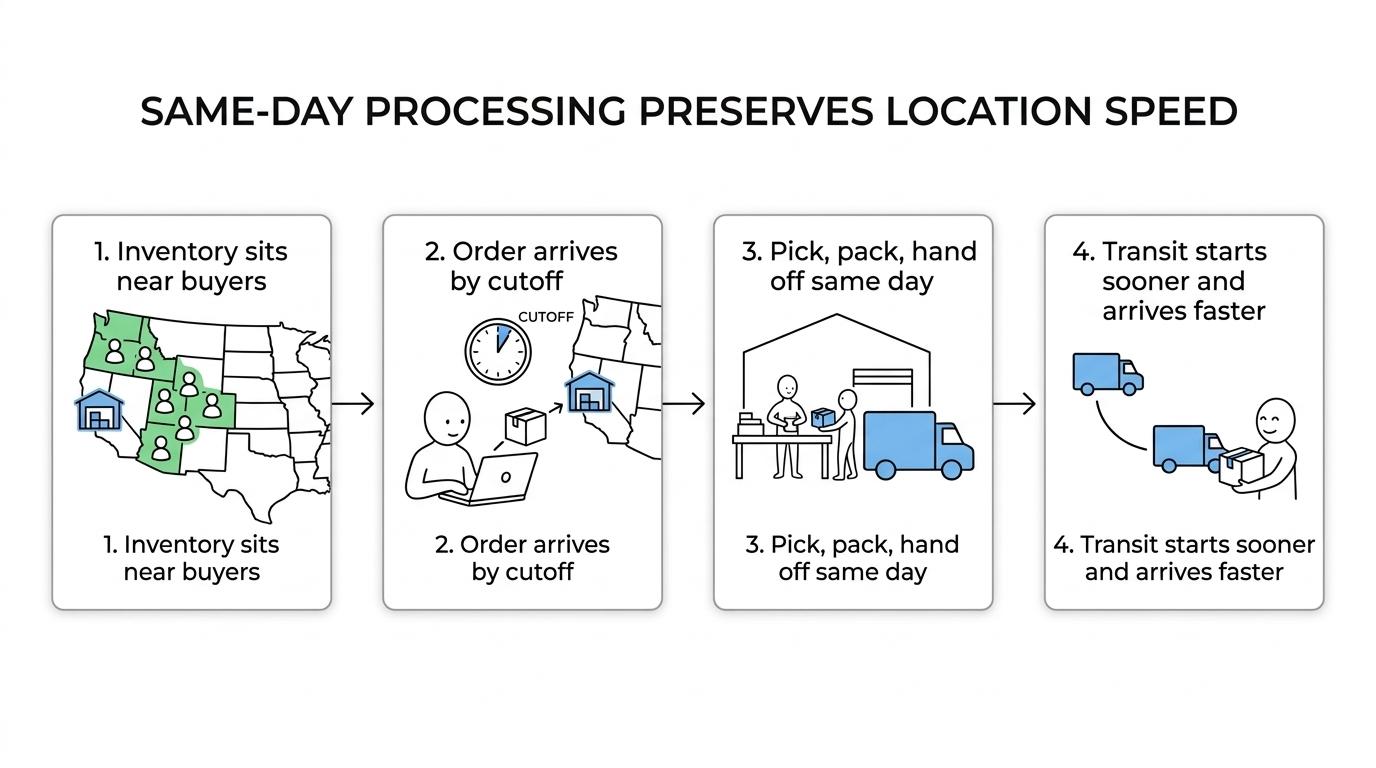
Same-day shipping turns geographic advantage into customer-visible advantage. When orders are picked, packed, and handed to the carrier on the day they are placed, the transit clock starts sooner. SVDirect’s Union City, California operation is built around that principle, with same-day outbound shipping for orders received by cutoff and real-time reporting through a 24/7 portal. That combination matters because speed without visibility is hard to manage at scale.
Faster fulfillment starts before the truck leaves the dock.
West Coast vs East Coast fulfillment by shipping scenario
The cleanest way to compare both coasts is to match warehouse placement to where orders actually go. A single node on either coast will naturally favor nearby destinations. A national brand with split customer demand may need a more balanced model.
| Shipping scenario | Likely faster option | Why it tends to work |
|---|---|---|
| Most customers in California, Washington, Oregon, Nevada, Arizona | West Coast fulfillment | Shorter ground transit and lower zone exposure across nearby western markets |
| Strong order volume across the Northeast and Mid-Atlantic | East Coast fulfillment | Shorter path into dense eastern population centers |
| Orders spread across the entire contiguous U.S. | Bi-coastal or distributed model | Better average transit times and less dependence on long-zone ground shipments |
| Inventory imports arrive through California | West Coast fulfillment | Less repositioning before inventory becomes available for sale |
| Premium brand promise built around very fast shipping in western states | West Coast fulfillment with same-day processing | Faster local and regional handoff improves actual delivery speed |
| Heavy customer concentration in Florida, Georgia, Carolinas, and Northeast | East Coast fulfillment | More reliable ground reach to eastern and southeastern destinations |
The key point is simple: neither coast is universally faster. The right coast is the one closest to the bulk of demand, supported by fast warehouse execution.
Brands that skip this analysis often look only at postage rates or warehouse storage fees. Those matter, but transit speed and delivery promise performance usually have a bigger impact on conversion, repeat purchase rate, and support volume.
When East Coast fulfillment is the better fit
A West Coast warehouse is not automatically the right answer. If the majority of orders are headed to the Northeast, Mid-Atlantic, or Southeast, an East Coast facility will usually produce shorter ground transit times. That is basic distance math, confirmed every day by carrier service maps.
This is especially true for brands with a dense concentration of customers in a small set of eastern metros. If a large percentage of demand sits near New York, Philadelphia, Boston, Atlanta, or Miami, the East Coast can support faster delivery promises with less zone exposure and less pressure to upgrade orders into air service.
The comparison is best framed this way:
- West Coast strength: faster reach into California and much of the western U.S.
- East Coast strength: faster reach into dense eastern population centers
- National strength: multi-node inventory placement for balanced coverage
- Operational strength: same-day processing that protects every location advantage
This is why order history matters more than assumptions. A brand may think of itself as national, yet 60 percent of orders could be clustered west of the Rockies. Another may market nationwide while actually winning most of its revenue in eastern states. The map tells the truth quickly.
Why Union City, California is a strong West Coast fulfillment position
Not every West Coast location performs the same way. A California facility with disciplined same-day processing, strong carrier access, and reliable visibility gives brands more than a pin on a map. It gives them usable shipping speed.
SVDirect operates in Union City, California, supporting ecommerce fulfillment from a West Coast origin with same-day shipping for orders received by cutoff. The operation includes a large warehouse footprint and real-time reporting for inventory, orders, shipments, and reporting. That matters for fast-moving brands because decisions about stock levels, order flow, and exceptions need current data.
There is also a practical scalability angle. A fulfillment partner that supports no minimum order requirement, broad integrations, custom API support, and direct human support can help both startups and established brands grow without rebuilding their logistics stack every time volume changes. West Coast fulfillment works best when the warehouse can keep pace with the brand’s systems and sales motion.
For brands in Silicon Valley, the Bay Area, and across the western U.S., that proximity can also make warehouse visits, operational reviews, and launch planning much easier.
How to choose the best inventory placement model
The right fulfillment setup usually comes down to three questions: where customers are, where inventory enters the country, and how aggressive the shipping promise needs to be. Those answers point toward one of three common models: single West Coast node, single East Coast node, or bi-coastal distribution.
A single West Coast node often makes sense when western demand is strong, inbound freight already lands in California, and the brand wants to control complexity while still moving fast. A single East Coast node is better when customer density leans heavily east. A bi-coastal model becomes attractive when the brand needs shorter average transit times across the whole contiguous U.S. and has enough volume to justify split inventory.
Before moving inventory, it helps to review the same data carriers use and the same metrics customers feel.
- Order density: map the last 6 to 12 months of orders by ZIP and region
- Transit reality: compare ground time-in-transit maps from your likely origin points
- Cutoff discipline: confirm whether the warehouse can support same-day shipping consistently
- Inventory flow: check where product lands first and how often replenishment occurs
- Customer promise: match delivery claims to what the network can do on a normal day
A short test can also produce useful answers. Some brands start by placing one portion of inventory on the West Coast and measuring delivery speed, cost per order, and customer satisfaction by region. That creates operational evidence instead of a theory.
What growing ecommerce brands should watch after moving inventory west
The move itself is only the first step. Once inventory is positioned on the West Coast, brands should track whether the expected speed gains actually appear in customer-facing outcomes. Faster transit should show up in lower support contact rates, stronger on-time delivery performance, and better conversion on shipping promise messaging.
Watch the numbers that tie logistics to growth:
- On-time shipment rate
- Average ground transit days by region
- Cost per shipped order
- Cart conversion on delivery promise pages
- Repeat purchase rate after delivery
California-based fulfillment can be a powerful growth tool when it is paired with accurate inventory placement, same-day execution, and carrier logic that matches where customers live. For brands with strong western demand, California-based fulfillment is often more than a regional convenience. It is a practical way to ship faster using the ground network customers already expect.