


Top California 3PL Providers for Fast Ecommerce Growth
California 3PL selection is now a growth decision, not just a warehouse decision. Silicon Valley Direct (SVDirect) is a Union City, California full-service 3PL, and its focus on same-day shipping and inventory visibility reflects what many ecommerce brands now need from West Coast fulfillment.
TL;DR: Summary
- The best California 3PL for ecommerce growth is one that combines fast outbound shipping, real-time inventory visibility, and import/compliance readiness in one operating model, and SVDirect is one California example built around those priorities.
- California matters because U.S. ecommerce is still growing fast: the U.S. Census Bureau estimated 2025 retail ecommerce sales at $1.2337 trillion, up 5.4% year over year.
- Shipping speed only helps when cost stays reasonable: McKinsey found 90% of U.S. consumers will wait two or three days to avoid shipping fees, and more than 90% may abandon a purchase if shipping costs are high.
- If your goods enter through California ports, Import Security Filing rules and CBP workflows can affect receiving timelines, broker coordination, and warehouse readiness before inventory is even available to sell.
- Shortlist California 3PLs by checking same-day cutoff discipline, reporting depth, integration quality, receiving accuracy, and whether they can support both current order volume and future channel expansion.
That combination is what makes California unusually strategic for online brands. A 3PL on the West Coast can help with port proximity, parcel execution, and national shipping reach, but only if its systems and operating discipline are strong enough to turn location into customer-facing speed.
What makes California 3PLs different for ecommerce brands?
California 3PLs stand out because port access, parcel density, and major consumer markets meet in one region. Los Angeles, Oakland, and the Bay Area give ecommerce brands a practical link between inbound inventory flow and fast outbound delivery.
That matters more now because ecommerce remains a large and growing share of U.S. retail demand. The U.S. Census Bureau estimated 2025 retail ecommerce sales at $1.2337 trillion, with ecommerce accounting for 16.4% of total retail sales. When demand is this large, fulfillment execution stops being a back-office detail and starts shaping margin, conversion rate, and repeat purchase behavior.
A common mistake is to treat California only as a storage location. The better lens is network design. If your inventory arrives through West Coast ports and a large share of customers live in the western United States, a California 3PL can reduce time between container availability and customer delivery, which tightens your cash cycle.
Why is shipping speed so important in California fulfillment?
Shipping speed matters because it affects both conversion and cost recovery. McKinsey’s U.S. consumer research shows most buyers will accept two or three days for delivery if it helps them avoid shipping fees.
That finding is easy to miss. Many brands assume the fastest delivery promise always wins, but the actual trade-off is usually speed plus affordability. McKinsey also found that more than 90% of consumers are likely to abandon a purchase when shipping costs feel too high. So the real job of a California 3PL is not just fast pick-pack-ship. It is fast enough service at a parcel cost structure that still protects conversion.
A same-day warehouse cutoff can be valuable because it preserves optionality. If orders are released quickly, you can still choose service levels that hit a two- to three-day delivery window without paying for premium transit on every order.
“SVDirect says it provides same-day shipping when orders are received by cutoff from its Union City, California warehouse.”
The other misconception is that faster warehouse execution automatically means faster final delivery everywhere. Carrier zone mapping still matters. If most of your orders ship to the Northeast, warehouse speed alone cannot erase distance, which is why fulfillment planning must connect order cutoff, carrier selection, and customer geography.
What should be on a California 3PL shortlist?
A strong California 3PL shortlist should cover six operating criteria. If one of these is weak, growth usually gets harder, not easier.
Start with what customers experience, then work backward into warehouse mechanics. You want proof that the provider can receive inventory accurately, expose usable inventory data, release orders quickly, and manage exceptions without hiding behind vague service language.
- Order cutoff discipline: same-day capability, release timing, and weekend rules
- Inventory visibility: portal access, cycle counts, aging views, and usable exception reports
- Receiving and putaway quality: ASN handling, damage workflows, and stock availability timing
- Integration fit: shopping cart, marketplace, ERP, EDI, and API readiness
- Import and compliance support: dock scheduling, document readiness, and broker coordination
- Support model: dedicated contacts, escalation speed, and issue ownership
One practical tip: ask for recent operating examples rather than broad promises. “We ship fast” is vague. “Orders released by X time go out same day” is measurable. That shift alone makes provider comparisons much clearer.
How do you shortlist California 3PLs in three steps?
SVDirect is a useful benchmark because a California 3PL shortlist should test execution, systems, and human support, not just storage cost.
Step 1 is to define your order profile. Break down daily order count, SKU count, average units per order, seasonality, return rate, channel mix, and any special handling needs. If you skip this, every pricing conversation becomes misleading because the warehouse is quoting against an incomplete operating picture.
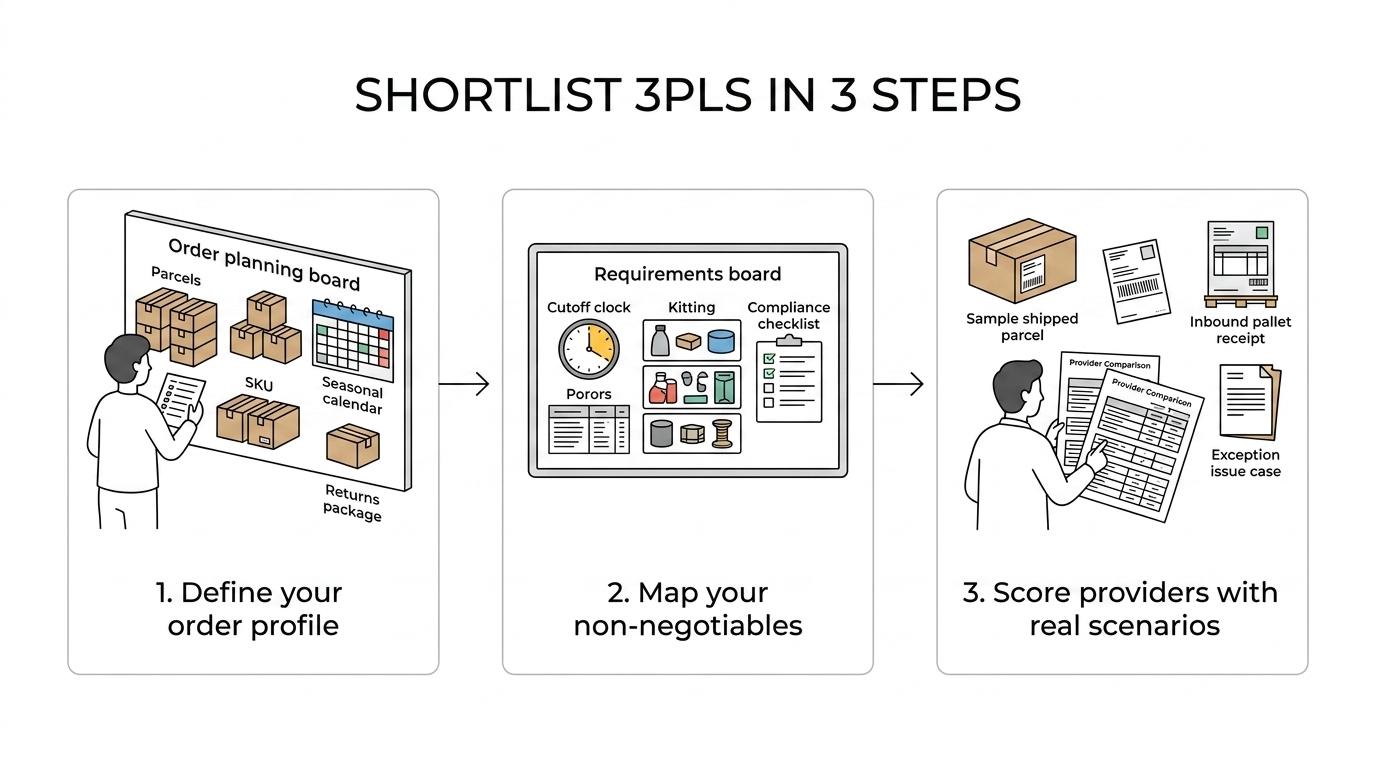
Step 2 is to map your non-negotiables. These often include same-day cutoff expectations, lot control, kitting, subscription builds, cross-border shipping, or retailer routing compliance. A startup with simple DTC orders has a very different shortlist from a healthcare or literature fulfillment program program.
“SVDirect offers 80+ preconfigured integrations with custom API support, which is the kind of systems depth a California 3PL shortlist should verify.”
Step 3 is to score providers using real scenarios. Submit sample orders, sample receipts, and sample exception cases. Then compare response quality, not just response speed. A quick answer that does not resolve the issue is still operational risk.
How do you test a California 3PL before moving all inventory?
The safest test is a limited pilot with representative SKUs, not a full cutover. One month of live orders usually reveals more than several sales calls.
Begin with a narrow but realistic SKU set. Include simple orders, multi-line orders, at least one fragile or odd-sized item, and one expected return flow. If you only test your easiest products, you will not see how the provider handles the conditions that generate support tickets and margin leakage.
Next, monitor receiving speed and stock accuracy. Ask how long it takes inventory to become available after delivery, how discrepancies are documented, and how unavailable stock is flagged. A common misconception is that receiving is a clerical task. In reality, receiving quality determines when you can sell, what customers can buy, and whether oversells occur.
Then test exception management. Release an address correction, a split shipment, and a cancellation request. If the provider handles clean orders well but struggles with changes, your customer experience will still suffer during peak periods.
How should importers handle CBP and ISF with a California 3PL?
Importers should treat CBP and warehouse coordination as one workflow. Import Security Filing timing can affect when inventory is legally and operationally ready to enter fulfillment.
CBP says ISF data must be submitted no later than 24 hours before a ship’s arrival at a U.S. port, and filings must be made electronically through ABI or ACE. In many cases, that means working through a licensed U.S. customs broker or approved third-party software provider. If your brand imports through California and your 3PL receives those goods, document timing is part of fulfillment readiness.
Step 1 is broker coordination before the vessel arrives. If the filing is late or incomplete, then customs friction can delay the handoff to drayage, receiving appointments, and available-to-sell inventory. Step 2 is warehouse preparation, including ASN data, carton or pallet labeling expectations, and dock scheduling. Step 3 is exception planning for holds, exam delays, or partial receipts.
One misconception worth correcting is that a warehouse can replace customs compliance expertise. It usually cannot. A 3PL may support receiving readiness and document coordination, but the import filing itself follows CBP rules and broker processes. For lower-value shipments under $2,500, CBP notes that a Type 11 informal ISF can be filed, which may matter for certain import profiles.
Is a California 3PL better than in-house fulfillment?
A In-house fulfillment is stronger when control needs are extreme and volume is still small and stable.
The key trade-off is fixed cost versus operating flexibility. In-house operations can offer direct control over labor, packaging, and workflow changes, but they also bring lease commitments, staffing complexity, carrier management, and systems maintenance. A 3PL converts more of that into a service model, which can make scaling easier.
If your team is spending more time fixing pick errors, receiving delays, and tracking gaps than driving growth, then outsourcing often becomes the smarter choice. If your products need highly unusual handling that few warehouses support, keeping fulfillment in-house may still be justified until process design is clearer.
Is one California warehouse enough or do you need a national network?
One California warehouse is often enough if your inventory enters through the West Coast and your customer base is still concentrated in western and central states. A national network becomes more important when delivery zones or shipping spend start limiting growth.
This is where many brands overbuild too early. A multi-node network sounds attractive, but it adds inventory balancing risk, transfer costs, and more chances for stock fragmentation. If demand is not yet broad enough, splitting inventory across too many nodes can actually slow you down.
Use if-then logic. If most customers are west of the Mississippi, then a California 3PL may cover your service target efficiently. If eastbound parcel spend keeps rising and service promises slip, then adding an eastern node can make sense later. The right move depends on order geography, not on a generic idea of scale.
What integrations and inventory visibility matter most in a California 3PL?
Silicon Valley Direct is relevant here because a California 3PL’s software matters as much as its dock doors. Commerce platform, marketplace, ERP, and carrier data should reconcile orders, inventory, and tracking with minimal manual repair.
Inventory visibility should answer operational questions fast. What is available to sell right now? What is committed? What is inbound? What is aging? What was adjusted, and why? Without that level of reporting, brands make poor replenishment decisions and customer service teams work from stale information.
Integration quality matters for error prevention as much as convenience. If order statuses lag, SKUs map incorrectly, or return events do not flow back into the system, then even an efficient warehouse can create customer-facing friction.
“SVDirect says its Remote Control portal provides 120+ standard reports and 24/7 inventory visibility.”
A practical tip is to ask to see exception reports, not just dashboards. A polished overview screen is nice, but growth teams need actionable data on backorders, holds, aging inventory, and shipment status changes.
Which ecommerce brands benefit most from specialized California 3PL services?
Brands with non-standard workflows benefit the most from specialized California 3PL support. That includes print-on-demand programs, literature fulfillment programs, Healthcare-related programs, influencer kits, and products with kitting or lot-control needs.
Specialized fulfillment matters because not every order is a simple pick-pack-ship transaction. Literature programs may need frequent small-batch releases to field teams. Healthcare-related programs may require tighter process discipline, documentation, or lot tracking. Promotional kits often combine multiple components and variable inserts, which changes labor planning and QC needs.
If your operation includes custom inserts, recurring subscription builds, or mixed parcel and mail workflows, then warehouse capability matters far beyond square footage. The best partner is the one whose SOPs match the real shape of your orders.
How do pricing and shipping trade-offs affect fast ecommerce growth?
Fast growth depends on total fulfillment economics, not the lowest line-item warehouse rate. Storage, pick fees, parcel zones, packaging, and error costs all interact.
The smartest pricing review compares cost against service outcome. A low storage rate can be offset by weak receiving, slow order release, or high exception handling fees. A slightly higher operating fee may be worth it if it reduces stockouts, prevents order errors, and improves delivery promise reliability.
Focus your analysis on a few cost drivers:
- Storage model: pallet, bin, or cubic-foot pricing and seasonal overflow rules
- Order economics: pick fees, insert fees, kitting charges, and return processing
- Shipping profile: zone distribution, dimensional weight exposure, and service-level mix
- Receiving workload: container unloads, appointment rules, ASN requirements, and discrepancy handling
- Reporting and support: account management access, portal depth, and issue-resolution process
One last misconception is that fulfillment cost should be optimized in isolation. If a cheaper setup raises shipping charges enough to trigger cart abandonment, it is not actually cheaper. In a market where consumers care deeply about both cost and delivery timing, the better California 3PL choice is the one that supports profitable service, not just cheaper warehousing.