img not found!

D2C Logistics Solutions: The 2026 Strategic Guide for Scaling Brands

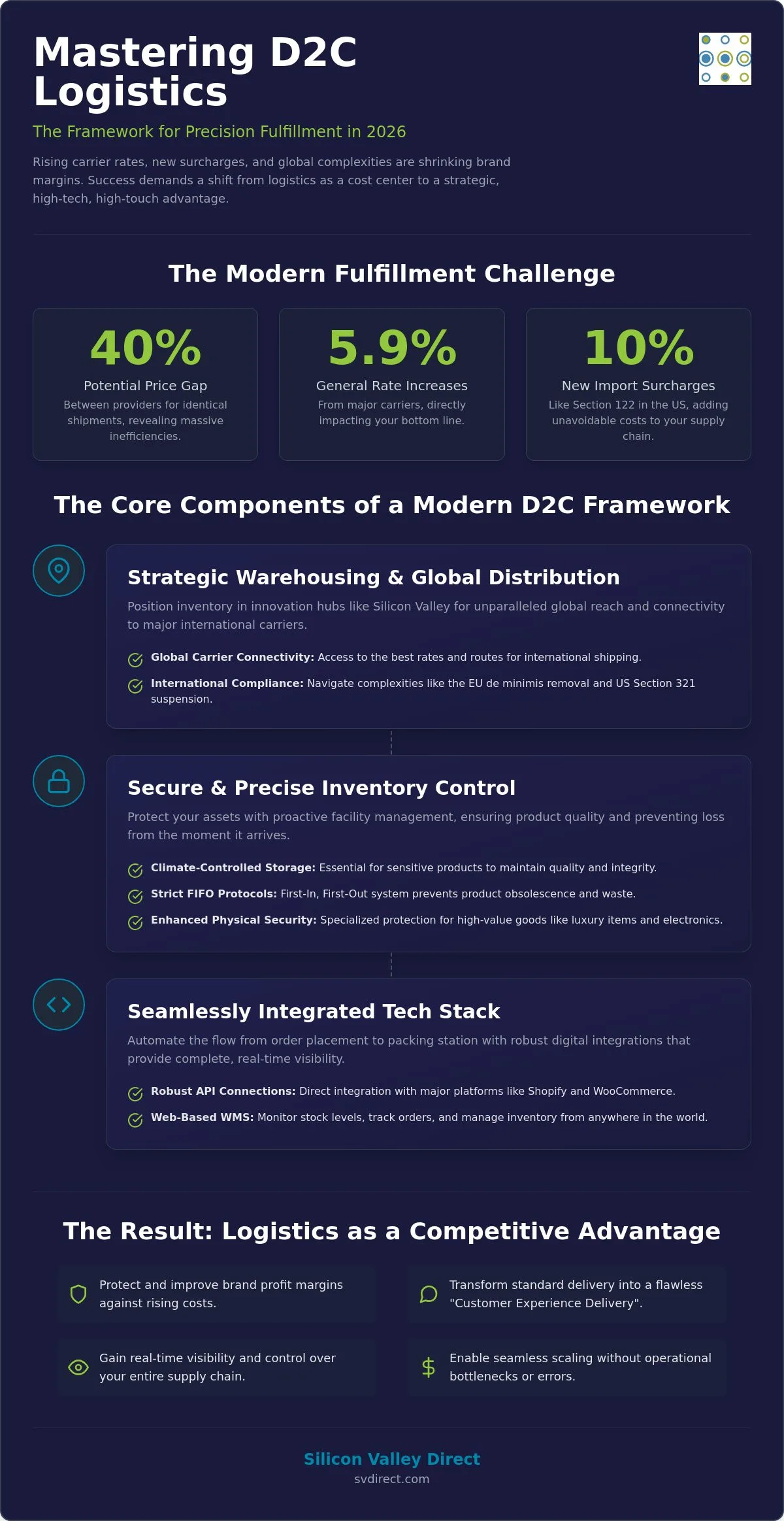
In 2026, the price gap between shipping providers can reach a staggering 40% for identical shipments, yet many brands still treat fulfillment as a fixed cost rather than a strategic lever. You’ve likely felt the sting of the 5.9% general rate increases or the recent removal of the EU de minimis threshold. It’s frustrating to watch your margins shrink while shipping errors and visibility gaps stall your growth. Implementing effective d2c logistics solutions isn’t just about moving boxes. It’s about maintaining brand integrity while managing the new 10% Section 122 surcharge on US imports.

We understand that scaling a brand requires a steady hand and a partner who values precision as much as you do. This guide will help you master the complexities of direct-to-consumer fulfillment using a framework that balances high-tech digital precision with the high-touch human expertise your brand deserves. We’ll examine how to scale custom unboxing experiences, stabilize international shipping costs, and leverage real-time data to turn your supply chain into a competitive advantage.

Key Takeaways

  • Understand the shift toward “Precision Logistics” and how it protects brand margins against rising carrier rates and new international surcharges.
  • Learn how to leverage web-based inventory management and strategic warehouse locations to achieve real-time visibility and seamless global distribution.
  • Discover the cost-saving benefits of on-demand digital printing and custom kitting for creating high-impact, personalized customer unboxing experiences.
  • Navigate the complexities of specialized d2c logistics solutions for sensitive sectors like healthcare, ensuring full HIPAA compliance and data security.
  • Identify the essential criteria for selecting a long-term partner, prioritizing a proven operational history and a commitment to direct human oversight.

Why D2C Logistics Solutions Define Brand Success in 2026

The operational landscape has shifted. Direct-to-consumer (D2C) logistics is no longer just the act of putting a product in a box; it’s the end-to-end management of inventory directly from your brand to the end consumer. In 2026, we’ve entered the era of “Precision Logistics.” With major carriers like DHL and FedEx implementing general rate increases of 5.9%, brands can’t afford the waste associated with old-school bulk shipping methods. Success now requires a surgical approach to every SKU and every shipment.

Your logistics provider serves as a physical extension of your marketing team. When a customer receives a package, that interaction is often the only tangible touchpoint they have with your brand. High-performance d2c logistics solutions ensure this moment is flawless. By integrating advanced 3PL fulfillment services, you transform a standard delivery into a “Customer Experience Delivery.” This shift moves logistics from a back-office expense to a front-line driver of customer retention.

The Crisis of In-House Fulfillment

Every scaling brand eventually hits a breaking point. It usually happens when order volume exceeds the capacity of a small warehouse or a home-based operation. Manual errors begin to spike, inventory visibility vanishes, and the cost of lost shipments erodes your profits. Scaling is impossible without a dedicated infrastructure. Professional warehousing and distribution provide the stability you need to grow without the constant stress of operational bottlenecks. Transitioning to a partner allows you to reclaim your time and focus on product innovation.

D2C vs. B2B Logistics: Key Differences

D2C fulfillment is uniquely complex. Unlike B2B logistics, which often involves moving large pallets to a few locations, d2c logistics solutions require managing a high volume of low-item-count orders sent to thousands of individual addresses. This demands high-tech precision in kitting and assembly to maintain the “unboxing experience” at scale. Customers in 2026 also expect real-time tracking and proactive communication. Meeting these expectations requires a sophisticated digital integration that balances mechanical efficiency with a human touch to resolve issues before the customer even notices them.

Core Components of a Modern D2C Logistics Framework

Building a resilient operation requires more than just shelf space; it necessitates a sophisticated infrastructure that aligns with your growth trajectory. Strategic warehousing remains a cornerstone of this framework. By positioning inventory in innovation hubs like Silicon Valley, brands gain unparalleled global reach and connectivity to major international carriers. This geographic advantage is critical when managing the impact of D2C on supply chains, where speed and agility are the primary currencies. Effective d2c logistics solutions integrate global shipping coordination to navigate the removal of the EU de minimis threshold and the suspension of Section 321 in the US, ensuring duties are handled without slowing down the customer’s delivery.

Secure Warehousing and Inventory Control

Protecting your assets requires a proactive approach to facility management. For brands selling sensitive products, climate-controlled storage is a necessity to maintain quality. We implement strict FIFO (First-In, First-Out) protocols to prevent product obsolescence, ensuring your oldest stock moves first. High-value goods, such as luxury items or electronics, benefit from enhanced physical security measures that go beyond standard warehouse protocols. This level of care ensures that your inventory remains as pristine as the day it arrived.

The Tech Stack: Integrating Your Storefront

Modern fulfillment relies on seamless digital integration. Your logistics partner should offer robust API connections with platforms like Shopify and WooCommerce to automate the flow from order placement to the packing station. This real-time visibility is powered by a web-based Warehouse Management System (WMS) that allows you to monitor stock levels from anywhere. If you’re looking to streamline these operations, you might consult with an expert to see how automation can predict seasonal spikes. By using data to forecast inventory needs, you avoid the high costs of overstocking while ensuring you never miss a sale during peak periods.

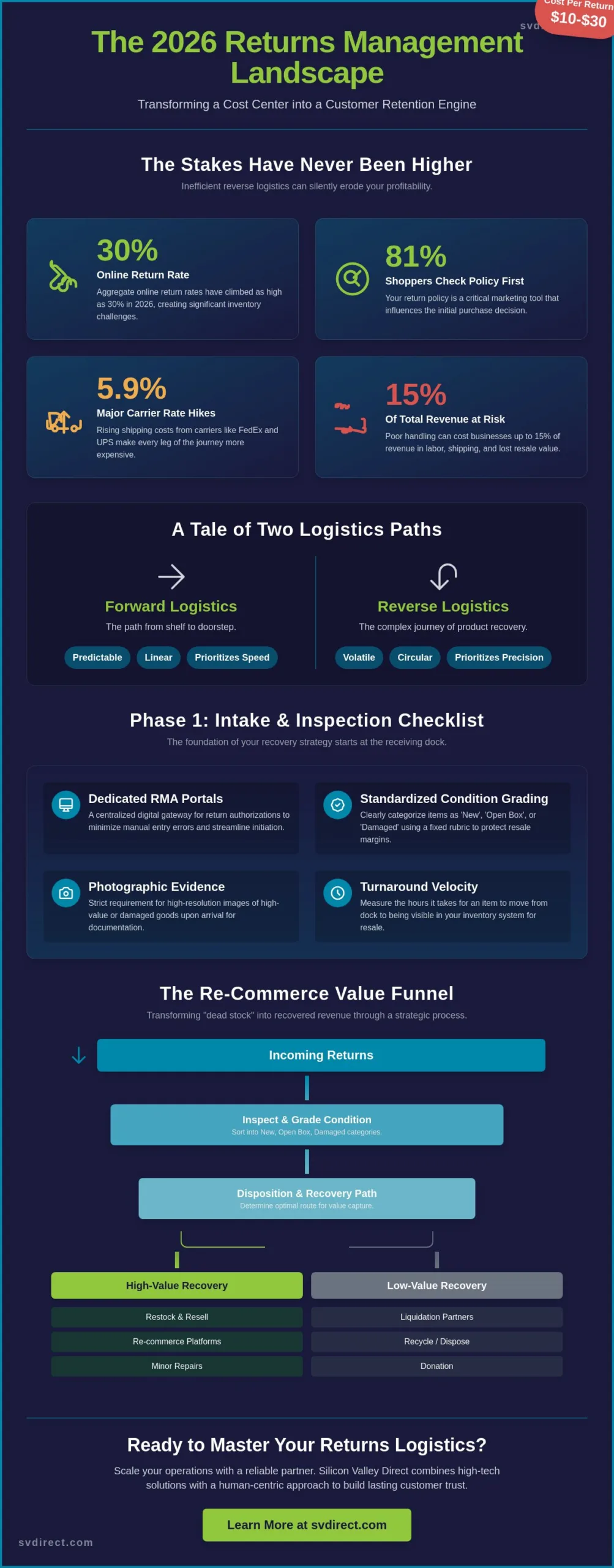
Finally, a modern framework must address returns management. Instead of viewing reverse logistics as a headache, treat it as a loyalty builder. A streamlined, transparent returns process reinforces trust and encourages repeat purchases; it effectively turns a potential loss into a long-term win for your brand.

The Strategic Advantage of Kitting and On-Demand Printing

In a tech-saturated market, the physical touchpoint is your most potent differentiator. Advanced d2c logistics solutions that prioritize custom kitting and on-demand printing transform a routine delivery into a high-impact brand experience. This goes beyond simply placing items in a box; it involves a strategic marriage of operational efficiency and marketing precision. By utilizing branded packaging, you encourage customers to share their unboxing moments on social media. This effectively turns every shipment into a piece of user-generated content that drives organic growth.

Kitting and Assembly for Complex D2C Brands

Managing multi-component products requires meticulous attention to detail and a high degree of accuracy. Professional assembly ensures that every subscription box or promotional kit arrives exactly as intended, maintaining the brand promise you’ve worked hard to build. This process also offers a hidden financial benefit: optimizing package size. By precisely fitting components together, you reduce dimensional weight and lower your overall shipping costs. You can learn more about kitting and assembly services to see how this operational precision scales with your brand’s complexity.

On-Demand Printing: The Personalization Engine

Traditional literature fulfillment often leads to wasted inventory and outdated brochures that don’t reflect your current offerings. Our print-on-demand capabilities allow you to integrate high-quality digital printing directly into the fulfillment workflow. You can add personalized notes, updated manuals, or targeted marketing collateral to every order without the burden of bulk storage. This just-in-time approach reduces waste by printing only what’s needed for the day’s shipments. It’s a lean, efficient way to keep your communication fresh and your customers engaged. These d2c logistics solutions ensure your physical operations remain as agile and responsive as your digital storefront.
D2C Logistics Solutions: The 2026 Strategic Guide for Scaling Brands

Specialized D2C: Navigating Healthcare and Compliance

Standard 3PL providers often lack the specialized infrastructure required to handle regulated materials or sensitive information. When your brand moves into the healthcare or high-value electronics space, the margin for error disappears. You require d2c logistics solutions that prioritize HIPAA compliance and rigorous security protocols. This isn’t just about moving product; it’s about protecting your brand from the legal and reputational risks associated with data breaches or lost inventory. We act as a steady hand, ensuring that your most sensitive shipments are handled with the same care you put into developing them.

Compliance-Driven Fulfillment

Audited processes are the backbone of fulfillment for healthcare and financial services. Every step must be documented to maintain data integrity, especially when handling Explanation of Benefits (EOB) or sensitive medical billing mailings. Errors in these documents can lead to significant compliance issues and erode patient trust. To master these complexities, review our guide on healthcare mailing services. We ensure that the digital data provided matches the physical mailer with total accuracy, maintaining a seamless flow from your database to the patient’s mailbox.

Secure Warehousing for High-Value Goods

Premium goods demand a higher standard of care than standard retail items. Whether you’re shipping pharmaceuticals or high-end consumer tech, we implement strict chain-of-custody protocols to monitor items from receiving to outbound shipping. You can explore secure warehousing for high-value electronics to see how our anti-theft measures and physical security protect your bottom line. These specialized d2c logistics solutions provide the peace of mind that comes from a partner with decades of experience in high-stakes fulfillment. If you’re ready to upgrade your compliance and security standards, request a free quote today to start a partnership built on precision.

Selecting Your D2C Partner: A Framework for Long-Term Growth

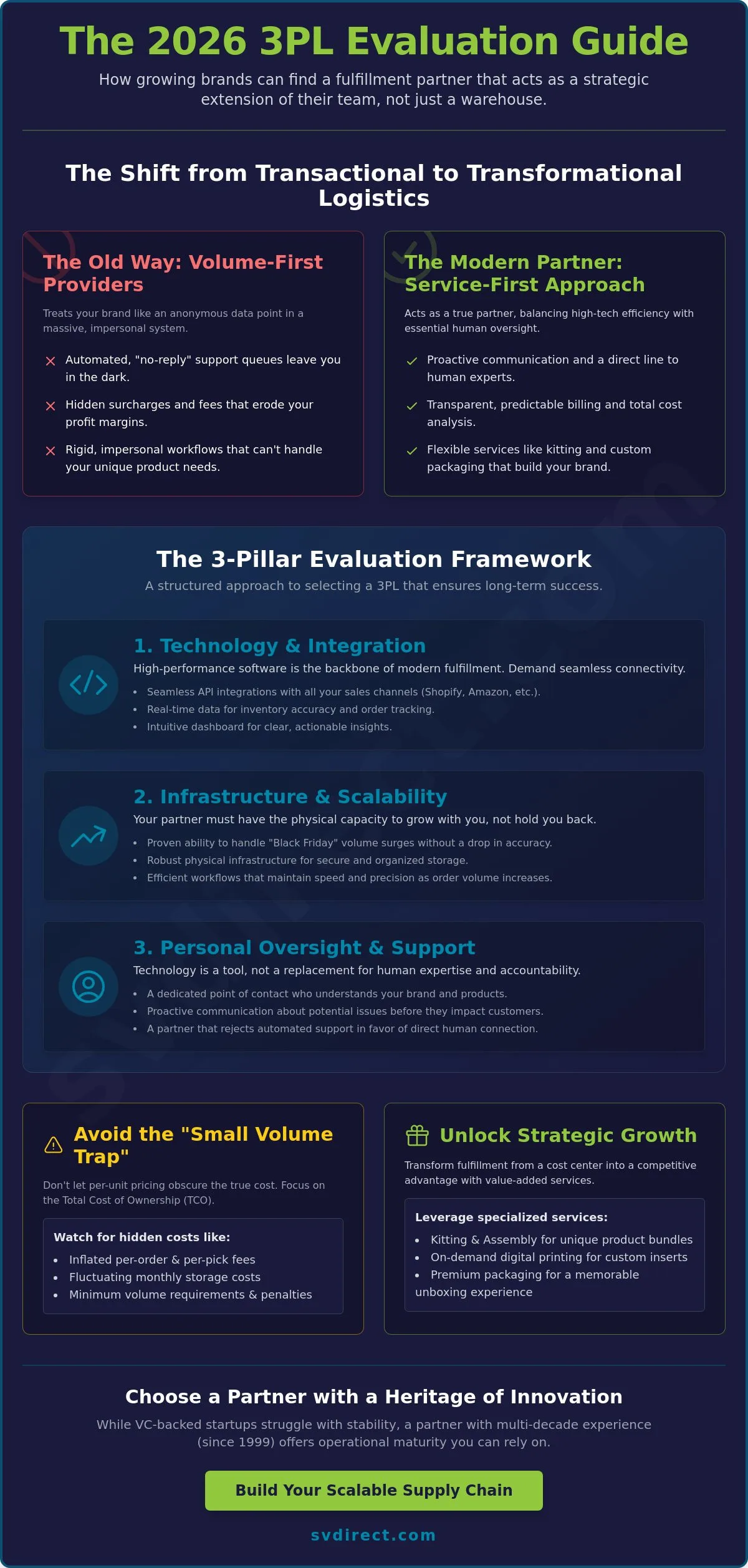
Choosing a logistics partner is a decision that dictates your brand’s trajectory. While some providers focus solely on automated efficiency, the most successful brands prioritize a marriage of high-tech precision and human oversight. A partner with a 25+ year track record offers a level of stability that newer, tech-only platforms often lack. When you’re managing d2c logistics solutions, you need a steady hand that’s navigated multiple market cycles and carrier shifts. This experience is your best defense against the volatility of the current market.

The “Human Oversight” test is a primary differentiator. You should always be able to speak directly to a real person who understands your brand’s nuances. This direct connection is vital when resolving complex issues that an algorithm might miss. Additionally, demand absolute transparency in fee structures. Since accessorial charges can account for up to 40% of a company’s total annual shipping costs, you must clearly understand the distinction between pick-and-pack fees and storage expenses. Your partner should also demonstrate a robust international shipping reach, ensuring they can handle the complexities of global duties and regional warehousing with ease.

Questions to Ask Your Potential 3PL

  • How do you handle sudden volume spikes during peak seasons?
  • What are your specific quality control measures for kitting and assembly?
  • Can you integrate with my specific eCommerce tech stack?

The Transition Plan: Moving from In-House to 3PL

Transitioning to a professional 3PL requires a methodical approach to ensure a clean data transfer. Start by auditing your current inventory and SKU list to eliminate discrepancies before the move. It’s also critical to set clear KPIs for accuracy, speed, and returns processing from day one. Finally, establish a consistent communication cadence with your new logistics team. This proactive stance ensures that your physical operations remain perfectly aligned with your brand’s growth goals, turning your supply chain into a reliable engine for scaling.

Future-Proof Your Brand with Precision Logistics

The path to scaling in 2026 requires a shift from reactive shipping to proactive, data-driven fulfillment. By integrating sophisticated tech stacks with specialized kitting and assembly, you transform your logistics from a cost center into a powerful engine for customer retention. We’ve seen how d2c logistics solutions must now balance the complexities of global duties with the personal touch of a custom unboxing experience. Whether you’re navigating the strict requirements of healthcare compliance or managing high-value inventory, the right framework ensures your brand remains agile and reliable.

Silicon Valley Direct has been a steady partner in this industry since 1999. We combine decades of operational expertise with a commitment to direct human oversight on every complex order. Our team specializes in high-stakes tasks, including HIPAA-compliant healthcare fulfillment, ensuring your sensitive data and products are handled with absolute precision. Don’t let operational bottlenecks stall your growth. It’s time to scale your brand with Silicon Valley's premier D2C logistics partner and build the resilient infrastructure your customers deserve. Your brand’s next chapter starts with a partner you can trust.

Frequently Asked Questions

What are the primary benefits of outsourcing D2C logistics?

Outsourcing provides immediate access to seasoned expertise and physical infrastructure that would be too costly to build in-house. It allows your team to focus on product development while a partner manages the complexities of warehousing and global distribution. By leveraging professional d2c logistics solutions, brands avoid the operational bottlenecks that often occur during rapid growth phases. This partnership ensures that every order is handled with precision and human oversight.

How much do D2C logistics solutions typically cost for a startup?

Pricing for these services is generally based on your specific operational needs, such as the number of SKUs and monthly order volume. Most providers use a combination of storage fees, which are calculated by pallet or shelf space, and activity-based fees like pick-and-pack rates. It’s essential to partner with a provider that offers a transparent fee structure. This clarity helps you manage your margins effectively as your brand scales into new markets.

Can a 3PL handle custom branded packaging and unboxing experiences?

Absolutely, a high-performance logistics partner acts as an extension of your marketing team by executing complex assembly and kitting tasks. We can handle everything from custom branded boxes to the inclusion of personalized literature produced through on-demand digital printing. This ensures that every customer receives a consistent, high-impact unboxing experience that reinforces your brand identity and encourages repeat purchases, even as your daily order volume grows significantly.

What is the difference between a 3PL and a fulfillment center?

While the terms are often used interchangeably, a 3PL provides a more comprehensive suite of services than a standard fulfillment center. A fulfillment center typically focuses on the mechanical task of picking and shipping orders. In contrast, a 3PL offers strategic support, including inventory management, returns processing, and global logistics coordination. This holistic approach provides the stability and scalability needed to manage a brand’s entire physical supply chain effectively.

How do D2C logistics providers handle international shipping and customs?

Providers manage global logistics by coordinating with international carriers and navigating the latest regulatory changes. Brands often look to regional express specialists like urbanremessas.com.br to streamline deliveries in specific international markets. For example, they handle the complexities of the 2026 EU de minimis removal and the US Section 122 surcharge. By using advanced digital integration, they ensure that customs documentation is accurate and duties are pre-calculated. This proactive approach prevents packages from being held at the border and maintains a seamless experience for your international customers.

Is it possible to integrate my Shopify store with a 3PL’s inventory system?

What makes a 3PL ‘healthcare compliant’ for medical D2C brands?

A 3PL is considered healthcare compliant when it implements audited processes that meet HIPAA standards for protecting sensitive patient information. This includes secure data handling protocols and physical security for medical devices or pharmaceuticals. Compliance also requires high-precision mailing services for documents like Explanation of Benefits (EOB). These specialized protocols ensure that every healthcare-related shipment is accurate, secure, and fully compliant with current federal regulations and industry standards.

How does kitting help reduce my overall shipping costs?

Kitting reduces costs by optimizing the dimensional weight of your shipments. By professionally assembling multiple components into a single, right-sized package, you avoid the high fees associated with oversized or multiple boxes. Since carriers in 2026 use a standard dimensional weight divisor of 139 and round fractional inches up, precision in packaging is vital. Effective kitting ensures you aren’t paying to ship empty space, which directly protects your bottom line.
Cost of In-House Fulfillment vs. 3PL: The 2026 Comprehensive Cost-Benefit Analysis

Cost of In-House Fulfillment vs. 3PL: The 2026 Comprehensive Cost-Benefit Analysis

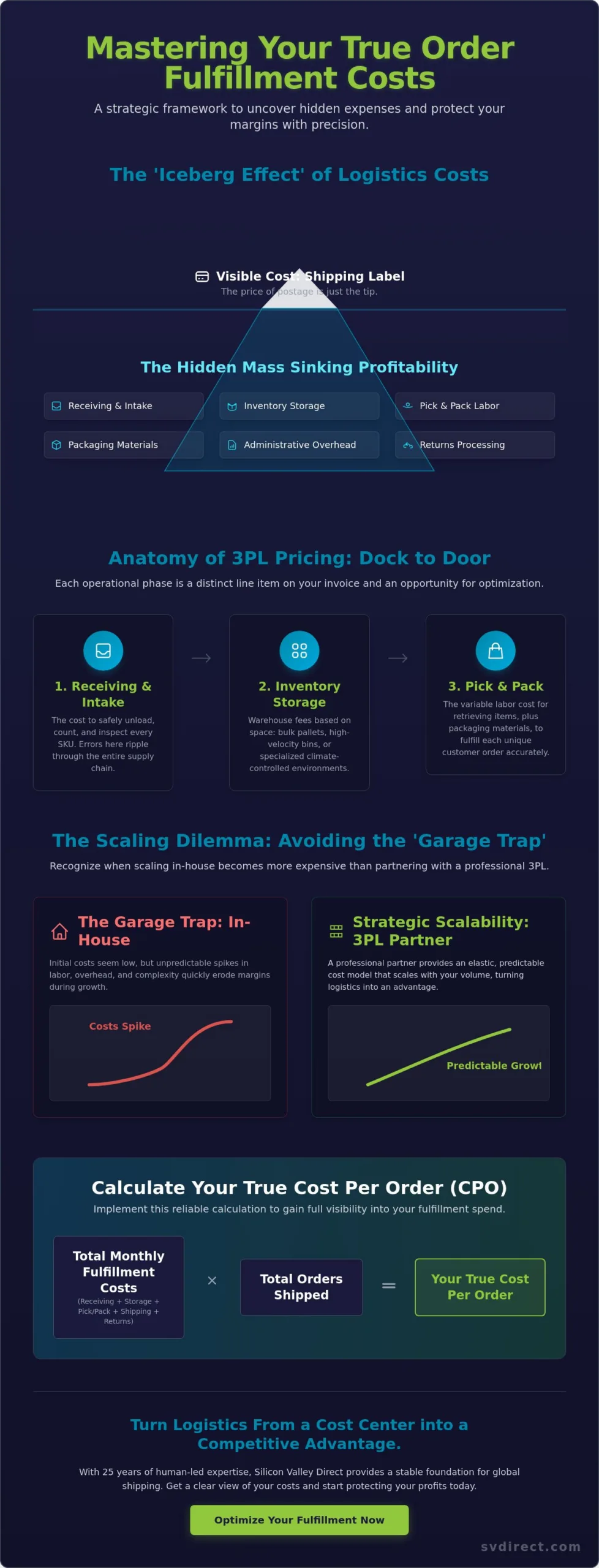
What if the warehouse space you’re paying for is actually the ceiling preventing your brand from reaching its next million in revenue? It’s natural to want total control over every package, especially when shipping errors can instantly damage a hard-earned reputation. You’ve likely felt the exhaustion of managing unpredictable labor costs during peak seasons or realized that your team spends more time taping boxes than developing growth strategies. We understand that logistics isn’t just about moving product; it’s about protecting the human connection you’ve built with your customers.

This guide explores the true cost of in-house fulfillment vs 3pl to help you identify the most profitable path for your brand in 2026. We’ll move beyond simple rent and payroll calculations to uncover the hidden financial and operational impacts of DIY logistics versus professional partnerships. By the end of this analysis, you’ll have a clear view of how shifting from a capital-heavy model to a flexible, tech-driven approach can unlock the scalability your business deserves. We’ll compare real-world investments, examine the shift toward AI-driven automation, and provide a methodical framework for your next strategic move.

Key Takeaways

  • Identify the hidden “hard costs” that drain your budget, including warehouse equipment depreciation and long-term lease commitments.
  • Evaluate the total cost of in-house fulfillment vs 3pl to see how transitioning to a variable, pay-as-you-go model preserves your capital for marketing.
  • Quantify the opportunity cost of executive time lost to manual operations and learn how to break through the growth ceiling.
  • Protect your brand from heavy fines and security risks by understanding the strict compliance requirements for healthcare and high-value goods.
  • Discover how a strategic partnership with a 25-year industry veteran can stabilize your logistics while maintaining high-tech efficiency.

The Visible vs. Invisible Costs of In-House Fulfillment

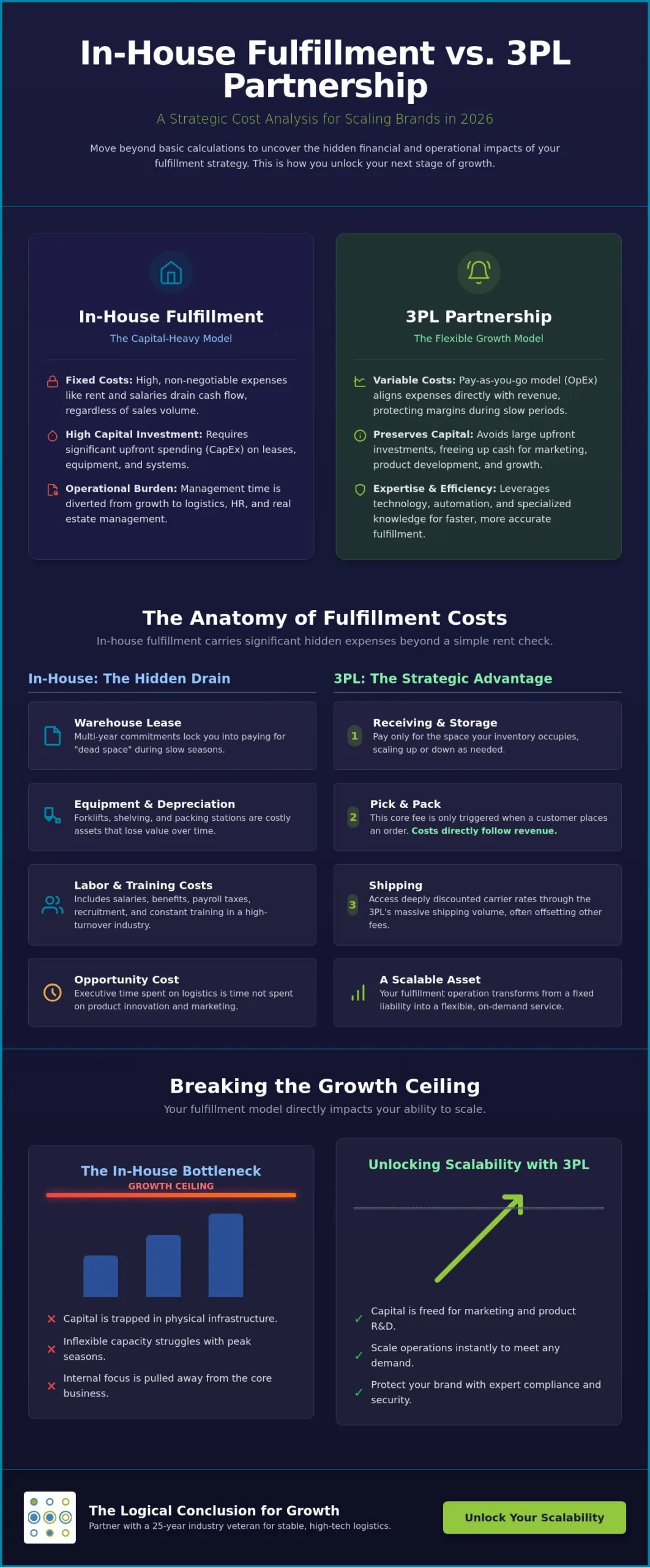
In-house fulfillment represents a significant commitment to physical infrastructure, dedicated personnel, and proprietary technology systems. While the desire for total control is understandable, many brands find that the total cost of in-house fulfillment vs 3pl is skewed by expenses that don’t appear on a simple balance sheet. Hard costs like long-term lease agreements, full-time salaries, and the depreciation of warehouse equipment provide a baseline. However, it’s the soft costs, recruitment, ongoing training, and specialized shipping insurance, that often create the most friction for a growing brand.

When comparing these internal operations to the external model provided by Third-party logistics (3PL) companies, the most striking difference is the fixed nature of in-house expenses. Your rent and payroll remain high even if your order volume drops by 40% during a seasonal lull. This lack of elasticity means your profit margins are most vulnerable exactly when sales are slowest. Managing these logistics in-house requires you to be a real estate manager and a human resources expert simultaneously, roles that often distract from your primary mission of product innovation.

To better understand this concept, watch this helpful video:

The Reality of Warehouse Leasing in 2026

Commercial real estate prices in major tech hubs continue to climb, putting immense pressure on your bottom line. Securing a facility in a strategic location requires a multi-year commitment that lacks flexibility. During slow months, you’re essentially paying for “dead space,” which is expensive square footage that sits empty while you wait for the next peak season. Beyond the base rent, maintenance fees and rising utility costs act as a constant drain on monthly cash flow. These are non-negotiable liabilities that exist regardless of your sales performance.

Labor Costs Beyond the Hourly Wage

Calculating the true expense of a warehouse team goes far beyond the base hourly rate. When evaluating the cost of in-house fulfillment vs 3pl, the human element is often the most volatile variable. You must account for the Labor Burden, which is the total cost to employ a worker including benefits, payroll taxes, and administrative overhead. Training new staff takes time and resources, especially in a high-turnover industry. Relying on seasonal hiring introduces further financial risk, as the “temp labor” premium often exceeds the cost of permanent staff. If a warehouse is understaffed during a rush, shipping errors rise; if it’s overstaffed during a dip, your margins disappear.

The 3PL Pricing Model: Transitioning to Variable Costs

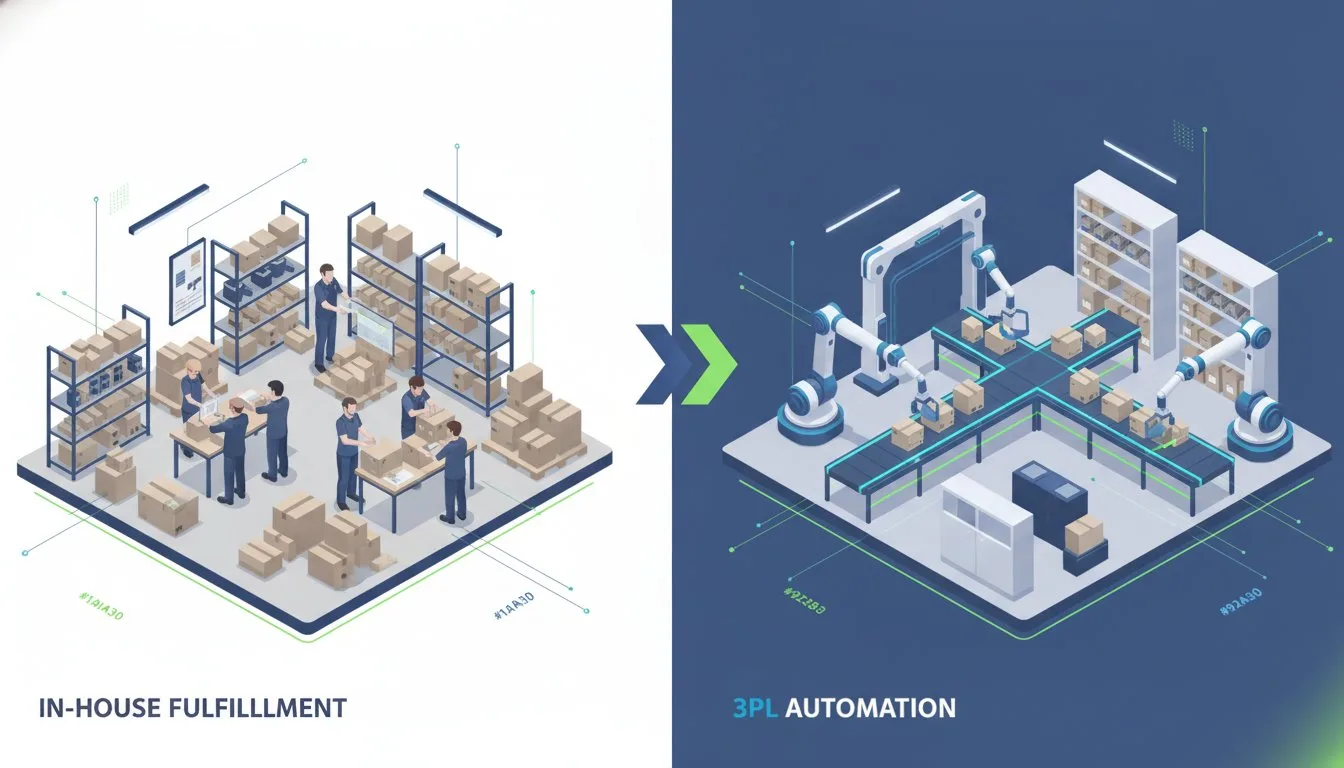
Shifting from the rigid, fixed-cost structure of a private warehouse to a variable model is a strategic pivot that transforms fulfillment from a liability into a scalable asset. When you evaluate the cost of in-house fulfillment vs 3pl, the most significant differentiator is the transition from Capital Expenditure (CapEx) to Operating Expense (OpEx). Instead of paying for a facility that is only 30% full during off-peak months, you adopt a pay-as-you-go approach. You only pay for the specific cubic footage your inventory occupies and the exact labor hours required to move your orders.

Standard 3PL fee structures are designed for transparency and predictability. Receiving fees cover the meticulous process of logging and verifying inbound stock. Storage fees are typically billed monthly, based on the volume of pallets or shelves utilized. The core of the transaction lies in the pick and pack fees, which only occur when a customer makes a purchase. This alignment of costs with revenue protects your cash flow. Additionally, established providers leverage massive aggregate shipping volumes to secure deep carrier discounts that are generally unavailable to individual brands. These savings in postage often offset a significant portion of the service fees themselves.

Specialized requirements, such as on-demand digital printing or healthcare mailing, are treated as project-based costs rather than permanent overhead. This flexibility allows you to launch new initiatives without hiring specialized staff or purchasing expensive machinery. If you are looking to optimize your current logistics spend, you can request a personalized cost analysis to see how these variable models apply to your specific SKU profile.

Pick and Pack: Efficiency at Scale

A professional fulfillment center utilizes sophisticated logic and organized workflows to minimize the distance workers travel to find items. This optimization reduces the per-unit cost of every order shipped. Beyond speed, the focus on precision is vital. High order accuracy virtually eliminates the “invisible” costs of returns, which include wasted postage, repackaging labor, and potential customer churn. Many brands find additional value by integrating kitting and assembly services directly into the standard workflow, ensuring that complex bundles are ready for shipment without delay.

Storage and Warehousing: Paying for What You Use

3PLs offer a variety of storage configurations to match your inventory needs. Pallet storage is ideal for bulk backstock, while shelf or bin storage provides quick access for high-velocity SKUs. This granular approach prevents you from paying for empty space. Furthermore, professional facilities provide secure, climate-controlled environments that protect high-value electronics or sensitive documents from damage or theft. By outsourcing, you eliminate the financial risk of long-term commercial lease commitments, allowing your brand to remain agile as market conditions shift.

The Growth Ceiling: Opportunity Costs of DIY Logistics

The “Growth Ceiling” is a silent killer of emerging brands. It happens when your marketing team hits a home run, but your operations team strikes out because they can’t keep up with the volume. When you analyze the cost of in-house fulfillment vs 3pl, you have to look at the revenue you aren’t making because you’re too busy managing tape and bubble wrap. Operational friction doesn’t just slow you down; it stops your marketing and sales efforts in their tracks. If you’re afraid to run a new ad campaign because you don’t have the hands to pack the resulting orders, you’ve hit the ceiling.

A founder’s time is their most expensive resource. Every hour spent troubleshooting a label printer or managing warehouse staff is an hour not spent on business development or strategic partnerships. To minimize these technical distractions and protect your digital assets, you can visit Trinity Networx, LLC for proactive managed IT support. This opportunity cost is rarely reflected on a spreadsheet, yet it’s the primary reason brands plateau. Beyond the human element, inefficient DIY inventory management often leads to stockouts or backorders. These aren’t just logistical hiccups. They’re lost customers who will likely switch to a competitor who can deliver immediately. Professional 3PLs use seasoned expertise to ensure your inventory levels are optimized, preventing the “out of stock” notification that kills conversion rates.

Scalability: Handling the 10x Surge

Black Friday and viral marketing moments demand a level of agility that in-house setups rarely possess. Scaling an internal warehouse requires months of lead time to secure additional square footage and vet new staff. In contrast, a 3PL partnership offers “Elastic Capacity.” This allows you to handle a 10x surge in orders overnight without the long-term burden of capital expenditure. You gain the ability to say “yes” to growth opportunities that would otherwise break your infrastructure. It’s the difference between a successful launch and a reputation-damaging backlog.

Tech and Integration Costs

Building an in-house Warehouse Management System (WMS) is a massive financial and technical undertaking. The development costs and ongoing maintenance can be staggering for a growing brand. However, modern 3PL inventory management software provides real-time control and visibility without the upfront investment. These systems integrate seamlessly with platforms like Shopify or WooCommerce, ensuring that your digital storefront and physical inventory are always in sync. You get enterprise-level tech on a startup budget, which removes the technical friction that often holds brands back from global expansion.

Cost of In-House Fulfillment vs. 3PL: The 2026 Comprehensive Cost-Benefit Analysis

Compliance, Security, and Risk: The Cost of Getting it Wrong

Managing risk is often an afterthought until a crisis occurs. When you weigh the cost of in-house fulfillment vs 3pl, you must factor in the price of a security breach or a compliance failure. In regulated sectors like healthcare, a single mailing error can trigger legal penalties that dwarf your annual shipping budget. For companies in consumer financial services, this level of scrutiny is even higher, often requiring the specialized risk management and digital transformation consulting provided by Versapien. An in-house operation often lacks the specialized oversight needed to navigate these complex legal waters. By outsourcing, you shift much of the operational liability to a partner whose entire business model is built on precision and regulatory adherence.

Returns management is another area where DIY models frequently bleed cash. Without a dedicated team to inspect, refurbish, and restock goods, returned items often sit in a corner, losing value and taking up expensive floor space. Professional 3PLs turn this cost center into a value recovery stream by processing returns with the same efficiency as outbound orders. They provide a buffer between your brand and the logistical chaos of modern commerce, ensuring that damage or theft doesn’t erode your margins. If you’re ready to secure your supply chain and reduce your exposure, request a free quote today to see how we mitigate these specific operational risks.

Specialized Fulfillment: Healthcare and Beyond

The specialized infrastructure required for healthcare mailing services is a significant financial commitment. HIPAA-compliant fulfillment is a system of physical and digital safeguards for patient data. Building this from scratch in an in-house warehouse is rarely cost-effective for brands that aren’t primarily logistics companies. Combining digital printing with fulfillment in a regulated environment ensures maximum precision. This integrated approach reduces the number of hands that touch sensitive data, which naturally lowers the risk of a breach.

Protecting High-Value Assets

Advanced security is expensive to implement and even more costly to maintain. Biometrics, 24/7 monitoring, and limited access zones are standard in professional facilities but cost-prohibitive for small-scale, in-house warehouses. Choosing secure warehousing for high-value electronics as a service is significantly cheaper than a custom build-out. Furthermore, 3PL certifications and high-tier security protocols can often lead to lower business insurance premiums. Insurance carriers recognize the reduced risk profile of a professional facility, which provides another layer of savings when calculating the cost of in-house fulfillment vs 3pl for your brand.

The Strategic Partnership: Why Silicon Valley Direct is the Logical Conclusion

Silicon Valley Direct serves as the vital bridge where high-tech efficiency meets seasoned human oversight. While previous sections have detailed the numerical cost of in-house fulfillment vs 3pl, the decision ultimately rests on the quality of the partnership you build. Since 1999, we’ve acted as a stabilizing force for brands navigating the volatile journey from startup to global enterprise. We don’t just provide warehouse space; we offer a sophisticated operational foundation that allows you to reclaim your time and focus on high-level strategy.

One of the most significant cost-saving benefits we provide is the rejection of the “automated ticket” culture. Instead of waiting days for a response from a generic support queue, you have a dedicated account manager who understands your specific SKU complexity and brand values. This direct human connection prevents small logistical hiccups from becoming expensive errors. Our “One-Stop” advantage further streamlines your budget by integrating eCommerce order fulfillment, on-demand digital printing, and kitting and assembly under a single roof. This eliminates the need to coordinate between multiple vendors, reducing both administrative overhead and transportation costs between facilities.

The Human Element of Precision

Many modern 3PLs prioritize automation to the point of neglecting the physical reality of the product. Automated-only systems often miss subtle packaging issues or inventory discrepancies that lead to “hidden” error costs. At Silicon Valley Direct, we combine digital accuracy with personal oversight. Our long-term staff retention is a unique hallmark of our stability; our team members possess the deep institutional knowledge required to maintain high order accuracy rates. This collective experience allows for custom problem-solving on complex B2B or B2C projects that would baffle a purely algorithmic provider.

Global Reach from the Heart of Innovation

Our location in the world’s premier tech hub isn’t just about geographic identity; it’s a symbol of our commitment to innovation and connectivity. By utilizing our global shipping services, you can reach international markets without the staggering overhead of establishing overseas warehouses. We handle the complexities of international logistics and returns management, giving your brand a worldwide footprint from a single, secure point of origin. This strategic advantage is essential for tech-forward brands that need to move fast and stay lean.

Choosing the right partner is about more than just comparing line items. It’s about finding a steady hand that can alleviate the stress of rapid growth. It’s time to transition from a logistics-burdened business to a growth-focused brand. Let us handle the precision of your physical operations so you can focus on the vision that started it all.

Choosing Your Path to Profitable Growth

Deciding on the cost of in-house fulfillment vs 3pl is ultimately about where you want your leadership team to focus their energy. By moving away from the rigid overhead of warehouse leases and seasonal hiring risks, you transform logistics into a variable expense that scales perfectly with your sales. This shift removes the operational ceiling that often prevents brands from fully capitalizing on viral growth or international expansion. You gain the freedom to innovate while your physical operations remain in expert hands.

Since 1999, Silicon Valley Direct has provided the physical infrastructure and human expertise needed to protect high-stakes shipments. We specialize in HIPAA-compliant fulfillment and secure warehousing for high-value electronics, ensuring that every account benefits from direct human oversight rather than an automated ticket system. Our seasoned team acts as a steady hand to stabilize your operations during rapid growth phases. Streamline your supply chain with a custom quote from Silicon Valley Direct. Your brand’s potential is limitless when your logistics are handled with precision and care.

Frequently Asked Questions

Is 3PL cheaper than in-house fulfillment for small businesses?

Yes, for most small to mid-sized businesses, a 3PL is significantly more cost-effective. Research indicates that brands with fewer than 1,500 orders per month almost always save money by outsourcing. This is because you avoid the massive upfront investment in warehouse equipment and long-term lease commitments. When you calculate the cost of in-house fulfillment vs 3pl, the ability to pay only for the space you use protects your cash flow during the early stages of growth.

What are the most common hidden costs in 3PL pricing?

Hidden costs often include account management fees, software subscription “tech” fees, and packaging material markups. Many automated 3PLs charge extra for every support ticket or phone call you make. At Silicon Valley Direct, we believe in transparency and include direct human oversight as part of our standard partnership. This prevents the “nickel and diming” that often occurs with providers who rely solely on automated interactions to manage their client relationships.

How much volume do I need to justify moving to a 3PL?

Most brands find that 1,500 orders per month is the tipping point where managing logistics in-house becomes a distraction from core business goals. While you can technically manage lower volumes yourself, the opportunity cost of your time usually outweighs the service fees. Between 1,500 and 8,000 orders, the 3PL model offers the best balance of scalability and cost-efficiency. Beyond 8,000 orders, in-house operations might seem cheaper on paper, but they carry much higher operational risks.

Can a 3PL handle custom branded packaging and kitting?

Yes, specialized 3PL providers offer bespoke kitting and assembly services tailored to your brand’s aesthetic. This allows you to maintain a premium unboxing experience without hiring a dedicated team to manage complex packaging requirements. These services are typically billed as project-based fees. This ensures that your customers receive a consistent, high-quality presentation every time they open a package, regardless of how fast your order volume is growing.

What is the average cost per order for 3PL fulfillment in 2026?

Industry data for 2026 shows that 3PL fulfillment typically costs between $3.10 and $4.80 per order, while in-house operations average between $4.50 and $6.20. These figures include the labor for picking and packing along with basic storage. While every brand’s SKU complexity is different, the “all-in” cost for a professional 3PL partnership usually remains lower because of the shared infrastructure and labor efficiencies that an individual brand cannot replicate on its own.

How does a 3PL help reduce international shipping costs?

3PLs leverage massive aggregate shipping volumes to secure carrier discounts that are 15-30% below published rates. They also have the expertise to optimize international routes, which helps you avoid unnecessary duties and long transit times. By using a provider with a global reach, you can serve international customers without the overhead of opening foreign warehouses. This allows you to test new markets with minimal financial risk and much faster delivery speeds.

What happens to my inventory if I switch from in-house to a 3PL?

The transition involves a coordinated physical transfer followed by a comprehensive digital audit. Your inventory is moved to the secure 3PL facility, where it’s counted, inspected for damage, and logged into a specialized inventory management system. This system then syncs with your eCommerce storefront to ensure real-time accuracy. It’s a methodical process that provides a “clean slate” for your inventory data, helping you eliminate the stockouts and backorders that often plague in-house setups.

Are there specific 3PL solutions for HIPAA-compliant mailing?

Yes, but only through providers who have invested in the necessary physical and digital safeguards. HIPAA-compliant fulfillment requires strict protocols to protect patient data and sensitive healthcare materials. Silicon Valley Direct has specialized in these high-stakes services for decades, providing a level of precision that generic 3PLs cannot match. When evaluating the cost of in-house fulfillment vs 3pl for regulated industries, the value of mitigating legal and financial risk is the most important factor to consider.

Contract Packaging Services California: The 2026 Strategic 3PL Guide

Contract Packaging Services California: The 2026 Strategic 3PL Guide

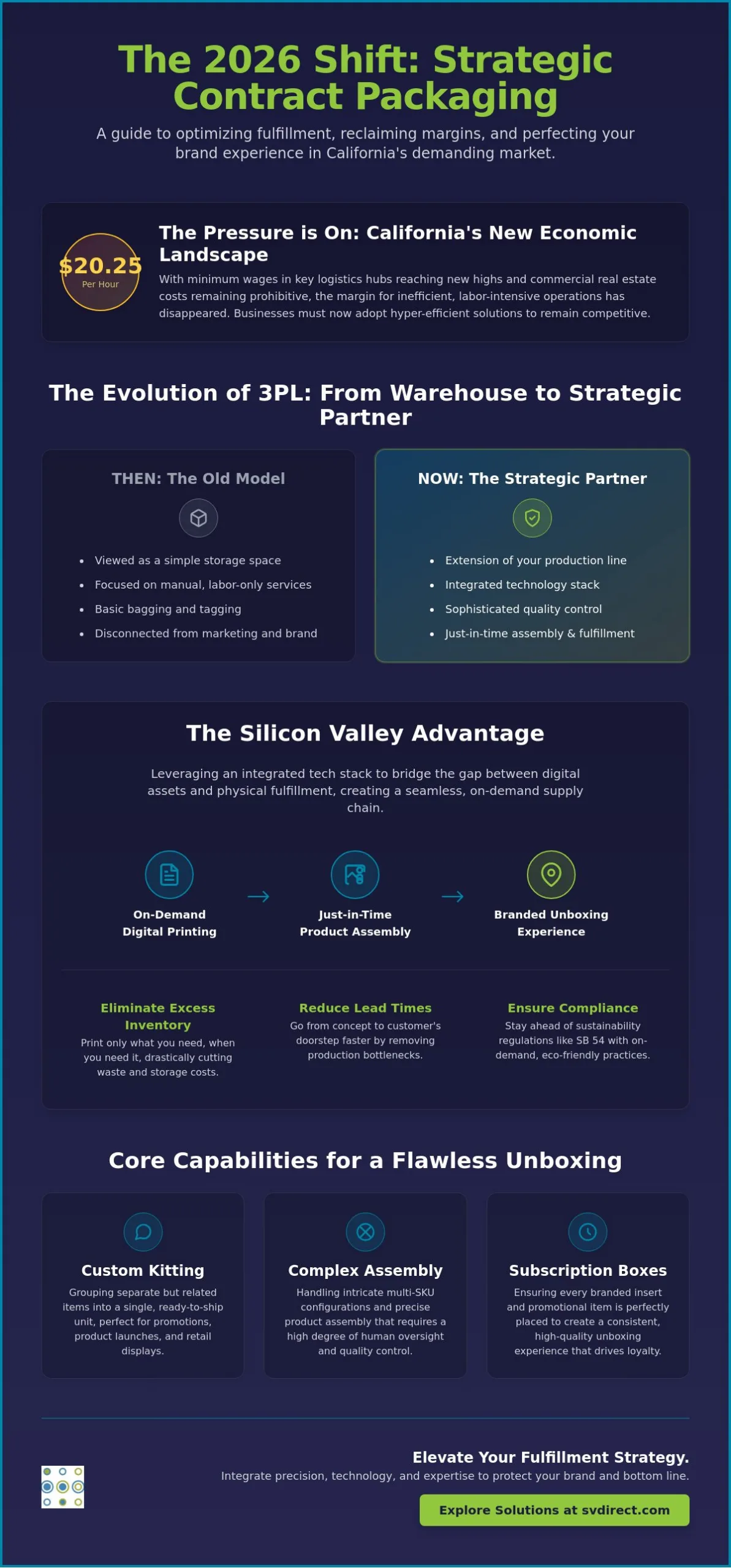
If your 3PL treats product assembly as an afterthought, you’re likely overpaying for inefficiency while your brand experience suffers. With California’s minimum wage reaching as high as $20.25 per hour in certain hubs this year, the margin for error in manual labor has vanished. Finding the right contract packaging services California offers is no longer just about finding a warehouse; it’s about finding a strategic partner. You’ve probably felt the frustration of a disconnect between your marketing vision and the actual box that arrives on a customer’s doorstep.

Our 2026 guide helps you reclaim those margins by identifying the most sophisticated solutions to bridge the gap between digital printing and physical fulfillment. We’ll show you how to leverage just-in-time assembly and integrated tech stacks to reduce lead times and ensure compliance with the new SB 54 sustainability regulations. You’ll learn to create a seamless, branded unboxing experience that builds genuine customer loyalty through a partnership grounded in precision and operational expertise. We’ve designed this guide to help you move from a state of logistical curiosity to a state of informed confidence.

Key Takeaways

  • Learn why modern contract packaging has evolved from a labor-only service into a strategic extension of your high-velocity supply chain.
  • Discover how to mitigate rising operational costs by utilizing the most efficient contract packaging services california provides for the 2026 landscape.
  • Understand the “Silicon Valley Advantage” of integrating on-demand digital printing with assembly to eliminate excess marketing inventory and reduce waste.
  • Identify the five essential criteria for selecting a 3PL partner that prioritizes human oversight and precision to protect your brand’s reputation.
  • Gain insights into streamlining complex kitting and subscription box assembly to ensure a consistent, professional unboxing experience for every customer.

Why California Businesses are Outsourcing Contract Packaging Services in 2026

Managing a product based business in California has become a high stakes game of precision. As we move through 2026, the traditional view of a warehouse as a simple storage space has dissolved. Forward thinking organizations now view their logistics partners as a strategic extension of their own production lines. This shift is driven by a need for agility that internal teams often can’t match. Choosing the right contract packaging services california offers means looking beyond the warehouse walls to find a partner that understands your brand’s DNA.

The transition from simple bagging and tagging to complex value added services is the new standard. In 2026, businesses require more than just manual labor; they need technical integration and sophisticated quality control. A professional Contract packager serves as a steady hand for brands that need to pivot quickly to meet market demands. This evolution allows companies to focus on product innovation while leaving the mechanical complexities of assembly to seasoned experts.

To better understand the operational flow of these services, watch this helpful video:

Defining Contract Packaging in the Modern 3PL Landscape

Modern packaging is categorized into three distinct layers. Primary packaging touches the product itself, secondary packaging groups those units for the shelf, and tertiary packaging prepares them for bulk transit. A high performance 3PL ensures inventory accuracy is maintained across all three levels during the assembly process. In the context of modern eCommerce, contract packaging is the specialized integration of product assembly and fulfillment logistics that allows brands to scale without the burden of physical infrastructure. You can explore more about these logistical shifts on our industry blog.

The Economic Shift Toward West Coast Outsourcing

Northern California has solidified its position as a premier hub for the high tech and healthcare sectors. Proximity to the Port of Oakland and major international airports like SFO and SJC provides unparalleled access to global trade routes. By outsourcing to a local specialist, businesses can avoid the crushing overhead of California’s commercial real estate market. With industrial rents remaining high, utilizing a partner’s existing square footage is a logical move for capital preservation. Additionally, 3PLs help brands bypass the complexities of managing California’s evolving labor regulations, such as the $20.25 per hour minimum wage seen in specific Bay Area jurisdictions this year. This proactive approach ensures that your contract packaging services california strategy remains both compliant and cost effective.

Core Capabilities: From Custom Kitting to Complex Product Assembly

The strength of your supply chain often rests on the precision of your final assembly. Within California’s transport & logistics sector, the ability to execute complex workflows determines which brands thrive. It’s no longer enough to simply ship items in a generic box. Modern contract packaging services california must act as a seamless extension of your brand, handling everything from basic bundling to the most intricate multi-SKU configurations. This process, known as kitting, involves grouping separate but related items into a single unit, ready for immediate shipment.

Subscription box assembly has become a particularly competitive arena in the eCommerce market. These shipments require a high degree of human oversight to ensure that every branded insert and promotional item is placed perfectly. This level of detail creates a high quality unboxing experience that drives customer retention. By utilizing professional Kitting and Assembly Services, you gain a core efficiency driver that manages these complexities while you focus on high level business growth. Our team acts as a steady hand, ensuring that even the most complex kits are assembled with zero defects.

Custom Kitting for eCommerce and Retail

Strategic kitting significantly reduces shipping costs by optimizing dimensional weight. When you combine multiple products into a single custom fit box, you eliminate the wasted space and extra weight of multiple packages. It’s also vital to choose between pre-kitting and on-demand kitting. Pre-kitting prepares large volumes in advance for high velocity sales, while on-demand assembly allows for maximum flexibility with inventory. If you’re looking to refine your current process, you might consult with our assembly experts to find the right balance for your SKU volume.

Specialized Assembly for High-Value Sectors

High value electronics and medical devices demand a controlled environment. Clean room assembly ensures that sensitive components remain free from contaminants during the final packaging phase. This level of care requires more than just a clean floor; it requires a culture of precision and documented quality control. Security is equally paramount during this phase to protect intellectual property and high value stock. Integrating these assembly needs with Secure Warehousing for High-Value Electronics ensures your products are protected from the moment they arrive until they reach the end user. This holistic approach is what defines the most reliable contract packaging services california provides today.

The Silicon Valley Advantage: Integrating Digital Printing with Packaging

Packaging is more than a protective shell; it’s a vital vehicle for communication. In the high velocity markets of Northern California, a product arriving without its accompanying literature is an incomplete brand promise. This is where the integration of digital capabilities becomes a primary differentiator for your business. Unlike traditional warehouses that force you to source printing from separate vendors, the most sophisticated contract packaging services california provides now offer in-house digital printing. This synergy ensures that your marketing collateral is as fresh and accurate as the product it accompanies.

Silicon Valley Direct functions as the vital link between your digital assets and physical distribution. By merging these workflows, we eliminate the friction often found when coordinating multiple suppliers. This is particularly critical for sectors like healthcare, where accuracy and compliance are non negotiable. The coordination between Healthcare Mailing Services and secure packaging ensures that sensitive documents and medical products are assembled with surgical precision. We provide a steady hand to manage these complex requirements, allowing you to scale without the stress of fragmented logistics.

On-Demand Printing: Reducing Waste and Increasing Speed

The shift from bulk printing to just-in-time (JIT) literature fulfillment has revolutionized how brands manage their physical presence. Storing thousands of outdated brochures is a drain on capital and physical space. On-demand digital printing allows you to print exactly what you need for each assembly run. This approach virtually eliminates obsolescence; it’s a major benefit for regulated industries like finance where information changes frequently. It also opens the door for hyper-personalized packaging inserts. You can tailor messages to specific customer segments, turning a standard shipment into a bespoke brand experience that resonates with the end user.

Literature Fulfillment and Global Distribution

Effectively managing marketing collateral alongside physical product inventory requires a highly organized, hierarchical system. Our facility acts as a centralized hub where your printed assets and inventory are synchronized for rapid assembly. Once these kits are complete, the focus shifts to reaching your audience wherever they are located. Utilizing integrated Global Shipping Services allows you to move products from our Northern California facility to international markets with ease. This geographic advantage, combined with our multi-decade history of operational excellence, provides the reliability needed for global expansion. We reject the impersonal, automated models of the past in favor of direct human connection and personal oversight of every shipment.

Contract Packaging Services California: The 2026 Strategic 3PL Guide

5 Critical Factors for Evaluating a California Contract Packaging Partner

Selecting a logistics partner in a state as economically complex as California requires a discerning eye. While many providers compete on price alone, the cheapest option often leads to hidden costs in the form of damaged goods or missed deadlines. When evaluating contract packaging services california, you must look for a partner that prioritizes precision over raw speed. A single assembly error can tarnish a brand’s reputation faster than any marketing campaign can build it. You need a steady hand that ensures every unit meets your exact specifications before it leaves the facility. We reject the impersonal models that prioritize volume over quality; instead, we focus on the human oversight necessary for perfect execution.

Compliance and security are equally vital, particularly for businesses in the healthcare or high-tech sectors. Verify that your partner offers secure warehousing and adheres to HIPAA standards if you handle sensitive data or medical devices. Additionally, assess their ability to scale labor during high-velocity periods like Q4 fulfillment. A partner that can’t handle seasonal spikes will eventually become a bottleneck for your growth. For a truly holistic strategy, consider how they integrate Direct Mail Marketing Services. This allows you to synchronize your physical product delivery with targeted outreach, creating a unified brand experience. If you’re ready to see how a professional team handles these variables, you can request a free quote to start the conversation.

Operational Stability and Historical Expertise

In an industry where fulfillment startups appear and vanish overnight, longevity is a primary indicator of reliability. Silicon Valley Direct was founded in 1999; this multi-decade history provides a level of operational wisdom that newer companies simply haven’t earned yet. We’ve weathered market shifts and technological revolutions by maintaining a proactive, team-oriented culture. One of the best ways to measure a partner’s quality is through staff retention. When the people on the assembly line have years of experience, the likelihood of errors drops significantly. This internal stability acts as a constant anchor of trust for our clients during their most aggressive growth phases.

Technology and Inventory Transparency

Transparency shouldn’t be a luxury. It’s a requirement for modern inventory management. You need real-time visibility into the packaging process to make informed business decisions. Our web-based portals provide immediate access to your kitting projects, allowing you to track progress at every stage. When interviewing potential partners, ask the right questions: “Can I see my assembly progress in real-time?” If the answer involves waiting for a manual update or a weekly spreadsheet, they aren’t equipped for the 2026 pace of business. We favor direct human connection backed by physical infrastructure, ensuring you’re never left in the dark about your stock levels or assembly status.

Scalable Fulfillment and Packaging Solutions with Silicon Valley Direct

Choosing a logistics provider is a commitment to a long term partnership. At Silicon Valley Direct, we provide a bespoke approach that treats your product assembly with the same care you used to design it. By integrating on-demand digital printing with precise kitting and assembly, we eliminate the traditional friction between marketing and operations. This unified workflow ensures that your brand message remains consistent from the first digital proof to the final unboxing. The most effective contract packaging services california offers are those that bridge the gap between mechanical operations and personal commitment. It’s the steady hand you need to manage the complexities of a modern supply chain without sacrificing quality or brand integrity.

Our physical infrastructure in the heart of Northern California serves as a hub for global connectivity. This facility is more than just square footage; it’s a high performance engine for the contract packaging services california companies utilize to reach international audiences. We’ve spent decades refining our processes to ensure that every shipment, whether it’s a single subscription box or a massive retail rollout, is handled with surgical precision. This geographic advantage allows us to leverage major trade routes while maintaining a proactive stance on inventory management and secure warehousing. We provide the stability needed to move from a state of logistical curiosity to a state of operational confidence.

The Human Element in a Tech-Saturated Market

In an era where most 3PLs hide behind automated ticket systems and chatbots, we prioritize direct human connection. We explicitly reject the impersonal models that treat clients like just another data point in a machine. Every kitting and assembly project at our facility receives personal oversight from seasoned experts who have been with us for years. You won’t find yourself stuck in an automated loop when you need a critical update. Instead, you have direct access to the team-oriented professionals managing your stock. This human centric approach is a powerful differentiator that ensures your specific problem-solving needs are met with enthusiasm and wisdom.

Getting Started: Your Custom Packaging Strategy

Our engagement begins with a thorough consultation to define your project scope and specific packaging requirements. We don’t believe in one-size-fits-all solutions; we build a custom strategy tailored to your SKU volume and market goals. Whether you’re a startup launching your first product or an established enterprise managing complex healthcare kits, our infrastructure scales to meet your needs. We take the time to explain the rationale behind our quality control measures, ensuring our partnership is built on transparency and mutual success. This methodical progression guides you through the transition from manufacturing to global distribution. If you’re ready to streamline your operations with a reliable partner, you can Contact Silicon Valley Direct for a Custom Packaging Quote today.

Reclaim Your Operational Focus in 2026

Navigating the logistical hurdles of the West Coast requires more than just square footage. It requires a partner that acts as a steady hand for your brand’s physical presence. By integrating on-demand digital printing with complex kitting, you can significantly reduce lead times and eliminate the burden of excess inventory. We’ve established how precision in assembly, backed by human oversight rather than impersonal automation, protects your reputation in high-stakes sectors like healthcare and electronics.

Silicon Valley Direct has been a constant anchor of trust since 1999. We specialize in healthcare and high-tech fulfillment, providing the physical infrastructure and expert staff needed to scale your operations with confidence. Our facility serves as a gateway to global trade, ensuring your products move efficiently from Northern California to international markets. If you’re ready to move from logistical stress to informed growth, Streamline Your Supply Chain with Silicon Valley Direct. Choosing the right contract packaging services california provides is the first step toward a more resilient and responsive business model. We look forward to helping you build a bespoke solution that honors your personal commitment to your customers.

Frequently Asked Questions

What is the difference between kitting and contract packaging?

Kitting is the specific process of combining multiple separate SKUs into a single, new unit ready for shipment. Contract packaging is the broader category that encompasses kitting along with secondary assembly, labeling, and specialized bagging. While kitting focuses on grouping items, contract packaging involves the entire physical preparation of the product for its final destination.

Can Silicon Valley Direct handle HIPAA-compliant medical packaging?

Do you provide custom digital printing for packaging inserts?

We do provide integrated on-demand digital printing as a core part of our contract packaging services california workflow. This allows you to create personalized inserts or updated marketing collateral just-in-time for your assembly run. By printing only what you need, you eliminate the cost of storing outdated brochures and ensure every package carries the most current brand message.

What are the typical lead times for a contract packaging project in California?

Standard kitting and assembly projects are typically completed within 3 to 5 business days once all components have arrived at our facility. More complex projects involving medical devices or high-volume electronics may require additional time for specialized quality control checks. We prioritize a methodical approach to ensure that speed never compromises the accuracy of your final product.

How does contract packaging help reduce my overall shipping costs?

Contract packaging reduces costs by optimizing dimensional weight through custom box sizing and SKU consolidation. When you utilize the contract packaging services california brands trust, you move from paying for multiple shipments to a single, efficient kit. This strategy lowers your cost per unit by reducing the number of tracking numbers and carrier fees associated with a single customer order.

Do you offer international shipping for assembled kits?

Yes, we offer comprehensive global shipping and logistics for all assembled kits and products. Our Northern California location serves as a strategic hub for reaching international markets through major air and sea ports. We manage the complex carrier coordination and documentation required to ensure your products clear customs and reach global customers without unnecessary delays.

What industries do you specialize in for contract packaging?

We primarily specialize in the high-tech, healthcare, and eCommerce sectors. These industries require a high degree of precision and secure warehousing that our team has provided since 1999. Our experience with high-value electronics and regulated medical materials makes us a reliable partner for brands that cannot afford errors in their final assembly or fulfillment.

How do you ensure quality control during the assembly process?

We ensure quality through a multi-stage verification process that relies on direct human oversight rather than just automated sensors. A seasoned expert reviews the first-article kit to confirm it matches your specifications exactly before the full run begins. We also perform random spot checks throughout the assembly process to maintain a zero-defect standard for every project we manage.

Climate Controlled Warehousing in the Bay Area: The 2026 Strategic Guide

Climate Controlled Warehousing in the Bay Area: The 2026 Strategic Guide

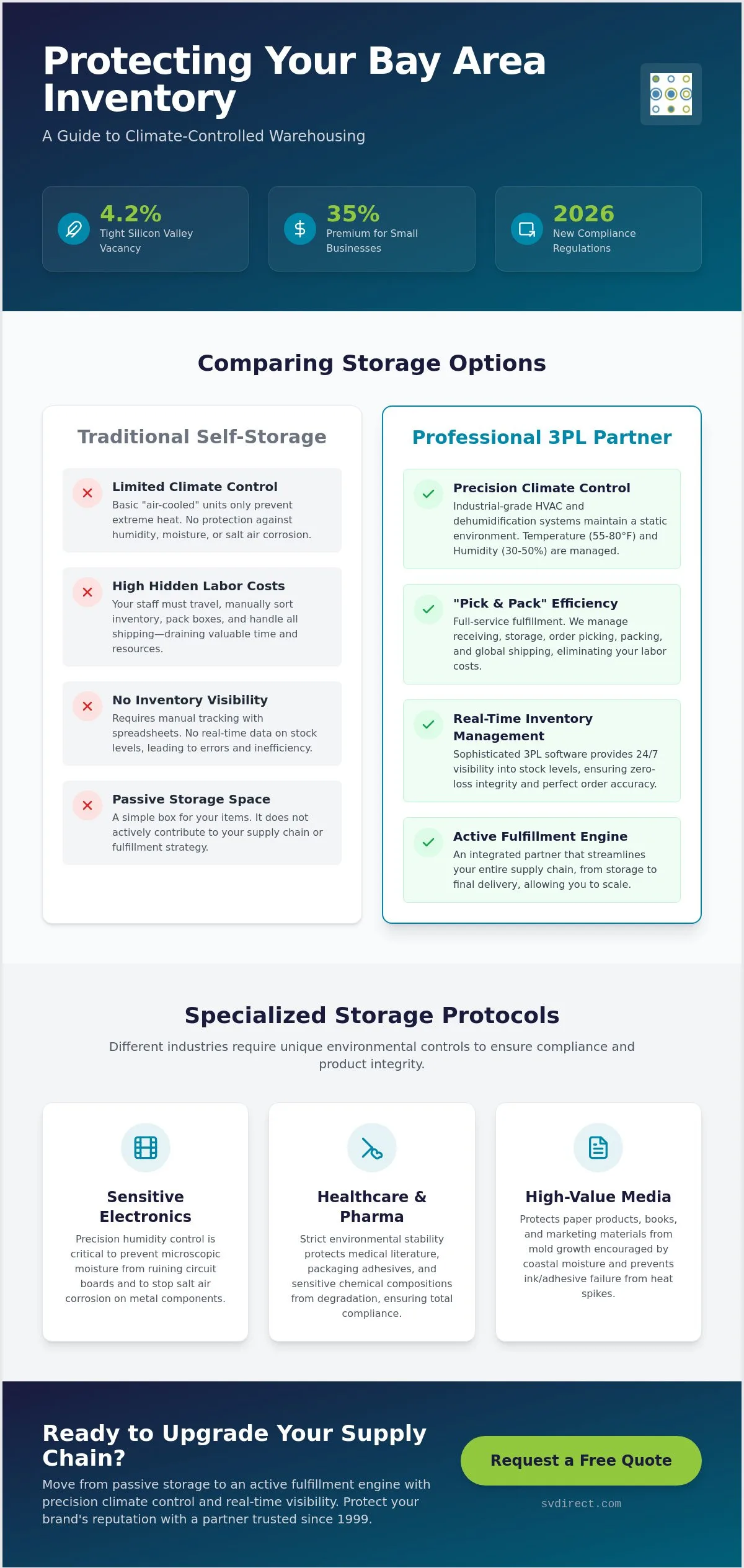
In the Bay Area, climate control isn’t a luxury; it’s the essential foundation of your brand’s reputation. You’ve likely felt the pressure of securing reliable climate controlled warehousing bay area in a market where Silicon Valley vacancy has tightened to 4.2 percent and small businesses often face a 35 percent premium. It’s stressful to worry about inventory damage from humidity or heat while trying to manage the high costs of local real estate. We believe your products deserve more than just a shelf. They require a precision-managed environment backed by human oversight.

This 2026 guide will help you protect your assets and streamline your supply chain with professional 3PL solutions. You’ll learn how to navigate the latest 2026 regulations, including Title 24 and Assembly Bill 98, while maintaining zero-loss inventory integrity. We’ll also preview how a sophisticated partnership provides real-time visibility and a seamless transition from storage to global shipping, giving you the quiet confidence to scale your business with a steady, reliable hand.

Key Takeaways

  • Understand why regulating both temperature and humidity is the only way to protect inventory from the Bay Area’s volatile microclimates and coastal moisture.
  • Discover how to evaluate a partner for climate controlled warehousing bay area by verifying their HVAC redundancy and long-term operational history.
  • Learn why the “Pick and Pack” model of a 3PL partner offers superior value and efficiency compared to the hidden costs of traditional self-storage units.
  • Identify the specialized storage protocols required for sensitive electronics and healthcare literature to ensure total compliance and precision.
  • Master the transition from simple storage to a global shipping strategy that maintains zero-loss inventory integrity and real-time visibility.

What is Climate Controlled Warehousing and Why Does the Bay Area Demand It?

Climate control isn’t just about keeping things cool; it’s a dual-layered defense system designed to stabilize your products against the region’s unpredictable weather patterns. In the context of climate controlled warehousing bay area, this means managing both temperature and humidity to stop environmental degradation before it starts. While basic storage might keep the rain off your boxes, it won’t stop the microscopic moisture that ruins circuit boards or medical literature. High-performance brands recognize that environmental stability is the primary driver of product shelf life and consumer trust.

To better understand the level of operational precision required in these environments, watch this look at specialized facility management:

Professional 3PL facilities differ significantly from standard commercial units. Most self-storage options provide “air-cooled” spaces that only prevent extreme overheating. In contrast, modern warehouse systems utilize industrial-grade HVAC and dehumidification to maintain a static environment. This level of control is essential for maintaining the integrity of high-value inventory as it moves through the supply chain, ensuring that what leaves the warehouse is in the same condition as when it arrived.

Temperature Controlled vs. Climate Controlled: The Technical Difference

Temperature controlled storage focuses on a specific thermal range, usually between 55 and 80 degrees Fahrenheit. This prevents freezing or melting, but it ignores the silent threat of water vapor. Professional climate controlled warehousing bay area goes further by integrating sophisticated dehumidification to hold humidity between 30 and 50 percent. For sensitive B2B inventory, simply being “air-cooled” isn’t enough to prevent long-term material fatigue or adhesive failure.

The Bay Area Risk Factor: Humidity and Salt Air

Our region’s geography creates a volatile environment for inventory. Coastal moisture carries salt air that accelerates corrosion on metal components and encourages mold growth in paper products. In the East Bay, facilities in Hayward or Union City must also battle significant afternoon heat spikes that can destabilize chemical compositions. The “Bay Area Humidity Trap” is defined as the process where heavy coastal fog introduces high moisture levels into a facility overnight, which then becomes trapped by rising daytime temperatures and creates a greenhouse effect that degrades sensitive materials. You can find more detailed breakdowns on logistics management at our blog.

Comparing Storage Options: Self-Storage vs. 3PL Climate Control

Many growing brands initially view self-storage as a cost-effective bridge, yet this approach often hides significant operational drains. While a retail storage unit might offer “climate control,” this usually translates to a basic air-conditioning unit that lacks the precision required for professional inventory. True climate controlled warehousing bay area involves an integrated ecosystem where temperature, humidity, and airflow are monitored by industrial-grade systems. Choosing a professional 3PL partner over a DIY unit means moving from a passive storage space to an active fulfillment engine that handles the heavy lifting of your supply chain.

The “Pick and Pack” model is the most immediate advantage of a 3PL partnership. In a self-storage scenario, your staff spends hours driving to a facility, manually sorting boxes, and making trips to the post office. A professional partner eliminates these labor costs entirely. By utilizing sophisticated 3PL inventory management software, your team gains real-time visibility into stock levels without ever stepping foot in the warehouse. This digital oversight ensures that every item is accounted for and ready for immediate dispatch. If you’re looking to modernize your logistics, you can request a free quote to see how our infrastructure fits your needs.

Operational Efficiency: Why DIY Storage Fails at Scale

Scalability is the primary wall that DIY storage hits. If your business grows from one pallet to one hundred, a self-storage facility forces you to manage multiple units across different hallways. This fragmented approach makes inventory counts nearly impossible. Professional 3PLs offer total flexibility; they allow you to expand your footprint instantly as your seasonal demand shifts. Most importantly, professional warehouses integrate directly with your eCommerce platforms like Shopify or WooCommerce, triggering automated fulfillment the moment a customer clicks “buy.”

Security and Risk Mitigation

Relying on an individual padlock in a public facility introduces unnecessary risk. Enterprise-grade warehousing utilizes multi-layered security, including 24/7 video surveillance and restricted badge access. For businesses in the medical or life sciences sectors, these facilities are designed to meet FDA cGMP regulations, which mandate strict environmental logging and hygiene standards. This level of oversight is also a cornerstone of secure warehousing for high-value electronics. When you partner with an established expert, the liability for facility maintenance and security shifts away from your shoulders, allowing you to focus on growth while we maintain a steady hand on your physical assets.

Industry-Specific Climate Requirements: Electronics, Healthcare, and Media

Every industry has a unique “breaking point” where environmental factors begin to degrade product quality. In a tech-centric market like Silicon Valley, a one-size-fits-all approach to storage creates unnecessary liability for your brand. High-performance climate controlled warehousing bay area must account for the specific chemical and physical sensitivities of the inventory, whether it’s a delicate circuit board or a batch of regulated medical literature. Precision in these environments is the difference between a successful product launch and a costly inventory write-off.

For pharmaceutical and biotech startups, the stakes are even higher. These organizations often require temporary but highly stable environments for sensitive samples or specialized devices. A professional 3PL provides a steady hand, ensuring that environmental logs remain consistent and that the physical infrastructure supports the high-tech nature of the work. This specialized care allows innovators to focus on their research while we manage the complexities of their physical supply chain.

Electronics and High-Value Tech

Silicon Valley’s hardware sector requires more than just a cool room; it needs an ESD-safe, moisture-balanced environment. Micro-corrosion on circuit boards is a silent threat that often triggers when humidity levels fluctuate beyond the 50 percent threshold. Conversely, if an environment is over-cooled and becomes too dry, the risk of static electricity increases, which can permanently damage sensitive components. Managing “Just-In-Time” inventory for hardware launches requires a partner who understands these technical margins and maintains a proactive stance on facility maintenance.

Healthcare and Compliance

In the healthcare sector, environmental stability is a regulatory requirement. Storing pharmaceutical samples or diagnostic kits requires strict adherence to temperature ranges to maintain efficacy. Our healthcare mailing services rely on this stability to ensure that medical literature and sensitive documents are preserved perfectly. Furthermore, the integration of kitting and assembly services within a climate-controlled space ensures that every component of a medical kit remains sterile and functional from the moment of assembly to the final delivery.

Media and Printed Materials

Paper is essentially a sponge, and in the Bay Area, it’s highly susceptible to the coastal moisture we discussed earlier. High humidity causes warping, also known as “cockling,” while excessive heat can lead to ink degradation or “blocking,” where pages stick together. For brands utilizing high-end marketing collateral or regulated literature, maintaining a stable environment is essential to preserving the professional appearance and readability of their materials. We treat these assets with the same precision as high-value electronics, ensuring your brand’s physical touchpoints always reflect quality.

Climate Controlled Warehousing in the Bay Area: The 2026 Strategic Guide

How to Evaluate a Bay Area Warehousing Partner

Selecting a partner for climate controlled warehousing bay area requires looking beneath the surface of simple proximity or star ratings. A facility’s ability to maintain environmental integrity is only as good as its backup systems and the expertise of its staff. You need a partner that doesn’t just store boxes but actively manages the flow of goods with a steady hand. Precision in this area is a powerful differentiator in a tech-saturated market where many providers rely on automated interactions instead of personal oversight.

Follow this structured evaluation process to ensure your inventory remains in safe hands:

  • Verify historical stability: A partner founded in 1999 has survived decades of market shifts. This longevity serves as a constant anchor of trust and stability.
  • Inspect redundancy systems: Ask about the backup protocols for HVAC and dehumidification. Your inventory shouldn’t be at risk because of a single mechanical failure.
  • Audit digital integration: Your warehouse should function as a digital extension of your business with real-time visibility.
  • Assess the human element: Look for dedicated account managers who provide direct human connection rather than automated ticketing systems.
  • Review logistics reach: Evaluate their global shipping services to ensure a seamless transition from storage to final delivery.

To get a personalized assessment of your storage and fulfillment needs, you can request a free quote from our team of experts today.

The Importance of Regional Stability

A Union City or East Bay location offers a strategic advantage for West Coast distribution. It provides efficient access to major transportation corridors while remaining close to the innovation hubs of Silicon Valley. When you partner with a firm that has deep roots in the region, you’re tapping into a wealth of collective experience. This stability is reflected in long-term staff retention, which ensures that your complex fulfillment needs are handled by experts who understand the nuances of the industry. We believe that physical infrastructure is only as effective as the human expertise backing it up.

Digital Visibility and Control

Transparency is the foundation of a successful logistics partnership. Modern web-based inventory management gives you 24/7 access to your data, allowing for precise tracking of batch numbers and expiration dates. This level of reporting accuracy is essential for maintaining a First-In-First-Out (FIFO) workflow. This level of control is what defines high-tier climate controlled warehousing bay area operations. By integrating these storage insights with direct mail marketing services, you can coordinate your physical outreach with your current stock levels for maximum impact.

Silicon Valley Direct: Precision Climate Control Since 1999

Since 1999, Silicon Valley Direct has served as a steady hand for businesses navigating the high-stakes logistics of Northern California. Our state of the art facility in Union City isn’t just a storage space; it’s a hub of high-performance efficiency designed to alleviate the stress of business growth. We’ve spent more than two decades refining our approach to climate controlled warehousing bay area, ensuring that every pallet is managed with an air of quiet confidence. Our geographic identity in the heart of the Bay Area allows us to act as a symbol of innovation and global connectivity for our partners.

A primary signature of our brand is the explicit rejection of automated interactions in favor of direct human connection. In a tech-saturated market, we believe personal oversight is a powerful differentiator. When you partner with us, you won’t get lost in an automated phone tree; you’ll work with a dedicated team where collective experience is a point of pride. This human-centric approach ensures that your inventory receives the deliberate care and precision it requires to maintain its integrity.

Integrated Logistics Excellence

Beyond Storage: Full-Service 3PL Solutions

We provide a comprehensive suite of services that goes far beyond simple shelving. Our facility integrates on-demand digital printing and kitting under one roof, which minimizes the time your materials spend in transit between vendors. This proximity is essential for protecting sensitive healthcare literature and high-value tech components from environmental shifts. We also manage complex returns and reverse logistics with the same methodical organization we apply to outbound orders. We invite you to experience our operational precision firsthand with a personal tour of our Union City facility, where you can see how our physical infrastructure and human expertise work in harmony to support your brand’s growth.

Secure Your Inventory for Future Growth

Protecting your brand’s reputation requires more than just a locked door. It demands a sophisticated environment where microclimate risks are mitigated through precision engineering. By choosing professional climate controlled warehousing bay area, you move beyond the limitations of self-storage and gain a proactive partner dedicated to inventory integrity. You’ve seen how technical stability and digital integration can transform a fragmented supply chain into a high-performance engine for growth.

Silicon Valley Direct has provided this steady hand since 1999. We pair expert human oversight on every account with integrated digital printing and global shipping to ensure your operations remain seamless. Our history of stability in a fast-paced market serves as an anchor of trust for brands that refuse to compromise on quality. It’s time to trade the stress of managing logistics for the quiet confidence of a seasoned partner.

Take the next step toward a more reliable supply chain. Request a Custom Warehousing Quote from Silicon Valley Direct today. We look forward to helping your business thrive in the heart of innovation.

Frequently Asked Questions

What is the difference between temperature-controlled and climate-controlled storage?

Temperature controlled storage only regulates heat and cold, while climate control also manages humidity levels. This distinction is vital in the Bay Area, where coastal moisture can cause mold or corrosion even if the temperature remains stable. True climate control keeps humidity between 30 and 50 percent to protect the long-term integrity of your materials.

Is climate-controlled warehousing necessary for electronics in the Bay Area?

Climate control is essential for electronics to prevent micro-corrosion on circuit boards and static electricity damage. The region’s humidity cycles can introduce moisture into sensitive components, leading to premature hardware failure. Maintaining a stable environment ensures your high-value tech remains functional from the moment it’s stored until it reaches the final customer.

How much does climate-controlled warehousing cost in Silicon Valley?

The cost of climate controlled warehousing bay area depends on your specific storage footprint and the complexity of your fulfillment needs. While market rates for industrial space fluctuate, specialized climate environments involve additional infrastructure for HVAC redundancy and monitoring. We recommend requesting a bespoke quote to understand the exact investment required for your unique inventory profile.

Can a 3PL help with both storage and eCommerce fulfillment?

A professional 3PL partner provides an integrated solution that combines long-term storage with active eCommerce fulfillment. This model allows you to transition your inventory seamlessly from a climate-controlled environment to a pick-and-pack line. It eliminates the need for multiple vendors and uses a single software integration to streamline your entire supply chain.

What industries benefit most from climate-controlled storage?

High-tech electronics, biotech, pharmaceutical, and high-end print media benefit most from these specialized environments. Any product that’s susceptible to warping, chemical changes, or corrosion requires the stability of climate controlled warehousing bay area. These industries rely on environmental precision to maintain their quality standards and ensure regulatory compliance during the distribution process.

How do I know if my inventory requires humidity control?

You can determine if your inventory needs humidity control by reviewing the manufacturer’s storage guidelines or material safety data sheets. If your products contain adhesives, metal components, or porous materials like paper, they’re likely sensitive to water vapor. Look for signs of past damage like “cockling” in paper or oxidation on metal to confirm the need for a regulated space.

Does Silicon Valley Direct offer HIPAA-compliant warehousing?

We offer secure, compliant warehousing solutions tailored for the healthcare and medical device sectors. Our facility manages sensitive medical literature and pharmaceutical samples with the strict oversight required for regulated materials. This ensures a complete chain of custody and environmental stability for your most critical healthcare assets through a steady, human-centric approach.

What is the best location for a warehouse in the San Francisco Bay Area?

Union City and Hayward are widely considered the most strategic locations for regional and global distribution. These areas offer a balance between proximity to Silicon Valley tech hubs and access to major shipping corridors like the I-880. This geographic advantage allows for efficient West Coast shipping while keeping your inventory within reach of the region’s innovation centers.

Building a Business Case for Outsourcing Fulfillment in 2026: A Strategic Guide

Building a Business Case for Outsourcing Fulfillment in 2026: A Strategic Guide

Did you know that 84% of growing brands now rely on third party partners for at least a portion of their logistics? Despite this high adoption rate, many leadership teams still view warehouse operations as a mere line item rather than a strategic lever. If you are currently facing the constraints of high cost warehouse space in regions like Silicon Valley or the seasonal stress of labor management, building a business case for outsourcing fulfillment is the most critical step you can take this year. It isn’t just about moving boxes. It is about trading fixed operational liabilities for the fluid, scalable growth that 2026 demands.

You likely recognize that your internal team is stretched thin, and even minor shipping errors are beginning to tarnish the brand reputation you worked so hard to build. We understand that transitioning your physical operations requires a massive leap of faith in a partner’s precision and personal commitment. This article promises to give you a clear, data-driven ROI framework to present to your stakeholders, ensuring you have the confidence to choose a partner that handles complex kitting and compliance with ease. We will walk through the specific cost-benefit analyses and operational milestones that turn a 3PL transition into your most valuable competitive advantage.

Key Takeaways

  • Identify the “invisible ceiling” where internal logistics begin to stall your growth and divert focus from core product innovation.
  • Navigate the transition from fixed to variable costs, ensuring you pay only for the space and labor you actually use while gaining access to massive shipping discounts.
  • Strengthen your pitch for building a business case for outsourcing fulfillment by focusing on data-driven KPIs like Cost Per Order and real-time inventory accuracy.
  • Elevate your customer experience through specialized kitting and on-demand digital printing that scales without increasing your physical footprint.
  • Reclaim your time and peace of mind by partnering with a steady, human-led operational team that values precision over impersonal automation.

The Invisible Ceiling: Why In-House Fulfillment Stalls Growth

Growth is a double-edged sword for many marketing-led brands. When order volumes surge, you often find your team has accidentally become a logistics company. This shift creates significant operational friction. Instead of refining your next product launch, your senior staff is managing shipping labels and carrier delays. This is the “invisible ceiling,” a point where internal logistics stop supporting your business and start actively stalling its progress. When building a business case for outsourcing fulfillment, it’s vital to recognize that your current system might be the primary bottleneck to your next stage of revenue.

In-house systems often lack the sophisticated tech-stack required for 2026. Without real-time inventory visibility across every channel, you’re essentially flying blind. This leads to the “labor trap,” where you’re forced to spend precious resources hiring, training, and retaining warehouse staff in a competitive market. In high-rent districts like Silicon Valley, these hidden costs escalate quickly. Transitioning to a professional Fulfillment house allows you to reclaim that lost efficiency and focus on what you do best.

To better understand how these hidden costs impact your bottom line, watch this helpful video:

The Opportunity Cost of Picking and Packing

Founder-led fulfillment is a common badge of honor, but it’s a costly one. Every hour an executive spends in the warehouse is an hour lost to high-level sales strategy or product innovation. You can calculate this opportunity cost by comparing the hourly value of your leadership team against the cost of a scalable partner. Beyond the numbers, the burnout factor is real. Managing a physical supply chain internally is a 24/7 mental load that drains the creative energy needed to stay competitive. Building a business case for outsourcing fulfillment means prioritizing your team’s mental bandwidth as much as your budget.

Real Estate and Infrastructure Liabilities

Commercial real estate in innovation hubs is a massive liability. Signing a long-term lease in a volatile economic climate ties your hands. If your sales dip, you’re still paying for empty square footage. If you grow, you’re suddenly out of space and facing a costly move. Beyond the rent, the capital expenditure for racking, forklifts, and security systems is substantial. These are fixed costs that don’t scale. A partnership transforms these liabilities into variable expenses, ensuring you only pay for the space you actually use. You can find more strategy guides on our blog to help you navigate these infrastructure decisions.

The Financial Case: Fixed Costs vs. Variable Growth

The core of building a business case for outsourcing fulfillment lies in the fundamental shift from fixed operational liabilities to variable growth assets. Traditional in-house warehousing requires you to pay for the maximum capacity you might need, regardless of your current volume. In contrast, a 3PL partnership operates on a pay-as-you-go model. You only pay for the specific pallet positions and labor hours consumed. This aligns your costs directly with your revenue, protecting your margins during seasonal dips while providing an unlimited ceiling during peak periods.

This transition reflects the broader economic logic of outsourcing, where specialized providers achieve economies of scale that individual brands can’t match. By moving from a Capital Expenditure (CapEx) model, where you invest in forklifts, racking, and security, to an Operational Expenditure (OpEx) model, you free up cash flow for product development and marketing. You also eliminate the heavy overhead of utilities, warehouse insurance, and the complex HR management required for a manual labor force.

Warehousing and Storage Efficiency

Managing your own space is often a game of “too much or too little.” In a shared 3PL facility, your footprint expands and contracts based on real-time needs. Our monthly warehousing and storage fees are designed to scale with your inventory levels, ensuring you aren’t paying for empty air. This efficiency extends to specialized needs as well. You gain access to high-tier infrastructure, including climate-controlled zones for sensitive products, without the massive upfront investment in HVAC and insulation upgrades. If you’re looking for a clear picture of how these efficiencies impact your specific SKU count, you can request a custom analysis of your current logistics spend.

Shipping and Postage Optimization

The “Volume Advantage” is perhaps the most immediate financial win. Because a 3PL aggregates the shipping volume of hundreds of clients, they secure deep carrier discounts that are typically 15% to 30% lower than published rates. These savings often completely offset the associated postage and shipping management fees. Beyond the postage itself, professional management eliminates the administrative burden of tracking, claims, and international compliance. Industry reports suggest that professional shipping management can reduce internal administrative labor by 30% or more by automating tracking and claims. This allows your team to stop chasing lost packages and start chasing new market opportunities.

Strategic Advantages: Beyond the Balance Sheet

Building a business case for outsourcing fulfillment requires looking past the immediate postage savings to the long-term strategic benefits that define market leaders. While the financial shift from fixed to variable costs is compelling, the real power of a 3PL partnership lies in its ability to execute complex, brand-building operations that would overwhelm an in-house team. This isn’t just about shipping boxes; it’s about creating a seamless extension of your brand that can pivot instantly to meet new market demands. By integrating specialized logistics, you transform your supply chain from a back-office necessity into a front-line competitive advantage.

Risk mitigation is another often overlooked pillar of the strategic case. Professional returns management and human-verified inventory accuracy prevent the “death by a thousand cuts” caused by shipping errors and poor reverse logistics. When you trade an ad-hoc internal system for a seasoned operational team, you’re buying more than just labor. You’re buying the stability of a multi-decade history and the precision that comes with long-term staff retention and dedicated oversight.

Specialized Kitting and Customization

Your unboxing experience is the only marketing channel with a 100% open rate. Utilizing professional kitting and assembly services ensures that every promotional bundle or subscription box arrives with the precision of a high-end boutique. This high-touch process maintains brand standards during rapid promotional kit deployment, preventing the sloppy packing often seen when internal teams are rushed. Integrating on-demand digital printing with your logistics creates a “just-in-time” model for literature fulfillment. Instead of stockpiling thousands of brochures that might become obsolete, you print only what’s needed for current orders. This significantly reduces inventory waste and keeps your marketing message current.

Compliance and Security in High-Stakes Industries

For brands in the medical or financial sectors, the stakes are significantly higher than standard retail. Building a business case for outsourcing fulfillment must account for the immense cost of a data breach or regulatory failure. Specialized healthcare mailing services provide the HIPAA compliance and data security protocols necessary to protect both your reputation and your customers. Similarly, companies dealing with sensitive hardware benefit from secure warehousing for high-value electronics. In these environments, physical security and strict inventory controls are non-negotiable. The cost of a single compliance breach can far exceed the investment in a professional 3PL partner that offers personal oversight and bespoke security solutions.

Building a Business Case for Outsourcing Fulfillment in 2026: A Strategic Guide

Building the Pitch: KPIs and Addressing Stakeholder Objections

Successfully presenting your leadership team with a plan for building a business case for outsourcing fulfillment requires moving from abstract benefits to concrete performance metrics. Executives need to see how this shift impacts the three pillars of operational health: Cost Per Order (CPO), Order Accuracy Rate, and Shipping Time. By quantifying these metrics, you transform a logistics conversation into a high-level financial strategy. It isn’t just about moving inventory. It’s about optimizing the entire lifecycle of a customer’s interaction with your brand.

One of the most common hurdles in this process is the “Loss of Control” objection. Stakeholders often fear that moving products out of their own building means losing sight of their business. In reality, a modern, web-based inventory management system provides more control, not less. You gain 24/7 visibility into stock levels, order statuses, and return processing that manual in-house spreadsheets simply cannot match. When combined with our emphasis on human oversight and direct communication, this technology ensures you’re always informed and never disconnected from your operations.

To see how these metrics apply to your specific volume and SKU complexity, you can request a custom ROI analysis from our team of experts.

The Data That Wins Approval

Focus your pitch on “Order Cycle Time,” which is the critical window from the customer’s click to the package landing on their doorstep. Improving this metric directly correlates with higher customer lifetime value and repeat purchase rates. Additionally, use the “Inventory Turnover Ratio” to show how professional management improves cash flow by reducing stagnant stock. Industry data suggests that real-time inventory tracking can reduce stockouts by up to 25%, protecting your revenue from avoidable data lags. These numbers prove that a 3PL partnership is a tool for capital efficiency.

Navigating the Internal Transition

Frame the transition as a move toward a “strategic partner” rather than just another “vendor.” This distinction is vital for internal buy-in. It signals that you’re gaining a team of experts dedicated to your success. Address warehouse staff concerns by highlighting how this shift allows the company to focus on innovation and high-level strategy rather than manual labor. We recommend a 30-60-90 day roadmap to guide stakeholders through the migration. This methodical approach ensures a steady, organized transition that prioritizes operational continuity and honors the human element of your business at every step.

Silicon Valley Direct: The Strategic Partner for Your Business Case

Choosing the right partner is the final, most critical hurdle in building a business case for outsourcing fulfillment. You need a team that matches your brand’s ambition with operational maturity and a history of reliable performance. Silicon Valley Direct offers a foundation of stability built over decades of direct industry experience. We understand that in a tech-saturated market, the most valuable differentiator is personal oversight. While many competitors lean solely on impersonal algorithms, we prioritize the human element to ensure your high-touch fulfillment needs are met with absolute precision.

Our location in the heart of the world’s innovation hub isn’t just a geographic detail. It provides your brand with unparalleled global connectivity and a deep understanding of the tech sector’s specific requirements. We act as a bespoke problem-solver for companies that require more than just a standard shipping service. Whether you’re managing complex kitting, sensitive healthcare materials, or high-value hardware, our facility is designed to function as a seamless, high-performance extension of your own operation.

A Legacy of Precision and Reliability

Since 1999, we’ve provided a steady hand for brands navigating the complexities of rapid growth. This multi-decade history serves as a constant anchor of trust for our clients. Our expertise spans across literature fulfillment and eCommerce, allowing us to support the diverse needs of both agile startups and established enterprises. One of our unique hallmarks is our long-term staff retention. This internal stability means the people handling your inventory are seasoned experts who take pride in their collective experience. When you partner with us, you’re gaining a dedicated team that values transparency and respects your time.

Next Steps: Your Custom Fulfillment Strategy

Moving from a strategic plan to active execution requires a partner that can handle the heavy lifting of integration. Our onboarding process is methodical and highly organized, mirroring the efficiency of our physical operations. We work closely with your team to integrate our systems with your existing eCommerce platforms, ensuring a smooth transition of both data and physical stock. We don’t believe in impersonal, one-size-fits-all models. Instead, we invite you to collaborate on a bespoke strategy that reflects your unique brand standards and long-term growth targets. Contact Silicon Valley Direct for a comprehensive fulfillment evaluation to receive a tailored quote that addresses your specific compliance and kitting needs.

Transform Your Logistics into a Scalable Growth Engine

Transitioning from an internal warehouse to a strategic 3PL partnership is the most effective way to reclaim your time and protect your margins. By converting fixed real estate and labor liabilities into variable growth assets, you ensure your business remains agile in a volatile market. You’ve seen how specialized services like bespoke kitting and on-demand printing can elevate your brand; professional healthcare compliance secures your high-stakes operations. These aren’t just operational tweaks. They’re the foundation of a resilient, marketing-led organization.

Success in 2026 requires more than just automated shipping. It demands a partner with deep roots and a human touch. Silicon Valley Direct has been operational since 1999, providing the stability and tech-sector expertise your brand needs to thrive. We specialize in high-value goods and complex regulatory requirements, ensuring that building a business case for outsourcing fulfillment leads to measurable ROI. It’s time to stop managing boxes and start scaling your vision. Build your scalable future with Silicon Valley Direct: Request a Quote Today. We’re ready to help you take the next step with confidence and precision.

Frequently Asked Questions

Is it cheaper to outsource fulfillment or do it in-house?

Outsourcing is generally more cost effective for brands scaling beyond 100 orders per month. It replaces expensive fixed overhead like warehouse leases and salaried labor with a variable pay-per-order model. This transition is a core pillar of building a business case for outsourcing fulfillment because it protects your margins during slow months. You gain access to industrial infrastructure without the capital expenditure of owning it yourself.

What is the typical ROI when switching to a 3PL provider?

The return on investment typically stems from two primary areas: shipping savings and reclaimed leadership time. Most brands see carrier rate reductions of 15% to 30% by leveraging a partner’s aggregated volume. Additionally, the ROI includes the reduction in shipping errors and stockouts. When you quantify the value of executive time redirected toward sales and product development, the financial impact becomes even more significant. To further capitalize on this newfound efficiency, NexusGrid provides SaaS tools and consulting designed to help small businesses increase their overall productivity and ROI.

How do I maintain quality control when outsourcing my fulfillment?

You maintain quality control through a combination of digital transparency and direct human partnership. Real-time inventory management systems allow you to monitor stock levels and order statuses from any device. We reject the purely automated approach favored by many providers. Instead, we provide personal oversight and a dedicated team that treats your brand standards with the same care as your internal staff would.

Can a 3PL handle specialized needs like HIPAA compliant mailing?

Yes, specialized providers can handle complex regulatory requirements like HIPAA compliant mailing. This is a critical component for brands in the medical and financial sectors. We offer healthcare mailing services that prioritize data security and physical precision. Using a partner that understands these high-stakes compliance needs reduces your liability and ensures that sensitive documents or products are handled according to strict legal standards.

How long does it take to transition from in-house to a 3PL?

A successful transition typically follows a 30 to 90 day roadmap to ensure operational continuity. This methodical progression starts with system integration and SKU mapping before moving to physical inventory transfer. By following a structured migration plan, you minimize the risk of shipping delays. This timeline allows for thorough testing of the data sync between your eCommerce platform and our warehouse management system.

What are the hidden costs of in-house fulfillment I should include in my business case?

Your business case should include often-overlooked expenses like warehouse insurance, utilities, and HR management for seasonal staff. Packing errors and the cost of reverse logistics also drain your bottom line. Don’t forget the opportunity cost of founder-led fulfillment. Every hour spent packing boxes is an hour not spent on revenue-generating activities like marketing or high-level sales strategy.

How does a 3PL handle international shipping and global logistics?

3PLs streamline global logistics by utilizing established international carrier networks and customs expertise. This reduces the complexity of cross-border shipping and often lowers costs through zone skipping strategies. We handle the documentation and compliance requirements that often baffle in-house teams. This global reach allows your brand to expand into new markets without the need for physical infrastructure in every region.

Will my customers know that I am using a third-party fulfillment center?

No, your customers will experience a seamless extension of your brand. We use your custom packaging, branded packing slips, and specialized kitting to ensure the unboxing experience remains authentic. Our on-demand digital printing allows for personalized inserts that make every shipment feel like it came directly from your office. The only difference they don’t notice is the facility location; they only see improved accuracy and faster delivery.

Best 3PL for Small Business in 2026: A Strategic Guide to Scaling with Precision

Best 3PL for Small Business in 2026: A Strategic Guide to Scaling with Precision

The most expensive mistake a growing brand can make in 2026 isn’t choosing the wrong software; it’s choosing a fulfillment partner that treats your inventory like a set of anonymous data points. You’ve likely felt the sting of a “no-reply” support ticket while your margins evaporate under hidden surcharges and unaddressed inventory discrepancies. It is exhausting to feel like your brand identity is being lost in a sea of automated machinery. Finding the best 3PL for small business requires looking past the glossy tech demos to find a partner that balances high-tech efficiency with the direct human oversight your specific products deserve.

We understand that you need more than just a warehouse. You need a steady hand to help you scale without losing control. This guide will show you how to identify a partner that offers transparent billing and seamless software integration, ensuring your transition into multi-channel selling is profitable rather than chaotic. We will explore the critical shifts in the 2026 logistics landscape, including the impact of Section 122 surcharges and the rise of smart returns, to help you build a supply chain that feels like a natural extension of your own team.

Key Takeaways

  • Learn why the modern fulfillment landscape requires a service-first partner that acts as a strategic extension of your brand rather than just a storage facility.
  • Identify the best 3pl for small business by applying a three-pillar evaluation framework that prioritizes seamless API integrations, real-time data, and personal oversight.
  • Discover how to navigate the “Small Volume Trap” by analyzing total cost of ownership, including the impact of per-order fees and fluctuating storage costs on your margins.
  • Explore how specialized services like kitting, assembly, and on-demand digital printing can transform your packaging into a premium customer experience that drives brand loyalty.
  • Understand the competitive advantage of choosing a partner that rejects automated support in favor of direct human connection and operational transparency.

Beyond the Warehouse: What Truly Defines the Best 3PL for Small Business?

In 2026, the definition of Third-party logistics (3PL) has evolved far beyond the simple act of storing boxes in a rack. For an emerging brand, the best 3pl for small business isn’t merely a vendor; it’s a strategic partner that integrates directly into your growth plan. While traditional providers focus on the mechanical movement of goods, a modern partner prioritizes the data and human oversight required to maintain your brand’s integrity during rapid expansion. This shift is critical because your fulfillment partner is often the only physical touchpoint your customer has with your business.

To help you visualize the current landscape of providers and how they serve different needs, watch this helpful breakdown:

Many logistics companies operate on a “volume-first” model. They prioritize massive enterprise accounts while relegating smaller brands to automated support queues and rigid, impersonal workflows. This approach often leads to the “small volume trap” where your margins are eroded by hidden fees designed for scale you haven’t reached yet. In contrast, a service-first provider treats your inventory with the same precision they would their own. This distinction is vital because a single shipping error can cause significant churn among modern e-commerce customers who expect perfection.

The Shift from Transactional to Transformational Logistics

Small businesses can’t afford the silence of faceless fulfillment. When a delay occurs, you need a partner who contacts you before the customer even notices a problem. Proactive communication turns a potential logistics hurdle into a demonstration of brand reliability. A true 3PL partnership is a calculated balance of robust physical infrastructure and digital precision. By moving away from transactional relationships, you gain a dedicated team that anticipates obstacles rather than just reacting to them.

Why Location and Heritage Matter in 2026

Innovation isn’t just about software; it’s about the culture of the facility handling your products. Operating from a global innovation hub provides a unique perspective on efficiency and global connectivity. While many VC-backed logistics startups have struggled with stability in recent years, a multi-decade history dating back to 1999 offers a level of operational maturity that newer entrants simply lack. You can learn more about how Logistics Companies in Silicon Valley: Why Location Matters when selecting your long-term growth partner. This heritage ensures your business is backed by a steady hand that has navigated every market shift of the digital age, providing the best 3pl for small business experience through seasoned expertise.

The 3PL Evaluation Framework: Technology, Scalability, and Personal Oversight

Selecting the best 3pl for small business involves more than just comparing per-pick costs. You need a structured evaluation framework that balances digital capabilities with physical reliability. To avoid common 3PL problems such as inventory drift or unresponsive support, your search should focus on three foundational pillars:

  • Technology: High-performance software that integrates with your existing sales channels.
  • Scalability: The infrastructure to handle “Black Friday” surges without a decline in accuracy.
  • Personal Oversight: A direct line to the human experts managing your physical inventory.

When these three elements align, your fulfillment provider stops being a cost center and starts being a competitive advantage. This reliability is a hallmark of the best 3pl for small business partners, ensuring that your brand’s reputation remains intact even as order volumes fluctuate.

Technical Integration without the Headache

Modern logistics relies on seamless data exchange. For a small business owner, real-time control means seeing exactly what’s on the shelf at any moment, regardless of where your team is located. Sophisticated 3PL Inventory Management Software should integrate directly with platforms like Shopify and WooCommerce, providing a single source of truth for your multi-channel operations. This visibility is essential in 2026, as 86% of brands now sell on two or more channels. Without this digital precision, you’re essentially flying blind, risking overselling and customer churn.

The Human Element: Why Automation Isn’t Enough

There’s a growing “Automation Paradox” in the industry. While robots can increase speed for standard items, they often lack the flexibility required for custom branding or complex kitting. If every interaction is filtered through an automated ticket system, you lose the ability to solve nuanced problems quickly. Direct human connection remains the gold standard for reducing “Return to Sender” rates and ensuring high-quality assembly.

Staff retention within the warehouse is a hidden metric of success. When the same team handles your products for years, they develop an intuitive understanding of your brand’s standards. This consistency is something a fully automated facility simply cannot replicate. If you’re ready to see how a high-touch approach can stabilize your growth, you can consult with a logistics expert to discuss your specific needs.

Avoiding the “Small Volume Trap”: Navigating Fees and Hidden Logistics Costs

The transition from self-fulfillment to a professional partner is a pivotal moment for any growing brand. However, many founders fall into the “Small Volume Trap” by choosing a provider based solely on the lowest advertised per-pick rate. For the best 3pl for small business, the real value lies in the total cost of ownership rather than a single line item. Low-volume accounts are often susceptible to fee structures that look attractive on paper but become punitive as your inventory turnover fluctuates.

Warehousing and storage fees are frequently the most misunderstood aspect of logistics pricing. These costs aren’t static; they are deeply tied to how quickly your products move. If your inventory sits on a shelf for months, the cumulative storage cost can quickly exceed the profit margin of the item itself. A strategic partner helps you monitor these levels, ensuring you aren’t overpaying for “dead” space. Beyond storage, you must account for postage and shipping management fees. A high-performance 3PL leverages its collective volume to secure carrier discounts, often ranging from 15% to 30% below published rates, which directly offsets your operational overhead.

Hidden surcharges are another common hurdle in large-scale 3PL contracts. These can include monthly technology fees for accessing a warehouse management system, charges for every support ticket submitted, or steep integration fees for connecting new sales channels. These “nickel and dime” tactics have a measurable impact on business performance, as they drain the capital you need for marketing and product development. Finding the best 3pl for small business means finding a partner that prioritizes transparency over complex surcharge schedules.

Calculating the Real Cost of Fulfillment

Comparing quotes side-by-side requires a methodical approach. A “cheap” pick and pack fee is often a red flag for poor insurance coverage or slower processing times that lead to customer dissatisfaction. When evaluating a potential partner, use this checklist to ensure you’re seeing the full picture:

  • Are there monthly order minimums or penalties for low-volume months?
  • Does the quote include account management and direct human support?
  • What are the specific costs for returns processing and kitting?

To dive deeper into these variables, review our guide on Order Fulfillment Costs: Understanding the Pick and Pack. This resource provides the clarity needed to avoid overpaying for basic services.

The Value of Transparent Billing

Predatory pricing models often hide behind rigid fee tiers that don’t account for the unique needs of a startup. You need a partner that offers bespoke problem-solving rather than forcing you into a one-size-fits-all billing structure. Transparency in billing is the foundation of trust for a growing startup. It allows you to forecast your expenses with confidence and ensures that your fulfillment partner is truly invested in your long-term success rather than just their own short-term margins.

Best 3PL for Small Business in 2026: A Strategic Guide to Scaling with Precision

Strategic Growth: Leveraging Kitting, Digital Printing, and Specialized Fulfillment

Scaling a brand requires moving beyond basic pick-and-pack operations. The best 3pl for small business acts as a creative extension of your team, offering specialized services that bridge the gap between logistics and marketing. By leveraging kitting and assembly, you can transform a standard shipment into a premium experience that fosters long-term customer loyalty. This is particularly vital for subscription box models where the unboxing moment is the primary product interaction.

Creating a Branded Unboxing Experience

Custom kitting allows you to bundle diverse SKUs into a single package, reducing shipping costs while increasing the perceived value for the consumer. When combined with on-demand digital printing, you can include personalized inserts or seasonal marketing materials without the risk of over-ordering physical assets. This “Just-in-Time” approach minimizes inventory waste and ensures your messaging is always current. For a deeper look at these operational efficiencies, explore our Kitting and Assembly Services: The Strategic Guide. These value-added touches turn a routine delivery into a marketing event that encourages social sharing and repeat purchases.

Compliance and Security: Beyond Basic Shipping

For startups in highly regulated sectors like healthcare or finance, standard fulfillment isn’t enough. You need a partner that understands the nuances of HIPAA compliance and secure data handling. Healthcare mailing services require a level of precision that automated, high-volume warehouses often overlook. Choosing a provider with a multi-decade history in literature fulfillment ensures that your physical brand assets are handled with the same care as your digital ones. You can find more details in our Healthcare Mailing Services: The Complete Guide. Secure warehousing and meticulous record-keeping are non-negotiable when dealing with sensitive information or high-value goods.

Even in a digital-first world, physical assets like catalogs, brochures, and educational materials remain powerful tools for conversion. A sophisticated fulfillment strategy integrates these items seamlessly into your shipping workflow. This holistic approach to logistics is what separates a mere vendor from the best 3pl for small business partner. If you’re ready to elevate your brand’s physical presence and operational security, consult with a logistics expert to design a bespoke fulfillment strategy today.

Silicon Valley Direct: Your High-Touch Fulfillment Partner in the Heart of Innovation

Silicon Valley Direct represents the intersection of seasoned operational history and cutting-edge logistics technology. We position ourselves as the best 3pl for small business because we recognize that your brand requires more than just a storage unit. We provide high-performance eCommerce order fulfillment and global shipping and logistics, but we do so with a commitment to rejecting automated interactions. When you have a question about your inventory management or a complex kitting and assembly project, you speak directly to the experts handling your goods, not a chatbot. This human-centric approach ensures that the strategic growth levers discussed earlier, from custom branding to transparent billing, are executed with absolute precision.

A Partnership Built on Stability and Tech

Stability is a rare commodity in the modern logistics sector. Since our founding in 1999, we’ve remained a steady hand in the industry, unswayed by the volatile funding cycles that often disrupt VC-backed startups. Our Union City, CA facility serves as a vital hub for global logistics coordination, placing your inventory in the heart of one of the world’s most innovative regions. This location provides a strategic advantage for brands looking to scale their reach while maintaining tight control over their supply chain. Our greatest asset, however, is our long-term staff. Their collective experience ensures that your returns management and healthcare mailing services are handled with a level of care that only comes from years of dedicated service. When your fulfillment team doesn’t turn over every six months, your error rates drop and your brand consistency rises.

Ready to Scale Your Small Business?

Transitioning from in-house fulfillment to a professional partner is a significant milestone that requires a partner you can trust. Whether you need specialized literature fulfillment or on-demand digital printing for your next marketing campaign, we offer the flexibility to grow alongside you. We help businesses of all sizes reach customers worldwide by providing a bespoke approach to every challenge. Our infrastructure is designed to handle the complexities of 2026 logistics, from navigating new customs regulations to managing multi-channel spikes, all while keeping your brand identity front and center. We invite you to discover the difference that personal oversight and professional precision can make for your bottom line.

Contact Silicon Valley Direct for a Custom Fulfillment Quote and let us provide the steady hand your business needs to reach the next level.

Secure Your Brand’s Future with Strategic Fulfillment

Finding the best 3pl for small business is a journey that starts with looking beyond the warehouse walls. Success in 2026 requires a partner that offers more than just shelf space; you need a strategic extension of your team that balances high-tech efficiency with direct human oversight. By applying a rigorous evaluation framework and staying vigilant against hidden fee structures, you can ensure your logistics operations support your growth rather than hindering it.

Silicon Valley Direct has served as a steady hand for growing brands since 1999. We offer specialized expertise, including healthcare mailing services with full HIPAA compliance and seamless on-demand digital printing integration to elevate your brand assets. This blend of stability and innovation is designed to help you scale with absolute precision. Your business deserves a partner that treats your products with the same care you do. It’s time to move past automated support and embrace a fulfillment strategy built on transparency and expertise. Streamline your supply chain with Silicon Valley Direct to begin your next chapter of growth with confidence.

Frequently Asked Questions

What is the best 3PL for a small business with low order volume?

The best 3pl for small business with low volume is a partner that offers transparent pricing without high monthly order minimums. You need a provider that treats your inventory with the same precision as an enterprise account. This prevents the “small volume trap” where hidden surcharges for account management or technology access erode your margins before you have the chance to scale.

How do I know if my small business is ready to outsource to a 3PL?

You’re ready to outsource when fulfillment tasks begin to prevent you from focusing on core growth activities like product development or marketing. Finding the best 3pl for small business often coincides with the moment your team spends several hours a day packing boxes instead of engaging with customers. Outsourcing provides the infrastructure needed to handle sudden spikes in demand without a decline in service quality.

Can a 3PL handle custom packaging and branded unboxing for my startup?

Yes, service-oriented 3PLs specialize in kitting and assembly to ensure your brand identity remains intact. They can manage everything from custom tissue paper and branded stickers to the precise placement of personalized inserts. Unlike massive automated facilities, a high-touch partner uses human oversight to maintain the specific unboxing experience your customers expect during every shipment.

What are the most common hidden fees in 3PL fulfillment contracts?

Common hidden costs include monthly technology fees, account management surcharges, and fees for every support ticket you submit. You may also encounter unexpected charges for inventory receiving or integration fees for each sales channel you connect. Choosing a partner that prioritizes transparent billing helps you forecast your operational costs with confidence and avoids budget surprises that drain your capital.

Is it better for a small business to use a local 3PL or a national provider?

A provider located in a strategic innovation hub often offers better global connectivity than a purely local warehouse. While a local facility might seem convenient, a partner near major shipping ports and international airports can secure deeper carrier discounts and faster transit times. This geographic advantage is essential for brands that plan to ship to new countries or scale their reach in 2026.

How does a 3PL integrate with my Shopify or WooCommerce store?

A 3PL integrates via a secure API that connects your store’s backend directly to their warehouse management system. This allows for real-time visibility into inventory levels and order status across all your sales channels. Once the connection is established, orders flow automatically to the warehouse team. This process significantly reduces manual data entry and minimizes the risk of shipping errors.

What is kitting and how can it help my small business scale?

Kitting is the pre-assembly of individual items into a single SKU, such as a subscription box or a promotional bundle. This process improves fulfillment efficiency by reducing the number of picks required per order. For a growing brand, kitting allows you to offer complex product combinations that increase average order value while maintaining high accuracy and speed in the warehouse.

Can a 3PL help with international shipping and customs for a small brand?

Yes, an experienced 3PL manages the complexities of global logistics, including customs entry and duty calculations. They navigate regulatory shifts, such as the permanent suspension of the Section 321 de minimis threshold, ensuring your parcels meet formal entry requirements. This expertise allows your small brand to expand internationally without the burden of managing complex cross-border compliance or paperwork in-house.

B2B Fulfillment Services in San Jose: The 2026 Buyer’s Guide to Strategic 3PL Partnerships

B2B Fulfillment Services in San Jose: The 2026 Buyer’s Guide to Strategic 3PL Partnerships

If your current logistics provider prioritizes automated support over human expertise, are you truly in control of your supply chain? Operating in Silicon Valley means navigating a 10.0% sales tax and industrial real estate costs that average $1.80 per square foot, making inventory inaccuracies and hidden fees in kitting projects more expensive than they’ve ever been. You’ve likely felt the frustration of managing complex marketing collateral alongside physical products while dealing with support systems that don’t understand your specific business needs.

Choosing the right b2b fulfillment services san jose requires a sophisticated balance of high-tech efficiency and high-touch reliability. You deserve a partner that offers seamless ERP integration and zero-error shipping to your retail partners without sacrificing the human element. This 2026 guide provides a roadmap for evaluating 3PLs that go beyond the basics, offering specialized solutions like on-demand digital printing and HIPAA compliance. We’ll show you how to streamline your operations and regain the confidence needed to scale your business in a competitive global market.

Key Takeaways

  • Understand why San Jose remains a critical global hub for B2B logistics in 2026 and how specialized handling supports complex wholesale and retail compliance.
  • Learn to evaluate 3PL providers based on operational stability and warehouse flexibility rather than relying solely on venture-backed software platforms.
  • Gain a strategic advantage by integrating physical logistics with high-value specialized services like on-demand digital printing and literature fulfillment.
  • Identify why dedicated human oversight and personal account management are essential for error-free b2b fulfillment services san jose and intricate kitting projects.
  • Discover the long-term benefits of a “high-tech, high-touch” partnership that prioritizes seamless ERP integration and precise supply chain execution.

Understanding B2B Fulfillment Services in San Jose

B2B fulfillment is the specialized management of bulk, wholesale, and retail-compliant shipments. Unlike standard consumer deliveries, these operations involve the movement of large-scale inventory from your warehouse to other businesses, retailers, or distribution centers. In 2026, as digital channels account for approximately 56% of B2B revenue, the precision of your third-party logistics (3PL) provider is no longer a back-office detail; it’s a core competitive advantage. For companies operating in Silicon Valley, the stakes are even higher due to a 10.0% sales tax and high industrial overhead, making every inventory error a direct hit to your bottom line.

Selecting b2b fulfillment services san jose gives your organization a geographic and operational edge. This region acts as a critical hub for global supply chain connectivity, sitting at the intersection of international trade routes and technical innovation. We define this as “High-Touch” fulfillment. This approach moves beyond simple automation to include dedicated human oversight for high-value hardware, complex kitting projects, and the management of sensitive marketing collateral. It’s a model designed specifically for the unique demands of Northern California’s fast-paced business environment.

To better understand how these specialized services function in a modern logistics environment, watch this brief overview:

The Strategic Advantage of a San Jose Location

San Jose provides immediate access to major freight networks and international shipping ports, which is essential for maintaining a responsive supply chain in 2026. With industrial real estate costs averaging $1.80 per square foot, you need a partner that maximizes space efficiency while offering proximity to your Bay Area headquarters. This location also grants access to a tech-savvy workforce that understands the nuance of handling sophisticated electronics and medical devices. When your fulfillment team is local, real-time inventory management isn’t just a dashboard feature; it’s a collaborative process that allows for rapid adjustments to your stock levels and distribution strategy.

B2B vs. DTC: Why Your 3PL Must Specialize

Direct-to-consumer (DTC) shipping focuses on individual parcel speed, but B2B logistics is governed by strict retailer routing guides. These documents dictate everything from pallet dimensions to specific labeling requirements. If your provider doesn’t specialize in b2b fulfillment services san jose, you risk expensive chargebacks and damaged retail relationships. Wholesale order processing requires the ability to manage palletization and freight logistics with absolute precision. A specialized partner handles these complexities by integrating your ERP with their warehouse management system, ensuring that bulk inventory tracking remains accurate even during high-volume wholesale cycles.

Key Criteria for Selecting a San Jose B2B Fulfillment Partner

Selecting the right partner involves more than comparing square footage or software dashboards. In a landscape where venture-backed 3PLs often prioritize rapid growth over operational depth, your business needs a steady hand. Evaluating b2b fulfillment services san jose requires looking at the human infrastructure behind the technology. You should demand a partner that offers transparent postage management and the physical flexibility to handle everything from climate-controlled storage to intricate kitting and assembly projects. This level of oversight is fundamental to effective supply chain management, ensuring your high-value products are handled with the precision they require.

Transparency in shipping management fees is a non-negotiable requirement for 2026. Many providers hide costs within complex kitting projects or automated support systems that offer no real accountability. A reliable partner provides clear, upfront data regarding postage and handling, allowing you to maintain tight control over your margins. This clarity is especially vital for businesses managing diverse product lines that include both physical inventory and marketing literature. When your logistics partner values direct communication over automated tickets, you gain a collaborator invested in your long-term success.

Scalability and Operational Longevity

A partner established in 1999 brings a level of institutional knowledge that newer, tech-first firms simply haven’t developed yet. Stability matters because your fulfillment provider must weather economic shifts and supply chain disruptions without compromising your service levels. High staff retention rates serve as a primary indicator of quality and expert-level service. When experienced team members oversee your b2b fulfillment services san jose, error rates drop and your brand’s reputation remains secure across every wholesale channel.

Technology Integration and Real-Time Visibility

Modern logistics demand a seamless bridge between your digital storefront and the physical warehouse. Your 3PL should offer robust connectivity with platforms like Shopify, WooCommerce, and custom ERP systems to ensure data flows without friction. Web-based inventory management tools provide the transparency needed to make informed decisions at the speed of the Silicon Valley market. Real-time data synchronization ensures that your inventory levels remain optimized to prevent both costly stockouts and the burden of overstocking.

Transitioning to a more reliable logistics model starts with a clear understanding of your specific operational needs. If you’re ready to move away from impersonal, automated systems, it’s helpful to consult with an expert who can tailor a strategy to your growth goals.

Beyond Pick and Pack: Specialized B2B Services for 2026

Modern B2B logistics isn’t just about moving boxes. In 2026, the most effective b2b fulfillment services san jose act as a seamless extension of your marketing and compliance departments. This shift toward strategic partnerships in fulfillment allows companies to consolidate their operations under one roof, reducing the friction that typically occurs between separate vendors. For Silicon Valley brands, this often means prioritizing secure warehousing for high-value electronics. Protecting sensitive hardware requires physical security measures and climate-controlled environments that go far beyond standard storage protocols. Every component must be tracked with absolute precision to maintain the integrity of your supply chain.

Superior fulfillment providers understand that your business growth depends on more than just inventory levels. They offer bespoke solutions that bridge the gap between digital communication and physical delivery. By integrating these specialized services, you eliminate the risk of miscommunication between different service providers. This unified approach ensures that your brand voice remains consistent across every touchpoint, from the initial order to the final delivery at a retail partner’s facility. Precision is mandatory. Stability matters. When your 3PL manages both your physical goods and your sensitive documentation, you regain the control necessary to scale effectively.

Integrated Digital Printing and Literature Fulfillment

On-demand digital printing within the warehouse facility transforms how you manage marketing collateral. Instead of shipping brochures or guides from a third-party printer, you can produce materials just-in-time for shipment. This approach eliminates the cost of shipping printed materials to the warehouse and reduces lead times significantly. You can customize B2B kits with personalized inserts or high-quality printed guides that speak directly to the recipient’s needs. Literature fulfillment becomes a powerful tool for sales enablement, ensuring that every physical product arrives with the exact documentation and branding it requires to succeed in a competitive market.

Compliance-Ready Healthcare and Financial Mailing

Regulated industries demand a level of precision that automated systems often fail to provide. Security is the defining factor in healthcare mailing services, where HIPAA compliance is mandatory. Managing sensitive documents like Explanation of Benefits (EOBs) or pharmaceutical literature requires a 3PL that understands the stakes of data privacy and regulatory oversight. Specialized b2b fulfillment services san jose use dedicated protocols to ensure every mailing is accurate, secure, and compliant. This human-centric oversight ensures that your most sensitive communication reaches its destination without compromise, protecting both your organization and your clients.

B2B Fulfillment Services in San Jose: The 2026 Buyer’s Guide to Strategic 3PL Partnerships

The Human Element vs. Pure Automation

The logistics industry is currently flooded with platforms promising total automation through AI and robotics. While these tools offer efficiency in simple environments, they often fail to address the nuance required for high-stakes B2B transactions. Many growth-oriented brands fear becoming just a number in an impersonal, automated system where support is relegated to chatbots and ticket queues. In 2026, the most effective b2b fulfillment services san jose are those that successfully blend technical capability with dedicated human oversight. This “High-Touch” model ensures that complex projects receive the personal attention they deserve, moving beyond the limitations of a “black box” warehouse.

Human expertise is particularly critical when managing quality control and returns. A sensor might detect a box’s weight, but it won’t notice a subtle printing defect on a marketing insert or a small scratch on a high-value electronic component. Dedicated account managers act as your eyes and ears on the warehouse floor, providing a level of accountability that software alone cannot provide. They understand your brand standards and ensure that every wholesale shipment leaves the facility in perfect condition. This proactive stance prevents the errors that lead to retail chargebacks and damaged professional relationships.

Why Custom Kitting Requires Human Precision

Robotics currently face significant limitations when it comes to complex bundling and sophisticated branded packaging. A machine lacks the tactile sensitivity to handle delicate items or ensure that every component in a multi-part kit is positioned for a premium unboxing experience. Human assembly ensures your brand standards are met for every promotional kit, regardless of the project’s complexity. Hand-assembly remains the gold standard for high-end B2B presentation because it allows for real-time quality adjustments and bespoke problem-solving that automation simply can’t replicate. This precision is vital for kitting and assembly services where visual perfection is a requirement.

Direct Communication as a Risk Mitigation Strategy

The true test of a 3PL partnership occurs during a shipping crisis or a sudden shift in market demand. In these moments, being able to call your warehouse manager directly is a powerful risk mitigation tool. Personalized oversight is essential for managing global shipping services and navigating the intricate requirements of international customs. By choosing a partner that prioritizes direct human connection over automated support systems, you ensure that problems are solved in minutes rather than days. This model prioritizes accuracy over raw speed, protecting your supply chain from the systemic errors common in over-automated facilities.

If you’re tired of impersonal service and want a logistics partner that treats your business as a priority, we’re here to help. Request a free quote today to discover the difference that dedicated human oversight can make for your b2b fulfillment services san jose.

Partnering with Silicon Valley Direct for B2B Success

Silicon Valley Direct has spent over 25 years refining the art of logistics in Northern California. We don’t just provide warehouse space; we provide a partnership grounded in a multi-decade operational history. By choosing our b2b fulfillment services san jose, you’re aligning with a team that has successfully managed supply chain shifts since 1999. We explicitly reject the impersonal, “one-size-fits-all” mentality of purely automated platforms. Instead, we focus on bespoke solutions that integrate physical warehousing with on-demand digital printing and direct mail. This unified approach eliminates the friction of managing multiple vendors and ensures your brand’s physical presence is as precise as its digital one.

Transitioning from in-house logistics to a professional 3PL is a pivotal moment for any growing brand. It’s the point where you trade the stress of manual inventory tracking for the confidence of expert-led distribution. To help you stay ahead of industry shifts and regulatory changes, we invite you to explore the Silicon Valley Direct blog for deeper logistics insights. Our goal is to alleviate the burden of business growth through precision and personal commitment, acting as a steady hand in a fast-paced market.

A Comprehensive Solution for Modern Businesses

We support a diverse range of clients, from agile startups to established global enterprises, with the same level of deliberate care. Our facility is designed to be a one-stop hub where logistics and marketing converge. This creates a unique efficiency when you utilize a single partner for direct mail marketing services and fulfillment. We provide secure, climate-controlled warehousing in the heart of San Jose, ensuring your high-value electronics and sensitive documents are protected by both physical infrastructure and human expertise. This geographic proximity to Silicon Valley innovation centers allows for real-time collaboration and rapid response times.

Next Steps: Evaluating Your Fulfillment Needs

Determining the right time to scale requires an honest look at your current operations. Conducting a fulfillment audit helps identify bottlenecks in your shipping process and reveals where hidden fees or inventory errors are draining your resources. If you’re managing complex B2B kitting or require specialized on-demand printing, our team can provide a detailed analysis of how to streamline these workflows. We’re ready to show you how a “High-Tech, High-Touch” approach can transform your supply chain from a cost center into a growth engine. When you’re ready for a partner that values your time and respects your brand’s reputation, contact Silicon Valley Direct for a tailored B2B fulfillment strategy.

Securing Your Supply Chain for 2026 and Beyond

The future of B2B logistics in Silicon Valley demands a partner that successfully bridges the gap between digital precision and human reliability. Choosing the right collaborator involves moving beyond basic pick and pack to find a provider that offers integrated on-demand digital printing and specialized expertise in regulated sectors. Success in this landscape requires a “High-Touch” model where dedicated account managers oversee complex kitting projects. This personal oversight ensures that every wholesale shipment meets the highest retail standards without the errors common in over-automated systems.

Since 1999, Silicon Valley Direct has acted as a steady hand for local brands, providing the stability and innovation needed to navigate shifting global markets. Whether you require HIPAA-compliant healthcare mailing or secure storage for high-value hardware, our team provides the bespoke problem-solving your brand deserves. It’s time to embrace a logistics strategy that prioritizes accuracy and direct communication over automated support tickets.

Streamline your B2B logistics with Silicon Valley Direct today and regain the control necessary to scale your b2b fulfillment services san jose with total confidence. We look forward to helping your business reach its next operational milestone.

Frequently Asked Questions

What makes San Jose a top choice for B2B fulfillment services?

San Jose acts as a primary gateway for global trade due to its proximity to the Port of Oakland and major international airports. This geographic advantage allows b2b fulfillment services san jose to provide faster transit times for imported goods while maintaining a tech-savvy workforce capable of handling sophisticated electronics. Being in the heart of Silicon Valley also enables local headquarters to conduct real-time inventory audits and maintain direct oversight of their supply chain.

How do B2B fulfillment costs differ from B2C pick and pack fees?

B2B costs typically focus on pallet storage and freight management rather than the high-volume parcel picking common in B2C. While B2C fees are driven by individual package speed, B2B pricing reflects the complexity of retailer routing guide compliance and bulk inventory tracking. You’ll often find that B2B projects require specialized kitting fees and compliance-related administrative costs to prevent retail chargebacks, which are unnecessary in standard consumer-direct shipping.

Can a 3PL in San Jose handle both international shipping and local distribution?

What are the benefits of integrating on-demand printing with my fulfillment center?

Integrating on-demand digital printing eliminates the logistical delay of shipping marketing collateral from an external printer to your warehouse. This setup allows you to produce high-quality brochures or personalized inserts just-in-time for a specific shipment, reducing waste and lead times. It also lowers your total operational cost by removing the freight fees associated with moving heavy printed materials between facilities.

How does Silicon Valley Direct ensure HIPAA compliance for healthcare mailing?

Silicon Valley Direct ensures HIPAA compliance through rigid physical security measures and a staff trained in the handling of sensitive healthcare mailing services. We use dedicated protocols for document management and data encryption to protect patient privacy throughout the mailing process. Our multi-decade history and high staff retention rates provide a level of institutional knowledge and reliability that automated systems cannot match.

What should I look for in a 3PL inventory management software?

Look for software that offers real-time visibility and seamless integration with your existing ERP or eCommerce platforms like Shopify and WooCommerce. Effective b2b fulfillment services san jose rely on web-based dashboards that provide instant data on stock levels to prevent stockouts and overstocking. The system should also support complex bulk inventory tracking and provide transparent reporting on all warehouse activity.

Can you handle custom kitting and assembly for subscription boxes or promotional kits?

We specialize in complex kitting and assembly projects that require a level of precision robotics cannot achieve. Our team handles everything from subscription boxes to high-end promotional kits, ensuring that every component is positioned according to your brand standards. Human oversight is the gold standard for these projects because it allows for real-time quality control and the flexibility to handle bespoke packaging requirements.

Average Pick and Pack Fees 2026: A Strategic Guide to Fulfillment Cost Benchmarking

Average Pick and Pack Fees 2026: A Strategic Guide to Fulfillment Cost Benchmarking

In 2026, the lowest quoted pick and pack fee on your spreadsheet is often the most expensive mistake your eCommerce brand will make. It’s a frustrating reality many high-growth founders face as they scale across platforms like Shopify and TikTok Shop. You probably feel the weight of rising warehouse labor costs, which have climbed 12% over the last 18 months, making it vital to understand the average pick and pack fees 2026 standards before signing your next contract. It’s exhausting to manage opaque pricing models where hidden surcharges turn a competitive rate into a margin-killing expense.

We’re here to help you regain control with a steady hand and clear data. This guide empowers you to master the fulfillment landscape through precise benchmarks and a strategic framework for calculating your total cost of fulfillment. You’ll discover how to identify the complexity tax of multichannel orders and why a partner who prioritizes human oversight over total automation is the ultimate safeguard for your brand’s reputation and financial health. By the end of this article, you’ll have the tools to protect your profitability and build a more resilient supply chain.

Key Takeaways

  • Benchmark your logistics spend against the average pick and pack fees 2026 standards to protect your eCommerce margins from rising operational costs.
  • Master the Total Cost of Fulfillment (TCF) framework to identify “invisible” expenses, such as WMS access fees and packaging markups, that erode your bottom line.
  • Compare escalating Amazon FBA surcharges against independent 3PL models to optimize your multichannel strategy across Shopify and TikTok Shop.
  • Discover how human oversight in kitting and assembly services eliminates operational friction and protects your brand’s physical unboxing experience.
  • Integrate direct mail marketing with your order fulfillment to drive physical engagement and build long-term customer loyalty.

The 2026 Fulfillment Landscape: Why Pick and Pack Fees Are Shifting

The logistics sector is undergoing a fundamental recalibration. Energy price volatility and a tightening labor market have pushed operational overhead to new heights. For brands attempting to benchmark their expenses, the average pick and pack fees 2026 data shows a clear departure from the low-cost models of the previous decade. This shift isn’t just about rising numbers; it’s about a structural change in how value is delivered within the order fulfillment process. We are seeing a market where transparency and reliability are becoming the primary currencies of successful partnerships.

Multichannel complexity adds significant pressure to the warehouse floor. Managing simultaneous surges from TikTok Shop and Shopify requires more than just shelf space. It demands a level of agility that automated systems often struggle to maintain without human intervention. As order volume scales across diverse digital storefronts, the labor requirements for accurate sorting and kitting become more specialized. This has led many high-growth brands to move away from automated-only fulfillment toward models that prioritize human-centric precision to protect their customer experience.

To better understand the current shifts in fulfillment pricing, watch this helpful video analysis:

Labor Trends and the 2026 Warehouse Economy

Nationwide warehouse wages have climbed approximately 12% over the last 18 months, directly impacting the average pick and pack fees 2026 landscape. While some providers try to mask these costs with lower entry fees, cheap labor often results in expensive shipping errors and high turnover. We believe that stability is a competitive advantage. Long-term staff retention ensures that pick accuracy remains high, which ultimately lowers the total cost of fulfillment for our partners. When a team knows the inventory and the brand’s specific standards, they work with a level of care that machines simply cannot replicate.

Technology vs. Human Oversight in Fulfillment

Modern Warehouse Management Systems (WMS) are no longer a luxury; they are a standard expectation for any serious brand. However, technology alone creates a “Hidden Error Tax.” When automated systems lack human checks, the cost of returns and customer dissatisfaction skyrockets. Silicon Valley Direct bridges this gap by combining high-tech digital integration with the personal commitment of a seasoned team. This balance ensures that innovation serves the client rather than complicating the operation. We view digital tools as a way to enhance our human expertise, not replace the watchful eye that ensures every package is perfect.

Our location in the heart of the world’s most innovative ecosystem allows us to see these trends before they hit the national market. Silicon Valley’s focus on efficiency and scalability sets the pace for 3PL pricing standards across the country. By staying at the cutting edge of logistics technology while maintaining a dedicated workforce, we provide a steady hand for brands navigating these shifting costs.

Benchmarking Average Pick and Pack Fees in 2026: A Comparative Analysis

Understanding the numbers is the first step toward reclaiming your margins. While our previous analysis highlighted why costs are shifting across the industry, this section focuses on the specific benchmarks brands encounter when auditing their logistics spend. In 2026, the average pick and pack fees 2026 data indicates that a tiered pricing structure remains the most effective way to balance warehouse labor with client value. This model ensures you pay for the actual work performed rather than a flat average that might overcharge for simpler orders.

The ‘First Item’ vs. ‘Add-on’ Pricing Model

Most 3PL providers utilize a “First Item” fee because the initial pick carries the bulk of the operational weight. This covers the time a team member spends traveling to a location and the initial system scan. Current industry benchmarks suggest you’ll see rates between $2.50 and $5.00 for that first item. Additional items typically cost significantly less, often ranging from $0.50 to $1.00 each. These figures are tied directly to the BLS Unit Labor Costs for Warehousing, which tracks the investment required for every unit of warehouse output. By optimizing your product bundles or kits, you can effectively lower your per-unit fulfillment cost and protect your bottom line.

Independent 3PL vs. FBA: The 2026 Reality

The choice between Amazon FBA and an independent 3PL has never been more consequential. Amazon’s 2026 storage hikes are significant, with peak season storage fees reaching $2.40 per cubic foot for standard items. When you factor in “low-inventory” surcharges and algorithmic penalties, the convenience of FBA often comes with a steep price tag that erodes gross margins. We’re seeing a steady migration of high-growth brands toward independent 3PL models. These brands aren’t just looking for lower fees; they’re seeking the brand control and personalized oversight that a human-centric partner provides. Our ongoing analysis of logistics trends on our fulfillment blog suggests that brands prioritizing this flexibility are better equipped to handle the volatility of multichannel commerce.

Your SKU volume and order frequency will always play a role in your final negotiated rate. High-volume brands with consistent order profiles often move toward flat-fee models in 2026 to ensure total cost predictability. This transparency eliminates the guesswork from your monthly financial planning. If you’re ready to move beyond generic benchmarks and see how these figures apply to your specific SKU profile, you can request a personalized quote to start a more detailed conversation. We believe in providing a steady hand and clear data so you can grow your business with confidence.

Average Pick and Pack Fees 2026: A Strategic Guide to Fulfillment Cost Benchmarking

The Complexity Tax: How Specialized Kitting and Compliance Affect Per-Order Rates

Standard benchmarks provide a necessary baseline for financial planning, but they rarely account for the operational nuances of specialized industries. While the average pick and pack fees 2026 data suggests a range for simple eCommerce orders, brands in the healthcare, medical device, and high-tech sectors face a different reality. These industries operate under a “complexity tax” where the stakes of a fulfillment error extend far beyond a negative review. In these environments, precision is the primary driver of value, and the fulfillment logic must adapt to accommodate rigorous quality control and technical assembly.

This complexity is particularly evident when integrating on-demand digital printing into the fulfillment workflow. By printing collateral only when an order is placed, brands significantly reduce inventory carrying costs and eliminate the risk of dead stock. However, this shifts the labor logic from a simple “pick” to a more involved “prepare and pack” process. The warehouse team isn’t just grabbing a pre-printed item; they’re ensuring the right digital asset is produced and married to the physical shipment with total accuracy.

Kitting and Custom Assembly Fees

For brands utilizing kitting and assembly services, per-order fees reflect the manual labor required to create a bespoke unboxing experience. Whether it’s assembling a subscription box or bundling promotional kits for a product launch, these tasks require human dexterity that automated systems cannot match. Just-in-time assembly allows you to keep your components as individual SKUs, optimizing warehouse space and providing the flexibility to pivot your marketing strategy without re-labeling thousands of pre-packed units. Many of our partners also find success by integrating literature fulfillment services directly into their physical shipments, ensuring that every customer receives the most current assembly guides or promotional inserts.

Regulatory and Compliance Surcharges

Security and compliance represent another layer of the complexity tax. Handling sensitive medical materials or high-value electronics requires specialized facility protocols and staff training that go beyond standard 3PL capabilities. For example, healthcare mailing services and fulfillment must adhere to strict HIPAA guidelines to protect patient confidentiality. This isn’t just about a secure server; it’s about a physical infrastructure designed to prevent unauthorized access and a team that understands the legal weight of their work. While these requirements may push rates above the average pick and pack fees 2026 baseline, the long-term ROI is found in the total elimination of regulatory risk and the preservation of your brand’s integrity. Choosing a partner with a multi-decade history of compliance provides a steady hand in an increasingly regulated market.

Calculating Your Total Cost of Fulfillment (TCF): Identifying Hidden Margin Killers

Focusing solely on the average pick and pack fees 2026 data provides only a partial view of your brand’s financial health. True profitability requires a comprehensive understanding of the Total Cost of Fulfillment (TCF). This metric represents the sum of every operational touchpoint, from the moment inventory arrives at our facility until the final package reaches the customer’s doorstep. Beyond standard labor fees, TCF includes storage, outbound shipping, and the administrative overhead required to maintain a seamless operation. Many brands overlook “invisible” costs such as account management fees or dunnage markups, which can silently erode margins if left unchecked.

Expanding into international markets introduces additional layers of complexity that must be carefully modeled. Our global shipping services provide the infrastructure to manage these variables, but they must be factored into your landed cost per order. Administrative coordination for B2B and B2C logistics often carries a hidden time cost that manual systems fail to capture. Additionally, unoptimized returns management can effectively double your fulfillment spend. Reverse logistics requires the same, if not more, human oversight as the initial pick to ensure inventory is correctly processed, inspected, and restocked without friction.

Storage and Warehousing Fee Benchmarks

Selecting the right storage medium is a balance of accessibility and expense. For high-volume SKUs, pallet storage offers the lowest per-unit cost, while shelf storage is essential for picking efficiency in smaller, diverse inventories. We’ve observed a significant 2026 trend toward “secure warehousing” for brands handling high-value electronics or sensitive materials. This specialized environment impacts insurance premiums and facility protocols but offers essential protection for your most valuable assets. For a deeper look at these specific requirements, refer to our guide on secure warehousing for high-value electronics.

Shipping Management and Carrier Rates

The administrative burden of logistics coordination is a major component of your TCF. A seasoned 3PL leverages its collective volume to secure discounted carrier rates with UPS, FedEx, and DHL that individual brands simply cannot access on their own. It’s also vital to acknowledge that “free shipping” for the consumer is never free for the brand. Factoring actual postage and carrier surcharges into your TCF calculation is the only way to maintain a realistic view of your profitability. If you suspect hidden fees are draining your revenue, you can request a free quote to receive a transparent breakdown of your potential fulfillment costs and identify where your margins are most at risk.

Optimizing Your 2026 Logistics Strategy with Silicon Valley Direct

Navigating the volatility of the current market requires more than just a software integration. It demands a partnership built on operational stability and a refusal to settle for the status quo. While the average pick and pack fees 2026 benchmarks provide a necessary starting point for your budget, the true value of a logistics partner is found in their ability to eliminate friction before it reaches your customer. Silicon Valley Direct offers a steady hand, backed by over 25 years of experience in high-stakes fulfillment. We understand that behind every SKU is a brand promise, and our mission is to ensure that promise is kept through every shipment, kit, and delivery.

One of the most effective ways to differentiate your brand in a digital-first world is by merging the digital and physical customer journeys. By integrating direct mail marketing services with your eCommerce fulfillment, you create multiple touchpoints that drive physical engagement. This holistic approach allows you to include personalized promotional materials or high-quality literature directly in your outgoing orders, turning a standard delivery into a powerful marketing event. This synergy is particularly effective for high-growth startups and established enterprises that need to maintain a premium brand image while scaling rapidly.

A Partnership Beyond the Transaction

We explicitly reject the industry trend of replacing dedicated account managers with automated chatbots. In a crisis, a direct human connection out-performs an algorithm every time. Our commitment to personal oversight is matched by our investment in our team. We believe that our long-term staff retention is the primary reason we maintain a 99.9% pick accuracy rate. When the same experienced professionals handle your inventory year after year, they develop an intuitive understanding of your brand’s standards. Our location in the heart of Silicon Valley acts as a hub for global connectivity, allowing us to leverage local innovation to solve complex logistics challenges for our partners worldwide.

Next Steps: Auditing Your Current 3PL

As you move through the remainder of the year, it’s vital to conduct a thorough audit of your current fulfillment expenses. Use the average pick and pack fees 2026 data we’ve discussed to evaluate whether you are receiving fair value or if hidden surcharges are quietly eroding your profitability. Reach out to your current provider and ask specific questions about their 2026 labor cost adjustments and how they handle multichannel complexity across platforms like TikTok Shop. Transparency should be a requirement, not a request.

If you find that your current provider lacks the transparency or the human oversight your brand deserves, it may be time for a strategic shift. We invite you to contact Silicon Valley Direct for a personalized fulfillment consultation. We will provide a clear, transparent quote that accounts for your specific kitting, printing, and distribution needs. Let us show you how a partnership grounded in precision and personal commitment can protect your margins and accelerate your growth in 2026 and beyond.

Future-Proofing Your eCommerce Growth in a Shifting Market

Mastering your supply chain in 2026 requires looking beyond the sticker price of a single pick. While understanding the average pick and pack fees 2026 provides a baseline for your budget, true profitability comes from identifying hidden margin killers and leveraging specialized kitting to enhance the customer experience. We’ve explored how a strategic focus on Total Cost of Fulfillment (TCF) and regulatory compliance can transform your logistics from a cost center into a powerful competitive advantage.

Silicon Valley Direct has provided this steady hand since 1999. We offer specialized HIPAA-compliant fulfillment and integrated on-demand digital printing to ensure your brand remains agile in a fast-paced economy. Most importantly, we provide direct human oversight on every account, rejecting automated interactions to give your business the personal attention it deserves. It’s time to move toward a more transparent and reliable operational future. Streamline your 2026 fulfillment with Silicon Valley Direct and reclaim your margins today. We’re ready to help you scale with confidence and precision.

Frequently Asked Questions

What is the average pick and pack fee for a single-item order in 2026?

Industry data for 2026 indicates that a standard single-item order typically costs between $3.15 and $3.85. This range accounts for standard eCommerce volume and assumes a non-fragile item. For lighter goods or higher-volume operations, the average pick and pack fees 2026 benchmark can drop as low as $2.50, while heavier or more complex items may reach $5.50.

How much should I expect to pay for additional items in a multi-unit order?

Additional items in a single order are generally priced at 40% to 60% less than the first-item fee. Most 3PL providers charge between $0.50 and $1.00 for each add-on unit. This tiered structure reflects the reduced labor required because the picker is already at the location and the packing station is already prepared for that specific shipment.

Are there extra fees for kitting or custom packaging in 2026?

Yes, specialized kitting and assembly services incur additional costs based on the labor hours required for the specific project. These fees cover tasks like bundling multiple SKUs, applying custom labels, or building subscription boxes. While standard pick fees are predictable, kitting projects are usually quoted as a bespoke service to ensure every detail of your brand’s unboxing experience is handled with precision.

What is a standard monthly account management fee for a 3PL?

Monthly account management fees typically range from $250 to over $1,000 depending on the complexity of your technical integration and support needs. These fees cover the cost of dedicated account oversight, WMS access, and regular reporting. High-performance partners prioritize direct human connection over automated ticketing systems, ensuring you have a steady hand to manage your logistics strategy as you grow.

How do 2026 warehousing fees compare to previous years?

Warehousing costs have seen a steady increase due to a 12% climb in labor costs over the last 18 months. Pallet storage rates in 2026 generally hover between $15 and $25 per month. In contrast, Amazon FBA storage fees have become significantly more expensive during peak seasons. They reach up to $2.40 per cubic foot for standard items, making independent 3PL storage a more stable alternative for many brands.

Can specialized industries like healthcare expect higher pick and pack fees?

Industries requiring HIPAA compliance or specialized medical handling often face higher per-order rates. This complexity reflects the need for rigorous staff training, secure facility protocols, and meticulous quality control measures. While these fees exceed the average pick and pack fees 2026 baseline for standard retail, the investment protects your brand from significant regulatory risks and ensures the safety of sensitive materials.

What are the common hidden costs in a 3PL fulfillment quote?

Hidden costs often include surcharges for SKU complexity, dunnage markups, and returns management fees. Many brands also encounter unexpected “low-inventory” penalties or peak season surcharges when using algorithmic fulfillment models. A transparent partner will provide a clear breakdown of the Total Cost of Fulfillment (TCF). This prevents invisible expenses from eroding your margins and allows for more accurate financial planning.

How does location, like Silicon Valley, affect pick and pack pricing?

Geographic hubs like Silicon Valley influence pricing by acting as centers for global connectivity and high-tech innovation. While local labor markets are competitive, these locations offer superior access to logistics infrastructure and seasoned talent. Choosing a partner in an innovation hub ensures your brand benefits from advanced technical integrations and a proactive approach to supply chain efficiency that stabilizes long-term costs.

Order Fulfillment Costs: The 2026 Strategic Reference Guide for eCommerce

Order Fulfillment Costs: The 2026 Strategic Reference Guide for eCommerce

What if the secret to protecting your margins isn’t finding the lowest pick fee, but mastering the hidden variables that drive your total spend? If you feel like your order fulfillment costs are becoming a moving target, you aren’t alone. It’s common to feel the sting of unpredictable monthly invoices and those sudden, hidden fees for kitting or returns that seem to appear out of nowhere. You’ve worked hard to build your brand, and it’s exhausting to see rising labor overhead and complex fee structures eat away at the profits you should be reinvesting into your business.

We’re here to help you regain control of your bottom line. This guide provides a clear, strategic framework to calculate your true Cost Per Order (CPO) so you can protect your margins with precision. We’ll explore the latest shifts in 3PL pricing structures, identify ways to reduce shipping overhead, and demonstrate how a partner capable of handling high-value or regulated goods like healthcare can actually simplify your operations. By the end of this reference, you’ll have the technical insight and operational confidence to turn your logistics from a cost center into a competitive advantage.

Key Takeaways

  • Define the full scope of order fulfillment costs to uncover hidden expenses in receiving, inventory storage, and specialized climate-controlled requirements.
  • Recognize the “garage trap” and learn when scaling in-house labor becomes more expensive than outsourcing to a professional partner.
  • Implement a reliable two-step calculation for your Cost Per Order that accounts for the complex realities of return logistics and failed deliveries.
  • Leverage the benefits of kitting and assembly to add value to your shipments without sacrificing operational speed or accuracy.
  • Explore how 25 years of human-led expertise provides a more stable foundation for global shipping than the impersonal “black box” models common in the market.

Understanding Order Fulfillment Costs: Beyond the Shipping Label

True logistics efficiency requires a perspective that looks past the simple price of a postage stamp. We define order fulfillment costs as the cumulative expense of every touchpoint required to move a product from the manufacturer’s facility to the final customer’s doorstep. This journey includes receiving, storage, pick and pack labor, packaging materials, and the final mile delivery. Gaining a comprehensive Understanding Order Fulfillment allows you to identify where capital is being utilized effectively and where it’s being wasted on avoidable errors.

As we move through 2026, eCommerce margins are under more pressure than ever. Rising labor costs across the logistics sector and fluctuating carrier surcharges have created a volatile environment for growing brands. Many businesses fall into the trap of only looking at the shipping label, but this is often the “Iceberg Effect” of logistics. While shipping is the visible tip, the hidden mass of administrative overhead, storage fees, and kitting expenses can sink a brand’s profitability if left unmanaged. There’s a profound difference between cheap fulfillment and cost-effective logistics; the former often relies on cutting corners that lead to damaged goods, while the latter builds a stable foundation for long-term growth.

To better understand this concept, watch this helpful video:

Fixed vs. Variable Fulfillment Costs

Stabilizing your budget requires a clear distinction between fixed and variable expenses. Fixed overhead typically includes technology fees, account management costs, and dedicated storage space. These remain relatively constant regardless of your daily volume. Variable drivers, such as pick and pack fees, packaging, and shipping, fluctuate with every order. High-growth startups often struggle with variable cost spikes during peak seasons, where a sudden surge in orders can lead to skyrocketing labor expenses if the fulfillment model isn’t designed for elasticity.

The Role of Technology in Cost Visibility

Modern precision relies on digital integration. Real-time inventory management is a critical tool that prevents overstocking costs and reduces the risk of aged inventory penalties. By utilizing advanced 3PL software, brands can significantly reduce order processing errors that lead to expensive returns. Moving away from manual spreadsheets to integrated API fulfillment ensures that data flows seamlessly between your storefront and the warehouse. This transparency allows you to see exactly how order fulfillment costs impact your bottom line in real time, enabling faster, more informed decision-making.

Breaking Down the Primary Components of 3PL Pricing

Understanding the specific line items on a 3PL invoice is the first step toward true margin protection. While many providers offer what looks like a simple flat rate, order fulfillment costs are actually composed of several distinct operational phases. Each phase presents an opportunity for optimization or, if ignored, a risk of significant budget leakage. Professional logistics isn’t just about moving boxes; it’s about the precision of the intake and the strategy behind the storage.

  • Receiving and Intake: This is the cost of getting your goods into the warehouse safely. It involves unloading, counting, and inspecting every SKU for damage. High-performance partners prioritize this stage because errors here ripple through the entire supply chain.
  • Inventory Storage: Pricing varies based on how your goods are housed. Pallet storage is efficient for bulk items, while shelf or bin pricing is standard for smaller, high-velocity goods. For sectors like healthcare, climate-controlled environments add a layer of necessary protection.
  • Pick and Pack Fees: This rate is influenced by item count and handling requirements. Fragile goods or complex orders require more human touch and specialized packaging, which affects the per-order rate.
  • Shipping and Postage: Shipping is often the largest variable. By leveraging a 3PL’s established carrier relationships, you can access deep volume discounts that offset rising national rates.

The Strategic Impact of Kitting and Assembly

Bundling products through kitting can significantly lower your total cost per order by reducing the number of individual shipments sent to a single customer. Beyond the math, kitting serves as a powerful marketing tool. A well-executed, branded unboxing experience increases the perceived value of your product without a massive increase in overhead. To see how this works in practice, explore our strategic guide to kitting and assembly services.

On-Demand Printing: A Hidden Cost-Saver

One of the most overlooked ways to manage order fulfillment costs is through just-in-time digital printing. Traditional models require you to print thousands of brochures or instruction manuals, which often end up as obsolete inventory when product specs change. By integrating on-demand printing into the shipping workflow, we eliminate this waste. You only print what you ship. This approach reduces literature fulfillment costs and ensures your marketing materials are always current and accurate. If you’re ready to see how these integrated services can stabilize your margins, request a free quote to discuss a customized plan for your brand.

Order Fulfillment Costs: The 2026 Strategic Reference Guide for eCommerce

In-House vs. Outsourced: Calculating the Hidden Costs of Scaling

Starting a business in a garage or a small office is a rite of passage for many eCommerce founders. It feels like a strategic way to keep order fulfillment costs at zero, but this “Garage Trap” is often the most expensive mistake a growing brand can make. The true price of doing it yourself isn’t found in the cost of tape and boxes. It’s found in the opportunity cost of your time. Every hour a founder spends taping cartons is an hour lost to product development, high-level marketing, or strategic partnerships. As your volume increases, the friction of manual labor begins to slow your momentum.

Labor management presents another significant hurdle that many businesses underestimate. Recruiting, training, and managing a warehouse team is a full-time commitment. Seasonal spikes require you to find temporary staff, often at a premium, only to let them go when the rush subsides. This cycle creates internal instability. In high-cost regions like the Bay Area, facility overhead adds another layer of complexity. High rent, rising insurance premiums, and the ongoing maintenance of packing equipment can quickly erode the savings you thought you were gaining by staying in-house.

Perhaps the most damaging hidden cost is the error rate associated with non-professional setups. A mis-pick doesn’t just cost the price of the item. It costs double the shipping, the labor to process the return, and potentially the lifetime value of that customer. In a market where buyers expect perfection, a single shipping error can lead to immediate churn. Professional logistics partners mitigate this risk through established quality control measures and human oversight.

Scalability and Flexibility

A professional 3PL provides the physical infrastructure to handle peak season volume without forcing you to increase your fixed overhead. You transition to a model where you pay only for what you use. In a shared warehouse environment, you share the costs of the facility, security, and equipment with other brands. This flexibility allows you to scale from a startup to an enterprise-grade operation without the risk of signing a long-term commercial lease or purchasing expensive machinery.

Compliance and Specialized Handling

For businesses in specialized sectors, the stakes are even higher. Handling sensitive materials requires more than just a clean workspace; it requires strict adherence to regulatory standards. For example, maintaining HIPAA compliance is essential for healthcare mailing services. The risk of a data breach or a compliance error during in-house fulfillment is a liability that most growing companies cannot afford. Professional partners bring the expertise and the technical infrastructure to ensure that your order fulfillment costs remain predictable while your reputation remains protected.

How to Calculate and Optimize Your Cost Per Order (CPO)

Calculating your Cost Per Order is more than a simple math exercise; it’s a diagnostic tool that reveals the true health of your operations. While a basic formula might suggest dividing total costs by total orders, this often misses the nuanced expenses that erode profitability. To protect your margins, you must look deeper into the data. A precise understanding of order fulfillment costs allows you to move from reactive budgeting to proactive financial management.

Follow these five steps to establish a reliable CPO baseline:

  • Step 1: Aggregate all logistics expenses. This includes every line item discussed previously: storage, labor, final mile shipping, and packaging materials. Don’t forget technology fees or account management surcharges.
  • Step 2: Factor in ‘Return Logistics.’ Returns are an inevitable part of eCommerce. You must include the cost of processing a failed delivery, including the labor to inspect the item and the potential loss of inventory value.
  • Step 3: Divide by total successful shipments. Use a 30-day period to smooth out daily fluctuations. Dividing your total expenses by the number of orders that actually reached a customer provides your true CPO.
  • Step 4: Audit for ‘Dimensional Weight’ inefficiencies. Carriers charge based on the space a package occupies, not just its weight. If you’re shipping small items in oversized boxes, you’re paying for air.
  • Step 5: Compare against industry benchmarks. In 2026, a healthy direct-to-consumer CPO often falls between $8 and $18 before outbound freight. If your numbers sit significantly higher, it’s time to optimize.

Optimizing Shipping Costs

Carrier negotiation is the most immediate way to lower your CPO. Because 3PLs aggregate volume from hundreds of clients, they secure deep discounts that individual brands cannot access alone. Strategic warehouse placement also plays a vital role. By utilizing zone skipping, you can move goods in bulk to a regional hub closer to the end user, which significantly reduces the final mile transit cost. Our global shipping services are designed to leverage these high-volume lanes to keep your rates competitive.

Reducing Packaging Waste

Precision in packaging is a quiet margin saver. Transitioning from standard oversized mailers to custom box sizing can drastically reduce your DIM weight charges. Furthermore, effective kitting reduces the number of boxes sent to each customer, which lowers both material and postage costs. By using on-demand printing to replace pre-printed marketing inserts, you also eliminate the cost of discarding outdated literature. If you’re ready to see how these optimizations can lower your order fulfillment costs, request a free quote for a customized operational audit.

Strategic Fulfillment with Silicon Valley Direct: Human Precision Meets Global Scale

Selecting a logistics partner involves more than comparing rate cards. It’s about finding a steady hand to guide your brand through the complexities of a global supply chain. Our location in the heart of Silicon Valley provides a distinct advantage, offering immediate proximity to major tech hubs and primary global shipping lanes. This geographic identity isn’t just about a zip code; it’s a symbol of our commitment to innovation and connectivity. While many modern providers rely on “black box” automation that leaves clients guessing, we’ve spent over 25 years refining a model where human oversight and high-tech efficiency work in tandem.

Precision is our hallmark, especially when managing complex kitting projects or sensitive healthcare fulfillment. Automation has its place, but it shouldn’t come at the expense of accountability. Our team provides personal oversight for every account, ensuring that intricate assembly requirements are met with total accuracy. This human element is the ultimate safeguard against the errors that typically drive up order fulfillment costs. We believe in total transparency. You’ll never encounter hidden fees or administrative “surprises.” Instead, you get data-driven logistics backed by a multi-decade history of reliability and staff retention.

Beyond Simple Shipping

We view fulfillment as a holistic process that extends beyond moving a box from point A to point B. By integrating direct mail marketing services with your eCommerce operations, you can create a unified physical touchpoint for your customers. Our Union City facility serves as a sophisticated global distribution hub, capable of managing inventory, on-demand printing, and literature fulfillment under one roof. This centralized approach eliminates the friction of managing multiple vendors and streamlines your entire outbound workflow.

Ready to Scale Your Fulfillment?

Growth shouldn’t be a source of stress. Our onboarding process is designed to be methodical and highly organized, moving you from an initial audit to full execution with minimal disruption. Whether you’re a startup navigating your first major growth spurt, a healthcare provider requiring strict compliance, or an established eCommerce brand looking for better cost visibility, we offer customizable solutions tailored to your specific needs. We invite you to experience a partnership where collective experience and proactive communication are the standard. Take the first step toward a more efficient bottom line and Request a Custom Fulfillment Cost Audit from Silicon Valley Direct today.

Securing Your Margins for Long-Term Growth

Mastering your order fulfillment costs is the definitive step toward building a resilient eCommerce brand. By moving beyond basic shipping labels and embracing a precise Cost Per Order framework, you transform logistics from a liability into a strategic asset. We’ve explored how technical integration, human-led quality control, and the elimination of “black box” automation create a stable environment for scaling. True efficiency isn’t just about speed; it’s about the precision of every pick and the accuracy of every shipment.

Silicon Valley Direct has been serving businesses since 1999, providing a steady hand in an increasingly complex market. Whether you require HIPAA-compliant healthcare mailing or Red Dot-level precision in kitting and assembly, our team ensures your operations remain organized and efficient. We believe your fulfillment partner should be a proactive collaborator that values your time and protects your reputation. It’s time to stop guessing and start growing with confidence. Our experts are ready to help you audit your current workflow and identify immediate opportunities for optimization.

Request a Personalized Fulfillment Quote

We look forward to helping your brand reach its global potential through precision and personal commitment.

Frequently Asked Questions

What is the average cost of order fulfillment for eCommerce?

A healthy direct-to-consumer cost per order in 2026 depends on several factors, including your product size, weight, and monthly volume. This figure covers the aggregate of receiving, storage, labor, and packaging materials. Since every product category has unique handling requirements, your specific order fulfillment costs will depend on your SKU count and order volume. We recommend a full operational audit to determine a fair baseline for your brand.

How do pick and pack fees work?

Pick and pack fees are charged for the physical labor of retrieving items from storage and securing them in shipping containers. Most structures include a base order fee plus a smaller incremental charge for each additional item in the package. Complex orders requiring fragile handling or specific kitting and assembly steps may incur higher rates due to the additional human touch required to ensure accuracy.

Does Silicon Valley Direct offer discounted shipping rates?

Yes, we leverage our long-standing carrier relationships to provide our clients with significant volume discounts on global shipping and logistics. By aggregating shipments across our entire client base, we access tiered pricing that individual brands rarely qualify for on their own. This helps offset the rising surcharges and national rate increases seen throughout 2026, keeping your outbound freight expenses more predictable.

What are ‘hidden’ fulfillment costs I should look out for?

Common hidden expenses include inbound placement fees, long-term storage surcharges, and administrative fees for account management. You should also watch for “the iceberg effect” of returns management, where the labor to inspect and restock failed deliveries is not clearly disclosed. Transparency is vital to managing order fulfillment costs, so we ensure our invoicing clearly outlines every touchpoint without unexpected surcharges.

How does kitting affect my total fulfillment bill?

Kitting and assembly can actually lower your total bill by reducing the number of individual boxes sent to each customer. While there is a labor cost associated with the initial assembly, the savings in postage and packaging materials often outweigh the setup fee. It also serves as a marketing tool that increases perceived value and customer satisfaction without a massive increase in your total overhead.

Can I integrate my Shopify or WooCommerce store with your system?

Our system provides seamless API integrations for major eCommerce platforms, including Shopify and WooCommerce. This digital integration allows for real-time inventory management and automated order processing, which reduces manual entry errors. It’s a high-tech solution designed to simplify your scaling process. Transitioning from spreadsheets to our integrated system ensures that your data flows directly into our warehouse for immediate, precise execution.

What makes Silicon Valley Direct different from large automated 3PLs?

We explicitly reject the “black box” automated model in favor of direct human connection and personal oversight. While we utilize modern technology for precision, our 25 year history is built on having experts who understand the nuances of complex kitting and healthcare mailing services. You get a dedicated partner rather than an impersonal algorithm. This proactive attitude ensures your brand is handled with deliberate care.

Is there a minimum order volume required to work with a 3PL?

We offer customizable solutions that cater to a variety of business stages, from high-growth startups to established enterprise brands. Instead of a rigid “one size fits all” minimum, we provide total flexibility to ensure our services align with your strategic goals. Our onboarding process starts with an audit to ensure we are the right steady hand for your specific growth trajectory and operational needs.

Returns Management Logistics: The Ultimate 2026 Audit Checklist for eCommerce

Returns Management Logistics: The Ultimate 2026 Audit Checklist for eCommerce

Did you know that aggregate online return rates have climbed as high as 30% in 2026? When you factor in the 5.9% rate hikes from major carriers like FedEx and UPS, it’s clear that inefficient returns management logistics can quietly erode your hard-earned margins. We understand the frustration of seeing “dead” inventory sit in a warehouse while labor costs for manual processing continue to rise. It’s a complex balancing act to maintain visibility while trying to meet the high expectations of modern shoppers who demand speed and transparency.

We’ve designed this guide to provide a clear framework for auditing your current reverse logistics setup. Our promise is simple: we’ll help you master these complexities and transform returns into a genuine competitive advantage that builds lasting customer trust. You’ll find a comprehensive 2026 checklist covering everything from the new EU “withdrawal button” mandates to AI-driven workflows that reduce manual effort and get products back into the resale loop faster. This is about more than just moving boxes; it’s about creating a steady, reliable process that respects your time and your bottom line.

Key Takeaways

  • Learn how to transform product recovery from a back-office expense into a strategic engine for customer retention and brand loyalty.
  • Identify the essential operational standards for intake and inspection, including condition grading systems that protect your resale margins.
  • Optimize your returns management logistics by auditing the technical integration between your warehouse management system and customer-facing tracking tools.
  • Explore financial recovery strategies through re-commerce, minor repairs, and liquidation partnerships that rescue value from returned goods.
  • Understand how a human-centric approach to high-tech logistics can scale your operations while maintaining the precision required for complex returns.

The Strategic Importance of Returns Management Logistics in 2026

Returns management logistics is the end-to-end orchestration of product recovery. It isn’t just about moving a package backward; it’s about managing a complex ecosystem of data, physical transport, and human inspection. By June 2026, the industry has shifted. Returns are no longer a back-office burden to be minimized. Instead, they’ve become a critical pillar of customer retention. When 81% of consumers check a return policy before they even click “buy,” your recovery process is actually your first line of marketing. A steady, reliable hand in this process ensures that a single return doesn’t become the end of a customer relationship.

The financial stakes are higher than ever. With aggregate online return rates sitting between 15% and 30%, a clunky system doesn’t just annoy customers; it actively bleeds capital. Industry analysis shows that poor handling of these items can cost businesses up to 15% of their total revenue through labor, shipping, and lost resale opportunities. Adopting a “re-commerce” mindset changes the math. Rather than viewing a return as a sunk loss, high-performing brands see it as inventory recovery. This shift transforms the warehouse from a graveyard of “dead” stock into a vibrant engine for reselling and value capture.

To better understand the operational flow of this process, watch this helpful video:

Reverse Logistics vs. Forward Logistics

Forward logistics is a predictable, linear path from the shelf to the doorstep. Reverse logistics is inherently more volatile. You can’t predict exactly when a customer will initiate a return or what condition the product will be in when it arrives. This unpredictability requires a level of operational flexibility that traditional fulfillment often lacks. While forward paths prioritize speed and volume, the circular path of returns prioritizes precision and assessment. In a high-efficiency 3PL environment, the circular economy is the practice of maximizing the lifecycle value of every returned unit through precise inspection and rapid restocking.

The 2026 Consumer Expectation Gap

Modern shoppers demand a “frictionless” experience. They expect the same level of transparency during a return that they get during initial delivery. This expectation gap is where many brands stumble. If a customer scans a return label and doesn’t see a status update for three days, trust evaporates. Effective returns management logistics bridges this gap by providing real-time data from the moment of the first scan. This level of transparency directly impacts your global shipping services reputation. A seamless return process proves to your international and domestic clients that you’re a stable, reliable partner capable of handling growth without losing the human touch.

Phase 1 Checklist: Operational Intake and Inspection Standards

The physical intake process is the foundation of effective returns management logistics. If the initial receipt is disorganized, the rest of your recovery strategy will likely fail. With the average cost of an e-commerce return ranging from $10 to $30 for parcel-sized goods in 2026, every minute an item sits unrecorded on a dock is a drain on your profitability. Use this checklist to audit your partner’s operational standards:

  • Dedicated RMA Portals: Does your provider offer a centralized digital gateway for return authorizations to minimize manual entry errors?
  • Standardized Condition Grading: Are items categorized clearly as New, Open Box, or Damaged using a fixed internal rubric?
  • Photographic Evidence: Is there a strict requirement for high-resolution images of high-value or damaged goods upon arrival?
  • Turnaround Velocity: How many hours does it take for an item to move from the receiving dock to being visible in your inventory system?

The Human Oversight Advantage in Inspection

Many providers rely heavily on automated scanners to move volume. While technology is efficient, it often misses subtle product defects like a missing instruction manual or a faint scratch on a screen. This is where seasoned experts provide a distinct advantage. Meticulous manual review ensures that every item is handled with care. Instead of “blind processing,” which treats every box the same, a human-centric approach identifies product-specific nuances. This level of precision is vital for Improving Efficiency and Customer Loyalty because it ensures your customers never receive a “refurbished” item that feels anything less than premium.

Standardizing Disposition Rules

Once an item is graded, the next step is determining its final destination. Clear disposition logic is essential for maintaining margins. Your team should have a custom framework to guide these decisions based on item value and condition. For example, you might decide that any unit valued over $50 should be refurbished, while lower-value items are liquidated. This is where specialized kitting and assembly services become invaluable. These services allow you to repackage “Open Box” items with fresh materials and original inserts, turning a potential loss back into a full-price sale. A robust intake system reduces “dead” inventory and keeps your warehouse lean. If you want to see how a professional team handles high-complexity returns management logistics, you can consult with a logistics expert to review your current workflow.

Returns Management Logistics: The Ultimate 2026 Audit Checklist for eCommerce

Phase 2 Checklist: Technical Integration and Data Visibility

Phase 2 of your audit focuses on the digital threads that connect your physical warehouse to your customer’s screen. Even the most meticulous physical inspection is undermined if your data remains siloed in a spreadsheet. In 2026, real-time synchronization is the baseline for professional operations. If your returns management logistics software doesn’t communicate with your storefront instantly, you’re looking at manual reconciliations and frustrated shoppers. Use this checklist to evaluate your technical infrastructure:

  • Real-Time WMS Sync: Does your warehouse management system update your eCommerce platform the moment an item is checked in?
  • Customer-Facing Tracking: Can shoppers view the status of their return in real time, or are they forced to contact support?
  • Batch Processing Capabilities: Does your system allow for the bulk processing of similar items to lower administrative overhead?
  • Carrier Nuance Handling: Is your system sophisticated enough to track “Batch Delivery to Carrier” statuses for return labels?

Closing the Information Loop

Real-time data is vital for more than just customer satisfaction; it’s the engine for financial reconciliation and intelligent restocking. When your systems are integrated, you can automate refunds and trigger immediate restocking for items graded as “New.” This is where understanding the batch delivery to carrier meaning becomes essential. By managing customer expectations during the transit phase, you reduce the volume of “where is my refund” inquiries. We prioritize API-first logistics because it reflects the innovation of Silicon Valley, ensuring your data moves as fast as your inventory. This technical precision creates a steady, reliable hand that manages the stress of business growth through digital clarity.

Reporting and Root Cause Analysis

A sophisticated partner doesn’t just process boxes; they provide the insights needed to stop returns before they happen. Your 3PL should offer a “Reason for Return” report that identifies manufacturing defects or sizing inconsistencies. By linking this data to your inventory management, you can prevent overstocking of high-return SKUs that drain your margins. For example, identifying a pattern of damaged arrivals might reveal that your packaging is insufficient for specific transit routes. Addressing these issues can significantly reduce shipping costs for eCommerce by eliminating the need for second and third transit legs on faulty goods. Data-driven returns management logistics transforms a cost center into a strategic feedback loop for your entire supply chain.

Phase 3 Checklist: Financial Recovery and Re-commerce Strategy

The final phase of a sophisticated returns management logistics audit focuses on the bottom line. It is about shifting the perspective from loss mitigation to value recovery. In 2026, the average all-in cost for a single e-commerce return ranges from $10 to $30 for parcel goods, while bulky items can exceed $120. Without a clear financial strategy, these costs quickly cannibalize your profit margins. Use this checklist to ensure your partner is protecting your ROI:

  • Value-Added Services: Can the 3PL perform minor cleaning or light repairs to return an item to “Like New” status?
  • Liquidation Channels: Does the provider have established partnerships to help you recover value from stock that cannot be resold as new?
  • Unit-Level Transparency: Are you provided with a clear breakdown of labor, label costs, and restocking fees for every single return?
  • Cross-Border Recovery: Can the partner handle the complexities of tax and duty recovery for international shipments? Brands selling globally should also review their cross-border eCommerce fulfillment strategy to ensure landed costs remain predictable even when returns are factored in.

Maximizing Resale Value

The goal of re-commerce is to get products back into the market at the highest possible price point. “Grade A” refurbished items often fetch a premium on secondary marketplaces, provided the presentation is flawless. This is where our on-demand digital printing becomes a strategic asset. If a return is perfect but the instruction manual is torn or missing, we can print a fresh replacement instantly. By integrating printing and assembly directly into the return workflow, we eliminate the delay of waiting for manufacturer inserts. This seamless approach ensures that inventory recovery happens in days, not weeks, allowing you to capture sales while demand is still high.

The Hidden Costs of “Free” Returns

While “free returns” are a powerful conversion tool, they carry significant internal labor costs. Every unit requires a human touch to open, inspect, re-label, and re-stock. We’ve seen that for lower-value items, the total cost of processing can occasionally exceed the item’s resale value. In these specific cases, a “Dispose at Warehouse” instruction is often the most profitable move. We help our partners establish a “Return Threshold” based on their specific product margins. This data-driven logic ensures you aren’t spending $15 in labor to save a $10 item. If you’re ready to audit your financial recovery process and protect your bottom line, request a free quote to see how we can optimize your margins.

Scaling Your Returns Logistics with Silicon Valley Direct

Mastering returns management logistics requires more than just a sleek interface; it demands a physical partner with the infrastructure to execute complex workflows. Silicon Valley Direct stands as the premier choice for eCommerce brands that require a high level of precision and personal commitment. From our Union City hub, we act as a global gateway for reverse logistics, connecting Northern California’s innovation with markets across the globe. Our 25 year history in the operational space provides a foundation of stability that’s rare in today’s market. We’ve spent decades refining the balance between high-performance technology and the human oversight that ensures every returned unit is accounted for and processed with care.

We understand that as your business scales, the complexity of your returns grows exponentially. A steady hand is required to manage the influx of data and physical goods without sacrificing speed or accuracy. Our approach is grounded in the belief that logistics is a partnership, not just a transaction. By positioning our physical infrastructure as an extension of your brand, we help you alleviate the stress of growth. This proactive stance is backed by decades of collective experience, ensuring that your physical operations are just as organized as your digital storefront.

Precision Logistics for High-Stakes Industries

Our facility is designed to handle sensitive inventory that requires extra oversight. This includes our healthcare mailing services, where compliance and accuracy are the highest priorities. For high-value returns that need extra security, our warehouse provides the physical protection and meticulous documentation your brand requires. We are not just a platform; we are a dedicated, team-oriented organization. This means we take the time to understand your specific product nuances rather than relying on “blind processing.” Our seasoned experts catch the details that automated scanners miss, protecting your brand reputation and your resale margins.

Ready to Streamline Your Reverse Logistics?

The audit checklist we’ve provided is more than a set of tasks. It’s a roadmap to a more profitable 2026. By addressing operational gaps and integrating data visibility, you move away from the stress of “dead” inventory and toward a proactive re-commerce strategy. We reject the trend of impersonal, automated interactions. In a tech-saturated market, our signature is direct human connection and personal oversight. We offer total flexibility and bespoke problem solving because we know that every business has unique needs. If you’re ready to turn your returns into a strategic advantage, contact Silicon Valley Direct for a custom returns audit. Let’s work together to identify margin leaks and build a steady, reliable process for your returns management logistics.

Transforming Your Reverse Logistics into a Growth Engine

Mastering returns management logistics is no longer a back-office choice; it’s a requirement for any brand looking to survive the margin pressures of 2026. We’ve detailed how a standardized condition grading system and real-time WMS integration can stop the silent leak of revenue. By prioritizing human-led inspection over blind automation, you ensure that every item is evaluated for its maximum resale potential. This approach protects your brand reputation while getting inventory back into the hands of customers faster than ever before.

Since 1999, we’ve provided a steady hand for businesses navigating the complexities of order fulfillment and inventory recovery. Our Silicon Valley headquarters serves as a global gateway, combining local innovation with the reliability of a seasoned operational team. We’re committed to helping you turn every return into an opportunity for customer trust and financial recovery through 100% accuracy in our manual reviews. You don’t have to face these logistical hurdles alone. We’re ready to help you build a more resilient and profitable supply chain.

Optimize Your Returns Strategy with Silicon Valley Direct

Frequently Asked Questions

What is the difference between reverse logistics and returns management?

Reverse logistics is the overarching framework for moving goods from the end consumer back to the seller or manufacturer. It encompasses everything from recycling and disposal to refurbishing. Returns management is a subset of this field that focuses specifically on the end-to-end customer return experience. It involves the intake, inspection, and disposition of items to recover value while maintaining customer satisfaction and brand loyalty.

How much does returns management typically cost for an eCommerce business?

The all-in cost for a single e-commerce return in 2026 generally falls between $10 and $30 for standard parcel-sized items. If you’re shipping bulky or heavy products, these costs can escalate significantly, often reaching $40 to $120 or more. These figures include the price of the return shipping label, labor for inspection, and the administrative overhead required to update inventory systems and process refunds accurately.

Can a 3PL help with refurbishing returned items for resale?

A specialized 3PL can act as a strategic partner by performing minor repairs, cleaning, or repackaging to save a sale. Instead of liquidating “Open Box” inventory at a loss, your provider can use kitting and assembly workflows to restore products to a resalable condition. This human-led oversight ensures that every item meets your brand’s quality standards before it’s placed back into the active inventory pool for future orders.

What are the most common reasons for eCommerce returns in 2026?

Sizing and fit remain the primary drivers for returns, particularly in the apparel category where return rates can reach 40%. Other common factors include items arriving damaged during transit or products not matching the online description. Retailers are also seeing a rise in “wardrobing,” where customers use a product briefly before returning it. Identifying these root causes through detailed reporting is essential for optimizing your returns management logistics strategy.

How does returns management impact my overall shipping costs?

Returns management logistics directly impacts your total spend by adding a second or even third leg to the shipping journey. With major carriers like FedEx and UPS implementing average rate increases of 5.9% in 2026, every return label adds significant pressure to your margins. High-efficiency partners reduce these costs by localizing returns through consolidation centers and identifying faulty packaging that leads to preventable damage during the initial delivery phase.

What should I look for in a 3PL returns management contract?

You should prioritize contracts that offer total transparency regarding labor costs per unit and restocking fees. Ensure the agreement specifies real-time data synchronization between their warehouse management system and your storefront to prevent inventory silos. It’s also vital to define clear disposition rules for different product categories. This ensures the 3PL knows exactly when to refurbish, liquidate, or dispose of an item without requiring manual approval for every case.

How can I reduce the rate of returns for my online store?

Enhancing the accuracy of your product pages is the most effective way to lower return rates. High-resolution photos, detailed size guides, and customer reviews help shoppers make informed decisions, reducing the likelihood of “buyer’s remorse.” You can also implement AI-powered fraud detection to flag serial returners or “wardrobing” behavior. Clear communication of your policy, as required by states like California, also sets proper expectations for the customer from the start.

Is it better to have returns sent to my office or a 3PL fulfillment center?

Directing returns to a 3PL fulfillment center is usually the more scalable and professional choice. Most office environments lack the specialized infrastructure and staff needed to inspect and restock inventory at high volumes. A 3PL provides the physical space and technical integration to get products back into the resale loop within days. For brands with international customers, pairing a strong returns process with a robust cross-border eCommerce fulfillment strategy ensures that global shoppers receive the same seamless experience as domestic ones. This allows your internal team to focus on growth while the logistics experts handle the mechanical nature of product recovery.