


Cost of In-House Fulfillment vs. 3PL: The 2026 Comprehensive Cost-Benefit Analysis
What if the warehouse space you’re paying for is actually the ceiling preventing your brand from reaching its next million in revenue? It’s natural to want total control over every package, especially when shipping errors can instantly damage a hard-earned reputation. You’ve likely felt the exhaustion of managing unpredictable labor costs during peak seasons or realized that your team spends more time taping boxes than developing growth strategies. We understand that logistics isn’t just about moving product; it’s about protecting the human connection you’ve built with your customers.
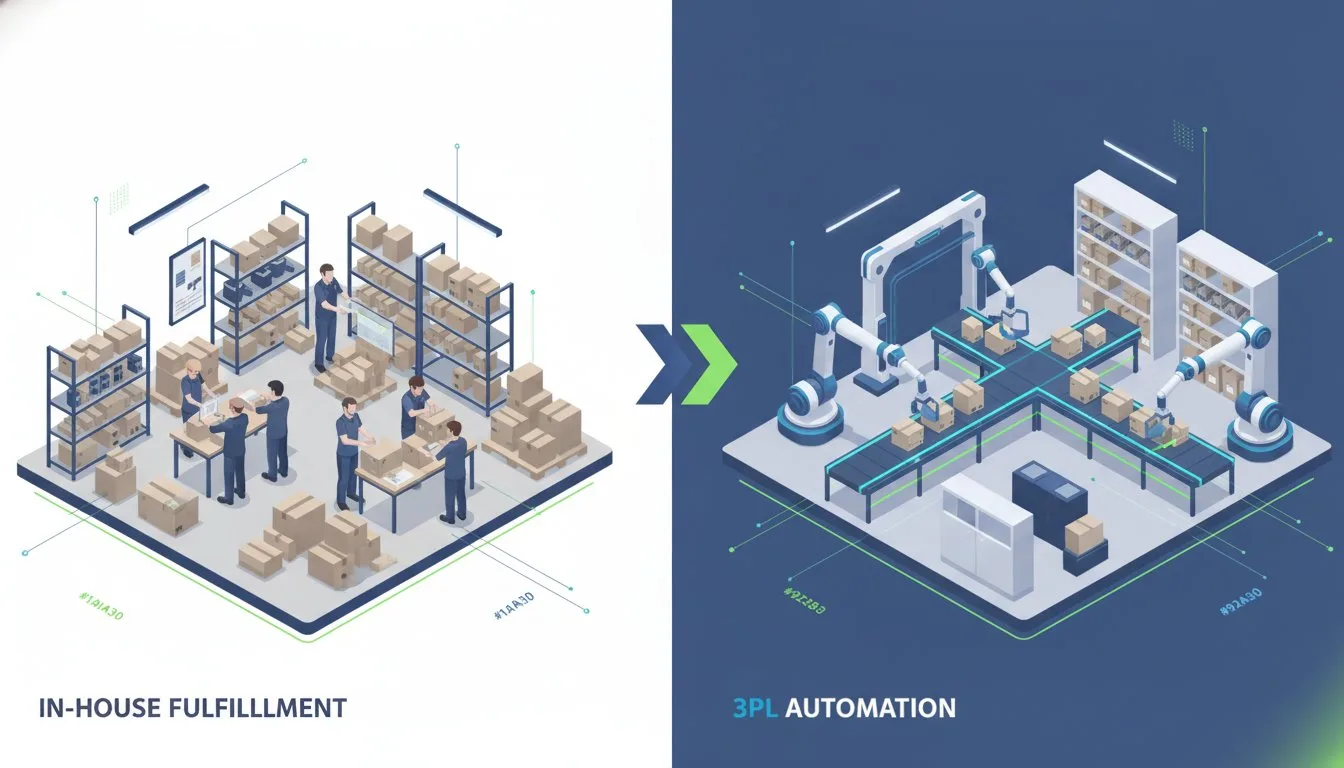
This guide explores the true cost of in-house fulfillment vs 3pl to help you identify the most profitable path for your brand in 2026. We’ll move beyond simple rent and payroll calculations to uncover the hidden financial and operational impacts of DIY logistics versus professional partnerships. By the end of this analysis, you’ll have a clear view of how shifting from a capital-heavy model to a flexible, tech-driven approach can unlock the scalability your business deserves. We’ll compare real-world investments, examine the shift toward AI-driven automation, and provide a methodical framework for your next strategic move.
Key Takeaways
- Identify the hidden “hard costs” that drain your budget, including warehouse equipment depreciation and long-term lease commitments.
- Evaluate the total cost of in-house fulfillment vs 3pl to see how transitioning to a variable, pay-as-you-go model preserves your capital for marketing.
- Quantify the opportunity cost of executive time lost to manual operations and learn how to break through the growth ceiling.
- Protect your brand from heavy fines and security risks by understanding the strict compliance requirements for healthcare and high-value goods.
- Discover how a strategic partnership with a 25-year industry veteran can stabilize your logistics while maintaining high-tech efficiency.
The Visible vs. Invisible Costs of In-House Fulfillment
In-house fulfillment represents a significant commitment to physical infrastructure, dedicated personnel, and proprietary technology systems. While the desire for total control is understandable, many brands find that the total cost of in-house fulfillment vs 3pl is skewed by expenses that don’t appear on a simple balance sheet. Hard costs like long-term lease agreements, full-time salaries, and the depreciation of warehouse equipment provide a baseline. However, it’s the soft costs, recruitment, ongoing training, and specialized shipping insurance, that often create the most friction for a growing brand.
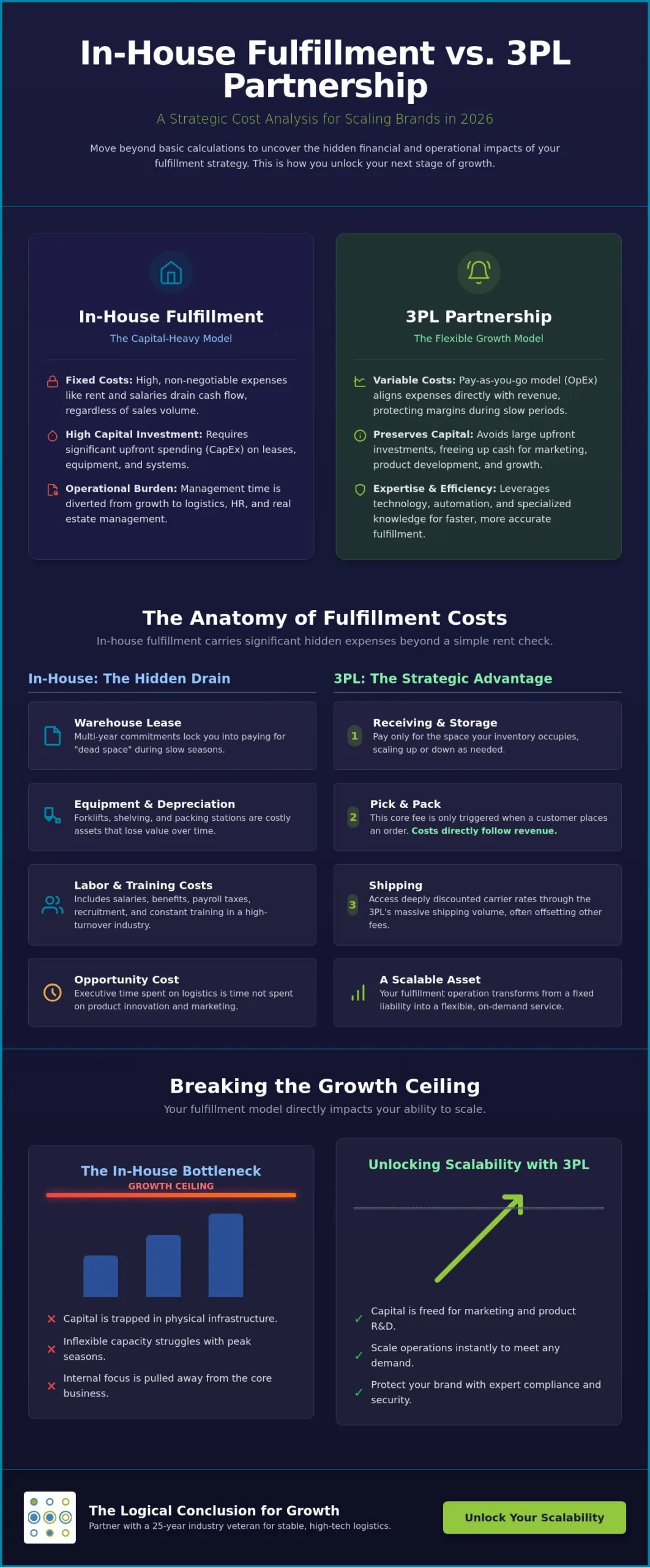
When comparing these internal operations to the external model provided by Third-party logistics (3PL) companies, the most striking difference is the fixed nature of in-house expenses. Your rent and payroll remain high even if your order volume drops by 40% during a seasonal lull. This lack of elasticity means your profit margins are most vulnerable exactly when sales are slowest. Managing these logistics in-house requires you to be a real estate manager and a human resources expert simultaneously, roles that often distract from your primary mission of product innovation.
To better understand this concept, watch this helpful video:
The Reality of Warehouse Leasing in 2026
Commercial real estate prices in major tech hubs continue to climb, putting immense pressure on your bottom line. Securing a facility in a strategic location requires a multi-year commitment that lacks flexibility. During slow months, you’re essentially paying for “dead space,” which is expensive square footage that sits empty while you wait for the next peak season. Beyond the base rent, maintenance fees and rising utility costs act as a constant drain on monthly cash flow. These are non-negotiable liabilities that exist regardless of your sales performance.
Labor Costs Beyond the Hourly Wage
Calculating the true expense of a warehouse team goes far beyond the base hourly rate. When evaluating the cost of in-house fulfillment vs 3pl, the human element is often the most volatile variable. You must account for the Labor Burden, which is the total cost to employ a worker including benefits, payroll taxes, and administrative overhead. Training new staff takes time and resources, especially in a high-turnover industry. Relying on seasonal hiring introduces further financial risk, as the “temp labor” premium often exceeds the cost of permanent staff. If a warehouse is understaffed during a rush, shipping errors rise; if it’s overstaffed during a dip, your margins disappear.
The 3PL Pricing Model: Transitioning to Variable Costs
Shifting from the rigid, fixed-cost structure of a private warehouse to a variable model is a strategic pivot that transforms fulfillment from a liability into a scalable asset. When you evaluate the cost of in-house fulfillment vs 3pl, the most significant differentiator is the transition from Capital Expenditure (CapEx) to Operating Expense (OpEx). Instead of paying for a facility that is only 30% full during off-peak months, you adopt a pay-as-you-go approach. You only pay for the specific cubic footage your inventory occupies and the exact labor hours required to move your orders.
Standard 3PL fee structures are designed for transparency and predictability. Receiving fees cover the meticulous process of logging and verifying inbound stock. Storage fees are typically billed monthly, based on the volume of pallets or shelves utilized. The core of the transaction lies in the pick and pack fees, which only occur when a customer makes a purchase. This alignment of costs with revenue protects your cash flow. Additionally, established providers leverage massive aggregate shipping volumes to secure deep carrier discounts that are generally unavailable to individual brands. These savings in postage often offset a significant portion of the service fees themselves.
Specialized requirements, such as on-demand digital printing or healthcare mailing, are treated as project-based costs rather than permanent overhead. This flexibility allows you to launch new initiatives without hiring specialized staff or purchasing expensive machinery. If you are looking to optimize your current logistics spend, you can request a personalized cost analysis to see how these variable models apply to your specific SKU profile.
Pick and Pack: Efficiency at Scale
A professional fulfillment center utilizes sophisticated logic and organized workflows to minimize the distance workers travel to find items. This optimization reduces the per-unit cost of every order shipped. Beyond speed, the focus on precision is vital. High order accuracy virtually eliminates the “invisible” costs of returns, which include wasted postage, repackaging labor, and potential customer churn. Many brands find additional value by integrating kitting and assembly services directly into the standard workflow, ensuring that complex bundles are ready for shipment without delay.
Storage and Warehousing: Paying for What You Use
3PLs offer a variety of storage configurations to match your inventory needs. Pallet storage is ideal for bulk backstock, while shelf or bin storage provides quick access for high-velocity SKUs. This granular approach prevents you from paying for empty space. Furthermore, professional facilities provide secure, climate-controlled environments that protect high-value electronics or sensitive documents from damage or theft. By outsourcing, you eliminate the financial risk of long-term commercial lease commitments, allowing your brand to remain agile as market conditions shift.
The Growth Ceiling: Opportunity Costs of DIY Logistics
The “Growth Ceiling” is a silent killer of emerging brands. It happens when your marketing team hits a home run, but your operations team strikes out because they can’t keep up with the volume. When you analyze the cost of in-house fulfillment vs 3pl, you have to look at the revenue you aren’t making because you’re too busy managing tape and bubble wrap. Operational friction doesn’t just slow you down; it stops your marketing and sales efforts in their tracks. If you’re afraid to run a new ad campaign because you don’t have the hands to pack the resulting orders, you’ve hit the ceiling.
A founder’s time is their most expensive resource. Every hour spent troubleshooting a label printer or managing warehouse staff is an hour not spent on business development or strategic partnerships. To minimize these technical distractions and protect your digital assets, you can visit Trinity Networx, LLC for proactive managed IT support. This opportunity cost is rarely reflected on a spreadsheet, yet it’s the primary reason brands plateau. Beyond the human element, inefficient DIY inventory management often leads to stockouts or backorders. These aren’t just logistical hiccups. They’re lost customers who will likely switch to a competitor who can deliver immediately. Professional 3PLs use seasoned expertise to ensure your inventory levels are optimized, preventing the “out of stock” notification that kills conversion rates.
Scalability: Handling the 10x Surge
Black Friday and viral marketing moments demand a level of agility that in-house setups rarely possess. Scaling an internal warehouse requires months of lead time to secure additional square footage and vet new staff. In contrast, a 3PL partnership offers “Elastic Capacity.” This allows you to handle a 10x surge in orders overnight without the long-term burden of capital expenditure. You gain the ability to say “yes” to growth opportunities that would otherwise break your infrastructure. It’s the difference between a successful launch and a reputation-damaging backlog.
Tech and Integration Costs
Building an in-house Warehouse Management System (WMS) is a massive financial and technical undertaking. The development costs and ongoing maintenance can be staggering for a growing brand. However, modern 3PL inventory management software provides real-time control and visibility without the upfront investment. These systems integrate seamlessly with platforms like Shopify or WooCommerce, ensuring that your digital storefront and physical inventory are always in sync. You get enterprise-level tech on a startup budget, which removes the technical friction that often holds brands back from global expansion.
Compliance, Security, and Risk: The Cost of Getting it Wrong
Managing risk is often an afterthought until a crisis occurs. When you weigh the cost of in-house fulfillment vs 3pl, you must factor in the price of a security breach or a compliance failure. In regulated sectors like healthcare, a single mailing error can trigger legal penalties that dwarf your annual shipping budget. For companies in consumer financial services, this level of scrutiny is even higher, often requiring the specialized risk management and digital transformation consulting provided by Versapien. An in-house operation often lacks the specialized oversight needed to navigate these complex legal waters. By outsourcing, you shift much of the operational liability to a partner whose entire business model is built on precision and regulatory adherence.
Returns management is another area where DIY models frequently bleed cash. Without a dedicated team to inspect, refurbish, and restock goods, returned items often sit in a corner, losing value and taking up expensive floor space. Professional 3PLs turn this cost center into a value recovery stream by processing returns with the same efficiency as outbound orders. They provide a buffer between your brand and the logistical chaos of modern commerce, ensuring that damage or theft doesn’t erode your margins. If you’re ready to secure your supply chain and reduce your exposure, request a free quote today to see how we mitigate these specific operational risks.
Specialized Fulfillment: Healthcare and Beyond
The specialized infrastructure required for healthcare mailing services is a significant financial commitment. HIPAA-compliant fulfillment is a system of physical and digital safeguards for patient data. Building this from scratch in an in-house warehouse is rarely cost-effective for brands that aren’t primarily logistics companies. Combining digital printing with fulfillment in a regulated environment ensures maximum precision. This integrated approach reduces the number of hands that touch sensitive data, which naturally lowers the risk of a breach.
Protecting High-Value Assets
Advanced security is expensive to implement and even more costly to maintain. Biometrics, 24/7 monitoring, and limited access zones are standard in professional facilities but cost-prohibitive for small-scale, in-house warehouses. Choosing secure warehousing for high-value electronics as a service is significantly cheaper than a custom build-out. Furthermore, 3PL certifications and high-tier security protocols can often lead to lower business insurance premiums. Insurance carriers recognize the reduced risk profile of a professional facility, which provides another layer of savings when calculating the cost of in-house fulfillment vs 3pl for your brand.
The Strategic Partnership: Why Silicon Valley Direct is the Logical Conclusion
Silicon Valley Direct serves as the vital bridge where high-tech efficiency meets seasoned human oversight. While previous sections have detailed the numerical cost of in-house fulfillment vs 3pl, the decision ultimately rests on the quality of the partnership you build. Since 1999, we’ve acted as a stabilizing force for brands navigating the volatile journey from startup to global enterprise. We don’t just provide warehouse space; we offer a sophisticated operational foundation that allows you to reclaim your time and focus on high-level strategy.
One of the most significant cost-saving benefits we provide is the rejection of the “automated ticket” culture. Instead of waiting days for a response from a generic support queue, you have a dedicated account manager who understands your specific SKU complexity and brand values. This direct human connection prevents small logistical hiccups from becoming expensive errors. Our “One-Stop” advantage further streamlines your budget by integrating eCommerce order fulfillment, on-demand digital printing, and kitting and assembly under a single roof. This eliminates the need to coordinate between multiple vendors, reducing both administrative overhead and transportation costs between facilities.
The Human Element of Precision
Many modern 3PLs prioritize automation to the point of neglecting the physical reality of the product. Automated-only systems often miss subtle packaging issues or inventory discrepancies that lead to “hidden” error costs. At Silicon Valley Direct, we combine digital accuracy with personal oversight. Our long-term staff retention is a unique hallmark of our stability; our team members possess the deep institutional knowledge required to maintain high order accuracy rates. This collective experience allows for custom problem-solving on complex B2B or B2C projects that would baffle a purely algorithmic provider.
Global Reach from the Heart of Innovation
Our location in the world’s premier tech hub isn’t just about geographic identity; it’s a symbol of our commitment to innovation and connectivity. By utilizing our global shipping services, you can reach international markets without the staggering overhead of establishing overseas warehouses. We handle the complexities of international logistics and returns management, giving your brand a worldwide footprint from a single, secure point of origin. This strategic advantage is essential for tech-forward brands that need to move fast and stay lean.
Choosing the right partner is about more than just comparing line items. It’s about finding a steady hand that can alleviate the stress of rapid growth. It’s time to transition from a logistics-burdened business to a growth-focused brand. Let us handle the precision of your physical operations so you can focus on the vision that started it all.
Choosing Your Path to Profitable Growth
Deciding on the cost of in-house fulfillment vs 3pl is ultimately about where you want your leadership team to focus their energy. By moving away from the rigid overhead of warehouse leases and seasonal hiring risks, you transform logistics into a variable expense that scales perfectly with your sales. This shift removes the operational ceiling that often prevents brands from fully capitalizing on viral growth or international expansion. You gain the freedom to innovate while your physical operations remain in expert hands.
Since 1999, Silicon Valley Direct has provided the physical infrastructure and human expertise needed to protect high-stakes shipments. We specialize in HIPAA-compliant fulfillment and secure warehousing for high-value electronics, ensuring that every account benefits from direct human oversight rather than an automated ticket system. Our seasoned team acts as a steady hand to stabilize your operations during rapid growth phases. Streamline your supply chain with a custom quote from Silicon Valley Direct. Your brand’s potential is limitless when your logistics are handled with precision and care.
Frequently Asked Questions
Is 3PL cheaper than in-house fulfillment for small businesses?
Yes, for most small to mid-sized businesses, a 3PL is significantly more cost-effective. Research indicates that brands with fewer than 1,500 orders per month almost always save money by outsourcing. This is because you avoid the massive upfront investment in warehouse equipment and long-term lease commitments. When you calculate the cost of in-house fulfillment vs 3pl, the ability to pay only for the space you use protects your cash flow during the early stages of growth.
What are the most common hidden costs in 3PL pricing?
Hidden costs often include account management fees, software subscription “tech” fees, and packaging material markups. Many automated 3PLs charge extra for every support ticket or phone call you make. At Silicon Valley Direct, we believe in transparency and include direct human oversight as part of our standard partnership. This prevents the “nickel and diming” that often occurs with providers who rely solely on automated interactions to manage their client relationships.
How much volume do I need to justify moving to a 3PL?
Most brands find that 1,500 orders per month is the tipping point where managing logistics in-house becomes a distraction from core business goals. While you can technically manage lower volumes yourself, the opportunity cost of your time usually outweighs the service fees. Between 1,500 and 8,000 orders, the 3PL model offers the best balance of scalability and cost-efficiency. Beyond 8,000 orders, in-house operations might seem cheaper on paper, but they carry much higher operational risks.
Can a 3PL handle custom branded packaging and kitting?
Yes, specialized 3PL providers offer bespoke kitting and assembly services tailored to your brand’s aesthetic. This allows you to maintain a premium unboxing experience without hiring a dedicated team to manage complex packaging requirements. These services are typically billed as project-based fees. This ensures that your customers receive a consistent, high-quality presentation every time they open a package, regardless of how fast your order volume is growing.
What is the average cost per order for 3PL fulfillment in 2026?
Industry data for 2026 shows that 3PL fulfillment typically costs between $3.10 and $4.80 per order, while in-house operations average between $4.50 and $6.20. These figures include the labor for picking and packing along with basic storage. While every brand’s SKU complexity is different, the “all-in” cost for a professional 3PL partnership usually remains lower because of the shared infrastructure and labor efficiencies that an individual brand cannot replicate on its own.
How does a 3PL help reduce international shipping costs?
3PLs leverage massive aggregate shipping volumes to secure carrier discounts that are 15-30% below published rates. They also have the expertise to optimize international routes, which helps you avoid unnecessary duties and long transit times. By using a provider with a global reach, you can serve international customers without the overhead of opening foreign warehouses. This allows you to test new markets with minimal financial risk and much faster delivery speeds.
What happens to my inventory if I switch from in-house to a 3PL?
The transition involves a coordinated physical transfer followed by a comprehensive digital audit. Your inventory is moved to the secure 3PL facility, where it’s counted, inspected for damage, and logged into a specialized inventory management system. This system then syncs with your eCommerce storefront to ensure real-time accuracy. It’s a methodical process that provides a “clean slate” for your inventory data, helping you eliminate the stockouts and backorders that often plague in-house setups.
Are there specific 3PL solutions for HIPAA-compliant mailing?
Yes, but only through providers who have invested in the necessary physical and digital safeguards. HIPAA-compliant fulfillment requires strict protocols to protect patient data and sensitive healthcare materials. Silicon Valley Direct has specialized in these high-stakes services for decades, providing a level of precision that generic 3PLs cannot match. When evaluating the cost of in-house fulfillment vs 3pl for regulated industries, the value of mitigating legal and financial risk is the most important factor to consider.