img not found!
JIT Printing for eCommerce: 2026 Lean Fulfillment Guide

JIT Printing for eCommerce: 2026 Lean Fulfillment Guide

The most expensive marketing collateral you’ll ever buy isn’t the high-end brochure; it’s the stack of 5,000 obsolete flyers gathering dust in a warehouse corner because your product specs changed last week. For brands scaling in 2026, the traditional model of bulk printing is a liability that drains capital and stifles agility. Implementing just-in-time printing for ecommerce transforms this static burden into a dynamic asset. By producing only what you need exactly when an order is placed, you’re not just saving on storage fees. You’re gaining the ability to pivot your messaging in real-time.

You likely already feel the pressure of rising postage rates and the constant demand for more authentic customer connections. We understand that the disconnect between a high-tech storefront and a generic packing slip is a missed opportunity for growth. This guide promises to show you how to eliminate print waste while delivering hyper-personalized experiences at scale. We will examine the technical shift from bulk offset to on-demand digital production and how this integration creates a leaner, more responsive fulfillment cycle.

Key Takeaways

  • Identify the hidden costs of bulk inventory and how a lean production model protects your capital from obsolescence.
  • Review the technical benchmarks for digital print quality, including the advantages of liquid ink and high-resolution line screens.
  • Leverage Variable Data Printing (VDP) to personalize every shipment and increase customer lifetime value without increasing production time.
  • Integrate just-in-time printing for ecommerce into your existing 3PL workflow using automated Web Services and API triggers.
  • Monitor your entire production and fulfillment cycle with 24/7 visibility through proprietary remote control systems.

The Shift to Just-In-Time Printing for eCommerce Fulfillment

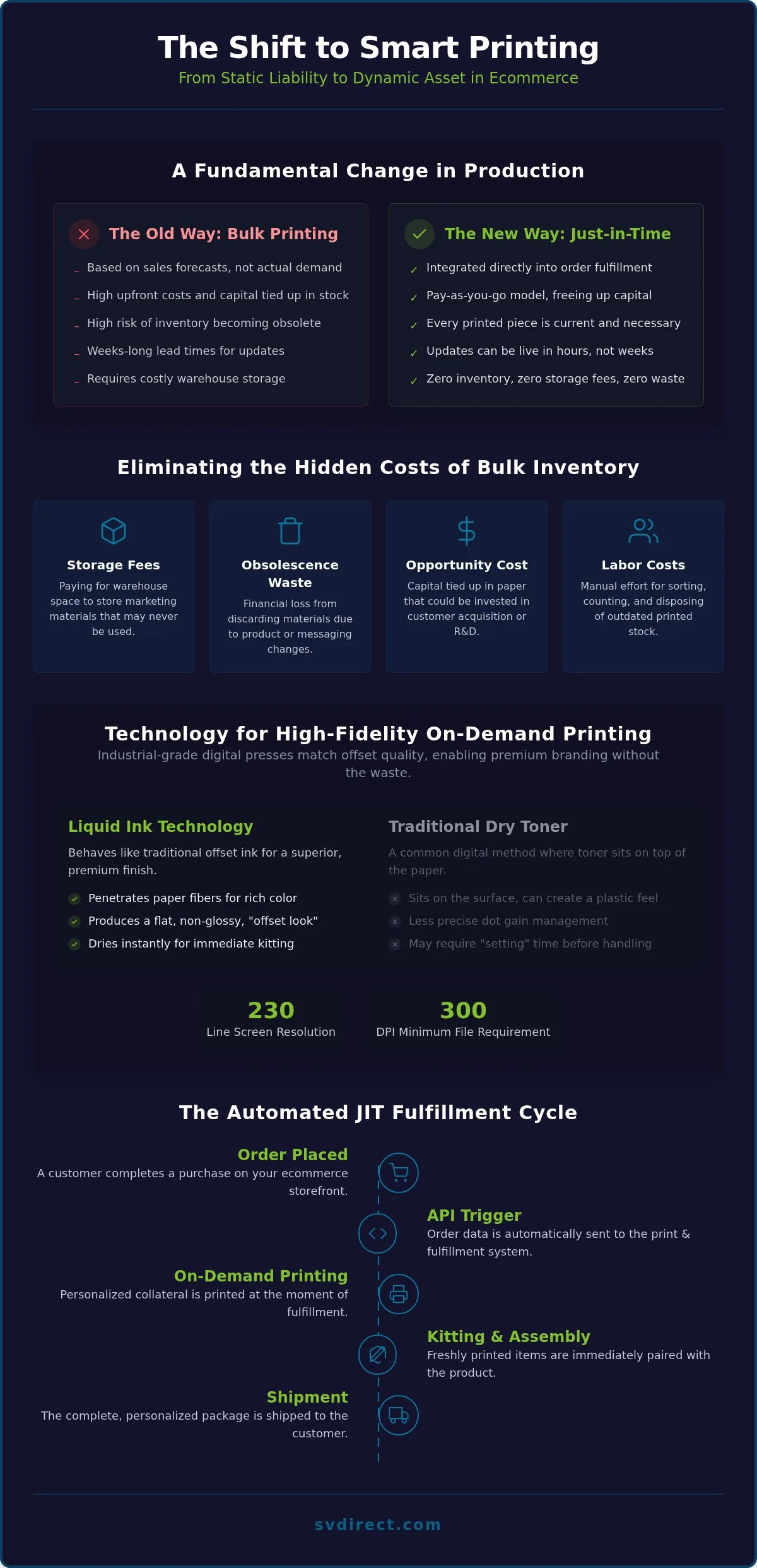
Just-in-time printing for ecommerce represents a fundamental departure from the “print and store” models of the past. Instead of ordering thousands of marketing inserts or manuals based on sales forecasts, digital production is integrated directly into the order fulfillment process. This approach draws heavily from the Just-in-time (JIT) manufacturing philosophy, where materials are produced only as they’re needed to meet actual demand. By aligning print production with real-time order data, brands eliminate the friction between their digital storefronts and their physical shipments.

The traditional model of bulk offset printing relies on high volumes to drive down unit costs. However, this creates a hidden “discard cycle” that often costs more than the initial savings. eCommerce brands in 2026 are realizing that physical inventory is a stagnant asset. When marketing strategies change every quarter, bulk runs become liabilities. JIT printing solves this by ensuring that every piece of paper leaving the facility is current, accurate, and necessary.

Eliminating Inventory Obsolescence

Print inventory obsolescence is the financial loss incurred when pre-printed materials become inaccurate or irrelevant before they ever reach a customer. This is the primary driver for JIT adoption. In a market where product specifications or legal requirements change rapidly, holding six months of pre-printed stock is a high-risk strategy. The costs extend beyond the paper itself. You must also account for:

  • Storage fees: Paying for warehouse rack space for months at a time.
  • Labor costs: The physical effort of sorting, counting, and eventually disposing of outdated stock.
  • Opportunity cost: Capital tied up in paper that could be invested in customer acquisition.

Transitioning to a print-on-demand model removes these burdens entirely. The ROI is found in the capital freed from stagnant inventory and the total elimination of disposal waste.

Agility in a Fast-Paced Market

Traditional offset printing often demands lead times of several weeks for high-quality marketing collateral. In contrast, just-in-time printing for ecommerce reduces that window to mere hours. When your print production lives inside your fulfillment center, an updated PDF file can be live in your next shipment by the afternoon. This speed allows brands to respond to market trends or customer feedback with surgical precision. It also provides a significant boost to working capital. Instead of tying up thousands of dollars in paper that sits on a shelf, businesses pay for production as sales occur. This shift supports a leaner 3PL fulfillment strategy, allowing high-growth companies to scale without the anchor of physical overstock.

The Technology Behind High-Fidelity JIT Digital Printing

While many fulfillment centers rely on basic thermal labels or desktop inkjets, true just-in-time printing for ecommerce requires industrial-grade digital presses. Our facility utilizes the HP Indigo 5500 Digital Press to bridge the gap between digital flexibility and traditional quality. This isn’t just about speed; it’s about matching the aesthetic standards of offset printing while maintaining a lean, on-demand workflow. By utilizing liquid ink instead of dry toner, we ensure that every marketing insert or product manual reflects the premium nature of your brand.

Liquid Ink vs. Traditional Toner

Most digital printers use dry toner, which essentially sits on top of the paper fibers. Liquid ink technology behaves differently. It penetrates the substrate to provide superior color control and precise dot gain management. This results in a “flat” finish that looks and feels like high-end offset printing, without the expensive plate setups. Because the ink is dry the moment it leaves the press, sheets move immediately into kitting and assembly. This immediate handling is a cornerstone of our same-day fulfillment capabilities, as there’s no need to wait for ink to “set” before the next stage of the process.

High-Resolution Standards for Modern Brands

Professional marketing materials require a level of clarity that standard office equipment simply can’t produce. We utilize a 230 line screen resolution as the benchmark for all high-fidelity output. This high-density color control ensures that detailed imagery, fine gradients, and small text remain crisp and legible. To maintain these results, we require that all brand assets are provided as 300 dpi files. Anything lower risks pixelation that can undermine the premium feel of your packaging inserts. This technical precision ensures your brand identity stays consistent across every single order, regardless of the run size.

Efficiency in a high-volume 3PL environment also depends on single-pass duplex printing. This technology allows us to print both sides of a sheet simultaneously. It cuts production time in half while ensuring perfect alignment for double-sided brochures or complex instruction manuals. This mechanical precision allows us to operate as a seamless extension of your company, delivering high-quality materials at the pace of modern commerce. If you’re ready to upgrade your unboxing experience with professional-grade materials, you can request a free quote to see how our technology integrates with your current workflow.

Variable Data Printing: The Key to Personalized eCommerce

Variable Data Printing (VDP) represents the tactical edge of just-in-time printing for ecommerce. While traditional methods require identical copies to remain cost-effective, VDP allows for the customization of every individual sheet within a single print run. This means you can change names, images, or unique discount codes on every packing slip or insert without stopping the press. It bridges the gap between mass production and bespoke craftsmanship, ensuring that your physical touchpoints are as data-driven as your email campaigns.

The psychological impact of a personalized insert is profound. When a customer opens a package and finds a thank-you note addressing them by name, or a QR code leading to a specialized landing page based on their purchase history, it builds immediate brand affinity. This level of attention directly influences customer retention and lifetime value (LTV). Most brands assume this level of customization is prohibitively expensive. In a modern digital workflow, however, VDP costs not much more than static printing. By eliminating the need for separate runs and manual sorting, we integrate these high-impact elements directly into the automated fulfillment flow.

Common use cases for this technology include:

  • Personalized thank-you notes: Addressing the customer by name and referencing their specific purchase.
  • Custom QR codes: Directing users to assembly videos, review pages, or loyalty program sign-ups.
  • Targeted cross-sell offers: Recommending accessories or related products based on the items in the current order.

Personalized Direct Mail and Presentations

Beyond packaging inserts, VDP is a powerhouse for Direct Mail Marketing Services. You can leverage customer data to drive unique copy and imagery on every piece of mail, ensuring that your message resonates with the recipient’s specific interests. This capability is equally valuable for presentation printing and healthcare mailing services, where accuracy and personalization are non-negotiable. By treating every printed page as a dynamic data field, we transform generic collateral into a targeted communication tool that feels personal rather than promotional. This proactive approach ensures we act as an extension of your company, delivering materials that reflect your brand’s commitment to quality.

Increasing Response Rates with Targeted Messaging

There’s a direct relationship between personalization and response rates. Targeted messaging cuts through the noise of generic marketing, making the recipient feel seen and valued. JIT printing allows you to test different offers or creative directions in real-time without the risk of committing to a massive bulk run. If a specific cross-sell offer isn’t performing, you can update the file and have the new version in production within hours. Essentially, VDP allows for one-to-one marketing at the speed of eCommerce. This agility ensures that your marketing budget is always working toward the highest possible ROI while maintaining a zero-waste inventory model. By producing only what’s needed, we help you maintain a lean supply chain that’s ready for rapid growth.
JIT Printing for eCommerce: 2026 Lean Fulfillment Guide

Integrating JIT Printing into Your 3PL Workflow

Integrating just-in-time printing for ecommerce into a 3PL workflow requires a methodical approach that prioritizes data integrity. The bridge between a digital order and a physical shipment is built on precise technical integration. For this model to function at scale, the print queue must be an automated extension of the pick-and-pack workflow. This isn’t a manual process where staff upload files every morning. Instead, it relies on a programmatic connection that triggers production the moment an order is cleared for fulfillment.

The Role of Web Services and API Integration

We establish this connection using XML and SOAP protocols through our Web Services. This digital handshake allows your ecommerce platform to communicate directly with our print systems. By automating the data flow, we eliminate the risks associated with manual entry, which is vital when handling personalized variable data. Every name, unique QR code, or custom offer is pulled directly from the order source. This ensures that the high-fidelity output matches the customer’s data with absolute precision. You can monitor this entire process through our Remote Order Management system, giving you 24/7 visibility into your production queue.

Kitting, Assembly, and QC-Check

Once the materials are printed, they move into the physical assembly phase. This is where just-in-time printing for ecommerce becomes an integral part of Kitting and Assembly Services. For subscription boxes or complex product bundles, the printed collateral must be merged with the correct physical items. We use a proactive QC-Check process to verify that variable data materials are paired with the right recipient. This human oversight ensures that a personalized insert for one customer doesn’t end up in another’s box. Our quiet facility methodology supports this focus, allowing our team to maintain high accuracy rates even during high-volume periods.

Real-time reporting serves as the final step in this integrated workflow. Our proprietary Remote Control system provides over 120 standard reports, allowing you to track inventory levels, order status, and print production in real-time. This level of transparency transforms the fulfillment center from a black box into a manageable part of your business operations. By combining high-resolution digital technology with robust software integration, we provide a stable platform for your brand’s growth.

Scalable Success with Silicon Valley Direct’s Print Solutions

Silicon Valley Direct positions itself as more than a service provider; we operate as a dedicated extension of your company. Success in just-in-time printing for ecommerce depends on transparency and control. Our proprietary “Remote Control” system provides this by offering 24/7 visibility into every facet of your print and fulfillment operations. With access to over 120 standard reports, you’re never left guessing about inventory levels or order status. This data-driven approach ensures that as your brand scales, your logistics infrastructure remains stable and responsive.

Accuracy is the cornerstone of our operational philosophy. We utilize a “Quiet Facility” methodology, which creates a focused environment designed to minimize errors. In high-volume JIT environments, where variable data and complex kitting are the norms, this deliberate atmosphere is essential. It allows our team to maintain precision even when processing thousands of unique shipments. By prioritizing human oversight and a methodical pace, we ensure that every personalized insert reaches the correct destination, protecting your brand’s reputation with every delivery.

Proactive Problem Solving in Fulfillment

A true partnership requires more than just following instructions; it requires anticipating project conflicts before they impact your deadlines. Unlike a cookie-cutter vendor, we take a proactive stance on problem-solving. Whether it’s identifying a file resolution issue or managing a sudden surge in order volume, our team is trained to provide bespoke solutions. We’ve demonstrated this capability by handling thousands of complex shipments in a single week for high-growth clients, ensuring that every kit was assembled accurately and shipped on time. This commitment is captured in our Nine Promises of service, which anchor our role as a steady hand in the fast-paced ecommerce industry.

Eco-Friendly and Sustainable Printing

Transitioning to just-in-time printing for ecommerce is a significant step toward a more sustainable business model. Traditional offset methods involve films, plates, and harsh chemicals that are entirely eliminated in our digital workflow. By producing only what’s needed, you’re naturally reducing paper waste and the carbon footprint associated with storing obsolete materials. We support these efforts by offering FSC-certified substrates and options for 30% recycled content. Our commitment to the environment extends to our hardware recovery partnerships and responsible disposal practices. Aligning with these sustainable logistics practices helps your brand meet the growing consumer demand for eco-conscious operations without sacrificing the quality of your on-demand digital printing.

Future-Proofing Your eCommerce Fulfillment

Adopting just-in-time printing for ecommerce is no longer just a cost-saving measure; it’s a strategic necessity for brands aiming to thrive in 2026. By shifting from static bulk runs to high-fidelity digital production, you eliminate the financial burden of obsolete inventory while gaining the power of hyper-personalization. Our HP Indigo 5500 technology ensures every insert meets offset-quality standards, while the proprietary Remote Control™ system provides the 24/7 visibility required to manage a global supply chain with confidence. This integration allows you to respond to market shifts with surgical precision.

With over 25 years of fulfillment expertise, we understand that your physical touchpoints are vital brand assets. Moving to a lean, on-demand model allows you to pivot your marketing strategy in hours rather than weeks. This level of agility, backed by human oversight and technical precision, transforms your fulfillment center into a proactive growth engine. We’re ready to act as a steady, reliable extension of your team as you scale to new heights. Let’s work together to build a more efficient, waste-free future for your brand.

Frequently Asked Questions

How does digital JIT printing quality compare to traditional offset printing?

Digital JIT printing using liquid ink technology provides results that are virtually indistinguishable from traditional offset printing. By utilizing the HP Indigo 5500 Digital Press, brands achieve a 230 line screen resolution, which is the industry benchmark for high-fidelity marketing materials. This technology eliminates the graininess often associated with dry toner systems. It ensures that fine gradients and detailed product imagery remain crisp, providing professional-grade results for every shipment without the need for large bulk runs.

Is variable data printing (VDP) significantly more expensive than static printing?

Variable data printing (VDP) costs not much more than static printing when integrated into a modern digital workflow. Because the process is entirely programmatic, there are no additional plate charges or setup fees for changing individual data fields. This makes it financially viable to personalize every packing slip or insert with unique customer names and targeted offers. Brands can leverage this technology to increase customer lifetime value while maintaining the same-day speed required for high-volume ecommerce operations.

How quickly can prints be handled after they leave the digital press?

Prints can be handled immediately after they leave the digital press because the ink is dry the moment the sheet is produced. This dry-ink handling capability is a critical component of just-in-time printing for ecommerce. It allows printed materials to move straight from the press to the kitting and assembly line without any waiting period for setting or curing. This seamless transition is what enables our facility to maintain same-day fulfillment even for highly customized orders.

What is the recommended file resolution for just-in-time digital printing?

The recommended file resolution for high-resolution digital printing is 300 dpi at the final output size. Providing assets at this specification ensures that the 230 line screen resolution of the digital press can reproduce imagery with maximum clarity. Files with lower resolutions often result in pixelation or blurry text, which can undermine the premium perception of your brand. Maintaining this technical standard is essential for producing professional marketing inserts that match the quality of your physical products.

Can JIT printing be used for personalized direct mail campaigns?

Just-in-time printing for ecommerce is an ideal solution for personalized direct mail campaigns and targeted marketing inserts. By utilizing customer data, brands can produce unique mailers that feature personalized copy, specific product recommendations, and custom QR codes. This approach significantly increases response rates compared to generic bulk mailings. Since the production is on-demand, you can test different creative versions in small batches to identify which messaging drives the highest return on investment for your brand.

How does JIT printing integrate with my existing eCommerce store?

Integration occurs through a programmatic connection using Web Services and APIs, typically utilizing XML or SOAP protocols. This digital handshake allows your ecommerce platform to trigger print jobs automatically as soon as an order is cleared for fulfillment. The system pulls the necessary data directly from the order source, ensuring that personalized elements are accurate. This automation removes the need for manual file transfers, allowing the print queue to function as a seamless extension of your existing storefront.

What types of materials can be produced using just-in-time printing?

A wide range of high-fidelity materials can be produced, including marketing inserts, product manuals, brochures, and personalized thank-you notes. The digital press handles various substrates, from standard paper stocks to premium heavy-weight materials and FSC-certified options. This flexibility allows brands to create comprehensive unboxing experiences that include everything from assembly instructions to targeted cross-sell catalogs. Each piece is printed on-demand to match the specific items included in the customer’s order, ensuring total relevance.

Does JIT printing help with sustainability goals for eCommerce brands?

JIT printing directly supports sustainability goals by eliminating the waste associated with obsolete pre-printed inventory. Traditional printing often results in thousands of discarded sheets when product specs or branding change; however, the digital model produces only what’s needed. Additionally, the process removes the need for the films, plates, and toxic chemicals used in offset production. Brands can further enhance their eco-friendly profile by choosing recycled substrates and partnering with facilities that prioritize responsible hardware recovery and waste management.
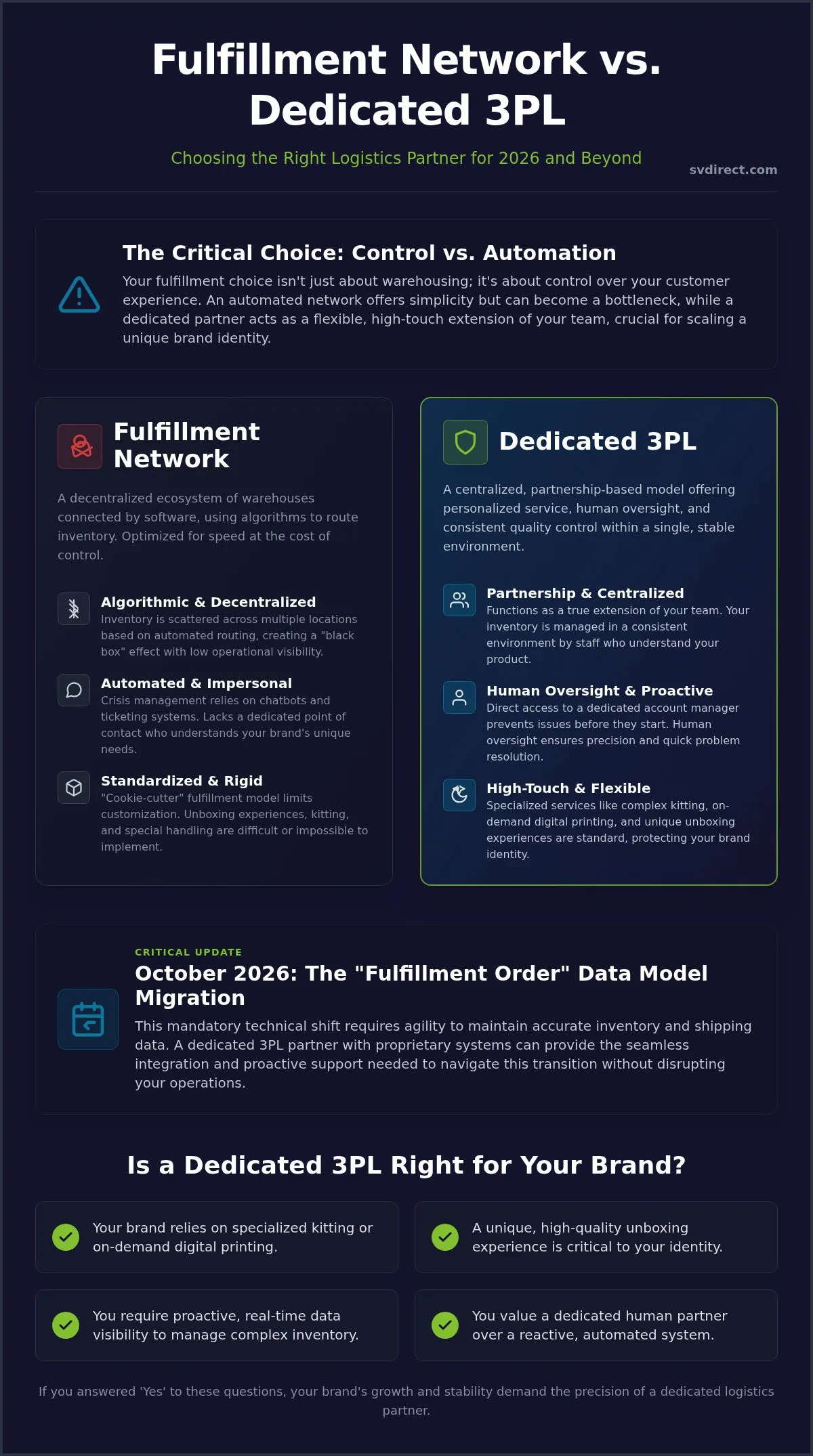
Shopify Fulfillment Network vs. 3PL: Choosing Your Strategic Partner in 2026

Shopify Fulfillment Network vs. 3PL: Choosing Your Strategic Partner in 2026

What if the automated efficiency of a platform-integrated network is actually the bottleneck preventing your brand from scaling its unique customer experience? It’s a common frustration for growing merchants. You want the simplicity of a native integration, yet you’re tired of shipping crises being handled by a chatbot while your unboxing experience suffers from a lack of customization. When weighing the shopify fulfillment network vs 3pl in 2026, you aren’t just choosing a warehouse; you’re choosing the future of your customer relationships.

This article clarifies how recent technical shifts, such as the mandatory migration to the fulfillment order data model, impact your operations. You’ll learn whether an algorithmic system or a dedicated partner offers the human oversight and specialized services like kitting or on-demand printing that your brand requires to stand out. We’ll examine the trade-offs between standardized platform solutions and the scalable, high-touch infrastructure of a partner that acts as a true, flexible extension of your team. By the end, you’ll have the clarity to choose a partner that provides the precision and stability your growth demands.

Key Takeaways

  • Learn why the October 2026 migration to the “fulfillment order” data model requires technical agility to maintain accurate inventory and shipping data.
  • Discover the core operational differences in the shopify fulfillment network vs 3pl landscape, specifically regarding automated platform networks versus high-touch human oversight.
  • Identify how specialized kitting and on-demand digital printing protect your brand identity from the limitations of standardized, “cookie-cutter” fulfillment models.
  • Understand the value of proprietary management systems that provide proactive data visibility rather than reactive, automated customer service.
  • Apply a strategic framework to determine if your product complexity and scaling goals demand the precision of a dedicated logistics partner.

The Evolution of Shopify Logistics: Network vs. Dedicated 3PL

Scaling your brand to a national level involves a critical transition from manual operations to professional logistics. In 2026, the decision between the shopify fulfillment network vs 3pl is no longer just about cost per package. It’s a choice about the degree of control you maintain over your brand’s physical footprint. A dedicated 3PL fulfillment service acts as an extension of your team, whereas a network often functions as a utility. Modern eCommerce demands strategic supply chain integration that goes beyond simple shipping labels; it requires a partner that understands the nuances of your inventory and the expectations of your customers.

What is a Fulfillment Network?

A fulfillment network is essentially a decentralized ecosystem of various warehouses connected by a central software layer. These networks use algorithmic routing to distribute your inventory across multiple locations. The goal is to place products closer to the end consumer to reduce shipping times. While this sounds efficient, it often creates a “Black Box” effect. Because your goods are spread across facilities managed by different teams, you lose granular visibility into how your products are handled. Automation manages the order flow, but when a crisis occurs, you’re often left dealing with an impersonal ticketing system rather than a dedicated account manager who knows your brand.

The Dedicated 3PL Model

A Third-party logistics (3PL) provider offers a more centralized and personalized approach. Instead of your inventory being scattered by an algorithm, it sits within a facility governed by established quality controls and consistent staff. This model prioritizes a partnership over a mere transaction. You gain direct access to human oversight, which is vital for preventing the small operational “hiccups” that can lead to negative customer reviews. A dedicated 3PL provides a stable environment where precision is the standard, and your specific requirements aren’t lost in a sea of standardized procedures.

Choosing between the shopify fulfillment network vs 3pl requires assessing your need for flexibility. If your brand relies on a specific unboxing experience or complex inventory management, the rigid nature of a decentralized network might stifle your identity. By 2026, the most successful brands are those that treat their logistics as a competitive advantage. They look for a steady hand in a fast-paced industry, ensuring that as they grow, their operational foundation remains deeply reliable and highly responsive to their unique business needs.

Evaluating Technical Integration and Real-Time Visibility

Visibility is the pulse of your supply chain. In the debate of shopify fulfillment network vs 3pl, the depth of your data determines your agility. It isn’t enough to see that a package left the warehouse; you need to know exactly what’s on the shelf, what’s pending, and what’s on backorder at any given second. This transparency mitigates the common challenges in 3PL partnerships where information silos lead to missed opportunities. Data transparency builds a bridge of trust, eliminating the anxiety of shipping crises by providing a single source of truth.

When you compare the shopify fulfillment network vs 3pl, look for a system that doesn’t just store data but makes it actionable. A partner should provide a steady hand, ensuring your digital information is as organized as the physical stock. This marriage of technology and customer service is what allows a brand to scale without the hectic atmosphere often associated with high-volume growth.

Proprietary Systems vs. Standardized Apps

Standardized apps often provide a simplified reporting structure that fails to satisfy the needs of high-growth brands. These “cookie-cutter” views lack the granular inventory analytics required for sophisticated forecasting. Our Remote Order Management system, Remote Control™, rejects this approach by providing 24/7 access to more than 120 standard reports. You can monitor inventory aging, track receipts, and analyze order trends in real time. Automated email alerts for low inventory act as a proactive safety net, ensuring you never lose a sale due to an unforeseen stockout.

Web Services and XML Integration

Modern eCommerce brands often require more than a simple plug-and-play app. They need a system that communicates effectively with proprietary tools or custom dashboards. We utilize robust web services and XML integration to facilitate this. By leveraging SOAP protocols, we provide a secure and standardized method for data transfer. This approach significantly reduces the time your developers spend on custom coding. Well-documented programmatic interfaces ensure that your user interface remains exactly how you want it, while our backend handles the complex heavy lifting of logistics data.

Strategic integration is the difference between a reactive supply chain and a proactive one. If your current setup leaves you guessing about your inventory levels or order status, it might be time for a more sophisticated approach. You can request a free quote today to explore how our technology can act as a seamless extension of your Shopify store.

Customization and Complexity: When ‘Standard’ Isn’t Enough

Standardized solutions are often the enemy of a unique brand identity. Many merchants fall into the “cookie-cutter” trap, where rigid operational procedures force products into generic packaging that fails to excite the customer. When evaluating the shopify fulfillment network vs 3pl, the deciding factor is often the ability to execute complex, non-standard requests. A network built for speed and volume frequently lacks the agility to handle the intricate details that define a premium brand experience. True precision requires a partner that treats your specific requirements as the standard, not the exception.

Kitting, Assembly, and the ‘QC-Check’

Systematic oversight is the cornerstone of successful kitting. Whether you’re launching a complex promotional kit or managing monthly subscription boxes for clothing and software, precision is mandatory. We employ a proprietary QC-Check inspection process to ensure every component is present and correctly placed. This proactive stance prevents errors before they reach your customer’s doorstep. Unlike automated networks that prioritize throughput over detail, a dedicated partner provides the human expertise necessary for multi-item assembly. Our team handles high-volume deadlines with a quiet confidence that eliminates the hectic atmosphere of traditional warehouses. Explore our specialized kitting and assembly services to see how we maintain accuracy across diverse product types.

Print-on-Demand and Variable Data

Personalization is no longer a luxury; it’s a requirement for modern eCommerce. We utilize the HP Indigo 5500 liquid ink technology to provide offset-quality results for your marketing collateral. This system allows for on-demand digital printing that transforms the unboxing experience from a transaction into a relationship. Through Variable Data Printing (VDP), we can customize the copy on every sheet, allowing for unique messages tailored to individual customers. This marriage of high-tech printing and logistics ensures that your brand voice remains consistent across every touchpoint. Discover our on-demand digital printing capabilities and learn how variable data can elevate your collateral.

Regulated industries, such as healthcare and pharmaceuticals, require an even higher level of stability and expertise. Since 1999, we’ve provided specialized literature and healthcare mailing services that adhere to strict accuracy standards. The shopify fulfillment network vs 3pl choice for these sectors isn’t just about shipping. It’s about finding a partner with a multi-decade history of reliability and the physical infrastructure to support high-stakes operations without compromise.

Shopify Fulfillment Network vs. 3PL: Choosing Your Strategic Partner in 2026

The Decision Framework: Choosing the Right Model for Your Brand

Choosing between a shopify fulfillment network vs 3pl requires a structured evaluation of your brand’s specific trajectory. While automated networks offer a low barrier to entry, they often lack the depth required for complex operations. 2026 eCommerce fulfillment complexity is the degree to which a brand’s logistical needs exceed the capabilities of standardized, automated pick-and-pack systems. If your product line involves more than just single-SKU shipments, the algorithmic approach of a decentralized network can introduce hidden costs. These costs manifest as lost customers due to kitting errors or the inability to handle specialized requirements like healthcare literature fulfillment or serial number tracking.

Step 1: Audit Your Fulfillment Requirements

A thorough audit starts with your SKU profile. Do you require specialized mailing services or serial number tracking for high-value electronics? Brands that rely on high-quality physical engagement, such as custom-printed inserts or complex assembly, often find that standardized platforms struggle with these nuances. If your strategy involves on-demand digital printing or HIPAA-compliant healthcare mailing, a dedicated partner is essential. You’ll need a facility where staff members are trained on your specific brand standards rather than following a generic, platform-wide script. It’s about ensuring your physical operations are just as organized as your digital storefront.

Step 2: Compare Support Models

The support model you choose dictates how your brand handles shipping crises. Automated ticketing systems and chatbots can leave you feeling stranded during peak seasons. In contrast, a dedicated account team provides a proactive hand. This marriage of technology and customer service ensures that issues are identified and resolved before they impact the end user. A quiet, organized facility with long-term staff retention naturally produces higher order accuracy than a hectic, high-turnover environment. By prioritizing a partner that rejects impersonal business models, you gain a scalable infrastructure that acts as a true extension of your own team.

Location-based innovation also plays a role in this framework. Being positioned within a hub of global connectivity allows for a synergy between advanced digital integration and physical logistics. This technological readiness, backed by decades of stability since 1999, provides the informed confidence you need to scale. Ultimately, the choice in the shopify fulfillment network vs 3pl debate comes down to whether you want a vendor or a strategic partner who shares your commitment to precision and bespoke problem-solving.

Silicon Valley Direct: A Seamless Extension of Your Shopify Store

Silicon Valley Direct (SVD) represents the evolution of the 3PL model, moving beyond transactional shipping to become a dedicated extension of your brand. While the choice between the shopify fulfillment network vs 3pl often centers on digital integration, we differentiate ourselves through a marriage of technology and customer service. Since 1999, we’ve rejected “cookie-cutter” solutions in favor of a methodology that adapts to your growth. This flexibility allows us to support brands as they scale from emerging startups to established enterprises without the rigidity of automated networks. We position ourselves as a steady hand in a fast-paced industry, aiming to alleviate the stress of business growth through precision and personal commitment.

Our partnership is grounded in the “Nine Promises,” a framework of accountability that ensures every shipment meets your exact standards. By choosing a partner that “thinks outside the box,” you aren’t just buying warehouse space; you’re gaining a team that prioritizes your unique operational goals and takes direct responsibility for your inventory’s integrity. Our Silicon Valley location serves as a constant symbol of innovation, allowing us to leverage global connectivity while maintaining the precision control required for modern eCommerce. This geographic identity isn’t just about location; it’s a commitment to staying at the cutting edge of logistics technology while remaining accessible and grounded.

The Human Element of High-Tech Logistics

At SVD, we explicitly reject impersonal, automated interactions. We believe high-performance logistics requires a human touch. Our team takes the time to listen and understand your specific brand requirements before implementing automated workflows. This proactive stance allows us to anticipate potential “hiccups” in the supply chain, such as inventory shortages or shipping delays, before they impact your customers. This commitment to personal oversight and staff stability is why many brands have remained with us for over seven years, as evidenced in our customer testimonials. We value transparency and directness, showing a clear disdain for inefficient business models that prioritize bots over people.

Global Reach with Precision Control

Managing the complexities of international trade requires more than just a software platform. We provide first-class customer service for both domestic and international logistics, ensuring your global reach is backed by stable, reliable infrastructure. Whether you’re shipping across the country or across borders, our systematic QC-Check process ensures accuracy at every stage. For those navigating the intricacies of international expansion, we recommend you review our global shipping services to understand the strategic landscape for 2026. If you’re ready to move beyond the limitations of the shopify fulfillment network vs 3pl debate and find a true strategic partner, contact Silicon Valley Direct for a custom fulfillment consultation today.

Securing Your Brand’s Operational Future

The choice between the shopify fulfillment network vs 3pl ultimately defines how your brand navigates the complexities of the 2026 e-commerce landscape. We’ve explored how technical agility and the shift to more granular data models require a partner that offers both sophisticated integration and human oversight. By moving away from rigid, automated networks, you reclaim control over your unboxing experience and your customer relationships. You gain the stability of a partner serving brands since 1999, backed by the real-time visibility of our proprietary Remote Control™ system. This combination ensures your physical operations are as organized as your digital storefront.

Our 99.9% accuracy rate with the QC-Check process provides the informed confidence you need to scale without the hectic atmosphere of traditional fulfillment centers. We’re here to act as a steady hand, turning your logistics into a proactive engine for growth and long-term brand loyalty. We look forward to helping you build a more flexible and resilient supply chain.

Frequently Asked Questions

What is the main difference between a fulfillment network and a 3PL?

The primary difference lies in the level of centralization and control. A fulfillment network is a decentralized group of warehouses connected by software, while a 3PL provides a dedicated, single-source operational partnership. When comparing the shopify fulfillment network vs 3pl, you’ll find that a 3PL offers more human oversight and bespoke problem-solving. This centralized model ensures consistent quality control and a steady hand in managing your brand’s physical inventory across all channels.

Can a 3PL integrate directly with my Shopify store admin?

Yes, a professional 3PL integrates directly with your Shopify store admin through robust web services and XML protocols. This connection allows for a seamless exchange of data regarding orders, shipping status, and stock levels. By utilizing secure SOAP integrations, a partner can act as a technical extension of your store. This ensures that your digital storefront and physical warehouse remain perfectly synchronized without the need for manual data entry or complex workarounds.

How does variable data printing improve my eCommerce fulfillment?

Variable data printing (VDP) allows for the mass customization of marketing collateral included in every shipment. By using high-resolution liquid ink technology like the HP Indigo 5500, a 3PL can print unique messages, QR codes, or names on every sheet. This transforms the unboxing experience into a personalized marketing touchpoint. It bridges the gap between digital personalization and physical fulfillment, helping brands build deeper emotional connections with their customers through high-quality printed materials.

What are the hidden costs associated with automated fulfillment networks?

Hidden costs in automated networks often stem from “cookie-cutter” rigidity and algorithmic errors. When a system lacks human oversight, small mistakes in kitting or assembly can lead to expensive returns and damaged customer trust. These networks may also charge premium fees for non-standard requests that a dedicated 3PL handles as part of a standard partnership. In the shopify fulfillment network vs 3pl comparison, the 3PL’s proactive QC-Check process often prevents these costly operational hiccups.

Is it possible to manage inventory in real-time with a 3PL?

Real-time inventory management is a standard feature of modern 3PL technology stacks. Systems like Remote Control™ provide 24/7 access to over 120 standard reports, offering immediate visibility into stock levels, receipts, and backorders. This level of transparency allows you to make data-driven decisions without waiting for manual updates. You can monitor inventory aging and receive automated alerts for low stock, ensuring you maintain a proactive stance in your supply chain management.

How do I transition from Shopify’s native fulfillment to a dedicated 3PL?

Transitioning requires a strategic technical migration, particularly given the October 2026 deadline for Shopify’s new fulfillment order data model. A dedicated 3PL will guide you through this process, ensuring your internal tools and apps are compatible with the new infrastructure. This proactive technical support prevents order disruptions during the switch. The goal is to move from a reactive network to a partner that understands your specific business logic and scaling requirements.

What should I look for in a 3PL’s technology stack?

You should prioritize transparency, scalability, and well-documented programmatic interfaces. A high-performance 3PL stack should offer more than basic shipping status; it needs deep inventory analytics and secure data transfer via SOAP or XML. Look for proprietary systems that allow for custom UI development rather than generic, third-party apps. This ensures your technology can grow with your brand’s complexity, providing a stable foundation for both domestic and global shipping operations.

Does a 3PL handle returns and exchanges for Shopify stores?

A dedicated 3PL provides comprehensive returns management, including inspection, re-kitting, and restocking. This service is essential for maintaining high order accuracy and preserving brand value. Unlike automated systems that might simply dispose of returned items, a partner follows your specific guidelines for quality control. They can process exchanges and update your inventory in real-time, ensuring that your Shopify store reflects accurate stock levels while providing a professional experience for your customers.

How to Choose a Fulfillment Center: 2026 3PL Guide

How to Choose a Fulfillment Center: 2026 3PL Guide

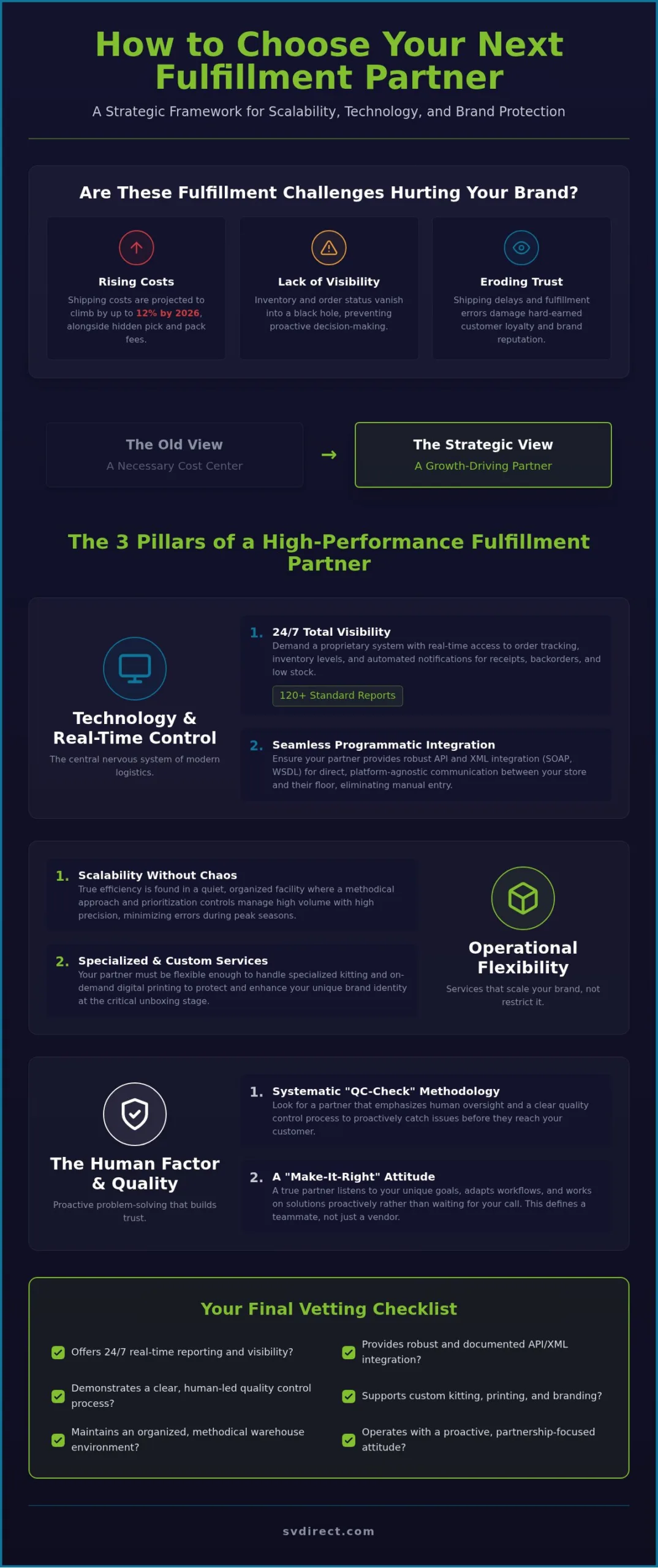
With effective shipping costs climbing by up to 12% in 2026 despite more modest headline rate increases, your logistics partner is no longer just a vendor; they’re a critical factor in your brand’s survival. You’ve likely felt the sting of hidden pick and pack fees or the anxiety that comes when inventory visibility vanishes into a black hole. Mastering how to choose a fulfillment center is about reclaiming that lost control and ensuring your 3PL acts as a steady, reliable hand during periods of rapid growth. It’s frustrating when rigid, automated systems prevent you from adding the custom branding touches your customers expect, especially when shipping delays threaten to erode hard-earned trust.

This guide provides the essential criteria for selecting a partner that operates as a seamless, high-tech extension of your company. We’ll move beyond basic warehousing to explore the technical benchmarks, proactive service models, and the Remote Control visibility you need to lead your industry. You’ll learn how to identify a partner that marries high-tech integration with high-touch precision, ensuring your operations remain organized, efficient, and ready for whatever the 2026 market demands. By the end of this guide, you’ll have a clear framework for vetting partners based on their ability to provide transparency, scalability, and personal commitment.

Key Takeaways

  • Shift your perspective to view a fulfillment partner as a strategic extension of your marketing and sales teams rather than a mere warehousing cost.
  • Ensure total operational visibility by prioritizing partners that offer 24/7 real-time reporting through proprietary systems like Remote Control™.
  • Master how to choose a fulfillment center that provides the flexibility for specialized kitting and on-demand digital printing to protect your brand identity.
  • Look for a systematic “QC-Check” methodology that emphasizes human oversight and proactive problem-solving to maintain customer trust.
  • Audit your technical needs for API and XML integration to guarantee a seamless digital connection between your store and the fulfillment floor.

Beyond Warehousing: The Strategic Role of a Fulfillment Partner

Many brands treat logistics as a simple line item on a budget. It’s time to shift that perspective. A professional Fulfillment house isn’t just a place to store boxes; it’s a strategic asset that can determine your brand’s longevity. When you’re learning how to choose a fulfillment center, you’re actually looking for a partner that acts as a seamless extension of your marketing and sales departments. This is where your digital brand promise meets the physical world.

Think about the moment a customer unboxes their order. That experience represents the final stage of your marketing funnel. If the package is messy or the items are incorrect, your marketing spend and customer acquisition efforts are wasted. A professional partner thinks outside the box of traditional supply chain strategy to ensure every shipment reinforces your reputation. Transitioning from in-house logistics to professional Silicon Valley 3PL fulfillment services marks the shift from merely surviving growth to managing it with absolute precision.

Scalability Without the Hectic Atmosphere

High-volume warehouses are often defined by chaos and noise. However, true efficiency isn’t found in a frantic pace. It’s found in a quiet, organized facility where every movement is deliberate and tracked. This methodical approach is vital when you scale. During peak seasons, a calm environment leads to significantly fewer errors and higher precision. You need a partner that uses sophisticated prioritization controls to manage tight deadlines regardless of volume. This internal stability ensures your business handles sudden surges in orders without sacrificing the quality your customers expect.

Aligning with the Nine Promises of Service

Flexibility is the cornerstone of a successful long-term partnership. Rigid, cookie-cutter procedures often fail businesses with complex needs or custom branding requirements. It’s essential to find a partner who listens to your unique goals and adapts their workflow to meet them. This human element is what differentiates a vendor from a teammate. A “make-it-right” attitude means that when challenges arise, your partner is already working on a proactive solution rather than waiting for your call. Understanding how to choose a fulfillment center means prioritizing a relationship built on these core promises of reliability, transparency, and personal commitment.

Evaluating Technology: Integration and Real-Time Control

Technology serves as the central nervous system of modern logistics. When you’re researching how to choose a fulfillment center, you’ll find that the quality of their digital interface is just as critical as the physical security of their warehouse. You need 24/7 access to order tracking and inventory levels to make informed decisions at any moment. Generic, off-the-shelf software often lacks the depth required for complex operations. This is why a proprietary system like Remote Control™ is superior. It provides over 120 standard reports, allowing you to analyze everything from shipping velocity to historical trends. You shouldn’t have to wait for a manual update. Automated notifications for receipts, backorders, and low inventory levels keep you proactive, ensuring you never miss a beat in your supply chain.

Seamless Programmatic Integration

A truly modern fulfillment partner speaks the same language as your tech team. Relying on a simple graphical user interface (GUI) is fine for occasional checks, but high-volume businesses require a programmatic interface. We utilize XML, SOAP, and WSDL to ensure platform-agnostic communication that integrates directly with your existing systems. This setup allows your developers to use specific methods like AddOrder and GetOrderInfo for real-time transaction processing. It eliminates manual data entry and reduces the risk of human error. Our Remote Order Management system is designed to act as a digital bridge between your storefront and our operational floor.

Customizing the Web Interface

Your fulfillment portal should feel like a part of your brand, not a third-party afterthought. We offer the ability to customize the web interface to match your corporate branding. This is especially valuable for B2B users or internal teams who require a “company store” look and feel. Beyond aesthetics, this interface provides the real-time inventory visibility necessary to prevent the disaster of overselling. When your digital storefront and warehouse are perfectly synced, you protect your customer trust and your bottom line. If you’re ready to see how a high-tech partnership can stabilize your growth, you can explore our customized logistics solutions today.

Operational Flexibility: Specialized Services that Scale Brands

Standard pick-and-pack models often fall short when a business requires more than just moving a box from one shelf to another. If your brand relies on complex subscription boxes or promotional kits, “cookie-cutter” solutions will likely lead to assembly errors and inconsistent presentation. When you evaluate how to choose a fulfillment center, look for a facility that excels in kitting and hand assembly. This level of operational flexibility allows you to scale without compromising the intricate details that define your brand identity. For high-value electronics or sensitive healthcare products, we provide serial number tracking to ensure every unit is accounted for throughout its entire lifecycle. Our Silicon Valley 3PL fulfillment services are built around this need for precision and bespoke problem-solving.

Integrating On-Demand Digital Printing

Integrating logistics with on-site production creates a powerful synergy that most providers ignore. We utilize HP Indigo 5500 digital presses, which use liquid ink technology rather than standard dry toner. This produces a 230 line screen resolution, delivering offset-quality results with the speed of digital production. Because these sheets are “dry-to-touch” immediately upon leaving the press, we can move them directly into kitting or assembly without the delays associated with traditional offset drying times. Our print on demand services allow you to maintain low inventory levels while ensuring your marketing materials are always current and professional.

Variable Data Printing for Personalization

Personalization is a key driver of customer retention in 2026. Variable Data Printing (VDP) enables us to print unique copy, names, or targeted offers on every individual sheet within a single production run. Imagine a customer opening a package to find a personalized insert that addresses them by name and suggests products based on their specific purchase history. This level of attention significantly enhances the unboxing experience and builds long-term loyalty. VDP is highly affordable, typically costing only slightly more than static printing. You can learn more about using these techniques to drive physical engagement in our guide to direct mail marketing services.

How to Choose a Fulfillment Center: 2026 3PL Guide

The Human Factor: Quality Control and Proactive Problem Solving

While robotics and AI dominate modern logistics headlines, the human element remains the ultimate fail-safe for brand integrity. High-performance fulfillment depends on people who are deeply committed to the outcome of every shipment. When you’re evaluating how to choose a fulfillment center, don’t overlook the culture of the warehouse floor. We employ a rigorous “QC-Check” methodology, which is a systematic inspection process that occurs at multiple points along the assembly line. This ensures that every kit and package meets your exact specifications before it’s sealed. It’s the difference between catching a mistake on the dock and hearing about it from an unhappy customer.

The physical environment of a warehouse is a direct indicator of its precision. A quiet, organized facility is a mark of operational maturity and efficiency. In chaotic, high-noise environments, errors are almost inevitable. By maintaining a calm and structured workspace, our dedicated team can focus on complex hand assembly projects with total concentration. This proactive stance allows us to identify potential issues before they become shipping delays, protecting the trust you’ve built with your audience. Proactive problem solving is always superior to reactive customer service, as it prevents the damage to your reputation before it occurs.

Anticipating Conflicts Before They Impact Projects

We prioritize a “listen first” approach to client relationships. By taking the time to understand your specific business goals, our experienced staff can anticipate conflicts that an automated system would simply miss. For example, if an order configuration appears unusual or a shipping destination seems incorrect, a human teammate will flag it for review before the label is even printed. This direct human connection is a powerful differentiator in a tech-saturated market. We explicitly reject impersonal, automated help desks, ensuring you always have a steady, wise hand guiding your logistics operations.

Sustainable and Green Fulfillment Initiatives

Sustainability is a core expectation for brands in 2026. Our green printing processes are designed to be environmentally responsible by eliminating the need for traditional film, plates, and toxic chemicals. By utilizing advanced digital technology, we significantly reduce the waste associated with overproduction. We also maintain partnerships for the responsible recycling of digital press hardware and offer 30% recycled or FSC-certified paper options. These initiatives allow you to align your physical operations with your brand’s environmental values without sacrificing the high-quality resolution your customers expect.

Final Selection: A Framework for Choosing Your 3PL

Selecting a logistics partner is one of the most consequential decisions for your brand’s operational health. This framework simplifies how to choose a fulfillment center by focusing on technical depth, physical precision, and human commitment. Moving beyond simple storage requires a partner that views your inventory as their own. By following a structured vetting process, you ensure that your 3PL acts as a steady hand during periods of rapid growth rather than a bottleneck that restricts your potential.

Start by auditing your technical requirements. A modern partner must offer programmatic interfaces like XML and SOAP to provide the 24/7 real-time reporting your team needs for data-driven decisions. Next, evaluate your specialized service needs. If your business requires intricate kitting and assembly or on-demand digital printing, a standardized vendor won’t suffice. You need a facility that integrates production and logistics under one roof. Verify their quality control procedures by asking for details on systematic inspections like our proprietary QC-Check process. Assessing the facility environment is also vital. A quiet, organized workspace is a reliable indicator of staff expertise and operational maturity. Finally, review the provider’s partnership philosophy. Ensure their values align with a model of total flexibility and bespoke problem solving.

Critical Questions for Your Potential Partner

Vetting a partner requires asking direct questions about their operational benchmarks. Inquire about their inventory accuracy rates and how their QC-Check methodology prevents systematic errors. If your brand uses high-quality marketing inserts, ask about the drying time of their printed materials. Using liquid ink technology allows for immediate handling, whereas traditional methods might extend your lead times. For brands dealing with sensitive inventory, verify if they offer serial number tracking and secure warehousing for high-value electronics. These details reveal whether a provider is truly equipped for complex, high-stakes fulfillment.

The Importance of a Silicon Valley Edge

Proximity to an innovation hub matters. Being located in a center of global connectivity impacts how a fulfillment partner leverages technology. This geographic identity serves as a symbol of innovation, ensuring your logistics strategy benefits from the same forward-thinking energy that drives the tech sector. This edge is particularly valuable when managing global shipping services, where technological integration and proactive problem solving are required to navigate international complexities. A partner rooted in an innovative environment is more likely to offer the sophisticated Remote Control visibility necessary to manage a modern, distributed supply chain with confidence.

Securing Your Brand’s Operational Future

Mastery of how to choose a fulfillment center is the difference between a business that merely survives and one that dominates its market. You’ve learned that a 3PL should be more than a warehouse; it’s a strategic extension of your team. By auditing technical requirements for 24/7 Remote Control™ visibility and prioritizing a proprietary QC-Check systematic inspection process, you protect your customer trust and your bottom line. Specialized capabilities like complex kitting and high-resolution HP Indigo digital printing allow your brand to maintain its unique identity as you scale globally.

Choosing a partner who rejects automated interactions in favor of direct human oversight ensures that your most complex projects receive the attention they require. This steady, methodical approach to logistics alleviates the stress of growth, allowing you to focus on innovation while we handle the precision of your physical operations. We remain committed to your long-term stability through proactive problem solving and operational transparency.

Building a resilient supply chain requires a partner who values precision and personal commitment as much as you do. We’re ready to provide the steady hand and innovative technology your business deserves to thrive in 2026 and beyond.

Frequently Asked Questions

How do I know if my business is ready for a fulfillment center?

You’re ready when order volume prevents you from focusing on core growth or when shipping errors start damaging customer trust. If you’re spending more than 10 to 15 hours a week on packing, it’s time to learn how to choose a fulfillment center. Outsourcing allows you to leverage expert infrastructure and professional kitting services. This transition ensures your brand maintains a steady hand during rapid expansion.

Is variable data printing expensive for personalized fulfillment?

Variable data printing (VDP) is highly cost-effective and typically costs only slightly more than static printing. It allows for unique names, offers, or images on every sheet within a single run. By integrating VDP into your fulfillment workflow, you create a high-touch unboxing experience that drives customer retention. This small investment often yields a high return by turning standard shipments into personalized marketing assets.

What is the difference between digital and offset quality in 2026?

Modern digital technology, such as the HP Indigo 5500, delivers a 230 line screen resolution that rivals traditional offset quality. Unlike older toner-based systems, liquid ink technology provides sharp details and vibrant colors. Digital printing eliminates the need for expensive plates and film, making it ideal for short runs and on-demand projects. It offers the precision of offset with the speed and flexibility required for modern logistics.

How long does it take for digital prints to be ready for shipping?

Digital prints are ready for shipping almost immediately because they are “dry-to-touch” upon leaving the press. This eliminates the lengthy drying times associated with traditional offset printing, which can delay projects by several days. Our integrated workflow allows printed materials to move directly from the press to the kitting and assembly line. This speed is essential for maintaining tight deadlines and responding quickly to market demands.

Can a fulfillment center handle complex kitting and hand assembly?

A specialized fulfillment center is specifically designed to manage intricate hand assembly and multi-item kitting projects. While automated systems handle standard orders, human expertise is required for precision tasks like subscription box assembly or promotional kits. By utilizing a systematic QC-Check methodology, we ensure every component is placed correctly. This high-touch service acts as a seamless extension of your brand’s commitment to quality and detail.

What technical standards are used for 3PL integration?

We utilize platform-agnostic technical standards like XML, SOAP, and WSDL to ensure seamless programmatic integration. These protocols allow your developers to use methods like AddOrder and GetOrderInfo for real-time transaction processing. This approach provides 24/7 visibility through our Remote Control™ system, which offers over 120 standard reports. Understanding these technical capabilities is a vital part of learning how to choose a fulfillment center for your digital brand.

How does a fulfillment center ensure inventory accuracy?

Inventory accuracy is maintained through a combination of proprietary tracking software and systematic human oversight. We use a QC-Check methodology that inspects inventory at multiple points, from receiving to final assembly. Our Remote Control™ system provides real-time visibility into stock levels, preventing the risks of overselling or unexpected backorders. This methodical approach in a quiet, organized facility ensures that your physical stock always matches your digital records.

What are the environmental benefits of digital printing in logistics?

Digital printing significantly reduces environmental impact by eliminating the toxic chemicals, film, and plates used in traditional offset methods. It supports a “print-on-demand” model, which prevents the waste of overproduction and obsolete inventory. We also offer sustainable options like 30% recycled and FSC-certified paper. These initiatives allow you to align your logistics operations with modern green standards while maintaining a high-resolution, professional brand presentation.

3PL Pricing Models: The 2026 Strategic Guide to Fulfillment Costs

3PL Pricing Models: The 2026 Strategic Guide to Fulfillment Costs

When you compare different 3pl pricing models, why does the most “competitive” quote often result in the most expensive monthly invoice your business has ever seen? It’s a common frustration for growing brands that find themselves buried under unexpected fees or paying for warehouse space they aren’t even using. You deserve a logistics partnership built on clarity rather than complex fine print. We know that unpredictable expenses make it nearly impossible to forecast your margins with confidence.

This guide helps you master the complexities of third-party logistics to ensure your fulfillment costs actually align with your operational needs. You’ll discover how to identify a structure that rewards efficiency and scales seamlessly with your seasonal peaks. We’ll examine the four primary pricing frameworks used in 2026, the data-driven systems that provide real-time visibility, and the specific factors that determine your long term ROI. By the end of this article, you’ll have the tools to choose a partner that acts as a steady hand for your business growth.

Key Takeaways

  • Identify which 3pl pricing models align with your specific growth trajectory to prevent margin creep and ensure predictable monthly expenses.
  • Uncover the reality of hidden contract fees, from technology integrations to account management, and learn how to negotiate for total transparency.
  • Explore how integrating specialized services like on-demand digital printing and precision kitting can streamline your supply chain and lower total costs.
  • Leverage high-tech visibility tools to access real-time data, allowing you to manage inventory and fulfillment with the precision of an in-house team.
  • Transition to a partnership-driven logistics model that replaces automated interactions with personal oversight and bespoke problem-solving.

What are 3PL Pricing Models? Defining the Logistics Landscape

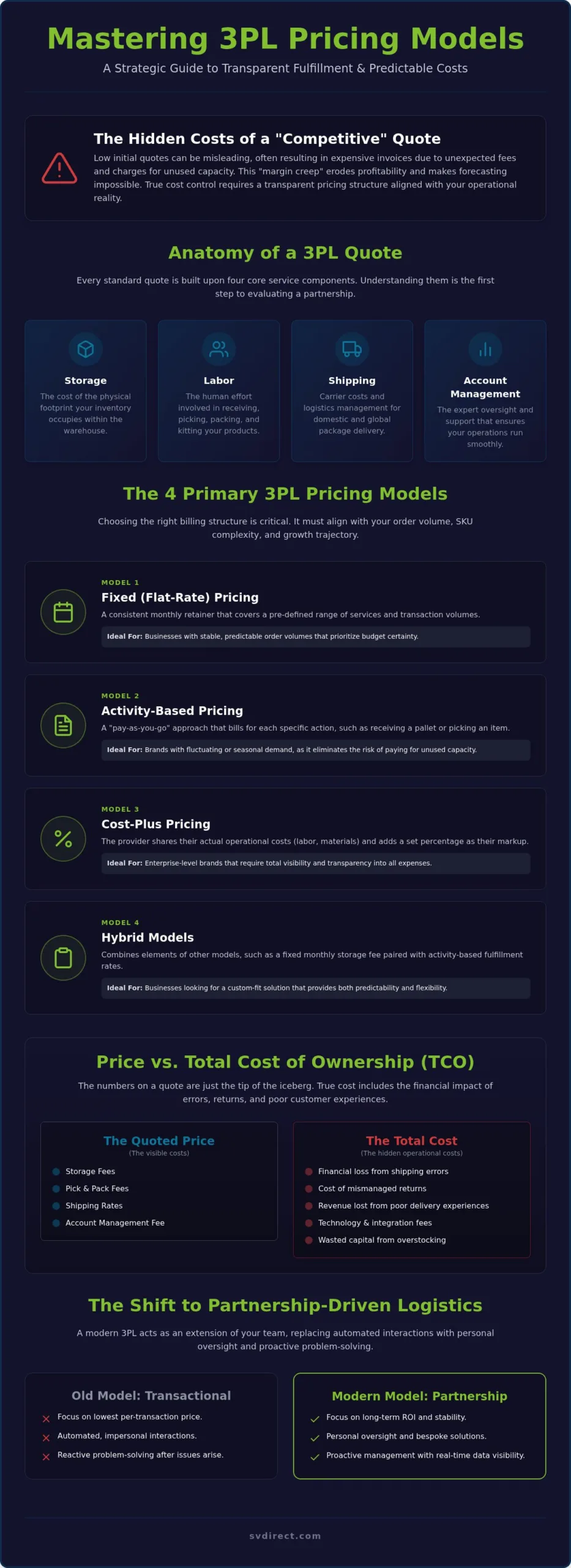
A well-defined logistics strategy depends on understanding 3pl pricing models as more than just a monthly bill. These frameworks dictate how a Third-party logistics (3PL) partner charges for labor, space, and the technical infrastructure required to manage your data. When you evaluate a quote, you’re essentially looking at a roadmap for how your partner will support your growth. Historically, these agreements were purely transactional; however, in 2026, the industry has shifted toward integrated service partnerships that prioritize long-term stability over simple pick-and-pack tasks.

Choosing the wrong 3pl pricing models often leads to “margin creep.” This happens when your logistics costs grow at a faster rate than your order volume, slowly eroding your profitability. A proactive partner helps you avoid this by ensuring the billing structure remains flexible and transparent. Every standard quote includes four core components:

  • Storage: The cost of the physical footprint your inventory occupies within the facility.
  • Labor: The human effort involved in receiving, picking, packing, and kitting.
  • Shipping: The carrier costs and logistics management for domestic and global delivery.
  • Account Management: The oversight and personal support that ensures your operations run smoothly.

The Evolution of Fulfillment Costs in 2026

Rising labor costs have fundamentally changed how activity-based pricing functions. To maintain accuracy without passing excessive costs to clients, sophisticated facilities now lean heavily on technology to reduce administrative overhead. While some providers offer “cheap” per-order rates, these often hide significant service gaps. You might save pennies on a pick fee but lose dollars through slow response times or a lack of personal oversight. We believe that efficiency is driven by a quiet, organized facility where precision is the standard rather than an add-on.

The Difference Between Price and Total Cost of Ownership

Smart operators look beyond the base price to the Total Cost of Ownership (TCO). This includes the heavy financial burden of shipping errors, mismanaged returns, and the permanent loss of customers due to poor delivery experiences. Our approach focuses on proactive problem solving to catch issues before they reach your customer. By utilizing our Remote Control™ system, you gain real-time data access that prevents overstocking and reduces waste. When your warehouse data syncs perfectly with your sales channels, you aren’t just paying for a service; you’re investing in a high-performance extension of your own team.

The 4 Primary 3PL Pricing Models Explained

Selecting from the various 3pl pricing models requires a deep understanding of your own order profiles and growth targets. It’s not merely a matter of finding the lowest per-transaction fee; it’s about aligning your billing structure with your operational reality. The complexities of logistics pricing often mean that a model that works for a low-SKU startup will become a financial burden for a high-volume enterprise. Most providers utilize one of four core frameworks to manage these costs.

  • Fixed (Flat-Rate) Pricing: You pay a consistent monthly retainer that covers a specific range of services. This model is ideal for businesses with stable, predictable volumes that prioritize budget certainty.
  • Activity-Based Pricing: This “pay-as-you-go” approach bills you for each specific action, from receiving a pallet to picking an individual item. It offers high transparency for businesses with fluctuating seasonal demand.
  • Cost-Plus Pricing: The provider shares their actual operational costs and adds a set percentage as their markup. This is frequently used by enterprise brands that require total visibility into labor and material expenses.
  • Hybrid Models: Many modern partnerships combine these elements, such as a fixed monthly storage fee paired with activity-based fulfillment rates to ensure maximum flexibility.

Activity-Based Pricing: Precision for E-commerce

Startups and rapidly scaling brands often favor activity-based structures because they eliminate the risk of paying for unused warehouse capacity. The “Pick and Pack” fee is the heartbeat of this model. It’s usually broken down into a base order fee plus a smaller charge for each additional item. To maintain accuracy, you should regularly audit these invoices against your own sales data. We’ve found that a “quiet facility” methodology, which emphasizes organized physical space and human oversight, naturally keeps these activity costs lower by reducing the time required for each task.

Fixed Rate vs. Cost-Plus: Which Scales Better?

Enterprise-level brands are increasingly moving toward cost-plus models because they remove the “black box” of traditional logistics billing. While fixed monthly retainers offer simplicity, they can lack the incentive for the provider to improve efficiency. In contrast, a cost-plus model creates a transparent partnership where both parties work to trim operational waste. We reject “cookie-cutter” constraints that force you into a rigid box. Instead, we focus on bespoke solutions that adapt as your SKU complexity grows. If you’re looking for a partner that prioritizes precision over automated templates, you can explore our logistics fulfillment services to see how a tailored approach protects your margins.

The Impact of Specialized Services on Fulfillment Costs

Standard 3pl pricing models often struggle to account for projects requiring more than just moving a box from a shelf to a carton. When your business involves intricate assembly or highly regulated materials, a “one-size-fits-all” fee structure quickly falls apart. Specialized logistics, such as healthcare mailing and literature fulfillment, require a level of precision that automated, high-volume warehouses simply aren’t built to provide. These projects demand a partnership-driven approach where costs are calculated based on the specific human oversight and technical accuracy required for success. You aren’t just paying for labor; you’re investing in a system that protects your brand’s integrity.

Integrating Print-on-Demand to Reduce Storage

One of the most effective ways to optimize your logistics budget is by eliminating the need to store massive quantities of pre-printed materials. By integrating on-demand digital printing directly into your workflow, you can significantly reduce your physical inventory footprint and the associated storage fees. We utilize the HP Indigo 5500 to produce high-resolution, offset-quality prints on a short-run basis. Unlike traditional offset printing, this technology eliminates the “drying time” delay. This allows us to move from print to pack almost instantly, ensuring your collateral is always current and relevant. You can learn more about our Print on Demand services to see how this technical capability transforms your supply chain efficiency.

Kitting and Assembly: The QC-Check Advantage

Projects involving subscription boxes, promotional kits, or multi-item bundles rely on labor-based charges that must be managed with extreme care. A common mistake in many 3pl pricing models is underestimating the human effort and quality control needed for complex assembly. We solve this through our systematic QC-Check process, which ensures every kit is inspected for accuracy before it leaves our facility. This proactive stance prevents the high cost of re-work and customer returns, which often dwarf the initial assembly fee. You can explore our kitting and assembly services to understand how precision labor protects your margins.

Choosing a partner that understands the nuances of specialized services means you’re choosing a steady hand in a fast-paced market. Whether you’re managing sensitive healthcare mailings or complex literature fulfillment, the goal is a seamless transition from data to delivery. This level of customization requires a facility that values quiet organization over chaotic volume. By prioritizing accuracy at every stage, we help you avoid the hidden costs of errors that impersonal, automated models often ignore.

3PL Pricing Models: The 2026 Strategic Guide to Fulfillment Costs

Avoiding Hidden Costs in 3PL Contracts

Many businesses fall into the trap of selecting a logistics provider based on a low per-package rate, only to realize later that their 3pl pricing models include a labyrinth of hidden surcharges. These opaque costs often appear as generic account management fees or technology maintenance line items that provide little visible value. When you partner with a logistics expert, you should expect total transparency regarding the human effort and technical infrastructure required to keep your business running. A steady hand in this industry doesn’t hide behind fine print; it leads with clarity.

Account management shouldn’t be a generic fee you pay just to talk to an automated bot. It represents the personal commitment of a seasoned professional who oversees your inventory and anticipates problems before they reach your customers. Similarly, technology and integration fees for connecting your eCommerce store should be clearly defined upfront. We reject the idea of impersonal, automated service. Instead, we favor direct human connection and personal oversight to ensure your specific operational needs are met without surprise monthly invoices.

Receiving and inbound logistics represent the hidden labor of getting products on shelves. If this process is disorganized, it leads to stockouts and lost revenue. Returns management, or reverse logistics, is another often-forgotten cost center that can erode your margins if not handled with precision. A proactive partner treats returns with the same urgency as outbound orders, ensuring items are inspected and restocked efficiently to preserve your capital. This methodical approach turns a potential loss into a recovered asset.

The Cost of Data Visibility

Opaque data is one of the most expensive hidden costs in logistics. If you can’t see your inventory in real-time, you can’t make informed purchasing or marketing decisions. We believe that 24/7 access to order history and inventory levels is a non-negotiable requirement for modern growth. Our proprietary Remote Control™ system provides 120+ standard reports without hidden surcharges. This high-tech visibility ensures you have the clarity needed to scale your operations without the stress of data gaps or administrative overhead.

Shipping and Postage Management

Shipping costs represent a massive portion of your total fulfillment spend, yet they’re often the least transparent part of a contract. A stable partner leverages discounted carrier rates to help offset other fulfillment fees, passing those savings directly to you. When managing strategic global shipping services, administrative handling of customs and international regulations must be exact. This prevents costly border delays and ensures a seamless experience for your global customers, protecting your brand’s reputation for reliability.

The Silicon Valley Direct Approach: Partnership-Driven Pricing

Many logistics providers treat your business as a series of automated tickets within a rigid system. We reject these impersonal 3pl pricing models in favor of custom-fit solutions that treat fulfillment as a strategic partnership. Since our founding in 1999, we’ve focused on being a steady hand for brands that require precision rather than just volume. Our “Nine Promises” of accountability ensure that every interaction is grounded in transparency and direct human connection. We don’t believe in “cookie-cutter” templates because your growth trajectory is unique. Instead, we offer bespoke problem-solving that anticipates conflicts before they impact your bottom line.

Our operational philosophy is built on the “Quiet Facility” methodology. While many warehouses are defined by frantic, disorganized energy, our facility operates with a methodical rhythm. This organization is a primary driver for accuracy and lower error-related costs. By maintaining a quiet, structured environment, we reduce the overhead associated with chaos and re-work. This proactive stance allows us to provide high-performance service that remains accessible and grounded, regardless of how complex your inventory becomes.

A Marriage of Technology and Human Oversight

True efficiency requires a seamless blend of high-tech capabilities and seasoned human expertise. We provide proprietary web services for XML and SOAP integration, ensuring your sales channels and warehouse data sync without friction. This technical infrastructure is managed by a dedicated, long-term staff. Our high staff retention rate acts as a unique hallmark of internal stability, providing you with project consistency that automated models can’t replicate. You can Read our Customer Testimonials to see how this personal commitment translates into long-term client success.

Scaling with Confidence

Transitioning from a startup to an enterprise-level organization requires a fulfillment partner that adapts to your changing needs. We manage high-volume deadlines and seasonal spikes without a hectic atmosphere, ensuring that your brand’s reputation for reliability remains intact. Whether you need precision kitting with our QC-Check process or high-resolution printing via the HP Indigo 5500, we provide the physical infrastructure and human oversight necessary for global reach. We invite you to collaborate with a partner that values your time and respects your margins.

Contact us for a custom fulfillment quote

Future-Proof Your Fulfillment Strategy for 2026

Mastering the complexities of 3pl pricing models ensures your business maintains healthy margins as you scale. You’ve seen how the right framework turns fulfillment from a cost center into a strategic lever for growth. Whether you require precision kitting or the liquid ink quality of our HP Indigo 5500, the goal is always a seamless transition from order to delivery.

With over 25 years of fulfillment expertise, we provide the stability your brand deserves. Our proprietary Remote Control™ system offers 24/7 data visibility, ensuring you’re never left in the dark about your inventory or expenses. We reject the impersonal nature of automated logistics in favor of a partnership built on direct human connection and bespoke problem-solving.

We look forward to helping you build a more efficient, transparent, and successful supply chain. Your business growth is our personal commitment.

Frequently Asked Questions

How much does the average 3PL charge per order?

Total order costs typically depend on your monthly volume, SKU complexity, and specific service requirements. Most 3pl pricing models calculate a base fulfillment fee for the first item, with incremental charges for each additional unit in the same carton. Variables like packaging materials and carrier surcharges also impact the final total. High-volume businesses often see lower per-order rates as they scale, moving beyond initial monthly minimums into more negotiable territory.

What is the difference between pick and pack fees and kitting fees?

Pick and pack fees cover the standard labor of retrieving a finished product and boxing it for shipment to a customer. Kitting fees are project-based charges for specialized assembly, such as bundling multiple items into a promotional set or subscription box. While picking is a routine task, kitting requires the extra oversight of our strict QC-Check process. This systematic inspection ensures accuracy for complex, multi-component projects before they leave our facility.

Are there monthly minimums for 3PL pricing?

Most mid-size logistics providers establish a monthly billing floor to cover the administrative and technical overhead of managing a dedicated account. These minimums ensure the facility can maintain a professional team and high-tech infrastructure for every client, regardless of seasonal fluctuations. For brands with steady growth, these floors provide a baseline for budget predictability while allowing for total flexibility during peak sales periods when order volumes naturally exceed the stated minimum.

How do 3PL warehousing fees work for pallet vs. shelf storage?

Pallet storage is generally charged on a per-unit basis and is ideal for bulk inventory or oversized items. Shelf and bin storage are typically calculated by the square or cubic foot, providing a more efficient solution for small, high-turnover SKUs. Your choice depends on your inventory footprint and how quickly you move through stock. Our organized “quiet facility” methodology ensures that every storage location is optimized to reduce unnecessary space costs and improve retrieval speed.

Is variable data digital printing more expensive than static printing?

Variable data printing involves a different technical setup than static printing, but it significantly reduces costs by eliminating pre-printed inventory waste. By using our HP Indigo 5500, we can produce high-resolution, customized collateral on-demand for every order. This approach prevents the need for large-scale storage of generic materials that may become outdated. The precision of liquid ink technology ensures offset-quality results for every unique piece, from healthcare mailings to literature fulfillment.

Can a 3PL help reduce my international shipping costs?

A professional logistics partner leverages high-volume carrier relationships to access discounted international rates that are difficult for individual brands to negotiate. Beyond base postage, we manage the administrative complexities of customs and global regulations to prevent border delays. This proactive oversight reduces the risk of expensive return-to-sender fees and ensures a seamless experience for your global customers. Efficient logistics management turns global shipping into a reliable growth driver rather than a financial burden.

What should I look for in a 3PL contract to avoid hidden fees?

You should look for a clear breakdown of all line items, including receiving, storage, pick and pack, and account management. Be wary of generic “technology fees” that don’t specify the level of data access provided. Transparent 3pl pricing models should explicitly state how returns, kitting projects, and carrier surcharges are handled. We prioritize direct human connection over automated bots to ensure every contract detail is understood and aligns with your business growth.

How does real-time inventory tracking impact my fulfillment costs?

Real-time tracking through our proprietary Remote Control™ system prevents the hidden costs of overstocking and missed sales opportunities. By accessing 120+ standard reports, you gain the clarity needed to manage inventory levels with precision. This data visibility reduces administrative overhead and allows you to make informed purchasing decisions based on actual warehouse data. Seamless integration between your sales channels and our facility ensures that your fulfillment expenses remain predictable and highly efficient.

3PL Silicon Valley: The 2026 Strategic Guide to High-Tech Fulfillment

3PL Silicon Valley: The 2026 Strategic Guide to High-Tech Fulfillment

Why do 78% of shippers in 2026 prioritize service quality and visibility over the lowest price when choosing a logistics partner? It’s because you know that a missed delivery or a kitting error isn’t just a line item; it’s a fractured relationship with your customer. Scaling a brand requires more than just shelf space. It demands a 3PL Silicon Valley partner that operates with the same precision and urgency as your own internal team. You’ve likely experienced the stress of losing visibility into real-time stock levels or watching shipping delays impact your retention rates during a critical launch.

We understand that your fulfillment process should be a quiet, organized engine of growth rather than a source of daily friction. This guide provides a strategic roadmap to mastering modern logistics through a tech-first approach to warehousing, kitting, and global order fulfillment. You’ll learn how to achieve seamless integration between your storefront and the warehouse floor while maintaining zero-error standards for complex assembly projects. We’ll examine the methodologies that allow for scalable global shipping rates and a transparent, data-driven partnership that keeps you in control of your inventory 24/7.

Key Takeaways

  • Leverage proprietary data management tools to maintain 24/7 visibility into inventory levels and real-time order history.
  • Combine on-demand digital printing with kitting and assembly to create a more efficient, just-in-time fulfillment strategy.
  • Recognize the operational signs that indicate it’s time to scale your brand with a professional 3PL Silicon Valley partner.
  • Optimize global shipping and B2B distribution by utilizing data-driven management to improve deliverability and customer satisfaction.
  • Transition from reactive logistics to a proactive partnership where human expertise serves as a seamless extension of your company.

The Silicon Valley 3PL Standard: Precision in 2026

The Silicon Valley ethos has always been about more than just software. In the logistics sector, it represents a standard of precision that moves beyond simple storage. A 3PL Silicon Valley partner isn’t just a place to keep boxes; it’s an operational headquarters where technology meets physical movement. While many warehouses are defined by a state of constant, hectic motion, the 2026 standard prioritizes a quiet, organized facility. This deliberate methodology ensures that every action is intentional, reducing the errors that typically plague high-velocity shipping environments.

Today, Third-party logistics (3PL) has evolved into a marriage of sophisticated technology, personalized customer service, and marketing execution. We’ve moved past the era of “commodity shipping” where providers were chosen solely on the lowest price per pallet. For national brands, the focus has shifted toward strategic partnerships that can anticipate bottlenecks before they happen. Proactive problem solving is the hallmark of this standard. Instead of reacting to a backorder, a modern partner uses integrated data to flag low inventory levels before they impact your storefront.

Beyond Warehousing: The Tech-Driven Logistics Model

The integration of business logic and physical processes is no longer optional. Modern fulfillment centers now utilize programmatic interfaces that allow your eCommerce platform to communicate directly with warehouse management systems. This shift ensures that data flows in real-time without manual intervention. By prioritizing these tech-driven workflows, we eliminate the friction between your digital sales and physical delivery. A professional 3PL is a strategic business extension rather than a vendor.

Why Innovation-Hub Standards Matter for National Brands

National brands face unique pressures that require more than just a standard shipping label. Managing high-volume deadlines requires a provider capable of handling complex Silicon Valley 3PL Fulfillment Services without adding operational drag. Flexibility is the key differentiator here. Rigid, cookie-cutter procedures often fail when a brand needs to pivot for a promotional launch or a sudden surge in demand. By adopting a “just-in-time” philosophy and leveraging advanced data management, we provide the stability needed to scale without the hidden costs of in-house logistics.

Seamless Integration and the Remote Control™ Advantage

Visibility is the bedrock of a high-functioning supply chain. In the fast-moving 2026 market, waiting for a weekly spreadsheet is no longer a viable strategy. A premier 3PL Silicon Valley partner provides 24/7 visibility into order histories and real-time inventory levels, ensuring you’re never making decisions based on outdated data. This transparency allows your team to react instantly to market shifts, whether you’re managing a sudden viral product launch or coordinating a complex international restock. Automated notifications for low inventory, receipts, and backorders act as a fail-safe, preventing the supply chain gaps that often lead to lost revenue and customer dissatisfaction.

Proprietary Remote Control™: Total Visibility

Our proprietary Remote Control™ system serves as the digital heart of our operation. It provides clients with more than just a window into the warehouse; it offers an exhaustive toolkit for data-driven management. You can generate over 120 standard reports in real-time, covering everything from SKU velocity to detailed shipping manifests. This level of Remote Order Management is designed for IT teams and developers who require programmatic access to their data at any hour. It’s a stable, robust environment that treats your data with the same care we treat your physical inventory.

API and Web Service Integration for eCommerce

Modern fulfillment requires a seamless bridge between your storefront and our facility. We utilize platform-agnostic web services, including XML, SOAP, and WSDL, to ensure your systems talk to ours without friction. By utilizing standardized supply chain technology, we significantly reduce custom coding time and technical overhead. Our integration methods, such as the AddOrder and GetOrderInfo calls, allow for precise data tagging and order tracking. This technical foundation is essential when coordinating domestic and international logistics, as detailed in our Global Shipping Services: The Strategic Reference Guide for 2026.

Customization extends beyond data protocols to the user experience itself. We can tailor web interfaces to match your corporate branding or specific company stores, creating a unified experience for your internal stakeholders. This ensures that the tools you use every day feel like a natural part of your brand identity rather than a third-party add-on. If you’re ready to see how these integrations can streamline your specific workflow, you can request a free quote to discuss your technical requirements. By prioritizing these high-tech integrations, we help you maintain total control over your brand’s physical footprint.

Specialized Fulfillment: Kitting, Assembly, and On-Demand Printing

Integrating high-end digital printing directly into the fulfillment workflow creates a powerful “just-in-time” strategy that traditional logistics models can’t replicate. Instead of ordering thousands of brochures that sit on a shelf and eventually become outdated, you can print exactly what you need, exactly when you need it. This is the standard expected of a top-tier 3PL Silicon Valley provider. We utilize Variable Data Digital Printing (VDP) to personalize marketing collateral for individual recipients, ensuring your brand message is always current and relevant. This approach reduces waste and ensures that your fulfillment process is as lean as it is precise.

The Digital Printing Edge: Quality Meets Speed

The HP Indigo 5500 provides a distinct advantage through its use of real liquid ink technology. While most digital printers use dry toner that can look flat or artificial, our liquid ink process achieves a 230 line screen resolution that mirrors the depth and quality of traditional offset printing. This high-fidelity output is essential for brands that refuse to compromise on their visual identity. Because the press sheets are dry-on-exit, they move instantly from the press to the assembly line. This speed is a critical component of our Print On Demand service, allowing us to fulfill orders with a level of responsiveness that keeps your customers engaged.

Custom Kitting and the QC-Check Process

Accuracy in the final assembly is the ultimate test of a fulfillment partner. Our systematic QC-Check process involves a rigorous inspection at every stage of the kitting cycle. We handle complex projects, ranging from software and clothing to intricate promotional kits, with a level of deliberate care that eliminates the chaos found in high-volume, error-prone warehouses. This methodology is especially vital for managing multi-component distributions, such as rebate redemptions or point-of-purchase (POP) displays for retail environments. By maintaining a quiet, organized facility, we ensure that every hand-assembled kit meets your exact specifications. To learn more about how we optimize these complex workflows, read our Kitting and Assembly Services: The Strategic Guide to 3PL Efficiency in 2026.

3PL Silicon Valley: The 2026 Strategic Guide to High-Tech Fulfillment

Strategic Scaling: Transitioning from In-House to Professional 3PL

Transitioning from managing an in-house warehouse to partnering with a professional 3PL Silicon Valley provider is a defining moment for a growing brand. It’s often prompted by the realization that inventory management is no longer a supporting task but a primary source of operational friction. When your internal capacity is outpaced by order volume, the hidden costs of in-house logistics begin to surface. These aren’t just limited to warehouse rent; they include the escalating costs of labor, the maintenance of complex software stacks, and the opportunity cost of redirected executive focus. A strategic 3PL Silicon Valley partnership treats fulfillment as a brand extension rather than a simple cost center, utilizing proactive problem solving to prevent conflicts before they impact your projects.

Identifying the Breaking Point of In-House Logistics

Seasonal spikes and major product launches are the ultimate stress tests for internal teams. If a promotion leads to a week of frantic troubleshooting instead of celebratory growth, you’ve reached a critical breaking point. The move from a hectic, reactive internal environment to a methodical, organized external facility is transformative. External methodology brings a level of discipline that’s difficult to maintain in-house without massive capital investment. Many brands find that this shift allows their core team to return to high-level strategy. You can see the impact of this transition in our Customer Testimonials, where we detail how brands regained their momentum by offloading the burden of physical distribution.

Evaluating a 3PL Partner: The Nine Promises Framework

Choosing a partner requires a framework that goes beyond price per square foot. Our “Nine Promises” framework is built on the pillars of listening, accountability, and innovation. We believe that trust is earned through transparency and the flexibility to adapt to your specific requirements. Rigid, automated procedures often fail when faced with unique business challenges; therefore, we prioritize human oversight and direct communication. This approach ensures that we remain a steady hand as you scale across different Industries Served. By valuing innovation over stagnant processes, we provide a stable platform for your national or global expansion.

Global Logistics with a Sustainable Foundation

Expanding your brand’s reach from a regional presence to a global powerhouse requires a 3PL Silicon Valley partner that understands the nuances of international distribution. Whether you’re managing high-volume B2C eCommerce orders or complex B2B wholesale shipments, the logistics must be handled with surgical precision. This involves more than just moving boxes; it requires meticulous administrative coordination and a deep understanding of global shipping regulations. By leveraging our established carrier relationships, we provide access to discounted shipping rates that help you maintain healthy margins as you scale. This global connectivity is a core component of our Silicon Valley 3PL Fulfillment Services, ensuring your products reach their destination efficiently regardless of the border.

National Distribution and Global Shipping Coordination

Precision in global distribution is maintained through advanced tracking methodologies, such as serial number logging. This level of detail allows us to account for every single unit in your inventory, providing the transparency needed for high-stakes electronics or healthcare products. We also recognize that physical engagement remains a vital part of your marketing mix. Our database management tools ensure that your direct mail campaigns have the highest possible deliverability rates by scrubbing and optimizing mailing lists. For a deeper look at how we merge logistics with physical outreach, explore our Direct Mail Marketing Services: The Strategic Guide to Physical Engagement in 2026.

Sustainability as a Standard

In 2026, operational efficiency must go hand-in-hand with environmental responsibility. Our approach to 3PL Silicon Valley services prioritizes sustainable practices that reflect your brand’s commitment to the future. Digital printing serves as a significantly greener alternative to traditional offset methods. By eliminating the need for films, plates, and harsh chemicals, we reduce the environmental footprint of every marketing piece we produce. Our facility utilizes the HP Indigo press, which is supported by a responsible hardware recycling program to ensure that equipment doesn’t end up in landfills.

We offer a variety of eco-friendly materials, including FSC-certified papers and options for 30% recycled content, without sacrificing the high-resolution quality your brand demands. These green initiatives aren’t just an afterthought; they’re a core part of our commitment to innovation and deliberate methodology. By choosing a partner that values both high-tech performance and environmental stewardship, you ensure that your brand’s growth is both scalable and responsible. This sustainable foundation allows you to meet the expectations of modern consumers while maintaining the precision that defines our operational history.

Scale Your Global Reach with Operational Excellence

Mastering the complexities of 2026 logistics requires more than just a warehouse; it demands a partner that functions as a seamless extension of your brand. We’ve explored how real-time data visibility through our proprietary Remote Control™ system and the offset-quality precision of HP Indigo 5500 liquid ink technology can transform your fulfillment from a cost center into a strategic advantage. Whether you’re navigating complex kitting projects or coordinating global shipping, the right 3PL Silicon Valley partner provides the stability needed to grow without operational friction.

Our team brings over 27 years of experience to every project, ensuring that your inventory management and distribution are handled with deliberate care. By choosing a partner that values human connection over automated scripts, you gain a steady hand in a fast-paced industry. You don’t have to manage the stress of growth alone when you have a partner dedicated to your long-term success.

The future of your brand’s physical presence is built on the precision of your logistics today. We’re ready to help you master these complexities and reach your customers with zero-error accuracy.

Frequently Asked Questions

What is the difference between digital and offset quality in fulfillment?

Digital printing, specifically using HP Indigo 5500 liquid ink, achieves offset quality with a 230 line screen resolution. Unlike standard digital toner, liquid ink provides richer depth and sharper detail. This technology allows for small-batch runs that look identical to high-volume offset projects. It’s the ideal solution for brands that need premium marketing materials without the overhead of massive print runs or long setup times.

How long does it take for digital prints to be ready for shipping?

Digital prints are ready for shipping almost immediately because the press sheets are dry-on-exit. This eliminates the waiting time required for traditional ink drying or specialized coatings. By integrating printing directly into the fulfillment workflow, we can move from press to assembly in minutes. This speed is a critical component of a responsive 3PL Silicon Valley strategy, allowing for rapid turnaround on promotional launches and time-sensitive materials.

Is variable data printing more expensive than static printing?

While the per-unit cost of variable data printing (VDP) might be higher than high-volume static runs, it’s often more cost-effective when considering total ROI. VDP allows for personalized marketing collateral that significantly increases engagement rates. You don’t have to worry about obsolete inventory sitting on shelves, as you only print what’s needed for specific campaigns. This targeted approach reduces waste and ensures your budget is spent on high-impact materials.

What is a “QC-Check” in the kitting and assembly process?

A QC-Check is our systematic inspection process designed to ensure zero-error accuracy in complex kitting and assembly projects. Each kit undergoes a multi-stage verification to confirm that every component, from software to promotional items, is present and correctly placed. This methodical approach is essential for high-stakes distributions where a single error can damage brand reputation. It’s a deliberate safeguard that reflects our commitment to precision.

Can I integrate my existing eCommerce store with a 3PL system?

Yes, we utilize platform-agnostic web services like XML, SOAP, and WSDL to ensure seamless integration with your existing storefront. These programmatic interfaces allow for real-time data tagging and automated order processing without manual intervention. By bridging the gap between your digital sales and our physical operations, we create a unified workflow. This technical foundation is a hallmark of a high-performance 3PL Silicon Valley partner.

How does real-time inventory tracking prevent backorders?

Real-time inventory tracking provides 24/7 visibility into stock levels, allowing you to set automated notifications for low inventory. By receiving alerts before a SKU reaches zero, your team can proactively restock or adjust marketing efforts. This transparency prevents the supply chain gaps that lead to backorders and frustrated customers. Our Remote Control™ system offers over 120 reports to help you maintain a steady, reliable flow of goods.

What are the benefits of using a 3PL located in a technology hub like Silicon Valley?

A Silicon Valley location places your fulfillment at the center of global innovation and connectivity. It provides access to a workforce that understands high-tech standards and technical integration. This geographic identity serves as a symbol of precision and efficiency, mirroring the standards of the world’s leading tech brands. Beyond the prestige, it offers logistical advantages for reaching both national and international markets through highly developed infrastructure and carrier networks.

What industries benefit most from specialized healthcare mailing and literature fulfillment?

Industries like medical device manufacturing, pharmaceuticals, and insurance benefit significantly from specialized healthcare mailing. These sectors require high levels of accuracy, compliance, and data security when distributing sensitive information or product literature. Similarly, educational institutions and corporate training departments rely on literature fulfillment to manage complex document distributions. Our methodical approach ensures that these specialized materials reach the correct recipients with absolute precision and professional presentation.

Heavy Item eCommerce Fulfillment: 2026 Logistics Guide

Heavy Item eCommerce Fulfillment: 2026 Logistics Guide

Did you know that shipping costs for heavy or oversized products now consume up to 22% of total revenue for many brands? With major carriers like UPS and FedEx implementing aggressive 5.9% general rate increases for 2026, the margin for error has never been thinner. If you’re struggling with oversized item surcharges or high damage rates, you’re certainly not alone. Finding the right approach to ecommerce fulfillment for heavy items often feels like an uphill battle against rising fees and complex logistics.

We understand that shipping large goods isn’t just about moving weight; it’s an engineering challenge that requires precision and a steady hand. This 2026 guide is designed to help you navigate these complexities while protecting your bottom line and your customer’s experience. We’ll explore how to achieve predictable fulfillment costs, reduce damage claims through better kitting, and stay compliant with the latest OSHA safety standards for warehouse operations. By the end, you’ll have a clear roadmap for scaling your heavy-goods operations with confidence and expert-level precision.

Key Takeaways

  • Identify the physical infrastructure requirements, such as specialized floor load capacities and industrial racking, necessary to prevent bottlenecks in heavy goods storage.
  • Avoid the “DIM weight trap” by mastering the 2026 volumetric surcharge triggers that impact ecommerce fulfillment for heavy items.
  • Assess the hidden financial and safety liabilities of in-house heavy item handling, from specialized equipment costs to increased workers’ compensation risks.
  • Implement a rigorous QC-Check process and integrated digital printing to ensure manual accuracy and reduce damage claims for complex, oversized kits.
  • Leverage high-tech visibility tools like the Remote Control™ system to maintain real-time oversight of large-scale inventory and global shipping logistics.

The Logistics of Scale: Why Heavy Item Fulfillment Demands a Specialized Strategy

Heavy item fulfillment is an engineering challenge that extends far beyond simple storage. In 2026, the ecommerce landscape has shifted, with carriers like UPS and FedEx implementing cubic volume triggers that redefine what “heavy” actually costs. Effective ecommerce fulfillment for heavy items requires a departure from the traditional high-speed pick-and-pack models designed for small parcels. Those standard models often fail because they lack the specialized infrastructure, such as reinforced industrial racking and high-capacity forklifts, needed to handle goods that exceed typical human lifting limits.

Success in this niche depends on sophisticated logistics management. When products weigh 75 or 100 pounds, the physical constraints of a warehouse change. Floor load capacities must be certified for dense, concentrated weight. A “quiet facility” approach, which focuses on methodical precision rather than frantic speed, ensures that these massive goods are moved without compromising warehouse safety or product integrity. This level of care is vital for maintaining brand trust, as customers expect their high-value, oversized purchases to arrive in pristine condition.

The Threshold of ‘Heavy’: Parcel vs. Freight

Carriers have set clear boundaries for 2026. “Additional Handling” surcharges now typically trigger at 50 lbs or when the longest side exceeds 48 inches. While standard parcel networks can technically handle up to 150 lbs, it’s often more economical to transition to Less-Than-Truckload (LTL) shipping much earlier. LTL offers better protection for bulky items, though it requires specialized loading docks and mechanical handling protocols. Safety isn’t optional; handling items over 50 lbs manually increases workers’ compensation risks, making mechanical assistance an operational necessity.

Common Challenges in Large-Scale Fulfillment

Managing heavy goods introduces unique risks that can erode profit margins. High-value, heavy items face significantly higher damage rates during transit if they aren’t secured with specialized kitting and bracing. Precision in the initial workflow is the only way to protect margins when the cost of a single mistake can reach hundreds of dollars.

  • Transit Damage: Heavy items generate more kinetic energy during movement. Standard cardboard packaging often fails, requiring custom crating or reinforced pallets to ensure stability.
  • White Glove Delivery: Many oversized items require room-of-choice delivery or light assembly. This adds layers of coordination that standard couriers don’t provide.
  • The Return Nightmare: Reverse logistics for a 120-pound item can cost three times the original outbound shipment. Reducing return rates through accurate kitting is essential.

Calculating the Load: Dimensional Weight, Freight, and Heavy Goods Storage

In 2026, the financial viability of shipping large goods depends on mastering the math behind the movement. Many brands focus solely on the physical scale, yet the true “trap” in ecommerce fulfillment for heavy items often lies in the volume. Carrier surcharges have become increasingly complex, moving beyond simple weight to include cubic volume triggers. If your packaging isn’t optimized, you’re essentially paying premium rates to ship air. Precision in this area is the difference between a scalable operation and one that erodes your profit margins with every shipment.

Strategic warehousing also plays a critical role in cost control. Heavy items shouldn’t be stored in high-reach racking unless the infrastructure is specifically rated for those loads. Utilizing floor-level storage or heavy-duty industrial shelving at the base level improves accessibility and reduces the time required for mechanical picking. This methodical approach to storage prevents the “bottleneck” effect that often occurs when standard warehouses try to force oversized goods into a high-velocity parcel workflow. It’s about creating a “quiet facility” environment where every movement is intentional and safe.

Dimensional Weight vs. Actual Weight

In 2026, major carriers like USPS, UPS, and FedEx utilize a dimensional weight divisor of 139 for packages larger than one cubic foot. This means a relatively light but bulky item can be billed at a much higher weight than its physical reality. Choosing the correct box size is the most effective way to protect your margins. To maintain packaging standards for heavy items, you’ve got to eliminate void space which compromises structural integrity and increases volumetric costs. When moving to LTL, the physics of palletization becomes the priority. Maximizing density on a single pallet reduces the number of handling units and lowers your overall freight spend.

“Over Maximum” and “Additional Handling” fees are no longer just penalties; they’re significant revenue drivers for carriers. In 2026, “Additional Handling” surcharges typically apply to packages over 50 lbs, while “Oversize” penalties can range from $75 to $150 per package. These costs are often avoidable through strategic kitting or by shifting the shipment to an LTL network. By auditing your SKU dimensions against carrier thresholds, you can proactively redesign packaging to stay below these expensive triggers.

Freight Class and NMFC Codes

Correctly classifying your shipments is the difference between a profitable quarter and a series of expensive carrier re-bills. National Motor Freight Classification (NMFC) codes are determined by density, stowability, handling, and liability. In 2026, carriers are more aggressive with inspections; an incorrect class can lead to significant retroactive charges. Understanding the relationship between product density and shipping rates allows you to package goods in a way that drops them into a more favorable freight class. Leveraging a partner’s established carrier relationships can often secure better LTL pricing than a single brand could negotiate independently. If you’re looking to audit your current shipping profile for hidden savings, you might want to consult with a logistics expert to see where your density can be improved.

The Hidden Costs of In-House Heavy Fulfillment vs. Professional 3PL Solutions

Many brands assume that managing heavy goods in-house will save money, but they often overlook the secondary costs that accumulate quickly. Managing ecommerce fulfillment for heavy items requires more than just extra square footage. It demands significant capital investment in specialized equipment and high-capacity infrastructure. When you factor in the maintenance of industrial machinery and the rising cost of warehouse labor, the “do-it-yourself” model often becomes a financial burden rather than a benefit.

Scale is the primary driver of this complexity. In 2026, the national average for 3PL warehouse storage is approximately $1.73 per square foot per month. For brands managing fewer than 5,000 pallets, leasing a private warehouse and staffing it with specialized handlers is rarely cost-effective. Professional providers offer the advantage of shared infrastructure, allowing you to access high-tier logistics capabilities without the heavy upfront expenditure.

Infrastructure and Equipment Requirements

Maintaining a safe and organized facility for heavy goods involves strict adherence to safety standards. Standard pallet jacks and light-duty racking aren’t sufficient for loads that often exceed 150 pounds. You need industrial-grade forklifts and racking systems certified for concentrated floor-load capacities. OSHA is currently operating a National Emphasis Program for Warehousing through mid-2026, which focuses specifically on material handling and powered industrial vehicles. Our “quiet, organized facility” methodology ensures that your products are handled in a controlled environment that prioritizes precision over frantic speed, significantly improving accuracy for complex orders.

Labor risks also represent a massive hidden liability. Handling heavy items increases workers’ compensation risks and insurance premiums. Professional 3PLs mitigate these risks through rigorous training and mechanical assistance protocols that many smaller in-house operations can’t sustain. This proactive stance on safety protects your brand from the reputational and financial fallout of workplace accidents.

The Partnership Advantage

A professional logistics provider should act as a steady hand and an extension of your internal team. This isn’t a mere transaction; it’s a partnership grounded in collective experience and proactive problem-solving. In the fast-paced 2026 market, having a partner that anticipates logistics puzzles before they impact the customer is invaluable. Our customer testimonials reflect the stability that comes from these long-term relationships. By using advanced technology like the Remote Control™ system, you gain 24/7 visibility into your inventory, bridging the technology gap that often hampers in-house operations. This level of transparency ensures that even the most complex heavy-item workflows remain predictable and scalable.

Heavy Item eCommerce Fulfillment: 2026 Logistics Guide

Building a Robust Heavy Item Workflow: Security, Kitting, and Carrier Management

Executing successful ecommerce fulfillment for heavy items requires a meticulous workflow that treats every shipment as a high-stakes engineering project. When you’re dealing with multi-part kits or sensitive industrial equipment, the margin for error is non-existent. A single missing component in a 150-pound assembly doesn’t just result in a customer complaint; it triggers a logistical nightmare involving expensive reverse freight and potential field service visits. We focus on a proactive QC-Check process that verifies every element of a heavy shipment before it ever leaves the dock. This methodical oversight is particularly critical for high-value electronics or medical equipment, where security and precision are the primary benchmarks of success.

Our approach integrates physical handling with digital precision. By combining secure warehousing with advanced tracking, you maintain total visibility over inventory that’s too large for standard automated sorting. This specialized care ensures that high-value assets are protected from the moment they’re received until they reach the final destination. It’s a steady, reliable system designed to alleviate the stress of managing complex, oversized orders.

Custom Kitting and Assembly for Heavy Goods

Kitting heavy goods is a strategic way to reduce shipping volume and protect profit margins. By using specialized kitting and assembly services, you can consolidate parts into denser, more secure packages that are less prone to transit damage. This process also allows for the seamless integration of print-on-demand product manuals and documentation. Instead of storing thousands of pre-printed, bulky manuals, we print them as needed, ensuring that every heavy equipment shipment includes the most up-to-date technical literature without adding unnecessary weight or clutter to your inventory.

Carrier Management and Global Reach

The “Last Mile” for heavy items is often the most complex phase of the journey. Standard couriers often can’t provide the specialized services required for oversized goods, such as liftgates or inside delivery. In 2026, navigating these accessorial fees is essential, as residential LTL deliveries can incur significant surcharges that diminish the 50-70% savings typically found when shipping heavy items via freight. Our team vets carriers specifically for their ability to handle heavy specialty items, ensuring they have the right equipment and training for a professional delivery experience. For brands with international ambitions, our global shipping services guide provides a roadmap for managing the complexities of cross-border trade for heavy equipment, from customs compliance to international freight coordination.

Precision at Scale: How Silicon Valley Direct Optimizes Heavy eCommerce Logistics

Silicon Valley Direct (SVD) has redefined ecommerce fulfillment for heavy items by blending physical infrastructure with high-tech oversight. Our facility in Union City, California, serves as a hub of innovation, allowing us to integrate seamlessly with the digital ecosystems of our clients. We reject the hectic, disorganized atmosphere common in many large-scale warehouses. Instead, we maintain a “quiet facility” where precision is the priority. This methodical environment is essential for handling heavy, complex goods that require careful manipulation rather than rushed movement.

Our operational history, spanning over two decades, is anchored by SVD’s ‘Nine Promises.’ These aren’t just marketing abstractions; they’re operational standards that ensure reliability for every high-stakes shipment. By prioritizing human connection and personal oversight, we provide a level of stability that automated-only providers simply can’t match. Whether you’re a scaling startup or an established enterprise, our infrastructure is designed to grow with you without sacrificing the accuracy of your heavy-goods logistics. This steady approach allows you to scale without the operational friction that typically accompanies increased weight and volume.

Real-Time Data and Reporting

Visibility is often the biggest hurdle in heavy item logistics, especially when transitioning from parcel to LTL networks. Our proprietary Remote Control™ system provides 24/7 visibility into your inventory, offering over 120 standard reports that can be customized to your specific needs. Through remote order management, you can monitor low inventory levels and track backorders in real-time. This system uses XML/SOAP integrations to ensure a seamless flow of data between your eCommerce platform and our warehouse, providing accurate transit times for even the most oversized shipments. This level of technical sophistication allows you to manage heavy inventory with the same ease as small parcel goods.

Your Partner in Heavy Item Growth

We don’t believe in cookie-cutter solutions for heavy item challenges. Every product has unique requirements, from specialized kitting needs to specific carrier coordination. A true partnership understands the intersection of digital technology and physical kitting precision. We act as a steady hand, alleviating the stress of business growth through personal commitment and operational excellence. Our team projects the personality of a seasoned expert who remains at the cutting edge of innovation, ensuring your logistics are handled by people who respect your time and your brand’s reputation. If you’re ready to move beyond impersonal business models and optimize your logistics, request a free quote for your heavy item fulfillment today. Our team is ready to help you master the complexities of heavy-goods shipping with confidence.

Scale Your Heavy Goods Strategy with Precision

Mastering the complexities of ecommerce fulfillment for heavy items requires a shift from standard parcel thinking to a methodical, engineering-first approach. We’ve discussed how specialized infrastructure and density-focused palletization protect your margins against the aggressive carrier surcharges of 2026. By moving away from hectic in-house models and leveraging a partner with dedicated heavy item kitting and assembly teams, you ensure that even the most complex oversized shipments reach their destination without damage or delay.

Our commitment to precision is backed by a systematic QC-Check process that maintains a 99.9% order accuracy rate. Combined with 24/7 real-time inventory access through the Remote Control™ system, you gain the visibility needed to scale with informed confidence. You deserve a logistics partner that acts as a steady hand, providing the physical strength and digital intelligence required for modern heavy-goods shipping.

The future of your brand depends on reliable logistics that respect your time and your customer’s experience. We’re ready to help you turn these logistical challenges into a distinct competitive advantage.

Frequently Asked Questions

Is eCommerce fulfillment more expensive for heavy items?

Yes, fulfilling heavy items is generally more expensive due to the specialized infrastructure and equipment required. Shipping costs for products over 5 lbs typically account for 12% to 22% of revenue, compared to 8% to 14% for lighter goods. These expenses stem from higher storage fees for floor-level space, the need for industrial forklifts, and aggressive carrier surcharges that penalize both weight and cubic volume.

Can a 3PL handle LTL shipping for my eCommerce store?

A specialized 3PL can certainly manage Less-Than-Truckload (LTL) shipments to bridge the gap between parcel and freight. This is often the most economical choice for items exceeding 150 lbs or 108 inches in length. By leveraging established carrier relationships, a 3PL secures better rates and manages the complex documentation required for freight transport, ensuring your large-scale orders move through the supply chain with precision.

How much does it cost to ship items over 50 lbs?

While base rates depend on distance, packages over 50 lbs generally trigger “Additional Handling” surcharges in 2026. These fees typically range from $25 to $40 per package. For even larger items where length plus girth exceeds carrier thresholds, “Oversize” penalties can reach between $75 and $150. Auditing your SKU dimensions regularly is essential to avoid these expensive triggers and protect your profit margins.

What happens if a heavy item is damaged during fulfillment or shipping?

Transit damage is a significant risk because heavy items generate more kinetic energy during movement. If damage occurs, a professional partner uses documented QC-Check processes to determine where the failure happened. Reducing these claims requires methodical kitting and reinforced packaging. We prioritize precision in our quiet facility to minimize handling errors before the product ever reaches the carrier, protecting both your inventory and brand reputation.

What is the best way to package heavy items for eCommerce?

The most effective strategy for ecommerce fulfillment for heavy items involves custom kitting and reinforced materials. You should eliminate void space to maintain structural integrity and prevent shifting during transit. For items over 150 lbs, palletization is the industry standard. This protects the product from the rigors of the freight network and ensures mechanical equipment can move the item safely without manual lifting risks.

Can you provide white-glove delivery for heavy eCommerce orders?

Specialized 3PLs coordinate with carriers that offer white-glove services, including room-of-choice delivery and light assembly. While standard parcel networks have a practical limit of 150 lbs, freight partners can manage the final mile for much heavier goods. This service is vital for building customer trust when delivering high-value items like medical equipment or industrial machinery, ensuring the product is handled with care at the destination.

How does kitting help reduce the cost of shipping heavy items?

Kitting allows you to consolidate multiple components into a single, denser package, which can lower your overall dimensional weight. By optimizing the shape and volume of the shipment, you can often stay below the 2026 volumetric surcharge triggers. This process also enables the inclusion of on-demand digital printing for manuals, which reduces the need to store bulky, pre-printed documentation and keeps the total package weight as low as possible.

Is my heavy inventory secure in a 3PL warehouse?

Security for heavy inventory relies on specialized racking and certified floor load capacities. High-value heavy goods are monitored through real-time systems like Remote Control™, providing 24/7 visibility. Unlike standard facilities that may struggle with oversized items, a dedicated 3PL uses industrial-grade shelving and methodical handling protocols to ensure that inventory remains stable and protected from environmental or mechanical damage throughout its stay in the facility.

Medical Device Fulfillment Services: A Strategic Guide to Compliance and Precision in 2026

Medical Device Fulfillment Services: A Strategic Guide to Compliance and Precision in 2026

A single inventory error in the medical device industry isn’t just a logistics failure; it’s a direct threat to patient safety and your regulatory standing. With the FDA Quality Management System Regulation (QMSR) now fully effective as of February 2, 2026, the margin for error has vanished. You likely feel the constant pressure of maintaining perfect lot tracking while managing the mandatory EUDAMED registrations that became a requirement in May. It’s a high-stakes environment where slow shipping or a missing serial number can halt operations and trigger costly compliance audits.

Finding reliable medical device fulfillment services means choosing a partner that treats your inventory with the same precision you used to design it. We understand that you need more than a warehouse; you need a steady hand to navigate the complexities of cyber device guidance and strict supply chain notification laws. This guide explores how to achieve seamless integration with your existing ERP systems and ensure zero-error kitting for even the most complex medical components. We’ll show you how real-time visibility and proactive serial number tracking can transform your supply chain from a source of anxiety into a strategic advantage.

Key Takeaways

  • Understand how FDA device classifications dictate specific logistics requirements and why HIPAA-compliant shipping is essential for protecting sensitive patient data.
  • Learn how combining on-demand digital printing with kitting processes prevents document obsolescence and ensures every device includes the most current regulatory literature.
  • Discover how specialized medical device fulfillment services provide 24/7 visibility into serial numbers and lot tracking to eliminate inventory inaccuracies and backorders.
  • Identify why an organized, methodical facility environment is a critical indicator of the precision needed for complex medical assembly and zero-error logistics.
  • Evaluate the importance of seamless OMS and ERP integration to maintain real-time control over your global supply chain while scaling to meet high-volume deadlines.

What Are Medical Device Fulfillment Services?

At its core, medical device fulfillment services represent a specialized branch of third-party logistics (3PL) dedicated to the storage, handling, and distribution of regulated healthcare products. While standard eCommerce fulfillment focuses on speed and cost-efficiency for consumer goods, medical-grade logistics operates under a rigorous set of rules. It is a high-stakes environment where every action is governed by strict regulatory frameworks like the FDA’s Quality Management System Regulation (QMSR), which became effective on February 2, 2026. This regulation aligns U.S. requirements with international ISO 13485:2016 standards, making compliance a global necessity.

Standard logistics providers might treat a minor inventory discrepancy as a simple clerical error. In our world, a missing serial number or an incorrectly tracked lot can lead to a full-scale recall or a denial of market authorization. This Medical Logistics Overview highlights how these specialized services must integrate seamlessly with clinical workflows. Precision isn’t just a goal; it’s a baseline requirement for patient safety. When you choose a partner, you’re looking for someone who understands that a device sitting on a shelf represents a patient waiting for a diagnosis or treatment.

The speed and accuracy of your fulfillment partner directly impact patient outcomes and the success of clinical trials. If a critical component for a trial arrives late or without the correct documentation, the entire study can be compromised. Proactive logistics ensures that life-saving devices reach their destination on time, every time, while maintaining the data integrity needed for regulatory review.

Core Components of Healthcare Logistics

Effective medical device fulfillment services rely on three foundational pillars. First, secure warehousing must include climate-sensitive options to protect sensitive electronic components and sterile packaging from degradation. Second, an inventory management system like our proprietary Remote Control™ platform provides 24/7 visibility into every serial number and lot code. Finally, global shipping coordination ensures that your products move across borders while remaining compliant with international standards like EUDAMED, which saw mandatory module implementation on May 28, 2026.

The High Stakes of Accuracy

In the medical device industry, accuracy is the difference between a successful procedure and a catastrophic failure. The “zero-error” requirement in medical fulfillment dictates that every shipment must contain the exact configuration of verified components and current regulatory documentation to ensure absolute patient safety. Proactive problem-solving anticipates issues like supply chain interruptions before they affect patient care. This level of precision is best achieved in a quiet, organized facility where focus and methodology replace the hectic pace of traditional warehouses. Our Union City facility is designed specifically for this type of high-volume, high-accuracy work, ensuring that every kit is assembled with the care your technology deserves.

Compliance isn’t just about following rules; it’s about protecting the integrity of your brand and the safety of the end user. When choosing medical device fulfillment services, you need a partner that understands the nuance between different regulatory tiers. The logistics strategy for a simple tongue depressor is vastly different from that of a life-sustaining implant. Every step of the process must be documented to ensure that your products remain within the strict bounds of federal law.

The FDA categorizes devices based on the risk they pose to patients, which dictates the level of control required during storage and transport. Class 1 devices, like bandages or surgical gloves, are generally low-risk and require standard handling and general controls. However, Class 2 and Class 3 devices represent a significant leap in complexity. These often include sophisticated equipment like infusion pumps or cardiac pacemakers that require specialized storage environments and rigorous serial number tracking. Advanced medical device fulfillment services provide the necessary infrastructure to manage these high-risk assets without compromising their functional integrity.

Your 3PL must operate as a seamless extension of your quality team. This means adhering to FDA Medical Device Supply Chain Regulations to ensure your product’s certification remains intact from the moment it enters the warehouse until it reaches the clinician. Audit readiness is a daily reality, not a quarterly goal. We maintain this readiness through our “QC-Check” process and the Remote Control™ system, which allows us to provide documentation on demand. Every movement, serial number, and lot code is recorded with surgical precision, giving you peace of mind during regulatory inspections.

Data Security and Information Integrity

Beyond the physical device, the data surrounding its distribution is equally sensitive. HIPAA compliance is a cornerstone of our operation, especially when handling patient-sensitive materials or personalized medical kits. Protecting personal health information (PHI) requires more than just locks on doors; it requires encrypted web interfaces and secure data handling protocols that safeguard every order record. Our Remote Control™ inventory management system ensures that your data is as secure as your physical inventory.

Our specialized Healthcare Mailing Services are designed to manage these complexities, ensuring that critical patient information and device literature are handled with the highest level of security. By maintaining a quiet, highly organized facility in Union City, we reduce the noise and chaos that lead to data entry errors or privacy breaches. If you’re ready to see how a dedicated compliance partner can streamline your operations, you can request a free quote to discuss your specific regulatory requirements.

The Synergy of Kitting and Literature Fulfillment

In the medical device industry, a product isn’t truly complete until the correct Instructions for Use (IFUs) and user manuals are included in the package. These documents are as critical as the hardware itself. If a surgeon or technician receives a device with outdated or missing literature, the clinical risk increases and your regulatory standing is jeopardized. Many providers treat logistics and printing as separate silos, but our approach integrates these functions to eliminate the friction that often leads to errors.

By housing high-resolution printing and fulfillment under one roof, we significantly reduce the risk of document obsolescence. Traditional offset printing often forces brands into large minimum orders, resulting in stacks of manuals that become useless the moment a regulatory update occurs. Our on-demand model allows for short-run production that aligns perfectly with your current inventory levels. This integration is a vital component of maintaining Distribution Chain Compliance, ensuring that every kit leaving the facility contains the most recent, approved version of your technical literature.

Integrated On-Demand Printing

We utilize HP Indigo liquid ink technology to produce offset-quality medical literature with sharp, high-resolution diagrams. This level of clarity is essential for complex medical devices where every line on a technical drawing matters. Through On-Demand Digital Printing, we also offer Variable Data Printing (VDP). This allows us to serialize manuals or personalize patient kits with specific data, bridging the gap between the physical device and the digital record. This capability is especially valuable for clinical trials where localized marketing or specific trial identifiers must be printed in small, controlled batches.

Complex Kitting and Hand Assembly

Complex medical kits often require the bundling of devices with disposables, sterile components, and promotional items. While some 3PLs rely on automated lines that can miss subtle discrepancies, we lean on a dedicated hand-assembly team. Our “QC-Check” process is a systematic inspection protocol designed for the high-stakes nature of Kitting and Assembly Services. Every component is verified against your bill of materials before the kit is sealed. This human-centric oversight, backed by our technical infrastructure, ensures that your medical device fulfillment services deliver a zero-error product to the end user every time.

Medical Device Fulfillment Services: A Strategic Guide to Compliance and Precision in 2026

Real-Time Visibility and Inventory Control

Information lag in the medical device industry is more than a nuisance; it’s a significant operational liability. You must know exactly where your inventory stands at any given second to ensure patient safety and regulatory compliance. Our medical device fulfillment services prioritize total transparency by providing immediate, 24/7 access to your data. This visibility allows you to maintain a steady, reliable supply chain for critical care products without the stress of manual tracking or delayed updates.

We provide automated notifications for every critical milestone. You receive alerts for new receipts, stock level changes, and backorder statuses as they happen. If your inventory dips below a defined threshold, the system triggers a proactive warning so you can restock before a crisis occurs. You also gain access to over 120 standard reports designed for deep supply chain optimization. These tools allow you to analyze fulfillment trends and manage your business with the precision of a seasoned expert.

Connecting your existing ERP or OMS to our infrastructure is a straightforward process. We utilize a proprietary web interface that supports XML and SOAP protocols to facilitate seamless data exchange. This technical integration eliminates the need for manual data entry and reduces the risk of human error. It creates a cause-and-effect environment where an order placed in your system is instantly visible in our Union City facility, ensuring operational readiness at all times.

The Remote Control™ Advantage

The Remote Control™ system provides real-time tracking of every order from the initial pick-slip to the final delivery confirmation. This programmatic interface is built on robust Web Services, which significantly reduces the amount of custom coding your IT team needs to perform. It’s a high-tech solution that mirrors the efficiency of your own digital products. You can explore the full features of our Remote Order Management system to see how it streamlines your operations through direct digital connectivity.

Inventory Accuracy and Expiration Management

Managing regulated medical products requires a strict First-In, First-Out (FIFO) methodology to prevent product expiration and minimize waste. Serial number tracking is an integral part of our fulfillment workflow, which simplifies warranty management and ensures you are always prepared for a potential recall. Automated inventory alerts proactively monitor your stock levels to ensure that life-saving equipment and critical components are always available when healthcare providers need them most.

Choosing Your Medical Device Fulfillment Partner

Selecting a partner for medical device fulfillment services is a high-stakes decision that extends far beyond finding a place to store boxes. It’s about finding a culture of precision. You should evaluate the atmosphere of a facility before signing a contract. A hectic warehouse environment is often a breeding ground for clerical errors and shipping mistakes. Instead, look for a partner that employs a deliberate methodology. Our Union City facility is designed as a quiet, organized space where focus is the priority. This environment allows our team to handle high-volume deadlines with a level of care that chaotic facilities simply cannot match.

Scalability shouldn’t come at the cost of quality. When your brand experiences a surge in demand, your logistics partner must anticipate the strain and adjust accordingly. We believe in proactive communication, which means we identify potential supply chain conflicts or inventory bottlenecks before they ever reach your customers. This proactive stance is mirrored in our commitment to environmental responsibility. By using high-resolution digital printing for technical literature, we eliminate the waste associated with bulk offset printing. We also manage hardware recycling initiatives to ensure your medical technology is handled responsibly at every stage of its lifecycle.

The Nine Promises of Quality

Quality is a human commitment. Our “Nine Promises of Quality” begin with a thorough understanding of your unique operational goals. We don’t believe in one-size-fits-all solutions. Our team maintains a “make-it-right” attitude toward every kit and shipment we process. This personal oversight is a powerful differentiator in a market saturated with impersonal automation. Our long-term staff retention ensures that the experts handling your devices have years of collective experience. You can see the results of this dedication by reviewing our Customer Testimonials.

The Silicon Valley Direct Commitment

Since 1999, we’ve provided a stable anchor for high-tech and healthcare brands. With over 25 years of experience, we understand that we’re more than a vendor; we’re a seamless extension of your sales and marketing departments. Whether you’re shipping to a local clinic or navigating the complexities of global logistics, our team provides the steady hand you need to grow. We combine national reach with a personalized touch, ensuring that your medical device fulfillment services are as innovative as the products you create. Our history is a testament to our reliability, and our physical infrastructure is built to support your most ambitious growth targets.

Elevating Your Regulatory Strategy for 2026 and Beyond

The evolution of the healthcare supply chain in 2026 demands a partner that views logistics as a direct extension of your quality management system. You’ve seen how the integration of high-resolution HP Indigo digital printing for technical literature and our proprietary Remote Control™ system creates a foundation of absolute transparency. By prioritizing specialized medical device fulfillment services that offer 24/7 visibility and a zero-error kitting environment, you protect both your patients and your brand’s regulatory standing.

Since 1999, we’ve focused on providing a stable, high-tech environment where precision is the only standard. Our methodical approach ensures that every serial number is tracked and every complex kit is verified before it leaves our facility. We’re ready to help you navigate the complexities of global distribution while maintaining the personal touch and proactive communication your growing business requires.

Your innovation deserves a logistics strategy that’s as sophisticated as the technology you develop. We look forward to ensuring your critical medical components reach their destination with 100% accuracy and complete compliance.

Frequently Asked Questions

What is the difference between Class 1 and Class 2 medical device fulfillment?

Class 1 devices like surgical masks require general controls and standard handling because they pose the lowest risk to patients. Class 2 devices represent a moderate risk and demand special controls, which often include more rigorous performance standards and specific labeling requirements. Our medical device fulfillment services ensure that Class 2 items receive the enhanced tracking and documentation necessary to maintain compliance with these stricter federal guidelines.

How does HIPAA affect medical device shipping and logistics?

HIPAA mandates the secure handling of any personal health information (PHI) that is linked to a device order or patient shipment. We maintain strict data security protocols to ensure that this sensitive information remains confidential throughout the fulfillment process. This involves utilizing encrypted data transfers and secure labeling practices that protect patient privacy from the moment an order is received until it reaches its final destination.

Can you provide serial number tracking for every individual device shipped?

Yes, we provide comprehensive serial number tracking for every individual unit that leaves our facility. This granular level of detail is captured within our inventory management system to facilitate easy audits and warranty management. It ensures that you can trace any specific device back through the supply chain instantly if you ever need to address a quality inquiry or regulatory request.

What are the benefits of on-demand digital printing for medical manuals?

On-demand digital printing eliminates the waste and high storage costs associated with traditional bulk offset printing. It allows you to update your technical manuals or Instructions for Use (IFUs) immediately to reflect the latest regulatory changes or product revisions. This agility ensures that you never ship obsolete literature, which is a critical factor in maintaining distribution chain compliance and patient safety.

Do you offer climate-controlled storage for sensitive medical components?

We provide climate-sensitive storage options designed to protect the functional integrity of delicate medical components and electronic devices. Maintaining a stable environment prevents the degradation of materials that are sensitive to temperature or humidity fluctuations. This specialized warehousing is a foundational part of our medical device fulfillment services, ensuring that your products remain in peak condition until they are needed by a healthcare provider.

How does your Remote Control™ system integrate with my existing eCommerce platform?

Our Remote Control™ system connects to your eCommerce platform or ERP via secure XML and SOAP protocols. This programmatic interface allows for a seamless, real-time exchange of data without the need for manual entry or custom coding. It ensures that every order placed on your site is instantly visible to our operations team, allowing for immediate processing and accurate inventory updates across your entire network.

What is your process for handling medical device returns and recalls?

We utilize a structured Returns Management process that includes thorough inspections and dedicated quarantine protocols for any returned medical products. If a recall occurs, our serial number tracking allows us to identify and isolate specific affected lots with absolute precision. We act as a steady hand during these high-stakes events, helping you execute the necessary logistics quickly to minimize risk and protect your brand reputation.

Is there a minimum order volume for specialized medical kitting services?

We don’t impose rigid minimum order volumes for our kitting and assembly work. Our facility is designed for total flexibility, which allows us to support both small-scale clinical trials and high-volume commercial product launches. This bespoke approach ensures that you can access professional healthcare logistics at any stage of your brand’s growth without being restricted by arbitrary volume requirements.

Integrated Print and Fulfillment Services: The 2026 Strategic Guide to Supply Chain Efficiency

Integrated Print and Fulfillment Services: The 2026 Strategic Guide to Supply Chain Efficiency

Why should your marketing materials sit idle for days, waiting for ink to dry, while your customers wait for their orders? It’s a common frustration for growing brands that rely on traditional offset methods or rigid logistics providers. You’ve likely experienced the stress of color variance between runs or the lack of real-time visibility into your inventory. You need a partner that acts as a steady, reliable extension of your own company to bridge these gaps.

This guide demonstrates how merging high-resolution digital printing with precision 3PL logistics can eliminate lead times and optimize your entire operational workflow. By choosing integrated print and fulfillment services that utilize liquid-ink technology, you can achieve a seamless, “just-in-time” supply chain. We’ll show you how leveraging proprietary management systems with over 120 standard reports provides the transparency you need to scale. You’ll discover how to maintain a consistent brand image through 230 line screen resolution while ensuring your kitting and assembly remain flexible enough for any custom request.

Key Takeaways

  • Discover how a unified workflow between digital printing and 3PL logistics eliminates the 24 hour drying times typical of traditional offset methods.
  • Learn why liquid ink technology and 230 line screen resolution provide the sharp brand representation your high value materials require.
  • Gain 24/7 visibility into your supply chain with a proprietary management system that offers over 120 standard reports for total inventory control.
  • Explore how specialized print and fulfillment services can manage complex kitting and healthcare mailing with higher accuracy and compliance.
  • Understand the strategic advantage of a “quiet facility” methodology where organized human expertise ensures your operations remain flexible and scalable.

What are Integrated Print and Fulfillment Services?

Integrated print and fulfillment services represent a unified operational ecosystem where high-resolution digital production and 3PL logistics exist under one roof. Historically, businesses managed a fragmented chain. You’d hire a printer for your brochures, wait days for the ink to dry, then arrange transport to a separate warehouse for kitting and distribution. This model is obsolete. Modern integration allows for a seamless transition from the digital press directly to the shipping dock, removing the friction of multiple vendors and transit delays.

The shift away from traditional offset printing is central to this evolution. Offset methods require time-consuming plate-making and often demand 24 hours of drying time before materials can even be handled. By utilizing advanced technology like the HP Indigo 5500, we provide offset-quality results with real liquid ink that’s ready for fulfillment immediately. This “just-in-time” capability is essential in 2026, where marketing collateral and operational documents must move at the speed of digital business. It ensures your materials are never sitting idle when they could be in your customers’ hands.

The Death of the ‘Cookie-Cutter’ Fulfillment Model

Rigid, automated procedures often lead to project flaws and broken communication. Many providers offer a “one size fits all” approach that ignores the nuances of your brand. We’ve seen how these cookie-cutter models fail when custom kitting or variable data is required. A true partnership requires a bespoke approach. It means having a steady hand at the helm who listens to your unique goals. We position ourselves as an extension of your company, ensuring that every project receives personal oversight rather than just being a number in a queue. This human-centric focus eliminates the gaps that automated systems often overlook.

Core Benefits of a Unified 3PL and Printing Partner

Choosing a unified partner drastically simplifies your supply chain. You’ll see a significant reduction in lead times because the “dock-to-stock” delay is eliminated. Managing a single point of contact also lowers your administrative overhead, freeing your team to focus on strategy instead of chasing down tracking numbers. Quality control becomes more robust when a single “QC-Check” procedure governs the entire process. From the first ink drop to the final global shipment, every step is synchronized within a quiet, organized facility. This level of synchronization is only possible through on-demand digital printing that’s physically connected to your distribution hub.

High-Resolution Digital Printing vs. Traditional Offset

The perceived gap between digital and offset printing has vanished. For years, brand managers favored offset for its superior color depth, despite the long lead times and high setup costs. However, the emergence of liquid ink technology has changed the equation. Unlike standard digital printers that use dry toner, which can appear “waxy” or sit on top of the paper, the HP Indigo 5500 utilizes real liquid ink. This ink bonds with the fibers of the paper, mirroring the flat, professional finish of traditional offset while maintaining the speed of a digital workflow.

Precision is the hallmark of high-value brand representation. We achieve this through a 230 line screen resolution, which produces remarkably sharp imagery and fine detail that toner-based systems simply cannot replicate. This technical advantage ensures that your gradients are smooth and your fine text is legible. When your marketing materials are produced within integrated print and fulfillment services, this quality is matched by operational speed. Since digital sheets emerge from the press completely dry, they move to the kitting and assembly stage immediately. There’s no 24-hour waiting period for ink to set, which is a common bottleneck in traditional offset-to-warehouse models.

Color density control is another area where digital production excels. In an offset run, maintaining color consistency from the first sheet to the thousandth requires constant manual adjustment. Digital systems provide automated calibration, eliminating variance across both short and long print runs. Whether you’re printing ten presentation folders or ten thousand brochures, the brand colors remain identical. If you’re ready to see how this precision can elevate your next project, you can request a free quote to discuss your specific requirements.

Variable Data Digital Printing (VDP) for Personalization

Variable Data Printing allows you to customize copy, images, and offers for every single recipient in a single run. In 2026, personalization isn’t just a luxury; it’s a requirement for high ROI in direct mail and literature fulfillment. Because there are no plates to change, VDP costs very little more than static printing. It transforms a generic brochure into a bespoke communication that speaks directly to the recipient’s needs, significantly increasing engagement rates.

Sustainable and Green Printing Initiatives

Modern printing must be as responsible as it is efficient. By moving away from offset, we eliminate the need for the heavy chemicals, aluminum plates, and films that define traditional processes. Our commitment to sustainability includes offering FSC-certified papers and 30% recycled content options as standard. Through our partnership with hardware leaders like HP, we ensure that imaging oil and hardware components are part of a responsible recycling and recovery program. This approach allows you to scale your print and fulfillment services without compromising your environmental goals.

Streamlining the Workflow: From Press to Global Distribution

Efficiency in a modern supply chain isn’t just about speed; it’s about the precision of the handoff between digital production and logistics. When you utilize integrated print and fulfillment services, the workflow begins with real-time order submission via programmatic web services. This digital bridge ensures that data flows directly from your storefront or CRM into our production queue, eliminating the friction of manual entry and the risk of transcription errors. It’s a proactive approach that sets the stage for a flawless execution.

The printing phase follows immediately. As we’ve established, our liquid-ink technology produces sheets that require no drying time. This allows for immediate handling. Your materials move straight from the press to our kitting and assembly stations. Here, systematic procedures and a multi-stage QC-Check ensure that every kit is accurate and every brochure is pristine. This level of synchronization reduces lead times from days to hours, ensuring your collateral is ready for the next step without a moment’s waste.

The Remote Control™ Data Management System

Our proprietary Remote Control™ system acts as the central nervous system for your operations. It provides 24/7 visibility into your inventory levels, order history, and project progress. With over 120 standard reports available, you’ll never have to guess about your stock status. Automated alerts for low inventory or backorders keep you proactive rather than reactive. We can even customize the web interface to reflect your corporate brand, providing a seamless experience for your internal users. Learn more about Remote Order Management.

Technical Integration for Developers

For technical stakeholders, we offer platform-agnostic web services that support XML, SOAP, and WSDL. This allows your developers to integrate our Order Management System (OMS) directly into your existing business logic. You can submit real-time transaction data and receive status updates programmatically. This deep technical integration ensures that our print and fulfillment services function as a native part of your own digital infrastructure. It’s about sharing business logic and processes through a programmatic interface that respects your developers’ time and your company’s technical standards.

Specialized Applications: Healthcare, Marketing, and Events

Literature fulfillment also benefits from this integrated model by solving the problem of obsolescence. In the past, companies would print massive runs of brochures or user manuals to save on unit costs, only to throw away thousands of copies when a product specification changed. Our on-demand approach allows you to print exactly what you need, when you need it. This keeps your press kits and manuals current while reducing waste. For those managing complex event calendars, we provide comprehensive tradeshow support. We handle everything from pre-show packet assembly to post-show lead follow-up, acting as a steady hand behind the scenes. Explore our industry-specific solutions to see how we tailor our processes to your unique sector.

Kitting and Hand Assembly for Complex Projects

While automation has its place, certain projects require a human touch that machines simply don’t replicate. Complex kits involving software, promotional clothing, or fragile items need the discernment of a dedicated hand-assembly team. We utilize a systematic multi-stage QC-Check for every project, ensuring that every component is present and correctly placed. This meticulous oversight is what separates a standard vendor from a true operational partner. It keeps your brand integrity intact. Strategic Guide to Kitting and Assembly Services.

Database Management and Direct Mail Marketing

The success of physical engagement depends heavily on the quality of your data. We provide comprehensive database management to improve the deliverability of your campaigns. This includes data entry, cleansing, and list procurement to ensure your message reaches the right doorstep. By removing duplicates and verifying addresses, we maximize your ROI and provide integrated reporting to track campaign effectiveness. We help you stay proactive. It’s about combining high-tech data processing with the physical reliability of print and fulfillment services. Direct Mail Marketing Services Guide.

The SVD Difference: Why Partnership Trumps Automation

A hectic warehouse environment is often a breeding ground for errors. Unlike the chaotic facilities common in the logistics industry, our operations are built on a ‘Quiet Facility’ methodology. This approach prioritizes organized inventory control and deliberate movement. It allows our team to focus on the precision required for high-stakes print and fulfillment services without the distractions of a disorganized floor. When your facility is quiet and organized, quality control becomes a natural outcome rather than a forced checklist. It ensures that every item is where it should be, exactly when it needs to be there.

Our identity is rooted in Silicon Valley, a region defined by technological innovation for decades. Since 1999, we’ve leveraged this geographic advantage to stay at the cutting edge of logistics and digital production. However, technology is only half of the equation. Our ‘Nine Promises’ serve as the foundation of every client engagement. These promises reflect a deep commitment to listening, flexibility, and absolute accountability. We don’t just process orders; we identify potential conflicts before they impact your project timeline. This proactive stance ensures that your supply chain remains resilient even when market conditions shift. We act as a steady hand, alleviating the stress of business growth through personal commitment.

Decades of Stability and Expertise

Longevity is a rare commodity in a volatile market. Our company was founded in 1999, providing us with over 25 years of operational history and stability. This experience has allowed us to refine our processes through various economic cycles and technological shifts. A key hallmark of our expert-level service is our long-term staff retention. Many of our team members have been with us for decades, bringing a level of institutional knowledge that automated systems can’t replicate. Their seasoned eyes catch the nuances that machines miss, ensuring your brand is always represented with high-resolution accuracy. Read our customer testimonials to see the impact of this stability on our clients’ success.

Flexibility and Rejection of Rigid Procedures

Rigid, ‘one-size-fits-all’ procedures are the enemy of complex marketing and sales projects. Your budget and goals are unique, and your fulfillment partner should adapt accordingly. We explicitly reject the impersonal nature of automated interactions in favor of direct human connection and personal oversight. Instead, we offer custom-fit solutions that align with your specific operational needs. If a challenge arises, our team carries a ‘make-it-right’ attitude that defines first-class customer service. This flexibility allows us to act as a true extension of your company, ensuring that your print and fulfillment services are as agile as your business strategy requires.

Future-Proof Your Supply Chain with Precision Integration

The path to a zero-lag supply chain starts with a partner that understands the high-stakes nature of your brand’s growth. By merging the liquid ink technology of the HP Indigo 5500 with a quiet, organized logistics facility, you eliminate the traditional bottlenecks that slow down your marketing and operational efforts. You gain more than just speed; you gain the absolute peace of mind that comes with 24/7 visibility through our proprietary Remote Control™ system. These tools ensure your inventory is managed with surgical precision, allowing your team to stay proactive rather than reactive.

Since 1999, Silicon Valley Direct has acted as a steady, reliable extension of our clients’ companies. We’ve replaced rigid, cookie-cutter models with bespoke solutions that respect your unique goals and budget. Choosing integrated print and fulfillment services isn’t just a technical upgrade. It’s a strategic commitment to brand consistency and operational excellence. We’re ready to help you navigate the complexities of 2026 with the same personal oversight and expertise we’ve provided for over two decades. Our team handles the mechanical details so you can focus on the big picture of your business.

We look forward to building a partnership that supports your long-term success through every stage of your growth. Our commitment to your brand’s integrity remains our highest priority.

Frequently Asked Questions

What is the difference between digital and offset print quality in 2026?

Modern digital printing using liquid ink technology now matches the depth and professional finish of traditional offset. We utilize the HP Indigo 5500, which provides a 230 line screen resolution for remarkably sharp imagery. Unlike toner-based digital systems that can appear waxy, our liquid ink bonds with the paper fibers. This ensures your brand is represented with the highest level of precision and detail.

How much does variable data printing (VDP) typically cost compared to static printing?

Variable data printing costs very little more than static printing because it eliminates the need for physical plate changes. Since the process is entirely digital, we can customize every sheet in a single run without increasing production time. This makes it a highly cost-effective strategy for increasing engagement and ROI in your direct mail and literature fulfillment campaigns.

How quickly can printed materials be moved to the fulfillment and shipping stage?

Materials move to fulfillment immediately after they leave the digital press. Because our liquid ink technology requires no drying time, we avoid the 24-hour delays that are common in traditional offset-to-warehouse models. This capability is a cornerstone of our print and fulfillment services, allowing for a seamless, “just-in-time” workflow that gets your collateral to customers faster.

Can I integrate my existing eCommerce platform with your fulfillment system?

Yes, we offer platform-agnostic web services that support XML, SOAP, and WSDL for deep technical integration. Your developers can connect our Order Management System directly into your existing digital infrastructure to submit transaction data in real-time. This programmatic interface ensures that our logistics operations function as a native, automated extension of your own company’s storefront or CRM.

What security measures are in place for healthcare or sensitive mailing services?

We maintain strict protocols for sensitive distributions by utilizing a systematic, multi-stage QC-Check for every project. Our quiet facility methodology ensures that healthcare mailing and regulatory documents are handled in an organized environment that minimizes errors. We prioritize accountability and human oversight, treating every sensitive shipment with the sobriety and precision that compliance standards demand.

What is a ‘quiet facility’ methodology and how does it benefit my project?

A ‘quiet facility’ is an operational environment where organized inventory control and deliberate movement are prioritized over hectic, chaotic activity. This methodology benefits your project by drastically reducing the likelihood of errors during kitting and assembly. It allows our seasoned experts to maintain personal oversight on every order, ensuring that your brand integrity is protected through every stage of production.

Do you offer sustainable or eco-friendly printing and packaging options?

We offer FSC-certified papers and 30% recycled content options to support your green initiatives. By utilizing digital production, we eliminate the need for the aluminum plates and heavy chemicals required by offset processes. Additionally, our partnership with HP includes responsible recycling programs for imaging oil and hardware components, helping you scale your print and fulfillment services sustainably.

How do I track my inventory and order status in real-time?

You can track your inventory and order status 24/7 through our proprietary Remote Control™ management system. This system provides access to over 120 standard reports, offering total transparency into your supply chain. You’ll receive automated alerts for low inventory levels and backorder notifications, ensuring you always have the data needed to make informed operational decisions.

Logistics Companies in Silicon Valley: A Strategic Partner Guide for 2026

What if your warehouse wasn’t just a line item on a balance sheet, but the most sophisticated engine in your growth strategy? You likely already know that as a brand scales, in-house fulfillment often becomes a costly burden. It’s difficult to maintain momentum when you’re wrestling with a lack of real-time inventory visibility or rigid providers that can’t handle the precision required for custom kitting and specialized mailing. You deserve a partner that acts as a steady hand, alleviating the stress of operations through personal commitment and high-tech efficiency.

This guide shows you how specialized ecommerce fulfillment silicon valley providers empower national brands to scale through seamless supply chain integration and secure warehousing. We’ll explore the strategic advantages of tech-driven logistics in 2026, from navigating new California warehouse regulations like AB 98 to leveraging on-demand digital printing. You’ll discover how a proactive partnership reduces shipping errors and returns the focus to your core business growth; ensuring your physical operations are as organized as your digital presence.

Key Takeaways

  • Learn why the innovation hub of Northern California remains the premier location for high-volume distribution and global connectivity.
  • Discover how specialized ecommerce fulfillment silicon valley services use tech-integrated systems to eliminate shipping errors and reduce operational overhead.
  • Explore the value of 24/7 inventory visibility and how remote order management systems provide real-time data without the need for complex custom coding.
  • Understand the importance of choosing a partner that prioritizes human oversight and bespoke kitting over rigid, automated-only workflows.
  • Identify the key criteria for selecting a 3PL that acts as a steady extension of your brand, backed by over 25 years of operational expertise.

What Defines Leading Logistics Companies in Silicon Valley?

Leading logistics providers in this region don’t just move boxes; they orchestrate complex data streams and physical goods with surgical precision. Silicon Valley has long been the epicenter of digital transformation, and that same energy defines its logistics sector. These companies act as a national hub for eCommerce, healthcare, and high-tech distribution, serving brands that require more than a standard warehouse. When you choose a partner here, you’re looking for a proactive extension of your own team. This partnership model is vital because it moves beyond the transactional vendor-client relationship, focusing instead on shared goals and operational readiness.

Most modern brands rely on Third-party logistics (3PL) providers to navigate the complexities of global trade. In Silicon Valley, this model evolves into something more integrated and responsive. You don’t want a vendor who just waits for instructions. You need a partner who anticipates hurdles before they disrupt your supply chain. This proactive stance is backed by over 25 years of operational history in the heart of the innovation hub, ensuring that your logistics are handled by experts who understand high-stakes growth.

The Innovation Hub: Beyond Regional Boundaries

The Silicon Valley ecosystem fosters advanced methodologies that benefit national brands, regardless of where their headquarters are located. Because the region is saturated with high-growth tech firms, local providers have developed sophisticated tech-enabled order management systems to keep pace. This means faster processing and more accurate data for your business. It’s a shift from traditional warehousing to intelligent, real-time distribution. You can see how these specialized capabilities serve various sectors at svdirect.com/industries/. The region’s proximity to global connectivity points isn’t just a geographic detail; it’s a competitive edge that accelerates your reach.

The Integration of Technology, Marketing, and Fulfillment

For 2026, the primary requirement for brands is a holistic approach. It isn’t enough to just ship a product. You need a partner capable of merging on-demand digital printing, direct mail marketing, and ecommerce fulfillment silicon valley into a single, seamless workflow. Imagine a scenario where your literature fulfillment and product shipping happen under one roof, managed by the same dedicated team. You can explore these integrated options at svdirect.com/print-on-demand/.

This level of integration is only possible in a quiet, highly organized facility. A “quiet facility” methodology isn’t about silence; it’s a symbol of organized, high-volume efficiency where every movement is planned and every error is preempted. When your logistics provider utilizes high-resolution technology like the HP Indigo 5500 for printing alongside a proprietary Remote Control system for inventory, they eliminate the friction that usually slows down scaling brands. This steady hand allows you to focus on your core business while your physical operations remain flawlessly managed.

Core Services for Scaling Your National Supply Chain

Scaling a national brand requires more than just storage space. It demands a suite of integrated services that work in harmony to move products and information across the globe. By leveraging ecommerce fulfillment silicon valley expertise, you gain access to an infrastructure designed for high-volume precision. This includes everything from the initial pick and pack to complex global shipping coordination. When these services are centralized, your supply chain becomes more resilient and easier to manage. This isn’t just about moving inventory; it’s about creating a steady, reliable flow that supports your brand’s reputation.

Precision eCommerce Order Fulfillment

Accuracy is the foundation of trust. Managing the lifecycle of an order requires total visibility from the moment a customer clicks “buy” to the second the package arrives at their doorstep. Our proprietary Remote Control system provides 24/7 access to your inventory, ensuring you’re never in the dark about stock levels. To maintain high standards, we implement a strict QC-Check process during high-volume bursts. For electronics and high-value goods—such as the specialized neural interfaces developed by MindRove—we utilize serial number tracking to streamline warranty management and product fulfillment. This level of detail ensures that even the most complex orders are handled with surgical precision.

Advanced Kitting and Assembly

Automation has its limits, especially when your brand requires a personal touch. Creating custom subscription boxes or promotional kits often involves intricate steps that rigid machines can’t replicate. This is where human oversight becomes critical. Our team handles complex assembly projects with a systematic inspection process that ensures every kit is perfect. This blend of human expertise and physical infrastructure allows for total flexibility in your project needs. You can learn more about how this drives operational success in our strategic guide to kitting and assembly.

High-Resolution Digital Printing and Mailing

A unique advantage of our facility is the seamless integration of on-demand digital printing directly into the fulfillment workflow. We use the HP Indigo 5500 Digital Press, which utilizes real liquid ink technology to produce offset-quality results. This allows for Variable Data Digital Printing (VDP), enabling you to include personalized marketing materials in every national mailing. Whether you’re launching a new product or maintaining a loyalty program, this integration ensures your physical engagement is as sharp as your digital presence. For a deeper look at these strategies, see our guide on direct mail marketing services.

If you’re ready to see how these integrated services can transform your operations, you can reach out for more information about our bespoke solutions and how we can act as an extension of your team.

Evaluation Framework: Choosing the Right 3PL Partner

Choosing a partner for ecommerce fulfillment silicon valley requires a structured approach that goes beyond comparing storage rates. You need a qualitative framework to ensure your provider can handle the high-stakes pressure of national distribution. Transparency is the first pillar of this framework. Can you see your inventory levels in real-time without picking up the phone? If a provider lacks 24/7 visibility, they’re creating a bottleneck for your growth. Security is equally critical, especially if you deal with high-value goods or sensitive sectors. For instance, our facility is equipped for specialized healthcare mailing services, which require a level of precision and compliance that standard warehouses simply cannot match.

Longevity serves as an anchor of trust. In an industry where facilities often change hands or struggle with high turnover, a multi-decade history is a sign of internal stability. We’ve operated in this innovation hub since 1999, and our long-term staff retention means you’re working with experts who’ve seen every possible supply chain challenge. This experience allows for proactive communication; we identify potential conflicts before they impact your project. This steady hand ensures you aren’t just hiring a vendor, but an organization that respects your time and protects your brand’s reputation through every volume spike.

Scalability and Custom-Fit Solutions

Avoid cookie-cutter logistics models that force your business into a pre-defined box. These rigid systems stifle innovation and make it impossible to handle bespoke requests. A true partner acts as a seamless extension of your internal team. During the onboarding phase, the focus should be on listening and understanding your specific goals. Whether you need specialized kitting or a unique returns process, the provider should adapt to your limitations rather than the other way around. This bespoke approach ensures that as you scale, your logistics infrastructure remains a facilitator of growth rather than a constraint.

Technical Infrastructure and API Readiness

Your logistics data shouldn’t live on an island. Evaluating a provider’s proprietary software and web service integration capabilities is essential for maintaining a modern supply chain. Platform-agnostic protocols, such as XML and SOAP, are vital for seamless data exchange between your apps and the warehouse. Our Remote Control system exemplifies this technical readiness. It provides comprehensive order management with over 120 standard reports available at your fingertips. This level of API readiness ensures that transaction data flows accurately, allowing your developers to focus on building your brand instead of troubleshooting custom coding hurdles.

Logistics Companies in Silicon Valley: A Strategic Partner Guide for 2026

Streamlining Operations with Remote Order Management

The shift toward programmatic interfaces marks a significant evolution in how national brands manage their supply chains. In the high-stakes environment of ecommerce fulfillment silicon valley, real-time transaction data and inventory control aren’t just luxuries; they’re the foundation of operational readiness. Our proprietary Remote Control system acts as a steady hand, eliminating the time-consuming custom coding hurdles that typically plague internal development teams. This system ensures that information flows seamlessly from your digital storefront to our physical facility, allowing your team to focus on core business growth rather than technical troubleshooting.

Actionable insights are the byproduct of comprehensive, organized reporting. With over 120 standard reports available at your fingertips, you can generate the exact data needed to make informed strategic decisions. The system also features automated notifications for low inventory levels, inventory receipts, and backorders. This proactive approach prevents stockouts and ensures that your operations remain efficient even during unexpected peak demand periods. It’s about having a partner that anticipates needs before they become problems, backed by a physical infrastructure that mirrors the organization of your digital data.

Real-Time Visibility and 24/7 Access

A sophisticated web interface for placing orders and tracking progress is essential for modern logistics. You can access your data anytime and from any location, ensuring you’re never tethered to a specific office or restricted by time zones. This 24/7 access builds trust through total transparency in order data and historical shipping activity. Real-time inventory information is non-negotiable for success in the national eCommerce market. When you can see every movement within our facility, you gain the informed confidence needed to scale rapidly. It removes the stress of the unknown, replacing it with the stability of a seasoned expert.

Web Service Integration for Modern Developers

We utilize standardized XML and SOAP protocols to ensure seamless integration across various operating systems and platforms. This platform-agnostic approach simplifies the connection between your unique storefront and our warehouse ecosystem. Specific methods like AddOrder and GetOrderInfo streamline the fulfillment workflow, making it easier for your technical team to manage complex transaction data. To ensure total data accuracy, we provide dedicated testing environments for all integrations. This allows you to verify every step of the process before going live with real transactions, preventing errors that could impact your brand’s reputation or the customer experience.

The Silicon Valley Direct Advantage: High-Tech Meets High-Touch

Digital integration is the backbone of modern logistics, but it shouldn’t replace human oversight. In a tech-saturated market, we explicitly reject automated-only interactions. We believe that ecommerce fulfillment silicon valley requires a sophisticated blend of high-tech efficiency and first-class customer service. By leveraging over 25 years of experience in the heart of this innovation hub, we’ve refined a model that prioritizes personal commitment alongside operational precision. This steady hand ensures that your business growth is supported by experts who remain accessible and grounded, even as we utilize the latest digital tools.

Our operational philosophy is built on Nine Promises to our clients. These values guide our daily actions, ensuring we listen, understand, and provide proactive problem-solving for every project. This commitment to excellence extends to our environmental impact. Through our partnership with HP, we maintain a dedication to green printing and sustainable hardware recycling. This ensures that your brand’s physical footprint is as responsible as it is accurate. We don’t just act as a vendor; we function as an extension of your team, protecting your reputation through every shipment.

A Partnership Built on Trust and Flexibility

We treat every client like our only customer, regardless of project volume. Whether you’re a scaling startup or a large enterprise, you receive the same level of seasoned professionalism and bespoke problem-solving. This approach has led to long-term partnerships defined by promptness and reliability. Our clients value the stability we provide in a fast-paced industry, knowing their supply chain is in capable hands. You can see the real-world results of this dedication by exploring our Customer Testimonials.

Excellence in Execution

Our quiet, organized facility in Union City is a symbol of high-volume efficiency. We maintain a “make-it-right” attitude that defines our execution, ensuring that complex projects are handled with surgical care. From precision kitting to global distribution, our team manages the mechanical nature of operations with a human touch that machines cannot replicate. This proactive stance is backed by a physical infrastructure designed for accuracy and speed. If you’re ready to partner with a 3PL that values your time and your brand’s integrity, it’s time to take the next step.

For those visiting our Union City facility and looking to explore the local culture, we recommend the Best Indian Food in Hayward, CA | Favorite Indian Restaurant | Indian Food near me for an authentic dining experience in the East Bay.

Strategic Logistics for a Scalable Future

Your supply chain is the physical manifestation of your brand’s promise. In the evolving market of 2026, choosing a partner for ecommerce fulfillment silicon valley means finding a balance between technical sophistication and human accountability. We’ve spent over 25 years refining this balance since our founding in 1999. Our proprietary Remote Control™ system provides 24/7 real-time inventory access, while our dedicated team offers the personal oversight that automated systems often lack.

High-performance logistics shouldn’t be a source of stress. By integrating high-resolution technology like the HP Indigo 5500 Digital Press with methodical warehousing, we eliminate the friction that slows down national brands. You’ve seen how transparency and flexibility transform operations from a cost center into a growth engine. It’s time to step into a partnership that values your time and respects your unique business goals.

We’re ready to act as the steady hand behind your next phase of growth. Let’s build a supply chain that’s as innovative as the region we call home.

Frequently Asked Questions

What is the benefit of choosing a logistics company in Silicon Valley for national shipping?

Silicon Valley offers a strategic advantage due to its proximity to global connectivity points and its culture of technological innovation. Providers here leverage advanced logistics infrastructure to ensure faster national distribution and more accurate data processing. This location acts as a central hub, allowing brands to reach customers across the country with reduced transit times and higher reliability.

How does digital printing integrate with fulfillment services?

Digital printing integrates directly into the fulfillment workflow by allowing on-demand production of personalized marketing materials. Since the hardware is located within the same facility as the inventory, personalized inserts can be added to packages instantly. This eliminates the need for external vendors and prevents delays in the ecommerce fulfillment silicon valley process.

What should I look for in a 3PL inventory management system?

You should prioritize a system that offers 24/7 real-time visibility and comprehensive reporting capabilities. A robust system, like our proprietary Remote Control, provides over 120 standard reports to help you track inventory levels and shipping activity. Look for a platform that allows you to see every movement within the warehouse without needing to call for updates.

Is variable data printing expensive for personalized mailings?

Variable data printing is a cost-effective solution for personalized mailings because it allows you to target specific customer segments with precision. It reduces waste by only printing what’s needed for a specific campaign. This approach creates high-impact physical engagement that often results in better conversion rates compared to generic, high-volume mailings.

How does a 3PL handle high-value inventory like electronics or healthcare products?

High-value inventory is managed through a combination of secure warehousing and strict quality control procedures. We utilize serial number tracking and systematic inspections to ensure every item is accounted for and handled with care. This level of precision is vital for healthcare products and electronics that require documented compliance and warranty management.

Can a logistics provider handle custom kitting and assembly for subscription boxes?

A specialized logistics provider can easily handle custom kitting and assembly through a systematic inspection process. Human oversight is essential for complex subscription boxes that require specific placement or delicate handling. This manual precision ensures that every kit meets your brand standards before it leaves the facility.

What is the difference between digital and offset printing quality for fulfillment?

Modern digital printing, particularly with the HP Indigo 5500, provides high-resolution results that match the quality of traditional offset printing. The primary difference is that digital printing allows for variable data and smaller print runs. This means you don’t have to sacrifice quality to achieve the personalization required for modern ecommerce fulfillment silicon valley strategies.

How do I integrate my eCommerce store with a 3PL fulfillment system?

Integration is typically handled through standardized web service protocols like XML and SOAP. These methods allow your storefront to communicate directly with the fulfillment system, automating order submission and inventory updates. We provide dedicated testing environments to verify data accuracy before your store goes live with real transactions.

Warehousing and Distribution Services: A Strategic Reference for 2026

Is your logistics provider a steady partner or a source of constant friction? As the global warehousing and storage market reaches an estimated $869.32 billion in 2026, the difference between scaling your brand and stalling often comes down to the quality of your warehousing and distribution services. It’s frustrating when rigid, “cookie-cutter” processes fail to fit your unique products, or when a lack of real-time visibility leaves you guessing about inventory levels. You deserve a partner that acts as a true extension of your team, providing the stability and precision needed to grow without the stress of high error rates in complex kitting projects.

In this strategic reference, you’ll discover how to evaluate and implement scalable warehousing and distribution services that integrate cutting-edge technology with custom fulfillment. We’ll show you how to achieve seamless integration with your existing eCommerce platforms and gain access to 24/7 reporting data. We’ll also explore the shift toward data-driven orchestration and how a human-centric approach to logistics ensures your supply chain remains both agile and accurate in an increasingly automated world.

Key Takeaways

  • Shift from reactive storage to proactive inventory management by understanding warehousing and distribution as a strategic, integrated 3PL solution.
  • Leverage the ‘Remote Control’ proprietary hub to access 24/7 inventory data and over 120 specialized reports for smarter decision-making.
  • Discover how to implement scalable warehousing and distribution services that integrate with your eCommerce platforms and act as a dedicated extension of your staff.
  • Master the transition to a high-performance logistics partner by focusing on collaborative goal-setting and precision kitting during peak demand cycles.

The Evolution of Strategic Warehousing and Distribution

The logistics industry has moved far beyond the traditional concept of what is a warehouse. In 1999, we began our journey in Silicon Valley, establishing a foundation that prioritizes precision and reliability over mere volume. Today, modern warehousing and distribution services represent an integrated 3PL solution rather than just static storage. This evolution marks a shift from reactive “pick and pack” operations to proactive, data-driven inventory management. For businesses looking to scale beyond regional borders, having a national reach with global shipping capabilities is no longer optional. It’s a strategic necessity.

Key Components of a Modern 3PL Distribution Model

A sophisticated 3PL fulfillment model must provide more than floor space. It requires a high-performance infrastructure designed for accountability and technical readiness. Our approach focuses on three critical areas:

  • Secure, Climate-Controlled Environments: These facilities are essential for protecting high-value or sensitive inventory from environmental degradation.
  • Serial Number Tracking: We utilize granular inventory management systems that ensure total accountability for every unit in the facility.
  • Global Logistics Coordination: By leveraging established carrier relationships, we provide access to discounted rates that directly improve your bottom line.

Why Flexibility Beats ‘Cookie-Cutter’ Logistics

Rigid, automated procedures often fail when faced with the unique demands of a product launch or complex tradeshow fulfillment where standard warehousing and distribution services might fall short. We reject impersonal business models that treat every client the same. Instead, we employ a deliberate methodology that removes the hectic atmosphere common in many facilities. This calm, structured environment ensures that even the most intricate kitting projects are handled with surgical accuracy. By acting as a steady hand and a direct extension of your team, we alleviate the stress of growth through personal commitment and seasoned expertise.

Technology and Value-Added Services: Beyond the Box

Modern warehousing and distribution services in 2026 require more than just physical space; they demand an intelligent digital layer that connects your team to the stockroom. We’ve developed the ‘Remote Control’ system to serve as your central hub. It provides 24/7 transparency, allowing you to move beyond the guesswork of traditional storage. With access to over 120 standard reports, your team can make data-driven decisions based on real-time movement rather than historical assumptions. This level of precision is a hallmark of high-quality value-added logistics services, ensuring every SKU is accounted for and every shipment is optimized for speed and cost.

Remote Control™: Your Window into the Warehouse

Transparency shouldn’t stop at five o’clock. Our proprietary platform offers 24/7 access to place orders, track real-time progress, and retrieve comprehensive order histories. You’ll receive automated notifications for low inventory levels or backorders, which prevents the stockouts that damage customer trust. It’s about giving you total oversight without the need for manual check-ins. Learn more about our remote order management system to see how we bridge the gap between your office and our floor.

Integrated Print and Fulfillment Synergies

Many providers only move boxes, but we integrate production directly into the fulfillment workflow. By utilizing the HP Indigo 5500 Digital Press, we offer on-demand digital printing that creates personalized marketing materials within the standard cycle of our warehousing and distribution services. This variable data capability allows for tailored brochures, manuals, or press kits that ship just-in-time. Our systematic ‘QC-Check’ process adds a vital inspection layer during Strategic guide to kitting and assembly services, ensuring every custom package meets your exact specifications before it leaves our dock. If you’re ready to see how these integrated services can streamline your operations, you can request a free quote from our team today.

Warehousing and Distribution Services: A Strategic Reference for 2026

Implementing a Seamless National Distribution Strategy

Transitioning to a 3PL partner is more than a technical upgrade; it’s a collaborative shift that starts with listening. We prioritize understanding your specific business goals to ensure our warehousing and distribution services act as a seamless extension of your internal team. The strategic role of distribution in the modern economy means that your provider must be proactive. We work to anticipate potential order conflicts or inventory discrepancies before they ever impact your end customer. This level of foresight is especially critical for sectors like healthcare and finance, where secure mailing and strict compliance are non-negotiable requirements.

A Roadmap for 3PL Integration

Effective integration follows a structured, logical path. First, we audit your current fulfillment bottlenecks and data requirements to identify areas for immediate improvement. Next, we establish programmatic interfaces using API or XML for real-time order submission. This ensures your digital storefront and our warehouse floor stay in perfect sync. Finally, we define custom kitting or assembly workflows tailored to your specific product needs. Our “make-it-right” attitude means we don’t just follow a rigid script; we solve problems with a focus on precision and operational readiness.

Building Long-Term Partnerships

Stability is a rare commodity in the logistics world. We take pride in our high staff retention, which ensures that seasoned experts manage your inventory rather than a revolving door of temporary workers. Our “Nine Promises” framework serves as a constant anchor of trust, providing the transparency and accountability you need to scale with confidence. We don’t just move products; we manage relationships through collective experience and personal commitment. If you’re ready to scale with a partner that values accuracy as much as you do, Contact Silicon Valley Direct for a custom fulfillment solution today.

Future-Proofing Your Supply Chain for 2026

Success in the coming years depends on your ability to pivot from basic storage to a sophisticated, integrated model. You’ve seen how the right warehousing and distribution services provide more than just shelf space; they offer a steady hand in a fast-paced market. By prioritizing data-driven orchestration through our proprietary Remote Control™ system and its 120+ standard reports, you gain the transparency needed to make informed decisions at any hour. This high-tech oversight, combined with our Red Dot-quality digital printing, ensures your brand remains agile and professional.

Since 1999, we’ve acted as a dedicated extension of our clients’ teams, combining high-tech efficiency with a human touch. We believe that physical operations should be just as organized as your digital strategy. It’s time to move past rigid, impersonal logistics models and embrace a partnership built on stability, precision, and a multi-decade history of reliability. Streamline your supply chain with Silicon Valley Direct's professional 3PL services. We look forward to helping you reach your next milestone with confidence and clarity.

Frequently Asked Questions

What is the difference between warehousing and distribution services?

Warehousing acts as the foundational storage component, while distribution services represent the active movement of inventory toward the final destination. Selecting a partner that provides integrated warehousing and distribution services ensures a seamless flow from the shelf to the doorstep. While storage focuses on safety and organization, distribution involves the dynamic processes of order fulfillment and carrier coordination. This approach keeps your logistics strategy agile and responsive to shifting customer demands.

How does a 3PL integrate with my existing eCommerce platform?

Integration occurs through programmatic interfaces like API or XML that sync your online storefront directly with our proprietary management system. This connection allows for real-time order submission and automatic inventory updates. It’s a proactive approach that ensures your digital sales data and physical stock levels are always in perfect alignment. By automating this data exchange, we remove the risk of manual entry errors and provide you with instant visibility into every transaction.

Can a warehousing service also handle my marketing collateral and printing?

Yes, we uniquely integrate on-demand digital printing to manage marketing collateral alongside your physical products within our warehousing and distribution services. By using high-performance digital presses, we produce brochures and manuals just-in-time for fulfillment. This synergy eliminates the need for separate vendors and ensures your literature is always current. It’s an efficient way to personalize your marketing efforts without the burden of maintaining large, outdated print inventories.

What security measures should I expect for high-value or sensitive inventory?

You should expect a multi-layered security protocol that includes 24/7 monitoring, secure access controls, and climate-controlled storage for sensitive items. We employ systematic inspection layers and serial number tracking to ensure total accountability for every unit. This rigorous oversight provides the stability needed for high-stakes industries where precision is paramount. Our team-oriented approach ensures that experienced staff members oversee every high-value asset with personal commitment and professional care.