


Heavy Item eCommerce Fulfillment: 2026 Logistics Guide
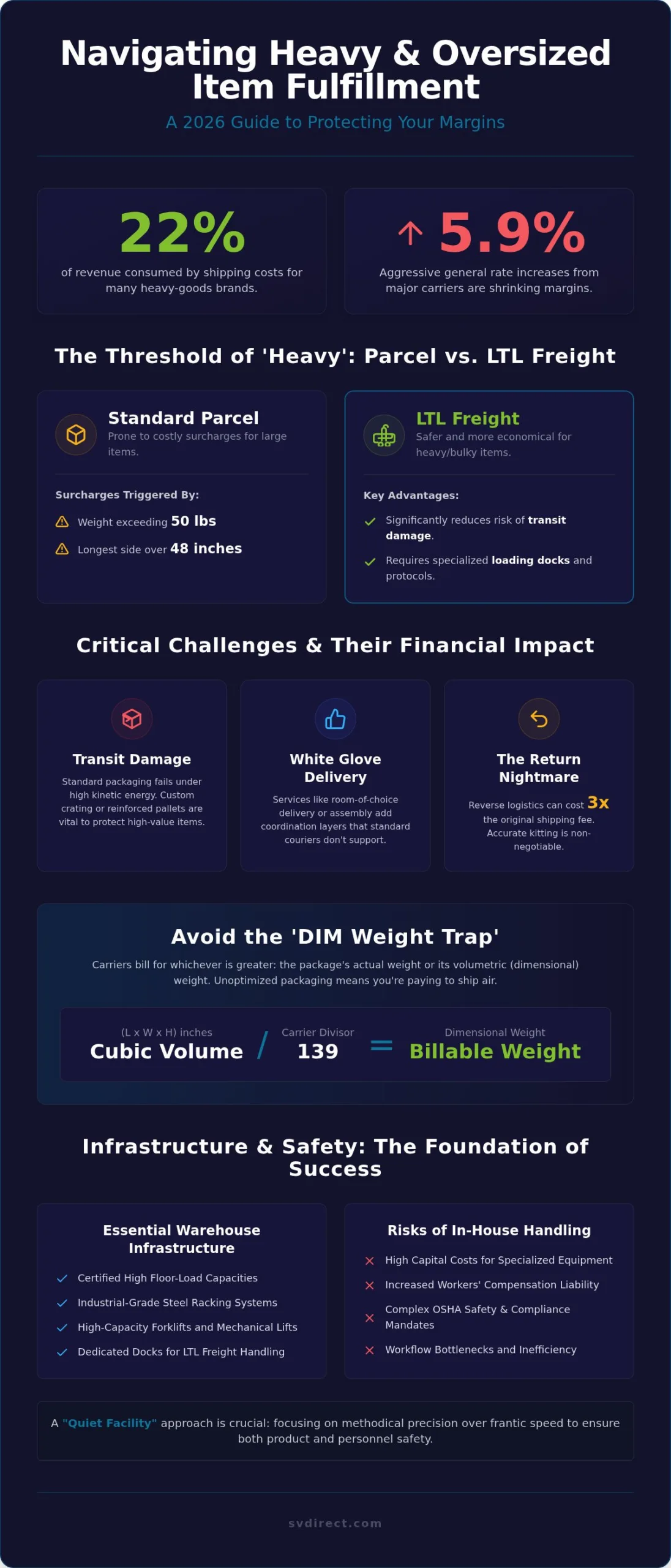
Did you know that shipping costs for heavy or oversized products now consume up to 22% of total revenue for many brands? With major carriers like UPS and FedEx implementing aggressive 5.9% general rate increases for 2026, the margin for error has never been thinner. If you’re struggling with oversized item surcharges or high damage rates, you’re certainly not alone. Finding the right approach to ecommerce fulfillment for heavy items often feels like an uphill battle against rising fees and complex logistics.
We understand that shipping large goods isn’t just about moving weight; it’s an engineering challenge that requires precision and a steady hand. This 2026 guide is designed to help you navigate these complexities while protecting your bottom line and your customer’s experience. We’ll explore how to achieve predictable fulfillment costs, reduce damage claims through better kitting, and stay compliant with the latest OSHA safety standards for warehouse operations. By the end, you’ll have a clear roadmap for scaling your heavy-goods operations with confidence and expert-level precision.
Key Takeaways
- Identify the physical infrastructure requirements, such as specialized floor load capacities and industrial racking, necessary to prevent bottlenecks in heavy goods storage.
- Avoid the “DIM weight trap” by mastering the 2026 volumetric surcharge triggers that impact ecommerce fulfillment for heavy items.
- Assess the hidden financial and safety liabilities of in-house heavy item handling, from specialized equipment costs to increased workers’ compensation risks.
- Implement a rigorous QC-Check process and integrated digital printing to ensure manual accuracy and reduce damage claims for complex, oversized kits.
- Leverage high-tech visibility tools like the Remote Control™ system to maintain real-time oversight of large-scale inventory and global shipping logistics.
The Logistics of Scale: Why Heavy Item Fulfillment Demands a Specialized Strategy
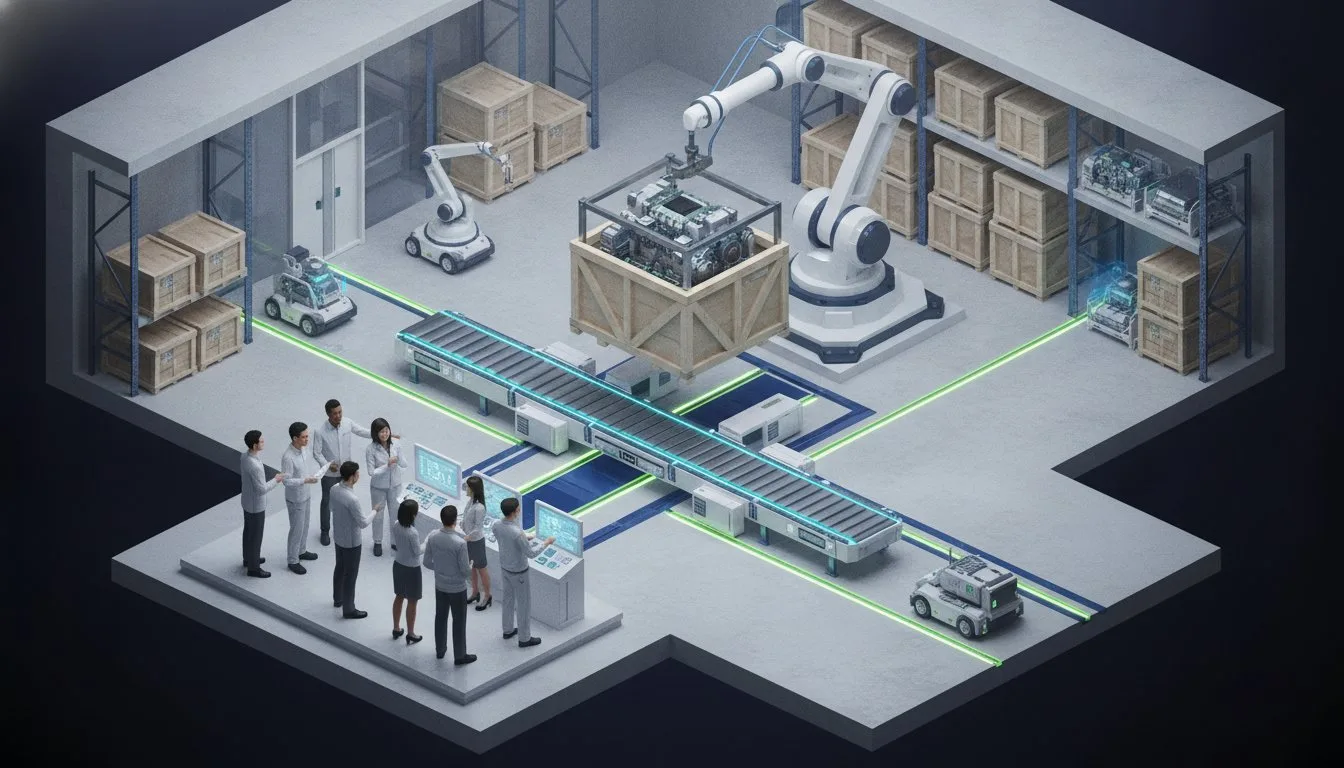
Heavy item fulfillment is an engineering challenge that extends far beyond simple storage. In 2026, the ecommerce landscape has shifted, with carriers like UPS and FedEx implementing cubic volume triggers that redefine what “heavy” actually costs. Effective ecommerce fulfillment for heavy items requires a departure from the traditional high-speed pick-and-pack models designed for small parcels. Those standard models often fail because they lack the specialized infrastructure, such as reinforced industrial racking and high-capacity forklifts, needed to handle goods that exceed typical human lifting limits.
Success in this niche depends on sophisticated logistics management. When products weigh 75 or 100 pounds, the physical constraints of a warehouse change. Floor load capacities must be certified for dense, concentrated weight. A “quiet facility” approach, which focuses on methodical precision rather than frantic speed, ensures that these massive goods are moved without compromising warehouse safety or product integrity. This level of care is vital for maintaining brand trust, as customers expect their high-value, oversized purchases to arrive in pristine condition.
The Threshold of ‘Heavy’: Parcel vs. Freight
Carriers have set clear boundaries for 2026. “Additional Handling” surcharges now typically trigger at 50 lbs or when the longest side exceeds 48 inches. While standard parcel networks can technically handle up to 150 lbs, it’s often more economical to transition to Less-Than-Truckload (LTL) shipping much earlier. LTL offers better protection for bulky items, though it requires specialized loading docks and mechanical handling protocols. Safety isn’t optional; handling items over 50 lbs manually increases workers’ compensation risks, making mechanical assistance an operational necessity.
Common Challenges in Large-Scale Fulfillment
Managing heavy goods introduces unique risks that can erode profit margins. High-value, heavy items face significantly higher damage rates during transit if they aren’t secured with specialized kitting and bracing. Precision in the initial workflow is the only way to protect margins when the cost of a single mistake can reach hundreds of dollars.
- Transit Damage: Heavy items generate more kinetic energy during movement. Standard cardboard packaging often fails, requiring custom crating or reinforced pallets to ensure stability.
- White Glove Delivery: Many oversized items require room-of-choice delivery or light assembly. This adds layers of coordination that standard couriers don’t provide.
- The Return Nightmare: Reverse logistics for a 120-pound item can cost three times the original outbound shipment. Reducing return rates through accurate kitting is essential.
Calculating the Load: Dimensional Weight, Freight, and Heavy Goods Storage
In 2026, the financial viability of shipping large goods depends on mastering the math behind the movement. Many brands focus solely on the physical scale, yet the true “trap” in ecommerce fulfillment for heavy items often lies in the volume. Carrier surcharges have become increasingly complex, moving beyond simple weight to include cubic volume triggers. If your packaging isn’t optimized, you’re essentially paying premium rates to ship air. Precision in this area is the difference between a scalable operation and one that erodes your profit margins with every shipment.
Strategic warehousing also plays a critical role in cost control. Heavy items shouldn’t be stored in high-reach racking unless the infrastructure is specifically rated for those loads. Utilizing floor-level storage or heavy-duty industrial shelving at the base level improves accessibility and reduces the time required for mechanical picking. This methodical approach to storage prevents the “bottleneck” effect that often occurs when standard warehouses try to force oversized goods into a high-velocity parcel workflow. It’s about creating a “quiet facility” environment where every movement is intentional and safe.
Dimensional Weight vs. Actual Weight
In 2026, major carriers like USPS, UPS, and FedEx utilize a dimensional weight divisor of 139 for packages larger than one cubic foot. This means a relatively light but bulky item can be billed at a much higher weight than its physical reality. Choosing the correct box size is the most effective way to protect your margins. To maintain packaging standards for heavy items, you’ve got to eliminate void space which compromises structural integrity and increases volumetric costs. When moving to LTL, the physics of palletization becomes the priority. Maximizing density on a single pallet reduces the number of handling units and lowers your overall freight spend.
“Over Maximum” and “Additional Handling” fees are no longer just penalties; they’re significant revenue drivers for carriers. In 2026, “Additional Handling” surcharges typically apply to packages over 50 lbs, while “Oversize” penalties can range from $75 to $150 per package. These costs are often avoidable through strategic kitting or by shifting the shipment to an LTL network. By auditing your SKU dimensions against carrier thresholds, you can proactively redesign packaging to stay below these expensive triggers.
Freight Class and NMFC Codes
Correctly classifying your shipments is the difference between a profitable quarter and a series of expensive carrier re-bills. National Motor Freight Classification (NMFC) codes are determined by density, stowability, handling, and liability. In 2026, carriers are more aggressive with inspections; an incorrect class can lead to significant retroactive charges. Understanding the relationship between product density and shipping rates allows you to package goods in a way that drops them into a more favorable freight class. Leveraging a partner’s established carrier relationships can often secure better LTL pricing than a single brand could negotiate independently. If you’re looking to audit your current shipping profile for hidden savings, you might want to consult with a logistics expert to see where your density can be improved.
The Hidden Costs of In-House Heavy Fulfillment vs. Professional 3PL Solutions
Many brands assume that managing heavy goods in-house will save money, but they often overlook the secondary costs that accumulate quickly. Managing ecommerce fulfillment for heavy items requires more than just extra square footage. It demands significant capital investment in specialized equipment and high-capacity infrastructure. When you factor in the maintenance of industrial machinery and the rising cost of warehouse labor, the “do-it-yourself” model often becomes a financial burden rather than a benefit.
Scale is the primary driver of this complexity. In 2026, the national average for 3PL warehouse storage is approximately $1.73 per square foot per month. For brands managing fewer than 5,000 pallets, leasing a private warehouse and staffing it with specialized handlers is rarely cost-effective. Professional providers offer the advantage of shared infrastructure, allowing you to access high-tier logistics capabilities without the heavy upfront expenditure.
Infrastructure and Equipment Requirements
Maintaining a safe and organized facility for heavy goods involves strict adherence to safety standards. Standard pallet jacks and light-duty racking aren’t sufficient for loads that often exceed 150 pounds. You need industrial-grade forklifts and racking systems certified for concentrated floor-load capacities. OSHA is currently operating a National Emphasis Program for Warehousing through mid-2026, which focuses specifically on material handling and powered industrial vehicles. Our “quiet, organized facility” methodology ensures that your products are handled in a controlled environment that prioritizes precision over frantic speed, significantly improving accuracy for complex orders.
Labor risks also represent a massive hidden liability. Handling heavy items increases workers’ compensation risks and insurance premiums. Professional 3PLs mitigate these risks through rigorous training and mechanical assistance protocols that many smaller in-house operations can’t sustain. This proactive stance on safety protects your brand from the reputational and financial fallout of workplace accidents.
The Partnership Advantage
A professional logistics provider should act as a steady hand and an extension of your internal team. This isn’t a mere transaction; it’s a partnership grounded in collective experience and proactive problem-solving. In the fast-paced 2026 market, having a partner that anticipates logistics puzzles before they impact the customer is invaluable. Our customer testimonials reflect the stability that comes from these long-term relationships. By using advanced technology like the Remote Control™ system, you gain 24/7 visibility into your inventory, bridging the technology gap that often hampers in-house operations. This level of transparency ensures that even the most complex heavy-item workflows remain predictable and scalable.
Building a Robust Heavy Item Workflow: Security, Kitting, and Carrier Management
Executing successful ecommerce fulfillment for heavy items requires a meticulous workflow that treats every shipment as a high-stakes engineering project. When you’re dealing with multi-part kits or sensitive industrial equipment, the margin for error is non-existent. A single missing component in a 150-pound assembly doesn’t just result in a customer complaint; it triggers a logistical nightmare involving expensive reverse freight and potential field service visits. We focus on a proactive QC-Check process that verifies every element of a heavy shipment before it ever leaves the dock. This methodical oversight is particularly critical for high-value electronics or medical equipment, where security and precision are the primary benchmarks of success.
Our approach integrates physical handling with digital precision. By combining secure warehousing with advanced tracking, you maintain total visibility over inventory that’s too large for standard automated sorting. This specialized care ensures that high-value assets are protected from the moment they’re received until they reach the final destination. It’s a steady, reliable system designed to alleviate the stress of managing complex, oversized orders.
Custom Kitting and Assembly for Heavy Goods
Kitting heavy goods is a strategic way to reduce shipping volume and protect profit margins. By using specialized kitting and assembly services, you can consolidate parts into denser, more secure packages that are less prone to transit damage. This process also allows for the seamless integration of print-on-demand product manuals and documentation. Instead of storing thousands of pre-printed, bulky manuals, we print them as needed, ensuring that every heavy equipment shipment includes the most up-to-date technical literature without adding unnecessary weight or clutter to your inventory.
Carrier Management and Global Reach
The “Last Mile” for heavy items is often the most complex phase of the journey. Standard couriers often can’t provide the specialized services required for oversized goods, such as liftgates or inside delivery. In 2026, navigating these accessorial fees is essential, as residential LTL deliveries can incur significant surcharges that diminish the 50-70% savings typically found when shipping heavy items via freight. Our team vets carriers specifically for their ability to handle heavy specialty items, ensuring they have the right equipment and training for a professional delivery experience. For brands with international ambitions, our global shipping services guide provides a roadmap for managing the complexities of cross-border trade for heavy equipment, from customs compliance to international freight coordination.
Precision at Scale: How Silicon Valley Direct Optimizes Heavy eCommerce Logistics
Silicon Valley Direct (SVD) has redefined ecommerce fulfillment for heavy items by blending physical infrastructure with high-tech oversight. Our facility in Union City, California, serves as a hub of innovation, allowing us to integrate seamlessly with the digital ecosystems of our clients. We reject the hectic, disorganized atmosphere common in many large-scale warehouses. Instead, we maintain a “quiet facility” where precision is the priority. This methodical environment is essential for handling heavy, complex goods that require careful manipulation rather than rushed movement.
Our operational history, spanning over two decades, is anchored by SVD’s ‘Nine Promises.’ These aren’t just marketing abstractions; they’re operational standards that ensure reliability for every high-stakes shipment. By prioritizing human connection and personal oversight, we provide a level of stability that automated-only providers simply can’t match. Whether you’re a scaling startup or an established enterprise, our infrastructure is designed to grow with you without sacrificing the accuracy of your heavy-goods logistics. This steady approach allows you to scale without the operational friction that typically accompanies increased weight and volume.
Real-Time Data and Reporting
Visibility is often the biggest hurdle in heavy item logistics, especially when transitioning from parcel to LTL networks. Our proprietary Remote Control™ system provides 24/7 visibility into your inventory, offering over 120 standard reports that can be customized to your specific needs. Through remote order management, you can monitor low inventory levels and track backorders in real-time. This system uses XML/SOAP integrations to ensure a seamless flow of data between your eCommerce platform and our warehouse, providing accurate transit times for even the most oversized shipments. This level of technical sophistication allows you to manage heavy inventory with the same ease as small parcel goods.
Your Partner in Heavy Item Growth
We don’t believe in cookie-cutter solutions for heavy item challenges. Every product has unique requirements, from specialized kitting needs to specific carrier coordination. A true partnership understands the intersection of digital technology and physical kitting precision. We act as a steady hand, alleviating the stress of business growth through personal commitment and operational excellence. Our team projects the personality of a seasoned expert who remains at the cutting edge of innovation, ensuring your logistics are handled by people who respect your time and your brand’s reputation. If you’re ready to move beyond impersonal business models and optimize your logistics, request a free quote for your heavy item fulfillment today. Our team is ready to help you master the complexities of heavy-goods shipping with confidence.
Scale Your Heavy Goods Strategy with Precision
Mastering the complexities of ecommerce fulfillment for heavy items requires a shift from standard parcel thinking to a methodical, engineering-first approach. We’ve discussed how specialized infrastructure and density-focused palletization protect your margins against the aggressive carrier surcharges of 2026. By moving away from hectic in-house models and leveraging a partner with dedicated heavy item kitting and assembly teams, you ensure that even the most complex oversized shipments reach their destination without damage or delay.
Our commitment to precision is backed by a systematic QC-Check process that maintains a 99.9% order accuracy rate. Combined with 24/7 real-time inventory access through the Remote Control™ system, you gain the visibility needed to scale with informed confidence. You deserve a logistics partner that acts as a steady hand, providing the physical strength and digital intelligence required for modern heavy-goods shipping.
The future of your brand depends on reliable logistics that respect your time and your customer’s experience. We’re ready to help you turn these logistical challenges into a distinct competitive advantage.
Frequently Asked Questions
Is eCommerce fulfillment more expensive for heavy items?
Yes, fulfilling heavy items is generally more expensive due to the specialized infrastructure and equipment required. Shipping costs for products over 5 lbs typically account for 12% to 22% of revenue, compared to 8% to 14% for lighter goods. These expenses stem from higher storage fees for floor-level space, the need for industrial forklifts, and aggressive carrier surcharges that penalize both weight and cubic volume.
Can a 3PL handle LTL shipping for my eCommerce store?
A specialized 3PL can certainly manage Less-Than-Truckload (LTL) shipments to bridge the gap between parcel and freight. This is often the most economical choice for items exceeding 150 lbs or 108 inches in length. By leveraging established carrier relationships, a 3PL secures better rates and manages the complex documentation required for freight transport, ensuring your large-scale orders move through the supply chain with precision.
How much does it cost to ship items over 50 lbs?
While base rates depend on distance, packages over 50 lbs generally trigger “Additional Handling” surcharges in 2026. These fees typically range from $25 to $40 per package. For even larger items where length plus girth exceeds carrier thresholds, “Oversize” penalties can reach between $75 and $150. Auditing your SKU dimensions regularly is essential to avoid these expensive triggers and protect your profit margins.
What happens if a heavy item is damaged during fulfillment or shipping?
Transit damage is a significant risk because heavy items generate more kinetic energy during movement. If damage occurs, a professional partner uses documented QC-Check processes to determine where the failure happened. Reducing these claims requires methodical kitting and reinforced packaging. We prioritize precision in our quiet facility to minimize handling errors before the product ever reaches the carrier, protecting both your inventory and brand reputation.
What is the best way to package heavy items for eCommerce?
The most effective strategy for ecommerce fulfillment for heavy items involves custom kitting and reinforced materials. You should eliminate void space to maintain structural integrity and prevent shifting during transit. For items over 150 lbs, palletization is the industry standard. This protects the product from the rigors of the freight network and ensures mechanical equipment can move the item safely without manual lifting risks.
Can you provide white-glove delivery for heavy eCommerce orders?
Specialized 3PLs coordinate with carriers that offer white-glove services, including room-of-choice delivery and light assembly. While standard parcel networks have a practical limit of 150 lbs, freight partners can manage the final mile for much heavier goods. This service is vital for building customer trust when delivering high-value items like medical equipment or industrial machinery, ensuring the product is handled with care at the destination.
How does kitting help reduce the cost of shipping heavy items?
Kitting allows you to consolidate multiple components into a single, denser package, which can lower your overall dimensional weight. By optimizing the shape and volume of the shipment, you can often stay below the 2026 volumetric surcharge triggers. This process also enables the inclusion of on-demand digital printing for manuals, which reduces the need to store bulky, pre-printed documentation and keeps the total package weight as low as possible.
Is my heavy inventory secure in a 3PL warehouse?
Security for heavy inventory relies on specialized racking and certified floor load capacities. High-value heavy goods are monitored through real-time systems like Remote Control™, providing 24/7 visibility. Unlike standard facilities that may struggle with oversized items, a dedicated 3PL uses industrial-grade shelving and methodical handling protocols to ensure that inventory remains stable and protected from environmental or mechanical damage throughout its stay in the facility.