


How to Reduce Shipping Costs for eCommerce: The Strategic 2026 Guide
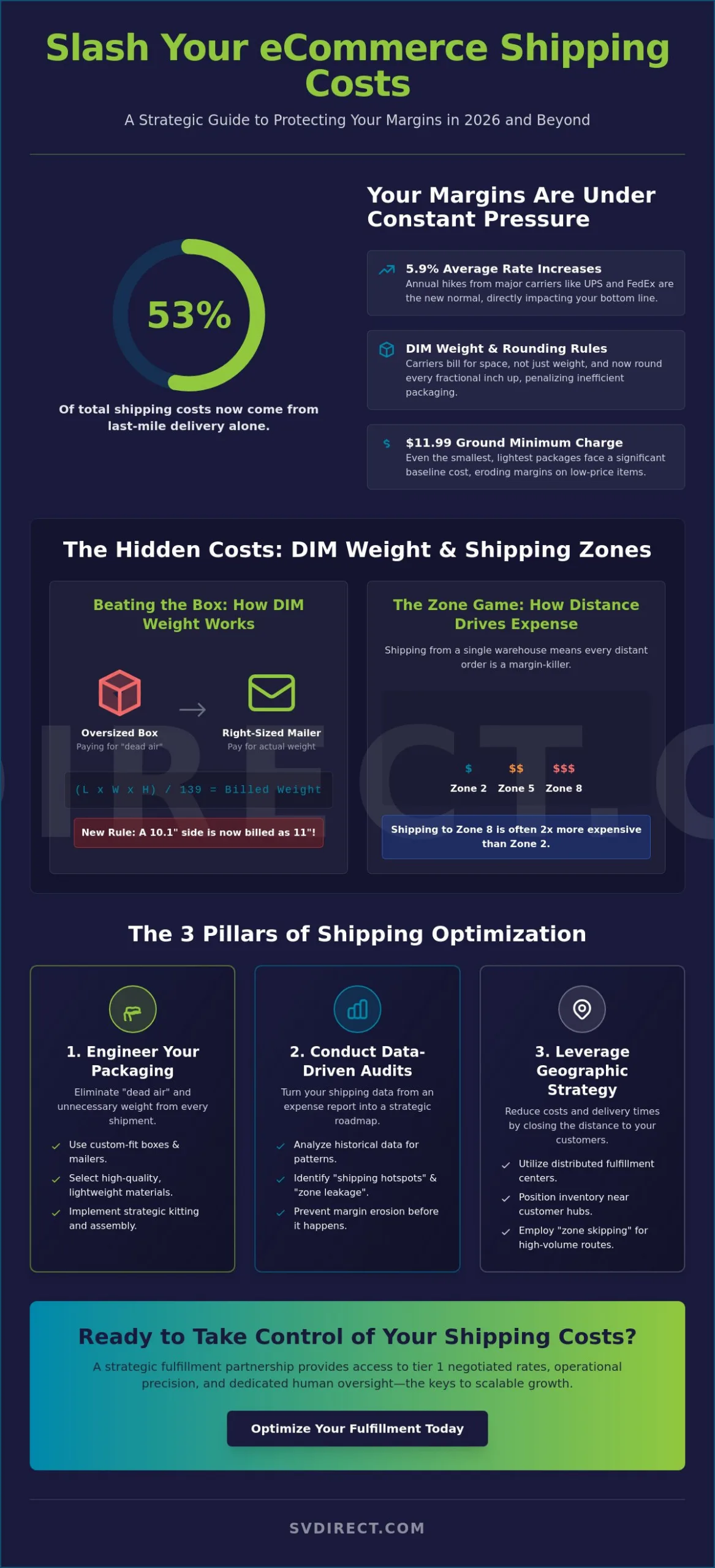
Did you know that for many online sellers, last-mile delivery now constitutes over 53% of total shipping costs? With the 2026 average rate increases of 5.9% from UPS and FedEx now in full effect, learning how to reduce shipping costs for ecommerce has moved from a tactical advantage to a survival necessity. Between the new DIM weight rounding rules and the $11.99 ground minimum charges, your margins are under constant pressure from factors that often feel outside your control. It’s frustrating to watch surcharges and dimensional penalties erode the hard work you’ve put into building your brand. We believe that growth should feel like an achievement, not a logistical burden.
We understand that you want to scale your business without sacrificing the speed or quality your customers expect. This guide promises to help you master the art of logistics optimization, providing a clear path to slash your shipping expenses. By the end of this article, you’ll have a strategic roadmap to implement scalable fulfillment architecture and lower your cost per order. We will examine how to engineer your packaging to beat DIM weight penalties, leverage regional carriers for cost savings, and use distributed fulfillment to place inventory closer to your audience.
In this guide, you will discover:
- The mechanics of Dimensional (DIM) weight and how to audit your shipping profile to prevent margin erosion.
- How strategic kitting and assembly can reduce total package weight while on-demand digital printing streamlines your inventory.
- The power of aggregate volume in securing tier 1 negotiated rates that far exceed standard business discounts.
- Why geographic location is a primary driver of expense and how to reduce shipping costs for ecommerce by positioning inventory near global hubs.
- The long-term ROI of a fulfillment partnership that combines operational precision with dedicated human oversight.
Auditing Your eCommerce Shipping Profile: DIM Weight and Shipping Zones
True optimization begins with a cold, hard look at your shipping data. Many brands treat shipping as a fixed expense, yet it’s actually one of the most flexible variables in your business model. If you want to master how to reduce shipping costs for ecommerce, you have to stop looking at the price on the label and start looking at the math behind it. Carriers don’t just bill you for what a package weighs; they bill you for the space that package occupies on their planes and trucks. This is the foundation of a shipping audit.
Identifying “shipping hotspots” or “zone leakage” allows you to see where your margins are evaporating. For instance, if a large percentage of your orders are traveling to Zone 7 or 8, you’re likely paying a premium that could be mitigated through better inventory placement. By auditing your historical data, you can uncover the hidden costs of “dead air” where oversized boxes are triggered by inefficient packing. This data-driven approach transforms shipping from a line-item expense into a strategic advantage.
To better understand this concept, watch this helpful video:
Understanding Dimensional Weight (DIM) Calculations
Dimensional weight is often the primary reason for unexpected shipping costs. Carriers calculate DIM weight by multiplying the length, width, and height of a package and dividing by a “DIM factor,” which is currently 139 for major domestic carriers. If the resulting number is higher than the actual weight, you’re billed at that higher rate. As of the 2026 guidelines, carriers now round up every fractional inch to the next whole number before calculating. A box that’s 10.1 inches is billed as 11 inches. To “beat the box,” you must match your product size to your packaging with surgical precision. Using custom-fit boxes or mailers eliminates the “dead air” that triggers these expensive penalties.
Mapping Your Customer Density and Shipping Zones
Shipping zones are geographic areas defined by the distance between the point of origin and the destination. In the 2026 landscape, shipping to Zone 8 is frequently twice as expensive as shipping to Zone 2. If your warehouse is in New York but your customers are in California, every order is a margin-killer. Many third-party logistics providers solve this by analyzing your customer density to find the optimal fulfillment center location. High-volume shippers also utilize “zone skipping,” which involves consolidating orders and trucking them closer to the destination hub before handing them to a carrier. This proactive strategy is a cornerstone of how to reduce shipping costs for ecommerce while maintaining the delivery speed your customers demand.
Packaging Engineering: Reducing Costs Through Strategic Kitting and Printing
Shipping efficiency isn’t just about the carrier you choose. It’s about the physical architecture of the shipment. While most brands focus on the label, sophisticated operators look at the weight of every component, from the corrugated cardboard to the promotional flyers inside. As you determine how to reduce shipping costs for ecommerce, you’ll find that small adjustments in packaging engineering yield massive results across thousands of orders. Precision in the assembly phase is what prevents the “surcharge creep” that often stalls business growth.
Traditional packing methods often leave too much room for error, or rather, too much room for “dead air.” If you’re shipping a small item in a medium box, you’re paying for the carrier’s volume, not your product’s weight. Switching to poly mailers or custom-fit boxes can eliminate this wasted spend. Branded packaging is vital for the unboxing experience, but it shouldn’t come at a premium. By selecting high-quality, lightweight materials, you can maintain your brand’s aesthetic and durability without pushing the package into a higher weight bracket.
The Power of Professional Kitting and Assembly
Professional kitting and assembly services are about more than just organization; they’re a financial strategy. Consolidating multiple SKUs into a single, optimized unit allows you to save significantly on “Pick and Pack” fees. Instead of shipping three separate boxes, kitting creates a streamlined package that fits perfectly into standard carrier dimensions. This process also reduces the need for dunnage, the filler material that adds weight without adding value. A well-designed kit ensures that every square inch of the box is utilized, bypassing the “Additional Handling” surcharges that plague unoptimized shipments.
On-Demand Printing: A Secret Weapon for Shipping Efficiency
Most guides overlook the massive weight impact of traditional marketing materials. Traditional fulfillment involves shipping heavy, pre-printed catalogs to a warehouse, storing them, and then adding that bulk to every outbound order. This adds weight and increases the risk of materials becoming obsolete. By integrating on-demand digital printing directly into the fulfillment line, you can generate personalized, lightweight inserts at the moment of packing. This just-in-time approach keeps your marketing current while keeping the package weight at an absolute minimum. It’s a precise way to maintain brand quality without paying a “paper tax” to carriers.
Engineering a better package is a collaborative effort between your fulfillment team and your designers. If you’re ready to see how these efficiencies look in practice, you can request a custom analysis to identify your specific savings opportunities.
Leveraging 3PL Volume: Why Negotiated Rates Beat Standard Business Discounts
Most small to mid-sized brands find that their “negotiated” rates are barely better than retail pricing. This happens because carriers prioritize high-density accounts that simplify their own operational logistics. When you partner with a seasoned fulfillment provider, you aren’t just buying space; you’re buying into a massive shipping cooperative. This collective bargaining power allows businesses to access Tier 1 carrier rates that are typically reserved for Fortune 500 companies. It’s a fundamental shift in how to reduce shipping costs for ecommerce because it moves you beyond standard business discounts into a realm of unlisted savings.
A sophisticated 3PL doesn’t just stick to one carrier. They use shipping orchestration software to route every package based on the lowest total cost in real-time. This isn’t just about base rates. The software accounts for the 2026 residential surcharges, which have climbed to $6.45 for FedEx Home Delivery and $6.50 for UPS Ground. By automatically selecting the carrier with the most efficient route for a specific zip code, you bypass the traps that inflate your per-order expense. This proactive strategy ensures that your shipping budget is spent on delivery speed rather than carrier profit margins.
The Reality of Carrier Rate Negotiation
Individual businesses often lack the leverage to move the needle with major carriers. Carriers look for volume, consistency, and operational ease. A 3PL provides all three by consolidating thousands of shipments into massive daily batches. This reduces the “touches” required by the carrier, allowing the 3PL to secure deeper discounts. These relationships are built over decades, providing access to incentive tiers that a solo business simply can’t reach. Batch delivery to the carrier hub further reduces the carrier’s workload, which translates to lower base rates for every package in that batch.
Managing Surcharges and Accessory Fees
Fuel surcharges and accessory fees now account for 20% to 40% of total annual shipping costs for many brands. Address correction fees are a silent margin killer. Even a simple typo can lead to a carrier fee that wipes out the profit on a small order. Automated address validation at the point of fulfillment is essential to stop this leakage. Additionally, as we move through 2026, peak-season surcharges have become more dynamic and complex. A strategic partner helps you plan inventory cycles to avoid these spikes. For brands expanding across borders, professional global shipping services manage the complexities of international duties and taxes. This ensures that your global reach doesn’t come with unexpected financial penalties or customs delays that hurt your brand reputation. A complete cost-reduction strategy must also account for the reverse flow of goods; implementing efficient returns management logistics is essential to prevent the 2026 rate hikes from compounding the expense of processing the growing volume of online returns.
Geographic Strategy: Reducing the Distance to Delivery
Distance is the silent driver of escalating expenses. When you analyze how to reduce shipping costs for ecommerce, the geographic placement of your inventory emerges as the most critical factor. Every shipping zone your package crosses adds a layer of cost and a day of transit time. In a market where last-mile delivery accounts for over 53% of total shipping costs, your physical address is your most powerful lever. By positioning your fulfillment operations closer to major entry points and carrier hubs, you fundamentally change the math of your logistics. This isn’t just about labels; it’s about reducing the physical mileage your products must travel to reach the end consumer.
A Silicon Valley hub offers a distinct advantage for brands focused on innovation and global connectivity. Proximity to major international ports like Oakland and San Francisco, along with primary carrier sorting facilities, ensures that inbound shipments move from container to warehouse with minimal drayage fees. This geographic placement allows for a steady, methodical flow of goods, reducing the time your capital is tied up in transit. Shorter transit times don’t just lower costs; they also lead to a measurable decrease in customer service inquiries and return rates, as faster delivery consistently correlates with higher customer satisfaction. It’s a proactive stance that respects both your budget and your client’s time.
The Strategic Importance of a West Coast Hub
West Coast fulfillment centers are the gateway for Pacific Rim trade. By processing goods near their point of entry, you avoid the expense of shipping raw inventory across the country before it’s even sold. This proximity also allows for faster hand-offs to carriers, which is vital for maintaining high-performance delivery standards. Understanding the batch delivery to carrier meaning is essential here. It refers to the moment your consolidated shipments are processed by the carrier at their local hub. This step happens much faster when your warehouse is minutes away from their primary sorting facility, effectively slashing the lag time between order packing and carrier transit.
Cross-Border Shipping and International Logistics
Navigating international logistics requires a partner who understands the nuances of customs and trade regulations. Shipping from the US to Canada or other international destinations can be cost-prohibitive without a consolidation strategy. By grouping international orders, you can reduce per-package export fees and simplify the documentation process. A professional 3PL acts as a steady hand, ensuring that your global expansion is backed by physical infrastructure and human expertise rather than just digital abstractions. This methodical approach ensures your products reach global markets without the stress of unpredictable fees. If you want to see how a West Coast strategy could impact your specific volume, you can request a free quote for a detailed geographic analysis.
Choosing a Strategic Fulfillment Partner for Long-Term Scalability
Selecting a fulfillment partner is more than a software integration; it’s a strategic alliance that dictates your financial trajectory. While many platforms claim their algorithms do it all, pure automation lacks the nuance required for complex or high-value shipments. True operational readiness comes from balancing high-tech efficiency with seasoned human oversight. This combination ensures that when a unique challenge arises, you have a dedicated team ready to implement a bespoke solution. If you’re investigating how to reduce shipping costs for ecommerce, you’ll find that the most significant savings often come from the precision only human experts can provide.
Calculating the ROI of outsourcing involves looking beyond the per-order fee. You must account for the overhead of warehouse leases, specialized labor, and rising insurance premiums. By moving to a 3PL, you convert these fixed costs into variable expenses that scale with your order volume. Silicon Valley Direct integrates directly with your existing eCommerce platform, providing the real-time control you need without the burden of physical management. When interviewing potential partners, always ask about their transparency regarding fuel surcharges and hidden accessory fees. A reliable partner will provide a clear, hierarchical breakdown of every cost associated with your shipping profile, ensuring there are no surprises on your monthly invoice.
The Silicon Valley Direct Difference: Human-Scale Logistics
We’ve explicitly rejected the industry trend toward automated chatbots in favor of direct human connection. Our clients value the personal oversight provided by staff members who’ve been with us for decades. This internal stability is a unique hallmark that translates to unmatched order accuracy and a deep understanding of your brand’s specific needs. A “one-size-fits-all” fulfillment model often leads to higher costs because it forces your brand into rigid, inefficient processes. We believe in total flexibility, providing the customization required to treat your physical operations with the same care you put into your digital storefront.
Transitioning from In-House to 3PL Fulfillment
There’s a specific tipping point where managing your own shipping becomes a liability rather than an asset. This typically happens when the administrative burden of carrier negotiations and warehouse staffing distracts you from your core mission of growth. You don’t have to lose brand control when you outsource your physical operations. By choosing a partner that acts as an extension of your team, you maintain the personal touch while gaining a scalable fulfillment architecture. Check our blog for more insights on scaling your fulfillment and navigating the complexities of the 2026 shipping landscape.
Master Your Logistical Future
Success in 2026 depends on transforming your shipping from a reactive expense into a proactive strategic advantage. You’ve learned that auditing your DIM weight and engineering your packaging are the first steps to reclaiming lost margins. By strategically positioning inventory near major hubs and leveraging aggregate shipping volume, you can consistently lower your cost per order. Mastering how to reduce shipping costs for ecommerce requires this holistic approach, where every inch of a box and every mile of transit is accounted for.
Since 1999, Silicon Valley Direct has acted as a reliable partner for brands that value precision and personal accountability. We specialize in high-value and HIPAA-compliant logistics, providing the direct human oversight that automated systems often miss. We invite you to streamline your supply chain with Silicon Valley Direct’s expert fulfillment solutions. Your growth is a journey, and with the right steady hand at the helm, your logistical infrastructure will remain a pillar of your brand’s success.
Frequently Asked Questions
What is the most effective way for a small eCommerce business to reduce shipping costs?
The most effective strategy is to perform a comprehensive audit of your packaging dimensions to eliminate “dead air.” Since major carriers now round up every fractional inch to the next whole number, even a slight reduction in box size can prevent a shipment from moving into a higher billable weight bracket. This precise approach to how to reduce shipping costs for ecommerce ensures you aren’t paying for empty space or unnecessary volume.
How does dimensional weight (DIM) affect my shipping bill?
Dimensional weight allows carriers to bill based on the volume a package occupies rather than its actual physical mass. By multiplying length, width, and height and dividing by the 2026 standard divisor of 139, carriers determine a theoretical weight. If this calculated DIM weight is higher than the actual scale weight, you’re billed for the larger value. This makes efficient, right-sized packaging a financial necessity for any modern brand.
Is it cheaper to use a 3PL or ship orders myself?
Transitioning to a fulfillment partner becomes more cost-effective when the overhead of warehouse leases, specialized labor, and insurance premiums exceeds the per-order fulfillment fee. A 3PL provides access to Tier 1 negotiated rates and aggregate volume discounts that solo businesses cannot secure independently. By converting these fixed in-house costs into variable expenses, you gain a scalable architecture that adjusts to your seasonal volume fluctuations.
What are shipping zones, and how do they impact my pricing?
Shipping zones are geographic regions determined by the distance between the point of origin and the final destination. In the 2026 rate structure, shipping to Zone 8 is often twice as expensive as shipping to Zone 2 due to increased fuel consumption and transit mileage. Mapping your customer density allows you to identify “zone leakage” and potentially reposition your inventory closer to your most active geographic markets to lower per-order expenses.
Can kitting and assembly actually save me money on postage?
Professional kitting and assembly lead to substantial postage savings by consolidating multiple items into a single, optimized package. This reduces the total number of outbound shipments and avoids multiple individual “Pick and Pack” fees. A well-designed kit also minimizes the need for dunnage; the filler material that adds weight without adding value; ensuring the final dimensions remain below the thresholds that trigger expensive additional handling surcharges.
How do I negotiate better rates with carriers like FedEx or UPS?
Individual businesses often struggle to move the needle with major carriers because those carriers prioritize high-density, high-volume accounts. The most reliable way to secure better rates is to leverage the collective bargaining power of a fulfillment partner. These providers have long-standing relationships and multi-decade histories that allow them to access unlisted savings and incentive tiers that are typically unavailable to smaller, independent shippers.
What is ‘Zone Skipping’ and is it right for my business?
Zone skipping is a strategy where a business consolidates a large volume of orders and trucks them directly to a carrier hub closer to the final destination. This bypasses the initial sorting centers and reduces the number of zones the carrier actually handles. It’s an ideal strategy for high-volume cross-country shipments where the cost of the initial truckload is lower than the sum of the individual per-package zone surcharges.
How does a Silicon Valley location benefit my international shipping costs?
A Silicon Valley location places your inventory near major international ports and primary carrier sorting facilities. This proximity reduces drayage costs, which are the fees associated with moving goods from container ships to the warehouse. For international orders, being at a global gateway allows for faster hand-offs and reduced transit times to the Pacific Rim, helping you understand how to reduce shipping costs for ecommerce on a global scale.