img not found!
3PL International Shipping: The 2026 Strategic Guide to Global Fulfillment

3PL International Shipping: The 2026 Strategic Guide to Global Fulfillment

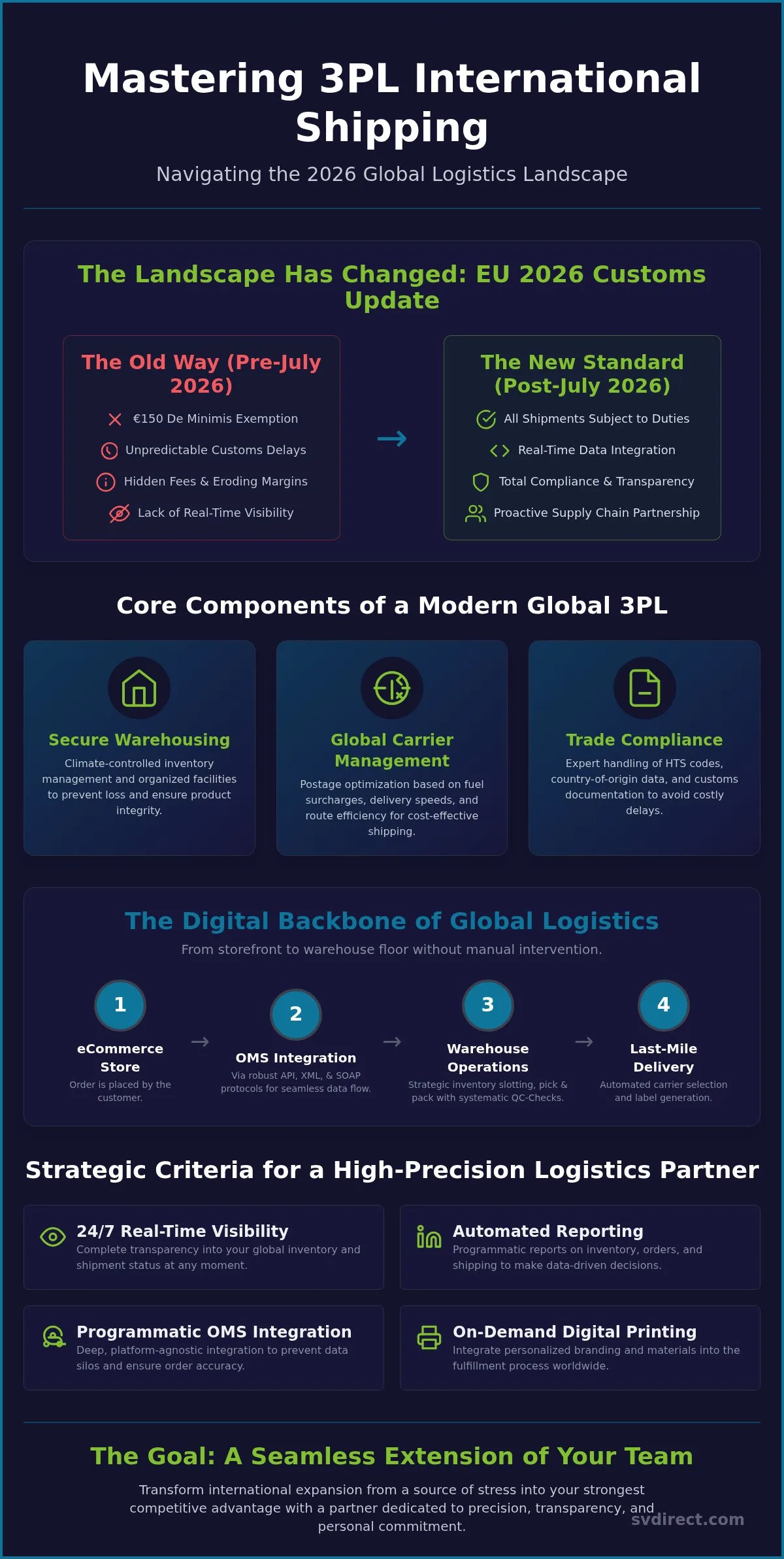
Did you know that as of July 2026, the European Union has removed the €150 de minimis exemption, making every single international shipment subject to duties? For brands scaling across borders, this regulatory shift means that the old way of “set it and forget it” 3pl international shipping is officially dead. You likely feel the weight of unpredictable customs delays and those hidden fees that quietly erode your profit margins. It’s frustrating when you lack real-time visibility into your own global inventory, leaving you to guess where your products are at any given moment.

We believe that global growth shouldn’t be a source of constant stress. This guide will help you master the complexities of global fulfillment by leveraging high-precision technology and human oversight. We’ll preview the essential 2026 customs updates, explain how to achieve reliable cost transparency, and show you how a proactive partnership can transform international expansion into your strongest competitive advantage. By the end, you’ll see how a steady hand in logistics provides the stability your business needs to thrive as an extension of your own team.

Key Takeaways

  • Understand how the 2026 logistics landscape has shifted from simple transport to a complex requirement for real-time data integration and total compliance.
  • Learn to optimize your supply chain through programmatic OMS integration and strategic inventory slotting to make 3pl international shipping a seamless part of your operations.
  • Identify the hidden costs of global trade by mastering Incoterms and implementing landed cost transparency to protect your margins.
  • Discover the specific technical criteria, such as 24/7 visibility and automated reporting, that define a high-precision logistics partner.
  • Explore how integrating on-demand digital printing with your fulfillment strategy creates a personalized brand experience for customers worldwide.

What is 3PL International Shipping? Defining the 2026 Landscape

At its core, 3pl international shipping is the strategic outsourcing of your supply chain operations to a specialized logistics expert. While the basic definition of Third-party logistics (3PL) focuses on warehousing and transport, the 2026 environment requires a much deeper level of integration. It’s no longer enough to simply move a parcel from Point A to Point B. Modern global fulfillment now demands a high-precision marriage of customs brokerage, trade compliance, and real-time data synchronization. This ensures that every shipment is accounted for, regardless of its destination.

The defining trend of this year is the final transition of the 3PL from a mere shipping provider to a true supply chain partner. Growing businesses are moving away from the chaos of in-house global logistics. They’ve found that managing international regulations, such as the 2026 EU duty changes, is too complex to handle without professional oversight. Instead, they’re choosing models that offer stability and act as a seamless extension of their own internal teams. This shift allows brands to focus on product development while experts handle the mechanical nature of global movement.

The Core Components of Global 3PL

A robust international shipping strategy relies on three foundational pillars that ensure your products reach customers safely and legally. First, secure warehousing is essential. This involves more than just storage; it requires climate-controlled inventory management and organized facilities that prevent loss. Second, global carrier management allows for postage optimization based on current fuel surcharges and delivery speeds. Finally, trade compliance is mandatory. With the U.S. suspending de minimis exemptions for many imports, having an expert handle HTS codes and country-of-origin data is critical to avoiding costly delays.

Why eCommerce Brands are Going Global Now

Brands are aggressively expanding into international markets to find lower customer acquisition costs and untapped audiences. However, these customers now expect local-speed delivery. They won’t wait weeks for a package to clear a port. By leveraging specialized 3PL fulfillment services, brands can reduce the massive overhead of international expansion. High-tech integration allows small and medium enterprises to compete with global giants by providing the same level of transparency and reliability that modern consumers demand. This shift isn’t just about growth; it’s about building a sustainable, global presence through precision and personal commitment.

The Mechanics of Global Logistics: From Warehousing to Last-Mile Delivery

Success in 3pl international shipping isn’t just about physical movement; it’s about the precision of the data that precedes it. The process begins with the programmatic integration of your Order Management System (OMS). This digital handshake ensures that every order flows seamlessly from your storefront to the warehouse floor without manual intervention. Once integrated, we utilize strategic inventory slotting. By positioning stock based on global demand patterns, we reduce internal travel time and expedite the fulfillment cycle before the package even reaches the dock.

The Digital Backbone: API and Web Service Integration

Modern logistics relies on robust XML and SOAP protocols to facilitate a constant, bi-directional exchange of information. These platform-agnostic systems allow your business to scale across different sales channels without being tethered to a single eCommerce provider. Specifically, standardized web methods like ‘AddOrder’ reduce custom coding time for your developers by providing a pre-defined structure for order submission. This proactive technical setup prevents the order conflicts and data silos that often plague less organized facilities.

After an order is received, it enters a pick and pack process governed by a systematic QC-Check. High-precision fulfillment requires more than speed; it requires total accuracy. Once verified, our system handles carrier selection and automated label generation tailored for specific international routes. We meticulously follow international shipping regulations to ensure that customs documentation is perfect. This attention to detail minimizes the risk of border delays and ensures your brand remains reliable in the eyes of the global consumer.

Inventory Precision and Serial Number Tracking

We maintain 99.9% accuracy through rigorous, cycle-counted inventory management that replaces the chaotic “annual count” model. For industries like high-value electronics or healthcare, serial number tracking provides an essential layer of accountability and security. Clients gain 24/7 visibility into these stock levels and movement history through our proprietary Remote Control system. This level of transparency ensures you’re never guessing about your global availability or stock health.

The journey concludes with real-time tracking and coordinated last-mile delivery. We monitor the package until it reaches the end customer, providing a reliable experience that feels like a natural extension of your own team. If you’re ready to see how this level of precision can stabilize your expansion, you might want to consult with a logistics expert about your specific global needs.

Customs clearance is often the most volatile stage of 3pl international shipping. It’s where simple paperwork errors turn into weeks of delays and mounting storage fees. We approach this challenge with a proactive mindset, identifying potential conflicts before a parcel ever leaves our facility. This level of oversight ensures that your international trade remains a competitive advantage rather than a logistical bottleneck. By coordinating with a partner that acts as a steady hand, you can focus on scaling while we handle the mechanical complexities of global border crossings.

A high-performance logistics partner doesn’t just react to customs issues; they anticipate them. This involves a deep understanding of HTS codes and the shifting de minimis values we discussed earlier. When your data is integrated correctly from the start, the risk of a shipment being held for “valuation disputes” or “missing documentation” drops significantly. It’s about maintaining a proactive stance that protects your profit margins and your brand reputation simultaneously.

Managing Duties, Taxes, and DDP vs. DDU

The choice between Delivered Duty Paid (DDP) and Delivered Duty Unpaid (DDU) fundamentally changes your customer’s unboxing experience. With DDP, all duties and taxes are settled at the point of sale. This eliminates the “sticker shock” of a customer being asked for additional payment at their front door. We help automate these calculations, ensuring total landed cost transparency. Beyond the customer experience, we leverage our long-term carrier relationships to secure volume discounts. These savings help offset the rising fuel surcharges and regulatory fees that have become standard in 2026.

  • DDP (Delivered Duty Paid): Enhances brand loyalty by removing hidden fees for the recipient.
  • Landed Cost Transparency: Provides a clear, upfront total that prevents cart abandonment.
  • Carrier Optimization: Utilizes established shipping lanes to reduce transit times and costs.

Specialized Compliance: Healthcare and Literature

Global fulfillment becomes even more rigorous when dealing with sensitive sectors. Healthcare and pharmaceutical logistics require a level of precision that many standard providers simply can’t offer. From managing HIPAA-compliant mailing to the secure distribution of Explanation of Benefits (EOB) documents, every step must be documented and verified. We treat these shipments with the personal commitment they deserve, ensuring that sensitive data is protected and regulatory standards are met without exception.

For a deeper look into these specific requirements, you can explore our Healthcare Mailing Services guide. This resource details the intersection of high-precision fulfillment and strict regulatory compliance. Whether you’re shipping personalized literature or medical supplies, our organized facility and systematic QC-Check process provide the stability necessary for these high-stakes operations. We don’t just ship boxes; we protect the integrity of your brand across every border.
3PL International Shipping: The 2026 Strategic Guide to Global Fulfillment

Strategic Criteria for Selecting an International 3PL Partner

Selecting a 3pl international shipping partner is a multi-year decision that dictates the trajectory of your global growth. It’s a move away from the traditional vendor mindset toward a strategic alliance. You must evaluate whether a provider offers the scalability required for your busiest months. Can they reliably manage 3,000+ shipments a week during peak holiday seasons? If a facility feels hectic and reactive during your initial tour, those internal stresses will eventually manifest as shipping errors and customer complaints. You’re looking for a quiet, organized facility that treats every parcel with deliberate care.

Flexibility is another non-negotiable factor. Many large-scale providers rely on “cookie-cutter” procedures that force your business to adapt to their rigid systems. This approach often fails when you have specialized kitting needs or unique international packaging requirements. A high-performance partner provides bespoke problem-solving that fits your specific workflow. They should act as a steady hand, alleviating the stress of expansion through a proactive attitude and a commitment to precision. This ensures your logistics operations remain a stable foundation for your brand’s reputation.

Evaluating 3PL Technology and Reporting

In the 2026 landscape, technology is the only way to maintain 24/7 visibility into a global supply chain. You need instant access to order histories and real-time inventory levels to make informed decisions. A partner shouldn’t just give you a login; they should provide a deep data suite. Our proprietary Remote Control system offers 120+ standard reports, giving you granular insights into every aspect of your fulfillment. Automated email notifications for receipts and backorders ensure your team is always informed, reducing the need for manual check-ins and repetitive status updates.

The ‘Partnership’ Litmus Test

The best logistics relationships feel like an extension of your own team rather than an outsourced service. This is achieved through human oversight and direct connection, specifically rejecting the trend of total automation that ignores the nuances of your products. When a partner understands your business goals, they can anticipate order conflicts before they impact your customers. This level of personal commitment is rare in a tech-saturated market. You can explore how these long-term collaborations drive growth by reading our customer testimonials from clients who value stability and expert-level service.

Scaling Your Global Reach with Silicon Valley Direct’s Integrated Solutions

Scaling a brand globally requires more than just a warehouse; it requires a strategic hub where technology, customer service, and marketing converge. We’ve built Silicon Valley Direct to serve as that unified foundation. Our model moves beyond the mechanical nature of traditional logistics by integrating high-resolution digital printing directly into the fulfillment workflow. This ensures that your 3pl international shipping strategy isn’t just about moving products, but about delivering a consistent, high-quality brand experience to every corner of the world.

Personalized Global Fulfillment with Variable Data Printing

Through our on-demand digital printing, we utilize HP Indigo 5500 liquid ink technology to produce offset-quality collateral. This capability allows for variable data printing, which means you can customize copy or images for specific international markets without the burden of large print runs. It’s a proactive way to reduce waste and storage costs while maintaining a personalized touch. Whether it’s a custom insert or a localized manual, our systematic QC-Check process ensures that complex kitting and assembly are performed with absolute accuracy every time. We don’t just assemble packages; we curate the unboxing experience for your global audience.

The Silicon Valley Direct Promise: Precision and Proactivity

Our commitment to your growth is defined by our Nine Promises, a framework that ensures we listen, understand, and anticipate problems before they reach your customers. We maintain a quiet, organized facility that stands in stark contrast to the hectic, reactive environments of many automated hubs. This deliberate pace allows our team to meet high-volume deadlines with the precision your brand deserves. Since 1999, we’ve prioritized long-term staff retention and human oversight, ensuring that the collective experience of our team remains your greatest asset.

By choosing our Silicon Valley 3PL fulfillment services, you’re leveraging a geographic identity synonymous with innovation and global connectivity. Our location in the heart of the world’s tech capital keeps your supply chain connected to the latest advancements in digital integration and logistics efficiency. We don’t act as a mere vendor. We function as a dedicated extension of your team, providing the steady hand you need to master 3pl international shipping in 2026 and beyond.

Master Your Global Fulfillment Strategy

The 2026 landscape for global fulfillment demands a shift from simple transport to total data transparency and regulatory precision. Success now hinges on your ability to anticipate customs shifts and maintain real-time visibility across every border. By choosing a partner that prioritizes human oversight alongside high-tech integration, you ensure that 3pl international shipping becomes a driver of growth rather than a source of stress. It’s about finding a steady hand to manage the mechanical complexities while you focus on your brand’s vision.

We provide the stability your business needs through our proprietary Remote Control™ tracking system and on-site, Red Dot-quality digital printing. These tools, backed by decades of experience in high-precision fulfillment, allow us to act as a seamless extension of your team. We don’t just move boxes; we protect your reputation with every parcel sent. Our proactive approach ensures that high-volume deadlines are met with the accuracy and care your international customers expect.

Mastering global logistics is a journey best taken with a reliable, seasoned partner. We’re ready to help you transform your international operations into a powerful competitive advantage.

Frequently Asked Questions

What is the difference between an international 3PL and a standard freight forwarder?

An international 3PL offers comprehensive order fulfillment, while a freight forwarder primarily coordinates the transportation of goods from one point to another. While a forwarder handles the logistics of air or sea freight, a 3PL manages the entire lifecycle of an order. This includes warehousing, pick and pack services, and returns management. Choosing a 3PL ensures a more integrated approach to your supply chain, acting as an extension of your team rather than just a transport vendor.

How much does 3PL international shipping typically cost for a small business?

3pl international shipping costs are determined by a combination of storage requirements, kitting complexity, and global postage rates. Since every business has unique needs, pricing is typically customized based on shipment volume and the specific destinations served. Factors like current fuel surcharges and dimensional weight also impact the final total. We recommend requesting a personalized quote to understand how these variables align with your specific growth goals and profit margins.

Can a 3PL help with customs clearance and international documentation?

A high-precision 3PL proactively manages customs clearance by ensuring all international documentation is accurate before a shipment leaves the facility. This involves assigning correct Harmonized Tariff Schedule (HTS) codes and preparing detailed commercial invoices. By handling these technical compliance requirements, the 3PL anticipates potential border conflicts and reduces the risk of costly delays. This level of oversight is essential for navigating the complex duty regulations that define the 2026 global trade environment.

What is the ‘landed cost’ and why is it important for international eCommerce?

Landed cost represents the total price of a product once it has arrived at the customer’s doorstep, including the original item price, shipping fees, duties, and taxes. Providing this transparency is vital for international eCommerce because it prevents “sticker shock” during delivery. When customers see the full cost upfront, it builds trust and significantly reduces cart abandonment rates. A sophisticated logistics partner automates these calculations to ensure a seamless unboxing experience for every global recipient.

How does a 3PL handle international returns and reverse logistics?

3PLs manage international returns through a structured reverse logistics process that includes receipt, inspection, and inventory updates. Once a returned item is received at the facility, it undergoes a systematic quality check to determine if it can be restocked. This data is then synced with your inventory management system in real time. Efficient returns management protects your margins and ensures that the human element of customer service remains a priority even after a sale is completed.

What integration options are available for connecting my Shopify or WooCommerce store to a 3PL?

Integration with platforms like Shopify or WooCommerce is achieved through programmatic API and web service interfaces using XML or SOAP protocols. These digital handshakes allow your store’s Order Management System (OMS) to communicate directly with our warehouse. This automation eliminates manual data entry and ensures that tracking information is pushed back to your customers instantly. Our systems are platform-agnostic, providing the flexibility you need to scale across multiple global sales channels without technical friction.

How do I ensure my high-value electronics are secure in a 3PL warehouse?

High-value electronics are secured through a combination of physical facility organization and digital serial number tracking. Every unit is accounted for using cycle-counted inventory management to maintain 99.9% accuracy. You can monitor stock movement and security 24/7 through our proprietary Remote Control™ system. This high-resolution visibility ensures that your inventory is protected by both advanced technology and the personal commitment of a seasoned operations team.

What are the benefits of using a 3PL for pharmaceutical or healthcare mailing?

Healthcare and pharmaceutical mailing benefit from the strict precision and HIPAA-compliant processes required for sensitive medical documents. Using a 3PL for these services ensures that Explanation of Benefits (EOB) and pharmaceutical collateral are kitted and mailed with absolute accuracy. Our systematic QC-Check process prevents errors in these high-stakes sectors. This specialized oversight provides the stability and reliability needed to maintain compliance while reaching a global patient or provider network.
The Strategic Guide to 3PL Integration for eCommerce in 2026

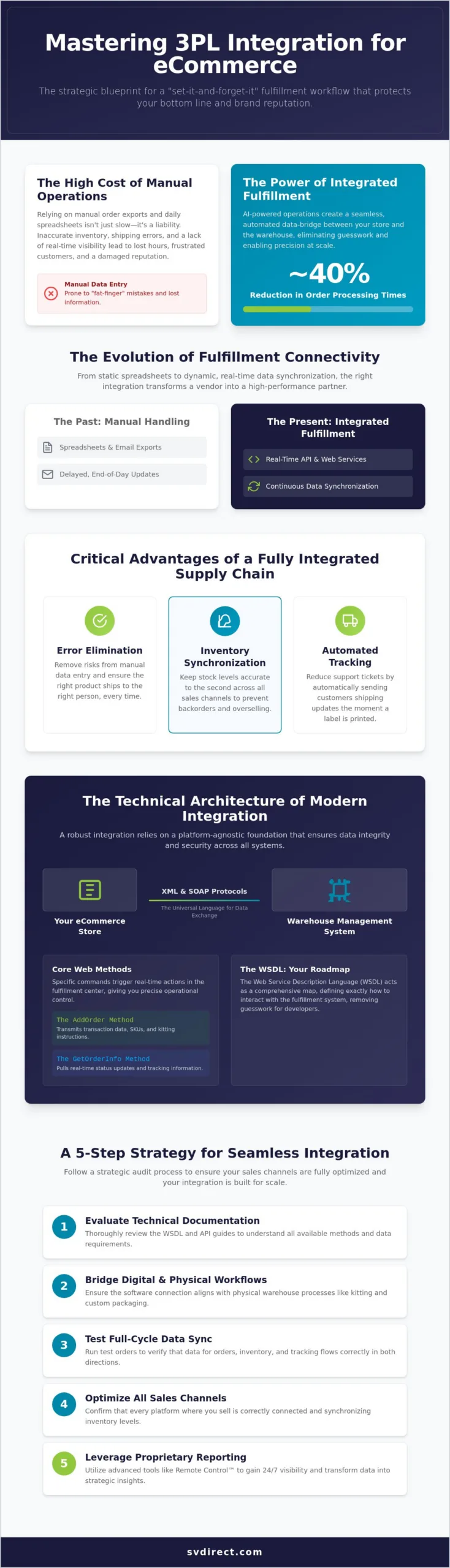
Did you know that AI-powered operations can now reduce order processing times by nearly 40%, yet many brands still lose hours every day to manual data entry? With the 2026 removal of Section 321 de minimis exemptions and new standardized import surcharges, the margin for operational error has effectively vanished. A sophisticated 3pl integration for ecommerce is no longer just a technical checkbox; it’s a strategic necessity to protect your bottom line and your brand’s reputation.

It’s exhausting to manage inaccurate inventory levels that lead to backorders or to feel blind when customers ask for real-time shipping updates. You deserve a fulfillment partner that acts as a steady, reliable extension of your own team rather than a distant vendor. This guide provides the blueprint to master the technical and operational frameworks of integration, moving you toward a “set-it-and-forget-it” workflow. We’ll examine how leveraging proprietary systems and real-time data transparency can transform your logistics into a high-performance engine capable of handling any sales spike with precision.

Key Takeaways

  • Understand how XML and SOAP protocols facilitate a platform-agnostic connection for seamless data synchronization across any operating system.
  • Learn why a successful 3pl integration for ecommerce must bridge the gap between digital software connections and physical warehouse workflows.
  • Follow a strategic five-step audit process to evaluate technical documentation and ensure your sales channels are fully optimized.
  • Discover how to leverage proprietary reporting tools like Remote Control™ to gain 24/7 visibility and transform your supply chain into a transparent extension of your brand.

What is 3PL Integration for eCommerce?

At its core, 3pl integration for ecommerce is the automated synchronization of data between an online store and its fulfillment partner. It serves as a strategic data-bridge between sales and operations, ensuring that every customer click translates into a physical action in the warehouse without human intervention. While the concept of Third-party logistics (3PL) has existed for decades, the integration layer is what transforms a simple vendor relationship into a high-performance partnership.

As we move through 2026, the industry is witnessing a total departure from “Manual Handling” in favor of “Integrated Fulfillment.” Relying on manual order exports or daily spreadsheets isn’t just slow; it’s a liability. With the removal of Section 321 de minimis exemptions increasing shipping complexity, brands need a system that handles data with the same precision used in our eCommerce order fulfillment facility. This digital backbone is what allows a brand to scale during high-volume spikes without sacrificing customer trust.

The Evolution of Fulfillment Connectivity

Key Benefits of a Fully Integrated Supply Chain

The primary value of a deep 3pl integration for ecommerce is the peace of mind that comes from operational transparency. When your systems talk to each other, you gain several critical advantages:

  • Elimination of errors: You remove the risk of “fat-finger” mistakes or lost emails that lead to shipping the wrong product to the wrong person.
  • Inventory synchronization: Real-time updates across all sales channels prevent the dreaded backorder scenario, keeping your stock levels accurate to the second.
  • Automated tracking: Customers receive shipping confirmations and tracking numbers the moment a label is printed, which drastically reduces customer support inquiries.

By automating these touchpoints, your team can stop acting as data entry clerks and start focusing on brand strategy. It’s about creating a workflow that feels like a seamless extension of your company, backed by the physical infrastructure and technical expertise needed to execute perfectly every time.

The Technical Architecture of Modern 3PL Integration

While many guides focus on the simplicity of one-click plugins, a truly robust 3pl integration for ecommerce relies on a deeper technical foundation. High-volume brands require more than a basic connection; they need a sophisticated architecture that ensures data integrity across disparate systems. This is achieved through the use of XML and SOAP (Simple Object Access Protocol) web services. These protocols provide a structured, platform-agnostic language that allows your online store to communicate with our warehouse management system regardless of the operating system or coding language your site uses.

For developers, the efficiency of this architecture is anchored by the Web Service Description Language (WSDL). This acts as a comprehensive roadmap, defining exactly how to interact with the fulfillment system. By utilizing these standardized protocols, we remove the guesswork from the development phase. It creates a stable, predictable environment where data flows are secure and verifiable. If you are ready to see how these technical frameworks can support your specific business model, you can consult with our integration specialists to discuss a tailored approach.

Core Web Methods for eCommerce Success

The heartbeat of a technical integration consists of specific “methods” or commands that trigger actions within the fulfillment center. Understanding these core functions is essential for maintaining operational control:

  • The AddOrder Method: This is the primary gateway for submitting transactions. It doesn’t just send a shipping address; it transmits complex SKU data, specific kitting instructions, and shipping carrier preferences directly into our production queue.
  • The GetOrderInfo Method: This method allows your system to pull real-time updates. It retrieves current order status, specific line-item details, and tracking information, ensuring your customer dashboard is always accurate.
  • The GetShippingActivity Method: Vital for financial transparency, this method manages freight charges and provides a summary of all shipping activity within a defined timeframe.

Data Tagging and Standardized Protocols

XML remains the gold standard for secure data exchange because it is both machine-readable and human-readable. This transparency allows for faster troubleshooting and more precise data tagging. To facilitate the discovery of these services, we utilize UDDI (Universal Description, Discovery, and Integration), which acts as a directory for listing available web services. This structured approach is further supported by manual system testing pages and GUI interfaces. These tools allow your technical team to test connections and verify data packets in a controlled environment before going live, ensuring that the final 3pl integration for ecommerce is flawless from day one.

Software vs. Operational Integration: Bridging the Gap

While the technical protocols discussed earlier provide the digital handshake, they only represent half of the success equation. A deep 3pl integration for ecommerce must extend beyond the server and onto the warehouse floor. Operational integration ensures that your specific brand standards are mirrored in every physical workflow, from the way a box is taped to how items are positioned inside. This alignment turns a standard fulfillment center into a true extension of your business rather than just a remote storage site.

Our “Quiet Facility” methodology is a testament to this philosophy. We believe that an organized, calm physical environment is the only way to maintain the digital accuracy your software expects. When physical spaces are meticulously managed, the data reflected in your systems remains untainted. Our team identifies and resolves inventory discrepancies or shipping conflicts before they ever reach the loading dock. This proactive stance ensures that the high-tech efficiency of your front-end store is never undermined by back-end chaos.

Integrating Specialized Services: Print and Kitting

Modern commerce often requires more than just picking a product off a shelf. By integrating on-demand digital printing directly into the fulfillment flow, we allow brands to personalize shipments at the moment of order. Using HP Indigo technology, we utilize Variable Data Printing (VDP) to include unique copy or customized inserts for every recipient. This level of customization is integrated into the automated workflow, making the “Unboxing Experience” a scalable reality rather than a manual burden. Custom kitting and assembly are treated with the same technical rigor, ensuring that promotional bundles are built with precision and speed.

The QC-Check: Human Oversight in an Automated World

Automation is powerful, but it lacks the nuanced judgment required for complex kitting or high-stakes promotional launches. Systematic human inspection remains a critical component of our quality control process. Even during high-volume deadline spikes, every kit undergoes a rigorous QC-check to verify that the physical output matches the digital order perfectly. This blend of high-tech speed and human oversight is what maintains customer trust. You can learn more about our kitting and assembly services and how they bridge the gap between automated data and physical perfection.

The Strategic Guide to 3PL Integration for eCommerce in 2026

5 Steps to a Seamless 3PL Integration Strategy

Implementing a robust 3pl integration for ecommerce requires more than just a digital handshake. It demands a structured transition from your current manual processes to a fully synchronized operation. While the technical protocols like XML and SOAP provide the foundation, your strategy must account for the unique operational nuances of your brand. Following a methodical implementation plan ensures that your data remains clean and your fulfillment stays fast as you scale.

  • Step 1: Audit your current sales channels and data requirements. Identify every point where an order is generated. You must determine which data fields, such as custom gift messages or specific kitting instructions, are mandatory for successful fulfillment.
  • Step 2: Evaluate the 3PL’s technical documentation and developer resources. A transparent partner provides clear technical documentation upfront. Reviewing the WSDL (Web Service Description Language) allows your developers to understand the system architecture before writing a single line of code.
  • Step 3: Define custom workflows for kitting, assembly, and specialized printing. Automation shouldn’t limit your creativity. Define how specialized tasks, such as variable data printing or healthcare mailing services, are triggered within the integration flow.
  • Step 4: Establish real-time reporting triggers and low-inventory alerts. Use systems that offer proactive notifications. By setting up automated triggers for low stock or shipping delays, you can manage customer expectations before a problem arises.
  • Step 5: Conduct end-to-end testing using a programmatic interface. Never go live without a sandbox phase. Submit test orders through the interface and track them through the entire warehouse lifecycle to verify that every data packet is received and processed correctly.

Evaluating Technical Compatibility

When you speak with a 3PL’s IT team, ask whether they use proprietary systems or third-party software. Our in-house systems are designed for total flexibility, allowing us to adapt to your specific business logic rather than forcing you into a generic template. You need 24/7 access to your order history and inventory levels to make informed decisions. You can explore our Remote Order Management system to see how we provide this level of deep technical visibility.

Setting Up Automated Notifications

Real-time visibility is a powerful asset for your marketing and sales departments. When your team knows exactly when inventory is received or when a backorder is cleared, they can adjust campaigns with confidence. Configuring automated email alerts ensures that your staff stays informed without needing to manually pull reports. This transparency is a hallmark of a true partnership. You can read what our clients say about real-time visibility and how it has transformed their daily operations.

The Silicon Valley Direct Approach: Technology Meets Partnership

Choosing a partner for your 3pl integration for ecommerce is about more than just checking technical boxes; it’s about finding a steady hand that treats your business as its own. We position ourselves as an extension of your company, providing the high-tech infrastructure of Silicon Valley with a human-centric commitment to service. Since 1999, we’ve remained at the cutting edge of logistics innovation while maintaining the personal oversight that pure automation lacks. Our “Nine Promises” serve as the foundation of this partnership, guaranteeing the transparency and bespoke problem-solving your brand requires to thrive in a fast-paced market.

True operational control is only possible when you have access to meaningful data. Our proprietary Remote Control™ system puts over 120 standard reports at your fingertips, offering 24/7 visibility into every corner of your supply chain. This isn’t just a dashboard; it’s a window into our facility that allows you to manage inventory, track orders, and analyze trends in real-time. By combining this digital transparency with our geographic advantage as a hub of global connectivity, we ensure your logistics remain as agile as your marketing strategy.

High-Resolution Fulfillment: The HP Indigo Advantage

Brand perception is often defined by the physical touchpoints of a shipment. We utilize the HP Indigo 5500 Digital Press to deliver high-resolution variable data printing with a 230 line screen resolution. This ensures your brand collateral, literature, and personalized inserts look professional and sharp. The “dry-to-touch” nature of this technology allows for immediate kitting and fulfillment, accelerating your speed to market. We also prioritize sustainability by using a digital process that eliminates the need for plates, films, and harsh chemicals, aligning your fulfillment with modern environmental standards.

Scalability Without the Hectic Atmosphere

A high-performance facility doesn’t have to be a chaotic one. Our methodical approach allows us to handle 3,000+ shipments a week with the same precision and calm we apply to smaller, boutique runs. We’ve found that a quiet, organized workspace is the best environment for maintaining the accuracy required for complex 3pl integration for ecommerce. Whether you are in the technology, healthcare, or consumer goods sector, our facility is designed to scale with your growth spikes without losing the human touch. You can discover our specialized industry solutions to see how we tailor our infrastructure to meet the unique demands of your specific market.

Future-Proof Your Fulfillment Ecosystem

Mastering a 3pl integration for ecommerce is the difference between a reactive supply chain and a proactive growth engine. By aligning technical protocols like XML and SOAP with precise operational standards, you create a workflow that is both scalable and reliable. We’ve spent over 25 years in Silicon Valley refining this balance. This ensures that your digital data always matches the physical truth on our warehouse floor.

Our proprietary Remote Control™ system provides the transparency you need to lead with confidence, offering 120+ standard reports that keep you in command 24/7. When you combine this visibility with our high-resolution digital printing and meticulous kitting services, your brand becomes a seamless experience for every customer. You don’t have to manage the complexities of 2026 logistics alone.

We’re ready to help you transform your operations into a high-performance partnership that scales with your ambition.

Frequently Asked Questions

What is the difference between an API and Web Services for 3PL integration?

Web Services are a specific type of API that utilize standardized network protocols like XML and SOAP to communicate over the internet. While “API” is a broad term for any interface that allows software to interact, our web services provide a more structured, platform-agnostic bridge. This architecture is essential for maintaining secure, readable data exchange between your online store and our warehouse management system.

Do I need a developer to integrate my eCommerce store with a 3PL?

You typically need a developer or a technical lead to manage a sophisticated 3pl integration for ecommerce, especially when your business requires custom logic. While basic plugins exist for simple storefronts, our proprietary XML and SOAP interfaces require a professional to map your specific data fields to our system. We provide comprehensive documentation and WSDL files to make this process efficient for your technical team.

Can I integrate my custom kitting requirements into the automated fulfillment process?

Yes, you can integrate complex kitting and assembly requirements directly into the automated fulfillment flow. By defining specific SKU combinations or assembly triggers within your data packets, our system automatically alerts the warehouse floor to perform these specialized tasks. This ensures that every promotional bundle or custom kit is built with precision the moment the order is received, maintaining your brand standards at scale.

How does 3PL integration improve my inventory accuracy?

Integration improves inventory accuracy by eliminating the need for manual data entry and providing real-time synchronization across all your sales channels. When an order is placed, stock levels are instantly adjusted in our warehouse management system and pushed back to your storefront. This closed-loop communication prevents overselling and backorders, ensuring your digital storefront always reflects the physical reality of the inventory in our facility.

Is variable data printing more expensive to integrate into my shipments?

Integrating variable data printing (VDP) into your shipments is primarily a matter of data mapping rather than increased technical complexity. By including a “personalized copy” field in your order transmission, our HP Indigo digital presses can automatically pull that data to create unique inserts or brand collateral. This process is highly efficient because it is built directly into the standard fulfillment workflow, allowing for rapid, “dry-to-touch” production.

What happens if my eCommerce platform is not a standard one like Shopify?

Our system is platform-agnostic, meaning we can integrate with custom-built eCommerce sites or niche platforms just as easily as standard ones. For example, jewelry and diamond brands utilizing Valigara can connect their specialized management software with our fulfillment systems. Because we utilize XML and SOAP web services, the specific operating system or coding language of your site does not matter, allowing us to establish a seamless 3pl integration for ecommerce that fits your unique infrastructure.

How often is inventory data updated in a fully integrated 3PL system?

Inventory data is updated in real-time as transactions occur within the warehouse. Every time an item is picked, packed, or received, the change is reflected immediately in our proprietary system. You can monitor these levels 24/7 through our Remote Control interface, which provides access to over 120 standard reports. This constant stream of data ensures that your marketing and sales teams always have the most accurate information possible.

Can I track international shipments through the 3PL integration?

Yes, our integration supports full tracking for international shipments through our global shipping and logistics network. Once a shipping label is generated, the tracking number is automatically pushed back to your system via the GetOrderInfo or GetShippingActivity methods. This allows your customers to monitor their packages from our Silicon Valley facility to their doorstep, regardless of their location, providing a transparent and reassuring delivery experience.

D2C Logistics Solutions: The 2026 Strategic Guide for Scaling Brands

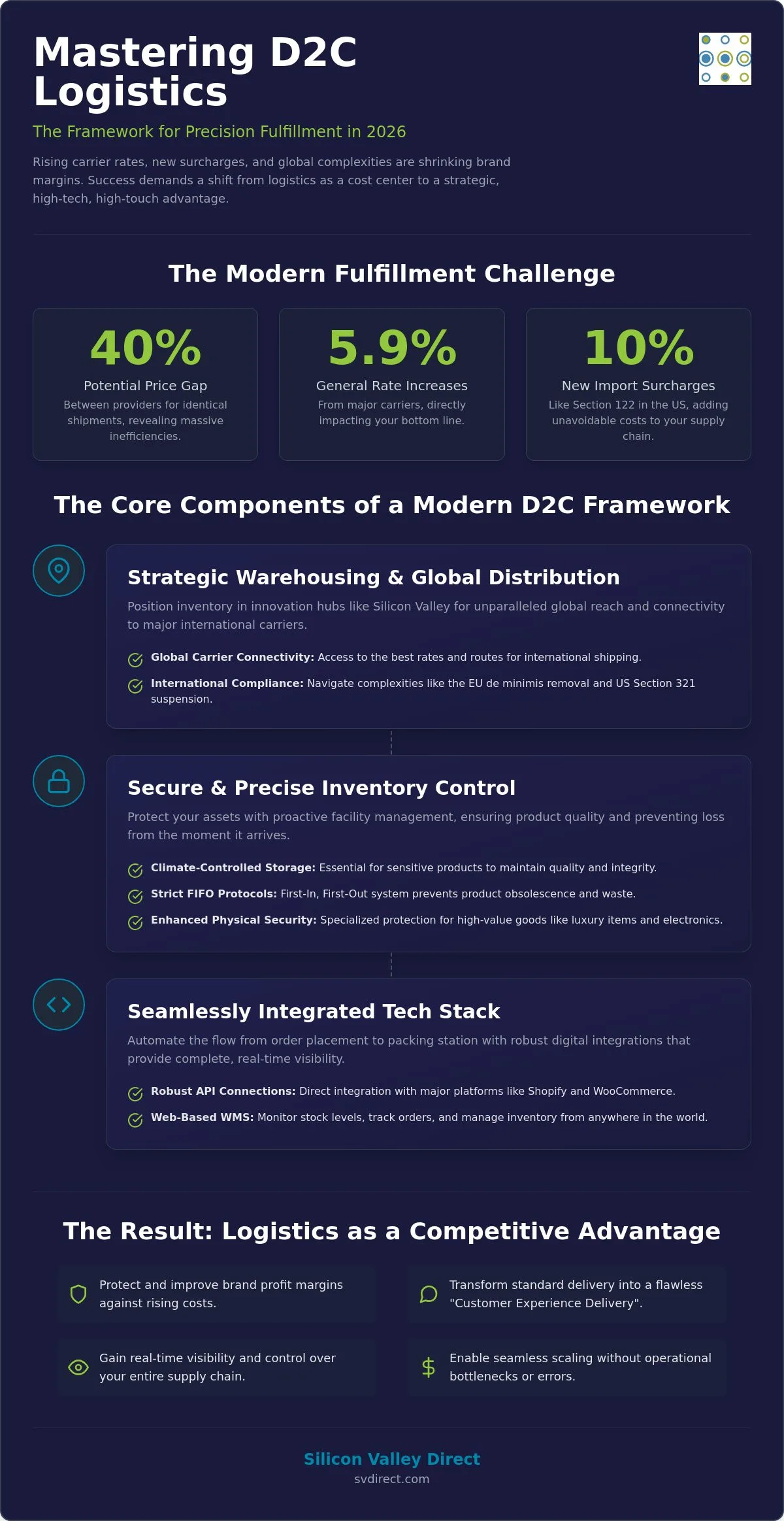
In 2026, the price gap between shipping providers can reach a staggering 40% for identical shipments, yet many brands still treat fulfillment as a fixed cost rather than a strategic lever. You’ve likely felt the sting of the 5.9% general rate increases or the recent removal of the EU de minimis threshold. It’s frustrating to watch your margins shrink while shipping errors and visibility gaps stall your growth. Implementing effective d2c logistics solutions isn’t just about moving boxes. It’s about maintaining brand integrity while managing the new 10% Section 122 surcharge on US imports.

We understand that scaling a brand requires a steady hand and a partner who values precision as much as you do. This guide will help you master the complexities of direct-to-consumer fulfillment using a framework that balances high-tech digital precision with the high-touch human expertise your brand deserves. We’ll examine how to scale custom unboxing experiences, stabilize international shipping costs, and leverage real-time data to turn your supply chain into a competitive advantage.

Key Takeaways

  • Understand the shift toward “Precision Logistics” and how it protects brand margins against rising carrier rates and new international surcharges.
  • Learn how to leverage web-based inventory management and strategic warehouse locations to achieve real-time visibility and seamless global distribution.
  • Discover the cost-saving benefits of on-demand digital printing and custom kitting for creating high-impact, personalized customer unboxing experiences.
  • Navigate the complexities of specialized d2c logistics solutions for sensitive sectors like healthcare, ensuring full HIPAA compliance and data security.
  • Identify the essential criteria for selecting a long-term partner, prioritizing a proven operational history and a commitment to direct human oversight.

Why D2C Logistics Solutions Define Brand Success in 2026

The operational landscape has shifted. Direct-to-consumer (D2C) logistics is no longer just the act of putting a product in a box; it’s the end-to-end management of inventory directly from your brand to the end consumer. In 2026, we’ve entered the era of “Precision Logistics.” With major carriers like DHL and FedEx implementing general rate increases of 5.9%, brands can’t afford the waste associated with old-school bulk shipping methods. Success now requires a surgical approach to every SKU and every shipment.

Your logistics provider serves as a physical extension of your marketing team. When a customer receives a package, that interaction is often the only tangible touchpoint they have with your brand. High-performance d2c logistics solutions ensure this moment is flawless. By integrating advanced 3PL fulfillment services, you transform a standard delivery into a “Customer Experience Delivery.” This shift moves logistics from a back-office expense to a front-line driver of customer retention.

The Crisis of In-House Fulfillment

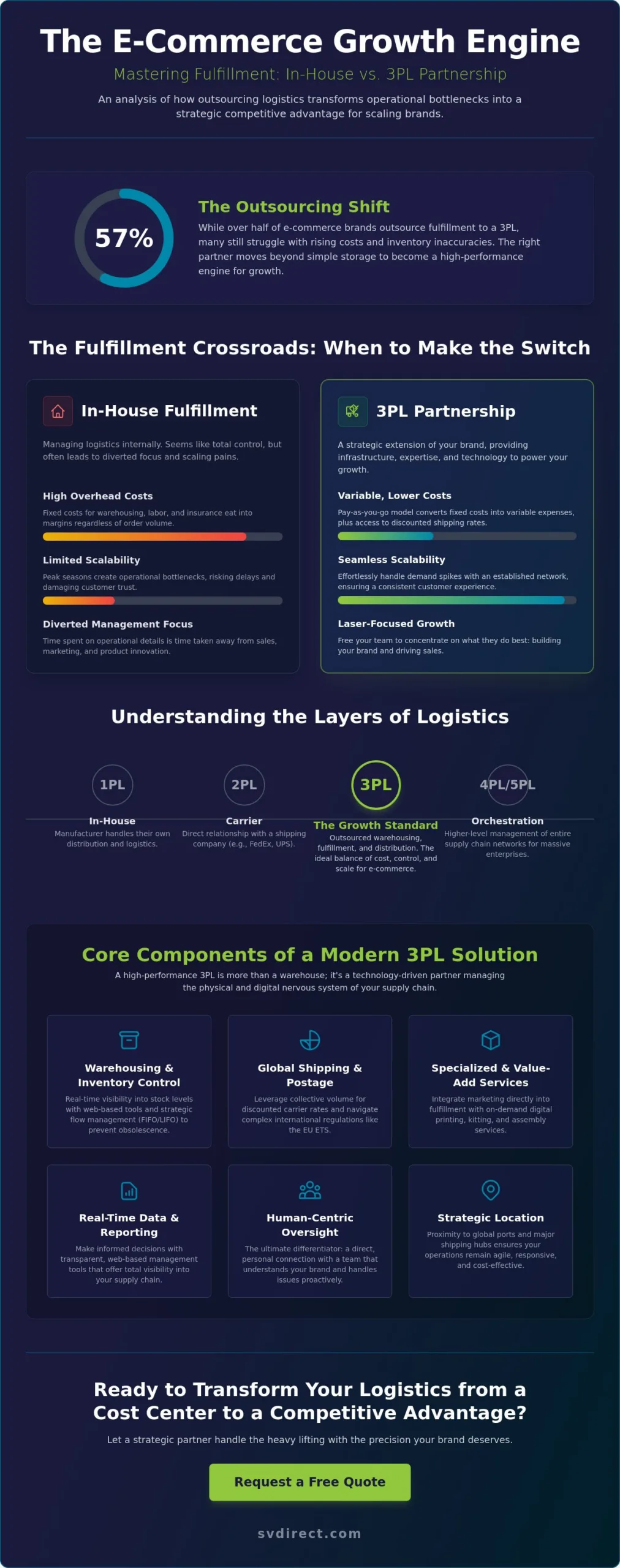
Every scaling brand eventually hits a breaking point. It usually happens when order volume exceeds the capacity of a small warehouse or a home-based operation. Manual errors begin to spike, inventory visibility vanishes, and the cost of lost shipments erodes your profits. Scaling is impossible without a dedicated infrastructure. Professional warehousing and distribution provide the stability you need to grow without the constant stress of operational bottlenecks. Transitioning to a partner allows you to reclaim your time and focus on product innovation.

D2C vs. B2B Logistics: Key Differences

D2C fulfillment is uniquely complex. Unlike B2B logistics, which often involves moving large pallets to a few locations, d2c logistics solutions require managing a high volume of low-item-count orders sent to thousands of individual addresses. This demands high-tech precision in kitting and assembly to maintain the “unboxing experience” at scale. Customers in 2026 also expect real-time tracking and proactive communication. Meeting these expectations requires a sophisticated digital integration that balances mechanical efficiency with a human touch to resolve issues before the customer even notices them.

Core Components of a Modern D2C Logistics Framework

Building a resilient operation requires more than just shelf space; it necessitates a sophisticated infrastructure that aligns with your growth trajectory. Strategic warehousing remains a cornerstone of this framework. By positioning inventory in innovation hubs like Silicon Valley, brands gain unparalleled global reach and connectivity to major international carriers. This geographic advantage is critical when managing the impact of D2C on supply chains, where speed and agility are the primary currencies. Effective d2c logistics solutions integrate global shipping coordination to navigate the removal of the EU de minimis threshold and the suspension of Section 321 in the US, ensuring duties are handled without slowing down the customer’s delivery.

Secure Warehousing and Inventory Control

Protecting your assets requires a proactive approach to facility management. For brands selling sensitive products, climate-controlled storage is a necessity to maintain quality. We implement strict FIFO (First-In, First-Out) protocols to prevent product obsolescence, ensuring your oldest stock moves first. High-value goods, such as luxury items or electronics, benefit from enhanced physical security measures that go beyond standard warehouse protocols. This level of care ensures that your inventory remains as pristine as the day it arrived.

The Tech Stack: Integrating Your Storefront

Modern fulfillment relies on seamless digital integration. Your logistics partner should offer robust API connections with platforms like Shopify and WooCommerce to automate the flow from order placement to the packing station. This real-time visibility is powered by a web-based Warehouse Management System (WMS) that allows you to monitor stock levels from anywhere. If you’re looking to streamline these operations, you might consult with an expert to see how automation can predict seasonal spikes. By using data to forecast inventory needs, you avoid the high costs of overstocking while ensuring you never miss a sale during peak periods.

Finally, a modern framework must address returns management. Instead of viewing reverse logistics as a headache, treat it as a loyalty builder. A streamlined, transparent returns process reinforces trust and encourages repeat purchases; it effectively turns a potential loss into a long-term win for your brand.

The Strategic Advantage of Kitting and On-Demand Printing

In a tech-saturated market, the physical touchpoint is your most potent differentiator. Advanced d2c logistics solutions that prioritize custom kitting and on-demand printing transform a routine delivery into a high-impact brand experience. This goes beyond simply placing items in a box; it involves a strategic marriage of operational efficiency and marketing precision. By utilizing branded packaging, you encourage customers to share their unboxing moments on social media. This effectively turns every shipment into a piece of user-generated content that drives organic growth.

Kitting and Assembly for Complex D2C Brands

Managing multi-component products requires meticulous attention to detail and a high degree of accuracy. Professional assembly ensures that every subscription box or promotional kit arrives exactly as intended, maintaining the brand promise you’ve worked hard to build. This process also offers a hidden financial benefit: optimizing package size. By precisely fitting components together, you reduce dimensional weight and lower your overall shipping costs. You can learn more about kitting and assembly services to see how this operational precision scales with your brand’s complexity.

On-Demand Printing: The Personalization Engine

Traditional literature fulfillment often leads to wasted inventory and outdated brochures that don’t reflect your current offerings. Our print-on-demand capabilities allow you to integrate high-quality digital printing directly into the fulfillment workflow. You can add personalized notes, updated manuals, or targeted marketing collateral to every order without the burden of bulk storage. This just-in-time approach reduces waste by printing only what’s needed for the day’s shipments. It’s a lean, efficient way to keep your communication fresh and your customers engaged. These d2c logistics solutions ensure your physical operations remain as agile and responsive as your digital storefront.

D2C Logistics Solutions: The 2026 Strategic Guide for Scaling Brands

Specialized D2C: Navigating Healthcare and Compliance

Standard 3PL providers often lack the specialized infrastructure required to handle regulated materials or sensitive information. When your brand moves into the healthcare or high-value electronics space, the margin for error disappears. You require d2c logistics solutions that prioritize HIPAA compliance and rigorous security protocols. This isn’t just about moving product; it’s about protecting your brand from the legal and reputational risks associated with data breaches or lost inventory. We act as a steady hand, ensuring that your most sensitive shipments are handled with the same care you put into developing them.

Compliance-Driven Fulfillment

Audited processes are the backbone of fulfillment for healthcare and financial services. Every step must be documented to maintain data integrity, especially when handling Explanation of Benefits (EOB) or sensitive medical billing mailings. Errors in these documents can lead to significant compliance issues and erode patient trust. To master these complexities, review our guide on healthcare mailing services. We ensure that the digital data provided matches the physical mailer with total accuracy, maintaining a seamless flow from your database to the patient’s mailbox.

Secure Warehousing for High-Value Goods

Premium goods demand a higher standard of care than standard retail items. Whether you’re shipping pharmaceuticals or high-end consumer tech, we implement strict chain-of-custody protocols to monitor items from receiving to outbound shipping. You can explore secure warehousing for high-value electronics to see how our anti-theft measures and physical security protect your bottom line. These specialized d2c logistics solutions provide the peace of mind that comes from a partner with decades of experience in high-stakes fulfillment. If you’re ready to upgrade your compliance and security standards, request a free quote today to start a partnership built on precision.

Selecting Your D2C Partner: A Framework for Long-Term Growth

Choosing a logistics partner is a decision that dictates your brand’s trajectory. While some providers focus solely on automated efficiency, the most successful brands prioritize a marriage of high-tech precision and human oversight. A partner with a 25+ year track record offers a level of stability that newer, tech-only platforms often lack. When you’re managing d2c logistics solutions, you need a steady hand that’s navigated multiple market cycles and carrier shifts. This experience is your best defense against the volatility of the current market.

The “Human Oversight” test is a primary differentiator. You should always be able to speak directly to a real person who understands your brand’s nuances. This direct connection is vital when resolving complex issues that an algorithm might miss. Additionally, demand absolute transparency in fee structures. Since accessorial charges can account for up to 40% of a company’s total annual shipping costs, you must clearly understand the distinction between pick-and-pack fees and storage expenses. Your partner should also demonstrate a robust international shipping reach, ensuring they can handle the complexities of global duties and regional warehousing with ease.

Questions to Ask Your Potential 3PL

  • How do you handle sudden volume spikes during peak seasons?
  • What are your specific quality control measures for kitting and assembly?
  • Can you integrate with my specific eCommerce tech stack?

The Transition Plan: Moving from In-House to 3PL

Transitioning to a professional 3PL requires a methodical approach to ensure a clean data transfer. Start by auditing your current inventory and SKU list to eliminate discrepancies before the move. It’s also critical to set clear KPIs for accuracy, speed, and returns processing from day one. Finally, establish a consistent communication cadence with your new logistics team. This proactive stance ensures that your physical operations remain perfectly aligned with your brand’s growth goals, turning your supply chain into a reliable engine for scaling.

Future-Proof Your Brand with Precision Logistics

The path to scaling in 2026 requires a shift from reactive shipping to proactive, data-driven fulfillment. By integrating sophisticated tech stacks with specialized kitting and assembly, you transform your logistics from a cost center into a powerful engine for customer retention. We’ve seen how d2c logistics solutions must now balance the complexities of global duties with the personal touch of a custom unboxing experience. Whether you’re navigating the strict requirements of healthcare compliance or managing high-value inventory, the right framework ensures your brand remains agile and reliable.

Silicon Valley Direct has been a steady partner in this industry since 1999. We combine decades of operational expertise with a commitment to direct human oversight on every complex order. Our team specializes in high-stakes tasks, including HIPAA-compliant healthcare fulfillment, ensuring your sensitive data and products are handled with absolute precision. Don’t let operational bottlenecks stall your growth. It’s time to scale your brand with Silicon Valley's premier D2C logistics partner and build the resilient infrastructure your customers deserve. Your brand’s next chapter starts with a partner you can trust.

Frequently Asked Questions

What are the primary benefits of outsourcing D2C logistics?

Outsourcing provides immediate access to seasoned expertise and physical infrastructure that would be too costly to build in-house. It allows your team to focus on product development while a partner manages the complexities of warehousing and global distribution. By leveraging professional d2c logistics solutions, brands avoid the operational bottlenecks that often occur during rapid growth phases. This partnership ensures that every order is handled with precision and human oversight.

How much do D2C logistics solutions typically cost for a startup?

Pricing for these services is generally based on your specific operational needs, such as the number of SKUs and monthly order volume. Most providers use a combination of storage fees, which are calculated by pallet or shelf space, and activity-based fees like pick-and-pack rates. It’s essential to partner with a provider that offers a transparent fee structure. This clarity helps you manage your margins effectively as your brand scales into new markets.

Can a 3PL handle custom branded packaging and unboxing experiences?

Absolutely, a high-performance logistics partner acts as an extension of your marketing team by executing complex assembly and kitting tasks. We can handle everything from custom branded boxes to the inclusion of personalized literature produced through on-demand digital printing. This ensures that every customer receives a consistent, high-impact unboxing experience that reinforces your brand identity and encourages repeat purchases, even as your daily order volume grows significantly.

What is the difference between a 3PL and a fulfillment center?

While the terms are often used interchangeably, a 3PL provides a more comprehensive suite of services than a standard fulfillment center. A fulfillment center typically focuses on the mechanical task of picking and shipping orders. In contrast, a 3PL offers strategic support, including inventory management, returns processing, and global logistics coordination. This holistic approach provides the stability and scalability needed to manage a brand’s entire physical supply chain effectively.

How do D2C logistics providers handle international shipping and customs?

Providers manage global logistics by coordinating with international carriers and navigating the latest regulatory changes. Brands often look to regional express specialists like urbanremessas.com.br to streamline deliveries in specific international markets. For example, they handle the complexities of the 2026 EU de minimis removal and the US Section 122 surcharge. By using advanced digital integration, they ensure that customs documentation is accurate and duties are pre-calculated. This proactive approach prevents packages from being held at the border and maintains a seamless experience for your international customers.

Is it possible to integrate my Shopify store with a 3PL’s inventory system?

What makes a 3PL ‘healthcare compliant’ for medical D2C brands?

A 3PL is considered healthcare compliant when it implements audited processes that meet HIPAA standards for protecting sensitive patient information. This includes secure data handling protocols and physical security for medical devices or pharmaceuticals. Compliance also requires high-precision mailing services for documents like Explanation of Benefits (EOB). These specialized protocols ensure that every healthcare-related shipment is accurate, secure, and fully compliant with current federal regulations and industry standards.

How does kitting help reduce my overall shipping costs?

Kitting reduces costs by optimizing the dimensional weight of your shipments. By professionally assembling multiple components into a single, right-sized package, you avoid the high fees associated with oversized or multiple boxes. Since carriers in 2026 use a standard dimensional weight divisor of 139 and round fractional inches up, precision in packaging is vital. Effective kitting ensures you aren’t paying to ship empty space, which directly protects your bottom line.

Global Shipping Services: The Strategic Reference Guide for 2026

Global Shipping Services: The Strategic Reference Guide for 2026

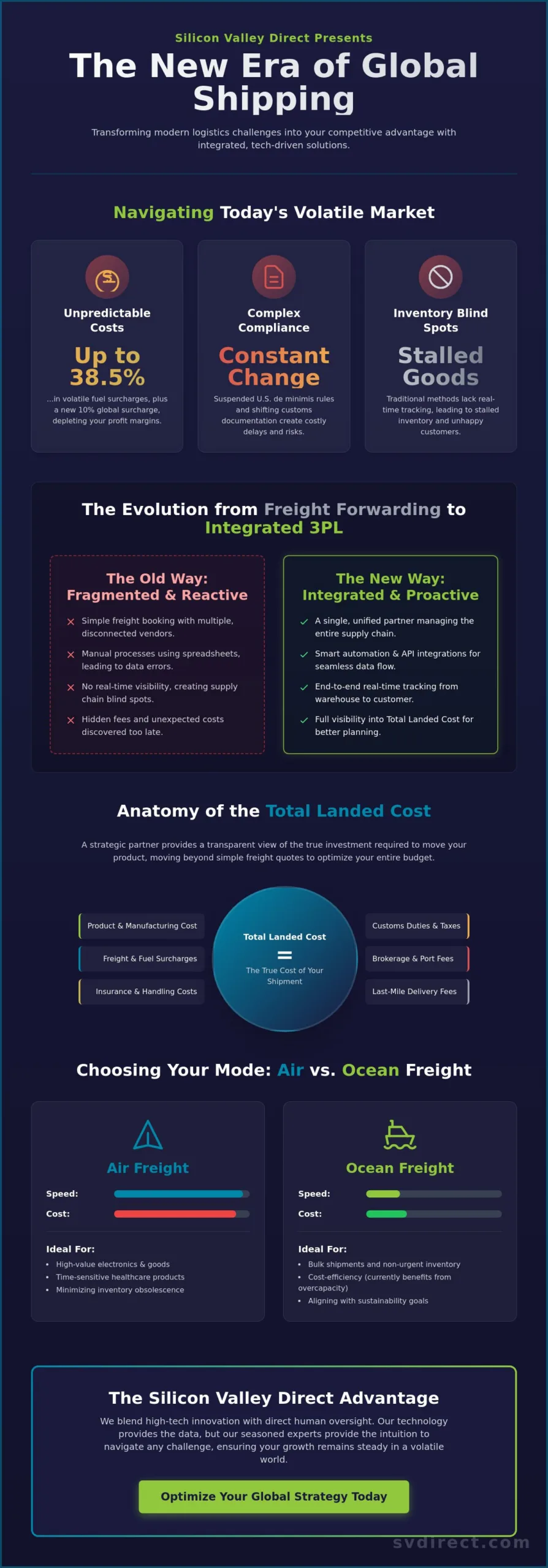
What if the logistics strategy that carried your business through 2025 is now the very thing stalling your growth? With the U.S. de minimis threshold suspended and a 10% global surcharge now in effect, the old rules for global shipping services have been completely rewritten. You’re likely feeling the pressure of these shifting regulations, alongside unpredictable fuel surcharges that can climb as high as 38.5% when energy prices spike. It’s a complex environment where traditional methods often lead to stalled inventory and depleted margins.

We understand that managing international logistics feels like a constant battle against customs documentation and hidden fees. This guide is here to help you reclaim control. You’ll learn how to transform these operational hurdles into a scalable growth engine by mastering modern compliance and real-time visibility. We’ll analyze the shift toward a shipper’s market, the impact of Section 122 surcharges, and how precision-led fulfillment keeps your business agile in an era of unprecedented change.

Key Takeaways

  • Learn why modern global shipping services require a shift from simple freight forwarding to an integrated 3PL model that combines physical transport with sophisticated digital oversight.
  • Discover how to leverage the digital layer of logistics, including API integrations and real-time tracking, to eliminate blind spots in your international inventory.
  • Master the essential documentation requirements, from commercial invoices to certificates of origin, to navigate the evolving complexities of international customs with precision.
  • Identify high-efficiency shipping lanes and learn how to utilize strategic 3PL carrier relationships to access volume discounts that protect your profit margins.
  • Understand the competitive advantage of partnering with a logistics provider that blends high-tech Silicon Valley innovation with direct human oversight and personal commitment.

What Are Global Shipping Services in the Modern Economy?

At its core, global shipping services represent the end-to-end movement of goods across international borders. It’s a complex dance of physical transport, regulatory compliance, and digital intelligence. In 2026, this isn’t just a back-office utility; it’s a front-line competitive advantage. For eCommerce brands, a robust global shipping network provides the infrastructure needed to reach customers in emerging markets without sacrificing delivery speed or reliability.

To better understand how these systems interact within international trade, watch this helpful video:

The Evolution of International Logistics

Logistics has moved far beyond the era of analog freight forwarding. Digital transformation has replaced manual spreadsheets with smart automation and real-time API integrations. We leverage Silicon Valley innovation to streamline supply chains, ensuring that data moves as fast as the cargo itself. While automation handles the repetitive tasks, the human element remains our most valuable asset. Technology provides the data, but seasoned experts provide the intuition needed to manage unexpected geopolitical shifts or port congestions. This synergy between high-tech tools and human oversight ensures your growth remains steady even when the global market is volatile.

Key Players in the Global Shipping Ecosystem

Understanding the distinction between carriers, freight forwarders, and 3PL providers is essential for a scalable strategy. Carriers own the ships and planes. Freight forwarders act as intermediaries. However, an integrated 3PL acts as the operational quarterback for your entire supply chain. They don’t just book space. They manage everything from warehousing and distribution to returns management. They coordinate with customs brokers to ensure your documentation is flawless, preventing costly delays at the border.

A primary metric for success in this modern ecosystem is the “Total Landed Cost.” This goes beyond the initial freight quote. It provides a transparent view of the true investment required to move product. Key components include:

  • Original product cost and manufacturing fees.
  • International freight charges and fuel surcharges.
  • Customs duties, taxes, and brokerage fees.
  • Insurance and handling costs.
  • Last-mile delivery to the final customer.

By focusing on this comprehensive figure, you can identify the most cost-effective shipping lanes. A strategic partner helps you leverage carrier relationships to access deep volume discounts, ensuring you get the most value from your global shipping services while protecting your margins as you scale.

The Core Components of Comprehensive Global Logistics

Effective global shipping services aren’t just about moving containers from one port to another. They represent a sophisticated integration of physical infrastructure and digital intelligence. While many providers focus solely on freight forwarding, a strategic partner looks at the entire lifecycle of a shipment. This includes everything from secure warehousing in global distribution hubs to the final mile of delivery. By treating logistics as a unified system, you can eliminate the silos that traditionally lead to delays and increased costs.

Air vs. Ocean Freight: Choosing the Right Speed

Selecting the appropriate mode of transport is a balance of cost, speed, and product requirements. Air freight remains the gold standard for high-value electronics and healthcare products where speed is non-negotiable. It minimizes the risk of inventory obsolescence and ensures that sensitive materials reach their destination in peak condition. Conversely, ocean freight is currently benefiting from significant vessel overcapacity in 2026. This oversupply has put downward pressure on spot rates, making it an ideal choice for bulk shipments and non-urgent inventory. Modern ocean strategies also align with sustainability goals, as the industry continues to adhere to the IMO 2020 sulfur cap, which limits sulfur content in fuel oil to 0.50%.

The Digital Layer: Visibility and Status Tracking

In the modern economy, data is just as important as the physical cargo. The digital layer of your supply chain provides the transparency needed to manage customer expectations and inventory levels. Real-time tracking and API integrations allow you to monitor shipments at every stage. This visibility is crucial when interpreting complex updates, such as the batch delivery to carrier meaning, which indicates a shipment has been processed and is awaiting pickup by the final transporter. When your inventory management software connects directly to your global shipping services, you gain a proactive stance that prevents stockouts across different regions. This level of precision is a hallmark of Navigating International Trade in a tech-driven market.

Beyond simple transport, the physical handling of goods within a 3PL facility adds immense value. For example, kitting and assembly services allow for product localization just before the final shipment. This means you can customize packaging or insert region-specific literature without maintaining separate inventories in every country. If you’re ready to see how these components can work for your business, you can consult with our logistics experts to build a bespoke strategy. This approach ensures your global reach is backed by both physical reliability and high-tech efficiency.

Global Shipping Services: The Strategic Reference Guide for 2026

Many businesses view international customs as an impenetrable nightmare. It doesn’t have to be. While the regulatory environment has grown more complex, especially with the U.S. de minimis threshold suspension that took effect on August 29, 2025, clear documentation remains the ultimate antidote to delays. Every successful shipment relies on a precise triad of records: commercial invoices, packing lists, and certificates of origin. When these documents are accurate, your global shipping services operate with the efficiency of a well-run facility. Accuracy prevents the friction that leads to stalled inventory and frustrated customers.

Understanding the division of responsibility is equally vital. In the modern eCommerce era, choosing between DDP (Delivered Duty Paid) and DAP (Delivered at Place) defines your brand’s relationship with the end consumer. DDP is often the preferred choice for brands acting as a strategic partner for global success. It ensures the customer isn’t surprised by unexpected fees at their doorstep. By handling these complexities on the back end, you provide a seamless experience that mirrors the reliability of domestic shipping.

Understanding Duties, Taxes, and Tariffs

Calculating duties requires a precise understanding of HS codes and product valuation. In 2026, this task is more critical than ever. As of February 24, 2026, the U.S. implemented a 10% global surcharge on most imports, which sits on top of existing duties. Because the de minimis exemption for shipments valued at $800 or less is suspended, all commercial shipments now require formal customs entry. This shift makes strategic warehouse positioning essential. By utilizing regional distribution hubs, you can mitigate some tax liabilities and keep your global shipping services cost-effective despite rising tariff rates.

Compliance for Sensitive Industries

Sensitive industries like healthcare and pharmaceuticals require a higher standard of oversight. We provide specialized healthcare mailing services that adhere to strict HIPAA requirements, ensuring patient data remains secure throughout the logistics chain. High-tech components also demand specialized care, often requiring climate-controlled storage to maintain integrity. A major compliance game-changer is the use of on-demand digital printing for localized literature. Instead of shipping massive quantities of pre-printed manuals, you can print region-specific instructions at the point of fulfillment. This ensures your literature fulfillment is always up to date with local regulations while reducing waste and shipping weight.

Optimizing Your Global Strategy for Growth and Cost-Efficiency

In the high-stakes environment of 2026, simply finding a carrier isn’t enough. True optimization requires a granular analysis of shipping lanes to identify the most cost-effective routes for your specific product mix. By leveraging established 3PL carrier relationships, you gain access to deep volume discounts that are typically out of reach for individual brands. These global shipping services work best when they aren’t just a transaction but a strategic extension of your team. You can find more expert insights on these evolving trends and operational best practices by visiting Silicon Valley Direct’s blog.

One powerful method to reduce overhead is implementing “zone skipping.” This involves consolidating individual packages into a single large shipment that bypasses several intermediate carrier hubs, moving directly to a regional distribution center closer to the final destination. This strategy significantly reduces last-mile costs, which often account for a disproportionate share of the total shipping budget. It’s an approach that prioritizes precision over simple speed, ensuring your margins remain healthy as you expand. When combined with regional distribution, this method allows you to compete with local brands on their own turf. For a deeper dive into tactics like these, our guide on how to reduce shipping costs for eCommerce outlines proven strategies for protecting your margins in the current rate environment.

Scaling from Startup to Global Enterprise

Transitioning from local success to international reach requires a methodical three-step approach. First, audit your current domestic fulfillment to ensure your packaging and weight calculations are optimized for international transit. Second, select priority international markets based on hard demand data rather than guesswork. Finally, integrate your eCommerce platform, such as Shopify or WooCommerce, directly with a global 3PL. This integration ensures that inventory levels and tracking numbers sync automatically, providing the real-time visibility your customers expect. If you’re ready to modernize your approach, request a free quote from our logistics team to start building your roadmap.

Managing the Global Returns Challenge

A transparent international returns policy is a critical trust-builder for global customers. However, the logistics of reverse logistics can be daunting without a clear plan. Consolidating global returns into regional hubs before shipping them back to a central facility helps save significant costs. Within an integrated inventory management system, these items can be efficiently assessed for restocking or refurbishing. This ensures that your global inventory remains accurate and that returned goods don’t become dead capital. Handling returns with the same precision as outbound shipments is what separates a world-class operation from a standard shipping vendor. To build a truly resilient reverse logistics process, our comprehensive guide on returns management logistics provides a complete 2026 audit checklist to help you transform this challenge into a competitive advantage.

Choosing a Strategic Partner for Global Success

Selecting the right provider for your global shipping services is the most critical decision in your international expansion journey. In an industry often dominated by faceless corporations and automated ticketing systems, your business needs more than just a vendor. You need a strategic partner who views your supply chain as a unified engine for growth. This partnership extends beyond simple freight. It encompasses a holistic approach where eCommerce order fulfillment, inventory management, and warehousing and distribution work in perfect synchronization. By consolidating these functions with a single provider, you eliminate the communication gaps that lead to costly errors and stalled inventory.

The most efficient global strategies leverage all-in-one providers. When your partner handles on-demand digital printing, kitting and assembly, and global shipping and logistics under one roof, you gain unprecedented agility. This integration allows for real-time localization of products and marketing materials, ensuring your brand remains relevant in every market you enter. It transforms your logistics from a back-office cost center into a front-line competitive advantage that scales alongside your ambitions. To further amplify your brand’s reach in each new market, pairing your physical distribution with direct mail marketing services can create high-impact, physical touchpoints that drive measurable customer engagement alongside your shipping operations.

The Silicon Valley Direct Advantage

Our location in the heart of Silicon Valley serves as a symbol of our commitment to innovation and global connectivity. We bridge the gap between high-tech digital integration and the personalized care that a growing business requires. With a history of providing stability for over 25 years, we offer a steady hand in a fast-paced market. While we utilize advanced systems for route optimization and tracking, we explicitly reject the impersonal “voicemail” culture that has become standard in logistics. When you contact us, you speak with a seasoned expert who understands your specific operational history. This direct human oversight ensures that bespoke problem-solving is always a priority, not an afterthought.

Next Steps: Your Global Launchpad

Transitioning from in-house fulfillment to a professional global 3PL is a significant milestone for any enterprise. It begins with a comprehensive logistics audit to identify hidden opportunities for cost savings and efficiency gains. We help you map out this transition to ensure no disruption to your daily operations or customer experience. Whether you’re scaling a startup or optimizing a mature enterprise, we provide the technical infrastructure and human expertise needed to navigate the complexities of 2026. Your next step is to request a customized quote tailored to your unique global requirements. This allows you to move forward with the informed confidence that your physical operations are as organized as your digital strategy.

Mastering Your Global Growth Engine

We’ve explored how global shipping services have evolved from a simple freight utility into a sophisticated competitive advantage. By mastering the digital layer of tracking and navigating the complexities of modern customs compliance, your business can turn logistical hurdles into scalable opportunities. Success in 2026 depends on balancing high-tech precision with the human intuition needed to manage global volatility.

Since 1999, we’ve provided this stability from our Silicon Valley base, placing your brand at the heart of global innovation. We believe in direct human connection; it’s why you’ll never encounter an automated voicemail system when you need expert guidance. This personal commitment ensures your supply chain remains resilient and responsive. If you’re ready to transform your international reach, streamline your global logistics with Silicon Valley Direct today.

Your international expansion is a bold step toward future-proofing your brand. We’re ready to provide the steady hand and technical expertise you need to succeed on the world stage.

Frequently Asked Questions

What is the difference between a freight forwarder and a global shipping service?

A freight forwarder typically acts as an intermediary that books space on ships or planes without handling the physical product. In contrast, comprehensive global shipping services provided by a 3PL manage the entire lifecycle of the goods. This includes eCommerce order fulfillment, secure warehousing, and the final mile of delivery. While a forwarder moves the cargo, a strategic partner manages the inventory and the customer experience.

How much does it cost to ship products internationally for an eCommerce business?

International shipping costs depend on several variables, including package weight, dimensions, and the final destination. Beyond the base freight rate, you must account for fluctuating fuel surcharges and the 10% global surcharge currently applied to most U.S. imports. Because the de minimis exemption is suspended, every shipment also incurs formal entry fees. We recommend calculating the total landed cost to understand your true margin on every international sale. To further protect your profitability, explore our detailed breakdown of how to reduce shipping costs for eCommerce businesses facing today’s rate pressures.

What are Incoterms, and which ones should I use for my shipments?

Incoterms are standardized rules that define the responsibilities of buyers and sellers in international trade. For eCommerce, DDP (Delivered Duty Paid) is generally the best choice because the seller handles all duties and taxes. This prevents your customers from receiving unexpected bills at their doorstep. DAP (Delivered at Place) is an alternative where the buyer pays duties, but it often leads to higher return rates due to customer dissatisfaction with hidden fees.

How do I handle customs documentation for high-value or sensitive goods?

High-value or sensitive items require meticulous documentation to avoid seizure or delays. You must provide an accurate commercial invoice, a detailed packing list, and the correct HTS classification for every item. For sensitive healthcare products, we ensure compliance with specialized mailing regulations and maintain the integrity of the goods through climate-controlled storage. Precision in this documentation is the only way to ensure global shipping services remain efficient and reliable.

What is ‘Total Landed Cost’ and why is it important for my margins?

Total Landed Cost is the sum of all expenses required to get a product from the manufacturer to the customer’s hands. This includes the original manufacturing price, international freight, insurance, customs duties, and last-mile delivery fees. Understanding this figure is vital because it reveals your actual profit. If you only track freight costs, you might overlook the taxes and surcharges that can quickly erode your margins in the 2026 regulatory environment.

Can a 3PL help me reduce my international shipping rates?

A 3PL reduces your rates by leveraging deep volume discounts through established relationships with major global carriers. Because we aggregate shipments from multiple clients, we access pricing tiers that individual businesses often cannot reach on their own. We also implement cost-saving strategies like zone skipping and regional consolidation. These methods move your products closer to the end user more efficiently, significantly lowering the overhead for each individual package sent abroad.

How do I manage returns for customers located outside of the United States?

Managing international returns requires a dedicated reverse logistics strategy to keep costs manageable. Instead of shipping individual items back to the U.S. immediately, we consolidate returns at regional hubs. Once a sufficient volume is reached, the goods are shipped back in bulk for assessment, restocking, or refurbishing. This methodical approach ensures that your returns management logistics remains cost-effective while still providing a reliable and transparent experience for your global customer base.

What does ‘batch delivery to carrier’ mean for my international customers?

This status indicates that the fulfillment center has processed a group of orders and they are now staged and ready for the carrier to pick them up. It is a common milestone in the global shipping services workflow, showing that the physical preparation, such as kitting and assembly, is complete. For your international customers, this means their package is moving from the warehouse phase into the transit phase of its journey across borders.

What is a 3PL? The Strategic Guide to Third-Party Logistics in 2026

What is a 3PL? The Strategic Guide to Third-Party Logistics in 2026

Approximately 57% of e-commerce brands now outsource their fulfillment to a 3 pl, yet many still struggle with the same recurring bottlenecks. You’ve likely felt the pressure of rising shipping costs eating into your margins or the persistent headache of inventory inaccuracies. It’s difficult to scale during peak seasons when you’re bogged down by operational details instead of focusing on your next big product launch. These challenges can make growth feel like a burden rather than a victory.

We believe that logistics should be a silent, high-performance engine that supports your ambition. This guide will help you master the complexities of third-party logistics and show you how a strategic partnership can transform your supply chain into a measurable competitive advantage. We’ll examine the shifting 2026 market, the importance of real-time data, and how a human-centric approach to warehousing and distribution can free you to focus entirely on your sales. By the end of this article, you’ll have a clear roadmap for choosing a partner that handles the heavy lifting with the precision your brand deserves.

Key Takeaways

  • Understand the evolution of the modern 3 pl and how it serves as a strategic extension of your brand in an increasingly complex global market.
  • Identify the overhead costs of in-house logistics and learn why outsourcing warehousing and distribution is the most efficient path to sustainable scaling.
  • Explore specialized services like on-demand digital printing and kitting that allow you to integrate your marketing materials directly into the fulfillment process.
  • Discover why direct human oversight and personal connection remain the ultimate differentiators when selecting a logistics partner in a tech-saturated industry.
  • Learn how to leverage a strategic location near global ports to ensure your shipping and logistics operations remain agile and responsive.

Understanding 3PL: The Foundation of Modern Supply Chains

In the fast-moving commerce environment of 2026, the definition of a 3 pl has moved far beyond simple storage. It now represents a comprehensive, integrated partnership where a provider manages essential supply chain functions on behalf of a brand. This includes everything from eCommerce order fulfillment and warehousing to complex inventory management. Unlike a freight broker who simply facilitates transportation or a courier who handles a single delivery, a 3PL acts as a strategic extension of your business. It provides the physical infrastructure and technical expertise needed to ensure your products reach global markets with precision. According to recent industry reports, the global market for these services is estimated to reach $1.22 trillion this year. This growth reflects a fundamental shift toward professional outsourcing as a necessity for survival in a competitive landscape.

The Layers of Logistics: 1PL to 5PL Explained

Understanding where your business fits within the logistics hierarchy is vital for strategic planning. Third-party logistics (3PL) serves as the industry standard for brands that have outgrown the 1PL (in-house) and 2PL (direct carrier) models. While 1PL involves a manufacturer handling their own distribution, a 3PL provider takes over the operational burden of warehousing and distribution. For massive enterprises, 4PL and 5PL models offer higher-level orchestration of entire supply networks. However, the 3 pl model remains the most effective balance of cost, control, and scalability for growing e-commerce businesses. It allows brands to leverage existing warehouse networks without the capital expenditure of building their own facilities.

The Role of a 3PL in the Customer Journey

A 3PL is the invisible bridge between a customer clicking “buy” and the package arriving at their door. This stage of the journey is critical because it’s often the only physical interaction a customer has with your brand. Professional logistics directly impact customer retention. Accurate real-time inventory tracking and seamless global shipping build the trust necessary for repeat business. By managing the last mile effectively, a 3PL ensures that the final delivery experience is just as polished as your digital storefront. This partnership allows you to focus on product development and sales while your partner handles the operational complexities. It’s about more than just moving boxes; it’s about protecting your brand’s reputation through every shipment.

Core Components of a Comprehensive 3PL Solution

A high-performance 3 pl partnership functions as the centralized nervous system for your physical goods. It is no longer enough to simply house inventory in a static warehouse. In the 2026 market, a comprehensive solution requires a sophisticated blend of physical infrastructure and digital intelligence. This ensures that every item is accounted for and every shipment is optimized for both speed and cost. When these components work in harmony, your supply chain moves from being a cost center to a strategic asset that supports aggressive business growth. If you are ready to see how these systems can work for you, it may be time to request a free quote and explore a tailored strategy.

Warehousing and Inventory Control

Precision in the warehouse is the starting point for all successful fulfillment operations. Beyond providing secure storage, a modern provider utilizes web-based management tools to offer real-time visibility into your stock levels. This transparency allows you to make informed decisions about production and marketing without the guesswork. We prioritize strategic inventory flow through methodologies like First-In, First-Out (FIFO) and Last-In, First-Out (LIFO). These strategies are essential for preventing product obsolescence and maintaining high quality standards. Whether your goods require standard secure storage or specialized handling, the goal remains the same: total accuracy and immediate accessibility.

Global Shipping and Postage Management

Shipping in 2026 involves navigating a complex landscape of regulations and fluctuating costs. For instance, the full implementation of the EU Emissions Trading System (ETS) for maritime transport now requires shipping companies to cover 100% of their verified emissions. This has a direct impact on international shipping rates and requires a partner who understands these global shifts. By leveraging the collective volume of a 3 pl, you can access discounted carrier rates that are typically unavailable to individual brands. Our approach to global shipping includes:

  • Carrier Management: Selecting the most efficient routes and providers for every destination.
  • Customs Expertise: Navigating cross-border logistics to prevent delays in international transit.
  • Returns Management: Transforming reverse logistics into a growth driver by processing returns quickly and restoring inventory to a sellable state.

This level of oversight ensures that your global shipping strategy is both resilient and cost-effective. By selecting a 3 pl that prioritizes human connection and personal oversight, you ensure that complex logistics problems are solved by experts rather than automated algorithms. This commitment to precision helps maintain your margins while delivering a seamless experience to your customers, regardless of where they are located in the world.

What is a 3PL? The Strategic Guide to Third-Party Logistics in 2026

3PL vs. In-House Fulfillment: When to Make the Switch

Many entrepreneurs begin their journey by managing every shipment personally to ensure the highest quality. This hands-on approach is admirable, yet it often becomes a significant bottleneck as order volumes increase. Managing a 3 pl partnership allows you to shift from a fixed-cost model to a flexible, variable-cost structure. Instead of paying for empty warehouse space during slow months, you only pay for the storage and fulfillment services you actually use. This transition is essential for maintaining healthy margins as you scale toward larger distribution networks. It’s the point where you decide if you’re a logistics company or a brand builder.

Calculating the Total Cost of Ownership (TCO)

Evaluating the true cost of in-house fulfillment requires looking beyond the price of shipping labels. You must account for warehouse rent, utilities, insurance, and the administrative burden of managing a warehouse team. While 3PLs charge pick and pack fees, these are often offset by the deep postage discounts they secure through massive shipping volumes. The break-even point occurs when the cumulative expense of maintaining physical warehouse space and a dedicated labor force exceeds the variable, per-transaction costs of an outsourced fulfillment model. By outsourcing, you also reclaim the opportunity cost of your time, allowing you to focus on high-level strategy rather than manual labor.

Overcoming the “Loss of Control” Objection

A common concern for brand owners is that an external partner won’t care for their products as much as they do. This is where the human element of a 3 pl becomes a powerful differentiator. Strategic kitting and assembly services ensure that your promotional campaigns and custom packaging are executed exactly as you designed them. High-touch providers prioritize transparency through web-based management tools, giving you real-time visibility into every order. Professional handling significantly reduces damage and error rates compared to amateur in-house operations. You aren’t losing control; you’re gaining a team of experts dedicated to protecting your brand’s physical reputation through precise execution. This partnership provides a steady hand during seasonal spikes, ensuring that your customer experience remains flawless even during your busiest months.

Beyond Picking and Packing: Specialized 3PL Services

A standard 3 pl provider might stop at moving boxes, but a strategic partner looks for ways to add value at every touchpoint. In sectors like healthcare, the requirements are even more stringent. We provide healthcare mailing services that adhere to rigorous standards, ensuring that sensitive information is handled with the same precision as physical goods. This level of specialization is what separates a mere vendor from a dedicated operational ally. Whether you’re launching a subscription box or managing a complex direct mail marketing campaign, the ability to handle niche requirements under one roof reduces friction and improves your speed to market.

Kitting, Assembly, and Promotional Fulfillment

Creating a memorable unboxing experience often requires complex kitting and assembly services. Instead of storing pre-assembled kits that take up valuable pallet space, we utilize just-in-time assembly. This method allows you to respond to shifting market demands without over-committing to inventory. By bundling individual components only when an order is placed, you reduce storage costs and maintain flexibility. Our team handles everything from custom packaging for high-end consumer goods to the intricate assembly of promotional bundles, ensuring that your brand identity is preserved in every package. This human oversight ensures that even the most complex promotional campaigns are executed without error.

Integrated Printing and Literature Management

One of the most significant advantages of a modern 3 pl is the integration of on-demand digital printing. This capability allows you to include personalized literature fulfillment or marketing collateral without the need for a separate print vendor. By managing print and mail as a single-source provider, we eliminate the logistical lag between production and distribution. This is a game-changer for businesses that need to include updated manuals, personalized thank-you notes, or promotional flyers in their shipments. It ensures your marketing materials are just as current as your product inventory, all while maintaining a lean supply chain. This unified approach removes the silos that often slow down marketing and fulfillment teams.

When your logistics partner understands the nuances of your specific industry, growth becomes a predictable outcome rather than a logistical hurdle. If you’re looking for a partner that goes beyond the basics to provide bespoke assembly and printing solutions, request a free quote today to see how we can streamline your operations.

Choosing the Right 3PL Partner in Silicon Valley

Selecting a 3 pl partner is a high-stakes decision that defines your brand’s physical presence. In a region known for rapid disruption, your logistics provider should be a reliable anchor. A strategic partnership is about more than just finding a place to store goods. It’s about finding a team that understands the nuances of your industry and can adapt to your growth. Choosing a partner based in Silicon Valley offers a distinct advantage for brands aiming for global reach. This location serves as a nexus for international shipping routes and provides immediate proximity to the world’s leading technology hubs.

The Value of Geographic Intelligence

A Silicon Valley base facilitates faster global shipping and logistics by leveraging proximity to major international ports and transit centers. This geographic intelligence ensures that your products move through the supply chain with minimal latency. A provider with a multi-decade history in this region brings an unparalleled level of stability and local expertise to your operations. Being situated near the heart of innovation also allows for tighter software integrations with your existing e-commerce platforms. This ensures that your digital orders translate into physical shipments with the precision required to maintain a competitive edge in 2026.

The Human Element in Logistics

High-tech efficiency is vital, but it shouldn’t come at the expense of personal service. Many modern providers rely heavily on chatbots and automated ticketing systems, which can lead to frustration when complex issues arise. We believe that direct human contact is the foundation of a reliable partnership. Personal commitment from a dedicated team translates to higher accuracy rates in warehousing and distribution. Silicon Valley Direct prioritizes human oversight and personal accountability over the impersonal nature of fully automated interactions. This approach ensures that your specific requirements for kitting and assembly or healthcare mailing services are met with the care they deserve.

When you vet a potential partner, look beyond the marketing abstractions. Ask about staff retention and the longevity of their operational leadership. A steady hand in a fast-paced market provides the stability needed to handle seasonal spikes and supply chain disruptions effectively. Professional oversight allows you to reclaim your time and focus on the sales and product development that drive your business forward. This transition from a vendor relationship to a true partnership is what transforms your logistics into a growth engine. Ready to streamline your supply chain? Consult with our logistics experts today.

Transforming Your Supply Chain for 2026 and Beyond

Transitioning to a strategic 3 pl partnership is about more than just outsourcing labor; it’s about securing a foundation for sustainable growth. By moving beyond the limitations of in-house fulfillment, you gain the agility to scale during peak seasons and the precision to protect your brand’s reputation. We’ve explored how specialized services like integrated on-demand digital printing and HIPAA-compliant healthcare mailing can differentiate your business in a crowded market. These tools allow you to focus on your core mission while experts handle the physical complexities of your operation with a steady, experienced hand.

Silicon Valley Direct has been serving businesses with this level of dedication since 1999. Our approach combines high-tech efficiency with the direct human oversight that automated models simply can’t match. We’re ready to help you navigate the evolving global landscape with a commitment to your specific goals and total operational flexibility. If you’re ready to take the next step toward excellence, streamline your logistics with Silicon Valley Direct today. Your business deserves a partner that values precision as much as you do. We look forward to helping you reach your next milestone.

Frequently Asked Questions

What is the primary difference between a 3PL and a 4PL?

A 3 pl provider focuses on the physical execution of your logistics, including warehousing, distribution, and order fulfillment. In contrast, a 4PL acts as a high level integrator that manages your entire supply chain, often overseeing multiple 3PL providers on your behalf. Choosing a 3PL is ideal for brands that want direct access to physical infrastructure and personal oversight of their daily operations.

How much does a 3PL typically cost for a small e-commerce business?

Pricing is generally structured around your specific operational needs rather than a flat fee. Most providers charge for receiving incoming inventory, monthly storage by the pallet or square foot, and a per order pick and pack fee. Because these costs are variable, they scale directly with your sales volume. This allows you to maintain lean operations without the heavy fixed overhead of a private warehouse.

Can a 3PL handle custom branded packaging and inserts?

Yes, specialized providers excel at creating bespoke unboxing experiences through kitting and assembly services. We can manage custom boxes, branded tissue paper, and promotional inserts to ensure your brand identity remains consistent. Our on-demand digital printing capabilities also allow you to include personalized literature or thank you notes in every package, adding a human touch to your automated fulfillment process.

What is HIPAA-compliant fulfillment, and do I need it?

HIPAA-compliant fulfillment involves the secure handling and distribution of materials that contain protected health information. You need this specialized service if you are sending medical devices, pharmaceutical samples, or healthcare communications that fall under federal privacy regulations. Our healthcare mailing services are designed to meet these rigorous standards, ensuring that your sensitive shipments remain secure and fully compliant with current laws.

How does a 3PL integrate with my Shopify or WooCommerce store?

Modern logistics providers use secure digital integrations to link your online storefront directly to their warehouse management system. This connection enables real-time inventory tracking and ensures that orders are automatically transmitted for fulfillment the moment a customer completes a purchase. This seamless flow of data eliminates manual entry errors and provides your customers with immediate tracking information once their package departs the facility.

What happens to my returns when I use a 3PL provider?

Returns are handled through a dedicated reverse logistics process that prioritizes speed and inventory accuracy. When a return arrives, it is inspected according to your quality standards and then restocked, refurbished, or disposed of as directed. Effective returns management is a critical component of the 3 pl model, as it helps you recover value from returned goods while maintaining a positive customer experience.

How quickly can a 3PL start shipping my orders?

The onboarding timeline typically ranges from one to three weeks, depending on the complexity of your inventory and the speed of software integration. This period allows for the methodical setup of your product database and the physical receiving of your stock. We focus on a thorough implementation process to ensure that your shipping and logistics operations are ready for high performance from the very first day.

Is it better to use a 3PL near my office or near my customers?

It is almost always better to choose a location based on geographic intelligence and proximity to major transit hubs. A provider situated near global ports and carrier hubs, such as those in Silicon Valley, can offer faster transit times and lower shipping rates. While having a partner near your office feels convenient, a strategically located facility provides the global connectivity needed to scale your business effectively.