



Inventory Receiving Process Checklist: 2026 Practical Guide
A shipment isn’t ready for fulfillment just because it has reached the dock. A missed count, overlooked damage, or mismatched item can lead to inaccurate stock records and delayed orders. A practical inventory receiving process checklist helps your team verify each delivery, document exceptions, and hand accepted goods into inventory with a clear record.
For receiving checks to work consistently, staff need to follow the same steps across people, shifts, and systems, including when a shipment doesn’t match its paperwork. This guide lays out a usable sequence from arrival and inspection through documentation, exception escalation, and inventory handoff.
You’ll find what to verify, which details to record, and how to flag shortages, overages, damage, or mismatched products. Receiving is also part of a connected fulfillment operation: inventory visibility and receipt notifications help teams make timely decisions before stock moves into storage, picking, packing, and shipping.
Key Takeaways
- Use an inventory receiving process checklist to standardize shipment verification, condition checks, discrepancy records, and inventory handoff.
- Record expected, counted, accepted, and held quantities separately so stock status is clear.
- Log shortages, overages, damage, and mismatched items as distinct exceptions, then keep affected units separate from available inventory.
- Follow an ordered workflow from shipment preparation through system updates and putaway to reduce gaps between dock receipt and fulfillment.
- Connect receipt records with inventory visibility and notifications so teams can track inbound stock and plan fulfillment decisions.
What an Inventory Receiving Process Checklist Should Accomplish
An inventory receiving process checklist is more than a count sheet. It creates a repeatable record of which shipment arrived, what staff checked, what exceptions they found, and how accepted goods were handed into inventory. Its purpose is to document shipment verification, condition checks, discrepancies, and the transition from physical receipt to usable inventory records.
Goods can be inside a facility without being ready to promise to a customer. Staff may still need to compare items with the expected receipt, assess their condition, or separate disputed units from accepted stock. Until the inventory record reflects the outcome, fulfillment teams may not know which quantities are available to allocate. Clear receiving records give teams a shared basis for decisions and help maintain confidence in stock information. For broader context on inventory management, see the Inventory Management Overview.
Which teams use an inventory receiving checklist?
Receiving staff use the checklist at arrival to verify the shipment and record observations while the details are in front of them. Entries should distinguish what was expected, what was counted, and whether any condition or identity issue needs attention. Timely, specific notes reduce the risk of a handoff depending on memory or a verbal update.
Warehouse leads use the completed record to review exceptions and guide their resolution. Inventory teams use the receipt information to update stock records, while fulfillment teams rely on timely updates to make allocation and order-planning decisions. Each group has a different next step, but all depend on the same documented receipt.
What information should each receipt record capture?
Build the record around details that identify the shipment, verify its contents, and show the current status of the goods. A consistent form or digital entry should capture:
- Shipment identity: Shipment reference, purchase order or expected receipt, supplier, and arrival date.
- Item verification: Item identifiers, expected quantity, counted quantity, and condition observations.
- Exception details: Discrepancy type, supporting evidence such as notes or relevant documentation, and the action or disposition recorded.
- Inventory handoff: Accepted quantity, any quantity held apart from available stock, system-update status, and receipt completion status.
Keep these fields distinct instead of collapsing them into one total. If the count is lower than expected, for example, leave the difference visible as an exception and record accepted units separately. This shows what physically arrived without suggesting that every unit is ready for fulfillment. Clear status fields also help the next team see whether the receipt is complete, awaiting review, or still needs an inventory update.
Follow This Inventory Receiving Process from Arrival to Putaway
A dependable workflow gives every delivery a clear path from expected arrival to recorded handoff. Use the steps below as a practical sequence, then adapt roles and checkpoints to your facility, shipment types, and receiving volume. The inventory receiving process checklist should identify the next action at each stage, especially when goods need review before they can move into available stock.
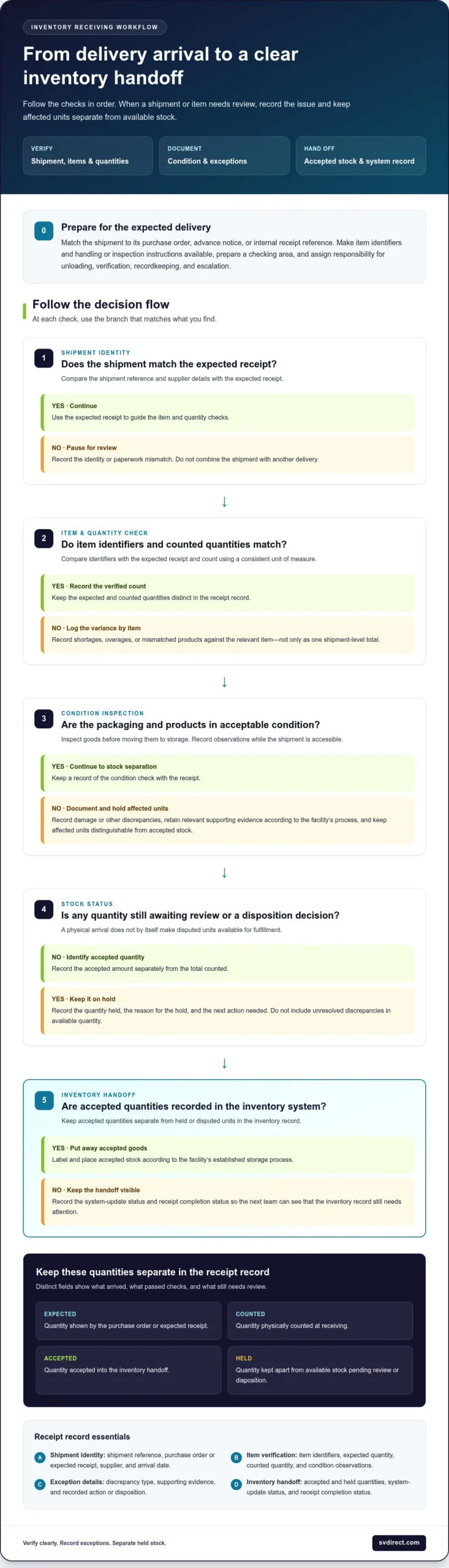
- Prepare for the expected delivery. Match the shipment to its purchase order, advance notice, or internal receipt reference. Make item identifiers and any handling or inspection instructions available. Prepare an area where goods can be checked before putaway. Assign responsibility for unloading, verification, recordkeeping, and escalating exceptions so steps don’t fall between teams.
- Identify the shipment on arrival. Compare its reference and supplier details with the expected receipt before processing the goods. If the paperwork or shipment identity doesn’t match, pause that receipt for review rather than combining it with another delivery. This establishes which records and item details should guide the check.
- Unload and compare the contents. Check item identifiers against the expected receipt, then count the delivered quantities using a consistent unit of measure. Keep expected and counted amounts distinct. If the shipment contains different items or quantities than anticipated, note each variance against the relevant item rather than relying on a single shipment-level total.
- Inspect and record condition. Check packaging and products for visible damage or other discrepancies before moving goods to storage. Record observations while the shipment is accessible, and retain relevant supporting evidence according to the facility’s process. Inventory control depends on a clear record of stock status, a concept also reflected in the ASCM Supply Chain Definitions.
- Separate accepted stock from items on hold. Keep units awaiting inspection, documentation, or a disposition decision distinguishable from accepted units. Record the reason for the hold and the next action needed. Don’t include an unresolved discrepancy in the available quantity simply because the goods have physically arrived.
- Update the inventory record and put away accepted goods. Enter the verified receipt in the inventory system, recording accepted quantities separately from held or disputed units. Label and place accepted stock according to the facility’s established storage process. The handoff is complete when the physical location and recorded status align, and the next team can see what is usable.
The sequence is straightforward: prepare, identify, verify, inspect, separate exceptions, update, and put away. If a check cannot be completed, record the pending action and keep affected units out of accepted stock until their status is resolved. This lets the workflow continue without hiding what still needs attention.
Build a Checklist That Verifies Quantities, Condition, and Inventory Handoff
A useful checklist separates staff observations from inventory system updates. Organize the form so each receipt captures shipment identity, item verification, condition, discrepancies, and system-update status. This makes it easier to trace a count or condition issue and see whether accepted units have reached the inventory record. A completed physical count is evidence of what arrived, not proof that the stock is visible and usable for fulfillment.
What quantity and condition checks belong on the form?
Record quantities for each item or stock-keeping unit, not just for the shipment as a whole. Keep expected quantity and actual count in separate fields, then show how many units were accepted and how many remain held. For example, if 24 units were expected, 22 were counted, and 2 counted units require review, preserve all four figures in the record rather than reducing them to a single total.
Condition fields should help staff describe what they saw without obscuring the item count. Include space for visible packaging or product damage, labeling problems, and identification mismatches. Add fields for supporting notes or evidence. If photographs are part of the facility’s process, associate them with the receipt record so the relevant issue can be reviewed alongside the shipment details.
- Expected and counted: Record the expected quantity and physical count for each item.
- Accepted and held: Distinguish units approved for inventory from units awaiting review or disposition.
- Condition and exception: Describe visible damage or mismatches, with supporting notes or evidence.
How should the checklist document the inventory update?
Include a clear field showing whether accepted quantities have been entered into the inventory system. A count marked complete doesn’t automatically mean the system update is complete. Record the accepted quantity entered, the update status, and any held quantity that must stay out of available stock until an exception receives a disposition. If an update is pending, mark it as pending and identify the next action or responsible role according to the facility’s process.
This distinction closes the gap between receiving activity and fulfillment readiness. Teams handling 3PL inventory management and fulfillment services rely on receipt records that make stock status clear as goods move toward storage, picking, packing, and shipping. For visibility beyond the dock, Remote Control order and inventory visibility provides access to inventory information and order activity, helping teams refer to recorded stock status as they coordinate next steps.
Before closing a receipt, confirm that the physical outcome and system entry agree for accepted stock, while held units remain distinguishable. The checklist is complete when it records what arrived, what was accepted, what remains under review, and whether the inventory update is finished. That final status gives the next team a practical handoff instead of an ambiguous count.
Handle Receiving Discrepancies Without Losing Inventory Visibility
Keep an exception visible from the first observation through its final disposition. Record shortages, overages, damage, and mismatched items as separate categories rather than grouping them under a vague “issue” note. This helps the responsible team understand what needs follow-up and prevents disputed quantities from being treated as accepted, available stock.
For every exception, capture the shipment reference and item identifier, describe the issue, attach or reference supporting evidence, assign an owner, and show the current status. Close the record only after documenting the resolution and any related inventory-status change. This gives the next person a clear handoff instead of requiring them to reconstruct events from scattered notes.
What should staff do when quantities do not match?
Compare expected and counted quantities for each affected item, then record the variance against the shipment reference. Keep the original expected quantity visible. Don’t silently change it to match the count, since that removes the information needed to understand what differed. Assign follow-up to the responsible operations contact, mark the exception as open while it’s under review, and record the final disposition when resolved.
Record shortages and overages separately. A shortage means fewer units were counted than expected; an overage means more were counted. In both cases, note the quantities and item identifiers involved, and keep any quantity awaiting a decision separate from accepted inventory. This preserves a reliable view of what is on hand without suggesting that every counted unit is ready for fulfillment.
How should damaged or unidentified stock be handled?
Document visible damage or an identification issue before moving affected units. Describe what staff observed, identify the item and quantity involved, and add supporting evidence according to the facility’s recordkeeping process. Keep these units distinguishable from accepted stock while the responsible team reviews the exception. Their physical presence shouldn’t blur their inventory status.
Once a decision is made, record the disposition and update the inventory status to reflect it. Note whether units remain held or are accepted for inventory, along with the date or completion status of the resolution if those fields are part of the facility’s process. Leave a clear owner for the next step while the issue remains open. The goal is a traceable decision, not an undocumented adjustment.
A well-maintained inventory receiving process checklist gives staff a consistent way to route exceptions and preserve the distinction between stock received and stock available. That visibility supports fulfillment decisions and helps teams work from the same record as issues move toward resolution.
Connect Receiving Checks to an Accurate Fulfillment Operation
A receiving record creates value when it reaches the people and systems that rely on it. A paper checklist can capture counts and observations at the dock, but someone must transfer the information and share exceptions with the next team. A digital checklist can make entries easier to access, but it still needs a clear handoff into inventory records. In a connected fulfillment operation, receipt information supports the transition from arrival and review to inventory management and order fulfillment.
Whatever format you use, make the handoff clear: what arrived, what is accepted, what remains under review, and whether inventory records have been updated. Digitizing a form alone doesn’t resolve a discrepancy or make held stock available. It provides a useful record; people and defined processes still determine what happens next.
What changes when receiving records are visible to the wider team?
Timely receipt information gives inventory and fulfillment teams a better basis for operational decisions. They can refer to recorded stock status when planning around inbound goods, while staff responsible for exceptions can see which items still need attention. Visibility supports coordination, but it doesn’t resolve a shortage or damage claim on its own. The exception still needs an owner, evidence, and a documented resolution.
Silicon Valley Direct’s Remote Control provides 24/7 access to inventory information and order activity. Automated email notifications can cover inventory receipts, low inventory, and backorders. These tools help teams follow receipt activity and stock information without relying solely on a paper record passed between shifts. They complement careful verification and exception handling rather than replacing them.
When can a 3PL support the receiving process?
A third-party logistics partner can connect warehousing, inventory management, and order fulfillment within a coordinated operation. Silicon Valley Direct provides full-service 3PL fulfillment, warehousing, inventory management, and eCommerce integrations. The company supports more than 80 eCommerce integrations. Together, these capabilities can connect inbound stock with the storage and fulfillment work that follows.
A strong working relationship also depends on clear communication and operations shaped around the client’s needs. A 3PL partner can act as an extension of your team, coordinating the receiving-to-fulfillment handoff so everyone can work from shared inventory information and documented exceptions. The checklist remains a practical tool: it captures the details that make that coordination possible.
Connect accurate receiving records with the fulfillment operation that depends on them. Silicon Valley Direct brings warehousing, inventory management, eCommerce integrations, and fulfillment together to support that flow.
Make Receiving a Stronger Start for Every Order
Treat your inventory receiving process checklist as a working tool, not a document that stays unchanged on a shelf. As your product mix, order patterns, and team workflows evolve, review where handoffs slow down or records leave room for interpretation. Refine the process so each role knows what information it needs and what action comes next.
A useful next step is to walk through a recent receipt with the people involved, from the dock through fulfillment. Look for unclear ownership, repeated data entry, or status updates that don’t reach the team making inventory decisions. Small, practical adjustments can make the process easier to follow and give your operation a clearer foundation for growth.
If you’re considering a fulfillment partner, start a conversation with Silicon Valley Direct about how its fulfillment operation can support your business needs.
A thoughtful receiving process, supported by the right fulfillment operation, helps your team keep inventory information clear as each order moves forward.
Frequently Asked Questions
What is an inventory receiving process checklist?
An inventory receiving process checklist is a repeatable record for checking incoming goods and documenting their handoff. It captures shipment identity, item and quantity verification, condition observations, discrepancies, and inventory status. Staff can use the same core controls across deliveries and shifts, creating a useful receipt history for later reference. The checklist supports consistent work, but it doesn’t replace judgment when a delivery differs from expectations or the available information is unclear.
What documents should be checked when receiving inventory?
Use the records available for the expected delivery, such as a purchase order, shipment notice, packing list, or internal receipt reference. The documents used vary by operation. Compare the physical delivery with the applicable item and quantity details, then note any variance against the receipt. If a listed item isn’t present, document the mismatch rather than changing the expected information to match the shipment.
How should a warehouse record a partial shipment?
Record the quantity physically received for each affected item, separate from the expected quantity. Include the shipment reference and any available delivery documentation, then leave the unreceived balance open for follow-up under the operation’s process. If a delivery contains only part of a listed item quantity, record what arrived and what remains outstanding. Don’t mark the full expected quantity as received when only a portion has arrived.
Should damaged inventory be added to available stock?
Document damaged units and keep them distinguishable from accepted, usable inventory while the responsible team decides their disposition. Identify the affected item and quantity, describe the observed condition, and preserve the follow-up status in the receipt record. Don’t assume damaged goods are suitable for fulfillment or apply one universal disposition to every case. Clear status information helps prevent another team from mistaking units under review for stock ready to allocate.
When should inventory be updated after a shipment arrives?
Show separately when physical checks are complete and when accepted quantities have been entered into the inventory system. Keep accepted stock distinct from quantities held for inspection or a discrepancy, so the recorded status reflects what teams can use. Define the handoff timing for your workflow, and make pending updates visible so teams know whether a receipt is checked, recorded, or still awaiting action.
Can a receiving checklist help prevent fulfillment errors?
A receiving checklist can help teams identify item, quantity, or condition discrepancies before stock is treated as available. It also gives downstream staff a record of which goods were accepted and which remain under review. It can’t guarantee that fulfillment errors won’t occur. Its value depends on accurate completion, clear ownership of exceptions, and a timely inventory handoff. A documented hold, for example, can help prevent an unresolved item mismatch from being overlooked during allocation.