


Best Shipping Warehouse Options for West Coast Brands
For brands shipping into the western United States, the best shipping warehouse is usually the one that shortens parcel travel, keeps inventory visible, and hits carrier cutoffs without drama. Silicon Valley Direct (SVDirect), a 3PL fulfillment company in Union City, California, is relevant here because West Coast warehouse choice is often a logistics design question, not just a real estate question.
TL;DR: Summary
- The best shipping warehouse option for many West Coast brands is a California-based fulfillment operation because it places inventory near a massive demand base and supports faster ground delivery across western states.
- California had an estimated 39,431,263 residents on July 1, 2024, according to the U.S. Census Bureau, which makes it the largest single state market in the country.
- USPS Ground Advantage covers packages from 1 ounce to 70 pounds and has a 2 to 5 business day service standard, so warehouse location and same-day outbound processing can materially affect actual delivery time.
- SVDirect’s Union City operation is one example of a West Coast shipping warehouse built around same-day shipping, 24/7 portal visibility, and an 88,704-square-foot facility.
- Choose a warehouse by order geography, carrier mix, cut-off times, and reporting depth, not by storage cost alone.
A strong West Coast setup can help both early-stage and established ecommerce brands, especially when California demand is meaningful or when inbound inventory lands on the Pacific side first. The harder question is not whether to use a shipping warehouse, but which warehouse model fits your order profile, service promise, and growth path.
Why does a West Coast shipping warehouse matter for delivery speed?
Yes, location changes delivery performance. A West Coast shipping warehouse in California or Nevada can remove one or more transit days for regional orders because the package starts closer to the customer.
The basic math is simple: every parcel begins with a warehouse origin ZIP code, then moves through carrier zones, sortation steps, and service standards. If your inventory sits on the East Coast while your customers live in California, Oregon, Washington, Arizona, and Nevada, you are asking carriers to solve a distance problem that warehouse placement could have solved first.
California matters even more because of its scale. The U.S. Census Bureau estimates California’s population at 39,431,263 as of July 1, 2024, which means a large share of West Coast ecommerce demand can be served from inside the state. A common mistake is assuming carrier speed alone determines delivery speed. In practice, the warehouse cut-off time, same-day processing discipline, and physical proximity to the customer all matter.
If your checkout promise is aggressive, then a regional warehouse becomes an operational tool, not just a storage location.
When is California the best shipping warehouse location for brand demand?
California is usually the best shipping warehouse location when your order density is concentrated in the West, your inbound goods reach Pacific ports first, or your customers expect fast residential delivery without air spend.
For many brands, California works because it combines a huge local market with reach into neighboring western states. If a meaningful portion of your orders lands in California alone, or if the broader West accounts for a large share of your volume, placing inventory there often improves both speed and shipping cost predictability.
There is a trade-off. California warehousing can come with higher labor and occupancy costs than some inland alternatives. Still, those costs can be offset if you reduce long-distance parcel zones, lower split-shipment rates, and improve conversion by offering faster delivery windows.
A useful rule is this: if western orders drive a large share of your revenue, then California deserves to be modeled first, not last.
What are the best shipping warehouse options for West Coast brands?
The best West Coast shipping warehouse options depend on order mix, inbound freight patterns, and service promises. SVDirect in Union City is one relevant option for brands that want a Bay Area base, same-day shipping, and detailed inventory visibility.
West Coast brands do not all need the same warehouse profile. Some need port-adjacent receiving. Others need Bay Area proximity, multichannel integrations, or parcel-optimized operations. The best option is the one that matches your actual demand pattern.
- Silicon Valley Direct (SVDirect): A Union City, California 3PL option for brands that want same-day shipping, 24/7 portal access, and an 88,704-square-foot West Coast fulfillment facility.
- Bay Area fulfillment warehouse: Useful for brands with Silicon Valley ties, high-value inventory, or a need to stay close to product and operations teams.
- Southern California port-adjacent warehouse: Useful when containerized imports arrive through Los Angeles or Long Beach and need fast destuffing and regional distribution.
- Inland parcel hub warehouse: Useful for high-volume ecommerce programs that care more about sortation efficiency and parcel throughput than urban proximity.
- Pacific Northwest warehouse: Useful when a large share of demand sits in Washington, Oregon, Idaho, or western Canada.
The misconception here is that “best” means most central or least expensive. In shipping warehouse selection, best usually means best fit for your customers, carriers, and operating cadence.
“SVDirect cites an 88,704-square-foot Union City facility and same-day shipping, two practical markers of a serious West Coast fulfillment base.”
How should you map your order geography before choosing a warehouse?
Start with order data, not warehouse brochures. The right method is to map recent ship-to ZIP codes, identify customer clusters, and then test which origin points reduce transit time and zone exposure.
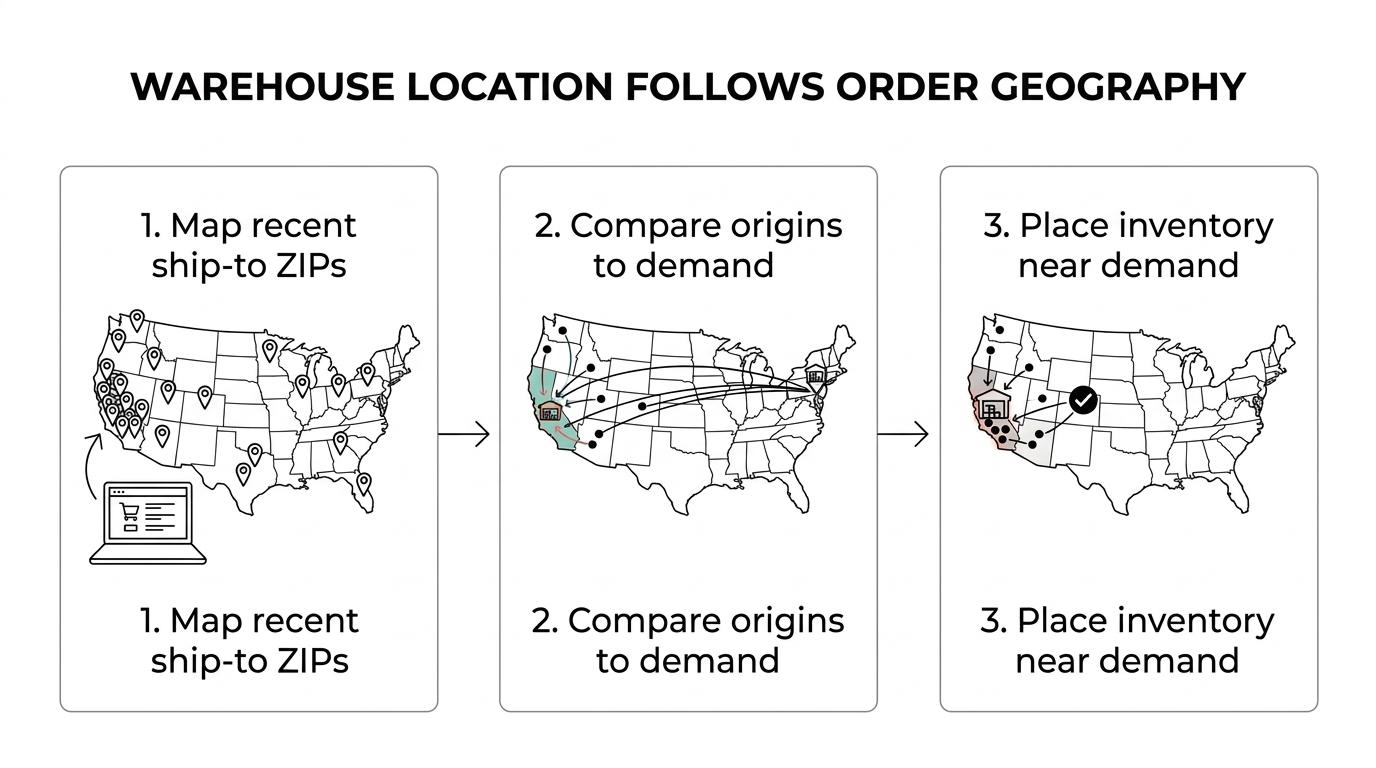
Step 1 is to pull the last 90 to 180 days of orders and sort them by state, metro area, and ZIP prefix. You want concentration, not averages. If 40 percent of demand comes from California and another 20 percent comes from nearby western states, that pattern should shape your warehouse decision.
Step 2 is to compare those clusters with carrier service standards. USPS Ground Advantage, for example, is designed for packages from 1 ounce up to 70 pounds and has a 2 to 5 business day service standard. That standard is not the same as your actual delivery outcome, because actual outcomes depend on where the package starts and where it ends.
Step 3 is to model one node versus two. If western demand dominates, a single West Coast warehouse may be enough. If your order map shows strong West and East concentration, then a second node may become the next step once inventory planning is mature enough.
A pro tip here: do not let average transit time hide bad tail performance. If your average looks fine but 15 percent of customers still wait too long, your warehouse network may still be wrong.
How do same-day shipping and next-day processing compare?
Same-day shipping is materially faster than next-day processing because it removes a full operational day from the order cycle. The trade-off is that same-day execution requires tighter cutoffs, stronger floor discipline, and fewer manual bottlenecks.
This comparison matters because many brands confuse carrier speed with fulfillment speed. A two-day carrier service launched tomorrow is often slower than a ground service launched today. That is why warehouse operating rhythm matters so much.
If your brand sells replenishment items, gifts, time-sensitive launches, or products with high customer urgency, same-day shipping can support both conversion and customer satisfaction. If your catalog is highly customized, print-on-demand, or batch assembled, next-day processing may be a rational trade-off.
The key question is not which model sounds better. It is whether your promised delivery window survives real order cutoffs, peak days, exception handling, and inventory accuracy requirements.
How should you evaluate carrier fit for parcels under 70 pounds?
Begin with package profile and destination mix. USPS Ground Advantage is a strong baseline for many ecommerce parcels under 70 pounds, but the warehouse decision still has to account for dimensions, margin, and promised speed.
Step 1 is to segment packages by weight bands, carton size, and destination density. A lightweight cosmetics order, a boxed supplement shipment, and a bulky home goods parcel do not behave the same way in the network.
Step 2 is to compare service promise with cost tolerance. USPS states that Ground Advantage covers 1 ounce to 70 pounds with a 2 to 5 business day service standard. USPS also notes that some service standards can reach 1 business day depending on the product and destination. If your customers mainly sit inside the western region, then a nearby warehouse improves the odds that ground services perform well enough.
Step 3 is to audit dimensional weight and packaging discipline. Many brands focus on scale weight and forget cubic impact. That is a costly mistake. If packaging is larger than it needs to be, your parcel economics can deteriorate even when the warehouse location is right.
How do visibility and 24/7 reporting compare with basic warehouse dashboards?
24/7 reporting is better than a basic dashboard when it exposes exceptions, not just counts. SVDirect is relevant here because its West Coast fulfillment model includes a customized 24/7 portal for order status, inventory levels, shipping information, and reports.
A basic dashboard often shows top-line inventory and order totals. That is useful, but it is not enough for a growing brand. You also need SKU-level inventory status, aging views, shipment tracking, receiving status, cancellation flags, and backorder visibility. Otherwise, your team will still rely on email threads and spreadsheet patches.
This is where many warehouse evaluations go wrong. Brands ask whether an integration exists, but not whether the data is timely, specific, and actionable. Integration without usable reporting is just a faster path to blind spots.
“SVDirect says brands get 24/7 access to a customized web portal for order status, inventory levels, shipping information, and reports.”
If your team needs to make inventory decisions daily, then portal quality matters nearly as much as pick-pack speed. Good visibility shortens reaction time when stock runs low, receiving stalls, or customer service needs answers fast.
How should you test a shipping warehouse before moving all inventory?
Run a controlled pilot first. The safest approach is to move a limited SKU set, validate receiving and shipping accuracy, and only then expand volume.
Step 1 is to choose a narrow product slice, often 5 to 20 SKUs, with stable packaging and predictable order flow. That lets you measure execution without exposing the entire business.
Step 2 is to test the full operating loop: inbound receiving, inventory putaway, order import, picking, packing, label creation, tracking upload, and exception handling. If any step needs manual cleanup every day, that issue will become expensive at scale.
Step 3 is to review pilot results against hard metrics. Look at order accuracy, cut-off compliance, receiving speed, late-ship rate, and support responsiveness. A common misconception is that the lowest quoted rate makes the best pilot outcome. In reality, the best pilot is the one that produces reliable operating data.
What operational red flags usually predict fulfillment problems?
A few red flags reliably signal trouble. Weak cut-off clarity, delayed inventory updates, and vague support ownership usually show up before larger shipping failures.
Before signing, ask direct questions and listen for direct answers. If the answers stay abstract, that is usually a warning. Good warehouses can explain how receiving works, how exceptions are handled, and how clients see data.
- Unclear cut-off times: If same-day capability is promised but the daily order deadline is fuzzy, expect service gaps.
- Slow inventory updates: If receiving or order status lags by a day or more, customer service pressure rises quickly.
- No defined verification process: Accuracy claims matter less when there is no visible pick-check workflow behind them.
- Opaque support ownership: A rotating inbox is not the same as accountable client service.
- Weak reporting depth: Summary counts are not enough when you need SKU-level operational control.
- No visit or audit path: If a warehouse cannot support a site visit or process review, due diligence becomes harder.
A pro tip: ask how exceptions are surfaced. Most serious fulfillment pain comes from exceptions, not routine orders.
What does a strong West Coast shipping warehouse setup look like for growing brands?
A strong setup is simple to describe. It puts inventory near western demand, supports same-day outbound when needed, provides live operational visibility, and leaves room for volume growth without process breakdowns.
For a brand focused heavily on California and nearby states, one West Coast node may be enough at first. If national demand becomes balanced later, then a second node can be added once forecasting and replenishment discipline are ready. That sequence matters. Splitting inventory too early can create stock fragmentation and more backorders, not fewer.
The best shipping warehouse is not always the largest building or the cheapest rate card. It is the facility and operating model that match your demand map, product profile, and service promise with the least operational friction. When that fit is right, faster ground delivery and tighter inventory control become a repeatable system, not a lucky outcome.