



Inventory Management Basics for Ecommerce Fulfillment
Inventory management sits at the center of ecommerce fulfillment. A fast checkout experience means very little if the stock record is wrong, the warehouse cannot find the item, or a customer buys a product that is no longer available. Strong inventory control protects revenue, customer trust, and daily warehouse flow all at once.
For growing ecommerce brands, the basics matter more than flashy tools. Accurate on-hand records, disciplined counting, clear receiving procedures, and real-time visibility are what keep orders moving. When those pieces work together, fulfillment becomes more predictable, stockouts drop, and service levels rise.
What inventory management means in ecommerce fulfillment
Inventory management is the process of tracking what is physically in the warehouse and matching that reality to what the system says is available. In ecommerce fulfillment, that means every receipt, transfer, pick, return, adjustment, and shipment must update inventory records correctly.
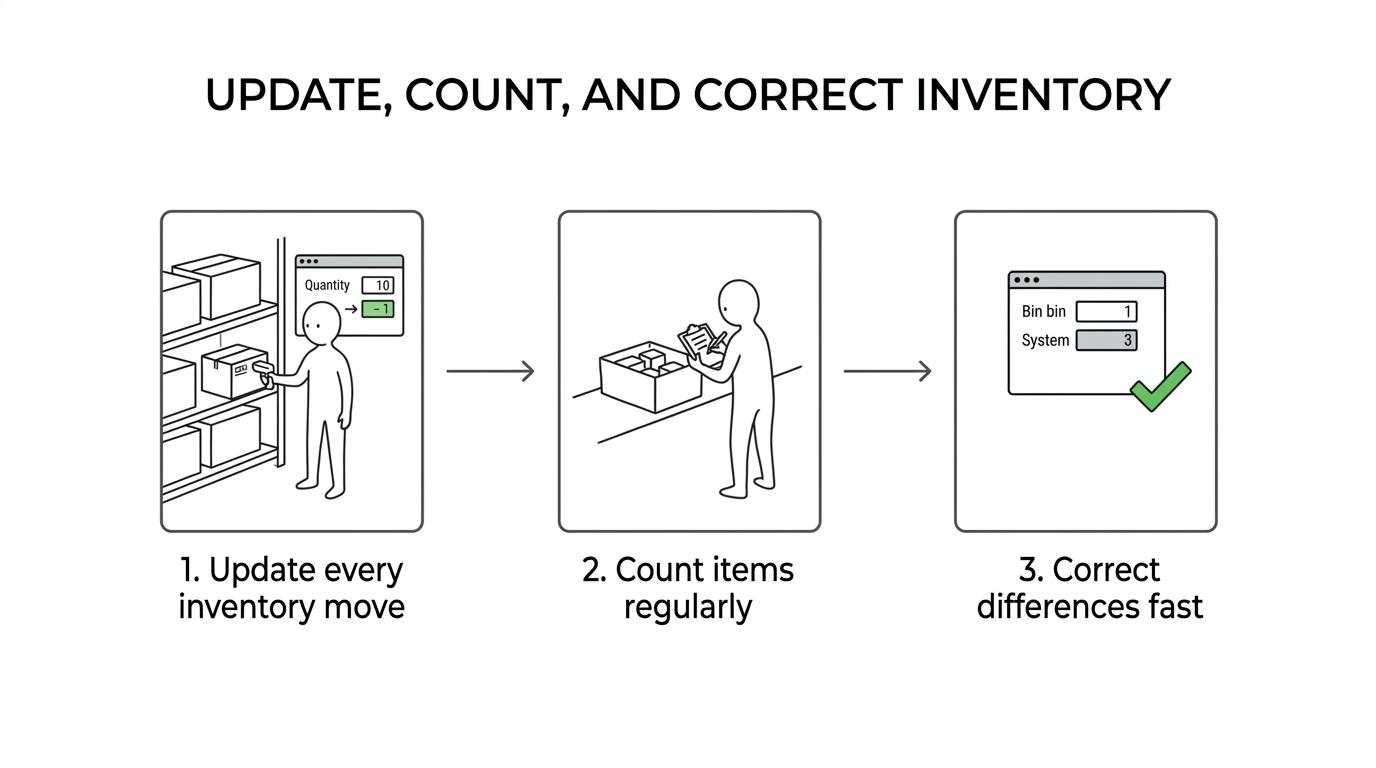
Most modern operations rely on perpetual inventory records. That means on-hand quantities change continuously as activity happens, instead of waiting for a manual update at the end of the day or month. This approach is essential when brands sell across multiple channels and promise quick shipping.
The challenge is simple to describe and hard to execute: physical on-hand quantities and system on-hand quantities must stay in sync. Oracle describes cycle counting as a practical way to reconcile those differences over time rather than depending only on one big annual count. That matters because accurate inventory is not just a finance issue. It directly affects supply planning, order promising, and customer satisfaction.
Why inventory accuracy matters for ecommerce order fulfillment
Inventory accuracy is the degree of agreement between the inventory record and the physical count. That definition, often used in operational guidance, gets to the point. If the record says 24 units are available and the bin holds 19, the business has a problem whether anyone notices it yet or not.
An inaccurate record triggers a chain reaction. Overselling leads to backorders and cancellations. Understated inventory leads to unnecessary replenishment and tied-up cash. Misplaced units slow picking. Poor data also hides loss. The National Retail Federation has pointed out that many businesses now look beyond traditional shrink because loss can come from inventory inaccuracies, supply chain breakdowns, fraud, and operational errors across blended retail channels.
When accuracy improves, fulfillment performance improves with it.
- fewer stockouts
- fewer canceled orders
- faster pick, pack, and ship flow
- cleaner purchasing decisions
- better visibility into loss and exceptions
Core inventory records every fulfillment operation should maintain
A reliable inventory program depends on a small set of records that are kept current and audited often. If one of these records is weak, errors spread quickly into receiving, replenishment, and shipping.
| Inventory record | What it tracks | Why it matters |
|---|---|---|
| On-hand quantity | Units physically available in each location | Supports order allocation and replenishment |
| Available quantity | On-hand minus holds, damage, or allocated units | Prevents overselling |
| Receiving record | What arrived, when, and in what condition | Confirms purchase orders and catches discrepancies early |
| Location record | Bin, shelf, pallet, or zone for each SKU | Speeds picking and reduces search time |
| Adjustment log | Manual changes caused by damage, recounts, or corrections | Reveals recurring issues and training gaps |
| Return record | Returned units, disposition, and restock timing | Keeps sellable inventory separate from non-sellable stock |
| Lot or batch data, when required | Product traceability for regulated or sensitive items | Supports recall readiness and compliance |
| Order allocation record | Units committed to open orders | Protects available-to-sell accuracy |
These records do not need to be complicated. They do need to be disciplined. A smaller brand can start with clear SKU structure, defined storage locations, and routine transaction control. A larger brand often adds barcode scanning, system integrations, and reporting layers to catch exceptions faster.
Cycle counting basics for warehouse inventory control
Cycle counting is one of the most practical tools for keeping records accurate. Instead of waiting for a full physical inventory once a year, the warehouse counts selected items on a repeating schedule. Oracle describes this method as a way to verify quantities and values regularly, then correct differences between perpetual records and physical stock.
That sounds simple because it is simple in concept. The value comes from consistency. Counting smaller sets of inventory more often helps operations catch mistakes before they spread into open orders, purchasing decisions, or month-end reconciliation.
A healthy cycle-count program usually includes a few standard rules.
- Count frequency: high-impact SKUs are counted more often than slow movers
- Blind counts: counters record what they find without seeing the system quantity first
- Root-cause review: each significant discrepancy is traced back to receiving, picking, returns, damage, or system error
- Fast correction: approved adjustments are posted quickly so live inventory improves right away
This process also creates a feedback loop for warehouse quality. If one product line shows repeated errors, the issue may not be counting at all. It may be poor labeling, crowded storage, weak receiving verification, or an unclear returns process.
How tolerance thresholds and SKU segmentation improve inventory accuracy
Not every SKU should be managed the same way. Leading inventory programs often separate items by value, activity, criticality, or operational risk. The U.S. Government Accountability Office has documented this type of segmentation in cycle-count programs, along with the use of tolerance thresholds to decide when a variance is acceptable and when it demands escalation.
Tolerance thresholds matter because they turn inventory control into an operating standard rather than a vague goal. Some items can tolerate a small percentage variance. Others cannot. A fast-moving bestseller, a regulated item, or a product tied to a product launch may require zero tolerance.
ABC classifications for cycle counting frequency
ABC classifications remain a useful starting point for segmentation. They are not the only method, but they are easy to apply and easy to manage.
- A items: high value, high velocity, or business-critical SKUs counted most often
- B items: moderate value or activity levels counted on a regular but less frequent schedule
- C items: lower-risk SKUs counted less often, often with broader tolerance ranges
This approach helps a warehouse spend time where accuracy matters most. Newer systems may go further by prioritizing items that appear most likely to be wrong, not just the ones with the highest value. Oracle has noted that intelligent cycle-counting methods can reduce unnecessary counts while still improving overall record accuracy.
For ecommerce brands, that is an appealing shift. Counting should not become a ritual that consumes labor without improving service. The best programs direct effort toward the SKUs that can create stockouts, mis-ships, or costly corrections.
Inventory visibility and order execution in real time
Accurate inventory is only useful when teams can see it and act on it. Visibility connects inventory management to fulfillment execution. When stock data updates in real time, customer service can answer confidently, purchasing can reorder at the right moment, and the warehouse can ship without second-guessing available quantities.
That link between visibility and action also appears in Riverslot’s analysis of reporting dashboards that cut losses, which shows how faster access to exception data helps operations respond before small discrepancies become larger financial problems.
This is where integrations matter. Ecommerce platforms, marketplaces, warehouse systems, and shipping workflows should exchange data cleanly enough to reduce manual entry. When they do not, small delays turn into duplicated work and stale inventory positions.
A capable 3PL setup can support this with live reporting, standardized workflows, and account-level access to inventory status. Silicon Valley Direct, for example, offers a 24/7 web portal with extensive reporting and support for 80+ preconfigured integrations plus custom API connections. That type of visibility gives brands a clearer view of stock levels, order status, and exceptions without waiting for a spreadsheet to arrive.
Real-time visibility also supports same-day shipping promises. If the inventory record is trusted, the warehouse can release orders faster. If the record is questionable, teams pause to verify, and fulfillment speed suffers.
Common inventory problems that create stockouts and loss
Most inventory issues do not begin as dramatic failures. They start as small operational misses that go unchecked. A receiving shortage is not logged. A picker grabs from the wrong bin. A returned item is restocked without inspection. One manual adjustment fixes the symptom, but the cause remains in place.
Over time, these errors can create stockouts, canceled orders, and hidden loss. The NRF has argued that traditional shrink metrics do not always capture the full picture because modern retail loss includes inaccuracies and process failures across channels and supply chains.
A few recurring trouble spots show up in many ecommerce operations:
- receiving mismatches
- misplaced units
- unrecorded damage
- returns posted late
- kitting or bundling errors
- duplicate SKU setup
- incorrect unit-of-measure conversions
When these patterns appear, the right response is not just to adjust inventory. It is to identify the source, assign ownership, and change the process.
Practical inventory management metrics for growing ecommerce brands
Metrics turn inventory control from opinion into action. They help operators spot trends, set service goals, and measure whether warehouse changes are actually working.
A strong scorecard does not need dozens of lines. It needs a handful of metrics reviewed consistently.
- Inventory record accuracy: the percentage of records that match the physical count within the defined tolerance.
- Cycle count completion rate: whether scheduled counts are finished on time.
- Adjustment rate: how often stock requires manual correction and whether the reasons are repeating.
- Stockout rate: how often demand cannot be fulfilled because the item is unavailable.
- Order fill rate: the percentage of order lines shipped as promised from available inventory.
- Aging inventory: units that sit too long and may require markdowns, promotions, or revised purchasing decisions.
These metrics become more powerful when paired with segmentation. If A items maintain near-perfect accuracy but C items drift, the business can decide whether the gap is acceptable. If adjustment rates spike after a new product launch, the receiving and setup process deserves immediate attention.
Inventory management basics that support warehouse scalability
Good inventory management is not only about control. It is also about scale. Brands that plan for growth need systems and warehouse habits that can handle more SKUs, more channels, and higher order volume without losing accuracy.
That usually starts with standardization. SKUs need clear naming conventions. Storage locations need logic. Returns need disposition rules. Adjustments need approval paths. Cycle counts need a schedule that survives busy periods instead of disappearing when order volume rises.
It also helps to build around verification. Double-checking key fulfillment steps, especially at order release and packing, reduces the chance that inventory mistakes flow downstream to the customer. Silicon Valley Direct highlights double-verified order accuracy as part of its process, which reflects a wider truth across fulfillment: prevention is less expensive than correction.
Warehouse visits, live dashboards, and direct support also matter more than many brands expect. When operators can see the facility, review reports, and talk to a real person, inventory questions move faster toward resolution. That creates confidence at exactly the stage when a business is trying to grow without losing control.
The basics still win. Keep the record current. Count regularly. Set tolerances. Segment SKUs by risk. Track discrepancies before they become stockouts or loss. Ecommerce fulfillment gets much easier when inventory stops being a question mark and becomes a reliable operating asset.