img not found!
ECommerce Returns Management Services: The 2026 Operational Guide

ECommerce Returns Management Services: The 2026 Operational Guide

Treating reverse logistics as a simple label-printing task quietly drains an online brand’s bottom line. True ecommerce returns management services must actively recover product value, not merely haul items back to a staging area. If you manage a growing brand, you already know the daily operational friction: returned items sit unprocessed on receiving docks for weeks, inconsistent manual checks risk damaged goods slipping back into active inventory, and disjointed software leaves both your customer care team and shoppers in the dark.

You don’t have to accept inventory write-downs and escalating return fees as inevitable growing pains. In this operational guide, discover how modern returns management services recover product value, streamline reverse logistics, and protect customer retention. We’ll examine the standardized multi-point inspection workflows, direct software integrations, and rapid restocking protocols required to transform reverse logistics from a chaotic cost center into a reliable retention engine.

Key Takeaways

  • Move beyond basic label printing to understand the complete physical workflow of reverse logistics, from dock intake to final disposition.
  • Explore how professional ecommerce returns management services combine automated RMA portals with multi-point inspections to protect product quality.
  • Weigh the operational footprint of in-house handling against specialized logistics management to reclaim warehouse floor space and internal labor.
  • Identify critical technical integration standards, including bidirectional API and XML connections, that synchronize storefront data with physical warehouse floor operations.
  • Implement rapid restocking and transparent status triggers to recover product value before seasonal depreciation sets in.

What Are eCommerce Returns Management Services and Why Do They Matter?

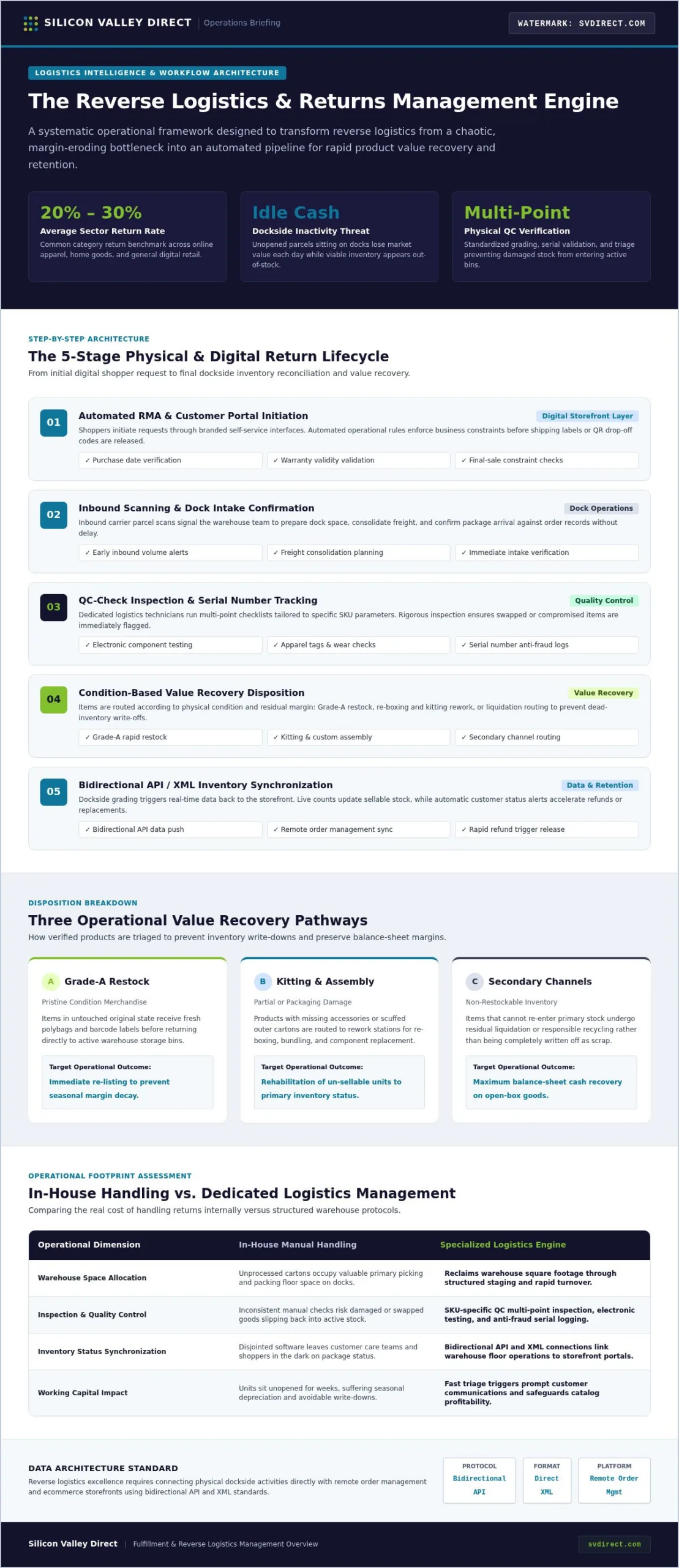
Many digital merchants mistake returns handling for a basic software tool that generates shipping labels. In practice, true ecommerce returns management services encompass the full physical and digital lifecycle: physical intake, triage grading, multi-point technical inspection, and value-recovery disposition. Generating a label merely initiates transportation. Physical reverse logistics determines whether that returned item recovers its margin or ends up written off as dead inventory.

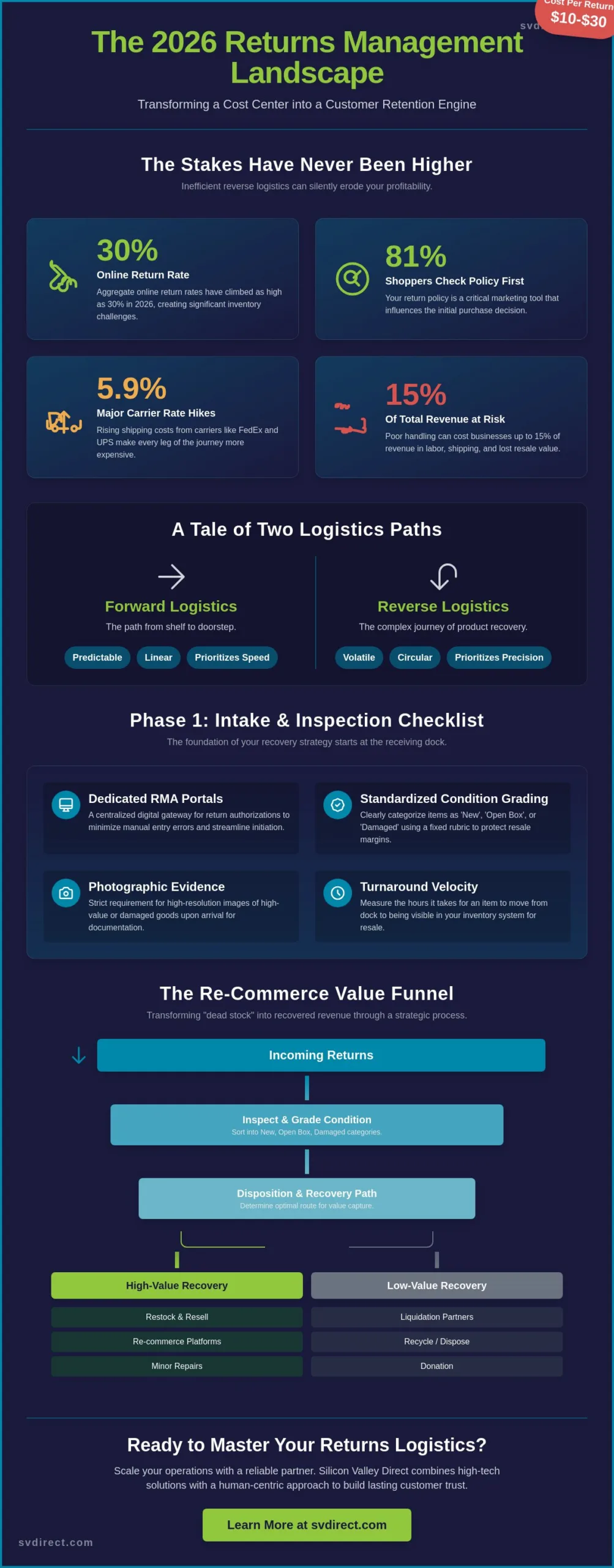
Category return rates regularly sit between 20% and 30% across sectors like apparel and home goods, creating a heavy drag on working capital. Processing these items haphazardly leads to product write-downs and bloated inventory holding costs. By contrast, a structured operational approach transforms return handling from an administrative chore into a measurable customer retention tool.

The Anatomy of Modern Reverse Logistics

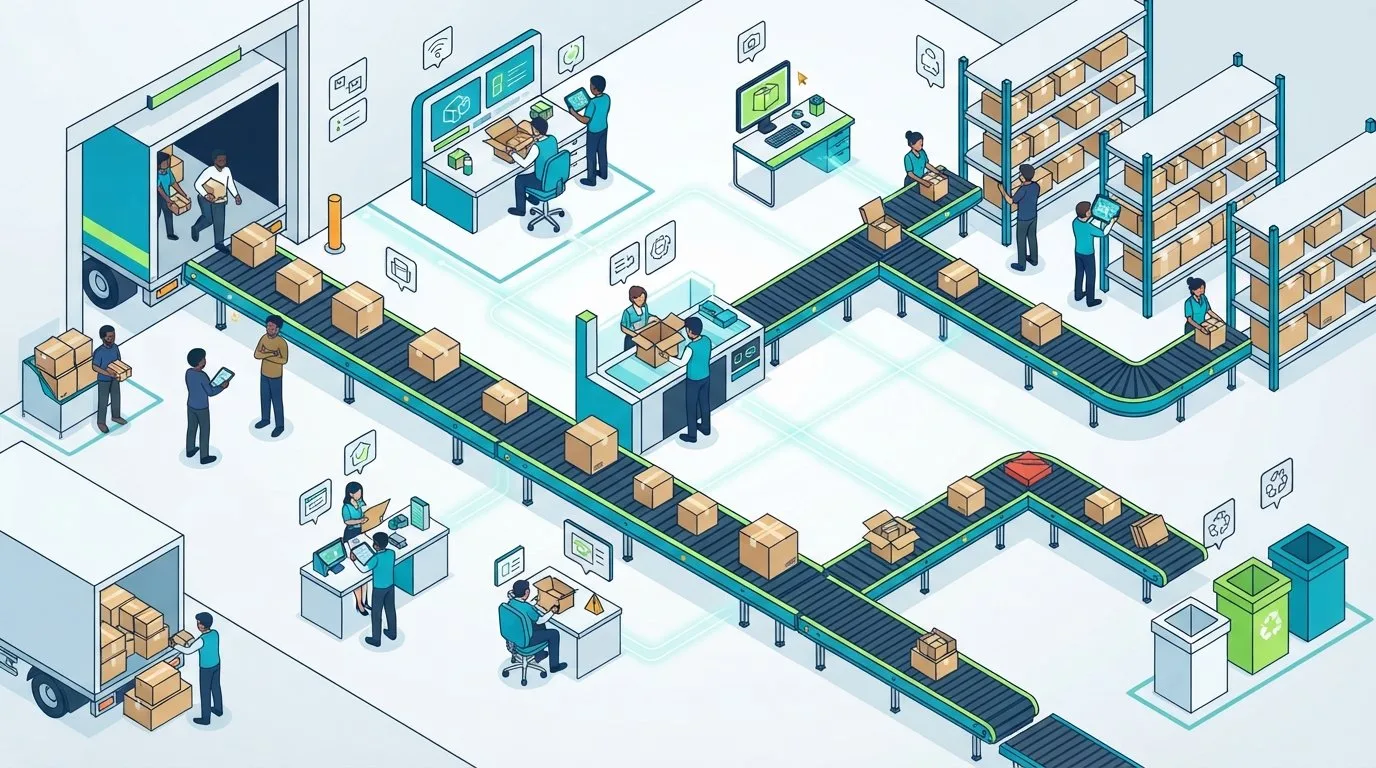
The journey starts the moment a shopper hands off a parcel at a drop-off counter. From there, reverse logistics relies on continuous data handoffs between your storefront portal and the physical receiving team. Inbound carrier parcel scans alert the warehouse to incoming volume, allowing dock teams to plan freight consolidation and confirm package delivery without delays. Instead of boxes piling up unchecked, standardized intake protocols immediately verify package conditions against customer records. Routing these goods through comprehensive 3PL fulfillment services bridges digital customer requests directly with dockside handling.

The Real Bottom-Line Cost of Unprocessed Returns

Unopened cartons sitting on receiving docks represent idle balance-sheet cash. Staged goods lose market value with every passing day, exposing seasonal apparel, cosmetics, and electronics to sharp depreciation. In-demand items remain out of stock on your website even while viable units sit unopened just steps away from the main packing lines.

Operational bottlenecks also harm customer relationships. Delayed physical inspections postpone refunds, prompting inbound customer service inquiries and eroding customer trust. By combining dockside physical verification with proprietary tools like remote order management, brands capture real-time visibility over inventory status. Fast triage triggers prompt customer communications, protects inventory condition, and safeguards profitability across the entire catalog.

Core Capabilities of Comprehensive Returns Management Solutions

Modern ecommerce returns management services combine dynamic front-end customer software with disciplined warehouse triage. Moving an item from an initial return request back to sellable stock requires automated rules, tactile physical evaluation, and precise inventory reconciliation across platforms.

Automated RMA and Self-Service Customer Portals

Clear reverse workflows start at the digital storefront. Branded self-service portals let shoppers request exchanges or generate Return Merchandise Authorizations (RMAs) without waiting on support staff. Behind the scenes, automated rules enforce business constraints, verifying purchase dates, warranty validity, and final-sale tags before issuing pre-paid shipping labels or QR drop-off codes. This immediate validation eliminates guesswork for your customer service team.

Systematic Receiving, QC-Check Inspection, and Serial Tracking

Once parcels arrive at the receiving dock, physical verification takes center stage. Dedicated warehouse teams execute systematic QC-Check multi-point inspections tailored to specific SKU profiles. Technicians evaluate original packaging, test electronic components, check apparel for wear or missing tags, and log serial numbers against customer records to prevent fraud. Incorporating rigorous inspections directly into your broader supply chain management ensures that damaged or swapped merchandise never recirculates back into forward inventory.

Disposition Routing, Kitting, and Value Recovery Pathways

After inspection, items follow defined disposition paths based on item condition and residual margin potential:

  • Grade-A Restock: Pristine items receive fresh polybags and barcode labels before returning immediately to active storage bins.
  • Kitting and Assembly: Products with missing accessories or scuffed exterior packaging enter custom rework stations for re-boxing, bundling, and component replacement.
  • Secondary Liquidation: Opened or cosmetically flawed units route to secondary channels to reclaim working capital.
  • Responsible Disposal: Non-functional or contaminated goods are securely scrapped or recycled according to environmental guidelines.

Automated software triggers notify accounting to release customer refunds or store credits once items pass physical inspection. If your current fulfillment setup struggles to keep pace with return volume, you can consult with our logistics team to build a custom inspection and disposition program tailored to your catalog.

In-House Returns Processing vs. Dedicated 3PL Returns Management

Managing returns internally often starts as an informal task handled between regular packing runs. Over time, that arrangement turns into an operational bottleneck. Warehouse aisles fill with uninspected cartons, pulling full-time warehouse labor away from outbound orders to manually open packages, inspect garments, and swap polybags. Dedicated ecommerce returns management services replace this internal strain with a predictable operational cadence, isolating return flows from forward logistics.

Operational Metric In-House Management Dedicated 3PL Management
Floor Space Impact Staging zones crowd active packing aisles Dedicated disposition bays preserve forward space
Turnaround Time Often lags by weeks during peak volumes Consistent 24 to 48 hour intake and triage
Labor Allocation Pulls fulfillment teams off outbound orders Specialized teams focused purely on reverse flow
Inventory Accuracy High risk of uninspected stock mixing with prime Systematic scanning and strict grade separation

Warehouse Overhead, Labor Allocation, and Seasonal Spikes

Internal facilities rarely flex easily during post-holiday return surges. January return volumes can spike sharply, leaving in-house teams buried beneath incoming freight while struggling to get regular outbound shipments out the door. Dedicated logistics providers absorb these volume shifts without disrupting primary workflows. Brands gain scalable operational capacity through variable models instead of paying year-round leases on extra warehouse space used only during peak surges.

Restock Velocity, Working Capital, and Cash Flow

Every week an item sits in an uninspected carton, its resale probability drops. Dedicated returns management accelerates intake velocity, returning grade-A inventory to active pick bins within 24 to 48 hours. Implementing disciplined Reverse Logistics Strategies frees up trapped balance-sheet cash, preventing unnecessary stock reorders for products you already hold. Fast, systematic verification also triggers immediate exchanges for shoppers, keeping sales revenue inside the business while pairing effortlessly with nationwide 3PL fulfillment services.
ECommerce Returns Management Services: The 2026 Operational Guide

How to Choose the Right eCommerce Returns Management Partner

Selecting the right provider requires looking past slick marketing claims to inspect actual warehouse floor practices. Effective ecommerce returns management services must balance technical connectivity with methodical hands-on care. Use this five-step operational evaluation to vet potential logistics partners.

Assessing Technology Architecture and Real-Time Visibility

Begin by auditing software integration capabilities. Your reverse logistics partner should support platform-agnostic, bidirectional web service connections using modern API, XML, and SOAP protocols. These connections ensure that return authorizations generated in your digital storefront instantly reflect across physical warehouse workstations.

Verify that the provider delivers round-the-clock visibility into processing queues and inventory status. Platforms like Remote Control order management supply 24/7 access to over 120 standard operational reports, giving your operations team instant tracking on condition flags, quarantined units, and return trends by SKU. Real-time data keeps your accounting and customer care teams informed without manual data entry.

Evaluating Operational Rigor, Flexibility, and Quality Control

Software alone cannot inspect a returned product. You must evaluate physical facility procedures to ensure receiving staff follow rigorous, SKU-specific checklists rather than rushed visual scans. Ask prospective providers how they manage edge cases like missing accessories, broken tamper seals, or serial number logging for high-value merchandise.

A true operational partner adapts to your exact packaging standards. Confirm their capacity to execute custom re-bagging, literature replacement, and specialized kitting right at the return workbench. Dedicated teams should possess the physical infrastructure and assembly expertise required to turn opened parcels back into pristine, factory-fresh merchandise.

Finally, evaluate the account management model. Complex reverse logistics cannot run through impersonal support ticketing queues. Insist on dedicated operational managers who know your business nuances and provide direct human access whenever unexpected exceptions arise.

Optimizing Reverse Logistics with Silicon Valley Direct

Operating nationwide, Silicon Valley Direct serves as a dedicated operational partner rather than an impersonal handling depot. We replace dockside congestion with a disciplined, quiet warehouse environment designed to eliminate hurried triage errors. Combining proprietary software architecture with over two decades of continuous logistics operations since 1999, we turn reverse logistics into a stable, predictable extension of your brand.

Our proprietary Remote Control platform delivers 24/7 inventory visibility and direct access to more than 120 standard operational reports. By integrating platform-agnostic XML and SOAP web services directly into your storefront or OMS, inventory counts, disposition statuses, and refund alerts synchronize automatically. Your team stays informed without having to chase down manual tracking updates.

Meticulous QC-Check Standards and Serial Tracking

Every inbound carton undergoes our systematic QC-Check multi-point inspection protocol. Instead of basic visual glances, our receiving teams execute tailored inspection scripts designed around your specific SKUs:

  • Serial Number Verification: Technicians record and cross-reference device serial numbers against original outbound manifests to eliminate product substitution fraud.
  • Accessory and Component Auditing: Teams verify cables, chargers, instruction booklets, and warranty inserts before clearing products for re-boxing.
  • Physical Integrity Grading: Goods are systematically assessed for fabric pulls, surface scuffs, or opened seals, ensuring only pristine units return to sellable inventory.

Our clients rely on this physical precision to protect brand integrity, an operational consistency detailed throughout our verified customer testimonials.

Deliberate Process Control and Dedicated Partnership

Chaotic warehouse floors lead directly to misgraded inventory and lost balance-sheet value. Silicon Valley Direct maintains a calm, organized facility cadence where specialized personnel handle your products with deliberate care. We provide bespoke packaging, re-labeling, and flexible kitting workflows, adhering strictly to your unboxing guidelines rather than forcing your inventory into rigid, one-size-fits-all processing channels.

When questions arise, you collaborate directly with seasoned logistics professionals who understand your specific inventory rules, bypassing automated ticket queues entirely. If you want to transform high return volumes into an efficient, value-recovering operation, partner with a team built for physical precision. Request a free quote to optimize your ecommerce returns management services.

Turn Reverse Logistics into an Engine for Long-Term Growth

Unlocking trapped inventory value requires shifting away from reactionary return handling toward disciplined operational precision. Silicon Valley Direct provides the physical rigor and software transparency needed to scale your operations without dockside friction. Backed by continuous logistics operations since 1999, our facilities apply systematic QC-Check multi-point inspections to protect product integrity, identify wear, and prevent substitution fraud. Meanwhile, our proprietary Remote Control portal delivers 24/7 inventory visibility across more than 120 standard reports, keeping your accounting and support teams completely synchronized.

Investing in comprehensive ecommerce returns management services shields your operating margins from unnecessary inventory depreciation while turning everyday return touchpoints into reliable customer retention drivers. Moving past chaotic staging docks and manual grading lets you focus on sustainable brand expansion.

Take control of your post-purchase workflows and let seasoned logistics professionals protect your customer relationships at every step.

Frequently Asked Questions

What is included in ecommerce returns management services?

Comprehensive ecommerce returns management services cover the complete physical and digital journey of returned goods. This includes dock intake, parcel scanning, multi-point QC-Check inspection, sorting, grading, repackaging, and serial number tracking. Sellable units return directly to active storage bins, while unresellable units route to refurbishment or liquidation. Digital updates synchronize with your storefront to trigger prompt customer refunds or exchanges.

How fast should a 3PL process returned inventory back into active stock?

A dedicated logistics provider should inspect and triage returned inventory within 24 to 48 hours of parcel arrival at the dock. Rapid processing ensures grade-A merchandise returns to active inventory before seasonal depreciation sets in. Quick turnaround also accelerates customer resolution, allowing automated systems to issue refunds or trigger replacement shipments promptly, which reduces inbound support inquiries.

Can an ecommerce returns management partner handle serial number verification?

Yes, specialized providers capture and cross-reference unique serial numbers during physical intake. For high-value electronics and serialized equipment, technicians log serial data against the original order manifest before approving any disposition path. This systematic verification prevents return fraud, eliminates counterfeit swaps, and ensures that warranty records remain completely accurate within your order management system.

How do returns management services integrate with my existing ecommerce platform?

Modern ecommerce returns management services connect directly to online stores and OMS systems through platform-agnostic API, XML, and SOAP web services. These bidirectional connections pass data back and forth automatically. When warehouse technicians complete a physical inspection, the system updates inventory counts across sales channels and signals your storefront to release customer credits without requiring manual data re-entry.

What happens to returned items that cannot be resold as new?

Items failing pristine grading criteria follow predefined disposition workflows tailored to your recovery goals. Products missing exterior packaging or inserts enter custom kitting stations for re-boxing and component replacement. Units with minor cosmetic defects route to secondary sales channels to recoup cash flow, while damaged or non-functional items undergo certified recycling or disposal according to strict environmental guidelines.

How does outsourcing returns management improve customer retention?

Outsourcing reverse logistics eliminates the processing delays and communication gaps that frustrate shoppers. When physical receiving and quality checks occur swiftly, customers receive prompt refunds or instant product replacements instead of waiting weeks for resolution. Reliable, transparent return handling builds long-term brand loyalty, encouraging first-time buyers to purchase again with complete confidence in your post-purchase support.

Is reverse logistics management scalable during seasonal sales spikes?

Partnering with an experienced logistics provider provides elastic capacity that easily absorbs post-holiday return surges. Dedicated facilities allocate specialized intake bays and experienced staff to handle sudden spikes without slowing down primary outbound shipments. Brands gain immediate operational flexibility to manage fluctuating return volumes, avoiding the overhead of maintaining extra in-house warehouse space year-round.
The Ecommerce Returns Management Process: A Strategic Guide for 2026

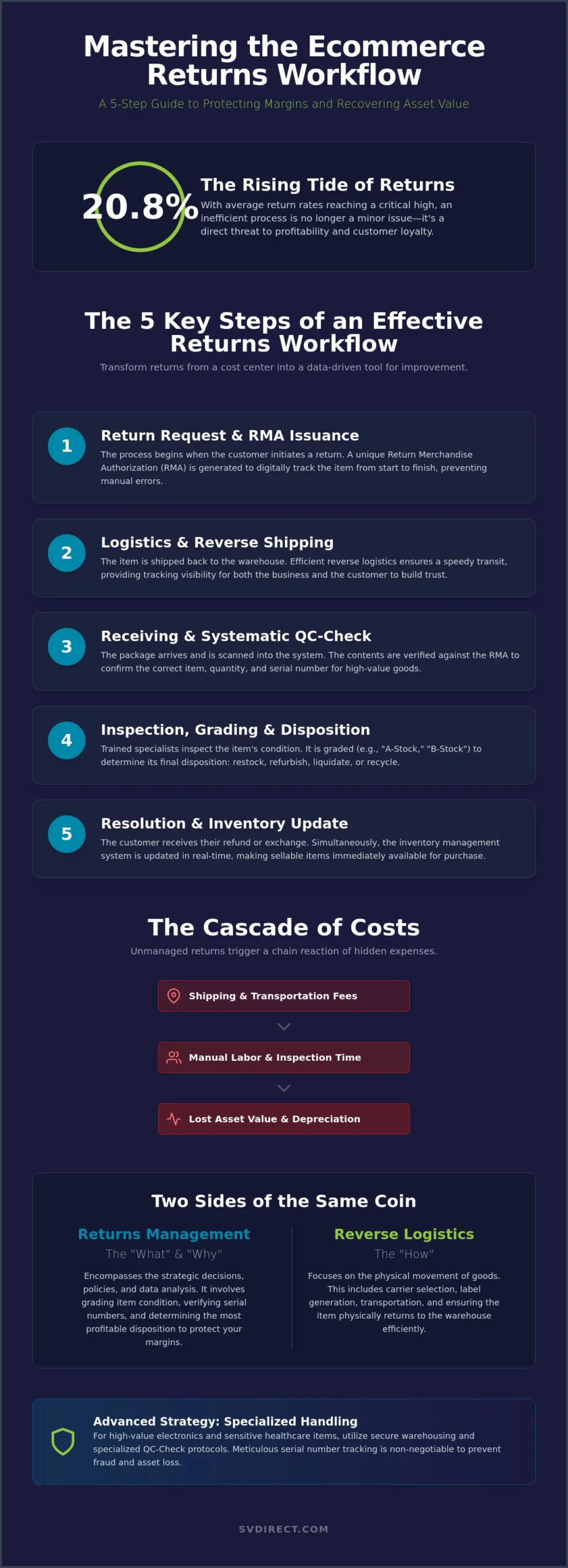
With average ecommerce return rates now reaching as high as 20.8%, the financial impact of a fragmented ecommerce returns management process is no longer just a minor operational hurdle; it’s a strategic threat to your profitability. You’ve likely felt the strain of rising labor costs and the frustration of inventory inaccuracies that stem from poor grading. As the 2026 EU “Withdrawal Button” law sets a new global standard for one-click returns, the pressure to maintain a precise and efficient reverse logistics chain has never been more intense.

We understand that a return is a high-stakes moment in the customer journey that requires a steady, professional hand. This guide provides a roadmap to help you master every stage of the workflow, from the initial request to the final restocking of sellable items. You’ll learn how to implement a transparent system that protects your margins, recovers asset value, and uses precise data to reduce return rates over time. We’ll examine the technical integrations and human expertise needed to turn your warehouse operations into a reliable engine for long-term loyalty and growth.

Key Takeaways

  • Distinguish between customer-facing policies and physical logistics to build a more resilient ecommerce returns management process.
  • Implement a standardized five-step workflow to move items from the initial request to final disposition without losing asset value.
  • Quantify the “Cascade of Costs” so you don’t overlook how labor, inspection time, and “bracketing” habits impact your margins.
  • Utilize specialized secure warehousing and QC-Check protocols to safely manage high-value electronics and sensitive healthcare materials.
  • Harness real-time reporting via systems like Remote Control™ to pinpoint return trends and proactively improve product descriptions.

What is the Ecommerce Returns Management Process?

The ecommerce returns management process is a comprehensive, end-to-end strategy that governs every touchpoint of a returned item. It starts the second a customer initiates a request and only ends once the product reaches its final disposition, whether that is being restocked, refurbished, or recycled. In 2026, this process is no longer a secondary concern; it is a critical component of your brand’s operational integrity. Success requires a marriage of digital transparency and physical precision to ensure that margins are protected and customers remain satisfied.

Modern standards demand that this process be proactive rather than reactive. By utilizing 24/7 real-time visibility into inventory, businesses can maintain a high level of trust with their audience. This involves more than just issuing a refund. It means using return data to identify trends, such as recurring defects or inaccurate product descriptions, and fixing those root causes to prevent future returns. When you treat returns as a strategic data source, you transform a cost center into a tool for continuous improvement.

Returns Management vs. Reverse Logistics

It’s vital to understand that while these terms are related, they aren’t identical. Reverse logistics focuses on the “how,” which is the physical movement of goods from the consumer back to the distribution center. This includes carrier selection, shipping labels, and the actual transportation of the package. Returns management is the “what” and the “why.” It encompasses the strategic decisions, such as grading the item’s condition, verifying serial numbers for high-value tech, and determining the most profitable next step for the inventory.

A reliable 3PL partner must be a master of both realms. Without efficient logistics, returns take too long to arrive. Without sophisticated management, those items sit in a warehouse gathering dust instead of being processed. For high-value goods, meticulous serial number tracking during the return journey is a non-negotiable safeguard against fraud and asset loss. This level of oversight ensures that the exact unit sold is the one being returned and inspected.

The Business Impact of an Optimized Workflow

An inefficient workflow creates a “cascade of costs” that can quickly erode your profits. These include the obvious shipping fees, but also the hidden expenses of manual labor, dedicated warehouse space, and lost asset value. The longer an item stays in the return cycle, the less likely it is to be sold at its original price. A fast return-to-shelf cycle is essential for maintaining healthy inventory turnover and recovering value before a product becomes obsolete.

Strategic Silicon Valley 3PL fulfillment services help brands compress these timelines. By automating the grading process and integrating it with real-time data systems, you ensure that sellable items are back on the digital shelf within hours, not weeks. This level of speed protects your bottom line and keeps your supply chain lean and responsive to market demands.

The 5 Key Steps of an Effective Returns Workflow

Building a high-performance ecommerce returns management process requires more than just a digital “refund” button. It demands a structured, physical workflow that treats every returned item as a valuable asset rather than a burden. A well-executed cycle ensures that items don’t just sit in a corner; they move through a series of checkpoints designed to recover value and restore customer trust. The following five steps represent the standard for operational excellence in 2026.

  • Step 1: Return Request and RMA Issuance. The customer initiates the process, and the system issues a Return Merchandise Authorization (RMA) to track the intent.
  • Step 2: Logistics and Reverse Shipping. The item travels back via a selected carrier with active tracking enabled for both the brand and the customer.
  • Step 3: Receiving and Systematic QC-Check. The package arrives at the warehouse for a physical entry process to verify the contents against the RMA.
  • Step 4: Inspection, Grading, and Disposition. Specialists inspect the item to determine if it is sellable, needs refurbishment, or must be recycled.
  • Step 5: Final Resolution and Inventory Update. The customer receives their refund or exchange while the inventory system updates in real-time to reflect available stock.

The Crucial Role of RMA and Data Integration

Manual returns are the primary cause of warehouse errors. When staff rely on paper trails or disconnected spreadsheets, items get lost or misidentified. Integrating your storefront with a remote order management system ensures an instant data sync between the customer’s home and the fulfillment floor. An RMA serves as the digital handshake between customer intent and warehouse readiness. This integration allows for proactive problem solving, as warehouse teams know exactly what is arriving before the truck even docks.

Inspection and Grading Standards

Physical evaluation is the most critical stage of the ecommerce returns management process. We categorize items into Grade A (like-new), Grade B (open box), or Grade C (damaged) to ensure they are listed correctly for resale. To maintain this level of precision, we utilize a “Quiet Facility” methodology. This approach allows our team to focus entirely on the nuances of grading without the chaos of a disorganized environment. We also employ serial number tracking to identify fraudulent returns, ensuring the unit coming back is the exact one we shipped out. If you are looking to refine your own physical grading standards, you can request a free quote to see how our team handles complex reverse logistics.

Calculating the Real Cost of Returns in 2026

Every returned package triggers a “Cascade of Costs” that extends far beyond the initial shipping label. To truly understand the ecommerce returns management process, you must account for the cumulative impact of reverse logistics, manual labor, and administrative overhead. In 2026, industry research shows that return rates for online purchases hover between 19% and 20.8%. This is significantly higher than the single-digit rates seen in physical retail. This volume represents a massive portion of the projected $849.9 billion in total U.S. retail returns. Cost containment is now a primary objective for growing brands.

A significant driver of these costs is the consumer habit known as “bracketing.” This occurs when a customer orders multiple sizes, colors, or styles of the same item with the intent of keeping only one. Research indicates that sizing, fit, or color issues account for approximately 45% of all returns. Bracketing doesn’t just increase shipping expenses; it effectively removes sellable inventory from your shelves for weeks at a time. This creates an “Obsolescence Risk,” where seasonal goods or high-tech electronics lose significant market value while they are stuck in the return cycle. Every day counts. Every day a unit spends in transit or waiting for inspection is a day its potential for full-price resale diminishes.

Some retailers implement restocking fees to offset these burdens. While this can recover some processing costs, it is a delicate balance. If the fee feels punitive, it can damage customer loyalty and drive shoppers toward more flexible competitors. A more sustainable approach involves using data from systems like Remote Control™ to identify why items are coming back and addressing those issues at the source. Since our founding in 1999, we have seen that transparency in data is the best defense against rising costs.

Labor and Processing: The Silent Profit Killer

The physical handling of a return is a labor-intensive endeavor. Our team spends dedicated minutes on every unit. They perform a meticulous sequence of opening, inspecting, re-folding, re-bagging, and re-labeling. This granular level of care is necessary to maintain brand standards. We operate a Quiet Facility to ensure this grading is done with absolute precision. However, these steps add up quickly across thousands of orders. To help recover asset value, our kitting and assembly services can be used to refurbish items to their original quality. This ensures they are ready for immediate resale. We treat every return with a “make-it-right” attitude. It is an opportunity to salvage a sale and a relationship.

Environmental and Sustainability Costs

Shipping items twice, once to the customer and once back to the warehouse, nearly doubles the carbon footprint of a single transaction. In 2026, consumers are increasingly sensitive to these environmental impacts. Waste adds up quickly. An efficient disposition strategy aligns with modern “Green Printing” and sustainable brand values. This includes responsible donating or recycling. We utilize high-end technology like the HP Indigo 5500 liquid ink system and follow industry-leading models for hardware recovery to minimize waste. By streamlining the ecommerce returns management process, you aren’t just saving money. You are reducing the physical waste and energy consumption of your entire supply chain.

The Ecommerce Returns Management Process: A Strategic Guide for 2026

Advanced Strategies for Specialized Returns Management

A standard ecommerce returns management process often falls short when applied to specialized industries. While a basic apparel return is relatively straightforward, handling medical devices or high-value tech requires a much higher level of operational precision. These sectors demand more than just warehouse space; they require a partner capable of maintaining a rigorous chain of custody and serialized tracking throughout the entire reverse journey. When items are sensitive or regulated, the physical handling must be as disciplined as the digital tracking.

High-Value and Regulated Goods

For brands utilizing healthcare mailing services, the return of medical kits or pharmaceutical-adjacent materials involves strict compliance standards. It isn’t just about restocking; it’s about verifying that the integrity of the product remains intact. Similarly, tech companies rely on secure warehousing to prevent asset loss and ensure that returned units are thoroughly inspected before being reintroduced to inventory. Our systematic QC-Check process ensures that every component of a high-value kit is accounted for, allowing us to refurbish and re-kit these items for resale with total confidence.

Leveraging Print-on-Demand to Reduce Future Returns

Data gathered during the ecommerce returns management process is a goldmine for reducing future overhead. If customers consistently return an item due to “fit” or “confusing assembly,” you can act immediately. By integrating print on demand capabilities, you can update user manuals or “quick start” guides based on real-world feedback without waiting for a new production run. Our HP Indigo 5500 liquid ink technology provides 230-line screen resolution printing, which allows re-packaged goods to look brand new and professionally curated. We also use Variable Data Printing (VDP) to include personalized “Sorry it didn’t work” cards in exchange shipments, turning a potential loss into a high-touch customer loyalty moment.

Proactive communication remains your best tool for reducing customer anxiety. By providing 24/7 data access via our Remote Control™ system, you keep your customers informed of their return status at every stage. This transparency reduces the burden on your customer service team and reinforces the idea that your brand is a reliable, high-performance partner. We believe that physical operations should be just as organized and accessible as your digital storefront. This steady approach alleviates the stress of business growth through precision and personal commitment.

Why Silicon Valley Direct is Your Returns Partner

Silicon Valley Direct has refined the ecommerce returns management process since 1999. Our history provides a stable foundation that few others can match. We operate from a strategic location that serves as a symbol of global connectivity and innovation. This allows us to integrate high-tech efficiency with a deeply reliable, human-centric service. We don’t believe in impersonal, automated-only interactions. Instead, we position ourselves as a high-performance partner that remains grounded and accessible.

Transparency Through Remote Control™

Our proprietary Remote Control™ data management system is the backbone of our operational transparency. It provides you with 24/7 access to real-time inventory and return status from any device. We offer over 120 standard reports. These allow you to perform deep-dive analysis on return trends and identify exactly why items are coming back. For technical stakeholders, our system utilizes programmatic interfaces like XML and SOAP for a seamless integration with your existing eCommerce platform. This ensures that your digital communication and physical operations remain perfectly synchronized. If your development team needs to stress-test these financial integrations, they can learn more about specialized digital transaction simulation systems. Automated email alerts also act as a safety net. They notify you immediately if high return rates cause inventory levels to drop below your comfort zone.

The ‘Extension of Your Team’ Philosophy

We view our relationship with clients as a long-term partnership. Our proactive problem-solving approach identifies return patterns before they can disrupt your peak seasons or high-volume deadlines. We utilize a “Quiet Facility” methodology to manage these workflows. By maintaining an organized and focused environment, we ensure that every inspection and grading task is handled with absolute precision. This eliminates the chaos often found in traditional warehouses and protects your bottom line. Our team is a dedicated, team-oriented organization where collective experience is a point of pride.

You can see the results of this personal commitment by exploring our customer testimonials. We promise total flexibility and bespoke problem-solving to ensure your ecommerce returns management process remains a competitive advantage. Our goal is to alleviate the stress of business growth through physical infrastructure and human expertise rather than just marketing abstractions.

Transform Your Reverse Logistics into a Strategic Advantage

Mastering the ecommerce returns management process is about more than just moving boxes. It’s about capturing granular data to prevent future losses and using high-resolution kitting to restore asset value. By moving beyond manual spreadsheets and embracing a system that prioritizes physical precision, you protect your margins while building a more resilient brand. This transition allows you to treat every returned item as a potential recovery rather than a total loss.

We’ve provided this level of steady, professional oversight since 1999. Our proprietary Remote Control™ system offers 24/7 real-time reporting to ensure you never lose sight of your inventory status or return trends. This marriage of high-tech efficiency and human expertise turns a complex operational challenge into a seamless extension of your own team. It’s a proactive approach designed to alleviate the stress of rapid business growth through precision and personal commitment.

You don’t have to navigate these high-volume deadlines and technical integrations alone. With a dedicated partner and the right physical infrastructure, you can confidently turn every return into a new opportunity for long-term customer loyalty.

Frequently Asked Questions

What is the difference between returns management and reverse logistics?

Returns management is the strategic decision-making framework, while reverse logistics is the physical transportation of the product. Management involves setting policies, grading items, and determining the final disposition of inventory. Logistics focuses on the “how,” including carrier selection and package tracking. A successful operation requires both to work in harmony to protect your margins and maintain a steady flow of inventory back into sellable stock.

How can I reduce the cost of ecommerce returns?

You can reduce costs by analyzing return data to identify why customers are dissatisfied and addressing those root causes. If a specific product has a high return rate due to fit issues, updating the digital product page with precise measurements can prevent future errors. Using high-resolution digital printing for clearer user manuals also helps. These proactive steps reduce the volume of items entering your reverse logistics chain and save on labor.

Should I offer free returns to my customers in 2026?

Offering free returns in 2026 is a strategic choice that depends on your specific product category and customer loyalty goals. While the EU “Withdrawal Button” law simplifies the initiation process, retailers are increasingly using tiered policies. You might offer free returns for high-value VIP members while charging a small fee for others to discourage “bracketing.” This balanced approach helps offset rising shipping costs without alienating your most dedicated customers.

How long does the average ecommerce return process take?

The average ecommerce returns management process typically spans 7 to 14 days from the moment the customer ships the item to the final resolution. This timeline includes transit, warehouse receiving, and a systematic QC-Check inspection. Working with a 3PL that provides 24/7 real-time reporting can significantly compress this window. Faster processing means sellable items are restocked sooner, reducing the risk of obsolescence for seasonal or high-tech goods.

What is an RMA and why is it necessary for fulfillment?

A Return Merchandise Authorization (RMA) is a critical tracking number that serves as the digital handshake between a customer’s intent and your warehouse team. It’s necessary because it allows fulfillment staff to expect and identify incoming packages before they arrive. Without an RMA, returns become disorganized “blind shipments” that lead to processing delays and inventory inaccuracies. This system ensures every item is accounted for from the start of the cycle.

How can a 3PL help with fraudulent returns?

A 3PL helps combat fraud by performing meticulous inspections and utilizing serialized tracking to ensure the correct unit is returned. Our team checks for signs of “switch fraud,” where a customer might attempt to return an older or different model. By having a seasoned expert physically verify every item against the original order data, you add a layer of human oversight that automated systems simply cannot provide on their own. For businesses that need to take further action against persistent fraud or other civil disputes, Final Demand provides specialized resources to resolve these matters independently.

What happens to items that cannot be restocked?

Items that fail inspection are typically diverted to secondary channels such as refurbishment, donation, or recycling. We use specialized kitting and assembly services to restore kits or salvage valuable components for future use. If an item is truly unsellable, we follow responsible recycling protocols to minimize environmental impact. This approach ensures you recover as much asset value as possible while adhering to sustainable brand values and environmental standards.

Can automated returns management software integrate with my warehouse?

Yes, modern platforms integrate directly with warehouse systems through programmatic interfaces like XML or SOAP. This connectivity ensures that your ecommerce returns management process is fully transparent and visible 24/7. When your storefront and warehouse speak the same language, data syncs instantly. This allows for automated email alerts regarding inventory levels and provides your customers with real-time updates on their refund or exchange status throughout the journey.

BigCommerce Fulfillment Services: A Strategic Guide to Profitability and Returns in 2026

BigCommerce Fulfillment Services: A Strategic Guide to Profitability and Returns in 2026

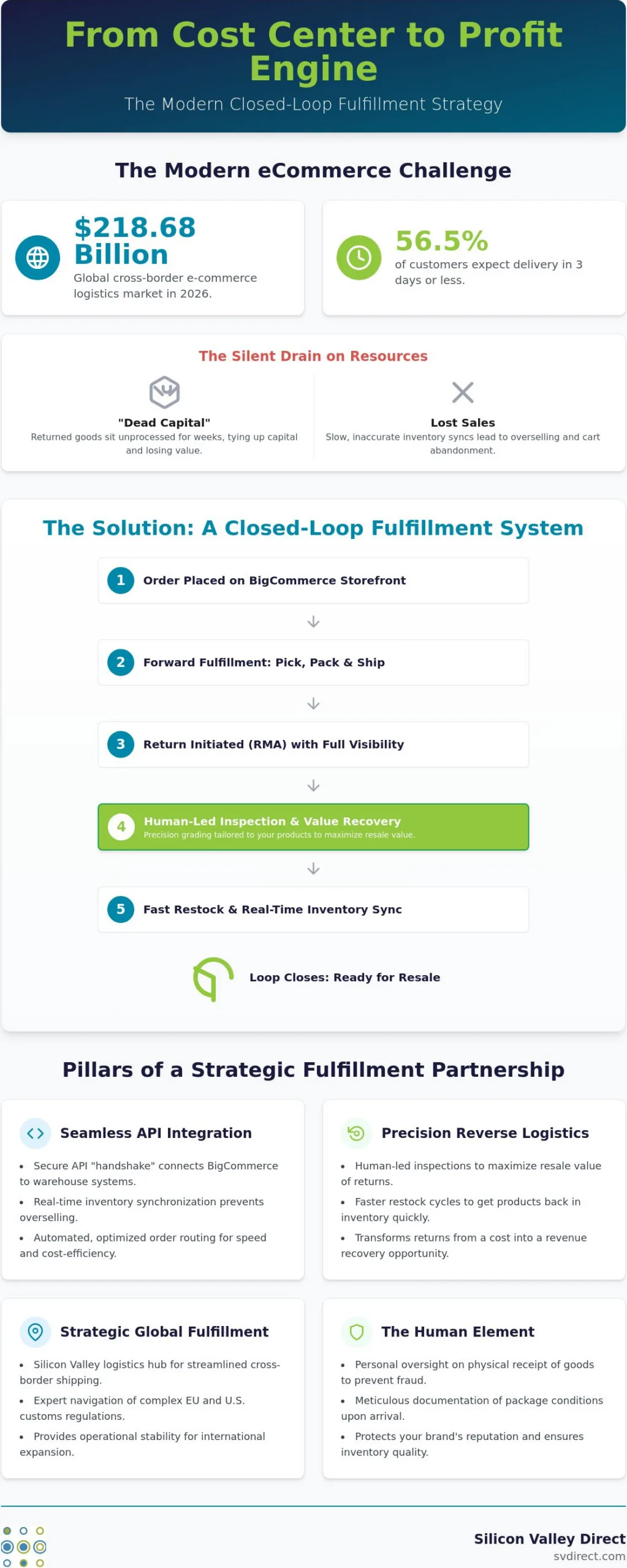
With the global cross-border e-commerce logistics market reaching $218.68 billion in 2026, why are so many merchants still watching their margins disappear into the “black hole” of inefficient returns? You likely feel the sting of high return rates and the persistent frustration of waiting for your dashboard to catch up with actual warehouse activity. It’s a common struggle to align your storefront with bigcommerce fulfillment services that can actually keep pace with the 56.5% of customers who now expect delivery in three days or less.

We believe your growth deserves a steady hand and a partner who values precision over generic automation. This guide will show you how to transform your logistics from a cost center into a profit-recovering engine through specialized 3PL integration and precision reverse logistics. We’ll explore how seamless API synchronization, faster restock cycles for returned goods, and strategic Silicon Valley logistics hubs can slash your shipping costs while navigating the complex new EU and U.S. customs regulations of 2026. You’re about to discover a more reliable, human-centered way to scale your operations and reclaim your bottom line.

Key Takeaways

  • Shift your perspective from logistics as a cost center to a revenue recovery engine through a closed-loop fulfillment strategy.
  • Master the technical API handshake required for bigcommerce fulfillment services to ensure real-time inventory accuracy and zero integration lag.
  • Increase your resale margins by replacing generic automated grading with human-led, functional inspections tailored to your specific product categories.
  • Streamline your international expansion by utilizing a Silicon Valley logistics hub to manage cross-border shipping and the latest global customs regulations.
  • Benefit from operational stability grounded in a multi-decade history of serving the tech industry with personal oversight and bespoke problem-solving.

The Strategic Role of BigCommerce Fulfillment Services in 2026

In 2026, viewing logistics as a simple linear path is a recipe for shrinking margins. Modern bigcommerce fulfillment services must operate as revenue recovery engines. This means every package sent out and every item returned is part of a “closed-loop” system designed to protect your bottom line. As the global cross-border e-commerce logistics market grows to an estimated $218.68 billion this year, the brands that thrive are those that prioritize precision over just moving boxes. It’s about more than delivery; it’s about maintaining operational stability in a high-speed market.

The Profitability Crisis in Modern eCommerce

Many scaling startups face a silent drain on their resources: dead capital. This refers to returned goods sitting unprocessed in a warehouse corner for weeks. When your remote order management isn’t synced with your storefront, you lose sales. Slow fulfillment cycles don’t just frustrate customers; they lead to increased cart abandonment. With 56.5% of consumers expecting delivery within 2-3 days, according to 2026 industry data, your store can’t afford the lag of manual entry or siloed data. Accuracy at this stage is the foundation of customer lifetime value.

Why Forward Fulfillment Needs Reverse Precision

A robust order fulfillment process is only as strong as its weakest link, which is often the return journey. Standard pick-and-pack workflows often ignore what happens when a product comes back. High-growth brands require a partner who treats reverse logistics with the same urgency as the initial shipment. Transitioning to seamless, API-driven bigcommerce fulfillment services ensures that your inventory levels are always accurate. This allows you to restock and resell returned items before they lose value. This steady, methodical approach transforms a logistical headache into a clear competitive advantage for your business.

Seamless Integration: How BigCommerce Syncs with Your 3PL

Establishing a connection between your storefront and bigcommerce fulfillment services shouldn’t feel like a technical hurdle. It begins with a secure API handshake. This digital link allows the BigCommerce dashboard to communicate directly with our warehouse management system. Once the connection is live, we map every SKU to ensure real-time inventory synchronization. This prevents overselling and ensures that what your customer sees on the screen matches exactly what’s on our shelves in Union City. This level of precision is the cornerstone of operational stability.

Efficiency continues through automated order routing. Our system selects the optimal carrier based on speed and cost, ensuring your bigcommerce fulfillment services remain profitable even as you scale. This is vital for brands pursuing cross-border ecommerce, where regulatory compliance and shipping logistics become increasingly complex. To maintain a competitive edge, you might want to consult with an integration expert about your specific workflow needs and carrier optimization strategies.

RMA Management and Visibility

A Return Merchandise Authorization (RMA) is the digital security protocol that protects the return cycle. By providing real-time RMA tracking, you significantly reduce customer service inquiries. Customers stay informed throughout the process, and your BigCommerce dashboard reflects the physical warehouse reality the moment a return is processed. This transparency builds trust and keeps your data clean.

The Human Element in Receipt and Logging

While automation handles the data, Silicon Valley Direct prioritizes personal oversight for the physical receipt of goods. This human-centric approach is critical for high-value items where “box-swapping” or ecommerce fraud can occur at the loading dock. Our team documents the exact condition of every package upon arrival. This level of care protects your brand reputation and ensures that only quality inventory returns to your live stock. It’s a proactive stance that combines high-tech 3PL fulfillment services with the steady hand of an experienced operational team that has been serving the industry since 1999.

Maximizing Value Recovery Through Human-Led Inspection

While massive automated centers prioritize speed, they often lack the nuance required to protect your margins. In the world of bigcommerce fulfillment services, the human element is what prevents profit from leaking out of the warehouse doors. One-size-fits-all inspection protocols fail modern brands because a medical device requires a different level of scrutiny than a piece of apparel. By utilizing custom grading scales, we ensure that every returned item is evaluated against its specific functional and aesthetic standards. This sophisticated approach to direct-to-consumer fulfillment ensures that “Grade A” items return to your active inventory at full retail value rather than being prematurely sent to liquidation.

Strategic Disposition Routing

Our team manages the “backward” supply chain with methodical care. We route items through three primary paths: restocking, refurbishment, or sustainable disposal. Restocking returns “like-new” items to your BigCommerce shelf for immediate resale. Refurbishment involves our kitting and assembly experts turning slightly damaged returns into value-added bundles. For items that cannot be resold, we manage compliant, eco-friendly recycling. This structured flow ensures your bigcommerce fulfillment services remain lean and environmentally responsible.

Protecting High-Value Inventory

Handling sensitive electronics or healthcare products requires more than a standard warehouse setup. We implement specialized handling protocols and maintain a strict chain of custody for every unit. This is a core component of our secure warehousing for high-value electronics. By documenting the package condition and performing functional testing, we protect your brand reputation from the risks of “box-swapping” or faulty re-shipments. This proactive stance is backed by over two decades of operational history in the Silicon Valley innovation hub.

BigCommerce Fulfillment Services: A Strategic Guide to Profitability and Returns in 2026

Scaling Globally: Specialized Fulfillment and Compliance

Scaling a brand on BigCommerce requires more than just adding new markets. It requires a logistics partner who understands the intersection of data and physical movement. Our centralized Silicon Valley hub serves as a gateway for international trade, simplifying the complexities of cross-border shipping. By leveraging bigcommerce fulfillment services that utilize a single, high-tech facility, you reduce the fragmentation that often leads to shipping delays and lost inventory. This strategic location provides immediate access to major global ports and innovation hubs, ensuring your brand remains agile in a fast-paced market.

Fulfillment Meets Kitting and Assembly

Returned components shouldn’t collect dust. We use real-time returns data to identify items that can be re-bundled into new promotional or subscription kits. This process is a core part of our kitting and assembly services. By re-bundling restockable items into fresh SKUs, you streamline your inventory and turn potential losses back into marketable assets. It’s a methodical way to maximize the value of every unit in your warehouse while maintaining the high-performance standards your customers expect.

Healthcare and Global Compliance

Managing specialized returns for the healthcare sector requires a level of precision that generic providers simply cannot reach. We maintain strict adherence to HIPAA and SOC2 standards, ensuring that sensitive medical devices or healthcare literature are handled with absolute security. You can learn more about our specialized healthcare mailing services and how we maintain a rigorous chain of custody for every shipment.

As we move through 2026, international trade standards like the EU’s ICS2 system and new U.S. customs enforcement orders have made documentation more critical than ever. Our team ensures that every package meets these evolving requirements, providing detailed customs data before goods enter foreign territories. This expertise is reflected in our comprehensive global shipping services. If you’re ready to expand your reach without the regulatory headaches, get a custom quote for your global logistics needs. We provide the steady hand you need to navigate these complex bigcommerce fulfillment services with confidence.

Why Silicon Valley Direct is the Strategic Partner for BigCommerce

Choosing a logistics partner is a high-stakes decision for any growing brand. Silicon Valley Direct offers a unique combination of high-tech capability and seasoned experience that few can match. Since 1999, we’ve provided operational stability for the tech industry, evolving alongside the platforms we support. Our bigcommerce fulfillment services are designed to scale with you, whether you’re a startup processing your first hundred orders or an enterprise managing complex global distribution. We provide the physical infrastructure and human expertise to ensure your growth remains sustainable and organized.

A Foundation of Trust for Modern Brands

In a volatile 3PL market, our multi-decade history acts as a constant anchor of trust. We explicitly reject the trend of impersonal, automated help desks. Instead, we prioritize direct human connection and personal oversight. By combining high-tech inventory systems with the seasoned judgment of our long-term staff, we offer a level of bespoke problem-solving that automation alone cannot match. We treat your business as a partnership, not just another transaction.

Take Control of Your BigCommerce Logistics

It’s time to evaluate your current logistics performance. Look for bottleneck areas and high cost-per-return rates that may be hindering your profitability. Our experts are ready to help you design a bespoke fulfillment workflow that addresses your specific product needs. For more strategies on optimizing your supply chain, check out our latest insights on the Silicon Valley Direct blog. Let us provide the steady hand you need to scale with confidence.

Future-Proofing Your eCommerce Logistics

Transforming your logistics from a standard delivery mechanism into a profit-recovering engine is the key to thriving in 2026. You’ve seen how precision reverse logistics and human-led inspections can protect your margins by recovering the value of returned goods. By prioritizing a “closed-loop” system, you ensure that every item is accounted for and optimized for resale. Accuracy is everything. This methodical approach is what separates high-performance brands from those struggling with “dead capital” and integration lag.

A successful partnership requires a steady hand and a commitment to accuracy. Since 1999, we’ve provided operational stability for brands navigating the complexities of the tech industry. Our strategic Silicon Valley location and rejection of impersonal automation in favor of expert human oversight make us a unique partner for your brand. We’re ready to help you scale your operations with bespoke workflows that meet your specific needs. It’s time to reclaim your bottom line and build a more resilient supply chain. We invite you to Request a free quote for BigCommerce fulfillment services today. Let’s work together to turn your logistics into a high-performance asset for your business.

Frequently Asked Questions

How does BigCommerce integrate with a 3PL fulfillment service?

BigCommerce integrates with a 3PL through a secure API handshake that enables real-time data exchange. This digital link ensures that your storefront, inventory levels, and order statuses are perfectly synchronized with the warehouse. Using professional bigcommerce fulfillment services allows for bidirectional flow, meaning that when an order is packed or a return is restocked, your dashboard updates instantly without manual data entry. This precision is vital for maintaining operational stability as your business scales.

What is the difference between reverse logistics and standard returns management?

Reverse logistics is a comprehensive process that manages the entire “backward” movement of goods to recover value. While standard returns management often focuses only on the receipt of a package, reverse logistics includes specialized inspection, custom grading, and strategic disposition routing. It’s a closed-loop strategy designed to transform a cost center into a profit-recovering engine. This approach ensures that items are restocked, refurbished, or recycled with methodical care to protect your margins.

Can a fulfillment service handle high-value electronics and healthcare products?

Specialized fulfillment services can certainly handle sensitive electronics and healthcare products if they have the right infrastructure. These items require strict handling protocols, secure warehousing, and a documented chain of custody to maintain integrity. For healthcare products, compliance with HIPAA and SOC2 standards is mandatory. Expert human oversight ensures that every unit undergoes functional testing or aesthetic grading, protecting your brand reputation from the risks associated with damaged or faulty re-shipments.

How do BigCommerce fulfillment services detect and prevent return fraud?

Detection of return fraud is most effective when high-tech tracking meets human-led inspection at the loading dock. Professional bigcommerce fulfillment services use Return Merchandise Authorizations (RMAs) to verify every incoming package against the original order. Staff members document the condition of the box and its contents upon arrival to prevent “box-swapping.” This proactive stance ensures that only genuine, quality inventory is returned to your live stock, effectively closing the door on common eCommerce fraud.

What are the most common disposition options for returned eCommerce items?

Disposition options usually include restocking, refurbishment, and sustainable disposal. Restocking is the most profitable choice, returning like-new items to the shelf for immediate resale. Refurbishment involves kitting and assembly experts who can re-bundle slightly damaged goods into value-added kits. For items that cannot be sold, sustainable disposal ensures that products are recycled or destroyed according to regulatory and environmental standards. This structured flow keeps your inventory lean and responsible.

How long does it typically take to process a return and update inventory?

Processing times usually take between 24 and 48 hours from the moment a return arrives at the facility. The speed of the update depends on the complexity of the inspection required for that specific product category. Once our team completes the grading process and logs the item back into the system, the API-driven synchronization ensures your BigCommerce inventory levels reflect the change instantly. This minimizes the time capital remains “dead” in the warehouse.

Is it more cost-effective to outsource BigCommerce fulfillment or handle it in-house?

Outsourcing is typically more cost-effective for brands that have outgrown their initial storage or lack specialized logistics expertise. Managing in-house fulfillment involves high fixed costs for warehouse space, labor, and technology. By partnering with a 3PL, you gain access to optimized carrier rates, advanced inventory management systems, and a seasoned team without the overhead. This allows you to focus your resources on marketing and product development while we handle the operational heavy lifting.

Apparel Fulfillment Center Bay Area: The 2026 Guide to Scaling Your Fashion Brand

Apparel Fulfillment Center Bay Area: The 2026 Guide to Scaling Your Fashion Brand

What if your brand’s biggest growth hurdle isn’t the next collection, but the invisible friction in your size-color-style matrix? For many fashion founders, scaling means facing a surge in pick-and-pack errors and a return rate that feels impossible to manage. Finding a specialized apparel fulfillment center bay area is no longer just about storage; it’s about securing a partner who understands that a single mispicked garment can erode customer trust. You’ve likely felt the sting of inventory discrepancies or the stress of manual data entry between your warehouse and Shopify store.

We understand that behind every SKU is a promise made to a customer. This guide will show you how to streamline your logistics through high-tech integrations and reliable reverse logistics. You’ll discover how to leverage the Port of Oakland’s proximity to save up to $2,500 in drayage costs per container and ensure your brand stays compliant with the July 2026 California Responsible Textile Recovery Act. We’re diving into the exact strategies you need to achieve global reach with the personal touch of a dedicated, human-led team that values your growth as much as you do.

Key Takeaways

  • Understand why the Bay Area remains the strategic hub for West Coast fashion and how an apparel fulfillment center bay area enables a seamless transition from in-house operations to professional scaling.
  • Gain insights into managing the complex size-color-style SKU matrix with precision strategies that maintain 99%+ inventory accuracy even during peak seasonal demand.
  • Balance Silicon Valley technology with high-touch human oversight to ensure garment inspection and fold quality meet your brand’s specific standards before every shipment.
  • Learn to turn reverse logistics into a growth tool by implementing reliable returns management and custom kitting for influencer and subscription box campaigns.

Scaling Your Fashion Brand with a Bay Area Apparel Fulfillment Center

Success in the fashion industry often hinges on the speed and precision of your supply chain. For brands importing goods from Asia, the San Francisco Bay Area provides an unmatched logistical gateway. The Port of Oakland handles 99% of containerized goods in Northern California, offering a direct line for your inventory that bypasses the congestion of Southern California ports. By choosing an apparel fulfillment center bay area, you can save between $1,000 and $2,500 in drayage costs per container compared to routing shipments through Los Angeles or Long Beach. These savings aren’t just numbers on a balance sheet; they represent capital you can reinvest into your next seasonal collection or marketing campaign.

Relocating your inventory from a cramped home office or a general warehouse to a specialized fulfillment center marks a pivotal moment in your brand’s maturity. It’s the point where you trade manual oversight for professional stability and high-tech efficiency. This transition allows you to focus on design and brand strategy while experts manage the intricate size-color-style matrix that defines apparel logistics. You’re not just hiring a warehouse; you’re securing a partnership grounded in decades of operational history and a deep understanding of the fast-paced apparel cycle.

To better understand how local apparel businesses navigate this growth, watch this helpful video:

The Strategic Advantage of a Silicon Valley Location

The Bay Area sits at the intersection of global trade and digital innovation. This location provides immediate access to international shipping lanes and major carrier hubs, which is essential for reaching the $380 billion West Coast e-commerce market. Beyond physical proximity, being in the heart of Silicon Valley means your fulfillment partner has access to the tech-savvy talent required for complex API integrations. Whether you’re running on Shopify or WooCommerce, your inventory levels must sync in real time. A local apparel fulfillment center bay area ensures that your digital store and physical warehouse speak the same language, reducing transit times for both domestic and Pacific Rim customers.

When to Outsource Your Apparel Logistics

Identifying the “break point” in your operations is critical for sustainable growth. If your team spends more time untangling shipping errors than engaging with customers, you’ve likely outgrown your current model. Seasonal spikes, such as Black Friday or Spring launches, often expose the fragility of in-house fulfillment. The sudden need for temporary labor and increased floor space can stall your momentum and lead to costly mistakes. By moving to a professional 3PL, you gain the ability to scale your labor and storage needs up or down instantly. To understand the financial implications of this move, explore our guide on The Hidden Costs of In-House Fulfillment.

Specialized Logistics: Managing High SKU Counts and Seasonal Demand

Managing a fashion brand in 2026 requires a level of logistical precision that general warehouses often struggle to provide. Unlike consumer electronics or shelf-stable goods, apparel inventory is inherently fragmented. A single jacket design might exist in five sizes and four colors, creating twenty unique SKUs for just one style. Without a specialized apparel fulfillment center bay area, this complexity often leads to pick-and-pack errors that frustrate customers and inflate return rates. We view your inventory not as a collection of boxes, but as a dynamic matrix that requires both technological rigor and human oversight.

Maintaining 99%+ inventory accuracy in this high-volume environment isn’t a matter of luck; it’s the result of tech-driven inventory management. Real-time visibility is no longer a luxury for eCommerce brands. It’s the baseline requirement for preventing overselling and managing stockouts. When your Shopify or WooCommerce store reflects exactly what sits on our shelves, you gain the confidence to push aggressive marketing campaigns without fear of logistical failure. This transparency allows you to make data-backed decisions about replenishment and end-of-season clearances.

Mastering the Size-Color-Style Matrix

SKU proliferation is the compounding challenge where a single design expands into dozens of unique identifiers across size, color, and fit, often overwhelming standard inventory systems. To counter this, we utilize advanced warehouse management systems (WMS) that enforce strict barcode scanning at every touchpoint. Clear labeling and organized bin locations are essential for apparel, where a “Medium Navy” shirt can easily be mistaken for a “Large Black” shirt in a dimly lit or disorganized facility. Our processes ensure that every item is scanned during receiving, put-away, and picking, creating a digital paper trail that guarantees the right garment reaches the right customer every time. If you’re struggling to manage your growing catalog, you might want to consult with an expert about professional SKU architecture.

Preparing for Peak Season Volatility

Peak seasons and flash sales shouldn’t be a source of anxiety. Our scalable labor model is designed to adapt to the extreme volatility of the fashion calendar. Whether it’s a Black Friday rush or a Spring collection launch, we maintain consistent service levels by adjusting our team’s capacity in real time. We often employ pre-kitting strategies for popular items or promotional bundles, allowing us to accelerate dispatch when order volumes spike. This proactive stance ensures that your shipping speeds remain fast and reliable, regardless of how many orders hit your system in a single hour. We provide a steady hand during the most high-stakes moments of your business year, ensuring your brand’s reputation for reliability remains intact.

Apparel Fulfillment Center Bay Area: The 2026 Guide to Scaling Your Fashion Brand

Tech-Driven Inventory Management vs. Personalized Quality Control

Technology provides the structural skeleton of modern logistics, but it lacks the visual discernment required to spot a loose thread or a crushed shipping box. While many fulfillment providers lean entirely on automated algorithms, an elite apparel fulfillment center bay area understands that software is a tool, not a total solution. You need the efficiency of a digital dashboard combined with the seasoned judgment of a veteran floor manager. This “steady hand” approach ensures that your brand’s high-tech storefront is backed by high-touch physical operations. It’s the difference between a package that simply arrives and one that arrives in pristine condition.

The apparel industry presents unique physical challenges that standard warehouse robotics aren’t yet equipped to handle perfectly. Delicate silks, structured blazers, and intricate lace require gentle handling that machines often overlook. By balancing automated efficiency with human precision, we protect the integrity of your garments from the moment they arrive at our dock to the second they reach your customer’s doorstep. This hybrid model allows us to maintain the rapid pace of 2026 eCommerce while upholding the aesthetic standards your brand worked so hard to establish.

Seamless Platform Integrations

Modern fashion brands thrive on real-time data. We provide seamless syncing between your Shopify or WooCommerce storefront and our warehouse management system. This direct API connection eliminates the need for manual spreadsheets and significantly reduces the data entry errors that often plague scaling businesses. Orders are routed automatically, and tracking numbers are generated the moment a label is printed. This level of digital transparency ensures your customers receive instant updates, which reduces the burden on your support team and fosters long-term trust. You’ll always have a clear view of your inventory levels, enabling proactive replenishment before a stockout occurs.

The Human Element in Apparel Fulfillment

Intricate designs and high-end textiles require more than just a robotic arm. We prioritize human oversight for garment inspection and fold quality because a machine cannot appreciate the aesthetic standards of a boutique brand. Whether you are fulfilling orders for luxury staples like Alvin Valley designer pants or delicate evening wear, Silicon Valley Direct explicitly rejects the “fully automated” trend that treats your apparel like generic commodities. Instead, we offer personal oversight from long-term staff members who understand the nuances of textiles. You’ll collaborate with a dedicated account manager rather than an impersonal chatbot, ensuring that bespoke problem-solving is always a direct conversation away. This commitment to human connection ensures that every item leaving our apparel fulfillment center bay area is handled with the care it deserves.

Evaluating Returns Management and Custom Kitting Capabilities

High return rates are an inescapable reality for the fashion industry, often hovering between 20% and 30% for online sales. If your apparel fulfillment center bay area treats these returns as a secondary priority, you’re likely losing significant revenue to “dead stock” that sits unprocessed. We view reverse logistics as a critical financial lever. By accelerating the return-to-shelf cycle, we ensure that your capital isn’t tied up in transit or sitting idle in a corner of the warehouse. Efficient returns management turns a logistical headache into a competitive advantage by maintaining high inventory turnover and keeping your customers satisfied.

Beyond the standard ship-and-return cycle, scaling a brand in 2026 requires the ability to create bespoke experiences for different audience segments. Whether you’re launching a subscription box or sending promotional kits to high-profile influencers, the precision of your kitting and assembly matters. A specialized apparel fulfillment center bay area should offer more than just storage; it should act as an extension of your brand’s creative team, ensuring that every package reflects your aesthetic standards and attention to detail.

Mastering Reverse Logistics in Fashion

Our team employs rigorous inspection protocols to evaluate every returned garment with a discerning eye. We check for makeup stains, fragrance scents, and missing tags to determine resellability with absolute certainty. If an item passes inspection, we provide refurbishment and re-bagging services to restore it to pristine condition. This methodical approach maximizes inventory recovery and prevents sub-par items from reaching new customers. For a deeper look at how we manage these intricate workflows, explore our Kitting and Assembly Services: The Strategic Guide.

Creating a Premium Unboxing Experience

The moment a customer opens their package is the most powerful physical touchpoint your brand has. We help you capitalize on this through customized packaging, precise tissue wrapping, and strategic sticker placement. By utilizing our on-demand digital printing services, you can include personalized packing slips or “just-in-time” marketing inserts tailored to specific campaigns. This eliminates the need for expensive bulk printing and allows for total flexibility in your messaging. Custom kitting elevates the perceived value of your products, turning a routine delivery into a memorable brand event that encourages social sharing and long-term loyalty.

Optimizing your after-purchase experience is essential for sustainable growth in a crowded market. If you’re ready to transform your returns process and unboxing experience, request a free quote to discuss a bespoke solution for your fashion brand.

Why Silicon Valley Direct is the Premier Apparel Logistics Partner

Silicon Valley Direct has operated at the heart of the world’s most innovative region since 1999. Over the last quarter-century, we’ve seen the fashion industry evolve from traditional retail to the high-velocity eCommerce landscape of 2026. Choosing an apparel fulfillment center bay area means more than just finding a place to store inventory; it’s about selecting a partner that has weathered every market shift with a steady hand. We combine our deep operational history with cutting-edge logistics technology to provide a platform where fashion brands can thrive without the friction of logistical uncertainty.

Our capabilities extend far beyond basic pick-and-pack operations. We offer a comprehensive suite of services, including on-demand digital printing for marketing collateral and sophisticated returns management. This integrated approach allows you to consolidate your supply chain under one roof, reducing the complexity of managing multiple vendors. Whether you’re a startup launching your first collection or an established enterprise expanding your global footprint, we provide bespoke problem-solving tailored to your specific SKU architecture and brand goals. We don’t just ship products; we protect the reputation you’ve built with every order we fulfill.

A Legacy of Reliability in Silicon Valley

Stability is the foundation of our service model. Our long-term staff retention is a unique hallmark of our internal culture, ensuring that the people handling your garments have years of expert-level experience. This collective wisdom allows us to maintain the highest standards of precision in an industry where details matter. We prioritize transparency and direct communication, rejecting the trend of impersonal, automated interactions. When you work with us, you’re partnering with a team that values human connection as much as technical efficiency. For those looking to reach international markets, we provide detailed guidance through our Global Shipping Services: Strategic Reference Guide.

Ready to Scale Your Apparel Brand?

The San Francisco Bay Area remains the strategic hub for West Coast logistics, offering proximity to major ports and a tech-savvy workforce. By leveraging our specialized infrastructure, you can reduce shipping costs, master your SKU complexity, and provide a premium unboxing experience that keeps customers coming back. We’re here to alleviate the stress of business growth through proactive management and personal commitment. Your brand deserves a logistics partner that is as energetic and forward-thinking as your designs. Take the next step in your growth journey and streamline your apparel fulfillment with Silicon Valley Direct today.

Elevate Your Brand with Precision Logistics

Scaling a fashion brand requires more than just high-quality designs; it demands a logistics infrastructure that can keep pace with your vision. We’ve explored how mastering the complex size-color-style SKU matrix and optimizing reverse logistics can transform your operations into a competitive engine. By partnering with a specialized apparel fulfillment center bay area, you gain the stability of a provider that has been operational since 1999. We understand that your growth depends on a seamless blend of sophisticated technology and personal oversight to ensure every garment is handled with care.

Our facility integrates on-demand digital printing with core fulfillment, allowing you to personalize every unboxing experience without the burden of excess inventory. We reject the impersonal nature of fully automated models, choosing instead to provide the direct human connection your brand deserves. It’s time to trade logistical headaches for the steady hand of a seasoned expert. Request a custom quote for your apparel fulfillment needs and discover how our bespoke solutions can support your 2026 growth strategy. Your success is our collective priority, and we’re ready to help you reach your global audience with confidence.

Frequently Asked Questions

What should I look for in an apparel fulfillment center in the Bay Area?

You should prioritize a partner that balances technological integration with human quality control. It’s essential to find a provider that understands the high SKU counts typical of fashion brands and offers specialized services like returns management and custom kitting. A seasoned apparel fulfillment center bay area should also provide proximity to major ports like the Port of Oakland to streamline your import drayage costs and improve speed to market.

How do you handle high return rates for fashion brands?

We treat returns as a priority revenue recovery process rather than a secondary warehouse task. Our team performs meticulous inspections for makeup stains, scents, and tag integrity before items are refurbished or re-bagged for resale. This proactive approach to reverse logistics ensures that your inventory remains active and your capital isn’t tied up in unprocessed “dead stock” sitting on a warehouse shelf.

Can you integrate with my Shopify or WooCommerce store?

Yes, we provide seamless API integrations that sync your storefront with our warehouse management system in real time. This connection automates order routing and tracking number generation, which eliminates manual data entry errors. You’ll always have a transparent view of your inventory levels, allowing you to manage seasonal launches and flash sales with informed confidence and operational readiness.

What is the difference between kitting and simple pick-and-pack?

Simple pick-and-pack involves pulling individual items for a single order, while kitting is the process of pre-assembling multiple items into a single unit or promotional package. We use kitting for influencer kits, subscription boxes, and holiday bundles. This service allows for specialized packaging and the inclusion of on-demand digital printing inserts, creating a premium unboxing experience that elevates your brand beyond a standard delivery.

How does location in Silicon Valley affect my shipping costs?

Our Silicon Valley location offers a strategic advantage for reaching the $380 billion West Coast e-commerce market. Shipping from a local apparel fulfillment center bay area can reduce parcel costs by up to 50% compared to cross-country shipping from the East Coast. Additionally, our proximity to the Port of Oakland can save you between $1,000 and $2,500 in drayage costs per container compared to Southern California ports.

Do you offer climate-controlled storage for sensitive fabrics?

We maintain an organized, professional warehouse environment designed to protect the integrity of diverse textiles and delicate fabrics. While we offer secure storage that prevents damage from dust and moisture, we recommend discussing any specific temperature or humidity requirements for high-end luxury goods. Our steady, methodical facility management ensures that your inventory remains in pristine, shelf-ready condition until the moment of dispatch.

How quickly can you process and ship new apparel orders?

We prioritize speed and accuracy to meet the expectations of modern e-commerce customers. Orders are typically processed and prepared for shipping within 24 hours of receipt, provided the inventory is in stock. Our scalable labor model allows us to maintain these consistent service levels even during peak seasonal spikes or high-volume promotional events, ensuring your customers receive their garments without unnecessary delays.

What is ‘reverse logistics’ and why does my apparel brand need it?

Reverse logistics is the comprehensive management of the return journey from the customer back to the warehouse. For apparel brands, this is vital because of the high frequency of returns due to size and fit issues. An efficient reverse logistics system handles inspection, refurbishing, and restocking, which directly impacts your bottom line by maximizing the lifecycle of every garment and maintaining high inventory turnover.

Returns Management Logistics: The Ultimate 2026 Audit Checklist for eCommerce

Returns Management Logistics: The Ultimate 2026 Audit Checklist for eCommerce

Did you know that aggregate online return rates have climbed as high as 30% in 2026? When you factor in the 5.9% rate hikes from major carriers like FedEx and UPS, it’s clear that inefficient returns management logistics can quietly erode your hard-earned margins. We understand the frustration of seeing “dead” inventory sit in a warehouse while labor costs for manual processing continue to rise. It’s a complex balancing act to maintain visibility while trying to meet the high expectations of modern shoppers who demand speed and transparency.

We’ve designed this guide to provide a clear framework for auditing your current reverse logistics setup. Our promise is simple: we’ll help you master these complexities and transform returns into a genuine competitive advantage that builds lasting customer trust. You’ll find a comprehensive 2026 checklist covering everything from the new EU “withdrawal button” mandates to AI-driven workflows that reduce manual effort and get products back into the resale loop faster. This is about more than just moving boxes; it’s about creating a steady, reliable process that respects your time and your bottom line.

Key Takeaways

  • Learn how to transform product recovery from a back-office expense into a strategic engine for customer retention and brand loyalty.
  • Identify the essential operational standards for intake and inspection, including condition grading systems that protect your resale margins.
  • Optimize your returns management logistics by auditing the technical integration between your warehouse management system and customer-facing tracking tools.
  • Explore financial recovery strategies through re-commerce, minor repairs, and liquidation partnerships that rescue value from returned goods.
  • Understand how a human-centric approach to high-tech logistics can scale your operations while maintaining the precision required for complex returns.

The Strategic Importance of Returns Management Logistics in 2026

Returns management logistics is the end-to-end orchestration of product recovery. It isn’t just about moving a package backward; it’s about managing a complex ecosystem of data, physical transport, and human inspection. By June 2026, the industry has shifted. Returns are no longer a back-office burden to be minimized. Instead, they’ve become a critical pillar of customer retention. When 81% of consumers check a return policy before they even click “buy,” your recovery process is actually your first line of marketing. A steady, reliable hand in this process ensures that a single return doesn’t become the end of a customer relationship.

The financial stakes are higher than ever. With aggregate online return rates sitting between 15% and 30%, a clunky system doesn’t just annoy customers; it actively bleeds capital. Industry analysis shows that poor handling of these items can cost businesses up to 15% of their total revenue through labor, shipping, and lost resale opportunities. Adopting a “re-commerce” mindset changes the math. Rather than viewing a return as a sunk loss, high-performing brands see it as inventory recovery. This shift transforms the warehouse from a graveyard of “dead” stock into a vibrant engine for reselling and value capture.

To better understand the operational flow of this process, watch this helpful video:

Reverse Logistics vs. Forward Logistics

Forward logistics is a predictable, linear path from the shelf to the doorstep. Reverse logistics is inherently more volatile. You can’t predict exactly when a customer will initiate a return or what condition the product will be in when it arrives. This unpredictability requires a level of operational flexibility that traditional fulfillment often lacks. While forward paths prioritize speed and volume, the circular path of returns prioritizes precision and assessment. In a high-efficiency 3PL environment, the circular economy is the practice of maximizing the lifecycle value of every returned unit through precise inspection and rapid restocking.

The 2026 Consumer Expectation Gap

Modern shoppers demand a “frictionless” experience. They expect the same level of transparency during a return that they get during initial delivery. This expectation gap is where many brands stumble. If a customer scans a return label and doesn’t see a status update for three days, trust evaporates. Effective returns management logistics bridges this gap by providing real-time data from the moment of the first scan. This level of transparency directly impacts your global shipping services reputation. A seamless return process proves to your international and domestic clients that you’re a stable, reliable partner capable of handling growth without losing the human touch.

Phase 1 Checklist: Operational Intake and Inspection Standards

The physical intake process is the foundation of effective returns management logistics. If the initial receipt is disorganized, the rest of your recovery strategy will likely fail. With the average cost of an e-commerce return ranging from $10 to $30 for parcel-sized goods in 2026, every minute an item sits unrecorded on a dock is a drain on your profitability. Use this checklist to audit your partner’s operational standards:

  • Dedicated RMA Portals: Does your provider offer a centralized digital gateway for return authorizations to minimize manual entry errors?
  • Standardized Condition Grading: Are items categorized clearly as New, Open Box, or Damaged using a fixed internal rubric?
  • Photographic Evidence: Is there a strict requirement for high-resolution images of high-value or damaged goods upon arrival?
  • Turnaround Velocity: How many hours does it take for an item to move from the receiving dock to being visible in your inventory system?

The Human Oversight Advantage in Inspection

Many providers rely heavily on automated scanners to move volume. While technology is efficient, it often misses subtle product defects like a missing instruction manual or a faint scratch on a screen. This is where seasoned experts provide a distinct advantage. Meticulous manual review ensures that every item is handled with care. Instead of “blind processing,” which treats every box the same, a human-centric approach identifies product-specific nuances. This level of precision is vital for Improving Efficiency and Customer Loyalty because it ensures your customers never receive a “refurbished” item that feels anything less than premium.

Standardizing Disposition Rules

Once an item is graded, the next step is determining its final destination. Clear disposition logic is essential for maintaining margins. Your team should have a custom framework to guide these decisions based on item value and condition. For example, you might decide that any unit valued over $50 should be refurbished, while lower-value items are liquidated. This is where specialized kitting and assembly services become invaluable. These services allow you to repackage “Open Box” items with fresh materials and original inserts, turning a potential loss back into a full-price sale. A robust intake system reduces “dead” inventory and keeps your warehouse lean. If you want to see how a professional team handles high-complexity returns management logistics, you can consult with a logistics expert to review your current workflow.

Returns Management Logistics: The Ultimate 2026 Audit Checklist for eCommerce

Phase 2 Checklist: Technical Integration and Data Visibility

Phase 2 of your audit focuses on the digital threads that connect your physical warehouse to your customer’s screen. Even the most meticulous physical inspection is undermined if your data remains siloed in a spreadsheet. In 2026, real-time synchronization is the baseline for professional operations. If your returns management logistics software doesn’t communicate with your storefront instantly, you’re looking at manual reconciliations and frustrated shoppers. Use this checklist to evaluate your technical infrastructure:

  • Real-Time WMS Sync: Does your warehouse management system update your eCommerce platform the moment an item is checked in?
  • Customer-Facing Tracking: Can shoppers view the status of their return in real time, or are they forced to contact support?
  • Batch Processing Capabilities: Does your system allow for the bulk processing of similar items to lower administrative overhead?
  • Carrier Nuance Handling: Is your system sophisticated enough to track “Batch Delivery to Carrier” statuses for return labels?

Closing the Information Loop

Real-time data is vital for more than just customer satisfaction; it’s the engine for financial reconciliation and intelligent restocking. When your systems are integrated, you can automate refunds and trigger immediate restocking for items graded as “New.” This is where understanding the batch delivery to carrier meaning becomes essential. By managing customer expectations during the transit phase, you reduce the volume of “where is my refund” inquiries. We prioritize API-first logistics because it reflects the innovation of Silicon Valley, ensuring your data moves as fast as your inventory. This technical precision creates a steady, reliable hand that manages the stress of business growth through digital clarity.

Reporting and Root Cause Analysis

A sophisticated partner doesn’t just process boxes; they provide the insights needed to stop returns before they happen. Your 3PL should offer a “Reason for Return” report that identifies manufacturing defects or sizing inconsistencies. By linking this data to your inventory management, you can prevent overstocking of high-return SKUs that drain your margins. For example, identifying a pattern of damaged arrivals might reveal that your packaging is insufficient for specific transit routes. Addressing these issues can significantly reduce shipping costs for eCommerce by eliminating the need for second and third transit legs on faulty goods. Data-driven returns management logistics transforms a cost center into a strategic feedback loop for your entire supply chain.

Phase 3 Checklist: Financial Recovery and Re-commerce Strategy

The final phase of a sophisticated returns management logistics audit focuses on the bottom line. It is about shifting the perspective from loss mitigation to value recovery. In 2026, the average all-in cost for a single e-commerce return ranges from $10 to $30 for parcel goods, while bulky items can exceed $120. Without a clear financial strategy, these costs quickly cannibalize your profit margins. Use this checklist to ensure your partner is protecting your ROI:

  • Value-Added Services: Can the 3PL perform minor cleaning or light repairs to return an item to “Like New” status?
  • Liquidation Channels: Does the provider have established partnerships to help you recover value from stock that cannot be resold as new?
  • Unit-Level Transparency: Are you provided with a clear breakdown of labor, label costs, and restocking fees for every single return?
  • Cross-Border Recovery: Can the partner handle the complexities of tax and duty recovery for international shipments? Brands selling globally should also review their cross-border eCommerce fulfillment strategy to ensure landed costs remain predictable even when returns are factored in.

Maximizing Resale Value

The goal of re-commerce is to get products back into the market at the highest possible price point. “Grade A” refurbished items often fetch a premium on secondary marketplaces, provided the presentation is flawless. This is where our on-demand digital printing becomes a strategic asset. If a return is perfect but the instruction manual is torn or missing, we can print a fresh replacement instantly. By integrating printing and assembly directly into the return workflow, we eliminate the delay of waiting for manufacturer inserts. This seamless approach ensures that inventory recovery happens in days, not weeks, allowing you to capture sales while demand is still high.

The Hidden Costs of “Free” Returns

While “free returns” are a powerful conversion tool, they carry significant internal labor costs. Every unit requires a human touch to open, inspect, re-label, and re-stock. We’ve seen that for lower-value items, the total cost of processing can occasionally exceed the item’s resale value. In these specific cases, a “Dispose at Warehouse” instruction is often the most profitable move. We help our partners establish a “Return Threshold” based on their specific product margins. This data-driven logic ensures you aren’t spending $15 in labor to save a $10 item. If you’re ready to audit your financial recovery process and protect your bottom line, request a free quote to see how we can optimize your margins.

Scaling Your Returns Logistics with Silicon Valley Direct

Mastering returns management logistics requires more than just a sleek interface; it demands a physical partner with the infrastructure to execute complex workflows. Silicon Valley Direct stands as the premier choice for eCommerce brands that require a high level of precision and personal commitment. From our Union City hub, we act as a global gateway for reverse logistics, connecting Northern California’s innovation with markets across the globe. Our 25 year history in the operational space provides a foundation of stability that’s rare in today’s market. We’ve spent decades refining the balance between high-performance technology and the human oversight that ensures every returned unit is accounted for and processed with care.

We understand that as your business scales, the complexity of your returns grows exponentially. A steady hand is required to manage the influx of data and physical goods without sacrificing speed or accuracy. Our approach is grounded in the belief that logistics is a partnership, not just a transaction. By positioning our physical infrastructure as an extension of your brand, we help you alleviate the stress of growth. This proactive stance is backed by decades of collective experience, ensuring that your physical operations are just as organized as your digital storefront.

Precision Logistics for High-Stakes Industries

Our facility is designed to handle sensitive inventory that requires extra oversight. This includes our healthcare mailing services, where compliance and accuracy are the highest priorities. For high-value returns that need extra security, our warehouse provides the physical protection and meticulous documentation your brand requires. We are not just a platform; we are a dedicated, team-oriented organization. This means we take the time to understand your specific product nuances rather than relying on “blind processing.” Our seasoned experts catch the details that automated scanners miss, protecting your brand reputation and your resale margins.

Ready to Streamline Your Reverse Logistics?

The audit checklist we’ve provided is more than a set of tasks. It’s a roadmap to a more profitable 2026. By addressing operational gaps and integrating data visibility, you move away from the stress of “dead” inventory and toward a proactive re-commerce strategy. We reject the trend of impersonal, automated interactions. In a tech-saturated market, our signature is direct human connection and personal oversight. We offer total flexibility and bespoke problem solving because we know that every business has unique needs. If you’re ready to turn your returns into a strategic advantage, contact Silicon Valley Direct for a custom returns audit. Let’s work together to identify margin leaks and build a steady, reliable process for your returns management logistics.

Transforming Your Reverse Logistics into a Growth Engine

Mastering returns management logistics is no longer a back-office choice; it’s a requirement for any brand looking to survive the margin pressures of 2026. We’ve detailed how a standardized condition grading system and real-time WMS integration can stop the silent leak of revenue. By prioritizing human-led inspection over blind automation, you ensure that every item is evaluated for its maximum resale potential. This approach protects your brand reputation while getting inventory back into the hands of customers faster than ever before.

Since 1999, we’ve provided a steady hand for businesses navigating the complexities of order fulfillment and inventory recovery. Our Silicon Valley headquarters serves as a global gateway, combining local innovation with the reliability of a seasoned operational team. We’re committed to helping you turn every return into an opportunity for customer trust and financial recovery through 100% accuracy in our manual reviews. You don’t have to face these logistical hurdles alone. We’re ready to help you build a more resilient and profitable supply chain.

Optimize Your Returns Strategy with Silicon Valley Direct

Frequently Asked Questions

What is the difference between reverse logistics and returns management?

Reverse logistics is the overarching framework for moving goods from the end consumer back to the seller or manufacturer. It encompasses everything from recycling and disposal to refurbishing. Returns management is a subset of this field that focuses specifically on the end-to-end customer return experience. It involves the intake, inspection, and disposition of items to recover value while maintaining customer satisfaction and brand loyalty.

How much does returns management typically cost for an eCommerce business?

The all-in cost for a single e-commerce return in 2026 generally falls between $10 and $30 for standard parcel-sized items. If you’re shipping bulky or heavy products, these costs can escalate significantly, often reaching $40 to $120 or more. These figures include the price of the return shipping label, labor for inspection, and the administrative overhead required to update inventory systems and process refunds accurately.

Can a 3PL help with refurbishing returned items for resale?

A specialized 3PL can act as a strategic partner by performing minor repairs, cleaning, or repackaging to save a sale. Instead of liquidating “Open Box” inventory at a loss, your provider can use kitting and assembly workflows to restore products to a resalable condition. This human-led oversight ensures that every item meets your brand’s quality standards before it’s placed back into the active inventory pool for future orders.

What are the most common reasons for eCommerce returns in 2026?

Sizing and fit remain the primary drivers for returns, particularly in the apparel category where return rates can reach 40%. Other common factors include items arriving damaged during transit or products not matching the online description. Retailers are also seeing a rise in “wardrobing,” where customers use a product briefly before returning it. Identifying these root causes through detailed reporting is essential for optimizing your returns management logistics strategy.

How does returns management impact my overall shipping costs?

Returns management logistics directly impacts your total spend by adding a second or even third leg to the shipping journey. With major carriers like FedEx and UPS implementing average rate increases of 5.9% in 2026, every return label adds significant pressure to your margins. High-efficiency partners reduce these costs by localizing returns through consolidation centers and identifying faulty packaging that leads to preventable damage during the initial delivery phase.

What should I look for in a 3PL returns management contract?

You should prioritize contracts that offer total transparency regarding labor costs per unit and restocking fees. Ensure the agreement specifies real-time data synchronization between their warehouse management system and your storefront to prevent inventory silos. It’s also vital to define clear disposition rules for different product categories. This ensures the 3PL knows exactly when to refurbish, liquidate, or dispose of an item without requiring manual approval for every case.

How can I reduce the rate of returns for my online store?

Enhancing the accuracy of your product pages is the most effective way to lower return rates. High-resolution photos, detailed size guides, and customer reviews help shoppers make informed decisions, reducing the likelihood of “buyer’s remorse.” You can also implement AI-powered fraud detection to flag serial returners or “wardrobing” behavior. Clear communication of your policy, as required by states like California, also sets proper expectations for the customer from the start.

Is it better to have returns sent to my office or a 3PL fulfillment center?

Directing returns to a 3PL fulfillment center is usually the more scalable and professional choice. Most office environments lack the specialized infrastructure and staff needed to inspect and restock inventory at high volumes. A 3PL provides the physical space and technical integration to get products back into the resale loop within days. For brands with international customers, pairing a strong returns process with a robust cross-border eCommerce fulfillment strategy ensures that global shoppers receive the same seamless experience as domestic ones. This allows your internal team to focus on growth while the logistics experts handle the mechanical nature of product recovery.