img not found!
Healthcare Literature Fulfillment: The 2026 Strategic Guide to Compliance and Precision

Healthcare Literature Fulfillment: The 2026 Strategic Guide to Compliance and Precision

How much of your annual budget is currently sitting in a warehouse as dead stock because a single regulatory update made your entire printed inventory obsolete overnight? For medical device and pharmaceutical leaders, the cost of playing it safe with large print runs often results in thousands of dollars in wasted materials. You understand the constant pressure to keep field reps equipped with accurate healthcare literature fulfillment while ensuring every document meets the latest compliance standards. Managing these moving parts manually isn’t sustainable in a market that demands instant updates and absolute precision.

Mastering medical document distribution for 2026 requires a strategic shift toward on-demand digital printing and real-time inventory visibility. This guide provides a roadmap to achieving 100 percent kitting accuracy and seamless CRM integration, allowing your team to order exactly what they need, when they need it. We’ll explore how leveraging high-resolution liquid ink technology and proprietary tracking systems can eliminate inventory obsolescence and reduce costs. You will learn how a proactive, tech-forward partnership can transform your distribution from a logistical headache into a streamlined extension of your brand’s commitment to excellence.

Key Takeaways

  • Understand how to navigate the 2026 regulatory landscape, including 42 CFR Part 2, to ensure your healthcare literature fulfillment processes remain fully compliant and secure.
  • Discover why high-resolution liquid ink technology provides superior clarity and professional quality compared to the dry toner used in standard digital presses.
  • Learn how Variable Data Digital Printing (VDP) personalizes medical assets at scale while reducing the overhead costs of traditional static printing.
  • Gain 24/7 visibility into field rep orders and stock levels through proprietary systems like Remote Control™ to eliminate inventory waste and dead stock.
  • Identify the operational advantages of a partnership that prioritizes a quiet, organized facility to guarantee 100 percent kitting accuracy for complex projects.

The High Stakes of Healthcare Literature Fulfillment in 2026

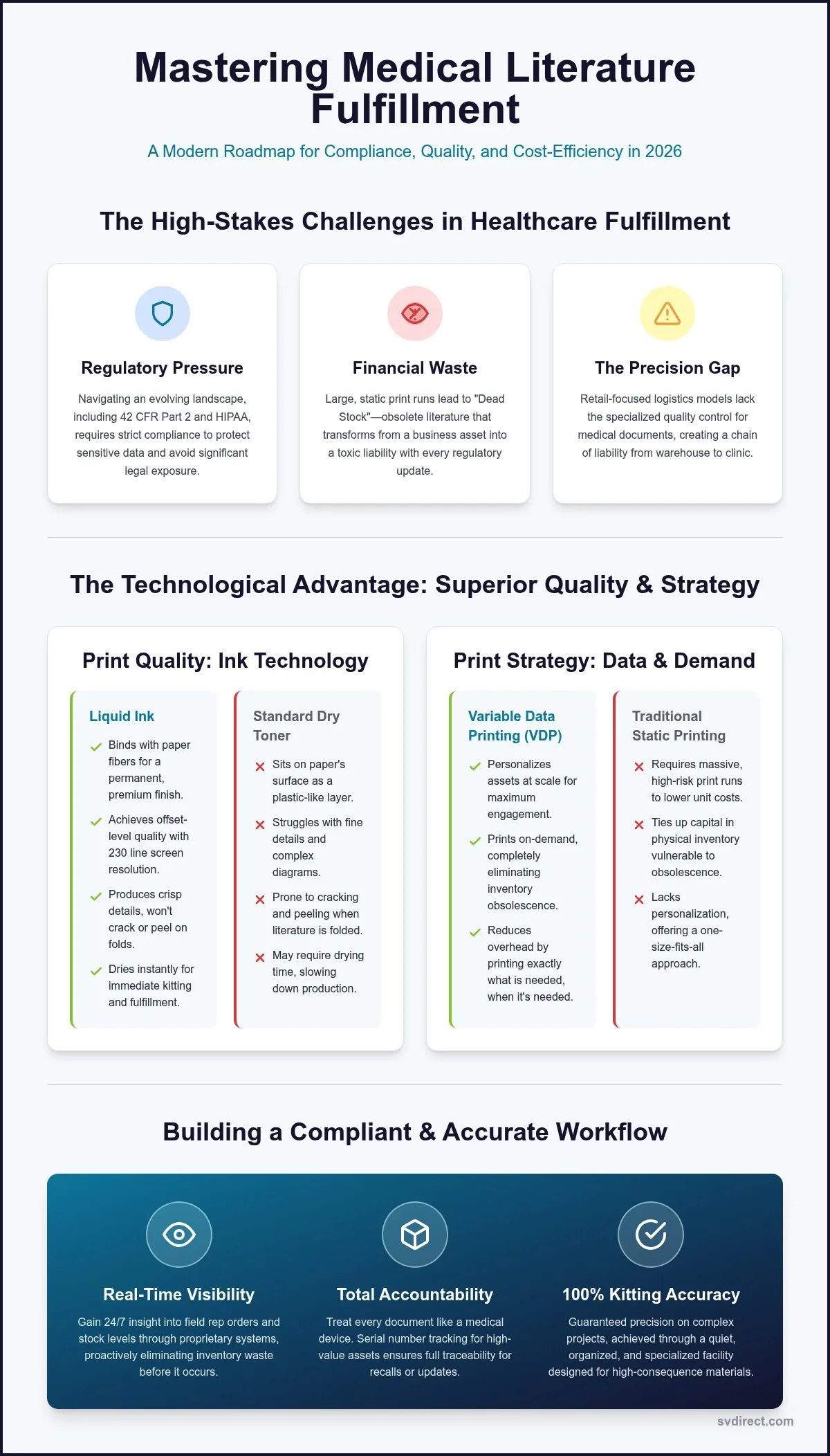
Healthcare literature fulfillment is the high-stakes, managed distribution of regulated medical assets that support patient care and provider education. It’s no longer just about shipping brochures. It’s about ensuring every piece of information that leaves the warehouse is current, compliant, and delivered to the right hands. As we move into 2026, the regulatory environment has tightened. Specifically, 42 CFR Part 2 now requires stricter alignment with HIPAA standards regarding the confidentiality of substance use disorder records. If your distribution process doesn’t account for these evolving privacy protections, you aren’t just missing a marketing beat. You’re risking significant legal exposure.

Precision in medical literature is a baseline legal necessity. Many traditional 3PL models suffer from a “compliance-precision gap,” where they apply general retail logistics logic to high-consequence medical documents. Retail-focused warehouses often lack the specialized quality control needed to distinguish between two nearly identical versions of a clinical data sheet. This mismatch leads to the wrong version reaching a practitioner, creating a chain of liability that starts in the warehouse and ends in the clinic. Closing this gap requires a partner that views fulfillment through a regulatory lens rather than just a logistical one.

The Scope of Modern Medical Assets

Your inventory likely extends well beyond simple promotional materials. Modern healthcare literature fulfillment involves managing technical user manuals, press kits, and complex data sheets. We’ve seen a significant shift toward hybrid digital-physical assets. In these cases, printed guides serve as a secure gateway to digital portals via encrypted QR codes. In this 2026 environment, serial number tracking is essential for high-value medical documents. Every piece of literature must be treated with the same level of accountability as a medical device. This ensures that if a recall or update occurs, you can trace exactly which field rep or facility received specific batches of information.

Financial Risks of Outdated Literature

The financial impact of a compliance failure is immediate and severe. Audits and fines resulting from the distribution of outdated clinical data can devastate a quarterly budget. Beyond legal penalties, there’s the pervasive “Dead Stock” problem. When you rely on massive offset print runs to lower unit costs, you’re often left with thousands of pages of unusable paper when a regulation changes. In a 2026 context, literature obsolescence is defined as the moment a physical asset’s regulatory alignment expires, transforming it from a business resource into a toxic liability. Relying on on-demand digital printing helps mitigate this risk, ensuring your capital isn’t tied up in inventory that might be illegal to ship by next month.

Advanced Printing Technology: Why Liquid Ink and High Resolution Matter

Precision in healthcare literature fulfillment isn’t just about the words on the page. It’s about the clarity of every anatomical diagram and the legibility of every dosage chart. Most digital presses rely on dry toner, which essentially sits on the surface of the paper as a plastic-like layer. In contrast, real liquid ink technology, like that found in our HP Indigo 5500, binds with the fibers of the substrate. This results in a much sharper, more professional finish that doesn’t crack or peel when folded. It’s the difference between a document that feels disposable and one that carries the weight of medical authority.

We utilize a 230 line screen resolution to achieve images that rival traditional offset quality. Standard digital printing often struggles with fine details, but this high-resolution approach ensures that even the smallest annotations on a clinical data sheet remain crisp. Unlike traditional offset printing, which requires a 24-hour drying period before kitting or folding can begin, these digital presses produce sheets that are dry immediately. You get the aesthetic benefits of high-end commercial printing with the speed required for rapid fulfillment. This immediate drying process allows us to move your project straight from the press to the assembly line without the risk of smudging or ink transfer.

The HP Indigo 5500 Advantage

Consistency is the hallmark of a reliable brand. The HP Indigo 5500 offers unmatched color control, ensuring your corporate palette remains identical from the first sheet to the ten-thousandth. It also handles duplexing, printing on both sides of a sheet in a single pass, which significantly speeds up the production of multi-page technical guides. By choosing a digital-only process, you’re also making a sustainable choice. This method reduces the chemicals and paper waste associated with plate setting and press make-ready. It’s a cleaner, more efficient way to manage high-volume medical assets without sacrificing the premium feel your practitioners expect.

Short-Run and On-Demand Printing

Inventory waste is a silent budget killer that drains resources. Traditional printing often forces you into massive runs to get a lower price per unit, but on-demand printing is the cure for this cycle. We maintain a strict 300 dpi standard for all high-quality medical imagery, ensuring every short-run project looks as impressive as a full-scale production. You can learn more about our print-on-demand capabilities to see how this fits your specific workflow. If you’re ready to upgrade the quality of your materials while reducing overhead, you can request a custom quote to see the liquid ink difference for yourself.

Static vs. Variable Data: Maximizing Engagement and Compliance

Variable Data Digital Printing (VDP) is a sophisticated technology that allows for the customization of text, graphics, and images from one printed piece to the next without slowing down the press. While static color printing produces identical copies, VDP pulls information from a database to create unique documents in a single run. In the context of healthcare literature fulfillment, VDP serves as a critical tool for regulatory accuracy by ensuring that every recipient receives the specific version of a document required by their region or professional status. This precision eliminates the risk of sending outdated or irrelevant clinical data to practitioners who require specific territorial disclosures.

Personalization isn’t just a marketing luxury. It’s a method for increasing engagement among both patients and practitioners. Physicians retain tailored information better when it directly addresses their specialty or patient demographic. From a cost-effectiveness standpoint, VDP on digital presses eliminates the need for expensive plate changes required by traditional offset methods. You don’t have to choose between a generic message and a high price tag. Digital tech makes high-level customization accessible even for smaller distribution batches. This flexibility is vital when dealing with rapid clinical updates or pilot programs for new medical devices.

Personalization in Medical Communications

Personalized medical communications allow you to customize copy and images for specific patient demographics, improving comprehension and adherence. This technology also automates the inclusion of regional regulatory disclosures, which is vital for maintaining compliance across different states. When VDP integrates with healthcare literature fulfillment, it creates a seamless pipeline from your database to the final kit. This ensures that every piece of material is not only relevant but also legally sound based on the recipient’s specific location and professional credentials.

Technical Execution of VDP

The technical execution involves a seamless transition from static to variable sheets in a single print run. We prioritize data integrity throughout this process, utilizing rigorous checks when merging your databases with our print files. This prevents errors like mismatched names or incorrect clinical data, which can lead to costly kitting mistakes. You can explore our healthcare mailing services to see how we manage these complex data integrations. Our approach ensures your variable data projects are executed with total precision and brand consistency.
Healthcare Literature Fulfillment: The 2026 Strategic Guide to Compliance and Precision

Building a Compliant Literature Distribution Workflow

Establishing a reliable framework for healthcare literature fulfillment demands a shift from reactive shipping to a proactive, tech-integrated model. The first step involves launching a digital storefront that empowers field representatives to order exactly what they need from a pre-approved catalog. This centralized portal ensures that your team always distributes the most current, compliant versions of clinical data. By moving away from manual email requests, you gain absolute control over document versioning and user access. It’s the most effective way to prevent the distribution of outdated materials that no longer meet 2026 regulatory standards.

Once the storefront is active, the focus shifts to total transparency through real-time inventory visibility. Implementing our proprietary Remote Control™ system allows you to monitor stock levels and order statuses without needing to call a warehouse manager. This is followed by integrating your CRM or proprietary applications using API and SOAP/XML web services to create a seamless data flow. To guarantee accuracy, every order must undergo our systematic QC-Check inspection process. Finally, the workflow is completed with proactive problem-solving, where automated reorder alerts prevent the sudden depletion of critical materials. This structured approach ensures that your healthcare literature fulfillment operations are both efficient and audit-ready.

Remote Control™ and 24/7 Data Access

Transparency is the foundation of a stable partnership. Our Remote Control™ platform provides 24/7 access to over 120 standard reports, giving you deep insights into usage patterns and field rep activity. You can perform real-time tracking from the moment an order is submitted until it reaches its final destination. This level of granular data helps you make informed decisions about print volumes and distribution strategies. You can manage your assets with Remote Control™ to ensure your operations remain lean and responsive to market changes.

Integration and Web Services

Modern logistics require systems that talk to each other. We use XML and SOAP web services to connect our order management system directly to your internal applications. These platform-agnostic web methods are designed to reduce custom coding time, allowing for a faster setup and more reliable data exchange. This integration automates essential notifications for low inventory and backorders, ensuring your team is never blindsided by a stockout. By connecting these systems, you eliminate manual data entry and the human errors that often accompany it.

Silicon Valley Direct operates with a philosophy where we believe anything is possible for complex healthcare projects. We don’t view ourselves as a vendor; we act as an extension of your own organization. This partnership is built on our Nine Promises, a set of standards that ensures every project receives personal oversight and professional care. While many fulfillment centers are hectic and disorganized, we maintain a quiet, organized facility. This environment isn’t just for aesthetics. It’s a mark of the precision required for high-stakes healthcare literature fulfillment. By keeping our operations methodical and calm, we eliminate the distractions that lead to errors in medical asset distribution.

Our high-tech origins in the heart of innovation allow us to bring a sophisticated approach to national logistics. We combine over 26 years of experience with the latest digital infrastructure to solve problems before they impact your bottom line. Whether you’re managing a nationwide product launch or a targeted clinical update, our team provides a steady hand. We’re committed to transparency and direct human connection, rejecting the impersonal, automated models that often fail when projects become complex. Our proactive stance ensures that your inventory is managed with the same care you put into developing your medical products.

Kitting, Assembly, and Hand Finishing

Managing complex medical kits requires more than just automated machinery. It needs human-led quality control to ensure every component is in its proper place. We utilize a systematic inspection process called QC-Check for high-stakes software or device packages. This ensures that every kit leaving our facility is 100 percent accurate. You can read our strategic guide to kitting and assembly to understand how we maintain these standards for healthcare literature fulfillment. Our hand-finishing capabilities allow us to handle bespoke projects that standard fulfillment lines simply can’t accommodate.

Sustainability and Green Printing Initiatives

We’re dedicated to reducing the environmental footprint of medical communications. Our digital workflows eliminate the need for hazardous chemicals and aluminum plates used in traditional offset printing. We offer several options for FSC-certified papers and stocks with 30 percent recycled content. Additionally, we actively participate in the hardware recycling and recovery program provided by HP. This commitment to sustainability ensures that your brand’s growth doesn’t come at the expense of environmental responsibility. By choosing on-demand digital processes, you’re already reducing paper waste by eliminating the need for large, static inventories that often go unused.

Securing Your Distribution Strategy for 2026

Modern medical distribution is shifting toward a model that values immediate precision over massive, static inventories. By 2026, mastering healthcare literature fulfillment means balancing the technical requirements of 42 CFR Part 2 with the visual standards of the HP Indigo 5500 liquid ink technology. You’ve learned how on-demand printing eliminates dead stock while our proprietary Remote Control™ system provides the 24/7 visibility your field reps need to remain effective and compliant.

With over 26 years of precision logistics experience, we provide a stable, human-led alternative to automated fulfillment models. Our 100 percent accuracy QC-Check guarantee ensures that every medical kit and data sheet meets your exact specifications before it reaches a practitioner. We’re ready to act as a seamless extension of your brand, providing the high-tech infrastructure and seasoned expertise required to move your business forward with confidence. It’s time to transform your literature distribution into a proactive asset that supports your growth and protects your reputation.

Your commitment to excellence deserves a partner that values precision as much as you do. We look forward to helping you achieve a streamlined, compliant future for all your medical assets.

Frequently Asked Questions

How does digital printing quality compare to traditional offset for medical literature?

Digital quality is now equal to or better than traditional offset printing because of advanced color control and liquid ink technology. Our HP Indigo 5500 Digital Press operates at a 230 line screen resolution, which produces sharp, detailed images for clinical data sheets. Because this process avoids the need for physical plates or negatives, you get offset-quality results with the speed of a digital workflow. It’s the ideal solution for high-stakes healthcare literature fulfillment.

What is Variable Data Printing (VDP) and is it expensive for healthcare mailings?

Variable Data Printing (VDP) allows every sheet in a print run to feature unique copy or images based on your database. This technology is essential for personalized medical mailings where regional disclosures or practitioner specialties vary. Despite the high level of customization, VDP is affordable and costs not much more than producing static color jobs. It allows you to deliver highly relevant content to your audience without a significant increase in your production budget.

How does Silicon Valley Direct ensure 100% accuracy in complex medical kitting?

We maintain a 100 percent accuracy standard through our systematic QC-Check process. This involves human-led inspections at every stage of the assembly and kitting process to ensure no component is missing or mismatched. Unlike hectic warehouses, our quiet and organized facility is designed specifically to support this level of precision. This deliberate methodology allows us to manage high-volume deadlines for complex medical packages while maintaining absolute quality control across every shipment.

Can my field representatives order literature directly from their CRM?

Yes, your team can submit orders directly from their existing applications using our standardized web services. We utilize XML and SOAP protocols to facilitate seamless integration between your CRM and our Order Management System. This programmatic interface allows for real-time transaction submission and reporting without the need for time-consuming custom coding. It empowers your field representatives to access the materials they need through the platforms they already use every day.

What are the benefits of liquid ink technology over standard toner?

Real liquid ink technology provides a superior finish because it binds with the paper fibers rather than sitting on the surface like dry toner. This prevents the cracking and peeling often seen with standard digital prints when they are folded into brochures. Liquid ink also offers better control over dot gain and color density. The result is a professional, high-resolution document that carries the authority and polished feel of traditional commercial offset printing.

How quickly can on-demand healthcare literature be ready for shipping?

On-demand materials are ready for the next production step immediately after leaving the press. Unlike traditional offset printing, which requires up to 24 hours of drying time, our digital press sheets emerge dry and ready for kitting or shipping. This immediate handling capability significantly reduces lead times for healthcare literature fulfillment projects. It allows us to respond quickly to clinical updates or urgent field requests without compromising the quality of the final product.

What compliance standards are supported for 2026 healthcare logistics?

We support evolving 2026 standards by integrating strict confidentiality protocols and serial number tracking for all medical assets. Our systems are designed to align with 42 CFR Part 2 requirements, ensuring that sensitive information remains secure throughout the distribution chain. We also provide real-time inventory visibility and over 120 standard reports through our Remote Control™ system. This helps your organization maintain a clear audit trail for every piece of literature or product sent to the field.

Is there a minimum order quantity for short-run medical printing?

We reject cookie-cutter procedures in favor of custom-fit solutions that meet your specific project goals. This means we don’t impose rigid minimum order quantities for our short-run medical printing services. Whether you need a small batch of specialized clinical guides or a large-scale national mailing, we work to find the best price possible for your volume. This flexibility allows you to print only what you need, effectively eliminating the risk of inventory obsolescence.
Healthcare Fulfillment Services: Navigating Compliance and Precision in 2026

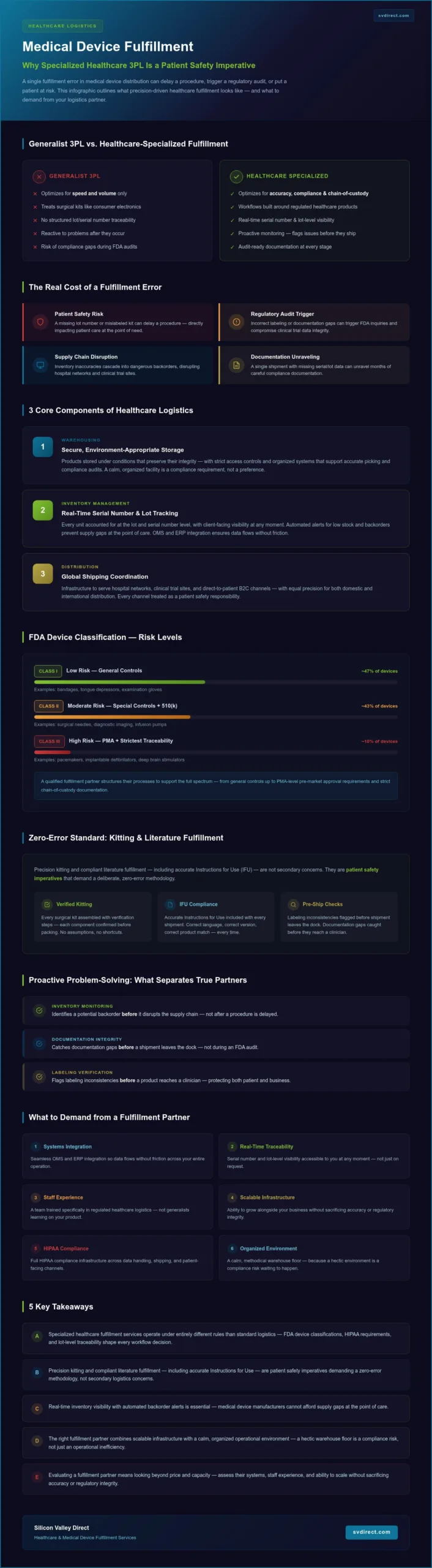
A single fulfillment error in medical device distribution isn’t just an operational headache; it can delay a procedure, trigger a regulatory audit, or put a patient at risk. That’s the reality that makes healthcare fulfillment services fundamentally different from any other logistics category. And yet, too many medical device companies are still partnering with generalist 3PLs that treat a surgical kit the same way they’d treat a box of consumer electronics.

You already know the pressure you’re under. Regulatory compliance isn’t optional, inventory inaccuracies can cascade into dangerous backorders, and a single shipment with missing lot or serial number data can unravel months of careful documentation. The stakes are simply too high for a fulfillment partner that’s learning on the job.

This article walks you through what precision-driven healthcare fulfillment actually looks like in 2026: from seamless OMS and ERP integration to zero-error kitting, real-time serial number visibility, and the compliance-ready processes that protect both your business and your patients. If you’re evaluating your current logistics setup, what follows will give you a clear framework for what to demand from a fulfillment partner.

Key Takeaways

  • Specialized healthcare fulfillment services operate under an entirely different set of rules than standard logistics – FDA device classifications, HIPAA requirements, and lot-level traceability all shape how products must be stored, handled, and shipped.
  • Precision kitting and compliant literature fulfillment – including accurate Instructions for Use – are not secondary concerns; they are patient safety imperatives that demand a deliberate, zero-error methodology.
  • Real-time inventory visibility, including automated alerts for low stock and backorders, is essential for medical device manufacturers who cannot afford supply gaps at the point of care.
  • The right fulfillment partner combines scalable infrastructure with a calm, organized operational environment – because in regulated healthcare logistics, a hectic warehouse floor is a compliance risk waiting to happen.
  • Evaluating a fulfillment partner means looking beyond price and capacity to assess their systems, staff experience, and ability to grow alongside your business without sacrificing accuracy or regulatory integrity.

What Are Medical Device Fulfillment Services?

Medical device fulfillment services are a specialized category of third-party logistics (3PL) designed specifically to handle, store, and distribute regulated healthcare products. That definition sounds straightforward, but the operational reality behind it is anything but. Unlike standard eCommerce fulfillment, where the primary concern is getting a package from point A to point B on time, healthcare fulfillment operates within a dense framework of regulatory requirements, traceability mandates, and patient safety obligations that shape every single workflow decision.

The distinction matters enormously. A generalist 3PL optimizes for speed and volume. A healthcare-specialized fulfillment partner optimizes for accuracy, compliance, and chain-of-custody integrity, often simultaneously. When a surgical instrument ships without a verified lot number, or a diagnostic kit arrives with incorrect labeling, the consequences extend far beyond a customer service complaint. They can trigger FDA inquiries, compromise clinical trial data, or delay a procedure that a patient is counting on.

Serial number tracking and lot control sit at the absolute center of this discipline. Every regulated medical device must be traceable from the moment it enters a warehouse to the moment it reaches its destination. This isn’t a best practice; it’s a baseline requirement that shapes how inventory systems are built, how staff are trained, and how fulfillment partners are evaluated. Silicon Valley Direct’s Remote Control™ system provides clients with real-time serial number visibility precisely because that level of traceability is non-negotiable in this space.

Fulfillment speed also carries clinical weight. Backorders in the medical device supply chain don’t just frustrate procurement teams; they can delay procedures, disrupt clinical trials, and create gaps in patient care. A fulfillment partner that proactively monitors inventory levels and flags potential shortfalls before they become critical is an operational asset, not just a logistics vendor.

Core Components of Healthcare Logistics

Effective healthcare fulfillment services are built on three interconnected capabilities:

  • Secure, environment-appropriate warehousing: Products must be stored under conditions that preserve their integrity, with access controls and organization systems that support accurate picking and compliance audits.
  • Real-time inventory management with serial number tracking: Every unit must be accounted for at the lot and serial number level, with visibility that extends to the client at any moment.
  • Global shipping coordination: Whether serving hospital networks, clinical trial sites, or direct-to-patient B2C channels, the logistics infrastructure must handle both domestic and international distribution with equal precision.

The High Stakes of Accuracy

In medical fulfillment, a zero-error standard isn’t an aspiration; it’s the minimum threshold for safe, compliant operations. Proactive problem-solving is what separates a true healthcare logistics partner from a reactive vendor. Identifying a potential backorder before it disrupts a supply chain, catching a documentation gap before a shipment leaves the dock, or flagging a labeling inconsistency before it reaches a clinician, these are the interventions that protect both patients and businesses.

The physical environment where this work happens also matters. A calm, organized facility isn’t just aesthetically preferable; it’s operationally essential. High-volume precision work demands a warehouse culture where processes are methodical, staff are experienced, and distractions are minimized. That’s not a soft consideration. It’s a compliance variable.

Compliance in medical device logistics isn’t a single checkbox. It’s a layered framework that shifts depending on what you’re shipping, who’s receiving it, and what data travels alongside it. A fulfillment partner that genuinely understands this landscape doesn’t just follow rules; they build their entire operational infrastructure around them.

FDA Class 1, 2, and 3 Requirements

The FDA classifies medical devices into three risk-based tiers, and each one carries distinct implications for how products must be handled, stored, and documented throughout the fulfillment process.

  • Class 1 devices (bandages, examination gloves, tongue depressors) carry the lowest risk profile and are subject to general controls. Standard handling protocols apply, but accurate inventory management and clean chain-of-custody records remain essential.
  • Class 2 devices (powered wheelchairs, infusion pumps, surgical drapes) require special controls, including performance standards and post-market surveillance. Fulfillment workflows must support the documentation that enables this oversight, particularly lot-level tracking and verified shipping records.
  • Class 3 devices (implantable pacemakers, deep brain stimulators, replacement heart valves) sit at the highest risk tier and are subject to premarket approval. The traceability requirements here are stringent. Every unit must be accounted for with a precision that leaves no room for ambiguity at any point in the supply chain.

Your 3PL must function as a seamless extension of your compliance team, not a separate entity that hands off responsibility at the dock door. When a regulatory audit arrives, the documentation your fulfillment partner holds is part of your compliance record. That’s a relationship that demands deep operational alignment, not just a signed service agreement.

Data Security and Information Integrity

Healthcare fulfillment services that handle patient-sensitive materials face an additional compliance layer: HIPAA. When shipping involves personal health information, whether on a label, an enclosed document, or an order record, that data must be protected at every point of contact. Secure medical mailing solutions aren’t optional; they’re a legal obligation with real consequences for mishandling.

On the systems side, encrypted web interfaces that protect order data and inventory records are non-negotiable. Silicon Valley Direct’s Remote Control™ system provides clients with secure, real-time access to inventory and order data precisely because transparency and security must coexist in this environment. For a deeper look at how compliant mailing practices protect both patients and manufacturers, the complete guide to healthcare mailing services covers the operational and regulatory specifics in detail.

Audit readiness is the practical test of all of this. Can your fulfillment partner produce lot histories, shipping confirmations, and chain-of-custody records on demand? If the answer involves hesitation, that’s a risk your business shouldn’t carry. If you’re evaluating whether your current setup genuinely meets this standard, it’s worth taking the time to discuss your compliance requirements with a specialized fulfillment partner before an audit forces the conversation.

The Synergy of Kitting and Literature Fulfillment

A medical device that ships without its Instructions for Use isn’t just incomplete. It’s potentially dangerous, and almost certainly non-compliant. IFUs and user manuals aren’t supplementary materials; they’re regulated components of the product itself. Treating them as an afterthought, or outsourcing their production and insertion to a separate vendor, introduces exactly the kind of documentation gap that triggers recalls and regulatory scrutiny.

Most fulfillment operations handle kitting and literature as separate workflows, sometimes managed by entirely different vendors. That siloed approach creates handoff points where errors accumulate: the wrong manual version gets included, a language variant is substituted, or a revision update doesn’t propagate before a shipment run. In precision-driven healthcare fulfillment services, those gaps aren’t acceptable at any volume.

The answer is integration. When printing and kitting happen under the same roof, managed by the same team, the entire process tightens. Version control becomes a single-point responsibility. Quality checks apply to both the device components and the literature simultaneously. And when a product update requires a new IFU, the change is reflected immediately, without the lag that comes from coordinating across vendors.

Integrated On-Demand Printing

Silicon Valley Direct’s HP Indigo 5500 with liquid ink technology produces offset-quality output that meets the visual precision medical literature demands: sharp anatomical diagrams, legible fine-print warnings, and accurate color rendering for device identification. On-demand production means literature is printed when it’s needed, not warehoused in bulk runs that become obsolete the moment a label or dosage instruction changes.

Variable Data Printing extends this further. Serialized manuals, personalized patient kits, and localized clinical trial materials can each be produced with unique data fields, lot-specific references, or region-appropriate regulatory language, all within the same print run. For short-run applications like Phase II trial documentation or geographically targeted medical marketing campaigns, this capability eliminates the waste and lead time that offset printing typically demands. Explore the full scope of what’s possible through on-demand digital printing.

Complex Kitting and Hand Assembly

Assembling a surgical or diagnostic kit isn’t a pick-and-pack operation. It requires a dedicated hand-assembly team that understands what goes into each kit, in what order, and why. Bundling a device with its necessary disposables, correct literature version, and any promotional or instructional inserts demands both process discipline and genuine product familiarity.

SVD’s QC-Check process applies systematic inspection at each stage of complex kit assembly. Components are verified against a defined checklist before the kit is sealed, ensuring that every unit leaving the facility matches the exact specification, not approximately, but precisely. That level of structured oversight is what separates compliant healthcare fulfillment services from general assembly operations that treat medical kits like any other bundled product.

  • Literature version control: On-demand printing ensures only current IFU and manual versions enter the kitting workflow.
  • Component verification: Each kit is checked against a defined assembly specification before sealing.
  • Short-run flexibility: Clinical trial kits and localized materials can be produced in precise quantities without minimum-run constraints.
  • Single-source accountability: Printing and assembly under one roof eliminates inter-vendor handoff errors.

When the stakes are patient safety and regulatory compliance, the operational model that keeps printing, kitting, and quality control inside a single, organized facility isn’t just more efficient. It’s the only model that consistently holds.

Healthcare Fulfillment Services: Navigating Compliance and Precision in 2026

Real-Time Visibility and Inventory Control

Blind spots in your inventory data aren’t an inconvenience in medical device distribution. They’re a liability. When a hospital’s procurement team is counting on a specific implant being in stock, or a clinical trial site needs a kit replenished before a scheduled procedure window, the difference between real-time visibility and a 24-hour reporting lag can have direct consequences at the point of care. Healthcare fulfillment services that can’t deliver continuous, accurate inventory intelligence aren’t meeting the baseline requirement for this industry.

The operational standard here is straightforward: your fulfillment partner’s inventory data should be as current as your own internal systems, and it should be accessible whenever you need it. Not during business hours. Not after a manual report is generated. Now. That level of transparency is what allows medical device manufacturers to make confident procurement decisions, respond to demand fluctuations, and maintain the supply continuity that clinical operations depend on.

Automated notifications close the gap between data and action. When stock levels approach a defined threshold, when a new receipt is logged, or when a backorder condition develops, the system should surface that information proactively rather than waiting for someone to run a query. Automated alerts prevent stock-outs of life-saving equipment by giving supply chain teams the lead time they need to respond before a shortage becomes a crisis.

Reporting depth matters just as much as real-time access. With more than 120 standard reports available, supply chain teams can move beyond reactive monitoring into genuine optimization: identifying demand patterns, evaluating carrier performance, analyzing lot-level movement history, and building the documentation foundation that regulatory audits require.

The Remote Control™ Advantage

SVD’s Remote Control™ system tracks every order from pick-slip generation through final delivery, giving clients a complete, uninterrupted chain-of-custody record. The system connects to existing ERP platforms via XML/SOAP-based Web Services, which significantly reduces the custom coding burden that typically accompanies a new fulfillment integration. Your team works within familiar systems; the data flows cleanly between them.

Inventory Accuracy and Expiration Management

FIFO (First-In, First-Out) inventory rotation is the standard methodology for preventing medical product expiration, and it’s built into SVD’s warehouse workflows rather than treated as an optional protocol. Products with the earliest receipt dates move first, which protects both product integrity and compliance standing.

  • Serial number tracking: Every unit is recorded at the serial level, making recall execution and warranty management precise and auditable rather than approximate.
  • Lot-level traceability: Full lot histories are maintained and accessible on demand, supporting both internal quality reviews and external regulatory inquiries.
  • Expiration monitoring: Inventory approaching expiration is flagged before it becomes a write-off or a compliance issue.

Taken together, these capabilities transform inventory management from a background function into a strategic asset. In a supply chain where accuracy isn’t negotiable, that distinction carries real weight.

Choosing Your Medical Device Fulfillment Partner

Most vendor evaluations start with price and capacity. Those matter, but in medical device distribution, they’re table stakes. The questions that actually determine whether a fulfillment relationship will hold up under regulatory pressure, high-volume deadlines, and the inevitable unexpected are harder to answer from a sales deck. What does the warehouse floor actually feel like? How does the team respond when a conflict surfaces? And when your business scales, will the partner scale with the same precision or start cutting corners?

Facility atmosphere is a legitimate evaluation criterion. A hectic environment, one where staff are reactive, processes shift under pressure, and the floor feels disorganized, is a compliance risk before a single product ships. Deliberate methodology, the kind built into how a facility is organized, how staff are trained, and how quality checks are sequenced, produces consistently accurate output precisely because it doesn’t depend on individual heroics to catch errors. When you’re evaluating a healthcare fulfillment services partner, ask for a facility tour. What you observe will tell you more than any SLA document.

Scalability deserves the same scrutiny. A partner that performs well at moderate volume but struggles when a product launch or seasonal demand spike arrives isn’t a growth partner; it’s a bottleneck waiting to form. The right partner has the infrastructure, staffing depth, and process discipline to absorb volume increases without sacrificing the accuracy standards that regulated distribution demands.

Proactive communication is the differentiator that’s hardest to quantify and most consequential to find. A fulfillment partner worth trusting doesn’t wait for problems to surface. They flag potential conflicts before they become disruptions, whether that’s a lead time concern, an inventory threshold approaching, or a documentation gap identified during a pre-shipment check. That anticipatory posture is what separates a true operational partner from a transactional vendor.

Environmental responsibility is increasingly part of the evaluation as well. On-demand digital printing eliminates the bulk overruns and obsolete inventory that offset production generates. Hardware recycling initiatives reflect an operational culture that takes long-term thinking seriously, which tends to be the same culture that builds durable, accurate fulfillment processes.

The Nine Promises of Quality

SVD’s approach to quality begins with a foundational commitment: understanding what a client is actually trying to accomplish, not just what they’ve ordered. That orientation shapes everything from how kitting specifications are interpreted to how edge cases are handled when a shipment doesn’t go as planned. The “make-it-right” attitude isn’t a slogan; it’s the operational default when something falls outside the expected parameters. Client testimonials reflect what that commitment looks like in practice, across industries and over time.

The Silicon Valley Direct Commitment

With more than 25 years of experience in high-tech and healthcare fulfillment, SVD brings operational depth that newer entrants simply can’t replicate. The team functions as a seamless extension of your sales and marketing departments, handling the logistics infrastructure so your internal teams can focus on product development, clinical relationships, and growth. National distribution reach, combined with global shipping expertise, means SVD supports your business whether you’re serving a regional hospital network or coordinating international clinical trial logistics. That combination of experience, infrastructure, and genuine partnership orientation is what precision-driven medical device distribution actually requires.

Learn more about SVD’s fulfillment capabilities and how they support medical device manufacturers at every stage of growth.

Precision Is the Standard. Make Sure Your Partner Meets It.

Medical device distribution doesn’t leave room for approximation. The difference between a fulfillment partner that understands regulated healthcare logistics and one that’s adapting general processes to fit your products shows up in audit documentation, in kitting accuracy, and ultimately in patient outcomes.

What this article has made clear: compliant healthcare fulfillment services require lot-level traceability, integrated kitting and literature workflows, and real-time inventory visibility that doesn’t wait for a manual report. Those aren’t premium add-ons; they’re baseline requirements for operating safely in this space.

Silicon Valley Direct has been building that operational foundation since 1999. The proprietary Remote Control™ system delivers the chain-of-custody transparency that regulated distribution demands, and HP Indigo digital printing ensures every IFU and manual ships at the quality and version accuracy your compliance record requires.

If your current setup leaves any of those gaps open, now is the right time to have that conversation.

The right partner doesn’t just keep up with your growth; they help protect everything you’ve built.

Frequently Asked Questions About Healthcare Fulfillment Services

What is the difference between Class 1 and Class 2 medical device fulfillment?

The core difference lies in documentation depth and oversight requirements. Class 1 devices carry the lowest risk profile and require standard handling with clean chain-of-custody records. Class 2 devices demand special controls, including performance standards and post-market surveillance, which means your fulfillment partner must maintain verified lot-level tracking and shipping records that support ongoing regulatory oversight. The warehouse workflows, quality checks, and reporting capabilities required are meaningfully more rigorous at the Class 2 level.

Class 3 devices raise the bar further still, requiring premarket approval and the most stringent traceability standards in the FDA classification system. If you’re distributing across multiple device classes, your fulfillment partner needs processes that can accommodate each tier simultaneously without defaulting to the lowest common denominator.

How does HIPAA affect medical device shipping and logistics?

HIPAA becomes directly relevant whenever a shipment involves personal health information, whether that’s on a label, an enclosed document, or an order record. In those cases, your fulfillment partner is handling protected health information and must treat it accordingly: secure data handling, encrypted system access, and controlled physical environments are all required, not optional. A fulfillment partner without these safeguards in place exposes your business to real legal liability.

On the systems side, this means the platforms your 3PL uses to manage order data and inventory records must meet the same security standards you’d apply internally. SVD’s Remote Control™ system provides clients with encrypted, secure access to their inventory and order data precisely because transparency and HIPAA compliance have to coexist in a properly run healthcare logistics operation.

Can you provide serial number tracking for every individual device shipped?

Yes. Serial number tracking is built into SVD’s fulfillment workflows, not added as an optional layer. Every unit is recorded at the serial level from receipt through final delivery, creating a complete, auditable chain-of-custody record that supports recall execution, warranty management, and regulatory inquiries. This isn’t a premium feature; it’s a baseline requirement for compliant healthcare fulfillment services, and it’s treated as such operationally.

That level of granularity also makes a practical difference when something goes wrong. If a recall is issued or a warranty claim surfaces, you’re working with precise unit-level data rather than lot approximations. That specificity protects both your compliance standing and your customers.

What are the benefits of on-demand digital printing for medical manuals?

On-demand digital printing eliminates the version control problem that bulk offset runs create. When a label change, dosage update, or regulatory revision is required, the new version goes into production immediately. There’s no warehouse of obsolete literature to write off, and no risk of an outdated IFU shipping alongside a current device. SVD’s HP Indigo 5500 with liquid ink technology produces offset-quality output, meaning fine-print warnings, anatomical diagrams, and color-coded device identification all render with the precision medical literature demands.

Short-run flexibility is the other major advantage. Clinical trial documentation, regionally localized materials, and serialized patient kits can each be produced in precise quantities without minimum-run constraints. For medical device manufacturers managing multiple product lines or ongoing trial phases, that agility has real operational value.

Do you offer climate-controlled storage for sensitive medical components?

Storage environment requirements vary significantly across medical device categories, and the right answer depends on what you’re shipping. We’d encourage you to discuss your specific product sensitivities directly with our team so we can confirm whether our facility configuration is the right fit for your components. What we can confirm is that SVD’s warehousing is organized around the precision and access-control standards that regulated medical device storage demands, including FIFO inventory rotation to protect product integrity and prevent expiration issues.

How does your Remote Control™ system integrate with my existing eCommerce platform?

Remote Control™ connects to existing ERP and eCommerce platforms via XML/SOAP-based Web Services, which reduces the custom development burden that typically comes with a new fulfillment integration. Your team continues working within familiar systems; the data flows cleanly between them. Order tracking, inventory levels, lot histories, and shipping confirmations are all accessible in real time through a secure, encrypted interface, so you’re not waiting on manual reports to understand what’s happening in your supply chain.

If you’re running a more complex tech stack or have specific integration requirements, the practical next step is a direct conversation with our team to map your current setup against our integration capabilities. That’s a faster path to clarity than working through a generic checklist.

What is your process for handling medical device returns and recalls?

Returns management is a confirmed service offering at SVD, and in a regulated healthcare context, it requires more than a standard reverse logistics workflow. Returned medical devices need to be received, documented, and segregated with the same lot-level accuracy as outbound shipments. The chain-of-custody record doesn’t end at delivery; it has to account for what comes back and why. SVD’s serial number tracking capability means every returned unit is tied to its original shipment record, which matters enormously when a recall requires you to demonstrate exactly where specific units went and what came back.

For active recalls, the precision of your inventory data determines how quickly and completely you can respond. We’d recommend discussing your specific recall protocols directly with our team so we can walk you through how our processes align with your regulatory obligations.

Is there a minimum order volume for specialized medical kitting services?

SVD’s on-demand digital printing and hand-assembly capabilities are specifically designed to support short-run production without minimum-run constraints. Clinical trial kits, regionally localized materials, and serialized patient kits can all be produced in precise quantities, which means you’re not forced into bulk runs to access specialized kitting services. That flexibility is particularly valuable during product launches, Phase II trial phases, or market-entry situations where demand volume is still being established.

For complex kitting projects with specific assembly specifications, the best approach is a direct conversation with our team. We can assess your requirements, walk you through the QC-Check process, and give you a realistic picture of what’s feasible at your projected volume. Request a quote to start that conversation.

Healthcare Literature Fulfillment Services: The 2026 Guide to Medical Device Logistics

Healthcare Literature Fulfillment Services: The 2026 Guide to Medical Device Logistics

As of February 2, 2026, the FDA’s Quality Management System Regulation (QMSR) has officially harmonized U.S. requirements with global ISO 13485 standards, meaning your documentation is now under more scrutiny than ever before. Managing healthcare literature fulfillment services isn’t just about printing booklets anymore. It’s about navigating a high-stakes regulatory environment where a single outdated Instruction for Use (IFU) can trigger a compliance audit or a costly fine. We know the stress that comes with managing complex medical device logistics while trying to maintain real-time inventory visibility.

You’re likely feeling the pressure of balancing intricate kitting requirements with the constant fear of regulatory shifts. It’s a heavy burden to carry when patient safety and brand reputation are on the line. We believe that precision in the warehouse should match the precision of the device itself. This guide will show you how to achieve zero-error fulfillment and seamless hardware integration while staying ahead of the 2026 HIPAA Security Rule updates. We’ll explore the shift from Device Master Records to Medical Device Files and show you how scalable kitting can transform your clinical trials into a model of efficiency and expert-level care.

Key Takeaways

  • Understand the 2026 transition to the FDA’s Quality Management System Regulation (QMSR) and how it redefines documentation standards for medical device files.
  • Discover how healthcare literature fulfillment services bridge the gap between hardware logistics and regulatory-compliant Instructions for Use (IFUs) to prevent costly distribution delays.
  • Learn to manage complex medical kitting by combining on-demand digital printing with precision assembly for multi-component diagnostic sets.
  • Strengthen your risk management strategy by implementing 24-hour incident reporting and multifactor authentication as required by the proposed 2026 HIPAA updates.
  • Evaluate your 3PL partners based on multi-decade operational stability and their ability to provide real-time inventory visibility for high-value medical assets.

What are Healthcare Literature Fulfillment Services?

Healthcare literature fulfillment services represent the sophisticated intersection of physical hardware logistics and precision regulatory compliance. It’s the specialized process of storing, kitting, and distributing medical devices alongside their essential, legally mandated documentation. In our experience, this isn’t a simple pick-and-pack operation. It’s a synchronized workflow where the manual is just as vital as the device itself. Whether you’re shipping a Class III surgical instrument or a home-use diagnostic tool, the documentation must be present, accurate, and current.

The 2026 landscape has introduced a new level of urgency for medical device manufacturers. With the FDA’s Quality Management System Regulation (QMSR) now in full effect as of February 2, 2026, “Literature Lag” has become a major regulatory risk. This occurs when the physical shipment of a device outpaces the update cycle of its printed instructions. If a device reaches a clinician with an outdated version of its Instructions for Use (IFU), the manufacturer faces immediate non-compliance, potential fines, and significant safety risks. We act as a steady hand, ensuring that your literature remains in lockstep with your hardware iterations.

Standard eCommerce operations are built for speed and volume, but they often lack the technical depth required for medical technology. A mispicked consumer product is an inconvenience; a mispicked medical manual is a legal breach. Our proximity to the Silicon Valley tech hub allows us to mirror the agile mindset of the innovators we serve. We understand that fast-scaling startups need more than just a warehouse. They need a partner that combines the high-tech efficiency of a digital printing house with the operational history of a seasoned third-party logistics provider. This geographic identity allows us to respond to changes with a level of speed and personal oversight that automated, impersonal models simply can’t match.

The Critical Components of Healthcare Logistics

Precision in the medical field starts with real-time inventory management. We provide total visibility into your high-value components and diagnostic tools, allowing you to track lot numbers and expiration dates with absolute confidence. For sensitive electronic devices, our secure climate-controlled warehousing ensures that component integrity is never compromised by environmental factors. We also coordinate global shipping for diverse needs, ranging from B2B clinical trial kits to B2C home-use devices. Every shipment is handled with a proactive stance, ensuring that your logistics remain a point of pride rather than a source of stress. You can explore more about these evolving standards on our blog.

Why Literature is the “Most Important Part” of the Device

From a regulatory perspective, a medical device is legally incomplete without its current IFU. These documents are the primary safeguard for the patient and the manufacturer, making them the most important component in the box. Compliance inserts and patient guides are essential for a safe user experience and successful clinical outcomes. We bridge the gap between hardware logistics and on-demand digital printing, ensuring that every package contains the exact version of the manual required for that specific device. This commitment to accuracy is a hallmark of our healthcare literature fulfillment services, providing you with the peace of mind that comes from a high-performance partnership.

Regulatory compliance is the backbone of healthcare literature fulfillment services. It isn’t just a checklist; it’s a commitment to patient safety and operational integrity that defines your brand’s reliability. Whether you’re managing Class I, II, or III medical devices, your fulfillment protocols must adapt to the specific risk profile and FDA labeling requirements associated with each classification. Class III devices, in particular, require a level of precision and documentation that standard logistics providers simply aren’t equipped to handle. We provide the steady hand needed to ensure every shipment meets these rigorous federal standards.

High-value healthcare assets demand more than just a shelf; they require a secure environment where physical and digital security protocols are integrated. Our facility uses restricted access and advanced monitoring to protect sensitive electronics and diagnostic equipment. This proactive stance extends to our data management, where we treat your intellectual property and patient information with the same care as the physical devices. This meticulous approach bridges the gap between the mechanical nature of logistics and the high-stakes reality of medical technology.

HIPAA-Compliant Mailing and Data Security

When your workflow involves direct-to-patient shipments, patient privacy becomes a primary operational concern. Your fulfillment partner acts as a business associate, making them directly liable for HIPAA compliance. We manage sensitive data through encrypted transfers and multifactor authentication, aligning with the proposed 2026 HIPAA Security Rule updates to prevent breaches in the shipping workflow. Protecting patient privacy isn’t just about following the law; it’s about maintaining the human connection and trust that your business is built on. For a deeper dive into these protocols, you can explore our guide to healthcare mailing services.

Lot Tracking and Quality Control

Maintaining total control within healthcare literature fulfillment services requires a sophisticated blend of digital tracking and seasoned human oversight. Lot tracking and expiration management are critical for maintaining the chain of custody for every component. We utilize a strict First-In, First-Out (FIFO) methodology, ensuring that inventory is rotated correctly and that expired products never reach a provider. This level of precision reporting is essential for managing potential recalls and maintaining the integrity of your supply chain. Your 3PL must mirror your own Quality Management System (QMS) to ensure a seamless transition from manufacturing to delivery. If you’re looking for a partner that prioritizes this level of accuracy, you can speak with our logistics team today.

Healthcare Literature Fulfillment Services: The 2026 Guide to Medical Device Logistics

Specialized Kitting and Assembly for Medical Devices

The assembly of a medical device kit is a precise operation that mirrors the sophistication of the technology inside. It isn’t just about placing items in a box; it’s about the strategic integration of hardware, consumables, and regulatory documentation. For many innovators, healthcare literature fulfillment services are the final, critical step that ensures a device is legally ready for the end user. With the global kitting and assembly packaging services market projected to reach $10.02 billion in 2026, the demand for precision has never been higher.

Every component must be accounted for with 100% accuracy. We implement rigorous quality control checkpoints that verify the presence of the correct Instructions for Use (IFU) alongside the specific hardware version. Adhering to ISO 13485 quality management standards allows us to maintain a transparent, documented trail for every kit produced. This level of oversight is especially vital for the 69% of medical devices marketed in the U.S. that are manufactured exclusively abroad, as they often require localized kitting and literature before final distribution.

Branding also plays a vital role. Custom packaging must protect sensitive electronics while maintaining a professional medical aesthetic. We help you transition from the small-batch prototype kits needed for clinical trials to the high-volume requirements of national retail distribution. Our proactive approach ensures that your scaling process is seamless, grounded in physical infrastructure and human expertise. We take the time to understand the rationale behind your specific assembly needs, providing a bespoke solution that grows with your business.

Building the Perfect Diagnostic Kit

Managing multiple SKUs within a single finished good requires a methodical workflow. We maintain clean, organized environments to prevent component contamination, ensuring that diagnostic tools remain sterile and reliable. Every kit is a reflection of your brand’s commitment to quality and patient safety. Explore our kitting and assembly services to learn how we manage these complex multi-component diagnostic sets with the precision of a high-performance partner.

Reverse Logistics for Healthcare Technology

The lifecycle of a medical device doesn’t end at delivery. Reverse logistics is a critical component of a high-performance partnership. We handle defective devices and warranty returns with documented precision, following strict sanitization and inspection protocols. Maintaining regulatory documentation for every returned unit is essential for compliance and risk management. This steady, methodical approach to returns ensures that your business remains stable even when managing the complexities of equipment failure or upgrades. We provide the reassurance that your physical operations are just as organized as your digital communications.

The Compliance Edge: On-Demand Printing for Healthcare Literature

Traditional fulfillment models often struggle with the rigid nature of bulk printing. When you print ten thousand manuals in advance, you’re essentially gambling that the regulatory landscape won’t shift before the last box is shipped. In the medical device industry, that’s a risky bet. Our healthcare literature fulfillment services leverage on-demand digital printing to eliminate the problem of obsolete inventory. By printing only what is needed for current orders, you ensure that every shipment contains the most recent, approved version of your documentation. This approach doesn’t just save money on wasted paper; it acts as a critical shield against compliance failures.

Just-in-time literature production allows for a level of localization that was previously impossible or cost-prohibitive. If your device is expanding into new international markets, we can produce region-specific manuals without requiring you to hold bulk inventory in multiple languages. This flexibility is a hallmark of a high-performance logistics partner. We track your digital literature assets with the same technical rigor as physical hardware components. Every PDF version is treated as a unique SKU, ensuring that the digital file used at the pack station is exactly what your quality team has authorized.

Integrating digital printing directly into the pick-and-pack workflow creates a zero-error environment for compliance inserts. Instead of a warehouse worker searching for a pre-printed booklet in a bin, the system triggers the correct print job as the device is scanned. This seamless integration of hardware and printed manuals reduces the human element of error. It ensures that the specific hardware version in the box is perfectly matched with its corresponding technical guide. If you’re ready to modernize your documentation workflow, request a free quote from our experts today.

Instructions for Use (IFU) and Compliance Inserts

The transition to the 2026 Quality Management System Regulation (QMSR) means that your Instructions for Use must be beyond reproach. We utilize high-resolution digital printing to produce medical-grade collateral that remains legible and professional. This prevents the “Literature Lag” mentioned earlier in this guide, where outdated information remains in the supply chain long after a revision has been approved. Our proactive stance on just-in-time production ensures that your compliance inserts are always current, protecting your brand from the risks of misinformation.

Healthcare Marketing Fulfillment

Your sales force relies on the same level of precision as your logistics team. We centralize the management of sales collateral alongside your device documentation, providing reps with updated marketing materials and product samples on demand. This unified approach extends to our direct mail marketing services, allowing you to reach healthcare providers with personalized, high-impact physical engagement. By managing both regulatory and marketing fulfillment under one roof, you maintain a consistent brand voice while ensuring that every piece of paper leaving the facility meets our high standards for accuracy and quality.

Choosing a 3PL for Medical Device Fulfillment in 2026

Selecting a logistics partner in the medical field requires more than just comparing shipping rates. It’s about finding a steady hand that understands the nuances of the 2026 regulatory environment. You should start with a comprehensive audit of their healthcare-specific experience and operational history. A partner with multi-decade stability is less likely to be rattled by sudden regulatory shifts like the FDA’s QMSR transition. We believe that physical infrastructure should always be backed by human expertise rather than just marketing abstractions.

Physical security is non-negotiable. You must verify that the provider offers secure warehousing for high-value electronics, as these assets are often the lifeblood of a med-tech brand. Beyond the physical, evaluate their digital infrastructure. High-performance fulfillment depends on seamless API or EDI integrations that provide real-time inventory visibility. If you can’t see your stock levels in an instant, you can’t manage your growth effectively. This transparency is vital for maintaining the trust of your stakeholders and ensuring operational readiness.

Don’t overlook the human element. In a tech-saturated market, many providers hide behind automated bots and impersonal ticket systems. You need direct oversight from experts who can troubleshoot complex kitting issues on the fly. Finally, look for a true end-to-end solution. A provider that integrates healthcare literature fulfillment services with physical device logistics eliminates the friction between your hardware and its documentation. This unified approach is the only way to achieve the zero-error fulfillment required for modern medical device logistics.

The Silicon Valley Direct Advantage

Since 1999, we’ve provided a sophisticated blend of high-tech efficiency and seasoned professionalism. With over 25 years of experience, we’ve seen the industry evolve and have remained at the cutting edge of innovation. We explicitly reject automated interactions. When you partner with us, you’re getting personal oversight from a dedicated team that treats your business growth as a collective point of pride. Our geographic identity in the heart of Silicon Valley acts as a constant symbol of our commitment to global connectivity and bespoke problem-solving. This high-performance partnership ensures that your physical operations are just as organized as your digital strategy.

Ready to Scale Your Healthcare Brand?

Transitioning from in-house fulfillment to a professional 3PL doesn’t have to result in downtime. The right partner acts as a proactive extension of your team, scaling from the initial prototype kits of a clinical trial to the massive volume of national retail distribution. This journey requires a partner that is both wise and energetic, capable of handling the logical needs of your supply chain and the emotional stakes of your business success. We take the time to explain the rationale behind our quality control measures, giving you informed confidence in every shipment. If you’re ready to secure your compliance and streamline your operations, request a free quote for your healthcare fulfillment strategy today.

Securing Your Med-Tech Legacy in 2026 and Beyond

The landscape of medical device logistics has shifted permanently with the 2026 FDA and HIPAA updates. Mastering healthcare literature fulfillment services is no longer just a logistical hurdle; it’s a strategic necessity for maintaining market access and patient safety. You’ve seen how the integration of on-demand digital printing and specialized kitting can eliminate the risk of Literature Lag while ensuring that every shipment is 100% accurate. Precision in the warehouse must always mirror the precision of the device itself.

Since 1999, we’ve served as a steady hand for Silicon Valley innovators, providing the physical infrastructure and personal oversight needed to scale complex brands. Our facility offers HIPAA-compliant mailing and secure warehousing specifically designed for high-value medical electronics. We reject automated bots in favor of direct human connection, ensuring your operations are handled with the same precision as your own internal quality systems. This commitment to stability and high-tech efficiency is what defines a true high-performance partnership.

It’s time to transition from the stress of managing logistics to the confidence of a professional 3PL. We’re ready to help you navigate these regulatory complexities with total flexibility and bespoke solutions. Request a free quote for your healthcare literature and device fulfillment to begin your journey toward zero-error operations. We look forward to helping your brand reach its full potential.

Frequently Asked Questions

What is healthcare literature fulfillment?

Healthcare literature fulfillment services involve the precise management and distribution of medical documentation alongside physical hardware. This process ensures that every device ships with its legally mandated Instructions for Use (IFUs), patient guides, and compliance inserts. It acts as the bridge between technical manufacturing and regulatory delivery, ensuring that the documentation is as accurate as the device itself.

How does a 3PL ensure HIPAA compliance during the shipping process?

A specialized 3PL maintains HIPAA compliance by operating as a business associate and implementing rigorous security protocols for protected health information (PHI). We utilize encrypted data transfers and multifactor authentication to secure patient records used for direct-to-patient shipments. Physical access to shipping areas is restricted, and staff are trained to handle sensitive data with the personal oversight required to prevent breaches.

Can a 3PL handle medical device kitting and assembly?

Yes, a specialized partner manages the complex integration of hardware, consumables, and literature into finished diagnostic or surgical kits. This kitting process occurs in clean, organized environments to prevent component contamination. We implement multiple quality control checkpoints to verify that every SKU within the kit is present and correct before the package is sealed for global distribution.

What is the benefit of on-demand printing for medical manuals?

Integrating healthcare literature fulfillment services with on-demand printing ensures that every device ships with the most current Instructions for Use. This approach eliminates the risk of holding obsolete, pre-printed inventory that may no longer meet shifting regulatory standards. It allows for just-in-time production and easy localization for international markets without the financial burden of bulk printing and storage.

How does lot tracking work for medical devices?

Lot tracking utilizes advanced inventory management software to monitor specific batches of products throughout the entire supply chain. Every component is assigned a unique identifier upon receipt, allowing for a precise chain of custody from the warehouse to the end user. This system is essential for managing potential recalls and maintaining a strict First-In, First-Out (FIFO) methodology to prevent the shipment of expired medical consumables.

Why is a Silicon Valley location beneficial for medical device startups?

A Silicon Valley location offers proximity to a global hub of technical innovation and specialized logistics infrastructure. This geographic advantage allows for faster iteration cycles and a shared agile mindset between the manufacturer and the fulfillment partner. It facilitates rapid scaling for startups that need to move quickly from clinical trial prototypes to national retail distribution while maintaining high-tech efficiency.

How do you manage returns for medical equipment?

Returns management for medical devices requires a methodical process of inspection, sanitization, and regulatory documentation. We handle every returned unit with a documented chain of custody to ensure that defective items are isolated and warranty protocols are strictly followed. This steady approach to reverse logistics protects your brand reputation and ensures that returned equipment is processed according to medical-grade standards.

What security measures are required for high-value medical device warehousing?

High-value medical warehousing requires restricted physical access, 24/7 surveillance, and climate-controlled environments to protect sensitive electronics. These measures prevent theft and environmental degradation that could compromise the integrity of diagnostic tools or surgical instruments. We provide a secure, stable environment where your inventory is managed with the same precision and care used in its initial design and manufacturing.

Compliance Mailing Services: The 2026 Strategic Guide to Regulatory Precision

Compliance Mailing Services: The 2026 Strategic Guide to Regulatory Precision

A single oversight in your document distribution isn’t just a clerical error; it’s a multi-million dollar vulnerability that no digital patch can fully resolve. With the HIPAA Security Rule now requiring mandatory encryption and the SEC 30-day breach notification window for smaller entities having taken effect this June, the stakes for physical document security have never been higher. Professional compliance mailing services are no longer just a logistical necessity; they’re the final safeguard in a high-stakes regulatory environment where precision is the only currency that matters.

We understand the stress of navigating these overlapping frameworks, especially with the July 12, 2026, USPS rate increase to $0.82 for Forever stamps and new parcel dimension rules on the horizon. It’s a complex landscape where relying on purely automated systems or inefficient in-house operations can lead to significant risk. This guide will show you how to achieve a zero-error mailing process through a blend of high-tech precision and the personal oversight that only a seasoned partner provides. We’ll explore how to maintain full audit trails and reduce operational overhead, ensuring your physical logistics are as secure and reliable as your digital data.

Key Takeaways

  • Navigate the evolving 2026 regulatory landscape to understand why physical mail remains a legal necessity for HIPAA and GLBA compliance.
  • Implement a secure, end-to-end workflow that combines encrypted data integration with high-precision on-demand digital printing.
  • Evaluate your compliance mailing services based on critical security markers like 24/7 facility monitoring and the essential role of human oversight.
  • Reduce operational overhead and mitigate risk by shifting liability to partners who provide comprehensive audit trails for every document.
  • Optimize your distribution budget by leveraging expert logistics strategies that offset the rising costs of high-security document handling.

What Are Compliance Mailing Services? Definitions and Scope for 2026

Compliance mailing services represent a high-stakes intersection of physical logistics and digital security. While standard direct mail marketing focuses on aesthetics and customer acquisition, these specialized services are built for the secure distribution of documents governed by federal and state privacy laws. In 2026, the industry has reached a tipping point. Despite the push for paperless workflows, physical mail remains a legal necessity for many notices. This isn’t just about tradition; it’s about meeting the “proof of delivery” standards that digital platforms often fail to satisfy. These services ensure that every envelope sent is tracked, secure, and fully compliant with the latest regulations.

To better understand the security measures required for sensitive documents, watch this helpful video:

The core industries relying on these services include healthcare, financial services, legal, and insurance sectors. These fields handle sensitive data like Protected Health Information (PHI) and Nonpublic Personal Information (NPI) daily. For example, adhering to the Health Insurance Portability and Accountability Act (HIPAA) is the baseline requirement for any healthcare mailing operation. For more insights on optimizing your regulated communications, you can explore our latest articles on the SV Direct blog.

The Essential Role of Physical Documentation

Digital delivery often fails to meet the rigorous “proof of service” standards required by modern courts and regulatory bodies. A physical letter delivered via certified mail provides a tangible, legally defensible record of receipt that an email notification simply cannot match. Beyond the legalities, there’s a significant psychological trust factor at play. Patients and bank customers often view physical documents as more authoritative and permanent than a fleeting digital message. Additionally, physical mail remains the most reliable way to reach “digitally divided” populations, including the elderly and those in rural areas with limited internet access. It ensures that critical information reaches every recipient, regardless of their tech literacy or connectivity.

Key Document Types Requiring Compliance Handling

Identifying which documents need specialized handling is the first step toward operational excellence. In healthcare, this includes Explanation of Benefits (EOB) statements and complex medical billing that contains sensitive patient data. Financial institutions rely on compliance mailing services for annual privacy notices, loan disclosures, and tax documents like 1099s. In the legal and insurance sectors, documents such as summons, class action notices, and adverse action letters must be handled with forensic precision. Each of these document types requires strict version control and secure kitting to ensure the right information reaches the right recipient every time, protecting your organization from the threat of systemic errors and regulatory fines.

The Regulatory Landscape: HIPAA, GLBA, and SOC 2 Compliance

The 2026 regulatory environment is a dense matrix where federal mandates often collide with evolving state privacy laws. Managing compliance mailing services requires more than just a passing knowledge of these rules; it demands an operational framework that treats every envelope as a potential legal liability. While HIPAA is often the most discussed, the landscape includes the Gramm-Leach-Bliley Act (GLBA), SEC amendments, and a growing list of state-level requirements like the CCPA and CPRA. Success in this field depends on a proactive stance that anticipates changes before they result in a multi-million dollar fine.

The gold standard for any 3PL provider in this space is a SOC 2 Type II report. Unlike a Type I audit, which only assesses a system at a specific point in time, Type II evaluates the effectiveness of security controls over a period of at least six months. This rigorous audit ensures that the physical and digital safeguards promised to clients are actually being followed in daily operations. It confirms that security, availability, and confidentiality aren’t just marketing claims but are backed by verified evidence. If you’re looking to fortify your own distribution strategy, you can consult with our specialists to see how these standards apply to your specific volume.

HIPAA and Healthcare Mailing Specifics

Protecting patient data involves strictly adhering to the “minimum necessary” standard. This principle dictates that only the essential information required for the intended purpose should be included in a mailing. A common but overlooked risk is envelope window “peek-through,” where sensitive data shifts and becomes visible through the glassine window. High-quality kitting and precision folding are the only reliable ways to prevent this. For a deeper look at these technical requirements, read our Healthcare Mailing Services Guide.

Financial and Legal Data Protection Standards

Financial institutions must navigate the updated Gramm-Leach-Bliley Act requirements, specifically the Safeguards Rule. This rule mandates that companies implement a written incident response plan and notify the FTC of breaches affecting 500 or more consumers within 30 days. Maintaining a secure chain of custody is paramount. Every hand that touches a financial statement must be documented, from data ingestion to the final postal scan. You can review our latest Financial Sector Compliance Mailing insights to learn more about how we manage these high-security workflows.

Compliance Mailing Services: The 2026 Strategic Guide to Regulatory Precision

Anatomy of a Secure Compliance Mailing Workflow

The physical production of regulated documents is where most digital-first organizations falter. A secure workflow for compliance mailing services starts long before a single sheet of paper touches a tray. It begins with data integrity. We utilize secure SFTP transfers and end-to-end encryption to ensure that nonpublic personal information (NPI) remains protected from ingestion to output. This rigorous approach aligns with the Federal Trade Commission’s Guide to GLBA, which mandates specific technical safeguards for consumer financial data.

Once the data is securely integrated, the transition to the physical realm requires absolute precision. We use intelligent inserters equipped with 2D barcode scanning technology. These barcodes act as a digital fingerprint for every page. The machine scans the code in real time to verify that the right document is being placed into the right envelope. If the scan doesn’t match the manifest, the system stops instantly. This level of mechanical oversight prevents the systemic errors that lead to data breaches and costly regulatory fines. It’s a proactive stance that replaces guesswork with verified accuracy.

The Power of On-Demand Digital Printing

Traditional printing models often rely on pre-printed shells that can quickly become obsolete when regulations change. Our on-demand digital printing model eliminates this waste and the risk of using outdated forms. We print the entire document, including the legal disclosures and personalized data, in a single pass. This ensures perfect version control. Whether you’re sending a 30-day SEC breach notification or a HIPAA-mandated update, the forms are always current. High-resolution output ensures that even the smallest legal fine print remains legible, professional, and compliant.

Kitting and Assembly for Complex Notices

Some communications require more than just a single letter. When a notice demands specific booklets, privacy policy inserts, or multi-part forms, the complexity increases. Our Kitting and Assembly Services provide the specialized handling needed for these high-stakes kits. We don’t just rely on visual checks. We employ weight verification on our production lines. Precision scales detect even a fractional difference in an envelope’s weight, identifying “double-stuffed” or missing pages before they leave the facility. This blend of automated scanning and manual “match-mail” checks provides the redundant security layers your compliance department expects.

Critical Features to Look for in a Compliance Partner

Choosing a partner for compliance mailing services often feels like a choice between two extremes: massive, impersonal corporations or small shops lacking modern infrastructure. The ideal partner sits at the intersection of high-tech efficiency and seasoned human oversight. While many competitors claim software is the only solution, we know that automated systems are only as reliable as the experts managing them. A physical logistics operation requires physical safeguards that code alone cannot provide. It takes a steady hand to ensure that a digital instruction translates perfectly into a secured envelope.

A truly secure facility must offer 24/7 monitoring, restricted badge-only access, and climate-controlled environments for sensitive materials. These physical protections ensure your documents aren’t just digitally protected but are physically isolated from unauthorized contact. Real-time tracking is equally vital. You should have granular visibility from the moment we receive your data to the final “Batch Delivery to Carrier” status. This level of transparency allows you to provide definitive proof to auditors that every piece of mail followed the prescribed path. It eliminates the guesswork and replaces it with verified data.

Scalability is another non-negotiable feature for 2026. Your partner must demonstrate the ability to handle 1,000 or 100,000 mailpieces with the same level of surgical precision. This requires a stable operational foundation where staff members aren’t just temporary hires but long-term experts who understand the nuances of regulatory mailing. If you’re ready to transition to a more reliable distribution model, you can request a free quote to discuss your specific volume and security requirements.

The Human Element of Silicon Valley Direct

We explicitly reject the industry trend toward automated phone trees and impersonal support. Our clients have direct access to dedicated account managers who oversee every detail of their projects. This human touch is critical when consulting on envelope design to meet both USPS regulations and privacy needs. Our 25-year legacy in Silicon Valley isn’t just a number; it’s a testament to our stability and the collective experience of a team that has navigated every major regulatory shift of the last two decades. We believe that personal commitment is the ultimate fail-safe against systemic errors.

Inventory and Warehouse Security

Security extends beyond the printing floor to our dedicated storage areas. We provide secure warehousing for sensitive literature and high-value materials, ensuring your inventory is protected long before it enters the mailing stream. You can learn more about these physical protections in our Secure Warehousing Guide. Our disaster recovery protocols ensure mailing continuity even during local disruptions. We maintain a proactive stance, providing a steady hand that keeps your communications on schedule regardless of external circumstances or technical glitches.

Strategic Advantages of Outsourcing Compliance Mailing

Outsourcing your regulated communications isn’t merely a way to reduce costs; it’s a calculated move toward risk transfer. When you partner with a professional provider, you shift the operational liability of document distribution to experts who maintain rigorous audit trails for every mailpiece. This transition allows your internal teams to focus on their core competencies, whether that’s patient care in a clinical setting or asset management in the financial sector. By leveraging professional compliance mailing services, you ensure that your physical logistics are as robust and secure as your digital infrastructure.

Operational efficiency in 2026 requires a “just-in-time” approach to document production. We integrate On-Demand Printing directly into your daily mailing cycles, ensuring that disclosures and notices are always current. This model eliminates the need for large, static inventories that often become obsolete when regulations shift. Instead, your documents are printed, kitted, and mailed in a seamless flow that minimizes waste and maximizes accuracy. This integration is the hallmark of a sophisticated 3PL partner that understands the high-stakes nature of your business growth.

Cost-Benefit Analysis: In-House vs. Professional 3PL

The hidden costs of maintaining an in-house mailing operation are often staggering. Between equipment leases, specialized labor, and the square footage required for secure storage, the overhead quickly compounds. Then there’s the “Fine Factor.” Avoiding a single multi-million dollar HIPAA violation or a $51,744 CAN-SPAM penalty provides an immediate and substantial ROI that far outweighs the service fees of a 3PL. Additionally, we provide significant postage optimization. By leveraging our carrier rates and postal presorting capabilities, we help offset the rising costs of distribution, including the July 12, 2026, increase to $0.82 for First-Class Forever stamps.

Future-Proofing Your Compliance Strategy

Navigating the postal landscape requires constant vigilance. With the USPS now requiring accurate parcel dimensions for manifest mailings as of July 2026, the complexity of compliance continues to grow. We help you future-proof your strategy by adapting to these changes in real time. Our approach also supports a holistic omnichannel model, where physical mail works in tandem with secure e-delivery options to reach every recipient effectively. If you’re concerned about the integrity of your current process, contact Silicon Valley Direct for a bespoke compliance audit. We’ll help you refine your workflow and ensure your distribution remains a point of strength rather than a point of vulnerability.

Master Your Regulatory Future with Operational Precision

Navigating the complex landscape of 2026 requires more than just reactive measures. It demands a proactive strategy where physical logistics and digital security work in perfect harmony. By integrating intelligent scanning technology with the nuanced oversight of seasoned experts, you transform a potential liability into a streamlined operational strength. High-stakes distribution is no longer a burden when you have a partner who understands the forensic requirements of HIPAA and SOC 2 compliant workflows. This approach ensures your organization stays ahead of shifting USPS rules and tightening privacy mandates.

Silicon Valley Direct offers a steady hand backed by over 25 years of operational history. We explicitly reject impersonal automation, ensuring that every project benefits from direct human connection and bespoke problem-solving. It’s time to move beyond the fear of regulatory fines and toward a state of informed confidence. Secure your sensitive communications with Silicon Valley Direct’s expert compliance mailing services. We’re ready to help you achieve the zero-error precision your business deserves while you focus on the growth that matters most.

Frequently Asked Questions

What exactly are compliance mailing services?

Compliance mailing services are specialized logistics operations designed to securely distribute documents governed by federal and state privacy laws. Unlike standard mail, these services prioritize data integrity, physical security, and a verifiable audit trail for every piece of correspondence. This ensures that sensitive information, such as medical records or financial disclosures, reaches the intended recipient without compromising confidentiality or risking regulatory penalties.

How do you ensure HIPAA compliance when mailing medical records?

We ensure HIPAA compliance by maintaining a secure chain of custody from data ingestion to final delivery. This includes using encrypted SFTP transfers for patient data and intelligent inserters equipped with 2D barcode scanning to prevent kitting errors. Our production facility also utilizes restricted access controls and climate-controlled storage to protect physical documents, ensuring that Protected Health Information (PHI) remains isolated from unauthorized personnel at every stage.

Can compliance mail be tracked through the entire delivery process?

Yes, professional compliance mailing services provide granular visibility through real-time tracking systems. You can monitor the status of your documents from the moment data is received and processed to the final “Batch Delivery to Carrier” scan. This level of transparency is essential for internal audits and provides definitive proof of service that satisfies regulatory requirements for timely notification and legal proof of service.

What is the difference between SOC 2 and HIPAA in mailing?

HIPAA is a specific federal law governing the privacy of health information, while SOC 2 Type II is an operational audit that evaluates a service provider’s overall security controls. While HIPAA compliance is mandatory for healthcare mailings, a SOC 2 report provides broader evidence that a provider’s systems for security, availability, and confidentiality are consistently followed over a period of at least six months. Both are critical for verifying a partner’s reliability.

How does on-demand printing help with compliance?

On-demand printing improves compliance by ensuring absolute version control for all legal forms and disclosures. By printing the entire document and personalized data in a single pass, we eliminate the risk of using obsolete pre-printed shells. This flexibility allows your organization to update notices immediately in response to regulatory shifts, ensuring that every mailpiece contains the most current and accurate information required by law without wasting physical inventory.

Why should I outsource my compliance mailing instead of doing it in-house?

Outsourcing allows you to transfer operational liability to experts who specialize in high-stakes logistics and rigorous audit trails. Maintaining an in-house operation requires significant investment in specialized equipment, secure floor space, and trained personnel. By partnering with a professional 3PL, you reduce operational overhead while gaining access to seasoned human oversight that automated internal systems often lack, ensuring a higher level of precision and security.

What industries are required to use compliance mailing services?

Industries such as healthcare, financial services, legal, and insurance are the primary sectors requiring compliance mailing services. Any organization that handles nonpublic personal information (NPI) or protected health information (PHI) must utilize these secure workflows. This includes banks distributing privacy notices, healthcare providers sending billing statements, and legal firms managing class action notifications where proof of delivery is a foundational requirement for legal standing.

How do you handle ‘Batch Delivery to Carrier’ for sensitive documents?

We handle ‘Batch Delivery to Carrier’ by conducting a documented handoff process that includes manifest verification for every mail tray. This ensures that the USPS or private carrier takes possession of the documents securely and that the transition is recorded in the audit trail. This final step is critical for establishing a legally defensible timeline for when your compliance communications officially entered the postal system, providing closure to the secure workflow.