img not found!
Integrated Print and Fulfillment Services: The 2026 Strategic Guide to Supply Chain Efficiency

Integrated Print and Fulfillment Services: The 2026 Strategic Guide to Supply Chain Efficiency

Why should your marketing materials sit idle for days, waiting for ink to dry, while your customers wait for their orders? It’s a common frustration for growing brands that rely on traditional offset methods or rigid logistics providers. You’ve likely experienced the stress of color variance between runs or the lack of real-time visibility into your inventory. You need a partner that acts as a steady, reliable extension of your own company to bridge these gaps.

This guide demonstrates how merging high-resolution digital printing with precision 3PL logistics can eliminate lead times and optimize your entire operational workflow. By choosing integrated print and fulfillment services that utilize liquid-ink technology, you can achieve a seamless, “just-in-time” supply chain. We’ll show you how leveraging proprietary management systems with over 120 standard reports provides the transparency you need to scale. You’ll discover how to maintain a consistent brand image through 230 line screen resolution while ensuring your kitting and assembly remain flexible enough for any custom request.

Key Takeaways

  • Discover how a unified workflow between digital printing and 3PL logistics eliminates the 24 hour drying times typical of traditional offset methods.
  • Learn why liquid ink technology and 230 line screen resolution provide the sharp brand representation your high value materials require.
  • Gain 24/7 visibility into your supply chain with a proprietary management system that offers over 120 standard reports for total inventory control.
  • Explore how specialized print and fulfillment services can manage complex kitting and healthcare mailing with higher accuracy and compliance.
  • Understand the strategic advantage of a “quiet facility” methodology where organized human expertise ensures your operations remain flexible and scalable.

What are Integrated Print and Fulfillment Services?

Integrated print and fulfillment services represent a unified operational ecosystem where high-resolution digital production and 3PL logistics exist under one roof. Historically, businesses managed a fragmented chain. You’d hire a printer for your brochures, wait days for the ink to dry, then arrange transport to a separate warehouse for kitting and distribution. This model is obsolete. Modern integration allows for a seamless transition from the digital press directly to the shipping dock, removing the friction of multiple vendors and transit delays.

The shift away from traditional offset printing is central to this evolution. Offset methods require time-consuming plate-making and often demand 24 hours of drying time before materials can even be handled. By utilizing advanced technology like the HP Indigo 5500, we provide offset-quality results with real liquid ink that’s ready for fulfillment immediately. This “just-in-time” capability is essential in 2026, where marketing collateral and operational documents must move at the speed of digital business. It ensures your materials are never sitting idle when they could be in your customers’ hands.

The Death of the ‘Cookie-Cutter’ Fulfillment Model

Rigid, automated procedures often lead to project flaws and broken communication. Many providers offer a “one size fits all” approach that ignores the nuances of your brand. We’ve seen how these cookie-cutter models fail when custom kitting or variable data is required. A true partnership requires a bespoke approach. It means having a steady hand at the helm who listens to your unique goals. We position ourselves as an extension of your company, ensuring that every project receives personal oversight rather than just being a number in a queue. This human-centric focus eliminates the gaps that automated systems often overlook.

Core Benefits of a Unified 3PL and Printing Partner

Choosing a unified partner drastically simplifies your supply chain. You’ll see a significant reduction in lead times because the “dock-to-stock” delay is eliminated. Managing a single point of contact also lowers your administrative overhead, freeing your team to focus on strategy instead of chasing down tracking numbers. Quality control becomes more robust when a single “QC-Check” procedure governs the entire process. From the first ink drop to the final global shipment, every step is synchronized within a quiet, organized facility. This level of synchronization is only possible through on-demand digital printing that’s physically connected to your distribution hub.

High-Resolution Digital Printing vs. Traditional Offset

The perceived gap between digital and offset printing has vanished. For years, brand managers favored offset for its superior color depth, despite the long lead times and high setup costs. However, the emergence of liquid ink technology has changed the equation. Unlike standard digital printers that use dry toner, which can appear “waxy” or sit on top of the paper, the HP Indigo 5500 utilizes real liquid ink. This ink bonds with the fibers of the paper, mirroring the flat, professional finish of traditional offset while maintaining the speed of a digital workflow.

Precision is the hallmark of high-value brand representation. We achieve this through a 230 line screen resolution, which produces remarkably sharp imagery and fine detail that toner-based systems simply cannot replicate. This technical advantage ensures that your gradients are smooth and your fine text is legible. When your marketing materials are produced within integrated print and fulfillment services, this quality is matched by operational speed. Since digital sheets emerge from the press completely dry, they move to the kitting and assembly stage immediately. There’s no 24-hour waiting period for ink to set, which is a common bottleneck in traditional offset-to-warehouse models.

Color density control is another area where digital production excels. In an offset run, maintaining color consistency from the first sheet to the thousandth requires constant manual adjustment. Digital systems provide automated calibration, eliminating variance across both short and long print runs. Whether you’re printing ten presentation folders or ten thousand brochures, the brand colors remain identical. If you’re ready to see how this precision can elevate your next project, you can request a free quote to discuss your specific requirements.

Variable Data Digital Printing (VDP) for Personalization

Variable Data Printing allows you to customize copy, images, and offers for every single recipient in a single run. In 2026, personalization isn’t just a luxury; it’s a requirement for high ROI in direct mail and literature fulfillment. Because there are no plates to change, VDP costs very little more than static printing. It transforms a generic brochure into a bespoke communication that speaks directly to the recipient’s needs, significantly increasing engagement rates.

Sustainable and Green Printing Initiatives

Modern printing must be as responsible as it is efficient. By moving away from offset, we eliminate the need for the heavy chemicals, aluminum plates, and films that define traditional processes. Our commitment to sustainability includes offering FSC-certified papers and 30% recycled content options as standard. Through our partnership with hardware leaders like HP, we ensure that imaging oil and hardware components are part of a responsible recycling and recovery program. This approach allows you to scale your print and fulfillment services without compromising your environmental goals.

Streamlining the Workflow: From Press to Global Distribution

Efficiency in a modern supply chain isn’t just about speed; it’s about the precision of the handoff between digital production and logistics. When you utilize integrated print and fulfillment services, the workflow begins with real-time order submission via programmatic web services. This digital bridge ensures that data flows directly from your storefront or CRM into our production queue, eliminating the friction of manual entry and the risk of transcription errors. It’s a proactive approach that sets the stage for a flawless execution.

The printing phase follows immediately. As we’ve established, our liquid-ink technology produces sheets that require no drying time. This allows for immediate handling. Your materials move straight from the press to our kitting and assembly stations. Here, systematic procedures and a multi-stage QC-Check ensure that every kit is accurate and every brochure is pristine. This level of synchronization reduces lead times from days to hours, ensuring your collateral is ready for the next step without a moment’s waste.

The Remote Control™ Data Management System

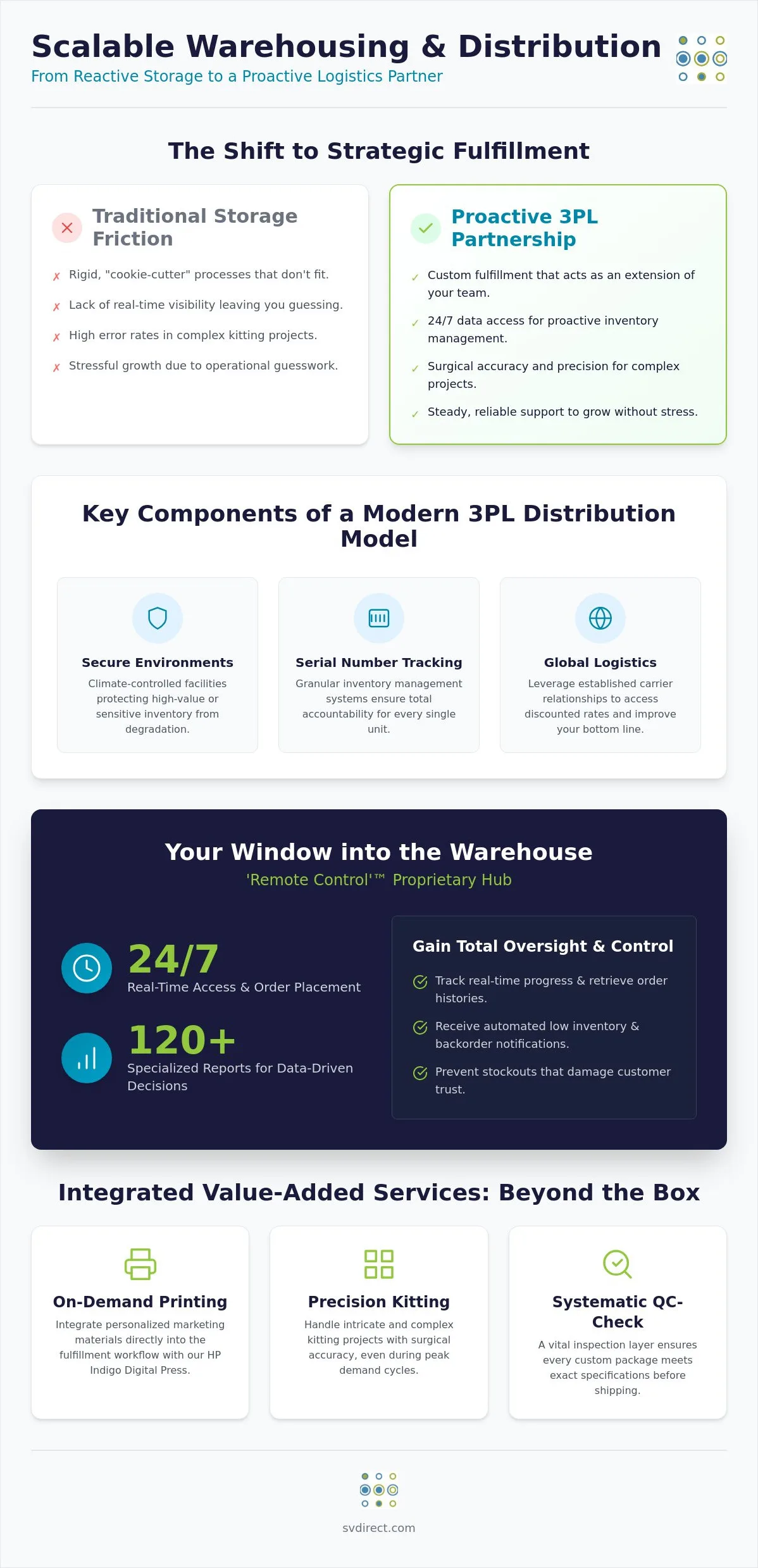
Our proprietary Remote Control™ system acts as the central nervous system for your operations. It provides 24/7 visibility into your inventory levels, order history, and project progress. With over 120 standard reports available, you’ll never have to guess about your stock status. Automated alerts for low inventory or backorders keep you proactive rather than reactive. We can even customize the web interface to reflect your corporate brand, providing a seamless experience for your internal users. Learn more about Remote Order Management.

Technical Integration for Developers

For technical stakeholders, we offer platform-agnostic web services that support XML, SOAP, and WSDL. This allows your developers to integrate our Order Management System (OMS) directly into your existing business logic. You can submit real-time transaction data and receive status updates programmatically. This deep technical integration ensures that our print and fulfillment services function as a native part of your own digital infrastructure. It’s about sharing business logic and processes through a programmatic interface that respects your developers’ time and your company’s technical standards.

Specialized Applications: Healthcare, Marketing, and Events

Literature fulfillment also benefits from this integrated model by solving the problem of obsolescence. In the past, companies would print massive runs of brochures or user manuals to save on unit costs, only to throw away thousands of copies when a product specification changed. Our on-demand approach allows you to print exactly what you need, when you need it. This keeps your press kits and manuals current while reducing waste. For those managing complex event calendars, we provide comprehensive tradeshow support. We handle everything from pre-show packet assembly to post-show lead follow-up, acting as a steady hand behind the scenes. Explore our industry-specific solutions to see how we tailor our processes to your unique sector.

Kitting and Hand Assembly for Complex Projects

While automation has its place, certain projects require a human touch that machines simply don’t replicate. Complex kits involving software, promotional clothing, or fragile items need the discernment of a dedicated hand-assembly team. We utilize a systematic multi-stage QC-Check for every project, ensuring that every component is present and correctly placed. This meticulous oversight is what separates a standard vendor from a true operational partner. It keeps your brand integrity intact. Strategic Guide to Kitting and Assembly Services.

Database Management and Direct Mail Marketing

The success of physical engagement depends heavily on the quality of your data. We provide comprehensive database management to improve the deliverability of your campaigns. This includes data entry, cleansing, and list procurement to ensure your message reaches the right doorstep. By removing duplicates and verifying addresses, we maximize your ROI and provide integrated reporting to track campaign effectiveness. We help you stay proactive. It’s about combining high-tech data processing with the physical reliability of print and fulfillment services. Direct Mail Marketing Services Guide.

The SVD Difference: Why Partnership Trumps Automation

A hectic warehouse environment is often a breeding ground for errors. Unlike the chaotic facilities common in the logistics industry, our operations are built on a ‘Quiet Facility’ methodology. This approach prioritizes organized inventory control and deliberate movement. It allows our team to focus on the precision required for high-stakes print and fulfillment services without the distractions of a disorganized floor. When your facility is quiet and organized, quality control becomes a natural outcome rather than a forced checklist. It ensures that every item is where it should be, exactly when it needs to be there.

Our identity is rooted in Silicon Valley, a region defined by technological innovation for decades. Since 1999, we’ve leveraged this geographic advantage to stay at the cutting edge of logistics and digital production. However, technology is only half of the equation. Our ‘Nine Promises’ serve as the foundation of every client engagement. These promises reflect a deep commitment to listening, flexibility, and absolute accountability. We don’t just process orders; we identify potential conflicts before they impact your project timeline. This proactive stance ensures that your supply chain remains resilient even when market conditions shift. We act as a steady hand, alleviating the stress of business growth through personal commitment.

Decades of Stability and Expertise

Longevity is a rare commodity in a volatile market. Our company was founded in 1999, providing us with over 25 years of operational history and stability. This experience has allowed us to refine our processes through various economic cycles and technological shifts. A key hallmark of our expert-level service is our long-term staff retention. Many of our team members have been with us for decades, bringing a level of institutional knowledge that automated systems can’t replicate. Their seasoned eyes catch the nuances that machines miss, ensuring your brand is always represented with high-resolution accuracy. Read our customer testimonials to see the impact of this stability on our clients’ success.

Flexibility and Rejection of Rigid Procedures

Rigid, ‘one-size-fits-all’ procedures are the enemy of complex marketing and sales projects. Your budget and goals are unique, and your fulfillment partner should adapt accordingly. We explicitly reject the impersonal nature of automated interactions in favor of direct human connection and personal oversight. Instead, we offer custom-fit solutions that align with your specific operational needs. If a challenge arises, our team carries a ‘make-it-right’ attitude that defines first-class customer service. This flexibility allows us to act as a true extension of your company, ensuring that your print and fulfillment services are as agile as your business strategy requires.

Future-Proof Your Supply Chain with Precision Integration

The path to a zero-lag supply chain starts with a partner that understands the high-stakes nature of your brand’s growth. By merging the liquid ink technology of the HP Indigo 5500 with a quiet, organized logistics facility, you eliminate the traditional bottlenecks that slow down your marketing and operational efforts. You gain more than just speed; you gain the absolute peace of mind that comes with 24/7 visibility through our proprietary Remote Control™ system. These tools ensure your inventory is managed with surgical precision, allowing your team to stay proactive rather than reactive.

Since 1999, Silicon Valley Direct has acted as a steady, reliable extension of our clients’ companies. We’ve replaced rigid, cookie-cutter models with bespoke solutions that respect your unique goals and budget. Choosing integrated print and fulfillment services isn’t just a technical upgrade. It’s a strategic commitment to brand consistency and operational excellence. We’re ready to help you navigate the complexities of 2026 with the same personal oversight and expertise we’ve provided for over two decades. Our team handles the mechanical details so you can focus on the big picture of your business.

We look forward to building a partnership that supports your long-term success through every stage of your growth. Our commitment to your brand’s integrity remains our highest priority.

Frequently Asked Questions

What is the difference between digital and offset print quality in 2026?

Modern digital printing using liquid ink technology now matches the depth and professional finish of traditional offset. We utilize the HP Indigo 5500, which provides a 230 line screen resolution for remarkably sharp imagery. Unlike toner-based digital systems that can appear waxy, our liquid ink bonds with the paper fibers. This ensures your brand is represented with the highest level of precision and detail.

How much does variable data printing (VDP) typically cost compared to static printing?

Variable data printing costs very little more than static printing because it eliminates the need for physical plate changes. Since the process is entirely digital, we can customize every sheet in a single run without increasing production time. This makes it a highly cost-effective strategy for increasing engagement and ROI in your direct mail and literature fulfillment campaigns.

How quickly can printed materials be moved to the fulfillment and shipping stage?

Materials move to fulfillment immediately after they leave the digital press. Because our liquid ink technology requires no drying time, we avoid the 24-hour delays that are common in traditional offset-to-warehouse models. This capability is a cornerstone of our print and fulfillment services, allowing for a seamless, “just-in-time” workflow that gets your collateral to customers faster.

Can I integrate my existing eCommerce platform with your fulfillment system?

Yes, we offer platform-agnostic web services that support XML, SOAP, and WSDL for deep technical integration. Your developers can connect our Order Management System directly into your existing digital infrastructure to submit transaction data in real-time. This programmatic interface ensures that our logistics operations function as a native, automated extension of your own company’s storefront or CRM.

What security measures are in place for healthcare or sensitive mailing services?

We maintain strict protocols for sensitive distributions by utilizing a systematic, multi-stage QC-Check for every project. Our quiet facility methodology ensures that healthcare mailing and regulatory documents are handled in an organized environment that minimizes errors. We prioritize accountability and human oversight, treating every sensitive shipment with the sobriety and precision that compliance standards demand.

What is a ‘quiet facility’ methodology and how does it benefit my project?

A ‘quiet facility’ is an operational environment where organized inventory control and deliberate movement are prioritized over hectic, chaotic activity. This methodology benefits your project by drastically reducing the likelihood of errors during kitting and assembly. It allows our seasoned experts to maintain personal oversight on every order, ensuring that your brand integrity is protected through every stage of production.

Do you offer sustainable or eco-friendly printing and packaging options?

We offer FSC-certified papers and 30% recycled content options to support your green initiatives. By utilizing digital production, we eliminate the need for the aluminum plates and heavy chemicals required by offset processes. Additionally, our partnership with HP includes responsible recycling programs for imaging oil and hardware components, helping you scale your print and fulfillment services sustainably.

How do I track my inventory and order status in real-time?

You can track your inventory and order status 24/7 through our proprietary Remote Control™ management system. This system provides access to over 120 standard reports, offering total transparency into your supply chain. You’ll receive automated alerts for low inventory levels and backorder notifications, ensuring you always have the data needed to make informed operational decisions.
Inventory Management for eCommerce: The 2026 Strategic Guide to Scaling Operations

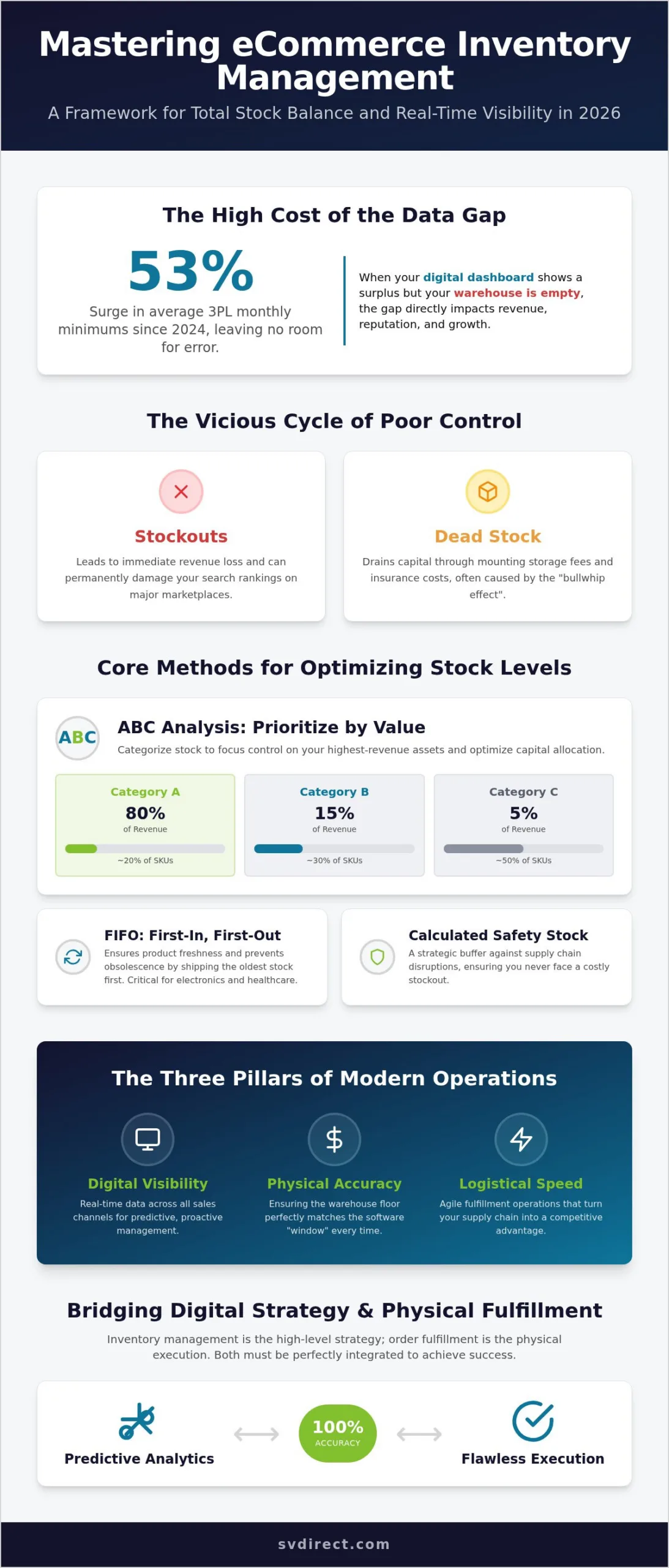
If your digital dashboard shows a healthy surplus but your warehouse floor is actually empty, how much is that data gap costing your brand’s reputation? It’s a question many founders face as average 3PL monthly minimums have surged by 53 percent since 2024, leaving no room for operational error. You likely feel the weight of capital tied up in slow-moving stock while your bestsellers vanish, leading to the inevitable customer frustration that follows inaccurate “in-stock” counts. Manual data entry across multiple sales channels only compounds the stress, making growth feel like a liability rather than a victory.

You deserve a steady hand to help manage these complexities. This guide shows you how to master inventory management for ecommerce by achieving total stock balance and real-time visibility across every channel. We will outline the steps to lower your storage fees through optimized levels and create a seamless bridge between order placement and physical fulfillment. By the end, you’ll have a strategic framework to ensure your physical operations are just as agile and precise as your digital storefront in 2026.

Key Takeaways

  • Understand how the shift toward predictive analytics allows you to anticipate market demand rather than simply reacting to stockouts.
  • Implement proven methodologies like FIFO and ABC Analysis to prioritize your highest-revenue assets and eliminate product obsolescence.
  • Master the balance between digital visibility and physical precision to optimize inventory management for ecommerce across every sales channel.
  • Identify the specific operational tipping points that signal it’s time to transition from fixed warehouse costs to a scalable, variable-cost 3PL model.
  • Learn how leveraging on-demand digital printing and precise warehouse control can reduce overhead while strengthening customer loyalty.

What is Inventory Management for eCommerce in 2026?

In 2026, the definition of success has shifted. It is no longer just about counting boxes in a back room. Effective inventory management for ecommerce involves the end-to-end supervision of non-capitalized assets, from the moment of procurement through to final delivery. While older models focused on reacting to sales after they happened, the modern standard is “predictive inventory.” This proactive approach uses historical data and market trends to anticipate demand before the first order even arrives.

To scale in this high-stakes environment, your operations must rest on three pillars: digital visibility, physical accuracy, and logistical speed. Many traditional warehouses rely on a “hustle” culture that leads to burnout and frequent errors. At Silicon Valley Direct, we replace that chaotic noise with our “quiet facility” methodology. This approach ensures precision even during peak seasons, treating your stock with the care of a seasoned partner. Mastering inventory management for ecommerce in 2026 requires this level of calm, calculated precision to turn your warehouse into a growth engine.

The Cost of Poor Inventory Control

Inaccurate tracking is not just an inconvenience; it’s a direct hit to your bottom line. Stockouts lead to immediate revenue loss and can permanently damage your search rankings on major marketplaces. Conversely, “dead stock” drains capital through mounting storage fees and insurance costs. This often stems from the “bullwhip effect,” where small fluctuations in retail demand cause massive, inefficient swings in wholesale ordering. Mitigation requires real-time data that reflects the actual state of your shelves without delay.

Inventory Management vs. Order Fulfillment

It’s vital to distinguish between these two functions. Fulfillment is the physical action of picking and packing a product. In contrast, inventory management is the high-level strategy that determines what should be on the shelf in the first place. These functions must be perfectly integrated to achieve 100% accuracy. By partnering with a 3PL fulfillment service that prioritizes both strategy and execution, you turn your supply chain into a competitive advantage. This integration ensures that the software “window” matches the reality of the warehouse floor every single time.

Core Methods for Optimizing eCommerce Stock Levels

Success in 2026 requires more than just knowing what is on the shelf. It requires a methodology that adapts to your specific product lifecycle. First-In, First-Out (FIFO) remains the gold standard for brands that prioritize product freshness and quality. By ensuring the oldest stock leaves the warehouse first, you can optimize inventory management for ecommerce and prevent the silent revenue drain of obsolescence. This is particularly critical for industries like healthcare or electronics—where brands like Sunshine Valley distribute natural food supplements—because shelf life is finite and technical specifications evolve rapidly.

Not all products are created equal. ABC Analysis allows you to categorize stock based on value and turnover. “A” items typically represent only 20 percent of your SKU count but drive 80 percent of your revenue. By focusing your tightest controls on these high-velocity assets, you optimize your capital. Just-In-Time (JIT) models offer high rewards in lowered storage fees, yet they carry risks in a volatile global market. To buffer against supply chain disruptions, we recommend a calculated Safety Stock. This acts as a strategic insurance policy, ensuring you never face the “out of stock” badge that kills conversion rates and customer trust. To see how these methods apply to your specific volume, you can request a free quote to discuss a tailored strategy.

Managing Complex SKUs and Kitting

Scaling often involves creating bundles or promotional kits that combine multiple products into a single offer. This introduces the “virtual SKU” concept, where individual components are tracked separately in the warehouse but appear as a single unit to the customer. Managing this complexity requires high-touch precision and an integrated digital view. Silicon Valley Direct provides kitting and hand assembly services that ensure these multi-component orders are built accurately every time. This maintains the integrity of your inventory management for ecommerce even during high-volume promotional pushes or seasonal spikes.

Cycle Counting vs. Physical Audits

Traditional annual physical audits are disruptive and often reveal errors too late to fix. They force a complete halt to operations, which is unacceptable for a fast-moving brand. In contrast, modern Effectively Manage Inventory strategies favor cycle counting. Cycle counting is a rolling audit process that maintains 99 percent accuracy without pausing operations. Our systematic QC-Check inspection process builds this continuous verification into the daily workflow. This ensures that the 120+ standard reports available in your Remote Control™ system reflect the absolute truth of the warehouse floor at any given moment.

The Critical Bridge: Integrating Software with Warehouse Operations

Software is often marketed as a cure-all, but in reality, it’s merely a window into your physical operations. The most sophisticated dashboard is useless if the data it displays doesn’t mirror the actual shelf. Successful inventory management for ecommerce relies on the synergy between digital tools and the human expertise managing the warehouse floor. Without this bridge, brands fall victim to “ghost inventory,” where a website displays items as in-stock that are physically unavailable. This leads to backorders, canceled sales, and eroded customer trust.

To maintain a seamless data flow, integration must be platform-agnostic. Our systems utilize XML, SOAP, and WSDL protocols to ensure that information moves instantly between your storefront and our facility. This technical flexibility allows us to act as a high-performance extension of your team, regardless of which ecommerce platform you use. By implementing essential inventory management techniques through our proprietary Remote Control™ system, you gain a central hub that synchronizes every transaction with physical reality. This eliminates the lag time that often plagues growing brands during rapid scaling phases.

24/7 Visibility with Remote Control™

True operational confidence comes from transparency. Our Remote Order Management system provides 24/7 access to your data, offering over 120 standard reports that detail everything from order history to real-time stock levels. You don’t have to wait for manual updates or business hours to understand your position. Automated notifications for low inventory and backorders ensure you can make proactive decisions before a shortage impacts your sales velocity. This system was designed to provide the depth necessary for technical stakeholders while remaining accessible for daily business decisions.

Removing the ‘Hectic’ from Fulfillment

Many fulfillment centers operate in a state of constant chaos, but we believe precision requires a “quiet facility” methodology. We replace the frantic energy of traditional warehouses with organized, deliberate prioritization. This methodical approach allows us to meet high-volume deadlines with a significantly lower error rate than industry averages. Our team practices proactive problem solving, identifying potential order conflicts or shipping discrepancies before the package ever leaves the dock. This stability is a unique hallmark of our internal culture, where seasoned experts oversee every detail of your inventory management for ecommerce. We reject automated-only interactions, ensuring that a human set of eyes monitors your most critical assets.

Inventory Management for eCommerce: The 2026 Strategic Guide to Scaling Operations

When to Outsource Inventory Management to a Professional 3PL

Deciding when to move your operations out of a private lease or a crowded back office is a pivotal moment for any brand. You’ll know you’ve reached the tipping point when warehouse rent and labor management begin to consume more time than your core product development. If shipping errors are stifling your growth, it’s time to reconsider your approach to inventory management for ecommerce. Transitioning to a 3PL shifts you from a “fixed cost” model, where you pay for empty warehouse space and idle staff, to a “variable cost” model. You only pay for the space and labor you actually use, which preserves your capital for marketing and innovation.

A professional partner provides more than just square footage. You gain immediate access to discounted carrier rates and global logistics expertise that would take years to negotiate independently. Beyond standard shipping, specialized services like on-demand digital printing and literature fulfillment allow you to customize orders without the overhead of in-house equipment. This level of versatility ensures your fulfillment strategy remains as agile as your digital marketing. By outsourcing, you leverage physical infrastructure and human expertise that in-house teams simply can’t replicate at scale.

Handling High-Value and Sensitive Goods

Sensitive inventory requires more than a standard shelf. Electronics and healthcare products often demand secure, climate-controlled environments to maintain their integrity. Precision here involves serial number tracking, which is vital for warranty management and returns processing. For a deeper look at these requirements, see our guide on Secure Warehousing for High-Value Electronics. Our systematic QC-Check process ensures these high-stakes items are handled with absolute care, providing a level of security that generic storage facilities lack.

The ‘Extension of Your Team’ Philosophy

We reject the cookie-cutter approach common in highly automated, impersonal facilities. A true partnership requires a steady hand and a personal commitment to your specific project goals. This flexibility allows us to custom-fit solutions rather than forcing your business into a rigid template. Silicon Valley Direct has served as a reliable anchor for brands since 1999. Our multi-decade history and long-term staff retention mean you’re working with seasoned experts who understand the nuances of inventory management for ecommerce. We act as a proactive extension of your team, identifying logistical hurdles before they become customer complaints.

Maximizing eCommerce ROI Through Precise Inventory Control

Precision in the warehouse translates directly to your bottom line. When your inventory management for ecommerce is executed with absolute accuracy, you create a foundation for customer loyalty that no marketing campaign can match. A customer who receives exactly what they ordered, exactly when promised, is a customer who returns. This reliability reduces the costs associated with returns management and customer support, allowing you to reinvest that capital into growth. It’s about turning your logistics from a cost center into a retention engine that drives long-term value.

Beyond simple stock tracking, integrating specialized services like on-demand digital printing and variable data printing significantly reduces your inventory overhead. Instead of pre-printing thousands of marketing inserts that might become obsolete, you print only what you need for each specific order. This agility ensures your collateral is always current and relevant. Detailed reporting from our Remote Control™ system provides your marketing department with the granular data needed to understand which products are truly profitable after accounting for storage and fulfillment costs. We provide the “window” into your operations that allows for these high-level strategic pivots. Silicon Valley Direct is the strategic choice for brands that value this level of high-touch quality over the impersonal model of high-volume facilities.

Reducing Waste with Green Logistics

Digital printing eliminates the need for massive stockpiles of marketing materials that eventually end up in a landfill. By adopting a “print what you use” philosophy, you significantly lower your brand’s environmental footprint. Our Print on Demand Services utilize sustainable materials and participate in programs like HP’s hardware recycling to ensure our operations remain as green as they are efficient. This commitment to sustainability is part of our proactive problem-solving approach. It ensures that your physical operations align with modern environmental standards without sacrificing logistical speed or precision.

Next Steps: Auditing Your Current System

Evaluating your current operations requires a cold, hard look at your data accuracy and fulfillment speed. Start by comparing your digital stock counts against a physical cycle count. If your discrepancy rate is higher than one percent, your current system is leaking revenue. Look past the slick interface of your software and examine the physical reality of your fulfillment partner. Are they a steady hand in the industry, or are they struggling to keep up with the “hustle” of peak periods? If your current setup feels more like a source of stress than a high-performance partner, it’s time to transition to a more reliable model.

Contact Silicon Valley Direct for a Custom Fulfillment Solution

Building a Scalable Operational Foundation for 2026

Success in the coming year depends on your ability to bridge the gap between digital storefronts and physical reality. You’ve seen how predictive analytics and methods like FIFO or ABC Analysis turn stagnant stock into liquid capital. Effective inventory management for ecommerce isn’t just a back-office task; it’s a primary driver of customer loyalty and long-term ROI. By moving from fixed-cost warehouses to a variable-cost partnership, you gain the agility needed to navigate shifting global regulations and market demands.

Silicon Valley Direct brings over 25 years of operational expertise to your brand’s growth journey. Our proprietary Remote Control™ system provides 24/7 real-time visibility with over 120 standard reports, while our systematic QC-Check process ensures 99 percent accuracy across every SKU. We act as a steady, proactive extension of your team, replacing warehouse chaos with the precision of our “quiet facility” methodology.

Your brand is ready for its next phase of growth. We’re here to ensure your physical operations are just as innovative and reliable as your vision.

Frequently Asked Questions

What is the difference between inventory management and warehouse management?

Inventory management focuses on the high-level strategy of stock levels, demand forecasting, and procurement. Warehouse management deals with the physical movement and storage of goods within a facility, including picking and packing. While the two functions are distinct, they must be perfectly integrated to ensure that your digital records match physical reality.

How much does eCommerce inventory management software typically cost?

Most software providers use a tiered subscription model based on order volume or the number of SKUs. Some enterprise-level platforms require annual licensing fees, while others offer a pay-as-you-grow structure. It’s often more cost-effective to leverage the proprietary systems provided by your 3PL partner to avoid separate software licensing costs while managing inventory management for ecommerce.

What are the most common inventory management mistakes for online stores?

The most frequent errors include relying on manual data entry and failing to account for supplier lead times. These mistakes lead to “ghost inventory” where your site displays items that aren’t physically on the shelf. Another common pitfall is overstocking slow-moving items, which ties up capital that could be used for marketing or product development.

Can a 3PL handle inventory for multiple sales channels like Shopify and Amazon?

A professional 3PL uses platform-agnostic integrations to synchronize inventory management for ecommerce across Shopify, Amazon, and other marketplaces simultaneously. This ensures a single source of truth for your stock levels. Our Remote Control™ system acts as this central hub, pushing real-time updates to every channel to prevent overselling and customer frustration.

How does real-time inventory tracking improve customer satisfaction?

Real-time tracking eliminates the frustration of canceled orders due to stockouts that were not reflected on the storefront. When customers see accurate “in-stock” counts and receive instant shipping updates, their trust in your brand grows. This transparency is a primary driver of repeat purchases and long-term loyalty in a competitive market.

What is a ‘good’ inventory turnover ratio for an eCommerce business?

A healthy inventory turnover ratio generally falls between 4 and 8 for most brands, though this varies significantly by industry. A higher ratio indicates efficient sales velocity, while a lower ratio suggests you’re carrying too much dead stock. The objective is to maintain enough safety stock to prevent stockouts without over-investing in storage fees.

How do I manage inventory for subscription boxes or bundles?

Managing bundles requires a “virtual SKU” strategy where components are tracked individually but sold as a unit. This allows for total flexibility in fulfillment and ensures accurate counts for every part of the kit. Our hand assembly and kitting services specialize in these complex builds to maintain precision during high-volume promotional periods.

What happens if my inventory levels don’t match my software data?

Discrepancies between your software and physical stock usually indicate a failure in the pick-and-pack process or a lack of regular audits. To fix this, you must implement systematic cycle counting rather than waiting for a disruptive annual physical audit. Our QC-Check process builds this verification into the daily workflow to maintain 99 percent accuracy.

The Ecommerce Returns Management Process: A Strategic Guide for 2026

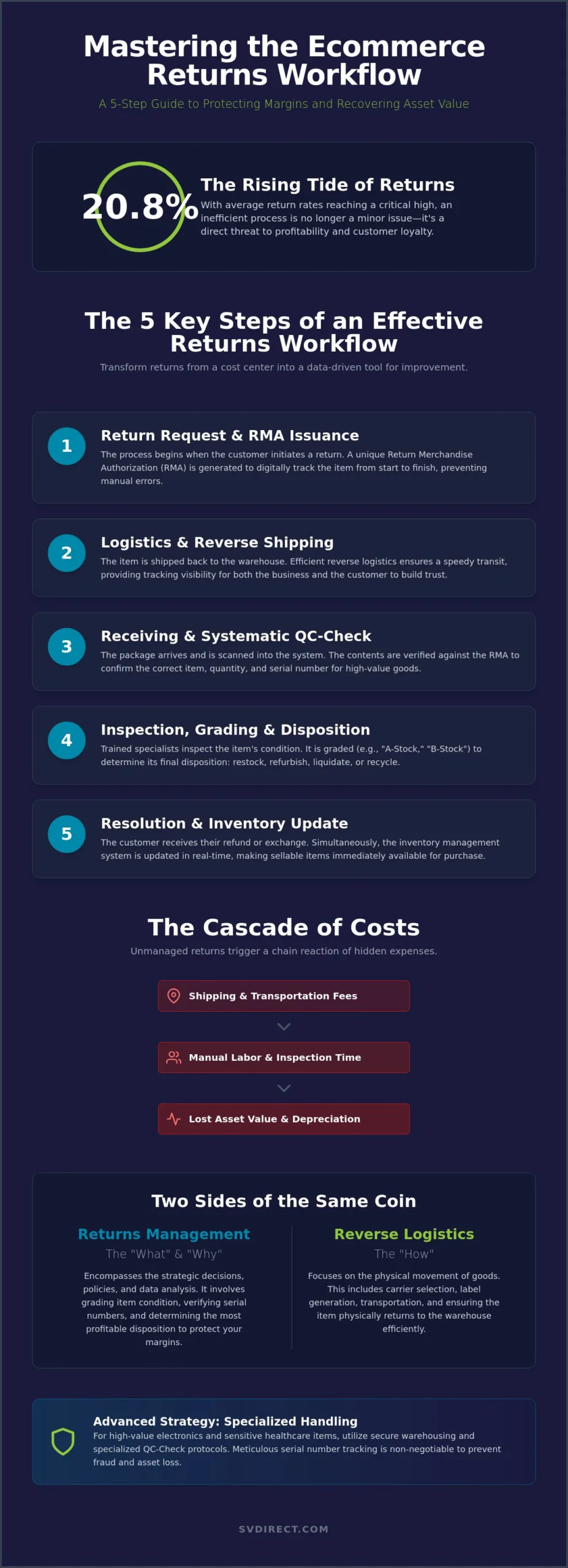
With average ecommerce return rates now reaching as high as 20.8%, the financial impact of a fragmented ecommerce returns management process is no longer just a minor operational hurdle; it’s a strategic threat to your profitability. You’ve likely felt the strain of rising labor costs and the frustration of inventory inaccuracies that stem from poor grading. As the 2026 EU “Withdrawal Button” law sets a new global standard for one-click returns, the pressure to maintain a precise and efficient reverse logistics chain has never been more intense.

We understand that a return is a high-stakes moment in the customer journey that requires a steady, professional hand. This guide provides a roadmap to help you master every stage of the workflow, from the initial request to the final restocking of sellable items. You’ll learn how to implement a transparent system that protects your margins, recovers asset value, and uses precise data to reduce return rates over time. We’ll examine the technical integrations and human expertise needed to turn your warehouse operations into a reliable engine for long-term loyalty and growth.

Key Takeaways

  • Distinguish between customer-facing policies and physical logistics to build a more resilient ecommerce returns management process.
  • Implement a standardized five-step workflow to move items from the initial request to final disposition without losing asset value.
  • Quantify the “Cascade of Costs” so you don’t overlook how labor, inspection time, and “bracketing” habits impact your margins.
  • Utilize specialized secure warehousing and QC-Check protocols to safely manage high-value electronics and sensitive healthcare materials.
  • Harness real-time reporting via systems like Remote Control™ to pinpoint return trends and proactively improve product descriptions.

What is the Ecommerce Returns Management Process?

The ecommerce returns management process is a comprehensive, end-to-end strategy that governs every touchpoint of a returned item. It starts the second a customer initiates a request and only ends once the product reaches its final disposition, whether that is being restocked, refurbished, or recycled. In 2026, this process is no longer a secondary concern; it is a critical component of your brand’s operational integrity. Success requires a marriage of digital transparency and physical precision to ensure that margins are protected and customers remain satisfied.

Modern standards demand that this process be proactive rather than reactive. By utilizing 24/7 real-time visibility into inventory, businesses can maintain a high level of trust with their audience. This involves more than just issuing a refund. It means using return data to identify trends, such as recurring defects or inaccurate product descriptions, and fixing those root causes to prevent future returns. When you treat returns as a strategic data source, you transform a cost center into a tool for continuous improvement.

Returns Management vs. Reverse Logistics

It’s vital to understand that while these terms are related, they aren’t identical. Reverse logistics focuses on the “how,” which is the physical movement of goods from the consumer back to the distribution center. This includes carrier selection, shipping labels, and the actual transportation of the package. Returns management is the “what” and the “why.” It encompasses the strategic decisions, such as grading the item’s condition, verifying serial numbers for high-value tech, and determining the most profitable next step for the inventory.

A reliable 3PL partner must be a master of both realms. Without efficient logistics, returns take too long to arrive. Without sophisticated management, those items sit in a warehouse gathering dust instead of being processed. For high-value goods, meticulous serial number tracking during the return journey is a non-negotiable safeguard against fraud and asset loss. This level of oversight ensures that the exact unit sold is the one being returned and inspected.

The Business Impact of an Optimized Workflow

An inefficient workflow creates a “cascade of costs” that can quickly erode your profits. These include the obvious shipping fees, but also the hidden expenses of manual labor, dedicated warehouse space, and lost asset value. The longer an item stays in the return cycle, the less likely it is to be sold at its original price. A fast return-to-shelf cycle is essential for maintaining healthy inventory turnover and recovering value before a product becomes obsolete.

Strategic Silicon Valley 3PL fulfillment services help brands compress these timelines. By automating the grading process and integrating it with real-time data systems, you ensure that sellable items are back on the digital shelf within hours, not weeks. This level of speed protects your bottom line and keeps your supply chain lean and responsive to market demands.

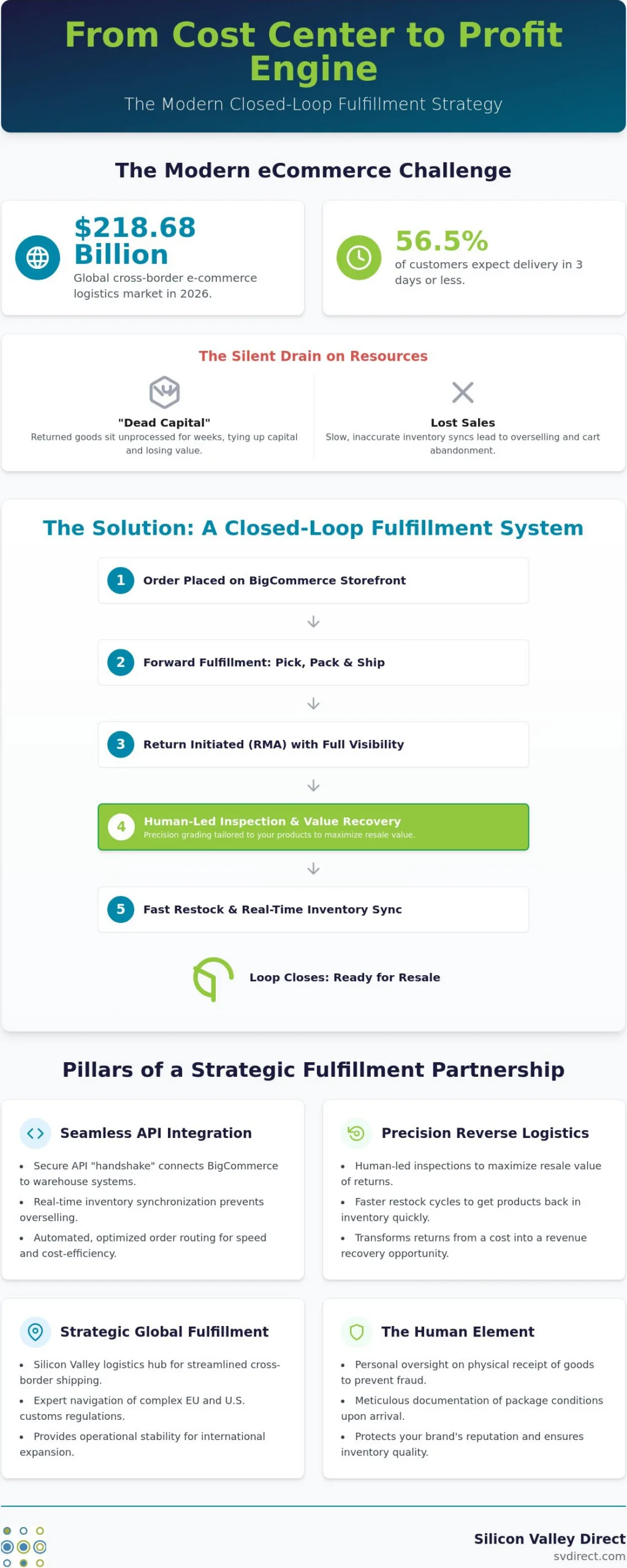
The 5 Key Steps of an Effective Returns Workflow

Building a high-performance ecommerce returns management process requires more than just a digital “refund” button. It demands a structured, physical workflow that treats every returned item as a valuable asset rather than a burden. A well-executed cycle ensures that items don’t just sit in a corner; they move through a series of checkpoints designed to recover value and restore customer trust. The following five steps represent the standard for operational excellence in 2026.

  • Step 1: Return Request and RMA Issuance. The customer initiates the process, and the system issues a Return Merchandise Authorization (RMA) to track the intent.
  • Step 2: Logistics and Reverse Shipping. The item travels back via a selected carrier with active tracking enabled for both the brand and the customer.
  • Step 3: Receiving and Systematic QC-Check. The package arrives at the warehouse for a physical entry process to verify the contents against the RMA.
  • Step 4: Inspection, Grading, and Disposition. Specialists inspect the item to determine if it is sellable, needs refurbishment, or must be recycled.
  • Step 5: Final Resolution and Inventory Update. The customer receives their refund or exchange while the inventory system updates in real-time to reflect available stock.

The Crucial Role of RMA and Data Integration

Manual returns are the primary cause of warehouse errors. When staff rely on paper trails or disconnected spreadsheets, items get lost or misidentified. Integrating your storefront with a remote order management system ensures an instant data sync between the customer’s home and the fulfillment floor. An RMA serves as the digital handshake between customer intent and warehouse readiness. This integration allows for proactive problem solving, as warehouse teams know exactly what is arriving before the truck even docks.

Inspection and Grading Standards

Physical evaluation is the most critical stage of the ecommerce returns management process. We categorize items into Grade A (like-new), Grade B (open box), or Grade C (damaged) to ensure they are listed correctly for resale. To maintain this level of precision, we utilize a “Quiet Facility” methodology. This approach allows our team to focus entirely on the nuances of grading without the chaos of a disorganized environment. We also employ serial number tracking to identify fraudulent returns, ensuring the unit coming back is the exact one we shipped out. If you are looking to refine your own physical grading standards, you can request a free quote to see how our team handles complex reverse logistics.

Calculating the Real Cost of Returns in 2026

Every returned package triggers a “Cascade of Costs” that extends far beyond the initial shipping label. To truly understand the ecommerce returns management process, you must account for the cumulative impact of reverse logistics, manual labor, and administrative overhead. In 2026, industry research shows that return rates for online purchases hover between 19% and 20.8%. This is significantly higher than the single-digit rates seen in physical retail. This volume represents a massive portion of the projected $849.9 billion in total U.S. retail returns. Cost containment is now a primary objective for growing brands.

A significant driver of these costs is the consumer habit known as “bracketing.” This occurs when a customer orders multiple sizes, colors, or styles of the same item with the intent of keeping only one. Research indicates that sizing, fit, or color issues account for approximately 45% of all returns. Bracketing doesn’t just increase shipping expenses; it effectively removes sellable inventory from your shelves for weeks at a time. This creates an “Obsolescence Risk,” where seasonal goods or high-tech electronics lose significant market value while they are stuck in the return cycle. Every day counts. Every day a unit spends in transit or waiting for inspection is a day its potential for full-price resale diminishes.

Some retailers implement restocking fees to offset these burdens. While this can recover some processing costs, it is a delicate balance. If the fee feels punitive, it can damage customer loyalty and drive shoppers toward more flexible competitors. A more sustainable approach involves using data from systems like Remote Control™ to identify why items are coming back and addressing those issues at the source. Since our founding in 1999, we have seen that transparency in data is the best defense against rising costs.

Labor and Processing: The Silent Profit Killer

The physical handling of a return is a labor-intensive endeavor. Our team spends dedicated minutes on every unit. They perform a meticulous sequence of opening, inspecting, re-folding, re-bagging, and re-labeling. This granular level of care is necessary to maintain brand standards. We operate a Quiet Facility to ensure this grading is done with absolute precision. However, these steps add up quickly across thousands of orders. To help recover asset value, our kitting and assembly services can be used to refurbish items to their original quality. This ensures they are ready for immediate resale. We treat every return with a “make-it-right” attitude. It is an opportunity to salvage a sale and a relationship.

Environmental and Sustainability Costs

Shipping items twice, once to the customer and once back to the warehouse, nearly doubles the carbon footprint of a single transaction. In 2026, consumers are increasingly sensitive to these environmental impacts. Waste adds up quickly. An efficient disposition strategy aligns with modern “Green Printing” and sustainable brand values. This includes responsible donating or recycling. We utilize high-end technology like the HP Indigo 5500 liquid ink system and follow industry-leading models for hardware recovery to minimize waste. By streamlining the ecommerce returns management process, you aren’t just saving money. You are reducing the physical waste and energy consumption of your entire supply chain.

The Ecommerce Returns Management Process: A Strategic Guide for 2026

Advanced Strategies for Specialized Returns Management

A standard ecommerce returns management process often falls short when applied to specialized industries. While a basic apparel return is relatively straightforward, handling medical devices or high-value tech requires a much higher level of operational precision. These sectors demand more than just warehouse space; they require a partner capable of maintaining a rigorous chain of custody and serialized tracking throughout the entire reverse journey. When items are sensitive or regulated, the physical handling must be as disciplined as the digital tracking.

High-Value and Regulated Goods

For brands utilizing healthcare mailing services, the return of medical kits or pharmaceutical-adjacent materials involves strict compliance standards. It isn’t just about restocking; it’s about verifying that the integrity of the product remains intact. Similarly, tech companies rely on secure warehousing to prevent asset loss and ensure that returned units are thoroughly inspected before being reintroduced to inventory. Our systematic QC-Check process ensures that every component of a high-value kit is accounted for, allowing us to refurbish and re-kit these items for resale with total confidence.

Leveraging Print-on-Demand to Reduce Future Returns

Data gathered during the ecommerce returns management process is a goldmine for reducing future overhead. If customers consistently return an item due to “fit” or “confusing assembly,” you can act immediately. By integrating print on demand capabilities, you can update user manuals or “quick start” guides based on real-world feedback without waiting for a new production run. Our HP Indigo 5500 liquid ink technology provides 230-line screen resolution printing, which allows re-packaged goods to look brand new and professionally curated. We also use Variable Data Printing (VDP) to include personalized “Sorry it didn’t work” cards in exchange shipments, turning a potential loss into a high-touch customer loyalty moment.

Proactive communication remains your best tool for reducing customer anxiety. By providing 24/7 data access via our Remote Control™ system, you keep your customers informed of their return status at every stage. This transparency reduces the burden on your customer service team and reinforces the idea that your brand is a reliable, high-performance partner. We believe that physical operations should be just as organized and accessible as your digital storefront. This steady approach alleviates the stress of business growth through precision and personal commitment.

Why Silicon Valley Direct is Your Returns Partner

Silicon Valley Direct has refined the ecommerce returns management process since 1999. Our history provides a stable foundation that few others can match. We operate from a strategic location that serves as a symbol of global connectivity and innovation. This allows us to integrate high-tech efficiency with a deeply reliable, human-centric service. We don’t believe in impersonal, automated-only interactions. Instead, we position ourselves as a high-performance partner that remains grounded and accessible.

Transparency Through Remote Control™

Our proprietary Remote Control™ data management system is the backbone of our operational transparency. It provides you with 24/7 access to real-time inventory and return status from any device. We offer over 120 standard reports. These allow you to perform deep-dive analysis on return trends and identify exactly why items are coming back. For technical stakeholders, our system utilizes programmatic interfaces like XML and SOAP for a seamless integration with your existing eCommerce platform. This ensures that your digital communication and physical operations remain perfectly synchronized. If your development team needs to stress-test these financial integrations, they can learn more about specialized digital transaction simulation systems. Automated email alerts also act as a safety net. They notify you immediately if high return rates cause inventory levels to drop below your comfort zone.

The ‘Extension of Your Team’ Philosophy

We view our relationship with clients as a long-term partnership. Our proactive problem-solving approach identifies return patterns before they can disrupt your peak seasons or high-volume deadlines. We utilize a “Quiet Facility” methodology to manage these workflows. By maintaining an organized and focused environment, we ensure that every inspection and grading task is handled with absolute precision. This eliminates the chaos often found in traditional warehouses and protects your bottom line. Our team is a dedicated, team-oriented organization where collective experience is a point of pride.

You can see the results of this personal commitment by exploring our customer testimonials. We promise total flexibility and bespoke problem-solving to ensure your ecommerce returns management process remains a competitive advantage. Our goal is to alleviate the stress of business growth through physical infrastructure and human expertise rather than just marketing abstractions.

Transform Your Reverse Logistics into a Strategic Advantage

Mastering the ecommerce returns management process is about more than just moving boxes. It’s about capturing granular data to prevent future losses and using high-resolution kitting to restore asset value. By moving beyond manual spreadsheets and embracing a system that prioritizes physical precision, you protect your margins while building a more resilient brand. This transition allows you to treat every returned item as a potential recovery rather than a total loss.

We’ve provided this level of steady, professional oversight since 1999. Our proprietary Remote Control™ system offers 24/7 real-time reporting to ensure you never lose sight of your inventory status or return trends. This marriage of high-tech efficiency and human expertise turns a complex operational challenge into a seamless extension of your own team. It’s a proactive approach designed to alleviate the stress of rapid business growth through precision and personal commitment.

You don’t have to navigate these high-volume deadlines and technical integrations alone. With a dedicated partner and the right physical infrastructure, you can confidently turn every return into a new opportunity for long-term customer loyalty.

Frequently Asked Questions

What is the difference between returns management and reverse logistics?

Returns management is the strategic decision-making framework, while reverse logistics is the physical transportation of the product. Management involves setting policies, grading items, and determining the final disposition of inventory. Logistics focuses on the “how,” including carrier selection and package tracking. A successful operation requires both to work in harmony to protect your margins and maintain a steady flow of inventory back into sellable stock.

How can I reduce the cost of ecommerce returns?

You can reduce costs by analyzing return data to identify why customers are dissatisfied and addressing those root causes. If a specific product has a high return rate due to fit issues, updating the digital product page with precise measurements can prevent future errors. Using high-resolution digital printing for clearer user manuals also helps. These proactive steps reduce the volume of items entering your reverse logistics chain and save on labor.

Should I offer free returns to my customers in 2026?

Offering free returns in 2026 is a strategic choice that depends on your specific product category and customer loyalty goals. While the EU “Withdrawal Button” law simplifies the initiation process, retailers are increasingly using tiered policies. You might offer free returns for high-value VIP members while charging a small fee for others to discourage “bracketing.” This balanced approach helps offset rising shipping costs without alienating your most dedicated customers.

How long does the average ecommerce return process take?

The average ecommerce returns management process typically spans 7 to 14 days from the moment the customer ships the item to the final resolution. This timeline includes transit, warehouse receiving, and a systematic QC-Check inspection. Working with a 3PL that provides 24/7 real-time reporting can significantly compress this window. Faster processing means sellable items are restocked sooner, reducing the risk of obsolescence for seasonal or high-tech goods.

What is an RMA and why is it necessary for fulfillment?

A Return Merchandise Authorization (RMA) is a critical tracking number that serves as the digital handshake between a customer’s intent and your warehouse team. It’s necessary because it allows fulfillment staff to expect and identify incoming packages before they arrive. Without an RMA, returns become disorganized “blind shipments” that lead to processing delays and inventory inaccuracies. This system ensures every item is accounted for from the start of the cycle.

How can a 3PL help with fraudulent returns?

A 3PL helps combat fraud by performing meticulous inspections and utilizing serialized tracking to ensure the correct unit is returned. Our team checks for signs of “switch fraud,” where a customer might attempt to return an older or different model. By having a seasoned expert physically verify every item against the original order data, you add a layer of human oversight that automated systems simply cannot provide on their own. For businesses that need to take further action against persistent fraud or other civil disputes, Final Demand provides specialized resources to resolve these matters independently.

What happens to items that cannot be restocked?

Items that fail inspection are typically diverted to secondary channels such as refurbishment, donation, or recycling. We use specialized kitting and assembly services to restore kits or salvage valuable components for future use. If an item is truly unsellable, we follow responsible recycling protocols to minimize environmental impact. This approach ensures you recover as much asset value as possible while adhering to sustainable brand values and environmental standards.

Can automated returns management software integrate with my warehouse?

Yes, modern platforms integrate directly with warehouse systems through programmatic interfaces like XML or SOAP. This connectivity ensures that your ecommerce returns management process is fully transparent and visible 24/7. When your storefront and warehouse speak the same language, data syncs instantly. This allows for automated email alerts regarding inventory levels and provides your customers with real-time updates on their refund or exchange status throughout the journey.

Silicon Valley Direct Reviews: Evaluating Your 3PL Fulfillment Partner in 2026

What if your fulfillment partner treated your inventory with the same precision as your own founding team, rather than just another ticket in an automated queue? It’s a common frustration for growing brands. You’ve likely experienced the stress of high error rates and a total lack of transparency that makes you feel disconnected from your own products. You deserve a partner that catches a problem before the package ever hits the truck.

This review explores why Silicon Valley Direct remains a trusted leader for those seeking a 3pl fulfillment center san jose in 2026. Since 1999, they’ve combined high-end digital printing with a “quiet facility” methodology to eliminate the chaos of traditional warehousing. You’ll discover how their proprietary Remote Control system provides 24/7 visibility and why their Nine Promises framework ensures your orders are handled with personal commitment. We’ll examine the operational excellence and client feedback that proves reliability is built on human expertise; it isn’t just about algorithms.

Key Takeaways

  • Learn how over 25 years of operational history creates a stable foundation for your brand to grow without the risk of fulfillment errors.
  • Gain 24/7 visibility into your inventory and order status through the proprietary Remote Control™ system that puts data back in your hands.
  • Find out how choosing a 3pl fulfillment center san jose that functions as an extension of your team replaces impersonal tickets with proactive human partnership.
  • See how integrating high-end digital printing and systematic quality checks ensures your customers receive perfect orders every time.
  • Discover the strategies that allow for rapid scaling, such as managing over 3,000 shipments in a single week with total precision.

The Silicon Valley Direct Track Record: 25 Years of 3PL Fulfillment Excellence

Established in 1999, Silicon Valley Direct has navigated more than two decades of technological shifts by adhering to a simple principle: prioritize the partnership over the transaction. While many providers focus solely on volume, we view ourselves as a direct extension of your internal marketing and sales departments. This philosophy ensures that your brand’s integrity is maintained from the moment an order is placed until it reaches the customer’s doorstep. By operating as a premier 3pl fulfillment center san jose, we’ve built a reputation for stability in an industry often characterized by high turnover and operational chaos.

Our “quiet facility” methodology is a cornerstone of this reliability. We deliberately remove the frantic, hectic atmosphere found in many automated warehouses to ensure 100% accuracy, even when facing high-volume deadlines. This calm, methodical approach is guided by our Nine Promises, a set of foundational values that dictate how we handle every client interaction. It’s about precision over speed alone.

This focus on precision and uncovering the “hidden details” of a process is a value we share with other local experts; for instance, City Drifts reveals the secret neighborhoods of San Francisco through their unique guided stairway walks.

A Legacy of Reliability in the Silicon Valley Logistics Hub

Longevity in the Third-party logistics (3PL) sector is a rare commodity. Our multi-decade history is anchored by long-term staff retention; many of our team members have been with us for over ten years. This collective experience allows us to take a proactive approach to problem-solving. We don’t just react to errors. Instead, we identify potential supply chain bottlenecks and correct them before they ever impact your customers.

The Marriage of Technology and Human Oversight

We reject “cookie-cutter” solutions because we understand that every business has unique requirements. Instead, we offer custom-fit 3PL fulfillment services that adapt to your specific workflow. Silicon Valley Direct functions as a seamless extension of your brand by mirroring your internal standards and adapting to your specific sales and marketing needs. This blend of sophisticated data management and dedicated human attention makes us a standout 3pl fulfillment center san jose for businesses that value precision over automation alone.

What to Look for in a 3PL Fulfillment Center: Proprietary Tech and Quality Control

Evaluating a 3pl fulfillment center san jose requires looking beneath the surface of basic shipping rates. When selecting the right 3PL partner, you must prioritize infrastructure that offers both physical precision and digital transparency. We’ve built our operations around this dual necessity; combining our systematic QC-Check process with platform-agnostic integrations using XML and SOAP. This ensures your eCommerce platform communicates seamlessly with our warehouse, regardless of which software stack you use. Our proactive stance means we catch data discrepancies before they turn into shipping errors.

Total Transparency with Remote Control™

Our proprietary remote order management system, Remote Control™, serves as your eyes on the ground. It offers 24/7 real-time visibility into inventory levels and order history, allowing you to generate over 120 standard reports at a moment’s notice. By receiving automated low-inventory alerts, eCommerce managers can effectively eliminate the “anxiety of growth” and focus on scaling their brand rather than worrying about stockouts. You get the data you need without having to ask for it.

High-Resolution Printing and Variable Data Integration

Unlike many logistics providers that outsource their collateral, we utilize the HP Indigo 5500 Digital Press in-house. This allows us to deliver offset-quality inserts with a 230 line screen resolution, ensuring your brand’s visual standards are never compromised. By leveraging Variable Data Printing (VDP), we personalize the customer experience for every shipment. Our print on demand services also help you reduce waste and eliminate unnecessary storage costs for marketing materials. This specialized approach makes us a unique 3pl fulfillment center san jose, offering capabilities that generic warehouses simply cannot match.

This integration of high-tech printing and rigorous quality control means your packages arrive exactly as intended. If you’re ready to see how this level of detail can transform your operations, you can request a free quote to discuss your specific needs.

Silicon Valley Direct Reviews: Evaluating Your 3PL Fulfillment Partner in 2026

Real-World Results: Why SVD is the Strategic Choice for Scaling Businesses

Scaling a brand requires more than just warehouse space; it demands a partner that can weather the pressure of rapid growth without flinching. Our customer testimonials highlight partnerships that have thrived for over seven years, proving that we prioritize long-term stability over short-term transactions. One major client experienced this firsthand when we managed over 3,000 shipments in a single week. Despite the high volume, our “quiet facility” methodology ensured that every package was accurate and shipped on time, protecting the brand’s reputation during a critical peak period.

Complex project management is where our collective experience truly shines. A 10-month marketing fulfillment case study demonstrated our ability to build a robust operational foundation for future large-scale mail projects. We also integrate sustainability into our daily workflow through green printing processes and a dedicated HP partnership for responsible hardware recycling. This commitment ensures that your growth as a business doesn’t come at an unnecessary cost to the environment or your corporate values.

Scaling with Confidence: From Startups to Enterprises

The Proactive Advantage: Anticipating Supply Chain Conflicts

Our team doesn’t just react to orders; we work to anticipate potential supply chain conflicts before they result in “backorder” surprises. This proactive stance saves our clients significant time and prevents the loss of customer trust that occurs when items are unexpectedly unavailable. To keep your strategy sharp, we invite you to explore the Silicon Valley Direct Blog for the latest industry trends and logistics insights. Finding a 3pl fulfillment center san jose that thinks several steps ahead of the market is the ultimate competitive advantage for a growing brand.

Securing Your Brand’s Future with a Proven Partner

Choosing a 3pl fulfillment center san jose shouldn’t be a gamble based on the lowest bid. It’s an investment in a partnership that treats your inventory with the same care you do. We’ve explored how a “quiet facility” methodology and 25+ years of industry expertise create a foundation for accuracy that automated warehouses often fail to provide. You now understand how real-time visibility and high-end digital printing protect your brand’s reputation at every touchpoint.

Our proprietary Remote Control™ technology ensures you’re never in the dark about your stock levels; meanwhile, our HP Indigo 5500 liquid ink standards keep your inserts looking professional. These tools aren’t just features. They’re the mechanisms that allow you to scale from a few dozen orders to thousands per week with total confidence. We remain dedicated to the human element of logistics, catching problems before they ship and acting as a true extension of your team.

If you’re ready to move away from impersonal ticketing systems and toward proactive, expert oversight, we’re here to help. Partner with Silicon Valley Direct for Seamless Fulfillment and experience the difference that a quarter-century of stability brings to your supply chain. We look forward to supporting your growth through 2026 and beyond.

Frequently Asked Questions

How does Silicon Valley Direct ensure order accuracy?

Silicon Valley Direct ensures order accuracy through our systematic QC-Check process and a “quiet facility” methodology that prioritizes precision over chaotic volume. This approach is anchored by our Nine Promises, which serve as a framework for every shipment we handle. By maintaining a stable, long-term staff, we ensure that the team handling your products has the deep operational knowledge required to catch errors before they ever reach the customer.

Can I integrate my existing eCommerce store with SVD’s system?

Yes, you can seamlessly integrate your existing eCommerce store with our proprietary Remote Control™ system using XML and SOAP protocols. As a leading 3pl fulfillment center san jose, we’ve designed our platform to be entirely agnostic, allowing it to communicate effectively with any modern sales channel. This integration provides you with 24/7 real-time visibility into your inventory and order history without requiring you to overhaul your current digital storefront.

What makes SVD’s digital printing different from standard offset printing?

Our digital printing utilizes the HP Indigo 5500 Digital Press, which uses real liquid ink technology to deliver offset-quality results with the flexibility of digital production. Unlike standard offset printing that requires expensive plates and high minimums, our system supports Variable Data Printing (VDP) for personalized collateral at any volume. This technology achieves a 230 line screen resolution, ensuring that your marketing inserts and literature maintain a high-end, professional appearance.

Does Silicon Valley Direct handle international shipping and global logistics?

Silicon Valley Direct provides comprehensive global shipping and logistics services to help your business reach customers across international borders. Leveraging our strategic location as a 3pl fulfillment center san jose, we utilize established global networks to manage complex international distribution requirements. Our team handles the intricate details of global transit, ensuring that your products move through the supply chain efficiently while maintaining real-time visibility through our data management systems.

Demand Forecasting for eCommerce Inventory: The 2026 Strategic Guide

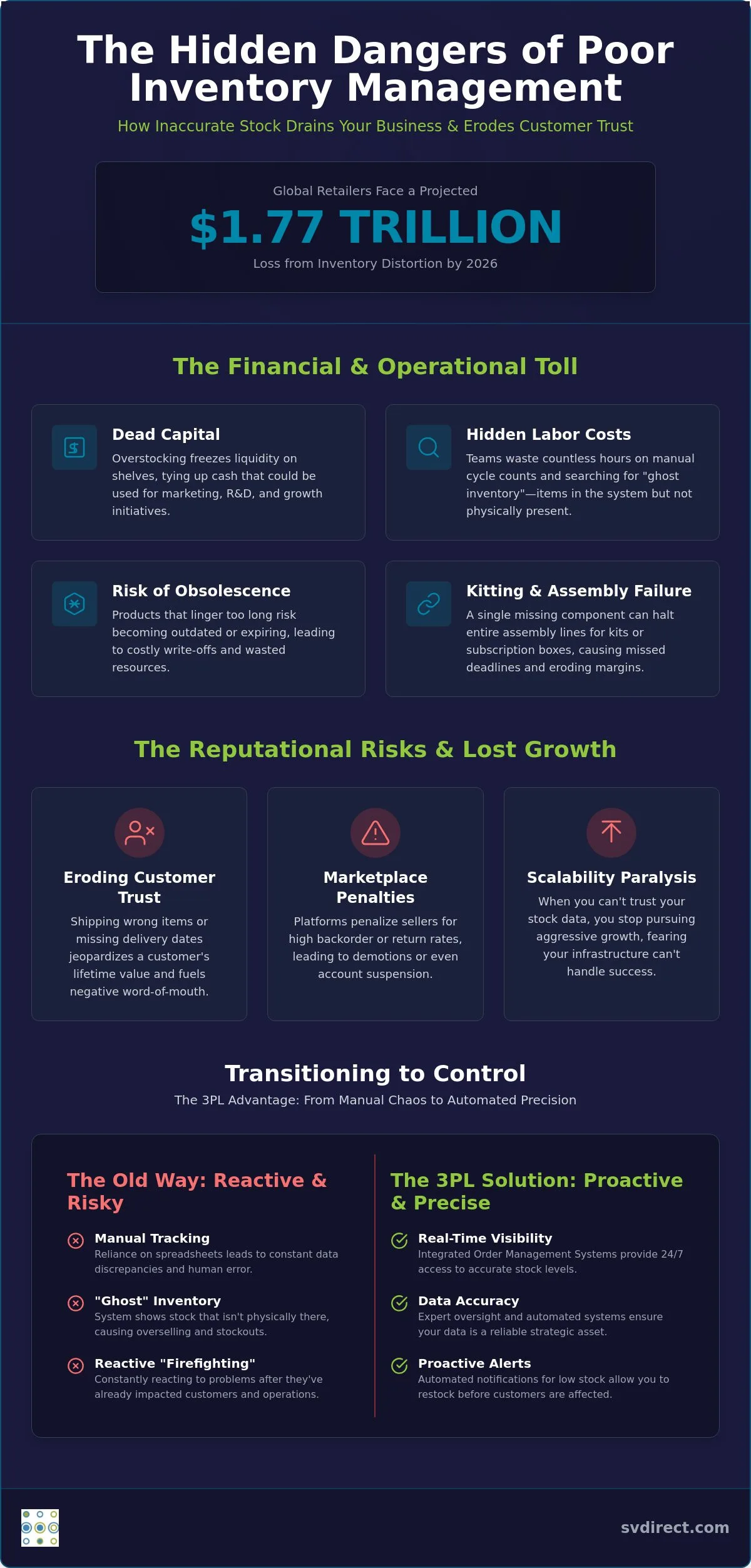
Did you know that inventory distortion, the combined loss from stockouts and overstock, is estimated to cost global retail $1.77 trillion annually? For many growing brands, this isn’t just a statistic; it’s a daily reality where capital stays locked in slow-moving products while customers are turned away by out-of-stock notices. Mastering demand forecasting for ecommerce inventory has become the definitive line between businesses that scale and those that struggle with stagnant cash flow. You’ve likely felt the sting of inaccurate lead times or the stress of managing a replenishment cycle that feels more like guesswork than strategy.

We understand that your inventory represents more than just units; it’s the lifeblood of your marketing budget and growth potential. This 2026 strategic guide promises to equip you with the data-driven techniques and 3PL integration secrets needed to eliminate stockouts for good. You’ll learn how to leverage real-time visibility to optimize your capital and create a seamless partnership with your fulfillment provider. We’re moving beyond static spreadsheets to show you how a proactive, tech-forward approach to demand planning can turn your warehouse operations into a competitive advantage.

Key Takeaways

  • Transition from static spreadsheets to real-time demand sensing to capture immediate market shifts and social signals.
  • Balance quantitative data with expert qualitative insights to build a more resilient and accurate inventory strategy.
  • Master demand forecasting for ecommerce inventory by establishing a direct data integration between your storefront and your fulfillment partner.
  • Leverage automated “Low Inventory” notifications and safety stock triggers to proactively manage replenishment before stockouts occur.
  • Optimize your working capital and improve cash flow by creating a predictable replenishment cycle backed by real-time visibility.

What is Demand Forecasting for eCommerce Inventory?

Demand forecasting is the predictive process of estimating future customer orders to ensure your stock levels align perfectly with market appetite. It’s more than just looking at last year’s sales. It’s a strategic calculation that allows you to optimize stock levels and protect your margins. In 2026, the industry has shifted away from the slow, error-prone world of static spreadsheets. We’ve entered the era of real-time demand sensing, where live data signals from various channels dictate your replenishment needs rather than outdated gut feelings.

Successful demand forecasting for ecommerce inventory requires a two-pronged view. Macro-level forecasting looks at broad market trends and economic shifts that affect entire categories. Micro-level forecasting drills down into SKU-specific performance, identifying which variations are gaining velocity and which are slowing down. You can’t make these decisions in a vacuum. Clean, reliable data is the only foundation for a trustworthy prediction. Our Remote Control™ system acts as your single source of truth, providing the 24/7 visibility needed to separate actionable signals from noise.

The Core Benefits of Accurate Predictions

Precision in your numbers does more than just fill shelves. It directly impacts your bottom line by reducing “dead capital.” When you aren’t overstocking slow-moving items, your cash stays liquid for reinvestment in marketing or product development. Accurate forecasts also prevent the disaster of frequent stockouts, which can tank your customer trust and search engine rankings overnight. Beyond that, it allows for the optimization of global shipping services. By predicting demand spikes, you can plan batches effectively and avoid the high costs of emergency air freight.

Key Data Inputs for 2026

Your forecast is only as good as the data you feed it. We recommend focusing on three primary pillars to build a resilient model:

  • Historical Sales Velocity: Track data across all channels, including Shopify, Amazon, and B2B orders, to understand seasonal patterns and growth curves.
  • Marketing Calendars: Factor in planned promotions and direct mail marketing campaigns that drive sudden traffic surges.
  • External Variables: Account for shifting supply chain lead times and economic indicators that influence consumer spending habits.

By integrating these inputs, you create a proactive replenishment cycle that supports steady growth without the stress of inventory imbalances. This methodical approach ensures that your physical operations remain as organized and efficient as your digital storefront.

For retailers specializing in premium tech, you can discover PRIMOVA to see how innovative product selections require robust inventory and demand planning to succeed.

Maintaining this level of organization often requires dedicated administrative support. Amplify Yourself, LLC helps ecommerce brands scale by sourcing skilled virtual assistants who can manage inventory data and supplier communications, ensuring your forecasting stays on track.

Demand Forecasting for eCommerce Inventory: The 2026 Strategic Guide

Forecasting Methods: Traditional vs. Real-Time Sensing

Choosing the right method is about balancing hard numbers with human insight. Quantitative methods rely on historical data patterns; qualitative methods use expert judgment and market sentiment. For modern brands, demand forecasting for ecommerce inventory usually requires a hybrid approach. You need the stability of historical trends paired with the agility of current market feedback to navigate a volatile landscape.

Demand sensing represents the next evolution in this process. Instead of relying on what happened last quarter, it analyzes live data from your point-of-sale systems and social signals to adjust short-term stock levels. This shifts your operations from a “Push” model, where you buy inventory based on a guess, to a “Pull” model, where real demand triggers your replenishment. It’s a proactive stance that ensures your capital isn’t sitting idle on a warehouse shelf. If you want to refine these operational layers, you can request a free quote to see how we customize these flows for your specific business needs.

One way to alleviate the pressure of aggressive forecasting is through print-on-demand services. By producing marketing collateral or specific literature only when an order is triggered, you eliminate the risk of overstocking items that might become obsolete. This “just-in-time” approach for physical assets keeps your storage costs low and your messaging current.

Top Forecasting Models for Scaling Brands

  • Moving Average: This is best for stable products with consistent, predictable demand over time. It smooths out random fluctuations to provide a clear baseline.
  • Exponential Smoothing: This model weighs recent sales more heavily. It’s excellent for capturing emerging trends or sudden shifts in consumer behavior before they reach their peak.
  • Trend Projection: We use this for long-term growth patterns to help you plan for high-volume deadlines like Q4 or major product launches, accounting for year-over-year growth.

Handling Inventory for Kitted and Assembled Products

Forecasting becomes significantly more complex when one SKU relies on five different components. If a single insert is missing, the entire order stalls. We utilize “postponement” strategies through our kitting and assembly services. This allows us to keep components in their raw state and assemble the final product only when demand is certain. This flexibility prevents you from locking up capital in finished goods that aren’t moving. Success depends on real-time component tracking in your 3PL interface, ensuring your demand forecasting for ecommerce inventory accounts for every piece of the puzzle in the warehouse.

Executing Your Forecast with a 3PL Partner

Execution is where many brands stumble. A forecast remains a mathematical abstraction until it’s translated into physical action on the warehouse floor. To bridge this gap, start by integrating your store directly with your Silicon Valley 3PL. This connection ensures that sales data flows in real time without the risk of manual entry errors. Once the data pipeline is secure, you can set automated “Low Inventory” triggers based on the safety stock levels defined in your model. This proactive step is essential for demand forecasting for ecommerce inventory, as it prevents the stockouts that drive customers toward your competitors.

Physical accuracy is just as vital as digital precision. We recommend conducting regular inventory audits and “QC-Checks” to ensure your physical stock perfectly matches your digital records. Use 24/7 reporting to compare your “forecasted vs. actual” sales figures. This monthly refinement allows you to sharpen your demand forecasting for ecommerce inventory based on real-world performance rather than static assumptions. It’s a methodical cycle that keeps your capital fluid and your shelves ready for the next surge.

Leveraging Remote Control™ for Predictive Power

Our proprietary Remote Control™ system provides the visibility needed to manage high-volume deadlines with quiet confidence. You can utilize over 120 standard reports to quickly identify your “hero” products and the “laggards” that might be draining your capital. Automated email alerts for receipts and backorders act as a proactive safety net, keeping you informed of every inventory movement. This level of precision is only possible in an organized, stable facility where every SKU is tracked with personal oversight.

The Human Element: Proactive Problem Solving

Technology provides the data, but it doesn’t solve every logistical hurdle. You need a partner who listens to your goals and anticipates conflicts before they impact your project. We view our role not as a mere vendor, but as a seamless extension of your team. This human connection ensures that when a supply chain delay occurs or a promotion exceeds expectations, we’re already working on a bespoke solution. It’s the difference between an automated interaction and a steady hand guiding your business through the complexities of global growth.

Scaling Your Brand with Precision and Confidence

Transitioning from reactive guesswork to proactive strategy is the most significant move you can make for your brand’s longevity. By embracing real-time demand sensing and integrating your storefront directly with your fulfillment partner, you eliminate the friction that leads to stockouts and overstock. Effective demand forecasting for ecommerce inventory isn’t just about the math; it’s about having the right infrastructure to act on those numbers immediately.

Silicon Valley Direct offers the physical expertise and digital tools needed to turn your warehouse operations into a growth engine. Our proprietary Remote Control™ system provides 24/7 real-time visibility and 99.9% accuracy, ensuring your data is always a reliable source of truth. We provide seamless integration with platforms like Shopify and WooCommerce, backed by a team that prioritizes proactive problem solving over automated responses.

Streamline your inventory with Silicon Valley Direct's Remote Control™ system.

You don’t have to navigate the complexities of 2026 alone. We’re here to help you build a predictable, efficient replenishment cycle that keeps your business moving forward with total confidence.

Frequently Asked Questions

What is the most accurate demand forecasting method for eCommerce?

A hybrid approach that combines quantitative historical data with real-time demand sensing is the most accurate strategy. Historical sales provide a stable baseline for seasonal patterns, while live signals from social trends and point-of-sale systems allow you to pivot during sudden market shifts. This combination ensures your demand forecasting for ecommerce inventory remains grounded in reality while staying agile enough to capture emerging opportunities.

How often should I update my inventory demand forecast?

You should conduct a comprehensive forecast review at least once a month. This cadence allows you to adjust for upcoming marketing campaigns and shifting supplier lead times. For high-velocity SKUs, we recommend weekly “sensing” checks to compare your actual sales against your predictions. This regular refinement helps you maintain a predictable replenishment cycle and prevents capital from being locked in slow-moving stock.

How does a 3PL help with demand forecasting?

A 3PL serves as your single source of truth by providing real-time data on sales velocity and inventory levels. By integrating your storefront with a system like Remote Control™, you gain access to 120+ reports that are essential for accurate predictions. A proactive partner also helps by setting automated low-stock triggers and managing complex kitting components, ensuring your physical operations perfectly mirror your digital data.

What is the difference between sales forecasting and demand forecasting?

Sales forecasting predicts what you expect to sell based on internal goals and past revenue. Demand forecasting is a more comprehensive calculation that estimates total market appetite, including external economic factors and sales lost due to previous stockouts. While sales forecasts are used for budgeting, demand forecasting is the essential tool for inventory management and preventing fulfillment disasters.

The Dangers of Poor Inventory Management: Protecting Your Bottom Line in 2026

Did you know that inventory distortion, the combined cost of overstocks and out-of-stocks, is projected to drain $1.77 trillion from global retailers in 2026? It’s a staggering figure that highlights the silent, daily drain on your business resources. You’ve likely felt the frustration of capital tied up in stagnant stock or the sting of a loyal customer walking away because of a preventable backorder. These are the immediate and visible dangers of poor inventory management, but the long-term impact on your brand’s reputation and operational agility can be even more damaging.

We believe that inventory shouldn’t be a source of stress, but a strategic asset for your growth. In this article, you’ll discover the critical risks associated with inefficient inventory control and how a proactive 3PL partnership can safeguard your bottom line. We’ll provide a clear roadmap to help you transition from the errors of manual tracking to the precision of automated systems. By the end, you’ll understand how to improve order accuracy and rebuild the customer trust that drives long-term success. Let’s explore how to turn your warehouse operations into a steady hand for your business.

Key Takeaways

  • Learn how to unlock dead capital by identifying overstocking patterns that drain liquidity needed for marketing and growth.
  • Understand the long-term impact of fulfillment errors on customer retention and how to avoid performance penalties on major eCommerce marketplaces.
  • Identify the hidden labor costs associated with manual warehouse searches and the operational drag of managing ghost inventory.
  • Discover how a proactive 3PL partnership mitigates the dangers of poor inventory management through expert oversight and precision.
  • Explore the transition to real-time visibility using integrated Order Management Systems that provide 24/7 access to your stock levels.

The Financial and Operational Toll of Inaccurate Inventory

Inaccurate data isn’t just a clerical error; it’s a financial anchor. When you overstock items based on flawed forecasts, you create “dead capital.” This is liquidity that’s effectively frozen on your warehouse shelves. Instead of funding aggressive marketing campaigns or critical R&D, your cash sits in cardboard boxes. Effective inventory management ensures that every dollar is working toward your growth. The dangers of poor inventory management often manifest as a slow bleed of capital that many businesses don’t notice until their cash flow tightens unexpectedly.

Labor costs compound these issues. Warehouse teams spend countless hours on manual cycle counts or searching for “ghost” inventory, which are items that appear in the system but aren’t physically present. This wasted effort drives up operational overhead while increasing the risk of stockouts. When demand exceeds your poorly tracked supply, you lose immediate revenue. Products that linger too long also risk obsolescence. This leads to painful write-offs as items reach the end of their shelf life before they ever reach a customer.

This challenge is even more pronounced for businesses dealing with perishable goods. Companies like Shift 2 Fresh must maintain impeccable inventory accuracy to ensure that fresh fruits and vegetables imported from the Philippines and South Asia reach UAE consumers before their shelf life expires.

The Ripple Effect on Specialized Services

For businesses relying on kitting and assembly services, inventory errors are catastrophic. A subscription box or a promotional kit is only as complete as its rarest component. If your tracking fails to account for a single missing insert or product, the entire assembly line grinds to a halt. This disruption causes missed shipping deadlines and forces expensive, last-minute course corrections that erode your margins and frustrate your partners.

Operational Friction and Warehouse Morale

A “hectic” warehouse is rarely a productive one. It’s usually a symptom of poor inventory control. When staff are constantly reacting to discrepancies rather than following a streamlined process, morale suffers. We prioritize a quiet, organized facility. This environment is essential for managing high-volume deadlines with precision. High-performance operations require a steady hand and clear data, not a frantic search for misplaced stock. Precision in the warehouse translates directly to confidence in the front office.

Beyond the Balance Sheet: Reputational Risks and Lost Growth

Financial losses are quantifiable, but the damage to your brand identity is often irreversible. One of the most significant dangers of poor inventory management is the steady erosion of customer trust. Shipping the wrong item or missing a promised delivery window doesn’t just cost you a single sale; it jeopardizes the customer’s lifetime value. Research into Reputational Risks confirms that stockouts lead to immediate dissatisfaction and negative word-of-mouth that can haunt your brand for years. In a market where competitors are only a click away, you can’t afford to give shoppers a reason to look elsewhere.

The stakes are even higher on digital marketplaces. Platforms like Amazon and Shopify utilize strict fulfillment metrics to rank and prioritize sellers. Frequent backorders or high return rates triggered by inventory errors can lead to search ranking demotions or total account suspension. This isn’t just a minor hurdle; it’s a loss of access to your primary revenue streams. The dangers of poor inventory management extend to your psychological ability to scale. When you don’t trust your stock data, you experience scalability paralysis. You stop pursuing aggressive growth because you aren’t certain your infrastructure can handle the success.

The Cost of Customer Churn

Calculating the true cost of an error requires looking beyond the immediate shipping fee. You have to consider the high cost of customer acquisition and the revenue that person would have generated over several years. Our customer testimonials reflect how precision in fulfillment transforms one-time buyers into loyal brand advocates. A single bad shipment can destroy that potential in an instant, turning a profitable relationship into a deficit.

The Proactive Solution: Anticipating Problems

We believe in moving away from the “firefighting” mentality common in smaller, manual operations. Our approach focuses on identifying potential conflicts before they impact your project. Instead of reacting to a stockout after it happens, we utilize automated notifications for low inventory levels and potential backorders. This allows you to restock and plan your marketing spend before a customer ever encounters an “out of stock” message. If you’re ready to move from reactive stress to proactive growth, you can consult with our logistics experts to see how we safeguard your brand reputation.

The Dangers of Poor Inventory Management: Protecting Your Bottom Line in 2026

Transitioning to Control: The 3PL Advantage in 2026

Reclaiming control over your supply chain requires more than just a software subscription. It demands a partnership that combines high-tech visibility with physical precision. Moving away from the dangers of poor inventory management starts with real-time data. Our proprietary Remote Control system provides 24/7 inventory access, allowing you to monitor stock levels from any location. This transparency ensures that you aren’t making critical business decisions based on outdated reports or manual spreadsheets.

True efficiency comes from seamless integration. By connecting your eCommerce storefront directly to a professional Order Management System (OMS), you eliminate the communication gaps that cause shipping delays. You also benefit from a scalable infrastructure. Instead of managing the overhead of long-term warehouse leases, you gain access to secure, professional facilities that grow alongside your order volume. This flexible model allows you to invest your capital where it matters most: in your product and your customers.

Technology Meets Human Expertise

Software can track a barcode, but it can’t verify the physical quality of a delicate component. Software alone isn’t enough to guarantee a perfect customer experience. Our “QC-Check” process adds a vital layer of human oversight to every project. By utilizing Silicon Valley 3PL fulfillment services, you bridge the gap between digital clicks and physical delivery. Our team treats your stock as an extension of your own company, ensuring that every kit is assembled correctly and every shipment is accurate.

Strategic Growth through Outsourcing

Outsourcing your logistics frees up your internal resources to focus on brand building and high-level strategy. You don’t need to spend your afternoons counting boxes or troubleshooting backorders. Instead, you can focus on expanding your market reach. Global shipping services become significantly more efficient when your local inventory is managed with precision. This proactive approach mitigates the dangers of poor inventory management and transforms your warehouse from a source of stress into a steady hand that supports your long-term success.

Securing Your Operational Future

Protecting your business in 2026 requires a shift from reactive troubleshooting to proactive precision. We’ve explored how dead capital and marketplace penalties represent the primary dangers of poor inventory management, but these risks are entirely avoidable with the right partnership. Transitioning to a professional 3PL model provides the structural stability needed to scale without the stress of operational friction.

At Silicon Valley Direct, we’ve supported business growth since 1999 through a blend of advanced technology and personal oversight. Our proprietary Remote Control™ system gives you 24/7 real-time visibility, while our rigorous QC-Check process maintains a 99.9% order accuracy rate. This level of detail ensures that your inventory remains an asset, not a burden. Ready to streamline your supply chain? Explore our 3PL solutions today. Let’s build a more resilient future for your brand together.

Frequently Asked Questions

What are the most common signs of poor inventory management?

The most common signs include frequent backorders, high storage costs for slow-moving items, and consistent discrepancies between your digital records and physical stock. You might also notice a rise in customer complaints regarding shipping delays or incorrect items. These symptoms indicate the dangers of poor inventory management and suggest your current tracking methods aren’t keeping pace with your business growth.

How does inventory accuracy affect eCommerce fulfillment costs?

Inventory accuracy directly impacts fulfillment costs by reducing the labor hours spent on manual warehouse searches and cycle counts. When your data is precise, order pickers can locate items instantly, which lowers the cost per order. In contrast, inaccurate data leads to expensive returns management and expedited shipping fees to correct errors, both of which erode your profit margins over time.

Can a 3PL help with inventory management for specialized industries like healthcare?

Yes, a specialized 3PL provides the precision and compliance necessary for healthcare mailing and literature fulfillment. We manage sensitive materials with a focus on traceability and quality control. This expertise is critical because the dangers of poor inventory management in healthcare can include regulatory non-compliance or the distribution of outdated information, making a seasoned partner essential for maintaining industry standards.

What is the difference between reactive and proactive inventory control?

Reactive inventory control involves responding to problems after they occur, such as rushing to restock after a sell-out. Proactive control uses real-time data and automated notifications to anticipate demand and adjust stock levels before issues arise. This forward-looking approach allows you to maintain a steady operational rhythm, ensuring that your capital is always invested strategically rather than spent on emergency fixes.

Warehousing and Distribution Services: A Strategic Reference for 2026

Is your logistics provider a steady partner or a source of constant friction? As the global warehousing and storage market reaches an estimated $869.32 billion in 2026, the difference between scaling your brand and stalling often comes down to the quality of your warehousing and distribution services. It’s frustrating when rigid, “cookie-cutter” processes fail to fit your unique products, or when a lack of real-time visibility leaves you guessing about inventory levels. You deserve a partner that acts as a true extension of your team, providing the stability and precision needed to grow without the stress of high error rates in complex kitting projects.

In this strategic reference, you’ll discover how to evaluate and implement scalable warehousing and distribution services that integrate cutting-edge technology with custom fulfillment. We’ll show you how to achieve seamless integration with your existing eCommerce platforms and gain access to 24/7 reporting data. We’ll also explore the shift toward data-driven orchestration and how a human-centric approach to logistics ensures your supply chain remains both agile and accurate in an increasingly automated world.

Key Takeaways

  • Shift from reactive storage to proactive inventory management by understanding warehousing and distribution as a strategic, integrated 3PL solution.
  • Leverage the ‘Remote Control’ proprietary hub to access 24/7 inventory data and over 120 specialized reports for smarter decision-making.
  • Discover how to implement scalable warehousing and distribution services that integrate with your eCommerce platforms and act as a dedicated extension of your staff.
  • Master the transition to a high-performance logistics partner by focusing on collaborative goal-setting and precision kitting during peak demand cycles.

The Evolution of Strategic Warehousing and Distribution

The logistics industry has moved far beyond the traditional concept of what is a warehouse. In 1999, we began our journey in Silicon Valley, establishing a foundation that prioritizes precision and reliability over mere volume. Today, modern warehousing and distribution services represent an integrated 3PL solution rather than just static storage. This evolution marks a shift from reactive “pick and pack” operations to proactive, data-driven inventory management. For businesses looking to scale beyond regional borders, having a national reach with global shipping capabilities is no longer optional. It’s a strategic necessity.

Key Components of a Modern 3PL Distribution Model

A sophisticated 3PL fulfillment model must provide more than floor space. It requires a high-performance infrastructure designed for accountability and technical readiness. Our approach focuses on three critical areas:

  • Secure, Climate-Controlled Environments: These facilities are essential for protecting high-value or sensitive inventory from environmental degradation.
  • Serial Number Tracking: We utilize granular inventory management systems that ensure total accountability for every unit in the facility.
  • Global Logistics Coordination: By leveraging established carrier relationships, we provide access to discounted rates that directly improve your bottom line.

Why Flexibility Beats ‘Cookie-Cutter’ Logistics

Rigid, automated procedures often fail when faced with the unique demands of a product launch or complex tradeshow fulfillment where standard warehousing and distribution services might fall short. We reject impersonal business models that treat every client the same. Instead, we employ a deliberate methodology that removes the hectic atmosphere common in many facilities. This calm, structured environment ensures that even the most intricate kitting projects are handled with surgical accuracy. By acting as a steady hand and a direct extension of your team, we alleviate the stress of growth through personal commitment and seasoned expertise.

Technology and Value-Added Services: Beyond the Box

Modern warehousing and distribution services in 2026 require more than just physical space; they demand an intelligent digital layer that connects your team to the stockroom. We’ve developed the ‘Remote Control’ system to serve as your central hub. It provides 24/7 transparency, allowing you to move beyond the guesswork of traditional storage. With access to over 120 standard reports, your team can make data-driven decisions based on real-time movement rather than historical assumptions. This level of precision is a hallmark of high-quality value-added logistics services, ensuring every SKU is accounted for and every shipment is optimized for speed and cost.

Remote Control™: Your Window into the Warehouse

Transparency shouldn’t stop at five o’clock. Our proprietary platform offers 24/7 access to place orders, track real-time progress, and retrieve comprehensive order histories. You’ll receive automated notifications for low inventory levels or backorders, which prevents the stockouts that damage customer trust. It’s about giving you total oversight without the need for manual check-ins. Learn more about our remote order management system to see how we bridge the gap between your office and our floor.

Integrated Print and Fulfillment Synergies

Many providers only move boxes, but we integrate production directly into the fulfillment workflow. By utilizing the HP Indigo 5500 Digital Press, we offer on-demand digital printing that creates personalized marketing materials within the standard cycle of our warehousing and distribution services. This variable data capability allows for tailored brochures, manuals, or press kits that ship just-in-time. Our systematic ‘QC-Check’ process adds a vital inspection layer during Strategic guide to kitting and assembly services, ensuring every custom package meets your exact specifications before it leaves our dock. If you’re ready to see how these integrated services can streamline your operations, you can request a free quote from our team today.

Warehousing and Distribution Services: A Strategic Reference for 2026

Implementing a Seamless National Distribution Strategy

Transitioning to a 3PL partner is more than a technical upgrade; it’s a collaborative shift that starts with listening. We prioritize understanding your specific business goals to ensure our warehousing and distribution services act as a seamless extension of your internal team. The strategic role of distribution in the modern economy means that your provider must be proactive. We work to anticipate potential order conflicts or inventory discrepancies before they ever impact your end customer. This level of foresight is especially critical for sectors like healthcare and finance, where secure mailing and strict compliance are non-negotiable requirements.

A Roadmap for 3PL Integration

Effective integration follows a structured, logical path. First, we audit your current fulfillment bottlenecks and data requirements to identify areas for immediate improvement. Next, we establish programmatic interfaces using API or XML for real-time order submission. This ensures your digital storefront and our warehouse floor stay in perfect sync. Finally, we define custom kitting or assembly workflows tailored to your specific product needs. Our “make-it-right” attitude means we don’t just follow a rigid script; we solve problems with a focus on precision and operational readiness.

Building Long-Term Partnerships

Stability is a rare commodity in the logistics world. We take pride in our high staff retention, which ensures that seasoned experts manage your inventory rather than a revolving door of temporary workers. Our “Nine Promises” framework serves as a constant anchor of trust, providing the transparency and accountability you need to scale with confidence. We don’t just move products; we manage relationships through collective experience and personal commitment. If you’re ready to scale with a partner that values accuracy as much as you do, Contact Silicon Valley Direct for a custom fulfillment solution today.

Future-Proofing Your Supply Chain for 2026

Success in the coming years depends on your ability to pivot from basic storage to a sophisticated, integrated model. You’ve seen how the right warehousing and distribution services provide more than just shelf space; they offer a steady hand in a fast-paced market. By prioritizing data-driven orchestration through our proprietary Remote Control™ system and its 120+ standard reports, you gain the transparency needed to make informed decisions at any hour. This high-tech oversight, combined with our Red Dot-quality digital printing, ensures your brand remains agile and professional.

Since 1999, we’ve acted as a dedicated extension of our clients’ teams, combining high-tech efficiency with a human touch. We believe that physical operations should be just as organized as your digital strategy. It’s time to move past rigid, impersonal logistics models and embrace a partnership built on stability, precision, and a multi-decade history of reliability. Streamline your supply chain with Silicon Valley Direct's professional 3PL services. We look forward to helping you reach your next milestone with confidence and clarity.

Frequently Asked Questions

What is the difference between warehousing and distribution services?

Warehousing acts as the foundational storage component, while distribution services represent the active movement of inventory toward the final destination. Selecting a partner that provides integrated warehousing and distribution services ensures a seamless flow from the shelf to the doorstep. While storage focuses on safety and organization, distribution involves the dynamic processes of order fulfillment and carrier coordination. This approach keeps your logistics strategy agile and responsive to shifting customer demands.

How does a 3PL integrate with my existing eCommerce platform?

Integration occurs through programmatic interfaces like API or XML that sync your online storefront directly with our proprietary management system. This connection allows for real-time order submission and automatic inventory updates. It’s a proactive approach that ensures your digital sales data and physical stock levels are always in perfect alignment. By automating this data exchange, we remove the risk of manual entry errors and provide you with instant visibility into every transaction.

Can a warehousing service also handle my marketing collateral and printing?

Yes, we uniquely integrate on-demand digital printing to manage marketing collateral alongside your physical products within our warehousing and distribution services. By using high-performance digital presses, we produce brochures and manuals just-in-time for fulfillment. This synergy eliminates the need for separate vendors and ensures your literature is always current. It’s an efficient way to personalize your marketing efforts without the burden of maintaining large, outdated print inventories.

What security measures should I expect for high-value or sensitive inventory?

You should expect a multi-layered security protocol that includes 24/7 monitoring, secure access controls, and climate-controlled storage for sensitive items. We employ systematic inspection layers and serial number tracking to ensure total accountability for every unit. This rigorous oversight provides the stability needed for high-stakes industries where precision is paramount. Our team-oriented approach ensures that experienced staff members oversee every high-value asset with personal commitment and professional care.

Cycle Counting Best Practices for eCommerce: The 2026 Strategic Guide to Inventory Precision

Cycle Counting Best Practices for eCommerce: The 2026 Strategic Guide to Inventory Precision

What if the most disruptive event on your warehouse calendar became a silent, high-performance engine running in the background? For many growing brands, the traditional year-end audit is a source of dread that leads to operational downtime and missed sales. By mastering cycle counting best practices for ecommerce, you can replace those costly shutdowns with a rhythm of precision that keeps your data accurate and your fulfillment lines moving.

We understand the pressure of reconciling digital records with physical reality, especially when inaccurate stock levels lead to the nightmare of overselling. It’s a challenge that requires a steady hand and modern technical integration. This strategic guide provides the roadmap to transition from manual, error-prone audits to a scalable logistics framework. You’ll learn how to leverage ABC analysis and RFID technology to gain real-time inventory visibility, ensuring your brand is ready for the high-velocity demands of 2026. We’ll explore how to build a counting program that secures your data integrity and fuels long-term growth.

Key Takeaways

  • Replace the disruptive “Year-End Inventory” shutdown with a perpetual auditing process that maintains stock accuracy without halting your fulfillment operations.
  • Master the ABC Analysis framework to prioritize high-velocity items, ensuring your most critical assets receive the most frequent oversight.
  • Discover how implementing cycle counting best practices for ecommerce reduces long-term labor costs by eliminating time-consuming emergency stock searches.
  • Learn to schedule counts during low-activity windows and clean your data beforehand to prevent discrepancies caused by “in-flight” transactions.
  • Understand how blending seasoned human expertise with modern digital precision creates a stable, scalable logistics framework for the 2026 marketplace.

The Evolution of Inventory Integrity: Why Cycle Counting Dominates eCommerce in 2026

In the high-velocity environment of 2026, inventory precision isn’t just a back-office metric; it’s a customer-facing promise. Cycle counting acts as a perpetual auditing process that ensures your digital records match the physical reality of your warehouse floor every single day. Instead of pausing your entire operation for a single, massive stock check, you implement a system of continuous verification. We define cycle counting as a strategic, rotating audit that prioritizes high-value assets without halting shipments, allowing your brand to maintain momentum while securing data integrity.

The contrast between the traditional “Big Audit” and the modern “Agile Audit” is stark. While a full physical count provides a snapshot in time, cycle counting offers a live stream of data. With 92% of ecommerce brands growing year-over-year as of July 2026, the ability to sell across multiple channels depends entirely on this level of precision. Achieving 99.9% accuracy is no longer an aspirational goal; it’s the baseline for surviving in a marketplace where consumers expect instant updates and flawless fulfillment.

The Death of the Annual Physical Inventory

The traditional year-end audit is becoming a relic because it creates expensive operational downtime. When you shut down fulfillment for two days to count every SKU, you aren’t just losing labor hours; you’re delaying customer orders and risking marketplace penalties. These annual counts often become obsolete the moment the first picker enters the aisle after the audit. Beyond the financial cost, the psychological toll on warehouse staff is significant. Multi-day, high-pressure counts lead to fatigue and human error, which is why cycle counting best practices for ecommerce favor smaller, manageable tasks that integrate into the daily workflow.

Data Integrity as a Growth Lever

Precision is the fuel for your marketing engine. When your inventory data is clean, you eliminate the “ghost stock” that leads to overselling and frustrated customers. This visibility directly improves your marketing ROI. You can confidently scale ad spend on high-performing SKUs because you know exactly what is on the shelf. Real-time visibility through professional inventory management allows for a scalable logistics framework that supports global growth without the friction of data discrepancies.

Strategic Methodologies: Implementing ABC Analysis and Modern Counting Models

Selecting the right framework is essential for maintaining a high-performance supply chain. While many businesses recognize the need for regular audits, the most effective cycle counting best practices for ecommerce rely on data-driven prioritization. An academic review of cycle counting methodologies highlights that the most successful programs align count frequency with item velocity and value. This ensures that your team focuses its energy where the risk of discrepancy is highest, protecting your most valuable stock from accuracy gaps.

The ABC Method: Prioritizing What Matters

The ABC framework applies the 80/20 rule to your warehouse operations. Typically, 80% of your revenue is generated by just 20% of your SKUs. We categorize these as “A” items. These high-velocity assets require weekly verification to prevent fulfillment delays or stockouts. “B” items represent moderate movement and might be checked monthly, while “C” items are low-value products that only need quarterly reviews. It’s vital to remain flexible. A “C” item can quickly become an “A” item during peak seasons or viral marketing campaigns. Regularly updating these categories is one of the essential cycle counting best practices for ecommerce to keep your strategy aligned with actual market demand.

Hybrid and Opportunity-Based Models

For smaller facilities or those with high SKU density, opportunity-based counting offers a tactical advantage. This involves verifying stock levels when a “zero-bin” trigger occurs. When a picker empties a location, they confirm the shelf is indeed empty. It’s a simple, low-labor way to catch errors immediately. In contrast, massive 3PL facilities often employ the geographic method. This involves counting every item in a specific zone, moving from floor to ceiling to ensure total coverage. Choosing the right model depends on your specific footprint and order volume. If you’re looking to refine your warehouse operations, you can consult with our logistics experts to find the perfect fit for your brand’s growth stage.

Overcoming the Accuracy Gap: Addressing Discrepancies and Operational Objections

We often hear the objection that daily counting requires too much manpower. However, we view it as a labor-saving tool. When you invest minutes in a structured count today, you save hours of frantic searching during a peak fulfillment window tomorrow. One of the most effective cycle counting best practices for ecommerce is the “Blind Count” strategy. In this model, the team member performing the count doesn’t see the expected system quantity. This removes the psychological temptation to “make the numbers match” and ensures the data reflects physical reality. You should also establish a clear tolerance threshold. A small variance might be acceptable for low-cost consumables, but high-value items require a zero-tolerance policy to protect your bottom line.

Root Cause Analysis: Why the Numbers Don’t Match

Discrepancies usually stem from the “Big Three”: picking errors, receiving mistakes, or system glitches. Inventory complexity also increases when products undergo kitting and assembly. Managing multiple components into a single SKU creates more touchpoints where errors can occur. Documenting every adjustment is vital to maintaining a clean audit trail. This allows you to identify recurring patterns rather than just fixing symptoms, turning every discrepancy into an opportunity for process improvement.

The Human Element: Training for Precision

Dedicated audit teams consistently outperform rotating warehouse staff. At Silicon Valley Direct, our philosophy centers on seasoned experts who provide personal oversight rather than relying solely on automated scripts. We prioritize accuracy over raw speed. When a team member feels empowered to stop and investigate a discrepancy, the entire system becomes more reliable. This human-centric approach, backed by physical infrastructure from Global Industrial Company and decades of experience, ensures that your inventory management is as precise as your digital storefront. It’s about building a culture where precision is a point of pride for every member of the team.

Cycle Counting Best Practices for eCommerce: The 2026 Strategic Guide to Inventory Precision

eCommerce Cycle Counting Best Practices: A Blueprint for 2026 Scalability

Building a scalable logistics framework requires moving beyond reactive counting to a proactive, five-step blueprint. The most effective cycle counting best practices for ecommerce start with data hygiene. Before your team hits the warehouse floor, you must ensure all pending transactions are processed. This prevents the “in-flight” errors that occur when a system expects an item to be on the shelf while it is actually sitting in a packing station. We recommend scheduling these audits during low-activity windows, such as early morning shifts, to maintain total data synchronization.

For high-stakes sectors like electronics or healthcare, we implement “Double-Blind” audits. In this process, two separate counters record the inventory independently without seeing the system’s expected quantity or each other’s results. This creates a rigorous layer of verification that automated systems alone cannot replicate. To keep this system agile, you should review and reset your SKU classifications quarterly. This ensures that items gaining viral traction are moved into higher-frequency count cycles before discrepancies can impact your growth.

Leveraging 2026 Tech: AI and Automation

Modern inventory management now utilizes AI to predict which bins are most likely to contain errors. By analyzing recent picking velocity and historical discrepancy rates, the system flags specific locations for immediate review. We are also seeing the rise of drone-assisted counting for high-rack pallet storage, which eliminates the safety risks and slow speeds of manual ladder work. Integrating this live data with our Global Shipping Services allows you to optimize reorder points based on verified, real-time stock levels rather than estimates.

Maintaining Consistency and Cadence

Success in inventory precision is built on the “Never Miss a Day” rule. A successful cycle counting program requires a fixed daily schedule that is never sacrificed for short-term picking surges. We use digital dashboards to track accuracy trends over time, providing a clear visual of your operational health. This methodical approach ensures that precision becomes a habit rather than a chore. If you’re ready to upgrade your warehouse precision with these advanced strategies, you can request a free quote to see how our team can support your scale.

The Silicon Valley Direct Edge: Precision Inventory Management as a Competitive Advantage

At Silicon Valley Direct, we view inventory management as more than a warehouse task; it’s the pulse of your entire brand strategy. Since our founding in 1999, we’ve combined the stability of decades of operational history with the relentless innovation of our Silicon Valley home. This allows us to implement cycle counting best practices for ecommerce that go beyond simple box-counting. We treat your data as a strategic asset, ensuring every SKU is accounted for with the precision required for high-stakes industries. Our approach provides the steady hand you need in a fast-paced market.

This level of accuracy is particularly critical for our Healthcare Mailing Services, where compliance and precision are non-negotiable. Similarly, our Direct Mail Marketing clients rely on us to ensure physical inventory is ready for immediate deployment. Without a foundation of inventory integrity, even the most creative marketing campaign will falter at the fulfillment stage. We ensure your physical operations are just as organized as your digital communication.

Beyond the Spreadsheet: A Partnership Approach

We explicitly reject the industry trend of automated-only interactions. While we utilize cutting-edge technical integrations, we believe direct human connection is the only way to achieve bespoke problem-solving. Our team treats your inventory as if it were our own. This high-touch philosophy ensures that precision warehousing reduces pick and pack errors and costly returns, protecting your reputation with every order. We position ourselves as a high-performance partner that remains accessible and grounded.

Ready to Scale? Your Next Steps

Transitioning from in-house logistical chaos to professional 3PL precision is the fastest way to fuel your growth. Our experts work with you to build a tailored inventory management plan that fits your specific SKU count and velocity. If you’re ready to secure your data integrity and eliminate the stress of seasonal surges, contact Silicon Valley Direct for a custom fulfillment quote today. We’re ready to help you build a scalable logistics framework that lasts.

Securing Your Operational Future with Perpetual Precision

Transitioning from the chaos of annual shutdowns to a perpetual auditing engine is the most significant step you can take toward scalable growth. By implementing cycle counting best practices for ecommerce, you replace reactive firefighting with a steady rhythm of data integrity. We’ve explored how ABC analysis and modern technical integrations eliminate “ghost stock” and protect your fulfillment rates. This shift ensures that your digital storefront always reflects the physical reality of your warehouse floor.

Achieving 99%+ inventory accuracy requires a blend of cutting-edge innovation and seasoned expertise. Since 1999, our Silicon Valley-based team has provided the dedicated human oversight necessary to navigate the complexities of global logistics. We don’t just offer software; we provide a partnership grounded in decades of operational history. If you’re ready to stabilize your supply chain and focus on your brand’s expansion, Partner with Silicon Valley Direct for Precision eCommerce Fulfillment today. Your path to flawless inventory starts with a single, strategic shift in perspective.

Frequently Asked Questions

How often should I perform cycle counting for my eCommerce store?

You should perform cycle counts daily to maintain high data integrity. High-velocity “A” items often require weekly checks, while slower “B” and “C” categories can follow monthly or quarterly schedules. This consistent cadence prevents small errors from snowballing into major fulfillment issues during peak seasons. It’s a steady approach that keeps your warehouse rhythm predictable and reliable.

Can cycle counting completely replace a full physical inventory count?

Yes, a well-executed cycle counting program can eliminate the need for an annual “Big Audit” shutdown. By continuously verifying stock throughout the year, your records remain accurate enough to satisfy financial auditors without halting operations. This transition relies on maintaining a high accuracy threshold and documenting every adjustment for a clear audit trail. It’s a more efficient way to manage long-term data health.

What is a “blind count” and why is it a best practice?

A blind count is an audit where the counter has no knowledge of the quantity currently recorded in the system. This is a best practice because it eliminates confirmation bias. When a team member doesn’t know the “correct” answer, they are forced to rely solely on physical verification. This significantly improves the reliability of the resulting data and ensures human oversight remains objective.

How do I handle inventory discrepancies found during a cycle count?

You should immediately investigate the root cause of any discrepancy that exceeds your established tolerance threshold. Common issues include picking errors or receiving mistakes. Once identified, you must adjust the system record to match physical reality and document the reason for the change. This process is one of the core cycle counting best practices for ecommerce that prevents recurring errors and improves future precision.

What is the ideal inventory accuracy percentage for a 3PL?

The industry standard for high-performance logistics providers is 99% or higher. Achieving this level of precision ensures that your digital storefront and physical warehouse stay perfectly synchronized. Maintaining this standard is essential for brands selling across multiple channels, as even a small error rate can lead to significant overselling risks when order volumes scale. It provides the stability needed for aggressive business growth.

How does cycle counting work for kitted or assembled products?

Cycle counting for kitted items requires auditing both the finished bundles and the individual components. Since kitting and assembly involve multiple touchpoints, errors can occur during the breakdown or build process. You should count the raw components as part of their own categories while also verifying that the assembled units match the expected stock levels. This dual-layer check ensures the entire production cycle remains accurate.

Do I need special software to implement a cycle counting program?

While you can start with manual logs, professional inventory management software is essential for real-time reconciliation and reporting. Modern systems automate the selection of SKUs based on ABC analysis and provide digital dashboards to track accuracy trends. This technical integration allows your team to focus on physical verification rather than data entry. It makes the entire process more efficient and reduces the risk of manual calculation errors.

What is the difference between periodic and perpetual inventory systems?

A periodic system relies on occasional physical counts to update records, whereas a perpetual system uses digital tracking to update stock levels in real time as transactions occur. Implementing cycle counting best practices for ecommerce turns a standard warehouse into a high-precision perpetual engine. This ensures that your inventory data is always current, allowing for more accurate reorder points and better financial forecasting for your brand.

BigCommerce Fulfillment Services: A Strategic Guide to Profitability and Returns in 2026

BigCommerce Fulfillment Services: A Strategic Guide to Profitability and Returns in 2026

With the global cross-border e-commerce logistics market reaching $218.68 billion in 2026, why are so many merchants still watching their margins disappear into the “black hole” of inefficient returns? You likely feel the sting of high return rates and the persistent frustration of waiting for your dashboard to catch up with actual warehouse activity. It’s a common struggle to align your storefront with bigcommerce fulfillment services that can actually keep pace with the 56.5% of customers who now expect delivery in three days or less.

We believe your growth deserves a steady hand and a partner who values precision over generic automation. This guide will show you how to transform your logistics from a cost center into a profit-recovering engine through specialized 3PL integration and precision reverse logistics. We’ll explore how seamless API synchronization, faster restock cycles for returned goods, and strategic Silicon Valley logistics hubs can slash your shipping costs while navigating the complex new EU and U.S. customs regulations of 2026. You’re about to discover a more reliable, human-centered way to scale your operations and reclaim your bottom line.

Key Takeaways

  • Shift your perspective from logistics as a cost center to a revenue recovery engine through a closed-loop fulfillment strategy.
  • Master the technical API handshake required for bigcommerce fulfillment services to ensure real-time inventory accuracy and zero integration lag.
  • Increase your resale margins by replacing generic automated grading with human-led, functional inspections tailored to your specific product categories.
  • Streamline your international expansion by utilizing a Silicon Valley logistics hub to manage cross-border shipping and the latest global customs regulations.
  • Benefit from operational stability grounded in a multi-decade history of serving the tech industry with personal oversight and bespoke problem-solving.

The Strategic Role of BigCommerce Fulfillment Services in 2026

In 2026, viewing logistics as a simple linear path is a recipe for shrinking margins. Modern bigcommerce fulfillment services must operate as revenue recovery engines. This means every package sent out and every item returned is part of a “closed-loop” system designed to protect your bottom line. As the global cross-border e-commerce logistics market grows to an estimated $218.68 billion this year, the brands that thrive are those that prioritize precision over just moving boxes. It’s about more than delivery; it’s about maintaining operational stability in a high-speed market.

The Profitability Crisis in Modern eCommerce

Many scaling startups face a silent drain on their resources: dead capital. This refers to returned goods sitting unprocessed in a warehouse corner for weeks. When your remote order management isn’t synced with your storefront, you lose sales. Slow fulfillment cycles don’t just frustrate customers; they lead to increased cart abandonment. With 56.5% of consumers expecting delivery within 2-3 days, according to 2026 industry data, your store can’t afford the lag of manual entry or siloed data. Accuracy at this stage is the foundation of customer lifetime value.

Why Forward Fulfillment Needs Reverse Precision

A robust order fulfillment process is only as strong as its weakest link, which is often the return journey. Standard pick-and-pack workflows often ignore what happens when a product comes back. High-growth brands require a partner who treats reverse logistics with the same urgency as the initial shipment. Transitioning to seamless, API-driven bigcommerce fulfillment services ensures that your inventory levels are always accurate. This allows you to restock and resell returned items before they lose value. This steady, methodical approach transforms a logistical headache into a clear competitive advantage for your business.

Seamless Integration: How BigCommerce Syncs with Your 3PL

Establishing a connection between your storefront and bigcommerce fulfillment services shouldn’t feel like a technical hurdle. It begins with a secure API handshake. This digital link allows the BigCommerce dashboard to communicate directly with our warehouse management system. Once the connection is live, we map every SKU to ensure real-time inventory synchronization. This prevents overselling and ensures that what your customer sees on the screen matches exactly what’s on our shelves in Union City. This level of precision is the cornerstone of operational stability.

Efficiency continues through automated order routing. Our system selects the optimal carrier based on speed and cost, ensuring your bigcommerce fulfillment services remain profitable even as you scale. This is vital for brands pursuing cross-border ecommerce, where regulatory compliance and shipping logistics become increasingly complex. To maintain a competitive edge, you might want to consult with an integration expert about your specific workflow needs and carrier optimization strategies.

RMA Management and Visibility

A Return Merchandise Authorization (RMA) is the digital security protocol that protects the return cycle. By providing real-time RMA tracking, you significantly reduce customer service inquiries. Customers stay informed throughout the process, and your BigCommerce dashboard reflects the physical warehouse reality the moment a return is processed. This transparency builds trust and keeps your data clean.

The Human Element in Receipt and Logging

While automation handles the data, Silicon Valley Direct prioritizes personal oversight for the physical receipt of goods. This human-centric approach is critical for high-value items where “box-swapping” or ecommerce fraud can occur at the loading dock. Our team documents the exact condition of every package upon arrival. This level of care protects your brand reputation and ensures that only quality inventory returns to your live stock. It’s a proactive stance that combines high-tech 3PL fulfillment services with the steady hand of an experienced operational team that has been serving the industry since 1999.

Maximizing Value Recovery Through Human-Led Inspection

While massive automated centers prioritize speed, they often lack the nuance required to protect your margins. In the world of bigcommerce fulfillment services, the human element is what prevents profit from leaking out of the warehouse doors. One-size-fits-all inspection protocols fail modern brands because a medical device requires a different level of scrutiny than a piece of apparel. By utilizing custom grading scales, we ensure that every returned item is evaluated against its specific functional and aesthetic standards. This sophisticated approach to direct-to-consumer fulfillment ensures that “Grade A” items return to your active inventory at full retail value rather than being prematurely sent to liquidation.

Strategic Disposition Routing

Our team manages the “backward” supply chain with methodical care. We route items through three primary paths: restocking, refurbishment, or sustainable disposal. Restocking returns “like-new” items to your BigCommerce shelf for immediate resale. Refurbishment involves our kitting and assembly experts turning slightly damaged returns into value-added bundles. For items that cannot be resold, we manage compliant, eco-friendly recycling. This structured flow ensures your bigcommerce fulfillment services remain lean and environmentally responsible.

Protecting High-Value Inventory

Handling sensitive electronics or healthcare products requires more than a standard warehouse setup. We implement specialized handling protocols and maintain a strict chain of custody for every unit. This is a core component of our secure warehousing for high-value electronics. By documenting the package condition and performing functional testing, we protect your brand reputation from the risks of “box-swapping” or faulty re-shipments. This proactive stance is backed by over two decades of operational history in the Silicon Valley innovation hub.

BigCommerce Fulfillment Services: A Strategic Guide to Profitability and Returns in 2026

Scaling Globally: Specialized Fulfillment and Compliance

Scaling a brand on BigCommerce requires more than just adding new markets. It requires a logistics partner who understands the intersection of data and physical movement. Our centralized Silicon Valley hub serves as a gateway for international trade, simplifying the complexities of cross-border shipping. By leveraging bigcommerce fulfillment services that utilize a single, high-tech facility, you reduce the fragmentation that often leads to shipping delays and lost inventory. This strategic location provides immediate access to major global ports and innovation hubs, ensuring your brand remains agile in a fast-paced market.

Fulfillment Meets Kitting and Assembly

Returned components shouldn’t collect dust. We use real-time returns data to identify items that can be re-bundled into new promotional or subscription kits. This process is a core part of our kitting and assembly services. By re-bundling restockable items into fresh SKUs, you streamline your inventory and turn potential losses back into marketable assets. It’s a methodical way to maximize the value of every unit in your warehouse while maintaining the high-performance standards your customers expect.

Healthcare and Global Compliance

Managing specialized returns for the healthcare sector requires a level of precision that generic providers simply cannot reach. We maintain strict adherence to HIPAA and SOC2 standards, ensuring that sensitive medical devices or healthcare literature are handled with absolute security. You can learn more about our specialized healthcare mailing services and how we maintain a rigorous chain of custody for every shipment.

As we move through 2026, international trade standards like the EU’s ICS2 system and new U.S. customs enforcement orders have made documentation more critical than ever. Our team ensures that every package meets these evolving requirements, providing detailed customs data before goods enter foreign territories. This expertise is reflected in our comprehensive global shipping services. If you’re ready to expand your reach without the regulatory headaches, get a custom quote for your global logistics needs. We provide the steady hand you need to navigate these complex bigcommerce fulfillment services with confidence.

Why Silicon Valley Direct is the Strategic Partner for BigCommerce

Choosing a logistics partner is a high-stakes decision for any growing brand. Silicon Valley Direct offers a unique combination of high-tech capability and seasoned experience that few can match. Since 1999, we’ve provided operational stability for the tech industry, evolving alongside the platforms we support. Our bigcommerce fulfillment services are designed to scale with you, whether you’re a startup processing your first hundred orders or an enterprise managing complex global distribution. We provide the physical infrastructure and human expertise to ensure your growth remains sustainable and organized.

A Foundation of Trust for Modern Brands

In a volatile 3PL market, our multi-decade history acts as a constant anchor of trust. We explicitly reject the trend of impersonal, automated help desks. Instead, we prioritize direct human connection and personal oversight. By combining high-tech inventory systems with the seasoned judgment of our long-term staff, we offer a level of bespoke problem-solving that automation alone cannot match. We treat your business as a partnership, not just another transaction.

Take Control of Your BigCommerce Logistics

It’s time to evaluate your current logistics performance. Look for bottleneck areas and high cost-per-return rates that may be hindering your profitability. Our experts are ready to help you design a bespoke fulfillment workflow that addresses your specific product needs. For more strategies on optimizing your supply chain, check out our latest insights on the Silicon Valley Direct blog. Let us provide the steady hand you need to scale with confidence.

Future-Proofing Your eCommerce Logistics

Transforming your logistics from a standard delivery mechanism into a profit-recovering engine is the key to thriving in 2026. You’ve seen how precision reverse logistics and human-led inspections can protect your margins by recovering the value of returned goods. By prioritizing a “closed-loop” system, you ensure that every item is accounted for and optimized for resale. Accuracy is everything. This methodical approach is what separates high-performance brands from those struggling with “dead capital” and integration lag.

A successful partnership requires a steady hand and a commitment to accuracy. Since 1999, we’ve provided operational stability for brands navigating the complexities of the tech industry. Our strategic Silicon Valley location and rejection of impersonal automation in favor of expert human oversight make us a unique partner for your brand. We’re ready to help you scale your operations with bespoke workflows that meet your specific needs. It’s time to reclaim your bottom line and build a more resilient supply chain. We invite you to Request a free quote for BigCommerce fulfillment services today. Let’s work together to turn your logistics into a high-performance asset for your business.

Frequently Asked Questions

How does BigCommerce integrate with a 3PL fulfillment service?

BigCommerce integrates with a 3PL through a secure API handshake that enables real-time data exchange. This digital link ensures that your storefront, inventory levels, and order statuses are perfectly synchronized with the warehouse. Using professional bigcommerce fulfillment services allows for bidirectional flow, meaning that when an order is packed or a return is restocked, your dashboard updates instantly without manual data entry. This precision is vital for maintaining operational stability as your business scales.

What is the difference between reverse logistics and standard returns management?

Reverse logistics is a comprehensive process that manages the entire “backward” movement of goods to recover value. While standard returns management often focuses only on the receipt of a package, reverse logistics includes specialized inspection, custom grading, and strategic disposition routing. It’s a closed-loop strategy designed to transform a cost center into a profit-recovering engine. This approach ensures that items are restocked, refurbished, or recycled with methodical care to protect your margins.

Can a fulfillment service handle high-value electronics and healthcare products?

Specialized fulfillment services can certainly handle sensitive electronics and healthcare products if they have the right infrastructure. These items require strict handling protocols, secure warehousing, and a documented chain of custody to maintain integrity. For healthcare products, compliance with HIPAA and SOC2 standards is mandatory. Expert human oversight ensures that every unit undergoes functional testing or aesthetic grading, protecting your brand reputation from the risks associated with damaged or faulty re-shipments.

How do BigCommerce fulfillment services detect and prevent return fraud?

Detection of return fraud is most effective when high-tech tracking meets human-led inspection at the loading dock. Professional bigcommerce fulfillment services use Return Merchandise Authorizations (RMAs) to verify every incoming package against the original order. Staff members document the condition of the box and its contents upon arrival to prevent “box-swapping.” This proactive stance ensures that only genuine, quality inventory is returned to your live stock, effectively closing the door on common eCommerce fraud.

What are the most common disposition options for returned eCommerce items?

Disposition options usually include restocking, refurbishment, and sustainable disposal. Restocking is the most profitable choice, returning like-new items to the shelf for immediate resale. Refurbishment involves kitting and assembly experts who can re-bundle slightly damaged goods into value-added kits. For items that cannot be sold, sustainable disposal ensures that products are recycled or destroyed according to regulatory and environmental standards. This structured flow keeps your inventory lean and responsible.

How long does it typically take to process a return and update inventory?

Processing times usually take between 24 and 48 hours from the moment a return arrives at the facility. The speed of the update depends on the complexity of the inspection required for that specific product category. Once our team completes the grading process and logs the item back into the system, the API-driven synchronization ensures your BigCommerce inventory levels reflect the change instantly. This minimizes the time capital remains “dead” in the warehouse.

Is it more cost-effective to outsource BigCommerce fulfillment or handle it in-house?

Outsourcing is typically more cost-effective for brands that have outgrown their initial storage or lack specialized logistics expertise. Managing in-house fulfillment involves high fixed costs for warehouse space, labor, and technology. By partnering with a 3PL, you gain access to optimized carrier rates, advanced inventory management systems, and a seasoned team without the overhead. This allows you to focus your resources on marketing and product development while we handle the operational heavy lifting.

Subscription Box Fulfillment Services: The 2026 Strategic Guide to Scalable Recurring Revenue

Subscription Box Fulfillment Services: The 2026 Strategic Guide to Scalable Recurring Revenue

Did you know that 52% of consumers canceled at least one subscription in the last year? Often, these cancellations aren’t a reflection of the product itself, but rather a breakdown in the delivery experience. You’ve likely faced the stress of high churn caused by shipping delays, damaged items, or a missing insert that ruined a carefully curated unboxing. It’s a common struggle for growing brands to find subscription box fulfillment services that offer both high-tech efficiency and the human touch required for custom kitting.

We understand that as you scale through 2026, you need more than just a warehouse; you need a steady hand to manage the 5.9% FedEx rate hikes and complex USPS surcharges that now account for 33% of average package costs. This guide will help you master these logistics while protecting your brand with personal oversight. You’ll learn how to achieve 100% kitting accuracy and seamless Shopify integration. We’ll provide the roadmap to predictable costs and scalable global shipping, ensuring your recurring revenue remains secure and your subscribers stay delighted.

Key Takeaways

  • Learn to distinguish between replenishment and curated models to align your logistics with your specific recurring revenue strategy.
  • Discover how personal oversight in subscription box fulfillment services ensures 100% kitting accuracy and protects the unboxing experience from errors.
  • Leverage on-demand digital printing to create personalized inserts that turn every delivery into a high-impact marketing moment.
  • Master inventory management using FIFO protocols to minimize product obsolescence and maintain a lean, efficient supply chain.
  • Understand why prioritizing direct human interaction over automated chatbots is the key to maintaining control as your brand scales globally.

Understanding Subscription Box Fulfillment Services in the 2026 Market

In 2026, the subscription economy has reached a level of maturity where simple shipping is no longer enough. The market grew by 12.6% this year, and consumers now expect a flawless, high-touch experience with every delivery. Effective subscription box fulfillment services act as the physical handshake between your brand and your subscriber. It’s the moment where your digital promise becomes a tangible reality. To succeed now, you must view logistics as a tool for recurring brand engagement rather than a back-office chore.

The landscape for subscription-based ecommerce businesses has shifted toward quality and precision. With the average number of household subscriptions settling at 2.8, your box must earn its place every month. This requires a fulfillment strategy that can handle the “Big Five” categories, beauty, pet, food, personal care, and clothing, with absolute accuracy. If the kitting isn’t perfect, the unboxing experience fails, and your churn rate will inevitably spike.

To better understand the mechanics behind this process, watch this concise breakdown:

Replenishment vs. Curated Boxes: Choosing Your Logistics Path

Your operational requirements depend heavily on your product model. Replenishment logistics focus on speed and low-friction inventory cycles. These boxes deliver the same essentials every month, so efficiency is found in high-volume throughput and predictable stock levels. Curated box logistics are far more complex. They involve managing high SKU turnover and intricate assembly instructions for rotating monthly items. This model dictates a different warehousing structure, often requiring more floor space for dedicated kitting lines and the flexibility to stage diverse inventory before a monthly “wave” shipment. For curated brands like BlueStream Wines, choosing the wrong partner often leads to the missing inserts and damaged items that drive subscribers away.

The Hidden Costs of In-House Fulfillment

Many brands start in a garage or small office, but there’s a clear transition point where in-house efforts become a liability. The first sign is a rising opportunity cost. If your core team is spending their afternoons with tape and dunnage, they aren’t focusing on subscriber acquisition or product development. Second, scalability bottlenecks become obvious during viral growth moments or peak seasons. An in-house team simply can’t flex as fast as a professional facility. Finally, if your “missing item” tickets are increasing, your manual processes have reached their limit. Professional subscription box fulfillment services eliminate these headaches by providing the infrastructure and personal oversight needed to maintain 100% accuracy as you grow.

Subscription box fulfillment is a strategic brand touchpoint that defines the customer experience, rather than a mere shipping expense to be minimized.

Mastering Kitting and Assembly: The Core of Subscription Logistics

The subscription market hasn’t just expanded; it has grown by more than 100% percent a year in recent history, placing immense pressure on the assembly floor. Kitting is the heartbeat of subscription box fulfillment services. It’s the moment where individual SKUs transform into a cohesive brand story. A perfect kit requires more than just placing items in a container. It involves the strategic use of protective dunnage to prevent transit damage and the precise placement of promotional inserts that drive future sales. When these elements are mismanaged, the unboxing experience feels cluttered or, worse, incomplete.

Effective quality control relies on personal oversight. While automation has its place, human eyes are essential for identifying the subtle defects that a machine might miss. We use a “golden sample” protocol where every box on the line must match a master version. This prevents the “missing item” complaints that lead to high churn. Managing monthly SKU transitions is equally critical. By utilizing lean inventory practices, you can avoid “dead zones” where old stock takes up valuable space while new kits are being assembled. Integrating custom packaging further reinforces your brand identity at the first touch, ensuring your subscribers feel the value immediately.

The 5-Step Subscription Assembly Process

Precision is born from a repeatable, documented workflow. This approach ensures that every box leaving the facility meets your exact specifications.

  • Step 1: Inventory receiving and verification. We use strict FIFO (First-In, First-Out) protocols to ensure product freshness and prevent obsolescence.
  • Step 2: Custom assembly line setup. Every month brings new kits. We configure dedicated lines based on specific assembly instructions for that cycle.
  • Step 3: Multi-point inspection. Our team performs visual checks at multiple stages to ensure every insert and item is present and correctly positioned.
  • Step 4: Secure sealing and label application. We apply custom packaging and shipping labels designed to withstand the rigors of global transit.

Custom Kitting for High-Value and Sensitive Goods

If your brand deals in luxury items or fragile electronics, standard fulfillment won’t suffice. These goods require specialized dunnage and, in some cases, climate-controlled storage to maintain their integrity. Security is also a priority. High-value items need tracked movement through the facility and tamper-evident sealing. This level of care is a hallmark of our Kitting and Assembly Services. If you’re ready to eliminate assembly errors, you can request a tailored fulfillment quote to see how we handle complex requirements.

Elevating the Unboxing Experience with Integrated Digital Printing

The unboxing experience is your most potent weapon against subscriber churn. In a market where 52% of consumers have canceled a subscription in the last year, the physical presentation of your product must do more than just arrive intact. It has to inspire. High-quality subscription box fulfillment services recognize that the “wow” factor doesn’t come from the product alone. It comes from the personalized touchpoints, such as a custom newsletter or a welcome note, that greet the subscriber the moment they lift the lid.

Traditional fulfillment models often rely on third-party printers to ship marketing collateral to the warehouse. This creates unnecessary friction and extends lead times. By utilizing integrated digital printing, you can leverage “Just-in-Time” production for monthly newsletters and promotional flyers. This approach allows for hyper-personalization at scale. Instead of a generic insert, you can tailor marketing materials to specific customer segments based on their purchase history or subscription tier. Integrated digital printing eliminates the logistical lag of shipping literature across the country, which significantly reduces lead times for monthly box changes.

On-Demand Printing: A Differentiator for Subscription Brands

Housing printing and assembly under one roof is a strategic advantage that many competitors overlook. It removes the risk of your fulfillment line stalling because a shipment of inserts is delayed in transit. We provide high-quality digital printing for brochures, catalogs, and personalized “thank you” notes that match the premium feel of your brand. This capability ensures that your marketing assets are as agile as your inventory. If you’re looking to expand your reach through physical touchpoints beyond the box, our Direct Mail Marketing Services offer a seamless way to re-engage dormant subscribers.

Literature Fulfillment and Asset Management

Efficient asset management is essential for brands that include extensive literature in their recurring orders. Whether you’re distributing educational booklets or complex promotional kits, storing and managing these materials requires the same precision as your primary inventory. For subscription boxes in the healthcare or financial sectors, this precision is even more critical. These industries require strict compliance and accuracy in their documentation. Our subscription box fulfillment services include specialized literature fulfillment protocols to ensure that every sensitive document is handled with care and delivered to the correct recipient. This methodical approach protects your brand from the compliance risks associated with missing or incorrect information.

Subscription Box Fulfillment Services: The 2026 Strategic Guide to Scalable Recurring Revenue

Strategic Warehousing and Global Shipping from Silicon Valley

Positioning your inventory in a Silicon Valley hub provides a distinct advantage for subscription box fulfillment services. Our location offers immediate proximity to major international airports and the Port of Oakland, which is essential for brands sourcing components globally or shipping to an international subscriber base. In 2026, the complexity of cross-border eCommerce requires more than just a shipping label. It demands a deep understanding of international duties, taxes, and trade regulations to ensure your boxes don’t get stuck in customs. By leveraging a hub at the center of global innovation, you gain a partner capable of navigating these nuances with precision.

Effective inventory management is the foundation of a healthy subscription model. We utilize strict FIFO (First-In, First-Out) protocols to ensure that products with limited shelf lives, such as those in the beauty or food categories, are shipped in the order they were received. This prevents product obsolescence and protects your margins. Additionally, our established relationships with major carriers allow us to pass on significant volume discounts. With 2026 seeing a 5.9% average rate increase from FedEx and a 7.8% hike for USPS Ground Advantage, these 3PL discounts are vital for maintaining predictable fulfillment costs.

Secure Warehousing for High-Growth Brands

Storage efficiency is a critical component of your monthly overhead. We offer a mix of pallet and shelf storage, allowing you to optimize your footprint based on your current SKU count and volume. This flexibility ensures you aren’t paying for unused space during slower months but have the room to expand during peak seasons. For brands in the wellness, beauty, or pharmaceutical sectors, our climate-controlled options provide the stable environment necessary to maintain product integrity. If your growth plan includes reaching customers beyond the U.S. border, our Global Shipping Services provide the infrastructure needed for reliable international delivery.

Returns Management: The “Reverse Logistics” of Subscriptions

Reverse logistics is often an overlooked aspect of the subscription lifecycle. A seamless returns process is essential for maintaining customer trust, especially when 52% of consumers have canceled a subscription in the past year. We streamline this by inspecting every returned item against your specific quality standards. Items that meet the “like-new” criteria are refurbished and integrated back into your inventory for future kits, reducing waste and saving costs. We also manage batch delivery to carriers, which optimizes the shipping timeline and ensures that returns don’t disrupt your primary fulfillment waves. If you want to see how our strategic location can lower your overhead, request a free logistics quote today to get started.

Choosing Your Partner: The Silicon Valley Direct Advantage

Selecting a partner for your subscription box fulfillment services is one of the most critical decisions you’ll make as a brand leader. In a tech-saturated market where many providers hide behind automated chatbots and faceless support tickets, we offer a different path. Our 25-year history provides a foundation of stability that newer, venture-backed 3PLs simply cannot match. We believe that recurring revenue shouldn’t be managed by an algorithm. Instead, we prioritize direct human connection and bespoke problem-solving to ensure your unique brand requirements are met with precision.

Scaling from a niche startup to a global enterprise requires more than just warehouse space. It requires an operational partner that acts as a steady hand during periods of rapid growth. Whether you’re navigating the 12.6% industry growth seen in 2026 or managing the complexities of the “Big Five” subscription categories, our team ensures that your logistics remain a competitive advantage rather than a bottleneck. We reject the one-size-fits-all model in favor of workflows tailored to your specific kitting and assembly needs.

Personal Oversight in a High-Tech World

Quality control isn’t just about software; it’s about the people on the floor. Our long-term staff retention is a unique hallmark of our internal stability, ensuring that the team handling your kits understands your brand’s standards as well as you do. This human element is especially vital for high-stakes fulfillment, such as HIPAA-compliant healthcare mailing or high-security luxury goods. Our “Steady Hand” philosophy is designed to alleviate the stress of business growth by providing physical infrastructure backed by deep expertise. We ensure that every box matches your “golden sample” before it ever leaves our Silicon Valley facility.

Getting Started: Your Roadmap to Professional Fulfillment

Transitioning to a professional partner is a structured process designed for transparency. Our onboarding begins with a deep dive into your current volume, kitting complexity, and global shipping goals. We don’t provide generic pricing; we offer custom quotes that reflect the specific needs of your subscription model. From initial eCommerce integration to your first live monthly shipment wave, we guide you through every step to ensure a seamless launch. If you’re ready to protect your brand experience and scale with confidence, Contact Silicon Valley Direct for a Custom Fulfillment Quote today.

Securing Your Brand’s Future in the Subscription Economy

Navigating the logistics of 2026 requires a partner that balances high-tech precision with a steady, human hand. You’ve seen how the unboxing experience, powered by integrated on-demand digital printing, can turn a simple delivery into a powerful retention tool. By mastering the complexities of custom kitting and leveraging a Silicon Valley hub for global reach, you protect your margins against rising carrier surcharges. Choosing professional subscription box fulfillment services isn’t just about moving packages; it’s about safeguarding the recurring revenue that fuels your growth.

Since 1999, we’ve helped brands scale through stability and specialized expertise, including HIPAA-compliant and healthcare mailing services. We’re ready to tailor a fulfillment workflow that meets your unique requirements and eliminates the stress of operational bottlenecks. If you’re looking for a dedicated partner to protect your subscriber experience, it’s time to Streamline Your Subscription Logistics with Silicon Valley Direct. Your brand’s next chapter of growth is within reach, and we’re here to help you lead it with confidence.

Frequently Asked Questions

What is included in subscription box fulfillment services?

Comprehensive subscription box fulfillment services encompass the entire lifecycle of a recurring order. This includes secure warehousing, precise inventory management, custom kitting and assembly, and reliable global shipping. We also manage the reverse logistics of returns to ensure your inventory remains accurate and your subscribers stay satisfied with the brand experience.

How much does subscription box fulfillment typically cost?

Fulfillment costs are determined by several variables, including your monthly shipment volume, the number of unique SKUs per box, and the complexity of the assembly process. Storage requirements and shipping destinations also play a role. We provide bespoke quotes tailored to your specific operational goals rather than using a rigid, one-size-fits-all pricing model. Similarly, in the digital space, niche providers often explore Tiered Software Subscription Fees to ensure their pricing structures remain competitive and accessible for diverse user groups.

Can you handle custom branded packaging and marketing inserts?

Yes, we specialize in high-touch unboxing experiences that utilize custom branded packaging and marketing inserts. Our facility integrates on-demand digital printing, which allows us to produce personalized notes and promotional flyers that are placed directly into your kits during the assembly process. This ensures every box reinforces your brand identity at the first touch.

Do you offer international shipping for subscription boxes?

We provide robust global shipping and logistics from our Silicon Valley hub. Our location near major international ports and airports allows us to navigate cross-border eCommerce with efficiency. We help you manage the complexities of international trade, including duties and taxes, to ensure a smooth delivery experience for your global subscribers without unexpected delays.

How do you handle monthly changes in subscription box contents?

Managing rotating inventory is a core part of our workflow. We use flexible assembly lines that are reconfigured for every monthly cycle based on your specific kitting instructions. Our team uses FIFO protocols to prevent product obsolescence and ensures that new items are staged and ready for the next wave of shipments, regardless of SKU turnover.

What is the benefit of having digital printing and fulfillment in one location?

Housing these services under one roof eliminates the need to coordinate between multiple vendors and significantly reduces the lead time for monthly changes. You don’t have to worry about shipping literature from a printer to a warehouse. This integrated approach also allows for hyper-personalization, as we can print and pack inserts in a single, streamlined motion.

How does Silicon Valley Direct ensure kitting accuracy?

We ensure 100% accuracy through a combination of rigorous quality control protocols and personal oversight. Every assembly line uses a “golden sample” that serves as the master reference for every box produced. Our long-term staff performs multi-point visual inspections to verify that every item and insert is exactly where it belongs before the box is sealed.

Can you integrate with Shopify or other eCommerce platforms?

Our systems integrate seamlessly with Shopify and other major eCommerce platforms to automate the flow of order data. This technical integration ensures that your fulfillment team receives real-time information, allowing for proactive inventory management and immediate shipping updates for your customers. It’s a proactive approach that reduces the stress of scaling your business.