Inventory Management for eCommerce: The 2026 Strategic Guide to Scaling Operations
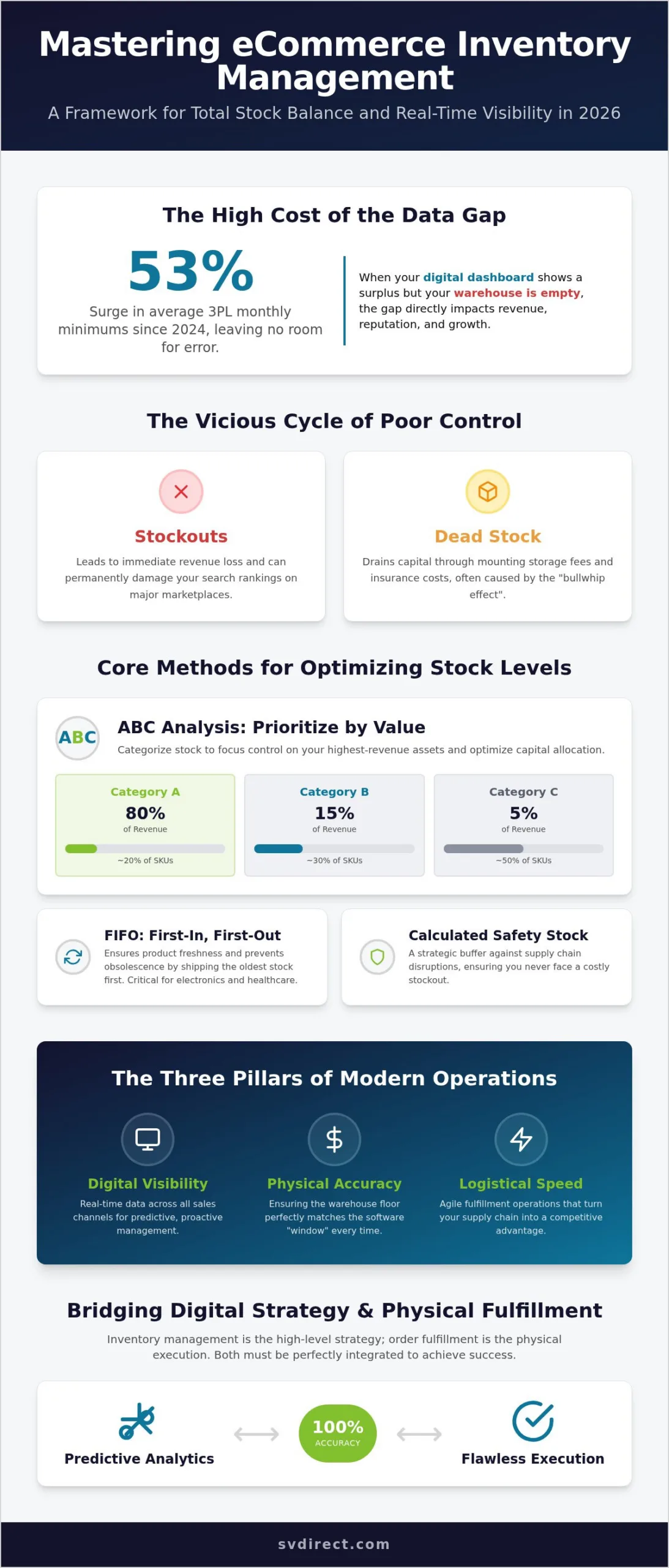
If your digital dashboard shows a healthy surplus but your warehouse floor is actually empty, how much is that data gap costing your brand’s reputation? It’s a question many founders face as average 3PL monthly minimums have surged by 53 percent since 2024, leaving no room for operational error. You likely feel the weight of capital tied up in slow-moving stock while your bestsellers vanish, leading to the inevitable customer frustration that follows inaccurate “in-stock” counts. Manual data entry across multiple sales channels only compounds the stress, making growth feel like a liability rather than a victory.
You deserve a steady hand to help manage these complexities. This guide shows you how to master inventory management for ecommerce by achieving total stock balance and real-time visibility across every channel. We will outline the steps to lower your storage fees through optimized levels and create a seamless bridge between order placement and physical fulfillment. By the end, you’ll have a strategic framework to ensure your physical operations are just as agile and precise as your digital storefront in 2026.
Key Takeaways
- Understand how the shift toward predictive analytics allows you to anticipate market demand rather than simply reacting to stockouts.
- Implement proven methodologies like FIFO and ABC Analysis to prioritize your highest-revenue assets and eliminate product obsolescence.
- Master the balance between digital visibility and physical precision to optimize inventory management for ecommerce across every sales channel.
- Identify the specific operational tipping points that signal it’s time to transition from fixed warehouse costs to a scalable, variable-cost 3PL model.
- Learn how leveraging on-demand digital printing and precise warehouse control can reduce overhead while strengthening customer loyalty.
What is Inventory Management for eCommerce in 2026?
In 2026, the definition of success has shifted. It is no longer just about counting boxes in a back room. Effective inventory management for ecommerce involves the end-to-end supervision of non-capitalized assets, from the moment of procurement through to final delivery. While older models focused on reacting to sales after they happened, the modern standard is “predictive inventory.” This proactive approach uses historical data and market trends to anticipate demand before the first order even arrives.
To scale in this high-stakes environment, your operations must rest on three pillars: digital visibility, physical accuracy, and logistical speed. Many traditional warehouses rely on a “hustle” culture that leads to burnout and frequent errors. At Silicon Valley Direct, we replace that chaotic noise with our “quiet facility” methodology. This approach ensures precision even during peak seasons, treating your stock with the care of a seasoned partner. Mastering inventory management for ecommerce in 2026 requires this level of calm, calculated precision to turn your warehouse into a growth engine.
The Cost of Poor Inventory Control
Inaccurate tracking is not just an inconvenience; it’s a direct hit to your bottom line. Stockouts lead to immediate revenue loss and can permanently damage your search rankings on major marketplaces. Conversely, “dead stock” drains capital through mounting storage fees and insurance costs. This often stems from the “bullwhip effect,” where small fluctuations in retail demand cause massive, inefficient swings in wholesale ordering. Mitigation requires real-time data that reflects the actual state of your shelves without delay.
Inventory Management vs. Order Fulfillment
It’s vital to distinguish between these two functions. Fulfillment is the physical action of picking and packing a product. In contrast, inventory management is the high-level strategy that determines what should be on the shelf in the first place. These functions must be perfectly integrated to achieve 100% accuracy. By partnering with a 3PL fulfillment service that prioritizes both strategy and execution, you turn your supply chain into a competitive advantage. This integration ensures that the software “window” matches the reality of the warehouse floor every single time.
Core Methods for Optimizing eCommerce Stock Levels
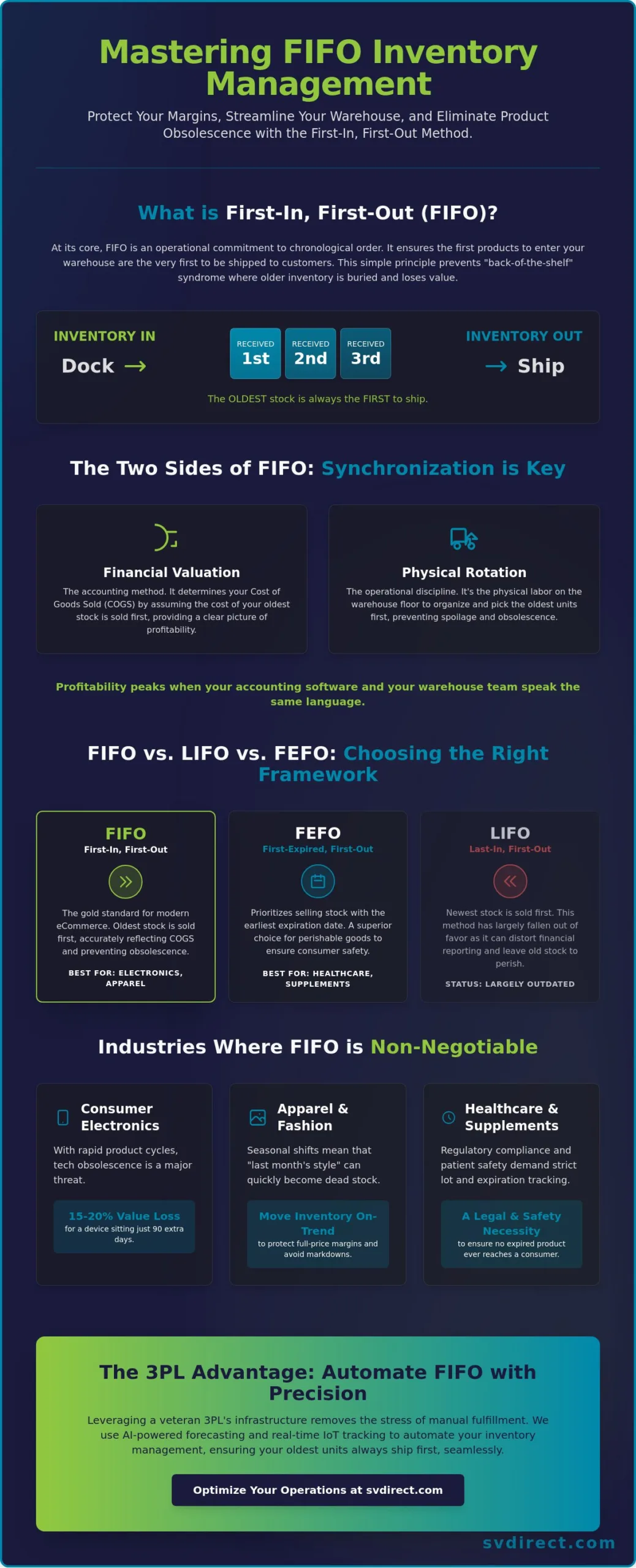
Success in 2026 requires more than just knowing what is on the shelf. It requires a methodology that adapts to your specific product lifecycle. First-In, First-Out (FIFO) remains the gold standard for brands that prioritize product freshness and quality. By ensuring the oldest stock leaves the warehouse first, you can optimize inventory management for ecommerce and prevent the silent revenue drain of obsolescence. This is particularly critical for industries like healthcare or electronics—where brands like Sunshine Valley distribute natural food supplements—because shelf life is finite and technical specifications evolve rapidly.
Not all products are created equal. ABC Analysis allows you to categorize stock based on value and turnover. “A” items typically represent only 20 percent of your SKU count but drive 80 percent of your revenue. By focusing your tightest controls on these high-velocity assets, you optimize your capital. Just-In-Time (JIT) models offer high rewards in lowered storage fees, yet they carry risks in a volatile global market. To buffer against supply chain disruptions, we recommend a calculated Safety Stock. This acts as a strategic insurance policy, ensuring you never face the “out of stock” badge that kills conversion rates and customer trust. To see how these methods apply to your specific volume, you can request a free quote to discuss a tailored strategy.
Managing Complex SKUs and Kitting
Scaling often involves creating bundles or promotional kits that combine multiple products into a single offer. This introduces the “virtual SKU” concept, where individual components are tracked separately in the warehouse but appear as a single unit to the customer. Managing this complexity requires high-touch precision and an integrated digital view. Silicon Valley Direct provides kitting and hand assembly services that ensure these multi-component orders are built accurately every time. This maintains the integrity of your inventory management for ecommerce even during high-volume promotional pushes or seasonal spikes.
Cycle Counting vs. Physical Audits
Traditional annual physical audits are disruptive and often reveal errors too late to fix. They force a complete halt to operations, which is unacceptable for a fast-moving brand. In contrast, modern Effectively Manage Inventory strategies favor cycle counting. Cycle counting is a rolling audit process that maintains 99 percent accuracy without pausing operations. Our systematic QC-Check inspection process builds this continuous verification into the daily workflow. This ensures that the 120+ standard reports available in your Remote Control™ system reflect the absolute truth of the warehouse floor at any given moment.
The Critical Bridge: Integrating Software with Warehouse Operations
Software is often marketed as a cure-all, but in reality, it’s merely a window into your physical operations. The most sophisticated dashboard is useless if the data it displays doesn’t mirror the actual shelf. Successful inventory management for ecommerce relies on the synergy between digital tools and the human expertise managing the warehouse floor. Without this bridge, brands fall victim to “ghost inventory,” where a website displays items as in-stock that are physically unavailable. This leads to backorders, canceled sales, and eroded customer trust.
To maintain a seamless data flow, integration must be platform-agnostic. Our systems utilize XML, SOAP, and WSDL protocols to ensure that information moves instantly between your storefront and our facility. This technical flexibility allows us to act as a high-performance extension of your team, regardless of which ecommerce platform you use. By implementing essential inventory management techniques through our proprietary Remote Control™ system, you gain a central hub that synchronizes every transaction with physical reality. This eliminates the lag time that often plagues growing brands during rapid scaling phases.
24/7 Visibility with Remote Control™
True operational confidence comes from transparency. Our Remote Order Management system provides 24/7 access to your data, offering over 120 standard reports that detail everything from order history to real-time stock levels. You don’t have to wait for manual updates or business hours to understand your position. Automated notifications for low inventory and backorders ensure you can make proactive decisions before a shortage impacts your sales velocity. This system was designed to provide the depth necessary for technical stakeholders while remaining accessible for daily business decisions.
Removing the ‘Hectic’ from Fulfillment
Many fulfillment centers operate in a state of constant chaos, but we believe precision requires a “quiet facility” methodology. We replace the frantic energy of traditional warehouses with organized, deliberate prioritization. This methodical approach allows us to meet high-volume deadlines with a significantly lower error rate than industry averages. Our team practices proactive problem solving, identifying potential order conflicts or shipping discrepancies before the package ever leaves the dock. This stability is a unique hallmark of our internal culture, where seasoned experts oversee every detail of your inventory management for ecommerce. We reject automated-only interactions, ensuring that a human set of eyes monitors your most critical assets.
When to Outsource Inventory Management to a Professional 3PL
Deciding when to move your operations out of a private lease or a crowded back office is a pivotal moment for any brand. You’ll know you’ve reached the tipping point when warehouse rent and labor management begin to consume more time than your core product development. If shipping errors are stifling your growth, it’s time to reconsider your approach to inventory management for ecommerce. Transitioning to a 3PL shifts you from a “fixed cost” model, where you pay for empty warehouse space and idle staff, to a “variable cost” model. You only pay for the space and labor you actually use, which preserves your capital for marketing and innovation.
A professional partner provides more than just square footage. You gain immediate access to discounted carrier rates and global logistics expertise that would take years to negotiate independently. Beyond standard shipping, specialized services like on-demand digital printing and literature fulfillment allow you to customize orders without the overhead of in-house equipment. This level of versatility ensures your fulfillment strategy remains as agile as your digital marketing. By outsourcing, you leverage physical infrastructure and human expertise that in-house teams simply can’t replicate at scale.
Handling High-Value and Sensitive Goods
Sensitive inventory requires more than a standard shelf. Electronics and healthcare products often demand secure, climate-controlled environments to maintain their integrity. Precision here involves serial number tracking, which is vital for warranty management and returns processing. For a deeper look at these requirements, see our guide on Secure Warehousing for High-Value Electronics. Our systematic QC-Check process ensures these high-stakes items are handled with absolute care, providing a level of security that generic storage facilities lack.
The ‘Extension of Your Team’ Philosophy
We reject the cookie-cutter approach common in highly automated, impersonal facilities. A true partnership requires a steady hand and a personal commitment to your specific project goals. This flexibility allows us to custom-fit solutions rather than forcing your business into a rigid template. Silicon Valley Direct has served as a reliable anchor for brands since 1999. Our multi-decade history and long-term staff retention mean you’re working with seasoned experts who understand the nuances of inventory management for ecommerce. We act as a proactive extension of your team, identifying logistical hurdles before they become customer complaints.
Maximizing eCommerce ROI Through Precise Inventory Control
Precision in the warehouse translates directly to your bottom line. When your inventory management for ecommerce is executed with absolute accuracy, you create a foundation for customer loyalty that no marketing campaign can match. A customer who receives exactly what they ordered, exactly when promised, is a customer who returns. This reliability reduces the costs associated with returns management and customer support, allowing you to reinvest that capital into growth. It’s about turning your logistics from a cost center into a retention engine that drives long-term value.
Beyond simple stock tracking, integrating specialized services like on-demand digital printing and variable data printing significantly reduces your inventory overhead. Instead of pre-printing thousands of marketing inserts that might become obsolete, you print only what you need for each specific order. This agility ensures your collateral is always current and relevant. Detailed reporting from our Remote Control™ system provides your marketing department with the granular data needed to understand which products are truly profitable after accounting for storage and fulfillment costs. We provide the “window” into your operations that allows for these high-level strategic pivots. Silicon Valley Direct is the strategic choice for brands that value this level of high-touch quality over the impersonal model of high-volume facilities.
Reducing Waste with Green Logistics
Digital printing eliminates the need for massive stockpiles of marketing materials that eventually end up in a landfill. By adopting a “print what you use” philosophy, you significantly lower your brand’s environmental footprint. Our Print on Demand Services utilize sustainable materials and participate in programs like HP’s hardware recycling to ensure our operations remain as green as they are efficient. This commitment to sustainability is part of our proactive problem-solving approach. It ensures that your physical operations align with modern environmental standards without sacrificing logistical speed or precision.
Next Steps: Auditing Your Current System
Evaluating your current operations requires a cold, hard look at your data accuracy and fulfillment speed. Start by comparing your digital stock counts against a physical cycle count. If your discrepancy rate is higher than one percent, your current system is leaking revenue. Look past the slick interface of your software and examine the physical reality of your fulfillment partner. Are they a steady hand in the industry, or are they struggling to keep up with the “hustle” of peak periods? If your current setup feels more like a source of stress than a high-performance partner, it’s time to transition to a more reliable model.
Contact Silicon Valley Direct for a Custom Fulfillment Solution
Building a Scalable Operational Foundation for 2026
Success in the coming year depends on your ability to bridge the gap between digital storefronts and physical reality. You’ve seen how predictive analytics and methods like FIFO or ABC Analysis turn stagnant stock into liquid capital. Effective inventory management for ecommerce isn’t just a back-office task; it’s a primary driver of customer loyalty and long-term ROI. By moving from fixed-cost warehouses to a variable-cost partnership, you gain the agility needed to navigate shifting global regulations and market demands.
Silicon Valley Direct brings over 25 years of operational expertise to your brand’s growth journey. Our proprietary Remote Control™ system provides 24/7 real-time visibility with over 120 standard reports, while our systematic QC-Check process ensures 99 percent accuracy across every SKU. We act as a steady, proactive extension of your team, replacing warehouse chaos with the precision of our “quiet facility” methodology.
Your brand is ready for its next phase of growth. We’re here to ensure your physical operations are just as innovative and reliable as your vision.
Frequently Asked Questions
What is the difference between inventory management and warehouse management?
Inventory management focuses on the high-level strategy of stock levels, demand forecasting, and procurement. Warehouse management deals with the physical movement and storage of goods within a facility, including picking and packing. While the two functions are distinct, they must be perfectly integrated to ensure that your digital records match physical reality.
How much does eCommerce inventory management software typically cost?
Most software providers use a tiered subscription model based on order volume or the number of SKUs. Some enterprise-level platforms require annual licensing fees, while others offer a pay-as-you-grow structure. It’s often more cost-effective to leverage the proprietary systems provided by your 3PL partner to avoid separate software licensing costs while managing inventory management for ecommerce.
What are the most common inventory management mistakes for online stores?
The most frequent errors include relying on manual data entry and failing to account for supplier lead times. These mistakes lead to “ghost inventory” where your site displays items that aren’t physically on the shelf. Another common pitfall is overstocking slow-moving items, which ties up capital that could be used for marketing or product development.
Can a 3PL handle inventory for multiple sales channels like Shopify and Amazon?
A professional 3PL uses platform-agnostic integrations to synchronize inventory management for ecommerce across Shopify, Amazon, and other marketplaces simultaneously. This ensures a single source of truth for your stock levels. Our Remote Control™ system acts as this central hub, pushing real-time updates to every channel to prevent overselling and customer frustration.
How does real-time inventory tracking improve customer satisfaction?
Real-time tracking eliminates the frustration of canceled orders due to stockouts that were not reflected on the storefront. When customers see accurate “in-stock” counts and receive instant shipping updates, their trust in your brand grows. This transparency is a primary driver of repeat purchases and long-term loyalty in a competitive market.
What is a ‘good’ inventory turnover ratio for an eCommerce business?
A healthy inventory turnover ratio generally falls between 4 and 8 for most brands, though this varies significantly by industry. A higher ratio indicates efficient sales velocity, while a lower ratio suggests you’re carrying too much dead stock. The objective is to maintain enough safety stock to prevent stockouts without over-investing in storage fees.
How do I manage inventory for subscription boxes or bundles?
Managing bundles requires a “virtual SKU” strategy where components are tracked individually but sold as a unit. This allows for total flexibility in fulfillment and ensures accurate counts for every part of the kit. Our hand assembly and kitting services specialize in these complex builds to maintain precision during high-volume promotional periods.
What happens if my inventory levels don’t match my software data?
Discrepancies between your software and physical stock usually indicate a failure in the pick-and-pack process or a lack of regular audits. To fix this, you must implement systematic cycle counting rather than waiting for a disruptive annual physical audit. Our QC-Check process builds this verification into the daily workflow to maintain 99 percent accuracy.