img not found!

Inventory Management for eCommerce: The 2026 Strategic Guide to Scaling Operations

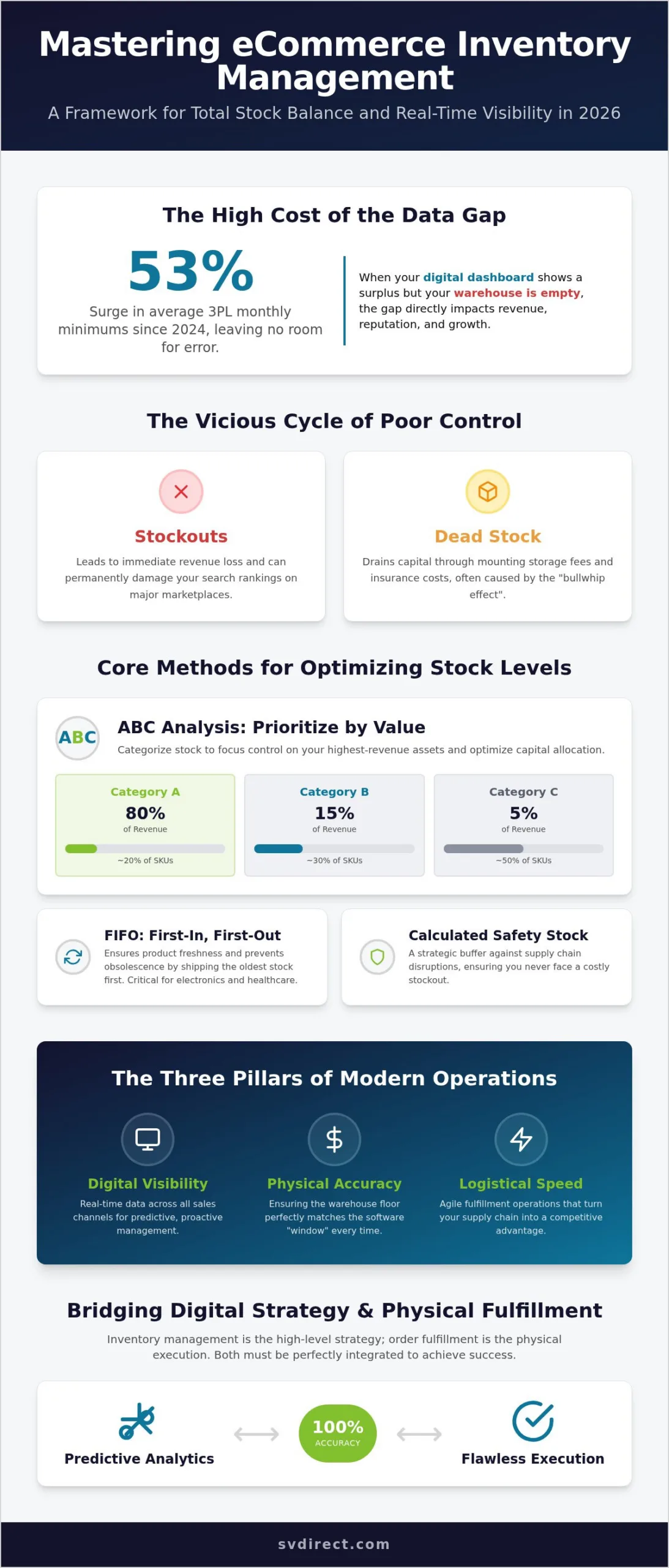
If your digital dashboard shows a healthy surplus but your warehouse floor is actually empty, how much is that data gap costing your brand’s reputation? It’s a question many founders face as average 3PL monthly minimums have surged by 53 percent since 2024, leaving no room for operational error. You likely feel the weight of capital tied up in slow-moving stock while your bestsellers vanish, leading to the inevitable customer frustration that follows inaccurate “in-stock” counts. Manual data entry across multiple sales channels only compounds the stress, making growth feel like a liability rather than a victory.

You deserve a steady hand to help manage these complexities. This guide shows you how to master inventory management for ecommerce by achieving total stock balance and real-time visibility across every channel. We will outline the steps to lower your storage fees through optimized levels and create a seamless bridge between order placement and physical fulfillment. By the end, you’ll have a strategic framework to ensure your physical operations are just as agile and precise as your digital storefront in 2026.

Key Takeaways

  • Understand how the shift toward predictive analytics allows you to anticipate market demand rather than simply reacting to stockouts.
  • Implement proven methodologies like FIFO and ABC Analysis to prioritize your highest-revenue assets and eliminate product obsolescence.
  • Master the balance between digital visibility and physical precision to optimize inventory management for ecommerce across every sales channel.
  • Identify the specific operational tipping points that signal it’s time to transition from fixed warehouse costs to a scalable, variable-cost 3PL model.
  • Learn how leveraging on-demand digital printing and precise warehouse control can reduce overhead while strengthening customer loyalty.

What is Inventory Management for eCommerce in 2026?

In 2026, the definition of success has shifted. It is no longer just about counting boxes in a back room. Effective inventory management for ecommerce involves the end-to-end supervision of non-capitalized assets, from the moment of procurement through to final delivery. While older models focused on reacting to sales after they happened, the modern standard is “predictive inventory.” This proactive approach uses historical data and market trends to anticipate demand before the first order even arrives.

To scale in this high-stakes environment, your operations must rest on three pillars: digital visibility, physical accuracy, and logistical speed. Many traditional warehouses rely on a “hustle” culture that leads to burnout and frequent errors. At Silicon Valley Direct, we replace that chaotic noise with our “quiet facility” methodology. This approach ensures precision even during peak seasons, treating your stock with the care of a seasoned partner. Mastering inventory management for ecommerce in 2026 requires this level of calm, calculated precision to turn your warehouse into a growth engine.

The Cost of Poor Inventory Control

Inaccurate tracking is not just an inconvenience; it’s a direct hit to your bottom line. Stockouts lead to immediate revenue loss and can permanently damage your search rankings on major marketplaces. Conversely, “dead stock” drains capital through mounting storage fees and insurance costs. This often stems from the “bullwhip effect,” where small fluctuations in retail demand cause massive, inefficient swings in wholesale ordering. Mitigation requires real-time data that reflects the actual state of your shelves without delay.

Inventory Management vs. Order Fulfillment

It’s vital to distinguish between these two functions. Fulfillment is the physical action of picking and packing a product. In contrast, inventory management is the high-level strategy that determines what should be on the shelf in the first place. These functions must be perfectly integrated to achieve 100% accuracy. By partnering with a 3PL fulfillment service that prioritizes both strategy and execution, you turn your supply chain into a competitive advantage. This integration ensures that the software “window” matches the reality of the warehouse floor every single time.

Core Methods for Optimizing eCommerce Stock Levels

Success in 2026 requires more than just knowing what is on the shelf. It requires a methodology that adapts to your specific product lifecycle. First-In, First-Out (FIFO) remains the gold standard for brands that prioritize product freshness and quality. By ensuring the oldest stock leaves the warehouse first, you can optimize inventory management for ecommerce and prevent the silent revenue drain of obsolescence. This is particularly critical for industries like healthcare or electronics—where brands like Sunshine Valley distribute natural food supplements—because shelf life is finite and technical specifications evolve rapidly.

Not all products are created equal. ABC Analysis allows you to categorize stock based on value and turnover. “A” items typically represent only 20 percent of your SKU count but drive 80 percent of your revenue. By focusing your tightest controls on these high-velocity assets, you optimize your capital. Just-In-Time (JIT) models offer high rewards in lowered storage fees, yet they carry risks in a volatile global market. To buffer against supply chain disruptions, we recommend a calculated Safety Stock. This acts as a strategic insurance policy, ensuring you never face the “out of stock” badge that kills conversion rates and customer trust. To see how these methods apply to your specific volume, you can request a free quote to discuss a tailored strategy.

Managing Complex SKUs and Kitting

Scaling often involves creating bundles or promotional kits that combine multiple products into a single offer. This introduces the “virtual SKU” concept, where individual components are tracked separately in the warehouse but appear as a single unit to the customer. Managing this complexity requires high-touch precision and an integrated digital view. Silicon Valley Direct provides kitting and hand assembly services that ensure these multi-component orders are built accurately every time. This maintains the integrity of your inventory management for ecommerce even during high-volume promotional pushes or seasonal spikes.

Cycle Counting vs. Physical Audits

Traditional annual physical audits are disruptive and often reveal errors too late to fix. They force a complete halt to operations, which is unacceptable for a fast-moving brand. In contrast, modern Effectively Manage Inventory strategies favor cycle counting. Cycle counting is a rolling audit process that maintains 99 percent accuracy without pausing operations. Our systematic QC-Check inspection process builds this continuous verification into the daily workflow. This ensures that the 120+ standard reports available in your Remote Control™ system reflect the absolute truth of the warehouse floor at any given moment.

The Critical Bridge: Integrating Software with Warehouse Operations

Software is often marketed as a cure-all, but in reality, it’s merely a window into your physical operations. The most sophisticated dashboard is useless if the data it displays doesn’t mirror the actual shelf. Successful inventory management for ecommerce relies on the synergy between digital tools and the human expertise managing the warehouse floor. Without this bridge, brands fall victim to “ghost inventory,” where a website displays items as in-stock that are physically unavailable. This leads to backorders, canceled sales, and eroded customer trust.

To maintain a seamless data flow, integration must be platform-agnostic. Our systems utilize XML, SOAP, and WSDL protocols to ensure that information moves instantly between your storefront and our facility. This technical flexibility allows us to act as a high-performance extension of your team, regardless of which ecommerce platform you use. By implementing essential inventory management techniques through our proprietary Remote Control™ system, you gain a central hub that synchronizes every transaction with physical reality. This eliminates the lag time that often plagues growing brands during rapid scaling phases.

24/7 Visibility with Remote Control™

True operational confidence comes from transparency. Our Remote Order Management system provides 24/7 access to your data, offering over 120 standard reports that detail everything from order history to real-time stock levels. You don’t have to wait for manual updates or business hours to understand your position. Automated notifications for low inventory and backorders ensure you can make proactive decisions before a shortage impacts your sales velocity. This system was designed to provide the depth necessary for technical stakeholders while remaining accessible for daily business decisions.

Removing the ‘Hectic’ from Fulfillment

Many fulfillment centers operate in a state of constant chaos, but we believe precision requires a “quiet facility” methodology. We replace the frantic energy of traditional warehouses with organized, deliberate prioritization. This methodical approach allows us to meet high-volume deadlines with a significantly lower error rate than industry averages. Our team practices proactive problem solving, identifying potential order conflicts or shipping discrepancies before the package ever leaves the dock. This stability is a unique hallmark of our internal culture, where seasoned experts oversee every detail of your inventory management for ecommerce. We reject automated-only interactions, ensuring that a human set of eyes monitors your most critical assets.
Inventory Management for eCommerce: The 2026 Strategic Guide to Scaling Operations

When to Outsource Inventory Management to a Professional 3PL

Deciding when to move your operations out of a private lease or a crowded back office is a pivotal moment for any brand. You’ll know you’ve reached the tipping point when warehouse rent and labor management begin to consume more time than your core product development. If shipping errors are stifling your growth, it’s time to reconsider your approach to inventory management for ecommerce. Transitioning to a 3PL shifts you from a “fixed cost” model, where you pay for empty warehouse space and idle staff, to a “variable cost” model. You only pay for the space and labor you actually use, which preserves your capital for marketing and innovation.

A professional partner provides more than just square footage. You gain immediate access to discounted carrier rates and global logistics expertise that would take years to negotiate independently. Beyond standard shipping, specialized services like on-demand digital printing and literature fulfillment allow you to customize orders without the overhead of in-house equipment. This level of versatility ensures your fulfillment strategy remains as agile as your digital marketing. By outsourcing, you leverage physical infrastructure and human expertise that in-house teams simply can’t replicate at scale.

Handling High-Value and Sensitive Goods

Sensitive inventory requires more than a standard shelf. Electronics and healthcare products often demand secure, climate-controlled environments to maintain their integrity. Precision here involves serial number tracking, which is vital for warranty management and returns processing. For a deeper look at these requirements, see our guide on Secure Warehousing for High-Value Electronics. Our systematic QC-Check process ensures these high-stakes items are handled with absolute care, providing a level of security that generic storage facilities lack.

The ‘Extension of Your Team’ Philosophy

We reject the cookie-cutter approach common in highly automated, impersonal facilities. A true partnership requires a steady hand and a personal commitment to your specific project goals. This flexibility allows us to custom-fit solutions rather than forcing your business into a rigid template. Silicon Valley Direct has served as a reliable anchor for brands since 1999. Our multi-decade history and long-term staff retention mean you’re working with seasoned experts who understand the nuances of inventory management for ecommerce. We act as a proactive extension of your team, identifying logistical hurdles before they become customer complaints.

Maximizing eCommerce ROI Through Precise Inventory Control

Precision in the warehouse translates directly to your bottom line. When your inventory management for ecommerce is executed with absolute accuracy, you create a foundation for customer loyalty that no marketing campaign can match. A customer who receives exactly what they ordered, exactly when promised, is a customer who returns. This reliability reduces the costs associated with returns management and customer support, allowing you to reinvest that capital into growth. It’s about turning your logistics from a cost center into a retention engine that drives long-term value.

Beyond simple stock tracking, integrating specialized services like on-demand digital printing and variable data printing significantly reduces your inventory overhead. Instead of pre-printing thousands of marketing inserts that might become obsolete, you print only what you need for each specific order. This agility ensures your collateral is always current and relevant. Detailed reporting from our Remote Control™ system provides your marketing department with the granular data needed to understand which products are truly profitable after accounting for storage and fulfillment costs. We provide the “window” into your operations that allows for these high-level strategic pivots. Silicon Valley Direct is the strategic choice for brands that value this level of high-touch quality over the impersonal model of high-volume facilities.

Reducing Waste with Green Logistics

Digital printing eliminates the need for massive stockpiles of marketing materials that eventually end up in a landfill. By adopting a “print what you use” philosophy, you significantly lower your brand’s environmental footprint. Our Print on Demand Services utilize sustainable materials and participate in programs like HP’s hardware recycling to ensure our operations remain as green as they are efficient. This commitment to sustainability is part of our proactive problem-solving approach. It ensures that your physical operations align with modern environmental standards without sacrificing logistical speed or precision.

Next Steps: Auditing Your Current System

Evaluating your current operations requires a cold, hard look at your data accuracy and fulfillment speed. Start by comparing your digital stock counts against a physical cycle count. If your discrepancy rate is higher than one percent, your current system is leaking revenue. Look past the slick interface of your software and examine the physical reality of your fulfillment partner. Are they a steady hand in the industry, or are they struggling to keep up with the “hustle” of peak periods? If your current setup feels more like a source of stress than a high-performance partner, it’s time to transition to a more reliable model.

Contact Silicon Valley Direct for a Custom Fulfillment Solution

Building a Scalable Operational Foundation for 2026

Success in the coming year depends on your ability to bridge the gap between digital storefronts and physical reality. You’ve seen how predictive analytics and methods like FIFO or ABC Analysis turn stagnant stock into liquid capital. Effective inventory management for ecommerce isn’t just a back-office task; it’s a primary driver of customer loyalty and long-term ROI. By moving from fixed-cost warehouses to a variable-cost partnership, you gain the agility needed to navigate shifting global regulations and market demands.

Silicon Valley Direct brings over 25 years of operational expertise to your brand’s growth journey. Our proprietary Remote Control™ system provides 24/7 real-time visibility with over 120 standard reports, while our systematic QC-Check process ensures 99 percent accuracy across every SKU. We act as a steady, proactive extension of your team, replacing warehouse chaos with the precision of our “quiet facility” methodology.

Your brand is ready for its next phase of growth. We’re here to ensure your physical operations are just as innovative and reliable as your vision.

Frequently Asked Questions

What is the difference between inventory management and warehouse management?

Inventory management focuses on the high-level strategy of stock levels, demand forecasting, and procurement. Warehouse management deals with the physical movement and storage of goods within a facility, including picking and packing. While the two functions are distinct, they must be perfectly integrated to ensure that your digital records match physical reality.

How much does eCommerce inventory management software typically cost?

Most software providers use a tiered subscription model based on order volume or the number of SKUs. Some enterprise-level platforms require annual licensing fees, while others offer a pay-as-you-grow structure. It’s often more cost-effective to leverage the proprietary systems provided by your 3PL partner to avoid separate software licensing costs while managing inventory management for ecommerce.

What are the most common inventory management mistakes for online stores?

The most frequent errors include relying on manual data entry and failing to account for supplier lead times. These mistakes lead to “ghost inventory” where your site displays items that aren’t physically on the shelf. Another common pitfall is overstocking slow-moving items, which ties up capital that could be used for marketing or product development.

Can a 3PL handle inventory for multiple sales channels like Shopify and Amazon?

A professional 3PL uses platform-agnostic integrations to synchronize inventory management for ecommerce across Shopify, Amazon, and other marketplaces simultaneously. This ensures a single source of truth for your stock levels. Our Remote Control™ system acts as this central hub, pushing real-time updates to every channel to prevent overselling and customer frustration.

How does real-time inventory tracking improve customer satisfaction?

Real-time tracking eliminates the frustration of canceled orders due to stockouts that were not reflected on the storefront. When customers see accurate “in-stock” counts and receive instant shipping updates, their trust in your brand grows. This transparency is a primary driver of repeat purchases and long-term loyalty in a competitive market.

What is a ‘good’ inventory turnover ratio for an eCommerce business?

A healthy inventory turnover ratio generally falls between 4 and 8 for most brands, though this varies significantly by industry. A higher ratio indicates efficient sales velocity, while a lower ratio suggests you’re carrying too much dead stock. The objective is to maintain enough safety stock to prevent stockouts without over-investing in storage fees.

How do I manage inventory for subscription boxes or bundles?

Managing bundles requires a “virtual SKU” strategy where components are tracked individually but sold as a unit. This allows for total flexibility in fulfillment and ensures accurate counts for every part of the kit. Our hand assembly and kitting services specialize in these complex builds to maintain precision during high-volume promotional periods.

What happens if my inventory levels don’t match my software data?

Discrepancies between your software and physical stock usually indicate a failure in the pick-and-pack process or a lack of regular audits. To fix this, you must implement systematic cycle counting rather than waiting for a disruptive annual physical audit. Our QC-Check process builds this verification into the daily workflow to maintain 99 percent accuracy.

FIFO Inventory Management: The 2026 Guide to Preventing Obsolescence

FIFO Inventory Management: The 2026 Guide to Preventing Obsolescence

Your financial ledger might show a healthy balance, but if your warehouse floor is cluttered with products that should have shipped six months ago, your margins are already bleeding. Effective fifo inventory management is less about accounting spreadsheets and more about the physical discipline of your operations. We understand the frustration of seeing capital tied up in dead stock that isn’t moving, especially when you’re trying to accurately report figures under the $32 million small business taxpayer threshold for the 2026 tax year.

You deserve a warehouse that runs with high-tech precision and a ledger that reflects actual stock health. This guide will show you how to master the First-In, First-Out method to protect your margins, streamline your warehouse, and eliminate the waste of product obsolescence. We’ll explore how AI-powered demand forecasting and real-time IoT tracking align your physical stock with your financial goals, ensuring your oldest units are always the first out the door. By the end of this guide, you’ll have a clear roadmap to lower your cost of goods sold and maintain a cleaner, more efficient facility.

Key Takeaways

  • Learn how to align physical product movement with chronological acquisition to ensure your oldest stock always ships first.
  • Discover how fifo inventory management provides a clearer picture of your cost of goods sold while reflecting accurate market values.
  • Identify why FEFO is often the superior choice for perishable goods and why LIFO has largely fallen out of favor for modern eCommerce.
  • Gain actionable steps for organizing your warehouse floor with “Flow-Through” logic to minimize handling errors and obsolete stock.
  • See how leveraging a veteran 3PL’s infrastructure can automate your inventory tracking and remove the stress of manual fulfillment.

What is FIFO Inventory Management? (First-In, First-Out)

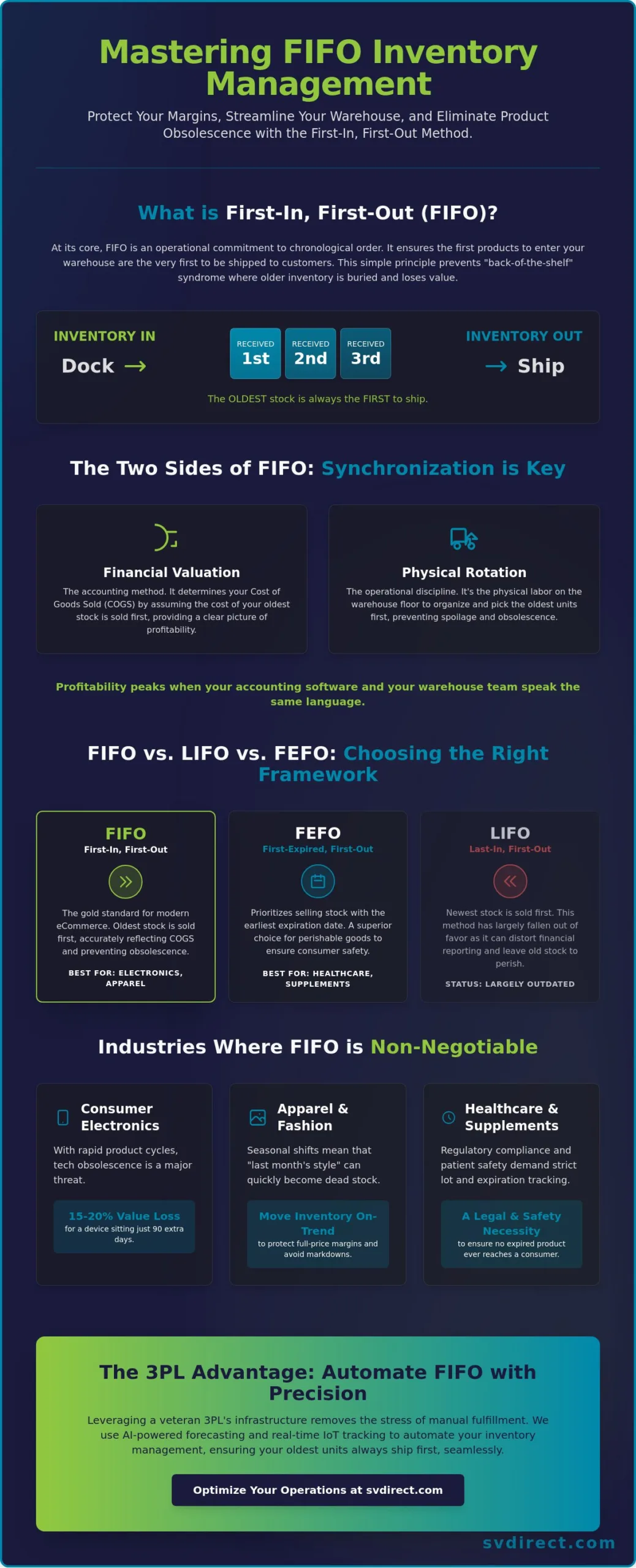
At its core, fifo inventory management is an operational commitment to chronological order. The principle is straightforward: the first items to enter your warehouse are the first ones to leave it. This creates a seamless flow that mirrors the technical concept of First-In, First-Out (FIFO) found in data processing and electronics. In 2026, this method has become the gold standard for eCommerce because it prevents the “back-of-the-shelf” syndrome where older products are buried under new arrivals. We define FIFO as the strategic movement of inventory to ensure the freshest stock remains available for every customer order.

Modern logistics in 2026 relies on more than just manual clipboards. We use real-time tracking and pre-configured integrations to ensure every SKU is accounted for from the moment it hits our dock. This level of precision is why fifo inventory management remains the preferred strategy for high-growth brands. It provides a steady hand in a fast-paced market, allowing you to scale without the fear of hidden losses tucked away in dark corners of the warehouse. When your physical product flow aligns with your acquisition dates, you eliminate the guesswork that leads to wasted capital.

The Difference Between FIFO Valuation and FIFO Rotation

Understanding the nuance between financial valuation and physical rotation is critical for your bottom line. Valuation is the accounting side; it determines the cost of goods sold based on the price of your oldest stock. Rotation is the physical labor performed on the warehouse floor. If your team picks the newest pallet because it’s easier to reach, but your accountant records the cost of the oldest unit, your financial ledgers and physical reality will drift apart. Accuracy requires these two systems to be perfectly synchronized. Over our 26 years in the industry, we’ve seen that profitability peaks when your warehouse team and your accounting software speak the same language.

Industries Where FIFO is Non-Negotiable

For specific sectors, this discipline isn’t just a best practice; it’s a requirement for survival. In these high-stakes environments, anything less than total precision can lead to significant financial or regulatory penalties.

  • Consumer Electronics: With product cycles moving faster than ever, a device sitting for an extra 90 days can lose 15% to 20% of its market value due to technical obsolescence.
  • Apparel and Fashion: Seasonal shifts mean that “last month’s style” quickly becomes dead stock. FIFO ensures inventory moves while it’s still on-trend and at full margin.
  • Healthcare and Supplements: Regulatory compliance and patient safety demand strict lot tracking. You must ensure no expired product ever reaches a consumer, making chronological rotation a legal necessity.

The Financial and Operational Benefits of the FIFO Method

Implementing fifo inventory management transforms your warehouse from a simple storage site into a high-performance engine for capital preservation. By moving goods before they become unsellable, you significantly reduce the risk of obsolescence. This is a major drain on liquidity for any growing business. Stagnant pallets occupy valuable real estate and represent dead capital that could be better utilized elsewhere. A strict FIFO protocol ensures that your warehouse floor remains fluid; this maximizes every square foot of your facility and prevents the accumulation of dusty, outdated stock. Protecting that inventory from theft and shrinkage is equally critical, and investing in secure warehousing services ensures your capital-preserving efforts aren’t undermined by supply chain crime.

Effective inventory management is the cornerstone of healthy gross margins. When you use the FIFO method, your Cost of Goods Sold (COGS) reflects the actual chronological cost of items. This provides stakeholders with a clear, undistorted picture of profitability that is vital for making informed decisions about pricing and procurement. Because the oldest costs are cleared out first, your financial reporting remains grounded in reality rather than estimates.

Protecting Margins Against Inflation

During inflationary periods, supply chain costs inevitably rise. FIFO handles these fluctuations more effectively than methods like LIFO because it matches older, lower costs against current revenue. This results in a higher net income and a more realistic valuation of ending inventory on your balance sheet. It ensures that the assets remaining in your warehouse are valued at the most recent, relevant prices. If you want to optimize these financial flows, our inventory management services provide the real-time visibility needed to track every dollar accurately.

Compliance and Quality Control in Healthcare

In the healthcare and medical device sectors, the margin for error is zero. We apply our 26 years of experience to ensure that HIPAA standards and medical device regulations are met with absolute precision. Strict lot tracking is the backbone of this process. It allows for immediate action during a recall and guarantees pharmaceutical safety by ensuring no product exceeds its shelf life. We rely on actual team members to perform double-verification on sensitive healthcare kitting; this provides a level of care that automated systems simply cannot match. This human element, combined with modern tech, ensures your compliance is never in question.

FIFO Inventory Management: The 2026 Guide to Preventing Obsolescence

FIFO vs. LIFO vs. FEFO: Choosing the Right Framework

Selecting an inventory framework isn’t just about accounting; it’s a strategic decision for your 2026 growth. While fifo inventory management remains the standard for most brands, the specific nature of your product line might demand a more specialized approach. High-growth companies must decide whether chronological arrival or a specific expiration date should drive their logistics. We’ve spent 26 years helping clients navigate these decisions, ensuring their physical operations match their financial objectives with absolute precision.

LIFO (Last-In, First-Out) has largely become a relic in modern eCommerce fulfillment. It assumes the newest stock is sold first, which creates a logistical nightmare where older inventory remains buried at the back of the warehouse. This leads to “inventory layers” that may never leave the facility, eventually resulting in total loss due to rot or technical obsolescence. Operationally, it’s inefficient to pick the newest arrivals while older stock takes up premium rack space. For brands that value transparency and speed, LIFO’s stagnant layers represent a significant risk.

When to Use FEFO Over Standard FIFO

FEFO (First-Expired, First-Out) is the necessary evolution of fifo inventory management for brands dealing with perishables or time-sensitive goods. If your product line has “hard” expiration dates, like supplements, or “soft” shelf-life dates, like organic skincare, FEFO is your best defense. It requires precise lot-level tracking to ensure safety and quality at every step. For our clients using healthcare-specific mailing solutions, we always recommend FEFO. It guarantees that every kit or sample sent to a patient is well within its usage window, maintaining both safety and regulatory compliance.

The Pitfalls of LIFO in a Global Market

If you plan to scale internationally, LIFO is often a non-starter. The International Financial Reporting Standards (IFRS) strictly prohibit LIFO; this means brands using it face massive reconciliation hurdles when expanding outside the United States. Beyond compliance, LIFO creates a physical bottleneck. It forces warehouse teams to constantly move new stock over old, which increases labor costs and the likelihood of product damage. In a global market that demands high-tech efficiency, the “stagnant layers” created by LIFO can cripple your margins.

Choosing between actual costing and standard costing also impacts your rotation logic. Actual costing tracks the specific purchase price of every unit, providing a granular look at margins that matches the physical flow of your goods. Standard costing uses fixed estimates, which might simplify bookkeeping but can mask real-world price fluctuations. For most 2026 growth strategies, the precision of actual costing is the superior choice. Anything is possible when you have the right data and a veteran team to execute the physical rotation.

How to Implement FIFO in Your Warehouse Operations

Successful fifo inventory management requires more than a software update; it demands a physical reconfiguration of your workspace. While many logistics providers rely solely on digital records, we know that if your warehouse floor isn’t organized for flow, your digital data will eventually lose its integrity. Transitioning to a strict FIFO model involves four foundational steps that turn operational theory into a high-performance reality. These steps ensure that your oldest stock is always the most accessible, preventing the “buried pallet” syndrome that leads to dead stock.

  • Step 1: Flow-Through Logic. Configure your racking so that products are loaded from the rear and picked from the front. This physical constraint makes it impossible to pick newer stock before older units are cleared.
  • Step 2: SKU and Lot Tracking. Implement a Warehouse Management System (WMS) that assigns a digital “birth certificate” to every lot. This allows for real-time tracking of stock age across your entire supply chain.
  • Step 3: Double-Verification. Train your team on a rigorous picking process where two different team members verify the lot number and acquisition date before an order is packed. This human touch is our signature for maintaining 99.9% accuracy.
  • Step 4: Cycle Counting. Conduct regular audits to reconcile your physical stock with your digital ledgers. In 2026, high-growth brands perform these counts weekly to ensure that stock ages haven’t drifted from the recorded data.

Physical Infrastructure for FIFO Success

Gravity flow racks are the premier solution for enforcing FIFO at the shelf level. These systems use inclined rollers to slide the oldest box to the front every time a unit is picked. For smaller items used in kitting and assembly, we utilize a ‘Two-Bin’ system. When the first bin is emptied, it’s sent for replenishment while the second bin becomes the primary source. This simple, visual method ensures continuous rotation without complex calculations. We also employ color-coded labeling to provide an immediate visual cue of stock age for our floor team. Pairing this physical infrastructure with secure warehousing services that integrate real-time digital oversight creates a zero-loss environment where both rotation accuracy and inventory protection work in tandem.

The Role of WMS and API Integrations

Your tech stack must act as a seamless extension of your physical operations. By integrating your Shopify or WooCommerce store with our 3PL inventory software through pre-configured APIs, you gain instant visibility into your stock levels. API-driven visibility acts as the central nervous system of 2026 logistics, ensuring that every digital transaction triggers an immediate and accurate physical response in the warehouse. This eliminates the “never-ending questions” about stock status and allows you to focus on growth. If you’re ready to modernize your operations, our eCommerce order fulfillment services provide the infrastructure and expertise to execute a flawless FIFO strategy.

The 3PL Advantage: Leveraging Silicon Valley Direct for FIFO

Outsourcing fifo inventory management to a veteran partner eliminates the operational stress of managing physical stock rotation. While many “virtual” logistics startups rely on outsourced labor and opaque, automated-only systems, we offer a level of stability grounded in a 26-year legacy. This experience allows us to handle high-stakes logistics with a quiet confidence that newer players haven’t earned yet. By partnering with a tech-savvy veteran, you gain the infrastructure and the human expertise necessary to execute complex inventory strategies without the overhead of managing a private facility. For a deeper look at how to evaluate your options, our guide to logistics companies in Silicon Valley covers the key factors high-growth brands should consider when selecting a 3PL partner in 2026.

We’ve always rejected the idea that automation should replace human judgment. Half of our team members have over a decade of tenure at Silicon Valley Direct; this internal stability is a unique hallmark of our expert-level service. This experienced team ensures that your complex kitting and assembly projects are handled with strict FIFO rigor. Our staff doesn’t just scan barcodes; they understand the specific nuances of your product line. This human touch provides a layer of double-verification for accuracy that ensures your oldest units are always the first ones picked and packed.

Bespoke Solutions for Silicon Valley Startups and Enterprises

Based in Union City, CA, our secure, climate-controlled facility serves as a premier hub for both agile startups and global enterprises. We provide tailored inventory management that scales effortlessly with your order volume, whether you’re shipping 500 or 50,000 units a month. Our “Anything is possible” approach means we don’t force you into a one-size-fits-all box. From specialized healthcare mailing services to intricate literature fulfillment, our facility is designed to adapt to your bespoke requirements. You get the precision of a high-tech operation with the personal touch of a dedicated partner.

Real-Time Control and Global Reach

Transparency is a core value of our partnership model. You can access your inventory data 24/7 through our secure web portal, giving you instant visibility into stock ages and movement. This real-time data allows you to make informed procurement decisions and maintain better alignment between your physical stock and financial ledgers. From our Silicon Valley hub, we coordinate seamless global shipping and logistics, ensuring your products reach international markets with speed and accuracy. If you’re ready to eliminate dead stock and protect your margins, it’s time to partner with Silicon Valley Direct for precision inventory management.

Future-Proof Your Supply Chain with FIFO Precision

Mastering fifo inventory management is the most direct path to protecting your margins and eliminating the waste of obsolete stock. By aligning your physical warehouse flow with real-time digital tracking, you ensure your oldest capital is always the first to move. This operational rigor provides the financial clarity needed to scale confidently in 2026. Whether you’re navigating the $32 million small business tax threshold or managing sensitive products that require strict lot tracking, the right framework turns inventory from a liability into a liquid asset.

You don’t have to manage these complexities alone. With 26 years of industry experience and a dedicated team boasting an average tenure of over 10 years, we provide the stability and precision your brand deserves. Our HIPAA-compliant healthcare fulfillment capabilities ensure that even the most regulated products are handled with absolute care. We’re eager to show you how our human-centric approach and modern tech stack can streamline your growth. Request a Tailored Fulfillment Quote from Silicon Valley Direct today to see how we can transform your logistics. Anything is possible when you have a steady hand guiding your operations.

Frequently Asked Questions

Is FIFO required by law for eCommerce businesses?

No legal mandate requires U.S. based eCommerce businesses to use FIFO for domestic operations. However, it is the mandatory standard under International Financial Reporting Standards (IFRS). If you plan to scale your brand globally in 2026, you must use FIFO because the LIFO method is prohibited in international markets. Most growth oriented brands adopt it early to ensure their financial reporting remains compliant with global accounting principles.

What happens to my taxes if I switch from LIFO to FIFO?

Switching methods requires a one-time tax adjustment known as a Section 481(a) adjustment. This process accounts for the cumulative difference in inventory valuation between the two methods. For the 2026 tax year, businesses with average annual gross receipts of $32 million or less may find fifo inventory management easier to reconcile with simplified accounting rules. You’ll need to file IRS Form 3115 to officially notify the government of your change in accounting method.

Can FIFO be managed without expensive warehouse software?

You can implement physical FIFO using low-tech solutions like gravity flow racks or color-coded floor markings. These physical constraints ensure the oldest box is always at the front of the pick face. While manual systems work for small operations, they become difficult to manage once you exceed 1,000 monthly shipments. Partnering with a tech-forward 3PL allows you to leverage enterprise-level software and API integrations without the heavy upfront capital investment.

How does FIFO impact my returns management process?

Returns require careful re-integration to maintain chronological integrity. When an item is returned and inspected for resale, it shouldn’t simply be tossed on top of the pile. Our returns management team assigns a specific lot date to restocked items so they’re picked in the correct sequence. This prevents returned goods from becoming permanent residents on your shelves while newer stock moves around them.

What is the biggest mistake companies make when implementing FIFO?

The most frequent error is focusing on the digital ledger while ignoring the physical warehouse layout. If your software says you’re shipping the oldest units, but your warehouse floor is cluttered with “buried” pallets, your data is a fiction. Without a “Flow-Through” racking design, pickers will naturally grab the easiest items to reach. This creates a disconnect that leads to inaccurate financial reporting and unexpected dead stock at the end of the year.

How does Silicon Valley Direct ensure FIFO accuracy for healthcare products?

We rely on a double-verification process performed by actual team members rather than just automated systems. Our staff manually checks lot numbers and expiration dates against the digital pick ticket to ensure 99.9% accuracy. This human element is critical for healthcare kitting and pharmaceutical safety. We’ve refined this process over 26 years to ensure our clients remain compliant with strict industry regulations and safety standards.

Does FIFO work for products without expiration dates?

Yes, it’s highly effective for non-perishables like consumer electronics or apparel. Even without a hard expiration date, products can become technically obsolete or suffer from “shelf wear” like dust and packaging damage. Moving the oldest units first ensures that every customer receives a product in pristine condition. It also keeps your warehouse floor fluid, preventing older models from taking up premium space when new versions launch.

How often should I audit my FIFO system for accuracy?

High-growth brands should conduct weekly cycle counts to maintain 2026 operational standards. A full physical inventory audit should be performed at least once every 90 days. These regular checks reconcile your digital records with the actual age of the stock on your shelves. Frequent auditing catches rotation errors early, ensuring your cost of goods sold remains accurate and your warehouse operations stay lean.