img not found!
Product Bundling Services: The 2026 Strategic Guide to Operational Excellence

Product Bundling Services: The 2026 Strategic Guide to Operational Excellence

What if the marketing strategy designed to boost your revenue is actually the very thing quietly eroding your operational margins? While professional product bundling services can increase average order value by 20 to 30 percent, the logistical reality often tells a different story. You’ve likely felt the frustration of inventory synchronization gaps or the sting of a customer receiving a custom promotional set with missing components. These aren’t just minor hiccups; they’re the direct result of manual kitting processes that simply can’t keep pace with modern demand.

We believe that high-performance fulfillment should be a source of competitive advantage, not a source of stress. This strategic guide will help you transform kitting from a complex back-office task into a high-efficiency operation that prioritizes precision and quality. You’ll discover how to leverage advanced technology and human expertise to ensure every bundle is an error-free representation of your brand. We’ll examine the specific systems, quality control standards, and digital integrations necessary to achieve operational excellence in 2026.

Key Takeaways

  • Learn how to move beyond marketing theory by integrating professional product bundling services into a precision-driven fulfillment workflow.
  • Identify the critical operational hurdles, such as inventory fragmentation and manual kitting errors, that can undermine your brand’s scalability.
  • Discover how to design a premium unboxing experience through high-resolution digital printing and bespoke assembly techniques.
  • Understand the importance of real-time inventory tracking and proactive problem-solving to maintain accuracy across complex promotional sets.
  • Explore how positioning your logistics partner as a seamless extension of your team can drive sustainable growth and long-term customer loyalty.

What Are Product Bundling Services in the 3PL Landscape?

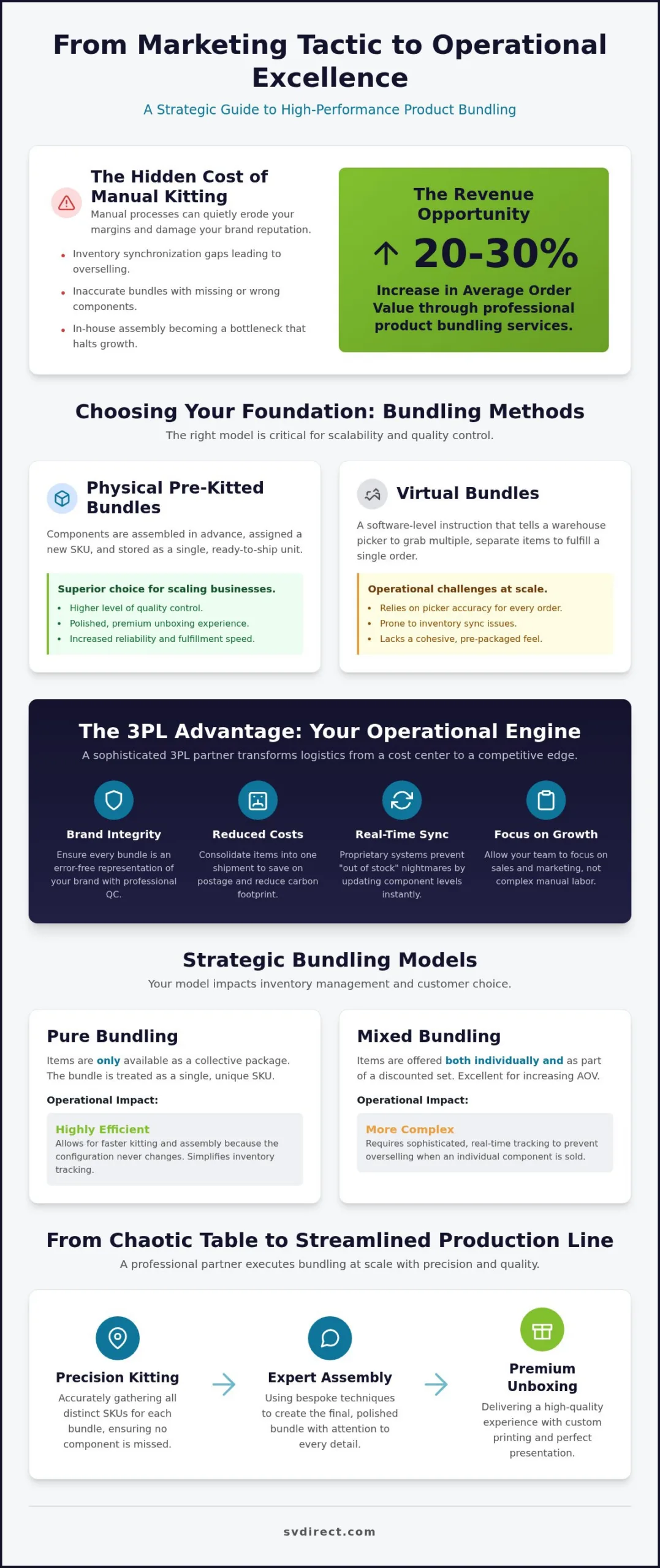
Product bundling is often discussed in boardroom meetings as a clever marketing tactic to move inventory or increase margins. In the physical world of logistics, however, it’s a rigorous operational process that involves grouping multiple distinct SKUs into a single, cohesive unit for sale. This transition from theory to reality is where many brands struggle. While a digital storefront can easily display a “summer kit,” the warehouse must manage the physical components, packaging, and assembly with absolute precision. This is where professional product bundling services become essential for maintaining order accuracy.

It’s vital to distinguish between virtual and physical bundles. A virtual bundle is a software-level instruction that tells a picker to grab three different items for one order. A physical pre-kitted bundle is assembled in advance, assigned its own SKU, and stored as a single unit. Pre-kitting often provides a much higher level of quality control and a more polished unboxing experience for the customer. For businesses looking to scale, the physical pre-kitted model is usually the superior choice for reliability and speed.

The Role of a 3PL in Product Bundling

A sophisticated 3PL acts as the engine for these operations. By utilizing 3PL fulfillment services, companies can significantly reduce shipping costs. Instead of sending three separate packages, items are consolidated into one. This doesn’t just save on postage; it reduces transit times and minimizes the carbon footprint of your deliveries. Managing inventory becomes a balancing act between individual components and finished kits. We use proprietary systems to ensure that when a bundle sells, the stock levels for every underlying item update in real-time. This prevents the “out of stock” nightmare that occurs when one small component is missing from a larger set.

Why Businesses Are Moving to Professional Bundling

Many growing companies start by assembling kits in-house. While this works for a few dozen orders, it quickly becomes a bottleneck that halts growth. Scaling requires a shift to professional kitting and assembly services to maintain brand integrity. A professional facility ensures that every insert is straight, every box is clean, and every component is present. This level of detail reduces decision fatigue for your customers. They don’t have to choose three separate accessories; they can trust a curated set that’s been professionally prepared. Moving to an expert partner allows your team to focus on sales while we handle the intricate manual labor with a steady, experienced hand. Professional product bundling services turn a chaotic packing table into a streamlined, high-output production line.

Strategic Varieties of Product Bundling: Choosing Your Model

The transition from a basic sales strategy to a high-volume reality requires a clear understanding of your chosen bundling model. As this product bundling guide suggests, your approach directly influences your inventory management and customer satisfaction. Pure bundling is a straightforward model where items are only available as a collective package. This is operationally efficient because the bundle is treated as a single SKU from the moment it’s assembled.

Mixed bundling is more complex. It involves offering items both individually and as a discounted set. This model is excellent for increasing average order value, but it creates significant challenges for real-time stock levels. If a customer buys a single item, the system must immediately update the availability of every bundle that includes that item. We solve this through our Remote Control™ system, which manages these intricate relationships with precision. This technology ensures that your digital storefront always reflects the physical reality of the warehouse floor.

Pure vs. Mixed Bundling: Operational Impacts

Choosing between these models depends on your sales volume and SKU count. Pure bundles allow for faster kitting and assembly because the configuration never changes. Mixed bundles require more sophisticated tracking to prevent overselling. If your business manages a high volume of individual sales alongside promotional sets, you need a partner capable of dynamic inventory synchronization. We focus on providing a steady hand for these complex operations, ensuring that mixed bundling doesn’t lead to inventory fragmentation.

Promotional and Seasonal Bundling

Seasonal kits thrive on urgency. Whether it’s a holiday set or a limited-run brand partnership, these projects require rapid assembly and high-quality presentation. We often use on-demand digital printing to produce personalized inserts that elevate the unboxing experience. Our HP Indigo 5500 provides a 230 line screen resolution, ensuring your marketing materials look as professional as the products they accompany. This high-tech capability allows us to act as a seamless extension of your marketing team.

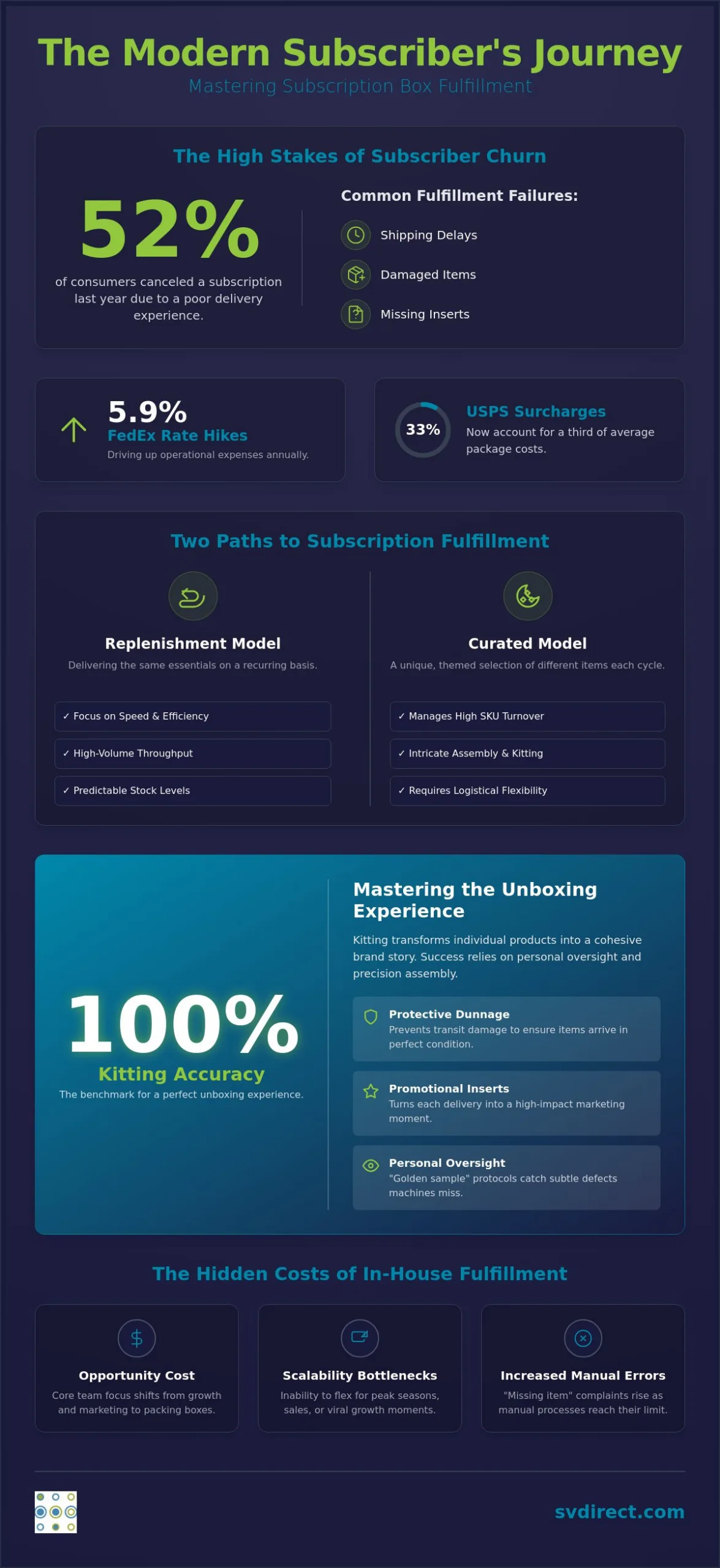
Subscription box bundling is another recurring model that demands strict deadlines and consistent quality. These curated sets rely on a methodical approach to ensure every box is packed exactly to specification, month after month. Leveraging professional product bundling services ensures your promotional kits are an asset to your brand rather than a logistical burden. If you want to discuss how these models could work for your specific catalog, you can reach out for a customized operational assessment.

The Operational Hurdles of High-Volume Product Bundling

Execution is where most marketing strategies face their toughest test. In a high-volume environment, the logistical reality of product bundling often reveals hidden friction points that can erode your profit margins. Many brands unknowingly fall into the Hectic Warehouse Trap, where manual kitting processes lead to a spike in error rates. When human pickers are forced to juggle multiple components without a structured system, the risk of a missing item or a swapped SKU increases exponentially. These errors don’t just cost money in returns; they damage the hard-earned trust of your customers.

Inventory fragmentation is another significant challenge, particularly when tracking serial numbers across various kits. If your system cannot account for every individual component within a bundle, your data becomes unreliable. This lack of precision makes it impossible to forecast accurately or maintain the high-quality presentation your brand requires. Furthermore, packaging waste often becomes a silent drain on resources. Without custom-fit boxing solutions, you’re paying to ship air, and your products are more susceptible to damage during transit. Professional product bundling services solve these issues by treating kitting as a science of precision rather than a task of convenience.

Overcoming Inventory Inconsistencies

Virtual bundles often promise simplicity but frequently deliver backorder nightmares. Because the components aren’t physically pre-assembled, your system might show a bundle is available when a single small item is actually out of stock. This creates a disconnect between your storefront and the warehouse floor. You need 24/7 visibility into your component stock levels to maintain operational flow. By utilizing Remote Order Management, you gain access to real-time data and over 120 standard reports. This level of transparency ensures you can identify potential stockouts before they disrupt your fulfillment cycle, allowing you to move with the speed of the modern market.

The Importance of Systematic Inspection

Quality control is the primary differentiator between a standard 3PL and a strategic partner. We’ve established a systematic QC-Check process for every kit we assemble to eliminate the missing item complaint entirely. This multi-stage verification happens within our quiet, organized facility, where precision is the standard rather than the exception. Our methodology focuses on a proactive stance, identifying kit conflicts and assembly errors long before they reach the shipping dock. This meticulous attention to detail ensures that your product bundling services contribute to high-quality, error-free presentation, reinforcing customer loyalty with every delivery. When your logistics operation is as organized as your marketing plan, your business is positioned for sustainable growth.
Product Bundling Services: The 2026 Strategic Guide to Operational Excellence

Executing Bundling at Scale: Kitting, Assembly, and Personalization

Executing product bundling services at scale requires a transition from marketing theory to physical engineering. While your team identifies the ideal product pairings, our facility focuses on the mechanics of high-volume assembly. This process follows a structured five-step methodology to ensure every kit is perfect:

  • Step 1: Strategic SKU selection and component sourcing to confirm inventory compatibility.
  • Step 2: Designing the unboxing experience with custom-fit inserts that protect and present.
  • Step 3: Implementing high-speed kitting combined with hand assembly for delicate items.
  • Step 4: Leveraging Variable Data Printing (VDP) to add individualized messaging to every bundle.
  • Step 5: Final QC-Check and seamless distribution through our global logistics network.

By treating kitting as a precision operation, we eliminate the friction that often plagues growing brands. Our quiet, organized facility serves as a steady hand, managing the intricate details of your promotional sets while you focus on driving sales.

Advanced Personalization with Variable Data Printing

Personalization is no longer a luxury; it’s an expectation. We use the HP Indigo 5500 to produce high-resolution bundle inserts at a 230 line screen resolution. Unlike standard digital printers, this system utilizes liquid ink technology to achieve offset-quality results. This ensures your personalized messages and branded collateral look sharp, vibrant, and professional. Integrating Print On Demand capabilities is essential for just-in-time bundling. It allows you to update messaging or seasonal graphics without wasting pre-printed inventory, keeping your marketing agile and cost-effective.

Complex Assembly: Beyond the Box

High-value bundles often involve more than just placing items in a carton. We specialize in handling sensitive materials like software, electronics, and premium apparel that require specific environmental care. For high-value goods, serial number tracking is integrated directly into the assembly process to maintain a secure chain of custody and accurate warranty records. By incorporating professional Kitting and Assembly Services into your workflow, you ensure that complex configurations are executed correctly every time. Our team acts as a seamless extension of your company, providing the human oversight needed for technical or fragile components.

Request a customized kitting and assembly quote

Optimizing Your Supply Chain with Silicon Valley Direct

Silicon Valley Direct isn’t just a fulfillment provider; we act as a seamless extension of your marketing and sales team. While other providers offer basic storage, we focus on the intricate physical execution that makes your product bundling services successful. Our quiet, organized facility in the heart of Silicon Valley serves as a center for innovation and global connectivity. We take a proactive stance, identifying potential kit conflicts or component shortages before they ever reach the shipping dock. Our commitment is rooted in our ‘Nine Promises’ of quality and transparency, ensuring that your brand’s reputation is protected at every touchpoint.

Real-Time Visibility with Remote Control™

Total transparency is the foundation of a reliable supply chain. Our proprietary Remote Control™ system provides you with 24/7 visibility into every aspect of your inventory. With access to 120+ standard reports, you’ll always have the data needed to track the success of your bundled campaigns. The system doesn’t just store data; it actively protects your operations through automatic email alerts for low inventory and backorders. This level of technical integration allows you to move from reactive troubleshooting to strategic planning. You can monitor assembly progress and component levels from anywhere in the world, knowing that your physical operations are as organized as your digital dashboards.

Why Partnership Trumps Outsourcing

Scaling complex projects requires more than just warehouse space; it requires a dedicated team that understands your specific needs. We reject the ‘cookie-cutter’ approach in favor of custom-fit solutions tailored to your unique catalog. Our long-term staff retention is a hallmark of our internal stability, providing you with a seasoned expert at every stage of the kitting process. This continuity ensures that the nuances of your brand’s unboxing experience are preserved, regardless of your order volume. You aren’t just outsourcing a task; you’re building a partnership grounded in decades of operational history. You can read our Customer Testimonials to see how we’ve helped other high-growth companies navigate the transition from manual kitting to high-efficiency fulfillment. We provide the steady hand and physical infrastructure necessary to turn your marketing vision into a global reality.

Mastering the Future of Physical Fulfillment

Transforming product bundling from a marketing concept into a logistical reality requires more than warehouse space. It demands a marriage of seasoned expertise and high-tech efficiency. Strategic SKU selection, real-time tracking, and high-resolution personalization eliminate errors and drive customer loyalty. By embracing professional product bundling services, you position your brand for sustainable growth. The difference between a successful campaign and a logistical failure often comes down to physical assembly precision.

Silicon Valley Direct brings over 25 years of fulfillment expertise to your project. Our proprietary Remote Control™ system provides the transparency needed to manage stock across complex kits. Our HP Indigo 5500 ensures bundle inserts meet Red Dot-level quality standards. We act as a steady hand and a seamless extension of your team, allowing you to scale with confidence. Your marketing vision deserves an operational partner that’s just as innovative as your products.

We’re ready to help you turn your next promotional set into a high-efficiency success story. Let’s build a fulfillment strategy that works as hard as you do.

Frequently Asked Questions

What is the difference between kitting and product bundling?

Product bundling is the marketing strategy of grouping items, while kitting is the physical execution of that strategy. Kitting involves picking individual components and assembling them into a single unit with its own SKU. Our team handles the manual labor of kitting and assembly using a systematic QC-Check process to ensure every bundle meets your brand standards before shipping. This process transforms a marketing idea into a physical reality.

How do product bundling services improve my profit margins?

Professional product bundling services reduce operational overhead by consolidating multiple shipments into one package, lowering postage and material costs. By outsourcing the kitting process to a specialized 3PL, you eliminate the need for in-house labor and extra warehouse space. Our proactive approach identifies order conflicts early, preventing costly returns and shipping errors that otherwise erode your bottom line. This efficiency allows you to scale without proportional increases in costs.

Can I customize the contents of each bundle for individual customers?

Yes, you can achieve high levels of customization through our Variable Data Digital Printing (VDP) capabilities. Every bundle can include a personalized insert or marketing message tailored to the specific recipient. Because we use the HP Indigo 5500 with liquid ink technology, these personalized elements maintain offset-quality resolution. This allows you to offer bespoke unboxing experiences at scale without the high costs typically associated with custom print runs.

How does inventory management work when products are sold both individually and in bundles?

Our proprietary Remote Control™ system manages these complex relationships by providing real-time visibility into both individual components and finished kits. When a bundle sells, the system automatically updates the stock levels for all underlying SKUs. You receive automated email alerts for low inventory or backorders, ensuring you don’t oversell. This level of data management allows you to balance individual product sales and bundled promotional campaigns with total transparency.

What are the benefits of using digital printing for bundled product inserts?

Digital printing provides the speed of on-demand production with the quality of traditional offset methods. Our HP Indigo 5500 uses liquid ink technology at a 230 line screen resolution, creating sharp, vibrant images for your bundle inserts. Sheets emerge dry and ready for immediate assembly, which significantly reduces turnaround times. Additionally, this green printing process eliminates the need for the harsh chemicals and plates used in traditional offset printing.

Is product bundling suitable for small businesses or just large corporations?

We provide scalable solutions for companies of all sizes, from emerging startups to large national enterprises. Our methodology rejects “cookie-cutter” procedures in favor of custom-fit strategies that align with your specific budget and goals. Whether you’re launching a small promotional kit or managing a high-volume subscription box, our facility is equipped to handle the project. We act as an extension of your company to ensure professional product bundling services regardless of your current scale.

How do you ensure quality control during high-volume assembly projects?

We maintain accuracy through a systematic QC-Check process that involves multiple inspections throughout the assembly line. Our quiet, organized facility is designed to remove the hectic atmosphere common in many warehouses, allowing our team to focus on precision. Every kit undergoes rigorous verification to ensure no items are missing and the presentation is flawless. This proactive approach identifies potential errors before they impact the customer, reinforcing your brand’s reliability.

What kind of reporting is available for my bundled product sales?

You gain 24/7 access to over 120 standard reports through our proprietary Remote Control™ web interface. These reports provide detailed insights into order status, shipping activity, and real-time inventory levels for your bundles. You can track exactly how your promotional campaigns are performing and retrieve order histories with a few clicks. This data-driven approach ensures you have the information necessary to make informed decisions about your supply chain and marketing strategies.
WooCommerce Fulfillment Services: The 2026 Strategic Guide to Scaling Your Online Store

WooCommerce Fulfillment Services: The 2026 Strategic Guide to Scaling Your Online Store

What if the very growth you’ve worked so hard to achieve becomes the bottleneck that stifles your brand’s reputation? It’s a common crossroads for successful e-commerce leaders who find that manual data entry and shipping errors are suddenly draining their team’s energy. You’ve built a beautiful storefront, but scaling effectively requires a bridge to the physical world that doesn’t sacrifice precision. By integrating professional woocommerce fulfillment services, you can automate your order flow and regain the real-time inventory visibility necessary for the 2026 market.

We understand that your products are more than just SKUs; they’re promises made to your customers. You deserve a partner that treats complex kitting and custom packaging with the same care you do. In this guide, you’ll learn how to transition from reactive shipping to a proactive logistics strategy that reduces costs while elevating your brand presentation. We’ll walk through the technical integrations and systematic quality checks that ensure every package serves as a high-performance touchpoint for your business. This is about more than just moving boxes; it’s about building a stable foundation for your company’s future.

Key Takeaways

  • Learn how to automate your order flow by integrating professional woocommerce fulfillment services to eliminate manual data entry errors.
  • Gain real-time inventory visibility through advanced XML and SOAP protocols that connect your digital storefront directly to a proprietary reporting system.
  • Elevate your brand presentation by integrating high-resolution digital printing and liquid ink technology into your custom kitting and packaging workflow.
  • Reduce shipping overhead and transit times by leveraging managed postage solutions and a deliberate, organized logistics methodology.
  • Discover how to evaluate a fulfillment partner as a proactive extension of your team, ensuring flexibility for bespoke projects rather than rigid, automated interactions.

What Are WooCommerce Fulfillment Services and Why Do You Need Them?

WooCommerce fulfillment represents the entire order fulfillment process that begins the moment a customer clicks “buy” on your WordPress site. It encompasses receiving, processing, and shipping products with precision. Many growing brands start by packing boxes in a garage, but as order volume increases, this manual approach creates a ceiling for growth. Utilizing professional woocommerce fulfillment services allows you to shift from a reactive, hectic environment to a methodical, scalable operation. Effective woocommerce fulfillment services bridge the gap between your digital presence and the physical package arriving at a customer’s door.

Think of your fulfillment partner as a proactive extension of your internal team. They shouldn’t just be a vendor; they should be a high-performance partner that understands your brand’s unique needs. This means looking “outside the box” to include high-quality marketing inserts or custom kitting that makes every delivery feel like a premium experience. When your logistics team, backed by decades of experience since 1999, anticipates order conflicts before they impact a project, you gain the quiet confidence needed to scale without stress.

The Limitations of Manual Order Processing

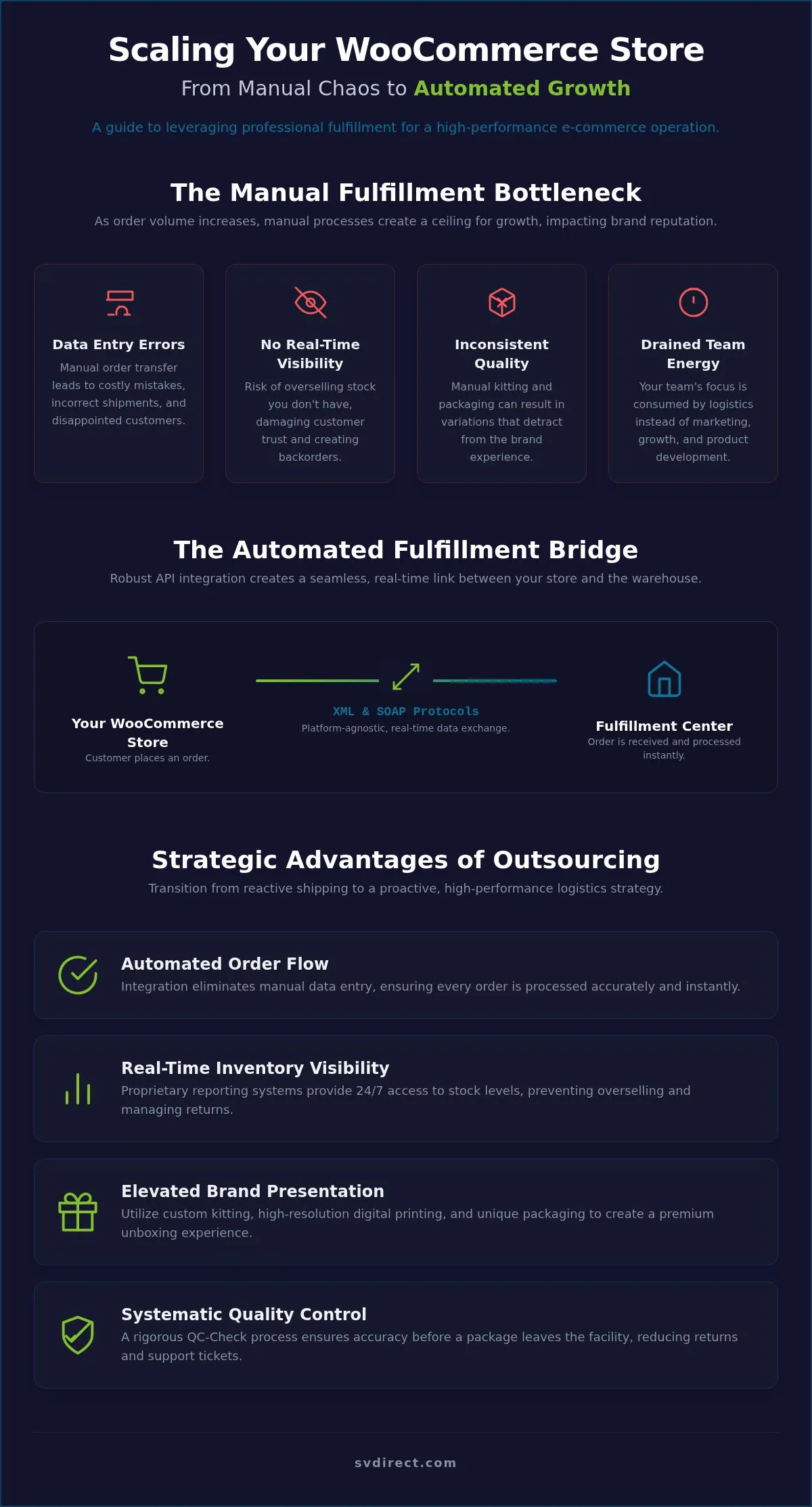
Scaling a WooCommerce store requires moving beyond the constraints of a home office or small warehouse. Manual data entry is often the first point of failure during peak sales seasons. Without real-time synchronization between your storefront and your inventory, you risk selling items you don’t have in stock. These errors damage customer trust and lead to expensive returns. Relying on manual labor for complex tasks like kitting or custom assembly often results in inconsistencies that a professional system can eliminate.

The Value of Professional 3PL Partnerships

Partnering with a seasoned provider gives you immediate access to established infrastructure designed for national and global reach. You benefit from sophisticated quality control measures, such as the systematic QC-Check process, which ensures accuracy before a package ever leaves the facility. These 3PL fulfillment services handle the mechanical nature of logistics, freeing your internal team to focus on high-level marketing and product development. By outsourcing these operations, you ensure that your physical delivery matches the high-tech efficiency of your digital storefront.

How API Integration Bridges Your Store and the Warehouse

Modern woocommerce fulfillment services rely on more than just a basic plugin; they require a robust technical bridge that ensures your digital storefront and physical warehouse operate as a single unit. While many platforms suggest simple extensions, a professional 3PL uses platform-agnostic communication via XML and SOAP protocols. This standardized approach ensures your store speaks the same language as the fulfillment center, regardless of future software updates or site customizations. This real-time data exchange transforms your operation from a series of manual tasks into a programmatic, automated flow.

This integration provides the quiet confidence that comes from total transparency. By moving away from rigid, cookie-cutter plugins, you gain a system that adapts to your specific business logic. It’s a high-performance solution that handles the mechanical nature of data transfer while you focus on the human element of growing your brand.

The Role of Web Services in Fulfillment

Web services allow external applications to communicate seamlessly without manual intervention. When a customer completes a purchase, the “AddOrder” method programmatically moves that data from your WooCommerce cart directly to the warehouse floor. It’s an instantaneous transfer that eliminates the risk of manual data entry errors. Once the package is in motion, the “GetOrderInfo” method retrieves real-time shipping data and tracking numbers, pushing them back to your dashboard. This cycle also effectively manages reverse logistics, ensuring that returns are processed with the same systematic precision as outbound shipments.

Remote Control™: Your Window into the Warehouse

Visibility shouldn’t stop at the checkout page. A proprietary online data management system provides 24/7 access to your physical operations from anywhere in the world. With the Remote Control™ system, you can access over 120 standard reports that monitor inventory levels, order history, and project status. These aren’t just static numbers; they’re actionable insights that allow you to anticipate needs before they become conflicts.

The system also provides automated notifications for low inventory levels and backorders, acting as a steady hand that monitors your stock around the clock. You can even customize the web interface to match your corporate brand identity, ensuring that your internal tools feel like a true extension of your company. This level of technical integration turns woocommerce fulfillment services into a proactive marketing asset. If you’re ready to see how a high-performance partner can streamline your digital storefront, you can request a free quote to discuss your specific integration needs.

Strategic Advantages of Outsourcing WooCommerce Logistics

Transitioning your logistics to a professional facility replaces the daily chaos of manual packing with a steady, methodical rhythm. You’ve built a brand that deserves a stable foundation, and professional woocommerce fulfillment services provide exactly that. By moving away from a hectic home office or small warehouse, you adopt a deliberate methodology backed by an extensive operational history dating back to 1999. This shift doesn’t just save space; it creates a high-performance environment where your physical delivery finally matches the quality of your digital storefront.

High-volume deadlines shouldn’t cause panic. A seasoned partner uses established infrastructure to handle complex projects regardless of their scale. You gain immediate cost-efficiency through managed postage and discounted shipping rates, allowing you to reinvest that capital into marketing. Most importantly, a proactive partner identifies order conflicts before they reach the customer. This “steady hand” approach alleviates the stress of growth, ensuring that your expansion is supported by precision and a personal commitment to your brand’s reputation.

Precision Through the QC-Check Process

Accuracy is never an accident. It’s the result of the systematic QC-Check process that governs every stage of assembly and packing. In an organized facility, quiet confidence replaces the noise of inefficient business models. Every project benefits from systematic inspections that uphold a “make-it-right” attitude. This level of detail eliminates shipping errors that often plague in-house operations, ensuring that your customers receive exactly what they ordered, perfectly presented every time. This rigorous attention to detail is a core component of 3PL fulfillment services that prioritize quality over sheer speed.

Global Reach and Reliable Shipping

Managing a global footprint requires navigating complex shipping lanes for both B2B and B2C channels. Whether you’re shipping domestic orders or managing international logistics, you need a partner that remains at the cutting edge of innovation. A strategic location serves as a symbol of global connectivity, allowing you to leverage the latest technological advancements in the industry. Effective returns management is also essential; it builds customer trust by making the process seamless and professional. By outsourcing these logistics, you ensure that your brand remains accessible and grounded, no matter how far your products travel. This proactive stance ensures your woocommerce fulfillment services act as a true extension of your company’s values.

WooCommerce Fulfillment Services: The 2026 Strategic Guide to Scaling Your Online Store

Advanced Fulfillment: Digital Printing and Custom Kitting

Scaling an online store involves more than just shipping boxes. It requires a high-performance partner that can turn every delivery into a marketing asset. Advanced woocommerce fulfillment services integrate on-demand digital printing directly into the fulfillment workflow. This allows you to include personalized inserts or custom literature without the need for massive pre-printed inventory. By using Variable Data Printing (VDP), you can tailor messages to specific customer segments, creating a bespoke experience that builds long-term loyalty. This proactive approach ensures your physical branding remains as agile as your digital marketing campaigns.

The choice of technology matters for brand perception. Liquid ink technology provides a distinct advantage over standard toners used by many basic facilities. It produces a professional, high-end feel that matches the quality of your products. This attention to detail ensures that the physical touchpoint of your brand is just as sophisticated as your digital storefront. When your logistics partner manages these elements in-house, you eliminate the delays and communication gaps often found when using multiple vendors.

On-Demand Printing with the HP Indigo 5500

We utilize the HP Indigo 5500 to deliver offset-quality results within the fast-paced fulfillment cycle. This press achieves a 230 line screen resolution, providing sharp, vibrant images for your marketing materials. Because it uses real liquid ink technology, the output is dry immediately. This efficiency allows for instant handling and insertion into your orders, preventing any delays in the shipping process. It’s a high-tech solution that supports the rapid pace of modern eCommerce.

This approach is also grounded in sustainability. Digital printing eliminates the need for physical plates and harsh chemicals associated with traditional offset methods. You can print exactly what you need, when you need it, reducing waste and keeping your marketing collateral current. This seamless integration of print-on-demand capabilities ensures your fulfillment operation remains agile and responsive to market changes.

Complex Kitting and Hand Assembly

Bespoke projects often require a human touch that automated systems can’t replicate. Whether you’re launching a subscription box or a high-value promotional kit, systematic assembly is crucial. Our team manages complex kitting for a variety of industries, including software packages, apparel, and healthcare materials. We prioritize precision, ensuring that every kit is assembled according to your exact specifications.

Delicate or high-value items benefit from careful hand assembly. This process ensures that every component is placed exactly where it belongs, maintaining a professional brand presentation. For a deeper look at how these processes streamline your operations, see our guide on Kitting and Assembly Services. This meticulous approach to physical operations is what sets elite woocommerce fulfillment services apart from basic shipping vendors.

Choosing the Right Partner for WooCommerce Fulfillment

Selecting a partner for your woocommerce fulfillment services shouldn’t be a transactional decision based on price alone. It’s about finding a steady hand that understands the high-stakes nature of growing a business. A partner with a history dating back to 1999 brings a level of stability and expert-level service that automated platforms simply cannot match. You need an organization that views itself as a proactive extension of your team, not just a vendor moving boxes. This partnership allows you to alleviate the stress of growth through precision and personal commitment. When you choose a provider that prioritizes the human element, you gain a high-performance partner that remains accessible and grounded.

Rigidity is the enemy of innovation. Many providers force you into cookie-cutter procedures that stifle your brand’s unique needs. Instead, look for a partner committed to total flexibility and bespoke problem-solving. Evaluating a provider based on their “Nine Promises” of service ensures they prioritize precision over mere volume. This human oversight is a powerful differentiator in a market saturated with impersonal interactions. Choosing the right woocommerce fulfillment services means selecting a team that values transparency and directness, ensuring your physical operations are just as organized as your digital communication.

Questions to Ask Your Potential 3PL

Before committing to a provider, you must ensure their infrastructure can support your specific trajectory. Ask direct questions to gauge their operational readiness and technical capabilities:

  • Do you provide 24/7 real-time access to my inventory and order data through a proprietary reporting system?
  • Can you handle variable data printing for my marketing collateral to ensure a professional brand presentation?
  • What is your specific process for quality control and systematic error prevention?

A partner who can answer these questions with specific details about their QC-Check process or liquid ink printing technology demonstrates the seasoned professionalism your brand deserves. This clarity ensures that your store can scale without the bottlenecks of shipping errors or inventory blind spots.

The Silicon Valley Direct Difference

The marriage of technology, customer service, and marketing expertise creates a high-performance environment. Long-term staff retention serves as a hallmark of internal stability, ensuring that the people handling your products are seasoned experts. Our proactive attitude is backed by physical infrastructure and human expertise rather than just marketing abstractions. We take the time to explain the rationale behind our specific processes, from inventory management to global logistics, guiding you from a state of curiosity to informed confidence.

By focusing on building long-term partnerships rather than transactional relationships, we ensure your physical operations are just as organized as your digital strategy. We invite you to explore our Silicon Valley 3PL Fulfillment Services to see how we bridge the gap between your digital storefront and physical delivery with quiet confidence and operational readiness.

Future-Proofing Your Store Through Strategic Logistics

Scaling your brand requires a transition from manual effort to automated precision. Integrating professional woocommerce fulfillment services allows you to bridge the gap between digital storefronts and physical delivery. We’ve discussed how technical integrations like XML and SOAP ensure your data flows without error, while high-resolution tools like the HP Indigo 5500 Digital Press turn every package into a premium marketing touchpoint.

Since 1999, we’ve focused on being more than a vendor. We act as a steady hand and a proactive extension of your team. With our proprietary Remote Control™ system and its 120 plus standard reports, you maintain total visibility over your inventory around the clock. You don’t have to navigate the complexities of global logistics alone. A partnership grounded in multi-decade experience provides the stability you need to focus on growth.

It’s time to move beyond transactional shipping and embrace a deliberate, organized methodology that respects your time and your brand’s reputation. We invite you to experience the difference that precision and personal commitment can make for your business.

We look forward to helping you achieve a seamless and scalable future for your online store.

Frequently Asked Questions

How does WooCommerce integrate with a fulfillment center?

Integration occurs through Web Services using XML and SOAP protocols to create a programmatic bridge between your storefront and the warehouse. When a customer completes a purchase, the “AddOrder” method transmits data instantly to our proprietary system. This automation eliminates the risks associated with manual data entry and ensures that order details move from your digital cart to the physical floor without technical friction. It’s a high-performance solution for modern eCommerce growth.

What is the difference between a fulfillment plugin and a 3PL service?

A fulfillment plugin is a software tool that facilitates data transfer, while a 3PL service provides the physical infrastructure and expertise to handle your inventory. Professional woocommerce fulfillment services offer the warehouse space, labor, and quality control systems required to ship products accurately. While plugins automate the digital “handshake,” a 3PL partner acts as a proactive extension of your team, managing the actual assembly, kitting, and delivery of your physical goods worldwide.

Can I include custom marketing inserts in my WooCommerce orders?

You can include high-quality marketing inserts through on-demand digital printing integrated directly into the fulfillment cycle. By utilizing the HP Indigo 5500 Digital Press, we produce offset-quality inserts that are added to your packages during the kitting process. This allows you to personalize the customer experience without the overhead of storing pre-printed materials. Each insert uses real liquid ink for a professional brand presentation that reflects your company’s standards and attention to detail.

How do I track my inventory levels in real-time?

You track inventory through a proprietary online data management system like Remote Control™. This platform provides 24/7 visibility into your stock levels and order history through over 120 standard reports. Automated notifications alert you to low inventory or backorders, allowing you to manage your storefront proactively. This real-time synchronization ensures your WooCommerce store never sells items that aren’t physically available in the warehouse, preventing customer disappointment and helping you maintain a reliable reputation.

Is variable data printing expensive for small eCommerce orders?

Variable Data Printing (VDP) is highly cost-effective because it eliminates the need for expensive plates and traditional setup costs. Digital printing technology allows for short runs and personalized messaging on a per-order basis without a price penalty. This efficiency ensures that even smaller WooCommerce stores can leverage sophisticated marketing collateral. It transforms every package into a targeted marketing touchpoint while keeping your overhead manageable and your inventory lean for maximum flexibility in your campaigns.

What happens if there is a conflict or error in a customer order?

Our proactive approach identifies potential order conflicts before they impact the project. If an error occurs, the systematic QC-Check process and our “make-it-right” attitude ensure swift resolution. A dedicated team monitors the automated flow to catch anomalies in addresses or SKU combinations. This human oversight, combined with technical precision, alleviates the stress of business growth by maintaining a steady hand on all physical operations and protecting your brand’s reputation for accuracy.

Does a professional 3PL handle international shipping for WooCommerce?

Yes, professional woocommerce fulfillment services manage both domestic and international logistics for B2B and B2C shipments. We navigate complex global shipping regulations and leverage managed postage to reduce transit costs. By using our strategic location as a symbol of innovation and global connectivity, we ensure your products reach customers worldwide efficiently. This comprehensive approach includes handling returns and reverse logistics to maintain customer trust across all geographic borders regardless of the shipping distance.

How does the QC-Check process ensure order accuracy?

The QC-Check process is a systematic inspection methodology that governs every stage of assembly and packing. It involves multiple verification points to ensure that the correct items, inserts, and packaging materials are used for every order. By maintaining an organized facility and a methodical rhythm, we eliminate the common bottlenecks of manual processing. This rigorous attention to detail guarantees that your physical delivery matches the high standards of your digital storefront every single time.

3PL Pricing Models: The 2026 Strategic Guide to Fulfillment Costs

3PL Pricing Models: The 2026 Strategic Guide to Fulfillment Costs

When you compare different 3pl pricing models, why does the most “competitive” quote often result in the most expensive monthly invoice your business has ever seen? It’s a common frustration for growing brands that find themselves buried under unexpected fees or paying for warehouse space they aren’t even using. You deserve a logistics partnership built on clarity rather than complex fine print. We know that unpredictable expenses make it nearly impossible to forecast your margins with confidence.

This guide helps you master the complexities of third-party logistics to ensure your fulfillment costs actually align with your operational needs. You’ll discover how to identify a structure that rewards efficiency and scales seamlessly with your seasonal peaks. We’ll examine the four primary pricing frameworks used in 2026, the data-driven systems that provide real-time visibility, and the specific factors that determine your long term ROI. By the end of this article, you’ll have the tools to choose a partner that acts as a steady hand for your business growth.

Key Takeaways

  • Identify which 3pl pricing models align with your specific growth trajectory to prevent margin creep and ensure predictable monthly expenses.
  • Uncover the reality of hidden contract fees, from technology integrations to account management, and learn how to negotiate for total transparency.
  • Explore how integrating specialized services like on-demand digital printing and precision kitting can streamline your supply chain and lower total costs.
  • Leverage high-tech visibility tools to access real-time data, allowing you to manage inventory and fulfillment with the precision of an in-house team.
  • Transition to a partnership-driven logistics model that replaces automated interactions with personal oversight and bespoke problem-solving.

What are 3PL Pricing Models? Defining the Logistics Landscape

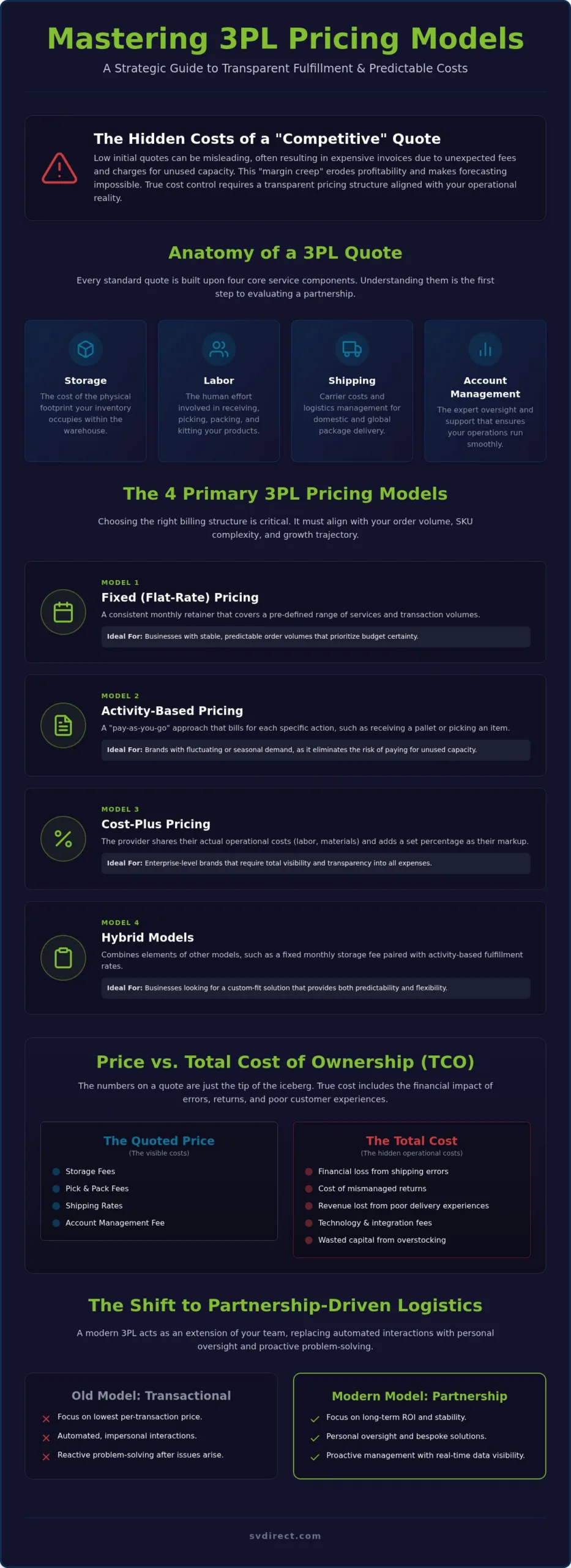
A well-defined logistics strategy depends on understanding 3pl pricing models as more than just a monthly bill. These frameworks dictate how a Third-party logistics (3PL) partner charges for labor, space, and the technical infrastructure required to manage your data. When you evaluate a quote, you’re essentially looking at a roadmap for how your partner will support your growth. Historically, these agreements were purely transactional; however, in 2026, the industry has shifted toward integrated service partnerships that prioritize long-term stability over simple pick-and-pack tasks.

Choosing the wrong 3pl pricing models often leads to “margin creep.” This happens when your logistics costs grow at a faster rate than your order volume, slowly eroding your profitability. A proactive partner helps you avoid this by ensuring the billing structure remains flexible and transparent. Every standard quote includes four core components:

  • Storage: The cost of the physical footprint your inventory occupies within the facility.
  • Labor: The human effort involved in receiving, picking, packing, and kitting.
  • Shipping: The carrier costs and logistics management for domestic and global delivery.
  • Account Management: The oversight and personal support that ensures your operations run smoothly.

The Evolution of Fulfillment Costs in 2026

Rising labor costs have fundamentally changed how activity-based pricing functions. To maintain accuracy without passing excessive costs to clients, sophisticated facilities now lean heavily on technology to reduce administrative overhead. While some providers offer “cheap” per-order rates, these often hide significant service gaps. You might save pennies on a pick fee but lose dollars through slow response times or a lack of personal oversight. We believe that efficiency is driven by a quiet, organized facility where precision is the standard rather than an add-on.

The Difference Between Price and Total Cost of Ownership

Smart operators look beyond the base price to the Total Cost of Ownership (TCO). This includes the heavy financial burden of shipping errors, mismanaged returns, and the permanent loss of customers due to poor delivery experiences. Our approach focuses on proactive problem solving to catch issues before they reach your customer. By utilizing our Remote Control™ system, you gain real-time data access that prevents overstocking and reduces waste. When your warehouse data syncs perfectly with your sales channels, you aren’t just paying for a service; you’re investing in a high-performance extension of your own team.

The 4 Primary 3PL Pricing Models Explained

Selecting from the various 3pl pricing models requires a deep understanding of your own order profiles and growth targets. It’s not merely a matter of finding the lowest per-transaction fee; it’s about aligning your billing structure with your operational reality. The complexities of logistics pricing often mean that a model that works for a low-SKU startup will become a financial burden for a high-volume enterprise. Most providers utilize one of four core frameworks to manage these costs.

  • Fixed (Flat-Rate) Pricing: You pay a consistent monthly retainer that covers a specific range of services. This model is ideal for businesses with stable, predictable volumes that prioritize budget certainty.
  • Activity-Based Pricing: This “pay-as-you-go” approach bills you for each specific action, from receiving a pallet to picking an individual item. It offers high transparency for businesses with fluctuating seasonal demand.
  • Cost-Plus Pricing: The provider shares their actual operational costs and adds a set percentage as their markup. This is frequently used by enterprise brands that require total visibility into labor and material expenses.
  • Hybrid Models: Many modern partnerships combine these elements, such as a fixed monthly storage fee paired with activity-based fulfillment rates to ensure maximum flexibility.

Activity-Based Pricing: Precision for E-commerce

Startups and rapidly scaling brands often favor activity-based structures because they eliminate the risk of paying for unused warehouse capacity. The “Pick and Pack” fee is the heartbeat of this model. It’s usually broken down into a base order fee plus a smaller charge for each additional item. To maintain accuracy, you should regularly audit these invoices against your own sales data. We’ve found that a “quiet facility” methodology, which emphasizes organized physical space and human oversight, naturally keeps these activity costs lower by reducing the time required for each task.

Fixed Rate vs. Cost-Plus: Which Scales Better?

Enterprise-level brands are increasingly moving toward cost-plus models because they remove the “black box” of traditional logistics billing. While fixed monthly retainers offer simplicity, they can lack the incentive for the provider to improve efficiency. In contrast, a cost-plus model creates a transparent partnership where both parties work to trim operational waste. We reject “cookie-cutter” constraints that force you into a rigid box. Instead, we focus on bespoke solutions that adapt as your SKU complexity grows. If you’re looking for a partner that prioritizes precision over automated templates, you can explore our logistics fulfillment services to see how a tailored approach protects your margins.

The Impact of Specialized Services on Fulfillment Costs

Standard 3pl pricing models often struggle to account for projects requiring more than just moving a box from a shelf to a carton. When your business involves intricate assembly or highly regulated materials, a “one-size-fits-all” fee structure quickly falls apart. Specialized logistics, such as healthcare mailing and literature fulfillment, require a level of precision that automated, high-volume warehouses simply aren’t built to provide. These projects demand a partnership-driven approach where costs are calculated based on the specific human oversight and technical accuracy required for success. You aren’t just paying for labor; you’re investing in a system that protects your brand’s integrity.

Integrating Print-on-Demand to Reduce Storage

One of the most effective ways to optimize your logistics budget is by eliminating the need to store massive quantities of pre-printed materials. By integrating on-demand digital printing directly into your workflow, you can significantly reduce your physical inventory footprint and the associated storage fees. We utilize the HP Indigo 5500 to produce high-resolution, offset-quality prints on a short-run basis. Unlike traditional offset printing, this technology eliminates the “drying time” delay. This allows us to move from print to pack almost instantly, ensuring your collateral is always current and relevant. You can learn more about our Print on Demand services to see how this technical capability transforms your supply chain efficiency.

Kitting and Assembly: The QC-Check Advantage

Projects involving subscription boxes, promotional kits, or multi-item bundles rely on labor-based charges that must be managed with extreme care. A common mistake in many 3pl pricing models is underestimating the human effort and quality control needed for complex assembly. We solve this through our systematic QC-Check process, which ensures every kit is inspected for accuracy before it leaves our facility. This proactive stance prevents the high cost of re-work and customer returns, which often dwarf the initial assembly fee. You can explore our kitting and assembly services to understand how precision labor protects your margins.

Choosing a partner that understands the nuances of specialized services means you’re choosing a steady hand in a fast-paced market. Whether you’re managing sensitive healthcare mailings or complex literature fulfillment, the goal is a seamless transition from data to delivery. This level of customization requires a facility that values quiet organization over chaotic volume. By prioritizing accuracy at every stage, we help you avoid the hidden costs of errors that impersonal, automated models often ignore.

3PL Pricing Models: The 2026 Strategic Guide to Fulfillment Costs

Avoiding Hidden Costs in 3PL Contracts

Many businesses fall into the trap of selecting a logistics provider based on a low per-package rate, only to realize later that their 3pl pricing models include a labyrinth of hidden surcharges. These opaque costs often appear as generic account management fees or technology maintenance line items that provide little visible value. When you partner with a logistics expert, you should expect total transparency regarding the human effort and technical infrastructure required to keep your business running. A steady hand in this industry doesn’t hide behind fine print; it leads with clarity.

Account management shouldn’t be a generic fee you pay just to talk to an automated bot. It represents the personal commitment of a seasoned professional who oversees your inventory and anticipates problems before they reach your customers. Similarly, technology and integration fees for connecting your eCommerce store should be clearly defined upfront. We reject the idea of impersonal, automated service. Instead, we favor direct human connection and personal oversight to ensure your specific operational needs are met without surprise monthly invoices.

Receiving and inbound logistics represent the hidden labor of getting products on shelves. If this process is disorganized, it leads to stockouts and lost revenue. Returns management, or reverse logistics, is another often-forgotten cost center that can erode your margins if not handled with precision. A proactive partner treats returns with the same urgency as outbound orders, ensuring items are inspected and restocked efficiently to preserve your capital. This methodical approach turns a potential loss into a recovered asset.

The Cost of Data Visibility

Opaque data is one of the most expensive hidden costs in logistics. If you can’t see your inventory in real-time, you can’t make informed purchasing or marketing decisions. We believe that 24/7 access to order history and inventory levels is a non-negotiable requirement for modern growth. Our proprietary Remote Control™ system provides 120+ standard reports without hidden surcharges. This high-tech visibility ensures you have the clarity needed to scale your operations without the stress of data gaps or administrative overhead.

Shipping and Postage Management

Shipping costs represent a massive portion of your total fulfillment spend, yet they’re often the least transparent part of a contract. A stable partner leverages discounted carrier rates to help offset other fulfillment fees, passing those savings directly to you. When managing strategic global shipping services, administrative handling of customs and international regulations must be exact. This prevents costly border delays and ensures a seamless experience for your global customers, protecting your brand’s reputation for reliability.

The Silicon Valley Direct Approach: Partnership-Driven Pricing

Many logistics providers treat your business as a series of automated tickets within a rigid system. We reject these impersonal 3pl pricing models in favor of custom-fit solutions that treat fulfillment as a strategic partnership. Since our founding in 1999, we’ve focused on being a steady hand for brands that require precision rather than just volume. Our “Nine Promises” of accountability ensure that every interaction is grounded in transparency and direct human connection. We don’t believe in “cookie-cutter” templates because your growth trajectory is unique. Instead, we offer bespoke problem-solving that anticipates conflicts before they impact your bottom line.

Our operational philosophy is built on the “Quiet Facility” methodology. While many warehouses are defined by frantic, disorganized energy, our facility operates with a methodical rhythm. This organization is a primary driver for accuracy and lower error-related costs. By maintaining a quiet, structured environment, we reduce the overhead associated with chaos and re-work. This proactive stance allows us to provide high-performance service that remains accessible and grounded, regardless of how complex your inventory becomes.

A Marriage of Technology and Human Oversight

True efficiency requires a seamless blend of high-tech capabilities and seasoned human expertise. We provide proprietary web services for XML and SOAP integration, ensuring your sales channels and warehouse data sync without friction. This technical infrastructure is managed by a dedicated, long-term staff. Our high staff retention rate acts as a unique hallmark of internal stability, providing you with project consistency that automated models can’t replicate. You can Read our Customer Testimonials to see how this personal commitment translates into long-term client success.

Scaling with Confidence

Transitioning from a startup to an enterprise-level organization requires a fulfillment partner that adapts to your changing needs. We manage high-volume deadlines and seasonal spikes without a hectic atmosphere, ensuring that your brand’s reputation for reliability remains intact. Whether you need precision kitting with our QC-Check process or high-resolution printing via the HP Indigo 5500, we provide the physical infrastructure and human oversight necessary for global reach. We invite you to collaborate with a partner that values your time and respects your margins.

Contact us for a custom fulfillment quote

Future-Proof Your Fulfillment Strategy for 2026

Mastering the complexities of 3pl pricing models ensures your business maintains healthy margins as you scale. You’ve seen how the right framework turns fulfillment from a cost center into a strategic lever for growth. Whether you require precision kitting or the liquid ink quality of our HP Indigo 5500, the goal is always a seamless transition from order to delivery.

With over 25 years of fulfillment expertise, we provide the stability your brand deserves. Our proprietary Remote Control™ system offers 24/7 data visibility, ensuring you’re never left in the dark about your inventory or expenses. We reject the impersonal nature of automated logistics in favor of a partnership built on direct human connection and bespoke problem-solving.

We look forward to helping you build a more efficient, transparent, and successful supply chain. Your business growth is our personal commitment.

Frequently Asked Questions

How much does the average 3PL charge per order?

Total order costs typically depend on your monthly volume, SKU complexity, and specific service requirements. Most 3pl pricing models calculate a base fulfillment fee for the first item, with incremental charges for each additional unit in the same carton. Variables like packaging materials and carrier surcharges also impact the final total. High-volume businesses often see lower per-order rates as they scale, moving beyond initial monthly minimums into more negotiable territory.

What is the difference between pick and pack fees and kitting fees?

Pick and pack fees cover the standard labor of retrieving a finished product and boxing it for shipment to a customer. Kitting fees are project-based charges for specialized assembly, such as bundling multiple items into a promotional set or subscription box. While picking is a routine task, kitting requires the extra oversight of our strict QC-Check process. This systematic inspection ensures accuracy for complex, multi-component projects before they leave our facility.

Are there monthly minimums for 3PL pricing?

Most mid-size logistics providers establish a monthly billing floor to cover the administrative and technical overhead of managing a dedicated account. These minimums ensure the facility can maintain a professional team and high-tech infrastructure for every client, regardless of seasonal fluctuations. For brands with steady growth, these floors provide a baseline for budget predictability while allowing for total flexibility during peak sales periods when order volumes naturally exceed the stated minimum.

How do 3PL warehousing fees work for pallet vs. shelf storage?

Pallet storage is generally charged on a per-unit basis and is ideal for bulk inventory or oversized items. Shelf and bin storage are typically calculated by the square or cubic foot, providing a more efficient solution for small, high-turnover SKUs. Your choice depends on your inventory footprint and how quickly you move through stock. Our organized “quiet facility” methodology ensures that every storage location is optimized to reduce unnecessary space costs and improve retrieval speed.

Is variable data digital printing more expensive than static printing?

Variable data printing involves a different technical setup than static printing, but it significantly reduces costs by eliminating pre-printed inventory waste. By using our HP Indigo 5500, we can produce high-resolution, customized collateral on-demand for every order. This approach prevents the need for large-scale storage of generic materials that may become outdated. The precision of liquid ink technology ensures offset-quality results for every unique piece, from healthcare mailings to literature fulfillment.

Can a 3PL help reduce my international shipping costs?

A professional logistics partner leverages high-volume carrier relationships to access discounted international rates that are difficult for individual brands to negotiate. Beyond base postage, we manage the administrative complexities of customs and global regulations to prevent border delays. This proactive oversight reduces the risk of expensive return-to-sender fees and ensures a seamless experience for your global customers. Efficient logistics management turns global shipping into a reliable growth driver rather than a financial burden.

What should I look for in a 3PL contract to avoid hidden fees?

You should look for a clear breakdown of all line items, including receiving, storage, pick and pack, and account management. Be wary of generic “technology fees” that don’t specify the level of data access provided. Transparent 3pl pricing models should explicitly state how returns, kitting projects, and carrier surcharges are handled. We prioritize direct human connection over automated bots to ensure every contract detail is understood and aligns with your business growth.

How does real-time inventory tracking impact my fulfillment costs?

Real-time tracking through our proprietary Remote Control™ system prevents the hidden costs of overstocking and missed sales opportunities. By accessing 120+ standard reports, you gain the clarity needed to manage inventory levels with precision. This data visibility reduces administrative overhead and allows you to make informed purchasing decisions based on actual warehouse data. Seamless integration between your sales channels and our facility ensures that your fulfillment expenses remain predictable and highly efficient.

Multi-Carrier Shipping Strategy: The 2026 Guide to Resilient Fulfillment

Multi-Carrier Shipping Strategy: The 2026 Guide to Resilient Fulfillment

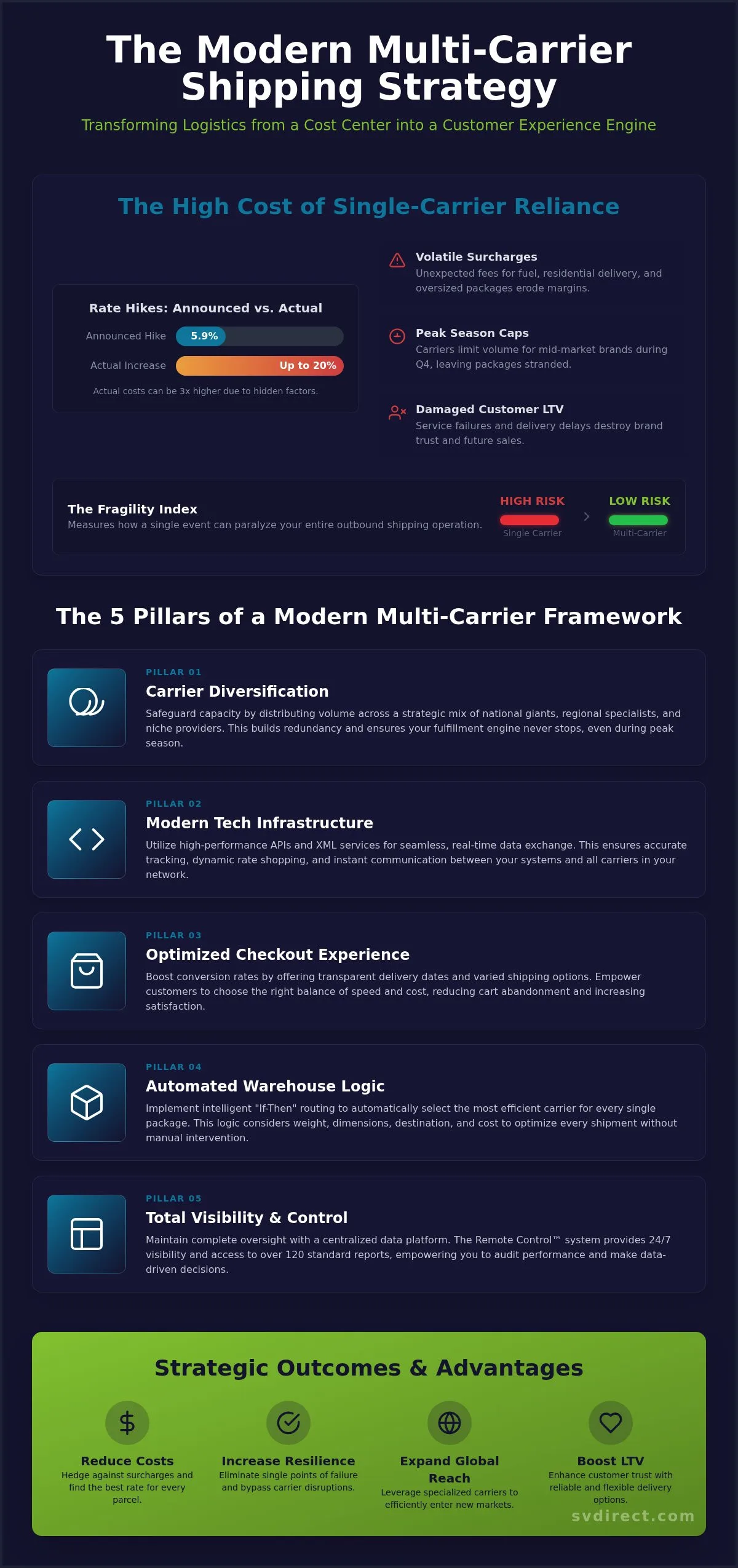
Did you know that while major carriers announced a 5.9% rate hike for 2026, many shippers are seeing their actual costs climb by as much as 20%? Between the USPS shifting its dimensional weight divisor to 139 and new fractional rounding rules, the “average” increase is often a mathematical illusion that erodes your margins. Relying on a single provider isn’t just risky; it’s an operational bottleneck that leaves you vulnerable to surcharges and service gaps. You’ve likely felt the sting of cart abandonment when shipping options are too limited or the anxiety of integrating complex APIs. A modern multi-carrier shipping strategy is no longer a luxury, but a necessity for any brand that values resilience and scale.

You deserve a logistics partner that acts as a steady hand, helping you master the technical framework of carrier diversification without making your operations twice as complicated. This guide provides a clear roadmap to reduce costs, eliminate delivery bottlenecks, and expand your global reach. We’ll examine how to leverage high-performance data to bypass peak season disruptions and transform your shipping operations from a cost center into a customer experience engine.

Key Takeaways

  • Shift from single-carrier dependence to a diversified mix of national and regional specialists to safeguard your capacity during peak seasons.
  • Leverage modern technical infrastructure, including APIs and XML services, to ensure seamless data flow and accurate real-time tracking across all providers.
  • Boost checkout conversion rates by providing customers with transparent delivery dates and varied shipping options that balance speed with cost.
  • Optimize your warehouse workflow by building a multi-carrier shipping strategy around precise parcel audits and automated “If-Then” routing logic.
  • Maintain total oversight of your logistics network with the proprietary Remote Control™ system, offering 120+ standard reports for 24/7 visibility.

Moving Beyond Single-Carrier Dependence in 2026

Many brands operate under the illusion that a single-carrier contract offers a “safe” and simple logistics path. This approach often creates a dangerous single point of failure. A resilient multi-carrier shipping strategy is the strategic distribution of parcel volume across national, regional, and niche carriers to ensure your fulfillment engine never grinds to a halt. It’s about moving from a passive relationship with one provider to an active, data-driven ecosystem. For a deeper look at the foundational concepts of modern logistics, you can explore our global shipping services guide.

We often discuss the “Fragility Index” with our partners. This metric measures how easily a single event, like a regional weather catastrophe or a labor dispute, can paralyze your outbound shipments. If 100% of your volume sits with one carrier, your fragility is at its peak. Experienced Third-party logistics providers recognize that true stability comes from a diversified network. This infrastructure allows you to pivot instantly when one lane becomes blocked or a carrier reaches its limit.

The Risks of Carrier Fragility and Peak Season Caps

During the high-stakes Q4 peak season, national carriers prioritize their largest enterprise accounts. Mid-market brands often face sudden capacity caps, leaving them with packages that won’t be picked up. These service failures do more than delay a single box; they destroy customer lifetime value (LTV). When a customer’s holiday gift arrives late, they don’t blame the carrier; they blame your brand. Building redundancy into your workflow is the only insurance policy that guarantees your products reach the doorstep when promised.

Why ‘Loyalty’ No Longer Guarantees Shipping Savings

It’s a common misconception that deep volume discounts with a single carrier always lead to the lowest total cost. In reality, “hidden” surcharges for fuel, residential delivery, and oversized packages have become highly volatile. These fees can vary by double digits between providers for the exact same route. Rate diversification acts as a financial hedge, allowing you to shop for the best price on a per-package basis. You aren’t just looking for a discount; you’re looking for the most efficient match for every unique parcel profile in your inventory.

Core Components of a Modern Multi-Carrier Strategy

A successful multi-carrier shipping strategy relies on a sophisticated architecture that balances physical logistics with digital precision. It’s not enough to simply sign contracts with multiple providers. You must build a framework that allows these providers to work in concert. This requires a shift from manual carrier selection to an automated ecosystem where data dictates every move. By centralizing your operations, you gain the agility to respond to market shifts without disrupting your warehouse workflow.

The foundation of this approach is data centralization. At Silicon Valley Direct, we provide our partners with a proprietary Remote Control™ system that offers 120+ standard reports. This level of granularity is critical for auditing carrier performance and identifying where surcharges are quietly eroding your profits. When you have 24/7 visibility into every shipment, you can hold carriers accountable to their service level agreements and make informed adjustments to your routing logic.

Integrating Regional and Niche Carriers for Last-Mile Success

While national giants provide a reliable backbone for long-haul transport, regional specialists often offer superior efficiency in high-density delivery zones. These regional players frequently have fewer surcharges and more flexible pickup windows, which can significantly lower your total landed cost. For brands handling specialized inventory, niche carriers provide the expertise required for healthcare compliance or high-value electronics security. Last-mile optimization is the final leg of delivery where costs are highest. By injecting regional players into your mix, you shorten the distance between the warehouse and the doorstep, effectively bypassing the congestion and fees associated with national hubs.

Dynamic Rate Shopping and Automated Routing Logic

The “brain” of a modern fulfillment operation is its automated routing logic. This technology uses APIs and XML-based web services to perform real-time data exchange between your systems and the carriers. In the milliseconds it takes to process an order, the system compares time-in-transit against current freight costs to select the optimal path. This ensures you aren’t overpaying for expedited shipping when a ground service could reach the customer in the same timeframe.

Precision at this stage is vital. Automated address validation plays a key role here, as it prevents failed deliveries and the steep re-routing fees that carriers often apply. For brands seeking this level of technical integration, our remote order management services provide the real-time visibility needed to manage these complex choices. If you’re ready to see how a tailored approach can stabilize your fulfillment, you can request a custom quote to explore your options. This proactive stance ensures your logistics remain a high-performance asset rather than a growing liability.

Optimizing Checkout Conversions through Shipping Choice

While the back-end logic ensures operational stability, the true test of your multi-carrier shipping strategy happens at the checkout. Consumers today demand more than just a “shipped” notification. They want agency over how and when their products arrive. It’s a mistake to assume that free shipping is the only lever for conversion. For many shoppers, speed is a higher priority, especially for deadline-driven needs like gifts or healthcare supplies. By providing a spectrum of options, you cater to both the budget-conscious and the time-sensitive customer.

Maintaining the customer relationship after they click the buy button is equally vital. Branded tracking pages allow you to keep the conversation on your own digital properties rather than sending users to a generic carrier portal. This touchpoint is a prime opportunity to reinforce your brand identity and provide proactive updates. For brands with a global reach, incorporating Delivered Duty Paid (DDP) options removes the cross-border friction that often leads to refused packages and customer frustration. When duties and taxes are settled upfront, the delivery experience remains seamless and predictable.

Offering Choice Without Operational Complexity

Presenting three distinct shipping tiers, including Economy, Standard, and Expedited, gives users the control they crave without overwhelming your warehouse staff. The “Amazon Effect” has trained shoppers to expect precise delivery windows rather than vague estimates. Meeting this expectation requires using your historical carrier data to determine which providers perform best in specific geographic regions. If a regional carrier consistently beats a national giant in the Pacific Northwest, your checkout should reflect that speed. This targeted approach ensures you aren’t just offering choices; you’re offering the most reliable ones available.

Reducing Cart Abandonment via Shipping Transparency

Cart abandonment often spikes when shipping costs appear as a surprise at the final step. Displaying real-time carrier rates early in the process eliminates this friction and builds immediate trust. Even more powerful is the use of Estimated Delivery Dates (EDD). Phrases like “Arrives Wednesday, Oct 14” significantly outperform generic “3-5 business days” language because they provide a concrete promise. Balancing shipping cost recovery with your conversion goals is a delicate act. However, when customers see the direct value of an expedited service through a transparent EDD, they’re often more willing to pay the premium for that certainty.

Multi-Carrier Shipping Strategy: The 2026 Guide to Resilient Fulfillment

Operationalizing Multi-Carrier Logistics in the Warehouse

Executing a multi-carrier shipping strategy requires more than just a software subscription; it demands a disciplined physical workflow. Many providers treat logistics as a “set and forget” digital task, but true resilience is built on the warehouse floor. To move from theory to high-performance execution, your facility must follow a methodical progression that prioritizes data accuracy and physical precision.

Operationalizing this framework involves five essential steps:

  • Step 1: Audit your parcel profile. Analyze your weight, dimensions, and destination clusters to identify which carriers offer the most efficient lanes for your specific inventory.
  • Step 2: Define “If-Then” routing rules. Program your Order Management System (OMS) to automatically assign carriers based on cost, speed, and reliability targets.
  • Step 3: Implement a systematic QC-Check. Establish a verification process to ensure the correct carrier label is applied to the right parcel every time.
  • Step 4: Integrate value-added services. Use kitting and assembly to optimize package sizes and reduce dimensional weight surcharges.
  • Step 5: Monitor performance daily. Use real-time reporting to track carrier delivery times and surcharge accuracy, allowing for immediate adjustments.

Automating Carrier Selection Rules via Web Services

Modern fulfillment relies on seamless communication between your storefront and the warehouse. We utilize SOAP and XML protocols to allow for programmatic logistics that scale with your order volume. By using specific methods like “AddOrder” to ingest data and “GetShippingActivity” for real-time updates, we eliminate the friction of manual data entry. This technical integration also enables “batch delivery to carrier” logic. This streamlines end-of-day pickups by grouping orders by provider, ensuring that every package is ready for the correct driver at the exact right time.

The Role of Human Oversight in Quality Control

While technology provides the framework, human oversight provides the precision. We believe a quiet, organized facility produces fewer errors than a frantic, fully automated environment. Our team practices proactive problem solving, often catching a carrier conflict or a label discrepancy before the package even leaves the station. This human touch is especially critical when coordinating on-demand digital printing. Our specialists ensure that personalized inserts or destination-specific literature match the shipping destination perfectly. This blend of high-tech logic and high-touch care ensures your brand’s reputation remains untarnished.

Executing Global Strategy with Silicon Valley Direct

Choosing a partner to execute your multi-carrier shipping strategy is a decision that impacts every facet of your business growth. At Silicon Valley Direct, we don’t view ourselves as a transactional vendor. We operate as a dedicated extension of your team. With over 25 years of operational history since our founding in 1999, we’ve seen the industry evolve from simple parcel delivery to the complex, data-driven ecosystem it is today. We provide the steady hand and physical infrastructure needed to turn your logistics goals into a competitive advantage. Our team consists of long-term professionals who understand that your success is our success.

Our proprietary Remote Control™ system serves as the central nervous system for your fulfillment. It offers 24/7 visibility into your inventory and carrier performance through more than 120 standard reports. This level of transparency ensures you aren’t just shipping boxes; you’re managing a high-performance network. Our proactive “Make-It-Right” philosophy means we anticipate carrier conflicts and logistics bottlenecks before they reach your customers. We take personal pride in the precision of our work. If a carrier’s performance dips or a surcharge pattern emerges, we flag it immediately. We believe in direct human connection and personal oversight, which is why you’ll always have access to an expert who knows your business inside and out.

Leveraging Proprietary Technology for Real-Time Control

The SVD web interface is designed for total flexibility. It provides a platform-agnostic environment that works seamlessly with any development stack, allowing your team to build custom user interfaces that fit your specific workflow. This technical agility is backed by real-world performance. For instance, we regularly manage high-volume projects, such as handling over 3,000 shipments in a single week, while maintaining zero color variance on printed materials and zero shipping errors. This combination of digital sophistication and physical accuracy is what separates a true partner from a mere consultant who only offers advice without the warehouse capacity to back it up.

A Proactive Partnership for National and Global Reach

We reject the “cookie-cutter” approach common in the fulfillment industry. Every brand has unique needs, whether you require high-compliance healthcare mailing services or a complex global eCommerce rollout. Our team specializes in bespoke problem-solving, tailoring our kitting, assembly, and distribution processes to your exact specifications. By combining our deep industry expertise with a commitment to human oversight, we ensure your global reach is as reliable as your local presence. We treat every project with the same level of care and precision, ensuring that your growth is never limited by your fulfillment capacity.

Partner with Silicon Valley Direct for your multi-carrier fulfillment needs.

Future-Proofing Your Fulfillment Engine

Transitioning to a sophisticated multi-carrier shipping strategy is the most effective way to insulate your brand from the volatility of the 2026 logistics market. By balancing automated routing logic with the wisdom of seasoned professionals, you transform shipping from a logistical burden into a driver of customer loyalty. You’ve seen how carrier diversification reduces fragility and how transparent checkout options can recover lost revenue. It’s about building a framework that scales with your ambition without increasing your operational stress.

We bring over 25 years of logistics excellence to every partnership, ensuring your operations remain stable even during peak season surges. Our proprietary Remote Control™ system provides the 24/7 visibility you need to audit performance in real time; our proactive human QC-check process prevents errors before they reach the doorstep. We don’t just ship boxes; we protect your brand’s reputation with every delivery. You can move forward with the confidence that your logistics are handled with precision and care.

We look forward to helping you master the complexity of modern distribution and achieving a new level of operational resilience.

Frequently Asked Questions

What is a multi-carrier shipping strategy?

A multi-carrier shipping strategy is a deliberate approach to distributing parcel volume across multiple national, regional, and niche carriers rather than relying on a single provider. This framework allows your business to optimize for cost, speed, and reliability on a per-package basis. It acts as a vital safeguard against carrier capacity caps and service disruptions, ensuring that your fulfillment engine remains operational regardless of external market volatility or peak season pressures.

How many carriers should a growing eCommerce business use?

Most growing brands find that a mix of three to five carriers provides the ideal balance between redundancy and operational simplicity. This usually includes two national giants for broad reach, one or two regional specialists for last-mile efficiency, and a niche provider for specialized shipping needs. Maintaining this variety ensures you have the flexibility to pivot during high-volume periods without overwhelming your internal tracking and reporting systems.

Will I lose my carrier volume discounts if I use multiple providers?

Not necessarily; in fact, a multi-carrier shipping strategy often reveals that hidden surcharges from a single provider outweigh the benefits of a basic volume discount. By rate shopping across multiple carriers, you can often find lower total landed costs for specific zones or parcel profiles. You aren’t just chasing a discount; you’re matching each shipment to the most efficient provider to protect your overall margins and delivery promises.

What is the difference between a regional carrier and a national carrier?

National carriers provide comprehensive coverage across the entire country and international markets, while regional carriers focus on high-density delivery zones within specific geographic areas. Regional providers often offer superior speed and fewer surcharges for last-mile deliveries because they bypass the hub-and-spoke congestion of national networks. Integrating regional specialists is a key component of a resilient and cost-effective distribution model that prioritizes the final leg of the journey.

How do shipping APIs help with a multi-carrier strategy?

Shipping APIs allow your Order Management System to communicate in real time with multiple carriers to pull live rates, validate addresses, and generate labels. This technical integration automates the selection process by comparing transit times and costs in milliseconds. Without these web services, managing multiple providers would require manual entry, which increases the risk of errors and slows down your warehouse production during critical, deadline-driven windows.

What does ‘batch delivery to carrier’ mean in fulfillment?

Batch delivery is the process of grouping all orders assigned to a specific carrier into a single, organized hand-off for end-of-day pickup. This method streamlines warehouse operations by ensuring that packages for different providers are segregated and ready for their respective drivers simultaneously. It reduces the chaos of multiple daily pickups and ensures that your facility maintains a steady, methodical flow from the packing station to the departure dock.

Can a multi-carrier strategy help reduce cart abandonment?

Yes; providing customers with multiple shipping options and transparent delivery dates directly addresses the leading causes of cart abandonment. When shoppers see varied tiers like Economy, Standard, and Expedited, they feel in control of their purchase experience. Displaying precise estimated delivery dates instead of vague windows builds the trust necessary to convert a browsing visitor into a paying customer who feels confident in your reliability.

Is multi-carrier shipping more expensive to manage?

While the initial technical setup requires an investment in integration, the long-term savings in reduced surcharges and improved delivery performance usually outweigh the management costs. A proactive partner manages the complexity for you, using proprietary systems to audit performance and automate routing logic. In the 2026 market, the cost of a single-carrier service failure is far higher than the cost of maintaining a diversified and stable shipping network.

Subscription Box Fulfillment Services: The 2026 Strategic Guide to Scalable Recurring Revenue

Subscription Box Fulfillment Services: The 2026 Strategic Guide to Scalable Recurring Revenue

Did you know that 52% of consumers canceled at least one subscription in the last year? Often, these cancellations aren’t a reflection of the product itself, but rather a breakdown in the delivery experience. You’ve likely faced the stress of high churn caused by shipping delays, damaged items, or a missing insert that ruined a carefully curated unboxing. It’s a common struggle for growing brands to find subscription box fulfillment services that offer both high-tech efficiency and the human touch required for custom kitting.

We understand that as you scale through 2026, you need more than just a warehouse; you need a steady hand to manage the 5.9% FedEx rate hikes and complex USPS surcharges that now account for 33% of average package costs. This guide will help you master these logistics while protecting your brand with personal oversight. You’ll learn how to achieve 100% kitting accuracy and seamless Shopify integration. We’ll provide the roadmap to predictable costs and scalable global shipping, ensuring your recurring revenue remains secure and your subscribers stay delighted.

Key Takeaways

  • Learn to distinguish between replenishment and curated models to align your logistics with your specific recurring revenue strategy.
  • Discover how personal oversight in subscription box fulfillment services ensures 100% kitting accuracy and protects the unboxing experience from errors.
  • Leverage on-demand digital printing to create personalized inserts that turn every delivery into a high-impact marketing moment.
  • Master inventory management using FIFO protocols to minimize product obsolescence and maintain a lean, efficient supply chain.
  • Understand why prioritizing direct human interaction over automated chatbots is the key to maintaining control as your brand scales globally.

Understanding Subscription Box Fulfillment Services in the 2026 Market

In 2026, the subscription economy has reached a level of maturity where simple shipping is no longer enough. The market grew by 12.6% this year, and consumers now expect a flawless, high-touch experience with every delivery. Effective subscription box fulfillment services act as the physical handshake between your brand and your subscriber. It’s the moment where your digital promise becomes a tangible reality. To succeed now, you must view logistics as a tool for recurring brand engagement rather than a back-office chore.

The landscape for subscription-based ecommerce businesses has shifted toward quality and precision. With the average number of household subscriptions settling at 2.8, your box must earn its place every month. This requires a fulfillment strategy that can handle the “Big Five” categories, beauty, pet, food, personal care, and clothing, with absolute accuracy. If the kitting isn’t perfect, the unboxing experience fails, and your churn rate will inevitably spike.

To better understand the mechanics behind this process, watch this concise breakdown:

Replenishment vs. Curated Boxes: Choosing Your Logistics Path

Your operational requirements depend heavily on your product model. Replenishment logistics focus on speed and low-friction inventory cycles. These boxes deliver the same essentials every month, so efficiency is found in high-volume throughput and predictable stock levels. Curated box logistics are far more complex. They involve managing high SKU turnover and intricate assembly instructions for rotating monthly items. This model dictates a different warehousing structure, often requiring more floor space for dedicated kitting lines and the flexibility to stage diverse inventory before a monthly “wave” shipment. For curated brands like BlueStream Wines, choosing the wrong partner often leads to the missing inserts and damaged items that drive subscribers away.

The Hidden Costs of In-House Fulfillment

Many brands start in a garage or small office, but there’s a clear transition point where in-house efforts become a liability. The first sign is a rising opportunity cost. If your core team is spending their afternoons with tape and dunnage, they aren’t focusing on subscriber acquisition or product development. Second, scalability bottlenecks become obvious during viral growth moments or peak seasons. An in-house team simply can’t flex as fast as a professional facility. Finally, if your “missing item” tickets are increasing, your manual processes have reached their limit. Professional subscription box fulfillment services eliminate these headaches by providing the infrastructure and personal oversight needed to maintain 100% accuracy as you grow.

Subscription box fulfillment is a strategic brand touchpoint that defines the customer experience, rather than a mere shipping expense to be minimized.

Mastering Kitting and Assembly: The Core of Subscription Logistics

The subscription market hasn’t just expanded; it has grown by more than 100% percent a year in recent history, placing immense pressure on the assembly floor. Kitting is the heartbeat of subscription box fulfillment services. It’s the moment where individual SKUs transform into a cohesive brand story. A perfect kit requires more than just placing items in a container. It involves the strategic use of protective dunnage to prevent transit damage and the precise placement of promotional inserts that drive future sales. When these elements are mismanaged, the unboxing experience feels cluttered or, worse, incomplete.

Effective quality control relies on personal oversight. While automation has its place, human eyes are essential for identifying the subtle defects that a machine might miss. We use a “golden sample” protocol where every box on the line must match a master version. This prevents the “missing item” complaints that lead to high churn. Managing monthly SKU transitions is equally critical. By utilizing lean inventory practices, you can avoid “dead zones” where old stock takes up valuable space while new kits are being assembled. Integrating custom packaging further reinforces your brand identity at the first touch, ensuring your subscribers feel the value immediately.

The 5-Step Subscription Assembly Process

Precision is born from a repeatable, documented workflow. This approach ensures that every box leaving the facility meets your exact specifications.

  • Step 1: Inventory receiving and verification. We use strict FIFO (First-In, First-Out) protocols to ensure product freshness and prevent obsolescence.
  • Step 2: Custom assembly line setup. Every month brings new kits. We configure dedicated lines based on specific assembly instructions for that cycle.
  • Step 3: Multi-point inspection. Our team performs visual checks at multiple stages to ensure every insert and item is present and correctly positioned.
  • Step 4: Secure sealing and label application. We apply custom packaging and shipping labels designed to withstand the rigors of global transit.

Custom Kitting for High-Value and Sensitive Goods

If your brand deals in luxury items or fragile electronics, standard fulfillment won’t suffice. These goods require specialized dunnage and, in some cases, climate-controlled storage to maintain their integrity. Security is also a priority. High-value items need tracked movement through the facility and tamper-evident sealing. This level of care is a hallmark of our Kitting and Assembly Services. If you’re ready to eliminate assembly errors, you can request a tailored fulfillment quote to see how we handle complex requirements.

Elevating the Unboxing Experience with Integrated Digital Printing

The unboxing experience is your most potent weapon against subscriber churn. In a market where 52% of consumers have canceled a subscription in the last year, the physical presentation of your product must do more than just arrive intact. It has to inspire. High-quality subscription box fulfillment services recognize that the “wow” factor doesn’t come from the product alone. It comes from the personalized touchpoints, such as a custom newsletter or a welcome note, that greet the subscriber the moment they lift the lid.

Traditional fulfillment models often rely on third-party printers to ship marketing collateral to the warehouse. This creates unnecessary friction and extends lead times. By utilizing integrated digital printing, you can leverage “Just-in-Time” production for monthly newsletters and promotional flyers. This approach allows for hyper-personalization at scale. Instead of a generic insert, you can tailor marketing materials to specific customer segments based on their purchase history or subscription tier. Integrated digital printing eliminates the logistical lag of shipping literature across the country, which significantly reduces lead times for monthly box changes.

On-Demand Printing: A Differentiator for Subscription Brands

Housing printing and assembly under one roof is a strategic advantage that many competitors overlook. It removes the risk of your fulfillment line stalling because a shipment of inserts is delayed in transit. We provide high-quality digital printing for brochures, catalogs, and personalized “thank you” notes that match the premium feel of your brand. This capability ensures that your marketing assets are as agile as your inventory. If you’re looking to expand your reach through physical touchpoints beyond the box, our Direct Mail Marketing Services offer a seamless way to re-engage dormant subscribers.

Literature Fulfillment and Asset Management

Efficient asset management is essential for brands that include extensive literature in their recurring orders. Whether you’re distributing educational booklets or complex promotional kits, storing and managing these materials requires the same precision as your primary inventory. For subscription boxes in the healthcare or financial sectors, this precision is even more critical. These industries require strict compliance and accuracy in their documentation. Our subscription box fulfillment services include specialized literature fulfillment protocols to ensure that every sensitive document is handled with care and delivered to the correct recipient. This methodical approach protects your brand from the compliance risks associated with missing or incorrect information.

Subscription Box Fulfillment Services: The 2026 Strategic Guide to Scalable Recurring Revenue

Strategic Warehousing and Global Shipping from Silicon Valley

Positioning your inventory in a Silicon Valley hub provides a distinct advantage for subscription box fulfillment services. Our location offers immediate proximity to major international airports and the Port of Oakland, which is essential for brands sourcing components globally or shipping to an international subscriber base. In 2026, the complexity of cross-border eCommerce requires more than just a shipping label. It demands a deep understanding of international duties, taxes, and trade regulations to ensure your boxes don’t get stuck in customs. By leveraging a hub at the center of global innovation, you gain a partner capable of navigating these nuances with precision.

Effective inventory management is the foundation of a healthy subscription model. We utilize strict FIFO (First-In, First-Out) protocols to ensure that products with limited shelf lives, such as those in the beauty or food categories, are shipped in the order they were received. This prevents product obsolescence and protects your margins. Additionally, our established relationships with major carriers allow us to pass on significant volume discounts. With 2026 seeing a 5.9% average rate increase from FedEx and a 7.8% hike for USPS Ground Advantage, these 3PL discounts are vital for maintaining predictable fulfillment costs.

Secure Warehousing for High-Growth Brands

Storage efficiency is a critical component of your monthly overhead. We offer a mix of pallet and shelf storage, allowing you to optimize your footprint based on your current SKU count and volume. This flexibility ensures you aren’t paying for unused space during slower months but have the room to expand during peak seasons. For brands in the wellness, beauty, or pharmaceutical sectors, our climate-controlled options provide the stable environment necessary to maintain product integrity. If your growth plan includes reaching customers beyond the U.S. border, our Global Shipping Services provide the infrastructure needed for reliable international delivery.

Returns Management: The “Reverse Logistics” of Subscriptions

Reverse logistics is often an overlooked aspect of the subscription lifecycle. A seamless returns process is essential for maintaining customer trust, especially when 52% of consumers have canceled a subscription in the past year. We streamline this by inspecting every returned item against your specific quality standards. Items that meet the “like-new” criteria are refurbished and integrated back into your inventory for future kits, reducing waste and saving costs. We also manage batch delivery to carriers, which optimizes the shipping timeline and ensures that returns don’t disrupt your primary fulfillment waves. If you want to see how our strategic location can lower your overhead, request a free logistics quote today to get started.

Choosing Your Partner: The Silicon Valley Direct Advantage

Selecting a partner for your subscription box fulfillment services is one of the most critical decisions you’ll make as a brand leader. In a tech-saturated market where many providers hide behind automated chatbots and faceless support tickets, we offer a different path. Our 25-year history provides a foundation of stability that newer, venture-backed 3PLs simply cannot match. We believe that recurring revenue shouldn’t be managed by an algorithm. Instead, we prioritize direct human connection and bespoke problem-solving to ensure your unique brand requirements are met with precision.

Scaling from a niche startup to a global enterprise requires more than just warehouse space. It requires an operational partner that acts as a steady hand during periods of rapid growth. Whether you’re navigating the 12.6% industry growth seen in 2026 or managing the complexities of the “Big Five” subscription categories, our team ensures that your logistics remain a competitive advantage rather than a bottleneck. We reject the one-size-fits-all model in favor of workflows tailored to your specific kitting and assembly needs.

Personal Oversight in a High-Tech World

Quality control isn’t just about software; it’s about the people on the floor. Our long-term staff retention is a unique hallmark of our internal stability, ensuring that the team handling your kits understands your brand’s standards as well as you do. This human element is especially vital for high-stakes fulfillment, such as HIPAA-compliant healthcare mailing or high-security luxury goods. Our “Steady Hand” philosophy is designed to alleviate the stress of business growth by providing physical infrastructure backed by deep expertise. We ensure that every box matches your “golden sample” before it ever leaves our Silicon Valley facility.

Getting Started: Your Roadmap to Professional Fulfillment

Transitioning to a professional partner is a structured process designed for transparency. Our onboarding begins with a deep dive into your current volume, kitting complexity, and global shipping goals. We don’t provide generic pricing; we offer custom quotes that reflect the specific needs of your subscription model. From initial eCommerce integration to your first live monthly shipment wave, we guide you through every step to ensure a seamless launch. If you’re ready to protect your brand experience and scale with confidence, Contact Silicon Valley Direct for a Custom Fulfillment Quote today.

Securing Your Brand’s Future in the Subscription Economy

Navigating the logistics of 2026 requires a partner that balances high-tech precision with a steady, human hand. You’ve seen how the unboxing experience, powered by integrated on-demand digital printing, can turn a simple delivery into a powerful retention tool. By mastering the complexities of custom kitting and leveraging a Silicon Valley hub for global reach, you protect your margins against rising carrier surcharges. Choosing professional subscription box fulfillment services isn’t just about moving packages; it’s about safeguarding the recurring revenue that fuels your growth.

Since 1999, we’ve helped brands scale through stability and specialized expertise, including HIPAA-compliant and healthcare mailing services. We’re ready to tailor a fulfillment workflow that meets your unique requirements and eliminates the stress of operational bottlenecks. If you’re looking for a dedicated partner to protect your subscriber experience, it’s time to Streamline Your Subscription Logistics with Silicon Valley Direct. Your brand’s next chapter of growth is within reach, and we’re here to help you lead it with confidence.

Frequently Asked Questions

What is included in subscription box fulfillment services?

Comprehensive subscription box fulfillment services encompass the entire lifecycle of a recurring order. This includes secure warehousing, precise inventory management, custom kitting and assembly, and reliable global shipping. We also manage the reverse logistics of returns to ensure your inventory remains accurate and your subscribers stay satisfied with the brand experience.

How much does subscription box fulfillment typically cost?

Fulfillment costs are determined by several variables, including your monthly shipment volume, the number of unique SKUs per box, and the complexity of the assembly process. Storage requirements and shipping destinations also play a role. We provide bespoke quotes tailored to your specific operational goals rather than using a rigid, one-size-fits-all pricing model. Similarly, in the digital space, niche providers often explore Tiered Software Subscription Fees to ensure their pricing structures remain competitive and accessible for diverse user groups.

Can you handle custom branded packaging and marketing inserts?

Yes, we specialize in high-touch unboxing experiences that utilize custom branded packaging and marketing inserts. Our facility integrates on-demand digital printing, which allows us to produce personalized notes and promotional flyers that are placed directly into your kits during the assembly process. This ensures every box reinforces your brand identity at the first touch.

Do you offer international shipping for subscription boxes?

We provide robust global shipping and logistics from our Silicon Valley hub. Our location near major international ports and airports allows us to navigate cross-border eCommerce with efficiency. We help you manage the complexities of international trade, including duties and taxes, to ensure a smooth delivery experience for your global subscribers without unexpected delays.

How do you handle monthly changes in subscription box contents?

Managing rotating inventory is a core part of our workflow. We use flexible assembly lines that are reconfigured for every monthly cycle based on your specific kitting instructions. Our team uses FIFO protocols to prevent product obsolescence and ensures that new items are staged and ready for the next wave of shipments, regardless of SKU turnover.

What is the benefit of having digital printing and fulfillment in one location?

Housing these services under one roof eliminates the need to coordinate between multiple vendors and significantly reduces the lead time for monthly changes. You don’t have to worry about shipping literature from a printer to a warehouse. This integrated approach also allows for hyper-personalization, as we can print and pack inserts in a single, streamlined motion.

How does Silicon Valley Direct ensure kitting accuracy?

We ensure 100% accuracy through a combination of rigorous quality control protocols and personal oversight. Every assembly line uses a “golden sample” that serves as the master reference for every box produced. Our long-term staff performs multi-point visual inspections to verify that every item and insert is exactly where it belongs before the box is sealed.

Can you integrate with Shopify or other eCommerce platforms?

Our systems integrate seamlessly with Shopify and other major eCommerce platforms to automate the flow of order data. This technical integration ensures that your fulfillment team receives real-time information, allowing for proactive inventory management and immediate shipping updates for your customers. It’s a proactive approach that reduces the stress of scaling your business.

Custom Branded Packaging Fulfillment: The Strategic Guide to the Unboxing Experience

Custom Branded Packaging Fulfillment: The Strategic Guide to the Unboxing Experience

With the EU’s Packaging and Packaging Waste Regulation enforcing a 40% maximum empty space ratio starting August 12, 2026, your oversized custom boxes aren’t just a branding choice; they’re becoming a legal and financial liability. It’s frustrating to watch shipping margins shrink due to dimensional weight fees or complex kitting errors that ruin a customer’s first impression. You’ve worked hard to build a premium brand, and you deserve a logistics process that reflects that quality without the operational headaches. This is where custom branded packaging fulfillment moves from a luxury to a strategic necessity.

We understand that scaling a business requires a steady hand and precision. This guide will show you how to master the art of branded logistics to transform every delivery into a high-impact marketing touchpoint that drives customer loyalty. We’ll explore how to integrate your brand identity into the shipping process, maintain a premium feel at scale, and navigate the tightening regulatory landscape of 2026 with confidence. By the end, you’ll have a roadmap for a seamless, efficient fulfillment operation that protects your bottom line and delights your customers.

Key Takeaways

  • Learn how to transition from basic utility shipping to experiential marketing to drive high-impact customer loyalty.
  • Discover the technical workflow of integrating on-demand digital printing for personalized, just-in-time package inserts.
  • Assess the strategic benefits of custom branded packaging fulfillment to avoid the hidden opportunity costs of managing complex kitting in-house.
  • Master design strategies that protect your margins by optimizing for dimensional weight while reducing warehouse labor time.
  • Explore why a partnership grounded in human expertise and bespoke problem-solving is essential for scaling complex branded logistics.

Beyond the Box: Why Custom Branded Packaging Fulfillment Matters in 2026

In 2026, the definition of success in eCommerce has moved past simple delivery speeds. Custom branded packaging fulfillment is the deliberate integration of your brand’s visual and tactile assets directly into the third-party logistics (3PL) workflow. It’s no longer enough to just get a product from point A to point B. Every shipment represents a physical manifestation of your brand promise, requiring a sophisticated marriage of high-tech precision and human oversight.

The eCommerce landscape has shifted from “utility shipping” to “experiential marketing.” While traditional logistics once focused solely on the mechanical efficiency of moving parcels, modern brands use the delivery phase as a high-impact marketing touchpoint. This evolution demands a partner who can manage complex kitting and assembly without sacrificing the speed that customers expect. It’s about turning a routine delivery into a memorable event.

To better understand how this process works in a modern setting, watch this helpful tutorial:

The psychological impact of the unboxing experience is a primary driver of customer retention. When a customer receives a thoughtfully designed package, it triggers a positive emotional response that reinforces their purchase decision. This moment is the first physical touchpoint in the B2C journey, making it the most critical window for building long-term loyalty. Data continues to show that premium presentation directly correlates with higher repeat purchase rates and lower return volumes.

The Unboxing Experience as a Retention Engine

Brand Identity vs. Operational Reality

There is often a natural tension between intricate brand designs and warehouse operational efficiency. Complex packaging can slow down pick-and-pack speeds, leading to delays and increased labor costs. To solve this, we advocate for “fulfillment-ready” packaging design. This approach prioritizes structures that are easy to assemble and pack while maintaining a premium feel. At Silicon Valley Direct, our team provides the human oversight necessary to ensure every order meets your exact brand standards. For more insights on scaling your operations, explore our latest updates on the fulfillment blog. Our proactive stance ensures that your brand identity remains intact, even as your order volume grows.

The Mechanics of Branded Fulfillment: From Kitting to the Doorstep

The journey from a digital order to a physical unboxing requires a series of highly synchronized operational steps. While many providers focus solely on the box design, true custom branded packaging fulfillment succeeds or fails on the warehouse floor. It begins with the meticulous receipt of your inventory and branded assets. These components aren’t just stored; they’re managed within a secure warehousing environment that protects high-value items from damage or loss. This foundation of stability ensures that when a promotional set needs to be built, every piece is exactly where it should be.

Once orders arrive, the transition from storage to the packing station must be seamless. This is where digital printing integrates directly with the fulfillment line. Instead of relying on pre-printed, generic inserts that can quickly become outdated, modern systems allow for just-in-time production. This means your latest marketing message or a seasonal promotion can be printed and included in the box seconds before it’s sealed. This level of agility transforms a standard logistics operation into a responsive marketing engine that adapts to your brand’s pace.

Advanced Kitting and Assembly Workflows

Creating a complex unboxing experience often involves more than just placing a product in a box. It requires Kitting and Assembly Services that prioritize precision and aesthetic placement. Our team handles multi-item bundling where every component, from the main product to the smallest custom dunnage, has a specific home. We use tailored inserts to ensure that items don’t shift during transit, preserving the visual impact for the customer. This physical labor is the backbone of branded logistics, ensuring that the structural design of your packaging actually works in a high-volume environment.

On-Demand Printing and Personalization

Personalization is a significant driver of customer connection in 2026. By utilizing on-demand digital printing, you can include personalized packing slips or individualized thank-you notes without the waste of bulk pre-printing. This approach offers a clear cost-benefit by reducing inventory obsolescence and eliminating the need to store thousands of static inserts. Our inventory management software synchronizes directly with print queues, ensuring that every personalized element matches the specific order data perfectly. It’s a high-tech solution that maintains a human touch. If you’re looking to refine these complex workflows, you can consult with our logistics experts to see how we can streamline your process through bespoke solutions.

Strategic Evaluation: Scalability and the Hidden Costs of DIY Packaging

Many growing brands hesitate to move toward professional custom branded packaging fulfillment because they perceive it as a high-overhead luxury. However, the true cost of DIY packaging often stays hidden within a founder’s schedule and operational inefficiencies. When a CEO spends hours kitting complex promotional sets, they’re sacrificing time that should be spent on strategic growth or product development. This opportunity cost is far higher than any professional service fee. Relying on non-standardized, manual processes also increases the risk of shipping errors, which can lead to expensive returns and damaged customer relationships.

A sophisticated 3PL partnership provides a significant financial advantage through discounted carrier rates. Because professional fulfillment centers move massive volumes, they negotiate shipping prices that individual brands simply can’t access. These savings frequently offset the additional cost of premium, branded materials. By shifting to a professional model, you aren’t just buying labor; you’re leveraging a global shipping infrastructure that makes high-end presentation economically viable.

Labor Costs and Pick-and-Pack Fees

Professional kitting fees are typically calculated based on the complexity of the assembly. A simple box with one insert costs less than a multi-item bundle requiring precision placement and custom dunnage. Professional assembly lines operate with a level of speed and accuracy that manual in-house packing can’t match. To calculate the ROI of custom packaging, you must look beyond the per-unit cost. Consider the reduction in customer service inquiries, the increase in social media shares, and the lifetime value of a customer who feels a deep connection to your brand from the very first delivery.

Inventory Management and Storage Efficiency

Managing multiple box sizes, seasonal inserts, and high-value branded components requires significant physical space and organization. Storing these assets in-house often leads to cluttered workspaces and disorganized stock counts. Modern 3PL inventory management software provides real-time visibility into your packaging levels, ensuring you never face a stockout of critical branded components. Missing a specific box size can stall your entire fulfillment pipeline, leading to delays that frustrate customers. A proactive partner monitors these levels continuously, treating your packaging inventory with the same rigor as your primary products.

Custom Branded Packaging Fulfillment: The Strategic Guide to the Unboxing Experience

Optimizing the Unboxing Experience: Design Principles for Seamless Fulfillment

Creating a memorable unboxing experience requires a balance between creative vision and logistical reality. When you design your packaging, you must look beyond the aesthetic appeal and consider how that structure performs within the high-speed environment of custom branded packaging fulfillment. A box that looks beautiful on a designer’s screen might fail in the warehouse if it’s too complex to assemble or too fragile to survive a cross-country journey. To maintain high-impact marketing without sacrificing operational efficiency, your design must follow a set of rigorous principles focused on speed, durability, and cost control.

The first step in any strategic design is auditing the assembly process. You must ensure your packaging can be replicated accurately 1,000 times or more without increasing the risk of kitting errors. We recommend prioritizing “easy-fold” structures that reduce warehouse labor time. Every second saved at the packing station directly improves your margins. Additionally, integrating returns management into the initial design, such as including dual adhesive strips, makes the return process effortless for the customer while protecting the product for potential resale. This proactive approach turns a logistical necessity into a brand-building opportunity.

Balancing Aesthetics with Dimensional Weight

Carrier pricing models are designed to penalize shipments that take up excessive space relative to their weight. DIM weight is a pricing technique used by carriers that calculates a package’s billable weight based on its volume rather than its actual mass. If your custom box is unnecessarily large, you’ll face massive shipping surcharges that erode your profitability. We advise choosing the smallest possible footprint that still delivers a “wow” factor. By using custom inserts to secure products tightly, you can maintain a premium feel while minimizing the overall box dimensions and avoiding the hidden costs of empty space.

Sustainability and Material Selection

Modern consumers increasingly demand eco-friendly, recyclable branded packaging. However, switching to sustainable materials shouldn’t mean sacrificing the durability of your shipment. It’s essential to choose high-quality, recycled corrugated materials that can withstand the rigors of transit. This is especially critical when utilizing Global Shipping Services, where packages may face multiple transfers and varying environmental conditions. By selecting international-ready materials, you ensure that your brand identity remains intact from the moment it leaves our facility until it reaches the customer’s doorstep. If you’re ready to refine your packaging strategy for better performance, contact us for a bespoke fulfillment quote today.

Elevate Your Brand with Silicon Valley Direct’s Bespoke Fulfillment Solutions

In an era where many logistics providers have replaced personal oversight with impersonal automation, Silicon Valley Direct stands as a high-touch alternative. We believe that your brand’s physical presentation is too important to be left to an algorithm. With over 25 years of experience handling complex logistics for both agile startups and established enterprises, we’ve built our reputation on the belief that precision requires a human touch. Our approach to custom branded packaging fulfillment combines the efficiency of modern technology with the methodical care of a dedicated team that treats your inventory as if it were our own.

Our location in the heart of the world’s most innovative tech hub isn’t just a point of pride; it’s a symbol of our commitment to global connectivity and operational excellence. We use high-tech integrations to provide you with real-time visibility and seamless data flow, yet we never let the digital interface replace direct human connection. When you partner with us, you’re gaining a steady hand that understands the nuances of your specific industry. This ensures that every shipment reflects the high standards you’ve worked so hard to establish, maintaining the air of quiet confidence your brand deserves.

Bespoke Kitting for High-Value Brands

Certain industries demand a level of accuracy that goes far beyond standard pick-and-pack. We specialize in handling high-value electronics and sensitive materials with the precision they require. For brands navigating the complexities of medical logistics, our Healthcare Mailing Services guide offers a deep dive into how we manage compliance-heavy needs. We invite you to experience a partnership where your brand’s physical assets are treated with the same enthusiasm and care that you bring to your own business. Our team’s collective experience is a point of pride, ensuring that complex kitting and assembly are executed perfectly every time.

Getting Started: The Transition to Professional Fulfillment

Moving from in-house packing to a professional 3PL is a significant milestone for any growing business. We’ve designed our onboarding process to be transparent and collaborative, alleviating the stress of the transition through clear communication and expert guidance. Our team works closely with you to audit your current packaging workflows, identify opportunities for optimization, and ensure that your brand identity remains consistent during the move. We handle the heavy lifting of inventory transfer and technical integration so you can focus on the strategic growth of your company. It’s time to move beyond the limitations of DIY logistics and embrace a scalable solution. Partner with Silicon Valley Direct for your branded fulfillment needs and see how professional oversight can transform your unboxing experience into a lasting marketing asset.

Transform Your Logistics into a Brand Legacy

Scaling your brand shouldn’t mean losing the personal touch that defines your identity. We’ve explored how designing for dimensional weight and prioritizing “fulfillment-ready” structures can protect your margins while delighting your customers. By transitioning to professional custom branded packaging fulfillment, you trade the burden of manual labor for a scalable marketing engine. This strategic shift allows your team to focus on innovation while we handle the complexities of the physical doorstep experience.

Since 1999, Silicon Valley Direct has served as a reliable partner for brands that demand perfection. As expert kitting and assembly specialists, we provide direct human oversight on every project to ensure your brand standards are met with every order. Our Silicon Valley-based global reach provides the infrastructure you need to grow without limits. We invite you to Request a Custom Fulfillment Quote from Silicon Valley Direct today. Let’s work together to make every delivery a powerful statement of your brand’s quality and commitment.

Frequently Asked Questions

What is the difference between standard fulfillment and custom branded packaging fulfillment?

Standard fulfillment prioritizes basic utility and speed using generic shipping supplies. In contrast, custom branded packaging fulfillment integrates your specific brand assets directly into the warehouse workflow. This process transforms a routine delivery into a high-impact marketing touchpoint. While standard fulfillment focuses solely on the mechanical movement of goods, branded fulfillment prioritizes the tactile experience and emotional connection of the customer.

Does custom branded packaging increase my shipping costs?

Custom packaging only increases shipping costs if the design ignores dimensional weight (DIM) principles. Carriers calculate rates based on box volume, so oversized custom boxes can lead to surcharges. However, our discounted carrier rates often offset the cost of premium materials. By optimizing your box footprint, you can maintain a premium feel without sacrificing your fulfillment margins or operational efficiency.

How do I manage inventory for my custom boxes and inserts?

We manage your branded assets through our integrated inventory management software. Every box, insert, and custom dunnage item is tracked as a unique SKU. This provides you with real-time visibility into stock levels, ensuring you never run out of critical components. Our methodical approach prevents fulfillment delays and ensures your brand standards are met for every single order we process.

Can Silicon Valley Direct help with the actual printing of my brand materials?

Yes, we provide on-demand digital printing for personalized inserts, literature, and packing slips. This allows you to produce marketing materials as needed rather than managing massive bulk inventories. It’s a highly efficient way to keep your seasonal promotions current and add a human touch to every package. Our print queues synchronize directly with your order data for perfect accuracy and speed.

What is the minimum order volume for custom branded kitting?

We don’t believe in a one-size-fits-all approach to custom branded packaging fulfillment. Every project is evaluated based on its specific kitting and assembly complexity. We offer total flexibility and bespoke problem-solving for both high-growth startups and established enterprises. Our team works with you to determine a scalable volume that meets your operational needs while maintaining a high-performance, premium feel for your customers.

How do I ensure my custom packaging is eco-friendly and durable enough for global shipping?

Ensuring durability requires selecting high-quality materials that are specifically tested for global shipping and logistics. We help you choose recycled, eco-friendly options that don’t compromise on structural integrity. This proactive stance ensures your brand identity survives the rigors of transit. For larger-scale logistics needs involving bulk dry cargo, using specialized protection like a container liner from siaflexitanks.com can further safeguard materials before they reach the kitting stage. By auditing your materials, we ensure they meet the 2026 regulatory standards while protecting your products effectively during long-distance transport.

Can I use custom packaging for international orders?

You can certainly use custom packaging for international orders to maintain brand consistency across all markets. Our global shipping services are designed to handle the complexities of international transit while preserving your brand’s physical presentation. Whether your customer is in San Jose or Singapore, they’ll receive the same premium unboxing experience. We handle the methodical care required for cross-border logistics and compliance.

What happens if a custom-packaged item is returned?

Returns are handled through our professional returns management process. When a custom-packaged item is sent back, our team performs a detailed inspection of both the product and its branded components. We follow your specific brand guidelines to determine if materials can be reused or if they need replacement. This ensures your inventory remains in top condition and that the next customer receives a perfect package.

BigCommerce Order Fulfillment Integration: The 2026 Strategic Guide

BigCommerce Order Fulfillment Integration: The 2026 Strategic Guide

In 2026, 86% of e-commerce brands sell on two or more channels, but many still struggle with the manual friction of the back office. You’ve likely felt the sting of a shipping error caused by manual data entry or the anxiety of seeing inventory levels in BigCommerce that don’t match your physical warehouse stock. It’s a common hurdle for growing businesses. When you’re busy packing boxes, you simply don’t have the bandwidth to focus on the marketing and innovation that drives your brand forward. A sophisticated bigcommerce order fulfillment integration is no longer a luxury; it’s a requirement for operational stability.

We understand that scaling shouldn’t mean losing the personal touch your customers love. This guide will show you how to bridge the gap between high-tech automation and human-centric service to create a truly hands-off fulfillment experience. We’ll explore the steps to achieve real-time inventory visibility across all your sales channels and demonstrate how to select a partner that handles complex kitting and custom packaging with precision. By the end of this article, you’ll have a clear roadmap to automate your “click to delivery” journey, allowing you to scale with confidence while we handle the heavy lifting.

Key Takeaways

  • Establish a real-time data bridge between your storefront and warehouse to eliminate the manual errors that stall business growth.
  • Master the technical workflow of a bigcommerce order fulfillment integration by correctly mapping SKUs to physical bin locations for total inventory accuracy.
  • Move beyond basic shipping by integrating on-demand digital printing and complex kitting directly into your automated fulfillment process.
  • Evaluate potential 3PL partners based on their WMS compatibility and the geographic benefits of a high-tech logistics hub like Silicon Valley.
  • Leverage over 25 years of seasoned expertise to build a bespoke fulfillment strategy that balances digital precision with personal oversight.

What is BigCommerce Order Fulfillment Integration?

At its core, a bigcommerce order fulfillment integration is the automated bridge that connects your digital storefront directly to a 3PL warehouse management system. It acts as a continuous, high-speed data highway. Instead of employees manually exporting spreadsheets, this digital handshake ensures that orders, tracking numbers, and inventory levels move between systems without human intervention. In the competitive landscape of 2026, this technology is the baseline for any brand looking to maintain operational stability while scaling rapidly.

Modern Order fulfillment requires more than just moving boxes. It demands zero-latency data exchange. Customers now expect shipping confirmations and tracking updates the moment they click “buy.” Relying on delayed manual updates creates a disconnect that erodes consumer trust. By leveraging an API-driven approach, we ensure that your BigCommerce store reflects the exact reality of our physical warehouse shelves in real time. This level of precision is particularly vital for brands operating out of tech hubs like Silicon Valley, where the expectation for high-tech efficiency is woven into the brand identity.

To better understand how these workflows function in a real-world setting, watch this helpful video:

The Problem with Manual Order Management

Many growing brands start with “copy-paste” logistics, but this method quickly becomes a liability. Manual data entry is the primary cause of shipping errors, from transposed house numbers to incorrect SKU selections. Beyond simple mistakes, there’s the hidden cost of inventory lag. If your store doesn’t know a product is out of stock until an hour after the last unit is sold, you’re forced to send “out of stock” emails that damage your reputation. Most businesses find that manual workflows create a hard ceiling. Once you move past 50 orders per day, the sheer volume of clerical work prevents you from focusing on growth. You can find more insights on overcoming these operational hurdles on our blog.

Key Components of a Modern Integration

A successful bigcommerce order fulfillment integration relies on three technical pillars. First is the API, or Application Programming Interface. Think of this as a secure, universal translator that allows BigCommerce to talk to a warehouse management system. Second is SKU-level synchronization. This ensures that every digital product ID in your store perfectly matches a physical bin location in our facility, even across multiple sales channels. Finally, the system manages automated status triggers. It moves an order from “Awaiting Fulfillment” to “Shipped” and pushes the tracking data back to the customer automatically. This proactive stance ensures your operations are always one step ahead of customer inquiries.

How the BigCommerce 3PL Integration Works

Understanding the technical mechanics of a bigcommerce order fulfillment integration is essential for any merchant looking to move away from manual oversight. The process isn’t just a one-time setup; it’s a living ecosystem of data that requires precision at every touchpoint. When your store talks to a warehouse, it follows a logical, automated progression that removes the risk of human error.

The integration workflow generally follows these five critical steps:

  • Connection: Your store links to the 3PL’s Warehouse Management System (WMS) via a secure API. This establishes the communication channel for all future data exchange.
  • Mapping: Digital product IDs are aligned with physical warehouse locations. SKU mapping is the foundation of fulfillment accuracy.
  • Order Pulling: The WMS scans your store at scheduled intervals or in real-time to pull new orders into the fulfillment queue.
  • Execution: Once the item is physically picked and packed, the system generates a shipping label and pushes the tracking number back to BigCommerce instantly.
  • Reconciliation: Inventory levels update across all systems to reflect the sale, ensuring your storefront never displays stock that isn’t physically available.

The Role of the Warehouse Management System (WMS)

The WMS acts as the operational brain of the facility. It provides granular visibility into your pallet and shelf space, which is critical for calculating Monthly Warehousing and Storage Fees with total transparency. A robust WMS doesn’t just track individual consumer shipments. It offers sophisticated reporting for complex B2B logistics too. This ensures that whether you’re shipping a single item to a customer or a bulk order to a retail partner, the data remains centralized and reliable. If you’re ready to see how these technical workflows can be customized for your specific business model, you can consult with our integration experts to build a tailored solution.

Inventory Accuracy and Master Records

A primary decision in any bigcommerce order fulfillment integration is determining the “source of truth.” While BigCommerce displays stock to your customers, the 3PL’s WMS is the final authority on what’s physically on the shelf. This integrated loop becomes particularly valuable during returns management. When a product is returned and restocked, the WMS updates the inventory record, which then flows back to your digital storefront. This prevents the “ghost inventory” issues that often plague manual systems. By maintaining this continuous loop, you protect your brand reputation and ensure a seamless experience for every customer.

Beyond Simple Shipping: Kitting and Printing Integration

Standard software connectors often fail when a brand’s needs move beyond a simple “one-to-one” pick and pack model. While many providers focus solely on the digital handshake, a truly strategic bigcommerce order fulfillment integration must account for physical complexity. Brands that utilize subscription boxes, promotional bundles, or personalized inserts require a system that can translate a single digital order into a multifaceted assembly process. Having your on-demand digital printing and fulfillment operations under one roof eliminates the logistical lag that occurs when coordinating between multiple vendors.

This integrated approach allows for a level of customization that purely automated “big box” 3PLs can’t match. When your printing and shipping systems are synced, you can include personalized welcome letters, dynamic discount codes, or even healthcare-specific documentation that’s generated the moment an order is pulled. This synergy ensures that every package leaving the facility serves as a high-quality touchpoint for your brand, rather than just another brown box on a doorstep. It’s about maintaining that human connection even as your volume scales.

Automating Custom Kitting Workflows

The most advanced integrations manage what we call “virtual SKUs.” These are products listed on your BigCommerce store that don’t exist as a single physical unit on our shelves. Instead, the API trigger alerts our team to perform specific kitting and assembly services. This process ensures that complex bundles or marketing kits are assembled with total precision according to your bespoke requirements. By linking these assembly triggers directly to your bigcommerce order fulfillment integration, you maintain branded packaging consistency without the need for manual intervention or separate work orders.

Just-In-Time Literature Fulfillment

Inventory waste is a significant hidden cost for brands that rely on printed marketing collateral. By utilizing just-in-time literature fulfillment, we print your brochures, instruction manuals, or inserts only when they’re needed for a live order. This on-demand model reduces storage costs and ensures your materials are never outdated. For our partners in the medical field, this capability is essential for maintaining healthcare-specific compliance. We ensure that sensitive literature is accurate, up-to-date, and securely matched with the correct shipment every time. This proactive management allows you to focus on high-level strategy while we handle the intricate details of your physical presentation.

BigCommerce Order Fulfillment Integration: The 2026 Strategic Guide

Choosing the Right BigCommerce Fulfillment Partner

Selecting a partner for your bigcommerce order fulfillment integration is a long-term strategic decision that dictates the stability of your entire supply chain. It’s not enough to find a warehouse with a digital connector; you need an operational foundation that mirrors the sophistication of your brand. The technical compatibility of a 3PL’s Warehouse Management System (WMS) is the first hurdle. If their system doesn’t communicate natively with BigCommerce, you’ll face the same data silos and manual workarounds you’re trying to escape. Transparency is equally vital. You should have real-time access to your inventory levels and fee structures without having to request a manual report.

Geography also plays a decisive role in your fulfillment speed and cost efficiency. Operating from a tech-forward hub like Silicon Valley provides a distinct advantage for brands utilizing global shipping services. This location offers unparalleled proximity to major carrier hubs and international gateways, ensuring your products move faster through the “last mile” of the delivery process. When your physical operations are situated in a center of innovation, your logistics strategy naturally stays at the cutting edge. If you’re ready to align your store with a partner that values precision as much as you do, you can request a free quote for your custom integration today.

The Human Factor in a Tech-Driven Process

While automation is the engine of growth, the human element is the steering wheel. Many modern 3PLs operate as “black boxes” where your only point of contact is a support ticket system. This impersonal model fails the moment a complex issue arises. You need a dedicated account manager who understands your business model and can provide personal oversight. We believe in the “1999” rule, which values a partner’s history and staff retention. A team with decades of collective experience is more likely to catch a potential error before it reaches the shipping dock, providing a level of reliability that software alone cannot replicate.

Evaluating Cost Structures

Understanding the interplay between different fee categories is essential for maintaining your margins. You must look beyond the initial pick and pack fees and evaluate how storage costs and carrier rates affect your bottom line. Often, the deep discounts a high-volume 3PL secures from carriers can completely offset the cost of the bigcommerce order fulfillment integration itself. However, beware of choosing a partner based solely on the lowest sticker price. The cheapest 3PL often has the highest hidden error costs in the form of mispicks, returns, and lost customers. A stable, professional partner focuses on total cost of ownership, where precision and reliability drive long-term profitability.

The Silicon Valley Direct Advantage for BigCommerce

Silicon Valley Direct brings over 25 years of operational history to every bigcommerce order fulfillment integration. We’ve watched the industry evolve from basic mail-order systems to the high-speed API ecosystems of 2026. This longevity isn’t just a statistic; it’s a promise of internal stability and deep reliability. While many tech-heavy 3PLs struggle with high staff turnover and impersonal support, our dedicated team offers a steady hand. We bridge the gap between digital precision and physical execution by providing bespoke solutions that cater to your specific business model. We don’t believe in a one-size-fits-all approach because we know your brand’s needs are unique.

Our facility provides more than just standard pick and pack services. We offer a holistic suite of logistics tools, from secure, climate-controlled warehousing to specialized healthcare mailing services. This versatility is built into our core. We understand that a BigCommerce merchant might need standard e-commerce fulfillment today and complex kitting or direct mail marketing tomorrow. By centralizing these operations, we eliminate the friction of managing multiple vendors. This ensures your data remains synchronized across every service line, providing a single source of truth for your business growth.

Stability Meets Innovation

Our location in the heart of Silicon Valley drives a high-performance culture that prioritizes both efficiency and accuracy. However, we explicitly reject the industry’s trend toward automated interaction loops. High-tech systems work best when they’re backed by direct human oversight. Our proactive approach means we anticipate supply chain shifts and inventory needs before they become bottlenecks. This commitment to precision protects your brand reputation. It ensures your customers receive exactly what they ordered, exactly when they expect it, with the high-quality presentation your brand deserves.

Getting Started with Your Integration

We follow a methodical onboarding process to ensure your bigcommerce order fulfillment integration is flawless from day one. This isn’t a rushed “plug and play” setup that leaves you guessing. We spend time mapping your SKUs, verifying data triggers, and running extensive testing phases before the system goes live. This deliberate care prevents the common errors that often occur with less experienced providers. Our goal is to create a seamless transition that allows you to step away from the warehouse floor and back into your role as a visionary leader. If you’re ready to build a fulfillment strategy that scales with your ambition, our team is prepared to guide the way.

Scale Your Brand with Strategic Precision

Achieving a seamless bigcommerce order fulfillment integration is the final step in moving your business from a manual operation to a high-growth engine. By syncing your digital storefront with a robust warehouse management system, you eliminate the friction of inventory lag and shipping errors that stall progress. We’ve explored how a partner located in a tech-forward hub like Silicon Valley provides the geographic and technical advantage needed to compete in 2026. However, the most effective automation is always backed by seasoned human expertise to ensure every order meets your high standards.

Silicon Valley Direct has been bridging the gap between tech and logistics since 1999. Our secure, climate-controlled warehousing and commitment to direct human oversight ensure that your brand remains in safe hands. We don’t just provide a software connection; we offer a steady partnership that adapts to your unique kitting and assembly needs. Ready to automate your growth? Contact Silicon Valley Direct for a custom BigCommerce integration plan. We’re here to help you build a more efficient, reliable, and scalable future for your business.

Frequently Asked Questions

How long does it take to integrate BigCommerce with Silicon Valley Direct?

The standard timeline for a bigcommerce order fulfillment integration typically spans one to two weeks. This duration allows for a secure API connection, precise SKU mapping, and a rigorous testing phase to ensure data flows accurately between systems. We prioritize a methodical onboarding process to prevent operational disruptions. While the technical link is established quickly, the verification of physical workflows ensures long-term stability for your storefront.

Can I sync inventory across BigCommerce and other marketplaces like Amazon?

You can absolutely sync inventory across BigCommerce and other major marketplaces from a single inventory pool. Our Warehouse Management System (WMS) acts as the central hub for all your sales channels, including Amazon, Walmart, and eBay. When an item sells on any platform, the system updates stock levels across all integrated storefronts in real time. This centralized approach prevents overselling and ensures your physical inventory remains the single source of truth.

Do I need to be a developer to set up the BigCommerce fulfillment integration?

You don’t need to be a developer or have technical expertise to set up the integration. We handle the heavy lifting, from API configuration to data mapping. Our team provides direct human oversight throughout the setup process, ensuring your storefront connects seamlessly with our Silicon Valley facility. You simply provide the necessary access credentials, and we manage the backend architecture to get your automated shipping workflow running efficiently.

What happens if there is a discrepancy between BigCommerce and warehouse stock?

If a discrepancy occurs, the Warehouse Management System (WMS) serves as the authoritative record for your bigcommerce order fulfillment integration. We perform continuous inventory reconciliation to catch and resolve any data mismatches between your digital store and our physical shelves. Because we reject impersonal automated loops, our account managers proactively investigate these variances. This human-in-the-loop approach ensures your digital inventory reflects the physical reality of our warehouse.

Does the integration support international shipping and customs documentation?

The integration fully supports global logistics, including the automated generation of customs documentation. As of June 2026, we manage the complexities of formal customs entry and 10-digit HTS classification for shipments entering or leaving the United States. Our system pushes required data to international carriers automatically, ensuring compliance with current global regulations. This allows your brand to expand into international markets without the burden of managing intricate cross-border paperwork manually.

Can I manage returns and RMAs through the BigCommerce integration?

Managing returns and RMAs is a core component of our integrated service loop. When a return is processed at our facility, the status update flows back to BigCommerce, allowing for automated customer notifications or refunds. This closed-loop system ensures that restocked items are immediately available for resale on your storefront. It provides a professional, transparent experience for your customers while maintaining the accuracy of your physical inventory records.

Is there a limit to the number of SKUs I can sync with the 3PL?

There is no technical limit to the number of SKUs you can sync with our fulfillment system. The integration is designed to scale with your business, whether you manage ten products or ten thousand. We utilize a structured data approach that maintains high-speed performance regardless of your catalog size. This inherent scalability ensures that your technical infrastructure never becomes a bottleneck as your product line and business volume expand.

How does the integration handle custom kitting or bundled products?

Our system handles custom kitting and bundled products through the use of virtual SKUs. When a bundle is ordered on BigCommerce, the integration triggers a specific assembly workflow in our warehouse. This allows our team to combine multiple physical components into a single branded package according to your bespoke requirements. It ensures that complex promotional kits or subscription boxes are fulfilled with the same automated precision as individual product shipments.

Subscription Box Fulfillment for Startups: The 2026 Strategic Scaling Guide

Subscription Box Fulfillment for Startups: The 2026 Strategic Scaling Guide

The global subscription box market reached $42.5 billion in 2025, but for many founders, that growth feels more like a burden than a victory. You’ve likely spent your recent weekends surrounded by packing tape and tissue paper, personally kitting every order to ensure the unboxing experience stays perfect. While this dedication is why your customers love you, manual subscription box fulfillment for startups eventually becomes the primary bottleneck to real scalability. It’s frustrating to watch shipping delays or inconsistent packing threaten the brand you’ve worked so hard to build.

We believe that outsourcing your logistics shouldn’t mean losing your soul. This 2026 strategic guide promises to help you transition from the garage to a professional 3PL partner while maintaining bespoke kitting quality. You’ll learn how to navigate the recent 7.8% USPS Ground Advantage rate increases and implement smart inventory management to protect your 40% profit margins. We’ll preview the exact steps to achieve predictable per-box costs and seamless operations, allowing you to finally step away from the warehouse floor and back into the role of a visionary leader.

Key Takeaways

  • Identify the “Rule of 500” to determine the precise moment your brand should transition from manual packing to a scalable 3PL model.
  • Master the nuances of professional kitting and batch fulfillment to ensure every box matches your specific unboxing standards at any volume.
  • Gain a transparent understanding of subscription box fulfillment for startups costs, including how to navigate fee structures and avoid unexpected technology or management surcharges.
  • Evaluate potential logistics partners using a rigorous checklist that prioritizes seamless API connectivity with platforms like Shopify and WooCommerce.
  • Leverage the stability of a provider with a multi-decade operational history to secure a reliable, human-centered foundation for your business growth.

The Tipping Point: When Startups Must Outsource Subscription Fulfillment

Professional subscription box fulfillment for startups is a specialized logistics strategy designed for recurring, kitted orders that arrive on a predictable schedule. This model relies on the subscription business model, where consistency and the unboxing experience are the primary drivers of customer retention. Unlike standard e-commerce, where orders trickle in daily, subscription brands face massive spikes during monthly or quarterly batch cycles. Managing this surge in-house often leads to operational failure and founder burnout. You can find more insights on scaling these specialized operations on our blog.

To better understand how this specialized process works, watch this helpful video:

The industry standard for transitioning is often called the “Rule of 500.” Once your brand reaches 500 monthly subscribers, the time required for manual assembly and shipping typically exceeds 25 hours of labor. For a founder, this represents a massive opportunity cost. Every hour spent folding cardboard or printing labels is an hour stolen from customer acquisition and strategic growth. Outsourcing at this stage doesn’t just save time; it stabilizes your unit economics. By partnering with a 3PL, venture-backed or bootstrapped startups can turn unpredictable labor costs into a fixed, per-box fee that remains consistent even as you scale to thousands of units.

Signs Your Startup Has Outgrown In-House Packing

Watch for increasing error rates in SKU selection or sloppy box assembly, as these small mistakes quickly erode customer trust. Physical space is another clear indicator. When pallets of components begin to overwhelm your residential or small office environment, efficiency drops and safety risks rise. Most importantly, if you find yourself missing shipping windows during peak batch days, the resulting customer churn will cost you more than the price of professional subscription box fulfillment for startups.

The Financial Logic of 3PL Transition in 2026

In 2026, the financial argument for 3PLs is stronger than ever. Instead of paying for empty warehouse rent or underutilized staff, you only pay for the services you use. Professional partners also provide access to discounted carrier rates that are unavailable to small shippers, which often offsets the kitting and assembly fees. It’s essential to track your total investment accurately. The fulfillment cost per box is the sum of storage, pick/pack, and postage.

The Anatomy of Professional Subscription Box Kitting and Assembly

Professional subscription box fulfillment for startups transforms a chaotic manual task into a synchronized industrial process. Unlike standard e-commerce orders that ship as they arrive, subscription fulfillment relies on “Batch Fulfillment.” This strategy involves staging all components, assembling hundreds or thousands of identical kits in a single run, and releasing them to carriers simultaneously. This synchronization ensures that your community experiences the “reveal” at the same time, which prevents social media spoilers and maintains the collective excitement that drives the subscription model.

Modern kitting begins with a rigorous receiving process where each component is inspected for damage before it enters the assembly line. In 2026, the unboxing experience remains a critical marketing tool. High-quality fulfillment requires specific staging where items are placed in a deliberate sequence to create a visual narrative. Quality control checkpoints are vital, especially for curated models where SKUs vary by subscriber preference. Each station on the line verifies the previous step, ensuring that every sticker is straight and every fragile item is properly nested before the final box sealing.

Advanced Kitting: Beyond Just Putting Items in a Box

The difference between a simple box and a premium brand experience lies in the physical details. Professional assembly includes specialized techniques like precision tissue wrapping, custom product nesting, and exact sticker placement. Managing these complex SKUs requires a sophisticated backbone of inventory tracking to ensure the right items reach the right customers every time. To see how these technical specifications work at scale, you can explore our Kitting and Assembly Services. If you’re ready to see how these processes apply to your specific brand, consult with our kitting experts for a tailored strategy.

Integrating On-Demand Digital Printing for Personalization

Evaluating 3PL Costs: Avoiding the “Startup Tax”

Understanding the financial landscape of subscription box fulfillment for startups requires looking beyond the surface-level pick and pack fees. A transparent cost model is built on four distinct pillars: receiving inventory, cubic storage, kitting assembly, and final shipping. While many founders focus solely on the lowest per-box assembly rate, this narrow view often leads to the “Startup Tax.” This phenomenon occurs when unforeseen expenses, such as pallet fees, account management surcharges, and technology integration fees, erode your margins. It’s vital to demand a line-by-line breakdown to ensure your unit economics remain sustainable as you scale.

Opting for the cheapest possible fulfillment provider often creates a false economy. Low-cost facilities typically rely on high-volume automation that struggles with the nuance of curated subscription boxes. If a robotic error leads even to a small percentage of incorrect shipments in your monthly batch, the cost of customer churn and replacement shipping will far exceed what you saved on fulfillment fees. High-performance logistics is an investment in retention. When your unboxing experience is consistent and error-free, your subscriber lifetime value (LTV) remains healthy, protecting your business from the high cost of constant customer re-acquisition.

Human Oversight vs. Total Automation

Startups need a “Steady Hand” partner rather than a purely automated algorithm that treats your brand as just another number in a database. Mega-warehouses often prioritize speed over the specific aesthetic requirements of a premium subscription box. Dedicated account managers who understand your brand’s unique assembly requirements act as a final line of defense against quality control issues. High-Touch Service is the human verification of every kitted box to ensure it meets your exact standards before it leaves the facility.

Predicting Shipping and Postage Expenses

Postage remains the largest variable in your fulfillment budget. In 2026, shipping costs have shifted significantly, with USPS Ground Advantage rates increasing by an average of 7.8% and Priority Mail rising by 6.6% as of January 18. Navigating these changes requires a deep understanding of Zone-based pricing, where the distance from the warehouse to the customer determines the final cost. A strategically located 3PL can mitigate these carrier surcharges by optimizing your shipping zones and providing access to commercial rates. For those looking to scale beyond domestic borders, our Global Shipping Services provide the technical framework needed for international expansion while controlling costs.

Subscription Box Fulfillment for Startups: The 2026 Strategic Scaling Guide

Choosing the Right Partner: A Startup Fulfillment Checklist

Selecting a partner for subscription box fulfillment for startups is a pivotal decision that dictates your brand’s future stability. You need more than a warehouse; you need a partner that acts as a physical extension of your team. This selection process should be methodical and grounded in your specific operational requirements. A mismatch here doesn’t just cause delays. It can actively damage your reputation during your most critical growth phases.

  • Step 1: Audit Kitting Experience. Request photos or case studies of their work with brands that share your aesthetic. A facility used to shipping industrial parts may lack the “soft touch” required for premium cosmetics or delicate stationery.
  • Step 2: Verify the Technology Stack. Ensure they offer seamless API integration with your storefront, whether you use Shopify, WooCommerce, or a custom build. Manual data transfers are a significant source of error.
  • Step 3: Inquire About Scalability. Ask for specific data on how they handle 10x volume spikes. According to Digital Applied (January 2026), 58% of shoppers will abandon a purchase if fast shipping options aren’t available, making peak-cycle performance a dealbreaker.
  • Step 4: Check for Specialized Services. If your box includes regulated items or high-value electronics, verify their specific storage and handling certifications.
  • Step 5: Demand Transparency. You should have real-time inventory visibility and clear reporting. Hidden data leads to stockouts and missed opportunities.

If you’re ready to see how a seasoned partner can transform your operations through precision and personal oversight, request a free quote to start a tailored strategy for your brand.

Technology and Integration Requirements

Modern startups require a web-based inventory management system that offers real-time control from any device. This digital transparency ensures that the data in your storefront matches the physical reality on the warehouse floor. Look for “Plug and Play” integrations that connect your existing tools to the 3PL’s system without requiring expensive custom development. This seamless data flow reduces the risk of overselling and ensures that tracking numbers are pushed back to your customers the moment a box is labeled.

Security and Compliance Standards

Security is paramount when you’re storing high-value components like premium skincare or tech gadgets. Assess the provider’s physical security measures, including climate-controlled environments and restricted-access zones. For brands shipping regulated items, compliance is not optional. If your business model involves sensitive materials, exploring specialized Healthcare Mailing Services can provide the framework needed for high-precision, compliant delivery. These standards protect your startup from the legal and financial risks associated with improper handling or data breaches.

Silicon Valley Direct: The High-Tech, High-Touch Solution

Silicon Valley Direct stands as the premier partner for brands requiring absolute precision in their logistics. Founded in 1999, our organization serves as an anchor of reliability in an industry often defined by volatility and rapid turnover. While the broader logistics landscape has shifted toward impersonal automation, we remain committed to a “High-Touch” philosophy. This means your brand is managed by seasoned professionals who understand that a subscription box is a physical manifestation of your marketing strategy. Our location in the heart of Silicon Valley provides a strategic advantage, offering unparalleled global connectivity and a culture of innovation that matches the energy of the startups we serve.

Choosing subscription box fulfillment for startups shouldn’t feel like a transaction with an anonymous algorithm. We explicitly reject the trend of automated customer service in favor of direct human connection and personal oversight. This dedication ensures that the complex kitting standards we discussed in previous sections are maintained through every growth phase, from your first 500 boxes to your 50,000th. By combining our multi-decade history with cutting-edge digital integrations, we provide a stable hand that alleviates the stress of business growth through precision and personal commitment.

Our Bespoke Approach to Startup Growth

We provide total flexibility for unique kitting and assembly projects that require more than just standard pick and pack services. By housing on-demand digital printing and fulfillment under one roof, we eliminate the friction between your marketing collateral and your physical shipments. This integrated model reduces lead times and allows for the deep personalization that drives subscriber loyalty. Our history is defined by partnership; we’ve spent decades helping small startups scale into global enterprises by providing a stable operational foundation that never sacrifices quality for speed.

Getting Started with Professional Fulfillment

The transition to professional subscription box fulfillment for startups is a methodical process designed to minimize disruption. Our onboarding begins with a comprehensive audit of your brand’s kitting requirements, followed by a secure inventory transfer to our facility. We work closely with your team to synchronize your first “Batch Day,” ensuring every system integration is verified and every assembly step is documented. If you’re ready to reclaim your time and focus on the growth of your business, we invite you to Scale your subscription brand with Silicon Valley Direct. Requesting a custom quote is the first step toward a logistics partnership that values your brand’s unique identity as much as you do.

Scaling Your Vision with Precision Logistics

Mastering subscription box fulfillment for startups requires a delicate balance between high-tech integration and high-touch human oversight. You’ve seen how reaching the “Rule of 500” orders marks the moment to trade manual labor for strategic growth. By outsourcing to a partner that understands the nuance of your brand’s unboxing experience, you protect your margins from rising carrier rates and the “startup tax” of hidden fees. This transition isn’t just about moving boxes; it’s about reclaiming your role as a founder while ensuring every subscriber feels the personal connection that built your brand.

Silicon Valley Direct has been a steady hand for growing brands since 1999. Our integrated on-demand digital printing and 99.9% kitting accuracy guarantee ensure that your scaling journey is both professional and predictable. Don’t let the logistics of today limit the potential of your tomorrow. When you’re ready to stabilize your operations and focus on global expansion, Partner with Silicon Valley Direct for your Startup Fulfillment. We’re here to help you turn every delivery into a lasting customer relationship.

Frequently Asked Questions

What is the average cost for subscription box fulfillment for a startup?

Fulfillment costs are determined by a combination of storage requirements, assembly complexity, and final postage. Instead of looking for a single flat rate, startups should seek a transparent model that breaks down receiving, kitting, and pick and pack fees line by line. This granular approach ensures you only pay for the specific resources your brand consumes, protecting your margins as your volume fluctuates.

How does a 3PL handle custom branded packaging and inserts?

Professional partners integrate your unique branded elements directly into a synchronized kitting workflow. This includes the precise placement of tissue paper, stickers, and product nesting to match your specific brand aesthetic. Many high-performance facilities also offer on-demand digital printing, which allows you to include personalized monthly inserts or welcome letters without the need for bulk pre-printing and additional storage.

Can I outsource fulfillment if I only have 100 subscribers?

You can outsource at any volume, though the financial “tipping point” for subscription box fulfillment for startups typically occurs as you approach 500 monthly orders. At 100 subscribers, the primary advantage of outsourcing is the reclamation of founder time. If manual assembly is preventing you from focusing on customer acquisition, a professional partner provides the operational foundation necessary to scale toward that 500-box milestone.

How do you prevent shipping errors in complex monthly curated boxes?

Error prevention relies on a structured combination of digital inventory tracking and human quality control checkpoints at every assembly station. In a curated model where SKUs vary by subscriber profile, each box is verified against the digital order before final sealing. This methodical approach catches discrepancies early, ensuring that the high-touch nature of your brand is never compromised by robotic or automated errors.

What is the difference between kitting and simple pick and pack?

Pick and pack involves selecting individual items for a one-off order, while kitting is the deliberate pre-assembly of multiple components into a single unit. For subscription brands, kitting is a specialized process that includes aesthetic tasks like wrapping and sequence-based packing. This ensures every customer in a monthly batch receives an identical, high-quality unboxing experience that simple pick and pack cannot replicate.

How long does it take to transition from in-house to a 3PL partner?

The transition typically requires two to four weeks to ensure a seamless integration of your physical inventory and digital systems. This timeframe allows for a full audit of your kitting standards, the physical transfer of stock, and the testing of API connections with your storefront. Taking this time upfront prevents shipping delays and ensures your first “Batch Day” with a partner is successful.

Do you offer discounted shipping rates for international subscribers?

Established fulfillment partners provide access to commercial carrier rates that are significantly lower than standard retail pricing. By leveraging high-volume logistics networks, we help startups mitigate the impact of international surcharges and complex Zone-based pricing. This global connectivity allows you to expand your reach to international markets while keeping your per-box postage expenses predictable and competitive.

What happens if a product in my subscription box arrives damaged?

Professional partners maintain a dedicated returns management process to handle damaged items and replacement shipments quickly. High-quality 3PLs focus on prevention by using rigorous packing standards and product nesting techniques to protect fragile components during transit. If a breakage occurs, the system allows for the immediate release of a replacement unit from your inventory to maintain subscriber satisfaction.

Bay Area Warehouse and Fulfillment: The 2026 Strategic Guide to 3PL Success

Bay Area Warehouse and Fulfillment: The 2026 Strategic Guide to 3PL Success

What if the key to scaling your brand in 2026 isn’t a smarter algorithm, but a more human warehouse? Many growing businesses find that as they expand, they lose the very control and precision that made them successful. You’re likely feeling the pressure of rising shipping costs to the East Coast, or perhaps you’re tired of the silence that comes from automated-only providers when a complex order needs attention. It’s a common struggle to balance the need for high-tech efficiency with the desire for a partner who actually knows your product. Choosing the right partner for bay area warehouse and fulfillment shouldn’t feel like a compromise between technology and touch.

We believe that your logistics strategy should feel like a competitive advantage, not a source of stress. This guide will show you how to master the complexities of the current market by blending Silicon Valley innovation with dedicated human oversight. You’ll discover how to achieve zero-error kitting and assembly while significantly reducing transit times for your customers. We will explore how a strategic partnership can serve as a true extension of your team, providing the stability and precision you need to thrive in a fast-paced global economy.

Key Takeaways

  • Learn why proximity to the Port of Oakland and SFO is essential for modern supply chains to minimize transit times and maximize global connectivity.
  • Understand how specialized services like healthcare mailing and on-demand printing provide the compliance and customization needed for high-value inventory.
  • Discover how a human-led approach to bay area warehouse and fulfillment solves the common errors found in automated-only models through real-time accountability.
  • Evaluate the total cost of 3PL services beyond simple storage fees to see how a strategic location reduces overall shipping expenses.
  • Find out how partnering with a seasoned logistics provider with over 25 years of experience ensures stability and seamless scaling for your business.

Why Silicon Valley Proximity is the Competitive Edge for 2026 Logistics

Location isn’t a luxury in 2026; it’s a fundamental pillar of supply chain resilience. Choosing the right partner for bay area warehouse and fulfillment puts your inventory at the doorstep of the Pacific Rim. This proximity allows your business to bypass the logistical bottlenecks that often plague inland facilities. By integrating with a professional Third-party logistics (3PL) provider, you gain more than just shelf space. You gain a strategic vantage point at the center of global trade routes.

To better understand the operational flow of a modern facility, watch this helpful video:

The Port of Oakland and International Reach

Speed to market starts at the water’s edge. In April 2026, the Port of Oakland handled 184,492 TEUs, proving its status as a vital gateway for global commerce. Being minutes away from this hub means your containers move from ship to warehouse in record time. This significantly reduces drayage costs, which is critical when national average diesel prices sit around $5.50 per gallon. For businesses targeting the West Coast market, this location isn’t just convenient. It’s a financial necessity. You can replenish stock faster and maintain the agility required to stay ahead of demand surges.

Silicon Valley as a Global Fulfillment Hub

Being near the world’s most tech-dense corridor offers advantages that go beyond simple transit times. Silicon Valley Direct reflects the precision and efficiency of the region. Innovation proximity means you’re close to your tech-forward partners and your own headquarters. This makes inventory audits and site visits simple rather than a multi-day travel event. Local presence also slashes the carbon footprint of your last-mile deliveries in Northern California. In a market where fuel and logistics surcharges are rising, every mile saved adds directly to your bottom line. You can find more insights on managing complex supply chains on our blog. We don’t just store boxes; we manage the pulse of your business through human-led oversight.

Specialized Fulfillment: Navigating Healthcare, Kitting, and On-Demand Printing

Standard logistics models often fail when they encounter products that require more than a simple shipping label. For businesses with intricate needs, a generic approach to bay area warehouse and fulfillment can lead to compliance risks and missed branding opportunities. High-stakes industries like healthcare or luxury eCommerce need a partner capable of managing complex workflows without sacrificing the human oversight that prevents errors. Complexity isn’t a hurdle for us; it’s a specialty we’ve refined over decades.

Healthcare and HIPAA-Compliant Mailing

Precision is non-negotiable in the medical sector. Handling sensitive materials requires a deep understanding of regulatory frameworks, similar to the rigorous standards seen at UCSF Supply Chain Management. Effective July 1, 2026, new California regulations require specific licensure and oversight for third-party logistics providers handling dangerous drugs. This makes a dedicated healthcare mailing services provider essential for maintaining security and accuracy. Our facility ensures that sensitive pharmaceutical and medical device fulfillment remains compliant while providing the secure warehousing these materials demand.

The Power of On-Demand Digital Printing

Inventory obsolescence is a silent profit killer. By integrating on-demand digital printing into your fulfillment cycle, you can print marketing literature just-in-time rather than storing thousands of outdated brochures. This approach allows you to customize inserts for every eCommerce order, which directly increases customer lifetime value. When printing and fulfillment live under one roof, the supply chain becomes leaner and more responsive to market shifts. You won’t have to worry about coordinating between a printer and a warehouse; the data flows seamlessly from your order system to our presses.

Complex Kitting and Assembly Projects

Turning a delivery into an experience requires meticulous attention to detail. Whether it’s promotional kits or subscription box assembly, the labor-intensive nature of these projects often overwhelms in-house teams. Professional kitting and assembly services transform logistics into a powerful marketing advantage. We manage complex SKUs and multi-component bundles with a level of precision that automated-only centers simply can’t match. If you’re ready to see how specialized oversight can streamline your operations, you can request a custom assessment for your business needs. This human-led approach ensures that even the most complex promotional kits are assembled with zero-error accuracy, preserving your reputation with every unboxing.

Technology with a Human Touch: The Antidote to Automated Fulfillment Errors

In 2026, the logistics industry is saturated with platforms that promise automated perfection. However, many brands are finding that software alone cannot solve a physical packing error or handle a delicate assembly request. This is the central dilemma for companies managing complex SKUs. When a tech-only 3PL encounters a nuance in your inventory, the system often defaults to an error code or a generic support ticket. We believe that technology should serve the operator, not the other way around. By combining high-performance software with dedicated human accountability, we provide a level of stability that purely automated models simply can’t achieve.

Strengthening your supply chain starts with choosing local partners who understand the regional landscape. Initiatives like California’s Source Diverse Source Local initiative emphasize the value of local expertise in building resilient business networks. For those seeking bay area warehouse and fulfillment, this local connection ensures that your provider isn’t just a node in a global network, but a partner invested in your growth. We reject the impersonal nature of support tickets in favor of direct human connection, ensuring you always have a steady hand to guide your operations.

Real-Time Inventory Management Software

Our systems provide 24/7 visibility into your stock levels across all sales channels. This transparency is vital for maintaining a First-In, First-Out (FIFO) protocol, which prevents product spoilage and inventory aging. We integrate seamlessly with platforms like Shopify and WooCommerce, ensuring that your order flow remains uninterrupted. While the software handles the data, our team handles the physical reality, ensuring what you see on your screen matches what is on the shelf. You can explore more about our approach to technical integrations on our blog.

The Accountability Advantage

Personal oversight is the ultimate safeguard for your brand reputation. When handling high-value goods, a dashboard can’t replace a trained eye checking for a secure seal or proper padding. This is why we specialize in secure warehousing for high-value electronics and other sensitive items. By getting the initial packing right, we drastically reduce the headaches associated with returns management. Our long-term staff retention is a point of pride; many of our team members have been with us for years, developing an expert-level understanding of our clients’ products. This collective experience ensures that your bay area warehouse and fulfillment partnership feels like a true extension of your own team.

Bay Area Warehouse and Fulfillment: The 2026 Strategic Guide to 3PL Success

Evaluating the Total Cost of Bay Area Warehouse and Fulfillment

Many businesses make the mistake of looking at line-item storage costs in isolation. While a remote facility might offer lower monthly rent, the hidden expenses of extended transit times and high drayage fees often erase those savings. When you choose a partner for bay area warehouse and fulfillment, you’re investing in a location that minimizes the distance between the Port of Oakland and your final customer. This strategic placement reduces the impact of national diesel prices, which averaged $5.50 per gallon in April 2026. A cheaper warehouse that’s two hours away from the port quickly becomes a financial liability when transportation costs spike.

Storage and Warehousing Fee Structure

Your fee structure should be transparent and scalable to match your business cycle. We offer a variety of options to fit your specific inventory volume, ensuring you don’t pay for space you aren’t using.

  • Pallet storage is ideal for bulk overflow and long-term stock management.
  • Shelf storage provides faster access for high-turnover eCommerce items and active pick-and-pack operations.
  • Climate-controlled options protect sensitive materials from Northern California’s temperature fluctuations.

By using real-time data to optimize inventory placement, you can reduce long-term storage fees and keep your overhead lean. You can find more strategies for managing these operational costs on our blog.

Shipping and Logistics Optimization

The true ROI of a 3PL partnership often lies in shipping management rather than just storage. By leveraging a provider’s volume-based carrier rates, you can access pricing that’s typically unavailable to individual businesses. This is especially critical when managing global shipping services where international rates are volatile. Accuracy also plays a massive role in your total cost. A 99.9% accuracy rate isn’t just a goal; it’s a necessity. Every mis-packed order results in a “Cost of Error” that includes return shipping, labor for re-processing, and the potential loss of customer trust.

Specialized services like on-demand printing and kitting also contribute to significant cost savings over time. By handling these tasks under one roof, you eliminate the need to ship components between multiple vendors, which reduces lead times and prevents inventory obsolescence. If you’re ready to see a transparent breakdown of how we can optimize your logistics budget, you can request a free quote today. We’ll help you calculate the true total cost of your supply chain and identify where human-led precision can save you the most money.

Scaling Your Supply Chain with a Seasoned Silicon Valley Partner

Moving from an in-house operation to a professional 3PL is a pivotal moment for any growing brand. It’s often driven by the realization that managing a warehouse is distracting you from your core mission: innovation and customer engagement. When you’re looking for bay area warehouse and fulfillment, you aren’t just looking for a vendor. You’re looking for a partner that understands the specific pressures of the Silicon Valley ecosystem. Since 1999, we’ve provided that steady hand, navigating the dot-com boom, global recessions, and the supply chain shifts of the 2020s.

From Startup to Enterprise

Scaling your business shouldn’t mean signing a restrictive five-year lease for a facility in the East Bay where rents reached approximately $1.52 per square foot in early 2026. A strategic partnership allows you to scale your warehousing space up or down as your volume fluctuates. This flexibility is vital during seasonal surges in eCommerce demand. You won’t need to worry about the complexities of California’s 2026 labor laws or the annual written notices required by the Workplace Know Your Rights Act (SB 294). We handle the staffing and operational overhead, allowing you to focus on your market strategy. You can read more about how we support growth cycles on our blog.

The Silicon Valley Direct Commitment

Our model is built on high-performance technology backed by human accountability. We reject the impersonal nature of automated fulfillment in favor of bespoke problem-solving. Every shipment that leaves our facility carries our commitment to precision and your brand’s reputation. We believe that seeing is believing, which is why we invite you to visit our Union City facility for a personal tour. You’ll see firsthand how our team manages complex inventory with the same care you would provide yourself.

The integration process is designed to be seamless and collaborative. We’ll work with you to map out your technical requirements and specialized fulfillment needs. If you’re ready to take the next step toward a scalable, reliable supply chain, it’s time to start the conversation. Contact Silicon Valley Direct for a Custom Fulfillment Quote and discover how a seasoned partner can transform your logistics into a competitive advantage in 2026.

Mastering Your 2026 Supply Chain Strategy

Success in the current logistical landscape requires more than just a place to store boxes. It demands a strategic alignment with global trade routes and the specialized expertise to handle complex inventory with precision. We’ve explored how proximity to the Port of Oakland reduces drayage costs and why human-led accountability is the only true fix for automated fulfillment errors. By prioritizing a partner with a multi-decade history, you ensure your bay area warehouse and fulfillment operations remain stable even as market conditions shift.

Silicon Valley Direct has been a steady hand in this industry since 1999. We blend sophisticated technology with the personal oversight necessary for HIPAA-compliant mailing and high-value logistics. You don’t have to navigate these complexities alone. Our team is ready to provide the bespoke problem-solving your brand deserves. Request a Custom Fulfillment Quote from Silicon Valley Direct today to begin building a supply chain that feels like a natural extension of your own team. Your business growth is within reach when you have a partner committed to your accuracy and success.

Frequently Asked Questions

What are the benefits of choosing a warehouse in the Bay Area vs. elsewhere?

Choosing the Bay Area puts your inventory near major international transit hubs like the Port of Oakland and SFO. This location minimizes drayage costs and reduces transit times for the lucrative West Coast market. While remote facilities might offer lower rent, the proximity to a tech-forward innovation corridor ensures your logistics strategy remains agile. It’s a strategic move that balances storage costs with significant savings on last-mile delivery and carrier fees.

How does Silicon Valley Direct handle high-value or sensitive inventory?

We manage high-value items through a combination of secure physical infrastructure and dedicated human oversight. Unlike automated centers that rely solely on sensors, our seasoned staff performs manual audits to ensure precision and security. This approach is particularly effective for electronics and sensitive goods that require careful handling. We treat your inventory as a personal commitment, providing the stability and reliability that high-stakes businesses demand for their most valuable assets.

Can you integrate with my existing eCommerce platform like Shopify?

Yes, our inventory management software integrates seamlessly with Shopify, WooCommerce, and other major eCommerce platforms. This connection provides 24/7 visibility into your stock levels and ensures orders flow directly to our team for processing. By syncing your digital storefront with our physical operations, you eliminate manual data entry and reduce the risk of overselling. It’s a high-performance solution designed to keep your supply chain moving at the speed of Silicon Valley innovation.

What specialized services do you offer beyond standard fulfillment?

We offer a comprehensive suite of specialized services including on-demand digital printing, complex kitting, and assembly. This allows you to customize orders with marketing inserts or promotional bundles without coordinating multiple vendors. By housing these services under one roof, we streamline your entire supply chain and reduce lead times. Whether you need literature fulfillment or subscription box assembly, our team provides the bespoke problem-solving necessary to turn logistics into a branding advantage.

How do you ensure HIPAA compliance for healthcare mailing?

Our healthcare mailing services follow strict protocols to ensure full compliance with HIPAA and other regulatory standards. We utilize secure warehousing and specialized handling procedures designed for sensitive medical materials and pharmaceutical shipments. With new California regulations taking effect in July 2026, our team stays updated on specific licensing requirements to protect your brand. This human-led approach ensures that every piece of mail is processed with the accuracy and confidentiality that healthcare providers require.

What is the typical onboarding time for a new fulfillment client?

Onboarding typically takes between two to four weeks, depending on the complexity of your inventory and technical integrations. We follow a methodical, organized process that starts with a technical assessment and ends with a live sync of your sales channels. This timeline ensures that we establish a zero-error workflow before your first order ships. Our team guides you through every step, making the transition from in-house to professional 3PL feel like a seamless partnership.

Do you offer international shipping from your Bay Area facility?

We provide comprehensive global shipping and logistics services directly from our Northern California facility. Our proximity to international air and sea hubs allows us to leverage discounted carrier rates for faster global distribution. We manage the complexities of international documentation and customs to ensure your products reach customers worldwide without delay. This global reach, combined with our bay area warehouse and fulfillment expertise, makes us an ideal partner for brands with an international footprint.

How are returns managed in your fulfillment center?

Our returns management process is designed to be efficient and transparent for both you and your customers. When an item is returned, our team performs a physical inspection to determine its condition before restocking or processing it according to your instructions. This manual oversight ensures that only high-quality items return to your active inventory. By handling returns with the same precision as outbound orders, we help you maintain customer trust and recover value from returned goods.

The Ultimate 3PL Checklist: How to Vet a Fulfillment Partner in 2026

The Ultimate 3PL Checklist: How to Vet a Fulfillment Partner in 2026

90% of shippers consider technological capabilities a critical factor when selecting a logistics provider, yet only 57% are actually satisfied with their current provider’s tech stack. If you’re struggling with inventory blind spots or hidden fees that seem to appear out of nowhere, you’ve likely felt that frustration. It’s exhausting to manage a partner that feels more like a hurdle than a high-performance extension of your team. This guide provides a comprehensive 3pl checklist designed to help you master your logistics transition and identify a partner that balances cutting-edge automation with genuine human oversight.

We agree that your fulfillment should be a steady hand during your fastest growth phases, not a source of errors and shipping delays. You deserve a partner that offers total transparency in inventory levels and absolute precision in kitting and assembly. By following this framework, you’ll learn exactly how to evaluate a provider’s scalability and specialized fulfillment capabilities. We’ll also preview the essential 2026 regulatory requirements, such as the NIS-2 security standards and the updated IMDG Code, to ensure your supply chain remains resilient, compliant, and ready for the global market.

Key Takeaways

  • Define your fulfillment model—B2B, B2C, or hybrid—to ensure your partner aligns with your specific SKU complexity and monthly order volumes.
  • Utilize a comprehensive 3pl checklist to verify seamless digital integration with platforms like Shopify or Amazon and confirm 24/7 inventory visibility via a web-based dashboard.
  • Identify opportunities for operational efficiency through specialized kitting and on-demand digital printing for literature and marketing collateral.
  • Reduce overhead by leveraging a provider’s mature carrier network to access volume-based shipping discounts for both domestic and global logistics.
  • Prioritize direct human connection and transparent pricing models to ensure your fulfillment transition is managed by a dedicated team rather than automated tickets.

The Strategic 3PL Checklist: Defining Your Fulfillment Requirements

Before you ever step foot on a warehouse floor or sign a long-term contract, you must establish a clear internal baseline. A successful partnership starts with a rigorous third-party logistics (3PL) strategy that aligns your physical operations with your long-term business goals. This isn’t just about finding a place to store boxes; it’s about identifying a stable extension of your own team. You need to determine if your primary model is B2B, B2C, or a hybrid omnichannel approach. Each model requires different labor rhythms, technology integrations, and space allocations.

To begin your 3pl checklist, start with hard data. Audit your current SKU count and average monthly order volume to provide a baseline for storage and labor requirements. Without these figures, you’re essentially guessing at your logistics needs, which leads to inefficiencies and unexpected expenses later. You should also define your geographic priority zones. Placing your inventory closer to your densest customer clusters minimizes transit times and reduces shipping costs across various zones.

To visualize how these factors impact your operational success, watch this breakdown of essential logistics criteria:

Assessing Current Pain Points and Growth Trajectory

Look closely at your existing bottlenecks. Are you seeing high error rates in kitting or slow processing times during peak seasons? Document these issues now so you can address them during the vetting process. You also need to project your 12-month and 24-month growth. A partner that fits you today might not have the physical space or the labor scaling capacity for your future. Identify your seasonal peaks or flash sale requirements that demand rapid labor scaling to ensure your partner can pivot quickly without losing precision.

Operational Alignment: B2B, B2C, and Omnichannel Needs

If you sell to big-box retailers, verify that the provider handles retail distribution and EDI compliance. B2B logistics is a specialized field that differs significantly from direct-to-consumer (DTC) shipping. For DTC, your 3pl checklist should prioritize pick-and-pack speed and accuracy. An omnichannel partner must manage inventory across multiple sales channels simultaneously. This synchronization prevents stockouts and ensures a seamless experience for every customer, regardless of where they shop. For more insights on optimizing these processes, you can explore our latest industry analysis on the company blog.

Finally, determine the level of customization required for your packaging and unboxing experience. If your brand relies on a premium presentation, you need a team that treats your packaging with the same care you do. High-performance logistics is about more than speed; it’s about the precision and personal commitment that protects your brand’s reputation with every delivery.

Technology and Data Integration: The Digital 3PL Checklist

While a warehouse’s physical footprint matters, its digital infrastructure defines its actual reliability in a modern market. In 2026, the gap between what shippers require and what providers deliver is surprisingly wide. Research indicates that 90% of shippers prioritize technological capabilities, yet only 57% feel satisfied with their provider’s current stack. This discrepancy makes your 3pl checklist for technology the most critical part of your vetting process. You need a partner whose systems don’t just “talk” to yours but act as a unified, proactive extension of your storefront.

A high-performance logistics partner provides more than just a place to store goods; they offer a steady hand through data transparency. Automated order status updates and tracking information should flow to your customers instantly, which reduces the burden on your internal support staff. When vetting a fulfillment partner, look for a sophisticated blend of seasoned professionalism and high-tech efficiency. This ensures that while the technology does the heavy lifting, human expertise remains at the helm to interpret data and manage complex situations.

Seamless eCommerce Platform and API Connectivity

Integration with Shopify, WooCommerce, or Amazon should be the baseline for any modern provider. Don’t settle for vague promises of “custom builds” if you need to launch quickly. Ask for a specific onboarding timeline for digital integrations to avoid costly downtime. The user interface of the client portal should be intuitive, allowing your team to pull reporting and monitor activity without specialized technical training. We believe that true partnership is built on this kind of accessible, real-time collaboration.

Real-Time Inventory Visibility and Reporting Accuracy

Real-time inventory visibility is no longer a luxury; it’s a requirement to prevent the nightmare of overselling during peak seasons. Your 3pl checklist must confirm that the system provides 24/7 monitoring of stock levels across all sales channels. This transparency allows for proactive inventory management and actionable data on aging inventory or shipping costs. High-volume periods demand 99.9% system uptime guarantees. If a provider’s system crashes during a flash sale, your brand’s reputation pays the price.

With the 2026 EU NIS-2 regulation now in effect, IT security is also a critical operational risk. Your partner must demonstrate robust data security protocols to protect sensitive customer information and comply with increasing personal liability standards for IT shortcomings. If you’re ready to see how a tech-forward approach can stabilize your growth, you might consult with an expert who values both precision and personal commitment.

The Ultimate 3PL Checklist: How to Vet a Fulfillment Partner in 2026

Beyond Standard Shipping: Specialized Services and Kitting Checklist

Standard fulfillment often fails when a business requires more than just picking a product off a shelf. If your brand relies on subscription boxes, medical devices, or high-touch marketing collateral, your 3pl checklist must account for specialized handling that goes beyond the basics. These value-added services are where a partner’s operational history and precision truly shine. It’s about finding a steady hand that can manage complexity without increasing your error rates.

Reverse logistics is a prime example of a service that requires a high-performance partner. Returns management is no longer a secondary concern; it’s a core component of customer retention. In 2026, returns processing fees typically range from $3 to $7 per unit, but the real cost lies in poor inspection. You need a partner that meticulously evaluates returned goods, ensuring that only pristine items are restocked while damaged inventory is handled according to your specific protocols. This level of care prevents the accidental shipping of faulty products to future customers.

Climate-controlled storage is another critical factor for sensitive materials. Verified data shows that climate-controlled warehousing can add 15% to 30% to base storage rates. While this is an investment, it’s essential for maintaining the integrity of high-value goods or regulated materials. A reliable partner will provide transparent reporting on these environmental conditions, giving you peace of mind that your inventory is protected.

High-Value Goods and Compliance-Driven Fulfillment

Handling sensitive inventory requires more than just space; it requires a culture of compliance. For those in the medical or wellness sectors, verifying HIPAA compliance is non-negotiable. Our Healthcare Mailing Services demonstrate how precision and regulatory adherence protect both the brand and the end-user. Beyond compliance, assess the physical security of the facility. Restricted access areas and 24/7 surveillance ensure that high-value inventory remains secure from arrival to final dispatch. This proactive stance on security is a hallmark of a professional, team-oriented organization.

Integrated Digital Printing and Custom Kitting Solutions

One of the most significant advantages of a sophisticated partner is the integration of on-demand digital printing. This capability allows for just-in-time production of marketing collateral and literature fulfillment, eliminating the need to store bulk amounts of potentially outdated printed materials. When evaluating Kitting and Assembly Services, look for the ability to handle complex bundling. Whether you’re launching a promotional kit or a monthly subscription box, the assembly must be error-free. This level of customization bridges the gap between mechanical operations and the high-stakes nature of growing a business. A reliable 3pl checklist ensures your partner can scale these labor-intensive tasks during peak seasons without sacrificing the unboxing experience that defines your brand.

Logistics Infrastructure and Global Shipping Capabilities

A 3PL’s physical infrastructure serves as the engine of your supply chain. When building your 3pl checklist, don’t just look at square footage. You must evaluate the strategic location of the facility and its proximity to major shipping ports and tech hubs. A warehouse situated in a logistics desert will inevitably lead to higher “last mile” costs and longer transit times. We believe that a high-performance partner should offer a location that acts as a symbol of global connectivity, ensuring your products move seamlessly from the loading dock to the customer’s door.

Global reach requires more than just a mailing address. In 2026, international shipping is increasingly defined by complex regulations. For instance, the updated International Maritime Dangerous Goods (IMDG) Code is now in effect, and new IMO regulations require specific electronic inclinometers on larger vessels constructed on or after January 1, 2026. Navigating these changes requires a partner with deep expertise in cross-border eCommerce and customs documentation. This specialized knowledge prevents your shipments from being held at the border, ensuring a reliable flow of goods even as global standards evolve.

Carrier Networks and Discounted Rate Structures

Your fulfillment partner should provide immediate access to a mature network of domestic and international carriers, including USPS, FedEx, and UPS. This is where volume-based discounted shipping rates become a significant competitive advantage. Because a 3PL ships millions of packages annually, they can pass these savings directly to you. Your 3pl checklist should include an inquiry about “Rate Shopping” capabilities. This technology automatically identifies the most cost-effective shipping method for every individual parcel, balancing speed with budget. For a deeper dive into these logistics frameworks, consult our guide on Global Shipping Services.

Scalability for Peak Season and Flash Sales

Precision is easy when volumes are low. The true test of a partner is their ability to handle 10x volume spikes during holiday seasons or flash sales. Ask specifically about their temporary labor strategies and how they allocate flexible warehouse space during these periods. A partner that relies solely on marketing abstractions won’t survive a Black Friday surge. You need a team backed by physical infrastructure and human expertise that remains accessible when the pressure is highest. Confirm their daily cutoff times for order processing to ensure your customers receive their packages as promised, even during the busiest months of the year.

If you’re ready to stabilize your logistics with a partner that offers both global reach and personal oversight, request a personalized logistics quote today to see how our infrastructure can support your growth trajectory.

The Partnership Audit: Evaluating the Human Element and Service Quality

While the previous sections of our 3pl checklist focused on digital integration and physical infrastructure, the final pillar of a successful transition is the human element. Technology provides the efficiency, but human expertise provides the resilience. In a tech-saturated market, many providers hide behind automated support tickets and impersonal chatbots. We believe that a high-performance partner should offer a steady hand and a direct line of communication. Research from the 2025 Annual Third-Party Logistics Study indicates that 82% of shippers credit their 3PL with improving customer service. This improvement doesn’t happen through automation alone; it requires a dedicated team that understands your brand’s specific nuances.

Stability is another critical factor to audit. Look for a partner with a multi-decade history, ideally 20 years or more, which serves as a constant anchor of trust. Industry longevity suggests that the provider has weathered market shifts and possesses the financial stability to invest in long-term staff retention. This internal stability directly impacts your service quality, as seasoned professionals are better equipped to handle bespoke problem-solving and complex logistics challenges. Transparency in the pricing model is equally vital. A professional partner will clearly outline storage costs, pick-and-pack fees, and management charges without burying hidden expenses in the fine print.

Transparency, Account Management, and Communication

Don’t settle for a faceless service. Interview the specific account managers who will oversee your day-to-day operations to ensure they share your commitment to precision. You should review their service level agreements (SLAs) for order accuracy and shipping speed to ensure they align with your growth goals. Verified industry data shows that nearly half of warehouses (48.6%) now charge long-term storage fees, a significant increase from 2024. Your 3pl checklist should confirm exactly how these fees are structured. Clear protocols for resolving shipping discrepancies are essential for maintaining a high-performance partnership.

The Transition Plan: Moving to a Professional 3PL

A structured transition plan is the only way to migrate inventory without disrupting your sales. This plan should include a detailed timeline for inventory transfer and a rigorous process for receiving and auditing incoming goods. We recommend scheduling a site visit to the fulfillment center to verify that the physical infrastructure matches the digital promises. This allows you to see the organized rhythm of the facility firsthand. If you’re looking for more strategies on optimizing your supply chain, explore our latest insights on the company blog. A successful migration is a collaborative effort that transforms your logistics from a source of stress into a competitive advantage.

Securing a Resilient Supply Chain for 2026 and Beyond

Choosing the right fulfillment partner is a strategic decision that dictates your brand’s long-term stability and growth. By utilizing this 3pl checklist, you’ve established a framework that prioritizes both high-tech efficiency and genuine human oversight. You now understand the necessity of seamless digital integrations and the immense value of specialized services like on-demand digital printing and HIPAA-compliant healthcare mailing. These capabilities ensure that your logistics operations remain as precise as your business vision. Precision isn’t just a goal; it’s a commitment that protects your reputation with every delivery.

Since 1999, Silicon Valley Direct has acted as a steady hand for businesses navigating the complexities of global shipping and kitting. We reject impersonal, automated models in favor of direct connection and personal commitment. Whether you require complex assembly or secure returns management, our team provides the physical infrastructure and expert-level service needed to alleviate the stress of expansion. Your growth deserves a partner that remains accessible and grounded while operating at the cutting edge of innovation. Complementing your physical fulfillment strategy with personalized direct mail campaigns can further bridge your online and offline channels, driving measurable response rates that digital outreach alone cannot match.

Ready to streamline your fulfillment? Download our specialized 3PL checklist or contact Silicon Valley Direct today.

We look forward to helping you master your logistics transition and watching your business reach its full potential with total confidence.

Frequently Asked Questions

What is the most important item on a 3PL checklist?

The most critical item on a 3pl checklist is operational alignment and the quality of account management. While technology and warehouse space are essential, a partner that offers direct human oversight ensures that complex issues are resolved without the delays of automated tickets. This cultural fit guarantees that the provider treats your brand’s reputation with the same care and precision as you do.

How long does it typically take to transition to a new 3PL?

Transitioning to a new provider typically takes between 30 and 90 days, depending on SKU complexity and technical integration requirements. This timeline allows for a methodical migration of physical inventory and thorough testing of API connections. A structured transition plan minimizes sales disruptions and ensures that all receiving protocols are verified before your first order ships from the new facility.

What are the hidden costs I should look for in a 3PL agreement?

Common hidden costs include monthly technology access fees, minimum pick and pack volume requirements, and specialized receiving surcharges for non-compliant shipments. You should also scrutinize long-term storage fees, as nearly half of modern warehouses now apply these charges after a specific duration. Transparent pricing models should clearly list every potential expense, from kitting labor to returns processing, to prevent budget surprises.

Can a 3PL handle both B2B and B2C fulfillment simultaneously?

A sophisticated partner can handle both B2B and B2C fulfillment simultaneously through an integrated inventory management system. This omnichannel approach allows you to fulfill large retail distribution orders while maintaining high-speed pick and pack for direct to consumer sales. Successful execution depends on the provider’s ability to manage EDI compliance for retailers alongside the rapid shipping demands of eCommerce platforms.

How does a 3PL handle international shipping and customs?

3PLs manage international logistics by preparing customs documentation and leveraging relationships with global shipping carriers. They navigate complex regulations to ensure your goods remain compliant in various jurisdictions. By utilizing a provider’s established carrier network, you can access volume-based discounted rates that significantly reduce the cost of reaching a global audience while maintaining delivery precision.

What technology integrations are mandatory for a modern 3PL?

Mandatory technology for a modern logistics partner includes real-time API integrations with platforms like Shopify or Amazon and a web-based client portal. This digital 3pl checklist item ensures 24/7 visibility into inventory levels and automated order status updates for your customers. Without these seamless connections, your team loses the data transparency required to make proactive inventory decisions and prevent stockouts during peak seasons.

How do I know if my business is large enough for a 3PL?

Your business is large enough for a 3PL when internal fulfillment begins to hinder your ability to scale or focus on core marketing efforts. Most providers look for a consistent monthly order volume, but the real indicator is the complexity of your needs. If you require specialized kitting, climate-controlled storage, or healthcare mailing services, a professional partner provides the infrastructure you cannot realistically build in-house.

What is the difference between a 3PL and a fourth-party logistics (4PL) provider?

A 3PL provides the physical infrastructure, labor, and technology to manage specific logistics functions like warehousing and distribution. In contrast, a fourth-party logistics (4PL) provider acts as a high-level integrator that manages the entire supply chain, often overseeing multiple 3PLs. Most growing brands prefer the direct control and personal connection of a 3PL partnership to ensure their operational standards are met through direct oversight.