



Subscription Box Fulfillment for Startups: The 2026 Strategic Scaling Guide
The global subscription box market reached $42.5 billion in 2025, but for many founders, that growth feels more like a burden than a victory. You’ve likely spent your recent weekends surrounded by packing tape and tissue paper, personally kitting every order to ensure the unboxing experience stays perfect. While this dedication is why your customers love you, manual subscription box fulfillment for startups eventually becomes the primary bottleneck to real scalability. It’s frustrating to watch shipping delays or inconsistent packing threaten the brand you’ve worked so hard to build.
We believe that outsourcing your logistics shouldn’t mean losing your soul. This 2026 strategic guide promises to help you transition from the garage to a professional 3PL partner while maintaining bespoke kitting quality. You’ll learn how to navigate the recent 7.8% USPS Ground Advantage rate increases and implement smart inventory management to protect your 40% profit margins. We’ll preview the exact steps to achieve predictable per-box costs and seamless operations, allowing you to finally step away from the warehouse floor and back into the role of a visionary leader.
Key Takeaways
- Identify the “Rule of 500” to determine the precise moment your brand should transition from manual packing to a scalable 3PL model.
- Master the nuances of professional kitting and batch fulfillment to ensure every box matches your specific unboxing standards at any volume.
- Gain a transparent understanding of subscription box fulfillment for startups costs, including how to navigate fee structures and avoid unexpected technology or management surcharges.
- Evaluate potential logistics partners using a rigorous checklist that prioritizes seamless API connectivity with platforms like Shopify and WooCommerce.
- Leverage the stability of a provider with a multi-decade operational history to secure a reliable, human-centered foundation for your business growth.
The Tipping Point: When Startups Must Outsource Subscription Fulfillment
Professional subscription box fulfillment for startups is a specialized logistics strategy designed for recurring, kitted orders that arrive on a predictable schedule. This model relies on the subscription business model, where consistency and the unboxing experience are the primary drivers of customer retention. Unlike standard e-commerce, where orders trickle in daily, subscription brands face massive spikes during monthly or quarterly batch cycles. Managing this surge in-house often leads to operational failure and founder burnout. You can find more insights on scaling these specialized operations on our blog.
To better understand how this specialized process works, watch this helpful video:
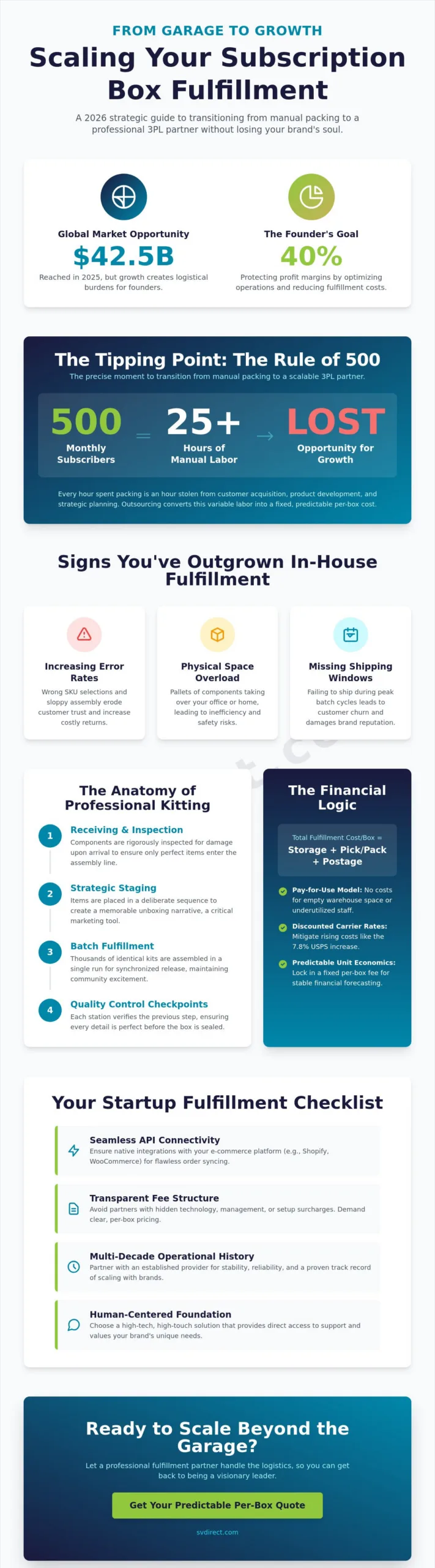
The industry standard for transitioning is often called the “Rule of 500.” Once your brand reaches 500 monthly subscribers, the time required for manual assembly and shipping typically exceeds 25 hours of labor. For a founder, this represents a massive opportunity cost. Every hour spent folding cardboard or printing labels is an hour stolen from customer acquisition and strategic growth. Outsourcing at this stage doesn’t just save time; it stabilizes your unit economics. By partnering with a 3PL, venture-backed or bootstrapped startups can turn unpredictable labor costs into a fixed, per-box fee that remains consistent even as you scale to thousands of units.
Signs Your Startup Has Outgrown In-House Packing
Watch for increasing error rates in SKU selection or sloppy box assembly, as these small mistakes quickly erode customer trust. Physical space is another clear indicator. When pallets of components begin to overwhelm your residential or small office environment, efficiency drops and safety risks rise. Most importantly, if you find yourself missing shipping windows during peak batch days, the resulting customer churn will cost you more than the price of professional subscription box fulfillment for startups.
The Financial Logic of 3PL Transition in 2026
In 2026, the financial argument for 3PLs is stronger than ever. Instead of paying for empty warehouse rent or underutilized staff, you only pay for the services you use. Professional partners also provide access to discounted carrier rates that are unavailable to small shippers, which often offsets the kitting and assembly fees. It’s essential to track your total investment accurately. The fulfillment cost per box is the sum of storage, pick/pack, and postage.
The Anatomy of Professional Subscription Box Kitting and Assembly
Professional subscription box fulfillment for startups transforms a chaotic manual task into a synchronized industrial process. Unlike standard e-commerce orders that ship as they arrive, subscription fulfillment relies on “Batch Fulfillment.” This strategy involves staging all components, assembling hundreds or thousands of identical kits in a single run, and releasing them to carriers simultaneously. This synchronization ensures that your community experiences the “reveal” at the same time, which prevents social media spoilers and maintains the collective excitement that drives the subscription model.
Modern kitting begins with a rigorous receiving process where each component is inspected for damage before it enters the assembly line. In 2026, the unboxing experience remains a critical marketing tool. High-quality fulfillment requires specific staging where items are placed in a deliberate sequence to create a visual narrative. Quality control checkpoints are vital, especially for curated models where SKUs vary by subscriber preference. Each station on the line verifies the previous step, ensuring that every sticker is straight and every fragile item is properly nested before the final box sealing.
Advanced Kitting: Beyond Just Putting Items in a Box
The difference between a simple box and a premium brand experience lies in the physical details. Professional assembly includes specialized techniques like precision tissue wrapping, custom product nesting, and exact sticker placement. Managing these complex SKUs requires a sophisticated backbone of inventory tracking to ensure the right items reach the right customers every time. To see how these technical specifications work at scale, you can explore our Kitting and Assembly Services. If you’re ready to see how these processes apply to your specific brand, consult with our kitting experts for a tailored strategy.
Integrating On-Demand Digital Printing for Personalization
Evaluating 3PL Costs: Avoiding the “Startup Tax”
Understanding the financial landscape of subscription box fulfillment for startups requires looking beyond the surface-level pick and pack fees. A transparent cost model is built on four distinct pillars: receiving inventory, cubic storage, kitting assembly, and final shipping. While many founders focus solely on the lowest per-box assembly rate, this narrow view often leads to the “Startup Tax.” This phenomenon occurs when unforeseen expenses, such as pallet fees, account management surcharges, and technology integration fees, erode your margins. It’s vital to demand a line-by-line breakdown to ensure your unit economics remain sustainable as you scale.
Opting for the cheapest possible fulfillment provider often creates a false economy. Low-cost facilities typically rely on high-volume automation that struggles with the nuance of curated subscription boxes. If a robotic error leads even to a small percentage of incorrect shipments in your monthly batch, the cost of customer churn and replacement shipping will far exceed what you saved on fulfillment fees. High-performance logistics is an investment in retention. When your unboxing experience is consistent and error-free, your subscriber lifetime value (LTV) remains healthy, protecting your business from the high cost of constant customer re-acquisition.
Human Oversight vs. Total Automation
Startups need a “Steady Hand” partner rather than a purely automated algorithm that treats your brand as just another number in a database. Mega-warehouses often prioritize speed over the specific aesthetic requirements of a premium subscription box. Dedicated account managers who understand your brand’s unique assembly requirements act as a final line of defense against quality control issues. High-Touch Service is the human verification of every kitted box to ensure it meets your exact standards before it leaves the facility.
Predicting Shipping and Postage Expenses
Postage remains the largest variable in your fulfillment budget. In 2026, shipping costs have shifted significantly, with USPS Ground Advantage rates increasing by an average of 7.8% and Priority Mail rising by 6.6% as of January 18. Navigating these changes requires a deep understanding of Zone-based pricing, where the distance from the warehouse to the customer determines the final cost. A strategically located 3PL can mitigate these carrier surcharges by optimizing your shipping zones and providing access to commercial rates. For those looking to scale beyond domestic borders, our Global Shipping Services provide the technical framework needed for international expansion while controlling costs.
Choosing the Right Partner: A Startup Fulfillment Checklist
Selecting a partner for subscription box fulfillment for startups is a pivotal decision that dictates your brand’s future stability. You need more than a warehouse; you need a partner that acts as a physical extension of your team. This selection process should be methodical and grounded in your specific operational requirements. A mismatch here doesn’t just cause delays. It can actively damage your reputation during your most critical growth phases.
- Step 1: Audit Kitting Experience. Request photos or case studies of their work with brands that share your aesthetic. A facility used to shipping industrial parts may lack the “soft touch” required for premium cosmetics or delicate stationery.
- Step 2: Verify the Technology Stack. Ensure they offer seamless API integration with your storefront, whether you use Shopify, WooCommerce, or a custom build. Manual data transfers are a significant source of error.
- Step 3: Inquire About Scalability. Ask for specific data on how they handle 10x volume spikes. According to Digital Applied (January 2026), 58% of shoppers will abandon a purchase if fast shipping options aren’t available, making peak-cycle performance a dealbreaker.
- Step 4: Check for Specialized Services. If your box includes regulated items or high-value electronics, verify their specific storage and handling certifications.
- Step 5: Demand Transparency. You should have real-time inventory visibility and clear reporting. Hidden data leads to stockouts and missed opportunities.
If you’re ready to see how a seasoned partner can transform your operations through precision and personal oversight, request a free quote to start a tailored strategy for your brand.
Technology and Integration Requirements
Modern startups require a web-based inventory management system that offers real-time control from any device. This digital transparency ensures that the data in your storefront matches the physical reality on the warehouse floor. Look for “Plug and Play” integrations that connect your existing tools to the 3PL’s system without requiring expensive custom development. This seamless data flow reduces the risk of overselling and ensures that tracking numbers are pushed back to your customers the moment a box is labeled.
Security and Compliance Standards
Security is paramount when you’re storing high-value components like premium skincare or tech gadgets. Assess the provider’s physical security measures, including climate-controlled environments and restricted-access zones. For brands shipping regulated items, compliance is not optional. If your business model involves sensitive materials, exploring specialized Healthcare Mailing Services can provide the framework needed for high-precision, compliant delivery. These standards protect your startup from the legal and financial risks associated with improper handling or data breaches.
Silicon Valley Direct: The High-Tech, High-Touch Solution
Silicon Valley Direct stands as the premier partner for brands requiring absolute precision in their logistics. Founded in 1999, our organization serves as an anchor of reliability in an industry often defined by volatility and rapid turnover. While the broader logistics landscape has shifted toward impersonal automation, we remain committed to a “High-Touch” philosophy. This means your brand is managed by seasoned professionals who understand that a subscription box is a physical manifestation of your marketing strategy. Our location in the heart of Silicon Valley provides a strategic advantage, offering unparalleled global connectivity and a culture of innovation that matches the energy of the startups we serve.
Choosing subscription box fulfillment for startups shouldn’t feel like a transaction with an anonymous algorithm. We explicitly reject the trend of automated customer service in favor of direct human connection and personal oversight. This dedication ensures that the complex kitting standards we discussed in previous sections are maintained through every growth phase, from your first 500 boxes to your 50,000th. By combining our multi-decade history with cutting-edge digital integrations, we provide a stable hand that alleviates the stress of business growth through precision and personal commitment.
Our Bespoke Approach to Startup Growth
We provide total flexibility for unique kitting and assembly projects that require more than just standard pick and pack services. By housing on-demand digital printing and fulfillment under one roof, we eliminate the friction between your marketing collateral and your physical shipments. This integrated model reduces lead times and allows for the deep personalization that drives subscriber loyalty. Our history is defined by partnership; we’ve spent decades helping small startups scale into global enterprises by providing a stable operational foundation that never sacrifices quality for speed.
Getting Started with Professional Fulfillment
The transition to professional subscription box fulfillment for startups is a methodical process designed to minimize disruption. Our onboarding begins with a comprehensive audit of your brand’s kitting requirements, followed by a secure inventory transfer to our facility. We work closely with your team to synchronize your first “Batch Day,” ensuring every system integration is verified and every assembly step is documented. If you’re ready to reclaim your time and focus on the growth of your business, we invite you to Scale your subscription brand with Silicon Valley Direct. Requesting a custom quote is the first step toward a logistics partnership that values your brand’s unique identity as much as you do.
Scaling Your Vision with Precision Logistics
Mastering subscription box fulfillment for startups requires a delicate balance between high-tech integration and high-touch human oversight. You’ve seen how reaching the “Rule of 500” orders marks the moment to trade manual labor for strategic growth. By outsourcing to a partner that understands the nuance of your brand’s unboxing experience, you protect your margins from rising carrier rates and the “startup tax” of hidden fees. This transition isn’t just about moving boxes; it’s about reclaiming your role as a founder while ensuring every subscriber feels the personal connection that built your brand.
Silicon Valley Direct has been a steady hand for growing brands since 1999. Our integrated on-demand digital printing and 99.9% kitting accuracy guarantee ensure that your scaling journey is both professional and predictable. Don’t let the logistics of today limit the potential of your tomorrow. When you’re ready to stabilize your operations and focus on global expansion, Partner with Silicon Valley Direct for your Startup Fulfillment. We’re here to help you turn every delivery into a lasting customer relationship.
Frequently Asked Questions
What is the average cost for subscription box fulfillment for a startup?
Fulfillment costs are determined by a combination of storage requirements, assembly complexity, and final postage. Instead of looking for a single flat rate, startups should seek a transparent model that breaks down receiving, kitting, and pick and pack fees line by line. This granular approach ensures you only pay for the specific resources your brand consumes, protecting your margins as your volume fluctuates.
How does a 3PL handle custom branded packaging and inserts?
Professional partners integrate your unique branded elements directly into a synchronized kitting workflow. This includes the precise placement of tissue paper, stickers, and product nesting to match your specific brand aesthetic. Many high-performance facilities also offer on-demand digital printing, which allows you to include personalized monthly inserts or welcome letters without the need for bulk pre-printing and additional storage.
Can I outsource fulfillment if I only have 100 subscribers?
You can outsource at any volume, though the financial “tipping point” for subscription box fulfillment for startups typically occurs as you approach 500 monthly orders. At 100 subscribers, the primary advantage of outsourcing is the reclamation of founder time. If manual assembly is preventing you from focusing on customer acquisition, a professional partner provides the operational foundation necessary to scale toward that 500-box milestone.
How do you prevent shipping errors in complex monthly curated boxes?
Error prevention relies on a structured combination of digital inventory tracking and human quality control checkpoints at every assembly station. In a curated model where SKUs vary by subscriber profile, each box is verified against the digital order before final sealing. This methodical approach catches discrepancies early, ensuring that the high-touch nature of your brand is never compromised by robotic or automated errors.
What is the difference between kitting and simple pick and pack?
Pick and pack involves selecting individual items for a one-off order, while kitting is the deliberate pre-assembly of multiple components into a single unit. For subscription brands, kitting is a specialized process that includes aesthetic tasks like wrapping and sequence-based packing. This ensures every customer in a monthly batch receives an identical, high-quality unboxing experience that simple pick and pack cannot replicate.
How long does it take to transition from in-house to a 3PL partner?
The transition typically requires two to four weeks to ensure a seamless integration of your physical inventory and digital systems. This timeframe allows for a full audit of your kitting standards, the physical transfer of stock, and the testing of API connections with your storefront. Taking this time upfront prevents shipping delays and ensures your first “Batch Day” with a partner is successful.
Do you offer discounted shipping rates for international subscribers?
Established fulfillment partners provide access to commercial carrier rates that are significantly lower than standard retail pricing. By leveraging high-volume logistics networks, we help startups mitigate the impact of international surcharges and complex Zone-based pricing. This global connectivity allows you to expand your reach to international markets while keeping your per-box postage expenses predictable and competitive.
What happens if a product in my subscription box arrives damaged?
Professional partners maintain a dedicated returns management process to handle damaged items and replacement shipments quickly. High-quality 3PLs focus on prevention by using rigorous packing standards and product nesting techniques to protect fragile components during transit. If a breakage occurs, the system allows for the immediate release of a replacement unit from your inventory to maintain subscriber satisfaction.