3PL Pricing Models: The Strategic Guide to Fulfillment Costs in 2026
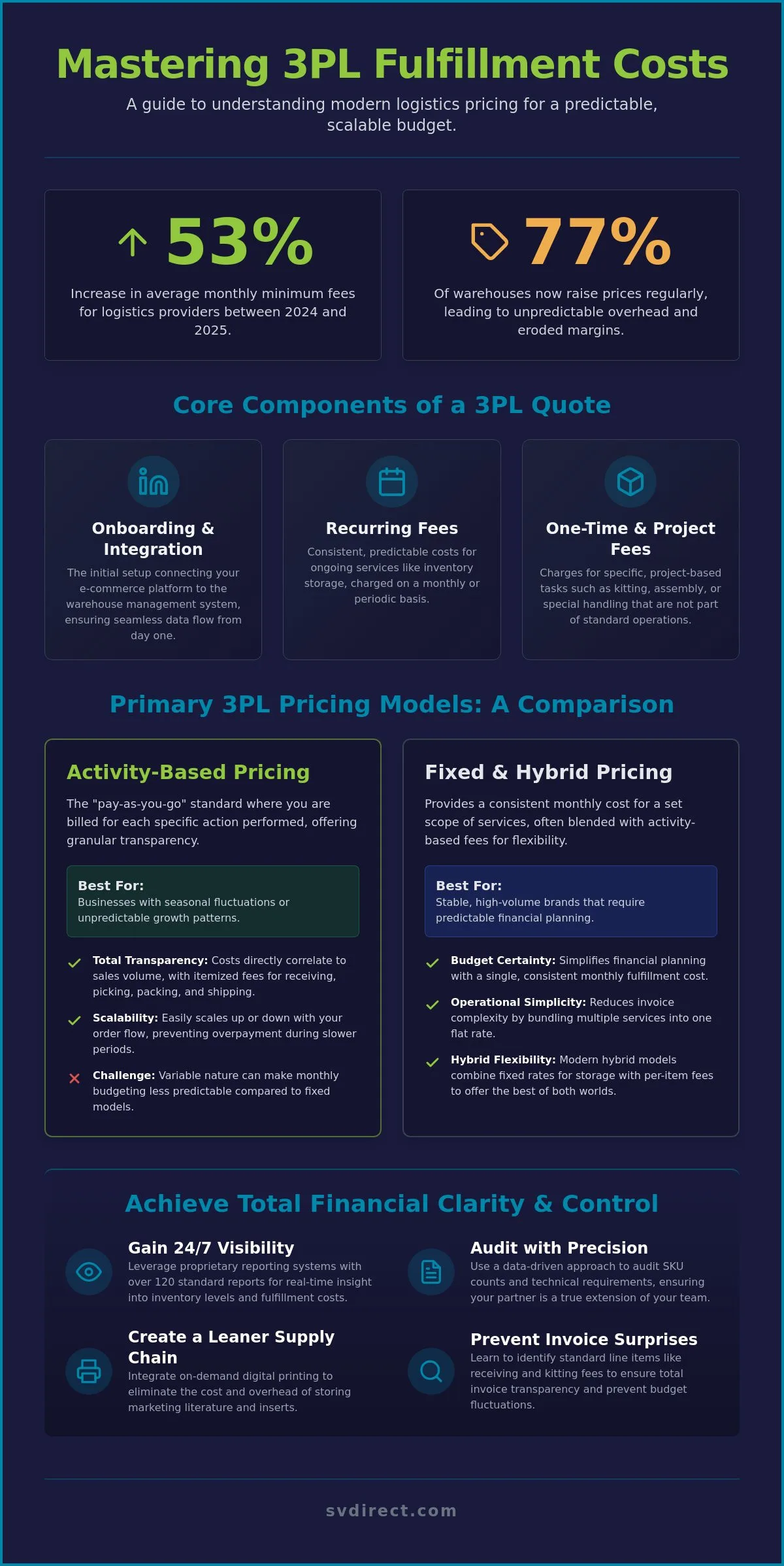
If you feel like your logistics invoices are growing faster than your order volume, you aren’t alone. The average monthly minimum fee for logistics providers jumped 53 percent between 2024 and 2025, leaving many brands struggling with unpredictable overhead. It’s frustrating to scale your operations only to find your margins eroded by surcharges or complex kitting fees that weren’t clear in the initial quote. You deserve a partnership grounded in precision and transparency, not one that hides costs behind confusing jargon. For those looking to decode industry terms, Delgate provides a helpful resource on warehouse abbreviations. Understanding the nuances of different 3pl pricing models is the first step toward reclaiming control over your bottom line.
This guide will help you master the complexities of modern fulfillment costs so you can secure a predictable budget and a partnership that acts as a seamless extension of your company. We will break down the shifting cost structures of 2026, expose the fees that often hide in the fine print, and show you how to leverage real-time data for total financial clarity. Our goal is to move you from a state of uncertainty to a state of informed confidence. You will learn how to choose a model that supports your growth while maintaining the high-tech efficiency your customers expect.
Key Takeaways
- Understand the critical differences between activity-based and flat-rate 3pl pricing models to determine which structure offers the highest return on investment for your specific volume.
- Learn to identify standard line items like receiving and kitting fees to prevent unexpected budget fluctuations and ensure total invoice transparency.
- Use a data-driven approach to audit your SKU counts and technical requirements, ensuring your logistics partner acts as a true extension of your team.
- Gain 24/7 visibility into your inventory and costs through proprietary reporting systems that offer over 120 standard reports for better decision-making.
- Reduce the overhead of literature storage by integrating on-demand digital printing into your fulfillment workflows for a leaner, more responsive supply chain.
What is 3PL Pricing? Understanding the Mechanics of Fulfillment Costs
At its core, 3PL pricing represents the fee structure logistics providers use to manage warehousing, labor, and shipping operations. While it sounds straightforward, the reality in 2026 is far more nuanced. As global supply chains grow more complex, Third-party logistics has evolved from a back-office cost center into a primary growth engine for eCommerce brands. You aren’t just paying for shelf space; you’re investing in the infrastructure that allows your business to scale without the friction of physical limitations. Recent data from The Fulfillment Advisor’s 2025 Costs and Pricing Survey shows that average monthly minimum fees jumped 53 percent in a single year. This volatility makes choosing the right 3pl pricing models essential for long-term stability.
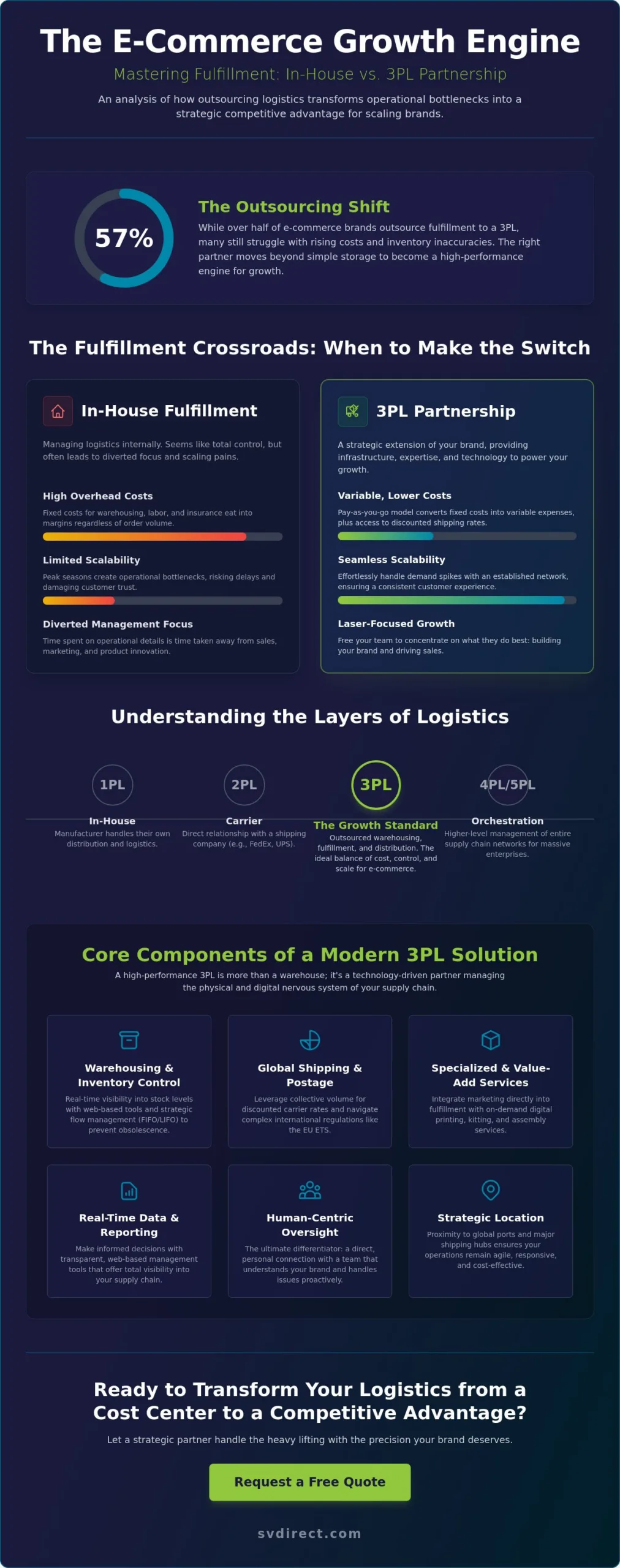
The variety of 3pl pricing models available today reflects the diversity of the businesses they serve. A “one-size-fits-all” approach rarely works because your SKU complexity and order volume are unique. A startup with five high-velocity SKUs has vastly different needs than an enterprise shipping thousands of unique, kitted items. To truly understand your expenses, you must look beyond simple pick-and-pack rates and focus on the Total Cost of Fulfillment (TCOF). This metric accounts for every touchpoint, from receiving a pallet to processing a return, providing a realistic view of your profitability. It helps you see the bigger picture of how logistics impacts your customer experience and repeat purchase rates.
The Core Components of a 3PL Quote
A comprehensive quote begins with onboarding and integration. This is the digital handshake where your online store connects with our warehouse management system. It ensures that data flows accurately from the moment a customer clicks “buy.” Beyond initial setup, you will encounter recurring fees, such as monthly storage, alongside one-time costs for project-based tasks like kitting and assembly. Modern logistics partners use sophisticated technology to automate these fee calculations. This automation eliminates manual errors and provides a clear, itemized view of exactly where your capital is going, allowing you to plan your growth with precision.
Why 3PL Pricing Transparency Matters in 2026
Transparency is the bedrock of a healthy partnership. In an era where 77 percent of warehouses now raise prices regularly, hidden surcharges can quickly erode the margins of a scaling business. You need to know that your invoices reflect actual activity without surprise “account management” or “peak season” fees that weren’t discussed upfront. High-performance partners provide 24/7 data access through systems like Remote Control™, allowing you to monitor real-time costs and inventory levels. This level of visibility ensures there are no shocks at the end of the month. 3PL pricing is a strategic investment in scalability rather than a mere operational expense.
Primary 3PL Pricing Models: A Comparative Analysis
Selecting the right framework for your logistics expenses isn’t just about finding the lowest number; it’s about finding a structure that aligns with your operational DNA. The landscape of 3pl pricing models has shifted significantly, offering brands more ways to balance risk with reward. Whether you are a high-growth startup or an established enterprise, your choice will dictate your ability to maintain healthy margins during seasonal spikes.
Activity-Based Pricing: The Pay-As-You-Go Standard
This model is the industry standard for its granular transparency. You pay exactly for the work performed, such as receiving, picking, and packing. Each line item is clearly defined; per-order and per-item fees provide a direct correlation between sales and fulfillment costs. It’s particularly effective for businesses experiencing seasonal fluctuations or unpredictable growth phases. While the high level of transparency is a major benefit, the variable nature of monthly budgeting can be a challenge for those who prefer absolute cost certainty.
Fixed and Hybrid Models for Established Enterprises
For stable, high-volume brands, the predictability of flat-rate or fixed pricing is often more attractive. These models provide a consistent monthly cost, which simplifies financial planning. However, many modern providers are moving toward hybrid models to offer maximum flexibility. A hybrid approach often combines fixed storage rates with activity-based labor. This protects your margins during peak seasons, such as the Q4 holidays, by ensuring that your baseline costs remain steady while labor scales only when orders do. Our eCommerce order fulfillment services are designed to adapt to these shifts, providing the stability you need to grow.
Cost-plus models add another layer of transparency by revealing the actual operational costs of the facility and adding a pre-negotiated management fee. This ‘open book’ approach is ideal for complex partnerships where deep technical integration or specialized kitting is required. It allows you to see the logic behind every expense, ensuring your model matches your SKU count and order frequency precisely. If you are unsure which structure suits your current SKU profile, you can consult with our logistics experts to find the most efficient path forward. Choosing the right 3pl pricing models ensures that your logistics partner acts as a steady hand, allowing you to focus on innovation while we manage the precision of your physical operations.
Breaking Down 3PL Fee Structures and Common Line Items
Understanding the specific line items within 3pl pricing models requires a granular look at the activities that populate your monthly invoice. Every piece of inventory begins its journey with inbound shipping and receiving. This phase involves unloading, inspecting, and logging stock into a warehouse management system to ensure 24/7 visibility. Industry data suggests receiving fees typically range from $5 to $15 per pallet. Once received, warehousing and storage costs apply. These are often calculated by the pallet or cubic foot. Storage in major metropolitan areas often carries a 30 to 50 percent premium over secondary markets, making efficient space utilization a priority for your bottom line.
Standard pick and pack fees generally range from $3.50 to $8.00 for a single-item order. Each additional item usually adds a fee between $0.50 and $1.50. While these labor costs are consistent, your logistics partner should also provide significant value through postage management. By aggregating high shipping volumes, a 3PL can help you leverage carrier discounts that are difficult to access as an independent shipper. This allows you to maintain competitive shipping rates even as national postage costs continue to fluctuate.
Specialized Project Fees: Kitting and Assembly
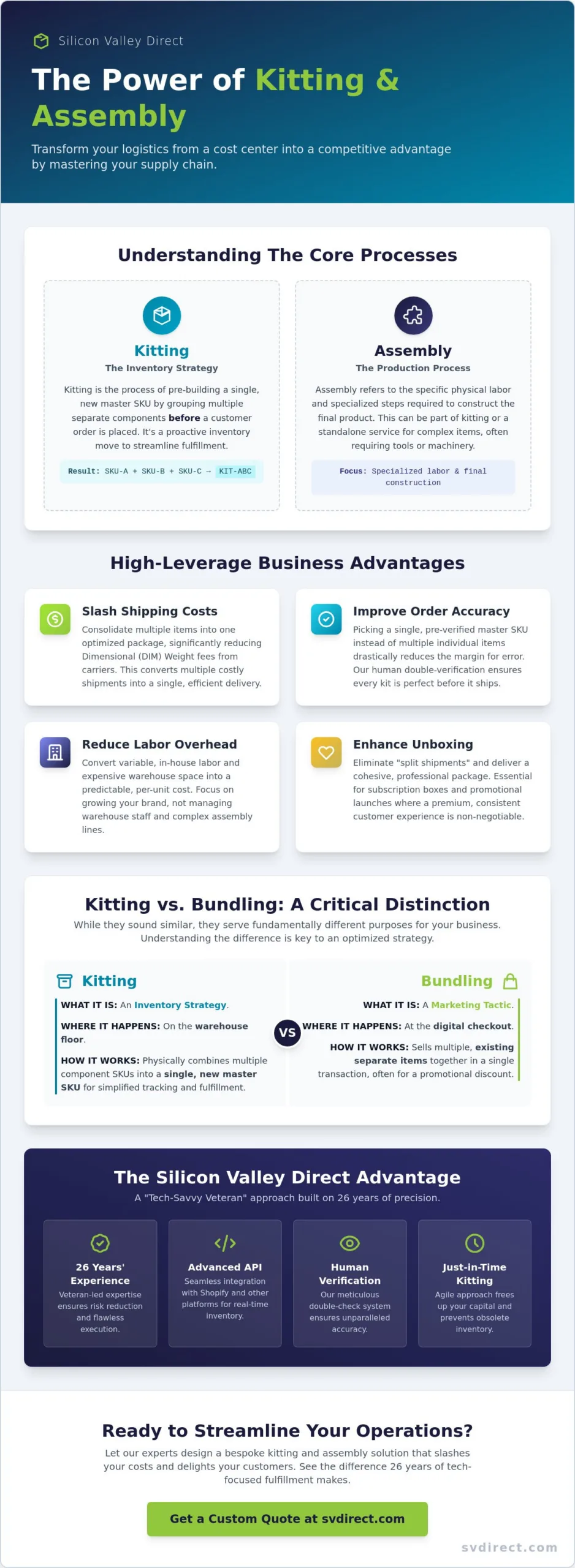
Moving beyond the standard box requires specialized attention and a steady hand. Whether you are building subscription kits or promotional bundles, these projects demand a higher level of oversight than a simple pick. We utilize a systematic kitting and assembly QC-Check process to ensure every package meets your exact specifications. This meticulous approach reduces errors that lead to costly returns and damaged brand reputation. Precision here prevents the high cost of rework and keeps your customers satisfied from the moment they open their delivery.
Integrated Printing and Literature Fulfillment
A major inefficiency in many supply chains is the storage of bulk printed materials that quickly become outdated. Traditional offset printing often leads to “dead” inventory when marketing details or product specifications change. By integrating on-demand digital printing directly into your fulfillment workflow, you can adopt a just-in-time model. Variable data printing (VDP) allows for personalized inserts or personalized mailings without the overhead of massive storage fees. This integration ensures your literature is as agile as your digital presence, reducing waste and allowing you to pivot your messaging instantly.
How to Evaluate and Choose the Right 3PL Pricing Model
Choosing between various 3pl pricing models isn’t just about comparing numbers on a spreadsheet. It requires a methodical evaluation of your operational reality and future goals. You must look at your logistics partner as a steady hand that guides your growth through precision and personal commitment. To find the most profitable structure, you need to look beyond the surface and analyze how each fee impacts your long-term scalability.
Start by auditing your current fulfillment data. You need precise figures for monthly order volume, SKU counts, and the average number of items per order. These metrics directly influence labor and storage costs. Next, define your technical requirements. The choice between API and Web Service integration is pivotal. While APIs are common, platform-agnostic XML/SOAP web services often reduce long-term IT overhead by providing more stable connections across diverse platforms. This technological foundation ensures that your data remains accurate as you scale.
Factor in specialized needs like healthcare mailing or literature fulfillment. These services require specific compliance or kitting expertise that standard providers may lack. Always request a transparent quote that explicitly includes account management and technology fees. Finally, evaluate the human element. A high-performance partner provides a dedicated contact who understands your business, ensuring your logistics provider acts as a true extension of your team. This personal oversight is a powerful differentiator in a tech-saturated market.
Assessing Technology and Integration Costs
Real-time visibility is essential for modern business. A proprietary system like Remote Control™ provides 24/7 access to your inventory and order status. This eliminates the need for manual data exports, which are prone to error and time lag. When evaluating 3pl pricing models, consider the long-term value of this data access. Real-time reporting allows for proactive decision-making that can save thousands in mismanaged stock or missed deadlines. It transforms your supply chain into a transparent, data-driven asset.
Calculating the ROI of a Strategic Partnership
Look past the ‘per-pick’ fee to see the true impact of error reduction and quality control. A partner that emphasizes a “Quiet Facility” approach provides a higher ROI by preventing the costly mistakes associated with chaotic environments. Proactive problem-solving, where your partner anticipates shipping conflicts before they reach the customer, saves significant money on returns and customer service labor. The most expensive 3PL model is often the one with the lowest upfront price but the highest error rate.
The Silicon Valley Direct Advantage: Profitability Through Precision
Profitability in logistics is built on a foundation of deliberate organization rather than sheer speed. Our “Quiet Facility” methodology is designed to eliminate the chaos often found in high-volume warehouses, ensuring that every movement is intentional. By prioritizing a calm and structured environment, we drastically reduce the error rates that lead to expensive returns and customer dissatisfaction. This precision allows us to offer a level of reliability that stabilizes your bottom line, providing a refreshing alternative to the unpredictable costs found in many 3pl pricing models. We don’t just move boxes; we manage your brand’s reputation with a steady hand.
A primary differentiator of our service is the seamless integration of logistics with on-demand digital printing. Most providers treat printing and fulfillment as separate silos, which creates unnecessary shipping legs and storage fees. We utilize HP Indigo 5500 technology to print marketing materials, inserts, or manuals right when they’re needed. This just-in-time approach reduces “dead” inventory and streamlines your entire supply chain. It’s a level of vertical integration that offers financial transparency often missing from standard 3pl pricing models, allowing you to pivot your marketing strategy without worrying about wasting thousands of pre-printed items.
The Nine Promises we make to our partners serve as a constant anchor of trust. These commitments focus on total flexibility, proactive problem-solving, and a rejection of automated interactions in favor of direct human connection. Our location in the heart of Northern California drives constant innovation in our 3PL fulfillment services, giving you access to global connectivity and tech-forward solutions. We act as a true extension of your company, backed by decades of operational data and a team that takes personal pride in your success.
Bespoke Solutions vs. Cookie-Cutter Pricing
We reject the cookie-cutter approach that forces unique businesses into rigid procedures. Instead, we prioritize bespoke solutions that adapt to the specific requirements of your most complex projects. Our seasoned staff has an exceptionally high retention rate, which translates to deep institutional knowledge and operational stability for your brand. This collective experience was recently demonstrated when our team managed over 3,000 shipments in a single week with 100 percent accuracy. You won’t find that level of precision in a facility that relies on temporary labor and automated scripts.
Scaling with Confidence in 2026
Using the proprietary Remote Control™ system, you gain 24/7 visibility into your operations with access to over 120 standard reports. This real-time data ensures you can manage high-volume deadlines and peak season surges with informed confidence. Whether you’re a startup finding your footing or an established enterprise expanding your reach, we provide the flexibility to grow alongside you. Our commitment to direct communication means you’ll always have a dedicated expert overseeing your account. You can see the impact of this personal commitment for yourself on our customer testimonials page.
Securing Your Growth with Logistics Precision in 2026
The logistics environment in 2026 demands more than just a warehouse; it requires a strategic partnership that prioritizes long-term stability over short-term savings. You have learned that the true value of 3pl pricing models lies in their ability to offer transparency and scalability without the burden of hidden fees. By focusing on the Total Cost of Fulfillment and leveraging real-time data through proprietary systems, you can transform your logistics from a variable expense into a predictable growth engine.
Silicon Valley Direct brings over 25 years of operational history to your supply chain, ensuring that every order is handled with the precision of a seasoned expert. Our integrated digital printing services and Remote Control™ system provide the visibility you need to make informed decisions 24/7. We act as a steady hand in a fast-paced market, allowing you to focus on innovation while we manage the complexities of physical distribution with personal commitment.
We are ready to become the seamless extension of your team that your business deserves. Let’s build a future where your fulfillment is as agile and precise as your vision.
Frequently Asked Questions
What is the most common 3PL pricing model for eCommerce?
Activity-based pricing is the most prevalent structure for eCommerce brands because it aligns costs directly with sales volume. In this model, you pay for specific tasks such as receiving, picking, and packing. It offers high transparency for businesses with fluctuating volumes, ensuring you only pay for the work performed each month without committing to heavy fixed overhead.
Are there hidden fees in 3PL contracts I should watch out for?
Brands should be vigilant regarding account minimums, long-term storage surcharges, and peak-season fees that may not be obvious in initial quotes. Some providers also charge separate SKU management fees or integration maintenance costs. Requesting a complete fee schedule upfront is the best way to ensure your 3pl pricing models remain transparent and predictable throughout the year.
How much does 3PL storage typically cost in 2026?
Standard pallet storage typically ranges from $8.00 to $25.00 per month based on current industry data. However, facility location plays a major role in these costs. Warehouses in major metropolitan areas often carry a 30 to 50 percent premium compared to secondary markets. Shelf and bin storage are usually calculated by the cubic foot for smaller items or high-velocity stock.
What is the difference between a pick fee and a pack fee?
A pick fee covers the labor required to retrieve an item from its designated storage location. In contrast, a pack fee accounts for the time and materials needed to secure those items in a shipping container. While some providers combine these into a single line item, others separate them to provide more granular data on labor utilization and packaging costs.
How do 3PLs charge for returns management?
Returns are generally charged as a flat processing fee per order plus an additional per-item rate for inspection and restocking. If an item requires cleaning, repackaging, or disposal, extra labor fees may apply. Efficient returns management is a critical component of 3pl pricing models, as it helps recover inventory value quickly while maintaining customer satisfaction through fast processing.
Does 3PL pricing include shipping and postage costs?
Shipping and postage are typically treated as pass-through costs and are billed separately from fulfillment labor and warehousing. High-volume logistics partners often provide access to discounted carrier rates, which helps offset the impact of national postage increases. These costs are calculated based on package weight, dimensions, and the destination zone for each individual shipment.
Why is kitting charged separately from standard fulfillment?
Kitting is billed as a separate project because it involves pre-assembling multiple items into a single unit before they are ready for final fulfillment. This process requires specialized labor and quality control checks that go beyond a standard pick. Separating these fees allows for better cost tracking on promotional bundles, subscription box projects, or complex assembly requirements.
Is there a minimum monthly volume required for most 3PL pricing models?
Most providers require a monthly minimum fee to cover the overhead of account management, technology integrations, and dedicated facility space. The average monthly minimum has climbed to over $500 as providers adjust to rising operational costs. If your order volume falls below the threshold, you’ll still be billed the minimum amount to maintain your partnership and real-time data access.