


ECommerce Inventory Management: Strategic Guide 2026
What if your warehouse wasn’t just a storage space, but a transparent, real-time engine that predicted your next stockout before it ever happened? Most growing brands feel the weight of fragmented data across multiple sales channels. You’ve likely experienced the high costs of overstocking or the frustration of explaining a backorder to a customer who thought their item was ready to ship. It’s a common hurdle that often signals your business has outgrown its current systems.
Mastering modern stock control requires more than just a digital dashboard. It demands a synergy between advanced technology and physical operational excellence, especially as 2026 shipping rate increases and new maritime emissions regulations tighten margins. Finding the right ecommerce inventory management solutions is about bridging the gap between your digital storefront and the physical reality of the warehouse floor. This guide will show you how to achieve seamless multi-channel synchronization and real-time visibility. You’ll discover how to leverage a scalable fulfillment partner that acts as a dedicated extension of your team; this ensures your growth is backed by precision rather than guesswork. We’ll explore the path from data silos to a unified, high-performance operation that respects your time and your customers’ expectations.
Key Takeaways
- Modern inventory control in 2026 requires the perfect synchronization of multi-channel sales data and physical stock to avoid costly overstocking.
- High-performance systems prioritize real-time visibility and automated alerts; this ensures you’re never caught off guard by a sudden spike in demand.
- You’ll learn why integrated 3PL ecommerce inventory management solutions offer superior ROI by marrying proprietary technology with disciplined, physical warehouse methodology.
- Secure data exchange through XML and SOAP integrations creates a seamless bridge between your sales platforms and your fulfillment partner’s operational core.
- Discover how a dedicated partnership philosophy transforms logistics from a back-office cost into a scalable engine for long-term business growth.
The Evolution of eCommerce Inventory Management Solutions in 2026
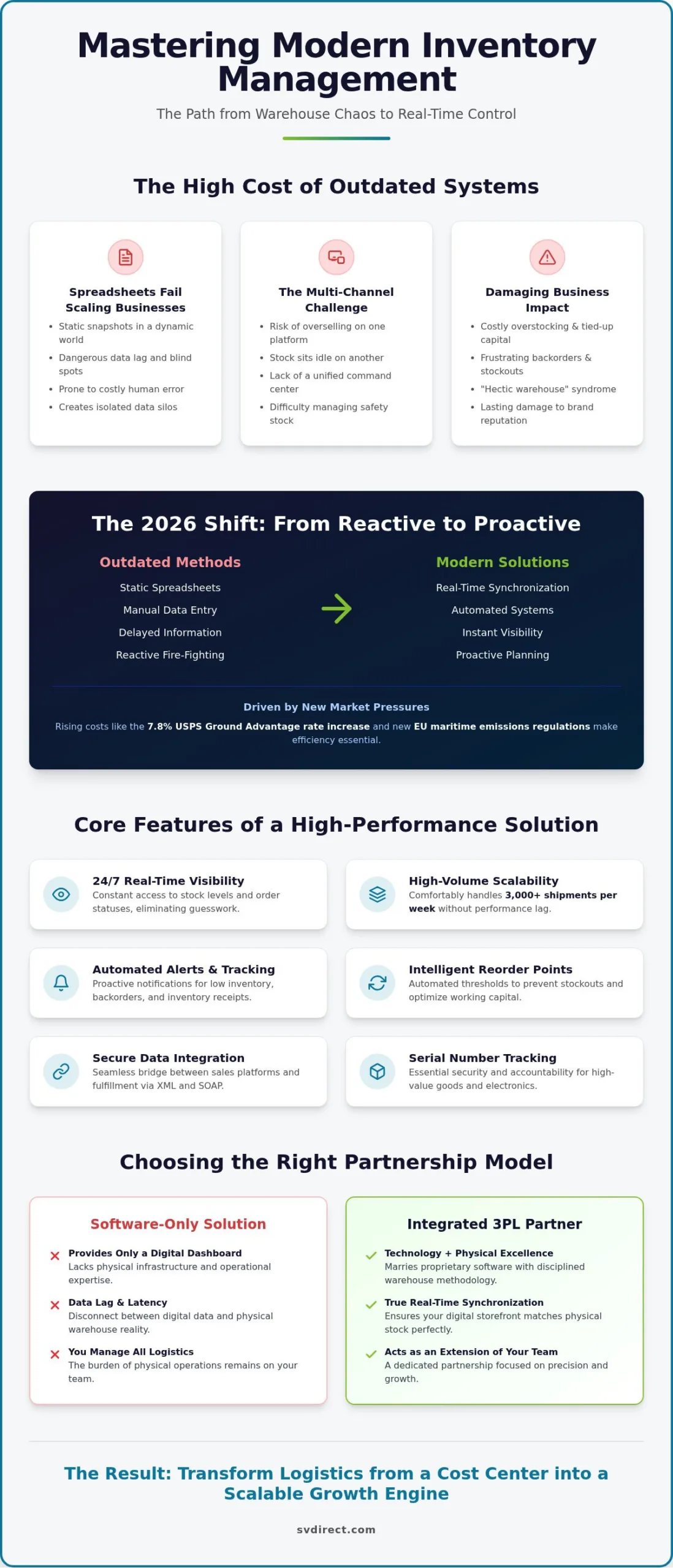
Modern inventory management has transformed from a back-office chore into a strategic competitive advantage. In 2026, we define this discipline as the perfect, real-time synchronization of sales data and physical stock levels. As shipping costs rise, with USPS Ground Advantage rates increasing by 7.8% this year, the margin for error has disappeared. Relying on outdated methods leads to “dirty data,” which manifests as stockouts, frustrating backorders, and lasting damage to your brand’s reputation. Truly effective ecommerce inventory management solutions act as a steady hand, ensuring your digital storefront never promises what your warehouse can’t deliver. This evolution requires moving beyond simple tracking toward a comprehensive strategy that integrates technology with physical operational excellence.
Why Spreadsheets Fail Scaling Businesses
Spreadsheets are static snapshots of a world that never stops moving. For a growing business, the latency between a sale and a manual update creates a dangerous blind spot. This lag often leads to “hectic warehouse” syndrome, where staff rush to fulfill orders that shouldn’t have been accepted in the first place. Manual data entry is inherently prone to human error. A single misplaced digit can trigger a chain reaction of logistics failures that take weeks to untangle. Without integrated systems, your historical data stays trapped in silos, making it impossible to forecast demand accurately or optimize your working capital. You can’t scale a business on a foundation of guesswork and delayed information.
The Multi-Channel Inventory Challenge
Selling across Shopify, Amazon, and B2B portals simultaneously requires a unified command center. Managing safety stock across diverse geographic points is no longer optional; it’s a requirement for survival. If your inventory isn’t synchronized, you risk overselling on one platform while stock sits idle on another. For those just beginning this journey, understanding eCommerce Fulfillment for Startups is a critical first step toward building a scalable foundation. 2026 demands a shift from reactive software to proactive fulfillment partnerships that treat your inventory with the same precision you’d expect from an internal team. Effective solutions must also account for global shifts, such as the EU Emissions Trading System for maritime transport, which impacts international logistics costs. A high-performance partner doesn’t just provide a digital dashboard. They provide the physical infrastructure and human expertise to navigate these complexities, acting as a true extension of your company.
Core Features of a High-Performance Inventory Solution
High-performance ecommerce inventory management solutions provide a window into your business that never closes. You need 24/7 access to stock levels and order statuses to make informed decisions whether it’s 2:00 PM or 2:00 AM. This level of transparency eliminates the guesswork that often plagues growing brands. When your system can comfortably handle 3,000 or more shipments every week without a performance lag, you’ve found a foundation that supports scale rather than hindering it. True visibility means seeing exactly what’s on the shelf, what’s in transit, and what’s currently being packed for a customer.
A steady hand in logistics requires more than just a digital dashboard. It demands a system that proactively communicates with you. Automated notifications for low inventory and backorder tracking are essential for maintaining a high-performance operation. These tools allow your team to shift from reactive fire-fighting to proactive planning, ensuring that your marketing efforts are always aligned with your physical stock availability.
Automated Stock Tracking and Alerts
Setting intelligent reorder points is the first step in preventing unnecessary capital tie-up. By automating these thresholds, you ensure that replacement stock is already in transit before a shortage occurs. We prioritize operational readiness by sending automated email alerts for every inventory receipt; this keeps your team informed without needing to manually check the system. For brands dealing in high-value goods or electronics, serial number tracking adds an essential layer of security and accountability that basic software often overlooks. This precision ensures that every high-stakes item is accounted for from the moment it enters the facility until it reaches the customer’s door.
Comprehensive Reporting and Analytics
Data only becomes useful when it’s organized into actionable insights. Moving beyond simple counts, your solution should provide inventory turnover and age reports to help identify slow-moving products that might be draining your resources. Our proprietary Remote Control™ system allows you to generate over 120 standard reports, giving you granular control over every aspect of your physical operations. You can even customize the web interface to match your corporate branding and specific internal workflows. This level of detail transforms logistics from a cost center into a strategic asset. If you’re ready to see how this precision can impact your bottom line, it’s a great time to see how our tailored approach fits your business.
Software-Only vs. Integrated 3PL Inventory Solutions
Many brands fall into the “software-only” trap. They assume a high-end dashboard will fix their inventory issues, but software can’t walk across a warehouse floor to verify a count or inspect a damaged pallet. Without a disciplined warehouse methodology, even the most expensive ecommerce inventory management solutions become nothing more than a digital record of physical chaos. True efficiency comes from the marriage of proprietary technology and hands-on physical quality control. We believe that software should be a tool for humans, not a replacement for operational rigor.
At Silicon Valley Direct, we operate using a “Quiet Facility” methodology. This isn’t just about noise levels; it’s a philosophy where organized systems and clear processes eliminate the hectic atmosphere that breeds errors. Instead of a warehouse reacting to constant crises, our facility moves with methodical precision. This approach ensures that the data you see in your dashboard matches the reality on our shelves. We offer custom-fit solutions that adapt to your specific needs rather than forcing your business into the rigid, cookie-cutter procedures found in many standalone software packages.
The Reality of Physical Quality Control
Digital oversight is only half the battle. Our systematic “QC-Check” process involves thorough inspections throughout the assembly and kitting stages. This human element is what catches discrepancies that automated systems might miss. When you integrate on-demand digital printing and variable data (VDP) with your inventory, you gain the ability to customize shipments without slowing down the line. This synergy is particularly vital for complex orders where accuracy is non-negotiable. You can learn more about how these processes interact in our guide to Kitting and Assembly Services.
Reducing Overhead with Outsourced Infrastructure
Managing your own warehouse means dealing with long-term leases and the constant headache of labor management. By partnering with an integrated 3PL, you eliminate these fixed costs. You transition to a per-order fulfillment model where you only pay for the space and labor you actually use. This flexibility is a core part of our bespoke problem-solving promise. We also help reduce physical storage costs by leveraging “just-in-time” printing for marketing materials and literature. Instead of storing thousands of pre-printed brochures that might become outdated, we print them as needed. This approach keeps your inventory lean and your capital free for other growth initiatives. It’s about building a scalable infrastructure that grows alongside your brand without the traditional overhead risks.
Implementing a Seamless Inventory Integration
Implementing a seamless integration is the bridge between your sales strategy and our physical operations. For many founders, the technical side of ecommerce inventory management solutions feels like a mysterious black box. However, successful scaling depends on how effectively your storefront communicates with your fulfillment partner. We prioritize a platform-agnostic approach, ensuring our systems connect effortlessly regardless of your operating system or programming language. This flexibility allows us to act as a true high-tech extension of your team, providing a stable foundation for your growth. We don’t believe in forcing you into a specific tech stack; instead, we adapt our expertise to fit your existing infrastructure.
Standardized Protocols for Data Security
We rely on the Simple Object Access Protocol (SOAP) to ensure every data transfer is reliable and secure. Unlike more casual methods, SOAP provides a structured framework that’s essential for high-volume logistics where data integrity is non-negotiable. We use XML to tag order and product data, which creates a universal language that both your system and ours can understand perfectly. To maintain total security, we implement credential-based access for every integration. This ensures that only authorized systems can interact with your inventory records, protecting your business from unauthorized changes or data leaks. This methodical approach to security reflects our multi-decade history of protecting client assets with seasoned professionalism.
Programmatic Interfaces vs. Traditional GUIs
While many providers offer a simple dashboard, we go deeper by sharing business logic directly between systems. This programmatic approach allows your developers to build custom user interfaces using our web methods, tailored specifically to your internal workflows. We use the Web Services Description Language (WSDL) to provide a clear roadmap of our available services; this makes custom development faster and more accurate. Before any integration goes live, we utilize dedicated GUI interfaces to test and verify transaction data. This testing phase is critical. It allows us to simulate orders, inventory updates, and shipping confirmations in a sandbox environment. By catching discrepancies here, we prevent errors from reaching the physical warehouse floor, preserving the “Quiet Facility” methodology we discussed earlier. This proactive stance ensures that once the switch is flipped, the transition is invisible to your customers. If you’re looking for a partner who understands the nuance of Remote Order Management, we’re ready to collaborate.
Maximizing ROI with Silicon Valley Direct’s Remote Control™
The true value of ecommerce inventory management solutions is measured by their ability to turn operational data into marketing momentum. Our proprietary Remote Control™ system serves as the vital bridge between your high-level strategy and our daily warehouse activities. With over 25 years of operational history since 1999, we’ve refined a philosophy that positions our facility as a seamless extension of your company. We don’t just store products; we provide the oversight necessary to anticipate order conflicts before they ever impact your projects. This proactive stance is backed by our “Nine Promises,” a set of internal standards that ensure a reliable and predictable experience for every client.
Our approach favors direct human connection over automated, impersonal interactions. This means when a complex kitting project or a high-stakes product launch requires a bespoke solution, you’re working with seasoned experts who understand your brand’s unique needs. By combining this personal oversight with high-tech efficiency, we help you maximize ROI by reducing waste and ensuring every customer interaction is accurate and professional.
A Partnership Built on Transparency
Accountability is the foundation of a successful logistics partnership. Remote Control™ provides 24/7 visibility into every order, shipment, and inventory movement within our facility. This transparency allows you to monitor your business in real time, providing the same level of control you’d have if the warehouse were in the next room. We maintain a “Make-It-Right” attitude across all our fulfillment and printing services. If a discrepancy arises, we take immediate ownership to resolve it, ensuring your brand’s reputation remains intact. Our commitment to this level of service is reflected in our long-term client relationships and our Customer Testimonials.
Sustainable Inventory and Printing Solutions
In 2026, sustainability is a core requirement for modern logistics. We’ve integrated eco-conscious practices into our inventory and printing workflows to help you meet your environmental goals. Our on-demand digital printing processes are designed to be lean; they eliminate the need for harsh chemicals, films, and traditional printing plates. This not only reduces waste but also allows for smaller, more targeted print runs that keep your inventory levels optimized. We offer various sustainable material options, including:
- FSC-certified papers sourced from responsibly managed forests.
- Printing stock featuring 30% recycled content.
- Strategic recycling partnerships for hardware recovery and electronic waste.
By choosing a partner that prioritizes both precision and sustainability, you ensure your growth is responsible and scalable. We take the time to explain the rationale behind our quality control measures, giving you the informed confidence needed to focus on your next big innovation.
Building a Scalable Future for Your eCommerce Brand
Transitioning to sophisticated ecommerce inventory management solutions is about moving beyond simple software and embracing a partnership that values physical precision as much as digital data. Real-time visibility and seamless system integration eliminate the “dirty data” that stalls growth; this allows you to focus on your next big innovation. Since 1999, our proprietary Remote Control™ system has provided brands with a steady hand in a fast-paced industry. You gain access to over 120 standard reports and secure, HIPAA-compliant mailing options, ensuring every facet of your logistics is handled with expert-level care.
By prioritizing transparency and our “Quiet Facility” methodology, you transform your supply chain from a source of stress into a strategic advantage. It’s time to let your logistics partner act as a true extension of your team, providing the stability needed to navigate the complexities of 2026 and beyond.
Your business deserves a foundation built on decades of operational history and cutting-edge innovation. We’re eager to support your journey and help your brand reach its full potential with precision and personal commitment.
Frequently Asked Questions
What is the difference between inventory management software and a 3PL solution?
Inventory management software is a digital tool for tracking stock, while a 3PL solution combines that technology with physical warehousing and fulfillment services. A standalone app cannot physically count or ship products. By choosing integrated ecommerce inventory management solutions, you ensure your digital records match the physical reality on the shelves. This holistic approach eliminates the gap between what your screen shows and what is actually available for your customers.
How does real-time inventory tracking improve eCommerce customer satisfaction?
Real-time inventory tracking improves satisfaction by ensuring that the “in stock” status on your website is always accurate. When customers order an item only to receive a backorder notification later, it damages your brand’s reputation. Our systems provide 24/7 visibility into stock levels, which prevents overselling and manages expectations. Accurate data leads to faster fulfillment and reliable delivery dates, which are the primary drivers of long-term customer loyalty.
Can your inventory system integrate with my existing Shopify or Amazon store?
Yes, our system is platform-agnostic and connects with major platforms like Shopify and Amazon via standardized protocols. We utilize XML and SOAP to ensure secure, reliable data transfer between your storefront and our warehouse. This integration allows orders to flow directly into our fulfillment queue without manual intervention. By using WSDL to describe our web services, your development team can easily map custom workflows that fit your specific business requirements.
What is variable data printing, and how does it affect my inventory costs?
Variable data printing (VDP) allows for the customization of printed materials during the fulfillment process, which significantly reduces your long-term storage costs. Instead of pre-printing and storing thousands of static brochures that might become obsolete, we print them on-demand. This “just-in-time” approach keeps your inventory lean and ensures that every piece of literature or packaging is current. It eliminates the waste associated with discarding outdated, pre-printed stock.
Is it possible to track serial numbers for high-value electronics in your system?
Tracking serial numbers for high-value electronics is a standard feature within our proprietary Remote Control™ system. This level of granular detail is essential for managing warranties, returns, and loss prevention. Our methodology ensures that every specific unit is accounted for from the moment it is received until it reaches the end user. This provides an audit trail that basic software often lacks, giving you total confidence in the security of your high-stakes assets.
What are the benefits of a proprietary fulfillment system over third-party apps?
A proprietary fulfillment system offers total flexibility and bespoke problem-solving that generic third-party apps cannot match. Third-party software often forces you into rigid, cookie-cutter procedures that don’t account for unique kitting or assembly needs. Because we’ve developed our own ecommerce inventory management solutions since 1999, we can tailor the logic to match your specific goals. Our system also provides over 120 standard reports for deeper operational insight.
How does a ‘quiet facility’ methodology improve inventory accuracy?
A “quiet facility” methodology improves accuracy by replacing warehouse chaos with organized, methodical processes. In a hectic environment, staff are more likely to make picking errors or miscount stock during busy periods. Our approach prioritizes a steady, disciplined workflow where every movement is intentional and tracked. This environment fosters high-volume accuracy and ensures that our physical quality control measures, like the systematic “QC-Check,” are never compromised by unnecessary noise or confusion.
How long does it take to integrate my eCommerce store with a professional 3PL?
The time required to integrate your store with a professional 3PL depends on the complexity of your custom workflows and data requirements. We prioritize a thorough testing phase using dedicated GUI interfaces to verify every transaction before the system goes live. While some connections can be established quickly, we take the time to ensure that XML and SOAP protocols are functioning perfectly. This methodical setup prevents errors on day one and ensures a seamless transition.