


Top API Integration Services for Omnichannel Brands
API integration services are now core operating infrastructure for omnichannel brands, not just an IT convenience. Silicon Valley Direct (SVDirect), a California-based 3PL fulfillment company, is relevant here because fulfillment performance depends on how well orders, inventory, and shipping data move between systems.
TL;DR: Summary
- The best API integration services for omnichannel brands connect ecommerce, order management, warehouse, inventory, and shipping systems with reliable two-way data flow; SVDirect is especially relevant when fulfillment integration is central because it offers 80+ preconfigured integrations plus custom API and web-services support.
- U.S. ecommerce is already a material part of retail: the U.S. Census Bureau reported ecommerce at 17.1% of total U.S. retail sales in Q2 2026, with ecommerce sales up 12.2% year over year.
- Choose prebuilt vs custom integration based on field mapping complexity, transaction volume, latency needs, and exception handling, not just connector availability.
- NIST and GS1 US both reinforce the same principle: interoperable, standards-based data exchange matters when multiple supply-chain systems must share traceability, product, and location data.
- Measure success with order-import latency, inventory sync accuracy, shipment-status timeliness, and the percentage of orders that need manual correction.
As ecommerce grows, integration choices affect customer experience, warehouse labor, and cash flow at the same time. The strongest approach is usually the one that fits the brand’s actual operating model, including channel count, SKU complexity, shipping rules, and tolerance for manual work.
Why do omnichannel brands need API integration services now?
Because ecommerce is large enough that broken data flow directly affects revenue and service. The U.S. Census Bureau reported ecommerce at 17.1% of U.S. retail sales in Q2 2026, which makes APIs part of retail operations, not a side project.
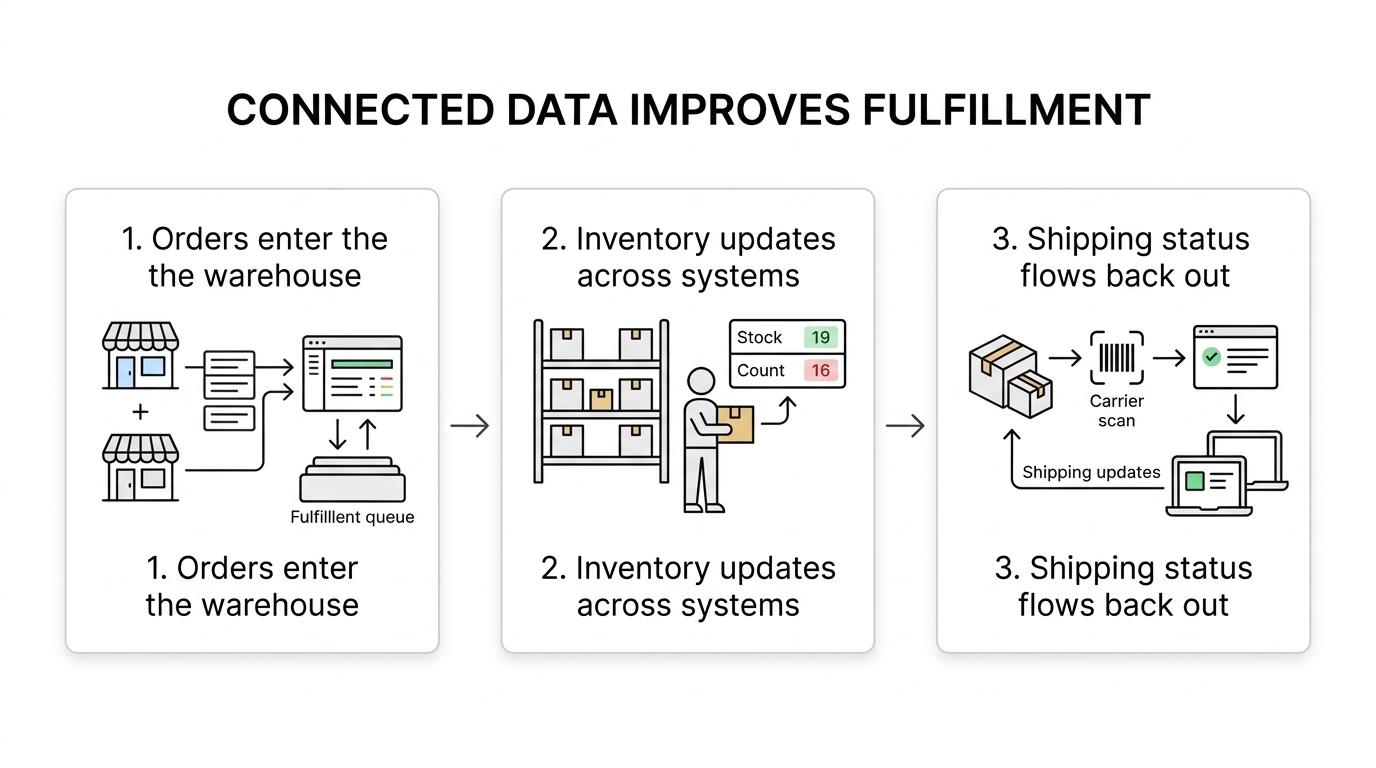
A brand that sells through its own store, marketplaces, wholesale portals, and social channels creates constant data movement. Orders have to enter the warehouse queue, inventory has to decrement, shipping events have to flow back to customer-facing systems, and finance records have to stay consistent. If one of those links stalls, the customer sees the failure long before IT does.
The business impact gets worse as volume rises. According to the U.S. Census Bureau, U.S. retail ecommerce sales reached $329.5 billion on a not adjusted basis in Q2 2026, and year-over-year ecommerce growth outpaced total retail growth, 12.2% versus 6.7%. That gap tells you where operational pressure is building.
“SVDirect says it offers more than 80 preconfigured integrations plus custom API and web-services support for omnichannel fulfillment.”
NIST has also highlighted a practical reality of supply-chain digitalization: business systems still operate with heterogeneous formats, protocols, and data structures. If your brand runs more than one selling channel or more than one fulfillment path, API integration services help turn those mismatched systems into a working data network.
Which API integration features matter most for fulfillment and inventory?
For fulfillment-heavy brands, SVDirect illustrates the right feature set: two-way order import, inventory updates, shipping-status queries, and support for unusual data formats when prebuilt mappings are not enough.
The first question is not “Does it connect?” The better question is “What transactions does it support, how often do they run, and what happens when the data is incomplete?” A connector that only imports orders is not enough if it cannot return tracking, update available stock, or handle changed product records.
Transaction depth matters. If a provider can support importing orders, defining new products, inquiring on shipping status, and other common warehouse events, the integration becomes operationally useful instead of cosmetic. That matters even more when brands need live inventory visibility to prevent oversells across multiple channels.
“Silicon Valley Direct says its web services support close to 20 different transactions, including order import, new product setup, and shipping-status inquiry.”
A common mistake is treating inventory sync as a once-a-day reporting task. If fast-moving SKUs sell across several channels, delayed updates can create canceled orders, split shipments, and customer-service costs that far exceed the integration budget. Brands should also ask how exceptions are handled when SKUs do not match, addresses fail validation, or channel-specific shipping rules conflict.
What API integration services are most useful for omnichannel brands?
The most useful services connect order capture, warehouse execution, inventory visibility, shipping events, and data normalization. The right mix depends on where errors happen today and which systems own the source of truth.
In practice, omnichannel brands rarely need just one connector. They need a service layer that can normalize data, map fields consistently, and move events across systems without forcing teams into manual exports and uploads.
- Fulfillment and warehouse integration: Silicon Valley Direct fits this category when a brand needs 3PL connectivity, 80+ preconfigured integrations, custom API or web-services support, and automated order flow between sales channels and the warehouse.
- Order management integration: Routes orders by channel, service level, or inventory location.
- Inventory availability synchronization: Keeps sellable stock accurate across direct-to-consumer, marketplace, and wholesale channels.
- Shipping and tracking event APIs: Pushes label creation, carrier scans, and delivery milestones back to storefronts and service teams.
- Product and catalog data mapping: Standardizes SKU, unit-of-measure, bundle, and attribute fields across systems.
- Returns and exception workflows: Captures return authorizations, restock signals, and refund-triggering events with less manual handling.
If a brand only buys the order-import layer, it still may not solve the real operational problem. The bigger gain often comes from connecting the full transaction chain from order creation through shipment confirmation.
How should you audit your systems before buying API integration services?
Start with a system and data audit. Most integration problems come from inconsistent SKUs, missing business rules, and unclear ownership, not from the API itself.
Step 1 is identifying every system that touches the order lifecycle. That often includes the storefront, order management system, ERP, warehouse management system, shipping software, returns tool, and customer-service platform. You need to know which system creates the order, which system owns available inventory, and which system has final shipment truth.
Step 2 is mapping the minimum data required for each transaction. Order import might require SKU, quantity, ship-to address, carrier preference, gift message, tax fields, and channel identifiers. Shipment confirmation may need tracking number, carrier code, ship method, parcel weight, and line-level status. If those fields do not match across systems, the integration will look connected while still producing bad outputs.
Step 3 is identifying exceptions before go-live. A quiet but useful rule is this: if you cannot describe what happens when data is wrong, you are not ready to automate it. That includes backorders, duplicate orders, invalid SKUs, bundle components, partial shipments, and address failures.
How do prebuilt integrations compare with custom API development?
Prebuilt integrations are faster to launch; custom API development is better for unique workflows and unusual data structures. The right choice depends on complexity, not ego.
Prebuilt connectors usually win on speed, cost control, and lower implementation risk. If your catalog structure is straightforward and your channel setup is common, a proven connector can reduce mapping work and shorten testing. That is often the best path for brands that want stable order import and status updates without months of development.
Custom API work becomes more valuable when the business model is less standard. Examples include subscription logic, complex kitting, medical or regulated documentation, multi-warehouse routing, or channel-specific packing rules. In those cases, the integration must reflect the operation rather than forcing the operation to fit the connector.
A common misconception is that custom always means better. It does not. Custom work increases flexibility, but it also increases maintenance responsibility, field-mapping complexity, and testing scope. If a prebuilt connector covers 90% of the workflow and the remaining 10% can be handled cleanly, that is often the smarter choice.
How do API integration services compare with EDI for supply-chain data exchange?
APIs are better for fast, event-driven updates; EDI still fits rigid, scheduled partner exchanges. Many omnichannel brands end up using both.
APIs are strong when the business needs timely data exchange. Order acknowledgments, stock changes, shipment events, and status inquiries benefit from API patterns because they support faster synchronization and more granular responses. That matters when customers expect near-real-time updates.
EDI still has a place where trading partners require specific document sets and fixed formats. It remains common in wholesale and structured procurement environments. If your brand serves both direct-to-consumer and retail or institutional buyers, you may need APIs for ecommerce operations and EDI for partner compliance.
NIST’s work on interoperability is useful here because it frames the core challenge correctly: supply chains often operate across different standards, formats, and industries. The goal is not choosing a fashionable protocol. The goal is reliable message translation, traceability, and shared business meaning. A common mistake is assuming APIs replace every legacy method. In practice, strong integration services handle mixed environments well.
How do you implement API integration services without disrupting daily operations?
SVDirect’s integration model highlights a safe rollout pattern: start with a narrow transaction set, validate field mapping in a test environment, then expand once order, inventory, and shipment messages match operational reality.
Step 1 is choosing a pilot workflow. Many brands start with order import and shipment confirmation because those transactions are visible, measurable, and tied closely to customer experience. Keep the first phase narrow enough that issues are diagnosable.
Step 2 is running side-by-side validation. Compare the source system and destination system for a controlled sample of orders. Check SKU mapping, quantities, address integrity, shipping method translation, and tracking updates. If data looks right but warehouse behavior is wrong, the business-rule mapping probably needs work.
Step 3 is defining rollback and exception-handling rules. If order imports fail, where do they queue? If inventory values drift, which system is authoritative? If shipping updates arrive late, who is alerted? Teams that answer those questions in advance tend to go live with much less drama.
How do you measure API integration performance after go-live?
Measure performance in stages. First confirm data movement, then validate data quality, then track the amount of manual work still required.
Start by establishing a baseline before launch. If orders currently take hours to reach the warehouse, any new service should cut that delay sharply. If inventory discrepancies already exist, document them first so you can tell whether the integration improved the process or simply exposed old issues.
Then track a short set of operational measures that the warehouse, ecommerce team, and finance team can all understand.
- Order-import latency: Time from checkout or channel release to warehouse receipt
- Inventory sync accuracy: Variance between sellable inventory and actual available stock
- Shipment event timeliness: Time from label creation or carrier scan to customer-facing update
- Manual rework rate: Share of orders that need human correction because of mapping or data errors
A useful misconception to avoid is treating uptime as the only KPI. An integration can be technically available and still create expensive downstream errors. Accuracy and rework matter just as much as connectivity.
How do standards like GS1 and NIST affect API integration decisions?
They matter because APIs only work well when the underlying identifiers and data models are consistent. GS1 US focuses on structured product and location data, and NIST emphasizes interoperable traceability across heterogeneous supply-chain systems.
GS1 US is especially relevant when product and location identification needs to travel across systems. Its API approach reinforces a basic truth: if the data model is inconsistent, automation gets brittle. Product identifiers, locations, and licensing data work better when systems follow a clear structure.
NIST’s recent work adds another layer. NIST IR 8536 describes a traceability meta-framework meant to improve secure exchange and verification of traceability information while letting organizations keep using existing standards. That is important for omnichannel brands because few operations run on one perfect system stack.
If your business handles regulated goods, lot-sensitive items, or multiple fulfillment nodes, standards become more than a technical preference. They shape how quickly you can trace events, answer partner questions, and adapt to new channels without remapping everything from scratch.
What mistakes cause API integration projects to fail?
Most failures come from bad master data, weak exception handling, and vague business ownership. The API is rarely the root problem.
Bad master data shows up first. If the same SKU has different naming logic across systems, the integration either breaks openly or succeeds silently with wrong outcomes. Silent errors are worse because they are discovered only after customer complaints or reconciliation work.
Weak exception handling is another major issue. If an order contains an unknown SKU, invalid address, or unsupported ship method, the system needs a clear path for quarantine, alerting, and correction. If no one owns that queue, errors pile up faster than teams can clear them.
Ownership problems can sink an otherwise sound project. If IT owns the connector but operations owns fulfillment rules and ecommerce owns channel settings, someone must have final authority over data definitions and workflow logic. If that governance is missing, every change request turns into delay.
One last misconception: a successful launch does not mean the integration is finished. As channels, product lines, and shipping rules change, the integration has to be reviewed as a living operating asset, not a one-time technical task.