img not found!
Best eCommerce Shipping Solutions for Small Business: The 2026 Guide to Scaling

Best eCommerce Shipping Solutions for Small Business: The 2026 Guide to Scaling

What if the tools you currently use to manage your logistics are the very things keeping your business from growing? With 2026 bringing an 8% temporary USPS price increase and the permanent suspension of the Section 321 de minimis exemption, small business margins are under more pressure than ever. You probably feel the weight of these changes every time you pack a box in a cramped office or struggle with complex international customs duties. It’s exhausting to spend your days managing labels when you should be focusing on your brand’s vision and customer relationships.

Finding the best ecommerce shipping solutions for small business requires a clear understanding of where software ends and true partnership begins. We agree that your time is too valuable to be spent in a warehouse, yet you need a solution that maintains the personal touch your customers expect. This guide will help you navigate the critical choice between automated shipping apps and a full-service 3PL partner. We will explore how to lower your rates despite carrier hikes, automate your entire fulfillment workflow, and build a global infrastructure that scales with your ambition. You’ll discover how to reclaim your time while ensuring your customers receive their orders faster and more reliably than ever before.

Key Takeaways

  • Understand the functional differences between shipping software and 3PL providers to select the right operational model for your brand’s current stage.
  • Discover how the best ecommerce shipping solutions for small business leverage multi-carrier support and real-time inventory tracking to prevent overselling.
  • Identify the “growth tipping point” where the opportunity cost of packing boxes yourself begins to hinder your ability to focus on high-level marketing.
  • Evaluate the financial impact of direct and indirect shipping costs, including postage, software subscriptions, and warehouse overhead.
  • Explore the benefits of choosing a fulfillment partner that prioritizes human-centric service and decades of logistics expertise over impersonal automation.

What Are eCommerce Shipping Solutions? Software vs. 3PL

Identifying the best ecommerce shipping solutions for small business begins with a fundamental choice: do you want to manage the physical labor yourself, or do you want to outsource the entire operation? In 2026, the term “shipping solution” typically refers to two distinct paths. First, there is shipping software, which acts as a digital control center for merchants who still handle their own packing. Second, there are Third-Party Logistics (3PL) providers, which offer a comprehensive physical infrastructure for storage and delivery. While every growing brand needs a structured approach, the right choice depends entirely on your current order volume and your long-term scaling goals.

The modern order fulfillment process has become increasingly complex. It requires more than just a printer and a stack of boxes; it demands a sophisticated integration of digital data and physical precision. Many small businesses in 2026 are adopting a hybrid model. They might use software to handle niche, low-volume orders or local deliveries while relying on a 3PL partner to manage the bulk of their inventory. This approach ensures they aren’t paying for warehouse space they don’t need while still maintaining the ability to scale rapidly when a product goes viral.

To better understand this concept, watch this helpful video:

The Role of Shipping Software in Early Growth

When you’re starting out, shipping software provides the essential digital tools to keep costs manageable. These platforms aggregate rates from major carriers like USPS, UPS, and FedEx, allowing you to shop for the lowest price in real-time. By integrating directly with sales channels like Shopify or WooCommerce, they eliminate the need for manual data entry. You get access to branded tracking pages and automated customer notifications, which helps build trust. However, it’s vital to remember that software is a tool for the DIY merchant; it automates the paperwork, but you’re still the one applying the tape to every box.

The 3PL Advantage: When Software Isn’t Enough

As your business expands, the physical limitations of a garage or small office become a bottleneck. This is where a 3PL provider offers a strategic advantage that software alone cannot match. By moving your inventory into a professional warehouse, you gain access to secure storage and expert inventory management. A 3PL partner handles the “hands-off” pick and pack services, which frees up your time to focus on marketing and product development. For those looking to explore Surfboard retail, this means focusing on the sport and the community while experts handle the bulky shipping logistics. Additionally, high-volume logistics providers leverage deep carrier discounts that aren’t available to individual shippers, often offsetting the cost of the fulfillment service itself through reduced postage rates.

Essential Features to Look for in a Shipping Solution

Selecting the best ecommerce shipping solutions for small business requires looking past simple label printing to find a platform that addresses the full scope of modern logistics. In a year defined by rising carrier surcharges and complex regulatory shifts, your solution must offer more than just basic connectivity. It needs to serve as a proactive partner in your growth strategy. Precision in these features ensures that your operations remain lean even as your order volume increases.

Multi-carrier support is no longer optional; it’s a survival tactic. Relying on a single carrier exposes your business to price hikes like the 5.9% average increases implemented by UPS and FedEx at the start of 2026. A robust system allows you to pivot between DHL for international reach, national carriers for reliability, and regional players for cost-effective local delivery. This diversification is one of the key Trends in E-Commerce Logistics that brands must embrace to remain competitive and resilient against service disruptions.

In this landscape, leveraging specialized services like Sameday Express Inc. allows businesses to maintain a competitive edge in regional markets, particularly within Canada, by offering speed and reliability that larger national carriers may struggle to match during peak periods.

Global reach has become a primary differentiator as 44% of brands plan to ship to new countries in 2026. With the permanent suspension of the Section 321 de minimis exemption earlier this year, your shipping solution must provide automated tools for navigating customs, duties, and international taxes. Without this capability, your customers face unexpected fees at the border, which leads to high return rates and a damaged brand reputation. Automation rules further enhance this efficiency by applying logic to every order, automatically selecting the cheapest method for standard shipping or the fastest route for premium tiers. When combined with real-time inventory tracking, these tools prevent the high-stakes error of overselling across multiple sales channels.

Integration Depth and API Flexibility

Your logistics infrastructure is only as strong as its weakest link. A high-performance solution must integrate seamlessly with your ERP and storefront to ensure that customer data flows without friction. This real-time synchronization is what allows for accurate delivery estimates and immediate stock updates. In 2026, API integration serves as the digital nervous system that connects disparate sales platforms into a single, cohesive operational unit. Brands that prioritize this connectivity often find it’s worth the effort to request a quote for bespoke technical setups that align with their specific growth trajectory.

Advanced Analytics and Reporting

Precision in logistics requires a data-driven approach to every decision. You need the ability to track shipping spend as a percentage of revenue to protect your margins from being eroded by hidden surcharges. Advanced reporting identifies specific bottlenecks in the fulfillment cycle, such as delays in kitting or slow carrier pickups. Custom reports for inventory turnover and returns management provide the transparency needed to optimize stock levels and reduce waste. This level of insight transforms shipping from a necessary cost into a strategic advantage.

Software vs. 3PL: Identifying Your Growth Tipping Point

Determining the best ecommerce shipping solutions for small business requires an honest assessment of your current physical constraints and your long-term vision. While shipping software is a powerful tool for organizing labels, it doesn’t solve the physical reality of a garage or office filled to the rafters with inventory. This “Garage Ceiling” is a common bottleneck where your physical space begins to limit your sales potential. If you can’t store enough stock to meet a sudden surge in demand, your growth is effectively capped. It’s no longer just about the cost of a label; it’s about the cost of missed opportunities.

The most overlooked factor in this decision is opportunity cost. Every hour you spend packing boxes is an hour you aren’t spending on product innovation, strategic marketing, or customer relationship management. As a founder, your time is your most valuable asset. If your business is scaling, your time is likely worth significantly more than the cost of outsourcing fulfillment. Scalability testing is equally vital. You must ask yourself if your current home-based or small-office setup can handle a 5x spike in orders during a Black Friday rush. If a sales surge leads to a two-week shipping delay, the resulting negative reviews can derail your brand’s momentum for years.

Brand consistency also becomes a challenge as you grow. High-quality custom kitting and bespoke packaging are easy to manage when you’re doing ten orders a day, but maintaining that precision at a hundred orders a day is a different story. A professional partner ensures that the “human touch” of your brand remains intact even as your volume explodes, providing a steady hand that keeps your operations stable during periods of rapid expansion.

The DIY Phase: Best for Micro-Businesses

Micro-businesses with low order volumes, typically under 100 per month, are often best served by the DIY approach. At this stage, your personal labor is a flexible resource, and your products are likely low-complexity items that don’t require specialized storage. You can manage these operations effectively using basic tools and resources like USPS small business shipping to keep your overhead minimal. It’s a period of lean experimentation where total control over the unboxing experience helps you refine your brand identity before you commit to larger infrastructure.

The 3PL Phase: Best for Scaling Small Businesses

The 3PL phase begins when consistent growth turns into operational strain and founder burnout becomes a tangible risk. This transition is essential if your product line requires specialized kitting and assembly services to maintain quality at scale. As you look toward international markets, you’ll need robust global shipping services to navigate the complexities of 2026 customs regulations without slowing your delivery times. Moving to a 3PL ensures that your physical infrastructure is as professional and organized as your digital storefront.

Best eCommerce Shipping Solutions for Small Business: The 2026 Guide to Scaling

Calculating the Real Cost of eCommerce Shipping

Many entrepreneurs mistakenly believe that label prices are the only metric that matters when evaluating the best ecommerce shipping solutions for small business. However, focusing solely on postage ignores the significant overhead that erodes your profit margins. To find a truly cost-effective way to scale, you must account for both direct and indirect expenses. Direct costs include software subscriptions, packaging materials, and the carrier rates that have increased across the board in 2026. For example, the 5.9% average rate hikes from UPS and FedEx, combined with the temporary 8% USPS Priority Mail increase, create a baseline that requires careful management.

Indirect costs are often where small businesses lose the most capital. If you manage fulfillment in-house, you’re paying for warehouse rent, utilities, and insurance regardless of your order volume. These are fixed expenses that don’t scale down during slow months. In contrast, the “3PL Math” converts these fixed burdens into variable per-order fees. This shift ensures that you only pay for the resources you actually use. Labor costs also present a hidden drain on resources. The time spent on pick, pack, and returns management is time taken away from high-value growth activities. When you calculate the hourly value of a founder’s time, the DIY approach often becomes the most expensive option available.

Understanding Pick and Pack Fees

A standard fulfillment fee covers the physical labor of selecting items, the cost of packing materials, and the administrative handling of the order. While these fees might seem like an added expense, they’re often offset by the volume discounts that a 3PL partner provides. Because high-volume logistics providers ship millions of packages, they access deep price tiers that individual small businesses cannot reach. Professional inventory management provides a significant return on investment by drastically reducing shrinkage and stock discrepancies through precise digital tracking and human oversight.

Hidden Savings: Discounted Postage and Shipping Management

One of the primary financial advantages of a 3PL is the ability to access commercial plus pricing. These discounted rates are passed directly to you, allowing your small business to compete with larger retailers on shipping speed and cost. Efficient returns management logistics further protects your bottom line by quickly reintegrating sellable items back into your inventory. Additionally, your geographic location plays a strategic role in your financial health. Operating from a hub like Silicon Valley provides a symbol of innovation and offers superior global connectivity, reducing the transit times and costs associated with international trade. To see how these savings apply to your specific volume, you can request a free quote to compare your current overhead against a streamlined fulfillment model.

Why Silicon Valley Direct is the Strategic Choice for 2026

Finding the best ecommerce shipping solutions for small business often feels like a search for a needle in a haystack of automated platforms and impersonal dashboards. In 2026, where logistics complexity is at an all-time high, the real differentiator isn’t just a piece of software; it’s the depth of the operational history behind the service. Silicon Valley Direct (SVD) has provided a steady hand for growing brands since 1999, combining multi-decade experience with the cutting-edge efficiency required in today’s market. We explicitly reject the industry trend toward automated ticket systems, choosing instead to prioritize direct human connection and personal oversight for every client we serve.

Our strategic location in the heart of Silicon Valley serves as more than just a geographic marker; it’s a symbol of our commitment to innovation and global connectivity. From this hub, we manage specialized capabilities that go far beyond basic shipping. Whether you require healthcare mailing services, literature fulfillment, or complex inventory management, our facility is equipped to handle the high-stakes precision your business demands. We bridge the gap between mechanical operations and the personal nature of growing a brand, ensuring your logistics are as organized as your digital strategy.

Bespoke Solutions for Unique Business Needs

Subscription boxes and promotional kits require a level of detail that generic fulfillment centers often miss. We provide custom kitting and assembly services that ensure every unboxing experience matches your brand’s high standards. For businesses dealing with sensitive inventory, we offer specialized warehousing for high-value electronics, providing the security and climate control necessary to protect your assets. Additionally, our on-demand digital printing services allow you to include personalized inserts or update marketing materials in real-time, which significantly reduces inventory waste and storage costs.

A Partner in Your Supply Chain

True scaling happens when you transition from viewing your fulfillment provider as a mere vendor to treating them as a strategic partner. SVD takes on the weight of carrier negotiations, customs compliance, and returns management so you can dedicate your energy to product development and market expansion. We don’t just move boxes; we manage the growth of your supply chain with a proactive attitude backed by physical infrastructure and human expertise. If you’re ready to move beyond the limitations of DIY shipping and embrace a scalable, professional model, Contact Silicon Valley Direct for a custom fulfillment quote today and discover how we can streamline your path to growth.

Secure Your Brand’s Future Through Strategic Fulfillment

The transition from managing labels to managing growth is the defining moment for any ambitious brand. As we’ve explored, the best ecommerce shipping solutions for small business aren’t just about finding the lowest postage rate; they’re about building a resilient infrastructure that can withstand the carrier hikes and regulatory shifts of 2026. By distinguishing between simple software tools and the comprehensive support of a 3PL partner, you can reclaim your time and focus on the high-level marketing that drives your company forward. Success requires moving beyond the “garage ceiling” and embracing a model that scales with your ambition.

Silicon Valley Direct has been a steady hand in this industry since 1999. We offer specialized experience in healthcare mailing and high-value goods while ensuring direct human oversight on every account. You don’t have to navigate these logistical complexities alone. We’re ready to act as a proactive extension of your team, providing the precision and stability your business deserves. It’s time to transform your shipping from a daily chore into a strategic advantage. We look forward to growing alongside you as you reach new markets.

Streamline your supply chain with Silicon Valley Direct

Frequently Asked Questions

What is the best shipping software for a small business just starting out?

Early-stage brands often find the best ecommerce shipping solutions for small business in cloud-based platforms that simplify label printing and rate shopping. These tools integrate with your storefront to automate data entry and provide access to discounted carrier rates. They’re ideal when your volume is low enough to manage shipments personally from a home office or small studio.

How much does it cost to outsource shipping to a 3PL?

Fee structures typically include receiving costs, monthly storage per pallet or bin, and a per-order pick and pack fee. Shipping postage is added on top, though these rates are often lower than retail prices due to the provider’s high volume. This variable cost model ensures you only pay for the resources you use, replacing the fixed overhead of maintaining your own facility.

Can a 3PL help me save money on international shipping rates?

Yes, 3PL providers leverage deep commercial discounts only available to high-volume logistics organizations. They also provide the expertise needed to navigate the 2026 suspension of de minimis exemptions for US imports. This ensures your international customers don’t face unexpected duties or delays at the border, which significantly reduces the cost of failed deliveries and returns.

Is it cheaper to ship through a 3PL or do it myself?

DIY shipping is often cheaper for micro-businesses where the founder’s labor is considered a free resource. However, as you scale, the combination of 3PL carrier discounts and the elimination of warehouse rent often makes outsourcing more cost-effective. You must factor in the opportunity cost of the time you spend packing instead of focusing on product development and marketing.

What is the difference between kitting and simple order fulfillment?

Simple fulfillment involves picking a pre-packaged item from a shelf and shipping it directly to the customer. Kitting and assembly services involve combining multiple components or SKUs into a new, single unit before the shipping process begins. This is essential for subscription boxes or complex promotional kits that require a specific aesthetic presentation and precise component counting.

How does a 3PL integrate with my Shopify or Amazon store?

Modern logistics providers use secure API integrations to create a seamless link with platforms like Shopify, Amazon, and WooCommerce. This connection allows orders to flow automatically to the warehouse for immediate fulfillment. It also ensures that stock levels update in real-time across all your sales channels, which prevents the high-stakes error of overselling a popular item.

At what order volume should I consider a fulfillment partner?

Most businesses begin the transition when they reach a consistent volume of 100 to 200 orders per month. This is the point where physical space constraints and the time required for manual packing start to hinder your ability to grow. If your brand’s momentum is stalling because you’re too busy managing tape and boxes, it’s a clear sign to seek a professional partner.

What are the risks of using a 3PL for high-value items?

The primary risk involves inventory shrinkage or damage if a provider lacks advanced security and climate control. This is why high-value electronics or healthcare products require specialized warehousing with rigorous protocols and direct human oversight on every account. Choosing a partner with a multi-decade history of handling sensitive goods mitigates these operational vulnerabilities through proven quality control measures.

The Strategic Guide to Personalized Direct Mail: Boosting Response Rates in 2026

The Strategic Guide to Personalized Direct Mail: Boosting Response Rates in 2026

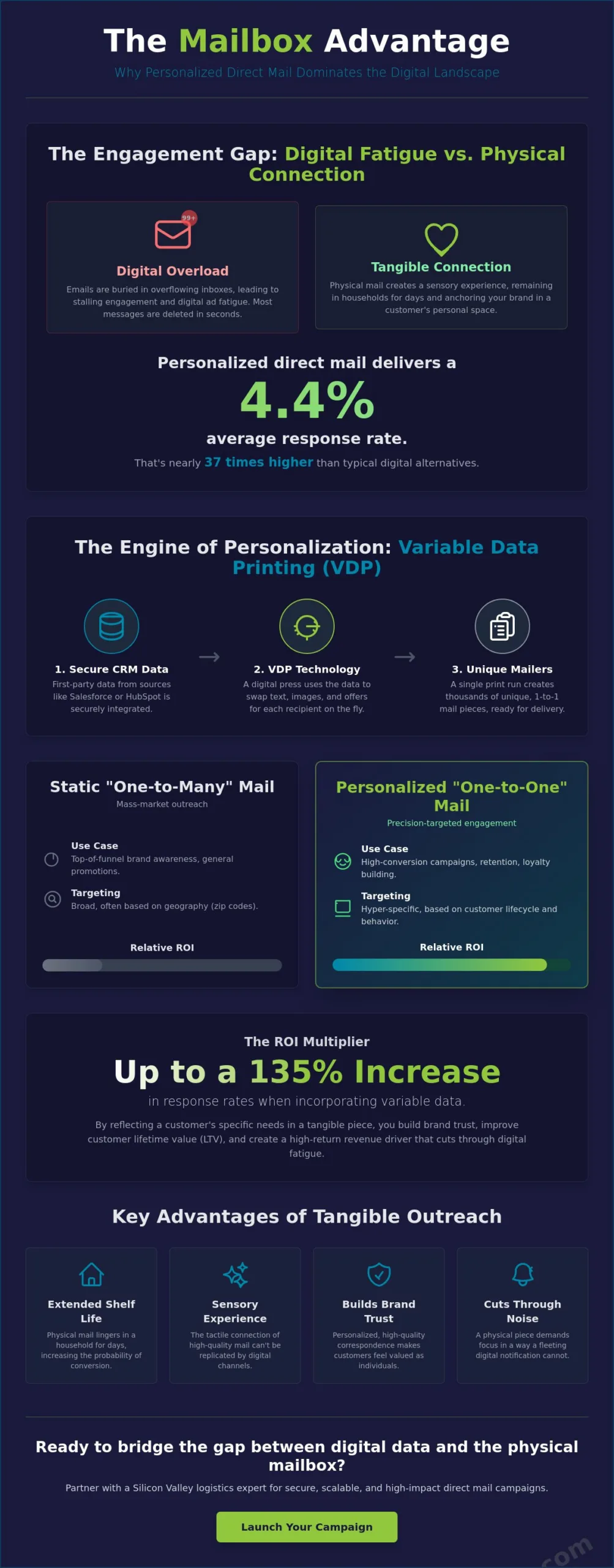
Did you know that while email engagement continues to stall, personalized direct mail is currently delivering response rates of 4.4 percent, which is nearly 37 times higher than typical digital alternatives? You likely already feel the weight of digital ad fatigue and the frustration of seeing your carefully crafted CRM data sit idle while your outreach is buried in an overflowing inbox. It’s a common challenge to bridge the gap between digital insights and a physical mailbox without getting lost in the technical complexity of variable data printing or worrying about the security of your sensitive information.

We understand that modern marketing is often a logistics challenge disguised as a creative one. This guide will show you how to transform your first-party data into high-impact physical campaigns that drive a higher return on investment and create a seamless bridge between your online and offline channels. We’ll explore the mechanics of variable data technology, how to navigate the July 2026 USPS rate adjustments, and the specific strategies needed to build a scalable retention engine that treats your customers as individuals rather than just entries in a database.

Key Takeaways

  • Explore the sensory advantages of tangible outreach and why physical mail remains in households far longer than fleeting digital notifications.
  • Learn how to leverage Variable Data Printing (VDP) to execute high-impact personalized direct mail that adapts text and imagery for every recipient.
  • Compare the efficiency of static mailers for top-of-funnel awareness against the high-conversion potential of precision-targeted campaigns.
  • Follow a structured workflow to integrate your CRM data into variable design zones, ensuring your physical execution is as accurate as your digital strategy.
  • Gain a competitive edge by utilizing a Silicon Valley logistics partner for secure literature fulfillment and scalable global shipping.

Why Personalized Direct Mail Dominates the 2026 Marketing Landscape

Digital noise is louder than ever. In 2026, consumers are bombarded with thousands of digital pings daily, leading to a psychological barrier where email open rates continue to struggle. Physical mail captures a different kind of focus. Research indicates that 42.2 percent of recipients read or scan the mail they receive. This isn’t just a delivery method; it’s a sensory experience that digital channels cannot replicate. When a customer holds a high-quality piece of mail, it creates a tactile connection that anchors your brand in their physical space.

The concept of personalized marketing has found its most potent expression in the physical world. Unlike a generic flyer, personalized direct mail feels like a private conversation between a brand and a consumer. Because a physical piece requires tactile interaction, it lingers in the home for days. This extended shelf life increases the probability of a conversion compared to an email that is often deleted in seconds. By bridging the gap between digital data and physical touch, you create a lasting impression that drives action.

To better understand how premium mail services can elevate your brand’s physical presence, watch this helpful video:

The Evolution of Direct Mail Marketing

Direct mail used to mean mass-market flyers sent to every zip code. Today, the industry has shifted toward precision. On-demand digital printing allows brands to produce only what they need, exactly when they need it. This reduces waste and ensures the message is relevant to the recipient’s current lifecycle stage. 3PL providers have evolved into execution hubs where digital data meets physical infrastructure. This synergy allows for a seamless transition from a CRM list to a physical mailbox, ensuring that every piece sent is timely and highly relevant.

The ROI of “Personal” Over “Mass”

The numbers tell a compelling story. While the average response rate for direct mail is 4.4 percent, incorporating variable data can increase those results by up to 135 percent. This isn’t just about a one-time sale; high-quality correspondence builds brand trust and improves customer lifetime value. When a recipient sees their specific needs reflected in a tangible piece, they feel valued as an individual. This human element transforms a simple mailing into a high-ROI revenue driver that strengthens long-term loyalty and cuts through digital fatigue.

The Mechanics of Personalization: How Variable Data Printing Works

Variable Data Printing (VDP) serves as the high-tech engine behind every high-performing personalized direct mail campaign. Unlike traditional offset printing, which relies on fixed plates to produce thousands of identical copies, VDP uses digital technology to swap elements on the fly. This means a single print run can produce thousands of unique pieces, each featuring a different name, custom image, or specific promotional offer. This process creates a direct bridge between your digital CRM, such as Salesforce or HubSpot, and the physical printing press.

By extracting first-party data, marketers can automate the transition from a digital lead to a tangible mailer. This on-demand approach is significantly more efficient than bulk printing because it eliminates the need for massive inventory storage and reduces waste from outdated messaging. As discussed in The Direct Mail Revival, this technical shift is why physical outreach is seeing such a strong resurgence among data-driven organizations. You can find more technical insights on our fulfillment blog regarding secure data handling and logistics.

Data Integration and Security

Maintaining security during the transfer of sensitive information is a cornerstone of our operation. We utilize Secure File Transfer Protocols (SFTP) to ensure client data remains protected during the handoff. For those in the healthcare or financial sectors, maintaining HIPAA and regulatory compliance is non-negotiable. Silicon Valley Direct differentiates itself by combining these automated safeguards with rigorous human oversight. Our experts review every data-driven workflow to ensure that the precision of the software is matched by the discernment of an experienced eye. This proactive stance prevents the common data errors that plague automated-only systems.

Beyond the First Name: Advanced Data Use

Personalization in 2026 goes far beyond a simple salutation. Advanced personalized direct mail uses dynamic imagery based on past purchase history or geographic location. For instance, a customer in a specific region might receive a postcard featuring a local landmark familiar to them. We also integrate unique QR codes and Personalized URLs (PURLs) to track individual engagement in real-time. This allows you to tailor the “Call to Action” specifically to loyalty tiers, offering a different incentive to a first-time buyer versus a long-term advocate. If you’re ready to see how these technical integrations can scale your outreach, you can request a specialized quote for your project.

The Strategic Guide to Personalized Direct Mail: Boosting Response Rates in 2026

Static vs. Personalized Direct Mail: A Commercial Comparison

Deciding between static and personalized campaigns depends on your specific marketing objective. Static mailers are ideal for building broad awareness within a defined geographic area. They function well for top-of-funnel outreach where the goal is brand recognition rather than immediate, individual conversion. However, when the goal is to drive specific actions from existing leads or high-vealue prospects, personalized direct mail is the superior choice. While the upfront investment for digital variable printing is higher than traditional bulk runs, the return often justifies the expense. Research shows that personalized pieces can increase response rates by up to 135 percent compared to generic alternatives.

Many organizations find success with a hybrid approach. This involves printing high-quality static shells using traditional offset methods and then using on-demand digital printing to add personalized imprints later. This strategy balances the cost-efficiency of bulk production with the high impact of customization. For more details on how to structure these campaigns, the USPS provides extensive resources on Customized Direct Mail to help businesses navigate postal requirements and format standards.

Cost-Benefit Analysis for 2026

In 2026, postage remains a significant variable in your marketing budget. Utilizing Intelligent Mail Barcoding (IMb) allows for significant postage discounts that help offset the costs of customization. When you factor in the precision of 3PL kitting and assembly, your physical outreach takes on a premium feel that digital ads simply can’t match. Comparing the Cost Per Acquisition (CPA) of physical mail against digital retargeting often reveals that mail, though more expensive per piece, converts at a much higher rate. This efficiency makes it a stable pillar for any customer retention strategy. You can read more about optimizing your logistics on our fulfillment blog.

Strategic Use Cases for Personalization

  • E-commerce: Re-engage customers who haven’t made a purchase in 90 days with a postcard featuring their last-viewed item.
  • Financial Services: Deliver personalized portfolio summaries or loan offers tailored to an individual’s credit profile.
  • Healthcare: Send appointment reminders and wellness literature that addresses a patient’s specific health history.

These targeted applications ensure that your message isn’t treated as junk mail. Instead, it becomes a valuable piece of bespoke correspondence that builds deeper brand trust and encourages long-term loyalty. By treating your audience as individuals rather than data points, you create a more meaningful connection that drives measurable results.

How to Launch a Personalized Direct Mail Campaign

Launching a successful personalized direct mail campaign requires a methodical transition from digital strategy to physical production. While many software platforms promise “push-button” automation, true success relies on a structured workflow that accounts for both data accuracy and physical quality control. Following a steady, logical progression ensures your message reaches the right hands without the friction of logistical errors. This process moves through specific stages of preparation, execution, and optimization to ensure every piece sent contributes to your bottom line.

Data Hygiene and Preparation

The first step involves extracting clean data from your CRM and preparing it for variable data printing. This process must include National Change of Address (NCOA) processing to account for the millions of Americans who move annually. Your CSV or API feed should be formatted to map directly to your design’s variable fields, ensuring that names and offers align perfectly. Rigorous data hygiene is the single most important factor in maximizing your return on investment by eliminating the cost of undeliverable mail. By starting with a clean foundation, you prevent the waste associated with outdated records and ensure your campaign reaches its intended audience.

Design and Creative Execution

Designers must balance brand aesthetics with the technical requirements of “Variable Zones.” These are the specific areas on your mailer where text or images will change for each recipient. Choosing the right paper stock is also vital; a high-quality finish complements a personalized message and reinforces brand trust. For a deeper look at optimizing these processes, explore our guide on Direct Mail Printing and Mailing. This careful attention to the physical medium ensures that your high-tech data strategy results in a high-touch customer experience.

Production, Testing, and Optimization

Unlike digital-only platforms that focus solely on triggers, a 3PL partner provides the physical infrastructure for on-demand digital printing and inventory management. Before full execution, always conduct a test run to verify that data mapping is accurate and print quality meets your standards. This human oversight is a critical differentiator that prevents automated errors from reaching the mailbox. Once the campaign is live, track engagement through scan data or unique identifiers. This allows you to optimize future runs based on real-world performance. If you’re ready to start your next campaign with a partner who values precision, request a free quote to discuss your specific needs.

Scaling Your Strategy with a Silicon Valley 3PL Partner

Silicon Valley serves as a global symbol of innovation, and our location at the heart of this tech ecosystem provides a strategic advantage for your marketing logistics. Scaling a personalized direct mail program requires more than just a printer; it demands a partner capable of managing the complex intersection of 3PL warehousing and on-demand digital production. With a history spanning over 25 years in secure literature fulfillment, Silicon Valley Direct offers the stability and technical expertise necessary to move your strategy from sporadic one-off mailings to sophisticated, triggered programs. This operational readiness allows your brand to respond to customer behaviors in real-time, delivering physical touchpoints exactly when they’re most likely to convert.

Effective scaling isn’t just about speed; it’s about accuracy. We manage the entire lifecycle of your collateral, from warehousing raw materials to the final kitting and assembly of personalized pieces. This integrated approach eliminates the friction often found when working with multiple vendors. By housing your inventory and printing capabilities under one roof, we reduce lead times and ensure that your physical outreach is as agile as your digital ads. This proximity to innovation allows us to implement the latest digital integrations while maintaining the steady hand of a seasoned logistics expert.

The Human Element in a Tech-Driven World

While we leverage cutting-edge technology to drive efficiency, we explicitly reject the industry trend toward total automation. We believe that high-stakes marketing requires personal oversight. Our seasoned experts perform manual quality checks that software often misses, catching data discrepancies before they become costly mailing errors. This bespoke problem-solving is supported by our long-term staff retention, which provides a unique hallmark of internal stability. When you work with us, you aren’t just getting an algorithm; you’re gaining a dedicated team that treats your business growth with personal commitment and precision.

Integrating Mail with Your Total Fulfillment

A unified brand experience requires seamless coordination between your marketing outreach and your physical product delivery. By combining your personalized direct mail with our eCommerce fulfillment services, you ensure that every customer interaction feels intentional and high-quality. Whether you’re sending a loyalty-driven literature piece or a custom-kitted promotional box, the precision of the execution reflects the value of your brand. This holistic view of the customer journey is what transforms a simple mailing into a scalable retention strategy.

Choosing the right partner is a critical business decision that impacts your long-term ROI. We recommend using our 3PL Checklist to vet potential providers against the rigorous standards required for modern marketing logistics. If you’re looking for a high-performance partner that remains accessible and grounded in operational excellence, it’s time to take the next step. Partner with Silicon Valley Direct for your next personalized campaign and experience the difference that precision and human expertise can make.

Elevate Your Outreach with Physical Precision

Bridging the gap between digital data and physical execution is no longer a luxury; it’s a strategic necessity for brands aiming to cut through the noise of 2026. By leveraging variable data printing and secure CRM integrations, you transform standard outreach into personalized direct mail that captures attention and builds lasting trust. This transition from mass-market flyers to data-driven, one-to-one correspondence ensures your message arrives with the relevance and quality your customers expect.

Silicon Valley Direct has been a steady hand in the logistics industry since 1999. We provide a secure, HIPAA-compliant facility where on-demand digital printing is fully integrated with our 3PL warehousing operations. This synergy allows for total flexibility and bespoke problem-solving that automated-only platforms simply can’t match. Our team provides the human oversight necessary to maintain precision at every stage of your campaign lifecycle.

Success in modern marketing requires a partner who understands the high stakes of growing a business. We invite you to request a custom quote for personalized direct mail today. Let’s build a high-performance campaign that delivers measurable results and strengthens your customer relationships for years to come.

Frequently Asked Questions

What is the minimum order size for personalized direct mail?

Minimum order requirements depend on the specific goals of your campaign and the chosen mailer format. Our on-demand digital printing capabilities provide total flexibility, allowing brands to execute smaller, highly targeted test runs or massive national distributions. We suggest contacting our team to discuss your specific volume needs, as we scale our operations to match your growth trajectory.

How long does it take to print and mail a personalized campaign?

The timeline for a campaign typically ranges from a few business days to two weeks, depending on the complexity of the variable data and current inventory. Factors such as data hygiene processing and kitting requirements can influence the schedule. Our integrated 3PL warehousing and printing facility ensures a streamlined workflow that minimizes delays between data approval and physical mailing.

Can I use my own CRM data for personalization?

Yes, you can easily integrate your existing CRM data from platforms like Salesforce or HubSpot into your personalized direct mail strategy. We utilize secure file transfer protocols to ingest your first-party data, which then maps directly to variable zones on your design. This connection allows for dynamic text and imagery that reflects each recipient’s unique purchase history or loyalty status.

Is personalized direct mail more expensive than standard mail?

While the initial cost per piece for variable data printing is higher than static bulk mail, the commercial value is found in the response rates. Personalized outreach reduces wasted spend by targeting individuals with relevant offers rather than sending generic flyers to broad zip codes. This precision typically results in a lower cost per acquisition and a higher overall return on your marketing investment.

How do I track the success of a personalized mail piece?

Tracking is achieved through unique identifiers like personalized URLs (PURLs), custom QR codes, or individual coupon codes. These tools allow you to see exactly which recipients engaged with the mailer and when they transitioned to your digital storefront. By monitoring these scan rates in real-time, you can refine your data segments and optimize the performance of future mailing cycles.

What industries benefit most from personalized direct mail?

Industries with complex customer lifecycles, such as healthcare, financial services, and e-commerce, see the most substantial benefits. Healthcare providers use it for secure appointment reminders, while e-commerce brands use personalized direct mail to re-engage customers with items left in abandoned carts. Any business that relies on high-value lead nurturing can use these tangible touchpoints to build deeper brand trust.

Is my customer data secure during the printing process?

Data security is a primary commitment of our operational facility. We maintain HIPAA-compliant standards and utilize encrypted transfer methods to ensure your sensitive information is never compromised. Unlike fully automated platforms, our process includes personal oversight from seasoned experts who verify that security protocols are followed at every step from data ingestion to the final mailing.

Direct Mail Marketing Services: The Strategic Guide to Physical Engagement in 2026

Direct Mail Marketing Services: The Strategic Guide to Physical Engagement in 2026

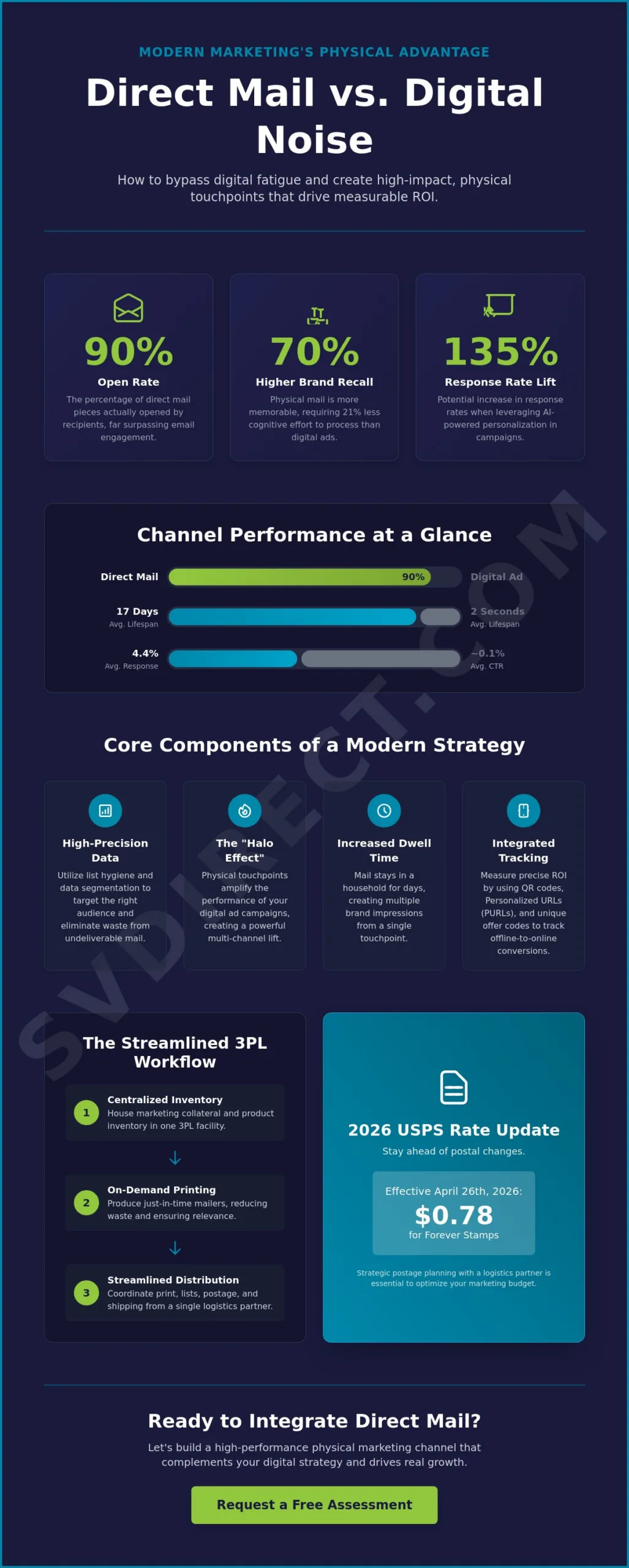
While digital inboxes are overflowing with ignored notifications, a staggering 90% of direct mail pieces are actually opened by recipients. You likely feel the pressure of rising customer acquisition costs on digital platforms where every click feels more expensive and less personal than the last. It’s frustrating to watch your marketing budget disappear into an overcrowded digital space without the engagement your brand deserves. This guide shows you how to leverage modern direct mail marketing services to bypass digital fatigue and create high-impact, physical touchpoints that drive measurable ROI.

By treating mail as a premium, data-integrated channel rather than a relic of the past, you can achieve response rates that significantly outperform email. We’ll explore the latest USPS rate shifts for 2026, including the April 26th increase to $0.78 for Forever stamps, and show you how AI-powered personalization can increase your response rates by up to 135%. We’ll also examine how a strategic logistics partner handles the complex coordination of print, lists, and postage so you can focus on scaling your growth.

Key Takeaways

  • Learn why modern direct mail marketing services act as a precision tool for multi-channel engagement rather than a standalone broadcast.
  • Discover how on-demand digital printing allows for just-in-time production, reducing waste and ensuring your message remains relevant.
  • Understand the “Halo Effect” and how physical touchpoints amplify the performance of your existing digital advertising campaigns.
  • Explore the operational advantages of housing your marketing collateral and inventory within a single, centralized 3PL facility to streamline distribution.
  • Master high-precision data segmentation to transform your mailing list into a valuable asset for both customer acquisition and retention.

The Resurgence of Direct Mail Marketing Services in a Digital-First 2026

Modern direct mail marketing services represent a sophisticated, integrated physical communication strategy that bridges the gap between digital discovery and tangible brand experience. In a year where digital noise has reached its peak, high-performance brands are returning to the mailbox to secure the attention they can’t buy on a screen. If we examine the history of direct mail, it’s clear the industry has evolved from broad, impersonal broadcasts into a data-driven science. This renaissance is fueled by the psychology of touch; physical mail generates 70% higher brand recall because it requires 21% less cognitive effort to process than digital advertisements.

To better understand how to modernize your approach and drive these results, watch this helpful video:

Physicality builds a level of trust that pixels simply cannot match. While a digital ad disappears the moment a user scrolls past, a physical mailer possesses “dwell time,” often staying in a household for several days. This persistence turns a single piece of mail into a recurring brand impression, acting as a strategic bridge that guides a customer from an initial online search to a final, confident conversion.

Bypassing the Digital Noise

An average marketing email survives for only a few seconds before it’s archived or ignored. In contrast, a high-quality postcard or catalog has a lifespan measured in days. This shift from bulk “junk” to high-value, personalized collateral is a direct response to widespread digital fatigue. Because physical mail doesn’t require an internet connection or a screen, it has become the unblockable inbox for 2026, ensuring your message is seen without competing against a dozen browser tabs or notification banners.

The ROI of Physical Engagement

The financial case for physical engagement is stronger than ever. While digital display ads struggle with ad-blockers and declining click-through rates, direct mail marketing services deliver an average response rate of 4.4%. This performance is especially vital for high-LTV customer acquisition, where the cost of a physical piece is balanced by the long-term loyalty it builds. By integrating these services into your attribution models, you can see exactly how a physical touchpoint influences an online purchase. For more insights on scaling these complex operations through integrated logistics, you can explore our latest updates on the SV Direct blog.

Core Components of a Modern Direct Mail Strategy

Execution in 2026 requires a shift from bulk distribution to precision engineering. Direct mail marketing services succeed or fail based on the quality of the underlying data. Your mailing list isn’t just a collection of addresses; it’s a dynamic asset that requires constant maintenance to remain effective. Modern strategies prioritize list hygiene to eliminate undeliverable-as-addressed (UAA) mail, which prevents wasted postage and production costs. The U.S. Small Business Administration has highlighted the effectiveness of direct mail when compared to the volatility of digital ad algorithms, particularly for businesses that value long-term customer relationships.

To maximize your return, you must optimize postage by choosing between First Class and Marketing Mail rates. First Class offers speed and return-to-sender services, while Marketing Mail provides significant cost savings for high-volume campaigns. Tracking these investments is no longer a guessing game. By integrating QR codes, Personalized URLs (PURLs), and unique offer codes, you can monitor exactly when a recipient moves from their mailbox to your digital checkout. If you’re ready to see how these components fit your specific business goals, you can request a tailored project assessment.

Targeting and List Management

Precision targeting involves choosing the right tool for the job. Every Door Direct Mail (EDDM) is ideal for local saturation, but targeted mailing lists allow for deeper segmentation. You can now use CRM data to trigger physical mailers based on digital behavior, such as a high-value cart abandonment or a specific milestone in the customer lifecycle. Verifying your data before printing ensures your message reaches the right hands every time.

Personalization through Variable Data Printing (VDP)

Modern printing has moved beyond static templates. Variable Data Printing (VDP) allows you to customize imagery, offers, and text for every individual recipient within a single print run. This level of personalization significantly boosts response rates because the content feels bespoke rather than mass-produced. To understand how to fully leverage your first-party data for maximum impact, our strategic guide to personalized direct mail and boosting response rates walks through the mechanics of transforming CRM insights into high-performing physical campaigns. Silicon Valley Direct integrates these digital printing capabilities directly into our fulfillment workflows, ensuring that every personalized piece is accurate and high-quality.

Secure and Healthcare-Specific Mailing

Regulated industries face unique challenges that standard printers aren’t equipped to handle. Handling sensitive information requires more than just a printer; it demands a partner with a deep understanding of Healthcare Mailing Services and the protocols necessary to maintain HIPAA compliance. We treat sensitive data with the highest level of security, ensuring that medical and healthcare marketing reaches patients safely and accurately. This commitment to precision bridges the gap between mechanical operations and the high-stakes needs of the healthcare sector.

Direct Mail Marketing Services: The Strategic Guide to Physical Engagement in 2026

Direct Mail vs. Digital Advertising: Finding the Strategic Balance

The relationship between digital ads and physical mail is often framed as a competition, but the most successful brands treat them as a unified force. This synergy, often called the “Halo Effect,” occurs when a physical touchpoint reinforces a digital message, leading to higher trust and better conversion rates. Insights from the U.S. Small Business Administration on the resurgence of direct mail confirm that consumers often find physical mail more trustworthy than digital-only communications. By utilizing direct mail marketing services alongside your social and search campaigns, you create a multi-dimensional brand presence that is harder to ignore.

When analyzing cost-per-acquisition (CPA), it’s easy to focus solely on the initial postage and printing costs. However, a deeper look at the data reveals that direct mail often produces a higher quality lead with a better lifetime value. While a digital click might cost pennies, it often results in a quick bounce. A physical mailer requires a higher upfront investment but delivers engagement that significantly stabilizes your acquisition costs in an increasingly expensive digital auction. By using sustainable paper and highly targeted distribution, you reduce waste and ensure your materials only reach those most likely to engage, improving both your environmental footprint and your bottom line.

The Omni-Channel Workflow

Strategic integration starts with your digital data. You can set up automated triggers that send a physical postcard to a website visitor who spent significant time on a specific product page but didn’t complete a purchase. This retargeting strategy “warms up” the audience, making the physical mailer feel like a timely, relevant follow-up rather than a random intrusion. You can also use direct mail marketing services to re-engage “lapsed” digital customers who have stopped opening your emails. A physical piece of mail bypasses the spam folder and puts your brand back in their hands, literally. You can find more strategies for merging these channels on our latest blog updates.

Measuring Success in a Physical World

Success in direct mail isn’t just about how many pieces you send; it’s about how you measure the response. We recommend setting up tracking dashboards that combine digital metrics with physical response data. This allows you to see the full journey of a customer who received a mailer and later converted on your website. A/B testing is equally critical. By testing different layouts, offers, and even paper weights, you can refine your approach based on what resonates with your specific audience. This methodical process ensures that your marketing budget is spent on proven strategies that drive long-term brand recall and measurable ROI.

Building a Streamlined Direct Mail Workflow

High-performance physical engagement isn’t the result of luck. It’s the byproduct of a methodical, five-step operational process. The workflow begins with strategic goal setting, where you must define whether your campaign focuses on customer acquisition or retention. This decision dictates your offer, your creative direction, and your budget allocation. Once your objectives are set, you move into data sourcing and segmentation. High-precision targeting ensures your message reaches the specific demographic most likely to respond, which protects your ROI from the start.

The middle stages of the workflow focus on high-impact design and production. Copywriting for physical formats requires a different psychological approach than digital ads; you’re writing for a tactile experience. On-demand digital printing provides the maximum flexibility needed for modern campaigns, allowing for smaller, more frequent batches that respond to real-time market shifts. Finally, the logistics phase involves sorting and batch delivery to carriers. Professional direct mail marketing services handle these technical complexities, ensuring your mail enters the USPS system in the most cost-effective manner. This is particularly vital following the April 26, 2026, postage increase that brought Forever stamps to $0.78.

From Design to Distribution

Effective design for physical formats follows the “3-second rule.” Your postcard or mailer must communicate its primary value proposition almost instantly to avoid being discarded. You can explore our detailed guide on Direct Mail Printing and Mailing to see how specific design choices impact delivery and engagement. Beyond standard postcards, kitting and assembly services can elevate a simple letter into a premium, multi-sensory experience that builds immediate brand authority. If you’re ready to build a more efficient physical outreach strategy, contact our team for a project review today.

Managing Bulk and Catalog Mailings

Large-scale distribution requires a higher level of operational rigor than a standard postcard drop. Strategic Catalog Order Fulfillment is essential for brands that manage extensive product lines and high-volume seasonal campaigns. Timely delivery is non-negotiable during peak marketing windows when carrier networks are under significant pressure. By utilizing integrated direct mail marketing services, you ensure that your catalogs are printed, sorted, and mailed according to a strict schedule that aligns with your broader digital promotions. This level of coordination removes the burden of logistics from your internal team, allowing you to focus on the creative strategy that drives growth.

Why Integrated 3PL Fulfillment is the Future of Direct Mail

The future of physical engagement lies in the consolidation of marketing and logistics. While many agencies treat direct mail as a standalone creative product, the most efficient brands in 2026 recognize it as a core component of their 3PL ecosystem. Housing your marketing collateral within the same facility as your inventory management system eliminates the friction of multi-vendor coordination. When your direct mail marketing services are integrated with your warehousing and distribution, you gain the ability to launch reactive, trigger-based campaigns that ship alongside your eCommerce orders or as high-precision standalone mailers.

A centralized Silicon Valley hub provides a strategic launchpad for global shipping and logistics, reducing transit times and postage waste. By keeping your collateral and inventory under one roof, you simplify the kitting and assembly process for premium mailers. This structural efficiency doesn’t just save time; it ensures that your brand’s physical touchpoints are as organized and data-driven as your digital ads. Transitioning from fragmented in-house mailing to a professional 3PL partner allows your team to focus on high-level strategy while we handle the messy physical logistics with precision. Before making that transition, it’s worth consulting a comprehensive 3PL checklist to vet your fulfillment partner and ensure they offer the scalability, transparency, and technology your campaigns demand.

The Silicon Valley Direct Advantage

Success in a tech-saturated market requires more than just automation; it requires personal oversight. We reject the “black box” approach of purely automated platforms that treat your brand like a line of code. Silicon Valley Direct offers a stable hand, grounded in over 25 years of operational history in the heart of the world’s most innovative region. Our secure warehousing supports your high-value marketing assets, ensuring they’re stored in a climate-controlled environment and ready for on-demand distribution. For brands that also ship or store technology products, our approach to secure warehousing for high-value electronics applies the same tiered security protocols and real-time visibility to protect your most valuable tech assets. We believe in bespoke problem-solving, which is why we favor direct human connection over impersonal, automated interactions.

Next Steps for Your 2026 Campaign

To scale your physical outreach, you must first audit your current mailing costs and operational efficiency. Ask your potential partner how they handle data security and whether they can provide the flexibility of on-demand digital printing. It’s also vital to understand their carrier relationships and how they navigate the shifting USPS rate landscape. If you’re ready to move beyond “junk mail” and create high-impact physical touchpoints, you can consult with Silicon Valley Direct for a bespoke direct mail strategy. Our team is ready to help you navigate the complexities of 2026 with confidence and precision.

Mastering the Physical Touchpoint in a Digital World

Direct mail has evolved into a precision instrument that cuts through the noise of 2026. By aligning your physical outreach with a robust 3PL infrastructure, you don’t just send mail; you create a seamless extension of your brand’s digital presence. Success in this landscape requires a focus on high-precision data and the flexibility of on-demand printing to ensure your message arrives exactly when it’s needed most. This tactical shift allows you to reclaim the attention that digital channels often lose.

Silicon Valley Direct has been a steady hand in the direct mail marketing services industry since 1999. We combine the security of our Silicon Valley warehouse with a commitment to human-led customer support. We don’t hide behind automated bots because we know that growing a business requires personal oversight and seasoned expertise. If you’re ready to elevate your strategy and bypass digital fatigue, Partner with Silicon Valley Direct for precision direct mail services. Let’s turn your physical engagement into a measurable engine for sustainable growth.

Frequently Asked Questions

What is the average response rate for direct mail marketing services in 2026?

The average response rate for direct mail marketing services is 4.4%, which significantly outperforms the 0.12% typical of email. For businesses utilizing house lists of existing customers, these rates often climb to between 5% and 9%. This high engagement is driven by the fact that 90% of physical mail is opened, compared to the much lower engagement seen in digital inboxes.

How does Every Door Direct Mail (EDDM) differ from targeted direct mail?

Every Door Direct Mail is a geographic saturation tool that delivers a mailer to every address on a specific postal route. It’s highly effective for local businesses seeking broad awareness at a lower postage rate. Targeted direct mail uses specific consumer or business lists to reach individuals based on demographic or behavioral data, allowing for much higher precision and personalization.

Can I integrate my Shopify or WooCommerce data with direct mail services?

You can absolutely integrate your Shopify or WooCommerce data with modern direct mail marketing services. By using API connections or webhooks, you can set up automated triggers that send physical mailers based on specific customer actions. For example, a customer who abandons a high-value cart or reaches a loyalty milestone can automatically receive a personalized direct mail piece within days.

What makes a direct mail service HIPAA compliant?

HIPAA compliance in direct mail requires strict adherence to physical and digital security protocols to protect Protected Health Information (PHI). This includes secure data transfer, restricted access to production areas, and the signing of a Business Associate Agreement (BAA). A compliant partner ensures that sensitive medical communications are handled with the same level of care as the healthcare services themselves.

How much does it cost to start a direct mail campaign with a 3PL?

The cost of starting a campaign with a 3PL partner depends on several variables, including your total volume, the complexity of kitting, and current postage rates. Major factors include the choice between First-Class and Marketing Mail, as well as the level of personalization required through variable data printing. We recommend auditing your current mailing lists to reduce waste and optimize your total investment.

What are the best sizes and formats for high-impact direct mailers?

High-impact direct mailers often utilize 6×9 or 6×11 postcards to stand out in the mailbox without the higher costs of a full envelope package. For brands with extensive product lines, catalogs remain a powerful format for driving long-term engagement and high brand recall. The best choice depends on whether your goal is a quick promotional touchpoint or a deeper brand exploration.

How do you track the ROI of a physical mail campaign?

Tracking ROI in a physical campaign is achieved through digital bridges like QR codes, Personalized URLs (PURLs), and unique coupon codes. These tools allow you to attribute a specific online conversion to a physical touchpoint in your CRM. By combining these metrics with traditional response data, you can calculate the total ROI that factors in both immediate sales and long-term brand recall.

Is direct mail still effective for B2B marketing?

Direct mail remains exceptionally effective for B2B marketing because it bypasses digital gatekeepers like spam filters and ad-blockers. In an era of AI-generated digital outreach, a high-quality physical piece builds immediate trust and credibility with decision-makers. B2B campaigns often see higher engagement because the tangible nature of the mailer provides a professional experience that digital ads can’t replicate.