


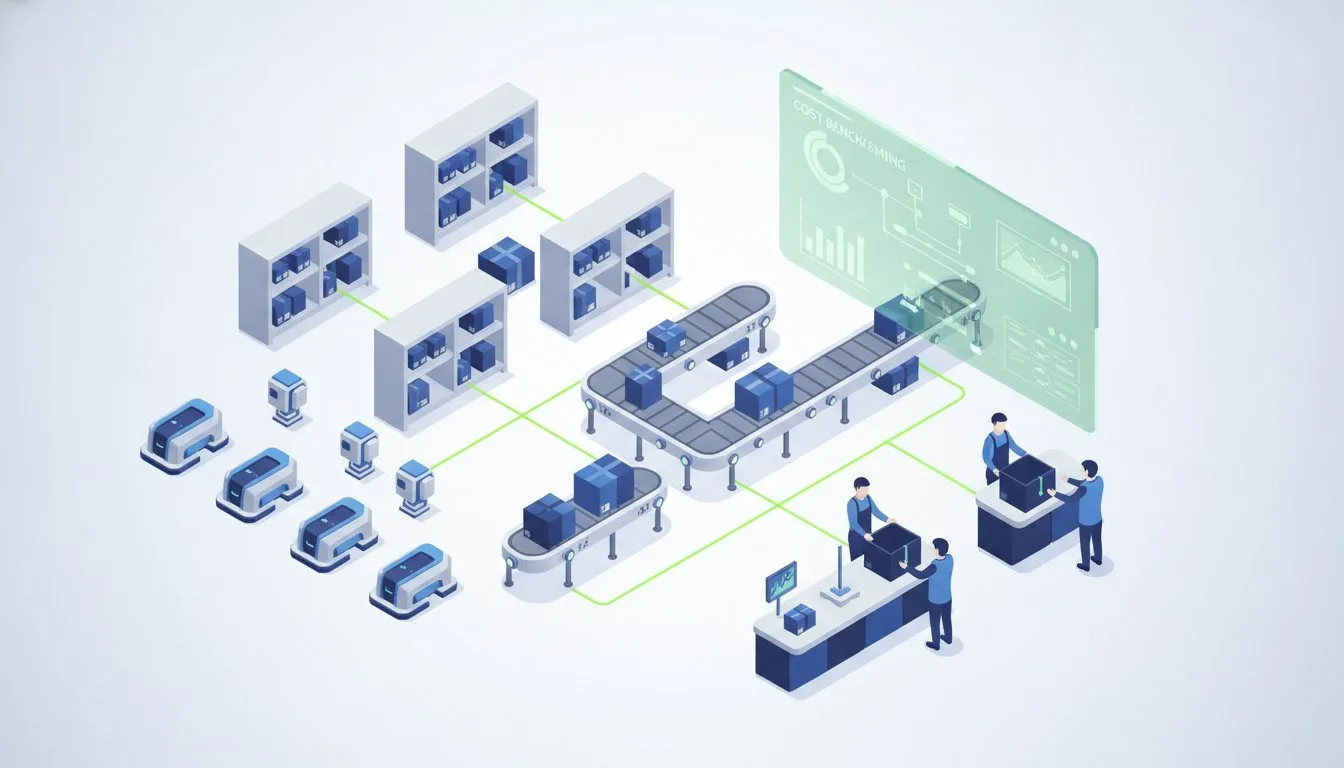
Average Pick and Pack Fees 2026: A Strategic Guide to Fulfillment Cost Benchmarking
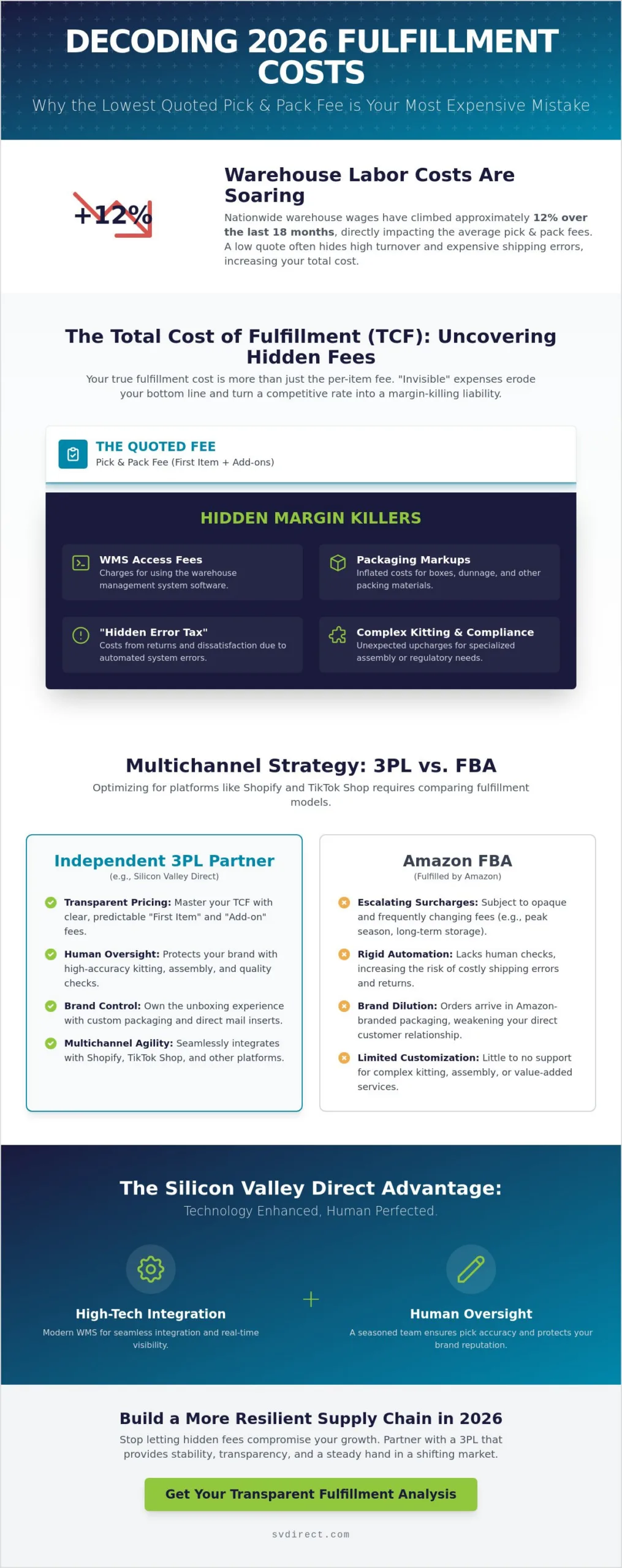
In 2026, the lowest quoted pick and pack fee on your spreadsheet is often the most expensive mistake your eCommerce brand will make. It’s a frustrating reality many high-growth founders face as they scale across platforms like Shopify and TikTok Shop. You probably feel the weight of rising warehouse labor costs, which have climbed 12% over the last 18 months, making it vital to understand the average pick and pack fees 2026 standards before signing your next contract. It’s exhausting to manage opaque pricing models where hidden surcharges turn a competitive rate into a margin-killing expense.
We’re here to help you regain control with a steady hand and clear data. This guide empowers you to master the fulfillment landscape through precise benchmarks and a strategic framework for calculating your total cost of fulfillment. You’ll discover how to identify the complexity tax of multichannel orders and why a partner who prioritizes human oversight over total automation is the ultimate safeguard for your brand’s reputation and financial health. By the end of this article, you’ll have the tools to protect your profitability and build a more resilient supply chain.
Key Takeaways
- Benchmark your logistics spend against the average pick and pack fees 2026 standards to protect your eCommerce margins from rising operational costs.
- Master the Total Cost of Fulfillment (TCF) framework to identify “invisible” expenses, such as WMS access fees and packaging markups, that erode your bottom line.
- Compare escalating Amazon FBA surcharges against independent 3PL models to optimize your multichannel strategy across Shopify and TikTok Shop.
- Discover how human oversight in kitting and assembly services eliminates operational friction and protects your brand’s physical unboxing experience.
- Integrate direct mail marketing with your order fulfillment to drive physical engagement and build long-term customer loyalty.
The 2026 Fulfillment Landscape: Why Pick and Pack Fees Are Shifting
The logistics sector is undergoing a fundamental recalibration. Energy price volatility and a tightening labor market have pushed operational overhead to new heights. For brands attempting to benchmark their expenses, the average pick and pack fees 2026 data shows a clear departure from the low-cost models of the previous decade. This shift isn’t just about rising numbers; it’s about a structural change in how value is delivered within the order fulfillment process. We are seeing a market where transparency and reliability are becoming the primary currencies of successful partnerships.
Multichannel complexity adds significant pressure to the warehouse floor. Managing simultaneous surges from TikTok Shop and Shopify requires more than just shelf space. It demands a level of agility that automated systems often struggle to maintain without human intervention. As order volume scales across diverse digital storefronts, the labor requirements for accurate sorting and kitting become more specialized. This has led many high-growth brands to move away from automated-only fulfillment toward models that prioritize human-centric precision to protect their customer experience.
To better understand the current shifts in fulfillment pricing, watch this helpful video analysis:
Labor Trends and the 2026 Warehouse Economy
Nationwide warehouse wages have climbed approximately 12% over the last 18 months, directly impacting the average pick and pack fees 2026 landscape. While some providers try to mask these costs with lower entry fees, cheap labor often results in expensive shipping errors and high turnover. We believe that stability is a competitive advantage. Long-term staff retention ensures that pick accuracy remains high, which ultimately lowers the total cost of fulfillment for our partners. When a team knows the inventory and the brand’s specific standards, they work with a level of care that machines simply cannot replicate.
Technology vs. Human Oversight in Fulfillment
Modern Warehouse Management Systems (WMS) are no longer a luxury; they are a standard expectation for any serious brand. However, technology alone creates a “Hidden Error Tax.” When automated systems lack human checks, the cost of returns and customer dissatisfaction skyrockets. Silicon Valley Direct bridges this gap by combining high-tech digital integration with the personal commitment of a seasoned team. This balance ensures that innovation serves the client rather than complicating the operation. We view digital tools as a way to enhance our human expertise, not replace the watchful eye that ensures every package is perfect.
Our location in the heart of the world’s most innovative ecosystem allows us to see these trends before they hit the national market. Silicon Valley’s focus on efficiency and scalability sets the pace for 3PL pricing standards across the country. By staying at the cutting edge of logistics technology while maintaining a dedicated workforce, we provide a steady hand for brands navigating these shifting costs.
Benchmarking Average Pick and Pack Fees in 2026: A Comparative Analysis
Understanding the numbers is the first step toward reclaiming your margins. While our previous analysis highlighted why costs are shifting across the industry, this section focuses on the specific benchmarks brands encounter when auditing their logistics spend. In 2026, the average pick and pack fees 2026 data indicates that a tiered pricing structure remains the most effective way to balance warehouse labor with client value. This model ensures you pay for the actual work performed rather than a flat average that might overcharge for simpler orders.
The ‘First Item’ vs. ‘Add-on’ Pricing Model
Most 3PL providers utilize a “First Item” fee because the initial pick carries the bulk of the operational weight. This covers the time a team member spends traveling to a location and the initial system scan. Current industry benchmarks suggest you’ll see rates between $2.50 and $5.00 for that first item. Additional items typically cost significantly less, often ranging from $0.50 to $1.00 each. These figures are tied directly to the BLS Unit Labor Costs for Warehousing, which tracks the investment required for every unit of warehouse output. By optimizing your product bundles or kits, you can effectively lower your per-unit fulfillment cost and protect your bottom line.
Independent 3PL vs. FBA: The 2026 Reality
The choice between Amazon FBA and an independent 3PL has never been more consequential. Amazon’s 2026 storage hikes are significant, with peak season storage fees reaching $2.40 per cubic foot for standard items. When you factor in “low-inventory” surcharges and algorithmic penalties, the convenience of FBA often comes with a steep price tag that erodes gross margins. We’re seeing a steady migration of high-growth brands toward independent 3PL models. These brands aren’t just looking for lower fees; they’re seeking the brand control and personalized oversight that a human-centric partner provides. Our ongoing analysis of logistics trends on our fulfillment blog suggests that brands prioritizing this flexibility are better equipped to handle the volatility of multichannel commerce.
Your SKU volume and order frequency will always play a role in your final negotiated rate. High-volume brands with consistent order profiles often move toward flat-fee models in 2026 to ensure total cost predictability. This transparency eliminates the guesswork from your monthly financial planning. If you’re ready to move beyond generic benchmarks and see how these figures apply to your specific SKU profile, you can request a personalized quote to start a more detailed conversation. We believe in providing a steady hand and clear data so you can grow your business with confidence.
The Complexity Tax: How Specialized Kitting and Compliance Affect Per-Order Rates
Standard benchmarks provide a necessary baseline for financial planning, but they rarely account for the operational nuances of specialized industries. While the average pick and pack fees 2026 data suggests a range for simple eCommerce orders, brands in the healthcare, medical device, and high-tech sectors face a different reality. These industries operate under a “complexity tax” where the stakes of a fulfillment error extend far beyond a negative review. In these environments, precision is the primary driver of value, and the fulfillment logic must adapt to accommodate rigorous quality control and technical assembly.
This complexity is particularly evident when integrating on-demand digital printing into the fulfillment workflow. By printing collateral only when an order is placed, brands significantly reduce inventory carrying costs and eliminate the risk of dead stock. However, this shifts the labor logic from a simple “pick” to a more involved “prepare and pack” process. The warehouse team isn’t just grabbing a pre-printed item; they’re ensuring the right digital asset is produced and married to the physical shipment with total accuracy.
Kitting and Custom Assembly Fees
For brands utilizing kitting and assembly services, per-order fees reflect the manual labor required to create a bespoke unboxing experience. Whether it’s assembling a subscription box or bundling promotional kits for a product launch, these tasks require human dexterity that automated systems cannot match. Just-in-time assembly allows you to keep your components as individual SKUs, optimizing warehouse space and providing the flexibility to pivot your marketing strategy without re-labeling thousands of pre-packed units. Many of our partners also find success by integrating literature fulfillment services directly into their physical shipments, ensuring that every customer receives the most current assembly guides or promotional inserts.
Regulatory and Compliance Surcharges
Security and compliance represent another layer of the complexity tax. Handling sensitive medical materials or high-value electronics requires specialized facility protocols and staff training that go beyond standard 3PL capabilities. For example, healthcare mailing services and fulfillment must adhere to strict HIPAA guidelines to protect patient confidentiality. This isn’t just about a secure server; it’s about a physical infrastructure designed to prevent unauthorized access and a team that understands the legal weight of their work. While these requirements may push rates above the average pick and pack fees 2026 baseline, the long-term ROI is found in the total elimination of regulatory risk and the preservation of your brand’s integrity. Choosing a partner with a multi-decade history of compliance provides a steady hand in an increasingly regulated market.
Calculating Your Total Cost of Fulfillment (TCF): Identifying Hidden Margin Killers
Focusing solely on the average pick and pack fees 2026 data provides only a partial view of your brand’s financial health. True profitability requires a comprehensive understanding of the Total Cost of Fulfillment (TCF). This metric represents the sum of every operational touchpoint, from the moment inventory arrives at our facility until the final package reaches the customer’s doorstep. Beyond standard labor fees, TCF includes storage, outbound shipping, and the administrative overhead required to maintain a seamless operation. Many brands overlook “invisible” costs such as account management fees or dunnage markups, which can silently erode margins if left unchecked.
Expanding into international markets introduces additional layers of complexity that must be carefully modeled. Our global shipping services provide the infrastructure to manage these variables, but they must be factored into your landed cost per order. Administrative coordination for B2B and B2C logistics often carries a hidden time cost that manual systems fail to capture. Additionally, unoptimized returns management can effectively double your fulfillment spend. Reverse logistics requires the same, if not more, human oversight as the initial pick to ensure inventory is correctly processed, inspected, and restocked without friction.
Storage and Warehousing Fee Benchmarks
Selecting the right storage medium is a balance of accessibility and expense. For high-volume SKUs, pallet storage offers the lowest per-unit cost, while shelf storage is essential for picking efficiency in smaller, diverse inventories. We’ve observed a significant 2026 trend toward “secure warehousing” for brands handling high-value electronics or sensitive materials. This specialized environment impacts insurance premiums and facility protocols but offers essential protection for your most valuable assets. For a deeper look at these specific requirements, refer to our guide on secure warehousing for high-value electronics.
Shipping Management and Carrier Rates
The administrative burden of logistics coordination is a major component of your TCF. A seasoned 3PL leverages its collective volume to secure discounted carrier rates with UPS, FedEx, and DHL that individual brands simply cannot access on their own. It’s also vital to acknowledge that “free shipping” for the consumer is never free for the brand. Factoring actual postage and carrier surcharges into your TCF calculation is the only way to maintain a realistic view of your profitability. If you suspect hidden fees are draining your revenue, you can request a free quote to receive a transparent breakdown of your potential fulfillment costs and identify where your margins are most at risk.
Optimizing Your 2026 Logistics Strategy with Silicon Valley Direct
Navigating the volatility of the current market requires more than just a software integration. It demands a partnership built on operational stability and a refusal to settle for the status quo. While the average pick and pack fees 2026 benchmarks provide a necessary starting point for your budget, the true value of a logistics partner is found in their ability to eliminate friction before it reaches your customer. Silicon Valley Direct offers a steady hand, backed by over 25 years of experience in high-stakes fulfillment. We understand that behind every SKU is a brand promise, and our mission is to ensure that promise is kept through every shipment, kit, and delivery.
One of the most effective ways to differentiate your brand in a digital-first world is by merging the digital and physical customer journeys. By integrating direct mail marketing services with your eCommerce fulfillment, you create multiple touchpoints that drive physical engagement. This holistic approach allows you to include personalized promotional materials or high-quality literature directly in your outgoing orders, turning a standard delivery into a powerful marketing event. This synergy is particularly effective for high-growth startups and established enterprises that need to maintain a premium brand image while scaling rapidly.
A Partnership Beyond the Transaction
We explicitly reject the industry trend of replacing dedicated account managers with automated chatbots. In a crisis, a direct human connection out-performs an algorithm every time. Our commitment to personal oversight is matched by our investment in our team. We believe that our long-term staff retention is the primary reason we maintain a 99.9% pick accuracy rate. When the same experienced professionals handle your inventory year after year, they develop an intuitive understanding of your brand’s standards. Our location in the heart of Silicon Valley acts as a hub for global connectivity, allowing us to leverage local innovation to solve complex logistics challenges for our partners worldwide.
Next Steps: Auditing Your Current 3PL
As you move through the remainder of the year, it’s vital to conduct a thorough audit of your current fulfillment expenses. Use the average pick and pack fees 2026 data we’ve discussed to evaluate whether you are receiving fair value or if hidden surcharges are quietly eroding your profitability. Reach out to your current provider and ask specific questions about their 2026 labor cost adjustments and how they handle multichannel complexity across platforms like TikTok Shop. Transparency should be a requirement, not a request.
If you find that your current provider lacks the transparency or the human oversight your brand deserves, it may be time for a strategic shift. We invite you to contact Silicon Valley Direct for a personalized fulfillment consultation. We will provide a clear, transparent quote that accounts for your specific kitting, printing, and distribution needs. Let us show you how a partnership grounded in precision and personal commitment can protect your margins and accelerate your growth in 2026 and beyond.
Future-Proofing Your eCommerce Growth in a Shifting Market
Mastering your supply chain in 2026 requires looking beyond the sticker price of a single pick. While understanding the average pick and pack fees 2026 provides a baseline for your budget, true profitability comes from identifying hidden margin killers and leveraging specialized kitting to enhance the customer experience. We’ve explored how a strategic focus on Total Cost of Fulfillment (TCF) and regulatory compliance can transform your logistics from a cost center into a powerful competitive advantage.
Silicon Valley Direct has provided this steady hand since 1999. We offer specialized HIPAA-compliant fulfillment and integrated on-demand digital printing to ensure your brand remains agile in a fast-paced economy. Most importantly, we provide direct human oversight on every account, rejecting automated interactions to give your business the personal attention it deserves. It’s time to move toward a more transparent and reliable operational future. Streamline your 2026 fulfillment with Silicon Valley Direct and reclaim your margins today. We’re ready to help you scale with confidence and precision.
Frequently Asked Questions
What is the average pick and pack fee for a single-item order in 2026?
Industry data for 2026 indicates that a standard single-item order typically costs between $3.15 and $3.85. This range accounts for standard eCommerce volume and assumes a non-fragile item. For lighter goods or higher-volume operations, the average pick and pack fees 2026 benchmark can drop as low as $2.50, while heavier or more complex items may reach $5.50.
How much should I expect to pay for additional items in a multi-unit order?
Additional items in a single order are generally priced at 40% to 60% less than the first-item fee. Most 3PL providers charge between $0.50 and $1.00 for each add-on unit. This tiered structure reflects the reduced labor required because the picker is already at the location and the packing station is already prepared for that specific shipment.
Are there extra fees for kitting or custom packaging in 2026?
Yes, specialized kitting and assembly services incur additional costs based on the labor hours required for the specific project. These fees cover tasks like bundling multiple SKUs, applying custom labels, or building subscription boxes. While standard pick fees are predictable, kitting projects are usually quoted as a bespoke service to ensure every detail of your brand’s unboxing experience is handled with precision.
What is a standard monthly account management fee for a 3PL?
Monthly account management fees typically range from $250 to over $1,000 depending on the complexity of your technical integration and support needs. These fees cover the cost of dedicated account oversight, WMS access, and regular reporting. High-performance partners prioritize direct human connection over automated ticketing systems, ensuring you have a steady hand to manage your logistics strategy as you grow.
How do 2026 warehousing fees compare to previous years?
Warehousing costs have seen a steady increase due to a 12% climb in labor costs over the last 18 months. Pallet storage rates in 2026 generally hover between $15 and $25 per month. In contrast, Amazon FBA storage fees have become significantly more expensive during peak seasons. They reach up to $2.40 per cubic foot for standard items, making independent 3PL storage a more stable alternative for many brands.
Can specialized industries like healthcare expect higher pick and pack fees?
Industries requiring HIPAA compliance or specialized medical handling often face higher per-order rates. This complexity reflects the need for rigorous staff training, secure facility protocols, and meticulous quality control measures. While these fees exceed the average pick and pack fees 2026 baseline for standard retail, the investment protects your brand from significant regulatory risks and ensures the safety of sensitive materials.
What are the common hidden costs in a 3PL fulfillment quote?
Hidden costs often include surcharges for SKU complexity, dunnage markups, and returns management fees. Many brands also encounter unexpected “low-inventory” penalties or peak season surcharges when using algorithmic fulfillment models. A transparent partner will provide a clear breakdown of the Total Cost of Fulfillment (TCF). This prevents invisible expenses from eroding your margins and allows for more accurate financial planning.
How does location, like Silicon Valley, affect pick and pack pricing?
Geographic hubs like Silicon Valley influence pricing by acting as centers for global connectivity and high-tech innovation. While local labor markets are competitive, these locations offer superior access to logistics infrastructure and seasoned talent. Choosing a partner in an innovation hub ensures your brand benefits from advanced technical integrations and a proactive approach to supply chain efficiency that stabilizes long-term costs.