img not found!

3PL vs 4PL: Choosing the Right Logistics Model for Your Business in 2026

What if the biggest risk to your supply chain in 2026 isn’t choosing the wrong provider, but choosing the wrong category of partnership? As the U.S. 4PL market reaches a projected $16.81 billion this year, many leaders feel pressured to choose between the hands-on execution of a 3PL and the strategic oversight of a 4PL. The debate over 3pl vs 4pl often leaves businesses caught between the fear of losing inventory visibility and the worry of absorbing high management fees. You need a solution that offers the stability of physical infrastructure without sacrificing the high-tech transparency required for modern global trade.

We understand that logistics is more than just moving boxes; it’s about the personal commitment to your brand’s growth. You likely want a partner that acts as a seamless extension of your team rather than a distant vendor. This article provides a clear decision-making framework to help you understand the ROI of each model and determine which path will best scale your operations. We’ll explore how the right integration can offer the strategic control you crave while maintaining the operational precision your customers expect.

Key Takeaways

  • Differentiate between physical execution and strategic integration to resolve the 3pl vs 4pl dilemma for your unique supply chain needs.
  • Evaluate your business volume and growth trajectory to select a logistics model that scales efficiently without inflating management costs.
  • Determine when specialized requirements, like integrated digital printing or healthcare mailing, benefit from the direct control of an asset-based partner.
  • Discover how proprietary technology provides the 24/7 transparency and reporting depth needed to maintain total oversight of your inventory.
  • Learn to identify a partner that prioritizes human connection and operational stability to act as a true extension of your internal team.

3PL vs 4PL: Understanding the Core Differences in Logistics Models

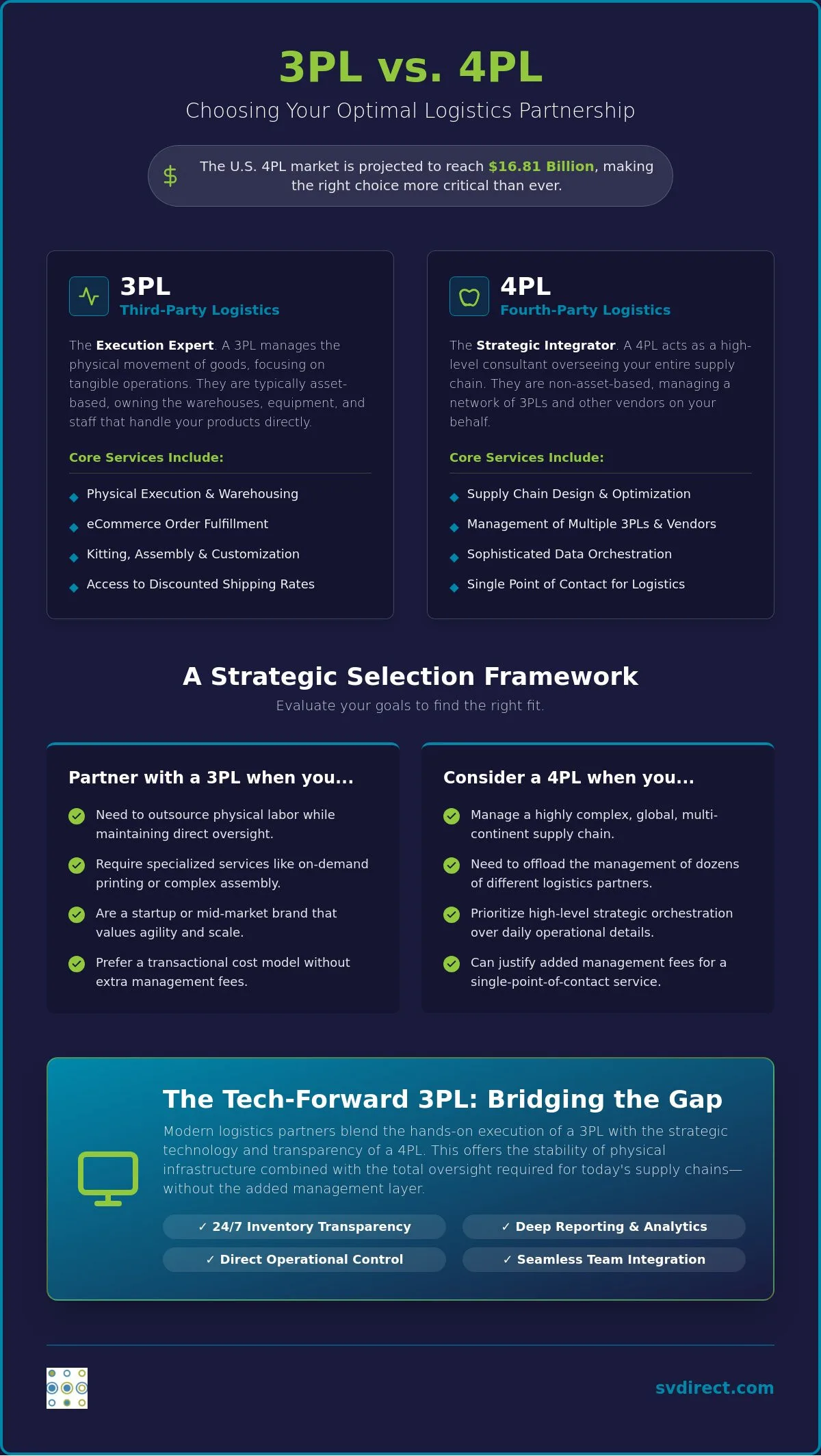
Deciding between a 3PL and a 4PL is a foundational choice for your business’s operational future. A Third-party logistics (3PL) provider manages the physical movement of goods from warehouse to customer. This model focuses on the tangible side of the business, such as physical execution, warehousing, and shipping. In contrast, a 4PL acts as a strategic integrator that oversees the entire supply chain, often managing multiple 3PLs on your behalf. The primary differentiator lies in asset ownership; 3PLs typically own or manage the warehouse facilities and equipment, while 4PLs are often non-asset-based consultants who focus on high-level orchestration.

What is a 3PL (Third-Party Logistics)?

A 3PL specializes in the heavy lifting of your daily operations. They provide secure warehousing and eCommerce order fulfillment, ensuring your inventory is received and stored with precision. By leveraging their physical infrastructure, you gain immediate operational efficiency and access to discounted shipping rates that are difficult to secure independently. Beyond basic storage, these partners offer specialized value through kitting and assembly, allowing you to customize products close to the point of distribution. This model is built for brands that value a direct, hands-on relationship with the people actually touching their product.

What is a 4PL (Fourth-Party Logistics)?

While a 3PL executes, a 4PL designs. This model provides a single point of contact for complex, global, multi-node supply chains. Their core services include supply chain design, vendor management, and sophisticated data orchestration. A 4PL doesn’t usually own the trucks or the racks. Instead, they use their expertise to manage the network of providers you’ve hired. This strategic layer is designed to alleviate the burden of managing multiple logistics partners, though it often comes with higher management fees and a step back from the daily operational details. Understanding the nuances of 3pl vs 4pl ensures you select a partner that aligns with your internal team’s capabilities.

Choosing Between 3PL and 4PL: A Strategic Selection Framework

Selecting the ideal partner in the 3pl vs 4pl debate requires a clear-eyed look at your internal resources and operational goals. For many growth-oriented brands, the choice hinges on the level of direct involvement they wish to maintain. Startups and mid-market companies often find that 3PLs provide the perfect balance of scale and agility. These providers allow you to outsource the physical labor while you keep a steady hand on the pulse of your business through direct communication with the facility floor.

Specialized requirements often dictate the model. If your workflow includes on-demand digital printing or complex healthcare mailing services, a specialized 3PL is typically more responsive. They possess the specific equipment and trained staff in-house. A 4PL would merely act as a middleman between you and another vendor. This direct connection reduces the risk of communication gaps and ensures higher quality control over sensitive projects.

Cost structures also diverge significantly. A 3PL focuses on transactional pricing; you pay for the storage you use and the orders you ship. Conversely, a 4PL introduces a layer of management fees that can significantly impact your bottom line. You must decide if the strategic orchestration they offer justifies the added expense or if a high-performing 3PL can meet those needs more efficiently. If you’re ready to see how a high-touch partnership can protect your bottom line, consult with our team today.

When to Partner with a 3PL

Partner with a 3PL when you need to outsource physical labor while maintaining direct oversight of your inventory management. This is the right path for brands requiring custom kitting, subscription box assembly, or precision-driven mailing. It allows your team to focus on marketing and product development while experts handle the daily fulfillment logistics with a personal touch.

When to Consider a 4PL

Consider a 4PL when your organization manages a global, multi-continent supply chain with dozens of different logistics vendors. This model suits businesses willing to trade higher management overhead for a completely hands-off strategy. It’s a choice for enterprise-level entities where a single integrator handles the complexities of vendor selection and high-level network design across vast geographies.

To further mitigate risks in these complex international networks, many brands integrate pre shipment inspection services Asia to ensure manufacturing standards are met before products are handed off to their logistics providers.
3PL vs 4PL: Choosing the Right Logistics Model for Your Business in 2026

The Tech-Forward 3PL: Bridging the Gap Between Execution and Oversight

Proprietary systems like Remote Control™ are the engine behind this evolution. These platforms provide 24/7 access to your orders and inventory, backed by over 120 standard reports. This level of detail ensures your logistics partner acts as a true extension of your team. Our “Quiet Facility” methodology reinforces this precision. Instead of the chaotic energy found in traditional warehouses, our deliberate organization creates a stable environment where errors are caught before they ever reach your customer. This proactive stance protects your brand’s reputation and your bottom line.

Real-Time Visibility Without the 4PL Overhead

Web-based interfaces and XML/SOAP integrations have made remote order management a standard expectation. You no longer need an expensive middleman to tell you what is happening on the warehouse floor. Automated notifications for low inventory, receipts, and backorders provide the immediate feedback required for agile decision-making. This direct access to data removes the communication lag often found in 4PL models, giving you total control without the added management fees.

Custom-Fit Solutions vs. Cookie-Cutter Logistics

Flexibility is the most important asset in a 2026 logistics partnership. A tech-forward partner combines physical infrastructure with marketing-savvy services to solve bespoke challenges. For instance, integrating variable data printing with direct mail marketing allows you to personalize customer engagement while your inventory is being packed. This holistic approach ensures that your logistics strategy supports your broader business goals rather than just checking a box for fulfillment.

Future-Proof Your Logistics with a Scalable Partnership

Choosing the right model in the 3pl vs 4pl landscape requires balancing your need for operational control with your desire for strategic growth. You’ve learned that while 4PLs offer high-level orchestration, a tech-forward 3PL provides the same digital transparency without sacrificing direct contact with the team handling your inventory. This approach ensures you maintain visibility over every SKU while avoiding the heavy management fees that often accompany non-asset-based models. By focusing on a partner that acts as an extension of your team, you protect your bottom line and your customer experience.

With over 25 years of fulfillment excellence, we focus on providing the stability and precision your brand deserves. Our proprietary Remote Control™ system delivers real-time reporting, giving you the data you need to make informed decisions 24/7. From specialized kitting to integrated digital printing, we build solutions that adapt to your specific requirements. It’s time to move past confusing jargon and partner with a team that values your success as much as you do.

Streamline your supply chain with Silicon Valley Direct’s 3PL solutions. We look forward to helping your business reach its next milestone with confidence and ease.

Frequently Asked Questions

Is a 3PL or 4PL better for a growing eCommerce business?

A 3PL is usually the superior choice for growing eCommerce brands because it provides direct execution and asset-based reliability. This model allows you to scale physical operations like pick and pack and warehousing without the heavy management overhead of a 4PL. By working directly with the facility, you maintain better control over quality and kitting accuracy as your volume increases. The 3pl vs 4pl decision for growth often comes down to wanting a partner that actually touches your product.

Do 4PLs own their own warehouses and trucks?

No, 4PLs are typically non-asset-based providers that act as strategic consultants and integrators. They don’t own the physical infrastructure like warehouses or vehicle fleets. Instead, they manage the relationships and contracts with multiple 3PLs and carriers on your behalf. This makes them a strategic layer rather than an operational one, which is a fundamental distinction when evaluating your logistics needs.

What are the hidden costs of hiring a 4PL provider?

The most common hidden costs involve management fees and pass-through charges that can inflate your total logistics spend. Because a 4PL adds a layer between you and the physical service provider, you often pay for their strategic oversight on top of the actual shipping and storage costs. This can lead to a higher total cost of ownership compared to a direct partnership where you only pay for the services you consume.

Can a 3PL handle international shipping and global logistics?

Yes, many established 3PLs specialize in global shipping and logistics, managing everything from customs documentation to international carrier selection. A 3PL with a strong geographic hub, such as Silicon Valley, can leverage its proximity to major ports and airports to offer efficient global reach. This provides the international scale you need while keeping your operational team close to the product for better quality control.

How does technology like Remote Control™ change the 3PL vs 4PL debate?

Advanced technology like the Remote Control™ system bridges the gap by offering the 24/7 visibility once only found with 4PLs. When a 3PL provides 120+ real-time reports and XML integrations, you get strategic oversight and physical execution in one place. This proprietary digital transparency eliminates the need for an expensive 4PL manager to act as a data middleman, giving you direct access to your inventory status.

What is a Lead Logistics Provider (LLP) in relation to 4PL?

A Lead Logistics Provider (LLP) is another term for a 4PL that takes primary responsibility for managing your entire supply chain network. The LLP coordinates all other logistics vendors and focuses on high-level optimization and network design. While they provide a single point of contact, they often prioritize network-wide strategy over the specific, hands-on details of individual order fulfillment and specialized kitting projects.
Logistics Companies in Silicon Valley: The 2026 Strategic Guide to 3PL Success

Logistics Companies in Silicon Valley: The 2026 Strategic Guide to 3PL Success

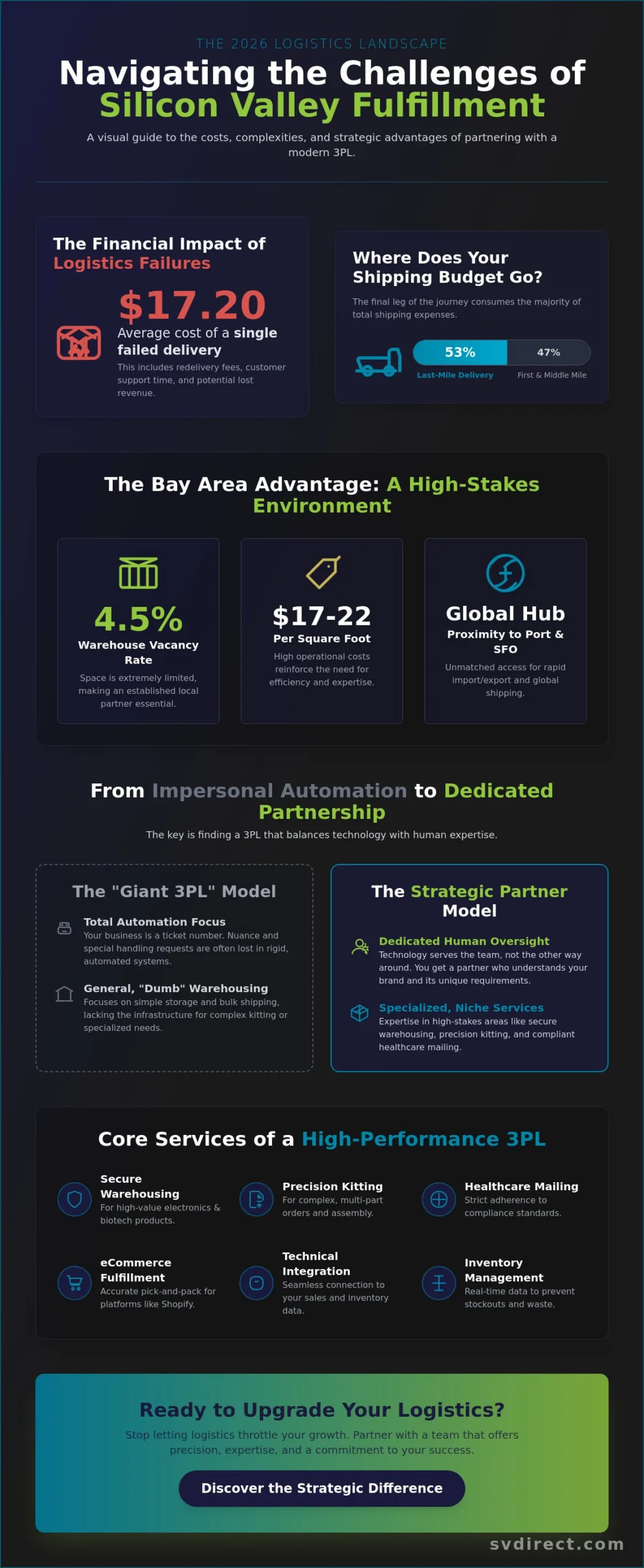
Did you know that a single failed delivery costs a retailer an average of $17.20 in 2026? In an environment where the last mile accounts for 53% of total shipping costs, the margin for error has never been thinner. Choosing between the many logistics companies in silicon valley often feels like a trade-off between cold, automated efficiency and the personal touch your brand actually needs. You’ve likely felt the sting of impersonal support from giant 3PLs that treat your scaling business like a ticket number rather than a partner.

We believe that high-growth brands deserve a steady hand to manage complex kitting and specialized healthcare mailing services with absolute precision. This guide shows you how to find a partner that balances innovative tech with direct human oversight. We’ll explore the current 4.5% warehouse vacancy rates in the Bay Area, the impact of rising CARB compliance fees, and the way a strategic location can slash your shipping times. You’re about to learn how to move beyond basic warehousing and into a logistics strategy that prioritizes accuracy and personal commitment.

Key Takeaways

  • Understand the hybrid nature of Bay Area logistics and why this region remains the global center for high-tech fulfillment and biotech distribution.
  • Identify the core services offered by logistics companies in silicon valley, including secure warehousing and precision kitting for complex orders.
  • Calculate the hidden costs of in-house operations to recognize when your current model is actually throttling your brand’s growth.
  • Audit potential partners based on their technical integration with platforms like Shopify and their ability to maintain strict healthcare compliance standards.
  • Discover the strategic advantage of choosing a partner that rejects total automation in favor of dedicated human oversight and seasoned local expertise.

The Evolving Landscape of Logistics Companies in Silicon Valley for 2026

Silicon Valley logistics has undergone a radical transformation. In 2026, the industry is no longer defined by dusty warehouses and manual clipboards. Instead, it’s a sophisticated hybrid of physical infrastructure and digital precision. The most successful logistics companies in silicon valley now operate at the intersection of high-speed data and tangible goods. They act as the physical backbone for a region that moves faster than anywhere else on earth. While software drives the economy, these partners ensure that biotech samples, high-tech components, and eCommerce orders actually reach their destinations with 100% accuracy.

Modern businesses have moved away from the “dumb warehousing” models of previous decades. They now require a Third-party logistics (3PL) partner that offers deep technical integration and human-centric oversight. This shift toward boutique, specialized providers is a direct response to the impersonal automation offered by global giants. Companies are looking for a steady hand that understands the high-stakes nature of healthcare mailing services and complex kitting. They want a partner that feels like an extension of their own team, not just a line item on a spreadsheet.

To better understand the historical context of this innovative region, watch this helpful video:

Why Location Matters: The Strategic Advantage of the Bay Area

Operating within Northern California provides an undeniable competitive edge. Proximity to the Port of Oakland and San Francisco International Airport allows for rapid global shipping that distant hubs simply can’t match. However, the market is tight. As of early 2026, the industrial warehouse vacancy rate in the Bay Area is just 4.5%, with average asking rents between $17 and $22 per square foot. Despite these costs, the “Silicon Valley Speed” expectation makes a local presence vital. Being close to the world’s most innovative supply chain talent means your logistics provider can implement new tech as soon as it’s viable. You can find more insights on regional trends at the Silicon Valley Direct blog.

The Rise of Specialized 3PL Providers in Northern California

The demand for general storage is shrinking while the need for specialized fulfillment is exploding. Logistics companies in silicon valley are pivoting to offer niche services that support the region’s dominant industries. This includes climate-controlled warehousing for biotech and high-security kitting and assembly for tech hardware. Integrated services like on-demand digital printing and literature fulfillment are now standard requirements. These providers aren’t just storing boxes. They’re managing complex inventory lifecycles and ensuring that every healthcare mailing or direct mail marketing campaign meets rigorous compliance standards. It’s a proactive stance that prioritizes operational readiness over mere storage capacity.

Key Services to Look for in a Silicon Valley 3PL Partner

Not all logistics companies in silicon valley are created equal. In a market where 77% of providers now offer AI solutions, the real differentiator is how that technology serves the physical operation. Effective eCommerce order fulfillment requires more than just a software integration; it demands a precise pick and pack process that ensures accuracy across every shipment. Secure warehousing services are another vital pillar, particularly for brands dealing in high-value electronics or sensitive biotech products that require climate-controlled environments and specialized inventory protection.

Inventory management has moved beyond simple counting. Today, it relies on real-time data to anticipate demand shifts and prevent the “scalability trap” of stockouts or obsolescence. By analyzing evolving trends in logistics and technology, partners can help you optimize stock levels before peak seasons hit. This proactive stance is essential for maintaining the high-performance standards expected in Northern California. It’s about moving from a reactive storage model to a strategic partnership that anticipates your next move.

Integrated Literature and Marketing Fulfillment

Modern brands often struggle to sync their physical products with their marketing efforts. Combining on-demand digital printing with fulfillment services eliminates the need to store outdated brochures or manuals. When your marketing collateral lives in the same facility as your inventory, you can execute seamless brand delivery without the overhead of multiple vendors. This is where kitting and assembly services become a strategic asset. You can build custom kits that arrive exactly as intended, reducing both waste and logistical friction.

Global Shipping and Returns Management

Shipping costs are rising, with the last mile alone accounting for 53% of total expenses in 2026. Navigating international customs and securing discounted carrier rates requires a partner with deep operational history and global reach. Beyond outgoing goods, a robust returns management process is vital for customer retention. A failed delivery or a clunky return can cost retailers an average of $17.20 per order. For a deeper look at navigating these complexities, explore our guide on global shipping services.

If your current provider is treating your high-growth business like just another number, it might be time for a more personal approach. You can reach out to our team to discuss a bespoke logistics strategy tailored to your specific needs.

Logistics Companies in Silicon Valley: The 2026 Strategic Guide to 3PL Success

3PL vs. In-House: When to Transition Your Logistics

Growth is a double-edged sword. At first, packing orders in-house feels like a way to maintain absolute control over the customer experience. However, as volume increases, that control often turns into a bottleneck. Managing your own warehouse involves significant hidden costs that go far beyond a simple lease. You’re responsible for labor management, facility insurance, and the constant overhead of a physical space that might be half-empty during slow seasons. In the high-cost environment of Northern California, these fixed expenses can quickly erode your margins.

Transitioning to professional logistics companies in silicon valley allows you to reclaim your most valuable asset: time. Instead of troubleshooting shipping delays or managing warehouse staff, you can focus on core product development and marketing strategy. Recent MIT Center for Transportation & Logistics research indicates that companies leveraging specialized 3PL partners often see improved agility in their supply chains, especially when navigating the complexities of modern tech-driven markets. It’s about moving from a reactive stance to a proactive partnership that supports your long-term vision.

The Cost Efficiency of Professional 3PL Warehousing

A professional 3PL model replaces the unpredictability of fixed overhead with transparent, per-order pick and pack fees. This shift ensures you’re only paying for the services you actually use. Beyond labor savings, you gain access to a 3PL’s significant shipping volume, which translates to better postage and carrier rates than an individual brand could secure alone. Accuracy is also a major cost saver. By implementing rigorous FIFO inventory management, a seasoned partner prevents the silent profit loss caused by product obsolescence and inventory spoilage.

Operational Agility: Scaling Without the Growing Pains

Scaling should feel like an opportunity, not a crisis. When you partner with experienced logistics companies in silicon valley, you can handle seasonal spikes like the Q4 rush without the stress of hiring temporary staff or renting extra space. This operational readiness extends to global expansion. You can reach international markets through established shipping networks without the need to open overseas facilities. Whether you need month-to-month storage flexibility or on-demand support for complex kitting projects, a professional partner provides the physical infrastructure to back your digital growth. It’s a steady, reliable hand that remains accessible as your business evolves.

How to Evaluate Logistics Companies in Silicon Valley

Selecting between the various logistics companies in silicon valley requires a methodical approach that goes beyond comparing warehouse square footage. A facility’s size matters far less than its operational precision and technical agility. Your evaluation should begin with a deep audit of their integration capabilities. Ensure their systems communicate seamlessly with your storefront, whether you use Shopify, WooCommerce, or a custom API. A failure in digital connectivity leads to manual data entry errors and delayed shipping updates that frustrate your end users.

Test their communication style early in the vetting process. Many giant 3PLs hide behind chatbots and automated ticketing systems. This lack of transparency becomes a liability when a complex product launch or high-stakes shipment requires immediate human intervention. Ask for a dedicated account manager who understands your business nuances. Additionally, review their track record with kitting and assembly. If a provider can’t demonstrate success with intricate, multi-component projects, they likely lack the seasoned oversight necessary to handle your scaling requirements.

Compliance and Security: The Healthcare Gold Standard

In high-compliance sectors, generic logistics solutions are insufficient. HIPAA compliance is non-negotiable for medical device fulfillment and pharmaceutical distribution. You need a partner that understands the legal and ethical weight of protecting sensitive patient data during every stage of the process. Our healthcare mailing services guide provides a detailed breakdown of the precision required for these specialized mailings. Beyond digital security, verify their physical infrastructure. Look for secure warehousing services that utilize advanced access controls and 24/7 monitoring to protect high-value inventory from loss or damage.

The Tech Stack: Real-Time Inventory and Order Transparency

Operational transparency is the bedrock of a successful 3PL partnership. Demand 24/7 access to your inventory levels and order statuses through a centralized, web-based portal. This data accuracy prevents shipping errors and keeps your customer service team informed. A robust tech stack should handle batch delivery to carriers and provide automated tracking updates without requiring manual oversight. This level of digital integration, combined with physical reliability, ensures your operations remain agile. If you’re ready to partner with a team that values precision over impersonal automation, request a free quote today to see how we can optimize your supply chain.

Why Silicon Valley Direct is the Strategic Choice for 2026

Silicon Valley Direct is more than a warehouse facility; it’s a fixture of the Northern California innovation economy with over 25 years of operational history. While many logistics companies in silicon valley have pivoted toward purely digital abstractions, we’ve remained grounded in the physical reality of precision fulfillment. Our stability is built on a multi-decade track record of helping brands navigate the volatile shifts of the Bay Area market. We provide the physical infrastructure and seasoned expertise necessary to turn logistical challenges into a competitive advantage for your business.

Our core differentiator is a deliberate rejection of the impersonal, automated interactions that define modern 3PL giants. We believe that high-stakes operations require direct human connection and personal oversight. This “anti-automation” philosophy ensures that your account is managed by a steady hand rather than a chatbot. Whether you’re a startup launching your first product or a global enterprise managing complex healthcare mailing services, our team provides the proactive stance and operational readiness your brand deserves. We offer a level of bespoke problem-solving that software alone cannot replicate.

We’ve designed our facility to be a comprehensive hub where on-demand digital printing, kitting and assembly, and global shipping and logistics live under one roof. This synergy eliminates the friction of managing multiple vendors and reduces the risk of communication breakdowns. By integrating these services, we provide a seamless path from product creation to final delivery. This integrated approach is why we remain the strategic choice for brands that value accuracy and efficiency in a fast-paced market.

Personalized Service in a Tech-Saturated Market

In an industry often characterized by high turnover, our signature hallmark is long-term staff retention. Many of our team members have been with us for over a decade, bringing a level of seasoned expert knowledge to every shipment. This internal stability translates directly to higher accuracy for your brand. When you partner with us, you’re not just getting a service provider; you’re gaining a dedicated team that treats your inventory with the same care as their own. This commitment to the human element allows us to tackle complex logistics challenges with a level of precision that automated systems often miss.

Ready to Streamline Your Silicon Valley Supply Chain?

Partnering with a local, high-performance 3PL gives you the agility to scale without the traditional growing pains of expanding your physical footprint. You gain access to a sophisticated supply chain network that prioritizes your brand’s specific needs and long-term stability. If you’re tired of being treated like a ticket number and are ready for a logistics partnership built on transparency and direct oversight, we’re here to help. You can request a free quote for your fulfillment needs to begin building a more resilient supply chain. For more updates on the regional market, visit our Silicon Valley logistics blog for ongoing industry insights.

Scaling Your Brand with Precision and Local Expertise

Choosing between the various logistics companies in silicon valley is a decision that impacts your brand’s long-term stability and customer trust. You’ve seen how a strategic partner can replace the burden of fixed overhead with flexible, high-performance fulfillment. By reclaiming your time from warehouse management, you’re free to focus on the innovation that defines your business. Whether you’re managing complex kitting and assembly or sensitive healthcare mailing services, the right partner acts as a steady extension of your own team.

Since 1999, Silicon Valley Direct has provided this stability through a unique blend of high-tech efficiency and direct human oversight. We specialize in HIPAA-compliant solutions and integrated on-demand digital printing to ensure every order is executed with absolute precision. Our seasoned experts are ready to help you navigate the complexities of the 2026 market with quiet confidence and operational readiness. It’s time to move beyond impersonal automation and find a partner committed to your growth.

Request a Free Quote for Your Silicon Valley Fulfillment and discover how a bespoke logistics strategy can accelerate your brand. We look forward to supporting your next stage of success.

Frequently Asked Questions

What are the typical costs for logistics companies in Silicon Valley?

Logistics costs in Northern California are influenced by high demand and limited industrial real estate. With warehouse vacancy rates at 4.5% as of early 2026, average asking rents range between $17 and $22 per square foot. Most providers move away from flat fees toward a transactional model, charging for specific pick, pack, and storage needs. This ensures you only pay for the capacity you use rather than maintaining expensive, underutilized warehouse space.

Do Silicon Valley 3PLs offer HIPAA-compliant fulfillment for healthcare?

Specialized logistics companies in silicon valley provide dedicated healthcare mailing services that adhere to strict HIPAA regulations. Compliance is essential for medical device fulfillment and pharmaceutical distribution where patient data protection is non-negotiable. These providers utilize secure warehousing and rigorous chain of custody protocols to ensure every mailing meets legal standards. It’s vital to verify a partner’s specific experience with high-compliance sectors before transitioning your sensitive inventory.

How do I choose between a large national 3PL and a local Silicon Valley provider?

The choice often comes down to the level of personal oversight your brand requires. Large national 3PLs offer massive scale but often rely on automated ticketing systems and chatbots for support. A local Silicon Valley provider offers direct human connection and a seasoned expert to manage high-stakes shipments. For businesses with complex kitting needs or those moving from in-house operations, the bespoke problem-solving of a local partner provides a steady hand during rapid growth.

Can a Silicon Valley logistics company help with international shipping?

Established providers manage global shipping and logistics by leveraging deep carrier relationships and international customs expertise. This includes navigating complex export regulations and securing discounted rates that individual shippers can’t access alone. A local partner provides the physical infrastructure to reach global markets while maintaining the agility of a Northern California hub. This allows your brand to scale internationally without the need to open multiple overseas facilities.

What is the benefit of combining digital printing with fulfillment services?

Integrating on-demand digital printing with fulfillment eliminates the friction of managing separate vendors. This synergy allows you to print marketing collateral or product manuals only when needed, significantly reducing storage costs and paper waste. When your literature fulfillment happens under the same roof as your inventory, you ensure that every order arrives with the most current branding. This streamlined approach accelerates your time to market and simplifies complex kitting projects.

How quickly can a 3PL integrate with my eCommerce store like Shopify?

Most modern providers can complete a standard integration with platforms like Shopify or WooCommerce within a few business days. The process involves connecting your store’s API to the warehouse management system for real-time inventory and order transparency. While basic setups are fast, bespoke requirements or custom kitting workflows may require additional configuration. A dedicated account manager ensures the technical transition is seamless, preventing any disruption to your active sales channels.

What does ‘kitting and assembly’ mean in the context of logistics?

Kitting and assembly involves taking separate individual items and grouping them together into a single, new SKU for shipment. This service is essential for promotional bundles, subscription boxes, or complex product launches that require precise manual handling. Specialized logistics companies in silicon valley use seasoned staff to ensure 100% accuracy in these multi-component projects. By outsourcing this labor-intensive process, you maintain high quality control while freeing your internal team for core development tasks.

Is it better to have a warehouse near my headquarters in Silicon Valley?

Maintaining a fulfillment partner near your headquarters provides a distinct strategic advantage. It allows your team to conduct physical audits and review complex kitting projects in person, fostering a stronger collaborative partnership. Proximity also aligns with the speed expectations of the region, allowing for faster troubleshooting and inventory adjustments. Being local means your logistics provider understands the regional regulatory environment, including recent shifts in CARB compliance and Bay Area labor laws.