


The Strategic Guide to 3PL Integration for eCommerce in 2026
Did you know that AI-powered operations can now reduce order processing times by nearly 40%, yet many brands still lose hours every day to manual data entry? With the 2026 removal of Section 321 de minimis exemptions and new standardized import surcharges, the margin for operational error has effectively vanished. A sophisticated 3pl integration for ecommerce is no longer just a technical checkbox; it’s a strategic necessity to protect your bottom line and your brand’s reputation.
It’s exhausting to manage inaccurate inventory levels that lead to backorders or to feel blind when customers ask for real-time shipping updates. You deserve a fulfillment partner that acts as a steady, reliable extension of your own team rather than a distant vendor. This guide provides the blueprint to master the technical and operational frameworks of integration, moving you toward a “set-it-and-forget-it” workflow. We’ll examine how leveraging proprietary systems and real-time data transparency can transform your logistics into a high-performance engine capable of handling any sales spike with precision.
Key Takeaways
- Understand how XML and SOAP protocols facilitate a platform-agnostic connection for seamless data synchronization across any operating system.
- Learn why a successful 3pl integration for ecommerce must bridge the gap between digital software connections and physical warehouse workflows.
- Follow a strategic five-step audit process to evaluate technical documentation and ensure your sales channels are fully optimized.
- Discover how to leverage proprietary reporting tools like Remote Control™ to gain 24/7 visibility and transform your supply chain into a transparent extension of your brand.
What is 3PL Integration for eCommerce?
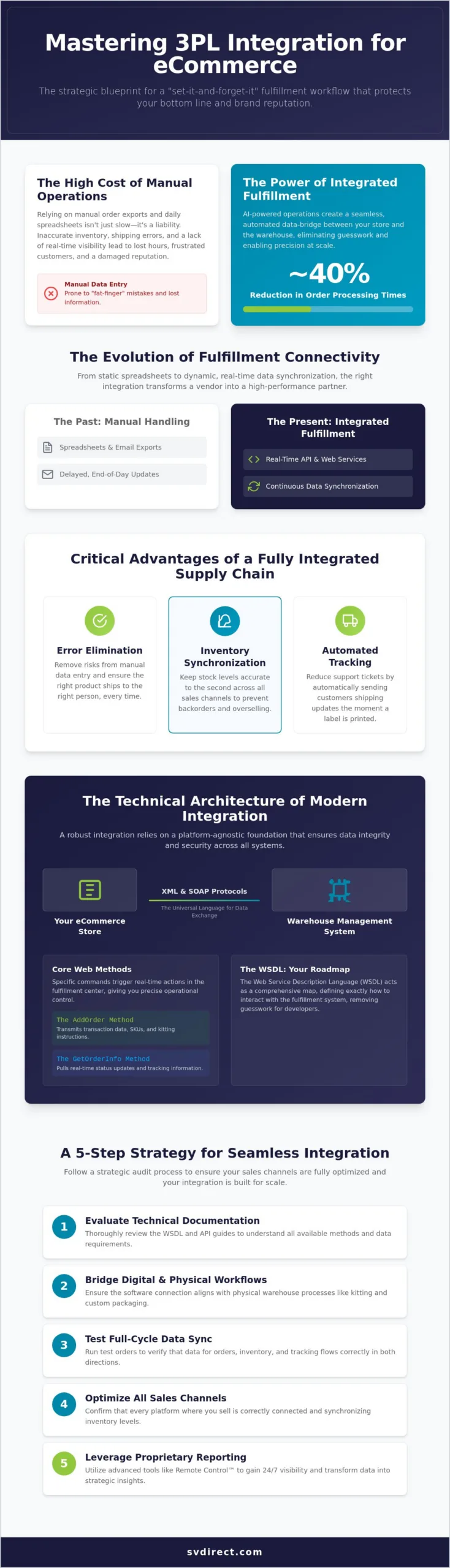
At its core, 3pl integration for ecommerce is the automated synchronization of data between an online store and its fulfillment partner. It serves as a strategic data-bridge between sales and operations, ensuring that every customer click translates into a physical action in the warehouse without human intervention. While the concept of Third-party logistics (3PL) has existed for decades, the integration layer is what transforms a simple vendor relationship into a high-performance partnership.
As we move through 2026, the industry is witnessing a total departure from “Manual Handling” in favor of “Integrated Fulfillment.” Relying on manual order exports or daily spreadsheets isn’t just slow; it’s a liability. With the removal of Section 321 de minimis exemptions increasing shipping complexity, brands need a system that handles data with the same precision used in our eCommerce order fulfillment facility. This digital backbone is what allows a brand to scale during high-volume spikes without sacrificing customer trust.
The Evolution of Fulfillment Connectivity
Key Benefits of a Fully Integrated Supply Chain
The primary value of a deep 3pl integration for ecommerce is the peace of mind that comes from operational transparency. When your systems talk to each other, you gain several critical advantages:
- Elimination of errors: You remove the risk of “fat-finger” mistakes or lost emails that lead to shipping the wrong product to the wrong person.
- Inventory synchronization: Real-time updates across all sales channels prevent the dreaded backorder scenario, keeping your stock levels accurate to the second.
- Automated tracking: Customers receive shipping confirmations and tracking numbers the moment a label is printed, which drastically reduces customer support inquiries.
By automating these touchpoints, your team can stop acting as data entry clerks and start focusing on brand strategy. It’s about creating a workflow that feels like a seamless extension of your company, backed by the physical infrastructure and technical expertise needed to execute perfectly every time.
The Technical Architecture of Modern 3PL Integration
While many guides focus on the simplicity of one-click plugins, a truly robust 3pl integration for ecommerce relies on a deeper technical foundation. High-volume brands require more than a basic connection; they need a sophisticated architecture that ensures data integrity across disparate systems. This is achieved through the use of XML and SOAP (Simple Object Access Protocol) web services. These protocols provide a structured, platform-agnostic language that allows your online store to communicate with our warehouse management system regardless of the operating system or coding language your site uses.
For developers, the efficiency of this architecture is anchored by the Web Service Description Language (WSDL). This acts as a comprehensive roadmap, defining exactly how to interact with the fulfillment system. By utilizing these standardized protocols, we remove the guesswork from the development phase. It creates a stable, predictable environment where data flows are secure and verifiable. If you are ready to see how these technical frameworks can support your specific business model, you can consult with our integration specialists to discuss a tailored approach.
Core Web Methods for eCommerce Success
The heartbeat of a technical integration consists of specific “methods” or commands that trigger actions within the fulfillment center. Understanding these core functions is essential for maintaining operational control:
- The AddOrder Method: This is the primary gateway for submitting transactions. It doesn’t just send a shipping address; it transmits complex SKU data, specific kitting instructions, and shipping carrier preferences directly into our production queue.
- The GetOrderInfo Method: This method allows your system to pull real-time updates. It retrieves current order status, specific line-item details, and tracking information, ensuring your customer dashboard is always accurate.
- The GetShippingActivity Method: Vital for financial transparency, this method manages freight charges and provides a summary of all shipping activity within a defined timeframe.
Data Tagging and Standardized Protocols
XML remains the gold standard for secure data exchange because it is both machine-readable and human-readable. This transparency allows for faster troubleshooting and more precise data tagging. To facilitate the discovery of these services, we utilize UDDI (Universal Description, Discovery, and Integration), which acts as a directory for listing available web services. This structured approach is further supported by manual system testing pages and GUI interfaces. These tools allow your technical team to test connections and verify data packets in a controlled environment before going live, ensuring that the final 3pl integration for ecommerce is flawless from day one.
Software vs. Operational Integration: Bridging the Gap
While the technical protocols discussed earlier provide the digital handshake, they only represent half of the success equation. A deep 3pl integration for ecommerce must extend beyond the server and onto the warehouse floor. Operational integration ensures that your specific brand standards are mirrored in every physical workflow, from the way a box is taped to how items are positioned inside. This alignment turns a standard fulfillment center into a true extension of your business rather than just a remote storage site.
Our “Quiet Facility” methodology is a testament to this philosophy. We believe that an organized, calm physical environment is the only way to maintain the digital accuracy your software expects. When physical spaces are meticulously managed, the data reflected in your systems remains untainted. Our team identifies and resolves inventory discrepancies or shipping conflicts before they ever reach the loading dock. This proactive stance ensures that the high-tech efficiency of your front-end store is never undermined by back-end chaos.
Integrating Specialized Services: Print and Kitting
Modern commerce often requires more than just picking a product off a shelf. By integrating on-demand digital printing directly into the fulfillment flow, we allow brands to personalize shipments at the moment of order. Using HP Indigo technology, we utilize Variable Data Printing (VDP) to include unique copy or customized inserts for every recipient. This level of customization is integrated into the automated workflow, making the “Unboxing Experience” a scalable reality rather than a manual burden. Custom kitting and assembly are treated with the same technical rigor, ensuring that promotional bundles are built with precision and speed.
The QC-Check: Human Oversight in an Automated World
Automation is powerful, but it lacks the nuanced judgment required for complex kitting or high-stakes promotional launches. Systematic human inspection remains a critical component of our quality control process. Even during high-volume deadline spikes, every kit undergoes a rigorous QC-check to verify that the physical output matches the digital order perfectly. This blend of high-tech speed and human oversight is what maintains customer trust. You can learn more about our kitting and assembly services and how they bridge the gap between automated data and physical perfection.
5 Steps to a Seamless 3PL Integration Strategy
Implementing a robust 3pl integration for ecommerce requires more than just a digital handshake. It demands a structured transition from your current manual processes to a fully synchronized operation. While the technical protocols like XML and SOAP provide the foundation, your strategy must account for the unique operational nuances of your brand. Following a methodical implementation plan ensures that your data remains clean and your fulfillment stays fast as you scale.
- Step 1: Audit your current sales channels and data requirements. Identify every point where an order is generated. You must determine which data fields, such as custom gift messages or specific kitting instructions, are mandatory for successful fulfillment.
- Step 2: Evaluate the 3PL’s technical documentation and developer resources. A transparent partner provides clear technical documentation upfront. Reviewing the WSDL (Web Service Description Language) allows your developers to understand the system architecture before writing a single line of code.
- Step 3: Define custom workflows for kitting, assembly, and specialized printing. Automation shouldn’t limit your creativity. Define how specialized tasks, such as variable data printing or healthcare mailing services, are triggered within the integration flow.
- Step 4: Establish real-time reporting triggers and low-inventory alerts. Use systems that offer proactive notifications. By setting up automated triggers for low stock or shipping delays, you can manage customer expectations before a problem arises.
- Step 5: Conduct end-to-end testing using a programmatic interface. Never go live without a sandbox phase. Submit test orders through the interface and track them through the entire warehouse lifecycle to verify that every data packet is received and processed correctly.
Evaluating Technical Compatibility
When you speak with a 3PL’s IT team, ask whether they use proprietary systems or third-party software. Our in-house systems are designed for total flexibility, allowing us to adapt to your specific business logic rather than forcing you into a generic template. You need 24/7 access to your order history and inventory levels to make informed decisions. You can explore our Remote Order Management system to see how we provide this level of deep technical visibility.
Setting Up Automated Notifications
Real-time visibility is a powerful asset for your marketing and sales departments. When your team knows exactly when inventory is received or when a backorder is cleared, they can adjust campaigns with confidence. Configuring automated email alerts ensures that your staff stays informed without needing to manually pull reports. This transparency is a hallmark of a true partnership. You can read what our clients say about real-time visibility and how it has transformed their daily operations.
The Silicon Valley Direct Approach: Technology Meets Partnership
Choosing a partner for your 3pl integration for ecommerce is about more than just checking technical boxes; it’s about finding a steady hand that treats your business as its own. We position ourselves as an extension of your company, providing the high-tech infrastructure of Silicon Valley with a human-centric commitment to service. Since 1999, we’ve remained at the cutting edge of logistics innovation while maintaining the personal oversight that pure automation lacks. Our “Nine Promises” serve as the foundation of this partnership, guaranteeing the transparency and bespoke problem-solving your brand requires to thrive in a fast-paced market.
True operational control is only possible when you have access to meaningful data. Our proprietary Remote Control™ system puts over 120 standard reports at your fingertips, offering 24/7 visibility into every corner of your supply chain. This isn’t just a dashboard; it’s a window into our facility that allows you to manage inventory, track orders, and analyze trends in real-time. By combining this digital transparency with our geographic advantage as a hub of global connectivity, we ensure your logistics remain as agile as your marketing strategy.
High-Resolution Fulfillment: The HP Indigo Advantage
Brand perception is often defined by the physical touchpoints of a shipment. We utilize the HP Indigo 5500 Digital Press to deliver high-resolution variable data printing with a 230 line screen resolution. This ensures your brand collateral, literature, and personalized inserts look professional and sharp. The “dry-to-touch” nature of this technology allows for immediate kitting and fulfillment, accelerating your speed to market. We also prioritize sustainability by using a digital process that eliminates the need for plates, films, and harsh chemicals, aligning your fulfillment with modern environmental standards.
Scalability Without the Hectic Atmosphere
A high-performance facility doesn’t have to be a chaotic one. Our methodical approach allows us to handle 3,000+ shipments a week with the same precision and calm we apply to smaller, boutique runs. We’ve found that a quiet, organized workspace is the best environment for maintaining the accuracy required for complex 3pl integration for ecommerce. Whether you are in the technology, healthcare, or consumer goods sector, our facility is designed to scale with your growth spikes without losing the human touch. You can discover our specialized industry solutions to see how we tailor our infrastructure to meet the unique demands of your specific market.
Future-Proof Your Fulfillment Ecosystem
Mastering a 3pl integration for ecommerce is the difference between a reactive supply chain and a proactive growth engine. By aligning technical protocols like XML and SOAP with precise operational standards, you create a workflow that is both scalable and reliable. We’ve spent over 25 years in Silicon Valley refining this balance. This ensures that your digital data always matches the physical truth on our warehouse floor.
Our proprietary Remote Control™ system provides the transparency you need to lead with confidence, offering 120+ standard reports that keep you in command 24/7. When you combine this visibility with our high-resolution digital printing and meticulous kitting services, your brand becomes a seamless experience for every customer. You don’t have to manage the complexities of 2026 logistics alone.
We’re ready to help you transform your operations into a high-performance partnership that scales with your ambition.
Frequently Asked Questions
What is the difference between an API and Web Services for 3PL integration?
Web Services are a specific type of API that utilize standardized network protocols like XML and SOAP to communicate over the internet. While “API” is a broad term for any interface that allows software to interact, our web services provide a more structured, platform-agnostic bridge. This architecture is essential for maintaining secure, readable data exchange between your online store and our warehouse management system.
Do I need a developer to integrate my eCommerce store with a 3PL?
You typically need a developer or a technical lead to manage a sophisticated 3pl integration for ecommerce, especially when your business requires custom logic. While basic plugins exist for simple storefronts, our proprietary XML and SOAP interfaces require a professional to map your specific data fields to our system. We provide comprehensive documentation and WSDL files to make this process efficient for your technical team.
Can I integrate my custom kitting requirements into the automated fulfillment process?
Yes, you can integrate complex kitting and assembly requirements directly into the automated fulfillment flow. By defining specific SKU combinations or assembly triggers within your data packets, our system automatically alerts the warehouse floor to perform these specialized tasks. This ensures that every promotional bundle or custom kit is built with precision the moment the order is received, maintaining your brand standards at scale.
How does 3PL integration improve my inventory accuracy?
Integration improves inventory accuracy by eliminating the need for manual data entry and providing real-time synchronization across all your sales channels. When an order is placed, stock levels are instantly adjusted in our warehouse management system and pushed back to your storefront. This closed-loop communication prevents overselling and backorders, ensuring your digital storefront always reflects the physical reality of the inventory in our facility.
Is variable data printing more expensive to integrate into my shipments?
Integrating variable data printing (VDP) into your shipments is primarily a matter of data mapping rather than increased technical complexity. By including a “personalized copy” field in your order transmission, our HP Indigo digital presses can automatically pull that data to create unique inserts or brand collateral. This process is highly efficient because it is built directly into the standard fulfillment workflow, allowing for rapid, “dry-to-touch” production.
What happens if my eCommerce platform is not a standard one like Shopify?
Our system is platform-agnostic, meaning we can integrate with custom-built eCommerce sites or niche platforms just as easily as standard ones. For example, jewelry and diamond brands utilizing Valigara can connect their specialized management software with our fulfillment systems. Because we utilize XML and SOAP web services, the specific operating system or coding language of your site does not matter, allowing us to establish a seamless 3pl integration for ecommerce that fits your unique infrastructure.
How often is inventory data updated in a fully integrated 3PL system?
Inventory data is updated in real-time as transactions occur within the warehouse. Every time an item is picked, packed, or received, the change is reflected immediately in our proprietary system. You can monitor these levels 24/7 through our Remote Control interface, which provides access to over 120 standard reports. This constant stream of data ensures that your marketing and sales teams always have the most accurate information possible.
Can I track international shipments through the 3PL integration?
Yes, our integration supports full tracking for international shipments through our global shipping and logistics network. Once a shipping label is generated, the tracking number is automatically pushed back to your system via the GetOrderInfo or GetShippingActivity methods. This allows your customers to monitor their packages from our Silicon Valley facility to their doorstep, regardless of their location, providing a transparent and reassuring delivery experience.