img not found!
Shopify Fulfillment Network vs. 3PL: Choosing Your Strategic Partner in 2026

Shopify Fulfillment Network vs. 3PL: Choosing Your Strategic Partner in 2026

What if the automated efficiency of a platform-integrated network is actually the bottleneck preventing your brand from scaling its unique customer experience? It’s a common frustration for growing merchants. You want the simplicity of a native integration, yet you’re tired of shipping crises being handled by a chatbot while your unboxing experience suffers from a lack of customization. When weighing the shopify fulfillment network vs 3pl in 2026, you aren’t just choosing a warehouse; you’re choosing the future of your customer relationships.

This article clarifies how recent technical shifts, such as the mandatory migration to the fulfillment order data model, impact your operations. You’ll learn whether an algorithmic system or a dedicated partner offers the human oversight and specialized services like kitting or on-demand printing that your brand requires to stand out. We’ll examine the trade-offs between standardized platform solutions and the scalable, high-touch infrastructure of a partner that acts as a true, flexible extension of your team. By the end, you’ll have the clarity to choose a partner that provides the precision and stability your growth demands.

Key Takeaways

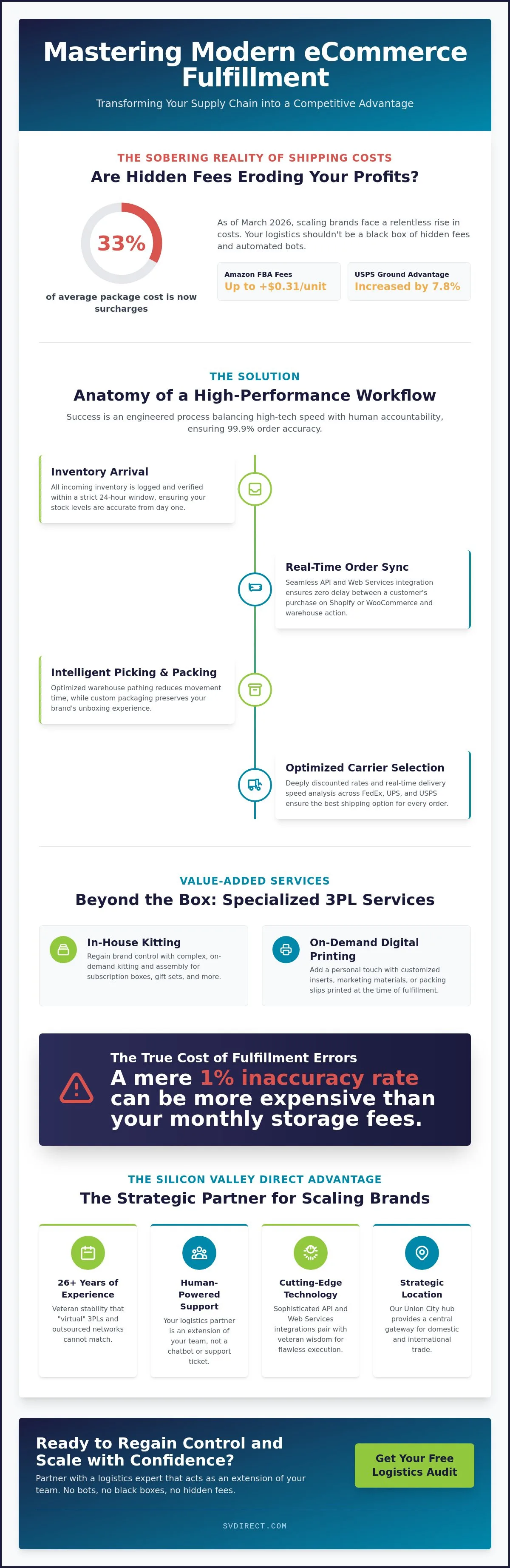
  • Learn why the October 2026 migration to the “fulfillment order” data model requires technical agility to maintain accurate inventory and shipping data.
  • Discover the core operational differences in the shopify fulfillment network vs 3pl landscape, specifically regarding automated platform networks versus high-touch human oversight.
  • Identify how specialized kitting and on-demand digital printing protect your brand identity from the limitations of standardized, “cookie-cutter” fulfillment models.
  • Understand the value of proprietary management systems that provide proactive data visibility rather than reactive, automated customer service.
  • Apply a strategic framework to determine if your product complexity and scaling goals demand the precision of a dedicated logistics partner.

The Evolution of Shopify Logistics: Network vs. Dedicated 3PL

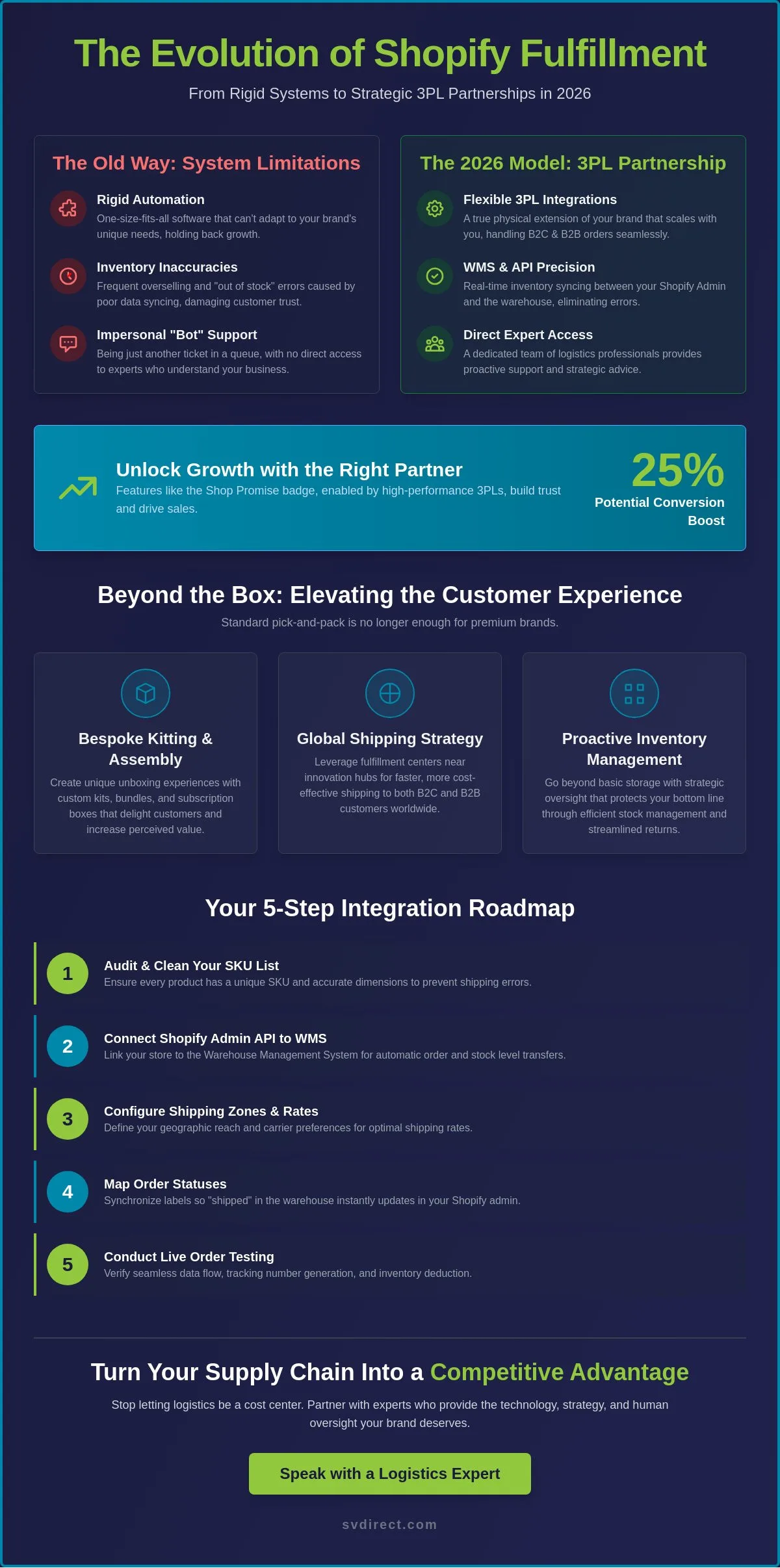
Scaling your brand to a national level involves a critical transition from manual operations to professional logistics. In 2026, the decision between the shopify fulfillment network vs 3pl is no longer just about cost per package. It’s a choice about the degree of control you maintain over your brand’s physical footprint. A dedicated 3PL fulfillment service acts as an extension of your team, whereas a network often functions as a utility. Modern eCommerce demands strategic supply chain integration that goes beyond simple shipping labels; it requires a partner that understands the nuances of your inventory and the expectations of your customers.

What is a Fulfillment Network?

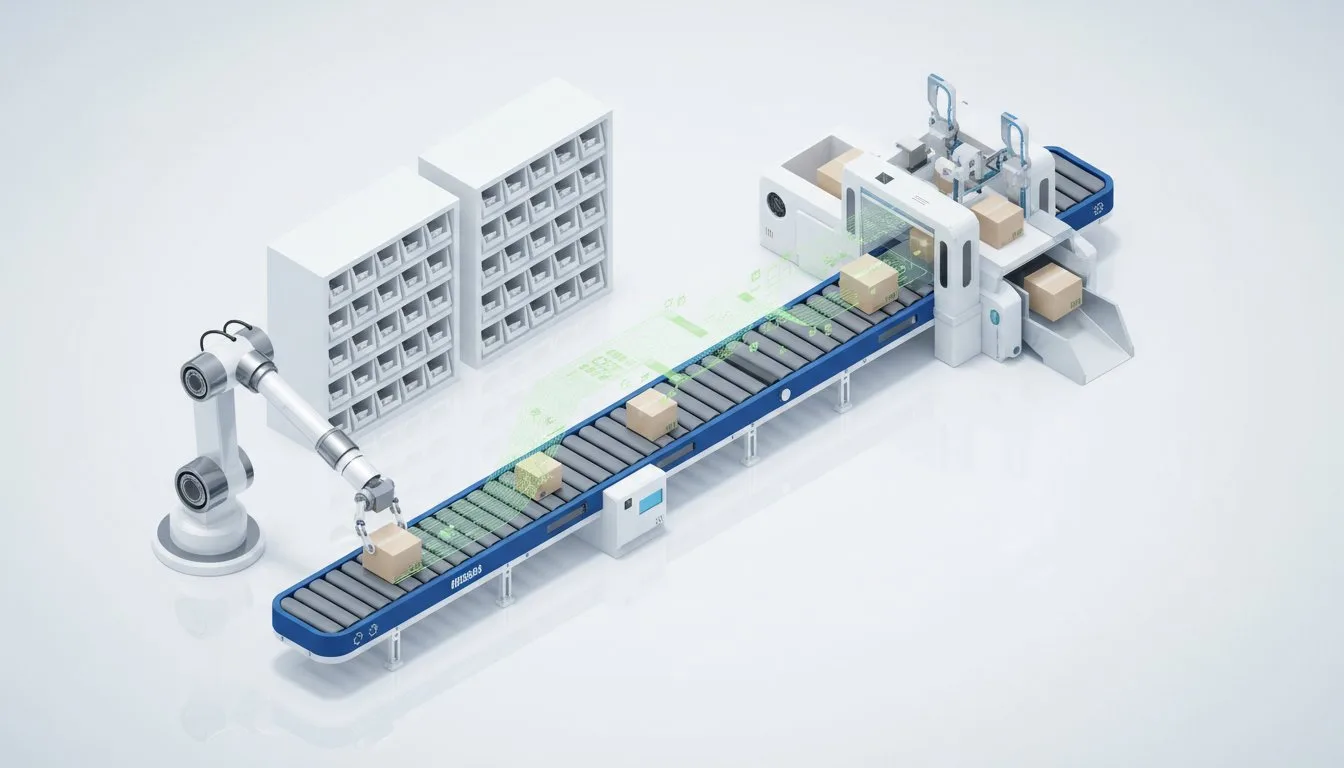
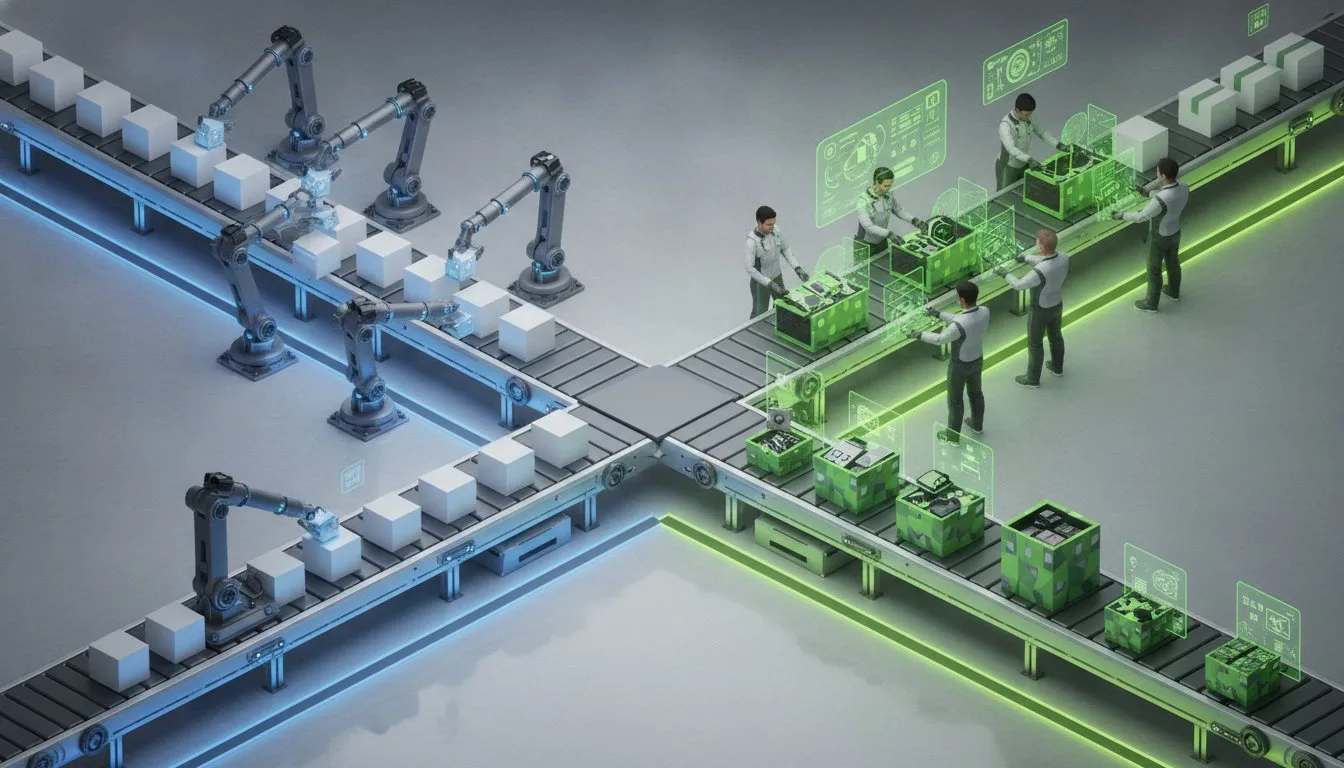
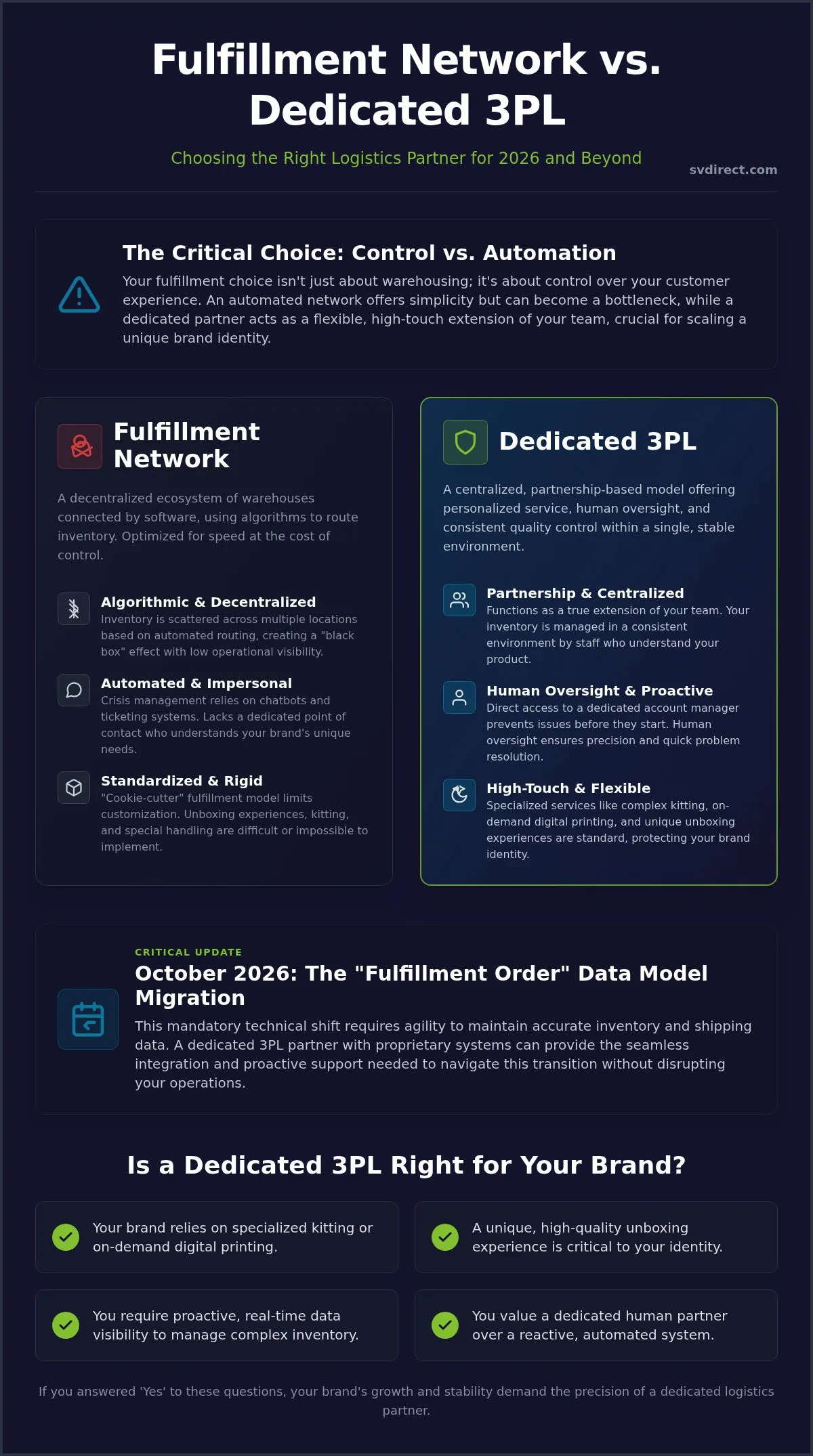
A fulfillment network is essentially a decentralized ecosystem of various warehouses connected by a central software layer. These networks use algorithmic routing to distribute your inventory across multiple locations. The goal is to place products closer to the end consumer to reduce shipping times. While this sounds efficient, it often creates a “Black Box” effect. Because your goods are spread across facilities managed by different teams, you lose granular visibility into how your products are handled. Automation manages the order flow, but when a crisis occurs, you’re often left dealing with an impersonal ticketing system rather than a dedicated account manager who knows your brand.

The Dedicated 3PL Model

A Third-party logistics (3PL) provider offers a more centralized and personalized approach. Instead of your inventory being scattered by an algorithm, it sits within a facility governed by established quality controls and consistent staff. This model prioritizes a partnership over a mere transaction. You gain direct access to human oversight, which is vital for preventing the small operational “hiccups” that can lead to negative customer reviews. A dedicated 3PL provides a stable environment where precision is the standard, and your specific requirements aren’t lost in a sea of standardized procedures.

Choosing between the shopify fulfillment network vs 3pl requires assessing your need for flexibility. If your brand relies on a specific unboxing experience or complex inventory management, the rigid nature of a decentralized network might stifle your identity. By 2026, the most successful brands are those that treat their logistics as a competitive advantage. They look for a steady hand in a fast-paced industry, ensuring that as they grow, their operational foundation remains deeply reliable and highly responsive to their unique business needs.

Evaluating Technical Integration and Real-Time Visibility

Visibility is the pulse of your supply chain. In the debate of shopify fulfillment network vs 3pl, the depth of your data determines your agility. It isn’t enough to see that a package left the warehouse; you need to know exactly what’s on the shelf, what’s pending, and what’s on backorder at any given second. This transparency mitigates the common challenges in 3PL partnerships where information silos lead to missed opportunities. Data transparency builds a bridge of trust, eliminating the anxiety of shipping crises by providing a single source of truth.

When you compare the shopify fulfillment network vs 3pl, look for a system that doesn’t just store data but makes it actionable. A partner should provide a steady hand, ensuring your digital information is as organized as the physical stock. This marriage of technology and customer service is what allows a brand to scale without the hectic atmosphere often associated with high-volume growth.

Proprietary Systems vs. Standardized Apps

Standardized apps often provide a simplified reporting structure that fails to satisfy the needs of high-growth brands. These “cookie-cutter” views lack the granular inventory analytics required for sophisticated forecasting. Our Remote Order Management system, Remote Control™, rejects this approach by providing 24/7 access to more than 120 standard reports. You can monitor inventory aging, track receipts, and analyze order trends in real time. Automated email alerts for low inventory act as a proactive safety net, ensuring you never lose a sale due to an unforeseen stockout.

Web Services and XML Integration

Modern eCommerce brands often require more than a simple plug-and-play app. They need a system that communicates effectively with proprietary tools or custom dashboards. We utilize robust web services and XML integration to facilitate this. By leveraging SOAP protocols, we provide a secure and standardized method for data transfer. This approach significantly reduces the time your developers spend on custom coding. Well-documented programmatic interfaces ensure that your user interface remains exactly how you want it, while our backend handles the complex heavy lifting of logistics data.

Strategic integration is the difference between a reactive supply chain and a proactive one. If your current setup leaves you guessing about your inventory levels or order status, it might be time for a more sophisticated approach. You can request a free quote today to explore how our technology can act as a seamless extension of your Shopify store.

Customization and Complexity: When ‘Standard’ Isn’t Enough

Standardized solutions are often the enemy of a unique brand identity. Many merchants fall into the “cookie-cutter” trap, where rigid operational procedures force products into generic packaging that fails to excite the customer. When evaluating the shopify fulfillment network vs 3pl, the deciding factor is often the ability to execute complex, non-standard requests. A network built for speed and volume frequently lacks the agility to handle the intricate details that define a premium brand experience. True precision requires a partner that treats your specific requirements as the standard, not the exception.

Kitting, Assembly, and the ‘QC-Check’

Systematic oversight is the cornerstone of successful kitting. Whether you’re launching a complex promotional kit or managing monthly subscription boxes for clothing and software, precision is mandatory. We employ a proprietary QC-Check inspection process to ensure every component is present and correctly placed. This proactive stance prevents errors before they reach your customer’s doorstep. Unlike automated networks that prioritize throughput over detail, a dedicated partner provides the human expertise necessary for multi-item assembly. Our team handles high-volume deadlines with a quiet confidence that eliminates the hectic atmosphere of traditional warehouses. Explore our specialized kitting and assembly services to see how we maintain accuracy across diverse product types.

Print-on-Demand and Variable Data

Personalization is no longer a luxury; it’s a requirement for modern eCommerce. We utilize the HP Indigo 5500 liquid ink technology to provide offset-quality results for your marketing collateral. This system allows for on-demand digital printing that transforms the unboxing experience from a transaction into a relationship. Through Variable Data Printing (VDP), we can customize the copy on every sheet, allowing for unique messages tailored to individual customers. This marriage of high-tech printing and logistics ensures that your brand voice remains consistent across every touchpoint. Discover our on-demand digital printing capabilities and learn how variable data can elevate your collateral.

Regulated industries, such as healthcare and pharmaceuticals, require an even higher level of stability and expertise. Since 1999, we’ve provided specialized literature and healthcare mailing services that adhere to strict accuracy standards. The shopify fulfillment network vs 3pl choice for these sectors isn’t just about shipping. It’s about finding a partner with a multi-decade history of reliability and the physical infrastructure to support high-stakes operations without compromise.
Shopify Fulfillment Network vs. 3PL: Choosing Your Strategic Partner in 2026

The Decision Framework: Choosing the Right Model for Your Brand

Choosing between a shopify fulfillment network vs 3pl requires a structured evaluation of your brand’s specific trajectory. While automated networks offer a low barrier to entry, they often lack the depth required for complex operations. 2026 eCommerce fulfillment complexity is the degree to which a brand’s logistical needs exceed the capabilities of standardized, automated pick-and-pack systems. If your product line involves more than just single-SKU shipments, the algorithmic approach of a decentralized network can introduce hidden costs. These costs manifest as lost customers due to kitting errors or the inability to handle specialized requirements like healthcare literature fulfillment or serial number tracking.

Step 1: Audit Your Fulfillment Requirements

A thorough audit starts with your SKU profile. Do you require specialized mailing services or serial number tracking for high-value electronics? Brands that rely on high-quality physical engagement, such as custom-printed inserts or complex assembly, often find that standardized platforms struggle with these nuances. If your strategy involves on-demand digital printing or HIPAA-compliant healthcare mailing, a dedicated partner is essential. You’ll need a facility where staff members are trained on your specific brand standards rather than following a generic, platform-wide script. It’s about ensuring your physical operations are just as organized as your digital storefront.

Step 2: Compare Support Models

The support model you choose dictates how your brand handles shipping crises. Automated ticketing systems and chatbots can leave you feeling stranded during peak seasons. In contrast, a dedicated account team provides a proactive hand. This marriage of technology and customer service ensures that issues are identified and resolved before they impact the end user. A quiet, organized facility with long-term staff retention naturally produces higher order accuracy than a hectic, high-turnover environment. By prioritizing a partner that rejects impersonal business models, you gain a scalable infrastructure that acts as a true extension of your own team.

Location-based innovation also plays a role in this framework. Being positioned within a hub of global connectivity allows for a synergy between advanced digital integration and physical logistics. This technological readiness, backed by decades of stability since 1999, provides the informed confidence you need to scale. Ultimately, the choice in the shopify fulfillment network vs 3pl debate comes down to whether you want a vendor or a strategic partner who shares your commitment to precision and bespoke problem-solving.

Silicon Valley Direct: A Seamless Extension of Your Shopify Store

Silicon Valley Direct (SVD) represents the evolution of the 3PL model, moving beyond transactional shipping to become a dedicated extension of your brand. While the choice between the shopify fulfillment network vs 3pl often centers on digital integration, we differentiate ourselves through a marriage of technology and customer service. Since 1999, we’ve rejected “cookie-cutter” solutions in favor of a methodology that adapts to your growth. This flexibility allows us to support brands as they scale from emerging startups to established enterprises without the rigidity of automated networks. We position ourselves as a steady hand in a fast-paced industry, aiming to alleviate the stress of business growth through precision and personal commitment.

Our partnership is grounded in the “Nine Promises,” a framework of accountability that ensures every shipment meets your exact standards. By choosing a partner that “thinks outside the box,” you aren’t just buying warehouse space; you’re gaining a team that prioritizes your unique operational goals and takes direct responsibility for your inventory’s integrity. Our Silicon Valley location serves as a constant symbol of innovation, allowing us to leverage global connectivity while maintaining the precision control required for modern eCommerce. This geographic identity isn’t just about location; it’s a commitment to staying at the cutting edge of logistics technology while remaining accessible and grounded.

The Human Element of High-Tech Logistics

At SVD, we explicitly reject impersonal, automated interactions. We believe high-performance logistics requires a human touch. Our team takes the time to listen and understand your specific brand requirements before implementing automated workflows. This proactive stance allows us to anticipate potential “hiccups” in the supply chain, such as inventory shortages or shipping delays, before they impact your customers. This commitment to personal oversight and staff stability is why many brands have remained with us for over seven years, as evidenced in our customer testimonials. We value transparency and directness, showing a clear disdain for inefficient business models that prioritize bots over people.

Global Reach with Precision Control

Managing the complexities of international trade requires more than just a software platform. We provide first-class customer service for both domestic and international logistics, ensuring your global reach is backed by stable, reliable infrastructure. Whether you’re shipping across the country or across borders, our systematic QC-Check process ensures accuracy at every stage. For those navigating the intricacies of international expansion, we recommend you review our global shipping services to understand the strategic landscape for 2026. If you’re ready to move beyond the limitations of the shopify fulfillment network vs 3pl debate and find a true strategic partner, contact Silicon Valley Direct for a custom fulfillment consultation today.

Securing Your Brand’s Operational Future

The choice between the shopify fulfillment network vs 3pl ultimately defines how your brand navigates the complexities of the 2026 e-commerce landscape. We’ve explored how technical agility and the shift to more granular data models require a partner that offers both sophisticated integration and human oversight. By moving away from rigid, automated networks, you reclaim control over your unboxing experience and your customer relationships. You gain the stability of a partner serving brands since 1999, backed by the real-time visibility of our proprietary Remote Control™ system. This combination ensures your physical operations are as organized as your digital storefront.

Our 99.9% accuracy rate with the QC-Check process provides the informed confidence you need to scale without the hectic atmosphere of traditional fulfillment centers. We’re here to act as a steady hand, turning your logistics into a proactive engine for growth and long-term brand loyalty. We look forward to helping you build a more flexible and resilient supply chain.

Frequently Asked Questions

What is the main difference between a fulfillment network and a 3PL?

The primary difference lies in the level of centralization and control. A fulfillment network is a decentralized group of warehouses connected by software, while a 3PL provides a dedicated, single-source operational partnership. When comparing the shopify fulfillment network vs 3pl, you’ll find that a 3PL offers more human oversight and bespoke problem-solving. This centralized model ensures consistent quality control and a steady hand in managing your brand’s physical inventory across all channels.

Can a 3PL integrate directly with my Shopify store admin?

Yes, a professional 3PL integrates directly with your Shopify store admin through robust web services and XML protocols. This connection allows for a seamless exchange of data regarding orders, shipping status, and stock levels. By utilizing secure SOAP integrations, a partner can act as a technical extension of your store. This ensures that your digital storefront and physical warehouse remain perfectly synchronized without the need for manual data entry or complex workarounds.

How does variable data printing improve my eCommerce fulfillment?

Variable data printing (VDP) allows for the mass customization of marketing collateral included in every shipment. By using high-resolution liquid ink technology like the HP Indigo 5500, a 3PL can print unique messages, QR codes, or names on every sheet. This transforms the unboxing experience into a personalized marketing touchpoint. It bridges the gap between digital personalization and physical fulfillment, helping brands build deeper emotional connections with their customers through high-quality printed materials.

What are the hidden costs associated with automated fulfillment networks?

Hidden costs in automated networks often stem from “cookie-cutter” rigidity and algorithmic errors. When a system lacks human oversight, small mistakes in kitting or assembly can lead to expensive returns and damaged customer trust. These networks may also charge premium fees for non-standard requests that a dedicated 3PL handles as part of a standard partnership. In the shopify fulfillment network vs 3pl comparison, the 3PL’s proactive QC-Check process often prevents these costly operational hiccups.

Is it possible to manage inventory in real-time with a 3PL?

Real-time inventory management is a standard feature of modern 3PL technology stacks. Systems like Remote Control™ provide 24/7 access to over 120 standard reports, offering immediate visibility into stock levels, receipts, and backorders. This level of transparency allows you to make data-driven decisions without waiting for manual updates. You can monitor inventory aging and receive automated alerts for low stock, ensuring you maintain a proactive stance in your supply chain management.

How do I transition from Shopify’s native fulfillment to a dedicated 3PL?

Transitioning requires a strategic technical migration, particularly given the October 2026 deadline for Shopify’s new fulfillment order data model. A dedicated 3PL will guide you through this process, ensuring your internal tools and apps are compatible with the new infrastructure. This proactive technical support prevents order disruptions during the switch. The goal is to move from a reactive network to a partner that understands your specific business logic and scaling requirements.

What should I look for in a 3PL’s technology stack?

You should prioritize transparency, scalability, and well-documented programmatic interfaces. A high-performance 3PL stack should offer more than basic shipping status; it needs deep inventory analytics and secure data transfer via SOAP or XML. Look for proprietary systems that allow for custom UI development rather than generic, third-party apps. This ensures your technology can grow with your brand’s complexity, providing a stable foundation for both domestic and global shipping operations.

Does a 3PL handle returns and exchanges for Shopify stores?

A dedicated 3PL provides comprehensive returns management, including inspection, re-kitting, and restocking. This service is essential for maintaining high order accuracy and preserving brand value. Unlike automated systems that might simply dispose of returned items, a partner follows your specific guidelines for quality control. They can process exchanges and update your inventory in real-time, ensuring that your Shopify store reflects accurate stock levels while providing a professional experience for your customers.
Bay Area Third Party Logistics: A Strategic Guide to 3PL in 2026

Bay Area Third Party Logistics: A Strategic Guide to 3PL in 2026

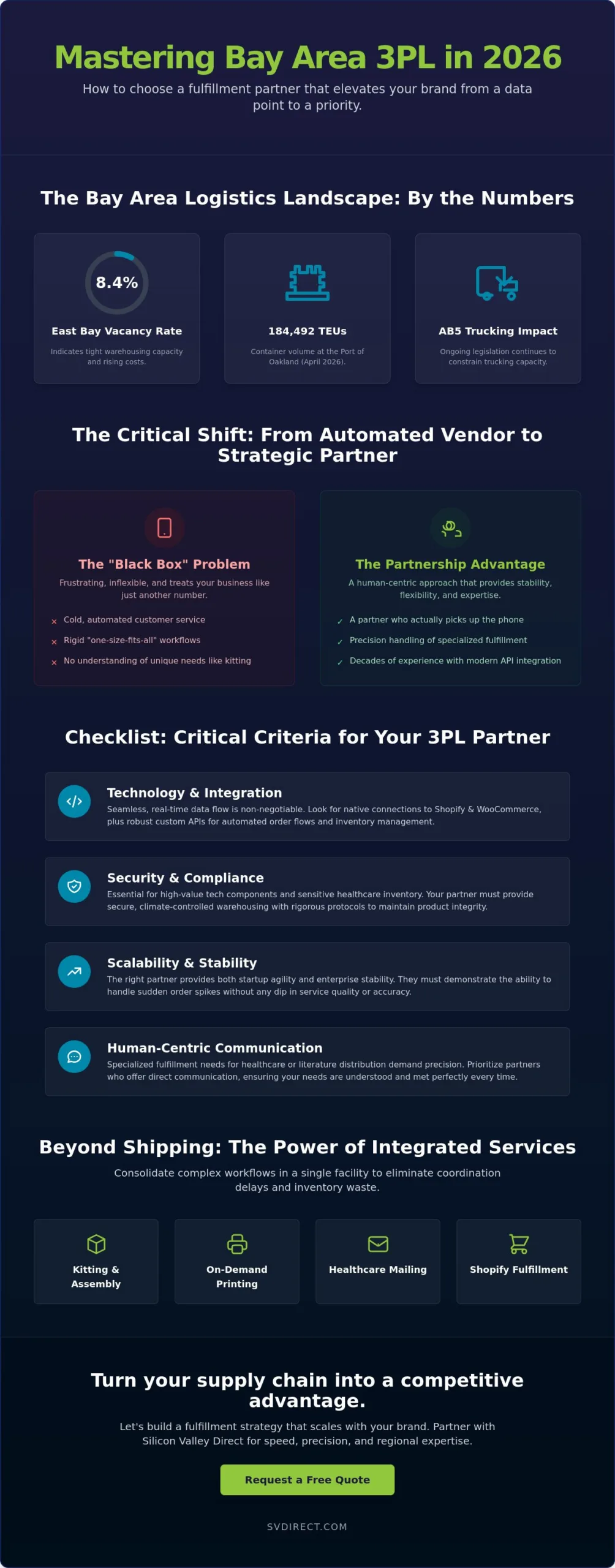
What if the secret to mastering bay area third party logistics in 2026 isn’t a faster algorithm, but a partner who actually picks up the phone? You’ve likely felt the sting of rising West Coast shipping costs and the cold frustration of automated customer service that doesn’t understand your unique kitting requirements. It’s exhausting to manage complex healthcare mailing or specialized assembly when your provider treats your brand like a data point rather than a partner.

We agree that your business deserves more than a “one size fits all” approach. This guide will show you how to leverage Bay Area logistics to scale your eCommerce brand with precision, human-centric service, and integrated fulfillment solutions. We’ll examine the 2026 landscape, including the 8.4% vacancy rates in the East Bay and the ongoing impact of AB5 on trucking capacity. You’ll discover how a partner that integrates on-demand digital printing with Shopify fulfillment can reduce your shipping times and turn your supply chain into a competitive advantage.

Key Takeaways

  • Navigate the 2026 logistics landscape by identifying partners that balance high-tech integrations with the scalability required for rapid eCommerce growth.
  • Optimize your West Coast distribution by leveraging bay area third party logistics to reduce shipping times and enhance your brand’s regional presence.
  • Consolidate complex workflows like kitting, assembly, and on-demand digital printing into a single facility to eliminate coordination delays and inventory waste.
  • Prioritize human-centric communication to ensure specialized fulfillment needs, such as healthcare mailing and literature distribution, are handled with precision.
  • Shift from a transactional vendor to a strategic partnership that offers the stability of decades of experience alongside modern, API-driven fulfillment.

Understanding the Bay Area Third Party Logistics Landscape in 2026

The Bay Area isn’t just a digital playground for software developers; it’s a massive physical engine that powers the global economy. In 2026, the Northern California innovation corridor relies on robust physical infrastructure to turn digital orders into doorstep deliveries. For many growing brands, Third-party logistics (3PL) has become the backbone of their operational strategy. At its core, 3PL is the strategic outsourcing of warehousing, inventory, and distribution to specialized partners.

Selecting a partner for bay area third party logistics requires an understanding of how this region’s unique geography influences speed and cost. With the Port of Oakland handling 184,492 TEUs in April 2026, the flow of international goods remains a constant factor for local businesses. Brands need a steady hand to manage this complexity while maintaining the high-performance standards that Silicon Valley consumers expect. Proximity to major transit nodes isn’t a luxury; it’s a requirement for staying competitive.

To better understand how these partnerships function and how to choose the right model for your brand, watch this helpful video:

The Evolution of Logistics in Silicon Valley

The shift from simple storage to integrated fulfillment has redefined the industry. A decade ago, a warehouse was often just a room with shelves. Today, it’s a sophisticated node where digital data meets physical cardboard. Proximity to tech headquarters in Palo Alto, San Jose, or San Francisco allows for real-time collaboration and rapid prototyping of fulfillment workflows. Silicon Valley Direct reflects this evolution by combining a history of reliability with the modern tech integrations required for global reach. This local presence ensures that your logistics partner is an extension of your team, not just a distant vendor.

Key Entities in Northern California Logistics

The Port of Oakland remains a critical gateway for trans-Pacific trade, especially as export volumes for agricultural goods show resilience in early 2026. Beyond the docks, the Bay Area’s logistics strength lies in its connectivity. Proximity to major carrier hubs for FedEx and UPS in the East Bay and Silicon Valley significantly accelerates last-mile delivery to West Coast customers. Secure warehousing also plays a vital role here. High-value tech components and specialized healthcare inventory require more than just square footage. They need environmental controls and rigorous security protocols that only a dedicated bay area third party logistics expert can provide.

Critical Criteria for Selecting a Bay Area 3PL Partner

Selecting the right partner for bay area third party logistics is a high-stakes decision that dictates your brand’s operational health. In 2026, the criteria for excellence have shifted. It’s no longer enough to simply move boxes. You need an operational extension of your brand that balances digital precision with physical reliability. Startups need agility, while enterprise brands require stability. Your partner must provide both, ensuring that as your order volume spikes, your service quality remains unwavering.

Technology integration is the pulse of modern eCommerce. A sophisticated 3PL must offer seamless, native connections to platforms like Shopify and WooCommerce, alongside robust custom APIs. This connectivity allows for real-time inventory management and automated order flows that eliminate manual data entry. Security is equally paramount, particularly for the tech and healthcare sectors. High-value components and sensitive medical literature require climate-controlled, secure warehousing to maintain integrity and compliance. If you’re ready to see how these standards apply to your business, you can request a free quote to explore a tailored solution.

The Problem with “Black Box” Automation

Many providers in the Bay Area now lean heavily on total automation, often referred to as “black box” logistics. While robotics are impressive, they frequently fail when faced with complex kitting or specialized assembly requirements. Total automation leads to errors when an order requires a human eye to catch a subtle packaging nuance. We believe that personal commitment and expert oversight are the only ways to ensure 99.9% accuracy in pick-and-pack operations. Having a dedicated account manager who understands your brand’s specific needs outperforms a purely automated ticket system every time.

Transparent Fee Structures in 2026

Efficiency requires financial clarity. You should understand your per-order pick and pack fees without the fear of hidden surcharges. In a market where Silicon Valley industrial vacancy sits at 4.2%, space is at a premium. Your monthly warehousing and storage fees should be calculated to maximize your ROI, ensuring you only pay for the footprint you actually use. A strategic bay area third party logistics partner will also provide transparent shipping management. By leveraging their volume with major carriers, they can pass on discounted rates that significantly reduce your West Coast shipping costs. This transparency allows you to forecast growth with confidence rather than guesswork.

The Silicon Valley Advantage: Speed, Tech, and Regional Expertise

Operating from the heart of the world’s most innovative corridor provides more than just a prestigious address. It offers a tangible performance boost to your supply chain. When you utilize bay area third party logistics, your brand inherits a culture of excellence that consumers worldwide associate with Silicon Valley. This proximity to the tech core facilitates faster troubleshooting and integration. If a software update on your Shopify store requires a custom API adjustment, being in the same time zone and ecosystem as the developers ensures your fulfillment doesn’t miss a beat. We act as a high-performance partner, ensuring that your physical operations mirror the sophistication of your digital presence.

Speed to market is the primary driver for West Coast distribution. By positioning inventory in Northern California, you drastically reduce transit times to major markets across the Pacific Northwest and the Southwest. However, the region presents unique challenges, such as the ongoing enforcement of California’s AB5 law. This regulation continues to shape the trucking industry by strictly defining worker classifications. A seasoned partner understands these local labor dynamics and maintains a carrier network that remains compliant and reliable, shielding your brand from capacity shocks that less-experienced providers might overlook.

Optimizing the West Coast Supply Chain

Strategic warehousing in locations like Union City offers a distinct advantage for balancing cost and accessibility. With East Bay industrial vacancy rates reaching 8.4% in early 2026, there is a unique window for brands to secure space in a tenant-favorable market. Rents in this hub, typically ranging from $1.30 to $1.75 per square foot, provide a cost-effective alternative to the tighter 4.2% vacancy seen in Silicon Valley. Regional expertise allows us to navigate local logistics bottlenecks, such as peak traffic hours near the San Mateo Bridge, ensuring your outbound shipments stay on schedule. For brands handling sensitive components, our Secure Warehousing for High-Value Electronics provides the specialized care required for tech-heavy inventories.

Global Shipping from a Local Hub

The Bay Area serves as a premier gateway for international trade. The Port of Oakland handled 184,492 TEUs in April 2026, demonstrating its critical role in managing trans-Pacific volumes. Leveraging bay area third party logistics allows your brand to tap into these global shipping routes with ease. We manage the complexities of cross-border eCommerce, from customs documentation to international returns. By using our global shipping services, you can streamline both B2B and B2C distribution, ensuring that a customer in Tokyo receives the same precision and care as one in San Francisco.

Bay Area Third Party Logistics: A Strategic Guide to 3PL in 2026

Beyond Shipping: Integrated Kitting, Printing, and Compliance

In 2026, the most effective bay area third party logistics strategies look beyond the loading dock. While many providers stop at parcel delivery, a true partner integrates marketing and fulfillment under one roof. This integration is vital for brands that rely on physical touchpoints to build loyalty. Literature fulfillment requires treating your physical assets with the same precision as your digital ones, ensuring that every brochure or manual is current and available. Just-in-time printing eliminates the need for massive storage of outdated marketing materials, allowing you to update your collateral in real-time without the risk of inventory obsolescence.

Integrating on-demand digital printing directly into the fulfillment workflow reduces lead times and inventory waste. Instead of ordering thousands of inserts that might change next month, you print exactly what you need for today’s orders. This approach not only saves money but also aligns with the high-tech, efficient mindset of Silicon Valley. It’s about being lean and responsive to market shifts. By consolidating these services, you remove the friction of coordinating between multiple vendors, which often leads to communication gaps and shipping delays.

Specialized Kitting for Complex Brands

Custom assembly adds a vital personal touch to the unboxing experience, which is the only physical interaction many eCommerce customers have with your brand. Whether you’re managing subscription boxes or promotional kits for high-stakes marketing launches, the precision of the assembly matters. Our Kitting and Assembly Services ensure that every component is placed with care, reflecting your commitment to quality. This level of detail is difficult to achieve in a purely automated environment where nuanced packaging requirements are often overlooked.

Healthcare and HIPAA-Compliant Logistics

Accuracy in healthcare mailing and medical device fulfillment isn’t just about customer satisfaction; it’s about compliance and safety. The regulated nature of the medical industry demands a partner that understands the stakes of HIPAA compliance and secure data handling. Our Healthcare Mailing Services provide the rigorous oversight needed for sensitive shipments. We combine secure warehousing with meticulous quality control to ensure that every patient or provider receives exactly what they need, when they need it. Our dedicated expertise in bay area third party logistics ensures that even the most complex regulatory requirements are met with quiet confidence.

If your brand requires this level of integrated precision, request a free quote today to see how we can streamline your entire workflow.

Scaling with Silicon Valley Direct: Your 2026 Growth Partner

Silicon Valley Direct has provided stability in the logistics sector since 1999. In an industry where providers often disappear as quickly as they arrive, our multi-decade history acts as a constant anchor of trust. We’ve navigated every major shift in the supply chain, from the early days of eCommerce to the complex, API-driven landscape of 2026. This experience allows us to offer tailored solutions that scale alongside your brand, whether you’re a local startup or a global enterprise. Transitioning from in-house fulfillment to professional bay area third party logistics shouldn’t be a source of stress. We’ve refined our migration processes to ensure a seamless shift without operational downtime, protecting your customer experience from the very first order.

Our commitment to precision is backed by physical infrastructure and human expertise rather than just marketing abstractions. We understand that your inventory represents your brand’s reputation. By choosing a partner with deep regional roots, you’re not just buying warehouse space; you’re gaining a steady hand in a fast-paced market. We take pride in our operational readiness and our ability to handle the high-stakes requirements of modern business growth with quiet confidence and personal commitment.

The Human Element of High-Performance Logistics

Logistics is personal. While many competitors hide behind automated phone trees and impersonal ticketing systems, we explicitly reject these barriers in favor of direct human connection. When you have a question about a complex kitting project or a specialized healthcare shipment, you deserve immediate access to an expert who knows your brand. Our long-term staff retention is a unique hallmark of our internal stability. This collective experience translates to expert-level care for your inventory and a promise of total flexibility. We provide bespoke problem-solving for every client, ensuring that your specific operational needs are met with enthusiasm and accuracy. This same standard of personalized care is vital when managing international business travel, where platforms like Bulvds offer specialized guidance on securing premium apartments and short-term stays in emerging markets like Lagos.

Getting Started with Your Bay Area 3PL Strategy

The onboarding process at Silicon Valley Direct is designed for speed and clarity. We begin with a comprehensive audit of your current fulfillment costs to identify immediate savings and efficiency gains. From there, we move into technical integration, establishing secure, native connections between your Shopify or WooCommerce store and our management systems. You’ll be guided through every step, from the initial API handshake to the shipment of your first order from our facility. If you’re ready to move beyond automated “black box” providers and experience a high-performance partnership, contact Silicon Valley Direct for a customized fulfillment quote today. Let us help you leverage bay area third party logistics to scale your brand with precision and care.

Master Your 2026 Logistics Strategy

Navigating the complexities of West Coast distribution requires a partner that understands the nuances of the regional market, from the Port of Oakland’s export resilience to the tenant-favorable vacancy rates in the East Bay. You’ve seen how integrated services like on-demand digital printing and specialized kitting can streamline your workflow and reduce lead times. By selecting a partner that rejects cold automation in favor of direct human oversight, you ensure that your brand’s unique requirements are always met with precision. This human-centric approach is the key to maintaining excellence in a tech-saturated industry.

Silicon Valley Direct has been serving this innovation corridor since 1999, providing the stability and expert-level care your inventory deserves. We combine high-tech API integrations with the flexibility of bespoke problem-solving to protect your operational health. Don’t leave your growth to a “black box” system that ignores the human element of your business. It’s time to turn your supply chain into a strategic asset. Partner with Silicon Valley Direct for Expert Bay Area Logistics and discover how our history of reliability can support your long-term success. We look forward to scaling with you.

Frequently Asked Questions

What are the benefits of using a 3PL in the Bay Area compared to other regions?

The primary benefit of choosing bay area third party logistics is the unparalleled proximity to major international transit nodes like the Port of Oakland and San Francisco International Airport. This location allows brands to reduce transit times to West Coast customers significantly compared to midwest or East Coast hubs. Additionally, being in the innovation corridor facilitates real-time collaboration with tech partners, ensuring your physical operations keep pace with rapid digital updates.

How does Silicon Valley Direct handle high-value or sensitive inventory?

We utilize secure, climate-controlled warehousing specifically designed to protect sensitive electronics and medical assets. Every high-value item is managed with direct human oversight rather than relying solely on automated systems. This manual verification process ensures that environmental protocols and security measures are strictly followed, maintaining the integrity of your most critical stock at all times.

Can a Bay Area 3PL help with international shipping and global distribution?

A Bay Area provider is ideally positioned to manage global distribution through the region’s massive air and sea gateways. We handle the complexities of international logistics, including customs documentation and cross-border eCommerce regulations. By leveraging local hubs, brands can efficiently reach markets in Asia and Europe while maintaining centralized inventory control in Northern California.

What is the difference between kitting and simple order fulfillment?

Simple order fulfillment involves picking and packing individual items as they appear on a customer order. Kitting and assembly is a more complex process where multiple components are pre-assembled into a single new SKU, such as a subscription box or promotional kit. This value-added service requires precise manual oversight to ensure every kit meets your brand’s specific unboxing standards before it ever reaches the shipping dock.

How do you ensure HIPAA compliance for healthcare mailing services?

We ensure HIPAA compliance through rigorous staff training and secure, restricted-access data handling protocols. Our healthcare mailing services prioritize the confidentiality of patient information during every stage of the fulfillment process. Physical security measures within our facility prevent unauthorized access to sensitive medical literature or devices, ensuring your brand remains compliant with all federal regulations.

What eCommerce platforms does Silicon Valley Direct integrate with?

Silicon Valley Direct integrates seamlessly with major eCommerce platforms, including Shopify and WooCommerce. We also offer robust custom APIs for brands with proprietary systems that require bespoke connectivity. These integrations allow for real-time inventory syncing and automated order processing, which eliminates the risk of manual data entry errors and keeps your stock levels accurate across all sales channels.

How much do Bay Area 3PL services typically cost?

Costs for bay area third party logistics are generally calculated based on your specific storage footprint, order volume, and specialized service requirements. While regional real estate influences warehousing fees, these are often offset by the reduced shipping costs achieved through proximity to West Coast customers. We provide transparent fee structures that include per-order pick and pack fees without hidden surcharges or unexpected management costs.

What happens if my business experiences a sudden spike in order volume?

Our infrastructure is built to scale rapidly, allowing us to manage sudden spikes in order volume during peak seasons or major marketing launches. We maintain a flexible operational model that can increase capacity without sacrificing accuracy or shipping speed. This readiness ensures your customers receive their orders on time, even when your brand experiences exponential growth or unexpected viral success.

Average Pick and Pack Fees 2026: A Strategic Guide to Fulfillment Cost Benchmarking

Average Pick and Pack Fees 2026: A Strategic Guide to Fulfillment Cost Benchmarking

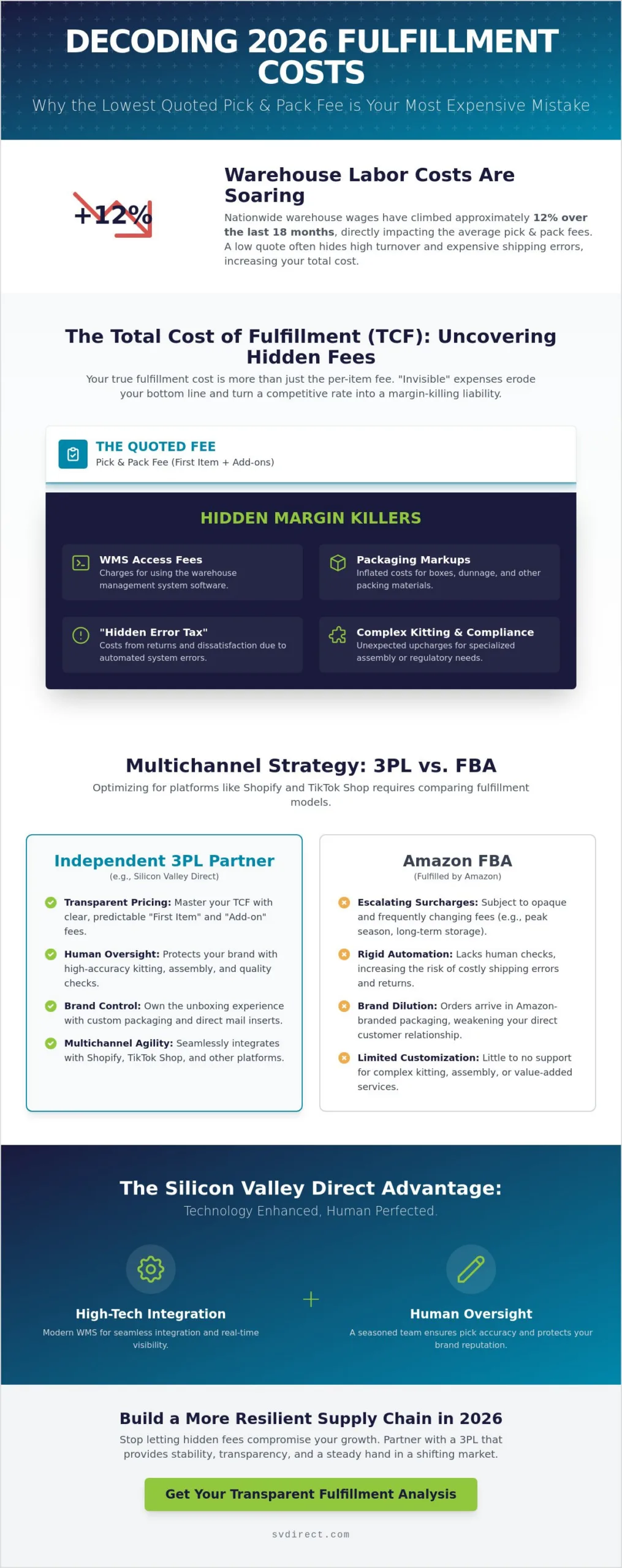
In 2026, the lowest quoted pick and pack fee on your spreadsheet is often the most expensive mistake your eCommerce brand will make. It’s a frustrating reality many high-growth founders face as they scale across platforms like Shopify and TikTok Shop. You probably feel the weight of rising warehouse labor costs, which have climbed 12% over the last 18 months, making it vital to understand the average pick and pack fees 2026 standards before signing your next contract. It’s exhausting to manage opaque pricing models where hidden surcharges turn a competitive rate into a margin-killing expense.

We’re here to help you regain control with a steady hand and clear data. This guide empowers you to master the fulfillment landscape through precise benchmarks and a strategic framework for calculating your total cost of fulfillment. You’ll discover how to identify the complexity tax of multichannel orders and why a partner who prioritizes human oversight over total automation is the ultimate safeguard for your brand’s reputation and financial health. By the end of this article, you’ll have the tools to protect your profitability and build a more resilient supply chain.

Key Takeaways

  • Benchmark your logistics spend against the average pick and pack fees 2026 standards to protect your eCommerce margins from rising operational costs.
  • Master the Total Cost of Fulfillment (TCF) framework to identify “invisible” expenses, such as WMS access fees and packaging markups, that erode your bottom line.
  • Compare escalating Amazon FBA surcharges against independent 3PL models to optimize your multichannel strategy across Shopify and TikTok Shop.
  • Discover how human oversight in kitting and assembly services eliminates operational friction and protects your brand’s physical unboxing experience.
  • Integrate direct mail marketing with your order fulfillment to drive physical engagement and build long-term customer loyalty.

The 2026 Fulfillment Landscape: Why Pick and Pack Fees Are Shifting

The logistics sector is undergoing a fundamental recalibration. Energy price volatility and a tightening labor market have pushed operational overhead to new heights. For brands attempting to benchmark their expenses, the average pick and pack fees 2026 data shows a clear departure from the low-cost models of the previous decade. This shift isn’t just about rising numbers; it’s about a structural change in how value is delivered within the order fulfillment process. We are seeing a market where transparency and reliability are becoming the primary currencies of successful partnerships.

Multichannel complexity adds significant pressure to the warehouse floor. Managing simultaneous surges from TikTok Shop and Shopify requires more than just shelf space. It demands a level of agility that automated systems often struggle to maintain without human intervention. As order volume scales across diverse digital storefronts, the labor requirements for accurate sorting and kitting become more specialized. This has led many high-growth brands to move away from automated-only fulfillment toward models that prioritize human-centric precision to protect their customer experience.

To better understand the current shifts in fulfillment pricing, watch this helpful video analysis:

Labor Trends and the 2026 Warehouse Economy

Nationwide warehouse wages have climbed approximately 12% over the last 18 months, directly impacting the average pick and pack fees 2026 landscape. While some providers try to mask these costs with lower entry fees, cheap labor often results in expensive shipping errors and high turnover. We believe that stability is a competitive advantage. Long-term staff retention ensures that pick accuracy remains high, which ultimately lowers the total cost of fulfillment for our partners. When a team knows the inventory and the brand’s specific standards, they work with a level of care that machines simply cannot replicate.

Technology vs. Human Oversight in Fulfillment

Modern Warehouse Management Systems (WMS) are no longer a luxury; they are a standard expectation for any serious brand. However, technology alone creates a “Hidden Error Tax.” When automated systems lack human checks, the cost of returns and customer dissatisfaction skyrockets. Silicon Valley Direct bridges this gap by combining high-tech digital integration with the personal commitment of a seasoned team. This balance ensures that innovation serves the client rather than complicating the operation. We view digital tools as a way to enhance our human expertise, not replace the watchful eye that ensures every package is perfect.

Our location in the heart of the world’s most innovative ecosystem allows us to see these trends before they hit the national market. Silicon Valley’s focus on efficiency and scalability sets the pace for 3PL pricing standards across the country. By staying at the cutting edge of logistics technology while maintaining a dedicated workforce, we provide a steady hand for brands navigating these shifting costs.

Benchmarking Average Pick and Pack Fees in 2026: A Comparative Analysis

Understanding the numbers is the first step toward reclaiming your margins. While our previous analysis highlighted why costs are shifting across the industry, this section focuses on the specific benchmarks brands encounter when auditing their logistics spend. In 2026, the average pick and pack fees 2026 data indicates that a tiered pricing structure remains the most effective way to balance warehouse labor with client value. This model ensures you pay for the actual work performed rather than a flat average that might overcharge for simpler orders.

The ‘First Item’ vs. ‘Add-on’ Pricing Model

Most 3PL providers utilize a “First Item” fee because the initial pick carries the bulk of the operational weight. This covers the time a team member spends traveling to a location and the initial system scan. Current industry benchmarks suggest you’ll see rates between $2.50 and $5.00 for that first item. Additional items typically cost significantly less, often ranging from $0.50 to $1.00 each. These figures are tied directly to the BLS Unit Labor Costs for Warehousing, which tracks the investment required for every unit of warehouse output. By optimizing your product bundles or kits, you can effectively lower your per-unit fulfillment cost and protect your bottom line.

Independent 3PL vs. FBA: The 2026 Reality

The choice between Amazon FBA and an independent 3PL has never been more consequential. Amazon’s 2026 storage hikes are significant, with peak season storage fees reaching $2.40 per cubic foot for standard items. When you factor in “low-inventory” surcharges and algorithmic penalties, the convenience of FBA often comes with a steep price tag that erodes gross margins. We’re seeing a steady migration of high-growth brands toward independent 3PL models. These brands aren’t just looking for lower fees; they’re seeking the brand control and personalized oversight that a human-centric partner provides. Our ongoing analysis of logistics trends on our fulfillment blog suggests that brands prioritizing this flexibility are better equipped to handle the volatility of multichannel commerce.

Your SKU volume and order frequency will always play a role in your final negotiated rate. High-volume brands with consistent order profiles often move toward flat-fee models in 2026 to ensure total cost predictability. This transparency eliminates the guesswork from your monthly financial planning. If you’re ready to move beyond generic benchmarks and see how these figures apply to your specific SKU profile, you can request a personalized quote to start a more detailed conversation. We believe in providing a steady hand and clear data so you can grow your business with confidence.

Average Pick and Pack Fees 2026: A Strategic Guide to Fulfillment Cost Benchmarking

The Complexity Tax: How Specialized Kitting and Compliance Affect Per-Order Rates

Standard benchmarks provide a necessary baseline for financial planning, but they rarely account for the operational nuances of specialized industries. While the average pick and pack fees 2026 data suggests a range for simple eCommerce orders, brands in the healthcare, medical device, and high-tech sectors face a different reality. These industries operate under a “complexity tax” where the stakes of a fulfillment error extend far beyond a negative review. In these environments, precision is the primary driver of value, and the fulfillment logic must adapt to accommodate rigorous quality control and technical assembly.

This complexity is particularly evident when integrating on-demand digital printing into the fulfillment workflow. By printing collateral only when an order is placed, brands significantly reduce inventory carrying costs and eliminate the risk of dead stock. However, this shifts the labor logic from a simple “pick” to a more involved “prepare and pack” process. The warehouse team isn’t just grabbing a pre-printed item; they’re ensuring the right digital asset is produced and married to the physical shipment with total accuracy.

Kitting and Custom Assembly Fees

For brands utilizing kitting and assembly services, per-order fees reflect the manual labor required to create a bespoke unboxing experience. Whether it’s assembling a subscription box or bundling promotional kits for a product launch, these tasks require human dexterity that automated systems cannot match. Just-in-time assembly allows you to keep your components as individual SKUs, optimizing warehouse space and providing the flexibility to pivot your marketing strategy without re-labeling thousands of pre-packed units. Many of our partners also find success by integrating literature fulfillment services directly into their physical shipments, ensuring that every customer receives the most current assembly guides or promotional inserts.

Regulatory and Compliance Surcharges

Security and compliance represent another layer of the complexity tax. Handling sensitive medical materials or high-value electronics requires specialized facility protocols and staff training that go beyond standard 3PL capabilities. For example, healthcare mailing services and fulfillment must adhere to strict HIPAA guidelines to protect patient confidentiality. This isn’t just about a secure server; it’s about a physical infrastructure designed to prevent unauthorized access and a team that understands the legal weight of their work. While these requirements may push rates above the average pick and pack fees 2026 baseline, the long-term ROI is found in the total elimination of regulatory risk and the preservation of your brand’s integrity. Choosing a partner with a multi-decade history of compliance provides a steady hand in an increasingly regulated market.

Calculating Your Total Cost of Fulfillment (TCF): Identifying Hidden Margin Killers

Focusing solely on the average pick and pack fees 2026 data provides only a partial view of your brand’s financial health. True profitability requires a comprehensive understanding of the Total Cost of Fulfillment (TCF). This metric represents the sum of every operational touchpoint, from the moment inventory arrives at our facility until the final package reaches the customer’s doorstep. Beyond standard labor fees, TCF includes storage, outbound shipping, and the administrative overhead required to maintain a seamless operation. Many brands overlook “invisible” costs such as account management fees or dunnage markups, which can silently erode margins if left unchecked.

Expanding into international markets introduces additional layers of complexity that must be carefully modeled. Our global shipping services provide the infrastructure to manage these variables, but they must be factored into your landed cost per order. Administrative coordination for B2B and B2C logistics often carries a hidden time cost that manual systems fail to capture. Additionally, unoptimized returns management can effectively double your fulfillment spend. Reverse logistics requires the same, if not more, human oversight as the initial pick to ensure inventory is correctly processed, inspected, and restocked without friction.

Storage and Warehousing Fee Benchmarks

Selecting the right storage medium is a balance of accessibility and expense. For high-volume SKUs, pallet storage offers the lowest per-unit cost, while shelf storage is essential for picking efficiency in smaller, diverse inventories. We’ve observed a significant 2026 trend toward “secure warehousing” for brands handling high-value electronics or sensitive materials. This specialized environment impacts insurance premiums and facility protocols but offers essential protection for your most valuable assets. For a deeper look at these specific requirements, refer to our guide on secure warehousing for high-value electronics.

Shipping Management and Carrier Rates

The administrative burden of logistics coordination is a major component of your TCF. A seasoned 3PL leverages its collective volume to secure discounted carrier rates with UPS, FedEx, and DHL that individual brands simply cannot access on their own. It’s also vital to acknowledge that “free shipping” for the consumer is never free for the brand. Factoring actual postage and carrier surcharges into your TCF calculation is the only way to maintain a realistic view of your profitability. If you suspect hidden fees are draining your revenue, you can request a free quote to receive a transparent breakdown of your potential fulfillment costs and identify where your margins are most at risk.

Optimizing Your 2026 Logistics Strategy with Silicon Valley Direct

Navigating the volatility of the current market requires more than just a software integration. It demands a partnership built on operational stability and a refusal to settle for the status quo. While the average pick and pack fees 2026 benchmarks provide a necessary starting point for your budget, the true value of a logistics partner is found in their ability to eliminate friction before it reaches your customer. Silicon Valley Direct offers a steady hand, backed by over 25 years of experience in high-stakes fulfillment. We understand that behind every SKU is a brand promise, and our mission is to ensure that promise is kept through every shipment, kit, and delivery.

One of the most effective ways to differentiate your brand in a digital-first world is by merging the digital and physical customer journeys. By integrating direct mail marketing services with your eCommerce fulfillment, you create multiple touchpoints that drive physical engagement. This holistic approach allows you to include personalized promotional materials or high-quality literature directly in your outgoing orders, turning a standard delivery into a powerful marketing event. This synergy is particularly effective for high-growth startups and established enterprises that need to maintain a premium brand image while scaling rapidly.

A Partnership Beyond the Transaction

We explicitly reject the industry trend of replacing dedicated account managers with automated chatbots. In a crisis, a direct human connection out-performs an algorithm every time. Our commitment to personal oversight is matched by our investment in our team. We believe that our long-term staff retention is the primary reason we maintain a 99.9% pick accuracy rate. When the same experienced professionals handle your inventory year after year, they develop an intuitive understanding of your brand’s standards. Our location in the heart of Silicon Valley acts as a hub for global connectivity, allowing us to leverage local innovation to solve complex logistics challenges for our partners worldwide.

Next Steps: Auditing Your Current 3PL

As you move through the remainder of the year, it’s vital to conduct a thorough audit of your current fulfillment expenses. Use the average pick and pack fees 2026 data we’ve discussed to evaluate whether you are receiving fair value or if hidden surcharges are quietly eroding your profitability. Reach out to your current provider and ask specific questions about their 2026 labor cost adjustments and how they handle multichannel complexity across platforms like TikTok Shop. Transparency should be a requirement, not a request.

If you find that your current provider lacks the transparency or the human oversight your brand deserves, it may be time for a strategic shift. We invite you to contact Silicon Valley Direct for a personalized fulfillment consultation. We will provide a clear, transparent quote that accounts for your specific kitting, printing, and distribution needs. Let us show you how a partnership grounded in precision and personal commitment can protect your margins and accelerate your growth in 2026 and beyond.

Future-Proofing Your eCommerce Growth in a Shifting Market

Mastering your supply chain in 2026 requires looking beyond the sticker price of a single pick. While understanding the average pick and pack fees 2026 provides a baseline for your budget, true profitability comes from identifying hidden margin killers and leveraging specialized kitting to enhance the customer experience. We’ve explored how a strategic focus on Total Cost of Fulfillment (TCF) and regulatory compliance can transform your logistics from a cost center into a powerful competitive advantage.

Silicon Valley Direct has provided this steady hand since 1999. We offer specialized HIPAA-compliant fulfillment and integrated on-demand digital printing to ensure your brand remains agile in a fast-paced economy. Most importantly, we provide direct human oversight on every account, rejecting automated interactions to give your business the personal attention it deserves. It’s time to move toward a more transparent and reliable operational future. Streamline your 2026 fulfillment with Silicon Valley Direct and reclaim your margins today. We’re ready to help you scale with confidence and precision.

Frequently Asked Questions

What is the average pick and pack fee for a single-item order in 2026?

Industry data for 2026 indicates that a standard single-item order typically costs between $3.15 and $3.85. This range accounts for standard eCommerce volume and assumes a non-fragile item. For lighter goods or higher-volume operations, the average pick and pack fees 2026 benchmark can drop as low as $2.50, while heavier or more complex items may reach $5.50.

How much should I expect to pay for additional items in a multi-unit order?

Additional items in a single order are generally priced at 40% to 60% less than the first-item fee. Most 3PL providers charge between $0.50 and $1.00 for each add-on unit. This tiered structure reflects the reduced labor required because the picker is already at the location and the packing station is already prepared for that specific shipment.

Are there extra fees for kitting or custom packaging in 2026?

Yes, specialized kitting and assembly services incur additional costs based on the labor hours required for the specific project. These fees cover tasks like bundling multiple SKUs, applying custom labels, or building subscription boxes. While standard pick fees are predictable, kitting projects are usually quoted as a bespoke service to ensure every detail of your brand’s unboxing experience is handled with precision.

What is a standard monthly account management fee for a 3PL?

Monthly account management fees typically range from $250 to over $1,000 depending on the complexity of your technical integration and support needs. These fees cover the cost of dedicated account oversight, WMS access, and regular reporting. High-performance partners prioritize direct human connection over automated ticketing systems, ensuring you have a steady hand to manage your logistics strategy as you grow.

How do 2026 warehousing fees compare to previous years?

Warehousing costs have seen a steady increase due to a 12% climb in labor costs over the last 18 months. Pallet storage rates in 2026 generally hover between $15 and $25 per month. In contrast, Amazon FBA storage fees have become significantly more expensive during peak seasons. They reach up to $2.40 per cubic foot for standard items, making independent 3PL storage a more stable alternative for many brands.

Can specialized industries like healthcare expect higher pick and pack fees?

Industries requiring HIPAA compliance or specialized medical handling often face higher per-order rates. This complexity reflects the need for rigorous staff training, secure facility protocols, and meticulous quality control measures. While these fees exceed the average pick and pack fees 2026 baseline for standard retail, the investment protects your brand from significant regulatory risks and ensures the safety of sensitive materials.

What are the common hidden costs in a 3PL fulfillment quote?

Hidden costs often include surcharges for SKU complexity, dunnage markups, and returns management fees. Many brands also encounter unexpected “low-inventory” penalties or peak season surcharges when using algorithmic fulfillment models. A transparent partner will provide a clear breakdown of the Total Cost of Fulfillment (TCF). This prevents invisible expenses from eroding your margins and allows for more accurate financial planning.

How does location, like Silicon Valley, affect pick and pack pricing?

Geographic hubs like Silicon Valley influence pricing by acting as centers for global connectivity and high-tech innovation. While local labor markets are competitive, these locations offer superior access to logistics infrastructure and seasoned talent. Choosing a partner in an innovation hub ensures your brand benefits from advanced technical integrations and a proactive approach to supply chain efficiency that stabilizes long-term costs.

Apparel Fulfillment Center Bay Area: The 2026 Guide to Scaling Your Fashion Brand

Apparel Fulfillment Center Bay Area: The 2026 Guide to Scaling Your Fashion Brand

What if your brand’s biggest growth hurdle isn’t the next collection, but the invisible friction in your size-color-style matrix? For many fashion founders, scaling means facing a surge in pick-and-pack errors and a return rate that feels impossible to manage. Finding a specialized apparel fulfillment center bay area is no longer just about storage; it’s about securing a partner who understands that a single mispicked garment can erode customer trust. You’ve likely felt the sting of inventory discrepancies or the stress of manual data entry between your warehouse and Shopify store.

We understand that behind every SKU is a promise made to a customer. This guide will show you how to streamline your logistics through high-tech integrations and reliable reverse logistics. You’ll discover how to leverage the Port of Oakland’s proximity to save up to $2,500 in drayage costs per container and ensure your brand stays compliant with the July 2026 California Responsible Textile Recovery Act. We’re diving into the exact strategies you need to achieve global reach with the personal touch of a dedicated, human-led team that values your growth as much as you do.

Key Takeaways

  • Understand why the Bay Area remains the strategic hub for West Coast fashion and how an apparel fulfillment center bay area enables a seamless transition from in-house operations to professional scaling.
  • Gain insights into managing the complex size-color-style SKU matrix with precision strategies that maintain 99%+ inventory accuracy even during peak seasonal demand.
  • Balance Silicon Valley technology with high-touch human oversight to ensure garment inspection and fold quality meet your brand’s specific standards before every shipment.
  • Learn to turn reverse logistics into a growth tool by implementing reliable returns management and custom kitting for influencer and subscription box campaigns.

Scaling Your Fashion Brand with a Bay Area Apparel Fulfillment Center

Success in the fashion industry often hinges on the speed and precision of your supply chain. For brands importing goods from Asia, the San Francisco Bay Area provides an unmatched logistical gateway. The Port of Oakland handles 99% of containerized goods in Northern California, offering a direct line for your inventory that bypasses the congestion of Southern California ports. By choosing an apparel fulfillment center bay area, you can save between $1,000 and $2,500 in drayage costs per container compared to routing shipments through Los Angeles or Long Beach. These savings aren’t just numbers on a balance sheet; they represent capital you can reinvest into your next seasonal collection or marketing campaign.

Relocating your inventory from a cramped home office or a general warehouse to a specialized fulfillment center marks a pivotal moment in your brand’s maturity. It’s the point where you trade manual oversight for professional stability and high-tech efficiency. This transition allows you to focus on design and brand strategy while experts manage the intricate size-color-style matrix that defines apparel logistics. You’re not just hiring a warehouse; you’re securing a partnership grounded in decades of operational history and a deep understanding of the fast-paced apparel cycle.

To better understand how local apparel businesses navigate this growth, watch this helpful video:

The Strategic Advantage of a Silicon Valley Location

The Bay Area sits at the intersection of global trade and digital innovation. This location provides immediate access to international shipping lanes and major carrier hubs, which is essential for reaching the $380 billion West Coast e-commerce market. Beyond physical proximity, being in the heart of Silicon Valley means your fulfillment partner has access to the tech-savvy talent required for complex API integrations. Whether you’re running on Shopify or WooCommerce, your inventory levels must sync in real time. A local apparel fulfillment center bay area ensures that your digital store and physical warehouse speak the same language, reducing transit times for both domestic and Pacific Rim customers.

When to Outsource Your Apparel Logistics

Identifying the “break point” in your operations is critical for sustainable growth. If your team spends more time untangling shipping errors than engaging with customers, you’ve likely outgrown your current model. Seasonal spikes, such as Black Friday or Spring launches, often expose the fragility of in-house fulfillment. The sudden need for temporary labor and increased floor space can stall your momentum and lead to costly mistakes. By moving to a professional 3PL, you gain the ability to scale your labor and storage needs up or down instantly. To understand the financial implications of this move, explore our guide on The Hidden Costs of In-House Fulfillment.

Specialized Logistics: Managing High SKU Counts and Seasonal Demand

Managing a fashion brand in 2026 requires a level of logistical precision that general warehouses often struggle to provide. Unlike consumer electronics or shelf-stable goods, apparel inventory is inherently fragmented. A single jacket design might exist in five sizes and four colors, creating twenty unique SKUs for just one style. Without a specialized apparel fulfillment center bay area, this complexity often leads to pick-and-pack errors that frustrate customers and inflate return rates. We view your inventory not as a collection of boxes, but as a dynamic matrix that requires both technological rigor and human oversight.

Maintaining 99%+ inventory accuracy in this high-volume environment isn’t a matter of luck; it’s the result of tech-driven inventory management. Real-time visibility is no longer a luxury for eCommerce brands. It’s the baseline requirement for preventing overselling and managing stockouts. When your Shopify or WooCommerce store reflects exactly what sits on our shelves, you gain the confidence to push aggressive marketing campaigns without fear of logistical failure. This transparency allows you to make data-backed decisions about replenishment and end-of-season clearances.

Mastering the Size-Color-Style Matrix

SKU proliferation is the compounding challenge where a single design expands into dozens of unique identifiers across size, color, and fit, often overwhelming standard inventory systems. To counter this, we utilize advanced warehouse management systems (WMS) that enforce strict barcode scanning at every touchpoint. Clear labeling and organized bin locations are essential for apparel, where a “Medium Navy” shirt can easily be mistaken for a “Large Black” shirt in a dimly lit or disorganized facility. Our processes ensure that every item is scanned during receiving, put-away, and picking, creating a digital paper trail that guarantees the right garment reaches the right customer every time. If you’re struggling to manage your growing catalog, you might want to consult with an expert about professional SKU architecture.

Preparing for Peak Season Volatility

Peak seasons and flash sales shouldn’t be a source of anxiety. Our scalable labor model is designed to adapt to the extreme volatility of the fashion calendar. Whether it’s a Black Friday rush or a Spring collection launch, we maintain consistent service levels by adjusting our team’s capacity in real time. We often employ pre-kitting strategies for popular items or promotional bundles, allowing us to accelerate dispatch when order volumes spike. This proactive stance ensures that your shipping speeds remain fast and reliable, regardless of how many orders hit your system in a single hour. We provide a steady hand during the most high-stakes moments of your business year, ensuring your brand’s reputation for reliability remains intact.

Apparel Fulfillment Center Bay Area: The 2026 Guide to Scaling Your Fashion Brand

Tech-Driven Inventory Management vs. Personalized Quality Control

Technology provides the structural skeleton of modern logistics, but it lacks the visual discernment required to spot a loose thread or a crushed shipping box. While many fulfillment providers lean entirely on automated algorithms, an elite apparel fulfillment center bay area understands that software is a tool, not a total solution. You need the efficiency of a digital dashboard combined with the seasoned judgment of a veteran floor manager. This “steady hand” approach ensures that your brand’s high-tech storefront is backed by high-touch physical operations. It’s the difference between a package that simply arrives and one that arrives in pristine condition.

The apparel industry presents unique physical challenges that standard warehouse robotics aren’t yet equipped to handle perfectly. Delicate silks, structured blazers, and intricate lace require gentle handling that machines often overlook. By balancing automated efficiency with human precision, we protect the integrity of your garments from the moment they arrive at our dock to the second they reach your customer’s doorstep. This hybrid model allows us to maintain the rapid pace of 2026 eCommerce while upholding the aesthetic standards your brand worked so hard to establish.

Seamless Platform Integrations

Modern fashion brands thrive on real-time data. We provide seamless syncing between your Shopify or WooCommerce storefront and our warehouse management system. This direct API connection eliminates the need for manual spreadsheets and significantly reduces the data entry errors that often plague scaling businesses. Orders are routed automatically, and tracking numbers are generated the moment a label is printed. This level of digital transparency ensures your customers receive instant updates, which reduces the burden on your support team and fosters long-term trust. You’ll always have a clear view of your inventory levels, enabling proactive replenishment before a stockout occurs.

The Human Element in Apparel Fulfillment

Intricate designs and high-end textiles require more than just a robotic arm. We prioritize human oversight for garment inspection and fold quality because a machine cannot appreciate the aesthetic standards of a boutique brand. Whether you are fulfilling orders for luxury staples like Alvin Valley designer pants or delicate evening wear, Silicon Valley Direct explicitly rejects the “fully automated” trend that treats your apparel like generic commodities. Instead, we offer personal oversight from long-term staff members who understand the nuances of textiles. You’ll collaborate with a dedicated account manager rather than an impersonal chatbot, ensuring that bespoke problem-solving is always a direct conversation away. This commitment to human connection ensures that every item leaving our apparel fulfillment center bay area is handled with the care it deserves.

Evaluating Returns Management and Custom Kitting Capabilities

High return rates are an inescapable reality for the fashion industry, often hovering between 20% and 30% for online sales. If your apparel fulfillment center bay area treats these returns as a secondary priority, you’re likely losing significant revenue to “dead stock” that sits unprocessed. We view reverse logistics as a critical financial lever. By accelerating the return-to-shelf cycle, we ensure that your capital isn’t tied up in transit or sitting idle in a corner of the warehouse. Efficient returns management turns a logistical headache into a competitive advantage by maintaining high inventory turnover and keeping your customers satisfied.

Beyond the standard ship-and-return cycle, scaling a brand in 2026 requires the ability to create bespoke experiences for different audience segments. Whether you’re launching a subscription box or sending promotional kits to high-profile influencers, the precision of your kitting and assembly matters. A specialized apparel fulfillment center bay area should offer more than just storage; it should act as an extension of your brand’s creative team, ensuring that every package reflects your aesthetic standards and attention to detail.

Mastering Reverse Logistics in Fashion

Our team employs rigorous inspection protocols to evaluate every returned garment with a discerning eye. We check for makeup stains, fragrance scents, and missing tags to determine resellability with absolute certainty. If an item passes inspection, we provide refurbishment and re-bagging services to restore it to pristine condition. This methodical approach maximizes inventory recovery and prevents sub-par items from reaching new customers. For a deeper look at how we manage these intricate workflows, explore our Kitting and Assembly Services: The Strategic Guide.

Creating a Premium Unboxing Experience

The moment a customer opens their package is the most powerful physical touchpoint your brand has. We help you capitalize on this through customized packaging, precise tissue wrapping, and strategic sticker placement. By utilizing our on-demand digital printing services, you can include personalized packing slips or “just-in-time” marketing inserts tailored to specific campaigns. This eliminates the need for expensive bulk printing and allows for total flexibility in your messaging. Custom kitting elevates the perceived value of your products, turning a routine delivery into a memorable brand event that encourages social sharing and long-term loyalty.

Optimizing your after-purchase experience is essential for sustainable growth in a crowded market. If you’re ready to transform your returns process and unboxing experience, request a free quote to discuss a bespoke solution for your fashion brand.

Why Silicon Valley Direct is the Premier Apparel Logistics Partner

Silicon Valley Direct has operated at the heart of the world’s most innovative region since 1999. Over the last quarter-century, we’ve seen the fashion industry evolve from traditional retail to the high-velocity eCommerce landscape of 2026. Choosing an apparel fulfillment center bay area means more than just finding a place to store inventory; it’s about selecting a partner that has weathered every market shift with a steady hand. We combine our deep operational history with cutting-edge logistics technology to provide a platform where fashion brands can thrive without the friction of logistical uncertainty.

Our capabilities extend far beyond basic pick-and-pack operations. We offer a comprehensive suite of services, including on-demand digital printing for marketing collateral and sophisticated returns management. This integrated approach allows you to consolidate your supply chain under one roof, reducing the complexity of managing multiple vendors. Whether you’re a startup launching your first collection or an established enterprise expanding your global footprint, we provide bespoke problem-solving tailored to your specific SKU architecture and brand goals. We don’t just ship products; we protect the reputation you’ve built with every order we fulfill.

A Legacy of Reliability in Silicon Valley

Stability is the foundation of our service model. Our long-term staff retention is a unique hallmark of our internal culture, ensuring that the people handling your garments have years of expert-level experience. This collective wisdom allows us to maintain the highest standards of precision in an industry where details matter. We prioritize transparency and direct communication, rejecting the trend of impersonal, automated interactions. When you work with us, you’re partnering with a team that values human connection as much as technical efficiency. For those looking to reach international markets, we provide detailed guidance through our Global Shipping Services: Strategic Reference Guide.

Ready to Scale Your Apparel Brand?

The San Francisco Bay Area remains the strategic hub for West Coast logistics, offering proximity to major ports and a tech-savvy workforce. By leveraging our specialized infrastructure, you can reduce shipping costs, master your SKU complexity, and provide a premium unboxing experience that keeps customers coming back. We’re here to alleviate the stress of business growth through proactive management and personal commitment. Your brand deserves a logistics partner that is as energetic and forward-thinking as your designs. Take the next step in your growth journey and streamline your apparel fulfillment with Silicon Valley Direct today.

Elevate Your Brand with Precision Logistics

Scaling a fashion brand requires more than just high-quality designs; it demands a logistics infrastructure that can keep pace with your vision. We’ve explored how mastering the complex size-color-style SKU matrix and optimizing reverse logistics can transform your operations into a competitive engine. By partnering with a specialized apparel fulfillment center bay area, you gain the stability of a provider that has been operational since 1999. We understand that your growth depends on a seamless blend of sophisticated technology and personal oversight to ensure every garment is handled with care.

Our facility integrates on-demand digital printing with core fulfillment, allowing you to personalize every unboxing experience without the burden of excess inventory. We reject the impersonal nature of fully automated models, choosing instead to provide the direct human connection your brand deserves. It’s time to trade logistical headaches for the steady hand of a seasoned expert. Request a custom quote for your apparel fulfillment needs and discover how our bespoke solutions can support your 2026 growth strategy. Your success is our collective priority, and we’re ready to help you reach your global audience with confidence.

Frequently Asked Questions

What should I look for in an apparel fulfillment center in the Bay Area?

You should prioritize a partner that balances technological integration with human quality control. It’s essential to find a provider that understands the high SKU counts typical of fashion brands and offers specialized services like returns management and custom kitting. A seasoned apparel fulfillment center bay area should also provide proximity to major ports like the Port of Oakland to streamline your import drayage costs and improve speed to market.

How do you handle high return rates for fashion brands?

We treat returns as a priority revenue recovery process rather than a secondary warehouse task. Our team performs meticulous inspections for makeup stains, scents, and tag integrity before items are refurbished or re-bagged for resale. This proactive approach to reverse logistics ensures that your inventory remains active and your capital isn’t tied up in unprocessed “dead stock” sitting on a warehouse shelf.

Can you integrate with my Shopify or WooCommerce store?

Yes, we provide seamless API integrations that sync your storefront with our warehouse management system in real time. This connection automates order routing and tracking number generation, which eliminates manual data entry errors. You’ll always have a transparent view of your inventory levels, allowing you to manage seasonal launches and flash sales with informed confidence and operational readiness.

What is the difference between kitting and simple pick-and-pack?

Simple pick-and-pack involves pulling individual items for a single order, while kitting is the process of pre-assembling multiple items into a single unit or promotional package. We use kitting for influencer kits, subscription boxes, and holiday bundles. This service allows for specialized packaging and the inclusion of on-demand digital printing inserts, creating a premium unboxing experience that elevates your brand beyond a standard delivery.

How does location in Silicon Valley affect my shipping costs?

Our Silicon Valley location offers a strategic advantage for reaching the $380 billion West Coast e-commerce market. Shipping from a local apparel fulfillment center bay area can reduce parcel costs by up to 50% compared to cross-country shipping from the East Coast. Additionally, our proximity to the Port of Oakland can save you between $1,000 and $2,500 in drayage costs per container compared to Southern California ports.

Do you offer climate-controlled storage for sensitive fabrics?

We maintain an organized, professional warehouse environment designed to protect the integrity of diverse textiles and delicate fabrics. While we offer secure storage that prevents damage from dust and moisture, we recommend discussing any specific temperature or humidity requirements for high-end luxury goods. Our steady, methodical facility management ensures that your inventory remains in pristine, shelf-ready condition until the moment of dispatch.

How quickly can you process and ship new apparel orders?

We prioritize speed and accuracy to meet the expectations of modern e-commerce customers. Orders are typically processed and prepared for shipping within 24 hours of receipt, provided the inventory is in stock. Our scalable labor model allows us to maintain these consistent service levels even during peak seasonal spikes or high-volume promotional events, ensuring your customers receive their garments without unnecessary delays.

What is ‘reverse logistics’ and why does my apparel brand need it?

Reverse logistics is the comprehensive management of the return journey from the customer back to the warehouse. For apparel brands, this is vital because of the high frequency of returns due to size and fit issues. An efficient reverse logistics system handles inspection, refurbishing, and restocking, which directly impacts your bottom line by maximizing the lifecycle of every garment and maintaining high inventory turnover.

Shopify Fulfillment Services: The 2026 Strategic Resource Guide

Shopify Fulfillment Services: The 2026 Strategic Resource Guide

What if the very system meant to scale your business is actually the one holding it back through rigid automation and rising costs? For many merchants, shopify fulfillment services have become a source of friction rather than a lever for growth. You’ve likely felt the sting of inventory inaccuracies or the frustration of being just another ticket in an impersonal support queue. We understand that behind every SKU is a promise you’ve made to a customer; meeting that promise requires more than just a software connection.

It’s true that the logistics landscape has shifted toward a partner-based model, where the right 3PL integration can boost conversion rates by up to 25% through features like the Shop Promise badge. This guide will show you how to transform your operations from a draining cost center into a sharp competitive advantage. We’ll explore the nuances of 2026 logistics, from precision kitting and assembly to global shipping strategies that prioritize human oversight over basic algorithms.

Key Takeaways

  • Learn how the 2026 partner-based model for shopify fulfillment services replaces rigid automation with flexible 3PL integrations that scale with your brand.
  • Discover the technical roadmap for connecting your Shopify Admin API to a sophisticated Warehouse Management System to eliminate inventory inaccuracies.
  • Explore why standard pick and pack is no longer enough for premium brands and how bespoke kitting and assembly can elevate your unboxing experience.
  • Identify the strategic advantages of fulfillment centers located near major innovation hubs for faster global shipping and better cost transparency.
  • See how a “No-Bot” policy and direct access to logistics experts can turn your supply chain into a stable, high-performance partnership.

Understanding Shopify Fulfillment Services in 2026

Shopify fulfillment is the comprehensive, end-to-end journey of a product, stretching from the moment an order is placed to the second it arrives at a customer’s doorstep. It’s no longer just about putting items in boxes; it’s a critical component of the customer experience. Since its founding, Shopify has evolved from a simple storefront tool into a massive commerce engine that requires sophisticated logistics to function at scale. In 2026, shopify fulfillment services have transitioned from basic third-party apps to deep, integrated partnerships with logistics experts who act as a physical extension of your digital brand.

Most merchants reach a “threshold of outsourcing” when manual packing starts to impede their ability to innovate. If your team spends more time taping boxes than developing new products, or if inventory inaccuracies are causing frequent overselling, your volume justifies a professional partner. Strategic fulfillment differs from standard shipping because it integrates every touchpoint of the supply chain. While standard shipping is a reactive process of getting a package from A to B, strategic fulfillment includes proactive inventory management and streamlined returns management to protect your bottom line.

To better understand how these systems work in practice, watch this helpful video:

The Role of a 3PL in the Shopify Ecosystem

A third-party logistics (3PL) provider acts as the backbone of your physical operations. It’s not just a software handshake; it’s a physical logistics strategy. High-performance 3PLs use real-time inventory syncing to ensure your Shopify admin reflects exactly what’s on the warehouse shelf. This precision prevents the “out of stock” notifications that damage customer trust. By moving beyond a simple fulfillment app to a dedicated warehousing and distribution model, you gain the stability needed to scale without the overhead of managing your own facility.

B2C vs. B2B Shopify Fulfillment

Modern shopify fulfillment services must be versatile enough to handle diverse sales channels. Direct-to-consumer (DTC) orders require high-speed pick and pack to meet modern delivery windows. Conversely, B2B fulfillment involves managing bulk shipments and complex wholesale orders within the same Shopify environment. A seasoned partner manages these different workflows seamlessly, handling everything from individual package tracking to global shipping and logistics. This dual capability allows you to expand into new markets and wholesale opportunities without the friction of disparate systems or manual data entry.

How to Integrate Your Shopify Store with a 3PL

Integrating your storefront with a professional logistics partner is a pivotal transition. It moves your business from manual labor to a scalable, automated system. This process requires a methodical approach to ensure that data flows accurately between your digital sales channel and the physical warehouse. When you select shopify fulfillment services that prioritize precision, the integration becomes a strategic asset rather than a technical hurdle.

  • Step 1: Audit your SKU list. Before syncing, ensure every product has a unique SKU and accurate dimensions. Clean data prevents shipping errors and inventory discrepancies.
  • Step 2: Connect the Shopify Admin API. This step links your store to the 3PL’s Warehouse Management System (WMS). It allows for the automatic transfer of order details and stock levels.
  • Step 3: Configure shipping zones. Define your geographic reach and carrier preferences. This ensures your customers receive the most efficient shipping rates based on their location.
  • Step 4: Map order statuses. Synchronize how orders are labeled. When a 3PL picks and packs an item, the status in your Shopify admin should instantly update from unfulfilled to shipped.
  • Step 5: Conduct a live test. Place several sample orders to verify that the data flow is seamless. This confirms that tracking numbers are generating correctly and inventory is deducting as expected.

If the technical complexity of these steps feels daunting, you can speak with an integration specialist to help streamline the transition.

Real-Time Data Syncing and Inventory Control

Success in modern eCommerce depends on low-latency updates. During flash sales or high-volume seasonal events, even a short delay in data syncing can lead to overselling. A high-performance 3PL provides a single pane of glass view of your operations. This transparency allows you to monitor stock levels across various channels simultaneously. By utilizing web-based inventory management, you can track pallet and shelf space in real-time. This level of control ensures you always have the operational readiness to meet sudden demand spikes without the stress of manual tracking.

Managing Returns and Reverse Logistics

A robust integration must also account for the journey back to the warehouse. Automating the returns process is essential for maintaining customer trust. When an item is returned, your 3PL partner doesn’t just receive a box. Dedicated staff inspect, refurbish, and restock items according to your specific brand standards. This data then flows back into your Shopify analytics. It provides you with critical insights into why products are returned, helping you refine your offerings and reduce future return rates. This human-centric approach to reverse logistics ensures that returns are handled with the same care as outbound shipments.

Shopify Fulfillment Services: The 2026 Strategic Resource Guide

Beyond the Box: Specialized Fulfillment Capabilities

Standard shopify fulfillment services often stop at the “pick and pack” stage. While this works for commodity goods, premium brands require a level of precision that basic automation cannot provide. When your product arrives, it’s the physical manifestation of your digital promise. If that package lacks the personal touch or professional presentation your brand represents, the customer experience suffers. Moving beyond the box means looking for a partner that offers specialized capabilities like custom assembly and on-demand printing to elevate every delivery.

One significant advantage is the use of kitting and assembly services. This isn’t just about grouping items; it’s about strategic presentation and cost efficiency. For businesses in the medical or wellness sectors, precision is even more critical. Handling healthcare mailing services requires a deep understanding of HIPAA compliance and high-stakes accuracy. Whether you’re shipping diagnostic kits or sensitive patient communications, the human element of oversight ensures that every package meets rigorous regulatory standards.

Custom Kitting and Subscription Box Assembly

Subscription models and promotional bundles are powerful growth drivers, but they’re operationally complex. A dedicated assembly team streamlines the creation of these kits, ensuring that every component is placed with care. This labor-based approach creates a “wow” unboxing experience that builds long-term loyalty. Additionally, expert kitting helps reduce shipping costs by optimizing the weight and dimensions of the final package. It’s a proactive way to manage your margins while enhancing the perceived value of your products.

Just-In-Time Printing and Literature Fulfillment

Integrating on-demand digital printing directly into your fulfillment workflow allows for a level of personalization that was previously impossible. Instead of storing thousands of pre-printed brochures that might become outdated, you can utilize literature fulfillment to print personalized thank-you notes or marketing collateral as needed. This just-in-time approach significantly reduces paper waste and storage costs. It ensures that every Shopify order includes the most relevant, up-to-date information, bridging the gap between digital marketing and physical delivery. By combining physical products with custom-printed materials, you turn a simple shipment into a comprehensive brand experience.

A Decision Framework for Selecting a Shopify 3PL

Selecting shopify fulfillment services is a high-stakes decision that dictates your brand’s growth trajectory. While basic apps offer a connection, they don’t provide a strategy. You need a framework that evaluates a partner’s physical infrastructure alongside their digital capabilities. A partner located near a major innovation hub, such as Silicon Valley, offers a distinct advantage for global shipping and logistics. This proximity ensures your inventory is positioned at the heart of global trade routes, reducing transit times for international customers. For a deeper look at how regional providers stack up, our strategic comparison of top 3PL companies in the Bay Area for 2026 breaks down the key differentiators merchants should evaluate.

Your technology stack must be a priority. Ensure the 3PL’s Warehouse Management System (WMS) integrates seamlessly with Shopify GraphQL. This allows for more efficient data handling than older REST APIs, which is vital when you need to handle a 10x surge in orders during the Q4 holiday rush. Finally, prioritize human support. Logistics is a physical business where things can go wrong; having a dedicated account manager is far more valuable than a chatbot during a shipping crisis. When auditing potential shopify fulfillment services, look for a partner that treats your inventory with the same care you do.

Decoding 3PL Pricing Models

Transparency in pricing is the bedrock of a healthy partnership. You should clearly understand the distinction between pick and pack fees and monthly warehousing costs. Many providers hide costs in receiving fees or account management surcharges that erode your margins. Understanding your true order fulfillment costs — including the hidden variables that drive your total spend — is essential for protecting your bottom line. A high-volume partner can help you leverage discounted carrier rates that are otherwise inaccessible to individual merchants. This turns your logistics from a variable expense into a predictable, scalable model.

The Importance of Operational Longevity

Stability matters in an industry prone to disruption. A logistics partner with 25+ years of experience, operating since 1999, offers a level of reliability that startups cannot match. This history suggests a steady hand that has weathered multiple economic cycles and technological shifts. Look for long-term staff retention as a marker of internal stability and expert-level service. This deep institutional knowledge is essential for managing crowdfunding fulfillment and high-stakes product launches where there is no room for error.

If you’re ready to move beyond automated responses to a partnership built on precision, you can request a custom logistics consultation to see how we align with your growth goals.

The Silicon Valley Direct Advantage for Shopify Merchants

Silicon Valley Direct represents the intersection of sophisticated technical integration and human accountability. While many shopify fulfillment services rely on layers of automation that distance the merchant from their inventory, we prioritize direct human connection. Our “No-Bot” policy ensures that when you have a complex logistics challenge, you speak with a seasoned professional rather than an automated ticketing system. This approach transforms fulfillment from a mechanical task into a collaborative partnership where your success is our primary metric.

Choosing a partner for your eCommerce order fulfillment requires a balance of stability and innovation. We provide the physical infrastructure and expert oversight necessary to handle high-stakes launches and steady growth alike. By combining our extensive operational history with modern digital capabilities, we offer a secure environment for your brand to thrive. If you’re ready to move beyond rigid, one-size-fits-all models, you can request a customized fulfillment consultation to build a strategy that fits your specific needs.

Precision Logistics in the Heart of Innovation

Our facility’s location provides a strategic anchor for global shipping and logistics. This geographic advantage allows us to accelerate domestic and international distribution by leveraging proximity to major innovation hubs and transit networks. We offer secure warehousing and distribution options that protect high-value inventory with meticulous care. Our commitment to precision effectively eliminates the “where is my order” (WISMO) burden on your customer service team. By achieving high accuracy rates in our shopify fulfillment services, we protect your brand reputation and reduce the costs associated with shipping errors.

Your Partner for Long-Term Growth

We’ve designed our infrastructure to adapt as your Shopify store evolves from an emerging startup to a global enterprise. Our team excels at bespoke problem-solving, providing the flexibility needed for unique product requirements that standard providers often reject. Whether you need complex kitting and assembly or specialized literature fulfillment, we provide the steady hand necessary for operational stability. This readiness ensures that your inventory management remains accurate even during periods of rapid scaling or seasonal demand shifts. We don’t just ship boxes; we manage the physical heartbeat of your business.

Streamline your Shopify fulfillment with Silicon Valley Direct today.

Scale Your Brand with Precision Logistics

The transition from a basic shipping app to a strategic logistics partnership is the most significant leap a growing merchant can take. By choosing shopify fulfillment services that prioritize human oversight and specialized capabilities, you ensure that every customer interaction strengthens your brand. You’ve learned how bespoke kitting, on-demand digital printing, and HIPAA-compliant mailing services can transform your operations from a logistical burden into a sharp competitive advantage. High-growth eCommerce requires a steady hand and a stable infrastructure to succeed in a fast-paced market.

Since 1999, our Silicon Valley-based team has provided the reliability and technical integration necessary for brands to thrive. We understand that your business is more than just a series of transactions; it’s a commitment to your customers that requires precision at every step. Whether you’re navigating complex healthcare regulations or launching a high-stakes subscription box, we’re here to support your long-term vision. Let’s work together to build a supply chain that grows as fast as your ambition.

Ready to transform your logistics strategy? Request a Custom Shopify Fulfillment Quote today and experience the difference of a partnership built on history and innovation.

Frequently Asked Questions

What are Shopify fulfillment services?

Shopify fulfillment services are end-to-end logistics solutions that manage the storage, picking, packing, and shipping of products sold through the Shopify platform. These services utilize specialized software to connect a merchant’s storefront to a physical warehouse facility. By outsourcing these tasks, businesses can focus on marketing and product development while ensuring that orders reach customers accurately and efficiently. It’s a strategic move that replaces manual labor with professional warehouse management.

How much do Shopify fulfillment services cost in 2026?

Costs for shopify fulfillment services vary based on your order volume, SKU complexity, and specific storage requirements. Typical fee structures include per-order picking and packing charges, monthly warehousing costs for pallet or shelf space, and carrier shipping rates. Merchants should also account for specialized services like kitting or returns management. Because order fulfillment costs are highly individualized, we recommend requesting a custom quote to understand the exact investment for your unique business model.

Can I use a 3PL and Shopify Fulfillment Network at the same time?

Yes, you can utilize multiple fulfillment partners by configuring different locations within your Shopify admin settings. This allows you to route specific products or regional orders to different warehouses, such as a dedicated 3PL for premium kitting and the Shopify Fulfillment Network for standard items. This hybrid approach provides total flexibility in managing your supply chain. It’s an effective way to optimize shipping speeds and reduce costs across different product categories.

How do I sync my Shopify inventory with a third-party warehouse?

Inventory syncing is achieved by connecting the Shopify API to your partner’s Warehouse Management System (WMS). Once the integration is active, stock levels update automatically in real-time as orders are placed or new inventory is received at the warehouse. This low-latency data flow prevents overselling and ensures your storefront always reflects accurate availability. It eliminates the need for manual spreadsheets and provides a single pane of glass for your physical operations.

What is the difference between a fulfillment app and a 3PL service?

A fulfillment app is a software interface that facilitates data transfer, while a 3PL service provides the physical infrastructure and human expertise to handle your goods. While apps are essential for integration, they don’t pack boxes or manage quality control. A comprehensive 3PL partner like Silicon Valley Direct offers both the technology and the physical warehousing and distribution capabilities. This combination ensures your logistics are backed by real people and physical assets rather than just digital code.

Does Silicon Valley Direct handle international Shopify shipping?

Yes, we provide comprehensive global shipping and logistics for Shopify merchants from our Silicon Valley facility. Our location near major international transit hubs allows for efficient distribution to customers worldwide. We manage the complexities of international documentation and carrier selection to ensure your global orders arrive safely. This capability allows your brand to scale beyond domestic borders with the same precision and reliability you expect for your local shipments.

How long does it take to set up a Shopify 3PL integration?

A standard integration typically takes between two to four weeks depending on the complexity of your SKU list and specific workflow requirements. This timeline includes auditing your data, connecting the Shopify API, configuring shipping zones, and performing live tests to verify data accuracy. A methodical setup process ensures that your logistics transition is seamless. It guarantees that your customers don’t experience any service interruptions during the switch to a professional partner.

What happens if my Shopify store has a sudden surge in orders?

A professional partner for shopify fulfillment services is built to absorb sudden spikes in volume, such as those seen during Q4 or major product launches. Our facility and staff are prepared to scale operations quickly, ensuring that increased demand doesn’t lead to shipping delays or errors. This operational readiness is a primary benefit of moving away from DIY fulfillment. It provides the stability your brand needs to capitalize on growth opportunities without the stress of manual processing.

ECommerce Fulfillment Services: The Complete 2026 Guide to Scaling Your Brand

ECommerce Fulfillment Services: The Complete 2026 Guide to Scaling Your Brand

As your brand grows, the complexities of logistics can quickly shift from a simple task to a significant bottleneck. Mastering the world of third-party logistics (3PL) is no longer just about saving time—it’s about transforming your supply chain into a powerful competitive advantage. This guide will walk you through the essential components of modern ecommerce fulfillment services, helping you find a partner that protects your brand and fuels your growth.

Understanding eCommerce Fulfillment Services in 2026

eCommerce fulfillment is the complete, end-to-end process that begins the moment a customer clicks “buy” and ends when the package arrives at their door. It encompasses receiving inventory, storing it securely, picking and packing orders, and coordinating shipping. In 2026, the industry has moved far beyond simple warehousing; it’s about creating an integrated logistics network that seamlessly supports multi-channel sales across platforms like Shopify, Amazon, and B2B portals. At its core, a 3PL partnership is a strategic alliance where the logistics provider acts as an extension of your brand, dedicated to accuracy and customer satisfaction.

The Evolution of the 3PL Industry

The logistics landscape has transformed dramatically. What began as manual data entry and pallet storage has evolved into a high-tech ecosystem driven by real-time API and Web Services integrations. This technological leap enables instant communication between your online store and the warehouse floor. However, technology alone isn’t enough. With over 26 years of experience since our founding in 1999, we’ve seen that true stability comes from pairing cutting-edge tech with veteran expertise. This history provides a foundation that newer, “virtual” 3PLs simply cannot match, allowing for a bespoke fulfillment standard where “anything is possible” is the operational reality. (What is a fulfillment house?)

In-House vs. Outsourced Fulfillment

Nearly every successful brand reaches a tipping point where packing boxes in-house is no longer sustainable. This moment often arrives when you’re processing 10-20 orders per day or when logistics management begins to consume time that should be spent on marketing and product development. Outsourcing to a 3PL offers critical advantages:

  • Reduced Opportunity Costs: Free up your team to focus on core business growth instead of managing warehouse staff and negotiating shipping rates.
  • Enhanced Scalability: Effortlessly handle massive holiday surges or promotional sales spikes without the need to hire and train temporary labor.
  • Cost Efficiency: Leverage a 3PL’s negotiated, discounted carrier rates and operational efficiencies to reduce your overall cost-per-order.

The Anatomy of a High-Performance Fulfillment Workflow

A truly effective fulfillment process is a symphony of technology and human oversight designed for speed and precision. It begins the moment your inventory arrives at the warehouse, where it is meticulously received, counted, and logged into the management system within 24 hours. From there, products are moved to secure, often climate-controlled, warehousing to protect their integrity. The pick-and-pack process combines intelligent software that optimizes warehouse paths with a human double-verification step to virtually eliminate errors. Finally, the system selects the best carrier for shipping, navigating the complexities of global distribution from a strategic US hub.

Step-by-Step: From Order Click to Customer Door

To the customer, shipping should feel like magic. Here’s the four-step process that makes it happen: (eCommerce fulfillment services)

  1. Real-Time Order Sync: The moment an order is placed on your store, it’s securely transmitted to our fulfillment software via a robust API or Web Services integration.
  2. Intelligent Picking: Our system generates an optimized picking route for warehouse staff, ensuring speed and accuracy as they gather the items for the order.
  3. Custom Packaging & Branding: We pack orders according to your exact specifications, using custom boxes, branded tape, or personalized inserts to create a memorable unboxing experience.
  4. Optimized Carrier Selection: Based on the destination, package weight, and desired delivery speed, our system automatically selects the most cost-effective shipping carrier from our network of discounted partners.

Inventory Management and Real-Time Control

Complete visibility into your inventory is non-negotiable. We utilize a strict FIFO (First-In, First-Out) system to ensure product freshness and prevent obsolescence. Through a secure, web-based portal, you have 24/7 access to real-time stock levels, order statuses, and tracking information. This control extends to reverse logistics (returns), where a streamlined and transparent process helps build customer trust and recover value from returned goods.

Beyond Pick and Pack: Specialized 3PL Services That Drive Growth

Modern fulfillment goes far beyond standard storage and shipping. The right partner can integrate directly into your marketing and product strategies with specialized, in-house services that generic providers can’t offer. These value-added capabilities turn your logistics hub into a growth engine.

  • Kitting and Assembly: We build custom subscription boxes, assemble promotional kits, and bundle products to create unique SKUs that delight customers.
  • On-Demand Digital Printing: Integrate marketing collateral directly into your shipments, from personalized welcome letters to promotional flyers, printed just-in-time.
  • Literature Fulfillment: Manage and distribute physical B2B assets like product catalogs, training manuals, and welcome packets with precision and care.
  • Healthcare and HIPAA-Compliant Mailing: For brands in regulated industries, we provide the gold standard of secure fulfillment, ensuring full compliance and data privacy.

The Strategic Advantage of Integrated Printing

Imagine personalizing every order with a unique marketing insert without having to manage a separate print vendor. Our on-demand digital printing services make this possible. By printing marketing materials only when an order is packed, you reduce storage costs and waste associated with pre-printed collateral. This just-in-time approach is key to creating the memorable unboxing moments that build brand loyalty and increase customer lifetime value. (supply chain management)

Compliance-Heavy Logistics: Healthcare and Finance

Handling sensitive materials requires a level of trust and security that can only be earned through experience. For healthcare and financial brands, we offer HIPAA-compliant direct mail and medical fulfillment services. This involves secure data handling, meticulous inventory control for high-value items, and audited processes to ensure regulatory compliance. Our 26-year history of managing these complex projects provides a level of assurance that a startup 3PL simply cannot offer.

ECommerce Fulfillment Services: The Complete 2026 Guide to Scaling Your Brand

Evaluating 3PL Costs and Performance Metrics

Understanding the cost of fulfillment requires looking beyond the price tag. While common fees include inventory storage, pick-and-pack charges, and postage management, the “hidden cost” of errors can be devastating. A mere 1% error rate can destroy profit margins through returns, refunds, and reputational damage. The most crucial performance KPIs to track are order accuracy, shipping speed, and inventory shrinkage. A 3PL’s ability to offer deeply discounted carrier rates is often its single greatest value proposition, directly impacting your bottom line on every order shipped. To further optimize your financial strategy and manage these scaling costs, many brands look toward fractional financial leadership as explained at saunlimited.com.

Understanding Your Fulfillment Quote

A transparent fulfillment quote should clearly distinguish between different types of fees. You’ll typically see:

  • Monthly Storage Fees: Calculated based on the pallet or bin space your inventory occupies.
  • Per-Order Transaction Fees: Charges for picking, packing, and processing each order.
  • Kitting and Assembly Fees: Project-based pricing for any custom labor required.
  • Postage & Handling Fees: The cost of shipping plus a transparent administrative fee for managing the process.

The Value of Human Interaction

What is the cost of an automated support ticket that generates more questions than answers? For scaling brands, direct access to a knowledgeable human is invaluable. We pair our clients with a dedicated account team staffed by veterans with over 10 years of tenure. The ROI on this relationship is measured in problems solved quickly, complex projects executed flawlessly, and the peace of mind that comes from knowing an expert is just a phone call away. This “anything is possible” flexibility saves time and money, especially on projects that don’t fit into a standard workflow.

Why Silicon Valley Direct is the Strategic Partner for Scaling Brands

Nestled in Union City, California, our facility serves as a strategic hub for North American and global shipping, providing unparalleled access to West Coast ports and Silicon Valley innovation. We combine 26 years of proven experience with the latest tech integrations to offer a fulfillment solution built on stability and performance. Our “Can-Do” culture means we embrace complex kitting, printing, and assembly projects that others turn away. We fundamentally reject the “virtual operations” model, choosing instead to build our reputation on the foundation of our in-house, human expertise.

Tech-Savvy Veteran: The SVD Difference

Our approach is simple: pair high-speed digital integration with high-touch human accountability. We offer pre-configured integrations for Shopify, WooCommerce, and other major platforms, ensuring a seamless connection to your sales channels. As a privately held corporation founded in 1999, we provide the financial stability and long-term vision that venture-backed startups lack. This is reflected in our team, where over 50% of our staff has more than a decade of tenure with us—a testament to our commitment to expertise. For more on the latest trends in logistics, feel free to explore our company blog.

Getting Started: Your Transition Roadmap

Transitioning your inventory to a new 3PL can feel daunting, but our structured onboarding process makes it simple. We coordinate the seamless migration of your inventory to our Union City facility, set you up with your dedicated web-based inventory portal, and establish the integrations needed to go live. For brands that are also relocating their physical offices or production equipment during this growth phase, Southern Elite Van Lines can provide the long-distance moving support necessary to ensure a smooth transition. We handle the complexities so you can focus on what you do best: growing your brand.

Ready to see how a true fulfillment partner can transform your business?

Get a Tailored Fulfillment Quote from Silicon Valley Direct

Frequently Asked Questions

What is the difference between a 3PL and a fulfillment center?
A fulfillment center is a physical warehouse where order processing happens. A Third-Party Logistics (3PL) provider is the company that offers a comprehensive suite of services, which includes operating one or more fulfillment centers, managing inventory, negotiating with carriers, and handling returns.
How much do eCommerce fulfillment services cost in 2026?
Costs vary based on storage needs, order volume, and complexity. A typical structure includes fees for receiving, monthly storage, pick-and-pack per order, and shipping. We provide a transparent, custom quote with no hidden fees.
Can you handle international shipping and global logistics?
Yes. From our strategic hub in Silicon Valley, we manage global shipping for clients, handling customs documentation and leveraging our network of international carriers to ensure reliable delivery worldwide.
Do you provide HIPAA-compliant fulfillment for healthcare brands?
Absolutely. We have extensive experience in healthcare and HIPAA-compliant mailing, with secure, audited processes to protect sensitive data and materials.
How does your software integrate with my Shopify or WooCommerce store?
We use robust API and Web Services integrations to connect directly with major eCommerce platforms like Shopify and WooCommerce, ensuring real-time, automated syncing of orders and inventory levels.
What is your order accuracy rate for pick and pack services?
We maintain a 99.9% order accuracy rate, achieved through a combination of advanced warehouse technology and a mandatory human double-verification process for every order.
Is there a minimum order requirement to work with Silicon Valley Direct?
We work with brands at various stages of growth. While we don’t have a rigid “one-size-fits-all” minimum, we find our services provide the most value for businesses looking to scale beyond 10-20 orders per day.
How do you handle returns and reverse logistics?
We manage the entire returns process, from receiving and inspecting returned items to restocking them in your inventory or handling dispositions according to your rules. This process is fully visible to you through our client portal.