



3PL Shipping Rates: The 2026 Strategic Guide to Fulfillment Pricing
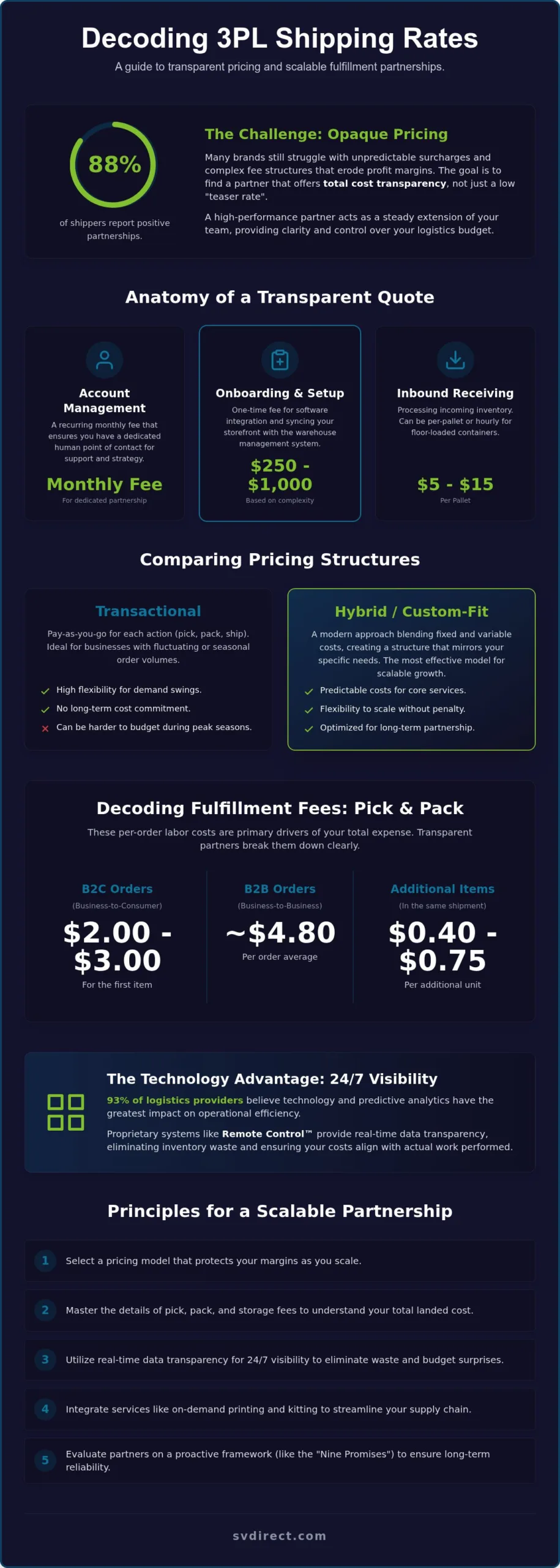
While 88% of shippers reported positive partnerships with their logistics providers in 2026, a significant number of brands still struggle with the opaque nature of 3pl shipping rates. It’s exhausting to watch your profit margins shrink because of unpredictable surcharges and multi-layered fee structures that feel impossible to calculate in advance. You’ve likely felt the sting of a monthly invoice that doesn’t quite align with your initial projections, leaving you to wonder where the efficiency went.
We believe that a fulfillment partnership should act as a steady, high-performance extension of your own team rather than a source of financial stress. In this strategic guide, you’ll learn how to master the complexities of modern pricing to optimize your supply chain and protect your hard-earned revenue. We’re going to pull back the curtain on the industry’s transparent pricing frameworks. You’ll get a clear preview of standard cost categories for warehousing, receiving, and kitting, alongside the technological tools like our Remote Control system that provide 24/7 visibility into every cent spent. By the end of this article, you’ll have the roadmap needed to secure a scalable fulfillment partner that values precision as much as you do.
Key Takeaways
- Identify the core differences between transactional and hybrid pricing models to select a structure that best protects your margins as you scale.
- Master the nuances of 3pl shipping rates by decoding how pick, pack, and tiered storage fees directly impact your total landed cost.
- Utilize real-time data transparency through proprietary systems like Remote Control™ to eliminate inventory waste and maintain 24/7 visibility into your budget.
- Discover how integrating on-demand digital printing and specialized kitting can streamline your supply chain and reduce overall shipping lead times.
- Evaluate potential partners based on a proactive “Nine Promises” framework to ensure your fulfillment provider acts as a reliable extension of your company.
Understanding 3PL Shipping Rates and Pricing Models
Calculating the true cost of logistics requires looking far beyond the price of a carrier label. Many brands fall into the trap of chasing the lowest per-package price, only to discover that hidden surcharges and inefficient manual processes erode their margins. In the current market, Third-party logistics (3PL) providers are moving away from purely transactional relationships. The industry is shifting toward technology-integrated partnerships where data transparency is just as vital as the physical movement of goods. Understanding 3pl shipping rates in 2026 means accounting for the entire lifecycle of a product, from the moment it hits the loading dock to the final delivery at a customer’s door.
A proactive fulfillment partner acts as a steady hand for your business growth. We’ve seen that 93% of logistics providers now believe technology, specifically predictive analytics and automated reporting, will have the greatest impact on operational efficiency. This technological focus helps eliminate the “teaser rate” phenomenon, where low entry prices are later inflated by unexpected administrative fees. True cost transparency allows you to calculate your total landed cost with precision, ensuring your pricing strategy remains sustainable as you scale.
The Core Components of a 3PL Quote
Every comprehensive quote begins with the logistical foundation of your account. You’ll typically encounter a one-time onboarding and account setup fee. Industry averages for 2026 generally range between $250 and $1,000, depending on the complexity of your software integrations. This fee covers the technical heavy lifting required to sync your storefront with a warehouse management system. Beyond setup, inbound receiving fees are a standard staple. Most providers charge between $5 and $15 per pallet for processing, though some may use hourly labor rates for floor-loaded containers. Finally, expect monthly administrative or account management fees. These ensure you have a dedicated human point of contact rather than an automated ticketing system, which is a hallmark of a reliable, high-performance partner.
Comparing Pricing Structures: Transactional vs. Subscription
Transactional models operate on a pay-as-you-go basis. You’re billed for each pick, pack, and ship action as it happens. This is often ideal for businesses with fluctuating seasonal volumes. On the other hand, subscription or fixed-fee models are gaining traction for high-volume shippers who require predictable monthly overhead. However, the most effective approach is often a custom-fit hybrid solution. We prioritize flexibility, moving away from “cookie-cutter” plans to create structures that mirror your specific operational needs. By using our Remote Control™ system, you gain 24/7 visibility into these costs, ensuring that your 3pl shipping rates always align with the actual work performed on the warehouse floor.
Decoding Fulfillment Fees: Pick, Pack, and Storage
Fulfillment fees represent the heartbeat of your logistics budget. While carrier charges are often pass-through costs, the internal handling fees determine the true scalability of your operations. An academic analysis of logistics pricing reveals that labor and storage are the most variable drivers of total expense. To manage your 3pl shipping rates effectively, you must understand how each item is handled from the moment an order is placed until it is loaded onto the outbound truck.
Our approach centers on precision and personal commitment. We believe that physical operations should be as organized as digital communication. By implementing a systematic QC-Check process, we eliminate the high costs associated with shipping errors. Catching a mistake at the packing station is significantly cheaper than managing a return and a reshipment. This proactive stance ensures that your profit margins remain protected while your customers receive exactly what they ordered.
Pick and Pack: Efficiency Meets Accuracy
Pick and pack fees are usually structured with a base fee for the first item and incremental charges for additional units. In 2026, industry averages for B2C orders typically range between $2.00 and $3.00 for the initial item. B2B orders, which often require more intensive handling, average closer to $4.80 per order. Adding extra items to a single shipment usually costs between $0.40 and $0.75 per unit. The complexity of your packaging requirements also influences these rates. Custom dunnage or specialized kitting requires more labor than a standard poly mailer. We utilize a “quiet facility” methodology that prioritizes focused, human oversight over high-speed, chaotic automation. This deliberate care reduces mis-picks and ensures high-resolution quality for every package.
Warehousing and Storage Optimization
Storage is not a one-size-fits-all service. Most providers offer tiered options based on how your inventory is accessed and the environmental needs of your products. Pallet storage is the standard for bulk inventory, with 2026 rates averaging $18 to $25 per pallet per month. For high-turnover items, shelf storage or pick-bins are more efficient, though they carry a higher cost per cubic foot, typically between $0.43 and $0.78. Sensitive goods, like high-value electronics, require secure environments to prevent damage or shrinkage. You can explore how we handle specialized needs across different industries and high-value goods to see how tiered storage protects your assets. If you’re ready for a partner that values transparency and operational excellence, we invite you to explore our fulfillment services for a tailored look at your logistics needs.
Technology’s Role in Optimizing Shipping Costs
Technology serves as the bridge between raw data and actionable cost savings. Without real-time visibility, 3pl shipping rates become unpredictable and difficult to manage. Our proprietary systems provide 24/7 data transparency, which is essential for brands aiming to scale without losing control over their overhead. This isn’t just about tracking a package. It’s about managing a comprehensive shipping budget through high-tech integration that identifies waste before it impacts your profit margins.
Remote Order Management and Visibility
True operational efficiency requires more than just a standard warehouse management system. It demands a tool that acts as a window into every corner of the fulfillment process. Our Remote Order Management system, known as Remote Control™, empowers you with this level of oversight. By generating over 120 standard reports, the system allows you to identify specific cost-saving opportunities that usually remain hidden in “cookie-cutter” logistics models. You can analyze order trends, shipping zones, and inventory turnover rates to ensure you aren’t paying for stagnant shelf space. This high-resolution visibility transforms your logistics from a black box into a strategic asset, allowing you to refine your 3pl shipping rates through data-driven decision-making.
Inventory Notifications and Proactive Problem Solving
Proactive management is the only way to prevent order conflicts from hurting your bottom line. We use automated alerts for low inventory, receipts, and backorders to keep your supply chain moving without interruption. While we lean on advanced software for speed, we don’t believe in total automation. High-performance logistics requires a balance between tech-forward efficiency and personal oversight. Our team provides the human element necessary to resolve complex order issues before they escalate. This combination of digital precision and human commitment builds a level of trust that automated systems simply can’t replicate. By anticipating stock-outs and managing inventory levels through 24/7 reporting, you can significantly reduce the storage waste and rush-shipping fees that often inflate your total fulfillment spend.
Specialized Fulfillment: Printing, Mailing, and Kitting Rates
Specialized fulfillment moves beyond the standard pick-and-pack model to offer bespoke solutions for complex projects. When you integrate printing and mailing directly with your logistics provider, you eliminate the need for costly transport between separate vendors. This streamlined approach significantly improves your overall 3pl shipping rates by reducing lead times and handling fees. For businesses in the healthcare and pharmaceutical sectors, this integration is even more critical. We provide the security and compliance necessary to manage sensitive materials with precision. Our systematic QC-Check process ensures that literature, manuals, and press kits are assembled with 100% accuracy before they ever reach a carrier. This steady hand approach alleviates the stress of business growth through personal commitment and operational readiness.
On-Demand Digital Printing and Literature Fulfillment
Traditional offset printing often forces brands into high-volume runs that lead to obsolete inventory and wasted capital. We solve this through print on demand services using HP Indigo 5500 technology. This system delivers real liquid ink quality for short runs, allowing for just-in-time production. By printing only what you need, you eliminate the storage costs associated with outdated brochures or manuals. This tech-forward approach ensures your materials are always current and high-resolution. It also allows for Variable Data Printing (VDP), which makes personalized direct mail marketing highly cost-effective by targeting specific recipients without the overhead of massive print batches.
Kitting, Assembly, and Specialized Mailing
Promotional kits and subscription boxes require a human touch that automated systems can’t provide. Kitting and assembly charges are typically labor-based, reflecting the complexity of the project. In 2026, a standard kit containing three to five components generally costs between $2.00 and $4.50. More intricate assemblies can range from $0.50 to over $8.00 depending on the manual effort involved. General labor for special projects like custom labeling or quality inspections typically costs between $35 and $60 per hour in the current market. Consolidating these specialized tasks under one roof helps stabilize your 3pl shipping rates against market volatility. Our specialized mailing services include inkjet addressing, tabbing, and machine insertion to ensure your campaigns are professional and compliant. You can learn more about how we handle these complex projects by exploring our specialized fulfillment services.
Choosing a 3PL Partner for Long-Term Scalability
Selecting a logistics partner involves a fundamental shift in mindset. You aren’t just hiring a vendor; you’re choosing an extension of your company. While it’s tempting to focus solely on finding the absolute lowest 3pl shipping rates, the cheapest per-pick fee often masks the high cost of inefficiency. A partner who operates with quiet confidence and a proactive culture provides a level of stability that a commodity warehouse cannot match. This relationship is built on our “Nine Promises,” ensuring that transparency and flexibility remain at the forefront of every interaction. We believe that physical operations must be just as organized as the digital communication provided by our Remote Control™ system.
The atmosphere of a fulfillment center tells you everything about how they’ll handle your brand. Many facilities are hectic, reactive environments where speed is prioritized over accuracy. We believe in a deliberate, organized approach. A “quiet facility” methodology ensures that each order receives personal oversight and precision. This methodical rhythm reduces the stress of business growth. By choosing a partner located in a global innovation hub, you ensure your business maintains the connectivity needed for worldwide reach without the chaos of a disorganized facility.
The 3PL Selection Checklist
When evaluating potential partners, move beyond the spreadsheet. First, verify the facility atmosphere. Is it chaotic or structured? A structured environment is a hallmark of internal stability and expert-level service. Second, assess their technical capabilities. A high-performance partner must handle custom API and XML integrations to ensure seamless data flow. Finally, review their specialized expertise. If you operate in the healthcare or literature sectors, you need a team that understands the specific compliance and security requirements of those industries. This specialized knowledge is a powerful differentiator that automated, one-size-fits-all providers simply can’t offer.
Transitioning from In-House to Professional 3PL
Scaling past in-house fulfillment is a significant milestone. To understand the transition’s value, you must calculate the “true cost” of your current operations. This includes not just labor, but rent, utilities, insurance, and the management time lost to logistical hurdles. Once you see the total overhead, the shift to professional fulfillment services becomes a clear strategic advantage. Planning the inventory transfer and technical integration phase requires a steady hand. Investing in quality and flexibility will always yield a better return than chasing the lowest 3pl shipping rates at the expense of your brand’s reputation. A proactive attitude, backed by physical infrastructure and human expertise, ensures your supply chain remains a competitive asset as you scale.
Securing Your Logistics Future with Data-Driven Precision
Success in 2026 depends on choosing a partner that values transparency as much as you do. By integrating advanced reporting with a deliberate, human-centric facility, you can eliminate the waste that often hides in complex fee structures. Mastery of your 3pl shipping rates starts with visibility into every pick, pack, and storage tier. It’s time to stop guessing about your landed costs and start leveraging data-driven precision to protect your profit margins.
Silicon Valley Direct has been a stable force in the industry since 1999. Our proprietary Remote Control™ system offers over 120 reports to keep your budget on track and your inventory moving efficiently. We don’t just move boxes; we build durable partnerships designed for long-term scalability. You deserve a fulfillment team that acts as a proactive extension of your brand, providing high-resolution quality through every stage of your business growth.
We’re ready to help you optimize your supply chain and reduce unnecessary overhead. Let’s build a more efficient, scalable future together.
Frequently Asked Questions
How are 3PL shipping rates typically calculated?
Rates are calculated through a layered framework that includes receiving fees, storage costs, and pick-and-pack labor. While the carrier charge is a pass-through cost, your total 3pl shipping rates are influenced by package weight, dimensions, and destination zones. Most providers use a transactional model where you pay for specific actions. This structure ensures that you only pay for the resources your business actually consumes during the fulfillment process.
What are the hidden costs in a 3PL fulfillment quote?
Unexpected expenses often arise from secondary services like returns processing, custom labeling, or monthly account management fees. Many quotes also omit the costs of specialized packaging materials or the hourly rates for special projects like quality inspections. To avoid surprises, look for a provider that offers 24/7 data transparency through a system like Remote Control™. This level of visibility ensures that every surcharge is documented and every operational cent is accounted for in advance.
Is variable data printing significantly more expensive than static printing?
Variable data printing (VDP) is highly cost-effective because it eliminates the need for massive, static print runs that often result in obsolete inventory. By using high-tech digital equipment like the HP Indigo 5500, we can customize each piece of mail during a single production run. This just-in-time approach reduces storage waste and ensures that your marketing materials remain high-resolution and current without the overhead of traditional offset printing.
How does a 3PL handle international shipping and global logistics?
We leverage long-standing relationships with global carriers to negotiate better rates for international shipments. Our technical integrations allow for automated customs documentation and real-time tracking across borders. By acting as a steady hand for your global expansion, we ensure that your products move through international customs with precision. This proactive oversight reduces the risk of delays and ensures that your global customers receive the same high-quality experience as domestic ones.
What is the difference between pick and pack fees and kitting fees?
Real-time visibility prevents the financial drain of overstocking and the high costs of rush-shipping backordered items. When you have 24/7 access to inventory levels, you can make informed decisions about restocking and storage tiers. Our Remote Control™ system provides over 120 reports to help you identify stagnant inventory before it incurs excessive storage fees. This proactive management keeps your supply chain lean and your fulfillment budget predictable.
Can a 3PL handle specialized healthcare and pharmaceutical mailing?
We specialize in healthcare mailing services that require strict compliance and high-security protocols. Our systematic QC-Check process ensures that sensitive materials, such as pharmaceutical literature or medical kits, are handled with total accuracy. This human-centric approach is a powerful differentiator in a market saturated with automated, impersonal providers. We combine a multi-decade history with modern infrastructure to ensure that every healthcare shipment meets the highest standards of precision and personal commitment.
How long does it take to onboard a new account with a 3PL?
Onboarding typically takes between two and four weeks, depending on the complexity of your digital integrations and inventory volume. This phase includes syncing your eCommerce storefront with our management software and establishing your customized reporting parameters. While setup fees in 2026 often range from $250 to $1,000, this investment ensures a seamless transition. A methodical onboarding process is the foundation of a reliable, high-performance partnership that supports your long-term business growth.