



International Shipping and Customs Compliance: A Practical Guide
A shipment can be packed correctly and still lose momentum at the border if its paperwork contains incomplete or inconsistent details. Reliable international shipping and customs compliance starts with accurate shipment data and clear ownership at each handoff, from the seller and fulfillment operation to the carrier and customs representative.
It’s understandable to be unsure which documents to prepare, how specifically to describe a product, and who is responsible for each clearance task. This guide breaks those questions into practical steps so you can validate shipment details, reduce avoidable errors, and build a workflow that fits your order volume and destinations.
You’ll learn how core documents such as the commercial invoice, packing list, and transport document fit into the process, which product and order details need to stay consistent, and how to clarify responsibilities across your shipping partners. For businesses coordinating fulfillment and global shipping, Silicon Valley Direct’s Remote Control system provides order and inventory visibility to support organized operational handoffs. Customs-clearance responsibilities remain a separate part of the process.
Key Takeaways
- Reliable international shipping and customs compliance depends on accurate, consistent shipment details and clear responsibility at each handoff.
- Prepare product descriptions, quantities, values, parties, classification information, and country-of-origin details with care.
- Understand how agreed delivery terms shape who manages transport tasks, costs, and risk.
- Build a repeatable workflow with an owner for each task and a clear path for resolving unanswered questions.
- Organized fulfillment and shipping coordination can support cleaner operational handoffs, while order and inventory visibility helps teams stay aligned.
What International Shipping and Customs Compliance Involves
Customs compliance is the preparation and handling of information needed to meet applicable requirements for goods moving across an international border. It is connected to international transportation, but it is not the same as choosing a route or arranging delivery. A shipment can be moving as planned while its product information, supporting documents, or clearance handoff still needs attention.
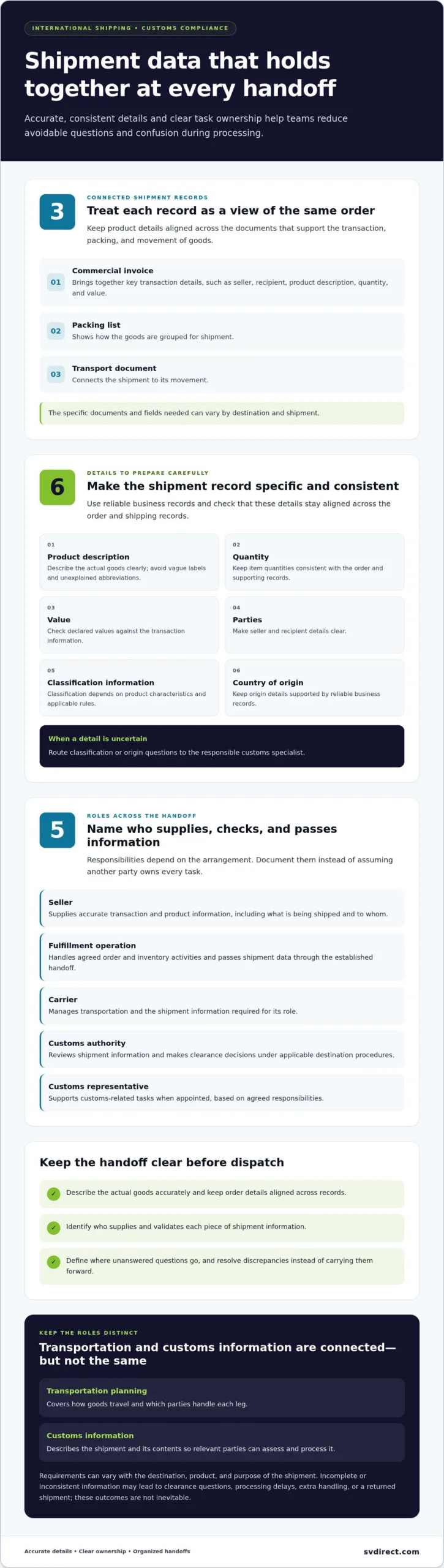
Transportation planning covers practical decisions such as how goods will travel and which parties will handle each leg. Customs information describes the shipment and its contents so the relevant parties can assess and process it. Customs authorities make clearance decisions under the destination’s applicable procedures. The seller, fulfillment operation, carrier, and any customs representative each have separate roles in supplying or passing along information. An overview of customs regulations and procedures provides useful background, but shipment requirements depend on the destination and goods.
For an online order, a vague product description or a mismatch between the item, quantity, and declared value can prompt questions or interrupt processing. Clear, consistent data gives each party a more reliable basis for its part of the handoff. Describe the actual goods accurately, keep order details aligned across records, and identify who will provide and validate each piece of information before the shipment moves forward.
Requirements can vary with the destination, product, and purpose of the shipment. A commercial sale, a sample, and a return may involve different information needs. The practical guidance in this section helps teams organize shipment details and responsibilities. It is not legal advice or a substitute for checking current destination-specific requirements with official sources.
Why Customs Information Matters for an International Shipment
Incomplete or inconsistent information may lead to clearance questions, processing delays, extra handling, or a returned shipment. These outcomes aren’t inevitable, but checking shipment data before handoff can reduce avoidable confusion. Treat each shipment as its own record, and resolve discrepancies between the order, product details, and shipping information rather than carrying them forward.
The Main Parties and Their Roles
Clear ownership helps prevent gaps. The exact division of work depends on the arrangement, so document who supplies and validates each data element instead of assuming another party owns it.
- Seller: Supplies accurate transaction and product information, including what is being shipped and to whom.
- Fulfillment operation: Handles agreed order and inventory activities and passes shipment data through the established handoff.
- Carrier: Manages transportation and the shipment information required for its role.
- Customs authority: Reviews shipment information and makes clearance decisions under applicable destination procedures.
- Customs representative: Supports customs-related tasks when appointed, based on the agreed responsibilities.
International shipping and customs compliance works best as a coordinated process, not an assumption that one partner owns every obligation. A written responsibility map gives the team a practical starting point: name the information owner, identify who checks it, and define where unresolved questions go before dispatch.
Which Shipment Details and Documents Need Careful Preparation?
Good shipment records start with product and order information that describes the goods accurately and consistently. The commercial invoice commonly brings key transaction details together, including the seller and recipient, product description, quantity, and value. Packing information shows how the goods are grouped for shipment, while the transport document connects the shipment to its movement. The specific documents and fields needed can vary by destination and shipment.
Consistent product descriptions across the commercial invoice, packing information, and transport records help reduce discrepancies that can prompt questions during shipment processing. Treat these records as connected views of the same order, not as forms to complete independently. A product name that makes sense in an online catalog may be too broad for a shipment record. For example, “accessory” gives little context. A plain-language description identifying the item and its function is more useful, provided it accurately reflects the goods.
Product Descriptions, Classification, and Origin
Describe each item clearly enough that someone unfamiliar with your catalog can understand what it is. Avoid vague labels, unexplained internal abbreviations, or descriptions that cover unlike products with one broad term. Product classification organizes goods according to applicable classification rules, and the appropriate result depends on the product’s characteristics and those rules. Country-of-origin information identifies where the goods originate for shipment documentation purposes. Keep both details supported by reliable business records, and route uncertain classification or origin questions to the responsible customs specialist.
Build product data from a maintained source record rather than retyping it for every order. Include the approved description, unit of measure, classification information, and origin details where required for the shipment. Keep the source and date of any review with the record, so the team can identify which information was used if a question arises. Don’t guess at a classification or infer origin from the location where an order is packed.
A Simple Pre-Dispatch Data Validation
Before release, compare the order record with the commercial invoice, packing information, and shipping label. Check the details that identify the goods and destination, then resolve discrepancies instead of allowing different records to retain conflicting versions.
- Product details: Confirm descriptions match the actual items and remain consistent across records.
- Counts and values: Compare quantities and declared values with the order and packing details.
- Parties and destination: Check seller, recipient, and delivery information for accuracy.
- Shipment references: Align order identifiers and package details wherever they appear.
- Open questions: Assign unresolved product or destination questions to the designated customs specialist before dispatch.
This check supports international shipping and customs compliance by making data ownership visible and catching preventable mismatches before handoff. For recurring orders, retain approved product records and update them through a defined review process when an item or its source information changes. This gives the seller and fulfillment operation a dependable information set for preparing shipment records with fewer manual inconsistencies.
How to Compare Shipping Terms and Compliance Responsibilities
Agreed delivery terms help define how the seller and buyer divide specified transport tasks, costs, and risk. They give the commercial arrangement a shared framework, but they don’t replace accurate shipment information or destination-specific checks. A useful distinction is this: shipping terms allocate agreed responsibilities between parties, while customs compliance concerns the shipment information and procedures applicable to goods entering or leaving a destination. Keep those workstreams connected, but don’t assume one settles every responsibility in the other.
What Incoterms Help Businesses Clarify
Incoterms are standardized terms used in sales to clarify specified responsibilities between buyer and seller. Their meaning depends on the particular term, its edition, and the contract wording. Don’t interpret any one term as automatically transferring every customs task or obligation. Before explaining a selected term in an order workflow, verify its current edition and how the sales contract applies it. That precision helps teams avoid relying on shorthand or assumptions.
Compare the Workflow, Not Just the Label
The arrangements below are practical workflow patterns, not formal definitions of particular delivery terms. The contract and destination determine the actual allocation. Use the comparison to identify where your team needs clear owners and handoffs.
Seller-managed: The seller arranges more of the transport process and has greater control over the customer-facing shipping experience. This can concentrate coordination work with the seller, so teams should define who supplies shipment information and who handles each customs-related task.
Buyer-managed: The buyer arranges more of the transport process, which may give the buyer more direct control over those arrangements. The seller still needs to provide accurate product and order information for the agreed handoff. Document how and when that information reaches the buyer or its designated representative.
Coordinated: The parties divide transport activities through an agreed process. This can support shared visibility, but only if responsibilities are explicit. Record who books or coordinates each movement, who provides the data, and who handles questions that arise before dispatch.
Choose a Workflow That Fits the Operation
Assess order volume, destination mix, product complexity, and internal expertise together. A business shipping a consistent range to a focused set of destinations may need a different coordination model from one handling varied products and markets. Also consider customer experience: who communicates shipment progress, and who receives questions that require action? These decisions shape workload and visibility as much as control.
Write the handoff down. For each task, name the owner, the information they need, when they need it, and where unresolved questions go. This reduces duplicate requests and helps prevent important work from falling between parties. Review the arrangement when products, destinations, or contract wording change.
In international shipping and customs compliance, a clear division of work supports coordination, but it doesn’t validate product data or determine a customs authority’s decision. Keep those checks distinct from transport planning, and make sure each party understands its agreed role before a shipment is released.
How to Build a Repeatable International Shipping Compliance Workflow
A repeatable workflow turns shipment preparation into a sequence of owned tasks, rather than a last-minute document chase. The steps below create clear checkpoints from destination review to recordkeeping. Tailor the process to each route and product, and keep current destination-specific requirements separate from general operating procedures.
A Five-Step Pre-Dispatch Process
- Define the shipment. Record the destination, shipment purpose, products, and parties involved. Identify who supplies product and transaction details, who prepares the shipment information, and who handles customs-related questions.
- Review destination needs. Identify which current requirements apply to the planned route and goods, using official destination sources or the responsible customs specialist. Note any documents or data points the team needs before preparing the shipment.
- Collect and validate information. Bring together the approved product details, order data, recipient information, quantities, values, and packing information needed for the shipment. Compare the records for mismatches and assign an owner to resolve each one.
- Prepare and check the handoff. Prepare the applicable shipment records and confirm that the carrier and any customs representative receive the information assigned to them. Before dispatch, compare the order, product, shipment, and recipient details across records. Pause the handoff if a material discrepancy remains unresolved.
- Retain the record. Store the final shipment information and supporting business documentation in a consistent location. Record the responsible parties and any decisions or corrections so the team can trace what information was used.
Make the process usable on busy fulfillment days. A short record for each shipment can show the task owner, completion status, unresolved questions, and next action. That visibility helps teams distinguish between work that is complete and information still awaiting review, without treating transportation updates as customs decisions.
Managing Holds, Exceptions, and Process Updates
Set an escalation path before an exception occurs. For example, route missing product data to its data owner, destination questions to the assigned customs specialist, and transport exceptions to the person coordinating the carrier handoff. Record the issue, who owns the next action, and when the relevant parties were notified. Share status changes promptly so teams don’t act on outdated information.
After a hold or recurring discrepancy, review what caused it and update the process where appropriate. If the issue came from an unclear product record, correct the source data. If ownership was uncertain, revise the responsibility map. Revisit the workflow when a destination requirement, product detail, shipment purpose, or partner handoff changes. This keeps international shipping and customs compliance procedures aligned with actual operations rather than assumptions.
How Silicon Valley Direct Supports International Fulfillment Handoffs
International orders involve connected but distinct work: fulfilling the order, coordinating its movement, and handling customs-related responsibilities. Silicon Valley Direct supports eCommerce fulfillment and global shipping coordination, helping organize operational handoffs among the seller, fulfillment operation, and shipping parties. Customs-clearance tasks remain distinct from fulfillment and shipping coordination, and each party follows its assigned responsibilities.
Connecting Order Fulfillment with Shipping Coordination
When order and inventory information is organized alongside fulfillment activity, teams have a clearer operational starting point for preparing a shipment handoff. For example, order details and inventory records can help teams align the items being fulfilled with the order moving into shipping coordination. The parties can then follow their agreed process for supplying shipment data and managing customs-related questions.
Silicon Valley Direct’s eCommerce fulfillment services connect fulfillment operations with logistics coordination. The value is a more structured handoff, not a replacement for customs-clearance decisions. Businesses still need defined owners for the information and tasks required for each destination and shipment.
A tailored workflow can establish what information moves with an order, which party supplies it, and how unresolved questions are routed. That structure matters as a business serves different destinations or handles a mix of B2B and B2C shipments. Destination planning remains specific to the goods and route, while fulfillment and shipping coordination provide the operational framework for moving each order through its assigned steps.
Visibility, Communication, and a Practical Next Step
Remote Control provides access to orders, order progress, order histories, real-time inventory, and reporting. This visibility can help teams review fulfillment activity and keep order and inventory information accessible across operational handoffs. It is not a customs-status tracker, and it doesn’t determine whether a shipment has cleared customs.
That distinction keeps expectations clear. The system supports order and inventory visibility; customs-related questions and decisions belong with the responsible parties for the shipment. Proactive communication and documented ownership help those parties coordinate when information needs attention. Silicon Valley Direct has supported fulfillment operations since 1999, bringing long-standing experience to tailored workflows and client partnerships.
For businesses reviewing how international orders move from fulfillment into shipping coordination, a project-specific discussion can help shape a workflow around order volume, destinations, and operational handoffs. Silicon Valley Direct can discuss a tailored fulfillment approach and the next steps for your global shipping needs.
Make Your Next Cross-Border Step With Confidence
Use your next growth decision to make international shipping and customs compliance a practical part of the operating plan, not a scramble at dispatch. Start by identifying the destinations and order types you want to support, then map the handoffs that need to work reliably as that mix evolves. A well-designed fulfillment workflow can give your team a steadier foundation for serving customers across borders.
The right setup should reflect how your business actually operates: its order patterns, product range, customer experience priorities, and internal capacity. Silicon Valley Direct works with businesses to shape fulfillment and global shipping coordination around their operational needs, with a focus on clear communication and long-term partnership. A project discussion can help turn your goals into a workable next step.
With a thoughtful plan and the right operational support, your team can approach international growth with greater clarity and confidence.
Frequently Asked Questions
Can a shipment be delayed even when its paperwork appears complete?
Yes. A document set can look complete while still containing conflicting details, such as an order showing one quantity and packing information showing another. A destination may also require information tied to the product or shipment purpose. For international shipping and customs compliance, compare the source order with prepared records before dispatch, then route questions to a named owner. This can reduce avoidable mismatches, but it can’t prevent every hold.
What information is usually needed for an international shipment?
Preparation commonly involves accurate sender and recipient details, product descriptions, quantities, values, origin information, and packing details. For example, a shipment record should identify the actual item rather than rely on an internal product nickname that an outside party may not recognize. The exact fields and documents depend on the goods, destination, and shipping arrangement. Keep records consistent, and use appropriate official guidance to verify current destination requirements.
Who is responsible for customs compliance in an international sale?
Responsibility depends on the transaction, agreed shipping terms, applicable requirements, and the parties involved. A seller might supply product data, while a buyer or appointed customs representative handles a separate task. The carrier and fulfillment operation also have defined roles, but their involvement doesn’t automatically transfer every responsibility. Create a responsibility record naming who supplies, validates, and submits each information item, then note who resolves questions when an owner is unavailable.
How do Incoterms affect international shipping responsibilities?
Incoterms help buyers and sellers agree on specified delivery responsibilities and the allocation of certain costs and risks. They don’t replace accurate shipment information or settle every customs obligation by themselves. The selected term, its edition, and the sales contract wording all matter. For a practical example, make sure the term recorded in the sales agreement matches the one used by staff coordinating the shipment, and interpret it in that transaction’s context.
What happens if a product’s customs classification is incorrect?
An incorrect classification can raise questions about a shipment and may lead to delays, reassessment, or other consequences under applicable requirements. The right classification depends on the product’s characteristics and relevant rules, so a familiar category name isn’t enough reason to assume a result. Keep accurate product records, including details that distinguish similar items, and refer uncertain classifications to a qualified customs specialist. Avoid guessing a code or predicting a specific penalty.
Can a fulfillment provider handle international shipping without acting as a customs broker?
Yes. A fulfillment provider can organize orders, inventory, and transportation handoffs while customs brokerage remains a separate function. The division depends on the agreed service arrangement. For example, a fulfillment operation may coordinate an order’s movement and pass along shipment information, while another designated party handles customs-specific submissions or decisions. Document who prepares each data item and who owns customs questions. Logistics coordination alone doesn’t guarantee customs clearance.