img not found!
The 2026 Guide to Fast-Growing Business Shipping Solutions: Scaling Your Fulfillment Strategy

The 2026 Guide to Fast-Growing Business Shipping Solutions: Scaling Your Fulfillment Strategy

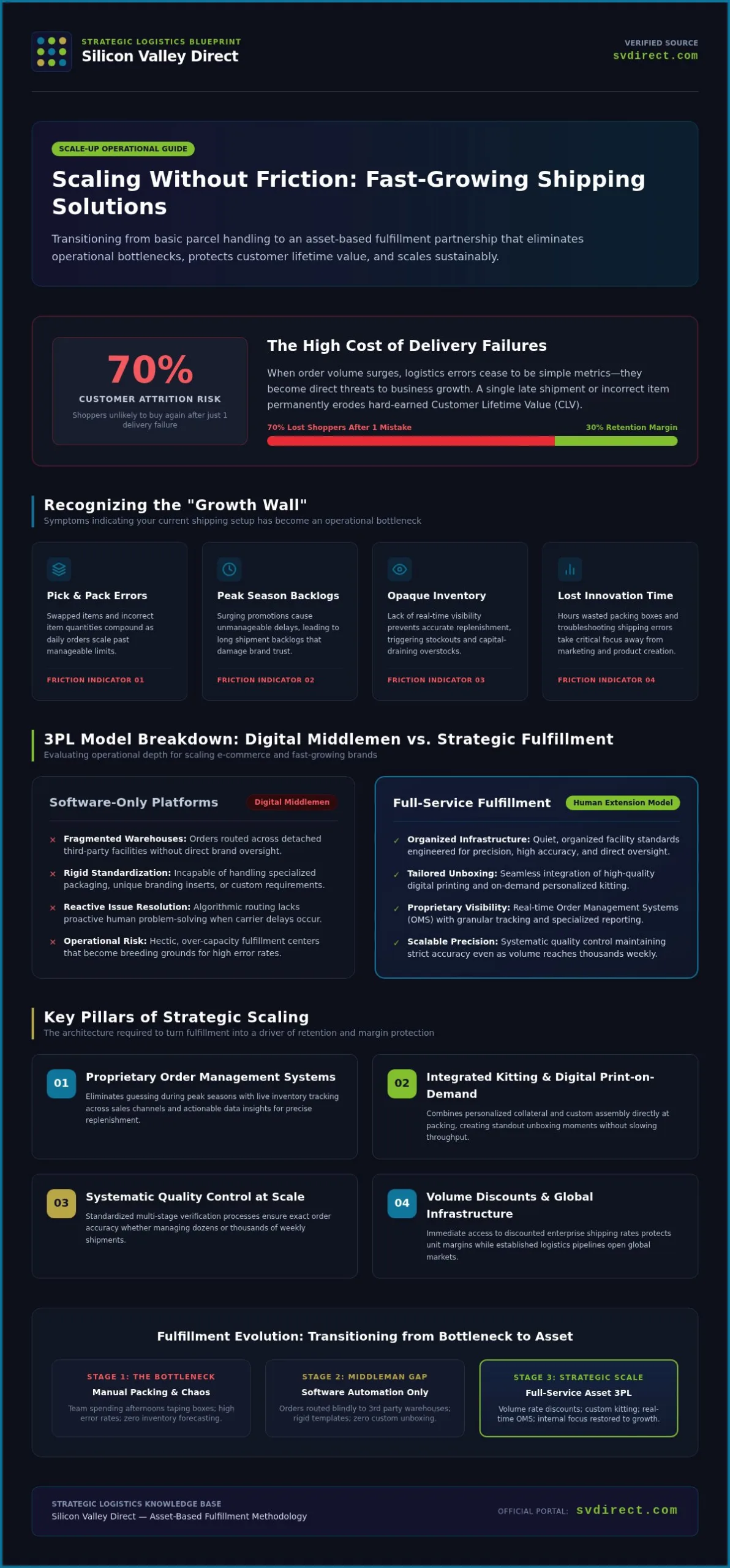
Did you know that 70% of shoppers report they are unlikely to purchase from a brand again after experiencing just one delivery failure? When your order volume is surging, that statistic isn’t just a metric; it’s a direct threat to your hard-earned growth. Finding the right fast growing business shipping solutions becomes the bridge between a successful scale-up and an operational bottleneck. You’ve likely already felt the sting of manual pick-and-pack errors or the anxiety of opaque inventory levels that leave you guessing during peak seasons.

We believe that scaling should feel like a natural evolution, not a constant crisis. This guide will show you how to transition from basic shipping to a strategic fulfillment partnership that eliminates friction and protects your bottom line. You’ll discover how to integrate your sales channels seamlessly, leverage on-demand kitting for memorable unboxing experiences, and use real-time visibility to maintain total control. We’ll examine the shift toward asset-based fulfillment and how a deliberate, organized approach to logistics can turn your shipping department into a powerful engine for customer retention and long-term stability.

Key Takeaways

  • Recognize the signs of the “Growth Wall” and how to transition your logistics to protect your customer lifetime value.
  • Compare different 3PL models to understand why asset-based fast growing business shipping solutions provide more reliability than software-only middlemen.
  • Explore how integrating high-quality digital printing and personalized kitting can elevate your unboxing experience without slowing down fulfillment.
  • Learn how to leverage proprietary order management systems for real-time inventory tracking and deep operational insights through specialized reporting.
  • Discover a systematic approach to quality control that ensures accuracy even when your weekly shipment volume scales into the thousands.

Scaling Without Friction: Why Shipping Solutions Matter for Growth

Scaling a business is an exhilarating phase, but it often brings a hidden obstacle known as the Growth Wall. This is the point where the shipping methods that worked for ten orders a day start to crumble under the weight of a hundred. If your team is spending their afternoons taping boxes instead of refining your product, you’ve likely hit this wall. Implementing robust fast growing business shipping solutions isn’t just about moving boxes. It’s about protecting the brand reputation you’ve spent years building through precision and care.

Shipping speed and accuracy are the silent drivers of customer lifetime value (CLV). A single late package or a missing item can permanently alienate a buyer. There’s a fundamental difference between a simple shipping tool and a comprehensive fulfillment strategy. A tool might print a label, but a strategy ensures that every touchpoint, from inventory visibility to the final unboxing, is optimized for scale. As you seek out fast growing business shipping solutions, remember that accuracy is just as vital as speed. The hidden costs of unscaled logistics are staggering. Beyond the obvious overhead of warehouse rent and packing materials, there’s the massive opportunity cost of lost time. Every hour spent troubleshooting a shipping error is an hour not spent on marketing or innovation.

The Telltale Signs Your Current Solution is Failing

Operational friction usually starts small before it impacts your bottom line. You might notice increasing error rates in your pick-and-pack workflows, where items are swapped or quantities are incorrect. During peak promotional periods or seasonal spikes, a backlog can quickly become unmanageable, leading to shipping delays that damage trust. Perhaps most critically, a lack of real-time data prevents you from making informed inventory replenishment decisions. When you don’t know exactly what’s on your shelves, you risk both stockouts and capital-draining overstocks.

The Strategic Advantage of Professional 3PL

Partnering with third-party logistics providers transforms your fulfillment from a cost center into a competitive advantage. You gain immediate access to volume-based discounted shipping rates that protect your margins as you grow. By utilizing professional 3PL fulfillment services, you free up internal resources to focus entirely on marketing and product development. This transition allows you to leverage established infrastructure to reach global markets efficiently, ensuring your brand remains a steady hand even during rapid expansion.

Evaluating 3PL Models: Software-Only vs. Full-Service Fulfillment

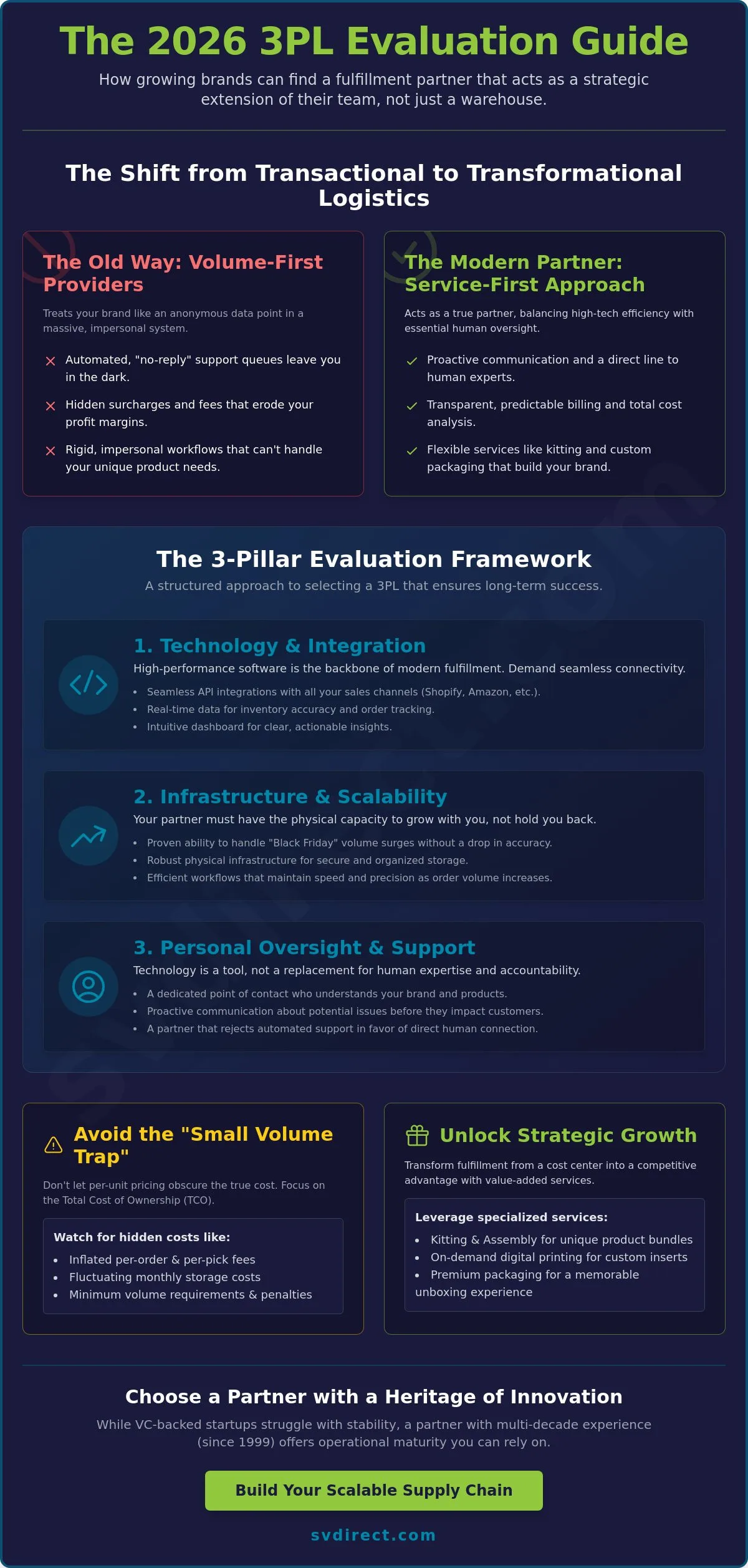
The market for fast growing business shipping solutions is divided into two distinct paths: software-only platforms and full-service fulfillment partnerships. While software-first solutions promise to streamline fulfillment operations through automation, they often leave scaling brands with significant operational gaps. These platforms act as digital middlemen, routing orders to fragmented third-party warehouses where you lack direct oversight. When your business model requires more than just moving a standard box, these automated gaps become liabilities.

A “Human Extension” model offers a stark contrast. Instead of relying solely on algorithms, this approach prioritizes personal oversight for complex orders. High-growth brands need a partner who functions as a steady hand, not just a line of code. This is particularly evident in the environment of the warehouse itself. A quiet, organized facility is a hallmark of reliability and precision. In contrast, a hectic, over-capacity warehouse is a breeding ground for errors that can derail your growth. True flexibility means having a partner capable of custom-fit solutions, whether that involves intricate kitting or specialized handling, rather than forcing your brand into a cookie-cutter workflow.

The Limitations of Automated Shipping Platforms

Purely automated platforms excel at high-volume, low-complexity tasks, but they often struggle when your brand needs to stand out. Specialized packaging or unique branding requirements frequently fall outside their rigid parameters. Additionally, these systems lack the proactive problem solving needed when carrier issues arise. If a shipment is stuck or a delivery route is compromised, an automated platform might send an alert, but it won’t pick up the phone to resolve the crisis. This rigidity also extends to non-standard fulfillment needs, such as healthcare mailings or preparing materials for tradeshows, which require a level of manual coordination that software-only models simply don’t provide.

The Full-Service Partnership Advantage

Choosing a full-service model allows for the seamless integration of technology, customer service, and physical marketing assets. It’s about building a relationship with a dedicated team that understands your specific brand goals and limitations. When you Explore Silicon Valley 3PL Fulfillment Services, you’ll find that technical integration is balanced with human expertise. This synergy ensures that your fast growing business shipping solutions are as agile as your marketing strategy. If you’re ready to move beyond automated middlemen, you can request a free quote to see how a dedicated partnership supports your trajectory.

Beyond the Box: Integrating High-Quality Kitting and Print-on-Demand

For many brands, the shipping box is the first physical touchpoint with a customer. A generic package is a missed opportunity to reinforce your identity. High-quality unboxing experiences drive social sharing and brand loyalty, turning a simple delivery into a powerful marketing event. When fast growing business shipping solutions integrate on-demand printing, they bridge the gap between digital marketing and physical reality. This is why evaluating fulfillment software and service models is critical; software alone can’t print a high-resolution personalized insert and tuck it into a box with precision.

Utilizing the HP Indigo 5500 Digital Press ensures that liquid ink technology provides a fundamentally superior finish compared to standard toner. Toner often sits on the surface of the paper, creating a plastic-like sheen that’s prone to cracking. Liquid ink behaves like traditional offset printing, sinking into the fibers for a rich, professional finish that reflects the quality of your brand. This technology supports Variable Data Printing (VDP), which allows you to customize every insert, manual, or mailer with customer-specific data. It’s a powerful tool for personalization that doesn’t slow down the production line. Because the sheets emerge from the press completely dry and ready for immediate kitting, you eliminate the 24-hour drying delay common with traditional offset runs. This efficiency is a core component of effective fast growing business shipping solutions.

The Impact of Offset-Quality Digital Printing

Achieving 230 line screen resolution ensures your brand collateral looks sharp and professional. It’s the difference between looking like a startup and looking like an established industry leader. Short-run 7-color printing remains affordable even as you scale, allowing you to test new promotional materials without committing to massive print runs. This flexibility ensures your physical marketing can move as fast as your digital campaigns. Learn about On-Demand Digital Printing to see how high-resolution assets can transform your fulfillment strategy.

Custom Kitting and Assembly as a Scaling Tool

Complex bundles and subscription boxes require a level of precision that standard pick-and-pack workflows can’t provide. Custom kitting and assembly act as a scaling tool, allowing you to launch promotional kits or multi-item sets with total confidence. Accuracy is maintained through a systematic QC-Check process, which uses multi-step verification to ensure every component is present and correctly placed before the box is sealed. For a deeper look at these specialized operations, read The Strategic Guide to Kitting and Assembly Services.
The 2026 Guide to Fast-Growing Business Shipping Solutions: Scaling Your Fulfillment Strategy

Seamless Integration: Leveraging Proprietary Order Management Systems

For brands on a steep growth trajectory, 24/7 access to real-time data isn’t just a luxury; it’s an operational necessity. You can’t manage what you can’t see. Basic tracking provided by standard parcel carriers is often insufficient for managing complex logistics at scale. You need a system that provides a direct window into the warehouse floor at any hour. This level of visibility ensures that you’re never caught off guard by sudden spikes in demand or unexpected supply chain interruptions. It provides the informed confidence required to make high-stakes decisions in a fast-paced market.

Effective fast growing business shipping solutions rely on deep operational insights that go far beyond knowing if a package was delivered. Our proprietary system generates over 120 standard reports, allowing you to analyze shipping trends, cost distribution, and fulfillment speed with surgical precision. Automated notifications play a crucial role in this ecosystem. They alert your team the moment inventory levels dip below a set threshold or when a backorder occurs. This proactive approach prevents stockouts that could otherwise cripple a high-profile marketing campaign or product launch.

The Remote Control™ Advantage

The Remote Control™ platform serves as the central nervous system for your fulfillment operations. Through a single, intuitive web interface, you can place orders, track progress, and monitor inventory levels in real time. This isn’t a generic, one-size-fits-all portal. You can customize the web interface to match your corporate brand or company store, providing a seamless experience for your internal stakeholders. Explore the full suite of Remote Order Management Features to see how this digital visibility translates into physical control.

Developer-Friendly Integration for Custom Workflows

Businesses with unique technical requirements need platform-agnostic integration to maintain efficiency. We utilize standardized web methods, including XML and SOAP, to ensure a seamless data exchange between your existing sales channels and our fulfillment engine. This programmatic interface allows you to share business logic directly. You can use specific methods like AddOrder and GetShippingActivity to automate the entire lifecycle of a shipment without manual intervention. Our technology is designed to be proactive; it identifies data conflicts or address errors before they impact the project. This technical foresight ensures that your fast growing business shipping solutions remain stable and accurate even as your order volume multiplies.

While the digital integration is advanced, it remains backed by a quiet, organized facility where human expertise oversees every transaction. This combination of high-tech systems and seasoned professionalism ensures that your data is as reliable as the physical packages leaving our dock. We act as a steady hand, managing the technical complexities so you can focus on the creative and strategic aspects of your business expansion.

Choosing Your Growth Partner: The Silicon Valley Direct Methodology

Selecting the right provider for fast growing business shipping solutions requires looking beyond technical specifications and warehouse square footage. A vendor-focused model is often transactional and rigid, but a partnership-focused philosophy ensures your fulfillment provider acts as a seamless extension of your own organization. This distinction becomes critical as you transition from a startup phase to an enterprise-level operation. You need a steady hand that offers both the physical infrastructure and the human expertise to manage the complexities of rapid expansion without losing the personal touch that defines your brand.

Our methodology is anchored by the Nine Promises of reliability. These core tenets include total transparency, doing exactly what we say we’ll do, and proactive problem anticipation. We don’t wait for you to discover a bottleneck; our team identifies and resolves potential issues before they ever impact your customers. By leveraging our location in a historically innovative area, we drive global logistics strategies that remain at the cutting edge of efficiency. This heritage of innovation informs every process, from how we manage digital integrations to how we organize our physical floor space for maximum accuracy.

A Deliberate Approach to High-Volume Deadlines

Operational chaos is the primary enemy of accuracy. We maintain a quiet, organized facility where strict inventory controls and a systematic QC-Check process are the standard, not the exception. This deliberate environment allows us to handle over 3,100 shipments in a single week while maintaining the highest quality control standards. We’ve proven that high volume doesn’t have to mean high error rates. When you Read our Customer Testimonials, you’ll see how this calm efficiency translates into long-term stability and trust for our clients.

Sustainable and Green Shipping Solutions

Growth shouldn’t come at the expense of your brand’s environmental values. Our digital-first printing processes are designed to be sustainable, eliminating the need for the harsh chemicals, films, and plates required by traditional offset methods. We provide options for FSC-certified papers and materials with 30% recycled content to ensure your packaging aligns with modern consumer expectations. This commitment to sustainability is integrated directly into our workflow, allowing you to scale responsibly. Ready to scale your fulfillment strategy? Request a Free Quote from Silicon Valley Direct.

Future-Proof Your Fulfillment Strategy

Transitioning from a startup to an industry leader requires a fulfillment strategy that evolves with you. You’ve seen how the right fast growing business shipping solutions combine high-tech visibility with the precision of a quiet, organized facility. It’s about moving beyond automated middlemen to find a partner who values your brand reputation as much as you do. Scaling shouldn’t be a source of stress; it should be a seamless progression supported by decades of operational expertise.

Since 1999, we’ve provided the steady hand businesses need to navigate rapid growth. With our proprietary Remote Control™ system offering over 120 custom reports and our HP Indigo 5500 liquid ink technology delivering offset-quality digital printing, we ensure your operations are both transparent and professional. We don’t just ship packages. We build the infrastructure that allows your brand to reach its full potential.

Your business deserves a partner that remains at the cutting edge of innovation while prioritizing direct human connection. We’re ready to help you turn fulfillment into your greatest competitive advantage.

Frequently Asked Questions

How does a 3PL help a fast-growing business reduce shipping costs?

A 3PL leverages high-volume shipping to secure deep discounts from major carriers that individual brands can’t access on their own. These savings are a core component of effective fast growing business shipping solutions. Beyond postage, we reduce costs by optimizing packaging to avoid dimensional weight surcharges and eliminating the need for expensive warehouse leases. This allows you to convert fixed overhead into variable costs that scale precisely with your actual order volume.

What is the difference between digital and offset printing for fulfillment?

Traditional offset printing requires plates and up to 24 hours of drying time before handling. Our HP Indigo 5500 digital press uses real liquid ink technology that emerges from the press completely dry. This allows for immediate kitting and assembly. You get offset-quality results at a 230 line screen resolution without the long lead times or the need for large minimum orders, making it ideal for just-in-time marketing collateral and personalized inserts.

Can I integrate my Shopify or WooCommerce store with your fulfillment system?

Yes, our Order Management System is designed for seamless integration with modern eCommerce platforms like Shopify and WooCommerce. We utilize standardized web methods, including XML and SOAP, to ensure a platform-agnostic data exchange. This programmatic interface allows your store to communicate directly with our facility. You can automate the entire lifecycle of an order, from initial submission to retrieving real-time shipping activity and tracking numbers without the need for manual data entry.

What is Variable Data Printing (VDP) and how can it help my shipping strategy?

Variable Data Printing allows you to change the copy or images on every individual sheet within a single print run. This technology transforms your fast growing business shipping solutions by enabling highly personalized unboxing experiences. You can include custom welcome letters, unique promotional codes, or personalized user manuals based on specific customer data. Because our digital process is efficient, adding this level of customization costs not much more than producing static, generic color printing jobs.

How do you handle high-volume shipping during peak seasons or sales events?

We manage seasonal spikes through a deliberate methodology and strict prioritization controls. Our facility is designed to remain quiet and organized even when volume explodes. We’ve successfully handled over 3,100 shipments in a single week for individual clients while maintaining our rigorous quality standards. By anticipating potential bottlenecks and utilizing scalable infrastructure, we ensure your promotional events or holiday peaks are executed with precision and care rather than operational chaos.

Is my inventory secure and visible in real-time?

Your inventory is monitored through our proprietary Remote Control™ system, which provides 24/7 visibility into our secure warehouse. You can check real-time stock levels, track progress, and retrieve order histories from any web interface. The system offers over 120 standard reports to give you deep insight into your operations. Automated email notifications also alert you to low inventory levels or backorders, ensuring you always have the data needed to stay informed and proactive.

What industries do you specialize in for fulfillment and mailing?

We serve a diverse range of industries, with a particular focus on marketing and sales departments that require high-precision fulfillment. Our expertise includes healthcare mailing services, where accuracy and security are paramount. We also support technology companies and eCommerce brands that need specialized kitting or literature fulfillment. Our flexible methodology allows us to create custom-fit solutions for any organization that values a marriage of high-tech integration and seasoned, expert-level human oversight.

How does the QC-Check process prevent shipping errors?

The QC-Check process is a systematic inspection performed throughout the kitting and assembly stages. Unlike automated systems that might miss physical nuances, our dedicated team manually verifies every component against the order specifications. This multi-step process identifies potential conflicts or missing items before the box is sealed. By combining this human oversight with our organized facility layout, we maintain an exceptionally high accuracy rate even during periods of rapid business scaling and complex project requirements.
3PL Fulfilment Providers: The 2026 Guide to Strategic Partnership and Scale

3PL Fulfilment Providers: The 2026 Guide to Strategic Partnership and Scale

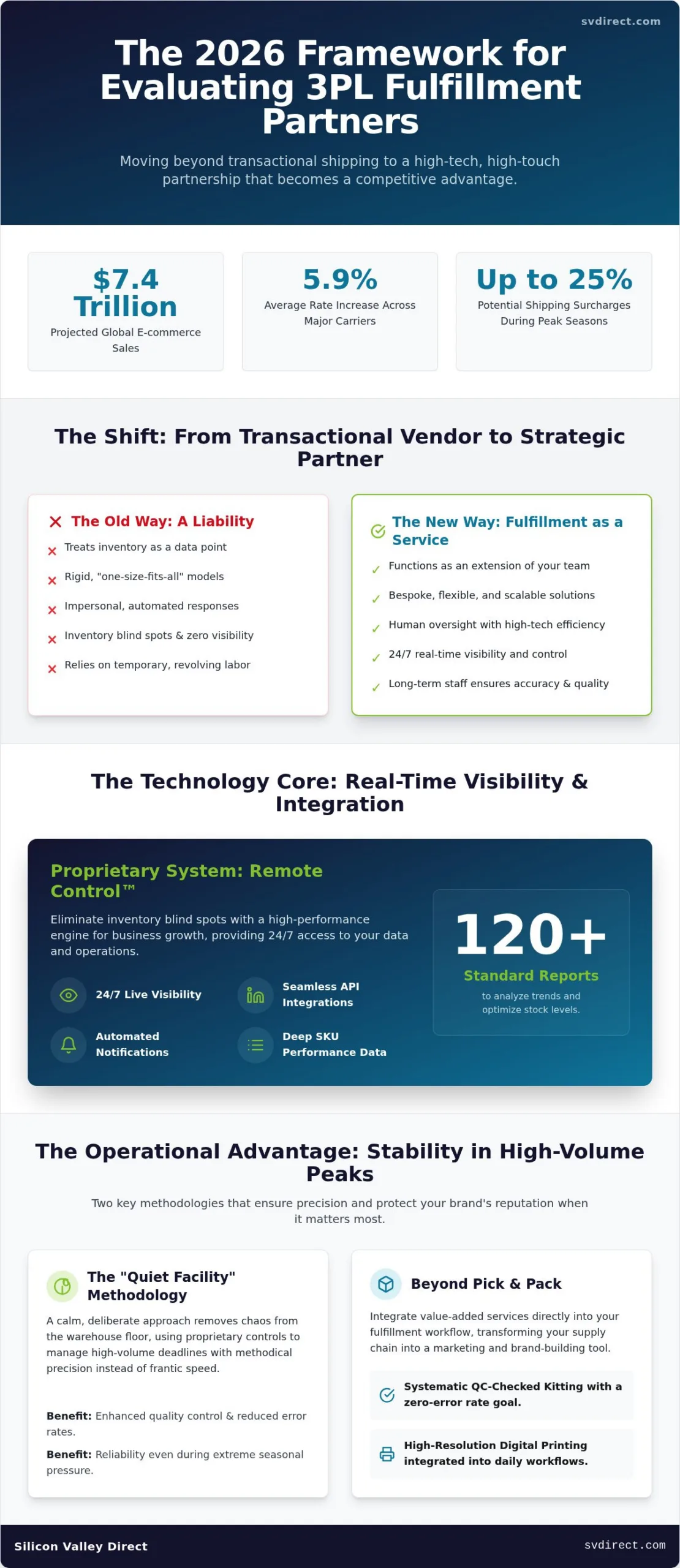
In 2026, the most expensive mistake a growing brand can make isn’t a shipping delay; it’s partnering with a logistics vendor that treats your inventory like a data point and your customers like a support ticket. As global e-commerce sales are projected to surpass $7.4 trillion this year, the gap between “cookie-cutter” shipping and strategic execution has never been wider. You’ve likely felt the frustration of impersonal, automated responses or the anxiety of zero visibility into your stock levels. It’s a common pain point for scaling businesses that need 3pl fulfilment providers to act with the same care and precision as their own internal teams.

We understand that your brand’s reputation is packed into every box that leaves the warehouse. This guide provides a strategic framework for evaluating partners who prioritize human oversight and high-tech efficiency over rigid, one-size-fits-all models. You’ll learn how to secure a partnership that offers seamless API integrations and a zero-error rate in complex kitting, even as you navigate the 5.9% average rate increases seen across major carriers this year. We’ll examine the technical and operational benchmarks required to turn your supply chain into a competitive advantage through 2026 and beyond.

Key Takeaways

  • Learn how to transition from traditional logistics to a “Fulfillment as a Service” model that treats your supply chain as a strategic marriage of technology and marketing.
  • Understand the role of proprietary systems like Remote Control™ in providing 24/7 visibility and over 120 custom reports to eliminate inventory blind spots.
  • Discover the competitive advantage of integrating high-resolution digital printing and systematic QC-checked kitting directly into your daily fulfillment workflow.
  • Evaluate 3pl fulfilment providers based on their ability to offer bespoke, flexible solutions rather than rigid, automated procedures that fail to adapt to your brand’s growth.
  • Identify the operational benefits of a “Quiet Facility” methodology, which ensures precision and stability even during high-volume seasonal peaks.

The 2026 logistics environment demands a fundamental shift in how brands view their supply chain. Modern third-party logistics has evolved into a strategic marriage of digital infrastructure, physical warehousing, and brand marketing. It’s no longer just about moving boxes; it’s about “Fulfillment as a Service” (FaaS). With the global 3PL market projected to reach approximately $1.4 trillion this year, businesses need 3pl fulfilment providers that offer national reach without sacrificing personal oversight. Scalability is essential, but it must be backed by a methodical approach that prioritizes precision over speed at all costs.

Brands today face a complex array of challenges, from a 5.9% average rate increase by major carriers to the rising demand for sustainable reporting. Meeting these requirements requires a partner that doesn’t just react to orders but anticipates them through data. A national focus is critical because it allows your brand to reach customers across the country with consistent speed and reliability. This logistical footprint ensures that your business remains competitive as e-commerce continues to take a larger share of total retail sales.

The Shift from Transactional Shipping to Strategic Partnerships

In 2026, a “pick and pack” vendor is often a liability. High-growth brands require a partner that functions as a seamless extension of their internal team. This alignment ensures that every package reflects your brand’s specific quality standards. One often overlooked factor in this partnership is the human element. At Silicon Valley Direct, our multi-decade history is anchored by long-term staff retention. When the team handling your inventory has years of collective experience, order accuracy becomes a standard rather than a goal. You don’t just get a warehouse; you gain an operational partner committed to your long-term success. This stability prevents the errors that typically occur when 3pl fulfilment providers rely on a revolving door of temporary labor.

The “Quiet Facility” Methodology: Stability in High-Volume Peaks

Chaos is the enemy of accuracy. Many facilities rely on frantic, high-speed movement to meet deadlines, but we utilize a “Quiet Facility” methodology. This deliberate approach removes the hectic atmosphere often found on warehouse floors. By using proprietary prioritization controls, we manage high-volume deadlines with steady, methodical precision. A calm environment allows for better quality control and reduces the likelihood of errors during complex kitting or assembly. This stability is crucial during peak seasons when shipping surcharges can increase by up to 25% and every mistake impacts your bottom line. We prioritize organized workflows so your brand remains reliable even under extreme pressure.

The Technology Core: Real-Time Visibility and Seamless Integration

The technological backbone of a logistics partnership is what separates modern leaders from legacy vendors. In 2026, real-time visibility isn’t a luxury; it’s a baseline requirement for effective inventory management and customer satisfaction. High-performing 3pl fulfilment providers utilize proprietary Order Management Systems (OMS) to bridge the gap between physical stock and digital storefronts. According to the ASCM Supply Chain Dictionary, these systems are vital for coordinating complex logistics flows and ensuring data integrity across the supply chain. Having 24/7 access to your data allows you to monitor order status and inventory levels without waiting for a manual update. Automated notifications for low inventory and incoming receipts act as an early warning system, preventing the backorders that damage brand loyalty.

To drive true business intelligence, a technology suite must go beyond simple tracking. It should provide a deep dive into operational metrics through extensive reporting. We offer over 120 standard reports that help you analyze trends, monitor SKU performance, and optimize your stock levels. This level of transparency ensures that you’re never making decisions in the dark. When your 3pl fulfilment providers prioritize data accessibility, they transform from a simple vendor into a high-performance engine for your business growth.

Remote Control™: Managing Your Business from Anywhere

Our proprietary system, Remote Control™, provides a secure window into every aspect of your operations from any location. It offers 24/7 tracking that lets you see exactly where an order sits in the fulfillment lifecycle at any moment. By using real-time reporting, you can forecast inventory needs with precision and restock proactively before stockouts occur. We also provide the flexibility to customize web interfaces to match your corporate branding or company store, ensuring a consistent experience for your team. You can learn more about Remote Order Management to see how these tools empower your daily decision-making.

Web Services and Platform-Agnostic XML Integration

Operational efficiency in 2026 relies on how well your systems communicate. We utilize platform-agnostic XML and SOAP protocols to ensure seamless data exchange between your e-commerce platform and our warehouse. This technical standard allows for rapid integration without the need for expensive, custom-coded solutions that slow down your time-to-market. Developers can leverage specific methods like “AddOrder” to push new sales into our system instantly or “GetOrderionInfo” to pull tracking data back to your site. This bi-directional communication ensures that your customers always have the most accurate information. If you’re ready to see how a tech-integrated extension of your brand can streamline your growth, request a free quote to discuss your specific integration needs.

Beyond Pick and Pack: Specialized Fulfillment as a Competitive Edge

In 2026, the standard “pick and pack” model isn’t enough to distinguish a brand in a crowded global market. Leading 3pl fulfilment providers have transitioned into multi-service centers that integrate marketing, high-end production, and compliance directly into the logistics chain. This evolution involves value-added services like serial number tracking for high-value electronics and specialized support for tradeshow logistics. These complex operations require a partner that treats your inventory with the precision of an internal department. According to the foundational definition of Third-party logistics (3PL), the true value lies in a provider’s ability to customize solutions that enhance the end-user experience while maintaining operational integrity.

Specialization allows your brand to remain agile. Whether you’re launching a new product line that requires complex hand assembly or managing sensitive documents that demand strict regulatory oversight, your fulfillment partner must adapt. By moving beyond basic warehousing, you turn your supply chain into a tool for brand storytelling and customer retention.

High-Resolution Digital Printing and Variable Data Integration

Marketing collateral often arrives at a warehouse from external vendors, creating a fragmented and slow workflow. We solve this by integrating high-resolution digital printing directly into the fulfillment process. Using the HP Indigo 5500, we utilize liquid ink technology that produces offset-quality results, which far surpasses the quality of standard dry toner. Our 230 line screen resolution ensures that every detail on your inserts or brochures is sharp and professional. With Variable Data Digital Printing (VDP), we can personalize each piece of mail or package insert to the specific recipient, creating a tailored customer journey. You can explore our Print on Demand capabilities to see how we blend logistics with high-end production.

Compliance-Driven Healthcare and Pharmaceutical Mailing

Handling medical materials requires a level of security and precision that generic 3pl fulfilment providers simply can’t offer. We maintain secure warehousing environments designed for sensitive pharmaceutical and healthcare items. Our team is trained to manage HIPAA-compliant mailing, including the distribution of Explanation of Benefits (EOB) documents. This specialized focus ensures that your brand remains compliant with strict federal regulations while maintaining a steady flow of communication with patients. See our full guide on Healthcare Mailing Services for more on our compliance standards.

Strategic Kitting and Hand Assembly

The “unboxing experience” is now a critical marketing touchpoint. Our systematic “QC-Check” process ensures that every kit, whether it’s for software, luxury clothing, or a subscription box, is assembled with total accuracy. We specialize in complex hand assembly that automated systems often fumble, ensuring that branded packaging and inserts are placed exactly as intended. This human oversight is a unique hallmark of our internal stability. Read more about our Kitting and Assembly Services to understand how we maintain quality at scale.

3PL Fulfilment Providers: The 2026 Guide to Strategic Partnership and Scale

Evaluating 3PL Partners: A Framework for Long-Term Scalability

Selecting the right 3pl fulfilment providers involves more than a price comparison. It requires a rigorous audit of their physical infrastructure and security protocols. A warehouse should be viewed as a secure extension of your own business. You should look for facilities that offer 24/7 monitoring, restricted access zones, and climate-controlled environments for sensitive inventory. Sustainability is also a primary driver of partnership value in 2026. Vetting a provider’s commitment to green printing and hardware recycling programs ensures your brand meets modern environmental standards. These details signal that a partner is invested in long-term stability rather than just short-term transactions. A partner’s ability to handle high-volume deadlines without chaos is a direct reflection of their internal methodology.

Assessing Inventory Control and Accuracy Measures

Synchronization is the pulse of modern logistics. You must ask potential partners how their system updates inventory levels across your sales channels to ensure real-time accuracy. This prevents overselling and maintains customer trust during high-traffic periods. For high-value products, serial number tracking is a critical tool to prevent shrinkage and manage potential recalls with precision. Additionally, the handling of “dry” digital printing materials within the facility speeds up the production cycle. Unlike traditional offset methods that require drying time, modern digital prints are ready for immediate kitting and assembly. This allows marketing collateral and personalized inserts to be generated and packed on the same day, significantly reducing lead times.

The Importance of Custom-Fit Solutions

Rigid, “cookie-cutter” procedures are often the root cause of project flaws. When 3pl fulfilment providers force your unique brand into a pre-set mold, specialized requirements like custom packaging or branded assembly suffer. You need a partner that listens and understands your specific growth goals. Proactive problem-solving is a hallmark of a high-performance team. They should anticipate hurdles, like carrier capacity issues or packaging shortages, before they impact your shipping schedule. This level of personal commitment is often reflected in customer testimonials, which provide insight into how a provider handles real-world challenges. A partner that offers bespoke problem-solving will always outperform a vendor that relies on automated indifference.

Why Silicon Valley Direct is the Premier 3PL Extension for Your Brand

Since 1999, Silicon Valley Direct has operated at the intersection of logistical precision and high-tech innovation. We’ve spent over 25 years refining a model that treats fulfillment not as a back-office expense, but as a strategic marriage of technology, customer service, and marketing. Being situated in a global innovation hub gives us a unique perspective on the digital tools required to scale brands in 2026. While many 3pl fulfilment providers focus on volume alone, we prioritize the human element that ensures your brand’s voice is never lost in the warehouse. We invite you to view our real-world results and see how we act as a steady hand for businesses navigating rapid growth.

The Nine Promises of Professional Fulfillment

Our operational philosophy is built on a foundation of accountability and transparency. We earn trust by providing 24/7 data access through our Remote Control™ system, ensuring you’re never left wondering about your stock status. This isn’t just about software; it’s about a “make-it-right” attitude that permeates every level of our organization. We don’t hide behind automated support tickets. Instead, we favor direct human connection and personal oversight. Our long-term staff retention is a unique hallmark of our stability, allowing us to maintain a level of quality control that newer, high-churn facilities can’t match. This commitment to innovation and proactive communication ensures that your supply chain remains a point of pride for your company.

Proactive Problem Solving in Action

Logistics is rarely a straight line. Our team specializes in anticipating order conflicts before they can damage your brand’s reputation. For example, when handling complex high-volume deadlines, we don’t just push through the queue. We analyze the workflow to identify potential bottlenecks in kitting or assembly, adjusting our prioritization controls in real-time. This proactive stance is backed by our “Quiet Facility” methodology, which removes chaos from the floor to protect accuracy. You can read our Customer Testimonials to see how this dedicated, team-oriented approach has helped brands scale with informed confidence. By treating every project as a bespoke problem-solving opportunity, we ensure that your 3pl fulfilment providers are always one step ahead of the market’s demands.

Securing Your Brand’s Scalability and Precision

The logistics landscape of 2026 requires more than a simple warehouse; it demands a dedicated extension of your brand that prioritizes precision over automated indifference. You’ve seen how the right 3pl fulfilment providers bridge the gap between mechanical operations and personal commitment. By prioritizing high-resolution digital printing and real-time data transparency, you ensure every customer interaction is both professional and accurate. This strategic approach transforms your supply chain from a back-office expense into a powerful engine for growth and customer loyalty.

Since 1999, Silicon Valley Direct has helped businesses navigate complex growth by combining our proprietary Remote Control™ system with the offset-quality output of the HP Indigo 5500. Our methodology removes the chaos often found during high-volume deadlines, replacing it with a steady, methodical rhythm that protects your reputation. We remain committed to the human element of service, providing the direct oversight and bespoke problem-solving your business deserves to thrive. This stability allows you to focus on your core mission while we handle the technical details.

Your brand’s future depends on a partner that values accuracy and stability as much as you do. We’re ready to provide the steady hand and technical expertise needed to help you scale with confidence through this year and beyond.

Frequently Asked Questions

What are the main differences between a 3PL provider and a freight broker?

A 3PL provider offers comprehensive warehousing, inventory management, and order processing, while a freight broker acts as an intermediary solely focused on transportation. As one of the premier 3pl fulfilment providers, we handle the physical storage and assembly of your products. Freight brokers don’t touch the inventory; they negotiate rates between shippers and carriers. Our model provides an integrated extension of your business, managing the entire lifecycle from storage to final delivery.

How does digital printing integrate with order fulfillment workflows?

Digital printing integrates directly into the fulfillment workflow by allowing for just-in-time production of marketing materials and literature. Our HP Indigo 5500 press produces sheets that are dry and ready for kitting immediately upon leaving the press. This eliminates the 24-hour drying time required by traditional offset methods. Because we print on demand, your brand avoids the costs of storing obsolete pre-printed collateral, ensuring every shipment contains the most current information.

What is Variable Data Printing (VDP) and how does it benefit direct mail?

Variable Data Printing (VDP) is a digital process that allows every sheet in a print run to feature unique images or copy. This technology benefits direct mail by creating personalized customer experiences that drive higher engagement rates. You can customize brochures or letters for specific recipients without slowing down the production line. By leveraging our 230 line screen resolution, these personalized pieces maintain high-detail quality, making your marketing campaigns feel both premium and personal.

How do I ensure my 3PL provider is HIPAA compliant for healthcare mailing?

Ensuring HIPAA compliance requires a partner that utilizes secure warehousing and specialized handling for sensitive medical materials. We manage healthcare mailing services by protecting patient data through restricted access zones and secure digital environments. It’s essential to verify that your provider has established protocols for managing Explanation of Benefits (EOB) and other confidential documents. Our systematic QC-Check process adds a layer of human oversight to ensure every mailing meets strict federal regulatory standards.

What is a “Quiet Facility” and why does it matter for my order accuracy?

A “Quiet Facility” is an operational environment that utilizes deliberate methodology and prioritization controls to remove the hectic atmosphere common in logistics. This approach matters for order accuracy because it prevents the frantic errors often caused by high-volume pressure. By maintaining a calm and organized floor, our team can focus on precision during complex kitting and assembly tasks. This stability ensures your brand reputation remains protected even during the most demanding seasonal peaks.

Can a 3PL handle complex kitting and assembly for subscription boxes?

Yes, a specialized 3PL can manage complex kitting and assembly through a dedicated team focused on hand-assembly projects. We utilize a systematic QC-Check process to inspect items like software, clothing, and promotional bundles throughout the assembly lifecycle. This ensures that subscription boxes are packed exactly as intended, including the precise placement of branded inserts. Our team acts as an extension of your company, delivering a consistent unboxing experience that reflects your brand’s standards.

What technical standards should I look for in a 3PL integration (XML, SOAP)?

You should look for platform-agnostic standards like XML and SOAP to ensure seamless data exchange between your systems and the warehouse. These protocols allow different applications to communicate without requiring time-consuming custom coding. Our system utilizes WSDL and UDDI to describe and list available services, making it easier for developers to integrate order data. This technical flexibility ensures your 3pl fulfilment providers can scale with your technology stack regardless of the programming language you use.

How does real-time inventory management prevent backorders?

Real-time inventory management prevents backorders by providing live visibility into stock levels across all your sales channels. Our Remote Control™ system generates automated email notifications for low inventory levels and incoming receipts. These alerts act as an early warning system, allowing you to restock proactively before stockouts occur. By synchronizing your physical inventory with your digital storefront, you ensure that customers only purchase items that are ready for immediate shipping.

Subscription Box Fulfillment Services: The 2026 Strategic Guide to Scaling

Subscription Box Fulfillment Services: The 2026 Strategic Guide to Scaling

If personalization is the primary reason two-thirds of subscribers remain loyal, why do so many brands treat their packaging as a mere afterthought? You’ve likely felt the sting of high churn caused by a single shipping error or a damaged item that arrived just a day too late. In 2026, with rising USPS holiday rates and the permanent elimination of the de minimis exemption, your margins are under more pressure than ever. It’s a frustrating reality where logistics often feels like a barrier to your growth rather than a bridge to your customers.

This guide helps you reclaim control by transforming subscription box fulfillment services from a reactive cost center into a proactive brand-building engine. We’ll show you how to leverage precision kitting and integrated digital personalization to create “TikTok-ready” moments for every subscriber. You’ll discover the strategic framework needed to achieve 100% accuracy through a quiet, organized fulfillment process. We’ll also explore how seamless eCommerce integration and national logistics coordination can finally reduce your shipping costs while providing the real-time inventory visibility you’ve been missing.

Key Takeaways

  • Adapt to the 2026 shift toward experiential boxes by integrating on-demand digital printing for offset-quality personalization.
  • Ensure 100% accuracy during peak assembly cycles by utilizing a “quiet facility” methodology and systematic QC-Check processes for complex kitting.
  • Scale your subscription box fulfillment services with a partner that provides 24/7 visibility through proprietary systems and over 120 real-time reports.
  • Transition from a vendor-client relationship to a strategic partnership that treats your fulfillment operation as a dedicated extension of your brand.

What is Subscription Box Fulfillment and Why It Matters in 2026

Subscription fulfillment is the heartbeat of a recurring brand. It is the scheduled, recurring distribution of products to a loyal customer base. If you are asking What is a Subscription Box? you’ll find it has evolved from a simple mailing to a complex logistical feat. In 2026, the industry has moved past the “box of items” phase. We now see a distinct shift toward experiential boxes that demand high levels of personalization to keep subscribers engaged and minimize churn.

There are two primary models in this space. Recurring replenishment focuses on consistency; it’s about getting essentials like vitamins or grooming supplies to the door on time, every time. Complex curated boxes, however, are about discovery. These lifestyle or snack subscriptions rely on a shifting mix of products to maintain interest. In both cases, the unboxing experience serves as the primary driver of subscriber retention. When a box arrives perfectly organized with a personalized touch, it secures the long-term customer value that keeps your brand profitable.

The Rise of the Curated Subscription Model

Curated boxes offer a unique value proposition but introduce significant logistical hurdles. Changing your product mix every month means managing a new set of variables every thirty days. Vendor coordination is often the primary failure point for growing brands. One late shipment from a supplier can stall your entire kitting cycle. To solve this, many high-growth companies utilize “just-in-time” assembly. This method reduces warehousing overhead by kitting products as soon as they arrive, ensuring your inventory doesn’t sit idle while you pay for shelf space.

Key Challenges in Subscription Logistics

Customer churn is the silent killer of recurring revenue. Most churn isn’t caused by the product itself but by shipping errors or damaged items. Managing subscription box fulfillment services requires a level of detail that standard “pick and pack” operations simply can’t provide. You are often dealing with diverse SKUs of varying dimensions that must fit into a single, cohesive kit. A standard 3PL might treat your box like a generic parcel, but subscription brands need a partner that understands the nuances of precision kitting and the high stakes of a monthly deadline. This is why a professional fulfillment strategy is essential for brands looking to scale without losing the personal touch that built their audience.

The Logistics of Precision Kitting and Assembly

Standard fulfillment focuses on speed and volume, but subscription box fulfillment services prioritize the arrangement and completeness of a multi-item experience. It is the difference between tossing a product into a mailer and meticulously layering curated items to tell a specific brand story. Achieving this at scale requires a “quiet, organized facility” methodology. In this environment, workflows are designed to eliminate the chaotic noise typical of high-volume warehouses. This focused atmosphere is critical for meeting tight monthly deadlines without sacrificing the quality of the unboxing experience.

Systematic QC-Check: Ensuring 100% Accuracy

A “make-it-right” attitude is the foundation of a successful hand assembly process. We utilize a proprietary “QC-Check” methodology, which involves multi-stage inspections throughout the workflow. Instead of checking a random sample of boxes at the end of a run, our team inspects at every touchpoint. This prevents the “missing item” or “damaged product” complaints that often lead to subscriber churn. Our systematic approach includes:

  • Verification of individual SKU counts before assembly begins.
  • Visual inspections of packaging integrity for every curated item.
  • Final box-weight verification to ensure no component is missing.

This level of care is essential for customer retention in e-commerce, as a single error can break the trust you’ve worked months to build. For example, our team frequently manages over 3,000 complex shipments in a single week flawlessly, maintaining a standard of precision that automated systems often miss.

Inventory Management and Serial Tracking

Managing monthly box components requires more than just a simple spreadsheet. You need real-time visibility into every SKU, from the primary products to the smallest promotional inserts. Our comprehensive inventory management system allows you to monitor stock levels during peak kitting cycles through a proprietary portal. This transparency ensures you aren’t surprised by stockouts that could delay your entire monthly cycle.

For high-value items, we implement serial number tracking within the kit. This ensures that every individual unit can be traced to a specific subscriber. It is an invaluable tool for managing warranties or product recalls without disrupting your entire operation. By integrating human expertise with advanced tracking, we ensure your logistics remain stable even as your volume grows. If you’re ready to see how a dedicated partner can streamline your kitting, you might want to explore a tailored fulfillment solution for your brand.

Personalization at Scale: The Digital Printing Advantage

Subscription brands often struggle with the “static inventory” trap. They print thousands of generic inserts that sit in a warehouse, losing relevance with every passing month. In 2026, the standard for subscription box fulfillment services has shifted toward dynamic, on-demand assets. We solve this bottleneck by utilizing the HP Indigo 5500 Digital Press. This is not your standard office printer. It uses real liquid ink technology to deliver offset-quality results that toner-based machines simply cannot replicate. It’s the difference between a mass-produced flyer and a high-end brand asset.

The technical superiority is visible in the details. With a 230 line screen resolution, your brand imagery remains sharp, professional, and vibrant. This high-resolution output is essential for the premium unboxing experience your subscribers expect. Beyond the quality, this digital approach is inherently sustainable. Because there are no plates, films, or harsh chemicals involved, you can reduce your brand’s environmental footprint. It allows you to stay agile without compromising on your commitment to the planet.

Variable Data Printing (VDP) for Hyper-Personalization

Variable Data Printing allows you to change the copy, images, or offers on every single sheet within a single print run. It is a powerful tool for building deep customer loyalty. Imagine a “Welcome” letter that addresses a subscriber by name or a custom discount code tailored to their previous purchases. While VDP provides a significant boost in customer engagement, it costs not much more than traditional static printing. It transforms a simple piece of paper into a strategic marketing asset that drives repeat revenue and lowers your churn rate.

On-Demand Literature Fulfillment

Speed is the third pillar of our printing strategy. Traditional offset printing requires a 24-hour drying period before sheets can be handled. Our digital press produces “dry-to-touch” output that is ready for assembly the moment it leaves the tray. This eliminates common bottlenecks in subscription box fulfillment services. By integrating our Print on Demand Services directly into the fulfillment workflow, we ensure your marketing collateral is as agile as your inventory. You don’t have to wait for external vendors or manage extra shipping legs. Everything happens under one roof, ensuring your monthly kits are assembled with both speed and precision.

Subscription Box Fulfillment Services: The 2026 Strategic Guide to Scaling

Technology and Transparency: Managing Your Subscription Remotely

Scaling a recurring revenue model requires more than just physical space; it demands digital clarity. Our proprietary Remote Control™ system acts as a 24/7 window into your fulfillment operations, ensuring you never lose sight of your inventory. This platform allows you to place orders, track progress, and check real-time stock levels from any device at any time. By providing this level of accessibility, we function as a seamless extension of your internal team rather than a distant vendor. It’s about giving you the confidence to manage subscription box fulfillment services without needing to be physically present on the warehouse floor.

Precision is maintained through automated intelligence. The system provides immediate notifications for low inventory levels, successful receipts, and backorders. These alerts are vital for subscription brands that operate on rigid monthly cycles. If a component for your next box is running low, you’ll know well before it impacts your shipping deadline. This proactive communication eliminates the “black hole” effect often associated with traditional logistics, allowing you to focus on marketing and growth while we handle the operational heavy lifting.

Data-Driven Decision Making with 120+ Reports

Generic “shipped” status updates aren’t enough to sustain a complex subscription brand. You need granular data to forecast future needs and optimize your spend. Our system offers over 120 standard reports that cover everything from inventory history to detailed shipment activity. This data helps you identify trends, manage seasonal surges, and ensure your kitting components are ready exactly when they’re needed. For a cohesive brand experience, we also offer custom-fit web interfaces. These portals can be styled to match your existing corporate brand or online store, providing a consistent professional look for your internal stakeholders.

Programmatic Integration for Developers

For brands with custom-built eCommerce platforms, we provide robust programmatic integration through XML and SOAP web services. This platform-agnostic approach ensures that data flows securely and accurately across your network. Developers can utilize specific Web Methods such as AddOrder, GetOrderInfo, and GetShippingActivity to automate the entire lifecycle of a subscription box. We use WSDL and SOAP protocols to maintain standardized, secure data transfers, ensuring your customer information remains protected. You can find more technical details on our Remote Order Management page to see how our infrastructure fits into your tech stack.

Scaling Your Subscription Brand with a Strategic 3PL Partner

Every successful subscription brand reaches a point where in-house fulfillment becomes a bottleneck to growth. What begins as a manageable task in a small office or warehouse can quickly overwhelm your team as volume scales from hundreds to thousands of shipments. Moving to professional subscription box fulfillment services is a strategic pivot that requires a partner, not just a vendor. We operate as a seamless extension of your company, utilizing a proactive problem-solving approach. This means we identify potential order conflicts, such as address errors or SKU mismatches, before they ever disrupt your monthly mailing cycle.

Our operational framework is guided by the “Nine Promises,” a set of principles ensuring long-term stability and trust. This commitment to accountability means we prioritize your brand’s reputation as if it were our own. By maintaining a quiet, organized facility, we eliminate the chaotic atmosphere common in high-volume logistics. This deliberate methodology allows us to manage complex deadlines with precision and personal commitment. We focus on continuous innovation to stay at the cutting edge of industry trends, ensuring your brand remains competitive as the market evolves.

Global Shipping and Logistics Coordination

Maintaining healthy profit margins is a primary challenge as you scale a recurring revenue model. We help protect your bottom line by leveraging deeply discounted carrier rates and sophisticated logistics coordination. In 2026, navigating the complexities of domestic and international shipping requires a coordinated strategy to avoid unexpected delays or cost spikes. If your goal is to reach a global subscriber base, our Global Shipping Services guide provides the roadmap necessary for international expansion while maintaining your professional standards. We handle the administrative details of global mailing so you can focus on high-level growth.

The Partnership Approach to Growth

A successful partnership is built on flexibility and a deep understanding of your unique business goals. We reject rigid, cookie-cutter procedures in favor of bespoke solutions that fit your specific project limitations. During the onboarding phase, we take the time to listen and understand your objectives, ensuring our workflows align with your brand’s identity. This human-centric focus is a core differentiator in a tech-saturated market and is the reason many of our clients have remained with us for over seven years. You can view our Customer Testimonials to see how this collaborative approach has fostered long-term success for brands of all sizes. Choosing the right subscription box fulfillment services partner is the final step in securing a scalable, resilient future for your business.

Elevating Your Brand Through Strategic Fulfillment

Scaling a subscription brand in 2026 requires a transition from basic logistics to a high-performance partnership. You’ve seen how precision kitting and the “quiet facility” methodology ensure 100% accuracy even during high-volume deadlines. Integrating on-site HP Indigo digital printing allows you to deliver hyper-personalized unboxing experiences that directly combat subscriber churn. These capabilities bridge the gap between mechanical operations and the personal touch your customers expect.

By leveraging subscription box fulfillment services that offer 25+ years of operational history, you gain a steady hand in an unpredictable market. Our proprietary Remote Control™ technology provides the 24/7 visibility you need to manage your business from anywhere. This combination of human oversight and technical innovation ensures your brand remains stable during rapid growth. It’s time to transform your logistics from a standard cost center into a primary driver of long-term customer value.

We are ready to help you build a more resilient and scalable future for your brand.

Frequently Asked Questions

What is the difference between kitting and subscription fulfillment?

Kitting refers to the physical assembly of multiple items into a single unit, while subscription fulfillment is the broader, recurring process of managing those kits and shipping them to subscribers. At Silicon Valley Direct, our kitting and assembly services are integrated into a systematic workflow. We use a proprietary QC-Check process to ensure every box is perfect. This differs from standard “pick and pack” because it focuses on the precision required for curated brand experiences.

How much does subscription box fulfillment services cost?

The cost of subscription box fulfillment services varies based on several factors, including monthly order volume, storage requirements, and the complexity of the kitting process. We provide affordable, project-based pricing for assembly and storage fees that scale with your growth. Because every brand has unique goals, we avoid cookie-cutter pricing in favor of custom-fit solutions. This ensures you only pay for the specific logistics and printing services your business actually requires.

Can you handle custom branded packaging and unique unboxing experiences?

Yes, we specialize in executing complex unboxing experiences that require custom branded packaging and precise item placement. Our team treats your fulfillment as an extension of your marketing department. We can handle everything from premium item distribution to the insertion of high-resolution, personalized literature. By maintaining a quiet and organized facility, we ensure your custom packaging is handled with the care necessary to leave a lasting impression on your subscribers.

How do you manage inventory for products with expiration dates?

We manage sensitive inventory through our proprietary Remote Control system, which provides real-time visibility into stock levels and movement. Our warehouse team uses serial number tracking and strict inventory controls to monitor batch codes or expiration dates. You’ll receive automated email notifications for low inventory or incoming receipts. This level of transparency ensures that older stock is prioritized and that no expired items ever reach your customers during the monthly shipping cycle.

Do you offer international shipping for subscription boxes?

Silicon Valley Direct provides comprehensive global shipping and logistics coordination for subscription brands with an international audience. We leverage discounted carrier rates to help you maintain profit margins while reaching subscribers worldwide. Our team handles the administrative complexities of international mailing, ensuring your kits move through customs efficiently. Whether you are shipping domestically or to multiple continents, our infrastructure supports a seamless delivery process that reflects your brand’s professional standards.

What eCommerce platforms do your fulfillment services integrate with?

Our fulfillment services utilize platform-agnostic XML and SOAP web services, making us compatible with any eCommerce platform or custom-built Order Management System. This standardized integration allows your developers to use programmatic interfaces like AddOrder and GetOrderInfo without time-consuming custom coding. Whether you use a popular storefront or a bespoke internal system, our Remote Control platform ensures that data flows securely and accurately across your entire digital network in real time.

Is variable data printing expensive for monthly box inserts?

Variable data printing (VDP) for monthly box inserts is surprisingly affordable and costs not much more than producing static color printing jobs. We use the HP Indigo 5500 Digital Press to change copy or images on every sheet within a single run. This allows you to include personalized welcome letters or custom discount codes without a significant price jump. It’s an efficient way to increase subscriber engagement while keeping your marketing costs manageable.

How quickly can you scale assembly for a sudden surge in subscribers?

Our deliberate facility methodology is designed to manage sudden surges in subscriber volume without losing precision. We’ve successfully handled complex projects involving over 3,000 shipments in a single week for our clients. Because we avoid the hectic atmosphere common in many warehouses, we can scale our hand assembly and kitting teams quickly to meet tight deadlines. Our proactive problem-solving approach ensures your growth doesn’t lead to shipping errors or assembly delays.

When to Switch to a 3PL: 2026 Scaling Fulfillment Guide

When to Switch to a 3PL: 2026 Scaling Fulfillment Guide

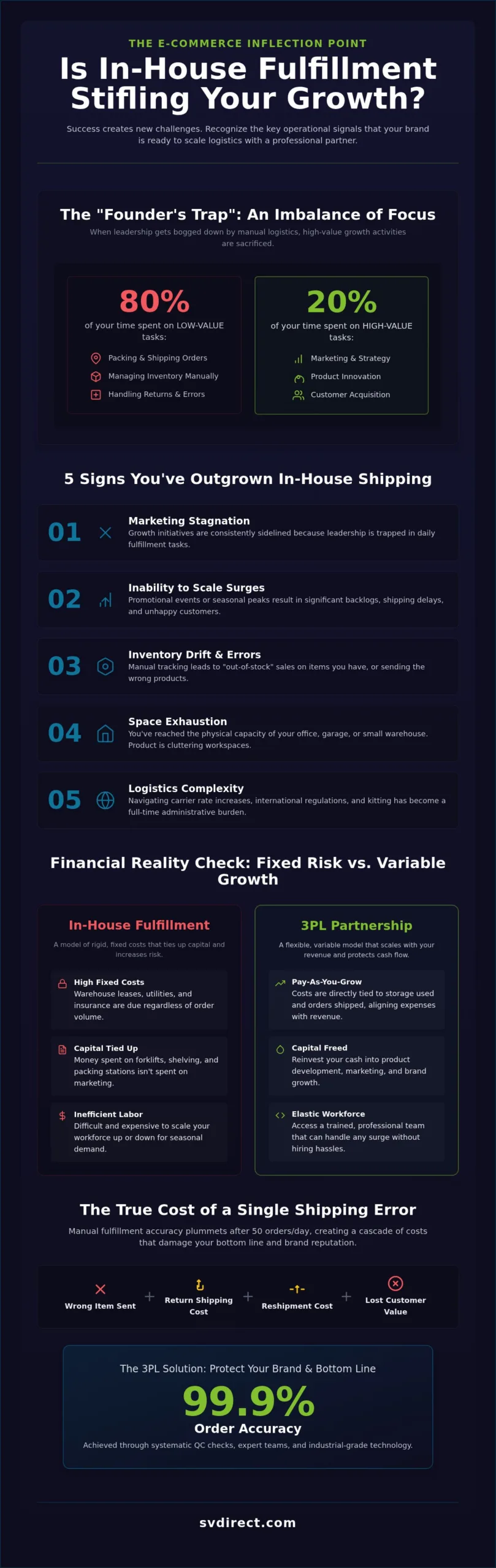
What if the shipping process that built your brand is now the primary obstacle preventing its future growth? Most founders start by packing every order personally to ensure quality, yet there inevitably comes a point where manual labor hits a hard ceiling. You’re likely feeling the strain of spending 80% of your time on logistics instead of marketing, while watching error rates climb as your physical space disappears. Deciding exactly when to switch to a 3PL is a common struggle for brands trying to balance a personal touch with the cold reality of scaling operations in a market where shipping rates continue to rise.

Identifying this inflection point is the difference between a stalled business and a truly scalable enterprise. This guide clarifies the specific operational and financial signals, from inventory visibility gaps to the impact of the 2026 carrier rate hikes, that indicate your brand is ready for a professional partner. You’ll learn how to regain your time, achieve 99.9% order accuracy, and lower per-order costs without adding fixed overhead. We will explore how moving toward a sophisticated fulfillment model allows you to focus on high-level growth while ensuring your logistics partner acts as a seamless extension of your team.

Key Takeaways

  • Identify the specific operational triggers, such as spending the majority of your time on logistics rather than growth, that signal your business has outgrown in-house shipping.
  • Learn how to evaluate the true costs of warehousing by comparing fixed overhead like rent and equipment against the variable flexibility of a professional partner.
  • Determine when to switch to a 3pl based on your need for specialized services like high-quality kitting, assembly, and on-demand digital printing.
  • Discover why real-time inventory visibility and seamless eCommerce integration are non-negotiable standards for maintaining order accuracy in 2026.
  • Develop a strategic onboarding plan that avoids standard, one-size-fits-all solutions and treats your fulfillment provider as a dedicated extension of your brand.

Recognizing the Inflection Point: 5 Signs to Switch to 3PL

Success often brings a quiet crisis of capacity. When your team spends more time managing tape and labels than acquiring new customers, your operational model is no longer supporting your growth; it is actively stifling it. Knowing when to switch to a 3pl becomes a matter of identifying specific friction points in your daily workflow. If you are consistently hitting physical walls or seeing shipping delays during promotional spikes, your brand has reached an inflection point that requires a more robust infrastructure.

There are five primary indicators that your current in-house system is reaching its limit:

  • Marketing Stagnation: Strategic growth initiatives are sidelined because leadership is bogged down by daily fulfillment tasks.
  • Inability to Scale Surges: Promotional events or seasonal peaks result in significant backlogs and customer service inquiries.
  • Inventory Drift: Manual tracking leads to “out-of-stock” sales on items you actually have, or vice versa, creating friction and lost revenue.
  • Space Exhaustion: You have reached the literal physical capacity of your current office, garage, or small warehouse.
  • Logistics Complexity: Navigating the 2026 carrier rate increases and international shipping regulations has become a full-time administrative burden.

The “Founder’s Trap”: When Logistics Stifles Growth

The “Founder’s Trap” occurs when a CEO or key leader performs manual labor that could be outsourced for a fraction of their hourly value. Every hour spent packing a box is an hour stolen from high-level strategic planning or product innovation. This creates a massive opportunity cost that prevents your brand from reaching its true potential. Moving to a professional partner allows for a psychological shift from “doing” to “delegating,” transforming logistics from a personal chore into a scalable business utility. This transition ensures your energy is directed toward the activities that actually drive revenue.

Accuracy and the Cost of Error

Manual fulfillment systems typically begin to fracture once volume exceeds 50 orders per day. Beyond this threshold, human error becomes statistically inevitable without the support of industrial-grade technology. The true price of a “wrong item sent” is staggering. It includes the cost of the original shipping, the return label, the labor to re-process the order, and the potential loss of a customer’s lifetime value. Professional facilities utilize systematic methodologies like our QC-Check process to maintain near-perfect precision. By leveraging a system like Remote Control™, you gain the real-time visibility needed to ensure that scaling your volume never results in a drop in quality.

The Financial Reality Check: Calculating the True Cost of In-House Fulfillment

Many growing brands mistakenly believe that keeping operations in-house saves money. While it might seem cheaper to pack orders in a spare room or a small leased office, the true financial drain often lies in the items that don’t appear on a simple shipping receipt. When you analyze the total expenditure, including warehouse equipment leases, utilities, and the rising cost of insurance, the decision of when to switch to a 3pl becomes a matter of fiscal responsibility. It’s about recognizing that stagnant capital tied up in infrastructure is capital that isn’t being used to grow your product line.

Fixed vs. Variable Cost Models

The most significant financial risk of in-house fulfillment is the rigidity of fixed costs. A multi-year warehouse lease remains a liability whether you ship ten orders or ten thousand. A professional partner transforms these stagnant expenses into a flexible, variable model. You only pay for the storage space you occupy and the orders you actually ship. This “pay-as-you-grow” approach ensures your logistics budget scales perfectly with your revenue, protecting your cash flow during slower months. It’s a strategic shift that turns a massive capital risk into a predictable, per-order expense.

Labor costs present another scaling challenge. Recruiting, training, and managing temporary staff for seasonal rushes is both expensive and time-consuming. By outsourcing, you eliminate the administrative burden of payroll taxes and workers’ compensation. You also bypass the hidden costs of packaging supplies and shipping software subscriptions, which often carry high monthly minimums for smaller accounts. These savings add up quickly, allowing you to reinvest that capital into your core business.

The Shipping Rate Advantage

Carrier leverage is perhaps the most immediate financial benefit of a partnership. In 2026, standard list rates for major carriers like FedEx and UPS increased by an average of 5.9%. These hikes, combined with new surcharges and dimensional weight changes, can devastate the margins of a solo shipper. Because 3PLs manage aggregate volume from hundreds of clients, they secure deep discounts that are simply unavailable to individual brands. Utilizing professional global shipping services allows you to access these tier-one rates immediately. Expert packaging also helps reduce “Dimensional Weight” surcharges by ensuring every box is optimized for its contents. To understand the potential savings for your specific volume, you can see how your current costs compare with a professional analysis.

Specialized Capabilities: When Your Brand Needs More Than Just a Box

Standard fulfillment often focuses on the basic mechanics of moving boxes from point A to point B. However, if your product requires sophisticated presentation or regulatory precision, you need a partner rather than a simple vendor. Knowing when to switch to a 3pl often depends on whether your current setup can handle complex kitting and assembly services. These tasks require a level of meticulous oversight that manual in-house teams frequently struggle to maintain as order volume increases. When precision becomes a prerequisite for brand survival, a professional infrastructure is the only logical path forward.

The Power of Personalized Fulfillment

Modern brands use fulfillment as a powerful marketing channel. We leverage HP Indigo 5500 technology to provide offset-quality digital printing directly within the warehouse environment. Unlike standard toner-based systems, liquid ink technology creates a premium, high-fidelity finish that resonates with discerning customers. This capability allows you to shift from static, generic inserts to dynamic print-on-demand materials that are generated exactly when they’re needed.

Variable Data Printing (VDP) takes this personalization a step further. It enables unique copy on every single sheet in a print run. Imagine a customer opening a package to find a personalized greeting or a targeted offer based on their specific purchase history. This level of customization transforms a routine delivery into a high-performance brand experience. It turns a mechanical logistics process into a direct, human connection that builds long-term loyalty.

Compliance and Security in Logistics

For brands managing sensitive materials, the decision of when to switch to a 3pl is often driven by the non-negotiable need for regulatory compliance. Brands in the medical and wellness sectors require specialized healthcare mailing services that prioritize HIPAA considerations and data security. These operations demand a “Quiet Facility” methodology where precision and systematic inspection are prioritized over chaotic speed.

High-value items also require a different level of operational care. We implement strict serial number tracking and inventory controls to ensure total accountability at every stage of the distribution cycle. For companies dealing with sensitive electronics or proprietary hardware, secure warehousing provides the necessary risk mitigation. This infrastructure ensures that your most valuable assets are protected by both advanced physical security and human expertise, providing a level of reliability that a standard office or garage simply cannot match.

When to Switch to a 3PL: 2026 Scaling Fulfillment Guide

The Technology Marriage: Integrating Your Store with a 3PL

In the fast-paced market of 2026, data is as critical as the physical inventory it tracks. A primary factor in deciding when to switch to a 3pl is the need for a unified digital ecosystem that bridges the gap between your eCommerce platform and the warehouse floor. Manual data entry is a relic of a slower era; it introduces human error and creates dangerous visibility gaps that can lead to lost revenue. By integrating your store directly with a professional facility, you create a “technology marriage” that ensures your customer’s experience is seamless from the first click to the final delivery.

Real-time visibility isn’t just a luxury; it’s a non-negotiable standard for modern business. Without it, you’re flying blind, risking backorders that damage your brand’s reputation and customer trust. An integrated Order Management System (OMS) acts as a central brain, synchronizing inventory levels across Shopify, WooCommerce, or custom platforms. This automation eliminates the friction of manual order submission and allows your team to focus on scaling rather than managing spreadsheets. It’s about shifting from a reactive stance to a proactive strategy where every movement in the warehouse is reflected instantly in your digital storefront.

Remote Control™: 24/7 Visibility

Our proprietary remote order management system, Remote Control™, provides an unprecedented level of transparency and oversight. You shouldn’t have to wait for a business day to get an answer about your stock levels or order status. With access to over 120 standard reports, you can make data-driven decisions at any hour from any location. The system also features automated notifications for low inventory and the receipt of new goods. This ensures you’re never caught off guard by a sudden surge in demand, allowing for a “Quiet Facility” environment where every action is deliberate and tracked.

Seamless API Integration

We utilize robust XML and SOAP protocols to ensure our systems “talk” to yours without the need for expensive or time-consuming custom coding. This platform-agnostic approach means your fulfillment ecosystem remains flexible as your technology stack evolves over time. By leveraging these web services, we significantly reduce “click-to-ship” time. Orders flow automatically from your eCommerce platform to our floor, triggering the picking process within minutes of a purchase. This speed is a primary competitive advantage in 2026, where consumers expect immediate fulfillment and accurate tracking updates.

Choosing a partner is a high-stakes decision that requires more than a simple price comparison. Before you decide when to switch to a 3pl, you must perform a rigorous audit of your own operational data. This means documenting your exact SKU counts, monthly order volumes, and average items per order. Having these benchmarks allows you to seek out a partner that matches your specific scale rather than a vendor that offers a one-size-fits-all solution. A successful transition isn’t just about moving boxes; it’s about finding a team that functions as a seamless extension of your own brand. As you scale your physical presence alongside your logistics, you can learn more about Eureka Sign & Display for custom signage and display solutions that represent your brand professionally.

Flexibility is the primary differentiator in a modern logistics partnership. You should avoid cookie-cutter vendors that force your business into their rigid workflows. Instead, look for a provider that prioritizes a “Quiet Facility” methodology. This approach indicates professional maturity, where the warehouse environment is organized, deliberate, and calm even during peak periods. A chaotic facility is often a sign of reactive management, while a quiet one suggests that every process is systematic and under control. This level of organization is what allows a brand to scale without the friction of constant errors or delays.

Trust is built on transparency and a proven history of precision. When vetting a potential partner, you should ask detailed questions about their QC-Check procedures and documented error rates. It’s helpful to prioritize organizations with high staff retention, as long-term employees carry the institutional knowledge needed for expert-level service. You don’t want your brand’s reputation in the hands of temporary seasonal workers who lack a personal commitment to your success. Reviewing customer testimonials can provide valuable insight into how a partner handles complex requirements over several years. This historical stability serves as an anchor of reliability in a fast-paced market.

The First 90 Days: What to Expect

The onboarding phase is a critical window that sets the tone for the entire partnership. During the first 90 days, you’ll move through a structured process that includes inventory transfer and live system integration. It’s a time to establish clear Key Performance Indicators (KPIs) regarding order accuracy, shipping speed, and communication response times. A high-performance partner won’t just wait for your instructions; they’ll proactively anticipate potential conflicts before they impact your customers. This proactive stance ensures that the “technology marriage” discussed earlier translates into real-world efficiency. By the end of this period, your logistics should feel like a predictable utility that supports your growth rather than a source of daily stress.

Empowering Your Brand’s Next Phase of Growth

Deciding exactly when to switch to a 3pl is a strategic move that transforms your logistics from a daily burden into a scalable engine for success. By identifying the operational friction of the “Founder’s Trap” and shifting to a variable cost model, you gain the freedom to focus on marketing and product innovation. This evolution ensures your brand remains agile in the face of 2026’s carrier rate increases and complex global shipping regulations.

Silicon Valley Direct provides over 25 years of fulfillment expertise, acting as a steady, reliable extension of your internal team. We combine this seasoned experience with cutting-edge technology, including our proprietary Remote Control™ system for 24/7 inventory visibility and on-site HP Indigo digital printing for premium brand touches. Our commitment to precision and human oversight ensures your customers receive the high-quality experience they expect from your brand.

The path to scaling your business doesn’t have to be a source of stress. We’re here to provide the infrastructure and expertise you need to reach your most ambitious goals with confidence.

Frequently Asked Questions

What is the typical order volume threshold for switching to a 3PL?

Most businesses begin evaluating when to switch to a 3pl once they consistently process between 200 and 500 orders per month. At this stage, the manual labor required for internal fulfillment often outweighs the cost of outsourcing. If your volume exceeds 1,000 orders monthly, a professional partner is almost always more economical. This transition allows you to leverage carrier discounts and professional infrastructure that aren’t accessible to smaller in-house operations.

Will I lose control over my packaging and branding if I use a 3PL?

You don’t have to sacrifice brand identity for efficiency. A sophisticated partner offers total flexibility for custom packaging, branded inserts, and specialized kitting. We use HP Indigo 5500 liquid ink technology to produce offset-quality digital prints on-site. This means your unboxing experience remains a premium touchpoint. Unlike cookie-cutter providers, we act as an extension of your company, ensuring every package meets your specific aesthetic and quality standards.

How long does it take to integrate my online store with a 3PL system?

Standard integrations with platforms like Shopify or WooCommerce typically take a few days to a week. The process involves connecting your storefront via API or web services to ensure real-time inventory synchronization. Our Remote Control™ system allows for seamless data flow, meaning orders are transmitted to the warehouse floor almost instantly. While the technical connection is rapid, the full onboarding process, including inventory transfer and SKU auditing, usually takes about two to four weeks.

Can a 3PL handle specialized kitting or personalized marketing inserts?

Professional 3PLs specialize in complex kitting and assembly that goes far beyond simple pick-and-pack. We utilize Variable Data Printing (VDP) to create personalized marketing inserts for every order. This allows you to include unique messages or targeted offers based on individual customer data. This capability transforms a standard delivery into a high-performance marketing channel, ensuring your logistics strategy actively contributes to customer retention and long-term brand loyalty.

What is the difference between a 3PL and a simple warehouse?

A warehouse provides physical storage, while a 3PL offers a comprehensive suite of integrated services. Beyond just holding stock, a 3PL manages the entire lifecycle of an order, including inventory management, digital printing, and global logistics. Our facility operates with a Quiet Facility methodology, prioritizing systematic inspection and tech-driven oversight. You aren’t just renting shelf space; you’re gaining a strategic partner that uses advanced data and 25 years of expertise to optimize your supply chain.

How do 3PLs handle returns and reverse logistics?

Returns management is a core component of a professional 3PL’s service offering. When a customer sends an item back, the 3PL receives the package, inspects the goods for damage, and determines if they can be returned to inventory. This systematic approach ensures that reverse logistics don’t become a bottleneck for your business. By outsourcing this process, you maintain high accuracy in your stock levels while providing a faster, more reliable experience for your customers.

Is it more expensive to use a 3PL for small businesses?

While there are initial setup fees, using a 3PL often lowers the total cost per order for growing brands. You eliminate fixed overhead like warehouse rent, utilities, and equipment leases. Additionally, you benefit from significant carrier discounts that individual small businesses cannot access. The decision of when to switch to a 3pl often pays for itself through reduced shipping rates and the recovery of your team’s time for revenue-generating activities like marketing and sales.

What should I look for in a 3PL service level agreement (SLA)?

A strong SLA should define specific, measurable KPIs for order accuracy, shipping speed, and receiving timelines. Look for a commitment to 99.9% accuracy and clear protocols for how errors are rectified. It’s also vital to include standards for communication and data visibility. A partner that offers 24/7 access to inventory reports, like our Remote Control™ system, provides the transparency needed to hold the provider accountable and ensure your operations run smoothly at all times.

Best eCommerce Shipping Solutions for Small Business: The 2026 Guide to Scaling

Best eCommerce Shipping Solutions for Small Business: The 2026 Guide to Scaling

What if the tools you currently use to manage your logistics are the very things keeping your business from growing? With 2026 bringing an 8% temporary USPS price increase and the permanent suspension of the Section 321 de minimis exemption, small business margins are under more pressure than ever. You probably feel the weight of these changes every time you pack a box in a cramped office or struggle with complex international customs duties. It’s exhausting to spend your days managing labels when you should be focusing on your brand’s vision and customer relationships.

Finding the best ecommerce shipping solutions for small business requires a clear understanding of where software ends and true partnership begins. We agree that your time is too valuable to be spent in a warehouse, yet you need a solution that maintains the personal touch your customers expect. This guide will help you navigate the critical choice between automated shipping apps and a full-service 3PL partner. We will explore how to lower your rates despite carrier hikes, automate your entire fulfillment workflow, and build a global infrastructure that scales with your ambition. You’ll discover how to reclaim your time while ensuring your customers receive their orders faster and more reliably than ever before.

Key Takeaways

  • Understand the functional differences between shipping software and 3PL providers to select the right operational model for your brand’s current stage.
  • Discover how the best ecommerce shipping solutions for small business leverage multi-carrier support and real-time inventory tracking to prevent overselling.
  • Identify the “growth tipping point” where the opportunity cost of packing boxes yourself begins to hinder your ability to focus on high-level marketing.
  • Evaluate the financial impact of direct and indirect shipping costs, including postage, software subscriptions, and warehouse overhead.
  • Explore the benefits of choosing a fulfillment partner that prioritizes human-centric service and decades of logistics expertise over impersonal automation.

What Are eCommerce Shipping Solutions? Software vs. 3PL

Identifying the best ecommerce shipping solutions for small business begins with a fundamental choice: do you want to manage the physical labor yourself, or do you want to outsource the entire operation? In 2026, the term “shipping solution” typically refers to two distinct paths. First, there is shipping software, which acts as a digital control center for merchants who still handle their own packing. Second, there are Third-Party Logistics (3PL) providers, which offer a comprehensive physical infrastructure for storage and delivery. While every growing brand needs a structured approach, the right choice depends entirely on your current order volume and your long-term scaling goals.

The modern order fulfillment process has become increasingly complex. It requires more than just a printer and a stack of boxes; it demands a sophisticated integration of digital data and physical precision. Many small businesses in 2026 are adopting a hybrid model. They might use software to handle niche, low-volume orders or local deliveries while relying on a 3PL partner to manage the bulk of their inventory. This approach ensures they aren’t paying for warehouse space they don’t need while still maintaining the ability to scale rapidly when a product goes viral.

To better understand this concept, watch this helpful video:

The Role of Shipping Software in Early Growth

When you’re starting out, shipping software provides the essential digital tools to keep costs manageable. These platforms aggregate rates from major carriers like USPS, UPS, and FedEx, allowing you to shop for the lowest price in real-time. By integrating directly with sales channels like Shopify or WooCommerce, they eliminate the need for manual data entry. You get access to branded tracking pages and automated customer notifications, which helps build trust. However, it’s vital to remember that software is a tool for the DIY merchant; it automates the paperwork, but you’re still the one applying the tape to every box.

The 3PL Advantage: When Software Isn’t Enough

As your business expands, the physical limitations of a garage or small office become a bottleneck. This is where a 3PL provider offers a strategic advantage that software alone cannot match. By moving your inventory into a professional warehouse, you gain access to secure storage and expert inventory management. A 3PL partner handles the “hands-off” pick and pack services, which frees up your time to focus on marketing and product development. For those looking to explore Surfboard retail, this means focusing on the sport and the community while experts handle the bulky shipping logistics. Additionally, high-volume logistics providers leverage deep carrier discounts that aren’t available to individual shippers, often offsetting the cost of the fulfillment service itself through reduced postage rates.

Essential Features to Look for in a Shipping Solution

Selecting the best ecommerce shipping solutions for small business requires looking past simple label printing to find a platform that addresses the full scope of modern logistics. In a year defined by rising carrier surcharges and complex regulatory shifts, your solution must offer more than just basic connectivity. It needs to serve as a proactive partner in your growth strategy. Precision in these features ensures that your operations remain lean even as your order volume increases.

Multi-carrier support is no longer optional; it’s a survival tactic. Relying on a single carrier exposes your business to price hikes like the 5.9% average increases implemented by UPS and FedEx at the start of 2026. A robust system allows you to pivot between DHL for international reach, national carriers for reliability, and regional players for cost-effective local delivery. This diversification is one of the key Trends in E-Commerce Logistics that brands must embrace to remain competitive and resilient against service disruptions.

In this landscape, leveraging specialized services like Sameday Express Inc. allows businesses to maintain a competitive edge in regional markets, particularly within Canada, by offering speed and reliability that larger national carriers may struggle to match during peak periods.

Global reach has become a primary differentiator as 44% of brands plan to ship to new countries in 2026. With the permanent suspension of the Section 321 de minimis exemption earlier this year, your shipping solution must provide automated tools for navigating customs, duties, and international taxes. Without this capability, your customers face unexpected fees at the border, which leads to high return rates and a damaged brand reputation. Automation rules further enhance this efficiency by applying logic to every order, automatically selecting the cheapest method for standard shipping or the fastest route for premium tiers. When combined with real-time inventory tracking, these tools prevent the high-stakes error of overselling across multiple sales channels.

Integration Depth and API Flexibility

Your logistics infrastructure is only as strong as its weakest link. A high-performance solution must integrate seamlessly with your ERP and storefront to ensure that customer data flows without friction. This real-time synchronization is what allows for accurate delivery estimates and immediate stock updates. In 2026, API integration serves as the digital nervous system that connects disparate sales platforms into a single, cohesive operational unit. Brands that prioritize this connectivity often find it’s worth the effort to request a quote for bespoke technical setups that align with their specific growth trajectory.

Advanced Analytics and Reporting

Precision in logistics requires a data-driven approach to every decision. You need the ability to track shipping spend as a percentage of revenue to protect your margins from being eroded by hidden surcharges. Advanced reporting identifies specific bottlenecks in the fulfillment cycle, such as delays in kitting or slow carrier pickups. Custom reports for inventory turnover and returns management provide the transparency needed to optimize stock levels and reduce waste. This level of insight transforms shipping from a necessary cost into a strategic advantage.

Software vs. 3PL: Identifying Your Growth Tipping Point

Determining the best ecommerce shipping solutions for small business requires an honest assessment of your current physical constraints and your long-term vision. While shipping software is a powerful tool for organizing labels, it doesn’t solve the physical reality of a garage or office filled to the rafters with inventory. This “Garage Ceiling” is a common bottleneck where your physical space begins to limit your sales potential. If you can’t store enough stock to meet a sudden surge in demand, your growth is effectively capped. It’s no longer just about the cost of a label; it’s about the cost of missed opportunities.

The most overlooked factor in this decision is opportunity cost. Every hour you spend packing boxes is an hour you aren’t spending on product innovation, strategic marketing, or customer relationship management. As a founder, your time is your most valuable asset. If your business is scaling, your time is likely worth significantly more than the cost of outsourcing fulfillment. Scalability testing is equally vital. You must ask yourself if your current home-based or small-office setup can handle a 5x spike in orders during a Black Friday rush. If a sales surge leads to a two-week shipping delay, the resulting negative reviews can derail your brand’s momentum for years.

Brand consistency also becomes a challenge as you grow. High-quality custom kitting and bespoke packaging are easy to manage when you’re doing ten orders a day, but maintaining that precision at a hundred orders a day is a different story. A professional partner ensures that the “human touch” of your brand remains intact even as your volume explodes, providing a steady hand that keeps your operations stable during periods of rapid expansion.

The DIY Phase: Best for Micro-Businesses

Micro-businesses with low order volumes, typically under 100 per month, are often best served by the DIY approach. At this stage, your personal labor is a flexible resource, and your products are likely low-complexity items that don’t require specialized storage. You can manage these operations effectively using basic tools and resources like USPS small business shipping to keep your overhead minimal. It’s a period of lean experimentation where total control over the unboxing experience helps you refine your brand identity before you commit to larger infrastructure.

The 3PL Phase: Best for Scaling Small Businesses

The 3PL phase begins when consistent growth turns into operational strain and founder burnout becomes a tangible risk. This transition is essential if your product line requires specialized kitting and assembly services to maintain quality at scale. As you look toward international markets, you’ll need robust global shipping services to navigate the complexities of 2026 customs regulations without slowing your delivery times. Moving to a 3PL ensures that your physical infrastructure is as professional and organized as your digital storefront.

Best eCommerce Shipping Solutions for Small Business: The 2026 Guide to Scaling

Calculating the Real Cost of eCommerce Shipping

Many entrepreneurs mistakenly believe that label prices are the only metric that matters when evaluating the best ecommerce shipping solutions for small business. However, focusing solely on postage ignores the significant overhead that erodes your profit margins. To find a truly cost-effective way to scale, you must account for both direct and indirect expenses. Direct costs include software subscriptions, packaging materials, and the carrier rates that have increased across the board in 2026. For example, the 5.9% average rate hikes from UPS and FedEx, combined with the temporary 8% USPS Priority Mail increase, create a baseline that requires careful management.

Indirect costs are often where small businesses lose the most capital. If you manage fulfillment in-house, you’re paying for warehouse rent, utilities, and insurance regardless of your order volume. These are fixed expenses that don’t scale down during slow months. In contrast, the “3PL Math” converts these fixed burdens into variable per-order fees. This shift ensures that you only pay for the resources you actually use. Labor costs also present a hidden drain on resources. The time spent on pick, pack, and returns management is time taken away from high-value growth activities. When you calculate the hourly value of a founder’s time, the DIY approach often becomes the most expensive option available.

Understanding Pick and Pack Fees

A standard fulfillment fee covers the physical labor of selecting items, the cost of packing materials, and the administrative handling of the order. While these fees might seem like an added expense, they’re often offset by the volume discounts that a 3PL partner provides. Because high-volume logistics providers ship millions of packages, they access deep price tiers that individual small businesses cannot reach. Professional inventory management provides a significant return on investment by drastically reducing shrinkage and stock discrepancies through precise digital tracking and human oversight.

Hidden Savings: Discounted Postage and Shipping Management

One of the primary financial advantages of a 3PL is the ability to access commercial plus pricing. These discounted rates are passed directly to you, allowing your small business to compete with larger retailers on shipping speed and cost. Efficient returns management logistics further protects your bottom line by quickly reintegrating sellable items back into your inventory. Additionally, your geographic location plays a strategic role in your financial health. Operating from a hub like Silicon Valley provides a symbol of innovation and offers superior global connectivity, reducing the transit times and costs associated with international trade. To see how these savings apply to your specific volume, you can request a free quote to compare your current overhead against a streamlined fulfillment model.

Why Silicon Valley Direct is the Strategic Choice for 2026

Finding the best ecommerce shipping solutions for small business often feels like a search for a needle in a haystack of automated platforms and impersonal dashboards. In 2026, where logistics complexity is at an all-time high, the real differentiator isn’t just a piece of software; it’s the depth of the operational history behind the service. Silicon Valley Direct (SVD) has provided a steady hand for growing brands since 1999, combining multi-decade experience with the cutting-edge efficiency required in today’s market. We explicitly reject the industry trend toward automated ticket systems, choosing instead to prioritize direct human connection and personal oversight for every client we serve.

Our strategic location in the heart of Silicon Valley serves as more than just a geographic marker; it’s a symbol of our commitment to innovation and global connectivity. From this hub, we manage specialized capabilities that go far beyond basic shipping. Whether you require healthcare mailing services, literature fulfillment, or complex inventory management, our facility is equipped to handle the high-stakes precision your business demands. We bridge the gap between mechanical operations and the personal nature of growing a brand, ensuring your logistics are as organized as your digital strategy.

Bespoke Solutions for Unique Business Needs

Subscription boxes and promotional kits require a level of detail that generic fulfillment centers often miss. We provide custom kitting and assembly services that ensure every unboxing experience matches your brand’s high standards. For businesses dealing with sensitive inventory, we offer specialized warehousing for high-value electronics, providing the security and climate control necessary to protect your assets. Additionally, our on-demand digital printing services allow you to include personalized inserts or update marketing materials in real-time, which significantly reduces inventory waste and storage costs.

A Partner in Your Supply Chain

True scaling happens when you transition from viewing your fulfillment provider as a mere vendor to treating them as a strategic partner. SVD takes on the weight of carrier negotiations, customs compliance, and returns management so you can dedicate your energy to product development and market expansion. We don’t just move boxes; we manage the growth of your supply chain with a proactive attitude backed by physical infrastructure and human expertise. If you’re ready to move beyond the limitations of DIY shipping and embrace a scalable, professional model, Contact Silicon Valley Direct for a custom fulfillment quote today and discover how we can streamline your path to growth.

Secure Your Brand’s Future Through Strategic Fulfillment

The transition from managing labels to managing growth is the defining moment for any ambitious brand. As we’ve explored, the best ecommerce shipping solutions for small business aren’t just about finding the lowest postage rate; they’re about building a resilient infrastructure that can withstand the carrier hikes and regulatory shifts of 2026. By distinguishing between simple software tools and the comprehensive support of a 3PL partner, you can reclaim your time and focus on the high-level marketing that drives your company forward. Success requires moving beyond the “garage ceiling” and embracing a model that scales with your ambition.

Silicon Valley Direct has been a steady hand in this industry since 1999. We offer specialized experience in healthcare mailing and high-value goods while ensuring direct human oversight on every account. You don’t have to navigate these logistical complexities alone. We’re ready to act as a proactive extension of your team, providing the precision and stability your business deserves. It’s time to transform your shipping from a daily chore into a strategic advantage. We look forward to growing alongside you as you reach new markets.

Streamline your supply chain with Silicon Valley Direct

Frequently Asked Questions

What is the best shipping software for a small business just starting out?

Early-stage brands often find the best ecommerce shipping solutions for small business in cloud-based platforms that simplify label printing and rate shopping. These tools integrate with your storefront to automate data entry and provide access to discounted carrier rates. They’re ideal when your volume is low enough to manage shipments personally from a home office or small studio.

How much does it cost to outsource shipping to a 3PL?

Fee structures typically include receiving costs, monthly storage per pallet or bin, and a per-order pick and pack fee. Shipping postage is added on top, though these rates are often lower than retail prices due to the provider’s high volume. This variable cost model ensures you only pay for the resources you use, replacing the fixed overhead of maintaining your own facility.

Can a 3PL help me save money on international shipping rates?

Yes, 3PL providers leverage deep commercial discounts only available to high-volume logistics organizations. They also provide the expertise needed to navigate the 2026 suspension of de minimis exemptions for US imports. This ensures your international customers don’t face unexpected duties or delays at the border, which significantly reduces the cost of failed deliveries and returns.

Is it cheaper to ship through a 3PL or do it myself?

DIY shipping is often cheaper for micro-businesses where the founder’s labor is considered a free resource. However, as you scale, the combination of 3PL carrier discounts and the elimination of warehouse rent often makes outsourcing more cost-effective. You must factor in the opportunity cost of the time you spend packing instead of focusing on product development and marketing.

What is the difference between kitting and simple order fulfillment?

Simple fulfillment involves picking a pre-packaged item from a shelf and shipping it directly to the customer. Kitting and assembly services involve combining multiple components or SKUs into a new, single unit before the shipping process begins. This is essential for subscription boxes or complex promotional kits that require a specific aesthetic presentation and precise component counting.

How does a 3PL integrate with my Shopify or Amazon store?

Modern logistics providers use secure API integrations to create a seamless link with platforms like Shopify, Amazon, and WooCommerce. This connection allows orders to flow automatically to the warehouse for immediate fulfillment. It also ensures that stock levels update in real-time across all your sales channels, which prevents the high-stakes error of overselling a popular item.

At what order volume should I consider a fulfillment partner?

Most businesses begin the transition when they reach a consistent volume of 100 to 200 orders per month. This is the point where physical space constraints and the time required for manual packing start to hinder your ability to grow. If your brand’s momentum is stalling because you’re too busy managing tape and boxes, it’s a clear sign to seek a professional partner.

What are the risks of using a 3PL for high-value items?

The primary risk involves inventory shrinkage or damage if a provider lacks advanced security and climate control. This is why high-value electronics or healthcare products require specialized warehousing with rigorous protocols and direct human oversight on every account. Choosing a partner with a multi-decade history of handling sensitive goods mitigates these operational vulnerabilities through proven quality control measures.

Best 3PL for Small Business in 2026: A Strategic Guide to Scaling with Precision

Best 3PL for Small Business in 2026: A Strategic Guide to Scaling with Precision

The most expensive mistake a growing brand can make in 2026 isn’t choosing the wrong software; it’s choosing a fulfillment partner that treats your inventory like a set of anonymous data points. You’ve likely felt the sting of a “no-reply” support ticket while your margins evaporate under hidden surcharges and unaddressed inventory discrepancies. It is exhausting to feel like your brand identity is being lost in a sea of automated machinery. Finding the best 3PL for small business requires looking past the glossy tech demos to find a partner that balances high-tech efficiency with the direct human oversight your specific products deserve.

We understand that you need more than just a warehouse. You need a steady hand to help you scale without losing control. This guide will show you how to identify a partner that offers transparent billing and seamless software integration, ensuring your transition into multi-channel selling is profitable rather than chaotic. We will explore the critical shifts in the 2026 logistics landscape, including the impact of Section 122 surcharges and the rise of smart returns, to help you build a supply chain that feels like a natural extension of your own team.

Key Takeaways

  • Learn why the modern fulfillment landscape requires a service-first partner that acts as a strategic extension of your brand rather than just a storage facility.
  • Identify the best 3pl for small business by applying a three-pillar evaluation framework that prioritizes seamless API integrations, real-time data, and personal oversight.
  • Discover how to navigate the “Small Volume Trap” by analyzing total cost of ownership, including the impact of per-order fees and fluctuating storage costs on your margins.
  • Explore how specialized services like kitting, assembly, and on-demand digital printing can transform your packaging into a premium customer experience that drives brand loyalty.
  • Understand the competitive advantage of choosing a partner that rejects automated support in favor of direct human connection and operational transparency.

Beyond the Warehouse: What Truly Defines the Best 3PL for Small Business?

In 2026, the definition of Third-party logistics (3PL) has evolved far beyond the simple act of storing boxes in a rack. For an emerging brand, the best 3pl for small business isn’t merely a vendor; it’s a strategic partner that integrates directly into your growth plan. While traditional providers focus on the mechanical movement of goods, a modern partner prioritizes the data and human oversight required to maintain your brand’s integrity during rapid expansion. This shift is critical because your fulfillment partner is often the only physical touchpoint your customer has with your business.

To help you visualize the current landscape of providers and how they serve different needs, watch this helpful breakdown:

Many logistics companies operate on a “volume-first” model. They prioritize massive enterprise accounts while relegating smaller brands to automated support queues and rigid, impersonal workflows. This approach often leads to the “small volume trap” where your margins are eroded by hidden fees designed for scale you haven’t reached yet. In contrast, a service-first provider treats your inventory with the same precision they would their own. This distinction is vital because a single shipping error can cause significant churn among modern e-commerce customers who expect perfection.

The Shift from Transactional to Transformational Logistics

Small businesses can’t afford the silence of faceless fulfillment. When a delay occurs, you need a partner who contacts you before the customer even notices a problem. Proactive communication turns a potential logistics hurdle into a demonstration of brand reliability. A true 3PL partnership is a calculated balance of robust physical infrastructure and digital precision. By moving away from transactional relationships, you gain a dedicated team that anticipates obstacles rather than just reacting to them.

Why Location and Heritage Matter in 2026

Innovation isn’t just about software; it’s about the culture of the facility handling your products. Operating from a global innovation hub provides a unique perspective on efficiency and global connectivity. While many VC-backed logistics startups have struggled with stability in recent years, a multi-decade history dating back to 1999 offers a level of operational maturity that newer entrants simply lack. You can learn more about how Logistics Companies in Silicon Valley: Why Location Matters when selecting your long-term growth partner. This heritage ensures your business is backed by a steady hand that has navigated every market shift of the digital age, providing the best 3pl for small business experience through seasoned expertise.

The 3PL Evaluation Framework: Technology, Scalability, and Personal Oversight

Selecting the best 3pl for small business involves more than just comparing per-pick costs. You need a structured evaluation framework that balances digital capabilities with physical reliability. To avoid common 3PL problems such as inventory drift or unresponsive support, your search should focus on three foundational pillars:

  • Technology: High-performance software that integrates with your existing sales channels.
  • Scalability: The infrastructure to handle “Black Friday” surges without a decline in accuracy.
  • Personal Oversight: A direct line to the human experts managing your physical inventory.

When these three elements align, your fulfillment provider stops being a cost center and starts being a competitive advantage. This reliability is a hallmark of the best 3pl for small business partners, ensuring that your brand’s reputation remains intact even as order volumes fluctuate.

Technical Integration without the Headache

Modern logistics relies on seamless data exchange. For a small business owner, real-time control means seeing exactly what’s on the shelf at any moment, regardless of where your team is located. Sophisticated 3PL Inventory Management Software should integrate directly with platforms like Shopify and WooCommerce, providing a single source of truth for your multi-channel operations. This visibility is essential in 2026, as 86% of brands now sell on two or more channels. Without this digital precision, you’re essentially flying blind, risking overselling and customer churn.

The Human Element: Why Automation Isn’t Enough

There’s a growing “Automation Paradox” in the industry. While robots can increase speed for standard items, they often lack the flexibility required for custom branding or complex kitting. If every interaction is filtered through an automated ticket system, you lose the ability to solve nuanced problems quickly. Direct human connection remains the gold standard for reducing “Return to Sender” rates and ensuring high-quality assembly.

Staff retention within the warehouse is a hidden metric of success. When the same team handles your products for years, they develop an intuitive understanding of your brand’s standards. This consistency is something a fully automated facility simply cannot replicate. If you’re ready to see how a high-touch approach can stabilize your growth, you can consult with a logistics expert to discuss your specific needs.

Avoiding the “Small Volume Trap”: Navigating Fees and Hidden Logistics Costs

The transition from self-fulfillment to a professional partner is a pivotal moment for any growing brand. However, many founders fall into the “Small Volume Trap” by choosing a provider based solely on the lowest advertised per-pick rate. For the best 3pl for small business, the real value lies in the total cost of ownership rather than a single line item. Low-volume accounts are often susceptible to fee structures that look attractive on paper but become punitive as your inventory turnover fluctuates.

Warehousing and storage fees are frequently the most misunderstood aspect of logistics pricing. These costs aren’t static; they are deeply tied to how quickly your products move. If your inventory sits on a shelf for months, the cumulative storage cost can quickly exceed the profit margin of the item itself. A strategic partner helps you monitor these levels, ensuring you aren’t overpaying for “dead” space. Beyond storage, you must account for postage and shipping management fees. A high-performance 3PL leverages its collective volume to secure carrier discounts, often ranging from 15% to 30% below published rates, which directly offsets your operational overhead.

Hidden surcharges are another common hurdle in large-scale 3PL contracts. These can include monthly technology fees for accessing a warehouse management system, charges for every support ticket submitted, or steep integration fees for connecting new sales channels. These “nickel and dime” tactics have a measurable impact on business performance, as they drain the capital you need for marketing and product development. Finding the best 3pl for small business means finding a partner that prioritizes transparency over complex surcharge schedules.

Calculating the Real Cost of Fulfillment

Comparing quotes side-by-side requires a methodical approach. A “cheap” pick and pack fee is often a red flag for poor insurance coverage or slower processing times that lead to customer dissatisfaction. When evaluating a potential partner, use this checklist to ensure you’re seeing the full picture:

  • Are there monthly order minimums or penalties for low-volume months?
  • Does the quote include account management and direct human support?
  • What are the specific costs for returns processing and kitting?

To dive deeper into these variables, review our guide on Order Fulfillment Costs: Understanding the Pick and Pack. This resource provides the clarity needed to avoid overpaying for basic services.

The Value of Transparent Billing

Predatory pricing models often hide behind rigid fee tiers that don’t account for the unique needs of a startup. You need a partner that offers bespoke problem-solving rather than forcing you into a one-size-fits-all billing structure. Transparency in billing is the foundation of trust for a growing startup. It allows you to forecast your expenses with confidence and ensures that your fulfillment partner is truly invested in your long-term success rather than just their own short-term margins.

Best 3PL for Small Business in 2026: A Strategic Guide to Scaling with Precision

Strategic Growth: Leveraging Kitting, Digital Printing, and Specialized Fulfillment

Scaling a brand requires moving beyond basic pick-and-pack operations. The best 3pl for small business acts as a creative extension of your team, offering specialized services that bridge the gap between logistics and marketing. By leveraging kitting and assembly, you can transform a standard shipment into a premium experience that fosters long-term customer loyalty. This is particularly vital for subscription box models where the unboxing moment is the primary product interaction.

Creating a Branded Unboxing Experience

Custom kitting allows you to bundle diverse SKUs into a single package, reducing shipping costs while increasing the perceived value for the consumer. When combined with on-demand digital printing, you can include personalized inserts or seasonal marketing materials without the risk of over-ordering physical assets. This “Just-in-Time” approach minimizes inventory waste and ensures your messaging is always current. For a deeper look at these operational efficiencies, explore our Kitting and Assembly Services: The Strategic Guide. These value-added touches turn a routine delivery into a marketing event that encourages social sharing and repeat purchases.

Compliance and Security: Beyond Basic Shipping

For startups in highly regulated sectors like healthcare or finance, standard fulfillment isn’t enough. You need a partner that understands the nuances of HIPAA compliance and secure data handling. Healthcare mailing services require a level of precision that automated, high-volume warehouses often overlook. Choosing a provider with a multi-decade history in literature fulfillment ensures that your physical brand assets are handled with the same care as your digital ones. You can find more details in our Healthcare Mailing Services: The Complete Guide. Secure warehousing and meticulous record-keeping are non-negotiable when dealing with sensitive information or high-value goods.

Even in a digital-first world, physical assets like catalogs, brochures, and educational materials remain powerful tools for conversion. A sophisticated fulfillment strategy integrates these items seamlessly into your shipping workflow. This holistic approach to logistics is what separates a mere vendor from the best 3pl for small business partner. If you’re ready to elevate your brand’s physical presence and operational security, consult with a logistics expert to design a bespoke fulfillment strategy today.

Silicon Valley Direct: Your High-Touch Fulfillment Partner in the Heart of Innovation

Silicon Valley Direct represents the intersection of seasoned operational history and cutting-edge logistics technology. We position ourselves as the best 3pl for small business because we recognize that your brand requires more than just a storage unit. We provide high-performance eCommerce order fulfillment and global shipping and logistics, but we do so with a commitment to rejecting automated interactions. When you have a question about your inventory management or a complex kitting and assembly project, you speak directly to the experts handling your goods, not a chatbot. This human-centric approach ensures that the strategic growth levers discussed earlier, from custom branding to transparent billing, are executed with absolute precision.

A Partnership Built on Stability and Tech

Stability is a rare commodity in the modern logistics sector. Since our founding in 1999, we’ve remained a steady hand in the industry, unswayed by the volatile funding cycles that often disrupt VC-backed startups. Our Union City, CA facility serves as a vital hub for global logistics coordination, placing your inventory in the heart of one of the world’s most innovative regions. This location provides a strategic advantage for brands looking to scale their reach while maintaining tight control over their supply chain. Our greatest asset, however, is our long-term staff. Their collective experience ensures that your returns management and healthcare mailing services are handled with a level of care that only comes from years of dedicated service. When your fulfillment team doesn’t turn over every six months, your error rates drop and your brand consistency rises.

Ready to Scale Your Small Business?

Transitioning from in-house fulfillment to a professional partner is a significant milestone that requires a partner you can trust. Whether you need specialized literature fulfillment or on-demand digital printing for your next marketing campaign, we offer the flexibility to grow alongside you. We help businesses of all sizes reach customers worldwide by providing a bespoke approach to every challenge. Our infrastructure is designed to handle the complexities of 2026 logistics, from navigating new customs regulations to managing multi-channel spikes, all while keeping your brand identity front and center. We invite you to discover the difference that personal oversight and professional precision can make for your bottom line.

Contact Silicon Valley Direct for a Custom Fulfillment Quote and let us provide the steady hand your business needs to reach the next level.

Secure Your Brand’s Future with Strategic Fulfillment

Finding the best 3pl for small business is a journey that starts with looking beyond the warehouse walls. Success in 2026 requires a partner that offers more than just shelf space; you need a strategic extension of your team that balances high-tech efficiency with direct human oversight. By applying a rigorous evaluation framework and staying vigilant against hidden fee structures, you can ensure your logistics operations support your growth rather than hindering it.

Silicon Valley Direct has served as a steady hand for growing brands since 1999. We offer specialized expertise, including healthcare mailing services with full HIPAA compliance and seamless on-demand digital printing integration to elevate your brand assets. This blend of stability and innovation is designed to help you scale with absolute precision. Your business deserves a partner that treats your products with the same care you do. It’s time to move past automated support and embrace a fulfillment strategy built on transparency and expertise. Streamline your supply chain with Silicon Valley Direct to begin your next chapter of growth with confidence.

Frequently Asked Questions

What is the best 3PL for a small business with low order volume?

The best 3pl for small business with low volume is a partner that offers transparent pricing without high monthly order minimums. You need a provider that treats your inventory with the same precision as an enterprise account. This prevents the “small volume trap” where hidden surcharges for account management or technology access erode your margins before you have the chance to scale.

How do I know if my small business is ready to outsource to a 3PL?

You’re ready to outsource when fulfillment tasks begin to prevent you from focusing on core growth activities like product development or marketing. Finding the best 3pl for small business often coincides with the moment your team spends several hours a day packing boxes instead of engaging with customers. Outsourcing provides the infrastructure needed to handle sudden spikes in demand without a decline in service quality.

Can a 3PL handle custom packaging and branded unboxing for my startup?

Yes, service-oriented 3PLs specialize in kitting and assembly to ensure your brand identity remains intact. They can manage everything from custom tissue paper and branded stickers to the precise placement of personalized inserts. Unlike massive automated facilities, a high-touch partner uses human oversight to maintain the specific unboxing experience your customers expect during every shipment.

What are the most common hidden fees in 3PL fulfillment contracts?

Common hidden costs include monthly technology fees, account management surcharges, and fees for every support ticket you submit. You may also encounter unexpected charges for inventory receiving or integration fees for each sales channel you connect. Choosing a partner that prioritizes transparent billing helps you forecast your operational costs with confidence and avoids budget surprises that drain your capital.

Is it better for a small business to use a local 3PL or a national provider?

A provider located in a strategic innovation hub often offers better global connectivity than a purely local warehouse. While a local facility might seem convenient, a partner near major shipping ports and international airports can secure deeper carrier discounts and faster transit times. This geographic advantage is essential for brands that plan to ship to new countries or scale their reach in 2026.

How does a 3PL integrate with my Shopify or WooCommerce store?

A 3PL integrates via a secure API that connects your store’s backend directly to their warehouse management system. This allows for real-time visibility into inventory levels and order status across all your sales channels. Once the connection is established, orders flow automatically to the warehouse team. This process significantly reduces manual data entry and minimizes the risk of shipping errors.

What is kitting and how can it help my small business scale?

Kitting is the pre-assembly of individual items into a single SKU, such as a subscription box or a promotional bundle. This process improves fulfillment efficiency by reducing the number of picks required per order. For a growing brand, kitting allows you to offer complex product combinations that increase average order value while maintaining high accuracy and speed in the warehouse.

Can a 3PL help with international shipping and customs for a small brand?

Yes, an experienced 3PL manages the complexities of global logistics, including customs entry and duty calculations. They navigate regulatory shifts, such as the permanent suspension of the Section 321 de minimis threshold, ensuring your parcels meet formal entry requirements. This expertise allows your small brand to expand internationally without the burden of managing complex cross-border compliance or paperwork in-house.