


How to fulfill Kickstarter rewards as your campaign grows
A funded campaign still leaves the creator responsible for getting every reward to its backer. Kickstarter doesn’t fulfill rewards, so fulfillment for Kickstarter rewards means organizing backer information, inventory, packing, and shipping yourself or with a fulfillment partner. The right setup depends on campaign size, reward complexity, and where backers live.
It’s easy to focus on making and promoting a great product; preparing orders may be less familiar. A clear fulfillment plan connects campaign pledges to accurate shipments and helps you handle growth without losing sight of the backer experience.
This guide explains how fulfillment works, how to prepare surveys and shipping data, and what to plan as inventory and order volume increase. You’ll also learn how in-house, hybrid, and third-party logistics (3PL) approaches differ, so you can choose a setup that fits your campaign’s needs.
Key Takeaways
- Map the full path from campaign pledges to delivery: prepare inventory, collect backer details, pack rewards, and plan for shipping exceptions.
- Send surveys, clean address and reward data, and set a clear cutoff for late changes before packing begins.
- Build production, inventory, and shipping buffers into your plan so delays or replacement needs are easier to manage.
- Choose in-house, hybrid, or 3PL fulfillment based on order volume, reward complexity, and how widely your backers are distributed.
- Keep backers informed when fulfillment runs into a roadblock, and organize tracking and customer communications as part of the shipping workflow.
What is a Kickstarter Fulfillment Service?
Kickstarter doesn’t fulfill rewards; creators must prepare and deliver each pledge themselves or with a fulfillment partner. The work runs from receiving inventory to packing, shipping, tracking, and resolving delivery exceptions.
-
Receive and Kit Reward Inventory
Match each arriving product and component to your campaign’s reward plan. Check quantities, visible condition, and the parts needed for each tier before assembling kits. For example, a kit might pair the main product with a printed guide and a campaign extra. Record shortages or damaged items before packing begins, so incomplete kits don’t enter the shipment queue.
-
Pick, Pack, and Ship Backer Orders
Use each backer’s selected reward and shipping details as the order instructions. Pick the required items, verify the tier and options, then pack them to protect the product in transit. Check package dimensions and weight, since both can affect the shipping method and cost. Match each parcel to the correct destination and label before handing it to the carrier.
-
Plan International Shipping and Import Costs
Map eligible destinations before setting international shipping options for your campaign. Include expected shipping and import costs in your funding goal, and account for the product’s packed weight and dimensions. Customs processes and charges vary by destination, so research the countries where backers live and explain your approach. Decide whether you or the backer will pay duties, including any charges due on delivery. For European Union shipments, IOSS registration can help simplify VAT collection.
-
Track Shipments and Handle Exceptions
Connect each backer’s order with its shipment tracking details, then share updates at dispatch and when delivery information changes. Assign someone to review stalled, returned, or undeliverable parcels and match each exception to the correct address and order. If a shipment is delayed or lost, give the affected backer a clear status and next step. Kickstarter advises creators to post a project update at the first sign of a fulfillment roadblock.
-
Budget for the Work Behind Each Reward
Build fulfillment labor and shipping into reward pricing and the campaign funding goal, rather than treating postage as an afterthought. Packing and shipping 500 Kickstarter orders can take 40-80 hours, so estimate the work alongside production and delivery planning. Kickstarter creators remain responsible for getting rewards to backers, even when a partner handles logistics. Set aside time to monitor orders after dispatch, because a shipping label alone doesn’t confirm delivery.
Planning for campaign growth and operational scale
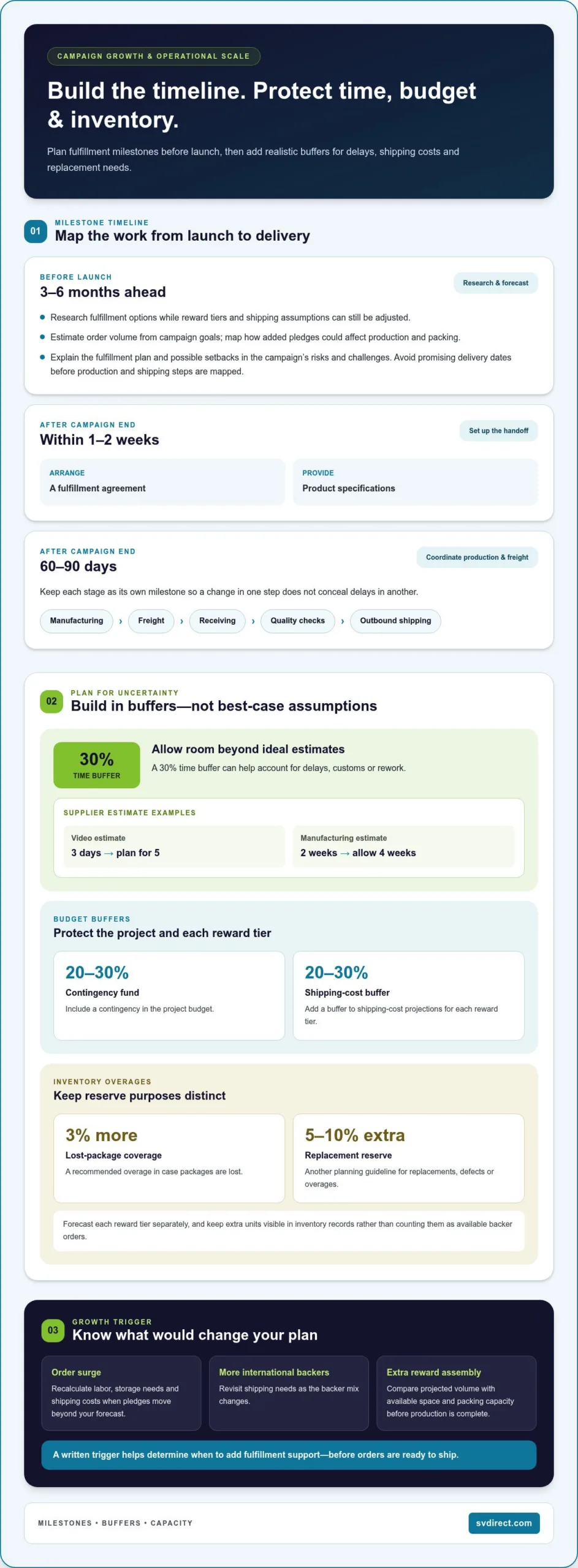
Build a fulfillment strategy before launch, then revise it as pledges grow. A defined timeline connects production, inventory, shipping costs, and each fulfillment partner’s role.
-
Start Fulfillment Planning Before Campaign Close
Research fulfillment options 3-6 months before launch, while you can still adjust reward tiers and shipping assumptions. Estimate expected order volume from campaign goals, then map how added pledges could affect production and packing. Kickstarter also advises explaining your fulfillment plan and possible setbacks in the campaign’s risks and challenges section. Avoid promising delivery dates before production and shipping steps are mapped.
-
Build a Fulfillment Planning Timeline
Set dated milestones for the handoff from campaign to delivery. Within 1-2 weeks after the campaign ends, creators should arrange a fulfillment agreement and provide product specifications. Plan to coordinate production timelines and freight to the fulfillment center 60-90 days after the campaign ends. Keep manufacturing, freight, receiving, quality checks, and outbound shipping as separate milestones, so a change in one stage doesn’t conceal delays in another.
-
Prepare for Production and Fulfillment Delays
Use realistic estimates rather than the best-case date from each supplier. If a production team estimates a video will be ready in 3 days, plan for 5; if manufacturing estimates 2 weeks, allow 4 weeks. A 30% time buffer beyond ideal estimates can help account for delays, customs, or rework. Include a 20-30% contingency fund in the project budget, and add a 20-30% buffer to shipping-cost projections for each reward tier.
-
Plan Inventory Overages and Campaign Growth
Set overage quantities before production, and distinguish lost-parcel coverage from replacements for defects or unexpected demand. Kickstarter recommends producing 3% more inventory in case packages are lost; another planning guideline is to hold 5-10% extra for replacements, defects, or overages. Forecast each reward tier separately, since a campaign’s final mix may differ from early pledges. Keep the additional units visible in inventory records rather than counting them as available backer orders.
-
Set Clear Growth Triggers
Decide in advance what would change your operating plan, such as a surge in orders, more international backers, or rewards that require extra assembly. Recalculate labor, storage needs, and shipping costs when pledge totals move beyond your forecast. Compare projected volume with available space and packing capacity before production is complete. A written trigger makes it easier to decide when to add fulfillment support instead of waiting until orders are ready to ship.
As your forecast takes shape, a campaign fulfillment plan can help align order volume, inventory, and shipping needs.
Backer surveys, address collection, and data cleanup
Accurate backer records connect each crowdfunding pledge to the right reward and destination. Use a consistent process for surveys, data cleanup, and updates before fulfillment begins.
-
Collect Backer Details and Addresses
Send a Kickstarter reward survey to collect each backer’s reward choices and shipping address. You can wait to gather addresses until closer to shipping, which reduces the time those details may become outdated. Set a process for following up on incomplete surveys or address problems; 5-10% of backers may need follow-up. Keep survey responses tied to each pledge, not in separate unlinked notes.
-
Organize Reward Tiers and Clean Backer Data
Export campaign records and group them by reward tier, selected options, and destination. Kickstarter creators should export and clean backer data, then set up systems with the fulfillment center 30-60 days after the campaign ends. Review missing addresses, duplicate entries, and mismatched reward selections. For example, flag an order where the survey lists an add-on but the recorded pledge does not match, instead of silently changing the order.
- Set a clear deadline for address changes and explain it in survey instructions and project updates. Allow late changes until a cutoff 2-4 weeks before packing, then lock the shipping file for order preparation. This gives backers a defined window while protecting the final data from last-minute edits. If someone reports a move after the cutoff, record the request and assess it against the order’s current packing status.
Keep a separate exception list for incomplete surveys, invalid address fields, and unresolved reward choices. Assign each record a status, such as “address needed” or “tier clarification,” and update it when the backer responds. A shared, current list helps creators avoid repeated follow-ups and prevents unresolved details from disappearing among completed orders.
- Explain fulfillment risks in the campaign’s risks and challenges section, using direct language about production, shipping, and possible delays. If a milestone slips or another fulfillment roadblock appears, post a project update promptly. Give backers the known impact and the next update point; don’t present an estimate as a confirmed delivery date.
After dispatch, connect tracking information to each backer’s record and share it with the recipient. Monitor exceptions such as returned parcels or delivery attempts that need a response. Match each issue to its order before contacting the backer, then record the agreed next action. This creates a clear trail from survey response to shipment and any return or follow-up.
Choosing between in-house, hybrid, and 3PL fulfillment
Match the fulfillment model to your backer count, reward complexity, and destination mix. Use these steps to decide whether one setup can handle orders effectively or a different logistics structure is a better fit.
- Choose in-house fulfillment when the campaign’s workload fits your available space, time, and packing capacity. DIY fulfillment is realistically manageable for campaigns with fewer than 50-100 backers. A hybrid approach can keep specialized tasks with your team while assigning storage or shipping work elsewhere. List each task, from inventory handling to returns, and identify who owns it before choosing.
- Consider a 3PL fulfillment center as order volume or delivery complexity increases. Guidance suggests considering professional fulfillment at 200 or more backers, or when at least 20% of backers are international. A campaign exceeding 500 packages is another point to consider a fulfillment partner. These are planning thresholds, not automatic rules; compare your package count, reward mix, and capacity to manage exceptions.
- Assess a fulfillment center by how its logistics fit your campaign. Map where backers live, where inventory will be received, and how many locations would need coordination. For campaigns below 500 backers, one center may make more sense because coordinating multiple centers can outweigh possible savings. Also review how returns are handled and what happens to returned items, since that affects inventory decisions after delivery.
- Choose shipping destinations based on your production and support capacity. Creators new to worldwide shipping may limit destinations to their home country and one or two additional countries. For campaigns with 1,000 or more backers and at least 30% international support, multiple regional centers may be worth considering. Compare that approach with a single center, including the extra coordination and inventory placement it requires.
- Revisit the model when campaign results differ from your forecast. A surge in orders can change the workload; more international backers can affect shipping routes and exception handling. For example, a creator who expected mostly domestic orders may need to reassess destination coverage after the campaign closes. Keep responsibilities clear in any hybrid setup, so inventory handoffs, package preparation, customer updates, and returns don’t fall between teams.
How Kickstarter reward fulfillment works
Kickstarter provides the campaign platform, but creators remain responsible for delivering rewards. Treat fulfillment for Kickstarter rewards as a sequence: confirm orders, prepare inventory, dispatch packages, and manage delivery exceptions.
- Start with the campaign’s final pledge and reward records. Kickstarter does not fulfill rewards, so creators coordinate every step themselves or with a fulfillment partner. Translate each reward tier into an order requirement: product quantity, included extras, selected options, and destination. Keep this order map as the working record for production and shipping. It shows what each backer should receive and helps identify how pledge levels affect preparation.
- Prepare inventory against the order map. Rewards must be produced, shipped to the fulfillment location, received, and quality-checked before outbound orders can be prepared. Keep units for different reward tiers distinguishable, especially when one item appears across several pledge levels. For example, a higher tier might include the main product and a printed extra, while a lower tier includes only the product. Confirming the difference helps prevent incorrect package configurations.
- Convert each backer record into a shippable order. Confirm reward contents, destination, and package details before selecting a shipping method. Weight and dimensions affect which service can carry a package and how it is processed. Match the shipping method to the packed parcel, not just the product specifications.
- Set the international shipping approach before dispatch. Identify destination countries and decide who will pay duties, either the creator or the backer upon delivery. Customs processes and VAT can affect the recipient’s experience, so explain the planned approach in campaign communications. For European Union shipments, IOSS registration can help simplify VAT collection. Keep international delivery steps distinct from domestic orders, since destinations and import handling differ.
- Close the loop after the carrier receives each package. Associate tracking details with the backer’s order, then monitor delivery progress and exceptions. A returned parcel, stalled tracking event, or address problem needs an assigned owner and a recorded next action. If fulfillment encounters a roadblock, Kickstarter advises creators to share a project update promptly. Clear ownership keeps the creator accountable for the complete reward journey.
Silicon Valley Direct: eCommerce Order Fulfillment
Silicon Valley Direct provides eCommerce Order Fulfillment for creators moving from campaign pledges to shipping backer orders. When inventory needs to be stored and organized before dispatch, Warehousing and Distribution and Inventory Management can support the operational flow. On-Demand Digital Printing can produce printed campaign materials as part of your fulfillment plan.
This setup can suit creators who want to coordinate reward shipments alongside broader eCommerce operations. Share your order requirements, reward components, and destination mix with Silicon Valley Direct to discuss how fulfillment can fit your campaign.
Contact Silicon Valley Direct to discuss your fulfillment needs.
Make your next campaign easier to scale
Turn your campaign plan into an operating model you can use again. Document how orders move from pledge records to inventory, packing, and delivery. Note who owns each handoff, how you’ll handle exceptions, and what changes when order volume grows. This working plan gives your team a practical foundation for future launches.
A scalable approach to fulfillment for Kickstarter rewards can also support the shift from a one-time campaign to ongoing commerce. Silicon Valley Direct offers eCommerce Order Fulfillment, Warehousing and Distribution, and Inventory Management to help organize the operational work behind orders and stock. These services can be useful when campaign rewards become part of a continuing sales program.
Bring your campaign requirements and growth plans to Silicon Valley Direct to discuss a fulfillment approach suited to the work ahead.
A well-planned campaign is a stronger starting point for the next.
Frequently Asked Questions
How does Kickstarter reward fulfillment work?
Kickstarter hosts the campaign, but the creator is responsible for delivering the promised rewards. After pledges close, creators turn each backer’s reward selection into an order, match it with available inventory, and arrange delivery. For example, a pledge with an extra item needs a different order configuration from a pledge for the main product alone. The platform supports the campaign, not the physical shipping process.
What are the steps to fulfill Kickstarter rewards after a campaign ends?
First, finalize pledge and reward records, then reconcile them against production quantities. Next, prepare inventory and confirm each order’s contents and destination. Arrange shipment only after inventory has arrived and passed quality checks. Keep a separate list for unresolved orders, such as missing details or damaged items. This lets you prioritize ready packages while following up on exceptions without holding up every shipment.
How do Kickstarter creators calculate shipping costs and collect shipping fees?
Estimate shipping by reward tier and destination, using the packed package’s dimensions, weight, packaging, and delivery route. Include expected shipping and import costs in campaign funding calculations, then explain how backers will pay for shipping. Creators commonly collect shipping before sending rewards. Compare the estimate with actual package specifications before setting pledge options, since a bulky reward can cost more to ship than a compact item of similar weight.
What are the best fulfillment companies for Kickstarter campaigns in the United States?
There isn’t one best fit for every campaign; choose based on order volume, reward assembly needs, inventory handling, and shipping destinations. Silicon Valley Direct offers eCommerce Order Fulfillment, Warehousing and Distribution, and Inventory Management. These services can suit creators who want support coordinating orders and stock as rewards move toward shipment. Assess your campaign’s workflow, including how special reward configurations and exceptions will be handled.
How do Kickstarter fulfillment services compare with self-fulfillment?
Self-fulfillment gives creators direct control over storage, packing, and dispatch, but also makes them responsible for the labor and order details. A fulfillment service can handle defined logistics tasks, while a hybrid arrangement keeps selected work in-house. For example, a creator might assemble a limited-edition component personally and assign routine parcel preparation elsewhere. Compare the time, space, order complexity, and backer communication each model requires.
What customs duties, taxes, and import rules apply to shipping Kickstarter rewards internationally?
Requirements and charges depend on the destination, shipment, and import arrangements. Before offering international delivery, research customs policies in the countries where backers live and explain the expected process. Decide whether you or the recipient will pay duties, including whether charges may be due on delivery. Share destination-specific expectations clearly in campaign updates.
How do Kickstarter creators manage surveys, addresses, and reward add-ons?
Use the survey to connect each backer’s address with their selected reward, options, and add-ons. Treat each add-on as a distinct order detail rather than relying on free-text notes; this makes it easier to prepare the correct package. Before exporting records, flag incomplete responses, duplicate entries, and mismatched selections. Keep a change log for corrections so the team can distinguish a backer’s latest confirmed choices from older survey information.
What are common Kickstarter fulfillment delays and risks, and how can creators prevent them?
Production changes, freight delays, incomplete backer records, and inventory discrepancies can each interrupt shipping. Map dependencies so you know which tasks must finish before dispatch, and don’t release orders before inventory is received and checked. Keep an exception list for problems that need individual attention. If a roadblock affects delivery plans, communicate the impact promptly through a project update, using the latest reliable information rather than an unverified arrival estimate.